


Community hub
Recent from talks
Contribute something
Nothing was collected or created yet.
Mijas
View on Wikipedia | You can help expand this article with text translated from the corresponding article in Spanish. (May 2023) Click [show] for important translation instructions.
|
 | This article needs additional citations for verification. (May 2023) |
.JPG)
Key Information


.svg)


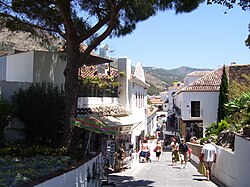
Mijas (/ˈmiːhəs/ MEE-həs; Spanish: [ˈmixas]) is a municipality in the Province of Málaga, in the autonomous community of Andalusia. Located on the southeastern coast of Spain, Mijas belongs to the region of Costa del Sol Occidental.[2] Its center is a typical Andalusian white-washed village, Mijas Pueblo, located on a mountainside about 430 metres or 1,476 feet above sea level, in the heart of the Costa del Sol region.
The municipality has three nuclei, gathering the majority of its population:
- Mijas Pueblo (a hillside village, administrative center of the municipality)
- La Cala de Mijas (a coastal village and a seaside resort)
- Las Lagunas (a suburban and commercial area to the north and west of, and largely integrated with, Fuengirola).
Mijas Costa is used to denominate the coastal area of Mijas, especially the villages Calahonda, Riviera and La Cala de Mijas.
The economy of Mijas is primarily based on tourism, featuring local historical museums and many souvenir shops. The municipality has seven golf courses (four more are under construction), including the La Cala Resort, which is the biggest golf resort in Spain. Agricultural products include potatoes, cereals, and avocados.
History
[edit]Mijas was founded in prehistoric times by the Tartessians.[clarification needed] The remains of the original fortification are still visible on parts of the exterior wall of the city. The area's mineral wealth attracted ancient Greeks and Phoenicians to the village, as described in Ptolemy's second-century Geography.
The Romans, who kept up a lively commerce with Mijas, knew it as Tamisa. Roman domination was later replaced with the Visigoths' rule after 714 AD. The Visigoths, in turn, were succeeded by the Moors. The Moors allowed the village inhabitants to preserve their property, religion, and customs in exchange for a third of their goods from agriculture, livestock, and farming. It was also the Moors who abbreviated the name of Tamisa to Mixa, which later became modern day Mijas.
During the time of the Emirate of Córdoba, the village was conquered by Umar ibn Hafsun. The village remained under the rule of Bobastro, who was defeated by Abd al-Rahman III in the late 9th century.
In 1487, Mijas resisted the attacks of the Catholic monarchs during the siege of Málaga. After Málaga fell, the inhabitants surrendered and most were sold as slaves. During the Revolt of the Comuneros a few decades later, Mijas remained loyal to the Spanish crown, which granted it the title of Muy Leal ("Very Loyal"). Soon after, Joanna of Castile promoted it to the status of villa (town) and it was exempt from royal taxes.
During this period and into the 19th century, Mijas suffered from intense pirate activity along the coast. It was this pirate activity that motivated the construction of the watchtowers that still stand today.
Modern age
[edit]In the 19th century, Mijas's livelihood was mainly agriculture, fishing, and some farming and mineral extraction. Grape vines were the main source of wealth in Mijas until the Phylloxera plague destroyed all of the vineyards. Also important to Mijas's economy was paper production. Some mills located in the area of Osunillas date back to 1744. The mid-1800s were a productive time for local industry, thanks to the arrival of Valencia’s paper-makers, carpenters from Alcoy (an Alicante’s Spanish town), and a mop,[clarification needed] which created new functional links among manufacturers. Especially notable were the "paper beds", which were very useful in Málaga because they were used as raisin wrappers.
An important historical event happened on December 2, 1831. General Torrijos landed at the beach El Charcón with 52 men. They crossed Mijas, climbed the hill to the top and took refuge at a house on Alqueria in Alhaurin de la Torre, on Molinas County property. They were surrounded by troops, sent by the governor Gonzales Moreno. Torrijos and his companions were shot on the San Andres beaches on December 11, 1831.
In 1873 a road opened between Mijas and Fuengirola, ending the segregation between the two towns which had been in effect since 1841. However, the village remained isolated until the arrival of the first newspaper, Second Republic. There was no phone service until 1953 and the town's architecture consisted mostly of shacks. The population was scattered across the countryside, which consisted of small farms. During the post-war period, hunger and unemployment increased. The only work in the area was the collection of grass for the esparto, but the effects of droughts weakened even this industry. During this era, Mijas also was the scene of anti-Franco army operations because of the support and respect of the army in this area.
In the 1950s, an asbestos factory was built to reduce unemployment and the first small hotel was built because of the growing fame of the Costa del Sol. With the advent of tourism, the towns of La Cala and Las Lagunas began construction of urban residential areas, resulting in the birth of Chollocasa, Cala, and many more cities. Las Lagunas appeared out of nowhere from the interior of a farming community and La Cala was a rural village with just 19 farming families.
Climate
[edit]The climate of Mijas, due to its proximity to the sea, enjoys semi-tropical temperatures with winter days being mostly warm/hot and agreeable, and days of hot/very hot weather from May until October. The months of July and August are very hot with temperatures at the end of July and early August hovering around 30C. Winter nights can be occasionally chilly but with only an occasional light frost. The rainfall is below 600 millimetres (24 inches) per year and occurs mainly between October and April. The town boasts some 2,920 hours of sunshine per year.
The climate changes gradually with increasing elevation in the mountains. Temperatures can drop to 10 °C (50 °F). In the peaks, over 600 m (2,000 ft) high, some ice may form in winter, while precipitation increases to almost 800 mm (32 in).
Education
[edit]The areas of Mijas and Fuengírola have a good state education system as does all the Costa del Sol. There are also plenty of private fee-paying International colleges for all ages, within easy reach. The local International, private fee-paying college is St. Anthony's College, Mijas.
See also
[edit]References
[edit]- ^ National Statistics Institute (13 December 2024). "Municipal Register of Spain of 2024".
- ^ "Mancomunidad de Municipios de la Costa del Sol Occidental". 2008-07-09. Archived from the original on 2008-07-09. Retrieved 2023-05-10.
External links
[edit]
36°36′N 4°38′W / 36.600°N 4.633°W
| International | |
|---|---|
| National | |
| Geographic | |
| Other | |

Mijas
View on GrokipediaStretching from the Sierra de Mijas foothills to the shoreline approximately 30 kilometers southwest of Málaga, the area features a varied landscape of rolling hills, pine-covered slopes, and beaches that underpin its status as a key Costa del Sol destination.[3][1] The municipality's population stands at around 90,000 residents, with nearly 40% comprising foreigners from over 125 nationalities, including a significant British expatriate community of almost 10,000, drawn by its mild climate and quality of life.[4][2] Its economy centers on tourism, bolstered by historical remnants from Bronze Age settlements through Roman and Moorish periods, alongside modern attractions like seven golf courses, a quadrangular bullring, and panoramic viewpoints.[5][6]
History
Prehistoric and ancient settlements
The earliest evidence of human occupation in the Mijas area dates to the Upper Paleolithic period, with archaeological traces indicating sporadic coastal settlements along the Málaga province shoreline, including sectors near Mijas Pueblo, associated with late-stage hunter-gatherer activities around 20,000 to 10,000 years ago.[7] More substantial prehistoric habitation emerges in the Bronze Age, approximately the second millennium BCE, featuring tools, ceramics, and settlement patterns suggestive of early agricultural communities exploiting the fertile hillsides for farming and herding.[5][8] Phoenician influence arrived around the 8th century BCE, introducing coastal trade networks and marking the onset of urbanization in the region; excavations at sites like Finca Acebedo have uncovered remains over 2,500 years old, including a Phoenician-Punic sanctuary in the La Muralla quarter and burial grounds with distinctive funeral rituals differing from those in nearby Cádiz and Málaga settlements.[9][10][11] These findings, potentially linked to Tartessian precursors, highlight Mijas' strategic position for maritime commerce and early fortification efforts, with remnants of defensive structures visible in the hillside terrain.[12] Roman-era evidence, from the 1st century BCE onward, includes rural villas and agricultural outposts documented through tile fragments at Haza del Algarrobo and other locales, positioning Mijas as a defensive hillside enclave supporting grain production and oversight of coastal routes amid the broader province's network of viae.[5] Foundations and artifacts near the modern parish church area corroborate this role, with the nearby ancient settlement of Suel—likely an Iberian-Punic successor—serving as a hub for Roman administrative and economic continuity until the 3rd century CE.[13][12]Medieval and early modern periods
During the Islamic period, Mijas, then known as Mixa, fell under Muslim control in 714 following the conquest by Abdalaziz, governor of Seville, and integrated into the Umayyad Emirate of Córdoba.[14] The settlement prospered initially due to its strategic position along trade routes between Málaga and Cádiz, fostering agricultural expansion through advanced irrigation systems introduced during the "Green Revolution," which supported crops like olives and vines amid the rugged terrain.[5] However, local autonomy efforts emerged in the late 9th century, as Mijas aligned with the muladí (converted Muslim) rebellion led by Umar ibn Hafsun against the centralized Umayyad Caliphate, changing hands multiple times between rebels based at Bobastro and caliphal forces from around 880 to 917, reflecting broader regional resistance to Cordoban dominance rather than unified Islamic solidarity.[5][14] The transition to Christian rule occurred in 1487, shortly after the fall of Málaga on August 18, when forces under the Catholic Monarchs Ferdinand and Isabella captured Mijas following local resistance that dated back to initial probes in 1485, resulting in the enslavement of most inhabitants and the destruction of settlements like Osunilla and Oznar.[5][14] Repopulation efforts commenced in 1492 with the repartimiento, allocating lands to approximately 50 Christian households (200–250 settlers, primarily from northern Spain), though many departed due to harsh mountainous conditions, seigneurial land controls by nobles, and persistent Berber pirate raids along the coast, which depopulated coastal areas and necessitated watchtowers like those at Calahonda and Calaburra.[5] This marked a cultural shift from Islamic tolerance of Christians and Jews to Christian dominance, with remaining Muslim populations (mudéjares) gradually integrating or facing conversion pressures, though Mijas earned the title of villa in 1512 for loyalty to Joanna of Castile, granting tax exemptions on sales to encourage stability.[14] Into the early modern period (16th–18th centuries), Mijas maintained a sparse, rural economy centered on subsistence agriculture, particularly olives and vines, supplemented by limited quarrying of marble and falsa ágata from the Sierra de Mijas in the 17th and 18th centuries, with minimal industrialization due to geographic isolation and small-scale operations.[15] Population remained low—130 households in 1585, around 400 by 1677, and approximately 770 households (roughly 4,000 inhabitants) by the mid-18th century—sustained by family-based farming amid ongoing vulnerabilities to piracy and feudal obligations, preserving a decentralized, agrarian character without significant urban or commercial growth until later centuries.[5][15]Tourism-driven modernization
Following the Spanish Civil War (1936–1939), Mijas remained economically stagnant, with its population sustained primarily through subsistence agriculture, olive cultivation, and limited livestock rearing amid Spain's autarkic policies and infrastructural neglect.[8] The town's isolation from coastal trade routes and poor connectivity delayed modernization until the 1950s, when initial tourism emerged as international travelers, drawn by the Mediterranean climate and the aesthetic appeal of Andalusian "pueblos blancos"—hilltop villages with whitewashed facades—began visiting sites like Mijas Pueblo.[16] This visitor influx provided the first economic incentives beyond agrarian yields, prompting small-scale hotel constructions and rudimentary accommodations to capitalize on demand for authentic rural experiences near the emerging Costa del Sol.[17] The 1960s and 1970s marked a decisive boom, as Spain's liberalization under the 1959 Stabilization Plan facilitated foreign investment and mass tourism, with Mijas benefiting from proximity to Málaga's airport and enhanced road networks linking inland villages to beaches.[18] Infrastructure investments, including paved access roads and hotel expansions, enabled the transition of coastal areas like La Cala de Mijas from fishing hamlets to resort zones, while rural landowners sold holdings to developers responding to surging European demand for sun-and-sea holidays.[12] This period's growth was empirically tied to tourism's multiplier effects: national tourist arrivals rose from 4 million in 1959 to over 30 million by 1975, injecting capital that locally spurred construction and service jobs in Mijas.[18] Population expansion underscored the sector's transformative impact, increasing from 9,300 residents in 1970 to nearly 80,000 by century's end, driven by employment in hospitality and real estate rather than natural growth alone.[19] Market-oriented adaptations, such as developing multiple golf courses to attract higher-spending visitors and extending seasonality, further embedded tourism as the economic core, supplanting agriculture and fostering a souvenir and leisure economy that prioritized visitor preferences over traditional livelihoods.[20] These developments yielded sustained GDP contributions at the regional level, with tourism accounting for 13% of Andalusia's output by leveraging Mijas's blend of cultural heritage and coastal amenities.[20]Geography
Location and physical features
Mijas is a municipality in the Province of Málaga, Andalusia, southern Spain, positioned along the Costa del Sol approximately 25 kilometers southwest of Málaga city center and 25 kilometers from Málaga-Costa del Sol Airport.[21][22] The municipality encompasses diverse terrain extending from the Mediterranean coastal plain eastward to the foothills of the Sierra de Mijas mountain range, with its administrative boundaries reflecting a transition from low-lying seaboard areas to elevated inland ridges.[1] Covering a total area of 148.8 square kilometers, Mijas features varied topography characterized by undulating hills, steep slopes, and pine-dotted highlands that rise from sea level to peaks in the Sierra de Mijas exceeding 1,000 meters, such as Pico de Mijas at 1,150 meters.[23] This elevation gradient supports distinct landscape zones, including the historic whitewashed village of Mijas Pueblo perched at around 430 meters on a mountainside, approximately 10 kilometers inland from the Mediterranean Sea, in contrast to the flatter, more developed coastal strip including La Cala de Mijas.[24][25][26]Climate patterns
Mijas exhibits a Mediterranean climate influenced by its coastal position, characterized by mild winters, hot summers, and extended periods of clear skies. Average high temperatures vary from 18°C in January to 28°C in August, while lows seldom fall below 7°C, with freezing conditions occurring rarely—typically less than once every several years due to the moderating effect of the nearby Mediterranean Sea.[27][28] Precipitation averages 491–500 mm annually, with the majority concentrated in winter months from October to March, resulting in dry summers that limit interruptions to outdoor endeavors.[29] This pattern supports modest agricultural output, such as citrus cultivation, while ensuring prolonged viability for recreation. The locale receives approximately 2,900–3,000 hours of sunshine yearly, corresponding to over 300 days with significant solar exposure, surpassing many inland Spanish areas.[30] This abundance causally enables sustained tourism, with golf facilities playable through winter and beaches accessible beyond high season, fostering economic durability against national averages where harsher winters curtail similar activities.[31][32]Demographics
Population trends and growth
The population of Mijas remained modest through the early 20th century, hovering below 10,000 residents prior to the 1960s, reflective of its agrarian economy and limited infrastructure.[19] The advent of mass tourism in the 1960s and 1970s catalyzed rapid expansion, with the population climbing to approximately 9,300 by the late 1970s as coastal developments drew workers and investors.[19] This trajectory persisted into the 21st century, driven by sustained demand for jobs in hospitality, construction, and ancillary services tied to the tourism boom.[33] Official data from Spain's Instituto Nacional de Estadística (INE) indicate a population of 93,302 as of January 1, 2024, up 1,611 from 2023, marking a consistent annual growth rate of roughly 1.8-2% in recent years.[34] [35] Between 2021 and 2024, the municipality added over 2,000 residents net, consolidating its position as the third-largest in Málaga province.[36] Growth has been uneven spatially, with higher densities in coastal zones like La Cala de Mijas and urbanizaciones—exceeding 1,000 inhabitants per square kilometer in developed areas—contrasting the sparser inland Mijas Pueblo, where traditional rural patterns prevail.[37]| Year | Population (INE Padrón) |
|---|---|
| 2021 | 91,154 |
| 2023 | 91,691 |
| 2024 | 93,302 |