


Community hub
Recent from talks
Contribute something
Nothing was collected or created yet.
Mitchell, South Dakota
View on Wikipedia
Mitchell is a city in and the county seat of Davison County, South Dakota, United States.[5] The population was 15,660 at the 2020 census making it the seventh most populous city in South Dakota.[6]
Key Information


Mitchell is the principal city of the Mitchell Micropolitan Statistical Area, which includes all of Davison and Hanson counties.
History
[edit]The first settlement at Mitchell was made in 1879.[7] Mitchell was incorporated in 1883.[1] It was named for Milwaukee banker Alexander Mitchell, President of the Chicago, Milwaukee, and St. Paul Railroad (Milwaukee Road).[8]
Geography
[edit]Mitchell is located on the James River. Enemy Creek is located 4.5 miles (7.2 km) southeast of the city.[9]
According to the United States Census Bureau, the city has a total area of 12.14 square miles (31.44 km2), of which 11.14 square miles (28.85 km2) is land and 1.00 square mile (2.59 km2) is water.[10]
Climate
[edit]Mitchell has a humid continental climate, the Upper Midwest, with cold winters and warm sometimes humid summers. Average daytime summer temperatures range from 86 °F (30 °C) during the day, and 62 °F (16 °C) during the night, and winter daytime temperatures average 26 °F (−3 °C) during the day, and 4 °F ( -15 °C) during the night. Most of the precipitation falls during the summer months, the wettest month being June, with an average of 3.52 inches (89.4 mm) of rain, and the driest month is January, with only 0.47 inches (11.9 mm) of rain. Mitchell is located in Tornado Alley, so thunderstorms, often spawning tornadoes, can be expected.
| Climate data for Mitchell, South Dakota (1991–2020 normals, extremes 1893–present) | |||||||||||||
|---|---|---|---|---|---|---|---|---|---|---|---|---|---|
| Month | Jan | Feb | Mar | Apr | May | Jun | Jul | Aug | Sep | Oct | Nov | Dec | Year |
| Record high °F (°C) | 68 (20) |
72 (22) |
95 (35) |
97 (36) |
108 (42) |
111 (44) |
116 (47) |
115 (46) |
106 (41) |
96 (36) |
84 (29) |
70 (21) |
116 (47) |
| Mean maximum °F (°C) | 50.6 (10.3) |
56.6 (13.7) |
71.8 (22.1) |
83.1 (28.4) |
90.3 (32.4) |
95.0 (35.0) |
99.0 (37.2) |
96.1 (35.6) |
92.8 (33.8) |
84.3 (29.1) |
69.2 (20.7) |
52.7 (11.5) |
100.4 (38.0) |
| Mean daily maximum °F (°C) | 27.3 (−2.6) |
32.4 (0.2) |
45.2 (7.3) |
58.6 (14.8) |
70.3 (21.3) |
80.9 (27.2) |
87.0 (30.6) |
84.0 (28.9) |
76.1 (24.5) |
60.9 (16.1) |
44.8 (7.1) |
30.8 (−0.7) |
58.2 (14.6) |
| Daily mean °F (°C) | 18.3 (−7.6) |
22.9 (−5.1) |
35.1 (1.7) |
47.6 (8.7) |
59.5 (15.3) |
70.2 (21.2) |
76.1 (24.5) |
73.0 (22.8) |
64.6 (18.1) |
50.0 (10.0) |
35.1 (1.7) |
22.7 (−5.2) |
47.9 (8.8) |
| Mean daily minimum °F (°C) | 9.3 (−12.6) |
13.4 (−10.3) |
25.1 (−3.8) |
36.5 (2.5) |
48.7 (9.3) |
59.5 (15.3) |
65.3 (18.5) |
62.1 (16.7) |
53.0 (11.7) |
39.1 (3.9) |
25.5 (−3.6) |
14.5 (−9.7) |
37.7 (3.2) |
| Mean minimum °F (°C) | −14.9 (−26.1) |
−9.6 (−23.1) |
0.8 (−17.3) |
18.8 (−7.3) |
32.6 (0.3) |
46.2 (7.9) |
51.3 (10.7) |
48.7 (9.3) |
34.3 (1.3) |
20.2 (−6.6) |
5.5 (−14.7) |
−8.1 (−22.3) |
−19.6 (−28.7) |
| Record low °F (°C) | −38 (−39) |
−40 (−40) |
−23 (−31) |
1 (−17) |
18 (−8) |
31 (−1) |
34 (1) |
34 (1) |
11 (−12) |
−8 (−22) |
−22 (−30) |
−34 (−37) |
−40 (−40) |
| Average precipitation inches (mm) | 0.61 (15) |
0.76 (19) |
1.26 (32) |
2.76 (70) |
3.69 (94) |
3.95 (100) |
3.02 (77) |
3.09 (78) |
2.64 (67) |
2.11 (54) |
1.12 (28) |
0.77 (20) |
25.78 (655) |
| Average snowfall inches (cm) | 5.6 (14) |
8.3 (21) |
5.8 (15) |
6.0 (15) |
0.0 (0.0) |
0.0 (0.0) |
0.0 (0.0) |
0.0 (0.0) |
0.0 (0.0) |
0.6 (1.5) |
4.1 (10) |
10.2 (26) |
40.6 (103) |
| Average precipitation days (≥ 0.01 in) | 5.0 | 6.2 | 6.9 | 8.8 | 11.8 | 10.5 | 6.7 | 8.0 | 7.3 | 7.9 | 3.5 | 6.4 | 89.0 |
| Average snowy days (≥ 0.1 in) | 4.8 | 5.3 | 4.0 | 1.7 | 0.0 | 0.0 | 0.0 | 0.0 | 0.0 | 0.6 | 1.8 | 5.8 | 24.0 |
| Source: NOAA[11][12] | |||||||||||||
Demographics
[edit]| Census | Pop. | Note | %± |
|---|---|---|---|
| 1880 | 320 | — | |
| 1890 | 2,217 | 592.8% | |
| 1900 | 4,055 | 82.9% | |
| 1910 | 6,515 | 60.7% | |
| 1920 | 8,478 | 30.1% | |
| 1930 | 10,942 | 29.1% | |
| 1940 | 10,633 | −2.8% | |
| 1950 | 12,123 | 14.0% | |
| 1960 | 12,555 | 3.6% | |
| 1970 | 13,425 | 6.9% | |
| 1980 | 13,916 | 3.7% | |
| 1990 | 13,798 | −0.8% | |
| 2000 | 14,558 | 5.5% | |
| 2010 | 15,254 | 4.8% | |
| 2020 | 15,660 | 2.7% | |
| U.S. Decennial Census[13][4] | |||
2010 census
[edit]As of the census[14] of 2010, there were 15,254 people, 6,696 households, and 3,641 families living in the city. The population density was 1,369.3 inhabitants per square mile (528.7/km2). There were 7,120 housing units at an average density of 639.1 per square mile (246.8/km2). The racial makeup of the city was 93.6% White, 0.5% African American, 3.0% Native American, 0.5% Asian, 0.1% Pacific Islander, 0.6% from other races, and 1.8% from two or more races. Hispanic or Latino of any race were 1.7% of the population.
There were 6,696 households, of which 26.4% had children under the age of 18 living with them, 41.1% were married couples living together, 9.5% had a female householder with no husband present, 3.7% had a male householder with no wife present, and 45.6% were non-families. 38.3% of all households were made up of individuals, and 15.7% had someone living alone who was 65 years of age or older. The average household size was 2.16 and the average family size was 2.88.
The median age in the city was 36.8 years. 22.6% of residents were under the age of 18; 12.5% were between the ages of 18 and 24; 22.8% were from 25 to 44; 23.9% were from 45 to 64; and 18.2% were 65 years of age or older. The gender makeup of the city was 48.8% male and 51.2% female.
2000 census
[edit]As of the census of 2000, there were 14,558 people, 6,121 households, and 3,599 families living in the city. The population density was 1,475.7 inhabitants per square mile (569.8/km2). There were 6,555 housing units at an average density of 664.4 per square mile (256.5/km2). The racial makeup of the city was 95.63% White, 0.32% African American, 2.40% Native American, 0.45% Asian, 0.03% Pacific Islander, 0.29% from other races, and 0.87% from two or more races. Hispanic or Latino of any race were 0.77% of the population.
There were 6,121 households, out of which 28.9% had children under the age of 18 living with them, 46.6% were married couples living together, 9.1% had a female householder with no husband present, and 41.2% were non-families. 34.3% of all households were made up of individuals, and 15.0% had someone living alone who was 65 years of age or older. The average household size was 2.27 and the average family size was 2.95.
In the city, the population was spread out, with 24.1% under the age of 18, 13.4% from 18 to 24, 25.3% from 25 to 44, 19.6% from 45 to 64, and 17.6% who were 65 years of age or older. The median age was 36 years. For every 100 females, there were 91.9 males. For every 100 females age 18 and over, there were 89.4 males.
As of 2000 the median income for a household in the city was $31,308, and the median income for a family was $43,095. Males had a median income of $30,881 versus $20,794 for females. The per capita income for the city was $17,888. About 8.8% of families and 12.8% of the population were below the poverty line, including 12.7% of those under age 18 and 10.9% of those age 65 or over.
Attractions
[edit].jpg)
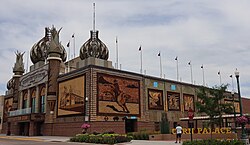
Mitchell is home of the Corn Palace. The Corn Palace is decorated with several colors of dried corn and grains, creating murals. The theme of the external murals is changed yearly at fall harvest; internal murals are changed approximately every ten years. The building itself is used for several purposes including a basketball arena, the local high school prom, trade shows, staged entertainment, and the Shriner's Circus.

Mitchell is also the home of the Dakota Discovery Museum, whose mission is to present and preserve the history of the prairie and the people who settled it. The museum covers the time period from 1600, when the Native Americans were still largely undiscovered, to 1939, the end of the Great Depression. The museum holds one of the most complete and pristine collections of American Indian quill and bead-works. The Dakota Discovery Museum also features artists such as Harvey Dunn, James Earle Fraser, Charles Hargens and Oscar Howe. In the village area behind the main building are four authentic historical buildings, including an 1885 one-room school house and the fully furnished 1886 Victorian-Italianate home of the co-founder of the Corn Palace, Louis Beckwith. Two new features of the museum are Discovery Land, a hands-on activity area for children ages five to ten, and the Heritage Gardens Project, which brings indigenous plants to the gardens surrounding the museum and historical buildings.
The Mitchell Prehistoric Indian Village, an archaeological site where scientists are excavating a Native American village, is another attraction in the city. The site, near Lake Mitchell, is believed to have been occupied by ancestors of the present-day Mandan, who now reside in North Dakota. The excavation is unique in that it is enclosed by an Archeodome, a climate-controlled building built over the site, which allows scientists to continue their excavation work year-round.
The Mitchell area also boasts several state champion trees: Black Cherry, Black Locust, Siberian Elm, and Tulip Tree.[15]
Education
[edit]The campus of Dakota Wesleyan University is located in southwest Mitchell. The campus of Mitchell Technical College is located in southeast Mitchell
Sports
[edit]The South Dakota Gold was a professional basketball club that competed in the International Basketball Association in the 2000–01 season.
Media
[edit]AM Radio
[edit]| AM radio stations | |||||
|---|---|---|---|---|---|
| Frequency | Call sign | Name | Format | Owner | City |
| 1490 AM & 101.3 FM | KORN | KORN News Radio 1490 | News/Talk/Sports | Nedved Media, LLC | Mitchell |
FM Radio
[edit]| FM radio stations | ||||||
|---|---|---|---|---|---|---|
| Frequency | Call sign | Name | Format | Owner | Target city/market | City of license |
| 89.7 FM | K209FX | K-Love | Contemporary Christian | Educational Media Foundation | Mitchell | Mitchell |
| 90.9 FM | K215AI | South Dakota Public Broadcasting | NPR | SD Board of Directors for Educational Telecommunications | Mitchell | Mitchell |
| 92.1 FM | KORN-FM | KORN Country 92.1 | Mainstream Country | Nedved Media, LLC | Mitchell | Mitchell |
| 93.3 FM | KJRV | Big Jim 93.3 | Classic Rock | Dakota Communications | Huron/Mitchell | Wessington Springs |
| 95.5 FM | K238BA | More 95.5 | AC | Saga Communications of South Dakota, LLC | Mitchell | Mitchell |
| 98.3 FM | KUQL | Kool 98.3 | Oldies | Saga Communications of South Dakota, LLC | Mitchell | Wessington Springs |
| 103.5 FM | K238BA | More 95.5 | AC | Saga Communications of South Dakota, LLC | Mitchell | Mitchell |
| 105.9 FM | KMIT | Hot Country KMIT | Country | Saga Communications of South Dakota, LLC | Mitchell | Mitchell |
| 107.3 FM | KQRN | Q107.3 | Adult hits, and Top 40 Rock and Pop Hits |
Nedved Media, LLC | Mitchell | Mitchell |
Newspaper
[edit]The Mitchell Republic is Mitchell's twice weekly print and daily e-paper, owned by the Forum Communications Company.[16]
Transportation
[edit]Intercity bus service to the city is provided by Jefferson Lines.[17]
In popular culture
[edit]The novel Woodworking by Emily St. James is set in Mitchell in the run-up to the 2016 presidential election.[18] The story focuses on the lives of trans women in varying stages of transition, including a teacher and student at Mitchell High School.[18] St. James grew up in nearby Armour, South Dakota.[19]
Notable people
[edit]
- Ordell Braase, NFL player and broadcaster
- Israel Greene, adjutant of the Confederate Marine Corps
- James S. Hyde, biophysicist
- Dusty Johnson, US Congressman, former PUC Commissioner, and chief of staff to the Governor
- John Bailey Jones, United States federal judge
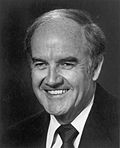
- George McGovern, Representative and Senator from South Dakota and 1972 Democratic nominee for President, grew up in Mitchell, and lived there until his death in 2012.
- Mike Miller, former NBA basketball player, a two-time NBA champion.
- Adam Morrison, basketball player, briefly lived in Mitchell as a young child while his father was coaching at Dakota Wesleyan.
- Gary Owens, voice actor and disc jockey
- David Rumelhart, cognitive psychologist who co-developed key neural network AI method Backpropagation with Geoffrey Hinton and Ronald J. Williams
- Howard Rushmore, journalist and investigative reporter
References
[edit]- ^ a b "SD Towns" (PDF). South Dakota State Historical Society. Archived from the original (PDF) on February 10, 2010. Retrieved February 14, 2010.
- ^ "ArcGIS REST Services Directory". United States Census Bureau. Retrieved October 15, 2022.
- ^ a b U.S. Geological Survey Geographic Names Information System: Mitchell, South Dakota
- ^ a b "Census Population API". United States Census Bureau. Retrieved October 15, 2022.
- ^ "Find a County". National Association of Counties. Retrieved June 7, 2011.
- ^ "U.S. Census Bureau: Mitchell city, South Dakota". www.census.gov. United States Census Bureau. Retrieved January 30, 2022.
- ^ Federal Writers' Project (1940). South Dakota place-names, v.1–3. University of South Dakota. p. 50.
- ^ Chicago and North Western Railway Company (1908). A History of the Origin of the Place Names Connected with the Chicago & North Western and Chicago, St. Paul, Minneapolis & Omaha Railways. p. 184.
- ^ "Water-resources data for the United States, Water Year 2013: U.S. Geological Survey Water-Data Report WDR-US-2013, site 06478052" (PDF). U.S. Geological Survey. 2014. Archived (PDF) from the original on February 18, 2017.
- ^ "US Gazetteer files 2010". United States Census Bureau. Archived from the original on January 25, 2012. Retrieved June 21, 2012.
- ^ "NowData − NOAA Online Weather Data". National Oceanic and Atmospheric Administration. Retrieved October 14, 2021.
- ^ "Station: Mitchell, SD". U.S. Climate Normals 2020: U.S. Monthly Climate Normals (1991–2020). National Oceanic and Atmospheric Administration. Retrieved October 14, 2021.
- ^ United States Census Bureau. "Census of Population and Housing". Retrieved September 23, 2013.
- ^ "U.S. Census website". United States Census Bureau. Retrieved June 21, 2012.
- ^ "SDDA — File Not Found". sdda.sd.gov. Retrieved April 6, 2018.
- ^ Zaleski, Jack. Forum Communications Company: A Narrative History 1980–2018. Forum Communications Company.
- ^ "South Dakota Bus Stops". Retrieved July 20, 2023.
- ^ a b Maran, Meredith (March 4, 2025). "'Woodworking' is a funny, convincing takedown of American prejudice". The Washington Post. Retrieved August 25, 2025.
- ^ Mehrotra, Claire (March 7, 2025). "What Emily St. James Hopes You Learn About the Trans Experience From Her Debut Novel". PEN America. Retrieved August 25, 2025.
External links
[edit]

- Mitchell, SD government website
- Mitchell Daily Republic – Local newspaper
- Vintage Postcards of Mitchell
- . Encyclopædia Britannica (11th ed.). 1911.
Municipalities and communities of Davison County, South Dakota, United States | ||
|---|---|---|
| City |  | |
| Town | ||
| CDP | ||

July 19, 1922 – October 21, 2012
U.S. Senator from South Dakota (1963–1981) U.S. Representatives from South Dakota (1957–1961) | ||
| Political career |
|  |
| Electoral history | ||
| Legacy | ||
| Other | ||

| International | |
|---|---|
| National | |
| Geographic | |
| Other | |

Mitchell, South Dakota
View on GrokipediaHistory
Founding and early settlement
The region encompassing present-day Mitchell, South Dakota, was historically inhabited by Sioux (Dakota and Lakota) peoples, whose territories extended across much of the Great Plains, including the James River valley area. The U.S. government's expansion westward, facilitated by treaties such as the 1868 Treaty of Fort Laramie, aimed to secure peace following conflicts like the Dakota War of 1862 and opened vast tracts of land east of the Missouri River for non-Native settlement by confirming tribal relocations to reservations, including the Great Sioux Reservation west of the river, while allowing settler passage and homesteading on ceded or unreserved lands under the Homestead Act of 1862.[7] This treaty, signed on April 29, 1868, at Fort Laramie in present-day Wyoming, involved multiple Sioux bands and the U.S., stipulating annuities and agency provisions in exchange for territorial concessions that indirectly enabled agricultural settlement in eastern Dakota Territory.[7] Mitchell originated as a railroad town amid the rapid expansion of lines into Dakota Territory during the late 1870s, driven by federal land grants to railroads and the promise of cheap farmland attracting homesteaders seeking arable prairie soils and reliable transport for grain and livestock. In 1879, the Chicago, Milwaukee, and St. Paul Railway (commonly known as the Milwaukee Road) advanced westward, prompting the platting of the town site in August by surveyor A.M. Rowley near the James River, supplanting an earlier informal settlement at Firesteel Creek established around 1871 but bypassed by the rail line.[8] The town was named in honor of Alexander Mitchell, a Milwaukee-based banker and president of the railroad, whose financial backing supported the extension into the territory; Mitchell, born in Scotland in 1817, had risen as a key financier in Wisconsin after emigrating in 1839, leveraging his influence to promote rail development that connected remote prairies to eastern markets.[8][9] Initial settlement accelerated after the railroad's arrival in late 1879, with the first lots sold and basic infrastructure like depots and sidings established, drawing pioneers motivated by 160-acre homestead claims under generous terms and the strategic rail hub position that reduced isolation risks compared to overland trails. The village of Mitchell was formally incorporated on March 1, 1881, by Dakota Territory authorities, marking the transition from transient rail camps to permanent agrarian outposts, though population remained sparse until the 1880s boom brought hundreds via immigrant trains from the Midwest and Europe.[9] This early phase emphasized rail-dependent logistics over speculative booms, as settlers prioritized farming the fertile loess soils for wheat and corn, with the line's completion to Mitchell enabling efficient shipment and averting the fate of bypassed sites like Firesteel.[10]Key developments in the 19th and early 20th centuries
Mitchell's growth accelerated following the completion of the Chicago, Milwaukee, and St. Paul Railroad line to the town in October 1880, which facilitated the transport of goods and settlers, establishing it as a key rail hub in Dakota Territory.[8] The Milwaukee Road further invested by constructing a roundhouse and machine shop at the south end of Main Street in 1884, supporting maintenance and expansion that bolstered local commerce tied to agriculture.[8] The town, platted in August 1879, was incorporated as a village in spring 1881, reflecting rapid organization amid railroad-driven settlement.[9] By the late 1880s, infrastructure developments emphasized self-reliant civic improvements, with the population reaching around 3,000 by 1892, underscoring the economic foundation in grain production and rail logistics.[11] A pivotal innovation occurred in 1892 with the construction of the first Corn Palace on the northeast corner of Fourth and Main Streets, designed explicitly to showcase the region's abundant corn and other crops to attract farmers and investors to South Dakota's fertile plains.[11] [6] This agricultural exposition building, adorned with native grains, symbolized practical promotion of the area's productivity, drawing visitors and reinforcing Mitchell's identity as a center for agribusiness before subsequent rebuilds in 1905 and later.[12] Early 20th-century rail enhancements and grain handling facilities, including elevators, further integrated the town into broader markets, sustaining growth through export-oriented farming until the onset of national economic shifts.[10]Mid-20th century to present
Following World War II, Mitchell's population stagnated in line with rural South Dakota's broader depopulation trends, driven by agricultural mechanization that reduced labor demands through equipment like tractors and combines, leading to farm consolidations and out-migration from small towns during the 1950s and 1970s.[13][14] South Dakota's overall population rose modestly from 652,740 in 1950 to 680,514 in 1960 before dipping to 665,507 by 1970, with non-metropolitan areas bearing the brunt of net losses as younger residents sought opportunities elsewhere.[15] While the Corn Palace, originally rebuilt in 1921, provided ongoing cultural stability through annual mural refreshes and events, it did not offset the structural economic shifts from mechanized farming that diminished rural workforces.[11] Renewed focus on planning emerged in the late 20th century, with Mitchell earning South Dakota's Community of the Year designation in 1988 for economic resilience amid persistent rural challenges.[16] This laid groundwork for 21st-century initiatives, including the city council's approval of a comprehensive plan on April 17, 2023, which detailed recommendations for housing expansion, land development, and infrastructure to address growth constraints.[17][18] By 2025, tangible progress included the start of downtown infrastructure upgrades on August 4, encompassing streetscape enhancements and utility improvements at intersections like 2nd Avenue and Main Street, funded partly through a Business Improvement District tax established in 2018.[19] These data-supported efforts—emphasizing capacity expansions in water and sewer systems—culminated in Mitchell's third Community of the Year award from the Governor's Office of Economic Development, recognizing sustained population stability around 15,600 residents and adaptive strategies against national rural decline patterns.[20][16][21]Geography
Location and topography
Mitchell is situated in Davison County in southeastern South Dakota, United States, at coordinates 43°42′34″N 98°01′47″W.[22] As the county seat, it lies within the Great Plains region, characterized by expansive flatlands transitioning into gently rolling prairies.[23] The city's elevation averages approximately 1,300 feet (396 meters) above sea level, reflecting the subdued topography of glacial deposits that mantle the area.[24] The municipality encompasses a land area of 11.24 square miles, primarily consisting of arable terrain shaped by Pleistocene glaciation.[25] Mitchell is positioned near the James River, a southward-flowing tributary of the Missouri River, with nearby tributaries influencing local drainage and historical settlement patterns by providing water resources in an otherwise semi-arid prairie environment.[26] Dominant soil types in the vicinity, such as the Davison series formed in glacial till and meltwater sediments, exhibit loamy textures with moderate drainage, rendering them highly suitable for corn cultivation—a primary agricultural staple that drove early European settlement and land use decisions based on soil fertility and topography.[27][28] These Mollisols, enriched by organic matter from native prairie grasses, support intensive row cropping on the level to undulating landscapes.[29]Environmental features
Lake Mitchell, an impoundment on Firesteel Creek with a surface area of 671 acres and maximum depth of 29 feet, was formed by the completion of an earthfill dam and concrete spillway in 1928–1929, originally to serve as a municipal water reservoir.[30][31] The lake supports recreational uses including boating and fishing, but its shallow mean depth of 12 feet and upstream watershed contribute to sedimentation and periodic flood risks, necessitating empirical hydrological assessments; for instance, state-mandated flood modeling delayed a planned 2025 drawdown for sediment removal and restoration, prioritizing downstream safety evaluations over immediate drainage.[32][33] The broader Mitchell area lies within South Dakota's mixedgrass prairie ecoregion, characterized by co-dominant cool- and warm-season grasses such as big bluestem and green needlegrass, interspersed with forbs that sustain deep-rooted drought resilience and soil stability.[34][35] These ecosystems underpin local wildlife, notably ring-necked pheasants, whose populations thrive on prairie cover and agricultural edges, positioning Davison County as a prime habitat for upland game bird hunting.[36][37] Davison County's land use reflects this prairie-agricultural interface, with farmland encompassing approximately 213,000 acres—predominantly 183,763 acres of cropland for grains and row crops, plus 29,291 acres of pasture—surrounding Mitchell's urban core and enabling integrated resource potentials from soil fertility to biodiversity.[38][39]Climate
Seasonal patterns
Mitchell exhibits a hot-summer humid continental climate classified as Dfa under the Köppen system, featuring pronounced seasonal contrasts driven by its inland position and exposure to shifting upper-level winds like the jet stream, which introduce high variability in temperature and storm patterns.[40][41] Summers are warm to hot, with the peak in July averaging a daily high of 86°F (30°C) and low of 64°F (18°C), though heat waves can push temperatures above 100°F periodically. Winters are severely cold, with January averaging a high of 29°F (-2°C) and low of 12°F (-11°C), and subzero readings common during outbreaks of Arctic air. These extremes underscore the unromanticized reality of Midwest continental weather, where rapid shifts from mild to harsh conditions occur without moderating oceanic influences.[40][42] Annual precipitation totals approximately 23 inches (58 cm), concentrated in the growing season from May to September, supporting agriculture but occasionally leading to summer droughts. Snowfall averages 41 inches (104 cm) per year, primarily from November to March, with December often the snowiest month at around 3 inches (7.6 cm). Spring brings elevated risks of severe thunderstorms and tornadoes, as warm Gulf moisture clashes with lingering cold fronts in this portion of Tornado Alley.[43][42][40]Historical weather events and data
Severe droughts afflicted South Dakota during the late 1880s and into the 1890s, particularly from 1887 to 1902, exacerbating economic depression and challenging early agricultural settlers in the region including Mitchell, where farming was central to initial development.[44] These dry periods reduced crop yields and water availability, contributing to farm failures and population fluctuations among homesteaders reliant on rainfall for wheat and corn production.[45] The all-time high temperature in Mitchell reached 116°F on July 24, 1940, while the record low was -40°F on February 10, 1994, reflecting the region's extreme continental climate variability.[46] [47] Other notable extremes include 115°F on July 4 and August 4, 1936 and 1934, respectively, during Dust Bowl-era heat waves that strained local resources and agriculture.[46] In the 2007 Midwest flooding, heavy rains from August 17-20 caused regional inundation across South Dakota, with some areas receiving over 10 inches, elevating river levels including the nearby James River and impacting Lake Mitchell's water management.[48] Flood watches extended to southeastern South Dakota, prompting evacuations and infrastructure assessments in Mitchell vicinity, though damages were less severe than in northern counties.[49]| Record Type | Value | Date |
|---|---|---|
| Highest Temperature | 116°F | July 24, 1940[46] |
| Lowest Temperature | -40°F | February 10, 1994[47] |
| Recent Notable High | 112°F (approximate regional peak in 1936 events) | July 1936[46] |
Demographics
Population trends and estimates
Mitchell experienced rapid population growth in the late 19th and early 20th centuries following its founding in 1879 and incorporation as a city in 1883. The 1880 census recorded 320 residents, surging to 2,217 by 1890—a 592.8% increase driven by railroad expansion and settlement in the region.[52] Subsequent decennial censuses documented continued expansion: 4,055 in 1900 (82.9% growth), 6,515 in 1910 (60.7%), and 8,478 in 1920 (30.1%).[52] Growth moderated after 1920, with the population reaching 9,442 in 1930, 10,633 in 1940, and 12,123 in 1950. Post-1950 trends showed relative stagnation, with incremental gains to 12,555 in 1960, 13,425 in 1970, 13,566 in 1980, 13,798 in 1990, 14,558 in 2000, 15,254 in 2010, and 15,660 in 2020.[52] This pattern reflects stability in a rural Midwestern context, contrasting with national shifts where the urban population share rose from about 56% in 1920 to over 80% by 2020.| Census Year | Population | Percent Change |
|---|---|---|
| 1880 | 320 | — |
| 1890 | 2,217 | 592.8% |
| 1900 | 4,055 | 82.9% |
| 1910 | 6,515 | 60.7% |
| 1920 | 8,478 | 30.1% |
| 1930 | 9,442 | 11.4% |
| 1940 | 10,633 | 12.6% |
| 1950 | 12,123 | 14.0% |
| 1960 | 12,555 | 3.6% |
| 1970 | 13,425 | 6.9% |
| 1980 | 13,566 | 1.0% |
| 1990 | 13,798 | 1.7% |
| 2000 | 14,558 | 5.6% |
| 2010 | 15,254 | 4.8% |
| 2020 | 15,660 | 2.7% |
2020 census breakdown
The 2020 United States Census recorded a population of 15,660 in Mitchell, South Dakota. Of the city's residents, 15,606 lived in urban areas while 54 resided in rural portions within municipal boundaries, yielding a 99.7% urbanization rate.[52] The census enumerated 7,086 occupied housing units.[53] Contemporaneous American Community Survey data aligned with the decennial count indicated a median age of 39.8 years.[54] Housing characteristics from the 2019–2023 period showed an owner-occupied unit rate of 58.7% among occupied units, with a median value of $182,000 for owner-occupied homes.Socioeconomic and ethnic composition
As of the 2023 American Community Survey estimates, Mitchell's population is predominantly White (Non-Hispanic), accounting for 89.7% of residents, with Native American residents comprising 5.1%, Hispanic or Latino residents 5.3%, and smaller shares for Black or African American (0.4%), Asian (0.7%), and other or multiracial groups (collectively under 3%).[21][55][56] These figures reflect a largely homogeneous community typical of rural Midwestern cities, with limited diversity compared to national averages where non-White groups exceed 40%.[25] The median household income in Mitchell was $56,374 in 2023, below the national median of approximately $75,000 and indicative of a working-class economic base reliant on local manufacturing and agriculture.[57][58] The poverty rate stood at 14.2%, higher than the state average of 11.8% but affecting about 2,130 individuals, with families facing elevated risks at 8.4%.[58][59] Educational attainment among adults aged 25 and older shows 92.9% holding a high school diploma or equivalent, aligning with strong local completion rates but with only about 28% possessing a bachelor's degree or higher, underscoring a skilled but not highly credentialed workforce.[58][60] Labor force participation hovers around 65% for the working-age population, with most employed residents commuting short distances within Davison County for jobs in production and service sectors, reflecting limited out-migration despite regional opportunities.[61][57]Economy
Major industries and employment
The Mitchell micropolitan area's economy relies on a mix of service, manufacturing, and agricultural sectors, with total employment reaching 13,500 in 2023, up 9.79% from 12,300 the prior year.[62] The unemployment rate in the area averaged approximately 1.9% throughout 2023, reflecting low joblessness consistent with broader South Dakota trends.[63] Health care and social assistance dominate employment, supporting 1,985 jobs in 2023, followed by manufacturing with 1,406 positions and retail trade at 1,393.[62] Key employers in these sectors include Avera Health Care System for medical services, Trail King Industries and AKG North America for heavy equipment and heat transfer manufacturing, and major retailers like Walmart.[1] Manufacturing contributes to value-added processing tied to regional commodities, while health care reflects the area's aging population and role as a regional hub.[64] Agriculture forms the economic base despite comprising fewer direct jobs than services, driving revenue through corn, soybean, and livestock production in Davison County.[1] Harvest activities peak in October, generating seasonal labor demands and income surges from crop sales, with recent expansions like the 2025 High Plains Processing soybean facility—capable of handling 35 million bushels annually—poised to enhance local processing and add 85 permanent jobs.[65] This underscores agriculture's causal role in sustaining manufacturing and trade, even as non-farm sectors lead in headcount.[64]Agricultural and manufacturing roles
Agriculture forms the economic backbone of Mitchell, South Dakota, with corn production serving as a primary driver in Davison County. The Corn Palace, a local landmark constructed from corn and other grains, symbolizes the region's historical and ongoing reliance on corn farming, which accounts for a significant portion of South Dakota's output. In 2024, South Dakota produced 883.96 million bushels of corn for grain across 5.39 million acres, yielding 164 bushels per acre, underscoring the crop's centrality to the state's—and by extension, Mitchell's—agricultural economy.[66] Local farmers in Davison County contribute to this through extensive corn acreage, supporting feed for livestock and value-added processing. Livestock operations, including cattle and hogs, complement crop farming, providing diversified income streams amid variable commodity prices. Recent developments in food processing have strengthened agricultural roles by enabling local value addition. The $500 million High Plains Processing plant, operational since September 2025 south of Mitchell, processes up to 37 million bushels of soybeans annually—equivalent to about 16% of South Dakota's 2024 soybean production—into oil, meal, and other products, creating jobs and stabilizing farmer revenues through domestic markets.[67] This facility, built by South Dakota Soybean Processors, addresses vulnerabilities from export dependencies, such as tariff disputes, by fostering in-state crushing capacity for soybeans and multi-seed crops.[68] Manufacturing in Mitchell anchors non-agricultural employment, with niches in equipment fabrication and industrial production providing stability. Companies like Mitchell Manufacturing operate machine shops for prototyping to full production, serving agricultural and general machinery needs with over 75 employees.[69] Metal fabrication firms, such as Bailey Metal Fabricators, specialize in structural steel and ornamental products, while Enertech produces geothermal systems in a dedicated facility.[70] Graphic Packaging International contributes through consumer packaging solutions, including foodservice items tied to local ag outputs.[71] Harvest season, particularly in fall, delivers substantial economic boosts beyond tourism, with increased activity in trucking, equipment services, and processing driving local commerce. Data indicates October as a peak period for sales and employment in Mitchell, countering reliance on summer visitors and highlighting agriculture's year-round causal impact on the regional economy.[3] These sectors collectively sustain Mitchell's rural economic realism, where productive outputs in crops, livestock, and fabricated goods underpin growth despite broader challenges.Economic challenges and growth
In May 2025, the Mitchell Area Development Corporation's economic report identified persistent housing shortages and child care gaps as key barriers to regional growth, with rising home prices exacerbating affordability issues amid small business expansion demands.[72] Average home values in Mitchell reached $253,977 by mid-2025, reflecting a 5.2% year-over-year increase, while state-level analyses linked child care shortages to an estimated $329 million in annual economic losses for South Dakota, limiting workforce participation and business scalability in communities like Mitchell.[73][74] High interest rates compounded these pressures, delaying housing projects such as Ridgeview on Foster, where a rate hike postponed construction by nine months, hindering supply amid demand from economic inflows.[75] Similarly, the Southlake Estates development near Lake Mitchell faced weather-induced setbacks in street completion, pushing ribbon-cutting events from earlier schedules to September 2025, though infrastructure progress continued to support lot visualization for builders.[76] Despite these hurdles, Mitchell received the South Dakota Governor's Office of Economic Development's Community of the Year award in February 2025—its third such honor—recognizing advances in housing development, workforce expansion, and overall economic vitality.[16] Local strategies included tax increment financing (TIF) districts, such as District 44 established in October 2025 for the Chef Louie project, aimed at funding infrastructure to attract investment.[77] However, critics have raised concerns over TIF proliferation in Mitchell and statewide, arguing they impose unverified burdens on non-participating taxpayers, lack sufficient transparency and audits, and may reflect inadequate oversight by local officials.[78][79] A Federal Reserve benchmark rate cut to 4-4.25% in September 2025 offered potential relief for housing momentum, though experts noted it alone would not resolve underlying supply constraints without accelerated construction.[80]Government and Politics
City administration structure
Mitchell operates under the aldermanic form of government, a mayor-council structure in which the mayor serves as chief executive and the council handles legislative duties.[81] The mayor, elected at-large, presides over city council meetings, enforces ordinances, and oversees administrative operations.[82] As of 2025, the mayor is Jordan Hanson, who was reappointed to lead department heads in July of that year.[82][83] The City Council comprises eight aldermen, with two elected from each of four wards for staggered three-year terms to ensure continuity.[84] Council members approve budgets, ordinances, and major contracts, meeting regularly to address municipal policies.[85] Key administrative departments include Public Works, which manages engineering oversight, infrastructure projects, street maintenance, and utilities such as water, sewer, and stormwater systems.[86] Within Public Works, the Planning and Zoning division enforces land-use regulations, processes variances, rezoning requests, and conditional uses to support orderly development.[87] The city follows structured budget processes across general, enterprise, and capital funds, with revenues from property taxes, sales taxes, and utility fees funding operations.[88] Infrastructure financing often involves state loans, such as the $3.39 million State Revolving Fund loan approved in October 2025 for North Ohlman Street utility replacements, repaid via utility bill surcharges over 30 years at approximately 4% interest.[89] Long-term planning is guided by the 2023 Comprehensive Plan, adopted on April 17 of that year, which outlines strategies for growth, housing, and infrastructure.[17]Recent political developments and controversies
In June 2025, the South Dakota Department of Corrections proposed a 160-acre site near Mitchell for a new men's prison, valued at $2.88 million and owned by James River Farms, prompting significant local backlash over concerns including increased traffic, environmental impacts, and public safety risks.[90] Initially, the Mitchell City Council passed a resolution on June 2 expressing interest in hosting the $600 million facility, citing potential economic benefits, but public opposition mounted rapidly.[91] Davison County Sheriff Scott Strait withdrew support on June 9, arguing the site lacked community buy-in and posed logistical challenges, followed by Mayor Jordan Hanson reversing his endorsement the next day, stating the project did not align with residents' priorities after widespread feedback.[92] [93] This episode highlighted tensions between state-level infrastructure needs and local autonomy in the conservative-leaning community, where residents prioritized quality-of-life factors over state-driven development.[94] City Council meetings in mid-2025 exposed internal divisions, with Council member Mike Bathke publicly accusing President Kevin McCardle and member Jeff Smith of unethical conduct on July 21, including improper post-meeting socializing that potentially violated South Dakota's open meetings law and unauthorized discussions with city staff.[95] McCardle and Smith denied the allegations, framing them as personal attacks, while Bathke cited specific instances of off-record interactions as eroding public trust.[96] Further friction arose in August, when Councilwoman Susan Tjarks criticized Mayor Hanson's absence from a local event, prompting calls for improved council decorum amid ongoing debates over term limits and development decisions.[97] [98] These disputes reflected broader scrutiny of governance transparency in a small-city setting, though no formal investigations ensued by late 2025. The 2024 suspension of the Mitchell American Legion Post 18 baseball program drew local controversy after six players faced rape charges stemming from an incident in 2023, leading the South Dakota American Legion to cancel the season and impose reinstatement conditions including removal of the coach and board.[99] Players pleaded guilty to lesser charges in September 2024, receiving probation and suspended sentences with no further jail time, but the program's ongoing ban for 2025 fueled debates over youth accountability, community sponsorship, and the Legion's oversight role.[100] [101] Families and the Mitchell Baseball Association pushed for revival, emphasizing reforms to prevent recurrence, underscoring tensions between restorative efforts and punitive measures in a tradition-bound rural context.[102]Attractions and Culture
Corn Palace and tourism
The Corn Palace in Mitchell, constructed in 1921, serves as a multi-purpose arena and tourist attraction featuring exterior murals created annually from corn, wheat, oats, and other grains to depict local themes and landmarks.[11] Its origins trace to 1892, when the first temporary structure was built to demonstrate South Dakota's agricultural productivity to potential settlers and visitors.[6] The current Moorish Revival-style building replaced earlier versions destroyed by fire, incorporating a design with minarets and domes that has remained largely intact since its completion.[11] Annually, the palace draws approximately 500,000 visitors, establishing it as Mitchell's primary tourist draw and a stop for travelers along Interstate 90.[11] These visitors contribute to seasonal tourism, peaking during summer months and harvest periods, though the influx remains secondary to the region's dominant agriculture-based economy, which relies on consistent crop production rather than transient tourist spending.[103] The facility hosts events such as the Corn Palace Stampede Rodeo, a Professional Rodeo Cowboys Association-sanctioned competition held each July, and the Corn Palace Festival in August, featuring carnival rides, parades, and agricultural exhibits that align with local farming cycles.[104][105] Maintenance of the Corn Palace includes annual mural redecoration costing around $150,000, sourced from donated grains to minimize expenses while preserving its unique aesthetic. A $4 million renovation in 2015 added modern features like expanded murals, a balcony, and improved signage, funded partly through city bonds still being repaid at $660,000 annually as of 2025.[106] Recent proposals in 2025 for further upgrades, including HVAC replacement estimated at $6-7 million and overall expansions up to $23 million, reflect ongoing debates over balancing preservation with fiscal priorities amid persistent debt from prior projects.[107][108]Local events and cultural institutions
Mitchell hosts annual community events centered on its agricultural heritage and rural traditions, including preparations for the non-resident pheasant hunting season opener on October 18, 2025, which attracts hunters nationwide and boosts local businesses through associated banquets and gatherings like the 40th Annual Pheasants Forever Pheasant Banquet held the preceding Friday at the Corn Palace.[109][110] These events underscore the region's emphasis on outdoor pursuits and seasonal rituals, fostering community cohesion among residents and visitors in a predominantly rural, conservative context where such traditions reinforce local identity but reflect limited ethnic diversity in participation.[111] Mitchell Main Street & Beyond organizes recurring downtown events that promote local commerce and social interaction, such as the Corn Palace Festival from August 20 to 24, 2025, featuring vendors, food, and entertainment along Main Street, alongside seasonal activities like the Downtown Trick or Treat and Pups & Pumpkins pet event in October.[112][113] Dakota Wesleyan University contributes through its Blue and White Days homecoming from October 19 to 26, 2025, including parades and cultural performances that engage the broader community.[114] These gatherings highlight strong interpersonal ties in a small-town setting, though their focus on traditional Midwestern activities may offer narrower cultural exposure compared to urban centers. Cultural institutions include the Dakota Discovery Museum, open Monday through Friday from 9 a.m. to 4 p.m. with $5 winter admission for adults, showcasing regional history and artifacts.[115] The George and Eleanor McGovern Library at Dakota Wesleyan University serves as a repository for political and local history, tied to the university's educational mission.[116] The Carnegie Resource Center, housed in a 1903 former library, maintains collections of historical prints, photographs, and genealogical data pertinent to Mitchell's past.[117] The Mitchell Public Library hosts community programs like Thursday storytime sessions, supporting literacy and family engagement.[118] Dakota Wesleyan University's performing arts department provides theatrical and musical venues, staging productions such as "Trail to Oregon" and vocal concerts throughout the year, which draw local audiences and integrate with university events.[119] These institutions emphasize preservation of agrarian and pioneer narratives, aligning with South Dakota's rural ethos, where community-oriented programming prioritizes historical continuity over avant-garde or multicultural experimentation, potentially limiting broader artistic diversity.[120]Representation in popular culture
The independent film Before the Fire (2020), a pandemic thriller directed by Mitchell native Charlie Buhler, was primarily filmed on location in and around the city, including her grandfather's farm, highlighting rural South Dakota settings amid a post-apocalyptic narrative.[121][122] Mitchell's representation in broader media centers on the Corn Palace as an emblem of Midwestern kitsch and roadside Americana, often cited in discussions of unusual U.S. attractions, though specific cameos in major films or television series remain limited.[123] Literary references to the city are sparse, with no prominent depictions in national fiction or memoirs beyond contextual mentions in regional histories of South Dakota agriculture and tourism.[124]Education
Public school system
The Mitchell School District 17-2 operates nine public schools serving students from pre-kindergarten through grade 12, with a fall 2023 enrollment of 2,728 students across PK-12.[125] Enrollment has declined slightly in recent years, reaching 2,637 for the 2024-25 school year and 2,600 for 2025-26, though elementary numbers showed a 2% increase in the latter.[126] The district maintains a student-teacher ratio of approximately 14:1, with 193 full-time equivalent teachers supporting operations.[127] Academic performance metrics indicate proficiency rates above state averages in several areas. On-time graduation rates stood at 90% in the most recent report card, exceeding the South Dakota average of 83%.[128] State assessment proficiency for English language arts reached 56-59%, compared to the state's 51%, while mathematics proficiency was 52-54%.[128] [129] The district offers career and technical education programs, including architecture and construction, automotive technology, health sciences, and Project Lead The Way pathways in biomedical science and engineering.[130] Facilities include specialized spaces for vocational training and special education services for eligible students from birth to age 21, with 20.8% of students identified as having special needs in 2023.[125] [131] Like many South Dakota districts, Mitchell faces challenges from statewide teacher shortages, exacerbated by low national rankings in educator pay (49th in 2024) and competition for qualified staff.[132] [133] District dropout rates remain low at 1.8%.[125]Higher education and recent initiatives
Dakota Wesleyan University (DWU), a private Methodist liberal arts institution founded in 1885, serves as the primary four-year college in Mitchell, offering over 40 majors and minors with an emphasis on personalized, hands-on education in fields such as business administration and nursing.[134][135] The business program prepares students for careers in management, finance, and related sectors through coursework in accounting, marketing, and leadership, while the Arlene Gates Department of Nursing provides associate, bachelor's, and accelerated options, achieving a 100% job placement rate for graduates and ranking among South Dakota's top nursing schools in 2026 assessments.[136][137][138] Mitchell Technical College complements DWU by focusing on vocational and associate-degree programs tailored to regional industries, particularly agriculture, with offerings in agronomy, agricultural business, precision agriculture technology, and animal science that integrate practical skills in farm management, commodity marketing, GPS data systems, and agronomic principles.[139][140][141] These programs address South Dakota's agricultural economy by training students for roles in production, sales, cooperatives, and precision farming, with graduates entering fields like agronomy services and agribusiness management.[142] In August 2025, Roger and Vicki Musick donated $33 million through their foundation, allocating $15 million each as endowments to Dakota Wesleyan University and Mitchell Public Schools to enhance educational pathways from pre-K through higher education, including support for pre-kindergarten programs, free community college tuition initiatives, and workforce development aimed at retaining talent in Mitchell.[143][144] The DWU endowment specifically bolsters post-secondary access and innovation, aligning with the university's strategic goals of expanding enrollment to 1,000 students and generating $20 million in annual economic impact through programs like nursing expansions.[145] This private philanthropy underscores a focus on self-sustaining educational growth over public funding dependency, with initial distributions targeted at scholarships, faculty development, and vocational-agricultural ties to foster local economic retention.[146]Infrastructure
Transportation networks
Mitchell is integrated into regional road networks primarily through U.S. Highway 281, which runs north-south through the city, connecting it to destinations like Aberdeen to the north and Sioux Falls to the south via intersections with other state routes. The city also features a business loop of Interstate 90 along South Dakota Highway 37 (Ohlman Street), linking directly to the mainline Interstate 90 at Exit 332 approximately 3 miles north of downtown, enabling efficient east-west travel across South Dakota and beyond.[147] Freight rail services in Mitchell support agricultural commerce via the Dakota Southern Railway, which operates lines serving grain origination west of the city and a local packaging plant, with commodities including soybeans processed at facilities like the High Plains Processing plant that opened in 2024. BNSF Railway maintains operations in the area for broader freight handling, contributing to the transport of grain, fertilizer, and related products essential to the region's economy.[148][149][150] The Mitchell Municipal Airport (FAA LID: MHE), located 3 miles north of the city, functions as a general aviation facility with a single fixed-base operator, Wright Brothers Aviation, offering services such as fuel and maintenance; it lacks scheduled commercial flights and primarily accommodates private, instructional, and occasional air taxi operations. Local mobility is supplemented by Palace Transit, a city-operated demand-response service providing curb-to-curb rides for residents Monday through Saturday, though no fixed-route public bus system or passenger rail exists. Intercity bus connections are available via Jefferson Lines at a downtown stop.[151][152][153]Utilities and public works
The City of Mitchell sources its municipal water primarily from Lake Mitchell, a surface water reservoir that serves as the community's primary drinking water supply.[154][155] The Public Works Department oversees water distribution, including recent upgrades such as an $11.68 million installation project completed in 2025, which increased pumping capacity to 2,000 gallons per minute to address capacity constraints during peak demand.[156] Additionally, a new pipeline project initiated in early 2025 provides a secondary source from regional aquifers, enhancing reliability against seasonal fluctuations in Lake Mitchell's levels, which have historically led to drawdown challenges exacerbated by nutrient runoff.[157][158] Wastewater services are managed through the city's sanitary sewer system, treated at facilities supervised by the Wastewater Superintendent, with strict prohibitions on connecting sump pumps to prevent inflow overloads.[159] A major $39.2 million South Wastewater Treatment Complex, under construction since 2025, includes a blower building, dewatering facility, and storage basin, designed to modernize aging infrastructure and comply with effluent standards; completion is targeted for fall 2026.[160][161] Approximately 60% of the city's 500,000 feet of sewer mains consist of vitrified clay pipes prone to deterioration, prompting phased replacements funded via state revolving loans evaluated for long-term cost efficiency.[162] Electricity and natural gas are supplied by NorthWestern Energy, serving urban customers with regulated rates tied to regional generation costs, while Central Electric Cooperative handles rural outskirts.[163][164] The Public Works Department coordinates utility billing and infrastructure planning, including a $3.93 million North Ohlman Street project in 2025 that replaces water and sewer lines to mitigate leaks and improve flow efficiency, financed through low-interest state loans with repayment structured to minimize ratepayer burden via incremental increases approved in January 2025.[86][165][166] These efforts prioritize empirical reliability metrics, such as reduced downtime and capacity expansion, over unsubstantiated environmental mandates.[167]Media
Newspapers and print
The principal print outlet in Mitchell is the Mitchell Republic, a daily newspaper that has served the community since 1879, providing coverage of local news, obituaries, sports, and weather primarily for Davison County and surrounding areas.[168][169] It operates with a focus on regional events, maintaining editorial independence as a community-oriented publication owned by Forum Communications Company, which emphasizes local journalism amid broader declines in print media viability.[170] Historically, Mitchell's print media landscape included earlier papers such as the Mitchell Mail, whose office was destroyed by fire in 1889 amid disputes over its reporting on local political corruption and land scandals, an event that drew statewide condemnation and underscored early tensions between frontier journalism and vested interests.[171] Other 19th- and early 20th-century titles, like the Mitchell Gazette and Mitchell Daily Republican, contributed to the area's journalistic record, with archives spanning from 1885 onward accessible for research into local history.[172][173] The Mitchell Republic evolved from these roots, absorbing functions of predecessors and continuing as the dominant print source, though exact current circulation figures are not publicly detailed beyond its role as the county's primary daily.[174]Radio stations
Mitchell, South Dakota, is served by several AM and FM radio stations that provide a mix of local news, talk, country music, and classic hits, catering primarily to a rural audience in Davison County and surrounding agricultural communities.[175] These stations emphasize community coverage, including high school sports for the Mitchell Kernels, weather updates for farming operations, and syndicated national programming.[176][177] Key local stations include KORN (1490 AM with FM translator at 101.3 MHz), which airs a news/talk format featuring local news, agriculture reports, Kernel sports broadcasts, and national talk shows.[176] Owned by Nedved Media, LLC, KORN has operated since 1940 and maintains a focus on regional issues relevant to South Dakota's rural listeners.[178] KMIT (105.9 FM), the market's highest-rated station, broadcasts hot country music alongside local news, Doppler weather radar updates, and community event promotions, reflecting the area's strong interest in modern country genres and agricultural lifestyles.[179][177]| Station | Frequency | Format | Ownership |
|---|---|---|---|
| KORN | 1490 AM / 101.3 FM translator | News/Talk (local news, ag, sports) | Nedved Media, LLC[176] |
| KMIT | 105.9 FM | Hot Country | Mitchell Broadcasting[177] |
| KUQL (Kool 98) | 98.3 FM | Classic Hits/Oldies | Saga Communications[180] |
| KQRN (Q107) | 107.3 FM | Contemporary Hits | Waitt Radio Group[181] |