


Community hub
Recent from talks
Contribute something
Nothing was collected or created yet.
Multiple-vortex tornado
View on Wikipedia

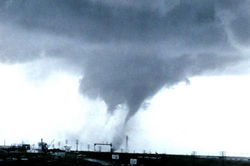
A multiple-vortex tornado (often shortened to multi-vortex tornado) is a tornado that contains several vortices (called subvortices or suction vortices) revolving around, inside of, and as part of the main vortex. The only times multiple vortices may be visible are when the tornado is first forming or when condensation and debris are balanced such that subvortices are apparent without being obscured. They can add over 100 mph to the ground-relative wind in a tornado circulation and are responsible for most cases where narrow arcs of extreme destruction lie right next to weak damage within tornado paths.[1]
Background
[edit]Suction vortices, also known as suction spots, are substructures found in many tornadoes, though they are not always easily visible. These vortices typically occur at the base of the tornado, where it makes contact with the ground. Sub-vortices tend to form after vortex breakdown reaches the surface, resulting from the interaction of cyclonically incoming and rising air. Although multi-vortex structures are common in tornadoes, they are not unique to them and can occur in other circulations, such as dust devils. This is a natural result of vortex dynamics in physics. Multi-vortex tornadoes should not be confused with cyclically tornadic supercells. Supercells are large, rotating thunderstorms that can produce multiple, distinct tornadoes, often referred to as tornado families. These tornadoes may form at different times or exist simultaneously but are separate from one another.[citation needed]
A phenomenon similar to multiple vortices is the satellite tornado. Unlike the multiple-vortex tornado, where smaller vortices form inside the main tornado, a satellite tornado develops outside the main tornado's circulation. It forms through a different mechanism, typically as a result of interactions with the parent storm's environment. Despite appearing close to the primary tornado, satellite tornadoes are independent and can have their own rotation.[1]
In rare instances, multi-vortex tornadoes may display their strength through the uncommon method of "horizontal vortices", in which tornadoes appearing to "bend" their multiple interior vortices; this results in a tornado appearing to radiate thin lines. Examples of tornadoes featuring horizontal vortices include the 2011 Tuscaloosa EF4 and 1999 Bridge Creek-Moore F5 tornadoes.
Notable tornadoes
[edit]The largest tornado ever documented was a multiple-vortex tornado. It struck El Reno, Oklahoma, on May 31, 2013, as a rain-wrapped tornado, killing tornado researcher Tim Samaras, his son Paul, their TWISTEX colleague Carl Young, and local amateur storm chaser Richard Henderson.[2] It had a maximum width of 2.6 miles (4.2 km) and a maximum recorded windspeed of at least 313 miles per hour (504 km/h). However, because of a lack of intense property damage, the tornado achieved a rating of EF3 on the Enhanced Fujita scale.[3] Nevertheless, the El Reno tornado is one of the three strongest tornadoes ever recorded in terms of maximum wind speeds, the next being the 2024 Greenfield EF4 tornado, reaching a measured windspeed of possibly up to 318 miles per hour (512 km/h), the last being the 1999 Bridge Creek–Moore tornado which doppler weather radar measured 321 miles per hour (517 km/h) mph. The Greenfield tornado also displayed multiple vortices.

The 1997 Jarrell tornado was another example of a multiple-vortex tornado. The infamous “Dead Man Walking” photo of it was at a juvenile stage of sub-vortices development. The 2011 Cullman–Arab tornado is also famous for footage of it "walking" while in its multi-vortex stage, as well as the 2013 El Reno tornado, which also had footage of it "walking" while multi-vortex.
See also
[edit]
References
[edit]- ^ a b Elite Spotter Workshop crh.noaa.gov Archived 8 August 2010 at the Wayback Machine
- ^ Clay, Nolan (3 June 2013). "Oklahoma storms: Amateur storm chaser took photo of tornado that killed him". The Oklahoman. Archived from the original on 9 March 2016. Retrieved 4 June 2013.
- ^ Jeff Snyder; H. B. Bluestein (2014). "Some Considerations for the Use of High-Resolution Mobile Radar Data in Tornado Intensity Determination". Weather Forecast. 29 (4): 799–827. Bibcode:2014WtFor..29..799S. doi:10.1175/WAF-D-14-00026.1. S2CID 122669043.
External links
[edit]- Multiple Vortex Tornado at the Online Tornado FAQ

| Concepts | |||||||||||||||||||||||||||||||||||||||||||||||
|---|---|---|---|---|---|---|---|---|---|---|---|---|---|---|---|---|---|---|---|---|---|---|---|---|---|---|---|---|---|---|---|---|---|---|---|---|---|---|---|---|---|---|---|---|---|---|---|
| Anticyclone |
| ||||||||||||||||||||||||||||||||||||||||||||||
| Cyclone |
| ||||||||||||||||||||||||||||||||||||||||||||||

Multiple-vortex tornado
View on GrokipediaDefinition and Characteristics
Definition
A multiple-vortex tornado is a type of tornado characterized by two or more smaller, intense sub-vortices rotating cyclonically around a common central axis, typically embedded within a larger parent circulation. These sub-vortices, often referred to as suction vortices, can produce extreme localized wind speeds and contribute to the overall destructive potential of the tornado by creating irregular damage patterns.[4][3] The terminology "multiple-vortex tornado" emerged from meteorological research in the 1970s, building on pioneering work by T. Theodore Fujita, who first proposed the concept of suction vortices in his 1971 analysis of damage from the 1970 Lubbock, Texas, tornado. Fujita's model described these substructures as intense, short-lived rotations within the main vortex, capable of winds exceeding those of the parent circulation by up to 100 mph. Earlier conceptual models, such as those by Davies-Jones in 1976, further formalized the "multiple-vortex" framework by integrating laboratory simulations and field observations. Synonyms like "satellite vortices" are sometimes used interchangeably, though "suction vortices" specifically highlights their role in amplifying suction and wind shear near the ground.[7][4] Multiple-vortex tornadoes are particularly prevalent in strong (EF2+) and violent (EF4–EF5) events, where they have been documented in most deadly and costly cases through post-storm damage surveys. Radar studies indicate multiple-vortex structures occur in a significant portion of strong to violent tornadoes (EF2 and above). They form almost exclusively within mesocyclone-producing supercell thunderstorms, distinguishing them from simpler single-vortex tornadoes that dominate weaker, non-supercell occurrences. This association underscores their link to highly organized convective systems with strong low-level shear.[8][3]Physical Structure
A multiple-vortex tornado consists of a central updraft core encircled by multiple sub-vortices, typically numbering 2 to 10, which orbit the core while contributing to the overall rotation.[9][3] These sub-vortices, often referred to as suction vortices, have diameters ranging from 100 to 500 meters and can orbit at tangential speeds up to 100 m/s, generating intense local wind gradients.[10][7] The central core acts as the primary vortex, with sub-vortices embedded within it, creating a composite structure where the intense shear zones between them amplify the tornado's rotational energy.[9] The lifecycle of this structure unfolds in distinct phases, beginning with the initial coalescence of sub-vortices around the central core, where they form and begin orbiting in a disorganized manner.[9] This transitions into a mature orbiting phase, lasting 1 to 10 minutes, during which the sub-vortices stabilize and revolve around the core at consistent intervals, often completing multiple revolutions.[3][9] Eventually, the structure may evolve through merger, where sub-vortices combine into a single dominant vortex or dissipate, marking the decline of the multiple-vortex configuration.[9] Visually, multiple-vortex tornadoes appear as a primary funnel containing several smaller funnels or rotating debris clouds, which can be observed orbiting within the main condensation funnel.[11] These features manifest in two primary configurations: tightly embedded sub-vortices that blend seamlessly into the core, creating a uniform but asymmetric appearance, or more loosely spaced "family" arrangements where distinct vortices are visible as separate, orbiting elements.[3][11] Debris clouds often highlight these motions, forming transient, high-contrast patterns against the main funnel wall. The overall size of a multiple-vortex tornado varies from several hundred meters to over 4 kilometers in diameter, influenced by the positioning and scale of the sub-vortices, which introduce irregular and asymmetric shapes rather than a symmetric cylinder.[9] This variability arises as sub-vortices migrate, expand, or contract, leading to fluctuating boundaries and non-uniform intensity across the cross-section.[10] Such structural complexity can result in localized wind speeds exceeding those of single-vortex tornadoes, enhancing damage potential.[9]Intensity Ratings
In multiple-vortex tornadoes, intensity is classified using the Enhanced Fujita (EF) scale, which correlates observed damage to estimated maximum wind speeds across 28 damage indicators ranging from well-constructed homes to trees. Sub-vortices within these tornadoes frequently generate localized peak winds of 200–300+ mph (90–134+ m/s), far exceeding the parent circulation's speeds and resulting in elevated EF ratings for narrow damage swaths, even as the broader path exhibits inconsistent destruction due to the transient nature of these embedded vortices.[12][13] These sub-vortices, or suction vortices, can augment ground-relative winds by over 100 mph, concentrating extreme forces in small areas and producing arcs of EF4 or EF5-level devastation adjacent to milder damage.[3] This variability complicates overall rating, as the EF scale prioritizes the highest observed damage to assign the tornado's rating, often highlighting the most intense sub-vortex impacts.[14] Assessing intensity poses significant challenges, particularly in reconciling Doppler radar data—which captures high sub-vortex winds aloft—with ground-based surveys that may overlook "spotty" patterns from rapidly cycling vortices. For example, radar analyses of the 2013 El Reno, Oklahoma, tornado revealed sub-vortex winds exceeding 200 mph, indicative of EF5 potential, yet the official EF3 rating stemmed from sparse rural damage indicators, underscoring how multiple vortices can embed high-intensity zones within a lower-rated path.[12][13] Post-2013 discussions and updates to EF scale guidelines, such as the 3rd edition (effective 2023), incorporate supplemental use of radar-derived winds and forensic engineering for estimation, alongside refined damage indicators and probabilistic thresholds. These updates were informed by cases like the 2011 Joplin, Missouri, tornado, a confirmed multiple-vortex event rated EF5 based on surveys revealing extreme localized structural failures exceeding 200 mph winds.[15][16] Compared to single-vortex tornadoes, multiple-vortex structures often achieve greater overall intensity through mechanisms like vortex stretching and convergence, which amplify sub-vortex winds and enhance the parent circulation's rotational energy.[14]Formation and Dynamics
Atmospheric Prerequisites
Multiple-vortex tornadoes form exclusively within supercell thunderstorms, which require a highly unstable atmosphere characterized by significant convective available potential energy (CAPE), typically exceeding 2000 J/kg, to support intense updrafts necessary for mesocyclone development.[17] Low lifting condensation level (LCL) heights, generally below 1000 m, promote the rapid descent of condensation and enhance low-level rotation by allowing parcels to reach the surface more easily.[17] Additionally, strong low-level wind shear, on the order of 20-40 knots with veering winds through the boundary layer, generates horizontal vorticity that can be tilted into the vertical by the updraft, fostering the rotating mesocyclone.[17] The rear-flank downdraft (RFD) plays a critical role in this process, as its occlusion wraps cooler air around the mesocyclone, tightening the circulation and creating the dynamic environment for tornado genesis.[18] Buoyancy driven by CAPE is essential for sustaining the mesocyclone's rotation, while the RFD's descent helps concentrate low-level vorticity. Environmental boundaries such as drylines or warm fronts further amplify instability by converging warm, moist air with drier air masses, leading to enhanced lift and storm initiation.[19] These conditions are most prevalent in the U.S. Great Plains, commonly referred to as Tornado Alley, where supercell-favorable environments occur frequently during the spring season. Climatological data from 1950 onward indicate that multiple-vortex tornadoes, often associated with violent events, peak in frequency during May and June in this region, coinciding with maximum instability and shear profiles.[20]Vortex Interaction Mechanisms
In multiple-vortex tornadoes, the orbiting motion of sub-vortices around the primary circulation center arises from the balance between centrifugal forces pushing outward and radial pressure gradients drawing inward, creating a dynamic equilibrium that allows multiple smaller vortices to rotate within the larger structure.[21] This interaction is governed by the conservation of angular momentum, where the specific angular momentum (with as the radial distance from the axis and as the tangential velocity) remains constant along streamlines, facilitating the redistribution of rotational energy among sub-vortices and preventing collapse into a single vortex.[21] High swirl ratios in the inflow amplify these forces, leading to intense local wind maxima associated with each sub-vortex.[4] The developmental stages begin with the tilting of horizontal vorticity—generated by vertical wind shear in the near-storm environment—into vertical axes by the converging updraft, which stretches and intensifies these parcels into coherent rotations.[4] This process culminates in vortex breakdown, where the primary vortex destabilizes into multiple sub-vortices through shear instability, particularly when the ratio of tangential to radial velocities exceeds critical thresholds, fragmenting the core into 2–6 smaller, rapidly rotating elements.[21] Observations confirm this breakdown manifests as doughnut-shaped regions of elevated tangential velocity, with sub-vortices forming at scales of tens to hundreds of meters.[4] Stability of these sub-vortices depends on sustained inflow convergence, which concentrates vorticity toward the center and reinforces orbital paths, while updraft tilt provides the necessary vertical shear to maintain cyclic intensification without immediate dispersal.[21] These factors enable persistent interactions, with sub-vortices exchanging momentum through mutual induction, often resulting in transient mergers or reconfigurations that enhance overall tornadic intensity.[4] Dissipation occurs primarily through viscous diffusion, which erodes the sharp gradients between sub-vortices and promotes their merger into a more unified circulation, or via external wind shear that disrupts coherent orbits and scatters the structures.[21] In intense cases, such as those observed with Doppler radar, these mergers can temporarily widen the tornado while reducing peak winds, transitioning the system back toward a single-vortex state.[4]Detection and Observation
Radar Identification
Multiple-vortex tornadoes exhibit distinct signatures on Doppler radar, primarily through multiple velocity couplets embedded within the broader mesocyclone circulation. These couplets appear as tight pairs of inbound and outbound radial velocities, often spanning gates from +50 to -50 m/s or greater, indicating intense low-level rotation associated with sub-vortices.[22] On reflectivity scans, a "debris ball" may manifest as a high-reflectivity region (typically 40-60 dBZ) near the ground, resulting from lofted non-meteorological scatterers lofted by the tornado's winds.[23] Advancements in dual-polarization radar, implemented across the U.S. NEXRAD network during the early 2010s, enhance identification of these features through hydrometeor classification algorithms. These systems differentiate tornado debris from precipitation by analyzing differential reflectivity (ZDR) and correlation coefficient (CC), where debris signatures show low ZDR (near 0 dB) and low CC (<0.8) due to irregular, non-spherical particles. This capability, operational since the 2011-2013 upgrade, allows forecasters to confirm tornadic activity even in rain-wrapped scenarios, reducing reliance on velocity data alone.[24] Detecting sub-vortices at scales of 100-300 m requires high-resolution mobile radars, such as the Doppler on Wheels (DOW) systems, which provide beam widths and sample volumes as fine as 25-65 m.[9] Operational NEXRAD radars, with coarser resolution (1-2 km at low levels), often fail to resolve these structures, leading to blended signatures that mimic a single vortex.[25] Radar observations of the 3 May 1999 Bridge Creek–Moore tornado, captured by DOW, revealed up to six resolvable sub-vortices revolving within the parent circulation, with tangential wind perturbations of 40-50 m/s. However, distant scans from fixed radars can produce false positives, where beam broadening smears velocity gradients, creating apparent couplets from mesocyclone-scale rotation rather than true subvortices.[27] This limitation underscores the need for close-range, high-resolution deployments to accurately delineate multiple-vortex structures.[28] Recent advancements as of 2025 include the integration of machine learning and AI models for tornado detection using radar data, enabling faster identification of multiple-vortex signatures through multi-task learning frameworks that analyze velocity and polarimetric variables simultaneously.[29] [30] Additionally, phased array radar technology, under testing and deployment by NOAA, offers scan times of 30-60 seconds with improved resolution, enhancing real-time detection of subvortices in operational settings.[31]Visual and Ground-Based Signs
Multiple-vortex tornadoes exhibit distinct visual traits that distinguish them from single-vortex tornadoes, primarily through the presence of multiple smaller-scale subvortices orbiting within the parent circulation. These subvortices, often termed "suction vortices" or "daughter vortices," manifest as short-lived, rapidly rotating funnels or whirls extending from the base of the parent cloud, sometimes appearing as several distinct columns rotating around a central axis.[3] Such structures are most visible during the tornado's mature phase when condensation funnels and debris are balanced, allowing observers to discern the orbiting motion.[4] The intense rotation of these subvortices frequently produces twisting patterns in the lofted debris cloud, creating a turbulent, irregular appearance with spiraling streams of material that highlight the internal dynamics.[32] Ground-based indicators provide post-event evidence of multiple-vortex activity, often revealed through detailed damage surveys. These tornadoes typically produce scoured paths featuring multiple narrow damage swaths, ranging from 5 to 20 meters wide, interspersed within the larger overall path of destruction; these linear features correspond to the transient tracks of individual subvortices. Within these sub-vortex paths, extreme ground scour is common, including soil inversion where the top layer of earth is lifted, inverted, and redeposited, exposing subsoil. Tree debarking, characterized by the stripping of bark and fraying of trunks, is also prevalent along these narrow tracks, reflecting the concentrated high winds of the subvortices. Eyewitness accounts from storm chasers and survivors offer valuable real-time insights into multiple-vortex behavior. During the 2013 El Reno, Oklahoma, tornado, chasers documented multiple transient subvortices orbiting within the broad parent vortex, with up to several visible simultaneously amid a chaotic debris field.[5] These observations highlighted the short-lived nature of the subvortices, which cycled rapidly and contributed to an erratic overall structure; survivors and chasers reported variations in the characteristic roaring sound, with intensifying or shifting rumbles corresponding to the passage of individual subvortices.[12] Such accounts underscore the hypnotic yet hazardous visual spectacle, where the orbiting vortices create a sense of multiple tornadoes within one. Detection of these signs faces significant limitations, particularly in adverse conditions. Heavy rain often wraps the tornado, concealing funnels and subvortices behind a veil of precipitation and obscuring twisting debris patterns from view.[3] Nighttime occurrences further complicate visual identification, as low light hinders spotting without supplemental illumination, relying instead on audible cues or indirect signs like sudden wind shifts.[33] Consequently, confirmation typically depends on video or photographic documentation from chasers, which can align with radar-detected multiple velocity signatures for validation.[5]Impacts and Case Studies
Damage Patterns
Multiple-vortex tornadoes produce distinctive damage patterns characterized by intermittent zones of extreme destruction interspersed with areas of comparatively minor scouring, resulting from the rapid formation, movement, and dissipation of subvortices within the parent circulation. These subvortices, often termed suction vortices, generate narrow arcs—typically 10 to 30 meters wide—of intense ground scouring, such as asphalt stripping from roads or complete debarking of trees, alternating with broader swaths of lighter debris dispersal or superficial erosion. This cycloidal or discontinuous damage signature arises as the subvortices orbit the main vortex, briefly concentrating wind speeds exceeding 200 mph in localized paths before shifting, leaving behind a patchwork of devastation that contrasts sharply with the more uniform destruction typical of single-vortex tornadoes.[3][34][4] The scale of these effects amplifies the lethality of multiple-vortex tornadoes through their unpredictable trajectories and transient high-wind bursts, which can toss vehicles significant distances or pulverize structures in isolated hotspots. For instance, in the 2011 Hackleburg–Phil Campbell tornado, an EF5 event with estimated winds of 210 mph contributed to 72 fatalities amid widespread structural annihilation along a 132-mile path. Such patterns correlate with Enhanced Fujita (EF) scale ratings of EF4 or EF5, where subvortices account for the most severe outcomes, including the majority of cases involving homes swept clean from foundations or embedded debris. Post-event surveys consistently reveal 20-50% greater spatial variability in damage intensity compared to single-vortex events, complicating intensity assessments and highlighting the role of vortex interactions in escalating impacts.[3][35][14][36] Economically, these irregular damage distributions challenge insurance modeling by introducing higher uncertainty in loss projections, as subvortices can amplify property destruction in non-contiguous zones, leading to elevated claims variability and requiring probabilistic simulations that incorporate multi-vortex dynamics for accurate risk assessment. Structurally, surveys indicate that reinforced buildings may withstand the parent vortex's winds but fail catastrophically under subvortex impacts, with debris from initial strikes exacerbating subsequent failures across widened affected areas. This variability informs updated engineering standards, emphasizing wider buffer zones around foundations to mitigate orbiting vortex effects.[37][38] Safety implications extend the effective danger zone beyond the visible funnel width, as orbiting subvortices can outreach the main circulation by 50-100 meters, creating an enlarged hazardous perimeter with sudden lethality spikes that evade traditional path predictions. This unpredictability heightens risks for evacuees and responders, necessitating expanded shelter protocols and real-time monitoring to account for the broader, erratic impact envelope.[5][39]Notable Historical Examples
One of the earliest well-documented multiple-vortex tornadoes in the United States occurred on April 9, 1947, during the Glazier-Higgins-Woodward outbreak in the Texas and Oklahoma Panhandles. Eyewitness accounts described the tornado exhibiting 3-4 distinct vortices as it devastated the towns of Glazier and Higgins, Texas, where it completely leveled structures and scoured the ground, earning an F5 rating on the Fujita scale with winds exceeding 261 mph.[40] This event, which killed at least 68 people along its 221-mile path, marked the first U.S. case where multiple vortices were clearly noted through survivor reports and post-storm surveys, providing early insights into the complex dynamics of such storms.[40] The May 3, 1999, Bridge Creek-Moore tornado in central Oklahoma stands as a landmark for radar-confirmed multiple-vortex structures, with Doppler on Wheels (DOW) observations capturing up to 7 sub-vortices rotating within the parent circulation. Rated F5, it produced the then-record wind speed of 301 mph measured in one sub-vortex, contributing to over $1 billion in damage across a 38-mile path that struck densely populated suburbs.[41] The event caused 36 direct fatalities and highlighted the role of sub-vortices in amplifying local wind intensities, as detailed in mobile radar analyses.[42] During the April 25-28, 2011, Super Outbreak, the Smithville, Mississippi, tornado exemplified multiple-vortex behavior on April 27, featuring at least 5 sub-vortices within an EF5-rated circulation that leveled the town and scoured soil up to 2 feet deep. This 45-mile-track event, part of a broader outbreak with 324 fatalities across multiple states, killed 23 people in Smithville alone and underscored the deceptive nature of multiple-vortex tornadoes, where intense sub-vortices can cause disproportionate damage in narrow swaths.[43] The May 31, 2013, El Reno, Oklahoma, tornado remains the widest on record at 2.6 miles, with mobile radar and video documentation revealing over 8 sub-vortices cycling rapidly within its rain-wrapped circulation, producing EF3-rated damage but winds exceeding 296 mph. This erratic, 16-mile-path storm killed 8 people, including 4 storm chasers struck by a sub-vortex, and revolutionized multiple-vortex research through unprecedented high-resolution Phased Array Radar (PAR) and mobile mesonet data that captured vortex breakdown and reformation in real time. For more recent examples, the May 21, 2024, Greenfield, Iowa, EF4 tornado exhibited multiple subvortices, causing 5 fatalities and extensive damage in a rural-urban path.[44][45][46]Research and Modeling
Early Scientific Investigations
The concept of multiple-vortex tornadoes emerged gradually through anecdotal observations and early damage analyses in the 19th and early 20th centuries. Pioneering meteorologist John Park Finley documented numerous tornado accounts in his 1881 report Tornadoes, including descriptions of irregular paths and damage that retrospectively suggest complex internal structures, though explicit recognition of subvortices was absent at the time.[47] Similarly, a 1948 photograph of a tornado near Peotone, Illinois, captured what is now identified as a multiple-vortex structure, but it went unrecognized for decades due to limited analytical tools.[48] These pre-1970s reports laid informal groundwork, often dismissed as eyewitness errors, highlighting the nascent stage of scientific inquiry into tornado internal dynamics. A pivotal advancement occurred in the mid-20th century with photogrammetric studies of damage patterns, exemplified by the 1953 Worcester, Massachusetts, F4 tornado. Witness accounts and photographic evidence indicated multiple funnels and discontinuous damage swaths, suggesting subvortices, though technology constrained definitive confirmation. This event underscored the potential for hidden vortex complexity, influencing later researchers to scrutinize irregular scouring and cycloidal marks in tornado paths. The 1970s marked breakthroughs in empirical confirmation, led by Tetsuya Theodore Fujita's seminal 1971 paper, "Proposed Mechanism of Suction Spots Accompanied by Tornadoes," presented at the Seventh Conference on Severe Local Storms. Analyzing damage from the 1957 Dallas, Texas, tornado and the 1971 nationwide outbreak, Fujita introduced the "multiple suction vortices" model to explain concentrated destruction zones and looping debris patterns, attributing them to smaller subvortices orbiting a parent vortex.[49] This work, integrated into his development of the Fujita (F) scale for tornado intensity—published the same year—emphasized damage indicators like tree cycloids and building foundations as evidence of subvortex activity, revolutionizing tornado classification. Further validation came from the Tornado Intercept Project (TIP) during 1972–1973, which employed mobile photography and nascent Doppler radar to document subvortices in real time. The project's interception of the May 24, 1973, Union City, Oklahoma, F4 tornado provided the first complete visual and radar lifecycle observations, revealing transient subvortices within the main vortex and confirming Fujita's hypotheses through ground-level imagery and velocity data.[50] These efforts established multiple-vortex structures as a common feature of violent tornadoes, informed by atmospheric prerequisites like intense low-level shear observed in the intercepted storms. Despite these advances, early investigations were hampered by technological limitations, including sparse radar coverage and reliance on post-event surveys, resulting in significant underestimation of multiple-vortex prevalence in 1960s–1980s climatologies based on visible or damage evidence.Contemporary Simulations and Predictions
Contemporary numerical modeling of multiple-vortex tornadoes relies heavily on high-resolution large eddy simulations (LES) that resolve sub-vortex scales at grid spacings of 10-50 meters, allowing for detailed depiction of turbulent flow fields and vortex interactions within tornado-like vortices.[51] These LES approaches successfully simulate multi-vortex structures by capturing the evolution from single to multiple vortices, including breakdown and touchdown phases, through explicit resolution of small-scale eddies.[52] A key component in these models is the vorticity transport equation, derived from the Navier-Stokes equations as where represents vorticity, is the velocity field, is the material derivative, and is the kinematic viscosity; this equation governs the stretching, tilting, and diffusion of vorticity essential to multiple-vortex formation. The Verification of the Origins of Rotation in Tornadoes Experiment 2 (VORTEX2), conducted from 2009 to 2010, advanced predictive capabilities by integrating mobile radar and in-situ field observations into ensemble Kalman filter (EnKF) models for real-time nowcasting of tornado dynamics.[53] These EnKF analyses, applied to VORTEX2 datasets such as the 5 June 2009 Goshen County, Wyoming, supercell, provided high-resolution insights into tornado maintenance and sub-vortex evolution through assimilation of dual-Doppler winds.[54] Recent field projects, such as VORTEX-Southeast (2022–2023), have continued these efforts by targeting quasilinear convective systems (QLCS) to observe mesovortex and multiple-vortex dynamics in diverse environments.[55] Complementing these efforts, machine learning algorithms, such as multi-task identification networks, analyze Doppler radar data for pattern recognition of tornadic circulations, improving detection by distinguishing them from non-tornadic features with high precision.[29] Looking ahead, the integration of artificial intelligence into forecasting systems promises real-time warnings for multiple-vortex tornadoes by processing multi-source data streams, potentially reducing lead times and false alarms through advanced probabilistic models.[56] However, current simulations face limitations in accurately representing terrain effects, as high-resolution LES struggles with complex topography that alters vortex dynamics and intensity, necessitating further refinements in boundary condition handling.[57]References
- https://doi.org/10.1175/1520-0434(2002)017<0473:TMVSOA>2.0.CO;2