


Community hub
Recent from talks
Contribute something
Nothing was collected or created yet.
Biceps
View on Wikipedia
| Biceps brachii | |
|---|---|
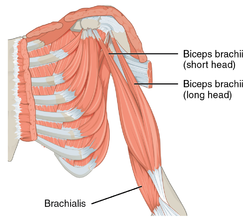
 The biceps is a two-headed muscle and is one of the chief flexors of the forearm. Here is the left side, seen from the front. | |
| Details | |
| Pronunciation | /ˈbaɪsɛps ˈbreɪkiaɪ/ |
| Origin | Short head: coracoid process of the scapula. Long head: supraglenoid tubercle |
| Insertion | Radial tuberosity and bicipital aponeurosis into deep fascia on medial part of forearm |
| Artery | Brachial artery |
| Nerve | Musculocutaneous nerve (C5–C7)[1] |
| Actions | |
| Antagonist | Triceps brachii muscle |
| Identifiers | |
| Latin | musculus biceps brachii |
| TA98 | A04.6.02.013 |
| TA2 | 2464 |
| Anatomical terms of muscle | |
The biceps or biceps brachii (Latin: musculus biceps brachii, "two-headed muscle of the arm") is a large muscle that lies on the front of the upper arm between the shoulder and the elbow. Both heads of the muscle arise on the scapula and join to form a single muscle belly which is attached to the upper forearm. While the long head of the biceps crosses both the shoulder and elbow joints, its main function is at the elbow where it flexes and supinates the forearm.[2]
Structure
[edit]

The biceps is one of three muscles in the anterior compartment of the upper arm, along with the brachialis muscle and the coracobrachialis muscle, with whom the biceps shares a nerve supply.[1] The biceps muscle has two heads, the short head and the long head, distinguished according to their origin at the coracoid process and supraglenoid tubercle of the scapula, respectively.[1] From its origin on the glenoid, the long head remains tendinous as it passes through the shoulder joint and through the intertubercular groove of the humerus.[2] Extending from its origin on the coracoid, the tendon of the short head runs adjacent to the tendon of the coracobrachialis. Unlike the other muscles in the anterior compartment of the arm, the long head of the biceps muscle crosses two joints, the shoulder joint and the elbow joint.
Both heads of the biceps join in the middle upper arm to form a single muscle mass, usually near the insertion of the deltoid, to form a common muscle belly;[3] although several anatomic studies have demonstrated that the muscle bellies remain distinct structures without confluent fibers.[4][5] As the muscle extends distally, the two heads rotate 90 degrees externally before inserting onto the radial tuberosity. The short head inserts distally on the tuberosity while the long head inserts proximally closer to the apex of the tuberosity.[4] The bicipital aponeurosis, also called the lacertus fibrosus, is a thick fascial band that organizes close to the musculotendinous junction of the biceps and radiates over and inserts onto the ulnar part of the antebrachial fascia.[6]
The tendon that attaches to the radial tuberosity is partially or completely surrounded by a bursa, the bicipitoradial bursa, which ensures frictionless motion between the biceps tendon and the proximal radius during pronation and supination of the forearm.[7]
Two muscles lie underneath the biceps brachii. These are the coracobrachialis muscle, which like the biceps originates from the coracoid process of the scapula, and the brachialis muscle which connects to the ulna and along the mid-shaft of the humerus. Besides those, the brachioradialis muscle is adjacent to the biceps and also inserts on the radius bone, though more distally.
-
 Biceps and triceps.
 -
 Movement of biceps and triceps when arm is flexing
 -
 The split line between the long and short heads


Variation
[edit]Traditionally described as a two-headed muscle, biceps brachii is one of the most variable muscles of the human body and has a third head arising from the humerus in 10% of cases (normal variation)—most commonly originating near the insertion of the coracobrachialis and joining the short head—but four, five, and even seven supernumerary heads have been reported in rare cases.[8]
One study found a higher than expected number of female cadavers with a third head of biceps brachii, equal incidence between sides of the body, and uniform innervation by musculocutaneous nerve.[9]
The distal biceps tendons are completely separated in 40% and bifurcated in 25% of cases. [10][5]
Nerve supply
[edit]The biceps shares its nerve supply with the other two muscles of the anterior compartment. The muscles are supplied by the musculocutaneous nerve. Fibers of the fifth, sixth and seventh cervical nerves make up the components of the musculocutaneous nerve which supply the biceps.[1]
Blood supply
[edit]The blood supply of the biceps is the brachial artery. The distal tendon of the biceps can be useful for palpating the brachial pulse, as the artery runs medial to the tendon in the cubital fossa.
Function
[edit]

The biceps works across three joints.[11] The most important of these functions is to supinate the forearm and flex the elbow. Besides, the long head of biceps prevents the upward displacement of the head of the humerus.[12] In more detail, the actions are, by joint:[13]
- Proximal radioulnar joint of the elbow – The biceps brachii functions as a powerful supinator of the forearm, i.e. it turns the palm upwards. This action, which is aided by the supinator muscle, requires the humeroulnar joint of the elbow to be at least partially flexed. If the humeroulnar joint is fully extended, supination is then primarily carried out by the supinator muscle. The biceps is a particularly powerful supinator of the forearm due to the distal attachment of the muscle at the radial tuberosity, on the opposite side of the bone from the supinator muscle. When flexed, the biceps effectively pulls the radius back into its neutral supinated position in concert with the supinator muscle.[14]: 346–347
- Humeroulnar joint of the elbow – The biceps brachii also functions as an important flexor of the forearm, particularly when the forearm is supinated.[1] Functionally, this action is performed when lifting an object, such as a bag of groceries or when performing a biceps curl. When the forearm is in pronation (the palm faces the ground), the brachialis, brachioradialis, and supinator function to flex the forearm, with minimal contribution from the biceps brachii. Regardless of forearm position, (supinated, pronated, or neutral) the force exerted by the biceps brachii remains the same; however, the brachioradialis has a much greater change in exertion depending on position than the biceps during concentric contractions. That is, the biceps can only exert so much force, and as forearm position changes, other muscles must compensate.[15]
- Glenohumeral joint (shoulder joint) – Several weaker functions occur at the glenohumeral joint. The biceps brachii weakly assists in forward flexion of the shoulder joint (bringing the arm forward and upwards). It may also contribute to abduction (bringing the arm out to the side) when the arm is externally (or laterally) rotated. The short head of the biceps brachii also assists with horizontal adduction (bringing the arm across the body) when the arm is internally (or medially) rotated. Finally, the short head of the biceps brachii, due to its attachment to the scapula (or shoulder blade), assists with stabilization of the shoulder joint when a heavy weight is carried in the arm. The tendon of the long head of the biceps also assists in holding the head of the humerus in the glenoid cavity and prevents an impingement of the supraspinatus tendon.[16][14]: 295
Motor units in the lateral portion of the long head of the biceps are preferentially activated during elbow flexion, while motor units in the medial portion[clarification needed] are preferentially activated during forearm supination.[17]
The biceps are usually attributed as representative of strength within a variety of worldwide cultures.[citation needed]
Clinical significance
[edit]
The proximal tendons of the biceps brachii are commonly involved in pathological processes and are a frequent cause of anterior shoulder pain.[18] Disorders of the distal biceps brachii tendon include insertional tendonitis and partial or complete tears of the tendon. Partial tears are usually characterized by pain and enlargement and abnormal contour of the tendon.[19] Complete tears occur as avulsion of the tendinous portion of the biceps away from its insertion on the tuberosity of the radius, and is often accompanied by a palpable, audible "pop" and immediate pain and soft tissue swelling.[20]
A soft-tissue mass is sometimes encountered in the anterior aspect of the arm, the so-called Reverse Popeye deformity, which paradoxically leads to a decreased strength during flexion of the elbow and supination of the forearm.[21]
Tendon rupture
[edit]
Tears of the biceps brachii may occur during athletic activities, however avulsion injuries of the distal biceps tendon are frequently occupational in nature and sustained during forceful, eccentric contraction of the biceps muscle while lifting.[20]
Treatment of a biceps tear depends on the severity of the injury. In most cases, the muscle will heal over time with no corrective surgery. Applying cold pressure and using anti-inflammatory medications will ease pain and reduce swelling. More severe injuries require surgery and post-op physical therapy to regain strength and functionality in the muscle. Corrective surgeries of this nature are typically reserved for elite athletes who rely on a complete recovery.[22]
Training
[edit]The biceps can be strengthened using weight and resistance training. Examples of well known biceps exercises are the chin-up and biceps curl. The majority of weightlifters separate bicep exercises into two categories: exercises which focus on the short-head of the biceps brachii and those which work the long-head. Bicep curls, barbell curls, and concentration curls primarily focus on the short-head of the biceps brachii, while dumbbell waiter curls and close-grip barbell curls work the long-head of the biceps.[23] In addition to these, weightlifters include exercises for the brachialis muscle, such as hammer curls, to increase the size of the upper arm.
Etymology and grammar
[edit]The biceps brachii muscle is the one that gave all muscles their name: it comes from the Latin musculus, "little mouse", because the appearance of the flexed biceps resembles the back of a mouse. The same phenomenon occurred in Greek, in which μῦς, mȳs, means both "mouse" and "muscle".[citation needed]
The term biceps brachii is a Latin phrase meaning "two-headed [muscle] of the arm", in reference to the fact that the muscle consists of two bundles of muscle, each with its own origin, sharing a common insertion point near the elbow joint. The proper plural form of the Latin adjective biceps is bicipites,[24] a form not in general English use. Instead, biceps is used in both singular and plural (i.e., when referring to both arms).
The English form bicep, attested from 1939, is a back formation derived from misinterpreting the s of biceps as the English plural marker -s.[25][26]
Adriaan van den Spiegel called the biceps a Pisciculus)[27] due to its fusiform shape, which is why in the Italian-language medical literature it is sometimes called il pescetto, "the small fish".
History
[edit] |
Leonardo da Vinci expressed the original idea of the biceps acting as a supinator in a series of annotated drawings made between 1505 and 1510; in which the principle of the biceps as a supinator, as well as its role as a flexor to the elbow were devised. However, this function remained undiscovered by the medical community as da Vinci was not regarded as a teacher of anatomy, nor were his results publicly released. It was not until 1713 that this movement was re-discovered by William Cheselden and subsequently recorded for the medical community. It was rewritten several times by different authors wishing to present information to different audiences. The most notable recent expansion upon Cheselden's recordings was written by Guillaume Duchenne in 1867, in a journal named Physiology of Motion. It remains one of the major references on supination action of the biceps brachii. [citation needed]
Other species
[edit]Neanderthals
[edit]In Neanderthals, the radial bicipital tuberosities were larger than in modern humans, which suggests they were probably able to use their biceps for supination over a wider range of pronation-supination. It is possible that they relied more on their biceps for forceful supination without the assistance of the supinator muscle like in modern humans, and thus that they used a different movement when throwing.[28]
Horses
[edit]In the horse, the biceps' function is to extend the shoulder and flex the elbow. It is composed of two short-fibred heads separated longitudinally by a thick internal tendon which stretches from the origin on the supraglenoid tubercle to the insertion on the medial radial tuberosity. This tendon can withstand very large forces when the biceps is stretched. From this internal tendon a strip of tendon, the lacertus fibrosus, connects the muscle with the extensor carpi radialis -- an important feature in the horse's stay apparatus (through which the horse can rest and sleep whilst standing.) [29]
References
[edit]- ^ a b c d e f g h Bogart BI, Ort VH (2007). Elsevier's integrated anatomy and embryology. Philadelphia, Pa.: Elsevier Saunders. pp. 262–267. ISBN 978-1-4160-3165-9.
- ^ a b Lippert LS (2006). Clinical kinesiology and anatomy (4th ed.). Philadelphia: F. A. Davis Company. pp. 126–7. ISBN 978-0-8036-1243-3.
- ^ "Google Scholar". scholar.google.com. Retrieved August 21, 2024.
- ^ a b Athwal GS, Steinmann SP, Rispoli DM (October 2007). "The distal biceps tendon: footprint and relevant clinical anatomy". The Journal of Hand Surgery. 32 (8): 1225–9. doi:10.1016/j.jhsa.2007.05.027. PMID 17923307.
- ^ a b Eames MH, Bain GI, Fogg QA, van Riet RP (May 2007). "Distal biceps tendon anatomy: a cadaveric study". The Journal of Bone and Joint Surgery. American Volume. 89 (5): 1044–9. doi:10.2106/JBJS.D.02992. PMID 17473142.
- ^ Platzer W (2004). Color Atlas of Human Anatomy. Vol. 1: Locomotor System (5th ed.). Thieme. p. 154. ISBN 978-1-58890-159-0.
- ^ Kegels L, Van Oyen J, Siemons W, Verdonk R (June 2006). "Bicipitoradial bursitis. A case report" (PDF). Acta Orthopaedica Belgica. 72 (3): 362–5. PMID 16889153.
- ^ Poudel PP, Bhattarai C (June 2009). "Study on the supernumerary heads of biceps brachii muscle in Nepalese". Nepal Medical College Journal. 11 (2): 96–8. PMID 19968147. S2CID 9963394.
- ^ Schwerdtfeger, Luke A.; Pascoe, Michael A.; Clapp, Tod (September 2018). "High incidence of a third head of biceps brachii in females". Translational Research in Anatomy. 12: 25–27. doi:10.1016/j.tria.2018.08.001.
- ^ Dirim B, Brouha SS, Pretterklieber ML, Wolff KS, Frank A, Pathria MN, Chung CB (December 2008). "Terminal bifurcation of the biceps brachii muscle and tendon: anatomic considerations and clinical implications". AJR. American Journal of Roentgenology. 191 (6): W248-55. doi:10.2214/AJR.08.1048. PMID 19020211.
- ^ "Biceps Brachii". ExRx.net. Retrieved January 16, 2017.
- ^ Krishna G (2010). "8 - Arm". BD Chaurasia's Human Anatomy (Regional and Applied Dissection and Clinical) Volume 1 - Upper limb and thorax (Fifth ed.). India: CBS Publishers and Distributors Pvt Ltd. p. 88. ISBN 978-81-239-1863-1.
- ^ Simons DG, Travell JG, Simons LS (1999). "30: Biceps Brachii Muscle". In Eric Johnson (ed.). Travell & Simons' Myofascial Pain and Dysfunction (2nd ed.). Baltimore, Maryland: Williams and Wilkins. pp. 648–659. ISBN 978-0-683-08363-7.
- ^ a b Saladin K (2015). Anatomy and Physiology: The Unity of Form and Function. New York, NY: McGraw-Hill Education. ISBN 978-0-07-340371-7.
- ^ Kleiber T, Kunz L, Disselhorst-Klug C (January 1, 2015). "Muscular coordination of biceps brachii and brachioradialis in elbow flexion with respect to hand position". Frontiers in Physiology. 6: 215. doi:10.3389/fphys.2015.00215. PMC 4526813. PMID 26300781.
- ^ Hermann Braus, Curt Elze: Musculus biceps brachii. In: Anatomie des Menschen. Ein Lehrbuch für Studierende und Ärzte. Erster Band. Bewegungsapparat. 3. Auflage. Julius Springer, Berlin 1954. Digitalisat der Universität Heidelberg. S. 298-301.
- ^ ter Haar Romeny, B.M.; Denier van der Gon, J.J.; Gielen, C.C.A.M. (September 1984). "Relation between location of a motor unit in the human biceps brachii and its critical firing levels for different tasks". Experimental Neurology. 85 (3): 631–650. doi:10.1016/0014-4886(84)90036-0. hdl:1874/23877. ISSN 0014-4886. PMID 6468581. S2CID 36705348.
- ^ Frost A, Zafar MS, Maffulli N (April 2009). "Tenotomy versus tenodesis in the management of pathologic lesions of the tendon of the long head of the biceps brachii". The American Journal of Sports Medicine. 37 (4): 828–33. doi:10.1177/0363546508322179. PMID 18762669. S2CID 35918574.
- ^ Chew ML, Giuffrè BM (2005). "Disorders of the distal biceps brachii tendon". Radiographics. 25 (5): 1227–37. doi:10.1148/rg.255045160. PMID 16160108.
- ^ a b Miller MD, Thompson SR, DeLee J, Drez D (2015). DeLee & Drez's orthopaedic sports medicine : principles and practice (Fourth ed.). Philadelphia, PA. ISBN 978-1-4557-4376-6. OCLC 880421005.
{{cite book}}: CS1 maint: location missing publisher (link) - ^ Arend CF. Ultrasound of the Shoulder. Master Medical Books, 2013. Free chapter on ultrasound evaluation of biceps tendon tears available at ShoulderUS.com
- ^ "Bicep tear - Muscular Injuries". Sports Medicine Information.
- ^ "Peak Workout (Long Head Bicep Exercises) Size & Defenition". January 28, 2018. Retrieved September 12, 2025.
- ^ "biceps". Latin Declension - Wiktionary. Retrieved October 31, 2020.
- ^ "Bicep". Dictionary and Thesaurus — Merriam-Webster Online. Retrieved December 22, 2010.
- ^ Zwicky A (July 30, 2008). "The dangers of satire". Language Log. Retrieved December 22, 2010.
- ^ Joseph Hyrtl: Muskeln. Anatomische Bedingung eines dreiköpfigen Biceps. In: Handbuch der Topographischen Anatomie. Band II. Braumüller, Wien 1865. S. 353–354.
- ^ Churchill SE, Rhodes JA (2009). "The Evolution of the Human Capacity for 'Killing at a Distance': The Human Fossil Evidence for the Evolution of Projectile Weaponry". In Hublin JJ, Richards MP (eds.). The evolution of hominin diets: integrating approaches to the study of Palaeolithic subsistence. Springer Science + Business Media. p. 208. ISBN 978-1-4020-9698-3.
- ^ Watson JC, Wilson AM (January 2007). "Muscle architecture of biceps brachii, triceps brachii and supraspinatus in the horse". Journal of Anatomy. 210 (1): 32–40. doi:10.1111/j.1469-7580.2006.00669.x. PMC 2100266. PMID 17229281.
External links
[edit]

- Anatomy photo:06:05-0102 at the SUNY Downstate Medical Center

Biceps
View on GrokipediaAnatomy
Origin and insertion
The biceps brachii muscle originates proximally via two distinct heads on the scapula. The long head arises from the supraglenoid tubercle and the superior portion of the glenoid labrum.[1] The short head originates from the apex of the coracoid process of the scapula, sharing this attachment site with the coracobrachialis muscle.[6] From their origins, the two heads follow divergent paths before converging. The tendon of the long head is long and thin, measuring approximately 9 cm, and passes intracapsularly through the glenohumeral joint capsule before exiting and traveling within the intertubercular (bicipital) groove of the humerus, held in place by the transverse humeral ligament; this positioning allows it to contribute to shoulder joint stability by depressing the humeral head during arm elevation.[1] In contrast, the short head tendon courses anterior to the shoulder joint capsule and lies medial to the long head. The heads merge into a single fusiform muscle belly in the anterior compartment of the arm, approximately midway along the humerus.[7] Distally, the muscle tapers to form a common tendon that inserts primarily onto the bicipital tuberosity of the radius.[8] A flat, broad expansion known as the bicipital aponeurosis arises from this tendon and extends medially to blend with the deep fascia overlying the flexor muscles of the forearm, providing additional attachment and distributing force across the antebrachial structures.[6] In adults, the total length of the biceps brachii, from origin to insertion, measures approximately 25-30 cm, varying with arm length and individual anatomy.Composition
The biceps brachii muscle is a fusiform structure consisting of two distinct heads—the long head and the short head—that arise separately from the scapula and converge distally to form a single, spindle-shaped belly in the anterior upper arm. This bipennate-like arrangement, with fibers oriented primarily parallel to the muscle's long axis, facilitates efficient contraction for power generation. The muscle is predominantly composed of type II fast-twitch fibers, which account for approximately 60% of the fiber population in humans, enabling rapid force production suited to dynamic movements.[9] The fusiform shape and convergence of the two heads into a single belly contribute to the biceps brachii's pronounced, rounded appearance during contraction. The muscle forms a visible lump or bulge when tensed because contraction shortens the length of the muscle fibers via the sliding filament mechanism, while the muscle's volume remains constant due to the incompressibility of muscle tissue. This causes the muscle to thicken and protrude outward, creating the characteristic peak. The proximal tendons exhibit distinct anatomical features: the long head tendon traverses an intra-articular path through the glenohumeral joint capsule, while the short head tendon follows an extra-articular course from the coracoid process. Distally, the tendon extends 2-3 cm from the muscle belly before flattening into a broad aponeurosis that inserts on the radial tuberosity and forearm fascia.[1][10] Architecturally, the biceps brachii features parallel fiber alignment within the belly, with a low pennation angle ranging from about 4° in elbow extension to 13° in flexion, which minimizes force loss and supports high contraction velocity. The physiological cross-sectional area averages 8.2 cm² (SD 3.4 cm²) in adults, reflecting its capacity for substantial force output relative to body size.[11][12] Connective tissue components include the epimysium encasing the entire muscle, perimysium organizing fiber bundles into fascicles, and endomysium sheathing individual fibers, all contributing to structural integrity and force transmission. The lacertus fibrosus, or bicipital aponeurosis, emerges from the distal tendon and distributes the muscle's contractile force to adjacent forearm structures, thereby reducing direct loading on the radial insertion site.[1]Variations
The biceps brachii muscle exhibits several anatomical variations, most notably the presence of an accessory or third head, which occurs with an overall pooled prevalence of 9.6% (95% CI 8–11%) across studied populations.[13] This third head typically originates from the anteromedial aspect of the humerus, between the insertion sites of the coracobrachialis and brachialis muscles, and joins the common distal tendon of the biceps brachii to insert on the radial tuberosity.[14] Prevalence rates for this variation range from 3% to 20% depending on the study cohort, with the accessory head more commonly unilateral than bilateral.[15] Variations in the origins of the biceps heads include rare instances of fusion between the long and short heads, where the two proximal tendons merge early along their course, reported in fewer than 5% of dissections.[16] Complete absence of the short head is exceptionally uncommon, documented primarily through isolated case reports rather than population-level data, often resulting in a unipennate muscle structure.[17] In some cases, the long head may exhibit a humeral origin as part of the third head configuration, altering its proximal trajectory without affecting the short head.[18] Distal insertion anomalies of the biceps brachii include tendinous slips fusing with the brachialis muscle or extending to the ulna via connections to the bicipital aponeurosis, observed in approximately 5–10% of anatomical specimens.[19] These variations show gender differences, with females exhibiting higher rates of complex distal insertions, such as multiple tendon bands (type III morphology in up to 7.5% of cases, significantly more frequent in females than males).[20] Population-specific traits influence the incidence of these variations, particularly the third head, which appears more frequently in Asian cohorts (e.g., 18% in Japanese and 8% in Chinese populations) compared to Europeans (around 10%).[21] Left-right asymmetry is common, with accessory heads occurring unilaterally in about 50% of affected individuals, leading to bilateral symmetry in only half of cases.[14]Innervation
The biceps brachii muscle receives its primary motor innervation from the musculocutaneous nerve, a terminal branch of the lateral cord of the brachial plexus derived from spinal roots C5-C7.[22] The musculocutaneous nerve pierces the coracobrachialis muscle near its insertion on the humerus and emits motor branches to the biceps brachii shortly thereafter, typically in the mid-arm region.[23] These branches supply both the long and short heads of the muscle, with anatomical studies identifying distinct patterns: in approximately 28% of cases, separate branches innervate the long head and short head individually, while a single branch or additional supply to the common belly occurs in the majority.[24] Intramuscular branching of these motor nerves forms characteristic motor endplate bands within the biceps brachii, appearing as an inverted V-shaped zone approximately 1 cm wide, located 7-11 cm superior to the olecranon process depending on the medial-to-lateral position.[25] This organization facilitates coordinated contraction across the muscle heads and is relevant for targeted interventions such as botulinum neurotoxin injections. Sensory innervation includes proprioceptive fibers conveyed via the same musculocutaneous nerve, primarily from C5-C6 roots, which monitor muscle length and tension through spindle afferents.[1] Anatomical anomalies in biceps brachii innervation are uncommon, occurring in 1-2% of cases, and may involve bifurcation of the musculocutaneous nerve or rare accessory contributions, such as indirect involvement from the accessory phrenic nerve through brachial plexus variations, potentially altering motor distribution to the coracobrachialis and biceps.[26]Blood supply
The biceps brachii muscle receives its arterial blood supply from multiple sources that ensure oxygenation and nutrient delivery across its proximal, main, and distal regions. The proximal portion, particularly the long head originating from the supraglenoid tubercle, is primarily supplied by branches of the suprascapular artery and the anterior circumflex humeral artery, which enter near the glenohumeral joint and provide vascularization to the intra-articular tendon segment.[27][28] In contrast, the short head, arising from the coracoid process, derives its proximal supply mainly from the anterior circumflex humeral artery, which courses deep to the muscle and delivers blood via ascending branches.[29] The primary vascularization of the muscle belly occurs through nutrient branches from the brachial artery and the profunda brachii artery, which penetrate the muscle along its length to form an extensive intramuscular network. These branches, often numbering up to eight, arise predominantly from the middle third of the brachial artery and distribute to both heads, supporting the bulk of metabolic demands during contraction.[1][30] Distally, at the tendon insertion on the radial tuberosity, blood supply is provided by the radial recurrent artery, which typically crosses volar to the tendon approximately 4 mm proximal to the insertion and forms anastomoses that nourish the enthesis. Venous drainage parallels this arterial system, with accompanying venae comitantes collecting blood from the muscle and tendon, ultimately draining into the brachial veins and then the axillary vein.[31][32] The biceps brachii demonstrates a high capillary density, especially in type I (slow-twitch) fibers, averaging 4.9 to 5.5 capillaries per fiber, which facilitates efficient oxygen delivery and contributes to the muscle's role in sustained endurance activities such as forearm supination. Arterioles branch frequently, typically every 1-2 mm along the muscle length, enhancing this microvascular architecture.[33]Function
Elbow flexion
The biceps brachii contributes to elbow flexion by contracting to shorten its muscle fibers via the sliding filament mechanism, which pulls the bicipital tuberosity of the radius toward the humerus through its distal insertion.[1] Since the muscle maintains a nearly constant volume during contraction, this shortening in length is accompanied by radial expansion, causing the muscle belly to thicken and form the characteristic bulge or peak. This effect is particularly pronounced in the biceps brachii due to its fusiform shape and two heads, resulting in a visible rounded appearance during flexion, especially when the muscle is tensed against resistance.[34] This action flexes the forearm at the elbow joint, with the muscle spanning from its origins on the coracoid process and supraglenoid tubercle to its insertion via the bicipital aponeurosis.[1] In terms of force generation, the biceps brachii produces peak isometric torque of approximately 50-70 Nm in healthy adults during elbow flexion, with maximum values occurring at around 90° of flexion due to optimal moment arm length.[35] The muscle's length-tension relationship reaches its optimum at elbow flexion angles of 110-120°, where sarcomere overlap allows for maximal active force production. The biceps brachii functions as a synergist to the primary elbow flexor, the brachialis, and the secondary flexor brachioradialis, all of which contribute to net flexion torque at the elbow.[1] Its action is opposed by the antagonist triceps brachii, which extends the elbow.[1] Electromyographic studies show that the biceps brachii exhibits its highest activation levels, reaching 80-100% of maximum voluntary contraction (MVC), during isolated isometric elbow flexion tasks against resistance, particularly in supinated forearm positions.[37]Forearm supination
The biceps brachii contributes to forearm supination by rotating the radius such that the palm faces upward, a motion facilitated by the spiral path of its distal tendon around the radial tuberosity. This insertion creates a cam effect, where contraction of the muscle generates supinatory torque as the tendon wraps around the radius, optimizing rotational force during elbow flexion.[38] The torque is maximal when the elbow is flexed, such as at 90°, as this position reduces the leverage of antagonist muscles like the pronator teres and aligns the biceps' line of pull for greater rotational efficiency.[39] With elbow extension, the effectiveness of supination diminishes because the moment arm shortens, altering the tendon's alignment relative to the radioulnar joint axis.[39] In terms of torque output, the biceps brachii can produce approximately 10-20 Nm of supinatory force at neutral forearm position with the elbow flexed, though values vary by individual factors like age and training status.[40] This capacity allows the biceps to interact synergistically with the supinator muscle to overcome pronator forces from muscles such as the pronator teres, enabling net supination even against resistance.[41] The biceps provides the primary supinatory power, often exceeding the supinator's contribution, particularly when the forearm starts from a pronated position.[42] Kinematically, the biceps brachii plays an essential role in fine motor tasks requiring precise supination, such as turning a key or screwing a lid, where controlled rotation is critical for hand positioning. Electromyographic (EMG) studies show higher biceps activation in supinated forearm positions during elbow flexion tasks between 60° and 90° of elbow flexion, reflecting heightened recruitment to sustain torque in mid-range positions.[43] This activation pattern synergizes with elbow flexion, enhancing overall supinatory efficiency without relying on isolated extension.[44]Accessory roles
The long head of the biceps brachii contributes to shoulder stabilization by exerting a depressive force on the humeral head during arm elevation, counteracting superior translation and maintaining glenohumeral congruence. This action is mediated through the tendon's intra-articular course, which tensions to resist upward migration of the humeral head, particularly under dynamic loads such as overhead reaching. In healthy individuals, electromyographic studies indicate modest activation of the long head during flexion and abduction, with activity increasing proportionally to load demands (e.g., 11.6% maximum voluntary contraction at 90° flexion with added weight). In cases of rotator cuff pathology, this depressive role becomes more pronounced, as the biceps compensates for deficient cuff muscles to preserve joint centering.[45][46] Beyond direct stabilization, the biceps brachii aids in postural support of the upper limb by countering gravitational forces during mid-range elbow flexion, helping to sustain arm position without excessive energy expenditure from primary movers. This isometric contribution enhances overall upper limb endurance in activities like holding objects at waist level. Additionally, the muscle generates compressive forces across the humeroulnar joint, promoting joint integrity and load distribution during sustained postures. These effects are evident in biomechanical models showing coordinated activation with synergists to minimize shear stresses.[3] Reflexive mechanisms further underscore the biceps' accessory functions, with Golgi tendon organs embedded in its tendon providing autogenic inhibition feedback to regulate tension. This sensory input facilitates load sharing among elbow flexors, such as the brachialis and brachioradialis, by inhibiting excessive biceps activation during high-force tasks and redistributing effort to prevent fatigue or injury. Computational simulations demonstrate that integrating Golgi tendon organ signals with muscle spindle data reduces postural errors by up to 70% and accelerates motor responses by 50% in multi-muscle coordination.[47] Despite these supportive roles, the biceps brachii exhibits clear limitations in upper limb mechanics. It plays no significant part in shoulder adduction or extension, as its line of pull favors anterior translation and flexion instead. Furthermore, in full forearm pronation, the muscle deactivates substantially, diminishing its contributions to both stabilization and compression due to biomechanical disadvantage. While primary actions in elbow flexion and supination form the basis for these accessory effects, anatomical variations like tendon path anomalies can modulate stability outcomes.[3]Clinical significance
Tendon disorders
Tendon disorders of the biceps brachii encompass a range of non-traumatic inflammatory and degenerative conditions affecting the proximal and distal tendons, often resulting from repetitive stress or underlying shoulder pathology. These disorders primarily involve the long head of the biceps tendon (LHBT) in its proximal portion and the distal tendon at its insertion on the radial tuberosity, leading to pain, functional limitations, and potential progression if untreated.[48][49] Bicipital tendinitis, also known as proximal biceps tendinitis, refers to inflammation of the LHBT within the bicipital groove of the humerus, typically arising from overuse in activities involving repetitive overhead motions such as throwing, swimming, or serving in racket sports.[50][51] This condition is characterized by microtears and synovitis in the tendon sheath, exacerbated by impingement from surrounding structures like the rotator cuff. Symptoms include a deep, throbbing ache in the anterior shoulder that may radiate distally toward the elbow, along with localized tenderness over the bicipital groove and mild weakness during shoulder flexion or elevation.[52][48] Pain is often worse at night or with resisted supination, and the condition predominantly affects active individuals in their 40s and 50s.[51] Distal biceps tendinosis involves degenerative changes, including collagen disorganization and mucoid degeneration, at the tendon's insertion on the radial tuberosity, commonly seen in manual laborers engaged in heavy lifting or repetitive gripping tasks that impose eccentric loads on the elbow.[49] Unlike acute injuries, this chronic process develops gradually from cumulative microtrauma, leading to tendon thickening and reduced elasticity without significant inflammation. Clinical presentation features insidious onset of anterior elbow pain, exacerbated by flexion or supination against resistance, accompanied by localized swelling and weakness in gripping activities, though full rupture is rare in this degenerative stage.[49][53] Subluxation of the LHBT occurs when the tendon medially displaces from the bicipital groove, often secondary to rotator cuff tears that compromise the stabilizing pulley formed by the superior glenohumeral ligament and subscapularis tendon.[54] This instability is most frequently associated with subscapularis pathology, as the tendon's medial restraint is lost, allowing dynamic or static dislocation during shoulder motion. It arises in 20-30% of rotator cuff tear cases, with higher rates in full-thickness subscapularis defects.[55] Patients typically report snapping sensations, anterior shoulder pain, and a palpable tendon shift in the groove, particularly with abduction and external rotation, which can mimic or coexist with impingement syndromes.[54][56] Diagnosis of biceps tendon disorders relies on a combination of clinical tests and imaging to confirm pathology and rule out associated conditions. The Speed's test, performed by having the patient flex the shoulder forward against resistance with the elbow extended, elicits anterior shoulder pain indicative of LHBT irritation, showing moderate sensitivity (around 60-70%) for tendinitis.[51][57] Yergason's test, involving resisted supination with the elbow flexed at 90 degrees, reproduces pain or subluxation in the bicipital groove, with specificity up to 78% for proximal tendon issues.[58][57] Magnetic resonance imaging (MRI) provides definitive visualization, revealing tendon thickening greater than 7 mm, increased intrasubstance signal, or contour abnormalities as hallmarks of tendinosis or tendinitis, while also assessing for subluxation through dynamic sequences if needed.[48][59]Rupture
A biceps tendon rupture involves the complete or partial tearing of the tendon connecting the biceps brachii muscle to the bone, most commonly at the proximal or distal attachment sites. Proximal ruptures, which account for 90-97% of all biceps tendon ruptures and primarily affect the long head tendon at the superior glenoid labrum, often occur spontaneously due to degenerative changes in older individuals.[60] In contrast, distal ruptures at the radial tuberosity represent only 3-10% of cases but are more likely to result from acute trauma, such as an eccentric overload during forceful elbow extension against resistance.[61] These injuries predominantly affect men, with proximal ruptures common in those over 60 years and distal ruptures in middle-aged individuals aged 40-60.[62] The incidence of distal biceps ruptures is estimated at 2-5.4 per 100,000 patient-years, while proximal ruptures occur more frequently but lack precise population-level data due to their often conservative management.[63] Risk factors for both types include advanced age, male sex, smoking, which impairs tendon vascularity and strength, chronic corticosteroid use that weakens connective tissue, and hyperlipidemia associated with degenerative tendon changes.[62] Additional contributors encompass obesity, overuse from repetitive heavy lifting, and rarely, conditions like diabetes or fluoroquinolone antibiotic use.[62] Symptoms typically manifest acutely with a sudden sharp pain in the anterior shoulder or elbow, often accompanied by an audible "pop" or snapping sensation at the moment of injury.[64] A characteristic "Popeye" deformity arises from proximal retraction of the muscle belly, creating a visible bulge in the upper arm, particularly prominent in long head proximal ruptures.[64] Bruising, swelling, and cramping with arm use follow, alongside functional deficits such as weakness in elbow flexion and forearm supination; untreated distal ruptures can result in 30-50% loss of supination strength, while proximal injuries cause milder flexion weakness of about 20%.[65] Diagnosis relies on clinical examination, including the hook test for distal integrity and assessment of the deformity, with ultrasound or MRI confirming the tear extent and retraction.[60] Treatment varies by rupture location and patient factors. Proximal long head ruptures are managed conservatively in most cases with a sling for 1-2 weeks, ice, nonsteroidal anti-inflammatory drugs, and physical therapy to restore range of motion and strength, yielding good functional outcomes without surgery for non-athletes.[64] Surgical intervention for proximal tears, such as tenodesis to the humerus, is reserved for young active individuals or those with persistent pain, cramping, or cosmetic concerns.[64] Distal ruptures, however, warrant prompt surgical reattachment to prevent permanent strength deficits, ideally within 2-3 weeks using techniques like the single-incision anterior (Henry) approach with suture anchors or the double-incision (Boyd-Anderson) method to minimize nerve injury risk.[65] Postoperative rehabilitation involves immobilization followed by progressive therapy, with surgical repair achieving over 90% restoration of strength and range of motion in most patients.[66] Conservative management of distal ruptures leads to acceptable results in low-demand patients but with notable supination weakness and fatigue.[65]Training and rehabilitation
Strengthening the biceps brachii typically involves resistance exercises targeting elbow flexion and forearm supination, with common variations including barbell curls, dumbbell curls, concentration curls, and hammer curls to emphasize the brachialis.[67] These exercises promote balanced activation, as electromyographic (EMG) studies show higher biceps brachii excitation during supinated grips in standard curls and increased brachialis involvement with neutral grips in hammer curls.[44] To enhance muscular endurance and lactate tolerance, training methods that induce metabolic stress are utilized, including high-repetition sets with moderate to light weights (15–30+ repetitions per set), short rest periods of 30–60 seconds between sets, and intensity techniques such as drop sets (reducing weight after reaching failure and continuing) and supersets (pairing two or more exercises with minimal rest). Blood flow restriction (BFR) training, involving partial occlusion of venous flow with cuffs on the upper arms during light-load exercises (20–30% of 1RM) for high repetitions, also elevates lactate levels while minimizing joint stress.[68][69] Guidelines recommend 3 sets of 8-12 repetitions at 70-80% of one-repetition maximum (1RM) to optimize hypertrophy and strength gains, performed 2-3 times per week with progressive overload.[70] Resistance training induces physiological adaptations such as muscle hypertrophy, where the cross-sectional area of the biceps brachii can increase by approximately 10-20% over 6-12 months of consistent programming, depending on volume and individual factors.[71] EMG-guided protocols ensure balanced activation across muscle heads, with variations like preacher curls showing superior long-head recruitment compared to standard curls.[72] A common misconception in resistance training is the belief that specific exercises can isolate the upper or lower portions of the biceps brachii. However, true isolation of upper versus lower portions is a myth with limited scientific support; EMG studies demonstrate that the muscle is activated overall, engaging both long and short heads uniformly along its length. For example, cable biceps curls do not primarily target the lower part of the biceps but rather the entire muscle.[73] Rehabilitation following biceps injuries, such as ruptures, employs progressive loading to restore function while minimizing re-injury risk. Initial phases (4-6 weeks post-rupture or repair) focus on isometrics and gentle range-of-motion exercises for the elbow and wrist, advancing to eccentric contractions and light curls by 6-12 weeks.[74] Full return to sport or heavy activity typically occurs in 3-6 months, guided by pain-free strength milestones and functional testing.[75] Precautions during training and rehabilitation include avoiding heavy loads in early phases to prevent re-injury and integrating rotator cuff and periscapular stabilization exercises to support shoulder health, as biceps function intersects with glenohumeral stability.[74]History and terminology
Etymology
The term "biceps" originates from Latin, where it combines the prefix "bi-" meaning "two" or "double" with "ceps," a variant of "caput" meaning "head," literally translating to "two-headed." This nomenclature specifically refers to the muscle's anatomical structure, characterized by two distinct origins or heads that converge into a single tendon.[76] The word was adopted into anatomical terminology during the Renaissance to denote muscles with dual proximal attachments, distinguishing them from single-headed counterparts like the triceps brachii.[77] The term "biceps" appears in Leonardo da Vinci's anatomical drawings between 1505 and 1510, and its first documented use in printed anatomical literature is in the work of Andreas Vesalius, the Flemish anatomist, in his seminal 1543 text De humani corporis fabrica libri septem. Vesalius employed the term to describe the biceps brachii as a flexor of the elbow, emphasizing its two-headed configuration in detailed dissections and illustrations, which marked a shift from medieval reliance on ancient texts toward empirical observation.[78] This Latin term built upon earlier classical foundations; in the 2nd century CE, the Greek physician Galen recognized the arm's flexor muscle as two-headed in his anatomical writings, such as De usu partium, though without the precise Latin coinage that Vesalius standardized during the Renaissance revival of anatomy.[79] By the 19th century, "biceps" had transcended strictly anatomical usage, becoming a cultural symbol of physical prowess and arm strength in the burgeoning fitness and bodybuilding movements of Victorian Britain and America. This evolution coincided with the popularization of "muscular Christianity" and public displays of strength in circuses and gymnasiums, where flexed biceps represented ideals of masculinity and vigor.[80]Grammar and nomenclature
In English, the term "biceps" functions as both a singular and plural noun, allowing constructions such as "the biceps flexes the elbow" for singular reference or "the biceps are visible during flexion" for plural, reflecting its adoption from Latin where the proper plural "bicipites" is rarely used and considered nonstandard.[81][82] The form "bicepses" occasionally appears as a plural but is less common than retaining "biceps" for multiple instances.[83] According to the International Anatomical Terminology established by the Federative International Programme for Anatomical Terminology (FIPAT) under the International Federation of Associations of Anatomists (IFAA) in 2019, the official Latin designation is musculus biceps brachii, with the English equivalent simply "biceps brachii." In medical and scientific literature, it is commonly abbreviated as "BB" for brevity, as seen in studies on muscle morphology and function.[7][84] Synonyms for the muscle include "biceps humeri" and descriptive phrases such as "two-headed muscle of the arm," emphasizing its dual origins. Historical texts occasionally employed terms like "cubital muscle" to refer to flexors in the elbow region, though this is less specific to the biceps brachii today.[85] In colloquial English, "biceps" frequently denotes the visible bulge or peak in the anterior upper arm produced during flexion, rather than the complete musculotendinous unit spanning from the shoulder to the elbow.[1] This usage highlights its cultural association with physical strength and aesthetics in fitness contexts.Historical development
The anatomical understanding of the biceps brachii muscle originated in ancient times with Claudius Galen's descriptions around 175 AD in On the Usefulness of the Parts of the Body, where he identified it as the primary flexor of the elbow joint, emphasizing its role in arm movement; however, his accounts were constrained by limited access to human cadavers, relying primarily on dissections of animals like apes and oxen, which introduced inaccuracies in depicting human-specific structures such as the precise origins and insertions.[86] Renaissance anatomists marked a pivotal shift toward empirical observation through human dissection. Andreas Vesalius, in his seminal 1543 work De humani corporis fabrica, provided the first accurate illustrations of the biceps brachii's dual heads—the long head originating from the supraglenoid tubercle and the short head from the coracoid process—challenging Galenic errors and establishing a foundation for precise muscular anatomy based on direct examination.[87] Leonardo da Vinci had earlier recognized the biceps' role in forearm supination in his anatomical drawings from 1505-1510, though this insight was not widely disseminated until later anatomists like William Cheselden in 1713 and Jacob Winslow in 1732 rediscovered and confirmed it, with Guillaume Duchenne providing a detailed account in 1867.[86] In the 19th century, Theodor Kocher advanced clinical applications in the 1870s by pioneering surgical techniques for biceps ruptures, including tenodesis and reattachment methods via his posterolateral elbow approach, which improved outcomes for traumatic injuries and laid groundwork for modern repairs.[88] The 20th and 21st centuries brought quantitative and imaging innovations. Electromyography (EMG) studies in the 1940s, such as those by Inman and colleagues, quantified biceps activation patterns during dynamic upper limb movements, revealing peak activity in flexion and supination with measurable electrical signals that confirmed its biarticular contributions.[89] More recently, MRI advancements in the 2000s enabled three-dimensional visualization of anatomical variations, as in Blemker et al.'s 2005 finite-element modeling, which highlighted nonuniform strain distributions and intraspecific differences in head architecture and tendon paths using high-resolution scans.[90]Comparative anatomy
In primates
In non-human primates, the biceps brachii exhibits structural variations that reflect adaptations to arboreal locomotion and suspension, contrasting with the human emphasis on forearm supination. In great apes such as chimpanzees (Pan troglodytes) and gorillas (Gorilla gorilla), the muscle features longer fascicle lengths, typically ranging from 10.5 to 20.3 cm in chimpanzees, compared to human values of approximately 15 cm, enabling greater excursion for brachiation and climbing.[91] These longer muscle bellies, combined with relatively larger overall mass (e.g., 62–191 g per head in chimpanzees), support sustained overhead arm positions during suspensory behaviors.[91] The insertion primarily occurs on the radial tuberosity, with the bicipital aponeurosis providing additional attachment to the forearm fascia, which may extend more broadly in non-human primates including toward the ulnar side.[92] Among New World monkeys (Platyrrhini), such as capuchins (Cebus apella), the biceps brachii shows a reduced short head relative to the long head, with the short head originating more proximally from the coracoid process or humerus, emphasizing the long head's role in suspension and grasping during arboreal travel.[93] This configuration results in a smaller overall physiological cross-sectional area, estimated at 5–10 cm² based on body size scaling from dissections, compared to 20–30 cm² in humans, reflecting lower force demands for rapid, leaping locomotion rather than prolonged loading.[94] Fiber composition in capuchin biceps includes a mix of slow-twitch oxidative (SO, ~40%) and fast-twitch oxidative-glycolytic (FOG, ~35%) fibers, supporting both postural maintenance and phasic contractions for foraging and tool manipulation.[95] Evolutionary shifts in the hominid lineage enhanced the biceps brachii's capacity for supination torque, facilitating precise tool use and manipulation. In early hominids, increased integration of forearm muscles, including the biceps, with the shoulder-arm module improved rotational efficiency, as evidenced by reduced musculoskeletal modularity in Homo sapiens (5 modules) compared to chimpanzees (11 modules), allowing finer control during dexterous activities.[96] Neanderthal (Homo neanderthalensis) variants demonstrate particularly robust insertions, with 126–138% greater biceps tension capacity than modern humans, inferred from proximal ulna morphology in fossils like Shanidar 3 and Kebara 2 (dated ~40,000–70,000 years ago), suggesting adaptations for high-leverage throwing and scraping tasks.[97] Functionally, non-human primates rely more heavily on the biceps brachii for shoulder flexion and stabilization during overhead postures than for isolated elbow flexion, with electromyographic patterns in rhesus monkeys (Macaca mulatta) showing preferred torque directions shifted 22° toward shoulder-extension/elbow-flexion combinations to counter gravitational loads in suspension.[98] In contrast, humans emphasize the muscle's supinatory role, particularly when the elbow is flexed, as the biceps generates peak torque in pronated-to-supinated transitions essential for tool handling, with minimal shoulder flexion contribution beyond abduction support.[98] These differences underscore the biceps' evolutionary repurposing from locomotor to manipulative functions in hominids.[96]In other mammals
In carnivores such as dogs and cats, the biceps brachii is typically a single-headed muscle originating primarily from the coracoid process of the scapula and inserting onto the radial tuberosity of the radius, facilitating powerful elbow flexion essential for predatory behaviors like grasping and subduing prey.[99] This configuration supports rapid, forceful movements, with the muscle predominantly composed of fast-twitch glycolytic fibers to enable quick contractions and short tendons that enhance efficiency during bursts of activity.[100] Innervation is provided by the musculocutaneous nerve (C6-C7 spinal segments), with variations including an axillary loop in cats that connects to the median nerve, unlike the more straightforward branching in dogs.[101] In rodents like rats, the biceps brachii represents a scaled-down version of the muscle, with a dominant origin from the coracoid process contributing to its compact structure, alongside a smaller long head from the supraglenoid tubercle, and insertion primarily on the radius to support forelimb flexion during locomotion and burrowing.[102] Fiber composition features slow-twitch oxidative fibers restricted to deep regions for sustained activity, while fast-twitch glycolytic fibers predominate in intermediate and superficial layers for agile movements.[103] This muscle is frequently utilized in laboratory models for studying muscle regeneration and nerve repair, as demonstrated in rat brachial plexus injury experiments where biceps function recovery informs therapeutic strategies for peripheral nerve damage. Among non-equine ungulates such as deer and other ruminants, the biceps brachii exhibits an elongated form adapted to the grazing posture, with origins from the supraglenoid tubercle and coracoid process extending via a long tendon that inserts in fusion with the brachialis muscle onto the proximal radius and ulna for stable elbow flexion during quadrupedal support.[104] Its vascular supply derives from branches of the subclavian artery transitioning to the axillary artery, ensuring robust perfusion in large-bodied species.[105] Notable variations occur in aquatic mammals, where the biceps brachii is absent in extant cetaceans like whales, having been lost independently in odontocete and mysticete lineages, with other flexor muscles assuming its roles in the streamlined, paddle-like forelimbs.[106] This evolutionary reduction contrasts with its presence in terrestrial and semi-aquatic ancestors, highlighting adaptations to fully aquatic locomotion.Functional adaptations
In mammals, the biceps brachii has undergone evolutionary shifts from primarily supporting quadrupedal locomotion in early forms to facilitating manipulative behaviors in primates. Fossil evidence indicates a notable increase in overall forelimb robusticity, including biceps size, in Homo erectus around 1.8 million years ago, correlating with enhanced tool use and bipedal efficiency.[107] In horses, the biceps brachii functions as an accessory to the deep digital flexor tendon via its lacertus fibrosus, storing elastic energy to facilitate passive protraction and stability during high-speed gaits like the gallop. This adaptation aids limb extension by countering elbow extension forces from the triceps during the stance phase, enabling efficient weight support and forward propulsion in behavioral contexts such as fleeing or racing. Rupture of the biceps tendon is rare but results in significant forelimb lameness, often confirmed via ultrasonography and bursoscopy. Electromyographic (EMG) studies reveal peak biceps activity during the early stance and late swing phases of the canter, with amplitudes significantly higher than in walking, underscoring its role in dynamic locomotor control.[108][109][110] Felines exhibit biceps adaptations suited to explosive predatory behaviors, where the muscle enables rapid elbow flexion for pouncing on prey, with the short head contributing dominantly to forearm supination and power generation during short bursts. This configuration supports vertical climbing, allowing cats to scale trees or walls by gripping and pulling with precise forelimb control, integrating with digital flexors for stability on irregular surfaces.[111][112] Aquatic mammals like seals demonstrate modified biceps brachii suited to swimming propulsion rather than terrestrial supination. In pinnipeds such as phocid seals, the muscle exhibits reduced size relative to terrestrial counterparts, becoming integrated with pectoral muscles like the pectoralis and deltoideus to drive foreflipper retraction and depression during underwater strokes. This adaptation prioritizes hydrodynamic efficiency in diving and foraging behaviors, generating lift-based thrust with minimal drag.[113]References
- https://pubmed.ncbi.nlm.nih.gov/10521638/