Hubbry Logo
Veil NebulaVeil NebulaMain
Open search
Veil Nebula
Community hub
Veil Nebula
logo
8 pages, 0 posts
0 subscribers
Be the first to start a discussion here.
Veil Nebula
Veil Nebula
from Wikipedia
Veil Nebula
Diffuse nebula
supernova remnant
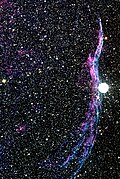
Western Veil Nebula
Observation data: J2000.0 epoch
Right ascension20h 45m 38.0s[1]
Declination+30° 42′ 30″[1]
Distance2,400[2] ly
Apparent magnitude (V)7.0
Apparent dimensions (V)3 degrees (diameter)
ConstellationCygnus
Physical characteristics
Radius50-65[citation needed] ly
DesignationsNGC 6960,[1] 6992,[1] 6995,[1] 6974, and 6979, IC 1340, Cygnus Loop, Cirrus Nebula,[1] Filamentary Nebula,[1] Witch's Broom Nebula (NGC 6960),[3] Caldwell 33/34
See also: Lists of nebulae

The Veil Nebula is a cloud of heated and ionized gas and dust in the constellation Cygnus.[4]

It constitutes the visible portions of the Cygnus Loop,[5] a supernova remnant, many portions of which have acquired their own individual names and catalogue identifiers. The source supernova was a star 20 times more massive than the Sun which exploded between 10,000 and 20,000 years ago.[2] At the time of the explosion, the supernova would have appeared brighter than Venus in the sky, and visible in the daytime.[6] The remnants have since expanded to cover an area of the sky roughly 3 degrees in diameter (about 6 times the diameter, and 36 times the area, of the full Moon).[4] While previous distance estimates have ranged from 1,200 to 5,800 light-years, a 2018 determination of 2,400 light-years is based on direct astrometric measurements.[2] (The distance estimates affect also the estimates of size and age.)

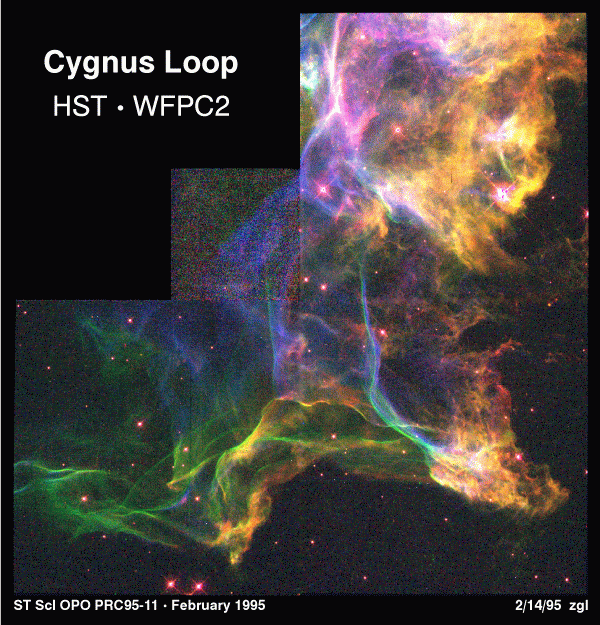
The Hubble Space Telescope captured several images of the nebula. The analysis of the emissions from the nebula indicates the presence of oxygen, sulfur, and hydrogen.[7] The Cygnus Loop is also a strong emitter of radio waves and x-rays.[8]

Components

[edit]
NASA photograph of the Cygnus Loop in ultraviolet light, with labels for well-known features. (25 November 2012)

In modern usage, the names Veil Nebula, Cirrus Nebula, and Filamentary Nebula generally refer to all the visible structure of the remnant, or even to the entire loop itself. The structure is so large that several NGC numbers were assigned to various arcs of the nebula.[9] There are three main visual components:

  • The Western Veil (also known as Caldwell 34), consisting of NGC 6960 (the "Witch's Broom",[10] Lacework Nebula,[8] "Filamentary Nebula"[10]) near the foreground star 52 Cygni;
  • The Eastern Veil (also known as Caldwell 33), whose brightest area is NGC 6992, trailing off farther south into NGC 6995 (together with NGC 6992 also known as "Network Nebula"[11]) and IC 1340;
  • Pickering's Triangle (or Pickering's Triangular Wisp), brightest at the north central edge of the loop, but visible in photographs continuing toward the central area of the loop.

NGC 6974 and NGC 6979 are luminous knots in a fainter patch of nebulosity on the northern rim between NGC 6992 and Pickering's Triangle.[12][13]

Observation

[edit]
George Willis Ritchey image of what he called the Great Nebula in Cygnus (In modern times the Veil Nebula); taken with the two-foot reflecting telescope with 3 hours exposure at the Yerkes Observatory in 1901.

The nebula was discovered on 5 September 1784 by William Herschel. He described the western end of the nebula as "Extended; passes thro' 52 Cygni... near 2 degree in length", and described the eastern end as "Branching nebulosity ... The following part divides into several streams uniting again towards the south."[14]

When finely resolved, some parts of the nebula appear to be rope-like filaments. The standard explanation is that the shock waves are so thin, less than one part in 50,000 of the radius,[15] that the shell is visible only when viewed exactly edge-on, giving the shell the appearance of a filament. At the estimated distance of 2400 light-years, the nebula has a radius of 65 light-years (a diameter of 130 light-years). The thickness of each filament is 150,000th of the radius, or about 4 billion miles, roughly the distance from Earth to Pluto. Undulations in the surface of the shell lead to multiple filamentary images, which appear to be intertwined.

Even though the nebula has a relatively bright integrated magnitude of 7, it is spread over so large an area that the surface brightness is quite low, so the nebula is notorious among astronomers as being difficult to see. However, an observer can see the nebula clearly in a telescope using an O-III astronomical filter (isolating the wavelength of light from doubly ionized oxygen), as almost all light from this nebula is emitted at this wavelength. An 8-inch (200 mm) telescope equipped with an O-III filter shows the delicate lacework apparent in photographs. Smaller telescopes with an O-III filter can show the nebula as well, and some[who?] argue that it can be seen without any optical aid except an O-III filter held up to the eye.[citation needed]

The brighter segments of the nebula have the New General Catalogue designations NGC 6960, 6974, 6979, 6992, and 6995. The easiest segment to find is 6960, which runs behind 52 Cygni, a star that can be seen with the naked eye. NGC 6992 and 6995 are objects on the eastern side of the loop which are also relatively easy to see. NGC 6974 and NGC 6979 are visible as knots in an area of nebulosity along the northern rim. Pickering's Triangle is much fainter and has no NGC number (though 6979 is occasionally used to refer to it). It was discovered photographically in 1904 by Williamina Fleming (after the New General Catalogue was published), but credit went to Edward Charles Pickering, the director of her observatory, as was the custom of the day.

The Veil Nebula is expanding at a velocity of about 1.5 million kilometers per hour. Using images taken by the Hubble Space Telescope between 1997 and 2015, the expansion of the Veil Nebula has been directly observed.[16][17]

See also

[edit]

References

[edit]
[edit]
Revisions and contributorsEdit on WikipediaRead on Wikipedia
from Grokipedia
The Veil Nebula is a prominent supernova remnant in the constellation Cygnus, representing the expanding shell of gas and dust ejected from the explosive death of a massive star approximately 20,000 years ago. Located at a distance of 725 ± 15 parsecs (about 2,365 light-years) from Earth, it forms part of the larger Cygnus Loop structure, with a radius of approximately 18 parsecs (about 59 light-years) and an angular diameter of roughly 3 degrees on the sky, making it visible to the naked eye under dark skies as a faint, hazy arc. Known for its intricate, filamentary wisps of ionized hydrogen, oxygen, and sulfur glowing from shock-heated interactions with the interstellar medium, the nebula exemplifies a middle-aged core-collapse supernova remnant, providing key insights into stellar evolution and cosmic shock dynamics. The nebula's most recognizable sections include NGC 6960 (the ""), a bright arc traversed by a prominent dark lane; NGC 6992 and NGC 6995 (the "East "), featuring elongated, curving filaments; and Pickering's Triangle (NGC 6979), a fainter interior of diffuse emission. These components arise from the supernova's , which propagates at speeds up to 1.5 million kilometers per hour, compressing and exciting ambient gas to produce the observed emissions in optical, , and wavelengths. The progenitor star, estimated at times the Sun's mass, likely carved out a low-density cavity via its prior to exploding, shaping the remnant's irregular morphology. First cataloged in the by astronomers like , the Veil Nebula has been a cornerstone for studying remnants since the mid-20th century, with radio and X-ray observations revealing its full extent as the , a near-complete shell with a diameter of approximately 37 parsecs. Modern imaging from the , including mosaics from 1997 and 2015, has captured its expansion at about 0.05 arcseconds per year, confirming kinematic models of its evolution. As a nearby, well-resolved laboratory for , it aids research into particle acceleration, magnetic fields, and the enrichment of the with heavy elements from the ejecta.

Physical Properties

Dimensions and Distance

The Veil Nebula is situated in the constellation Cygnus at equatorial coordinates of 20h 45m 38.0s and +30° 42′ 30″ (J2000.0). It forms a prominent part of the larger . The distance to the Veil Nebula is 725 ± 15 parsecs (approximately 2,360 light-years) from Earth, determined through Early Data Release 3 parallax measurements of stars projected onto the remnant. Earlier distance estimates varied widely, including about 1,470 light-years from a 1999 study of expansion kinematics and around 2,500 light-years from analyses in the 1930s and 1950s; the 2021 value is preferred for its reliance on direct astrometric distances to multiple associated stars, reducing uncertainties from indirect methods. A 2024 spectroscopic study suggests a broader range of 2,400–2,600 light-years. This nebula exhibits an apparent of about 3° on the . At the established distance, this corresponds to a physical of 50–65 light-years. The overall shell structure expands at roughly 1.5 million km/h, as measured via proper motions of its filaments from images spanning 1997 to 2015.

Composition and Emission

The Veil Nebula, part of the Cygnus Loop supernova remnant, primarily consists of ionized interstellar gas swept up by the expanding , with key elements including , oxygen, , , , iron, and carbon. The gas exhibits low , with abundances of carbon, , and oxygen approximately 0.44 times solar values in many regions, reflecting the composition of the pre-supernova rather than enriched ejecta. Dust grains, including silicates and , are present but partially disrupted by shocks, liberating at least 50% of the into the gas phase. Emission in the Veil Nebula arises from optically thin, filamentary structures where the supernova , propagating at speeds around 1.5 million km/h, collides with denser gas, exciting atoms through collisions and causing them to radiate as they return to lower states. In the radio , continuum emission originates from produced by relativistic electrons spiraling in magnetic fields within the shocked regions. emission stems from highly ionized plasma heated to temperatures exceeding 10^6 K (about a million degrees ) by these shocks, revealing clumpy, limb-brightened structures. The nebula's visible glow is dominated by forbidden emission lines from singly and doubly ionized atoms, which are prominent due to the low densities preventing collisional de-excitation. Key lines include those from oxygen, which produce the characteristic green hues, and , contributing red filaments. The table below lists major optical emission lines observed in the Veil Nebula, along with their wavelengths and associated elements.
ElementLineWavelength (nm)
H I656.3
O III[O III]500.7
S II[S II]671.7
S II[S II]673.0
These lines were mapped using narrowband filters in observations, highlighting structural variations across the remnant. Across other wavelengths, the Veil Nebula shows emission from warm dust grains (temperatures around hundreds of K) heated by the shock, as detected by the Spitzer and telescopes, tracing interactions with the surrounding medium. emission arises from hot, ionized gas, observed via far-UV that reveals previously undetected atomic features from iron and . No significant molecular content is present, as the high temperatures and maintain the gas in an atomic or ionic state throughout the remnant.

Formation and Evolution

Supernova Progenitor

The Veil Nebula, known scientifically as the , resulted from the core-collapse explosion of a massive with an estimated initial mass of approximately 15 solar masses. This underwent advanced stages of nuclear burning, culminating in the collapse of its iron core and the ejection of enriched layers containing heavy elements such as oxygen, , and . The presence of these metals in the remnant's plasma, with abundances inconsistent with Type Ia events, confirms the event as a rather than a thermonuclear in a . The progenitor may have been isolated or part of a binary system. Evidence for a possible binary origin includes candidate runaway stars identified via Gaia astrometry, which could represent a surviving companion ejected during the explosion. The supernova occurred approximately 20,000 years ago, predating historical astronomical records, though its peak brightness at the remnant's distance would have reached an apparent magnitude of around -7, making it highly visible to the naked eye had it happened in recent millennia. The imparted a of roughly 6×10496 \times 10^{49} to 8×10498 \times 10^{49} ergs to the surrounding , notably lower than the canonical 105110^{51} ergs for typical core-collapse events, consistent with a relatively low-mass and a low-density circumstellar environment. No central , such as a pulsar-powered or , has been detected at the remnant's geometric center despite extensive radio, , and gamma-ray surveys. This absence implies an asymmetric mechanism, possibly involving rapid rotation or strong magnetic fields, which imparted a natal "kick" velocity of several hundred km/s to the remnant, displacing it from the site.

Age and Expansion Dynamics

The Veil Nebula, as part of the supernova remnant, has an estimated age of 17,000 to 25,000 years (as of 2024), derived from expansion measurements, , and models that account for the lack of detectable light echoes or historical supernova sightings from . This range aligns with the remnant's middle-aged status and is supported by recent distance revisions to approximately 750 pc using and high-resolution . However, some earlier dynamical analyses based on and suggest a younger age of 5,000 to 8,000 years, highlighting ongoing discrepancies in modeling the blast wave's interaction with the surrounding cavity. The preferred 17,000–25,000-year estimate provides a consistent framework for the remnant's observed size and velocity profile. The expansion dynamics of the Veil Nebula are governed by the Sedov-Taylor phase, a self-similar adiabatic evolution where the shock front decelerates as it sweeps up interstellar material, transitioning toward the radiative phase due to increased cooling. Recent observations indicate the remnant is entering the radiative phase, with shell fragments moving radially at velocities of 100–200 km/s, and an average radial expansion rate of about 115 km/s, as measured from optical and observations of the 's interaction with the nonuniform ambient medium. This phase reflects the remnant's energy distribution, where the initial explosion's is gradually thermalized, driving the filamentary structures observed in the nebula. Kinematic models, informed by proper motion surveys of optical filaments, reveal a non-uniform expansion pattern, influenced by density variations in the interstellar medium and possible progenitor wind cavity. In homologous expansion approximations, the radial velocity vv relates to the distance rr from the explosion center and the age tt via the relation v=rt,v = \frac{r}{t}, which holds for the early free-expansion dominance but adjusts in the Sedov-Taylor regime to account for deceleration. The nebula's hot gas is cooling and recombining while interacting with the interstellar medium, leading to projected dispersal and mixing over the next 10,000–50,000 years as the remnant fades into the galactic ecosystem.

Structure and Components

Western Veil

The Western Veil, designated NGC 6960 and commonly known as the "," is a prominent filamentary structure within the Veil Nebula complex, spanning approximately 2° by 1° in angular extent and positioned near the foreground star 52 Cygni, which serves as a useful visual reference for locating it in the constellation Cygnus. This component appears as a sweeping, curved arc of glowing gas, evoking the shape of a or sweeping tendrils, with intricate bright ridges interspersed by darker lanes caused by dust absorption. Its morphology is characterized by a network of thin, tangled filaments that resemble a crumpled sheet viewed edge-on, where brighter segments highlight regions of denser material interacting with the expanding . These filaments exhibit a mix of large-scale arcs and finer, small-scale structures, with the overall form curving gracefully across the field of view. The emission is predominantly in the Hα line, reflecting the of by the shock-heated gas, though the nebula's composition is broadly dominated by such line emission across the Veil complex. Darker absorption features, including prominent lanes, interrupt the brightness, creating a lace-like contrast that enhances its intricate appearance. NGC 6960 displays elevated in Hα compared to other wavelengths, underscoring the efficiency of radiative shocks in this region. It is also associated with distinct radio and hotspots, arising from interactions between the remnant's shock front and localized dense clouds, which amplify non-thermal emission in radio and thermal in X-rays. These hotspots, particularly evident west of the main arc, indicate areas of enhanced particle acceleration and heating.

Eastern Veil and Pickering's Triangle

The Eastern Veil comprises the prominent arcs designated NGC 6992 and NGC 6995, collectively referred to as the Network Nebula or Filamentary Nebula due to their intricate, web-like appearance. These structures consist of thin, tangled filaments of ionized gas and dust, glowing from collisionally excited oxygen and other elements, and span approximately 2 degrees across the sky in the constellation Cygnus. The filaments exhibit a mix of sharp, edge-on shock fronts and more diffuse, face-on regions, with prominent tendril-like protrusions highlighting the dynamic interaction of the expanding remnant with surrounding . Adjacent to the Eastern Veil lies Pickering's Triangle (also known as Fleming's Triangular Wisp), a subtler, triangular expanse centered on the NGC 6979 region, marked by its faint, diffuse nebulosity and low surface brightness that challenges visual detection. This feature was discovered photographically in 1904 by at the Observatory and named in honor of its director, , though modern references often credit Fleming directly. Unlike the bolder arcs of the Eastern Veil, Pickering's Triangle presents a hazy, low-contrast glow, representing a less dense portion of the remnant's shell where emission is primarily from broader shock interactions. Together, the Eastern Veil and Pickering's Triangle form interconnected fragments of the Cygnus Loop's expanding shell, with gradients in gas density creating overlapping tendrils and variable brightness across their shared boundary. X-ray observations highlight bright knots in the eastern sections, such as the XA region, where the shock collides with dense molecular clouds, heating gas to millions of degrees and producing intense thermal emission. These knots trace recent shock propagation, contrasting with the optical filaments and revealing hotter, interior dynamics. NGC 6974 stands out as a luminous northern patch bridging the arcs and triangle, featuring enhanced emission knots suggestive of localized density enhancements within the remnant. Expansion rates observed in these eastern components, typically around 0.11 arcseconds per year, underscore their ongoing evolution as part of the larger structure.

Observation and Study

Historical Discovery

The Veil Nebula was discovered on September 5, 1784, by British astronomer during his systematic survey of the night sky using an 18.7-inch . He identified several distinct patches of faint, irregular nebulosity in the constellation Cygnus, describing them as separate objects without resolvable stars and cataloging them as h 19 (the southwestern arc), h 20 (a small knot), h 21 (the northeastern arc), h 22, h 23, and h 24 (filamentary extensions). These observations were later formalized in the compiled by J. L. E. Dreyer and published in 1888, where the features received the designations NGC 6960 (the prominent western arc, also known as the ), NGC 6979 (a compact emission region), NGC 6992 (the eastern arc), and NGC 6995 (a faint southeastern extension). Herschel's son, , contributed to early visual studies during his observations in the 1830s from , , producing detailed sketches that highlighted the nebula's delicate, lace-like filaments and irregular boundaries, though the object's low made it challenging even with larger telescopes. The first photographic records of the Veil Nebula emerged in 1901, captured by American astronomer George Willis Ritchey at in Williams Bay, . Employing the observatory's new 24-inch (61 cm) , Ritchey obtained a groundbreaking three-hour exposure on a glass photographic plate of the western section (NGC 6960), which he termed the "Great Nebula in Cygnus." This image dramatically revealed the intricate network of glowing filaments and dark lanes, far surpassing the resolution of earlier visual drawings and confirming the object's complex morphology._(17813060474).jpg) By the mid-20th century, the Veil Nebula was recognized as a fragment of the larger structure, identified as a through combined optical and radio investigations. Early radio detections in the early 1950s mapped strong, extended non-thermal emission coinciding with the optical features, suggesting a unified expanding shell from a stellar explosion. Initial distance estimates placed the remnant at approximately 800 light-years (250 parsecs). A key milestone came from spectroscopic observations by Rudolf Minkowski in the 1950s, who analyzed emission lines from the bright rims of NGC 6960 and NGC 6992 using the 100-inch telescope at . These spectra showed high-velocity Doppler shifts indicative of radial expansion at about 116 km/s, providing direct evidence of the nebula's dynamical evolution as supernova interacting with interstellar gas. Integrating these velocities with historical proper motion data from Edwin Hubble's 1920s measurements, Minkowski derived an age of roughly 11,000 years for the explosion, solidifying the Veil's status as a prototypical .

Modern Imaging and Measurements

Modern imaging of the Veil Nebula has been revolutionized by space-based observatories, providing unprecedented detail on its filamentary structures and dynamic evolution. The (HST) first captured detailed images of three sections of the nebula in 1997, revealing intricate oxygen- and sulfur-rich filaments glowing in the aftermath of the supernova. Subsequent HST observations in 2015 enhanced these views with higher resolution, combining broadband and narrowband data to highlight the nebula's complex morphology. In February 2025, HST released a new colorful composite image, integrating , optical, and near-infrared wavelengths to showcase the nebula's vibrant hues and subtle details, such as fine wisps and knots along the expanding shell. These images not only illustrate the nebula's scale—spanning about 3 degrees on the sky—but also enable direct comparison over decades to track structural changes. Complementary X-ray observations from the have mapped the hot plasma within the Veil Nebula, revealing regions where shock waves have heated interstellar gas to over a million degrees . data, including a 3D model released in April 2025, depict the distribution of this superheated material, primarily in the northeastern and southwestern arcs, where X-ray emission traces the interaction between the and surrounding medium. These observations confirm the presence of multimillion-degree plasma filling cavities within the remnant, providing insights into the energy distribution and cooling processes not visible in optical light. Key observational techniques have improved the detection of the Veil Nebula's faint emission. In optical wavelengths, O III narrowband filters are essential for enhancing visibility, as they isolate the [O III] 500.7 nm line dominant in the nebula's ionized gas, dramatically increasing contrast against the sky background. Radio with the () has mapped the non-thermal emission from relativistic electrons spiraling in magnetic fields, delineating the shell's overall structure at centimeter wavelengths and revealing extensions beyond the optical boundaries. While the (JWST) holds potential for infrared observations to probe cooler dust and molecular components, no major dedicated datasets for the Veil Nebula were available as of 2025, with focus remaining on HST's updates. Measurements from these modern datasets include expansion tracking via proper motion analysis. By comparing HST images from 1997 and 2015, astronomers measured an angular expansion rate of approximately 0.03 arcseconds per year for the bright eastern and western filaments, consistent with kinematic models of the remnant's outward motion. Surface brightness variations across the nebula range from brighter arcs (around 20 mag/arcsec² in O III) to fainter extensions, reflecting uneven gas and ; the overall integrated magnitude is about 7.0, but the low average (near 22 mag/arcsec²) makes detailed mapping challenging without advanced instrumentation. The 2025 HST image particularly highlights evolutionary changes in filament details over nearly three decades, such as subtle shifts in brightness and structure due to ongoing expansion. Observing the Veil Nebula presents significant challenges due to its low , requiring with minimal for optimal visibility. Telescopes of 8-inch or larger, paired with O III or ultra-high-contrast (UHC) filters, are recommended to resolve the filaments; under such conditions, the nebula appears as a delicate network of arcs best seen in .

References

Add your contribution
Related Hubs
User Avatar
No comments yet.