Hubbry Logo
NeedlefishNeedlefishMain
Open search
Needlefish
Community hub
Needlefish
logo
8 pages, 0 posts
0 subscribers
Be the first to start a discussion here.
Contribute something
Needlefish
Needlefish
from Wikipedia

Needlefish
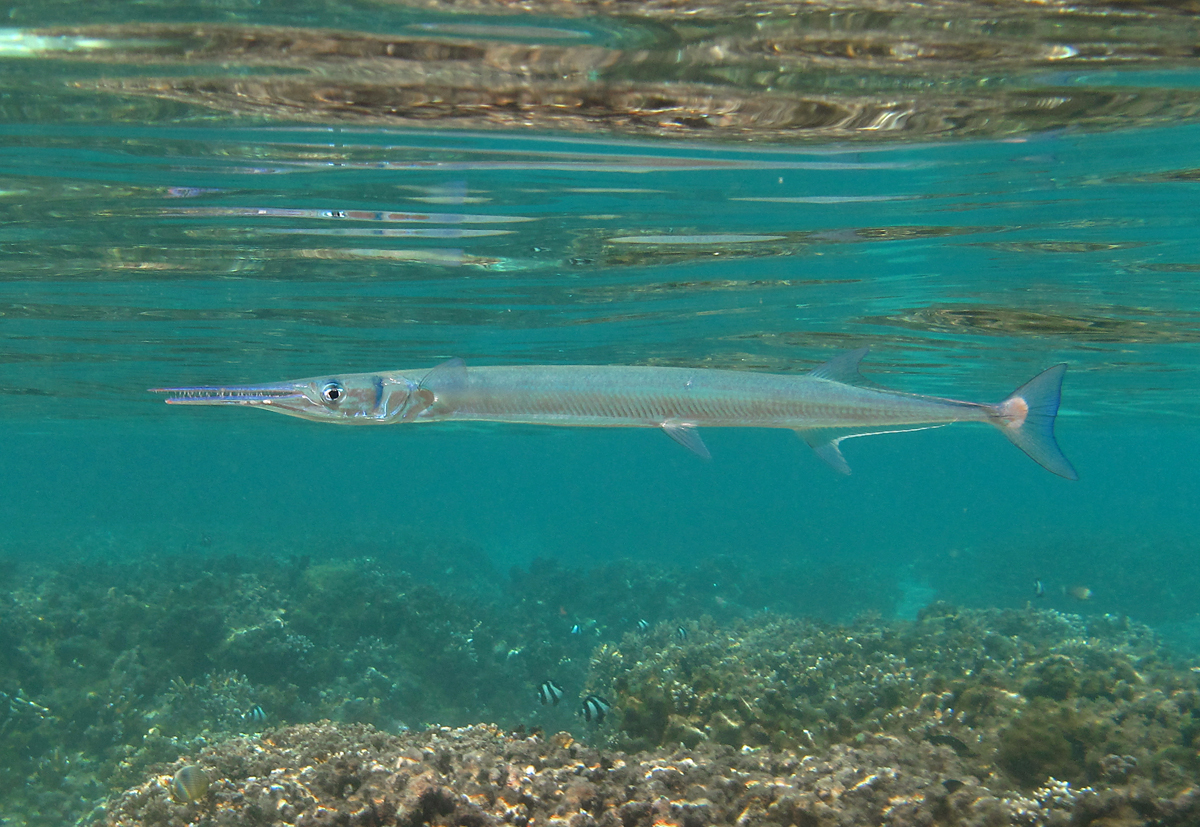
Tylosurus crocodilus
Scientific classification Edit this classification
Kingdom: Animalia
Phylum: Chordata
Class: Actinopterygii
Order: Beloniformes
Superfamily: Scomberesocoidea
Family: Belonidae
Bonaparte, 1832[1]
Genera

Ablennes
Belone
Belonion
Petalichthys
Platybelone
Potamorrhaphis
Pseudotylosurus
Strongylura
Tylosurus
Xenentodon

Needlefish (family Belonidae) or long toms[2] are piscivorous fishes primarily associated with very shallow marine habitats or the surface of the open sea. Some genera include species found in marine, brackish, and freshwater environments (e.g., Strongylura), while a few genera are confined to freshwater rivers and streams, including Belonion, Potamorrhaphis, and Xenentodon.[3] Needlefish closely resemble North American freshwater gars (family Lepisosteidae) in being elongated and having long, narrow jaws filled with sharp teeth, and some species of needlefishes are referred to as gars or garfish despite being only distantly related to the true gars. In fact, the name "garfish" was originally used for the needlefish Belone belone in Europe and only later applied to the North American fishes by European settlers during the 18th century.[4]

Description

[edit]

Needlefish are slender, ranging from 3.0 to 95 cm (1.2 to 37.4 in) in length. They have a single dorsal fin, placed far back on the body, almost opposite to the anal fin. Their most distinctive feature is their long, narrow beak, which bears multiple sharp teeth. In most species, the upper jaw reaches its full length only in adults, so the juveniles have a half-beak appearance, with an elongated lower jaw, but a much smaller upper one. During this stage of their lifecycle, they eat plankton, switching to fish once the beak fully develops. Needlefish reproduce through mating and laying eggs. The male usually rides the female on the waves as they mate.[5]

Needlefish are most common in the subtropics, but some inhabit temperate waters, as well, particularly during the winter. Belone belone, a common North Atlantic species, often swim in schools alongside tuna. Recently, some small specimens have been seen in the Mediterranean Sea.

Ecology

[edit]
A hunting needlefish

All needlefish feed primarily on smaller fish.[6] In addition, some species also take krill,[citation needed] swimming crustaceans,[7] small cephalopods[citation needed] and insects.[8]

Needlefish have been documented in taking advantage of Snell's Window when attacking prey; leaping at a shallow angle to ambush schools of small fish. Due to light refraction through water, objects at the edges of the window appear distorted, disrupting the image of the leaping needlefish and allowing it to get within very short distances of its prey.[9]

Danger to humans

[edit]
A needlefish being cleaned by cleaner wrasse, Labroides phthirophagus.

Needlefish, like all ray-finned beloniforms, are capable of making short jumps out of the water at up to 60 km/h (37 mph). Since needlefish swim near the surface, they often leap over the decks of shallow boats rather than going around. This jumping activity is greatly excited by artificial light at night; night fisherman and divers in areas across the Pacific Ocean have been "attacked" by schools of suddenly excited needlefish diving across the water towards the light source at high speed. Their sharp beaks are capable of inflicting deep puncture wounds, often breaking off inside the victim in the process. For many traditional Pacific Islander communities, who primarily fish on reefs from low boats, needlefish represent an even greater risk of injury than sharks.[10]

Occasional deaths and serious injuries have been attributed to needlefish. They include the following documented incidents:

  • In 1977, a 10-year-old Hawaiian boy, night fishing with his father at Hanamaulu Bay, Kauaʻi, was killed when a 1.0-to-1.2-metre-long (3.3 to 3.9 ft) needlefish jumped from the water and pierced his eye and brain.[11]
  • In 2007, a 16-year-old Vietnamese boy was stabbed through the heart by the 15 cm (5.9 in) beak of a needlefish while diving for sea cucumbers at night near Halong Bay.[12]
  • In 2010, a kayaker in Florida was nearly killed when a crocodile needlefish (houndfish, Tylosurus crocodilus) leapt from the water and impaled her in the chest.[13][14]
  • In 2012, German kitesurfer Wolfram Reiners was seriously wounded in the foot by a needlefish near the Seychelles.[15][16]
  • In May 2013, a kitesurfer in Egypt's Red Sea was speared directly under his knee when a needlefish jumped out of the water.[17]
  • In October 2013, a Saudi Arabian news website also reported the death of a young Saudi man in Dammam who died of hemorrhaging after being hit by a needlefish on the left side of the neck.[18]
  • In 2014, a Russian tourist was nearly killed by a needlefish off Nha Trang in Vietnam. The fish bit her neck and left pieces of its teeth inside her spinal cord, paralyzing her.[19][20]
  • In early January 2016, a 39-year-old Indonesian woman from Palu, Central Sulawesi, was seriously injured when a half-metre-long needlefish jumped and pierced her just above the right eye. She was swimming in water 80 cm deep in Tanjung Karang, a popular recreational spot in the Donggala Regency, Central Sulawesi. She died a few hours later despite efforts to save her at a local hospital. Shortly after, pictures of her injury spread through instant-messaging applications, while several local news websites also reported the incident, some erroneously attributing the attack to a marlin.[21][22]
  • In December 2018, a needlefish struck the neck of a Thai Navy special forces cadet, causing his death.[23]
  • In April 2024, a 59-year old Filipino fisherman off the coast of Iloilo, Panay Island, Philippines, was pierced in the stomach by a needlefish (locally known as balo) jumping out of the water. He was rushed to a nearby hospital but was declared dead on arrival due to hemorrhage.[24]
  • In October 2024, an Italian surfer died in Indonesia after being impaled in her upper left chest by a needlefish.[25]

In the aquarium

[edit]
X-ray of a needlefish

Some species of needlefish inhabit brackish and freshwater environments, and one of the freshwater species, Xenentodon cancila from Southeast Asia, is occasionally kept as an aquarium fish. It is a relatively small species, no more than 40 cm in length when fully grown, but is considered to be a rather delicate fish best suited to advanced aquarists.[26]

Taxonomy

[edit]

The needlefish family is classified within the order Beloniformes and along with the sauries of the family Scomberesocidae they make up the superfamily Scomberesocoidea and in turn, is one of two superfamilies in the suborder Exocoetoidei which comprises all of the Beloniformes except for the ricefishes of the family Adrianichthydae. Workers have concluded that the genus Belone is the sister group to the sauries and that if this is correct them the Belonidae is only monophyletic if the sauries are included within it.[27]

References

[edit]
[edit]
Revisions and contributorsEdit on WikipediaRead on Wikipedia
from Grokipedia
Needlefishes (family Belonidae) are a group of approximately 49 species of elongate, carnivorous ray-finned fishes in the order , renowned for their slender bodies and elongated, beak-like jaws lined with sharp teeth that function as specialized tools for capturing prey. These surface-oriented predators inhabit tropical and temperate marine, brackish, and freshwater environments worldwide, often leaping out of the water to evade threats or pursue food. The family comprises 10 genera, including prominent ones such as Strongylura, Tylosurus, and Belone, with species ranging in maximum length from 7 cm to over 2 m, though most are under 1 m. Their bodies are streamlined and cylindrical to slightly compressed, covered in small scales, with a metallic green or blue dorsum and silvery white ventral side for in open water; the dorsal and anal fins are positioned posteriorly for rapid bursts of speed, while pectoral fins are short. No fin spines are present, and the jaws are notably extended, with the lower jaw often slightly longer than the upper in adults. Needlefishes are primarily found in coastal and pelagic waters, from shallow reefs and estuaries to the open ocean surface, with some exhibiting diadromous migrations between saltwater and freshwater systems. They are distributed pantropically but extend into subtropical and temperate zones, with higher diversity in the region; for example, the Atlantic needlefish (Strongylura marina) occurs along the western Atlantic coasts, entering brackish rivers and canals. Ecologically, needlefishes are ambush predators that feed mainly on small schooling fishes, crustaceans, and squid, using their needle-like beaks to slash or impale prey sideways before consuming it whole. They reproduce by broadcasting nonguarded eggs adorned with sticky filaments that entangle in vegetation or debris, facilitating adhesion in their dynamic habitats; juveniles often form schools for protection. Their leaping behavior, while adaptive, poses risks to humans, as high-speed jumps near boats or shores can cause serious injuries from the sharp beaks. Commercially, some species are fished for food or bait in tropical regions, though overexploitation has impacted populations in certain areas.

Physical Characteristics

Body Morphology

Needlefish, belonging to the family Belonidae, exhibit a highly specialized elongated, cylindrical that optimizes hydrodynamic efficiency for rapid movement through surface waters. This streamlined form tapers gradually from a relatively deep anterior region to a slender posterior, facilitating high-speed pursuits of prey near the water's surface. The most distinctive feature is the beak-like , formed by the pronounced elongation of both the upper and lower jaws, which can extend up to half the body length in some species; these jaws are lined with numerous sharp, needle-like teeth adapted for grasping small, agile . The positioning of the fins further enhances the needlefish's acceleration capabilities. A single and an anal fin are located far posteriorly on the body, often near the caudal peduncle, with ray counts typically ranging from 11–43 for the dorsal and 12–39 for the anal; this rearward placement allows for powerful bursts of speed by leveraging undulations while minimizing drag from anterior structures. Pectoral fins are short and low on the body, and pelvic fins occupy an abdominal position, all without spines to maintain a smooth profile. These adaptations collectively enable anguilliform locomotion, where body undulations propagate from head to for efficient propulsion. The body is covered in small, scales that are easily detached, which serves to reduce frictional drag during swimming. These scales contribute to the overall sleek exterior, promoting over the body surface. Internally, needlefish possess a physostomous connected to the digestive tract via a pneumatic duct, allowing rapid adjustment of gas volume for precise control in shallow, surface-oriented habitats. Coloration patterns, such as silvery flanks, briefly enhance in open water but are secondary to these structural traits.

Size and Coloration

Needlefish in the family Belonidae exhibit a wide range of adult body sizes, with most species reaching lengths of 30 to 100 cm total length (TL), though extremes occur across the approximately 50 species. Smaller representatives, such as certain freshwater forms, may only attain 10-20 cm, while larger marine species commonly exceed 1 m. For instance, the hound needlefish (Tylosurus crocodilus) is among the largest, with a maximum recorded length of 150 cm TL. The coloration of needlefish is adapted for their surface-dwelling , featuring a silvery-blue or greenish dorsum that fades to white or silver on the sides and ventral surface, providing camouflage against the underwater from above and blending with the bright surface light from below. This pattern enhances concealment in open water, where their elongate further minimizes visibility to predators and prey. Many also display a thin dark lateral stripe running along the body, aiding in species identification and additional disruptive . Fin coloration varies among species, often with subtle markings that contribute to overall or species distinction; for example, some exhibit dark edges on the dorsal and caudal fins, while others like the redfin needlefish (Strongylura notata) show pink to orange hues in the dorsal, anal, and caudal fins. Sexual dimorphism in size is common, with females typically larger than males in many species, potentially linked to greater reproductive investment.

Habitat and Distribution

Geographic Range

Needlefish of the family Belonidae are distributed worldwide, primarily inhabiting tropical and temperate marine waters across the Atlantic, Indian, and Pacific Oceans. Their range encompasses coastal and open ocean environments, with the greatest diversity and abundance occurring in warm oceanic regions. In the , needlefish are particularly common along coastal zones, extending their presence into the through via the , where certain species have established populations as non-indigenous introductions. This expansion highlights the family's adaptability to connected waterways, allowing dispersal from the into basins. Recent studies (as of 2024) have described two new Ablennes species in the , further highlighting diversity in this region. While predominantly marine, some belonid species occupy freshwater and brackish habitats; for instance, the Asian needlefish is native to rivers and streams in . Occurrences in temperate waters are rarer, with some species exhibiting diadromous migrations between marine and freshwater or estuarine systems.

Environmental Preferences

Needlefish, belonging to the family Belonidae, primarily inhabit surface waters of shallow coastal areas, including reefs and mangroves, where they rarely venture deeper than 10 meters. These exhibit a strong association with epipelagic zones, often skimming the water's surface in open seas or sheltered lagoons, which facilitates their predatory lifestyle. They demonstrate remarkable tolerance for varying salinities, thriving in full marine conditions as well as estuarine and brackish environments, with certain species like Strongylura marina capable of entering freshwater habitats. This adaptability allows needlefish to exploit diverse aquatic interfaces, from oceanic shallows to river mouths. Most tropical needlefish species prefer temperatures ranging from 20°C to 30°C, while temperate species tolerate cooler waters down to about 8°C, which aligns with their global distribution in sunlit, clear waters essential for their visual . Their activity patterns are often nocturnal or crepuscular, particularly in open seas, where low levels enhance their ability to detect prey near the surface while minimizing exposure to diurnal predators. This is tied to ambient conditions, with increased surfacing and leaping observed at night, especially around artificial lights.

Behavior and Ecology

Feeding and Predation

Needlefish, belonging to the family Belonidae, exhibit a primarily piscivorous diet, targeting smaller fish such as (Mugilidae), gobies (Gobidae), and other belonids near the water's surface, supplemented by crustaceans like penaeid and decapods, and occasionally cephalopods. In studies of Mediterranean populations, teleosts constitute about 62.6% of the diet by index of relative importance (IRI), while crustaceans account for 37.3%, with juveniles showing a preference for smaller prey like copepods before shifting to fish as adults. Amazonian species display similar opportunism, consuming characins and alongside in smaller taxa like Belonion apodion. This surface-oriented feeding reflects their elongate body morphology and well-developed , enabling vertical migrations to exploit pelagic and near-surface resources. Their hunting strategy relies on high-speed bursts, often culminating in aerial leaps to impale prey on their needle-like jaws lined with sharp teeth, extending attack ranges from under 50 cm in water to over 2 m in air. Species like Tylosurus exploit Snell's Window—an optical phenomenon that limits underwater visibility of the surface—to approach schools of small fish (e.g., Atherinomorus vaigiensis) undetected, launching ballistic attacks at angles below 30° to disrupt cohesion and target individuals. These leaps, reaching speeds up to 65 km/h, allow decapitation or impalement of prey, which is then swallowed whole, with some species like Pseudotylosurus microps using head-first strikes for precision. Juveniles often school in sheltered areas for protection against predators, transitioning to more solitary or small-group hunting as adults to pursue mobile prey effectively. As mid-level predators in coastal and estuarine food webs, needlefish prey on plankton-feeding small and , linking benthic and pelagic communities while evading larger piscivores such as tunas, dolphins, and seabirds. Their opportunistic role helps regulate populations of bait and crustaceans, though they themselves fall prey to apex predators, maintaining trophic balance in tropical and temperate marine ecosystems.

Reproduction and Development

Needlefish in the family Belonidae exhibit , with reproduction occurring through batch spawning in open water. Spawning aggregations often form during specific lunar phases, particularly around the full or new moon in tropical species, facilitating synchronized release of gametes in coastal or nearshore areas. This surface-oriented behavior aids dispersal of eggs and larvae in pelagic environments. Females typically produce 10,000 to 50,000 eggs per spawning batch, though numbers can vary by and ; for instance, in Tylosurus acus melanotus, batch ranges from about 1,000 to 25,000 eggs, while absolute reaches up to 168,000 in larger individuals. These eggs feature adhesive filaments or tendrils that enable attachment to floating debris, vegetation, or other substrates, promoting survival by elevating them above predators. No is provided post-spawning, leaving eggs and early larvae vulnerable to environmental conditions. Upon hatching, needlefish larvae emerge as yolk-sac stages, measuring 9–14 mm in length with large eyes and an open mouth, rapidly depleting the yolk reserve over the initial phase. Development progresses through distinct larval and juvenile phases, characterized by morphological changes such as elongation of the jaws, fin ray formation, and pigmentation patterns that aid in . Growth is notably rapid, transitioning to juveniles within weeks to months as larvae feed on and small prey. Sexual maturity is generally attained at 1–2 years of age, depending on and environmental factors, with females often maturing slightly later than males. Breeding peaks seasonally during warmer months, such as late spring to summer in temperate and subtropical regions, aligning with optimal temperatures for gonadal development and larval survival. In tropical areas, spawning may occur more continuously but still shows lunar-timed pulses.

Taxonomy and Phylogeny

Classification

Needlefish are classified in the family Belonidae, which belongs to the order and suborder Belonoidei. The family encompasses approximately 10 genera and around 49 species, characterized by their piscivorous habits and association with marine and brackish environments. Within the order , Belonidae shares close phylogenetic relations with the halfbeaks of the family Hemiramphidae and the flyingfishes of the family Exocoetidae, all of which exhibit adaptations for surface-dwelling lifestyles such as elongated bodies and posterior fin placements. These families collectively form part of the broader Belonoidei suborder, distinguished from the other suborder Adrianichthyoidei by features like the presence of elongated jaws in adults. Historically, the of needlefish underwent shifts to separate them from the of the family Lepisosteidae, with which they were once conflated due to superficial resemblances in body elongation and morphology; however, Belonidae are differentiated by their beak-like jaws filled with sharp teeth, scales, and lack of heavy ganoid armor. This distinction was solidified through , emphasizing differences in extension and fin structure. Key diagnostic traits defining Belonidae include an elongate, streamlined body; a symmetrical homocercal caudal ; and a that originates near the pectoral and runs along the ventral margin of the body. These features, combined with the absence of fin spines and posteriorly positioned dorsal and anal fins, underpin their and highlight adaptations for rapid surface swimming.

Species Diversity

The family Belonidae encompasses 49 recognized species distributed across 10 genera, reflecting a moderate level of diversity within the order . The genus Strongylura, with 14 species, is the most speciose, followed by Tylosurus (8 species) and Xenentodon (2 species), while the remaining genera are monotypic or contain few species; these include Ablennes, Belone, Belonion, Petalichthys, Platybelone, Potamorrhaphis, and Pseudotylosurus. Most species are marine, though several inhabit freshwater or estuarine environments, particularly in and . Notable species include the Atlantic needlefish (Strongylura marina), a widespread coastal predator in the Western Atlantic reaching lengths of up to 140 cm, and the hound needlefish (Tylosurus crocodilus), a large Indo-Pacific species that can exceed 2 m and is known for its aggressive surface hunting. The freshwater Asian needlefish (Xenentodon cancila), native to rivers and streams in South and Southeast Asia, represents an adaptation to inland habitats and grows to about 40 cm. Invasive populations have emerged outside native ranges, such as in Hawaiian waters, where it was introduced around and preys on local fish like introduced , potentially disrupting aquatic ecosystems. is evident in certain regions, including the , where species like the Red Sea houndfish (Tylosurus choram) are restricted, contributing to localized hotspots. Size variations among underscore their ecological roles, from diminutive freshwater forms around 7 cm to large oceanic predators over 2 m.

Human Interactions

Risks to Humans

Needlefish pose risks to humans primarily through their ability to leap out of the at high speeds, reaching up to 60 km/h, which can result in penetrating injuries from their elongated, beak-like jaws. These often occur when needlefish are startled or pursuing prey near the surface, leading to of the head, neck, torso, or limbs in people nearby. Documented cases include severe penetrating wounds to the , spine, , and cervical region, with injuries appearing deceptively minor externally but potentially causing significant internal damage such as organ or neurological impairment. Fatalities from needlefish impalements, though rare, have been recorded in more than 13 instances worldwide. A notable historical case occurred in 1977, when a 10-year-old boy in was killed during a nighttime trip after a needlefish pierced his eye and . More recently, in October 2024, Italian surfer Giulia Manfrini died after being impaled in the chest by a sharp-billed (reported as either a needlefish or ) while she was surfing off the coast of , . These events highlight the potential lethality, particularly when the penetrates vital areas like the , major blood vessels, or heart. The risk is greatest for swimmers, fishers, and boaters in tropical and subtropical coastal waters, especially at or night when needlefish are more active near the surface and attracted to lights or silhouettes. Incidents are more common in regions like the and , where needlefish populations are abundant, and activities such as night fishing or increase exposure. Leaping , often triggered by evading predators or , contributes to these unpredictable encounters. Medical management of needlefish injuries focuses on immediate irrigation and to remove fragments of the , which can harbor marine bacteria and lead to severe infections if retained. Broad-spectrum antibiotics targeting marine pathogens, such as species, are essential, often combined with surgical exploration for deep punctures to prevent complications like , abscesses, or systemic . In cases involving the eye, , or spine, multidisciplinary care including and possible operative intervention is required to address potential vascular or neurological threats.

Captivity and Fisheries

Needlefish species, particularly those in the genus Xenentodon, present significant challenges for due to their large adult size, often exceeding 1 meter in length, and their predatory behavior, which can lead to aggression toward smaller or in shared enclosures. These traits necessitate expansive tanks with high , strong , and secure lids to accommodate their active swimming and jumping tendencies, rendering them unsuitable for most home aquariums. Instead, they are more appropriately housed in large public aquariums, where specialized setups can mimic their natural coastal or brackish environments and provide sufficient space to reduce stress. In commercial fisheries, needlefish are targeted primarily in and the regions for food, often grilled, smoked, or fried in local cuisines. Historical data from the (FAO) indicate annual catches of needlefishes ranging from 32,900 to 39,400 tons in the Western Central Pacific during the early , highlighting their economic value in small-scale and artisanal operations. Their abundance near shorelines facilitates capture using gillnets, cast nets, or hook-and-line methods, contributing to regional protein sources despite limited global trade. Due to their widespread distribution and ease of capture from piers, jetties, or shallow waters using simple lures or baits, needlefish serve as popular live or cut bait in sport fishing for larger predators like and . This utilization underscores their ecological role as prey while supporting recreational without significant dedicated harvest efforts. Most needlefish species are assessed as Least Concern by the International Union for Conservation of Nature (IUCN), reflecting stable populations across their tropical and subtropical ranges. However, localized threats include in coastal fisheries and habitat degradation from loss due to development and , which impacts juvenile nurseries for several . Freshwater needlefish, such as , may also face management as potential in non-native waterways, with ecological risk screenings recommending monitoring to prevent establishment outside their native Southeast Asian habitats.

References

Add your contribution
Related Hubs
Contribute something
User Avatar
No comments yet.