
Objective-collapse theory
View on Wikipedia| Part of a series of articles about |
| Quantum mechanics |
|---|
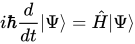
Objective-collapse theories, also known spontaneous collapse models[1] or dynamical reduction models,[2] are proposed solutions to the measurement problem in quantum mechanics.[3] As with other interpretations of quantum mechanics, they are possible explanations of why and how quantum measurements always give definite outcomes, not a superposition of them as predicted by the Schrödinger equation, and more generally how the classical world emerges from quantum theory. The fundamental idea is that the unitary evolution of the wave function describing the state of a quantum system is approximate. It works well for microscopic systems, but progressively loses its validity when the mass / complexity of the system increases.
In collapse theories, the Schrödinger equation is supplemented with additional nonlinear and stochastic terms (spontaneous collapses) which localize the wave function in space. The resulting dynamics is such that for microscopic isolated systems, the new terms have a negligible effect; therefore, the usual quantum properties are recovered, apart from very tiny deviations. Such deviations can potentially be detected in dedicated experiments, and efforts are increasing worldwide towards testing them.
An inbuilt amplification mechanism makes sure that for macroscopic systems consisting of many particles, the collapse becomes stronger than the quantum dynamics. Then their wave function is always well-localized in space, so well-localized that it behaves, for all practical purposes, like a point moving in space according to Newton's laws.
In this sense, collapse models provide a unified description of microscopic and macroscopic systems, avoiding the conceptual problems associated to measurements in quantum theory.
The most well-known examples of such theories are:
- Ghirardi–Rimini–Weber (GRW) model
- Continuous spontaneous localization (CSL) model
- Diósi–Penrose (DP) model
Collapse theories stand in opposition to many-worlds interpretation theories, in that they hold that a process of wave function collapse curtails the branching of the wave function and removes unobserved behaviour.
History of collapse theories
[edit]Philip Pearle's 1976 paper pioneered the quantum nonlinear stochastic equations to model the collapse of the wave function in a dynamical way;[4]: 477 [5][6][7] this formalism was later used for the CSL model. However, these models lacked the character of "universality" of the dynamics, i.e. its applicability to an arbitrary physical system (at least at the non-relativistic level), a necessary condition for any model to become a viable option.
The next major advance came in 1986, when Ghirardi, Rimini and Weber published the paper with the meaningful title "Unified dynamics for microscopic and macroscopic systems",[4][8] where they presented what is now known as the GRW model, after the initials of the authors. The model has two guiding principles:[4]
- The position basis states are used in the dynamic state reduction (the "preferred basis" is position);
- The modification must reduce superpositions for macroscopic objects without altering the microscopic predictions.
In 1990 the efforts for the GRW group on one side, and of P. Pearle on the other side, were brought together in formulating the Continuous Spontaneous Localization (CSL) model,[9][10] where the Schrödinger dynamics and a randomly fluctuating classical field produce collapse into spatially localized eigentstates.[4]: 478
In the late 1980s and 1990s, Diosi[11][12] and Penrose[13][14] and others[4]: 508 independently formulated the idea that the wave function collapse is related to gravity. The dynamical equation is structurally similar to the CSL equation.
Most popular models
[edit]Three models are most widely discussed in the literature:
- Ghirardi–Rimini–Weber (GRW) model:[8] It is assumed that each constituent of a physical system independently undergoes spontaneous collapses. The collapses are random in time, distributed according to a Poisson distribution; they are random in space and are more likely to occur where the wave function is larger. In between collapses, the wave function evolves according to the Schrödinger equation. For composite systems, the collapse on each constituent causes the collapse of the center of mass wave functions.
- Continuous spontaneous localization (CSL) model:[10] The Schrödinger equation is supplemented with a nonlinear and stochastic diffusion process driven by a suitably chosen universal noise coupled to the mass-density of the system, which counteracts the quantum spread of the wave function. As for the GRW model, the larger the system, the stronger the collapse, thus explaining the quantum-to-classical transition as a progressive breakdown of quantum linearity, when the system's mass increases. The CSL model is formulated in terms of identical particles.
- Diósi–Penrose (DP) model:[12][13] Diósi and Penrose formulated the idea that gravity is responsible for the collapse of the wave function. Penrose argued that, in a quantum gravity scenario where a spatial superposition creates the superposition of two different spacetime curvatures, gravity does not tolerate such superpositions and spontaneously collapses them. He also provided a phenomenological formula for the collapse time. Independently and prior to Penrose, Diósi presented a dynamical model that collapses the wave function with the same time scale suggested by Penrose.
The Quantum Mechanics with Universal Position Localization (QMUPL) model[12] should also be mentioned; an extension of the GRW model for identical particles formulated by Tumulka,[15] which proves several important mathematical results regarding the collapse equations.[16]
In all models listed so far, the noise responsible for the collapse is Markovian (memoryless): either a Poisson process in the discrete GRW model, or a white noise in the continuous models. The models can be generalized to include arbitrary (colored) noises, possibly with a frequency cutoff: the CSL model has been extended to its colored version[17][18] (cCSL), as well as the QMUPL model[19][20] (cQMUPL). In these new models the collapse properties remain basically unaltered, but specific physical predictions can change significantly.
In all collapse models, the noise effect must prevent quantum mechanical linearity and unitarity and thus cannot be described within quantum-mechanics.[21]: 423 Because the noise responsible for the collapse induces Brownian motion on each constituent of a physical system, energy is not conserved. The kinetic energy increases at a constant rate. Such a feature can be modified, without altering the collapse properties, by including appropriate dissipative effects in the dynamics. This is achieved for the GRW, CSL, QMUPL and DP models, obtaining their dissipative counterparts (dGRW,[22] dCSL,[23][24] dQMUPL,[25] DP[26][24]). The QMUPL model has been further generalized to include both colored noise as well as dissipative effects[27][28] (dcQMUPL model).
Tests of collapse models
[edit]Collapse models modify the Schrödinger equation; therefore, they make predictions that differ from standard quantum mechanical predictions. Although the deviations are difficult to detect, there is a growing number of experiments searching for spontaneous collapse effects. They can be classified in two groups:
- Interferometric experiments. They are refined versions of the double-slit experiment, showing the wave nature of matter (and light). The modern versions are meant to increase the mass of the system, the time of flight, and/or the delocalization distance in order to create ever larger superpositions. The most prominent experiments of this kind are with atoms, molecules and phonons.
- Non-interferometric experiments. They are based on the fact that the collapse noise, besides collapsing the wave function, also induces a diffusion on top of particles' motion, which acts always, also when the wave function is already localized. Experiments of this kind involve cold atoms, opto-mechanical systems, gravitational wave detectors, underground experiments.[29]
Problems and criticisms to collapse theories
[edit]Violation of the principle of the conservation of energy
[edit]According to collapse theories, energy is not conserved, also for isolated particles. More precisely, in the GRW, CSL and DP models the kinetic energy increases at a constant rate, which is small but non-zero.
This is often presented as an unavoidable consequence of Heisenberg's uncertainty principle: the collapse in position causes a larger uncertainty in momentum. This explanation is wrong; in collapse theories the collapse in position also determines a localization in momentum, driving the wave function to an almost minimum uncertainty state both in position and in momentum,[16] compatibly with Heisenberg's principle. The reason the energy increases is that the collapse noise diffuses the particle, thus accelerating it.
This is the same situation as in classical Brownian motion, and similarly this increase can be stopped by adding dissipative effects. Dissipative versions of the QMUPL, GRW, CSL and DP models exist,[22][23][25][24] where the collapse properties are left unaltered with respect to the original models, while the energy thermalizes to a finite value (therefore it can even decrease, depending on its initial value).
Still, in the dissipative model the energy is not strictly conserved. A resolution to this situation might come by considering also the noise a dynamical variable with its own energy, which is exchanged with the quantum system in such a way that the energy of the total system and noise together is conserved.[citation needed]
Relativistic collapse models
[edit]One of the biggest challenges in collapse theories is to make them compatible with relativistic requirements. The GRW, CSL and DP models are not. The biggest difficulty is how to combine the nonlocal character of the collapse, which is necessary in order to make it compatible with the experimentally verified violation of Bell inequalities, with the relativistic principle of locality. Models exist[30][31] that attempt to generalize in a relativistic sense the GRW and CSL models, but their status as relativistic theories is still unclear. The formulation of a proper Lorentz-covariant theory of continuous objective collapse is still a matter of research.
Tails problem
[edit]In all collapse theories, the wave function is never fully contained within one (small) region of space, because the Schrödinger term of the dynamics will always spread it outside. Therefore, wave functions always contain tails stretching out to infinity, although their "weight" is smaller in larger systems. Critics of collapse theories argue that it is not clear how to interpret these tails. Two distinct problems have been discussed in the literature. The first is the "bare" tails problem: it is not clear how to interpret these tails because they amount to the system never being really fully localized in space. A special case of this problem is known as the "counting anomaly".[32][33] Supporters of collapse theories mostly dismiss this criticism as a misunderstanding of the theory,[34][35] as in the context of dynamical collapse theories, the absolute square of the wave function is interpreted as an actual matter density. In this case, the tails merely represent an immeasurably small amount of smeared-out matter. This leads into the second problem, however, the so-called "structured tails problem": it is not clear how to interpret these tails because even though their "amount of matter" is small, that matter is structured like a perfectly legitimate world. Thus, after the box is opened and Schroedinger's cat has collapsed to the "alive" state, there still exists a tail of the wavefunction containing "low matter" entity structured like a dead cat. Collapse theorists have offered a range of possible solutions to the structured tails problem, but it remains an open problem.[36]
See also
[edit]- Interpretation of quantum mechanics
- Many-worlds interpretation
- Philosophy of information
- Philosophy of physics
- Quantum information
- Quantum entanglement
- Coherence (physics)
- Quantum decoherence
- EPR paradox
- Quantum Zeno effect
- Measurement problem
- Measurement in quantum mechanics
- Wave function collapse
- Quantum gravity
References
[edit]- ^ Bassi, Angelo; Lochan, Kinjalk; Satin, Seema; Singh, Tejinder P.; Ulbricht, Hendrik (2013). "Models of wave-function collapse, underlying theories, and experimental tests". Reviews of Modern Physics. 85 (2): 471–527. arXiv:1204.4325. Bibcode:2013RvMP...85..471B. doi:10.1103/RevModPhys.85.471. ISSN 0034-6861. S2CID 119261020.
- ^ Bassi, Angelo; Ghirardi, GianCarlo (2003). "Dynamical reduction models". Physics Reports. 379 (5–6): 257–426. arXiv:quant-ph/0302164. Bibcode:2003PhR...379..257B. doi:10.1016/S0370-1573(03)00103-0. S2CID 119076099.
- ^ Bell, J. S. (2004). Speakable and Unspeakable in Quantum Mechanics: Collected Papers on Quantum Philosophy (2 ed.). Cambridge University Press. doi:10.1017/cbo9780511815676. ISBN 978-0-521-52338-7.
- ^ a b c d e Bassi, Angelo; Lochan, Kinjalk; Satin, Seema; Singh, Tejinder P.; Ulbricht, Hendrik (2013-04-02). "Models of wave-function collapse, underlying theories, and experimental tests". Reviews of Modern Physics. 85 (2): 471–527. arXiv:1204.4325. Bibcode:2013RvMP...85..471B. doi:10.1103/RevModPhys.85.471.
- ^ Pearle, Philip (1976). "Reduction of the state vector by a nonlinear Schr\"odinger equation". Physical Review D. 13 (4): 857–868. Bibcode:1976PhRvD..13..857P. doi:10.1103/PhysRevD.13.857.
- ^ Pearle, Philip (1979). "Toward explaining why events occur". International Journal of Theoretical Physics. 18 (7): 489–518. Bibcode:1979IJTP...18..489P. doi:10.1007/BF00670504. ISSN 0020-7748. S2CID 119407617.
- ^ Pearle, Philip (1984). "Experimental tests of dynamical state-vector reduction". Physical Review D. 29 (2): 235–240. Bibcode:1984PhRvD..29..235P. doi:10.1103/PhysRevD.29.235.
- ^ a b Ghirardi, G. C.; Rimini, A.; Weber, T. (1986). "Unified dynamics for microscopic and macroscopic systems". Physical Review D. 34 (2): 470–491. Bibcode:1986PhRvD..34..470G. doi:10.1103/PhysRevD.34.470. PMID 9957165.
- ^ Pearle, Philip (1989). "Combining stochastic dynamical state-vector reduction with spontaneous localization". Physical Review A. 39 (5): 2277–2289. Bibcode:1989PhRvA..39.2277P. doi:10.1103/PhysRevA.39.2277. PMID 9901493.
- ^ a b Ghirardi, Gian Carlo; Pearle, Philip; Rimini, Alberto (1990). "Markov processes in Hilbert space and continuous spontaneous localization of systems of identical particles". Physical Review A. 42 (1): 78–89. Bibcode:1990PhRvA..42...78G. doi:10.1103/PhysRevA.42.78. PMID 9903779.
- ^ Diósi, L. (1987). "A universal master equation for the gravitational violation of quantum mechanics". Physics Letters A. 120 (8): 377–381. Bibcode:1987PhLA..120..377D. doi:10.1016/0375-9601(87)90681-5.
- ^ a b c Diósi, L. (1989). "Models for universal reduction of macroscopic quantum fluctuations". Physical Review A. 40 (3): 1165–1174. Bibcode:1989PhRvA..40.1165D. doi:10.1103/PhysRevA.40.1165. ISSN 0556-2791. PMID 9902248.
- ^ a b Penrose, Roger (1996). "On Gravity's role in Quantum State Reduction". General Relativity and Gravitation. 28 (5): 581–600. Bibcode:1996GReGr..28..581P. doi:10.1007/BF02105068. ISSN 0001-7701. S2CID 44038399.
- ^ Penrose, Roger (2014). "On the Gravitization of Quantum Mechanics 1: Quantum State Reduction". Foundations of Physics. 44 (5): 557–575. Bibcode:2014FoPh...44..557P. doi:10.1007/s10701-013-9770-0. ISSN 0015-9018.
- ^ Tumulka, Roderich (2006). "On spontaneous wave function collapse and quantum field theory". Proceedings of the Royal Society A: Mathematical, Physical and Engineering Sciences. 462 (2070): 1897–1908. arXiv:quant-ph/0508230. Bibcode:2006RSPSA.462.1897T. doi:10.1098/rspa.2005.1636. ISSN 1364-5021. S2CID 16123332.
- ^ a b Bassi, Angelo (2005). "Collapse models: analysis of the free particle dynamics". Journal of Physics A: Mathematical and General. 38 (14): 3173–3192. arXiv:quant-ph/0410222. doi:10.1088/0305-4470/38/14/008. ISSN 0305-4470. S2CID 37142667.
- ^ Adler, Stephen L; Bassi, Angelo (2007). "Collapse models with non-white noises". Journal of Physics A: Mathematical and Theoretical. 40 (50): 15083–15098. arXiv:0708.3624. Bibcode:2007JPhA...4015083A. doi:10.1088/1751-8113/40/50/012. ISSN 1751-8113. S2CID 118366772.
- ^ Adler, Stephen L; Bassi, Angelo (2008). "Collapse models with non-white noises: II. Particle-density coupled noises". Journal of Physics A: Mathematical and Theoretical. 41 (39) 395308. arXiv:0807.2846. Bibcode:2008JPhA...41M5308A. doi:10.1088/1751-8113/41/39/395308. ISSN 1751-8113. S2CID 118551622.
- ^ Bassi, Angelo; Ferialdi, Luca (2009). "Non-Markovian dynamics for a free quantum particle subject to spontaneous collapse in space: General solution and main properties". Physical Review A. 80 (1) 012116. arXiv:0901.1254. Bibcode:2009PhRvA..80a2116B. doi:10.1103/PhysRevA.80.012116. ISSN 1050-2947. S2CID 119297164.
- ^ Bassi, Angelo; Ferialdi, Luca (2009). "Non-Markovian Quantum Trajectories: An Exact Result". Physical Review Letters. 103 (5) 050403. arXiv:0907.1615. Bibcode:2009PhRvL.103e0403B. doi:10.1103/PhysRevLett.103.050403. ISSN 0031-9007. PMID 19792469. S2CID 25021141.
- ^ Leggett, A J (2002-04-22). "Testing the limits of quantum mechanics: motivation, state of play, prospects". Journal of Physics: Condensed Matter. 14 (15): R415 – R451. doi:10.1088/0953-8984/14/15/201. ISSN 0953-8984.
- ^ a b Smirne, Andrea; Vacchini, Bassano; Bassi, Angelo (2014). "Dissipative extension of the Ghirardi-Rimini-Weber model". Physical Review A. 90 (6) 062135. arXiv:1408.6115. Bibcode:2014PhRvA..90f2135S. doi:10.1103/PhysRevA.90.062135. ISSN 1050-2947. S2CID 52232273.
- ^ a b Smirne, Andrea; Bassi, Angelo (2015). "Dissipative Continuous Spontaneous Localization (CSL) model". Scientific Reports. 5 (1) 12518. arXiv:1408.6446. Bibcode:2015NatSR...512518S. doi:10.1038/srep12518. ISSN 2045-2322. PMC 4525142. PMID 26243034.
- ^ a b c Di Bartolomeo, Giovanni; Carlesso, Matteo; Piscicchia, Kristian; Curceanu, Catalina; Derakhshani, Maaneli; Diósi, Lajos (2023-07-06). "Linear-friction many-body equation for dissipative spontaneous wave-function collapse". Physical Review A. 108 (1) 012202. arXiv:2301.07661. Bibcode:2023PhRvA.108a2202D. doi:10.1103/PhysRevA.108.012202. ISSN 2469-9926.
- ^ a b Bassi, Angelo; Ippoliti, Emiliano; Vacchini, Bassano (2005). "On the energy increase in space-collapse models". Journal of Physics A: Mathematical and General. 38 (37): 8017–8038. arXiv:quant-ph/0506083. Bibcode:2005JPhA...38.8017B. doi:10.1088/0305-4470/38/37/007. ISSN 0305-4470. S2CID 43241594.
- ^ Bahrami, M.; Smirne, A.; Bassi, A. (2014-12-01). "Role of gravity in the collapse of a wave function: A probe into the Diósi-Penrose model". Physical Review A. 90 (6) 062105. arXiv:1408.6460. Bibcode:2014PhRvA..90f2105B. doi:10.1103/PhysRevA.90.062105. hdl:2434/676178. ISSN 1050-2947.
- ^ Ferialdi, Luca; Bassi, Angelo (2012). "Dissipative collapse models with nonwhite noises". Physical Review A. 86 (2) 022108. arXiv:1112.5065. Bibcode:2012PhRvA..86b2108F. doi:10.1103/PhysRevA.86.022108. ISSN 1050-2947. S2CID 119216571.
- ^ Ferialdi, Luca; Bassi, Angelo (2012). "Exact Solution for a Non-Markovian Dissipative Quantum Dynamics". Physical Review Letters. 108 (17) 170404. arXiv:1204.4348. Bibcode:2012PhRvL.108q0404F. doi:10.1103/PhysRevLett.108.170404. ISSN 0031-9007. PMID 22680843. S2CID 16746767.
- ^ Carlesso, Matteo; Donadi, Sandro; Ferialdi, Luca; Paternostro, Mauro; Ulbricht, Hendrik; Bassi, Angelo (February 2022). "Present status and future challenges of non-interferometric tests of collapse models". Nature Physics. 18 (3): 243–250. arXiv:2203.04231. Bibcode:2022NatPh..18..243C. doi:10.1038/s41567-021-01489-5. ISSN 1745-2481. S2CID 246949254.
- ^ Ghirardi, G. C.; Grassi, R.; Pearle, P. (1990). "Relativistic dynamical reduction models: General framework and examples". Foundations of Physics. 20 (11): 1271–1316. Bibcode:1990FoPh...20.1271G. doi:10.1007/BF01883487. ISSN 0015-9018. S2CID 123661865.
- ^ Tumulka, Roderich (2006). "A Relativistic Version of the Ghirardi–Rimini–Weber Model". Journal of Statistical Physics. 125 (4): 821–840. arXiv:quant-ph/0406094. Bibcode:2006JSP...125..821T. doi:10.1007/s10955-006-9227-3. ISSN 0022-4715. S2CID 13923422.
- ^ Lewis, Peter J. (1997). "Quantum Mechanics, Orthogonality, and Counting". The British Journal for the Philosophy of Science. 48 (3): 313–328. doi:10.1093/bjps/48.3.313. ISSN 0007-0882.
- ^ Clifton, R.; Monton, B. (1999). "Discussion. Losing your marbles in wavefunction collapse theories". The British Journal for the Philosophy of Science. 50 (4): 697–717. doi:10.1093/bjps/50.4.697. ISSN 0007-0882.
- ^ Ghirardi, G. C.; Bassi, A. (1999). "Do dynamical reduction models imply that arithmetic does not apply to ordinary macroscopic objects?". The British Journal for the Philosophy of Science. 50 (1): 49–64. arXiv:quant-ph/9810041. doi:10.1093/bjps/50.1.49. ISSN 0007-0882.
- ^ Bassi, A.; Ghirardi, G.-C. (1999). "Discussion. More about dynamical reduction and the enumeration principle". The British Journal for the Philosophy of Science. 50 (4): 719–734. doi:10.1093/bjps/50.4.719. ISSN 0007-0882.
- ^ McQueen, Kelvin J. (2015). "Four Tails Problems for Dynamical Collapse Theories". Studies in History and Philosophy of Science Part B: Studies in History and Philosophy of Modern Physics. 49: 10–18. arXiv:1501.05778. Bibcode:2015SHPMP..49...10M. doi:10.1016/j.shpsb.2014.12.001. ISSN 1355-2198. S2CID 55718585.
External links
[edit]- Giancarlo Ghirardi, Collapse Theories, Stanford Encyclopedia of Philosophy (First published Thu Mar 7, 2002; substantive revision Fri May 15, 2020)
- "Physics Experiments Spell Doom for Quantum 'Collapse' Theory". Quanta Magazine. 2022-10-20. Retrieved 2022-10-21.

Objective-collapse theory
View on GrokipediaIntroduction and Motivation
The Quantum Measurement Problem
The dynamics of quantum systems in isolation are governed by the Schrödinger equation, which dictates a deterministic, unitary evolution of the wave function . Formulated by Erwin Schrödinger in 1926, this equation takes the form , where is the Hamiltonian operator representing the total energy of the system, is the reduced Planck's constant, and is the imaginary unit.[4] This unitary evolution preserves the norm of the wave function and ensures that the total probability remains conserved over time, allowing quantum systems to maintain superpositions of multiple states indefinitely without any preferred outcome emerging spontaneously.[5] Upon interaction with a measurement apparatus, however, quantum mechanics invokes the Born rule to predict the probabilities of observed outcomes. Proposed by Max Born in 1926, the rule states that the probability of measuring the system in a particular eigenstate of the observable is given by , where is the complex amplitude of the projection. This probabilistic collapse of the wave function from a superposition to a definite state contrasts sharply with the unitary evolution prescribed by the Schrödinger equation, introducing a non-unitary process that is not derived from the fundamental dynamics but postulated separately. Without this rule, the theory would yield only amplitudes, not observable frequencies of outcomes.[6] The quantum measurement problem arises from the ambiguity in defining what constitutes a "measurement" capable of triggering this collapse, leading to a circular reliance on classical concepts within a fundamentally quantum framework. John von Neumann formalized this issue in his 1932 treatise, describing a chain of interactions (the von Neumann chain) where the quantum system entangles successively with a measuring device, an environment, and ultimately an observer, yet the collapse's location remains indeterminate and can be deferred arbitrarily along the chain without resolving the superposition. This chain highlights the problem's circularity, as distinguishing quantum from classical realms presupposes a measurement process that the theory itself cannot specify. Eugene Wigner amplified this concern in 1961 through the "Wigner's friend" paradox, where an observer (the friend) measures a quantum system and records a definite outcome, but from the external perspective of Wigner, the entire laboratory—including the friend—remains in superposition until Wigner's own measurement intervenes.[7] In the Copenhagen interpretation, this suggests a subjective element to collapse, tied to conscious observation, rendering the process observer-dependent rather than objective.[8] Absent an objective collapse mechanism, the Schrödinger equation implies that macroscopic superpositions should persist eternally, as the unitary evolution applies universally without exception for scale. This prediction clashes with empirical reality, where large-scale objects exhibit definite classical properties—such as a cat being unambiguously alive or dead—without observable interference from quantum superpositions, motivating resolutions like objective-collapse theories that introduce physical modifications to the dynamics.[9]Objective Collapse Hypothesis
The objective collapse hypothesis posits that the collapse of the quantum wave function is a genuine physical process, occurring spontaneously and randomly as an objective feature of nature, rather than a subjective effect tied to observation or measurement. This approach modifies the standard linear Schrödinger equation by incorporating nonlinear and stochastic terms that induce the wave function to localize into definite states over time.[10] Unlike decoherence, which arises from interactions with the environment and merely suppresses interference effects without eliminating superpositions from the universal wave function, objective collapse theories introduce a fundamental dynamical mechanism that actually reduces the wave function to a single outcome. In contrast to the many-worlds interpretation, where no collapse occurs and all possible outcomes branch into parallel realities, the hypothesis ensures a unique, definite result for each quantum event, preserving the linearity of quantum evolution only approximately at microscopic scales.[10] The primary motivation for the objective collapse hypothesis is to resolve the quantum measurement problem by integrating collapse directly into the laws of quantum dynamics, thereby providing a physical explanation for the definite outcomes observed in experiments without invoking special rules for measurement devices or conscious observers. This makes collapse an intrinsic part of the theory's evolution, ensuring that quantum predictions for microscopic systems remain empirically validated while addressing the preferred basis problem inherent in standard quantum mechanics.[10] Key requirements for such theories include nonlinearity in the dynamical evolution to allow for the reduction of superpositions, a scale-dependent amplification that suppresses macroscopic superpositions (e.g., of objects larger than atomic scales) while leaving microscopic quantum behaviors unaffected, and overall compatibility with all established quantum mechanical predictions to avoid immediate falsification.[10] Philosophically, the hypothesis upholds scientific realism by treating the quantum state as an objective representation of physical reality, guaranteeing a definite macroscopic world—such as the unambiguous position of a cat or the moon—independent of any observer's knowledge or consciousness, thus bridging the gap between quantum indeterminacy and classical definiteness.[10]Historical Development
Early Ideas and Influences
The Einstein-Podolsky-Rosen (EPR) paradox, articulated in a 1935 paper, highlighted fundamental issues with the standard interpretation of quantum mechanics, particularly the lack of objective reality for physical properties without measurement. Einstein and his co-authors argued that quantum mechanics failed to provide a complete description of physical reality, as it implied nonlocal influences and observer-dependent outcomes, motivating later efforts to restore objectivity through mechanisms like spontaneous collapse that would localize wave functions independently of observation. Early stochastic interpretations of quantum mechanics also contributed to the conceptual foundations of objective collapse. In 1952, David Bohm proposed a hidden-variable theory that supplemented the Schrödinger equation with deterministic particle trajectories guided by a pilot wave, addressing some measurement issues through nonlocality but retaining the linear evolution of the wave function. This pilot-wave approach, building on Louis de Broglie's 1927 ideas, inspired subsequent stochastic modifications by suggesting that randomness could be incorporated via hidden variables to resolve superpositions, though Bohm's model did not introduce collapse.[11] A pivotal early proposal came from Philip Pearle in 1976, who introduced a nonlinear stochastic modification to the Schrödinger equation to model the reduction of the state vector during measurement, aiming to avoid infinite regress in the measurement chain by incorporating spontaneous localization that suppresses superpositions for macroscopic systems. Pearle's framework demonstrated that such dynamics could resolve the measurement problem while preserving quantum predictions for microscopic scales, laying groundwork for universal collapse models. In the 1950s and 1960s, physicists engaged in discussions on the limitations of quantum linearity for describing macroscopic systems, emphasizing the need for mechanisms to explain the emergence of classical behavior from quantum principles without observer intervention. These debates underscored the tension between linear unitary evolution and observed definiteness in large-scale phenomena, influencing the philosophical push toward objective dynamics. The philosophical roots of formalized objective collapse trace back to ideas developed by Giancarlo Ghirardi and Alberto Rimini in the early 1980s, which were unpublished at the time but acknowledged in their 1986 collaboration with Tullio Weber. This work built on prior explorations of quantum decay and measurement processes, proposing a unified stochastic dynamics to ensure spontaneous reduction for all systems, regardless of size.Key Milestones in the 20th and 21st Centuries
In 1986, Giancarlo Ghirardi, Alberto Rimini, and Tullio Weber proposed the Ghirardi–Rimini–Weber (GRW) theory, introducing spontaneous localization as a dynamical mechanism to resolve the quantum measurement problem by modifying the Schrödinger equation with rare, random collapses that suppress superpositions for macroscopic systems.[12] Building on this foundation, in 1990, Ghirardi, Philip Pearle, and Rimini developed the continuous spontaneous localization (CSL) model, which replaced the discrete collapses of GRW with a continuous stochastic process, providing a smoother evolution while maintaining the objective reduction of wave function superpositions.[13] During the 1990s, efforts to extend GRW to relativistic frameworks, such as the relativistic GRW (RGRW) models proposed by researchers including Olga Nicrosini and Rimini, encountered significant challenges, including inconsistencies with Lorentz invariance and difficulties in preserving the no-signaling theorem in multi-particle systems. In the late 1980s, Lajos Diósi proposed a gravity-linked collapse model, and independently in 1996, Roger Penrose advanced a similar idea suggesting that gravitational instability induces objective wave function collapse, a proposal later refined in the 2010s through analyses of decoherence rates and experimental bounds on collapse parameters. Recent developments in 2025 include nonstochastic approaches to objective collapse, such as hybrid models combining pilot-wave guidance with collapse dynamics to achieve measurement-induced reduction without probabilistic elements.[14] Hybrid stochastic-universal-irreversible (SUI) models have also emerged, demonstrating spontaneous irreversibility and thermalization in collapse scenarios by integrating stochastic and universal principles.[15] Additionally, proposals for collapse-induced spacetime dynamics suggest that wave function collapses trigger rapid changes in the energy-momentum tensor, propagating gravitational effects at the speed of light.[16] Comprehensive reviews, such as that by Angelo Bassi and collaborators, have integrated theoretical advancements with experimental constraints, emphasizing the need for unified frameworks that bridge collapse phenomenology and testable predictions up to 2023, with ongoing extensions into relativistic and gravitational contexts.[17]Theoretical Framework
Core Principles
Objective-collapse theories propose a dynamical mechanism for the reduction of the quantum wave function, introducing spontaneous, objective modifications that occur randomly without requiring external measurement or observation. These modifications, often termed "collapses" or "localizations," alter the wave function in a way that selects definite states from superpositions, addressing the measurement problem by making collapse an intrinsic feature of quantum evolution.[2] A fundamental principle is the scale dependence of collapse events, where microscopic systems experience rare collapses—on the order of once every 100 million years per particle—preserving standard quantum behavior, while macroscopic systems, comprising vast numbers of particles, undergo frequent collapses—approximately every 10^{-7} seconds—effectively suppressing large-scale superpositions and yielding classical-like definiteness. This amplification mechanism ensures compatibility with empirical observations at both scales.[2] The processes are inherently stochastic, incorporating random noise or discrete jumps into the evolution, which results in probabilistic outcomes that reproduce the Born rule for measurement probabilities without invoking subjective interpretation.[2] Unlike the linear unitary evolution of standard quantum mechanics, objective-collapse dynamics are nonlinear, enabling the wave function to preferentially evolve toward localized states and achieve objective definiteness. To align with experimental data, these theories introduce tunable parameters, such as the collapse rate λ (typically around 10^{-16} s^{-1} per particle) and the localization length r_c (on the order of 10^{-5} cm), which govern the frequency and spatial extent of collapses, respectively.[2]Mathematical Foundations
Objective-collapse theories modify the standard quantum mechanical evolution by incorporating a hybrid dynamics that combines the unitary Schrödinger evolution with an additional stochastic term responsible for spontaneous wave function collapse. This general form ensures that microscopic systems evolve approximately unitarily, while macroscopic superpositions are suppressed through localization processes. The state vector evolves according to the stochastic differential equationProminent Models
Ghirardi–Rimini–Weber (GRW) Theory
The Ghirardi–Rimini–Weber (GRW) theory, proposed in 1986, introduces a discrete mechanism of spontaneous wave function collapse to address the quantum measurement problem by unifying the dynamics of microscopic and macroscopic systems. In this model, spontaneous localizations, or "hits," occur at random times and positions for individual particles, modifying the standard quantum evolution without relying on observer-induced collapses. These hits are Poisson-distributed events that localize the wave function while preserving its norm, ensuring that microscopic systems evolve nearly as in standard quantum mechanics, whereas macroscopic superpositions collapse rapidly due to the collective effect of many particles.[2] The collapse operator in the original GRW model acts by multiplying the wave function of a particle by a Gaussian centered at a randomly chosen position :Continuous Spontaneous Localization (CSL) Model
The Continuous Spontaneous Localization (CSL) model represents a refinement of the Ghirardi–Rimini–Weber (GRW) theory, transitioning from discrete collapses to a continuous dynamical process driven by stochastic white noise that localizes the wave function over time. Developed in 1990 by Ghirardi, Pearle, and Rimini, this model addresses limitations in the original GRW framework by formulating the evolution in terms of Markov processes in Hilbert space, ensuring consistent treatment for systems of identical particles while maintaining the core objective-collapse mechanism. The approach models localization as a diffusive process, where the wave function undergoes gradual suppression of superpositions without abrupt jumps, thereby providing a smoother modification to the Schrödinger equation.[3] The mathematical foundation of CSL is a master equation governing the density operator , incorporating the standard unitary evolution plus a term that induces spontaneous localization:Other Variants
The Diósi–Penrose (DP) model represents a gravity-induced variant of objective-collapse theory, where the collapse rate is proportional to the gravitational self-energy of the system, specifically λ ∝ G m² / (ℏ r), thereby linking quantum superposition instability to spacetime curvature and potential quantum gravity effects. Originally proposed by Lajos Diósi in 1989 as a phenomenological model tying collapse to Newtonian gravitational differences between superposed states, it was refined by Roger Penrose in 1996, who argued that superpositions of differing spacetimes are inherently unstable due to general relativistic principles. This model distinguishes itself from stochastic frameworks like GRW and CSL by grounding the collapse mechanism in a physical interaction with gravity, predicting faster localization for massive objects without ad hoc parameters. Nonstochastic objective-collapse approaches seek to resolve the measurement problem through deterministic mutual feedback between the wave function and particle positions, avoiding randomness altogether. A 2025 proposal hybridizes Bohmian mechanics' pilot-wave guidance with objective-collapse dynamics, extending Schrödinger's equation to incorporate macroscopic collapse via a nonstochastic term that enforces localization without state-dependent noise.[14] This framework maintains compatibility with standard quantum predictions at microscopic scales while achieving objective reduction through iterative wave-particle interactions, potentially addressing issues like preferred basis selection in a relativistically invariant manner. Unlike stochastic models, it introduces no additional parameters like or , relying instead on the existing Bohmian guidance equation modified by a collapse feedback. The hybrid stochastic-universal-irreversibility (SUI) model integrates objective collapse with thermodynamic principles to explain spontaneous irreversibility and thermalization. Introduced in a 2025 study, it modifies quantum dynamics to include universal stochastic terms that drive both wave function localization and entropy production, applicable to systems ranging from isolated particles to macroscopic ensembles.[15] By combining collapse-induced decoherence with irreversible processes, the SUI model provides a unified description of quantum-to-classical transitions and heat dissipation, falsifiable through predictions of enhanced decoherence rates in non-equilibrium settings. It retains CSL-like parameters ( s, m) but adds an entropy production term proportional to the localization rate. Relativistic extensions of objective-collapse models address the non-relativistic limitations of earlier variants by incorporating Lorentz invariance and spacetime structure. A 1999 proposal introduces a finite relativistic collapse mechanism for free particles using tachyonic features to mediate state vector reduction while preserving causality.[20] More recent work in 2025 proposes a semiclassical relativistic generalization where wave function collapse in superposed states alters the energy-momentum tensor, triggering propagating spacetime dynamics at the speed of light and unifying quantum mechanics with general relativity.[16] These models ensure local collapse operators and non-Markovian evolution to maintain consistency with special relativity, differing from GRW/CSL by embedding reduction in curved spacetime geometries. Trace-based objective-collapse models tie reduction to the evolution of the density matrix trace, emphasizing information-theoretic triggers over mass or gravity. In such frameworks, collapse is governed by trace-preserving nonlinear terms that enforce diagonalization in a preferred basis, linking quantum dynamics to universal principles of information loss. The QMUPL (Quantum Mechanics with Universal Position Localization) variant, explored in recent analyses, posits collapse as a locality-enforcing process that resolves superpositions via trace dynamics, ensuring relativistic covariance without stochastic elements.[21] These approaches prioritize conceptual ties to quantum information theory, offering alternatives to gravity-based mechanisms by focusing on the mathematical structure of the reduced density operator.Experimental Tests
Proposed Experimental Approaches
One prominent proposal for testing objective-collapse theories involves matter-wave interferometry, where the creation of spatial superpositions of massive particles allows detection of collapse-induced decoherence through reduced interference visibility. In such experiments, systems like Bose-Einstein condensates or molecular beams are prepared in delocalized states, and any deviation from standard quantum predictions—manifesting as faster-than-expected loss of coherence—could signal spontaneous collapse. For instance, Talbot-Lau interferometers with macromolecules up to 10,000 atomic mass units have been proposed to probe parameter spaces inaccessible to smaller systems, leveraging the mass dependence of collapse rates in models like GRW and CSL.[22] Another approach focuses on spectral line broadening in atomic or molecular systems, where the non-unitary evolution from collapse mechanisms introduces additional linewidth increases beyond standard quantum electrodynamics effects. This arises from the stochastic perturbation of energy levels in two-level systems, potentially observable via ultrahigh-precision spectroscopy of emission lines in isolated atoms or oscillators. Proposals suggest using stable lasers to measure these subtle broadenings, which scale with the collapse strength parameter λ, offering a frequency-domain test complementary to spatial interferometry.[23] Continuous spontaneous localization models, in particular, predict spontaneous radiation emission from charged particles due to their interaction with the underlying noise field, leading to excess photon or X-ray output from otherwise isolated systems. Experimental setups could involve monitoring germanium detectors or atomic samples for anomalous low-energy emissions, where the rate depends on the localization rate and particle density, distinguishing collapse effects from environmental noise.[24][25] Non-interferometric tests target position diffusion in isolated macroscopic objects, such as levitated nanoparticles or ultracold cantilevers, where collapse induces excess momentum kicks and observable Brownian-like motion without environmental decoherence. By cooling these systems to millikelvin temperatures in vacuum and tracking their center-of-mass position over time, deviations from quantum predictions—such as increased variance in displacement—can reveal the diffusion constant tied to collapse parameters. Space-based platforms like MAQRO have been suggested to enhance sensitivity by minimizing gravitational and thermal disturbances.[26][27] A recent proposal introduces real-time tracking of collapse or decoherence using a "superposition trap" configuration, engineered via the quantum continuity equation to spatially confine coherent superpositions while allowing collapsed components to escape and be detected. This involves atom interferometers with internal-state-selective operations on systems like strontium atoms, monitoring leakage rates to directly observe the dynamics of the quantum-to-classical transition and test model-specific signatures.[28]Current Constraints and Bounds
Experimental upper limits on the collapse rate parameter λ in objective-collapse models, such as the Ghirardi–Rimini–Weber (GRW) theory, have been established through matter-wave interferometry experiments. Neutron interferometry studies in the 2010s provided stringent bounds, with λ < 10^{-15} s^{-1} derived from the absence of decoherence effects in neutron paths separated by distances on the order of micrometers. In 2019, advancements in molecular interferometry further constrained λ by demonstrating sustained quantum coherence in large molecules. Experiments involving interference of functionalized oligoporphyrin molecules with masses exceeding 25,000 Da yielded upper limits on λ around 10^{-16} s^{-1}, tightening previous bounds by observing no anomalous decoherence over propagation distances of several meters.[29] For the Continuous Spontaneous Localization (CSL) model, dedicated searches for spontaneous X-ray emissions at the Gran Sasso National Laboratory have provided model-specific constraints. The VIP-2 experiment in 2023 analyzed low-energy X-ray spectra from atomic excitations induced by collapse-induced stochastic motion, providing improved upper limits on CSL parameters and enhancing previous bounds by a factor of 13 in the λ-r_C parameter space.[30] Tests of gravity-induced collapse models, such as the Diósi–Penrose proposal, have yielded no detections in optomechanical setups up to 2025. Optomechanical experiments using levitated microspheres and superconducting resonators, designed to probe gravitational self-interaction in superpositions, reported null results consistent with standard quantum mechanics, placing indirect limits on the collapse timescale for milligram-scale masses.[31] Recent optomechanical experiments have provided bounds on λ around 10^{-16} s^{-1} for systems with effective masses around 10^{-10} g. In 2025, analysis of LISA Pathfinder's rotational noise data provided improved upper bounds on CSL collapse parameters, enhancing constraints by a factor of approximately 2 for certain localization length r_C values.[32] Ongoing and proposed experiments promise even stricter bounds in the coming years. The FELIX (Free-orbit Experiment with Laser Interferometry X-rays) mission, a proposed space-based experiment, aims to test macroscopic superpositions of crystalline samples to probe collapse effects at scales relevant to CSL and GRW models. Additionally, space-based interferometers like those in the MAQRO proposal target sub-attonewton force sensitivities to detect gravity-related decoherence, potentially constraining λ below 10^{-18} s^{-1} for kilogram-scale objects.Criticisms and Challenges
Energy Non-Conservation Issues
Objective-collapse theories introduce stochastic modifications to the Schrödinger equation, leading to spontaneous wave function localization that violates energy conservation. In these models, the nonlinear and nonunitary dynamics—manifested as discrete jumps in the Ghirardi–Rimini–Weber (GRW) theory or continuous diffusion in the continuous spontaneous localization (CSL) model—generate uncontrollable energy fluctuations. The average energy increase arises from the localization process, which narrows the wave function and boosts kinetic energy without a balancing decrease in potential energy. A characteristic estimate for the mean energy shift per collapse event is given by , where is the collapse rate, is the particle mass, is the reduced Planck's constant, and is the localization length scale.[33] In the GRW model, spontaneous Gaussian jumps centered at random positions multiply the wave function, effectively localizing superpositions. For an initially delocalized state, such as a free particle in a spread-out wave packet, a collapse to a narrower state increases the expectation value of kinetic energy due to the uncertainty principle, as the momentum spread widens without any external work or potential adjustment. This energy injection occurs stochastically and unpredictably, with the average rate scaling with the number of particles in a system, as .[33][34] The magnitude of these violations is typically negligible for microscopic systems, where collapse rates are low ( s for GRW) and energy increments remain far below thermal scales, but they accumulate for macroscopic objects. In large systems, the repeated stochastic localizations lead to a secular energy drift that could manifest as unexplained heating, potentially conflicting with the second law of thermodynamics by introducing irreversible entropy production without environmental coupling. For instance, in CSL with standard parameters ( s, m), the energy increase per unit time for a 1 g object is on the order of eV/s, still small but cumulatively problematic over cosmological timescales.[33][35] To address this issue, several resolutions have been proposed, though none are fully satisfactory. One approach involves adiabatic approximations, where the collapse is assumed to occur slowly relative to the system's internal dynamics, minimizing abrupt energy jumps by aligning the localization with the Hamiltonian evolution; however, this remains an idealization and does not eliminate violations in general cases. Another strategy is to couple the collapse mechanism to the environment or introduce dissipative terms, as in the dissipative CSL model, which modifies the stochastic noise to bound the total energy and prevent unbounded growth by incorporating friction-like effects that radiate excess energy. These fixes, while improving consistency for isolated systems, are incomplete and often require additional parameters or assumptions about underlying fields.[36][33] Philosophically, the energy non-conservation in these stochastic theories has sparked debate over whether strict, deterministic conservation laws must hold at the fundamental level or if statistical expectations suffice in inherently probabilistic frameworks. Proponents argue that, akin to the collapse postulate in standard quantum mechanics, small violations are permissible if unobservable and consistent with empirical data, viewing energy as an approximate symmetry rather than absolute. Critics, however, contend that such breaches undermine the foundational status of conservation principles derived from Noether's theorem, necessitating a deeper rethinking of symmetries in modified quantum theories. Recent experiments as of 2025 have further constrained collapse parameters, exacerbating these energy violation issues for certain parameter ranges.[35][34][1]Relativistic Extensions
Objective-collapse theories, such as the original Ghirardi–Rimini–Weber (GRW) model, encounter significant challenges when extending to relativistic frameworks due to their reliance on non-local, instantaneous wave function collapses. These collapses, which localize the wave function at discrete space-time points, occur simultaneously across all reference frames, violating Lorentz invariance by implying instantaneous influences over space-like separations and conflicting with the principle of relativity.[37] This non-locality arises because the collapse mechanism does not respect the causal structure of Minkowski spacetime, potentially allowing for frame-dependent outcomes in particle interactions. Early attempts to address these issues focused on continuous models like the continuous spontaneous localization (CSL) framework, with relativistic extensions proposed in the 1990s using quantum scalar fields to mediate collapses. Philip Pearle's 1990 work outlined a relativistic statevector reduction theory, aiming to incorporate field operators for a Lorentz-invariant dynamics, but subsequent developments revealed parameter conflicts, such as inconsistencies between collapse rates required for macroscopic localization and those compatible with microscopic stability or experimental bounds on energy dissipation. These efforts highlighted tensions in scaling non-relativistic parameters to relativistic regimes without introducing unphysical divergences or violating microcausality. More recent formulations, such as the relativistic GRW (rGRW) model, build on the Tomonaga-Schwinger equation to define multi-time wave functions and incorporate discrete collapses along spacelike hypersurfaces, attempting to maintain relativistic consistency for non-interacting particles. However, rGRW variants often require a preferred foliation of spacetime to synchronize collapses, implicitly introducing a preferred frame that undermines full Lorentz covariance, or risk superluminal signaling in entangled systems due to non-local probability updates.[38] Similarly, other approaches like those exploring universal position localization in relativistic quantum mechanics face analogous issues with frame dependence and causal violations. In 2025, new proposals have sought to mitigate these problems by tying collapse dynamics to light-speed propagation in spacetime, employing local collapse operators driven by non-Markovian noise with Lorentz-invariant correlations to ensure causality preservation without instantaneous non-local effects.[39] These models propagate collapse influences along null geodesics, aligning with relativistic field theory principles. Despite such progress, no fully satisfactory Lorentz-covariant objective-collapse theory has been achieved, as existing extensions either demand additional postulates beyond standard quantum mechanics or fail to resolve all tensions with special relativity's no-signaling theorem.[39]The Tails Problem
In objective-collapse theories, the tails problem arises because the collapse mechanism does not fully localize the wave function to a single definite state; instead, after a collapse event, small-amplitude "tails" remain in regions where the particle or system is not localized, preventing the wave function from ever becoming exactly definite.[40] These tails stem from the mathematical form of the collapse operators, typically Gaussian in shape, which suppress but do not eliminate superpositions entirely.[41] In the Ghirardi–Rimini–Weber (GRW) theory and the continuous spontaneous localization (CSL) model, these tails decay very slowly over time due to the low collapse rates required to match microscopic quantum behavior while achieving macroscopic classicality.[40] This gradual suppression leads to only approximate localization, where the wave function's probability distribution approaches but never reaches a perfectly classical outcome.[41] The consequences of these persistent tails include the theoretical possibility of interference effects between the main localized component and the tails, even for macroscopic systems, which conflicts with the observed definiteness of everyday outcomes.[40] Such interference, though exponentially suppressed, implies that definite states are never truly achieved, potentially allowing for subtle quantum-like behaviors in principle at all scales.[41] To address the tails problem, some proposals involve iterative collapse processes that repeatedly localize the wave function until tails are sufficiently negligible, or the introduction of thresholds based on variance ratios or sensory discrimination criteria to define when a state is "possessed" despite residual tails.[40] However, these solutions introduce arbitrariness, such as choosing specific error bars or collapse frequencies, without a clear physical justification.[41] Philosophically, the tails problem undermines the core objective of collapse theories to provide exact, objective definite states without relying on observer-induced measurement, as the lingering indefiniteness echoes aspects of the measurement problem and risks interpreting the tails as supporting a multiverse-like ontology.[40] Stephen L. Adler, in his 2000s analyses, critiqued this as introducing excessive ontological vagueness, arguing that smeared mass density or qualified value attributions fail to fully resolve the conceptual tensions.[40]Integration with Other Theories
Objective-collapse theories have been explored as potential bridges to quantum gravity, particularly through the Diósi-Penrose model, which posits that wave function collapse arises from gravitational effects due to fluctuations in spacetime geometry. In this framework, the superposition of mass distributions generates unstable gravitational fields, leading to spontaneous localization that scales with the gravitational self-energy difference between superposed states. This approach suggests a fundamental connection between quantum mechanics and general relativity, where collapse is not ad hoc but emerges from spacetime's intrinsic granularity at the Planck scale. Hybrid models integrating objective collapse with decoherence mechanisms aim to enhance realism by combining spontaneous localization with environmental interactions, addressing limitations in pure decoherence programs that fail to fully resolve the measurement problem. These hybrids propose that collapse provides a dynamical reduction absent in standard decoherence, while environmental effects amplify localization for macroscopic systems, yielding more robust predictions for the quantum-to-classical transition. For instance, gravitationally induced models treat collapse and decoherence as complementary processes, where spontaneous effects dominate at short scales and environmental noise at larger ones, improving consistency with thermodynamic principles. Recent analyses show that such integrations maintain second-law compliance while bounding energy dissipation.[42] Extending objective-collapse models to quantum field theory (QFT) encounters significant challenges, primarily due to infinities arising in the collapse operator when applied to infinite degrees of freedom in field configurations. In non-relativistic formulations, the collapse rate integrates over field modes, leading to divergent contributions that require renormalization akin to QFT divergences, but without a clear ultraviolet cutoff from gravity or other physics. These issues complicate parameter tuning and predictive power, as unrenormalized models predict infinite localization rates for extended systems, undermining the theory's viability in relativistic regimes. Efforts to formulate field-theoretic versions, such as smearing the collapse noise over finite volumes, mitigate but do not fully resolve these infinities, highlighting the need for a deeper unification with QFT renormalization group flows.[1] Objective-collapse theories contribute to resolving the measurement problem by providing objective, stochastic dynamics that eliminate observer dependence, contrasting with hidden-variable approaches like Bohmian mechanics, which introduce non-local guiding waves, and the many-worlds interpretation, which posits branching without reduction. Unlike hidden variables, collapse models avoid conspiracy in initial conditions by incorporating intrinsic randomness, while critiquing many-worlds for proliferating unobservable worlds without empirical distinction. This positions collapse as a parsimonious unification candidate, testable via deviations from standard quantum predictions, potentially bridging interpretive divides through dynamical realism.Further reading
- Stanford Encyclopedia of Philosophy entry on "Collapse Theories" (https://plato.stanford.edu/entries/qm-collapse/), which provides a comprehensive overview of objective collapse theories including GRW, CSL, and Diósi–Penrose models.[10]
- Max Tegmark's book "Our Mathematical Universe: My Quest for the Ultimate Nature of Reality" (2014), as it discusses related concepts in quantum interpretations and objective reduction in the context of consciousness and multiverses.[43]