Hubbry Logo
ObservableObservableMain
Open search
Observable
Community hub
Observable
logo
7 pages, 0 posts
0 subscribers
Be the first to start a discussion here.
Observable
Observable
from Wikipedia

In physics, an observable is a physical property or physical quantity that can be measured. In classical mechanics, an observable is a real-valued "function" on the set of all possible system states, e.g., position and momentum. In quantum mechanics, an observable is an operator, or gauge, where the property of the quantum state can be determined by some sequence of operations. For example, these operations might involve submitting the system to various electromagnetic fields and eventually reading a value.

Physically meaningful observables must also satisfy transformation laws that relate observations performed by different observers in different frames of reference. These transformation laws are automorphisms of the state space, that is bijective transformations that preserve certain mathematical properties of the space in question.

Quantum mechanics

[edit]

In quantum mechanics, observables manifest as self-adjoint operators on a separable complex Hilbert space representing the quantum state space.[1] Observables assign values to outcomes of particular measurements, corresponding to the eigenvalue of the operator. If these outcomes represent physically allowable states (i.e. those that belong to the Hilbert space) the eigenvalues are real; however, the converse is not necessarily true.[2][3][4] As a consequence, only certain measurements can determine the value of an observable for some state of a quantum system. In classical mechanics, any measurement can be made to determine the value of an observable.

The relation between the state of a quantum system and the value of an observable requires some linear algebra for its description. In the mathematical formulation of quantum mechanics, up to a phase constant, pure states are given by non-zero vectors in a Hilbert space V. Two vectors v and w are considered to specify the same state if and only if for some non-zero . Observables are given by self-adjoint operators on V. Not every self-adjoint operator corresponds to a physically meaningful observable.[5][6][7][8] Also, not all physical observables are associated with non-trivial self-adjoint operators. For example, in quantum theory, mass appears as a parameter in the Hamiltonian, not as a non-trivial operator.[9]

In the case of transformation laws in quantum mechanics, the requisite automorphisms are unitary (or antiunitary) linear transformations of the Hilbert space V. Under Galilean relativity or special relativity, the mathematics of frames of reference is particularly simple, considerably restricting the set of physically meaningful observables.

In quantum mechanics, measurement of observables exhibits some seemingly unintuitive properties. Specifically, if a system is in a state described by a vector in a Hilbert space, the measurement process affects the state in a non-deterministic but statistically predictable way. In particular, after a measurement is applied, the state description by a single vector may be destroyed, being replaced by a statistical ensemble. The irreversible nature of measurement operations in quantum physics is sometimes referred to as the measurement problem and is described mathematically by quantum operations. By the structure of quantum operations, this description is mathematically equivalent to that offered by the relative state interpretation where the original system is regarded as a subsystem of a larger system and the state of the original system is given by the partial trace of the state of the larger system.

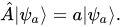
In quantum mechanics, dynamical variables such as position, translational (linear) momentum, orbital angular momentum, spin, and total angular momentum are each associated with a self-adjoint operator that acts on the state of the quantum system. The eigenvalues of operator correspond to the possible values that the dynamical variable can be observed as having. For example, suppose is an eigenket (eigenvector) of the observable , with eigenvalue , and exists in a Hilbert space. Then

This eigenket equation says that if a measurement of the observable is made while the system of interest is in the state , then the observed value of that particular measurement must return the eigenvalue with certainty. However, if the system of interest is in the general state (and and are unit vectors, and the eigenspace of is one-dimensional), then the eigenvalue is returned with probability , by the Born rule.

Compatible and incompatible observables in quantum mechanics

[edit]

A crucial difference between classical quantities and quantum mechanical observables is that some pairs of quantum observables may not be simultaneously measurable, a property referred to as complementarity. This is mathematically expressed by non-commutativity of their corresponding operators, to the effect that the commutator

This inequality expresses a dependence of measurement results on the order in which measurements of observables and are performed. A measurement of alters the quantum state in a way that is incompatible with the subsequent measurement of and vice versa.

Observables corresponding to commuting operators are called compatible observables. For example, momentum along say the and axes are compatible. Observables corresponding to non-commuting operators are called incompatible observables or complementary variables. For example, the position and momentum along the same axis are incompatible.[10]: 155 

Incompatible observables cannot have a complete set of common eigenfunctions. Note that there can be some simultaneous eigenvectors of and , but not enough in number to constitute a complete basis.[11][12]

See also

[edit]

References

[edit]

Further reading

[edit]
Revisions and contributorsEdit on WikipediaRead on Wikipedia
from Grokipedia
Observable is a San Francisco-based software company that provides a cloud-based platform for collaborative data exploration, analysis, and visualization. The platform enables teams to create interactive notebooks integrating code, data queries, and dynamic graphics, supporting languages like , SQL, and Python while emphasizing real-time collaboration and AI-assisted insights. Founded in 2016 by , the creator of the visualization library, and Melody Meckfessel, a former executive, Observable aims to make data work more accessible and trustworthy for diverse users including developers, analysts, and business professionals. The core of Observable's offering is its reactive computational notebook environment, where cells execute code to generate live outputs such as charts, maps, and dashboards, with changes propagating automatically across the document. Key features include seamless integration with databases like Snowflake and BigQuery, support for open-source libraries like D3 and Plot, and tools for embedding visualizations in external applications or exporting them as static files. The platform's design draws from Bostock's expertise in web-based graphics, evolving from an initial focus on JavaScript-centric exploration to a broader ecosystem that includes the Observable Framework for building data apps and the Observable Canvases for AI-enhanced analysis. Since its public launch in 2018, Observable has grown through community contributions, with over 1.2 million notebooks created. Observable has secured significant venture funding to expand its capabilities, including a $10.5 million Series A round in November 2020 led by and Acrew Capital and a $35.6 million Series B in led by Menlo Ventures, bringing total funding to $46.1 million. As of 2025, the company reports milestones such as over 508 million downloads of , 350,000 users, and the launch of Observable Canvases, positioning it as a leader in modern data collaboration tools.

Overview

Definition

In physics, an observable is a physical property or quantity whose value can be determined through empirical measurement. Examples include position, momentum, and energy in mechanics, which can be quantified using appropriate instruments under controlled conditions. Unlike abstract theoretical variables—such as parameters in mathematical models that lack direct empirical access—observables are distinguished by their measurability and relevance to experimental verification. This empirical accessibility ensures that observables bridge theoretical predictions with real-world data, forming the foundation of scientific inquiry across disciplines. General examples span various fields: in , serves as a key observable, representing the average of particles and measurable via thermometers or spectroscopic methods. In , is an observable that quantifies motion and can be determined from displacement over time using tools like or optical tracking. In , the measurability of observables implies reproducibility: under identical initial conditions, repeated measurements yield the same value, underscoring the deterministic framework of the theory. This property contrasts with quantum contexts, where observables are associated with operators, though their measurement outcomes exhibit probabilistic characteristics.

Historical Development

The concept of observables in physics originated in the foundations of during the 17th century. advanced the empirical measurement of quantities such as position, velocity, and time through his inclined-plane experiments on falling objects, establishing a quantitative approach to motion that emphasized observable data over qualitative speculation. This work directly influenced Isaac Newton's Philosophiæ Naturalis Principia Mathematica (1687), which integrated these observables into a comprehensive deterministic system governed by laws of motion and universal gravitation, allowing precise predictions from initial conditions. By the 19th century, the deterministic nature of classical observables reached its philosophical zenith with Pierre-Simon Laplace's articulation of causal determinism. In his 1814 Essai philosophique sur les probabilités, Laplace described a hypothetical superintelligence—later termed Laplace's demon—that could compute the future state of the universe entirely from the positions and momenta of all particles at one moment, embodying the classical ideal of fully predictable observables. This view reinforced the belief that physical quantities like position and momentum were inherently deterministic and accessible through complete measurement. The early marked a profound transition as anomalies in atomic phenomena exposed limitations in classical observables, leading to the quantum revolution. Niels Bohr's principle of complementarity, presented in his 1927 Como lecture, shifted focus from underlying hidden variables to the inherent incompatibility of certain observables in quantum measurements, resolving paradoxes by prioritizing empirical outcomes over classical . Pivotal milestones defined this quantum framework: Werner Heisenberg's 1925 paper introduced , representing observables as non-commuting arrays to model discrete quantum transitions and spectral lines, diverging from continuous classical variables. John von Neumann's 1932 Mathematical Foundations of Quantum Mechanics further solidified the shift by formalizing observables within , transforming them from definite classical parameters into probabilistic operators whose measurements yield eigenvalue spectra with inherent uncertainties. Post-1920s quantum theory thus supplanted Laplace's deterministic worldview with a probabilistic paradigm, where observables reflect statistical predictions rather than absolute certainties.

Classical Physics

Observables in Classical Mechanics

In , observables are real-valued smooth functions defined on the , a that encodes the complete state of a through its position coordinates qq and conjugate momentum coordinates pp. The is typically represented as the TMT^*M over the configuration space manifold MM, where each point (q,p)(q, p) specifies the system's configuration and its generalized momenta. This formalism allows observables to capture measurable physical quantities, such as or , as functions A:TMRA: T^*M \to \mathbb{R}. Common examples of observables include the T=p22mT = \frac{p^2}{2m}, which depends solely on the for a particle of mm; the V(q)V(q), a function of position alone; and the total , embodied by the Hamiltonian H=T+VH = T + V, which governs the system's dynamics. These functions are evaluated at specific points in to yield numerical values for the observables at a given state. The Hamiltonian itself serves as the primary observable for and in isolated systems. The dynamics of observables are described using the Poisson bracket, a bilinear operation that encodes the symplectic structure of phase space. For two observables AA and BB in a system with nn degrees of freedom, the Poisson bracket is defined as {A,B}=i=1n(AqiBpiApiBqi).\{A, B\} = \sum_{i=1}^n \left( \frac{\partial A}{\partial q_i} \frac{\partial B}{\partial p_i} - \frac{\partial A}{\partial p_i} \frac{\partial B}{\partial q_i} \right). This bracket satisfies antisymmetry ({A,B}={B,A}\{A, B\} = -\{B, A\}), bilinearity, and the Jacobi identity, endowing the space of observables with a Lie algebra structure. The time evolution of an observable AA follows Hamilton's equation dAdt={A,H}+At,\frac{dA}{dt} = \{A, H\} + \frac{\partial A}{\partial t}, where the partial derivative accounts for any explicit time dependence in AA; if AA is time-independent and {A,H}=0\{A, H\} = 0, then AA is a conserved quantity. In one dimension, the bracket simplifies to {A,B}=AqBpApBq\{A, B\} = \frac{\partial A}{\partial q} \frac{\partial B}{\partial p} - \frac{\partial A}{\partial p} \frac{\partial B}{\partial q}. Measurement in is inherently deterministic: given ideal instruments, the exact values of all observables can be obtained simultaneously for a in a well-defined state (q,p)(q, p), as there are no fundamental limitations on precision or compatibility between measurements. This contrasts with , where observables become non-commuting operators on a .

Measurement and Determinism

In classical physics, the measurement of observables entails direct empirical determination of their numerical values under controlled conditions, typically using instruments such as rulers to gauge position or clocks to record time. This process assumes negligible back-action from the measurement apparatus on macroscopic systems, allowing observables like velocity or energy to be ascertained with high precision without significantly altering the system's state. Such measurements form the foundation for empirical validation of physical laws, where the observable's value is extracted reproducibly from the system's interaction with the measuring device. The of underpins the interpretation of these , asserting that the future evolution of a classical is uniquely determined by its initial state. formalized this in , describing an intellect that, knowing the positions and momenta (key observables) of all particles at time t=0t=0, could predict the entire future trajectory through Newton's laws. This Laplacian implies that perfect of observables eliminates , rendering the 's path predictable in , as the are reversible and time-symmetric. However, practical limitations arise in chaotic systems, where infinitesimal errors in measuring initial observables are exponentially amplified over time, leading to divergence in predicted trajectories. The exemplifies this sensitivity, as small uncertainties in positions or velocities render long-term forecasts infeasible despite the underlying deterministic equations. Theoretically, these challenges are resolvable with arbitrarily precise measurements, preserving , though computational and observational constraints impose effective unpredictability. In , observables are often treated as ensemble averages over many realizations of the system, bridging microscopic measurements to macroscopic properties. For instance, in an emerges as the time-averaged per unit area from molecular collisions, yielding the equation of state PV=NkTPV = NkT, where PP is the observable , VV the volume, NN the number of particles, kk Boltzmann's constant, and TT the . This averaging approach accounts for the collective behavior of unmeasurable individual particle states, providing a deterministic framework for thermodynamic predictions.

Quantum Mechanics

Observables as Operators

In , observables are mathematically represented by (Hermitian) operators acting on the of the quantum system. This formulation, introduced by , ensures that the possible outcomes of measurements correspond to the real eigenvalues of these operators, reflecting the empirical reality that measurement results are real numbers. Self-adjointness guarantees that the operator is equal to its , A^=A^\hat{A}^\dagger = \hat{A}, which is essential for the probabilistic interpretation of quantum states. Specific examples illustrate this operator representation. In the position basis, the position operator x^\hat{x} is defined as multiplication by the position coordinate xx, so x^ψ(x)=xψ(x)\hat{x} \psi(x) = x \psi(x) for a wave function ψ(x)\psi(x). The momentum operator p^\hat{p}, in the same representation, takes the differential form p^=iddx\hat{p} = -i \hbar \frac{d}{dx}, where \hbar is the reduced Planck's constant. These canonical operators satisfy the commutation relation [x^,p^]=i[\hat{x}, \hat{p}] = i \hbar, foundational to the Heisenberg uncertainty principle, though their explicit forms depend on the chosen basis. The general structure of an observable operator A^\hat{A} is provided by the for operators, which allows a spectral decomposition A^=iλiψiψi\hat{A} = \sum_i \lambda_i |\psi_i \rangle \langle \psi_i |, where {λi}\{\lambda_i\} are the distinct eigenvalues representing possible outcomes, and ψi|\psi_i \rangle are the corresponding orthonormal eigenvectors forming a complete basis of the . For continuous spectra, the sum generalizes to an over the spectral measure. This decomposition underpins the probabilistic nature of measurements, as the probability of obtaining eigenvalue λi\lambda_i in state ψ|\psi \rangle is ψiψ2|\langle \psi_i | \psi \rangle|^2. The expectation value of an observable A^\hat{A} in a normalized state ψ|\psi \rangle is given by the inner product A^=ψA^ψ\langle \hat{A} \rangle = \langle \psi | \hat{A} | \psi \rangle, which represents the average outcome over many measurements on identically prepared systems. Using the spectral decomposition, this simplifies to A^=iλiψiψ2\langle \hat{A} \rangle = \sum_i \lambda_i |\langle \psi_i | \psi \rangle|^2, weighting each eigenvalue by its probability. This operator framework distinguishes quantum observables from their classical counterparts, where they are simply real-valued functions on phase space.

Compatible Observables

In , two observables represented by operators  and B̂ are compatible if they commute, meaning their vanishes: [A^,B^]=A^B^B^A^=0[ \hat{A}, \hat{B} ] = \hat{A}\hat{B} - \hat{B}\hat{A} = 0. This commutation relation implies that both observables can be measured simultaneously with arbitrary precision, without one measurement disturbing the outcome of the other. The concept originates from the foundational axiomatization of , where observables are associated with linear operators on , and compatibility ensures that the measurement process preserves the eigenstates relevant to both. A key mathematical property of compatible observables is that commuting self-adjoint operators share a common complete set of eigenstates. If ψ|\psi\rangle is an eigenstate of  with eigenvalue λ\lambda, so A^ψ=λψ\hat{A} |\psi\rangle = \lambda |\psi\rangle, then ψ|\psi\rangle is also an eigenstate of B̂ with some eigenvalue μ\mu, satisfying B^ψ=μψ\hat{B} |\psi\rangle = \mu |\psi\rangle. This shared eigenbasis arises from the simultaneous diagonalizability of commuting operators, as guaranteed by the in theory, allowing the observables to be jointly diagonalized. Representative examples of compatible observables include the Hamiltonian Ĥ (total energy) and components of in systems governed by central potentials, such as the potential in the . Here, Ĥ commutes with the square of the L^2\hat{L}^2 and its z-component L^z\hat{L}_z, i.e., [H^,L^2]=0[ \hat{H}, \hat{L}^2 ] = 0 and [H^,L^z]=0[ \hat{H}, \hat{L}_z ] = 0, enabling the specification of energy levels alongside angular momentum quantum numbers without conflict. Another example is the in one spatial direction and the in an orthogonal direction, such as x^\hat{x} and p^y\hat{p}_y, which commute since [x^,p^y]=0[ \hat{x}, \hat{p}_y ] = 0, reflecting the independence of perpendicular coordinates in free space./02%3A_Introduction_to_Quantum_Mechanics/2.05%3A_Operators_Commutators_and_Uncertainty_Principle) The implications of compatibility extend to the prediction of joint outcomes. For a ψ|\psi\rangle, the joint for obtaining eigenvalues λ\lambda of  and μ\mu of B̂ is P(λ,μ)=ϕλμψ2P(\lambda, \mu) = |\langle \phi_{\lambda \mu} | \psi \rangle|^2, where ϕλμ|\phi_{\lambda \mu}\rangle denotes the common eigenstates labeled by both eigenvalues. This distribution fully characterizes the simultaneous statistics, underscoring how compatibility resolves the otherwise indeterminate correlations between observables in quantum theory.

Incompatible Observables

In , two observables represented by Hermitian operators  and B̂ are defined as incompatible if their [Â, B̂] ≠ 0. This non-commutativity implies that the operators do not share a complete set of common eigenstates, preventing the existence of a eigenbasis and thereby prohibiting the precise simultaneous determination of definite values for both observables in any . A example of incompatible observables is the x̂ and the p̂, which satisfy the commutation relation [x̂, p̂] = iℏ. This relation underpins the duality between the position and representations of the wave function, where precise knowledge in one domain inherently broadens the uncertainty in the other. The general consequences of incompatibility are profound: no can serve as a simultaneous eigenstate of both operators, and a of one observable inevitably disturbs the system's preparation with respect to the other. Heisenberg illustrated this disturbance through his 1927 gamma-ray microscope , in which high-resolution imaging of an electron's position using short-wavelength gamma rays causes unpredictable transfers via , thus altering the electron's trajectory. This notion of incompatible observables was pivotal in the philosophical debates between Niels Bohr and Albert Einstein at the Fifth Solvay Conference in 1927, where discussions centered on whether quantum mechanics fully captures the objective reality of physical observables or introduces fundamental indeterminacy. Such incompatibility also gives rise to uncertainty relations that quantify the trade-offs in measurement precision.

Measurement and Interpretation

Eigenvalue Measurements

In quantum mechanics, the measurement of an observable A^\hat{A} is governed by the projection postulate, which specifies both the possible outcomes and their probabilities. For a system in a normalized state ψ|\psi\rangle, the observable A^\hat{A} possesses a complete set of orthonormal eigenstates i|i\rangle with corresponding eigenvalues λi\lambda_i. Upon measurement, the system yields one of the eigenvalues λi\lambda_i with probability iψ2|\langle i | \psi \rangle|^2, the square of the modulus of the projection of ψ|\psi\rangle onto the eigenstate i|i\rangle. This probabilistic nature arises because the state ψ|\psi\rangle is generally a superposition of the eigenstates, and the measurement selects one eigenvalue according to the Born rule. Following the measurement outcome λi\lambda_i, the wave function undergoes an instantaneous collapse to the corresponding eigenstate i|i\rangle, a process known as the von Neumann projection. This non-unitary projection abruptly reduces the superposition to a definite eigenstate, marking the transition from quantum superposition to a classical-like definite outcome. The postulate, formalized by John von Neumann in his 1932 treatise, ensures that the post-measurement state is normalized and aligned with the measured eigenvalue. A key consequence of this collapse is the repeatability of measurements: if the same observable A^\hat{A} is measured immediately after on the collapsed state i|i\rangle, the outcome λi\lambda_i is obtained with certainty (probability 1), as i|i\rangle is an eigenstate. This property underscores the definitive nature of the measurement process and distinguishes it from the unitary evolution governing the system between measurements. A illustrative example is the measurement of the z-component of spin, SzS_z, for a spin-1/2 particle, where the eigenvalues are ±/2\pm \hbar/2 with eigenstates +|+\rangle and |-\rangle. For a general state ψ=cos(θ/2)++sin(θ/2)eiϕ|\psi\rangle = \cos(\theta/2) |+\rangle + \sin(\theta/2) e^{i\phi} |-\rangle, represented on the by a point at polar angle θ\theta from the +z axis, the probability of measuring +/2+\hbar/2 is cos2(θ/2)\cos^2(\theta/2), and /2-\hbar/2 is sin2(θ/2)\sin^2(\theta/2). Post-measurement, the state collapses to either +|+\rangle or |-\rangle, ensuring a subsequent SzS_z measurement yields the same result deterministically.

Expectation Values and Uncertainty

In , the expectation value of an observable represented by a Hermitian operator A^\hat{A} provides the average result of repeated measurements on an ensemble of systems prepared in the state ψ|\psi\rangle. If ψ=iciλi|\psi\rangle = \sum_i c_i |\lambda_i\rangle in the eigenbasis of A^\hat{A}, with eigenvalues λi\lambda_i and probabilities ci2|c_i|^2, then the expectation value is given by A^=iλici2.\langle \hat{A} \rangle = \sum_i \lambda_i |c_i|^2. This quantity, introduced in the foundational formalism of , connects the probabilistic nature of measurements to a value analogous to classical statistics. The time dependence of expectation values follows from the dynamics of the wave function, as encapsulated in the . For a general observable A^\hat{A}, possibly time-dependent, the theorem states dA^dt=A^t+i[H^,A^],\frac{d\langle \hat{A} \rangle}{dt} = \left\langle \frac{\partial \hat{A}}{\partial t} \right\rangle + \frac{i}{\hbar} \langle [\hat{H}, \hat{A}] \rangle, where H^\hat{H} is the Hamiltonian and [,][\cdot, \cdot] denotes the . This relation demonstrates how quantum expectation values approximate classical trajectories for sharply peaked states, bridging the two theories. To characterize the fluctuations around this average, the variance of an observable A^\hat{A} is defined as ΔA2=A^2A^2,\Delta A^2 = \langle \hat{A}^2 \rangle - \langle \hat{A} \rangle^2, where ΔA\Delta A measures the standard deviation or intrinsic uncertainty in measurement outcomes. For pairs of incompatible observables A^\hat{A} and B^\hat{B} that do not commute, these uncertainties obey the Robertson–Schrödinger relation: ΔAΔB12[A^,B^].\Delta A \Delta B \geq \frac{1}{2} \left| \langle [\hat{A}, \hat{B}] \rangle \right|.
Add your contribution
Related Hubs
User Avatar
No comments yet.