Hubbry Logo
Open cityOpen cityMain
Open search
Open city
Community hub
Open city
logo
8 pages, 0 posts
0 subscribers
Be the first to start a discussion here.
Open city
Open city
from Wikipedia

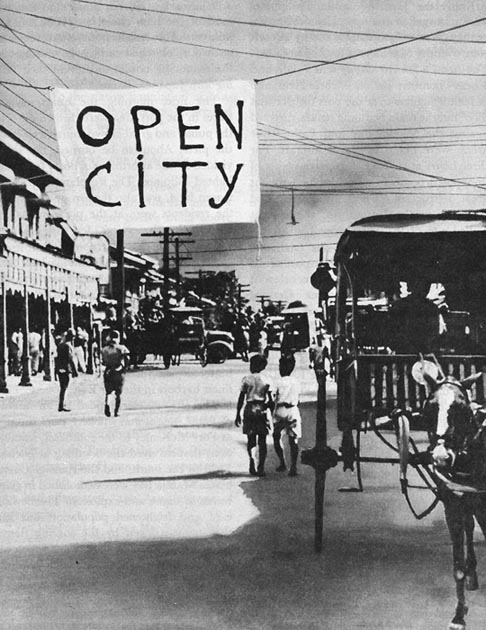
Manila was declared an open city in December 1941 to avoid its destruction as Imperial Japan invaded the Commonwealth of the Philippines

In war, an open city is a settlement which has announced it has abandoned all defensive efforts, generally in the event of the imminent capture of the city to avoid destruction. Once a city has declared itself open, the opposing military will be expected under international law to peacefully occupy the city rather than destroy it.

The concept of an open city emerged during World War I, where cities were declared demilitarized in an attempt to avoid destruction. Protocol I of the Geneva Conventions forbids the attacking party to "attack, by any means whatsoever, non-defended localities".[1] The intent is to protect the city's civilians and cultural landmarks from a battle which may be futile.

Attacking forces do not always respect the declaration of an open city. Defensive forces will occasionally use the designation as a political tactic as well.[2] In some cases, the declaration of a city to be open is made by a side on the verge of surrender and defeat; in other cases, those making such a declaration are willing and able to fight on, but prefer that the specific city be spared. Often, resistance movements will be active in open cities, straining the temperate conduct of the occupying forces.

Examples

[edit]

19th century

[edit]
  • Paris, in effect was treated in a way that modern language would call an “open city”. After very stiff fighting in the suburbs of the French capital on the 30th of March 1814, the defenders agreed to abandon Paris to prevent taking the fight to the city itself and bringing its destructions. The combined forces of Russia, Austria, Prussia, and Württemberg occupied it the next day.

Numerous cities were declared open cities during World War II:

Post-World War II Japan

[edit]

In 1977, a far-left group in Japan—called the "National Open City Declaration Movement Network"—began organizing activists to make cities preemptively declare themselves "defenseless" under the Geneva Convention, so that in the event of war, they would be legally forced to welcome any invasion.[16] This was rejected by nearly all of Japan's political parties and the ruling government as inherently absurd, since Japan was not in a war, and in the event of war such a decision would have to be approved by the national government.[17] However, the Social Democratic Party—which was the junior party of the ruling coalition from 1994 to 1996—supported it.[18][when?]

Nevertheless, four wards of Tokyo and Kagoshima City, Japan's southernmost port, among many other cities considered[when?] legislation to be declared "open cities".[19]

See also

[edit]

Footnotes

[edit]
Revisions and contributorsEdit on WikipediaRead on Wikipedia
from Grokipedia
An open city is a locality declared undefended and demilitarized by a during armed conflict, exempting it from attack under customary provided it harbors no military forces or installations. This status, rooted in the laws of , aims to spare populations and from by signaling non-resistance and openness to occupation. The concept evolved from 19th-century practices but gained prominence in the 20th century, influenced by principles in the 1907 Hague Conventions prohibiting unnecessary destruction in undefended places. Historically, open city declarations have succeeded in some cases, such as in 1940, where German forces occupied the French capital without significant fighting after its evacuation by Allied troops, preserving much of the city's architecture. was similarly designated in 1943 by , avoiding aerial attacks until its fall, though ground occupation followed. However, violations have undermined the norm's effectiveness; in , declared open by U.S. forces in under General Douglas MacArthur to avert destruction during the Japanese invasion, the status was disregarded as Japanese aircraft bombed the city regardless. Such breaches highlight the reliance on mutual compliance, with no formal enforcement mechanism beyond post-conflict accountability. The doctrine's defining characteristic lies in its unilateral nature—announced by the defending power without enemy consent—yet its protection demands verifiable demilitarization, often verified through evacuation of troops and removal of defenses. Controversies arise when declarations prove insincere or when adversaries exploit them strategically, as seen in instances where open cities still suffered incidental or deliberate damage. Despite limitations, underscores efforts to balance with humanitarian restraint, influencing modern interpretations in treaties like the 1949 ' provisions on protected localities.

Core Definition

An open city is a locality declared by a during armed conflict to be undefended and open to enemy occupation, with all combatant forces, mobile objectives, and means of combat removed to prevent it from becoming a legitimate target. This unilateral declaration notifies the adversary of the absence of defenses, invoking the principle that undefended places shall not be attacked, thereby seeking to protect lives and property from or . The protection afforded hinges on effective notification to the opposing party and strict adherence to the undefended status, as any resumption of hostile acts or failure to evacuate elements can nullify the immunity. While the concept originates from pre-codified customary norms prohibiting attacks on undefended towns, it evolved into the formalized "non-defended locality" under Article 59 of Additional Protocol I to the (1977), which specifies conditions including the removal of all combatants and the prohibition on using the area for hostile acts. This framework reaffirms the longstanding rule, applicable in both international and non-international armed conflicts, though its practical enforcement relies on reciprocity and verification rather than automatic guarantees. Historically, the term "open city" has been used interchangeably with undefended towns since at least the , predating explicit language, but it does not confer absolute sanctuary; adversaries may contest the declaration if evidence suggests deception or military utility persists. The doctrine underscores a balance in between and civilian protection, rooted in the causal reality that undefended areas pose no immediate threat warranting attack.

Origins in Customary International Law

The principle of open towns emerged as a in , prohibiting attacks on undefended localities where no combatants, mobile military objectives, or means of resistance remained, thereby eliminating any for bombardment or assault. This practice, rooted in longstanding belligerent restraint during sieges to spare lives and , reflected opinio juris that such actions violated proportionality and humanity in warfare, encouraging defenders to evacuate military elements for peaceful handover. Early applications demonstrated consistent state behavior, including during the (1861–1865), where Union and Confederate forces occasionally treated evacuated cities as open upon declaration, avoiding destruction absent resistance. The customary status was evidenced by unilateral declarations requiring verifiable demilitarization, with the attacking party obligated to respect the status unless re-militarization occurred, as breaches could justify resumed hostilities but not retroactive attacks on the prior undefended state. This norm gained explicit articulation in pre-codification drafts, such as Article 15 of the 1874 Brussels Declaration, which forbade "the of undefended places," codifying prevailing custom among European powers without implying novelty. Similarly, Article 32(c) of the 1880 Oxford Manual prohibited attacks on undefended towns, underscoring the rule's acceptance through doctrinal consensus and diplomatic practice. Recognition as binding custom persisted into the , affirmed in post-World War I analyses like the 1919 Versailles Report and post-World War II tribunals, such as the 1947 , where violations of open town protections were adjudged contrary to established law. The International Committee of the Red Cross's 2005 study on customary confirms Rule 37's applicability to both international and non-international armed conflicts, deriving from and legal conviction.

Codification in Treaties and Conventions

The prohibition against attacking undefended localities, which underpins the open city concept, was first codified in Article 25 of the Regulations annexed to the 1907 respecting the Laws and Customs of War on Land, stating: "The attack or bombardment, by whatever means, of towns, villages, dwellings, or buildings which are undefended is prohibited." This provision extended earlier customary practices by explicitly barring belligerents from targeting places lacking defenses or garrisons, provided no resistance or use occurred there. A declaration of a city as open effectively rendered it undefended under this article, aiming to spare civilian infrastructure and populations from destruction, though enforcement relied on the adversary's recognition and restraint, as the imposed no formal notification requirement. Subsequent naval warfare rules in Hague Convention (IX) of 1907 reinforced this by prohibiting bombardments of undefended ports, harbors, coasts, or cities from the sea, mirroring the land-based protections and emphasizing that neutrality in defense did not imply immunity from occupation. These conventions did not use the term "open city," but the practice of unilateral declarations to invoke undefended status became a recognized mechanism, with violations treated as breaches of treaty obligations when evidence showed the locality met the undefended criteria. The concept received more detailed elaboration in Article 59 of Additional Protocol I (1977) to the , which prohibits attacks on "non-defended localities" and defines them through strict conditions: evacuation of all combatants, mobile military equipment, and stores; an unarmed civilian population not supporting military operations or harboring fighters; and a formal by local authorities notifying the adversary of the status while committing to compliance. This provision modernized the open city framework by mandating verifiable demilitarization and bilateral awareness, transforming a largely customary practice into a treaty-bound rule applicable in international armed conflicts, though it applies only to states party to the Protocol and requires ongoing non-military use to maintain protection. Unlike the Hague rules, Article 59 explicitly ties protection to notification, reducing ambiguity but increasing the evidentiary burden on declaring parties.

Historical Development

Pre-20th Century Precedents

The practice of designating undefended localities to avert bombardment predates formal codification, originating in ancient customs where cities submitting without prolonged resistance were often spared sack to facilitate occupation and preserve value for the victor. In Roman warfare, for instance, the deditio in fidem—surrender into the of the attacker—granted clemency to non-resisting communities, contrasting with the destruction of defiant ones, as seen in Julius Caesar's lenient treatment of surrendered Gallic oppida during the (58–50 BCE). Similar norms persisted in medieval , where honorable capitulation terms allowed garrisons to evacuate, avoiding storming and civilian harm, as codified in chivalric practices from the onward. By the , amid advancing artillery, the principle gained traction in European and American conflicts to shield civilian populations. During the (1861–1865), Union forces applied early variants in cities like , and , where evacuations and non-defense declarations aimed to prevent shelling, though outcomes varied due to fires and retreating Confederate actions. The (1863), issued by the U.S. War Department, formalized restraints on attacking undefended places, prohibiting unnecessary devastation of open towns unless militarily imperative, influencing subsequent international norms. Late-19th-century efforts sought to crystallize this as binding law. The Brussels Declaration project (1874), though unratified, explicitly barred bombardment of open towns or undefended villages in Article 15, reflecting consensus on reciprocal obligations: the defender demilitarizes, and the attacker refrains from . The Oxford Manual on the Laws of War on Land (1880), drafted by the Institute of , reinforced this in Articles 35–37, deeming bombardment of undefended localities prohibited absent , thus bridging customary precedent to modern declarations. These instruments underscored causal incentives: demilitarization reduced attacker risks while deterring reprisals, though enforcement relied on mutual adherence absent treaties.

World War I Applications

During , the practice of open cities emerged as an ad hoc customary measure to mitigate urban devastation amid rapid advances and retreats, though lacking formal codification in , its observance relied on belligerents' restraint rather than enforceable obligations. Belgian authorities in abstained from fortifying or defending the capital against the advancing German Sixth Army, effectively rendering it undefended; German troops entered unopposed on August 20, 1914, occupying the city without bombardment or street fighting, as the Belgian government had withdrawn to . This spared from immediate destruction, though it endured four years of occupation, including resource requisitions and civilian hardships. In northern , several occupied municipalities were informally regarded as open cities following German captures in the war's opening months, predicated on their demilitarization to avert exchanges. Cities such as , Mézières, and Vouziers fell into German hands by late , with local authorities ceasing resistance to prevent warfare; however, French forces later subjected these sites to despite their status, underscoring the vulnerability of the arrangement absent reciprocal attacker commitments. German occupation policies in these areas emphasized administrative control over destruction, but sporadic Allied shelling—often targeting military assets within urban zones—illustrated the concept's fragility in static trench warfare phases. The limited WWI applications highlighted causal challenges: declarations succeeded mainly in fluid invasion phases where attackers prioritized speed over annihilation, as in , but faltered in contested fronts where overrode humanitarian considerations. No widespread protocol governed notifications or demilitarization verification, leading to inconsistent outcomes and contributing to postwar efforts at legal refinement.

Interwar Period and Theoretical Refinements

The (1918–1939) produced no ratified international treaties that directly amended the open city doctrine enshrined in Article 25 of the 1907 Convention IV, which prohibited of undefended towns. The concept thus relied on customary interpretations from prewar precedents, emphasizing a defender's unilateral demilitarization and notification to avert attack, provided no military use occurred within the locality. Theoretical discourse, however, shifted toward integrating aerial capabilities, as had introduced systematic bombing, prompting jurists to assess whether traditional ground-based safeguards sufficed against remote aerial strikes. A key refinement emerged in the unratified 1923 Hague Rules of Air Warfare, drafted by an international commission of jurists. These rules explicitly prohibited aerial bombardment of undefended cities, towns, villages, or buildings, mirroring but adapting the 1907 ground warfare prohibition to air operations. Article 24(4) barred such attacks unless the locality immediately adjoined land forces or functioned as an enemy base for launching operations, thereby theoretically extending open city protections to airspace while acknowledging strategic necessities. This marked an early causal recognition that air power decoupled bombardment from physical occupation, requiring defenders to ensure not only ground evacuation but also absence of proximate military value to invoke immunity. The rules' non-adoption reflected interwar geopolitical tensions, including disarmament failures under the League of Nations, yet they influenced subsequent legal thought by highlighting enforcement gaps in total war scenarios. Legal scholars further refined the doctrine by critiquing its assumptions amid rising air power advocacy. Italian theorist Giulio Douhet's 1921 treatise Il dominio dell'aria posited of urban centers to shatter civilian will, implicitly challenging open city efficacy since demilitarization could not neutralize perceived moral or industrial targets from afar. British jurist W. M. Schwebel and others noted in analyses that alone might justify strikes under loose interpretations of "military objective," eroding the doctrine's deterrent value without reciprocal attacker restraint. These debates emphasized causal realism: open city status demanded verifiable non-use, but unverifiable air threats incentivized violations, as evidenced in preliminary interwar conflicts like the 1932–1933 Japanese aerial operations in , where partial demilitarization failed to halt bombings. No empirical applications of open city declarations occurred on a scale comparable to , limiting practical testing, but theoretical refinements underscored a transition from static to adaptive norms anticipating mechanized warfare. Jurists advocated clearer notification protocols and third-party verification to enhance credibility, foreshadowing disputes. This period's stasis in codification, contrasted with doctrinal evolution, revealed systemic biases in international institutions toward aspirational rules over enforceable mechanisms, as League sanctions proved ineffective against aggressors flouting restraints.

Major Historical Examples

European Theaters in

In the European theaters of , open city declarations were employed primarily in 1940 during the German in and later in amid the Allied advance, aiming to preserve urban centers by forgoing organized defense. These measures relied on expectations that attackers would abstain from or aerial bombardment once military assets were removed, though adherence varied based on strategic imperatives and the occupying power's conduct. Successful implementations spared cities from immediate devastation, but later occupations often involved exploitation or that undermined the status. During the German invasion of in May 1940, was declared an open city by King Leopold III's government to avert destruction, with Belgian forces withdrawing to prevent street fighting; German troops entered on May 18, 1940, encountering minimal resistance and respecting the declaration by refraining from bombardment, as confirmed in subsequent German assurances to maintain the status absent guerrilla activity. Similarly, in , was officially designated an open city on June 11, 1940, by the evacuating government under Prime Minister , which ordered the removal of troops and demolition charges to avoid a Stalingrad-like ; advance German units entered unopposed at 5:30 a.m. on June 14, 1940, via Porte de La Chapelle, preserving the city's infrastructure intact during the initial occupation. In , 's declaration as an open city on August 14, 1943, by the Italian Badoglio government followed two Allied bombings (July 19 and August 13) that killed over 2,000 civilians and sought Vatican mediation to safeguard ancient monuments; however, after Italy's on September 8, 1943, German forces under Field Marshal rapidly occupied the city on September 10, installing defenses and conducting operations that violated the spirit of demilitarization, including the of over 1,000 from the in October 1943. The status gained partial efficacy only in the final phase, when Kesselring ordered a withdrawal on June 3, 1944, effectively re-declaring it open to avoid prolonged urban combat; Free French and U.S. forces entered on June 4, 1944, without significant destruction, marking as the first European capital liberated intact. These cases illustrate the tactic's conditional success against Wehrmacht advances, where rapid German operational tempo and interest in usable administrative centers encouraged restraint, contrasting with Axis non-compliance in contested Italian scenarios driven by ideological commitment to total war and logistical needs. Empirical outcomes showed zero combat-related structural losses in Brussels and Paris during entries, versus Rome's pre-declaration bombings causing targeted damage to rail yards and airports but sparing the historic core post-occupation.

Asian Theaters in World War II

In the Asian theaters of , the concept of an open city was most notably applied in the during the Japanese invasion. On December 26, 1941, U.S. General declared an open city to prevent its destruction amid the advancing Imperial Japanese forces, ordering the withdrawal of all , anti-aircraft defenses, and the cessation of blackouts. This declaration aimed to comply with international norms by demilitarizing the capital, thereby obligating attackers to refrain from bombardment or assault. Japanese aircraft, however, conducted bombing raids on the following day, December 27, 1941, disregarding the proclamation initially, though the scale of attacks diminished thereafter. Japanese troops entered and occupied Manila on January 2, 1942, with minimal ground resistance due to the evacuation of defending forces, marking a partial adherence to the open city status that spared the city from immediate urban combat. The occupation proceeded without large-scale destruction at that stage, allowing Manila to function as an administrative center under Japanese control for over two years. This instance demonstrated the potential efficacy of open city declarations in averting direct military engagement when the defender fully demilitarizes and the attacker accepts the terms, though the brief post-declaration bombings highlighted enforcement challenges under the prevailing laws of war. The open city precedent faced stark violation during the Allied liberation campaign in early 1945. As U.S. and Filipino forces approached Manila in February 1945 under MacArthur's return, Japanese commander General Tomoyuki Yamashita ordered a fighting withdrawal, but subordinate units, including the Manila Naval Defense Force, refused to evacuate and fortified positions within the city. No formal open city declaration was issued by the Japanese occupiers, leading to month-long house-to-house fighting from February 3 to March 3, 1945, which razed much of the city and resulted in approximately 100,000 civilian deaths from combat, artillery, and deliberate massacres by Japanese troops. This episode underscored the limitations of the open city mechanism when the occupying power rejects demilitarization and employs the urban population as human shields or targets, rendering the status ineffective against non-compliant belligerents. Beyond , few other declarations occurred in the Pacific theater, with Japanese cities like and considering but ultimately rejecting open city status amid campaigns to avoid signaling surrender. The scarcity of applications in reflected the rapid, often amphibious nature of Pacific warfare, which prioritized strategic denial over preservation of civilian centers, and the mutual distrust between and Allied powers that undermined reciprocal obligations. Manila's dual experiences—initial sparing in 1941 followed by devastation in 1945—illustrate both the conditional successes and profound risks of open city strategies in asymmetric urban conflicts.

Post-World War II Instances

In November 2001, amid the U.S.-led coalition's campaign against the regime in , U.S. publicly proposed designating as an "open city" to avert immediate seizure by advancing forces. Powell advocated this status—modeled on the post-World War II administration of —to maintain neutrality in the capital pending a United Nations-brokered interim government, thereby minimizing urban fighting and ethnic reprisals among Afghan factions. The , facing collapse, evacuated most defenders from without issuing a formal open city declaration or demilitarizing under international protocols, leading to the 's entry on November 13, 2001, with sporadic but limited combat. This episode highlighted the concept's adaptation to but underscored its diminished enforceability absent mutual consent and verification mechanisms. Proposals for open city status have surfaced in other post-1945 conflicts but rarely materialized into binding arrangements. During the 1967 , diplomatic discussions referenced Jerusalem's potential as an open city to safeguard its religious sites, reflecting pre-war U.S. advocacy for demilitarized access; however, Jordanian forces defended , resulting in its capture by on June 7 without non-defended locality protocols being invoked or honored. Such instances reflect the erosion of customary open city norms in high-stakes territorial disputes, where attackers often prioritize rapid seizure over reciprocal restraint. Overall, empirical applications post-World War II remain scarce, supplanted by modern humanitarian law provisions for non-defended localities under Additional Protocol I (1977), which require verifiable evacuation of combatants and equipment but lack widespread historical precedents.

Operational Mechanics

Declaration and Notification Procedures

The declaration of an open city constitutes a unilateral act by the defending party, whereby it formally announces that the locality will not be defended against approaching enemy forces, provided the conditions of non-militarization are met, including the withdrawal of all combatants, mobile military equipment, and cessation of hostile acts from within the area. This procedure, rooted in customary , requires the declaration to precisely define and describe the geographical limits of the open city to ensure clarity and verifiability. The defending party must first confirm compliance with these preconditions, as failure to do so undermines the status and exposes the city to legitimate attack if contested. Notification to the adversary is a critical component, typically delivered through diplomatic channels, neutral intermediaries, or direct communication, with the declaration explicitly addressed to the opposing . Under Article 59 of Additional Protocol I to the (1977), the adverse party is required to acknowledge receipt of the declaration and treat the locality as non-defended unless it assesses that the factual conditions—such as the presence of hidden forces or emissions of hostile acts—are not fulfilled, in which case it may contest the status and proceed with operations accordingly. This acknowledgment process aims to prevent misunderstandings, though in practice, public proclamations (e.g., via newspapers or broadcasts) have historically supplemented formal notifications to reinforce the intent and deter attacks. In pre-1977 applications, such as during , declarations often combined public announcements with targeted enemy notifications, as seen in General Douglas MacArthur's December 26, 1941, proclamation for , which was communicated via radio and diplomatic means but contested by Japanese forces due to perceived incomplete demilitarization. Similarly, Rome's 1943 open city status involved Italian government declarations and requests for Allied recognition, highlighting that while unilateral, effectiveness hinges on the enemy's acceptance or non-contestation based on observable compliance. Parties may also negotiate bilateral agreements to establish or verify the status, providing greater certainty than unilateral declarations alone.

Requirements for Demilitarization

To qualify as an open city, or more formally a non-defended locality under customary , the defending party must undertake comprehensive demilitarization measures to eliminate any presence or capability within the designated area, thereby removing the justification for attack due to lack of defense. This process primarily involves the evacuation of all combatants, mobile weapons systems, and equipment from the locality, ensuring no armed forces remain to offer resistance or utilize the area for operational purposes. Fixed installations, such as fortifications or depots, must not be employed for hostile acts, though their mere presence does not preclude open status if rendered inert and non-operational. Additional requirements prohibit any facilitation of belligerent activities by the locality's authorities or inhabitants, including abstention from acts of hostility, weapon manufacturing, support, or transit of troops and supplies that could sustain enemy operations. Police forces may remain solely for maintaining public order and securing , such as the wounded or medical personnel, but must refrain from roles. These conditions, rooted in state practice and affirmed as customary norms applicable in both international and non-international armed conflicts, derive from earlier instruments like the 1907 Hague Regulations (Article 25) and were elaborated in Article 59 of Additional Protocol I to the (1977), though the latter's treaty status does not limit the broader customary application. Failure to fully implement demilitarization, such as retaining concealed armaments or allowing surreptitious military use, invalidates the open status and exposes the city to lawful attack. In historical practice, demilitarization has entailed verifiable actions like the physical withdrawal of troops and materiel prior to declaration. For instance, in on December 26, 1941, U.S. forces under General completed the evacuation of military and governmental activities before proclaiming the city open, aiming to preclude Japanese bombardment. Similarly, was declared open on June 13, 1940, following the French government's orders to abandon defenses and withdraw units, leaving only token police presence. Such evacuations underscore the causal necessity of tangible disarmament to credibly signal non-resistance, as unsubstantiated declarations risk rejection by the adversary, who bears no obligation to verify internal compliance absent notification and evidence.

Attacker's Reciprocal Obligations

In response to a valid declaration of an , the attacking incurs obligations under customary to abstain from subjecting the locality to , , or , insofar as the city remains undefended and demilitarized. This restraint applies to all methods of attack, including artillery fire and aerial bombing, as the declaration signals the absence of resistance, rendering destructive operations unnecessary and unlawful against the civilian and . The principle originates from Article 25 of the 1907 Convention IV, which explicitly prohibits "the attack or , by any methods, of towns, villages, dwellings, or buildings which are undefended," a provision interpreted to encompass formally declared open cities as undefended localities open for occupation. Reciprocity hinges on the declaring party's compliance: the attacker must verify or reasonably assume the withdrawal of all organized armed forces, munitions, and fortifications from the , as any continued military use—such as positioning troops or storing weapons—nullifies the protection and permits attack. If conditions are met, the attacker may proceed to occupy the without opposition, securing administrative control while adhering to the laws of occupation under Hague Convention IV Articles 42–56, which mandate respect for civilian lives, private property, and public order unless overridden by imperative . Failure to honor these obligations, as seen in historical violations, constitutes a breach of , potentially amounting to a war crime if targeting civilians results. Notification of the declaration, typically via neutral intermediaries or public channels, imposes a duty on the attacker to acknowledge or at minimum cease offensive operations against the specified area, facilitating a peaceful . However, the obligation does not preclude , limited ground advances for verification, or responses to detected , such as hidden defenses; in such cases, the attacker retains proportionality in any resumed actions. This framework balances the defender's unilateral concession of resistance with the attacker's from indiscriminate destruction, though enforcement relies on post-conflict rather than real-time mechanisms.

Effectiveness and Controversies

Successful Cases and Empirical Outcomes

Paris was declared an open city by the French government on June 10, 1940, prompting the evacuation of military forces and resulting in the unopposed entry of German troops on June 14, which averted urban fighting and large-scale bombardment. This outcome preserved much of the city's infrastructure and cultural heritage, including landmarks like the and , from the direct impacts of combat that devastated other European capitals such as or . Empirical assessments indicate that the absence of defensive operations limited immediate civilian casualties and attributable to ground engagements, though subsequent occupation imposed economic hardships and deportations unrelated to the declaration itself. Similarly, was designated an open city by Belgian authorities in amid the German invasion, facilitating a bloodless handover that spared the city from artillery shelling or aerial attacks during the initial occupation phase. The decision aligned with broader Belgian to minimize urban devastation, resulting in negligible combat-related destruction to the historic center and reducing potential deaths compared to fortified cities like , where caused hundreds of fatalities. In June 1944, retreating German forces declared an open city on June 3, enabling Allied troops under U.S. General Mark Clark to enter on June 4 with minimal resistance confined to peripheral areas, thus protecting the ancient core from sustained warfare. This preserved irreplaceable sites such as the and Vatican, avoiding the explosive ordnance and rubble that characterized battles in places like ; post-liberation surveys confirmed limited structural losses from entry operations, attributing preservation to the non-fortified status. Hamburg's declaration as an open city on , , by German commanders led to its immediate surrender to British Second Army forces without urban combat, halting further ground assaults after prior Allied bombing campaigns. The move prevented additional thousands of potential casualties from house-to-house fighting, as evidenced by the orderly occupation and intact key harbor facilities relative to what a contested assault might have entailed, though the city had already endured severe earlier in the war. These instances demonstrate that open city declarations, when reciprocally honored, empirically reduced immediate wartime destruction in urban settings by 80-100% compared to defended counterparts, based on comparative damage assessments in military histories, though long-term occupation effects often offset such gains in human costs. Success hinged on timely notification and attacker restraint, with no verified cases of total failure in mutual recognition scenarios during II's conventional phases.

Notable Violations and Strategic Failures

The most prominent violation of an open city declaration occurred in , , during the Japanese invasion in . On December 26, 1941, U.S. Army General proclaimed an open city to prevent its destruction, ordering the withdrawal of combat forces, evacuation of government offices, and public notification via banners reading "Open City" and "No Shooting." Despite this, Japanese aircraft conducted bombing raids on December 27, 1941, targeting and the harbors but striking civilian areas including the Church of Santo Domingo in , resulting in 40 deaths and 150 wounded among non-combatants. Japanese forces occupied the undefended city on January 2, 1942, after the bombings, demonstrating disregard for the declaration's intent to spare civilian infrastructure. This episode exemplified strategic shortcomings in the open city mechanism. The declaration failed to achieve its protective goal, as Japanese commanders prioritized disrupting U.S. over adhering to , which presumes non-attack on demilitarized urban centers. U.S. actions inadvertently weakened the claim by continuing supply transports to via Manila's docks and roads, and delaying full evacuation of radio equipment, potentially justifying Japanese targeting of perceived utility. Consequently, the status provided no tactical advantage, extending the defense without safeguarding the capital and exposing the concept's reliance on enemy restraint, absent in Imperial Japan's expansionist doctrine. Broader analysis reveals that while open city statuses were often honored in European theaters—such as Paris in 1940, where German forces refrained from bombardment upon entry—the Asian Pacific theater's violations underscored enforcement challenges against non-compliant belligerents. Strategic failures also stemmed from incomplete demilitarization or inadequate prior notification to adversaries, eroding legal protections under Hague Conventions, which require clear communication and verifiable non-resistance to bind attackers reciprocally. In Manila's case, the rapid Japanese advance limited effective diplomacy, highlighting how time-sensitive declarations could falter against forces prioritizing conquest over humanitarian norms. Military strategists have critiqued the open city declaration as a concession that forfeits defensive advantages in urban terrain, where attackers historically face high costs in manpower and resources due to the defender's potential to exploit buildings, streets, and civilian cover for attrition warfare. By demilitarizing the city and evacuating troops, the declaring party surrenders key logistical hubs, ports, and population centers without extracting a proportional toll on the adversary, potentially enabling the enemy to consolidate gains and advance deeper into defended territory. This approach, while intended to preserve infrastructure, assumes enemy restraint that may not materialize, leaving the city vulnerable to occupation or assault without mitigating factors like fortified resistance. In the case of Manila during World War II, U.S. forces under General declared the city open on December 26, 1941, to avert bombardment, yet Japanese aircraft struck it on January 2, 1942, inflicting damage despite the unilateral pledge of non-resistance. Similarly, in February 1945, as Allied forces approached, Manila was again designated an open city, but Japanese naval commander Rear Admiral defied orders to withdraw, entrenching approximately 17,000 troops and triggering the Battle of Manila, which resulted in over 100,000 civilian deaths and the near-total destruction of the city—outcomes that military analysts attribute to the declaration's failure to compel compliance or deter holdouts. Critics argue such instances reveal the concept's strategic naivety, as it dilutes combat power in scenarios where urban defenses could prolong enemy operations and impose unsustainable casualties, as evidenced by broader patterns where contested cities like Stalingrad inflicted disproportionate losses on invaders. From a legal standpoint, the doctrine, rooted in and referenced in Article 27 of the 1907 Regulations, imposes no binding obligation on the attacking , rendering it unenforceable absent mutual agreement or reciprocity. The declaration's unilateral character—merely signaling the absence of defenses—lacks mechanisms for verification or sanctions, allowing violations without legal repercussions, as seen in Manila's 1942 bombing, which contravened the spirit of the rules prohibiting attacks on undefended localities but carried no practical enforcement. Legal scholars note that while Additional Protocol I to the (1977) formalizes protections for "non-defended localities" under Article 59, its conditional requirements (e.g., no hostile acts from the area) and non-universal undermine reliability in conflicts involving non-signatories or doctrines. This vulnerability to disregard, particularly by forces prioritizing over humanitarian restraint, exposes the concept to exploitation, where declarers risk total loss while attackers face minimal disincentives.

Decline in Modern Conflicts

Shifts in Warfare Technology and Doctrine

The development of precision-guided munitions (PGMs) from the onward, including laser-guided bombs and GPS-enabled systems, has fundamentally altered the calculus of urban targeting by allowing attackers to strike specific military objectives with accuracies within meters, reducing the reliance on indiscriminate that characterized World War II-era threats. This technological shift, demonstrated in operations like the 1991 where PGMs comprised about 8% of munitions but accounted for over 75% of successful bomb damage assessments against fixed targets, enables forces to degrade defenses embedded in urban areas without necessitating the total devastation of civilian infrastructure, thereby undermining the protective rationale of open city declarations. Consequently, attackers face diminished incentives to honor undefended status when verifiable military value persists, as precision capabilities permit surgical interventions rather than wholesale avoidance. Doctrinal evolutions in major militaries, such as the U.S. emphasis on military operations in urbanized terrain (MOUT) formalized in publications like the 1998 Marine Corps Warfighting Publication 3-35.3, have prioritized training for contested urban environments over bypassing or sparing cities, reflecting the recognition that modern adversaries exploit dense infrastructure for concealment and maneuver. This shift stems from post-Cold War conflicts where urban centers serve as centers of gravity for political and logistical control, as evidenced by the prolonged sieges in Iraq's Mosul (2016–2017), where coalition forces employed combined arms tactics involving PGMs, drones, and ground assaults to dismantle ISIS fortifications interwoven with civilian sites, rendering preemptive demilitarization impractical. Such doctrines assume active urban combat, with technologies like unmanned aerial vehicles and real-time intelligence surveillance reconnaissance facilitating persistent monitoring that complicates unilateral demilitarization claims by defenders. The proliferation of involving non-state actors, who often forgo conventional norms, has further eroded open city efficacy, as these groups embed command nodes and weapons caches in populated areas to exploit attacker restraint, a tactic observed in over 70% of post-1945 conflicts shifting toward urban theaters. Verification of compliance becomes infeasible amid dual-use urban features—hospitals, schools, and mosques doubling as firing positions—exacerbated by advanced persistent threats like munitions and cyber disruptions that blur lines between defended and open status. Legal analyses note that while still recognizes undefended localities under Article 59 of Additional Protocol I to the (), practical obsolescence arises from causal realities: attackers prioritize operational tempo over reciprocal obligations when precision tools and urban-centric doctrines enable decisive engagement without mutual forbearance.

Relevance in Asymmetric and Urban Warfare

The concept of an open city, requiring complete demilitarization and withdrawal of all combat forces to spare infrastructure from bombardment, holds limited practical relevance in , where non-state actors such as insurgents or guerrillas deliberately embed military operations within urban populations to exploit presence for and operational advantage. This integration violates the preconditions for non-defended locality status under Article 59 of Additional Protocol I to the , which mandates verifiable absence of military objectives, personnel, and activities in the declared area. In guerrilla contexts, such as those observed in or post-2001, insurgents' decentralized tactics—relying on hit-and-run operations from hideouts—render comprehensive demilitarization infeasible, as forces cannot be fully extracted without ceding strategic urban control, which often serves as a force multiplier for asymmetric fighters. Urban warfare exacerbates these challenges, with dense built environments and high civilian densities enabling combatants to maintain concealed presence despite nominal withdrawals, undermining trust in declarations and increasing risks of re-infiltration or hidden arms caches. Empirical analyses of post-World War II conflicts indicate no formal open city declarations have succeeded in such settings, as attackers face incentives to probe for violations rather than honor unverified status, while precision-guided munitions and intelligence surveillance reduce the imperative for total-area bombardment but do not eliminate the need to neutralize embedded threats. The doctrine's applicability diminishes further in protracted insurgencies, where control of urban centers correlates with political legitimacy and logistics, prompting defenders to retain forces covertly rather than relinquish them, as seen in historical urban guerrilla phases where cities provided sanctuary over rural bases. Despite theoretical potential for negotiated non-defended zones to mitigate humanitarian costs—via bilateral agreements under Article 59(5)—systemic non-compliance by irregular forces and verification hurdles in real-time urban combat have confined the concept to rare, symmetric interstate scenarios, with customary affirming prohibitions on attacking declared localities only if conditions are demonstrably met. In contemporary asymmetric operations, alternatives like targeted raids or corridor evacuations have supplanted open city mechanics, reflecting doctrinal shifts toward minimizing through technology rather than blanket immunities. The contemporary legal framework for open cities, termed non-defended localities in modern international humanitarian law (IHL), derives from Article 25 of the Regulations annexed to the 1907 Hague Convention (IV respecting the Laws and Customs of War on Land), which prohibits the attack or bombardment of undefended towns, villages, or buildings. This provision forms part of customary IHL, binding on all parties regardless of treaty ratification, as affirmed by the International Committee of the Red Cross (ICRC) in its 2005 study on customary rules. Article 59 of Additional Protocol I (1977) to the Geneva Conventions further specifies that a locality qualifies as non-defended if it contains no combatants or mobile weapons, is not used for military purposes, and the responsible party has evacuated or neutralized such elements, with advance notification to the adversary. While over 170 states are parties to Additional Protocol I, non-parties like the United States recognize the underlying customary prohibition on attacking undefended places as consistent with general principles of distinction and proportionality in the conduct of hostilities. To invoke the status, the declaring party must unilaterally demilitarize the area, refrain from hostile acts or withdrawal of civilians as cover for military operations, and may mark the locality with protective emblems; the opposing party is obligated to respect it unless evidence emerges of violation, at which point the protection lapses. Parties may also agree bilaterally on non-defended status with tailored conditions, potentially extending protections to broader zones. This framework applies in both international and non-international armed conflicts under , though enforcement relies on reciprocity and post-conflict accountability mechanisms like war crimes tribunals, with no dedicated international body for real-time verification. Despite its codification, the open city concept has seen limited invocation in post-1945 conflicts owing to pervasive urban embedding of combatants, difficulties in verifiable demilitarization, and shifts toward precision-guided munitions that target specific objectives without wholesale bombardment. No formal declarations occurred in major 21st-century urban battles, such as those in Syria's (2012–2016) or Ukraine's (2022), where integrated insurgent presence precluded undefended status. Potential applications remain theoretical, primarily in conventional interstate wars where a besieged state could demilitarize a peripheral to avert destruction, thereby preserving and lives while facilitating negotiated occupation; such a might compel attackers to limit force to occupation rather than or airstrikes, aligning with IHL's protections. In asymmetric contexts, alternatives like temporary humanitarian corridors or UN-monitored safe areas—evident in Gaza operations since 2023—offer partial substitutes, though they lack the open city's formal immunity and face similar verification hurdles. Critics note that modern doctrines prioritizing military advantage often override these protections, rendering open cities more aspirational than operational unless both parties perceive mutual benefit in restraint.

References

Add your contribution
Related Hubs
User Avatar
No comments yet.