Hubbry Logo
Law of warLaw of warMain
Open search
Law of war
Community hub
Law of war
logo
8 pages, 0 posts
0 subscribers
Be the first to start a discussion here.
Contribute something
Law of war
Law of war
from Wikipedia
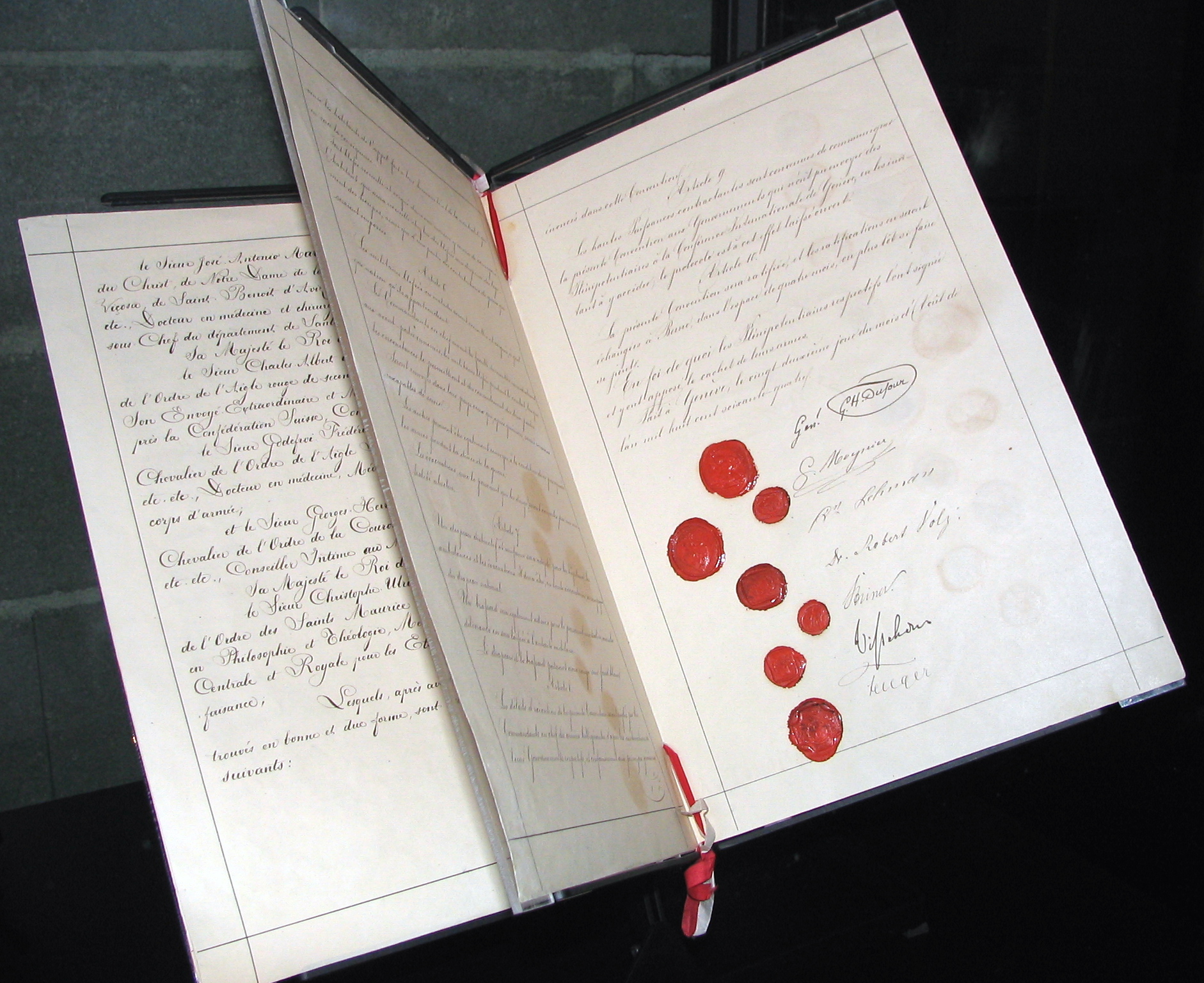
The First Geneva Convention governing the sick and wounded members of armed forces was signed in 1864.

The law of war, also referred to as international humanitarian law or the law of armed conflict, is the branch of international law relating to the conduct of war, which includes jus ad bellum (the law governing the permissibility of going to war) and jus in bello (the law applicable during war). The laws of war define sovereignty and nationhood, states and territories, occupation, and other critical terms of public international law.

Among other issues, the modern laws of war address the declarations of war; acceptance of surrender and the treatment of prisoners of war; the principles of distinction, as well as military necessity and proportionality; and the prohibition of certain weapons that cause unnecessary or excessive suffering.[1][2]

The law of war is considered distinct from other bodies of law—such as the domestic law of a particular belligerent to a conflict—which may provide additional legal limits to the conduct or justification of war.

Early sources and history

[edit]

The first traces of a law of war come from the Babylonians. It is the Code of Hammurabi,[3] king of Babylon, which in 1750 B.C., explains its laws imposing a code of conduct in the event of war:

I prescribe these laws so that the strong do not oppress the weak.

An example from the Book of Deuteronomy 20:19–20 limits the amount of environmental damage, allowing only the cutting down of non-fruitful trees for use in the siege operation, while fruitful trees should be preserved for use as a food source. Similarly, Deuteronomy 21:10–14 requires that female captives who were forced to marry the victors of a war, then not desired anymore, be let go wherever they want, and requires them not to be treated as slaves nor be sold for money.

In the early 7th century, the first Sunni Muslim caliph, Abu Bakr, whilst instructing his Muslim army, laid down rules against the mutilation of corpses, killing children, women, and the elderly. He also laid down rules against environmental harm to trees and slaying of the enemy's animals:

Stop, O people, that I may give you ten rules for your guidance in the battlefield. Do not commit treachery or deviate from the right path. You must not mutilate dead bodies. Neither kill a child, nor a woman, nor an aged man. Bring no harm to the trees, nor burn them with fire, especially those which are fruitful. Slay not any of the enemy's flock, save for your food. You are likely to pass by people who have devoted their lives to monastic services; leave them alone.[4][5]

In the history of the early Christian church, many Christian writers considered that Christians could not be soldiers or fight wars. Augustine of Hippo contradicted this and wrote about 'just war' doctrine, in which he explained the circumstances when war could or could not be morally justified.

In 697, Adomnan of Iona gathered Kings and church leaders from around Ireland and Scotland to Birr, where he gave them the 'Law of the Innocents', which banned killing women and children in war, and the destruction of churches.[6]

Apart from chivalry in medieval Europe, the Roman Catholic Church also began promulgating teachings on just war, reflected to some extent in movements such as the Peace and Truce of God. The impulse to restrict the extent of warfare, and especially protect the lives and property of non-combatants continued with Hugo Grotius and his attempts to write laws of war.

Modern sources

[edit]
The signing of the First Geneva Convention by some of the major European powers in 1864

The modern law of war is made up from three principal sources:[7]

Positive international humanitarian law consists of treaties (international agreements) that directly affect the laws of war by binding consenting nations and achieving widespread consent.

The opposite of positive laws of war is customary laws of war,[7] many of which were explored at the Nuremberg War Trials. These laws define both the permissive rights of states as well as prohibitions on their conduct when dealing with irregular forces and non-signatories.

The Treaty of Armistice and Regularization of War signed on November 25 and 26, 1820 between the president of the Republic of Colombia, Simón Bolívar and the Chief of the Military Forces of the Spanish Kingdom, Pablo Morillo, is the precursor of the International Humanitarian Law.[8] The Treaty of Guadalupe Hidalgo, signed and ratified by the United States and Mexico in 1848, articulates rules for any future wars, including protection of civilians and treatment of prisoners of war.[9] The Lieber Code, promulgated by the Union during the American Civil War, was critical in the development of the laws of land warfare.[10]

Historian Geoffrey Best called the period from 1856 to 1909 the law of war's "epoch of highest repute."[11] The defining aspect of this period was the establishment, by states, of a positive legal or legislative foundation (i.e., written) superseding a regime based primarily on religion, chivalry, and customs.[12] It is during this "modern" era that the international conference became the forum for debate and agreement between states and the "multilateral treaty" served as the positive mechanism for codification.

The Nuremberg War Trial judgment on "The Law Relating to War Crimes and Crimes Against Humanity"[13] held, under the guidelines Nuremberg Principles, that treaties like the Hague Convention of 1907, having been widely accepted by "all civilised nations" for about half a century, were by then part of the customary laws of war and binding on all parties whether the party was a signatory to the specific treaty or not.

Interpretations of international humanitarian law change over time and this also affects the laws of war. For example, Carla Del Ponte, the chief prosecutor for the International Criminal Tribunal for the former Yugoslavia pointed out in 2001 that although there is no specific treaty ban on the use of depleted uranium projectiles, there is a developing scientific debate and concern expressed regarding the effect of the use of such projectiles and it is possible that, in future, there may be a consensus view in international legal circles that use of such projectiles violates general principles of the law applicable to use of weapons in armed conflict.[14]

Purposes

[edit]

It has often been commented that creating laws for something as inherently lawless as war seems like a lesson in absurdity. But based on the adherence to what amounted to customary international humanitarian law by warring parties through the ages, it was believed by many, especially after the eighteenth century, that codifying laws of war would be beneficial.[15] Classifications of what kind of conflict is taking place is also important. Depending on how a conflict is classified certain actors may or may not use force against another power. This can lead to tactical classification of a conflict so that one actor has the sole right of force. Sometimes a new body of law is even created to do so.[16]

Some of the central principles underlying laws of war are:[citation needed]

  • Wars should be limited to achieving the political goals that started the war (e.g., territorial control) and should not include unnecessary destruction.
  • Wars should be brought to an end as quickly as possible.
  • People and property that do not contribute to the war effort should be protected against unnecessary destruction and hardship.

To this end, laws of war are intended to mitigate the hardships of war by:

The idea that there is a right to war concerns, on the one hand, the jus ad bellum, the right to make war or to enter war, assuming a motive such as to defend oneself from a threat or danger, presupposes a declaration of war that warns the adversary: war is a loyal act, and on the other hand, jus in bello, the law of war, the way of making war, which involves behaving as soldiers invested with a mission for which all violence is not allowed. In any case, the very idea of a right to war is based on an idea of war that can be defined as an armed conflict, limited in space, limited in time, and by its objectives. War begins with a declaration (of war), ends with a treaty (of peace) or surrender agreement, an act of sharing, etc.[17] Laws of war serve the conflicts that are currently taking place. As conflicts change over time so do the laws that govern them. New laws can therefore be created. This is recently seen in the "assassination policies" adopted during the "War on Terror".[18]

Principles

[edit]
A 1904 article outlining the basic principles of the law of war, as published in the Tacoma Times

Military necessity, along with distinction, proportionality, humanity (sometimes called unnecessary suffering), and honor (sometimes called chivalry) are the five most commonly cited principles of international humanitarian law governing the legal use of force in an armed conflict.

Military necessity is governed by several constraints: an attack or action must be intended to help in the defeat of the enemy; it must be an attack on a legitimate military objective,[19] and the harm caused to protected civilians or civilian property must be proportional and not excessive in relation to the concrete and direct military advantage anticipated.[20]

Distinction is a principle under international humanitarian law governing the legal use of force in an armed conflict, whereby belligerents must distinguish between combatants and protected civilians.[a][21]

Proportionality is a principle under international humanitarian law governing the legal use of force in an armed conflict, whereby belligerents must make sure that the harm caused to protected civilians or civilian property is not excessive in relation to the concrete and direct military advantage expected by an attack on a legitimate military objective.[20] However, as Robbie Sabel, Professor of international law at the Hebrew University, who has written on this topic, notes: “Anyone with experience in armed conflict knows that you want to hit the enemy’s forces harder than they hit you… if you are attacked with a rifle, there is no rule that stipulates that you can only shoot back with a rifle, but using a machine gun would not be fair, or that if you are attacked with only one tank you cannot shoot back with two.”[22]

Humanity is a principle based on the 1907 Hague Convention IV - The Laws and Customs of War on Land restrictions against using arms, projectiles, or materials calculated to cause suffering or injury manifestly disproportionate to the military advantage realized by the use of the weapon for legitimate military purposes. In some countries, weapons are reviewed prior to their use in combat to determine if they comply with the law of war and are not designed to cause unnecessary suffering when used in their intended manner. This principle also prohibits using an otherwise lawful weapon in a manner that causes unnecessary suffering.[23]

Honor is a principle that demands a certain amount of fairness and mutual respect between adversaries. Parties to a conflict must accept that their right to adopt means of injuring each other is not unlimited, they must refrain from taking advantage of the adversary's adherence to the law by falsely claiming the law's protections, and they must recognize that they are members of a common profession that fights not out of personal hostility but on behalf of their respective States.[23]

Substantive examples

[edit]

To fulfill the purposes noted above, the laws of war place substantive limits on the lawful exercise of a belligerent's power. Generally speaking, the laws require that belligerents refrain from employing violence that is not reasonably necessary for military purposes and that belligerents conduct hostilities with regard for the principles of humanity and chivalry.

However, because the laws of war are based on consensus (as the nature of international law often relies on self-policing by individual states), the content and interpretation of such laws are extensive, contested, and ever-changing.[24]

The following are particular examples of some of the substance of the laws of war, as those laws are interpreted today.

Declaration of war

[edit]

Section III of the Hague Convention of 1907 required hostilities to be preceded by a reasoned declaration of war or by an ultimatum with a conditional declaration of war.

Some treaties, notably the United Nations Charter (1945) Article 2,[25] and other articles in the Charter, seek to curtail the right of member states to declare war; as does the older Kellogg–Briand Pact of 1928 for those nations who ratified it.[26] These have led to fewer modern armed conflicts being preceded by formal declarations of war, undermining the objectives of the Hague Convention.

Lawful conduct of belligerent actors

[edit]

Modern laws of war regarding conduct during war (jus in bello), such as the 1949 Geneva Conventions, provide that it is unlawful for belligerents to engage in combat without meeting certain requirements. Article 4(a)(2) of the Geneva Convention relative to the Treatment of Prisoners of War recognizes Lawful Combatants by the following characteristics:

  • (a) That of being commanded by a person responsible for his subordinates;
  • (b) That of having a fixed distinctive sign recognizable at a distance;
  • (c) That of carrying arms openly; and
  • (d) That of conducting their operations in accordance with the laws and customs of war.[27]

Impersonating enemy combatants by wearing the enemy's uniform is possibly allowed, however the issue is unsettled. Fighting in that uniform is unlawful perfidy,[28] as is the taking of hostages.[citation needed]

Combatants also must be commanded by a responsible officer. That is, a commander can be held liable in a court of law for the improper actions of their subordinates. There is an exception to this if the war came on so suddenly that there was no time to organize a resistance, e.g. as a result of a foreign occupation.[citation needed]

People parachuting from an aircraft in distress

[edit]

Modern laws of war, specifically within Protocol I additional to the 1949 Geneva Conventions, prohibits attacking people parachuting from an aircraft in distress regardless of what territory they are over. Once they land in territory controlled by the enemy, they must be given an opportunity to surrender before being attacked unless it is apparent that they are engaging in a hostile act or attempting to escape. This prohibition does not apply to the dropping of airborne troops, special forces, commandos, spies, saboteurs, liaison officers, and intelligence agents. Thus, such personnel descending by parachutes are legitimate targets and, therefore, may be attacked, even if their aircraft is in distress.

Red Cross, Red Crescent, Magen David Adom, and the white flag

[edit]
The emblem of the International Committee of the Red Cross (French: Comité international de la croix-rouge)

Modern laws of war, such as the 1949 Geneva Conventions, also include prohibitions on attacking doctors, ambulances or hospital ships displaying a Red Cross, a Red Crescent, Magen David Adom, Red Crystal, or other emblem related to the International Red Cross and Red Crescent Movement. It is also prohibited to fire at a person or vehicle bearing a white flag, since that indicates an intent to surrender or a desire to communicate.[29]

In either case, people protected by the Red Cross/Crescent/Star or white flag are expected to maintain neutrality, and may not engage in warlike acts. In fact, engaging in war activities under a protected symbol is itself a violation of the laws of war known as perfidy. Failure to follow these requirements can result in the loss of protected status and make the individual violating the requirements a lawful target.[29]

Applicability to states and individuals

[edit]

The law of war is binding not only upon states as such but also upon individuals and, in particular, the members of their armed forces. Parties are bound by the laws of war to the extent that such compliance does not interfere with achieving legitimate military goals. For example, they are obliged to make every effort to avoid damaging people and property not involved in combat or the war effort, but they are not guilty of a war crime if a bomb mistakenly or incidentally hits a residential area.[citation needed]

By the same token, combatants that intentionally use protected people or property as human shields or camouflage are guilty of violations of the laws of war and are responsible for damage to those that should be protected.[29]

Mercenaries

[edit]

The use of contracted combatants in warfare has been an especially tricky situation for the laws of war. Some scholars claim that private security contractors appear so similar to state forces that it is unclear if acts of war are taking place by private or public agents.[30] International law has yet to come to a consensus on this issue.

Remedies for violations

[edit]

During conflict, punishment for violating the laws of war may consist of a specific, deliberate and limited violation of the laws of war in reprisal.[citation needed]

After a conflict ends, any persons who have committed or ordered any breach of the laws of war, especially atrocities, may be held individually accountable for war crimes. Also, nations that signed the Geneva Conventions are required to search for, try and punish, anyone who had committed or ordered certain "grave breaches" of the laws of war. (Third Geneva Convention, Article 129 and Article 130)

Combatants who break specific provisions of the laws of war are termed unlawful combatants. Unlawful combatants who have been captured may lose the status and protections that would otherwise be afforded to them as prisoners of war, but only after a "competent tribunal" has determined that they are not eligible for POW status (e.g., Third Geneva Convention, Article 5) At that point, an unlawful combatant may be interrogated, tried, imprisoned, and even executed for their violation of the laws of war pursuant to the domestic law of their captor, but they are still entitled to certain additional protections, including that they be "treated with humanity and, in case of trial, shall not be deprived of the rights of fair and regular trial." (Fourth Geneva Convention, Article 5)

International treaties on the laws of war

[edit]

List of declarations, conventions, treaties, and judgments on the laws of war:[31][32][33]

See also

[edit]

Notes

[edit]

References

[edit]

Further reading

[edit]
[edit]
Revisions and contributorsEdit on WikipediaRead on Wikipedia
from Grokipedia
The law of war, also known as international humanitarian law or the law of armed conflict, comprises a set of international rules that seek, for humanitarian reasons, to limit the effects of armed conflict by protecting persons who do not or no longer take a direct part in hostilities—such as civilians, the wounded, the sick, and prisoners of war—and by restricting the means and methods of warfare. These rules form part of public international law, primarily through treaties and customary norms, and apply to both international and non-international armed conflicts. The foundational modern instruments are the four Geneva Conventions of 1949, adopted in response to World War II atrocities and universally ratified by 196 states, along with their Additional Protocols of 1977 and 2005, which expand protections and address new warfare realities. Earlier codifications, including the Hague Conventions of 1899 and 1907, regulate permissible weapons and tactics, emphasizing principles like distinction between combatants and civilians, proportionality in military actions to avoid excessive civilian harm relative to anticipated advantage, military necessity, and the prohibition of superfluous injury or unnecessary suffering. Enforcement relies on state obligations, international criminal tribunals such as the International Criminal Court for war crimes prosecutions, and oversight by bodies like the International Committee of the Red Cross, though empirical evidence from conflicts indicates persistent violations due to the fog of war and incentives for restraint in adherence.

Historical Foundations

Ancient and Pre-Modern Origins

The earliest documented attempts to regulate warfare appear in ancient Mesopotamian legal codes, such as the Code of Hammurabi, promulgated around 1755–1750 BCE by the Babylonian king Hammurabi. This stele-inscribed collection of 282 laws emphasized retributive justice and social order, including provisions indirectly related to military conduct, such as the regulation of plunder returns and the treatment of captives or slaves acquired in conflict, which aimed to prevent internal disorder from wartime gains. While primarily a civil code, it reflected nascent customs distinguishing between lawful seizure in war and illicit theft, influencing subsequent Near Eastern legal traditions. In the broader ancient Near East, Assyrian legal texts from the Middle Assyrian period (circa 1450–1250 BCE) codified rules governing military expeditions, including the handling of prisoners and spoils, though Assyrian warfare was notoriously harsh, prioritizing terror tactics like mass deportations to deter rebellion. Egyptian records from the New Kingdom (circa 1550–1070 BCE) similarly document pharaonic campaigns with implicit norms, such as sparing certain temples or elites to legitimize conquests, but these were pragmatic rather than humanitarian, often justified by divine mandate. These codes focused more on jus post bellum—post-victory administration—than restricting violence during hostilities, revealing warfare's role in empire-building with minimal restraints on combatants. Ancient Indian texts provided more explicit strictures on battlefield conduct, rooted in dharma (cosmic order). The Arthashastra, attributed to Kautilya (circa 300 BCE), outlined military strategy while prohibiting concealed, barbed, or poisoned weapons, mandating protection for non-combatants like ascetics and women, and restricting fights to daylight hours between sunrise and sunset. Complementary Vedic and epic sources, such as the Laws of Manu and Mahabharata, emphasized honorable combat, forbidding attacks on the wounded, fleeing, or unarmed foes, and requiring advance specification of battle time and place to uphold warrior duty. These principles derived from ethical realism, balancing artha (state interest) with moral limits to sustain societal stability amid frequent interstate conflicts. In China, Sun Tzu's Art of War (circa 5th century BCE) prioritized strategic efficiency over brute force, advising against sieges of cities unless unavoidable and advocating subjugation through maneuver to minimize casualties and preserve resources. This reflected a realist calculus where unnecessary destruction weakened the victor, though it permitted deception and emphasized speed in combat without codified protections for civilians or prohibitions on tactics like ambushes. Greek city-states observed customary restraints, such as immunity for heralds and truces for Olympic games or burials, but lacked formalized codes, with warfare often escalatory as in the Peloponnesian War (431–404 BCE). Rome advanced procedural norms through the jus fetiale, a priestly college established by the 8th century BCE, which ritualized war declarations via demands for restitution, boundary spear-throwing, and invocations ensuring divine sanction for "just wars" against aggressors or treaty-breakers. This system, evolving into jus gentium (law of nations), extended to treaties and captive treatment, promoting predictability in interstate relations while justifying expansion. Pre-modern Europe saw the emergence of chivalric codes among feudal knights from the 12th century onward, idealized in treatises like those of Ramon Llull (1274–1276 CE), which enjoined protection of the weak, ransoming nobles over killing, and avoidance of treachery or peasant harm during campaigns. These norms, blending Christian ethics with martial honor, prohibited assaults on clergy, women, or non-combatants and mandated herald respect, though enforcement was inconsistent, often overridden by tactical needs as in the Hundred Years' War (1337–1453 CE). Chivalry thus represented a cultural overlay on customary law, curbing excesses through peer accountability rather than sovereign edict, yet permitting relentless crusades against non-Christians.

Religious and Just War Influences

Religious traditions have profoundly shaped the laws of war by establishing early norms for the conduct of hostilities, often blending moral imperatives with divine commands. In ancient Judaism, the Torah's Book of Deuteronomy outlines specific regulations for warfare, mandating that besiegers offer terms of peace before assaulting a city and prohibiting the destruction of fruit-bearing trees, which could be used for sustenance during sieges. These provisions reflect a pragmatic restraint, distinguishing between combatants and essential resources, while allowing exemptions for newlyweds and homeowners from military service to preserve societal stability. For certain Canaanite cities, however, the herem doctrine prescribed total destruction of inhabitants and property as a divine mandate, prioritizing conquest over mercy in existential threats to the community. Christian theology formalized these influences through just war theory, originating with Augustine of Hippo around 413–426 CE in works like The City of God, where he justified defensive wars under legitimate authority to restore peace, emphasizing right intention to avoid vengeance or conquest for glory. Augustine distinguished between the justice of resorting to war (jus ad bellum) and conduct within it (jus in bello), railing against gratuitous violence while permitting force proportionate to achieving peace against aggressors. Thomas Aquinas in the 13th century systematized this in Summa Theologica (II-II, q. 40), requiring just cause, legitimate sovereign authority, and right intent for initiating war, alongside in bello principles of discrimination between combatants and non-combatants and proportionality to limit unnecessary harm. These criteria derived from natural law reasoning rather than revelation alone, influencing medieval canon law and chivalric codes that prohibited treachery and protected clergy, women, and the unarmed. In Islam, Quranic verses and hadith established parallel restraints on jihad, conceptualized as defensive struggle against oppression, with prohibitions against killing non-combatants such as women, children, the elderly, or clergy, and against mutilation, arson, or environmental destruction. Surah 2:190–193 commands fighting only those who fight you but forbids transgression, while hadith collections like Sahih Bukhari record Prophet Muhammad's instructions to spare non-fighters and offer peace terms, mirroring Deuteronomic offers. Jurists like those in the Hanafi and Maliki schools differentiated offensive jihad against polytheists from defensive wars, imposing rules against betrayal and requiring proportionality, though interpretations varied, with some classical texts permitting broader campaigns for dar al-Islam expansion. These religious frameworks prefigured core elements of modern international humanitarian law, such as distinction and proportionality, by grounding warfare in moral limits rather than absolute sovereignty. Just war theory's emphasis on legitimate authority and necessity informed Grotius's 1625 De Jure Belli ac Pacis, bridging theology to secular positive law, while Islamic siyar (international law) influenced early treaties with non-Muslims. Empirical historical application, however, often deviated—crusades invoked just war yet involved atrocities, and jihad expansions included conquests—highlighting tensions between doctrine and practice driven by political incentives over doctrinal purity. Despite biases in academic sources favoring Western traditions, primary texts reveal convergent causal realities: survival imperatives necessitated restraints to enable sustained conflict and post-war order, independent of ideological veneer.

Codification in the Modern Era

The modern codification of the laws of war commenced in the 19th century amid industrial-scale conflicts that highlighted the need for formalized rules on wartime conduct. The Lieber Code, formally General Orders No. 100, was issued by U.S. President Abraham Lincoln on April 24, 1863, to govern the Union Army during the American Civil War. Drafted primarily by jurist Francis Lieber, this 157-article document outlined permissible actions in occupation, treatment of prisoners of war, and distinctions between combatants and non-combatants, incorporating concepts of military necessity while prohibiting acts like torture, poisoning wells, and summary executions. It influenced subsequent international efforts by providing a practical model, though applied unilaterally by the Union forces. The establishment of the International Committee of the Red Cross in 1863, spurred by Henri Dunant's observations of the Battle of Solferino in 1859, accelerated multilateral codification. This culminated in the First Geneva Convention, signed on August 22, 1864, by 12 European states, which mandated protection and neutral status for the wounded, sick soldiers, medical personnel, and facilities during armed conflict. The convention required belligerents to collect and care for enemy wounded without adverse distinction, marking the first treaty dedicated to humanitarian protections in warfare and forming the basis for the Red Cross emblem's recognition. Revisions followed in 1906 and 1929 to extend coverage to prisoners of war. Parallel advancements addressed weaponry and tactics through the 1868 St. Petersburg Declaration, which prohibited the use of explosive projectiles weighing less than 400 grams to limit unnecessary suffering. The Hague Peace Conferences of 1899 and 1907 produced a series of conventions that codified broader rules on land warfare, naval engagements, and neutral rights. The 1899 conventions included regulations banning poison weapons, dum-dum bullets, and bombardment of undefended towns, while the 1907 Hague Convention IV and its annexed regulations detailed rights and duties of belligerents, protections for populations under occupation, and prohibitions on pillage and reprisals against civilians. These instruments, ratified by major powers, transitioned customary practices into binding treaty law, though enforcement remained limited by state sovereignty and the absence of centralized adjudication prior to World War I.

Post-World War II Evolution

The Nuremberg International Military Tribunal (1945–1946) and the International Military Tribunal for the Far East in Tokyo (1946–1948) prosecuted Axis leaders for war crimes, crimes against peace, and crimes against humanity, establishing precedents for individual criminal responsibility under international law and reinforcing prohibitions on atrocities such as the murder of civilians and mistreatment of prisoners of war. These trials highlighted deficiencies in pre-war treaties, including inadequate protections for civilians and prisoners, prompting the International Committee of the Red Cross to convene diplomatic conferences to revise the Geneva Conventions. The four Geneva Conventions were adopted on August 12, 1949, by representatives from 59 states at a conference in Geneva, entering into force on October 21, 1950, following ratifications by two-thirds of signatories. By 2025, all 196 states parties to the United Nations, plus observers, had ratified them, marking near-universal adherence. The conventions expanded protections beyond prior versions: the First and Second address the wounded and sick in armed forces on land and sea; the Third details prisoner-of-war rights, including humane treatment, labor limits, and repatriation; the Fourth introduces comprehensive safeguards for civilians in occupied territory, prohibiting deportations, collective punishments, and hostage-taking. Common Article 3 applies humanitarian standards in non-international conflicts, banning violence to life, torture, and summary executions. In response to post-colonial wars and internal conflicts, two Additional Protocols were adopted on June 8, 1977: Protocol I supplements the conventions for international armed conflicts, enhancing civilian protections against indiscriminate attacks and incorporating "wars of national liberation" as equivalent to interstate wars under Article 1(4); Protocol II extends minimal protections to non-international armed conflicts meeting a threshold of organized dissident forces controlling territory. As of 2023, 174 states had ratified Protocol I and 169 Protocol II. Protocol I's provisions on combatant status for irregular fighters and restrictions on reprisals drew criticism from the United States, which signed but did not ratify it, with the Reagan administration arguing certain articles effectively provided "humanitarian law in favor of terrorists" by blurring distinctions between combatants and civilians in asymmetric warfare. Subsequent treaties, such as the 1998 Rome Statute establishing the International Criminal Court to prosecute grave breaches as war crimes, further institutionalized enforcement, though ratification remains uneven among major powers.

Core Principles

Distinction Between Combatants and Civilians

The principle of distinction mandates that parties to an armed conflict differentiate between combatants, who may be lawfully targeted, and civilians, who enjoy protection from direct attack unless and for such time as they take a direct part in hostilities. This core rule of international humanitarian law (IHL) prohibits directing attacks against the civilian population or civilian objects and bans indiscriminate attacks that fail to distinguish between military and non-military targets. As customary international law, it binds all parties regardless of treaty ratification, originating from efforts to limit war's horrors by confining violence to those actively waging it. Legal foundations trace to the 1899 and 1907 Hague Regulations, which required combatants to distinguish themselves via fixed distinctive signs visible at distance and to carry arms openly during operations, enabling adversaries to identify lawful targets. The 1949 Geneva Conventions implicitly reinforce this through protections for civilians as non-combatants, while Additional Protocol I of 1977 explicitly codifies the obligation in Article 48: parties "shall at all times distinguish between the civilian population and combatants and between civilian objects and military objectives and accordingly shall direct their operations only against military objectives." Article 50 defines civilians as those not belonging to armed forces or organized armed groups, presuming civilian status for doubt about an individual's status during military operations. Combatant status, conferring combatant privilege and potential prisoner-of-war protections upon capture, applies in international armed conflicts (IACs) to members of a party's armed forces (excluding medical/religious personnel) or militias/volunteer corps fulfilling four criteria: responsible command, fixed distinctive sign, open carry of arms, and compliance with laws of war. Levée en masse participants—inhabitants of non-occupied territory spontaneously rising against invaders, carrying arms openly and respecting war laws—also qualify. In non-international armed conflicts (NIACs), the distinction persists as customary law, though without formal combatant status; dissident forces must still distinguish themselves to avoid endangering civilians they exploit for cover. Direct participation in hostilities by civilians—threshold acts like using weapons or planning attacks—temporarily removes protection, but mere presence in combat zones or support roles (e.g., logistics without direct harm) does not. Violations occur when combatants fail to mark themselves or when attacks treat civilians as presumptive threats without specific intelligence, as evidenced in analyses of urban warfare where 90% of casualties in recent conflicts have been civilian, often due to blurred lines rather than intentional policy. Asymmetric warfare poses enforcement challenges, as non-state actors frequently embed among civilians, forgo distinctive signs, and use human shields, deliberately eroding distinguishability to provoke responses that generate propaganda value from collateral harm. This tactic, observed in conflicts like those involving insurgents in Iraq (2003–2011) where fighters routinely blended into populations, shifts causal responsibility for heightened civilian risk onto violators who reject IHL's reciprocal protections, compelling state forces to rely on precision intelligence and rules of engagement to verify targets. Empirical data from such scenarios indicate that failure to self-distinguish by irregulars correlates with elevated misidentification errors, underscoring the principle's reliance on mutual compliance for efficacy. Prosecutions under bodies like the International Criminal Court for indiscriminate attacks affirm the rule's applicability, with convictions tied to evidence of intent or feasible precautions neglected.

Proportionality and Military Necessity

The principle of military necessity in international humanitarian law (IHL) permits a belligerent to apply any amount and kind of force to compel the complete submission of the enemy with a minimum expenditure of time, life, and physical resources, provided such actions are not otherwise prohibited by the law of war. This principle, rooted in customary law and codified in instruments like the 1907 Hague Regulations, requires that measures be indispensable for securing the ends of war and cease once the enemy is hors de combat or the military objective is achieved. It does not justify acts of reprisal, cruelty, or destruction beyond what is required to weaken the enemy's military resistance, as affirmed in the 1948 Hostage Case by a U.S. military tribunal, which held that military necessity admits no cruelty for its own sake or revenge. Proportionality, closely intertwined with military necessity, prohibits attacks on military objectives if the expected incidental harm to civilians or civilian objects—such as loss of life, injury, or damage—is excessive relative to the concrete and direct military advantage anticipated. This rule, explicitly stated in Article 51(5)(b) of Additional Protocol I to the Geneva Conventions (1977), applies during the conduct of hostilities (jus in bello) and demands an ex ante assessment by commanders based on information available at the time, rather than hindsight. Unlike broader proportionality assessments in jus ad bellum (the legality of resorting to war), this principle focuses solely on balancing specific attack benefits against collateral effects, allowing incidental civilian harm but forbidding it when disproportionate. The interplay of these principles embodies IHL's foundational tension between humanity and necessity, ensuring warfare is not unlimited while permitting effective military operations. For instance, destroying a command center amid civilian areas may be lawful if the anticipated disruption to enemy operations outweighs foreseeable civilian casualties, but leveling an entire city block for a single sniper would violate proportionality absent overriding necessity. Violations, such as indiscriminate bombings causing excessive civilian deaths, have been prosecuted as war crimes under the Rome Statute of the International Criminal Court (Article 8(2)(b)(iv)), as in the 1999 NATO Kosovo campaign investigations where cluster munitions near populated areas raised proportionality concerns. Empirical assessments, including post-strike investigations, underscore that proportionality requires verifiable military gains, like severing supply lines, rather than speculative or remote advantages. In practice, military necessity limits permissible force to what is objectively required, precluding wanton destruction; for example, the 1907 Hague Convention IV (Article 23(g)) bans seizure of enemy property unless imperatively demanded by war's necessities. Proportionality assessments must account for feasible precautions to minimize harm, such as warnings or precision targeting, as mandated by Additional Protocol I Article 57. Challenges arise in asymmetric conflicts where adversaries exploit civilian proximity, yet the law imposes the burden on attackers to refrain if harm exceeds advantage, without excusing violations through enemy tactics. Customary IHL, applicable to all parties regardless of treaty ratification, reinforces these rules through state practice and judicial precedents, including International Court of Justice advisory opinions emphasizing strict application to prevent unnecessary suffering.

Humanity and Prohibition of Unnecessary Suffering

The principle of humanity underlying international humanitarian law requires belligerents to refrain from causing suffering or destruction not justified by military necessity, thereby imposing limits on the conduct of hostilities to mitigate the inherent brutality of armed conflict. This principle, distinct yet complementary to military necessity, evolved from customary restraints observed in historical warfare, where excessive cruelty was often condemned on moral grounds, as seen in early codifications like the Lieber Code of 1863, which prohibited "unnecessary violence" toward enemies who had surrendered. Central to this principle is the explicit prohibition on employing weapons, means, or methods of warfare that are inherently designed to cause superfluous injury or unnecessary suffering, defined as harm exceeding that required to achieve a legitimate military objective, such as putting personnel hors de combat or destroying equipment. This rule, codified in Article 35(2) of Additional Protocol I to the Geneva Conventions (1977), states: "It is prohibited to employ weapons, means or methods of warfare of a nature to cause superfluous injury or unnecessary suffering." The assessment focuses on the normal or expected effects of the weapon in its typical use, rather than isolated incidents, ensuring that anticipated suffering aligns with operational imperatives rather than gratuitous pain. Historically, the prohibition traces to the St. Petersburg Declaration of 1868, where 20 states renounced the use of explosive projectiles weighing less than 400 grams, declaring that such arms "uselessly aggravate the sufferings of disabled men" beyond the goal of disabling combatants. This marked the first multilateral treaty articulating the balance between military utility and humane restraint, influencing subsequent instruments like the 1899 Hague Declaration banning expanding bullets (dum-dum bullets) for causing excessive wounds disproportionate to their stopping power. As customary international law, the rule binds all parties in both international and non-international armed conflicts, irrespective of treaty ratification, and applies to states, non-state actors, and even novel technologies, with the International Committee of the Red Cross affirming its universal scope through state practice and opinio juris. Enforcement relies on domestic implementation, such as Article 36 of Additional Protocol I, which obliges states to review new weapons for compliance during development, ensuring that innovations like certain anti-personnel mines or blinding lasers—banned by the 1995 Protocol IV to the Convention on Certain Conventional Weapons—do not violate the prohibition by design. Violations, such as deploying inherently inhumane munitions, may constitute war crimes under the Rome Statute of the International Criminal Court (Article 8(2)(b)(xx)), prosecutable before international tribunals, though challenges persist in objectively quantifying "unnecessary" suffering amid evolving weaponry.

Customary International Law

Customary international humanitarian law (IHL) consists of rules derived from a general practice of states accepted as legally binding, known as opinio juris, and exists independently of treaty obligations. This body of law binds all states and participants in armed conflicts, filling gaps in treaty coverage, particularly for non-signatory states or non-international armed conflicts. Prior to the mid-19th century codifications, the laws of war operated almost entirely as customary norms shaped by battlefield practices and reciprocal restraints among belligerents. The formation of customary IHL requires two elements: widespread and consistent state practice, evidenced by military manuals, national legislation, judicial decisions, and operational conduct; and opinio juris, demonstrated by states' belief that the practice is required by law rather than mere policy or comity. Historical examples include the Lieber Code of 1863, issued by U.S. President Abraham Lincoln for Union forces during the American Civil War, which articulated principles like the protection of non-combatants and prohibition of unnecessary suffering, reflecting emerging customary restraints. In modern identification, the International Committee of the Red Cross (ICRC) conducted a 2005 study compiling 161 rules based on extensive state practice and opinio juris across over 100 countries, covering both international and non-international conflicts. Core customary rules in the law of war emphasize distinction, prohibiting attacks on civilians or civilian objects while permitting targeting of military objectives (Rule 1); bans on violence aimed at spreading terror among civilians (Rule 2); and requirements for precautions in attack to minimize civilian harm (Rule 15). Other rules proscribe methods causing superfluous injury or unnecessary suffering (Rule 70) and mandate humane treatment of persons hors de combat (Rule 47). These apply universally, supplementing treaties like the Geneva Conventions, but debates persist; for instance, the United States has contested the customary status of certain ICRC-proposed rules, such as expansive interpretations of fundamental guarantees, citing insufficient global opinio juris or discordant practice in operational contexts. Judicial bodies, including the International Court of Justice, affirm customary IHL's role in interpreting state obligations, as in the 1996 Nuclear Weapons Advisory Opinion, where core principles like distinction were deemed inherent to the law of armed conflict. Customary IHL evolves through ongoing state interactions, with post-1949 developments incorporating protections against indiscriminate weapons and environmental harm during hostilities, evidenced by national military doctrines and treaty ratifications signaling acceptance. Non-state actors are bound only to the extent customary rules reflect universal practice applicable in non-international conflicts, though enforcement relies on state accountability mechanisms.

Treaties and Conventions

The Hague Conventions of 1899 and 1907 represent early multilateral efforts to codify rules for warfare, focusing on land and naval conduct, the treatment of prisoners, and prohibitions on certain weapons like expanding bullets and poison gases. The 1899 conference produced three conventions and three declarations, including Convention II on the laws and customs of war on land, ratified by 36 states initially. The 1907 revisions expanded to 13 conventions, with Convention IV updating land warfare rules; over 50 states are parties to key provisions, though adherence varies as customary law supplements treaty obligations. The four Geneva Conventions of 1949 form the cornerstone of modern international humanitarian law, addressing protections in armed conflicts: Convention I for the wounded and sick in armed forces in the field, II for those at sea, III for prisoners of war, and IV for civilians. Adopted on August 12, 1949, and entering into force October 21, 1950, they have achieved near-universal ratification, with 196 states parties as of 2023, binding even non-signatories via customary law. These treaties mandate humane treatment, prohibit torture, and require medical care, with Common Article 3 applying minimum protections in non-international conflicts. Additional Protocols of 1977 extend these protections: Protocol I enhances safeguards in international armed conflicts, including rules on targeting civilians and prohibiting reprisals; Protocol II strengthens Common Article 3 for non-international conflicts; Protocol III of 2005 introduces the Red Crystal emblem. Ratified by 174, 169, and 77 states respectively, these protocols reflect post-colonial and civil war contexts but face non-ratification by major powers like the United States for Protocol I due to concerns over national liberation movements equating to terrorism. Specialized treaties further restrict weapons: the 1925 Geneva Protocol bans chemical and biological weapons in war, ratified by 146 states; the 1980 Convention on Certain Conventional Weapons (CCW) and its protocols limit indiscriminate arms like blinding lasers, with 127 parties; the 1997 Ottawa Treaty prohibits anti-personnel landmines, joined by 164 states; and the 2008 Convention on Cluster Munitions bans those weapons, with 112 parties. These instruments, administered via depositaries like the United Nations, emphasize military necessity while prohibiting excessive harm, though non-universal adherence—such as major powers abstaining from Ottawa and Cluster bans—highlights tensions between treaty specificity and strategic needs.

Relationship to Jus ad Bellum

The law of war, or jus in bello, governs the conduct of hostilities during armed conflict and operates independently of jus ad bellum, which regulates the legality of resorting to force. Jus ad bellum primarily derives from the United Nations Charter (1945), prohibiting the use of force except in self-defense under Article 51 or with Security Council authorization under Chapter VII. In contrast, jus in bello—embodied in treaties like the Geneva Conventions (1949) and customary international humanitarian law—imposes obligations on all belligerents to limit suffering, irrespective of the conflict's origins or the parties' legal rights to initiate it. This separation emerged distinctly after World War II, as the UN Charter criminalized aggressive war while humanitarian treaties focused solely on wartime behavior, with the terms jus ad bellum and jus in bello gaining prominence in legal discourse around the 1950s. Historically rooted in just war theory, where moral justification intertwined resort and conduct, modern international law decoupled them to ensure jus in bello applies universally, preventing scenarios where an aggressor's victims lack protections or where defenders withhold compliance pending fault determinations. The International Committee of the Red Cross (ICRC) maintains that this independence is essential for effective victim safeguards, as assessing jus ad bellum compliance during conflict would paralyze humanitarian implementation. The distinction serves protective, pragmatic, and logical purposes: it shields non-combatants and combatants hors de combat regardless of aggression claims, fosters reciprocal adherence by equalizing standards, and aligns with the sequential logic of authorizing force (jus ad bellum) versus constraining its execution (jus in bello). While some legal interactions exist—such as Article 103 of the UN Charter potentially prioritizing jus ad bellum obligations in treaty conflicts or state responsibility rules invoking self-defense—the core principle remains that jus in bello violations incur liability independently of jus ad bellum breaches, as affirmed in International Court of Justice advisory opinions like the 1996 Nuclear Weapons case. This framework upholds humanitarian imperatives amid disputes over war's lawfulness, though critics note occasional interpretive overlaps in contexts like occupation or countermeasures.

Scope of Application

Applicability to States and Regular Armed Forces

The laws of war, comprising international humanitarian law (IHL), bind states participating in international armed conflicts (IACs) as High Contracting Parties to relevant treaties, with applicability triggered by Common Article 2 of the four Geneva Conventions of August 12, 1949. This provision states that the Conventions "shall apply to all cases of declared war or of any other armed conflict which may arise between two or more of the High Contracting Parties, even if the state of war is not recognized by one of them." The article further extends protections to situations of partial or total occupation of the territory of a High Contracting Party, irrespective of armed resistance or a formal declaration of war. As of 2023, 196 states are parties to the Geneva Conventions, ensuring near-universal treaty-based applicability in IACs involving states. Customary IHL supplements treaty obligations, imposing binding rules on all states in IACs regardless of ratification status, derived from consistent state practice and opinio juris. States must not only adhere to jus in bello norms—regulating conduct during conflict—but also fulfill pre- and post-conflict duties, such as disseminating IHL within their military structures and enacting domestic legislation to enforce compliance. Failure to do so constitutes a breach attributable to the state under international law, as affirmed in cases before the International Court of Justice, such as Nicaragua v. United States (1986), where state responsibility for armed forces' actions was upheld. Regular armed forces of states engaged in IACs qualify as combatants under Article 4(A)(1) of the Third Geneva Convention, encompassing "members of the armed forces of a Party to the conflict, as well as members of militias or volunteer corps forming part of such armed forces." This status grants lawful combatants the privilege of direct participation in hostilities without incurring domestic criminal liability for such acts (combatant immunity), provided they comply with IHL, and entitles them to prisoner-of-war (POW) protections upon capture, including humane treatment and repatriation post-hostilities. Article 43 of Additional Protocol I (1977), ratified by 174 states as of 2023, reinforces this by defining combatants as "all organized armed forces of a Party to the conflict," excluding levée en masse unless conditions like open carrying of arms are met. In non-international armed conflicts (NIACs), states' regular armed forces remain bound by Common Article 3 of the Geneva Conventions, prohibiting violence to life, torture, and hostage-taking, as well as Additional Protocol II (1977) if the conflict meets intensity and organization thresholds, ratified by 169 states. Unlike IACs, NIACs do not confer full combatant or POW status to state forces' captured members against non-state opponents, but states retain obligations to protect civilians and ensure accountability for violations. Jus in bello applies impartially to state armed forces, detached from jus ad bellum considerations of conflict initiation, ensuring reciprocity in restraints on warfare despite asymmetries in cause or aggression.

Non-State Actors, Insurgents, and Asymmetric Conflicts

The application of international humanitarian law (IHL) to non-state actors primarily occurs in non-international armed conflicts (NIACs), defined as protracted armed confrontations between governmental forces and organized non-state armed groups, or between such groups within a state's territory. Common Article 3 to the four Geneva Conventions of 1949 imposes fundamental obligations on all parties to NIACs, including non-state actors, requiring humane treatment of persons taking no active part in hostilities, prohibition of violence to life and person (including murder, mutilation, cruel treatment, and torture), protection against hostage-taking, outrages upon personal dignity, and summary executions, as well as care for the wounded and sick. These rules bind non-state groups directly, even without state-like status, through the conventions' application to "each Party to the conflict," interpreted to include insurgent forces. Additional Protocol II of 1977 expands protections in NIACs involving organized dissident armed forces under responsible command controlling territory, but its ratification is not universal, limiting its scope compared to customary IHL, which fills gaps by applying similar principles broadly. Insurgents, as members of non-state armed groups challenging state authority, do not automatically qualify for lawful combatant status under IHL, which is reserved for international armed conflicts (IACs) and requires criteria such as belonging to an organized force under responsible command, wearing distinctive signs visible at distance, carrying arms openly, and conducting operations in compliance with IHL. In NIACs, insurgents lack the combatant privilege—immunity from prosecution for mere participation in hostilities—and captured fighters may be tried under domestic law for rebellion or related offenses, without entitlement to prisoner-of-war (POW) status unless specific IAC thresholds are met, such as foreign intervention classifying the conflict internationally. This distinction incentivizes compliance with IHL markers like uniforms to claim protections, but many insurgent groups forgo them, blending with civilians and forfeiting targetable status only during direct participation in hostilities. Asymmetric conflicts, characterized by disparities in military power where non-state actors employ guerrilla tactics, terrorism, or irregular warfare against superior state forces, pose enforcement challenges to IHL principles like distinction and proportionality. Insurgents often exploit civilian environments for cover, using human shields, embedding in urban areas, or conducting indiscriminate attacks, which complicates state adherence to targeting rules requiring feasible precautions to minimize civilian harm. Customary IHL demands that all parties, including non-state groups, distinguish between combatants and civilians, yet empirical patterns in conflicts like those in Syria (2011–present) or Afghanistan (2001–2021) show frequent violations by insurgents, such as deliberate civilian targeting via improvised explosive devices, eroding reciprocity and prompting states to classify perpetrators as unlawful combatants subject to domestic criminal processes rather than full IHL protections. Non-state actors may reject IHL applicability, citing its state-centric origins or ideological incompatibility, further undermining compliance, though states remain bound and face accountability pressures from bodies like the International Criminal Court for any disproportionate responses.

Mercenaries and Private Military Contractors

Mercenaries are defined under Article 47 of Additional Protocol I to the Geneva Conventions of 1949 as individuals who are specially recruited locally or abroad to fight in an armed conflict, motivated essentially by the desire for private gain, and promised material compensation substantially in excess of that paid to combatants of similar rank and function in the armed forces of the contracting party. Such persons must also not be nationals or residents of a party to the conflict, nor members of its armed forces, and must be motivated to take direct part in hostilities. Mercenaries lack the legal status of combatants and are thus ineligible for prisoner-of-war protections upon capture; they may be prosecuted as unlawful combatants for their direct participation in hostilities by the detaining power, with status determination made by a competent tribunal. This provision, adopted in 1977, reflects efforts to deter profit-driven fighters who operate outside state command structures, though its application requires all cumulative criteria to be met, limiting prosecutions. The International Convention against the Recruitment, Use, Financing and Training of Mercenaries, adopted by the UN General Assembly in 1989 and entering into force on October 20, 2001, criminalizes state involvement in mercenary activities, prohibiting recruitment, use, financing, or training of such individuals for participation in hostilities or to destabilize states. Article 1 mirrors the Protocol I definition but extends to non-international conflicts and acts against sovereignty, with states obligated to enact domestic laws punishing violations, including up to seven years' imprisonment for participants. Ratified by 46 states as of 2023, the convention has limited adherence among major powers, undermining enforcement; for instance, it excludes permanent armed forces members and volunteers integrated into state militaries. Cases like the 2004 coup attempt in Equatorial Guinea highlighted prosecutorial challenges, with few convictions despite arrests. Private military contractors (PMCs), operating through corporate entities like Academi (formerly Blackwater) or the Wagner Group, differ from mercenaries as they provide services under contract to states or private clients, often including logistics, security, or combat support, without necessarily meeting the Protocol I profit-motive threshold. International humanitarian law (IHL) does not ban PMCs outright, but states hiring them bear responsibility to ensure compliance with IHL, including training personnel and preventing direct participation in hostilities by civilians. PMC personnel may qualify as combatants if incorporated into armed forces under responsible command, distinguishing insignia, and conducting operations in accordance with IHL per Article 43 of Additional Protocol I; otherwise, they retain civilian status, losing protection when directly participating in hostilities. The 2008 Montreux Document, endorsed by 54 states and the International Committee of the Red Cross, outlines voluntary best practices for regulating PMCs, emphasizing state oversight to avoid impunity. In practice, PMC status has led to accountability gaps, as seen in the 2007 Nisour Square incident where Blackwater contractors killed 17 Iraqi civilians, resulting in delayed U.S. prosecutions under the Military Extraterritorial Jurisdiction Act of 2000, which extends federal jurisdiction to contractors abroad. Wagner Group fighters in Ukraine, deployed by Russia since 2014, have been classified as mercenaries by Ukraine and denied POW status, with over 1,000 captured by 2022 facing trials for unlawful participation, though Russia integrated some into its forces to confer combatant privileges. States must investigate PMC violations as war crimes if applicable, yet weak domestic enforcement and extraterritorial challenges persist, with IHL customary rules binding all parties regardless of mercenary or PMC labels.

Specific Rules of Conduct

Declaration of War and Initiation

The Hague Convention (III) relative to the Opening of Hostilities of 1907 establishes that hostilities between contracting states must not commence without a previous and explicit warning, in the form of either a reasoned declaration of war or an ultimatum containing a conditional declaration of war. This provision, adopted in response to the Russo-Japanese War of 1904–1905, which erupted without prior notice, aimed to provide affected states time for mobilization, diplomatic clarification, and notification to neutral powers, thereby reducing ambiguity in the legal status of the conflict. Article 1 reflects an effort to formalize initiation procedures, ensuring that war's onset is deliberate and announced rather than abrupt, though it applies only among the convention's parties, which include most modern states. Despite this treaty obligation, formal declarations of war have become exceptional in state practice since the mid-20th century, supplanted by surprise operations, limited interventions, or escalations without explicit announcements. Examples include Japan's attack on Pearl Harbor in 1941, Israel's preemptive strikes in the 1967 Six-Day War, and numerous U.S.-led operations such as the Korean War (1950–1953) and the 2003 invasion of Iraq, none of which involved prior declarations or ultimatums as contemplated by the Hague rules. The United States, for instance, has not issued a congressional declaration of war since World War II in 1941–1942. This shift stems from strategic imperatives favoring operational surprise, the evolution of rapid mobilization capabilities, and the desire to avoid domestic or international legal triggers, such as activating certain treaty clauses or neutrality obligations. Codified rules of armed conflict, emphasizing conduct during hostilities (jus in bello) over resort to force (jus ad bellum), have further diminished incentives for formalities, as states seek to limit broader legal ramifications like requirements for peace treaties. International humanitarian law (jus in bello) applies irrespective of a formal declaration or ultimatum, activating upon the outbreak of armed conflict rather than its announcement. The Geneva Conventions of 1949 explicitly extend to "cases of declared war or of any other armed conflict," ensuring protections for combatants, civilians, and wounded personnel from the fact of hostilities alone. This independence preserves the law's humanitarian core, preventing parties from evading obligations through undeclared actions or denials of belligerent status. Customary international law reinforces this, treating the existence of protracted violence between states or against non-state actors as sufficient threshold, without requiring prior notification. Violations of initiation norms, such as unannounced attacks, do not suspend jus in bello duties but may intersect with jus ad bellum assessments under the UN Charter, where aggressive surprise could indicate unlawful aggression. Empirical patterns show consistent application: post-1945 tribunals, including those for Yugoslavia and Rwanda, have prosecuted conduct in undeclared conflicts under the same frameworks as declared wars.

Targeting, Weapons, and Tactics

The law of armed conflict mandates that parties distinguish between military objectives and civilians or civilian objects, prohibiting attacks that fail to differentiate between combatants and non-combatants. This principle of distinction, codified in Article 48 of Additional Protocol I to the Geneva Conventions (1977), requires constant care to spare civilians and prohibits indiscriminate attacks, such as those not directed at specific military objectives or employing inherently indiscriminate methods. Military objectives are limited to those objects which by their nature, location, purpose, or use make an effective contribution to military action and whose total or partial destruction, capture, or neutralization offers a definite military advantage in the circumstances ruling at the time. Attacks must adhere to the principle of proportionality, ensuring that anticipated civilian harm or damage to civilian objects incidental to the attack is not excessive in relation to the concrete and direct military advantage anticipated. This assessment balances military necessity—permitting only actions indispensable for securing objectives permitted by international law—against humanity's constraints on superfluous injury or unnecessary suffering. Precautions in attack are required, including verification of targets, choice of means to minimize civilian harm, and warnings when feasible, as outlined in Articles 57 and 58 of Additional Protocol I. Restrictions on weapons derive from treaties prohibiting or limiting those causing superfluous injury, unnecessary suffering, or indiscriminate effects. The 1899 Hague Declaration IV,3 bans bullets that expand or flatten easily in the human body, such as dum-dum bullets, to prevent excessive wounding. The 1980 Convention on Prohibitions or Restrictions on the Use of Certain Conventional Weapons Which May Be Deemed to Be Excessively Injurious or to Have Indiscriminate Effects (CCW), with its protocols, restricts or prohibits blinding laser weapons (Protocol IV, 1995), incendiary weapons against civilians (Protocol III, 1980), and explosive remnants of war clearance (Protocol V, 2003), while regulating booby-traps and mines (Amended Protocol II, 1996). These rules aim to mitigate indiscriminate harm without unduly hampering legitimate military operations. Tactics must respect prohibitions on perfidy, defined in Article 37 of Additional Protocol I as feigning protected status (e.g., incapacitated status, civilian pretense, or protected emblems) to kill, injure, or capture an adversary, which invites reliance on apparent legal protections. Ruses of war, such as camouflage or decoys that mislead without invoking protected status, remain permissible as they do not betray lawful expectations. Denial of quarter—ordering or threatening that no prisoners will be taken—is forbidden under Article 40 of Additional Protocol I and customary law, ensuring surrendering combatants receive quarter unless they attempt to evade capture perfidiously. Other prohibited methods include pillage and wanton destruction not justified by military necessity.

Protection of Civilians, Prisoners, and Medical Personnel

The law of war requires parties to an armed conflict to distinguish between combatants and non-combatants, prohibiting attacks on civilians who do not directly participate in hostilities. This principle, codified in Article 48 of Additional Protocol I to the Geneva Conventions (1977), mandates that military objectives be selected to spare civilians and civilian objects as much as possible. Under Geneva Convention IV (1949), civilians in the power of an enemy state—defined as protected persons excluding nationals of the Detaining Power or co-belligerents—are entitled to respect for their persons, honor, family rights, religious convictions, and customs. Prohibited acts include murder, torture, corporal punishment, collective penalties, reprisals, hostage-taking, and pillage, with no protected person subjected to physical or moral coercion or trials lacking basic guarantees. In occupied territories, Geneva Convention IV imposes additional safeguards, such as prohibiting deportations or transfers of civilians except for security or imperative military reasons, and requiring the occupying power to maintain public order, safety, and essential public services. Customary international humanitarian law reinforces these treaty obligations, applying universally regardless of ratification status; for instance, Rule 6 prohibits the displacement of civilians unless required by imperative military reasons or for their safety. Food and medical supplies must be provided without adverse distinction, and attacks causing excessive incidental civilian harm relative to anticipated military advantage are banned. Prisoners of war (POWs), comprising captured members of armed forces and certain other categories under Geneva Convention III (1949), must receive humane treatment from the moment of capture, protected against violence, intimidation, insults, and public curiosity. They are entitled to respect for their persons and honor, with women receiving treatment as favorable as men; prohibited practices include torture, medical experiments, and reprisals. POWs have rights to adequate food (at least equivalent to the Detaining Power's troops), clothing, quarters, hygiene, and medical care without discrimination, including for the wounded and sick who must be treated promptly. Labor is permitted only within limits, excluding military or hazardous work, with pay and protections; interrogation must avoid coercion, and personal effects generally remain inviolable. Medical personnel, whether military or civilian, exclusively assigned to medical duties for the search, collection, transport, or treatment of the wounded, sick, or shipwrecked, shall be respected and protected against attack at all times. Geneva Convention I (1949) extends this to military medical personnel, who, if captured, are retained only to minister to their own forces but may treat others with consent; civilian medical personnel under Convention IV receive analogous safeguards, allowed to continue duties freely. Medical units and transports are similarly protected unless used for hostile acts, and personnel must not be compelled to perform tasks incompatible with medical ethics or other protected duties. Customary Rule 25 affirms these protections, while Rule 26 safeguards medical activities performed for all sides without adverse distinction. The protective emblems—Red Cross, Red Crescent, or Red Crystal—signal this status, though their misuse undermines protections.

Use of Protected Symbols and Surrender

Protected symbols, including the distinctive emblems of the Red Cross, Red Crescent, and Red Crystal, are established under the four Geneva Conventions of August 12, 1949, to mark persons, vehicles, buildings, and equipment involved in medical duties, thereby signaling their neutrality and entitling them to respect and protection from attack during international armed conflicts. These emblems must be displayed visibly and used only for authorized purposes, such as identifying hospitals, ambulances, and medical personnel, to maintain their effectiveness as safeguards against belligerent actions. National legislation in states party to the Conventions is required to regulate their domestic use and prevent dilution of their significance outside conflict, as unauthorized commercial or indicative employment erodes trust in their protective role during hostilities. Misuse of these emblems constitutes a serious violation when it involves feigning protected status to deceive an adversary, classified as perfidy under Article 37 of Additional Protocol I to the Geneva Conventions (1977), which prohibits acts inviting enemy confidence in an improper reliance on the law of armed conflict. Such improper use, including to shield military objectives or personnel not entitled to protection, is a war crime in international armed conflicts if it results in death or serious injury to the enemy, as codified in customary international humanitarian law. Historical precedents, such as the deliberate misuse of Red Cross markings by combatants to approach targets undetected, have been prosecuted as grave breaches; for instance, under the Rome Statute of the International Criminal Court (Article 8(2)(b)(vii)), intentionally using the emblem contrary to its protective intent while perfidiously killing or injuring adversaries qualifies as a war crime. States must repress such abuses through penal sanctions, with the International Committee of the Red Cross documenting over 100 reported misuse incidents in conflicts since 1949, often linked to asymmetric tactics by non-state actors. Surrender in the law of armed conflict renders combatants hors de combat, prohibiting attacks against them once they clearly express an intention to submit to the enemy's authority, as affirmed in customary rule 47 of international humanitarian law applicable to both international and non-international conflicts. This obligation stems from the foundational principle that military necessity does not justify harming those who no longer pose a threat, requiring the surrendering party to provide unambiguous signals—such as raising empty hands, displaying a white flag, or laying down arms—while the accepting force must verify compliance without undue risk to itself. Failure to accept a genuine surrender, such as executing visibly unarmed personnel signaling capitulation, violates Geneva Convention III (Article 4) and constitutes a war crime under universal jurisdiction, as evidenced in tribunals like the International Criminal Tribunal for the former Yugoslavia, where convictions for denying quarter to surrendering Bosnian forces in 1995 Srebrenica events underscored the rule's enforcement. Perfidy involving false signals of surrender, such as hoisting a white flag to lure adversaries into ambush, is expressly forbidden under Additional Protocol I (Article 37(1)) and earlier Hague Regulations (1907, Article 23), transforming a protected act into a deceptive tactic that invites reliance on humanitarian protections. In practice, challenges arise in chaotic battlefields, where distant or obscured signals may lead to precautionary fire, but deliberate rejection of confirmed surrender—distinct from ruses permissible under Article 37(2)—exposes perpetrators to prosecution; for example, U.S. military manuals since 1956 emphasize accepting surrender "if possible" only after ensuring no trap, reflecting a balance between self-preservation and legal duty without excusing bad-faith killings. Non-state actors in conflicts like Syria (2011–present) have frequently abused surrender signals, prompting international condemnations and calls for stricter verification protocols to preserve the norm's integrity.

Violations, Remedies, and Enforcement

Definition and Examples of War Crimes

War crimes constitute serious violations of international humanitarian law (IHL) occurring in the context of armed conflict, entailing individual criminal responsibility under customary international law and treaties such as the Geneva Conventions of 1949 and their Additional Protocols. These acts are codified primarily in Article 8 of the Rome Statute of the International Criminal Court (1998), which defines war crimes as grave breaches of the Geneva Conventions—such as willful killing, torture or inhuman treatment, intentionally causing great suffering or serious injury, and extensive destruction or appropriation of property not justified by military necessity—and other serious violations of the laws and customs applicable in international armed conflict, including the Hague Conventions of 1899 and 1907. In non-international armed conflicts, war crimes encompass serious violations of Common Article 3 of the Geneva Conventions and Additional Protocol II, such as violence to life and person, taking of hostages, humiliating and degrading treatment, and attacks against the civilian population. The distinction emphasizes that not all IHL violations qualify as war crimes; only those deemed grave or entailing direct criminal liability, irrespective of orders received or nationality, rise to this level. Grave breaches, applicable in international armed conflicts, require states parties to the Geneva Conventions to enact legislation punishing such acts, including willful killing of protected persons (e.g., civilians or prisoners of war), torture, medical or scientific experiments on protected persons, and unlawful deportation or transfer. For instance, the compelled prostitution or rape of women in occupied territory constitutes a grave breach, as does the unjustified destruction of towns or buildings. Other serious violations include intentionally directing attacks against civilian populations or objects not military targets, launching indiscriminate attacks expected to cause excessive civilian incidental harm relative to anticipated military advantage, and using prohibited methods like poison or poisoned weapons, expanding bullets, or asphyxiating gases. In both international and non-international conflicts, conscripting or enlisting children under 15 into armed forces or using them in hostilities qualifies as a war crime, reflecting the protective intent of Additional Protocol II. Examples from customary IHL illustrate application: treacherously killing or wounding enemy combatants, executing prisoners of war without trial, or pillaging public or private property in occupied territory. Attacking personnel or objects involved in humanitarian assistance, such as clearly marked ambulances or relief convoys, or denying quarter by ordering no survivors constitute war crimes when committed with intent or knowledge. In non-international settings, passing sentences without due process guarantees by a regularly constituted court, or outrages upon personal dignity like mutilation or rape, fall under this category. These definitions derive from treaty obligations binding 196 states for the Geneva Conventions and reflect universal jurisdiction principles, though prosecution remains subject to evidentiary standards proving nexus to armed conflict and perpetrator intent.

National and International Accountability Mechanisms

National jurisdictions serve as the primary mechanism for holding individuals accountable for violations of the laws of war, with states obligated under customary international law and treaties like the Geneva Conventions to investigate and prosecute grave breaches committed by their nationals or on their territory. Domestic military justice systems, such as the United States Uniform Code of Military Justice, enable prosecutions of armed forces members for acts like mistreatment of prisoners or unlawful killings, as seen in cases arising from the Iraq War, including the 2006 court-martial of soldiers involved in detainee abuses at Abu Ghraib prison. Civilian courts also handle such cases under statutes incorporating international humanitarian law (IHL), exemplified by Germany's 2022 conviction of a Syrian regime official for war crimes including torture and murder under universal jurisdiction principles, which allow prosecution regardless of the perpetrator's nationality or the crime's location. These mechanisms prioritize state sovereignty but face challenges like political interference or resource limitations, often resulting in uneven enforcement. International accountability supplements national efforts through ad hoc tribunals established for specific conflicts, prosecuting individuals for war crimes, crimes against humanity, and genocide when domestic systems fail. The International Military Tribunal at Nuremberg (1945–1946) convicted 19 high-ranking Nazi officials of war crimes such as the murder of civilians and prisoners of war, setting precedents for individual criminal responsibility under IHL. Similarly, the International Criminal Tribunal for the former Yugoslavia (ICTY), created by UN Security Council Resolution 827 in 1993, indicted 161 individuals for atrocities during the 1990s Balkan wars, including the Srebrenica massacre, and convicted 90 by its closure in 2017, contributing to jurisprudence on targeting civilians and command responsibility. The ICTY and parallel International Criminal Tribunal for Rwanda (ICTR, 1994) demonstrated the feasibility of international prosecution but highlighted logistical and funding dependencies on UN member states. The International Criminal Court (ICC), established by the 1998 Rome Statute and operational since 2002, provides a permanent forum for individual accountability, with jurisdiction over war crimes as defined in Article 8, including willful killing, torture, and attacks on civilians. Functioning on the principle of complementarity, the ICC intervenes only when national courts are unwilling or genuinely unable to prosecute, as in its 2016 conviction of Congolese militia leader Bosco Ntaganda for war crimes and crimes against humanity committed in 2002–2003. As of 2025, 124 states are parties to the Rome Statute, though major powers like the United States, Russia, and China have not ratified it, limiting universal reach and exposing the court to criticisms of selectivity, such as its early focus on African cases despite global mandates. UN Security Council referrals can extend jurisdiction, as attempted for Darfur in 2005, but veto powers often hinder application to influential actors.

Enforcement Challenges and Reciprocity

The enforcement of the laws of war faces inherent structural limitations due to the decentralized nature of international law, which lacks a supranational police force or compulsory jurisdiction over sovereign states. Compliance primarily depends on the self-restraint of belligerents, internal military discipline, and national implementation of obligations, such as enacting penal legislation under Article 146 of the Fourth Geneva Convention. Without automatic enforcement mechanisms, violations often go unpunished, particularly when powerful states resist external accountability; for instance, major powers like the United States, Russia, and China have not ratified the Rome Statute, limiting the International Criminal Court's reach to only 123 member states as of 2023. This sovereignty-based system exacerbates impunity, as states may prioritize strategic interests over legal obligations, especially in protracted conflicts where political will for prosecution wanes. Prosecution challenges further compound enforcement difficulties, including evidentiary hurdles in chaotic war zones, jurisdictional conflicts, and the reluctance of states to extradite or try their own nationals. International tribunals like the International Criminal Court rely on state cooperation for arrests and evidence, which is frequently withheld; in the 2022 Russian invasion of Ukraine, for example, despite over 100,000 alleged war crimes documented by Ukrainian authorities by mid-2023, few high-level perpetrators faced immediate international trials due to Russia's veto power in the UN Security Council and non-cooperation. Asymmetric warfare intensifies these issues, as non-state actors such as insurgent groups often operate beyond state control and disregard conventions they have not ratified, rendering traditional accountability tools ineffective against entities lacking territory or centralized command structures. Reciprocity serves as a de facto enforcement tool, where states adhere to the laws of war to secure reciprocal treatment of their own forces and civilians, rooted in mutual deterrence rather than unilateral morality. Historically, this principle underpinned early rules of warfare, allowing suspension of protections in response to enemy breaches, though modern treaties like the Geneva Conventions prohibit reprisals against protected persons to prevent escalatory spirals. Empirical studies indicate that reciprocity drives compliance in symmetric conflicts between states with comparable capabilities, as the threat of retaliation—such as targeting enemy prisoners—deters violations; for example, during World War II, mutual observance of POW treatment persisted largely due to expectations of exchange. However, reciprocity falters in asymmetric scenarios, where weaker parties may violate rules without fearing equivalent reprisals, or when ideologically motivated actors, like terrorist groups, reject the framework altogether, viewing captured fighters as non-reciprocal targets. This reliance on self-enforcing norms highlights the laws of war's vulnerability to power imbalances, underscoring that sustained adherence requires not only legal prohibitions but aligned incentives among combatants.

Criticisms and Debates

Effectiveness in Limiting Atrocities

The law of war, encompassing treaties like the , aims to mitigate atrocities through rules on distinction, proportionality, and humane treatment, yet empirical assessments reveal in curbing their . Quantifying compliance proves challenging, as (IHL) permits certain incidental to objectives, complicating distinctions between lawful and violations; moreover, may substitute overt atrocities with subtler forms of indirect to preserve international legitimacy, evading clear . Historical data on casualty ratios further this shortfall: pre-1949 conflicts like saw at roughly 5-10% of totals, while post-convention wars exhibit ratios of 65-70% civilians in many modern conflicts, attributable not only to IHL adherence but to shifts toward urban, emphasizing and embedded combatants. These trends persist despite widespread , suggesting IHL's normative influence does not translate to consistent behavioral restraint. In interstate wars among professional militaries, IHL correlates with improved treatment of prisoners and wounded, driven by reciprocity and reputational incentives rather than enforcement; for example, post-1949 conflicts like the Gulf War (1991) saw low coalition-inflicted civilian casualties relative to scale, aligning with doctrinal adherence to distinction principles. However, in asymmetric or civil wars involving non-state actors—such as Syria (2011-present) or Yemen (2014-present)—atrocities like indiscriminate bombings and sieges proliferate, with IHL violations comprising the majority of documented incidents per UN reports, unmitigated by absent deterrence or domestic accountability. Prosecution mechanisms, including the International Criminal Court, have yielded few convictions relative to violations (e.g., only 10 completed war crimes cases by 2023 despite thousands alleged), undermining deterrent effects and highlighting enforcement's causal weakness. Causal realism points to IHL's marginal amid overriding factors like strategic imperatives and command structures; peer-reviewed analyses indicate that while legal influences lower-level compliance in disciplined forces, high-level decisions prioritize over restraint when perceived existential threats arise, as evidenced by persistent crimes in conflicts like the Second Congo (1998-2003), where over 5 million included systematic targeting despite applicable conventions. Ultimately, IHL's hinges on and mutual , yielding restraint in symmetric engagements but failing to limit atrocities where power asymmetries or ideological commitments prevail, as compliance from recurrent violations in 21st-century conflicts affirm.

Politicization and Selective Application

The application of the laws of war has been subject to politicization, whereby enforcement mechanisms prioritize geopolitical interests over universal principles, often resulting in selective scrutiny of violations. International bodies like the (UNHRC) exemplify this through disproportionate focus on specific states; has faced a dedicated agenda item (Item 7) since , the only country singled out in this manner, leading to four annual resolutions against it compared to one each for regimes like or . From to 2023, the adopted 154 resolutions criticizing versus 71 against all other countries combined, a disparity attributed by observers to bloc voting by authoritarian member states rather than objective assessment of global conflicts. This pattern suggests that resolutions serve diplomatic agendas, diluting the impartiality required for effective IHL implementation. The International Criminal Court (ICC) has similarly drawn accusations of selectivity, with early cases overwhelmingly targeting African leaders—nine of the first ten situations investigated involved African states—prompting African Union concerns over neocolonial bias. While the ICC's Rome Statute aims for complementarity with national jurisdictions, major powers like the United States, Russia, and China have not ratified it, shielding their nationals from direct prosecution unless referred by the UN Security Council, which powerful permanent members can veto. Critics, including legal scholars, argue this structural favoritism toward influential actors undermines procedural justice, as case selection appears driven by accessibility of evidence against weaker parties rather than comprehensive deterrence of atrocities. In the 2023-2024 Gaza conflict, ICC arrest warrants sought for Israeli leaders alongside Hamas figures marked a shift, yet historical precedents, such as limited accountability for NATO actions in Kosovo (1999), highlight ongoing disparities where Western-led operations evade equivalent international scrutiny. State practices further illustrate hypocrisy; the United States invoked Geneva Conventions protections for Iraqi detainees in 2003 while denying them to Taliban captives at Guantánamo Bay, classifying the latter as "unlawful combatants" outside IHL frameworks, a distinction Amnesty International labeled inconsistent with treaty obligations. In the Russia-Ukraine war (initiated February 24, 2022), Western governments and NGOs extensively documented Russian civilian targeting, yet analogous investigations into coalition airstrikes in Afghanistan (2001-2021), which caused over 13,000 civilian deaths per UN estimates, relied on domestic military reviews with minimal external prosecutions. Such variances, where reciprocity and power dynamics dictate application, erode IHL's deterrent value, as compliance incentivizes evasion through alliances or veto power rather than adherence to first principles of distinction and proportionality. Realist analyses posit that this selective enforcement reflects IHL's origins as a restraint among equals, ill-suited to asymmetric conflicts dominated by dominant powers using law as coercive leverage.

Compatibility with Modern and Asymmetric Warfare

The laws of armed conflict, codified primarily in the Geneva Conventions and customary international humanitarian law (IHL), were developed with conventional, symmetric warfare between states in mind, where combatants are typically uniformed and distinguishable from civilians. In asymmetric conflicts involving non-state actors, such as insurgent groups or terrorists, this distinction principle is routinely undermined, as fighters often operate without uniforms, embed military assets in civilian areas, and employ human shields to exploit the legal constraints on their adversaries. For instance, groups like ISIS in Iraq and Syria from 2014 to 2019 integrated command centers and weapons caches into urban populations, forcing responding forces into scenarios where precise targeting risks disproportionate civilian harm, thereby challenging the feasibility of IHL's core tenets. Modern technological advancements exacerbate these issues. Unmanned aerial vehicles (drones) enable remote precision strikes, yet attribution of responsibility remains problematic in cyber warfare domains, where attacks can originate from non-state hackers or state proxies without clear chains of command, complicating IHL's requirements for proportionality—assessing anticipated military advantage against incidental civilian harm. In conflicts like the U.S. operations against al-Qaeda affiliates post-2001, drone strikes have reduced pilot risk but raised concerns over error rates in target identification, with reports estimating civilian casualties in the hundreds from 2004 to 2020 due to intelligence gaps. Autonomous systems further strain rules on distinction, as algorithms may not reliably differentiate combatants in fluid environments, prompting debates on whether existing IHL adequately governs such tools without explicit prohibitions on indiscriminate effects. Critics argue that IHL's framework disadvantages rule-abiding states in asymmetric wars, as non-state actors face few incentives to comply—lacking territory to lose or formal militaries to prosecute—while using "lawfare" to portray compliant responses as violations, as seen in the 2023-2024 Israel-Hamas conflict where Hamas's tunnel networks under civilian sites in Gaza invoked proportionality challenges. Empirical analyses indicate that in urban asymmetric settings, such as Mosul in 2016-2017, coalition forces adhering to IHL incurred higher operational costs and casualties compared to adversaries unbound by it, suggesting a need for doctrinal adaptations like revised rules of engagement rather than wholesale revision of treaties. Nonetheless, proponents maintain that IHL's universality deters escalation and preserves post-conflict legitimacy, though enforcement gaps persist due to non-state actors' immunity from state-like accountability.

Contemporary Developments

Adaptation to New Technologies and Domains

The law of conflict (LOAC), also known as (IHL), embodies principles such as distinction between combatants and civilians, proportionality in attacks, and , which are intended to apply universally to all methods and means of warfare irrespective of technological advancements. However, emerging technologies introduce challenges including rapid cycles that outpace oversight, difficulties in attributing actions to specific , and the potential for indiscriminate effects in non-traditional domains like and . These adaptations occur primarily through interpretive guidance, state , and multilateral negotiations rather than comprehensive new treaties, as existing LOAC rules are deemed technology-neutral but require clarification for novel contexts. In cyberspace, LOAC applicability hinges on whether operations qualify as attacks under Article 49(1) of Additional Protocol I to the Geneva Conventions, defined by effects causing injury, death, or damage equivalent to kinetic means. The Tallinn Manual 2.0, a 2017 non-binding expert compilation produced by the NATO Cooperative Cyber Defence Centre of Excellence, asserts that IHL governs cyber operations during armed conflicts, imposing obligations like precautions against civilian harm and prohibitions on superfluous injury. For instance, cyber attacks disrupting critical infrastructure must adhere to proportionality assessments, weighing anticipated military advantage against incidental civilian losses. Attribution remains a practical hurdle, often relying on intelligence rather than legal thresholds, and peacetime cyber incidents below armed conflict levels fall under sovereignty or countermeasures rather than full LOAC. State practice, including U.S. Department of Defense directives from 2015, affirms these interpretations without treaty codification. Unmanned aerial vehicles (drones) and lethal autonomous weapon systems (LAWS) test LOAC's requirements for human accountability in targeting. Remotely piloted drones, employed extensively since the U.S. intensified operations in 2001, must comply with distinction and proportionality, as affirmed in International Committee of the Red Cross (ICRC) analyses, though real-time assessments can lead to errors in dynamic environments. LAWS, which select and engage targets without human intervention post-programming, raise concerns over predictable compliance with IHL, particularly distinction, due to algorithmic limitations in contextual judgment. Negotiations under the UN Convention on Certain Conventional Weapons (CCW) Group of Governmental Experts, ongoing since 2017, have produced guiding principles in 2019 emphasizing meaningful human control but no binding prohibitions, with divisions persisting: over 30 states including Austria advocate bans on human-targeting systems, while major powers like the U.S. and Russia prioritize reviews over outright restrictions. The ICRC, in its 2021 position, calls for prohibitions on autonomy in applying force against humans, citing ethical and reliability risks, yet acknowledges that programmed constraints could theoretically align LAWS with LOAC if verifiable. As of 2025, no multilateral treaty exists, with adaptation relying on national policies and customary evolution. Outer space operations invoke the 1967 Outer Space Treaty, which prohibits nuclear weapons and weapons of mass destruction in orbit but permits conventional military activities, including anti-satellite (ASAT) systems. LOAC extends to space during armed conflicts, requiring attacks on satellites to respect distinction—e.g., military versus dual-use civilian assets—and proportionality, as debris from kinetic ASAT tests like China's 2007 and India's 2019 demonstrations can render orbits unusable, potentially violating indiscriminate weapons bans. Non-kinetic options like jamming face similar scrutiny under precautions rules. No dedicated space warfare treaty exists, with adaptation through bilateral moratoriums—e.g., U.S. pledges since 2022—and customary limits on excessive collateral effects. Emerging domains like hypersonic weapons amplify speed-related proportionality challenges but remain governed by core LOAC without specific protocols as of 2025.

Application in Recent Conflicts

In the Russia-Ukraine war, initiated by Russia's full-scale invasion on February 24, 2022, the conflict qualifies as an international armed conflict under international humanitarian law (IHL), triggering the full application of the Geneva Conventions and customary rules on distinction, proportionality, and precautions in attack. Russian forces have faced accusations of systematic violations, including the use of drones to terrorize civilians in violation of prohibitions against attacks intended to spread terror, as seen in strikes on non-military targets in urban areas. Ukraine has invoked IHL in proceedings before the International Court of Justice, alleging Russian breaches of the Genocide Convention intertwined with IHL obligations during occupation of territories like Crimea and Donbas, where annexation claims do not alter the applicability of occupation law requiring protection of civilians and public order. Both parties remain bound to take feasible precautions to minimize civilian harm, though enforcement relies on reciprocal compliance amid reports of prisoner mistreatment contravening Common Article 3 standards extended to international conflicts. The Israel-Hamas hostilities escalating after Hamas's October 7, 2023, attacks on Israeli civilians—killing over 1,200 and taking hostages in deliberate violations of IHL prohibitions on targeting civilians and using human shields—have tested principles of distinction and proportionality in Gaza operations. Israel's defensive response, involving airstrikes and ground incursions, must adhere to IHL by directing attacks only against military objectives while assessing anticipated civilian harm against military advantage, yet dense urban environments have amplified challenges, with over 40,000 Palestinian deaths reported by mid-2024, prompting debates over excessive incidental harm despite warnings and evacuation orders. Hamas's embedding of military assets in civilian infrastructure, including hospitals and schools, contravenes bans on perfidy and endangering protected sites, complicating Israel's compliance with precaution duties. IHL applies equally to non-state actors like Hamas, binding them via customary law to Geneva protections for wounded and captured fighters, though rocket barrages into Israel have indiscriminately endangered civilians. In the Syrian civil war, commencing in 2011 as a non-international armed conflict, Common Article 3 of the Geneva Conventions sets minimum protections against violence to life, torture, and humiliating treatment for all persons not actively participating in hostilities, extended by customary IHL to rebels and government forces alike. Syrian regime forces under Bashar al-Assad have employed indiscriminate barrel bombs and chemical weapons in opposition-held areas like Aleppo, breaching prohibitions on disproportionate attacks and protected object immunity, with over 500 attacks on medical facilities documented by 2016 in contravention of special protections for healthcare under Additional Protocol I customs. Non-state groups, including ISIS, have committed systematic beheadings and enslavement violating fundamental guarantees, while foreign interventions by Russia and the U.S.-led coalition invoked IHL thresholds for airstrikes, requiring target verification to avoid civilian objects despite high collateral reports in Raqqa. Syria's non-ratification of Additional Protocol II limits treaty bindings but does not exempt customary rules, highlighting IHL's universal application amid fragmented enforcement. U.S. drone strikes in non-international armed conflicts like those against al-Qaeda affiliates in Yemen and Afghanistan from 2002 onward have applied IHL through targeted killings justified as lawful if targets are combatants posing continuing threats, with strikes required to minimize civilian casualties via intelligence and precision. The 2021 Kabul drone strike killing 10 civilians, including seven children, exemplified proportionality failures, prompting policy shifts under the Biden administration mandating near-certainty of no civilian harm outside active hostilities. In Yemen, strikes via bases like Germany's Ramstein have raised third-state complicity issues under IHL, as host nations must ensure operations comply with distinction principles, with civilian deaths estimated in hundreds from signature strikes based on patterns rather than positive identification. These applications underscore IHL's extension to remote warfare, where transparency deficits hinder accountability, though executive orders since 2013 have imposed stricter standards than pure treaty minima.

References

Add your contribution
Related Hubs
Contribute something
User Avatar
No comments yet.