Hubbry Logo
Leningrad–Novgorod offensiveLeningrad–Novgorod offensiveMain
Open search
Leningrad–Novgorod offensive
Community hub
Leningrad–Novgorod offensive
logo
8 pages, 0 posts
0 subscribers
Be the first to start a discussion here.
Leningrad–Novgorod offensive
from Wikipedia
Leningrad–Novgorod offensive
Part of the Eastern Front of World War II

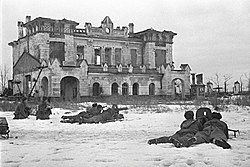
Soviet machine-gunners near Detskoye Selo railway station in Pushkin, 21 January
Date14 January – 1 March 1944
Location
Result
  • Soviet victory
Territorial
changes
Recapture of the region by Soviets
Belligerents
Nazi Germany Germany Soviet Union
Commanders and leaders
Nazi Germany Georg von Küchler
(Until 1 February)
Nazi Germany Walter Model
(From February 1)
Soviet Union Leonid Govorov
Soviet Union Vladimir Tributs
Soviet Union Kirill Meretskov
Soviet Union Markian Popov
Units involved
Army Group North:
44 infantry divisions
[2]
Leningrad Front
Volkhov Front
2nd Baltic Front
Baltic Fleet:
57 divisions
Strength
500,000 personnel
2,389 artillery pieces
146 tanks
140 aircraft[2]
822,000 personnel
4,600 artillery pieces
550 tanks
653 aircraft[2]
Casualties and losses
24,739 dead and missing[3]
46,912 wounded[3]
Total: 71,651 casualties (per German military medical reports)[3]
76,686 dead and missing,
237,267 wounded[4]
Total: 313,953 casualties[4]
Soviet gains, mid-1943 to end of 1944

The Leningrad–Novgorod strategic offensive was a strategic offensive during World War II. It was launched by the Red Army on 14 January 1944 with an attack on the German Army Group North by the Soviet Volkhov and Leningrad fronts, along with part of the 2nd Baltic Front,[5] with a goal of fully lifting the siege of Leningrad. Approximately two weeks later, the Red Army regained control of the Moscow–Leningrad railway, and on 26 January 1944 Joseph Stalin declared that the siege of Leningrad was lifted, and that German forces were expelled from the Leningrad Oblast.[6] The lifting of the 900-day-long blockade was celebrated in Leningrad on that day with a 324-gun salute.[5] The strategic offensive ended a month later on 1 March, when Stavka ordered the troops of the Leningrad Front to a follow-on operation across the Narva River, while the 2nd Baltic was to defend the territory it gained in pursuit of the German XVI Army Corps.[7]

The Germans had suffered nearly 72,000 casualties, lost 85 artillery pieces ranging in caliber from 15 cm to 40 cm, and were pushed back between 60 and 100 kilometers from Leningrad to the Luga River.[8]

Background

[edit]

After Operation Barbarossa, German troops had encircled Leningrad, and began the siege of Leningrad. Several operations had been designed by the Soviet commanders in the area to liberate the outskirts of Leningrad from the Germans. In the fall of 1943, preparations had begun to design another plan to retake the outskirts of Leningrad from the Germans, after the only partially successful Operation Iskra in January that year which had followed the failed Sinyavino Offensive of late 1942. The first staff meeting was held on 9 September 1943, two years and a day after the beginning of the siege.[9] Two plans, Neva I and Neva II, were conceived. Neva I was to be implemented if the Germans, pressured on different fronts, withdrew their forces from Leningrad on their own accord to reinforce the pressured areas. Both Stavka and Leningrad believed this was possible.[9] Neva II, therefore, would be implemented if the Germans did not withdraw from Leningrad within the coming months.[9] The offensive would be three-pronged, driving from the foothold at Oranienbaum that had been captured earlier that year, the Pulkovo Heights and from the fortifications around Novgorod.[9] The offensive was planned to start in the winter, when sufficient numbers of troops and artillery could be moved across the ice without incident.[9]

Preparations

[edit]

Soviet

[edit]

The Baltic Fleet had been assigned the task of transporting the Second Shock Army under the command of Ivan Fedyuninsky over Lake Ladoga to Oranienbaum. From 5 November 1943 onwards the Fleet transported 30,000 troops, 47 tanks, 400 artillery pieces, 1,400 trucks and 10,000 tons of ammunition and supplies from the wharves at the Leningrad factories, Kanat and the naval base at Lisy Nos to Oranienbaum.[10] After Lake Ladoga froze, another 22,000 men, 800 trucks, 140 tanks and 380 guns were sent overland to the jump-off point.[10] When the shipments were complete, the artillery was positioned along the entire length of the Leningrad, Second Baltic and Volkhov fronts at a concentration of 200 guns per kilometer, including 21,600 standard artillery pieces, 1,500 Katyusha rocket guns, and 600 anti-aircraft guns.[10] 1,500 planes were also obtained from the Baltic Fleet and from installations around Leningrad.[10][11] The total number of Soviet personnel prepared for action was 1,241,000, against the 741,000 German troops.[12] A final meeting took place on 11 January in Smolny.[13] General Govorov, the top Soviet commander on the Leningrad Front, had listed his priorities. In order to open up southeastward and eastward main railroad lines from Leningrad, Soviet troops would have to occupy Gatchina, from which they could retake Mga, the minor city and rail station whose capture in 1941 had closed the last railroad route into Leningrad. Govorov positioned his troops accordingly.[13]

German

[edit]
Panther on the Eastern Front, 1944

The situation of the German Army Group North at the end of 1943 had deteriorated to a critical point. The Blue Division and three German divisions had been withdrawn by October, while the Army Group had acquired sixty miles of additional frontage from Army Group Center during the same period. As replacements, Field Marshal Georg von Küchler received the Spanish Blue Legion and three divisions of SS troops. In such a weakened state, the Army Group staff planned a new position to its rear that would shorten the front lines by twenty-five percent and remove the Soviet threats posed in many salients on the current lines. The plan Operation Blue called for a January withdrawal of over 150 miles to the natural defensive barrier formed by the Narva and Velikaya Rivers and Lakes Peipus and Pskov. This position, the so-called "Panther Line", was buttressed by fortifications that had been constructed since September. The retreat would be carried out in stages, using intermediate defensive positions, the most important of which was the Rollbahn Line formed on the October Railway running through Tosno, Lyuban and Chudovo. There the two most exposed Army Corps, the XXVI and XXVIII, would regroup and catch their breath before proceeding farther back to their positions in the Panther Line.[14]

The fate of Army Group North turned for the worse in the new year, for Hitler rejected all proposals for an early withdrawal into the "Panther" position, insisting that the Soviet forces be kept as far as possible from Germany and that they be forced to pay dearly for each meter of ground. Finally, Hitler transferred three more first-rate infantry divisions out of Army Group North to reinforce Erich von Manstein's Army Group South as it reeled back from the Dnieper River under continuous Soviet assault. Field Marshal von Küchler now held an extremely precarious position, and could only await events on the Leningrad and Volkhov Fronts with great pessimism.[14]

On a connecting road between Lake Ilmen and the Gulf of Finland

Combat activity

[edit]

Krasnoye Selo–Ropsha offensive: 14–31 January 1944

[edit]

In the late hours of 13 January 1944 long-range bombers from the Baltic Fleet attacked the main German command points on the defensive line. On 14 January troops from both the Oranienbaum foothold and Volkhov Front attacked, followed the next day by troops of the 42nd Army under the command of Ivan Maslennikov from the Pulkovo Heights.[13] An artillery barrage was launched all along the front, laying down 220,000 shells onto the German lines.[15] Fog inhibited major progress for the first few days, although the Second Shock Army and 42nd Army advanced two miles on a seven-mile front while in combat with the 9th and 10th Luftwaffe Field Divisions,[13] and the Volkhov Front pushed the Germans back about three miles.[15] It thawed on the 16th, and the Second Shock Army managed to move forward 23 kilometers.[8][16] On the 19th, the Second Shock Army captured Ropsha and the 63rd Guards Rifle Division, part of the 42nd Army, drove the Germans out of Krasnoye Selo. By 26 January German troops had been pushed 100 kilometers away from the city, and the Moscow–Leningrad Railroad line had been opened.[17] The next day, Stalin declared the city to have been relieved, and Leningrad celebrated with a red, white and blue salute from 324 Katyusha rocket launchers and artillery pieces at 8 pm,[17] which was inconceivable during the siege due to blackout.

Novgorod–Luga offensive : 14 January – 15 February 1944

[edit]

On 14 January Soviet troops of the Volkhov Front launched an offensive from the Novgorod area towards Luga against a part of the 18th German Army. The aim was freeing the October Railway and encircling, together with the troops of the Leningrad Front, the main forces of the 18th Army in the Luga region.

The offensive did not develop as rapidly as planned before the operation. The German 18th Army suffered a heavy defeat, but still wasn't destroyed and retained a significant part of its combat potential, which prevented the Soviet troops in the spring of 1944 to break through the Panther–Wotan line and begin the liberation of the Baltics. One of the reasons for this development was the lack of coordination between the 2nd Baltic Front and the Volkhov Front, which allowed the German command to move significant forces from the 16th Army to the Luga area.

By 15 February the troops of the Volkhov Front, as well as the 42nd and 67th Army of the Leningrad Front, reached Lake Peipus, having pushed the enemy 50–120 kilometers to the West. In total 779 cities and settlements were liberated, including Novgorod, Luga, Batetsky, Oredezh, Mga, Tosno, Lyuban and Chudovo. The restoration of control over the strategically important railways, especially Kirov and October, was of great importance.

Staraya Russa – Novorzhev Offensive : 18 February – 1 March 1944

[edit]

On 18 February, Soviet troops of the 2nd Baltic Front, carried out this operation in cooperation with part of the Leningrad Front against the German 16th Army of Army Group "North" with the aim of liberating the area southwest of Lake Ilmen and creating the conditions for further offensives.

As a result of the operation, the Soviet troops, pursuing the retreating enemy, advanced up to 180 kilometers to the West, liberating many cities and towns, including Staraya Russa, Novorzhev, Dno and Putoshka.

Kingisepp–Gdov Offensive : 1 February – 1 March 1944

[edit]

Overview

[edit]
Position of the armies before the operation and plan of attack Operations between 14 and 31 January 1944 Operations between 1–15 February 1944

Aftermath

[edit]

In Soviet propaganda, this offensive was listed as one of Stalin's ten blows.

References

[edit]

Bibliography

[edit]
Revisions and contributorsEdit on WikipediaRead on Wikipedia
from Grokipedia
The Leningrad–Novgorod offensive, officially designated as the Leningrad-Novgorod Strategic Offensive Operation, was a major Red Army operation conducted from 14 January to 1 March 1944 against German Army Group North, aimed at fully relieving the siege of Leningrad, destroying the besieging German 18th Army through double envelopment, and recapturing key areas including Novgorod and the approaches to Luga. Soviet forces, totaling approximately 1.24 million personnel from the Leningrad Front under Marshal Leonid Govorov, the Volkhov Front under Army General Kirill Meretskov, elements of the 2nd Baltic Front under Army General Markian Popov, and naval support from the Baltic Fleet under Admiral Vladimir Tributs, deployed over 1,200 armored vehicles, 14,300 artillery pieces and mortars, and around 1,500 aircraft to assault entrenched German positions held by about 741,000 troops organized into 40 infantry divisions, one Panzergrenadier division, and two mountain divisions. The offensive achieved its immediate goals by penetrating German defenses in multiple sectors, liberating Leningrad from encirclement by 26 January, pushing Axis forces back 60 to 100 kilometers to the Luga River, and compelling Army Group North—initially commanded by Field Marshal Georg von Küchler and later Walter Model—to execute a fighting withdrawal to the Panther defensive line by mid-February, thereby ending the prolonged threat to Leningrad but at the cost of heavy Soviet casualties exceeding 300,000, reflective of the attritional nature of operations on the Eastern Front.

Historical Context

The Siege of Leningrad

The Siege of Leningrad began on 8 September 1941, when elements of German Army Group North, advancing rapidly since the launch of Operation Barbarossa on 22 June, severed land connections to the city and established positions on its southern outskirts, fully encircling the population center of approximately 2.5–2.9 million residents. German high command, led by Field Marshal Wilhelm von Leeb, adhered to Adolf Hitler's explicit orders to forgo a direct storming of the urban fortifications—influenced by the high casualties of urban combat experienced earlier at Minsk and Smolensk—and instead pursued a strategy of attrition through total blockade, sustained artillery barrages, and Luftwaffe bombing to induce mass starvation and demoralization. This approach reflected causal calculations of resource efficiency: capturing Leningrad intact offered limited strategic gain compared to the projected losses of assaulting its defenses, manned by Soviet Leningrad and Volkhov Fronts totaling over 300,000 troops initially, while tying down German forces for prolonged encirclement conserved manpower for other sectors. Soviet relief operations proved insufficient to break the stranglehold until late in the siege. The most notable interim success was Operation Iskra, initiated on 12 January 1943 by the Leningrad and Volkhov Fronts under Generals Leonid Govorov and Kirill Meretskov, which pierced German lines at the Sinyavino Heights after intense fighting, securing an 8–10 kilometer-wide land corridor eastward from the city and enabling rail supplies to supplement the precarious "Road of Life." This ice road across frozen Lake Ladoga, operational from September 1941 onward in winter, ferried critical but inadequate provisions—such as 118,000 tons of food and 55,000 tons of ammunition by early 1943—via convoys of trucks and sleds under constant threat of German interdiction, with summer barge routes providing marginal additional tonnage before the lake froze again. Despite these measures, supply deficits persisted, rationing civilians to 125–250 grams of bread daily during peak famine periods, while military units endured similar deprivations that eroded operational readiness amid subzero temperatures and disease outbreaks. The blockade's toll manifested primarily through engineered famine, with empirical records indicating around 630,000 civilian deaths from starvation and associated illnesses by January 1944, concentrated in the winter of 1941–1942 when caloric intake fell below subsistence levels for over 90% of the population. German artillery and air strikes inflicted additional casualties, totaling thousands from direct bombardment, exacerbating the crisis by destroying infrastructure and utilities. Soviet garrison forces, reduced to skeletal effectiveness by malnutrition—evidenced by desertion rates and lowered combat output—nonetheless maintained perimeter defenses, repelling limited German offensives like those in the Sinyavino sector, though at the cost of tens of thousands in military fatalities from attrition rather than decisive engagements. Aggregate civilian mortality estimates from archival data and postwar analyses reach 800,000–1 million, underscoring the blockade's efficacy as a weapon of demographic destruction without committing to infantry assaults.

Eastern Front Developments Leading to 1944

The German defeat at Stalingrad in February 1943 marked a turning point, with the surrender of the 6th Army resulting in over 91,000 prisoners and the loss of approximately 250,000 German troops overall, severely depleting Axis offensive capacity on the Eastern Front. This was compounded by the failed Operation Citadel at Kursk in July 1943, where German forces suffered heavy tank losses—around 1,500 armored vehicles destroyed or damaged—halting their ability to launch major offensives and allowing Soviet forces to seize the strategic initiative. Consequently, Army Group North, tasked with holding the Leningrad salient, became overextended; by mid-1943, it fielded only about 360,000 front-line troops with limited armored support, roughly 40 tanks and assault guns, while facing persistent Soviet pressure without reinforcements diverted to southern sectors. Soviet recovery stemmed from the rapid relocation of over 1,500 industrial enterprises eastward beyond the Urals between 1941 and 1942, preserving production capacity despite initial territorial losses, which enabled annual output of millions of artillery pieces and tanks by 1943. Lend-Lease aid from the United States and Britain, totaling over 400,000 trucks and 11,000 aircraft by 1944, bridged logistical gaps during this transition, facilitating Soviet mobility and multi-front operations without which offensive sustainment would have been constrained. Manpower mobilization further bolstered Red Army strength, drawing from a population base that allowed for sustained reinforcements exceeding 6 million troops committed across the front by late 1943, contrasting with German reliance on understrength divisions and foreign auxiliaries. During the winter of 1943–1944, localized stalemates prevailed in the northern sector amid the broader Dnieper–Carpathian Offensive, where Soviet forces advanced 300–500 kilometers, forcing German retreats but encountering fortified lines that limited breakthroughs near Leningrad. German counteroffensives, such as those in the Ukraine, failed to regain momentum, suffering from fuel shortages and Allied bombing disruptions, which eroded reserves and exposed Army Group North's flanks. By January 1944, this dynamic yielded Soviet numerical superiority in the Leningrad–Novgorod sector, with approximately 1.24 million troops arrayed against roughly 741,000 German and allied forces, setting conditions for coordinated assaults leveraging material preponderance over entrenched defenses.

Strategic Planning

Soviet Objectives and Command Decisions

The Soviet Stavka, under Joseph Stalin's direction, issued orders on 27 December 1943 for the Leningrad, Volkhov, and 2nd Baltic Fronts to launch a coordinated offensive aimed at lifting the siege of Leningrad, liberating key areas such as Novgorod and Luga, and destroying the German 18th Army through double envelopment. This objective prioritized the complete annihilation of the enemy grouping over minimizing Soviet casualties, reflecting a strategy of decisive encirclement to shatter Army Group North's defensive posture in the region. The plan envisioned the Leningrad and Volkhov Fronts pinching off the 18th Army's forces between them, while the 2nd Baltic Front struck southward to prevent reinforcement and link up with Baltic theater operations. Command of the operation fell to General Leonid Govorov of the Leningrad Front, tasked with breakthroughs from the Oranienbaum bridgehead and southward sectors to exploit toward the Narva River, and General Kirill Meretskov of the Volkhov Front, directed to seize Novgorod, advance 100–200 kilometers westward to the Luga line, and converge for the envelopment. General Andrey Popov commanded the 2nd Baltic Front, with orders to encircle German forces west of Novgorod and disrupt lines of retreat, ultimately aiming to reach the eastern shore of Lake Peipus and positions favorable for further advances into Estonia. These directives emphasized rapid exploitation of initial penetrations to achieve operational depth, setting the stage for broader liberation of the Leningrad oblast and preconditions for Baltic campaigns. The Leningrad–Novgorod offensive formed part of Stalin's broader 1944 strategy of multiple simultaneous strategic blows across the Eastern Front, including the ongoing Dnieper–Carpathian offensive in the south, to overextend German reserves and prevent coherent defensive reallocations. By launching in mid-January 1944, it complemented these efforts, exploiting German commitments elsewhere to facilitate the northern thrust without immediate expectation of major reinforcements to Army Group North. This multi-front pressure aimed to collapse the Axis position through cumulative attrition and isolation, aligning with Soviet high command's assessment of diluted Wehrmacht capabilities following prior defeats.

German Defensive Posture and Intelligence Assessments

Army Group North, under the command of Field Marshal Georg von Küchler, adopted a predominantly static defensive posture along the Leningrad front in late 1943 and early 1944, with its principal force—the 18th Army led by General of Infantry Georg Lindemann—entrenched in forward positions facing key Soviet-held areas such as the Oranienbaum bridgehead. These dispositions relied on existing field fortifications and natural obstacles, supplemented by preparations for deeper defensive lines like the Panther Position (Panther-Stellung), a partially constructed barrier extending from the Narva River area southwestward, intended as a consolidation point but not yet occupied. Adolf Hitler's directives enforced an inflexible no-retreat policy, prohibiting voluntary withdrawals to shorten lines or preserve forces, as such moves were viewed as undermining the strategic goal of tying down Soviet reserves through prolonged siege operations around Leningrad. This stance, rooted in Hitler's broader operational philosophy of elastic defense only under duress, foreclosed preemptive maneuvers by Küchler, such as repositioning to the Panther Line despite its incomplete state, thereby exposing forward troops to overextension amid deteriorating mobility. German intelligence, informed by Luftwaffe aerial reconnaissance and reports from Soviet deserters, registered escalating enemy buildups—including troop concentrations and logistical accumulations—by early January 1944, forecasting a multidirectional offensive to shatter the siege and advance toward Estonia. These assessments underscored the vulnerability of salients and overstretched flanks but clashed with Hitler's insistence on holding ground to bleed Soviet strength, compounded by Army Group North's chronic shortages in panzer reserves and fuel stocks, which immobilized armored counterattack options and enforced a rigid, infantry-centric defense under harsh winter rigors.

Preparations and Forces

Soviet Assembly and Logistics

The Soviet Union assembled forces for the Leningrad–Novgorod offensive by concentrating approximately 1.241 million personnel across the Leningrad, Volkhov, and 2nd Baltic Fronts, comprising the equivalent of 105 infantry divisions and 12 tank brigades. These fronts included 33 infantry divisions and three infantry brigades in the Leningrad Front alone, reinforced through mass mobilization that drew on reserves and undertrained units to achieve numerical superiority. From November 1943, the Baltic Fleet supported this buildup by transporting 30,000 troops, 47 tanks, 400 artillery pieces, 1,400 trucks, and 10,000 tons of ammunition and supplies across Lake Ladoga, enabling the forward deployment of mechanized elements exceeding 1,000 tanks overall. Logistical preparations emphasized rail infrastructure and stockpiling to sustain the offensive's artillery-intensive approach. Soviet engineers constructed and extended rail lines under combat conditions, including a 34-kilometer track to Leningrad completed in two weeks during early 1943 despite enemy shelling, which facilitated the delivery of munitions and reinforcements to the besieged sector. Ammunition reserves amassed for initial barrages totaled over 100,000 shells per front sector, prioritizing high-volume fire to suppress German defenses, though exact figures varied by axis of advance. Lend-Lease aid proved critical for overcoming transport shortages, supplying hundreds of thousands of trucks that enhanced the Red Army's mobility for 1944 offensives and allowed rapid redistribution of supplies from rear depots to forward assemblies. To mask these concentrations, Soviet command employed deception tactics rooted in maskirovka doctrine, including simulated activities and restricted movements to feign defensive postures while concealing troop buildups from German reconnaissance, a practice refined after 1943 operational reforms. Challenges such as harsh winter conditions and reliance on quantity—evident in the integration of penal formations for high-risk assaults—were mitigated through forced labor for supply routes and centralized planning under the Stavka, though this exposed vulnerabilities like potential desertions in hastily mobilized units.

German Fortifications and Troop Dispositions

The German 18th Army, under Generaloberst Georg Lindemann, deployed approximately 21 infantry divisions—totaling an estimated 200,000 to 250,000 troops—across a broad front in the Leningrad-Novgorod sector, organized into layered defenses that exploited natural terrain features like frozen lakes, dense forests, and river lines for delaying tactics. These positions included forward outposts held since 1941, an intermediate Rollbahn Line along the October Railway near Tosno, Lyuban, and Chudovo, and rearward precursors to the Panther-Wotan Line centered on the Luga River area, where fortifications had been under construction since September 1943. The defenses featured extensive field engineering, including thousands of bunkers, trench networks, anti-tank ditches, minefields, and over 200 kilometers of barbed wire, particularly concentrated around key nodes like Luga and Novgorod, which channeled Soviet advances into kill zones and inflicted heavy initial casualties despite German numerical inferiority. Troop dispositions were structured by corps, with the XXVI Corps (General Martin Grase) covering the northern flank near the Gulf of Finland, the XXVIII Corps (General Herbert Loch) on the exposed southern approaches to Novgorod, the LIV Corps (General Otto Sponheimer) in the central Luga sector, and the III SS Panzer Corps providing limited reinforcement in the Narva bridgehead. Infantry divisions, such as the 69th Infantry Division, bore the brunt of static defense with wide frontages up to 23 kilometers per division, supplemented by five former Luftwaffe field divisions repurposed for ground holding. SS elements, including the 11th SS Panzergrenadier Division "Nordland" and the 4th SS Volunteer Panzergrenadier Brigade "Nederland" under III SS Panzer Corps, bolstered select sectors with motorized capabilities, though overall mobile reserves were minimal and armor scarce, prioritizing fortified immobility over maneuver. Anticipating potential Soviet breakthroughs, German forces conducted preemptive demolitions, including the controlled flooding and ice-breaking of a 30-mile section of the Narva River to impede crossings, in line with directives emphasizing prepared withdrawal lines while denying resources to the enemy through selective scorched-earth measures. These engineering efforts, combined with terrain-adapted obstacles, enabled the 18th Army to prolong resistance, forcing Soviet forces to overcome entrenched positions at significant cost before deeper penetrations could occur.

Course of Operations

Initial Breakthrough Attempts: 14–27 January 1944

The Leningrad–Novgorod offensive commenced on 14 January 1944, as the Soviet Leningrad and Volkhov Fronts launched simultaneous assaults against the German 18th Army's defenses south and east of Leningrad, with the primary aim of shattering the prolonged siege through coordinated breakthroughs. The opening phase featured intensive artillery preparations, including barrages from multiple divisions concentrated to pulverize German fortifications and forward positions, followed by infantry advances exploiting the frozen winter terrain that facilitated mechanized mobility despite exposing troops to flanking fire in open, snow-covered approaches. These efforts targeted key sectors, such as the Oranienbaum bridgehead held by Leningrad Front forces and the Volkhov Front's thrusts flanking Novgorod, where initial German resistance relied on entrenched strongpoints and rapid counterattacks to blunt Soviet penetrations. Leningrad Front units, including the 2nd Shock Army, struck westward from the Oranienbaum enclave toward Krasnoye Selo and Ropsha, methodically advancing after artillery softened the German lines, while Volkhov Front armies enveloped Novgorod from north and south, overcoming early repulses through repeated assaults that leveraged numerical superiority in manpower and guns. German commanders, anticipating threats at Novgorod but underestimating the scale of the barrages, shifted reserves piecemeal, allowing Soviet forces to grind forward amid harsh conditions where sub-zero temperatures froze the ground for tank operations yet increased vulnerability to enfilading machine-gun and artillery fire across exposed flanks. Over the subsequent days, persistent pressure eroded German cohesion, with Soviet infantry employing massed waves post-preparation to seize intermediate objectives and widen breaches. By 27 January 1944, advancing elements from the Leningrad Front linked with defenders in the city's southern suburbs, formally lifting the siege after 872 days by establishing a continuous land connection that severed the German encirclement. This convergence marked the culmination of the initial breakthrough phase, as Volkhov Front operations toward Novgorod simultaneously compelled German withdrawals, though full exploitation awaited subsequent offensives; the success hinged on artillery dominance and relentless infantry commitment overriding fortified defenses and adverse weather.

Krasnoye Selo–Ropsha Offensive

The Krasnoye Selo–Ropsha Offensive, codenamed Operation January Thunder, formed the western component of the Leningrad–Novgorod Offensive, targeting the German-held corridor between Leningrad and the Oranienbaum bridgehead to secure the Gulf of Finland coast. Launched on 14 January 1944 by the Leningrad Front under General Leonid Govorov, it involved the 42nd Army (commanded by General Ivan Maslennikov) advancing from positions south of Leningrad and the 2nd Shock Army (under General Ivan Fedyuninsky) pushing eastward from the Oranienbaum lodgement, which had been reinforced by barge transports along the gulf's southern shore in late 1943. Soviet artillery barrages and naval gunfire from two battleships, delivering 305 mm shells, supported the initial assaults against fortified German villages and defensive lines held by the 18th Army's III SS Panzer Corps and Luftwaffe field divisions. By 17 January, the attackers achieved a breakthrough over a 23 km front, enveloping Krasnoye Selo despite resistance from entrenched positions. On 19 January, the 63rd Guards Rifle Division of the 42nd Army captured Krasnoye Selo, while elements of the 2nd Shock Army seized Ropsha, linking up south of the town and forming pockets that trapped segments of the German 9th and 10th Luftwaffe Field Divisions. The German 18th Army, under Generaloberst Georg Lindemann, responded with local counterattacks using reserves, including elements equipped with 110 armored fighting vehicles, to stem the advance and relieve encircled units, but these efforts failed to prevent surrenders within the pockets. Soviet forces pressed forward 60–100 km along the coastal axis by 30 January, clearing fortified settlements amid challenging winter terrain and securing the flank for subsequent operations, though overextended supply lines halted deeper exploitation. The operation inflicted approximately 21,000 casualties on the Germans, captured 85 artillery pieces ranging from 150 to 400 mm caliber, and forced Army Group North to abandon its forward positions near Leningrad, contributing to the overall relief of the siege.

Novgorod–Luga Offensive

The Novgorod–Luga Offensive, conducted from 14 January to 15 February 1944 as part of the broader Leningrad–Novgorod operation, involved the Soviet Volkhov Front's 59th Army under General Ivan T. Korovnikov launching the main thrust against German positions east of Novgorod. Supported by the 8th and 54th Armies, the offensive aimed to shatter the German 18th Army's defenses along the Volkhov River line, sever critical rail communications, and advance toward Luga to disrupt the enemy's lateral supply routes. Soviet forces, numbering approximately 297,860 men with 400 tanks and extensive artillery, exploited bridgeheads on Lake Ilmen for surprise night assaults, achieving initial penetrations through superior firepower that overwhelmed entrenched German infantry divisions of the 26th, 28th, and 38th Corps. By 15–16 January, the 59th Army's XIV and VII Rifle Corps had severed the vital Chudovo–Novgorod railway, isolating German forces and compelling rearguard actions to cover retreats. Novgorod fell on 20 January after converging attacks from bridgeheads north and south of the city trapped defenders, with Soviet troops capturing over 15,000 Germans killed or prisoners, 182 guns, and 120 mortars while advancing 60–100 km in subsequent days. German Kampfgruppen and rear guards, including strongpoints at Batetsky, imposed delays through demolitions and fixed defenses, but gaps in their lines allowed Soviet exploitation, though at high cost in infantry assaults against prepared positions. Partisan support from 35,000 fighters in 13 brigades further disrupted German cohesion during the rapid advance. The 59th Army reached the Luga River by 26 January, setting conditions for the joint 67th Army (Leningrad Front) and 59th Army envelopment that liberated Luga on 12 February despite fierce resistance and demolitions. This central thrust cut the Kirov and Oktyabrsky railways by 29 January, forcing the German 18th Army to contract its front and abandon forward salients, as Soviet artillery barrages and tank-supported infantry overcame attrition-heavy assaults on fortified nodes. The operation's causal breakthroughs stemmed from concentrated firepower ratios—over 3,600 artillery pieces and mortars against depleted German reserves—enabling exploitation but highlighting persistent challenges in sustaining momentum amid winter terrain and enemy delays.

Staraya Russa–Novorzhev Offensive

The Staraya Russa–Novorzhev Offensive, conducted from 18 February to 1 March 1944, represented the southern component of Soviet efforts to exploit breakthroughs achieved in the initial phases of the Leningrad–Novgorod operation, aiming to envelop protruding German salients held by Army Group North's 16th Army. Forces of the Soviet 2nd Baltic Front, under General Markian Popov, including the 1st Shock Army, 3rd Shock Army, 22nd Army, and 10th Guards Army, launched coordinated attacks southward from positions east of Staraya Russa, supported by elements of the Leningrad Front and the 15th Air Army with approximately 355 aircraft. The primary objectives focused on liquidating isolated German pockets around Staraya Russa, severing rail communications, and advancing westward toward Novorzhev to widen the breach and threaten deeper encirclements of German rear areas, ultimately seeking to penetrate the Panther–Wotan defensive line and facilitate entry into the Baltic states. Initial assaults on 18 February targeted remnants of German forces trapped in , where the 1st Shock rapidly overran defenses, liberating the town and disrupting 16th Army's I, II, VIII, X, and XLIII , as well as elements of the VI SS Volunteer . These pockets, isolated by prior Soviet penetrations, suffered divisional collapses as supply lines fragmented, compelling fragmented withdrawals under from pursuing Soviet and mechanized units. German from , numbering about 200 aircraft, provided limited cover but could not stem the amid deteriorating , including the onset of spring thaws that transitioned terrain from frozen to muddy, complicating mechanized pursuits while favoring defensive elastic maneuvers. By 23–24 , Soviet forces pressed toward Dno, encountering stiffer resistance in assaults but securing the rail junction on 24 , which further severed key German routes and enabled advances up to 180 kilometers westward. Mechanized elements of the shock armies exploited these gains, pushing to Novorzhev, which fell on 29 , alongside the liberation of Dno and Pustoshka, thereby threatening broader of 16th Army's southern flank. However, German elastic defenses—characterized by phased withdrawals to prepared positions—prevented the complete destruction of major formations, as Soviet spearheads encountered fortified lines short of the Panther–Wotan Stellung, resulting in incomplete and a stabilization of the front by early . This shortfall underscored the operation's role in widening the initial breach but highlighted limitations in fully dismantling German resistance in the sector.

Kingisepp–Gdov Offensive

The Kingisepp–Gdov Offensive, conducted from 1 February to 1 March 1944 as the northwestern phase of the Leningrad–Novgorod operation, involved the Soviet Leningrad Front under General Leonid Govorov targeting German positions to secure approaches to Narva and Lake Peipus while pursuing retreating elements of the 18th Army. The primary Soviet forces included the 2nd Shock Army commanded by Lieutenant General Ivan Fedyuninsky and the 8th Army under Lieutenant General Filipp Starikov, with the 109th Rifle Corps (Major General Ivan Alferov) leading the assault. German defenders, part of Army Group North's 18th Army (General Georg Lindemann), comprised Gruppe Sponheimer (later redesignated Armeegruppe Narwa under General Johannes Friessner) and the III SS Panzer Corps (SS-Obergruppenführer Felix Steiner), featuring SS formations such as the 4th SS Volunteer Panzergrenadier Brigade Nederland and 11th SS Panzergrenadier Division Nordland. Initial objectives focused on capturing Kingisepp and Gdov to disrupt German withdrawals and establish bridgeheads across the Narva River. On 1 February, the 109th Rifle Corps rapidly overran defenses to seize , compelling the 18th Army to conduct rearguard actions while falling back toward the Narva River's eastern bank. By 2 February, forward Soviet units established limited bridgeheads north and south of , with the 8th Army expanding a position in the Krivasoo Swamp by 7 February and the 30th Guards Rifle Corps capturing Auvere Station on 11 February. Amphibious operations supplemented the ground push, including the seizure of Piirissaar Island on 12 February, but assaults at Mereküla (14 February) and Meerapalu suffered heavy losses from German counterattacks, with the 260th Independent Naval Infantry Brigade nearly annihilated at the former site. Gdov fell amid the broader advance, yet terrain constraints—such as the frozen Narva River, extensive swamps, and poor roads exacerbated by the spring thaw—created bottlenecks that impeded rapid exploitation. German rearguards, supported by artillery and occasional Luftwaffe strikes including 21 Ju 87 dive-bombers at Meerapalu, effectively delayed pursuits without sustaining encirclements. Soviet air superiority facilitated reconnaissance and interdiction, yet proved insufficient to overcome fortified narrows at Narva, where German bridgehead defenses stabilized the front by mid-February. Despite territorial gains along Lake Peipus's eastern shore and persistent pressure, the offensive failed to trap significant German forces, as the 18th Army withdrew methodically to prepared positions, preserving combat effectiveness for subsequent Narva battles. Momentum stalled short of a decisive envelopment, highlighting the limitations of pursuit across riverine and marshy obstacles against resilient rearguards.

German Response and Withdrawal

Hitler's Strategic Directives

Throughout the Leningrad–Novgorod offensive, repeatedly proposals from commanders to withdraw to the Panther Line (also termed the Ostwall), a prepared defensive position extending from westward, insisting instead on holding forward lines to maximize Soviet attrition and delay advances toward Leningrad. In early , prior to the Soviet beginning on 14 , advocated overextended fronts and repositioning to the Panther defenses, but Hitler categorically , viewing any as a premature concession that would free enemy reserves for other sectors. This stance persisted even after the offensive's initial breakthroughs, with Hitler prioritizing the pinning of Soviet forces in the north to alleviate pressure on southern fronts like Ukraine, where major retreats were underway. The directives embodied Hitler's broader operational of rigid defense, encapsulated in orders demanding troops "stand and fight" without authorized fallback, which field reports indicated would conserve strength for a coherent counteroffensive but were to symbolize unyielding resolve against Bolshevik advances. On 20–22 , amid collapsing sectors from Leningrad to Novgorod, commanders including Küchler pressed for immediate Panther withdrawal during consultations at , yet Hitler dismissed compromises such as partial pullbacks, arguing the Leningrad —though militarily expendable—must absorb Soviet manpower to exhaust their resources before reallocating southward. This insistence on maximal delay, rooted in ideological commitment to total resistance rather than elastic defense, directly linked to elevated German losses, as divisions faced encirclement risks without phased evacuation. Following von Küchler's relief on 16 January and General Georg Lindemann's appointment, similar pleas for flexibility were ignored, fostering command friction where frontline units executed ad-hoc withdrawals under fire, bypassing central approval and amplifying casualties from disrupted logistics and exposed flanks. Hitler's centralization—eschewing subordinate initiative in favor of Führer-dictated holds—undermined adaptive responses, as evidenced by the 18th Army's fragmented retreats that sacrificed equipment and personnel to piecemeal Soviet penetrations rather than an orderly repositioning. This policy, while symbolically upholding the siege's psychological weight, prioritized attritional denial over force preservation, contributing to the near-destruction of encircled formations before partial Panther authorization on 1 February.

Retreat to the Panther Line

In late February and early March 1944, German Army Group North executed a phased withdrawal from exposed positions southeast of Leningrad and around Lake Ilmen, evacuating salients to consolidate on the Panther Line defenses stretching from Narva on the Gulf of Finland, along the Narva River and Lake Peipus, to Pskov. This pullback involved distances varying by sector, with forces in the northern sector retreating approximately 140 kilometers from the Oranienbaum bridgehead area to Narva, while southern elements fell back up to 190 kilometers from Novgorod toward Pskov, shortening the front and leveraging natural obstacles supplemented by hasty fortifications including trenches, anti-tank ditches, and limited minefields. Rearguard units, often comprising infantry and engineer detachments, conducted delaying actions to screen the main force's disengagement, enabling most combat-effective divisions to preserve their cohesion and heavy equipment despite Soviet pursuit. Despite these measures, the retreat incurred significant losses from localized encirclements and , with nearly between 10 and 1 , including around 29,000 dead and missing, as Soviet forces gaps in the withdrawing lines. Core formations like the 18th Army managed to extricate themselves largely intact, but smaller groups faced in pockets formed during the maneuvers. To deny advancing Soviet troops usable assets, German forces implemented scorched-earth measures, systematically demolishing bridges, lines, depots, and settlements across the abandoned territories, which disrupted and slowed follow-on offensives by forcing repairs on . These tactics, while tactically effective in the short term, contributed to the devastation of the without preventing the overall Soviet territorial gains. By 1 , the bulk of had reached the Panther positions, where incomplete but prepared defenses—including concrete bunkers in key sectors—allowed a temporary stabilization amid ongoing Soviet pressure.

Casualties and Losses

Soviet Human and Material Costs

The Leningrad–Novgorod offensive exacted a heavy toll on Soviet personnel, with total reaching approximately 314,000, including over 76,000 killed or missing and the balance wounded or sick. These figures, drawn from declassified Soviet archival analyzed , underscore the operation's reliance on infantry-heavy assaults to overcome German field fortifications, swamp lines, and prepared positions. Disproportionate attrition occurred among troops following massive preparations, as residual from bunkers, , and minefields inflicted severe losses during close-quarters advances, often yielding local exchange ratios unfavorable to the . Penal formations and hastily reformed units, deployed to spearhead penetrations under strict timelines dictated by directives, amplified these costs by exposing undertrained personnel to concentrated defensive . Soviet expenditures were likewise substantial, with armored forces losing numerous tanks to German counterattacks and emplaced defenses despite an initial superiority of over 1,000 vehicles committed, while units endured that degraded their over the six-week campaign.

German Casualties and Equipment Abandonment

German forces of Army Group North incurred approximately 71,651 casualties during the Leningrad–Novgorod offensive from 14 January to 1 March 1944, including 24,739 killed or missing and 46,912 wounded, according to Wehrmacht medical reports and statistics. These losses were concentrated in the 18th Army, particularly among encircled formations such as elements of the XXXVIII and I Corps, where thousands of troops were captured following breaches in defensive lines at key points like Novgorod and Luga. Despite numerical inferiority of roughly 4:1 against Soviet forces totaling over 300,000 troops, German defenders leveraged marshy terrain, fortified positions, and coordinated artillery fire to inflict disproportionate casualties on attackers, achieving an estimated 4:1 loss ratio in their favor through disciplined rearguard actions and minimal desertions. Equipment losses included at least 85 heavy artillery pieces (calibers 15 cm to 40 cm) captured or destroyed, primarily from overrun batteries in forward positions. Hitler's directives prohibiting premature withdrawal until mid-February exacerbated these losses, as delayed permissions for retrograde movements forced some units to abandon heavy guns, ammunition dumps, and vehicles during hasty retreats under pressure, though exact figures for total matériel left behind remain imprecise in German records. Mobile elements, including panzer and motorized divisions, were largely extricated intact to the Panther Line, preserving operational maneuver capability despite the abandonment of static assets in encircled pockets. This reflected tactical resilience amid strategic rigidity, with rearward echelons prioritizing combat-effective units over irrecoverable heavy equipment.

Aftermath and Strategic Impact

Immediate Territorial Outcomes

The Leningrad–Novgorod offensive culminated in the Red Army's recapture of territories south and southeast of Leningrad, fully lifting the siege on January 27, 1944, after Soviet forces from the Leningrad and Volkhov Fronts cleared the final German positions obstructing land communications to the city. The Volkhov Front advanced 200–280 kilometers in its sector, capturing Novgorod on January 20 and pushing toward Luga, which fell on February 12; meanwhile, the Leningrad Front progressed 60–120 kilometers, securing Pushkin, Gatchina, and other southern suburbs. These immediate gains expelled German forces from the immediate Leningrad approaches but fell short of encircling and annihilating the 18th Army, which conducted a phased withdrawal without catastrophic losses. German Army Group North responded by consolidating on the pre-prepared Panther Line (also known as the Ostwall in this sector) by , , contracting its front from approximately kilometers to kilometers and thereby stabilizing defenses east of and . This repositioning preserved combat-effective formations at the of ceding the Novgorod–Luga and exposing the Estonian and Latvian flanks to potential , as the shortened line prioritized depth over breadth. Reoccupied areas rapidly fell under administration, which enforced population to detect with German occupation authorities, resulting in arrests, executions, and deportations of suspected amid the reimposition of Soviet control. Such measures, rooted in wartime protocols, targeted individuals deemed unreliable but also ensnared civilians with minimal , reflecting the regime's of over judicial in zones.

Broader Implications for Army Group North

The Leningrad–Novgorod Offensive forced to conduct a fighting withdrawal to the Panther Line, a hasty network of field fortifications stretching from on the southward through to and beyond, stabilizing the front by early after the loss of 200 kilometers of territory. This repositioning shortened the defensive front by approximately 25 percent but exposed the army group's eastern flank to potential envelopment, as Soviet forces reoriented for subsequent pushes into the Baltic region, including the Narva sector where German positions repelled attacks through July 1944. Adolf Hitler's directives prohibiting elastic defense or timely retreat—rooted in his strategic obsession with retaining bridgeheads and mineral resources in the Baltics—immobilized Army Group North, committing roughly 25 divisions to a narrowing salient that became partially isolated by mid-1944. Contact with Army Group Center severed on July 10, 1944, following the latter's annihilation in Operation Bagration, yet Hitler rejected proposals for westward relocation, mandating a hold at all costs that tied down these formations uselessly amid dwindling supplies and manpower. This self-imposed rigidity precluded reinforcement of central sectors, where the absence of northern panzer reserves—such as elements of the III SS Panzer Corps—indirectly amplified vulnerabilities exploited during Bagration's rapid advance. By autumn 1944, the group's contraction into the , renamed on January 25, 1945, exemplified broader German overextension, with irrecoverable units diverted from decisive theaters due to command-level insistence on static positions rather than phased withdrawals. Such decisions, prioritizing ideological imperatives over operational mobility, sustained a sink that eroded cohesion across the Eastern Front without yielding proportionate strategic gains.

Analysis of Military Effectiveness

Soviet Offensive Tactics and Their Limitations

The Red Army's offensive in the Leningrad–Novgorod operation adhered to the deep battle doctrine, initiating breakthroughs with massive artillery preparations followed by infantry shock assaults and mechanized exploitation. On 14 January 1944, the 2nd Shock Army launched from the Oranienbaum bridgehead after concentrations of up to 320 artillery pieces per mile, supported by 21,600 guns and mortars, 1,500 Katyusha rocket launchers, and naval gunfire, enabling initial penetrations of German positions near Krasnoye Selo. Similarly, the 42nd Army crossed the Neva River on 15 January under barrage cover to seize positions south of Leningrad, while the Volkhov Front's 59th and 67th Armies targeted Novgorod with comparable firepower to shatter forward defenses. These tactics aimed at rapid operational depth, deploying 1,200 armored vehicles for exploitation once infantry cleared paths, reflecting post-Kursk refinements in sequential echelons for sustained momentum. However, execution revealed persistent limitations in coordination and adaptability, particularly in the northern theater's challenging terrain and weather. Mechanized units frequently stalled in marshes and forests, as seen with the 59th Army's advance toward Luga, where poor roads and thawing conditions in late January isolated tanks from supporting infantry, preventing deep penetrations despite initial successes. Staff training, honed in mobile southern fronts but degraded by prolonged static siege warfare around Leningrad, led to disjointed follow-through; supply lines collapsed amid destroyed infrastructure, forcing reliance on costly frontal probes rather than fluid exploitation. Penal battalions, drawn from disciplinary units under , were committed to high-risk assaults—such as clearing fortified swamps like Krivasoo, where the 314th Division suffered devastating losses—to maintain pressure, prioritizing momentum over casualty conservation even as 1944 reforms emphasized combined arms. This attrition-oriented approach yielded over 313,000 Soviet casualties by operation's end on 1 March, underscoring incomplete doctrinal maturation. Empirical outcomes highlighted numerical superiority—1.241 million troops against roughly ,000 German defenders—as the primary of territorial gains, rather than qualitative tactical edges. Despite a 4:1 manpower advantage and overwhelming , failures in synchronizing echelons allowed German forces to withdraw without , as mobile groups overextended without securing flanks, reverting to grinding engagements at chokepoints like the Luga line. Analyses post-Kursk noted that while deep battle enabled breakthroughs, northern logistical and environmental constraints exposed causal vulnerabilities in assuming uninterrupted exploitation, resulting in partial successes confined to lifting rather than operational destruction of .

German Defensive Resilience and Command Failures

Despite facing Soviet forces with significant numerical advantages in manpower, , and armor, the German 18th under demonstrated notable defensive resilience through elastic tactics that emphasized depth, local counterattacks, and exploitation of the region's forested and marshy to disrupt Soviet advances. These methods allowed German units to impose a high attrition rate on the attackers, with Soviet casualties reaching 313,953 (including 76,686 killed or missing) against 71,651 German casualties (including 24,739 killed or missing), yielding a casualty favoring the defenders despite their static positions and shortages. German firepower was conserved through selective engagements, fortified positions inherited from the prolonged Leningrad siege, and mobile reserves that blunted penetrations, particularly in the wooded areas south of the city where mobility favored the defenders' prepared defenses over the attackers' massed assaults. This field-level adaptability contrasted sharply with high command directives that undermined operational flexibility. Adolf Hitler's insistence on a "no-withdraw" policy prohibited timely retreats, resulting in localized encirclements of German formations and unnecessary losses, as exemplified by the relief of commander on 15 January 1944 for issuing an unauthorized withdrawal order to avert disaster amid the Soviet breakthrough. His successor, , who assumed command of the 18th Army on 16 January, implemented tactical holds and limited withdrawals at the corps level to preserve combat coherence, enabling the army to disengage and fall back to the Panther Line by early March without total annihilation. Ultimately, these defensive efforts ensured the 18th 's survival as an intact capable of continued operations in the , in marked contrast to the near-complete destruction of Army Groups and during contemporaneous Soviet offensives, where rigid adherence to hold orders led to wholesale encirclements and surrenders. The resilience at lower echelons highlighted how doctrinal shifts toward elastic defense in depth mitigated some strategic rigidities, though Hitler's micromanagement precluded a more economical phased withdrawal that might have further reduced losses.

References

Add your contribution
Related Hubs
User Avatar
No comments yet.