


Community hub
Recent from talks
Contribute something
Nothing was collected or created yet.
Control room
View on Wikipedia | This article needs additional citations for verification. (September 2010) |


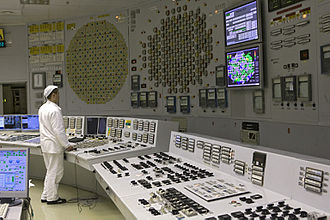
A control room or operations room is a central space where a large physical facility (such as a power plant) or physically dispersed service (such as a network of driverless transit trains) can be monitored and controlled. It is often part of a larger command center.
Overview
[edit]A control room's purpose is production control, and serves as a central space where a large physical facility or physically dispersed service can be monitored and controlled. Central control rooms came into general use in factories during the 1920s.[1]
Control rooms for vital facilities are typically tightly secured and inaccessible to the general public. Multiple electronic displays and control panels are usually present, and there may also be a large wall-sized display area visible from all locations within the space. Some control rooms are themselves under continuous video surveillance and recording, for security and personnel accountability purposes. Many control rooms are occupied on a "24/7/365" basis, and may have multiple people on duty at all times (such as implementation of a "two-man rule"), to ensure continuous vigilance.
Other special-purpose control room spaces may be temporarily set up for special projects (such as an oceanographic exploration mission), and closed or dismantled once the project is concluded.
Examples
[edit]
Control rooms are typically found in installations such as:
- Nuclear power plants and other power-generating stations
- Electric power distribution companies and other Utilities
- Oil refineries and chemical plants
- Airlines, where they are often referred to as operations control centers, and are responsible for flight operations dispatch, monitoring and support
- Major transportation facilities such as bridges, tunnels, canals and rapid transit systems, where they are often staffed 24 hours a day to monitor and report on traffic congestion and to respond to emergencies
- Military facilities (ranging in scale from a missile silo to NORAD), also referred to as operations rooms
- NASA flight controllers work in several "flight control rooms" in mission control centers; affiliated facilities, such as the Jet Propulsion Laboratory have their own control rooms
- Computerized data centers, often serving remote users in multiple time zones
- Network operations centers
- Large institutions such as universities, hospitals, major research facilities (such as particle accelerator laboratories), high security prisons, and theme parks
- Emergency services including police, fire service and emergency medical service
- Call centers, which may use them to monitor incoming and outgoing communications of customer service representatives, and to provide general oversight
- Rail operations centers, such as the Union Pacific Harriman Dispatch Center, control rail operations over thousands of miles of railroad. Train dispatchers staff these facilities around the clock to manage efficient rail operations. In the UK, they are usually operated separately by each train operating company or by Network Rail, and include train crew and rolling stock resourcing.
Special hazards and mitigation
[edit]Control rooms are usually equipped with elaborate fire suppression and security systems to safeguard their contents and occupants, and to ensure continued operation in emergencies. In hazardous environments, they may also be areas of refuge for personnel trapped on-site. They are typically crowded with equipment, mounted in multi-function rack mount cabinets to allow updating. The concentration of equipment often requires special electrical uninterruptible power supply (UPS) feeds and air conditioning.
Since the control equipment is intended to control other items in the surrounding facility, these often fire-resistance rated service rooms require many penetrations for cables. Due to routine equipment updates, these penetrations are subject to frequent changes, requiring maintenance programs to include vigilant firestop management for code compliance.
Due to the sensitive equipment in control room cabinets, it is useful to ensure the use of "T-rated" firestops that are massive and thick enough to resist heat transmission to the inside of the control room. It is also common to place control rooms under positive pressure ventilation to prevent smoke or toxic gases from entering. If used, gaseous fire suppressants must occupy the space that is to be protected for a minimum period of time to be sure a fire can be completely extinguished. Openings in such spaces must therefore be kept to a minimum to prevent the escape of the suppression gas.
A mobile control room is designated as particularly in high risk facilities, such as a nuclear power station or a petrochemical facility.[further explanation needed] It can provided a guaranteed life support for the anticipated safety control.
Design
[edit]The design of a control room incorporates ergonomic and aesthetic features including optimum traffic flow, acoustics, illumination, and health and safety of the workers.[2] Ergonomic considerations determine the placement of humans and equipment to ensure that operators can easily move into, out of, and around the control room, and can interact with each other without any hindrances during emergency situations; and to keep noise and other distractions to a minimum.
Ergonomic control room design, through early assessment, optimized layout, well-managed alarms and acoustics, enhances performance, situational awareness, and operator well-being.[3]
International standards like ISO 11064 provide guidelines for ergonomic control room design and are used worldwide across many industries.
In popular culture
[edit]Control room scenes dealing with crisis situations appear frequently in thriller novels and action films. In addition, a few documentaries have been filmed with scenes in real-life control room settings.
- Fail-Safe - a 1964 Cold war thriller film directed by Sidney Lumet, based on the 1962 novel of the same name by Eugene Burdick and Harvey Wheeler. It portrays a fictional account of a Cold War nuclear crisis.
- The Prisoner - a 1967 British television series (17 episodes), which follows a British former secret agent who is abducted and held prisoner in a mysterious coastal village resort where his captors try to find out why he abruptly resigned from his job.
- The Taking of Pelham One Two Three - a 1974 American thriller film directed by Joseph Sargent, produced by Edgar J. Scherick, and starring Walter Matthau, Robert Shaw, Martin Balsam and Héctor Elizondo. Peter Stone adapted the screenplay, from the 1973 novel of the same name by Morton Freedgood (under the pen name John Godey) about a group of criminals taking hostage for ransom the passengers of a busy New York City Subway car.
- The China Syndrome - a 1979 American thriller film that tells the story of a television reporter and her cameraman who discover safety coverups at a nuclear power plant. It stars Jane Fonda, Jack Lemmon and Michael Douglas, with Douglas also serving as the film's producer.
- GoldenEye - a 1995 spy film, and 17th in the James Bond franchise, features 2 control rooms used for Command and control of a fictitious satellite based weapon, the original control room belonging to the USSR and a replica built by the Janus Crime Syndicate who have taken possession of the satellite for nefarious purposes. The latter also featured as a playable level in the videogame of the same name for the Nintendo 64.
- Minority Report - a 2002 American neo-noir science fiction thriller film directed by Steven Spielberg, and loosely based on the short story of the same name by Philip K. Dick. It is set primarily in Washington DC, and Northern Virginia in the year 2054, where "PreCrime", a specialized police department, apprehends criminals based on foreknowledge provided by three psychics called "precogs".
- Control Room - a 2004 documentary film about Al Jazeera and its relations with the US Central Command (CENTCOM), as well as the other news organizations that covered the 2003 invasion of Iraq.
Image gallery
[edit]-
 NASA control for the International Space Station (ISS)
 -
 Russian mission control for the ISS
 -

-
 Hydroelectric power Itaipu dam jointly operated by Brazil and Paraguay
 -
-
 Engine control for an oil tanker ship
 -

-
 The NewsHour with Jim Lehrer broadcast newsroom
 -
 German solid waste incinerator
 -
 Meteorological satellite control in Germany
 -

-


_Control_Room_HighRes.jpg)


See also
[edit]References
[edit]- ^ Bennett, S. (1993). A History of Control Engineering 1930-1955. London: Peter Peregrinus Ltd. On behalf of the Institution of Electrical Engineers. ISBN 0-86341-280-7.
- ^ Design, Control Room. "Control Room Design". Control Room Design - HSE. Retrieved 12 January 2016.
- ^ Piso, E. (1981-08-01). "Ergonomic Evaluation of Control Rooms: Two Case Studies". IFAC Proceedings Volumes. 8th IFAC World Congress on Control Science and Technology for the Progress of Society, Kyoto, Japan, 24-28 August 1981. 14 (2): 3455–3461. doi:10.1016/S1474-6670(17)63983-1. ISSN 1474-6670.
External links
[edit]
- Lindsay Bjerregaard (Dec 6, 2017). "Managing System Operations At JetBlue". MRO network. Penton. The airline tries to anticipate operational needs and stay ahead of potential disruptions as fleet expansion continues.
- Control Room Design
- US Army INSCOM Information Dominance Center
- ISO 11064: Optimising the ergonomics of control rooms. Motilde (May 2025).
| National | |
|---|---|
| Other | |

Control room
View on GrokipediaIntroduction
Definition and Purpose
A control room is a dedicated facility within a work system, comprising people, equipment, and their interactions in a defined space and environment, designed for the centralized monitoring, supervision, and control of complex systems or processes.[4] According to ergonomic standards, it serves as a critical hub where operators interact with integrated technologies to oversee operations in real time.[5] The primary purposes of a control room include providing real-time oversight of operational activities, enabling rapid response to anomalies or emergencies, coordinating multiple subsystems, and logging data for subsequent analysis and decision-making.[3] These functions ensure efficient management of processes, enhancing safety, productivity, and reliability across various sectors. Key characteristics of control rooms encompass centralized user interfaces, such as consoles and multi-screen displays, that facilitate human-machine interaction; integration of sensors for data acquisition and actuators for system control; and a strong emphasis on ergonomic design to support operator performance. These elements allow for seamless supervision of distributed operations, often through systems like SCADA that connect field devices to control interfaces. Control rooms have evolved from paradigms relying on manual monitoring to automated frameworks incorporating advanced digital integration, shifting the focus from direct physical intervention to sophisticated supervisory roles while maintaining core objectives of oversight and control.[4] Examples include their application in power plants for process regulation or in television studios for broadcast coordination.Historical Development
The origins of control rooms trace back to the 19th-century Industrial Revolution, where centralized monitoring emerged in transportation and communication sectors. Early precursors appeared in telegraph offices, which served as hubs for operators managing electrical signals over long distances, with the first practical systems installed in the 1830s for railway applications.[6] In railways, signal boxes functioned as rudimentary control rooms, allowing operators to coordinate train movements and prevent collisions; for example, one was introduced by the London & Croydon Railway in 1843 to manage a key junction.[7] These manual setups, often simple shelters equipped with levers and telegraphs, marked the shift from decentralized oversight to coordinated control in complex operations.[8] By the mid-20th century, control rooms advanced significantly during and after World War II, particularly in high-stakes environments like nuclear facilities. The Manhattan Project's Hanford Site featured one of the earliest industrial-scale nuclear reactor control rooms, operational from 1944, where operators monitored plutonium production through panels of instruments and switches.[9] Post-war, these designs influenced nuclear power plants worldwide, emphasizing redundancy and real-time monitoring. In the space race, NASA's Mission Control Center at the Manned Spacecraft Center (now Johnson Space Center) was established in the early 1960s for the Mercury program, evolving into a sophisticated hub for Apollo missions by 1969, with rows of consoles enabling remote oversight of spacecraft.[10] The digital transition began in the 1970s with the introduction of Supervisory Control and Data Acquisition (SCADA) systems, which replaced analog panels with computer-based remote monitoring and control, initially using mainframes for data acquisition in utilities and manufacturing.[11] By the 1990s, the adoption of networked, distributed control systems (DCS) allowed integration of personal computers and Ethernet, enabling multi-operator collaboration and reducing reliance on centralized mainframes in industrial settings.[12] Since the late 2010s, further evolution has included integration of artificial intelligence (AI) and Internet of Things (IoT) technologies, facilitating predictive analytics and automated responses in control environments.[13] Key events underscored the need for improved designs. The 1986 Chernobyl disaster exposed vulnerabilities in human-machine interfaces and operator training in nuclear control rooms, prompting global reforms in ergonomic layouts and safety protocols.[14] Preparations for the Y2K millennium bug in the late 1990s accelerated the implementation of redundant systems and robust software testing in critical infrastructure control rooms, averting potential widespread failures.[15] Control rooms also proliferated globally, notably in the Soviet Union during the mid-20th century, where centralized planning under the state economy led to elaborate industrial dispatch rooms for coordinating factories and energy grids, reflecting the era's emphasis on collective oversight.[16]Types and Applications
Industrial and Process Control Rooms
Industrial and process control rooms function as centralized command centers for supervising and automating large-scale operations in sectors like energy production, petrochemical processing, and utilities. In power generation, these rooms oversee nuclear reactors and fossil fuel plants, where operators monitor reactor cores, turbine performance, and grid integration to ensure stable energy output. Oil refineries utilize them to coordinate distillation, cracking, and hydrotreating processes, optimizing crude oil conversion into fuels and chemicals. Water treatment facilities rely on such rooms to regulate filtration, chemical dosing, and distribution systems for safe potable and industrial water supply.[17][18][19][20] These control rooms feature advanced automation through large-scale Supervisory Control and Data Acquisition (SCADA) and Programmable Logic Controller (PLC) systems, which facilitate real-time monitoring and control of continuous processes across distributed equipment. Historically, mimic panels provided physical, schematic representations of plant layouts to visualize flow paths and status indicators, aiding quick fault identification. Modern equivalents include digital twins—virtual replicas that simulate processes in real time for predictive analysis and scenario testing, enhancing operational foresight without physical intervention.[21][22][23] Scale varies significantly based on facility size and complexity; small chemical plants often employ compact rooms with 10-20 operators managing localized reactions and batch processes, while mega-facilities like offshore oil rigs demand expansive, modular setups to handle remote drilling, production, and safety interlocks under extreme conditions. The 1979 Three Mile Island nuclear incident exposed design-related problems and confusing instrumentation in the control room, prompting regulatory reforms that influenced global standards for clearer displays and human-centered designs in subsequent plants.[24][25][26][27] Additionally, contemporary systems integrate with Enterprise Resource Planning (ERP) platforms to link real-time process data with supply chain logistics, enabling synchronized inventory management and production scheduling.[28] A primary challenge involves processing high-throughput data from thousands of sensors, which generates vast streams of information that risk overwhelming operators without robust filtering and analytics tools. Ergonomic layouts in these rooms adapt general design principles to accommodate 24/7 shift work, promoting sustained vigilance through adjustable consoles and reduced cognitive load.[29][30][31]Media and Broadcast Control Rooms
Media and broadcast control rooms serve as the central hubs for coordinating live and recorded content production in television studios, radio stations, and film post-production suites. In television studios, these rooms facilitate the directing of live shows by managing video feeds from multiple cameras, integrating graphics, and overseeing audio levels to ensure seamless on-air delivery. Radio broadcasting control rooms, often integrated into on-air studios, focus on audio mixing and playback, using consoles to balance host commentary, music, and sound effects for real-time transmission. Post-production suites, meanwhile, employ control rooms for editing workflows, where operators synchronize footage, apply visual effects, and finalize audio in film and media projects.[32][33][34] Distinct elements in these control rooms include video switchers for transitioning between camera angles, audio mixers for balancing sound sources, teleprompters for scripting on-air talent, and systems for multi-camera synchronization to maintain timing across feeds. These components enable precise control over creative outputs, such as switching live shots during a sports event or layering effects in a news segment.[35][36] The evolution of media control rooms traces from compact 1950s black-and-white booths, which relied on analog switchers and basic monitors for monochrome broadcasts, to contemporary 4K and 8K digital workflows that support high-resolution processing and IP-based signal routing. Early setups in the post-World War II era handled limited feeds with manual adjustments, while modern rooms incorporate software-defined automation and virtual reality integration for immersive production previews and remote collaboration. This shift has enabled handling complex, multi-platform distributions, from traditional airwaves to streaming services.[37][38][39] Prominent examples include CNN's global newsroom control, featuring walls with up to 30 screens displaying over 400 live feeds from worldwide bureaus for real-time news coordination. Olympic broadcast centers, managed by organizations like Olympic Broadcasting Services, utilize expansive control rooms to handle hundreds of video and audio feeds from multiple venues, ensuring synchronized global transmission. Unique to these environments is the emphasis on precise timing for live events, achieved through cue systems like tally lights and intercoms that signal talent for actions such as camera cutaways or segment starts, alongside direct communication channels to guide on-air performers without disrupting the broadcast flow.[40][41][42][43]Transportation and Infrastructure Control Rooms
Transportation and infrastructure control rooms serve as centralized hubs for monitoring and managing dynamic systems that ensure public mobility and operational reliability across air, rail, road, and utility networks. These facilities integrate real-time data from sensors, surveillance, and communication systems to coordinate traffic flows, prevent disruptions, and respond to incidents, prioritizing safety for millions of daily users. Unlike static industrial controls, they handle variable human-driven elements such as fluctuating passenger volumes and weather impacts, often operating 24/7 to maintain seamless service. Key applications include air traffic control towers, which oversee aircraft movements at airports; subway and rail operations centers, which manage train schedules and track conditions; and smart city traffic hubs, which optimize urban road networks. For instance, the Federal Aviation Administration's (FAA) 22 Air Route Traffic Control Centers (ARTCCs), or en route centers, handle high-altitude airspace across the United States, using radar and automation to separate flights and issue clearances. In rail systems, London's Underground control room coordinates operations for its 272 stations, accommodating up to 5 million passenger journeys daily through centralized signaling and incident management. Smart city examples, such as Pittsburgh's Surtrac system, employ sensors at intersections to adjust signals in real time, reducing travel times by 25% and congestion by 40%. Specialized features enhance these operations, including radar and GPS integrations for precise vehicle tracking, predictive analytics for congestion forecasting, and emergency dispatch systems for rapid response. Radar systems, combined with GPS from navigation devices, enable continuous monitoring of traffic volume and speeds in control rooms, supporting adaptive signal control. Predictive analytics tools process historical and live data to anticipate bottlenecks, allowing operators to reroute traffic proactively and cut peak-hour delays by up to 20%. Emergency dispatch integrates video feeds, GIS mapping, and communication channels to coordinate responses, such as in urban incident centers where dispatchers toggle between calls and live surveillance. Modern developments in the 2020s focus on integrating drones and autonomous vehicles while bolstering cyber resilience. The FAA's Unmanned Aircraft System Traffic Management (UTM) framework enables low-altitude drone operations by providing collaborative airspace coordination, addressing the rise in commercial drone flights. Autonomous vehicle integration, as outlined in the U.S. Department of Transportation's initiatives, incorporates vehicle-to-infrastructure (V2I) communication to enhance network efficiency and safety in control rooms. To counter cyber threats, infrastructure control rooms adopt resilience measures like automated asset inventories and segmented networks, mitigating risks from attacks on traffic systems that could disrupt mobility. In January 2025, the Cybersecurity and Infrastructure Security Agency (CISA) released twelve advisories on Industrial Control Systems (ICS) vulnerabilities, underscoring the need for continued enhancements in control room cyber defenses.[44] Distinct challenges involve real-time coordination across distributed assets, such as synchronizing signals over vast urban grids, and ensuring failover to backup sites during outages. Urban traffic control faces issues like data latency and varying network topologies, requiring robust algorithms to maintain flow without interruptions. Failover systems, including redundant servers and offsite backups, allow seamless transitions, minimizing downtime in high-stakes environments like rail operations.Design and Layout
Ergonomic and Spatial Considerations
Control room layouts prioritize operator efficiency and collaboration through strategic console arrangements and zoning. Linear console setups facilitate straightforward alignment along walls, promoting easy access and scalability for larger teams, while curved or radial configurations enhance sightlines to central video walls, reducing neck strain and improving shared visibility for up to 120 degrees of viewing angle.[45] Zoning separates operator workstations from supervisory areas to minimize distractions, with operators positioned for direct task focus and supervisors elevated or offset for oversight without impeding workflows.[1] Ergonomic standards, particularly those outlined in ISO 11064, guide furniture and environmental elements to support prolonged operations. Workstation furniture adheres to adjustable heights, with seat heights accommodating the 5th to 95th percentile of users (typically 380-500 mm) and fixed desk surfaces at around 735 mm to allow neutral postures, often supplemented by footrests for legroom clearance of at least 100 mm under the desk.[46] Lighting levels are maintained between 200 and 500 lux for visual display unit (VDU) environments to prevent glare and eye fatigue, with a Unified Glare Index below 19 and color rendering index above 80.[1] Noise control limits ambient levels to 30-45 dB to foster concentration, achieved through absorptive materials and acoustic partitioning that dampen alarms and conversations.[47] Spatial factors ensure adequate room dimensions and supportive conditions for 24/7 functionality. Allocation typically ranges from 10 to 50 square meters per operator, depending on task complexity and equipment, with a minimum of 30 square meters for a single-operator room to allow movement and auxiliary space.[48] Climate control maintains temperatures of 20-24°C and humidity at 40-60% to sustain alertness during extended shifts, while accessibility features like adjustable consoles and wide aisles (at least 1.2 meters) accommodate diverse users, including those with disabilities.[49] Human factors research emphasizes designs that mitigate fatigue and cognitive demands. Shift rotations, typically 8-12 hours with breaks, counteract physiological fatigue by aligning with circadian rhythms and allowing recovery, as supported by ergonomic guidelines that integrate rest zones. Intuitive interfaces, such as grouped controls within easy reach (arm's length of 300-600 mm), reduce cognitive load by minimizing information overload and supporting rapid decision-making in high-stakes scenarios.[50] Post-9/11 redesigns in critical infrastructure control rooms have emphasized resilience through enhanced security and backup systems.[51]Technological Components
Control rooms rely on a suite of core hardware components to facilitate efficient monitoring and operation. Multi-monitor setups, often configured as video walls or ergonomic operator workstations, enable operators to view multiple data streams simultaneously, enhancing situational awareness in high-stakes environments like industrial processes or broadcast facilities.[52] These setups typically incorporate duplicated display panels for redundancy and clarity, with resolutions starting at 1080p and scaling to 4K or higher for detailed visualization.[53] KVM (keyboard, video, mouse) switches are essential for allowing a single set of peripherals to control multiple computers or systems, reducing workspace clutter and improving scalability; modern iterations, such as KVM over IP, extend control remotely across networks while maintaining security isolation.[54] Uninterruptible power supplies (UPS) provide backup power to critical hardware, ensuring continuous operation during outages and minimizing downtime in mission-critical settings.[52] Software systems form the backbone of control room functionality, integrating data from various sources for real-time decision support. Human-Machine Interfaces (HMI) serve as intuitive graphical frontends, allowing operators to interact with underlying processes through customizable dashboards and touch-enabled controls.[52] Distributed Control Systems (DCS), such as ABB's System 800xA, manage complex industrial automation by distributing control functions across networked controllers, enabling scalable oversight of plant-wide operations while reducing the physical footprint of control infrastructure.[55] Alarm management software, exemplified by Honeywell's solutions, filters and prioritizes alerts to combat operator overload, achieving up to an 80% reduction in alarm counts and supporting compliance with standards like ISA 18.2 and EEMUA 191 across thousands of installations.[56] These systems often incorporate video wall management software to orchestrate content across displays, ensuring low-latency processing of inputs from cameras and sensors.[57] Effective communication within control rooms is bolstered by specialized tools that enable seamless collaboration. VoIP-based intercoms and internal networks facilitate rapid audio exchanges between operators and field personnel, often integrated with two-way radios for robust, real-time coordination.[52] Video conferencing systems, including desktop solutions with USB cameras and high-quality audio, support remote expert consultations and multi-location teamwork, enhancing response times in dynamic scenarios.[52] Data analytics platforms leverage big data techniques for anomaly detection, processing streams from operational sensors to identify patterns and predict issues before they escalate.[53] Integration trends in control rooms emphasize connectivity and resilience to handle increasing data volumes. IoT sensors are routinely incorporated to provide real-time environmental and equipment data, feeding into centralized systems for comprehensive monitoring.[52] Cloud-based redundancy ensures failover capabilities, allowing remote access and backup during local disruptions, while maintaining data synchronization across hybrid environments.[52] Cybersecurity protocols, including zero-trust models, are increasingly adopted in operational technology (OT) settings like control rooms; these frameworks verify every access request regardless of origin, bridging IT-OT gaps to protect against threats in integrated networks.[58] Additional measures, such as AES/TLS encryption and AI-driven threat detection, safeguard AV over IP infrastructures that extend KVM and display functionalities.[53] Recent advancements have introduced AI-driven automation to elevate control room capabilities, particularly in the 2020s. Machine learning algorithms enable predictive maintenance by analyzing sensor data to forecast equipment failures, optimizing resource allocation and reducing unplanned downtime in sectors like energy and transportation.[59] These AI tools also automate routine workflows, providing real-time insights and anomaly detection to support faster decision-making.[59] Virtual reality (VR) and augmented reality (AR) technologies are employed for training simulations, replicating complex scenarios to prepare operators without risking live systems, thereby improving preparedness for emergencies.[59] Such innovations complement ergonomic designs by fitting digital interfaces to operator needs, fostering intuitive interactions in spatially optimized environments.[52]Operations and Human Factors
Staffing and Roles
Control rooms typically require a structured personnel hierarchy to ensure continuous monitoring and reliable operations. Key roles include operators, who are responsible for monitoring instrumentation such as dials and screens, responding to alarms, and executing control procedures; supervisors, who oversee shift activities, approve operational changes, and coordinate team responses; technicians, who maintain and troubleshoot equipment to prevent disruptions; and analysts, who review data logs and provide technical insights for optimization and incident analysis.[60][61][62] Staffing models in control rooms emphasize 24/7 coverage through shift rotations, often utilizing 12-hour shifts with overlaps for handovers to minimize errors during transitions. Common rotations include clockwise patterns to reduce fatigue, limiting consecutive night shifts to no more than three, and models like the 2-2-3 schedule where teams alternate days on and off. Team sizes vary by operational complexity, for example, a minimum of 7 personnel in designs like the AP1000 nuclear facility, with typical sizes ranging from 10 to 30 in complex industrial setups, ensuring adequate redundancy without overburdening individuals.[60][63][61] Training requirements for control room personnel focus on both technical proficiency and emergency preparedness, often mandated by sector-specific certifications. In power operations, operators must obtain NERC System Operator Certification, which involves passing an exam on reliability standards and completing continuing education every three years to handle bulk power system dynamics. General training incorporates classroom instruction, on-the-job shadowing, and simulation-based exercises for crisis response, enabling personnel to practice abnormal scenarios and system shutdowns safely.[64][62] Human factors in control room staffing prioritize a balance of technical and soft skills to enhance team performance and resilience. Personnel require diverse competencies, including expertise in control systems alongside communication, situational awareness, and teamwork to facilitate effective coordination during high-pressure situations. Succession planning ensures 24/7 coverage by identifying high-potential individuals through assessments and providing targeted development, such as leadership training, to fill critical roles amid turnover.[62][65] While general principles apply across sectors, staffing variations reflect operational demands; for instance, industrial control rooms emphasize engineering-focused operators and technicians for process monitoring.[60][61]Monitoring and Decision-Making Processes
In control rooms, monitoring techniques primarily involve continuous scanning of system dashboards that aggregate real-time data from sensors and processes, enabling operators to visualize key performance indicators and detect deviations early.[66] Threshold-based alarms trigger audible and visual notifications when parameters exceed predefined limits, prioritizing critical events to prevent escalation.[67] Trend analysis complements these by examining historical and ongoing data patterns to forecast potential issues, such as gradual pressure buildups in industrial processes. As of 2025, emerging technologies like AI for predictive analytics are enhancing operator situational awareness and reducing cognitive load.[68][69] Decision frameworks in control rooms rely on Standard Operating Procedures (SOPs) that outline escalations for abnormal conditions, ensuring consistent responses across shifts.[70] Root cause analysis, often employing tools like fishbone diagrams, systematically identifies underlying factors contributing to alarms or disruptions by categorizing causes into areas such as equipment, methods, and personnel.[71] These frameworks integrate operator judgment with predefined protocols to mitigate incidents efficiently. Key tools supporting these processes include event logging systems that record alarms, operator actions, and system states for post-event review and compliance.[70] Handover protocols between shifts mandate the transfer of critical information, such as ongoing trends and unresolved alerts, through structured checklists to maintain situational awareness. Simulation software enables what-if scenario testing, allowing operators to rehearse responses to hypothetical failures without risking live operations.[72] Performance metrics evaluate the effectiveness of these processes, with guidelines recommending an average alarm rate of no more than one per 10 minutes per operator during steady-state operations to avoid overload.[67] Response times for critical alerts are targeted to be prompt, with acknowledgment typically within a few minutes to minimize potential impacts.[70] Error rates are reduced through checklists integrated into SOPs, aiming for near-zero procedural deviations in high-stakes environments. Balancing automation involves semi-autonomous systems where human override capabilities ensure operator intervention in complex scenarios, such as overriding automated adjustments during unforeseen interactions.[73] Examples include auto-shutdown sequences in process industries that activate on detected hazards but allow manual reset to verify conditions before full halt.[74] This approach maintains human authority while leveraging automation for routine efficiency.Safety and Risk Management
Identified Hazards
Control rooms, critical hubs for monitoring and managing complex operations across industries, are susceptible to a range of hazards that can compromise personnel safety, system integrity, and overall functionality. These hazards encompass physical, operational, external, and sector-specific risks, often exacerbated by the high-stakes, 24/7 nature of control room environments.[75] Physical HazardsOperators in control rooms face significant ergonomic strains from prolonged sitting, repetitive tasks, and extended screen interactions, leading to musculoskeletal disorders such as chronic pain in the neck, shoulders, and back.[75] Repetitive stress injuries (RSI) arise from constant use of keyboards, mice, and monitoring equipment, damaging muscles, tendons, and nerves over time.[76] Environmental factors, including poor ventilation and inadequate lighting, contribute to fatigue and reduced cognitive performance, heightening the risk of errors during extended shifts.[75] These issues are particularly acute in static workstation setups where operators remain seated for hours without sufficient breaks.[77] Operational Risks
Human error remains a primary operational hazard in control rooms, especially under high-stress scenarios where workload overload diminishes vigilance and increases cognitive failures.[78] Studies indicate that human errors contribute to over 80% of accidents in chemical industries and more than 90% in nuclear facilities, often stemming from miscommunications or procedural lapses during emergencies.[79] System failures, such as single points of failure in monitoring equipment or power supplies, can cascade into broader disruptions, as evidenced by the Piper Alpha disaster in 1988, where control room blackouts and alarm failures escalated a minor incident into a catastrophic explosion killing 167 people.[80] In process industries, outdated control panel designs further amplify these risks by overwhelming operators with information during crises. External Threats
Cyberattacks targeting industrial control systems (ICS) pose severe risks to networked control rooms, potentially allowing unauthorized access to manipulate processes or disrupt operations.[81] Recent incidents demonstrate a shift toward ICS vulnerabilities, such as the September 2024 ransomware attack on the Arkansas City water treatment facility in Kansas, which forced a switch to manual operations and prompted a federal investigation.[82] State-sponsored actors have exploited these systems for sabotage in critical infrastructure like energy and water facilities.[83] Natural disasters, including floods, earthquakes, and storms, threaten control room infrastructure by causing power outages, structural damage, or equipment failure, which can halt monitoring and response capabilities in hazardous installations.[84] Sector-Specific Hazards
In nuclear control rooms, radiation exposure represents a unique risk, with potential doses approaching occupational limits (0.05 Sv or 5 rem total effective dose equivalent) during accidents that release radioactive materials.[85] A 2024 meta-analysis found higher risks for mesothelioma among workers and for all-cancer, thyroid cancer, and leukemia among nearby residents exposed to low-dose radiation from nuclear power plants.[86] For media and broadcast control rooms, electromagnetic interference (EMI) from nearby high-power transmitters or equipment can disrupt signal integrity, leading to data corruption or system malfunctions.[87] Poorly shielded environments exacerbate EMI, compromising audio-visual feeds essential for real-time operations.[87]