



Community hub
Recent from talks
Contribute something
Nothing was collected or created yet.
Character theory
View on WikipediaIn mathematics, more specifically in group theory, the character of a group representation is a function on the group that associates to each group element the trace of the corresponding matrix. The character carries the essential information about the representation in a more condensed form. Georg Frobenius initially developed representation theory of finite groups entirely based on the characters, and without any explicit matrix realization of representations themselves. This is possible because a complex representation of a finite group is determined (up to isomorphism) by its character. The situation with representations over a field of positive characteristic, so-called "modular representations", is more delicate, but Richard Brauer developed a powerful theory of characters in this case as well. Many deep theorems on the structure of finite groups use characters of modular representations.
Applications
[edit]Characters of irreducible representations encode many important properties of a group and can thus be used to study its structure. Character theory is an essential tool in the classification of finite simple groups. Close to half of the proof of the Feit–Thompson theorem involves intricate calculations with character values. Easier, but still essential, results that use character theory include Burnside's theorem (a purely group-theoretic proof of Burnside's theorem has since been found, but that proof came over half a century after Burnside's original proof), and a theorem of Richard Brauer and Michio Suzuki stating that a finite simple group cannot have a generalized quaternion group as its Sylow 2-subgroup.
Definitions
[edit]Let V be a finite-dimensional vector space over a field F and let ρ : G → GL(V) be a representation of a group G on V. The character of ρ is the function χρ : G → F given by

where Tr is the trace.
A character χρ is called irreducible or simple if ρ is an irreducible representation. The degree of the character χ is the dimension of ρ; in characteristic zero this is equal to the value χ(1). A character of degree 1 is called linear. When G is finite and F has characteristic zero, the kernel of the character χρ is the normal subgroup:

which is precisely the kernel of the representation ρ. However, the character is not a group homomorphism in general.
Properties
[edit]- Characters are class functions, that is, they each take a constant value on a given conjugacy class. More precisely, the set of irreducible characters of a given group G into a field F form a basis of the F-vector space of all class functions G → F.
- Isomorphic representations have the same characters. Over a field of characteristic 0, two representations are isomorphic if and only if they have the same character.[1]
- If a representation is the direct sum of subrepresentations, then the corresponding character is the sum of the characters of those subrepresentations.
- If a character of the finite group G is restricted to a subgroup H, then the result is also a character of H.
- Every character value χ(g) is a sum of n m-th roots of unity, where n is the degree (that is, the dimension of the associated vector space) of the representation with character χ and m is the order of g. In particular, when F = C, every such character value is an algebraic integer.
- If F = C and χ is irreducible, then is an algebraic integer for all x in G.
- If F is algebraically closed and char(F) does not divide the order of G, then the number of irreducible characters of G is equal to the number of conjugacy classes of G. Furthermore, in this case, the degrees of the irreducible characters are divisors of the order of G (and they even divide [G : Z(G)] if F = C).
![{\displaystyle [G:C_{G}(x)]{\frac {\chi (x)}{\chi (1)}}}](https://wikimedia.org/api/rest_v1/media/math/render/svg/43d45c086b0cb3b5a9332f5c93ac326a1a775bf0)
Arithmetic properties
[edit]Let ρ and σ be representations of G. Then the following identities hold:



![{\displaystyle \chi _{{\scriptscriptstyle {\rm {{Alt}^{2}}}}\rho }(g)={\tfrac {1}{2}}\!\left[\left(\chi _{\rho }(g)\right)^{2}-\chi _{\rho }(g^{2})\right]}](https://wikimedia.org/api/rest_v1/media/math/render/svg/9910b16063a19f9e275232665129d571dabf0a61)
![{\displaystyle \chi _{{\scriptscriptstyle {\rm {{Sym}^{2}}}}\rho }(g)={\tfrac {1}{2}}\!\left[\left(\chi _{\rho }(g)\right)^{2}+\chi _{\rho }(g^{2})\right]}](https://wikimedia.org/api/rest_v1/media/math/render/svg/8b25d62167586f95ccca96a97b83ebd283086903)
where ρ⊕σ is the direct sum, ρ⊗σ is the tensor product, ρ∗ denotes the conjugate transpose of ρ, and Alt2 is the alternating product Alt2ρ = ρ ∧ ρ and Sym2 is the symmetric square, which is determined by

Character tables
[edit]The irreducible complex characters of a finite group form a character table which encodes much useful information about the group G in a compact form. Each row is labelled by an irreducible representation and the entries in the row are the characters of the representation on the respective conjugacy class of G. The columns are labelled by (representatives of) the conjugacy classes of G. It is customary to label the first row by the character of the trivial representation, which is the trivial action of G on a 1-dimensional vector space by for all . Each entry in the first row is therefore 1. Similarly, it is customary to label the first column by the identity. Therefore, the first column contains the degree of each irreducible character.


Here is the character table of

the cyclic group with three elements and generator u:
| (1) | (u) | (u2) | |
| 1 | 1 | 1 | 1 |
| χ1 | 1 | ω | ω2 |
| χ2 | 1 | ω2 | ω |
where ω is a primitive third root of unity.
The character table is always square, because the number of irreducible representations is equal to the number of conjugacy classes.[2]
Orthogonality relations
[edit]The space of complex-valued class functions of a finite group G has a natural inner product:
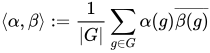
where β(g) is the complex conjugate of β(g). With respect to this inner product, the irreducible characters form an orthonormal basis for the space of class-functions, and this yields the orthogonality relation for the rows of the character table:
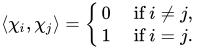
For g, h in G, applying the same inner product to the columns of the character table yields:

where the sum is over all of the irreducible characters χi of G and the symbol |CG(g)| denotes the order of the centralizer of g. Note that since g and h are conjugate iff they are in the same column of the character table, this implies that the columns of the character table are orthogonal.
The orthogonality relations can aid many computations including:
- Decomposing an unknown character as a linear combination of irreducible characters.
- Constructing the complete character table when only some of the irreducible characters are known.
- Finding the orders of the centralizers of representatives of the conjugacy classes of a group.
- Finding the order of the group.
Character table properties
[edit]Certain properties of the group G can be deduced from its character table:
- The order of G is given by the sum of the squares of the entries of the first column (the degrees of the irreducible characters). More generally, the sum of the squares of the absolute values of the entries in any column gives the order of the centralizer of an element of the corresponding conjugacy class.
- All normal subgroups of G (and thus whether or not G is simple) can be recognised from its character table. The kernel of a character χ is the set of elements g in G for which χ(g) = χ(1); this is a normal subgroup of G. Each normal subgroup of G is the intersection of the kernels of some of the irreducible characters of G.
- The commutator subgroup of G is the intersection of the kernels of the linear characters of G.
- If G is finite, then since the character table is square and has as many rows as conjugacy classes, it follows that G is abelian iff each conjugacy class is a singleton iff the character table of G is iff each irreducible character is linear.
- It follows, using some results of Richard Brauer from modular representation theory, that the prime divisors of the orders of the elements of each conjugacy class of a finite group can be deduced from its character table (an observation of Graham Higman).

The character table does not in general determine the group up to isomorphism: for example, the quaternion group Q and the dihedral group of 8 elements, D4, have the same character table. Brauer asked whether the character table, together with the knowledge of how the powers of elements of its conjugacy classes are distributed, determines a finite group up to isomorphism. In 1964, this was answered in the negative by E. C. Dade.
The linear representations of G are themselves a group under the tensor product, since the tensor product of 1-dimensional vector spaces is again 1-dimensional. That is, if and are linear representations, then defines a new linear representation. This gives rise to a group of linear characters, called the character group under the operation . This group is connected to Dirichlet characters and Fourier analysis.



=\chi _{1}(g)\chi _{2}(g)}](https://wikimedia.org/api/rest_v1/media/math/render/svg/c28a4ed83bb25996accc5d17cb08895707a89cf2)
Induced characters and Frobenius reciprocity
[edit]The characters discussed in this section are assumed to be complex-valued. Let H be a subgroup of the finite group G. Given a character χ of G, let χH denote its restriction to H. Let θ be a character of H. Ferdinand Georg Frobenius showed how to construct a character of G from θ, using what is now known as Frobenius reciprocity. Since the irreducible characters of G form an orthonormal basis for the space of complex-valued class functions of G, there is a unique class function θG of G with the property that

for each irreducible character χ of G (the leftmost inner product is for class functions of G and the rightmost inner product is for class functions of H). Since the restriction of a character of G to the subgroup H is again a character of H, this definition makes it clear that θG is a non-negative integer combination of irreducible characters of G, so is indeed a character of G. It is known as the character of G induced from θ. The defining formula of Frobenius reciprocity can be extended to general complex-valued class functions.
Given a matrix representation ρ of H, Frobenius later gave an explicit way to construct a matrix representation of G, known as the representation induced from ρ, and written analogously as ρG. This led to an alternative description of the induced character θG. This induced character vanishes on all elements of G which are not conjugate to any element of H. Since the induced character is a class function of G, it is only now necessary to describe its values on elements of H. If one writes G as a disjoint union of right cosets of H, say

then, given an element h of H, we have:
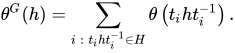
Because θ is a class function of H, this value does not depend on the particular choice of coset representatives.
This alternative description of the induced character sometimes allows explicit computation from relatively little information about the embedding of H in G, and is often useful for calculation of particular character tables. When θ is the trivial character of H, the induced character obtained is known as the permutation character of G (on the cosets of H).
The general technique of character induction and later refinements found numerous applications in finite group theory and elsewhere in mathematics, in the hands of mathematicians such as Emil Artin, Richard Brauer, Walter Feit and Michio Suzuki, as well as Frobenius himself.
Mackey decomposition
[edit]The Mackey decomposition was defined and explored by George Mackey in the context of Lie groups, but is a powerful tool in the character theory and representation theory of finite groups. Its basic form concerns the way a character (or module) induced from a subgroup H of a finite group G behaves on restriction back to a (possibly different) subgroup K of G, and makes use of the decomposition of G into (H, K)-double cosets.
If is a disjoint union, and θ is a complex class function of H, then Mackey's formula states that

![{\displaystyle \left(\theta ^{G}\right)_{K}=\sum _{t\in T}\left(\left[\theta ^{t}\right]_{t^{-1}Ht\cap K}\right)^{K},}](https://wikimedia.org/api/rest_v1/media/math/render/svg/312b7470e8c28873d072f83bbe60167a2861050b)
where θt is the class function of t−1Ht defined by θt(t−1ht) = θ(h) for all h in H. There is a similar formula for the restriction of an induced module to a subgroup, which holds for representations over any ring, and has applications in a wide variety of algebraic and topological contexts.
Mackey decomposition, in conjunction with Frobenius reciprocity, yields a well-known and useful formula for the inner product of two class functions θ and ψ induced from respective subgroups H and K, whose utility lies in the fact that it only depends on how conjugates of H and K intersect each other. The formula (with its derivation) is:
![{\displaystyle {\begin{aligned}\left\langle \theta ^{G},\psi ^{G}\right\rangle &=\left\langle \left(\theta ^{G}\right)_{K},\psi \right\rangle \\&=\sum _{t\in T}\left\langle \left(\left[\theta ^{t}\right]_{t^{-1}Ht\cap K}\right)^{K},\psi \right\rangle \\&=\sum _{t\in T}\left\langle \left(\theta ^{t}\right)_{t^{-1}Ht\cap K},\psi _{t^{-1}Ht\cap K}\right\rangle ,\end{aligned}}}](https://wikimedia.org/api/rest_v1/media/math/render/svg/eaedd2b0cf424d55c699ff6f591d6c9bd1b267ac)
(where T is a full set of (H, K)-double coset representatives, as before). This formula is often used when θ and ψ are linear characters, in which case all the inner products appearing in the right hand sum are either 1 or 0, depending on whether or not the linear characters θt and ψ have the same restriction to t−1Ht ∩ K. If θ and ψ are both trivial characters, then the inner product simplifies to |T|.
"Twisted" dimension
[edit]One may interpret the character of a representation as the "twisted" dimension of a vector space.[3] Treating the character as a function of the elements of the group χ(g), its value at the identity is the dimension of the space, since χ(1) = Tr(ρ(1)) = Tr(IV) = dim(V). Accordingly, one can view the other values of the character as "twisted" dimensions.[clarification needed]
One can find analogs or generalizations of statements about dimensions to statements about characters or representations. A sophisticated example of this occurs in the theory of monstrous moonshine: the j-invariant is the graded dimension of an infinite-dimensional graded representation of the Monster group, and replacing the dimension with the character gives the McKay–Thompson series for each element of the Monster group.[3]
Characters of Lie groups and Lie algebras
[edit]If is a Lie group and a finite-dimensional representation of , the character of is defined precisely as for any group as


- .
Meanwhile, if is a Lie algebra and a finite-dimensional representation of , we can define the character by

- .

The character will satisfy for all in the associated Lie group and all . If we have a Lie group representation and an associated Lie algebra representation, the character of the Lie algebra representation is related to the character of the group representation by the formula



- .
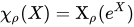
Suppose now that is a complex semisimple Lie algebra with Cartan subalgebra . The value of the character of an irreducible representation of is determined by its values on . The restriction of the character to can easily be computed in terms of the weight spaces, as follows:

- ,

where the sum is over all weights of and where is the multiplicity of .[4]


The (restriction to of the) character can be computed more explicitly by the Weyl character formula.
See also
[edit]- Irreducible representation § Applications in theoretical physics and chemistry
- Association schemes, a combinatorial generalization of group-character theory.
- Clifford theory, introduced by A. H. Clifford in 1937, yields information about the restriction of a complex irreducible character of a finite group G to a normal subgroup N.
- Frobenius formula
- Real element, a group element g such that χ(g) is a real number for all characters χ
References
[edit]- Lecture 2 of Fulton, William; Harris, Joe (1991). Representation theory. A first course. Graduate Texts in Mathematics, Readings in Mathematics. Vol. 129. New York: Springer-Verlag. doi:10.1007/978-1-4612-0979-9. ISBN 978-0-387-97495-8. MR 1153249. OCLC 246650103. online
- Gannon, Terry (2006). Moonshine beyond the Monster: The Bridge Connecting Algebra, Modular Forms and Physics. Cambridge University Press. ISBN 978-0-521-83531-2.
- Hall, Brian C. (2015), Lie groups, Lie algebras, and representations: An elementary introduction, Graduate Texts in Mathematics, vol. 222 (2nd ed.), Springer, ISBN 978-3319134666
- Isaacs, I.M. (1994). Character Theory of Finite Groups (Corrected reprint of the 1976 original, published by Academic Press. ed.). Dover. ISBN 978-0-486-68014-9.
- James, Gordon; Liebeck, Martin (2001). Representations and Characters of Groups (2nd ed.). Cambridge University Press. ISBN 978-0-521-00392-6.
- Serre, Jean-Pierre (1977). Linear Representations of Finite Groups. Graduate Texts in Mathematics. Vol. 42. Translated from the second French edition by Leonard L. Scott. New York-Heidelberg: Springer-Verlag. doi:10.1007/978-1-4684-9458-7. ISBN 978-0-387-90190-9. MR 0450380.
External links
[edit]- Character at PlanetMath.
| International | |
|---|---|
| National | |
| Other | |

Character theory
View on GrokipediaFoundations
Definitions
In the context of representation theory for finite groups, a representation of a finite group is defined as a group homomorphism , where is a finite-dimensional vector space over the complex numbers and denotes the general linear group of invertible linear transformations on .[7] This setup encodes the action of on via linear transformations, preserving the group structure. The dimension of , denoted , is called the degree of the representation. The character associated to a representation is the function given by for each , where is the trace of the matrix representing with respect to any basis of .[8] Characters are class functions, meaning for all , as the trace is invariant under simultaneous conjugation of the matrix. The space of all class functions on , denoted , consists of complex-valued functions constant on the conjugacy classes of .[4] An irreducible representation of is one that admits no proper nontrivial invariant subspace under the action of . The characters of the irreducible representations form an orthonormal basis for the vector space with respect to the inner product , though the orthogonality details are explored elsewhere.[9] The set of irreducible characters is denoted , and its cardinality equals the number of conjugacy classes . A fundamental example is the trivial representation, where is the identity transformation on for all , yielding the trivial character for every . This one-dimensional representation is always irreducible.[1]Representations and linear characters
Linear characters are the characters of one-dimensional representations of a finite group , which are group homomorphisms satisfying for all .[10] These representations map elements of to the multiplicative group of nonzero complex numbers, preserving the group operation multiplicatively.[10] For a finite abelian group , every irreducible representation is one-dimensional, meaning all irreducible characters are linear.[10] The set of all linear characters of forms a group under pointwise multiplication, known as the dual group , which is isomorphic to itself.[10] The trivial character, which sends every element to 1, serves as the identity element in this dual group. The kernel of a linear character , defined as , is a normal subgroup of .[10] By the first isomorphism theorem for groups, the quotient is isomorphic to the image , which is a finite cyclic subgroup of the unit circle.[4] A concrete example arises with the cyclic group , generated by 1 modulo . Its linear characters are given by for and , corresponding to the th roots of unity.[10] In general, the number of linear characters of a finite abelian group equals , matching the order of the group since the dual group is isomorphic to .[10]Properties
Arithmetic properties
In the theory of representations of finite groups over the complex numbers, the character associated to a representation is defined by for . These characters are constant on conjugacy classes of , meaning for all , and thus belong to the space of class functions on .[11] The degree of a character , denoted , is the value at the identity element and equals the dimension of the representation space . This degree is a positive integer. For an irreducible character, the degree divides the order of the group .[11] A fundamental inequality states that for any character and element , , with equality holding if and only if is a scalar multiple of the identity matrix on . This bound reflects the unitary nature of representations of finite groups up to equivalence.[11] The arithmetic structure of characters is further illuminated by the inner product on the space of class functions, defined as . For irreducible characters , this inner product takes integer values: it equals 1 if and 0 otherwise.[11] In particular, the norm if and only if is the character of an irreducible representation. By Schur's lemma, which asserts that the endomorphism algebra of an irreducible representation over is isomorphic to , distinct irreducible representations cannot have the same character, ensuring that irreducible characters are pairwise distinct.Multiplicativity and orthogonality
One key property of characters in representation theory is their multiplicativity under direct products of groups. For finite groups and , if and , then the irreducible characters of the direct product are precisely the products , defined by for and .[12] This reflects how representations of arise as external tensor products of representations of and . A related multiplicativity holds for tensor products of representations of the same group. If and are representations with characters and , the tensor product representation on has character for all .[12] This product structure facilitates the analysis of how representations combine under tensoring, preserving the trace via the multiplicativity of traces on tensor products of matrices. In contrast, characters exhibit additivity under direct sums of representations. For representations on and on , the direct sum on has character for all .[12] This linearity allows any representation to be expressed as a direct sum of irreducible ones, with the character serving as an additive invariant. Irreducible characters also display orthogonality properties when viewed as functions constant on conjugacy classes. Specifically, the set of irreducible characters forms an orthogonal basis for the space of class functions on with respect to the inner product , where the sum can be grouped over conjugacy classes due to class constancy.[12] This column orthogonality underpins the uniqueness of character tables and decomposition into irreducibles. To illustrate these properties, consider the symmetric group , which has three conjugacy classes: the identity , transpositions (order 2), and 3-cycles (order 3). Its irreducible characters are the trivial character , the sign character with values , and the 2-dimensional character with values .[4] The additivity is evident in the permutation representation, whose character decomposes as . For multiplicativity, the tensor product of with itself yields the character , which further decomposes but demonstrates the pointwise product rule. Restricting to the subgroup , the characters of multiply consistently with those of the subgroup's irreducibles (the trivial and two complex 1-dimensional characters), aligning with the direct product structure for abelian factors.[12]Character Tables
Construction and examples
The character table of a finite group is constructed by indexing the columns with the conjugacy classes of and the rows with its irreducible characters. The number of irreducible characters equals the number of conjugacy classes.[13] To determine the table, first compute the conjugacy classes explicitly for small groups. The degrees (values at the identity) of the irreducible characters must satisfy , and each degree divides . One standard approach uses the decomposition of known representations, such as the regular representation or permutation representations on cosets. The regular representation of acts on the vector space of functions on by left translation, with character if (the identity) and otherwise.[14] This character decomposes as , where the sum is over all irreducible characters , so the multiplicity of each irreducible is its degree .[14] For small groups, the remaining character values can be found by decomposing the permutation representation (e.g., the action on cosets of subgroups) into irreducibles or by solving systems based on known values and verification via orthogonality relations.Example: Symmetric Group
The symmetric group has order 6 and three conjugacy classes: the identity (size 1), the 3-cycles (size 2), and the transpositions (size 3).[15] There are thus three irreducible characters, with degrees satisfying ; the possible degrees are 1, 1, and 2 (as has two 1-dimensional representations from its abelianization ).[15] The trivial representation gives the first row: . The sign representation (det of the permutation representation) gives . The remaining 2-dimensional irreducible is the standard representation on modulo the trivial subspace, with character , obtained by subtracting the trivial and sign characters from the permutation character .[15] The full table is:| Character / Class | (size 1) | 3-cycles (size 2) | Transpositions (size 3) |
|---|---|---|---|
| Trivial () | 1 | 1 | 1 |
| Sign () | 1 | 1 | -1 |
| Standard () | 2 | -1 | 0 |
Example: Quaternion Group
The quaternion group has order 8 and five conjugacy classes: (size 1), (size 1), (size 2), (size 2), and (size 2).[16] Thus, there are five irreducible characters, with degrees 1, 1, 1, 1, and 2 (as ). The four 1-dimensional characters arise from the quotient , which is abelian. The trivial character is . The other three 1-dimensional characters are the sign-like representations with kernels , , and : , , and .[16] The 2-dimensional irreducible is faithful, realized over using quaternionic units (e.g., via matrices with and satisfying , ), with character . This representation is not realizable over without extension, highlighting the need for complex coefficients despite real-valued characters.[16] The full table is:| Character / Class | (size 1) | (size 1) | (size 2) | (size 2) | (size 2) |
|---|---|---|---|---|---|
| Trivial () | 1 | 1 | 1 | 1 | 1 |
| -kernel () | 1 | 1 | 1 | -1 | -1 |
| -kernel () | 1 | 1 | -1 | 1 | -1 |
| -kernel () | 1 | 1 | -1 | -1 | 1 |
| Faithful 2D () | 2 | -2 | 0 | 0 | 0 |
Orthogonality relations
The orthogonality relations for characters of a finite group form a cornerstone of character theory, establishing that the irreducible characters form an orthonormal basis for the space of class functions on .[17] The row orthogonality relation asserts that for distinct irreducible characters , while if , This relation follows from the fact that the inner product equals the Kronecker delta , which counts the multiplicity of the trivial representation in the tensor product of representations affording and the dual of . The column orthogonality relation, in turn, concerns sums over irreducible characters for fixed conjugacy classes. Let and be distinct conjugacy classes of , and let denote the common value of for . Then while if , Here, is the size of the class , and the relation reflects the orthogonality of the columns of the character table when appropriately normalized by class sizes.[17] A sketch of the proofs relies on the unitarity of irreducible representations and properties of matrix coefficients. For row orthogonality, consider unitary representations and affording and , respectively. The characters are traces of these representations, and the sum equals times the dimension of the space of -invariant bilinear forms intertwining and , which is if and zero otherwise by Schur's lemma.[17] Column orthogonality follows by applying row orthogonality to induced characters or by considering the regular representation decomposed into irreducibles, where the coefficient of the class function supported on is analyzed via conjugation action. These relations imply the uniqueness of the character table of up to permutation of rows (corresponding to irreducibles) and columns (corresponding to classes), as the irreducible characters form a basis for the class functions, with the orthogonality ensuring linear independence and completeness.[17] Moreover, they provide an explicit formula for decomposing any class function on as , where the coefficients are computed using the inner product; this "inverse" formula allows determination of multiplicities in direct sums of representations from their characters.Induction and Decomposition
Induced characters
In representation theory of finite groups, given a subgroup of a finite group and a character of a representation of , the induced character is defined by where is a set of left coset representatives for in , and is the conjugate character (with if ).[5] A key property of the induced character is its value at the identity element: , where is the index of in , reflecting the dimension of the underlying induced representation.[5] Additionally, is constant on the double cosets of in , meaning its value at depends only on the double coset .[5] For example, if is the trivial character of , then is the character of the permutation representation of acting on the left cosets by left multiplication.[5] When is the trivial subgroup and is the trivial character of , the induced character is the regular character of , which takes the value at the identity and elsewhere.[5] The Frobenius reciprocity theorem relates induction to restriction of characters: for characters of and of , where denotes the inner product of class functions on .[5]Frobenius reciprocity
Frobenius reciprocity establishes an adjunction between the induction and restriction functors in the representation theory of finite groups, providing a fundamental link for computing characters of groups using information from their subgroups. Specifically, for a finite group , a subgroup , an irreducible character of , and an irreducible character of , the theorem states that where denotes the inner product of class functions on .[13] This equality implies that the multiplicity of in the decomposition of the induced character equals the multiplicity of in the restriction of to .[5] The proof proceeds by establishing a natural isomorphism between Hom-spaces: , where is a representation of and of .[18] To show this, define an evaluation map by restricting a -homomorphism to the -fixed part, and construct an inverse using the coinduction structure or direct summation over cosets.[19] For the character version, the inner products are computed explicitly using the orthogonality of characters and the formula for the induced character, which sums over double cosets weighted by their sizes: leading to the equality after averaging over conjugacy classes.[13] This reciprocity enables the decomposition of induced characters into irreducibles by examining restrictions of known irreducibles to the subgroup, avoiding direct computation of the full induced character table.[5] For instance, if contains with multiplicity , then contains with the same multiplicity , facilitating efficient character table construction for larger groups.[20] A concrete application appears in the dihedral group of order 8, generated by rotation (order 4) and reflection , with cyclic subgroup of order 4. The irreducible characters of include the faithful character with , , , . Inducing to yields a 2-dimensional irreducible representation, and Frobenius reciprocity confirms its irreducibility by showing that the restriction of each 2-dimensional irreducible of to contains exactly once, matching the inner product for the corresponding .[21] As a corollary in the context of normal subgroups, Frobenius reciprocity underpins basic Clifford theory: if and is an irreducible representation of , then any irreducible representation of whose restriction to contains induces from the stabilizer of under the conjugation action of , with the restriction being a multiple of the -orbit of .[5] This transitive action on homogeneous components ensures that is induced from an extension or twist of over its inertial subgroup.[13]Mackey decomposition
The Mackey decomposition theorem provides a formula for expressing the induction of a character from a subgroup to the full group in terms of inductions from an intermediate subgroup , where . Specifically, for a character of , the induced character decomposes as where the sum runs over a set of representatives for the double cosets , and denotes the conjugate character defined by for . This formula arises from applying the adjointness of induction and restriction (Frobenius reciprocity) to the standard Mackey restriction formula, allowing the decomposition of induced characters through intermediate steps. It is particularly useful for understanding the structure of representations when subgroups form a chain, as it facilitates iterative computations. When is a normal subgroup of , the Mackey decomposition simplifies significantly. In this case, the double cosets correspond to the cosets of acting by conjugation on the characters of , and decomposes into a direct sum of induced characters from the stabilizers under this action. More precisely, if is -irreducible, the constituents of are determined by the orbits of under conjugation by elements of , with the decomposition involving inductions from the linear characters of the quotient . This special case connects directly to Clifford theory, where the irreducible constituents above correspond bijectively to the irreducible characters of via the Clifford correspondence, ensuring that each such induced representation is irreducible if the stabilizer action is transitive. The Mackey decomposition is especially valuable for computing character tables of solvable groups, where one can exploit a composition series or chief series with abelian factors. Starting from linear characters of the minimal nontrivial subgroup, successive applications of the formula allow induction through each layer, decomposing the resulting characters into manageable sums that can be further restricted or analyzed using orthogonality. For instance, in -groups, this approach reveals the structure of nonlinear irreducibles; consider an extraspecial -group of order , where the center is normal of order . Inducing a nonprincipal linear character of to yields , where is the unique irreducible representation of degree with central character . Since the conjugation action of on the nonprincipal linear characters of is trivial, there are such distinct irreducibles, one for each nonprincipal , complemented by the linear characters. This method efficiently constructs the full character table without enumerating all conjugacy classes.Advanced Topics
Twisted dimensions
In representation theory of finite groups, twisted characters arise from projective representations, which are modifications of ordinary linear representations using 2-cocycles. A 2-cocycle for a finite group satisfies the condition for all . This defines a projective representation on a finite-dimensional complex vector space , where for all . The associated twisted group algebra has basis and multiplication , with irreducible modules corresponding to irreducible projective representations.[22] The twisted character of such a representation is defined by for . It is an -class function, meaning . The twisted degree is , the dimension of the representation space, which divides for irreducible cases assuming a normalized cocycle where . A key property is the inequality for all , with equality holding if and only if is scalar multiplication by a complex number of modulus 1, analogous to the ordinary case but adjusted by the cocycle twist.[22][23] Twisted characters relate to ordinary characters through the structure of the twisted group algebra: the irreducible twisted characters form an orthonormal basis for the space of -class functions with respect to a twisted inner product, mirroring the orthogonality relations in classical character theory. Specifically, for distinct irreducible projective characters and with the same cocycle, the inner product is zero, and it equals 1 for with itself. Moreover, any projective character decomposes as a linear combination of irreducible ordinary characters lifted via central extensions associated to the cohomology class , providing a bridge between projective and linear representation theories.[23][22] An illustrative example occurs with extraspecial -groups, such as the Heisenberg group modulo of order . Here, nontrivial 2-cocycles yield projective representations whose twisted characters reveal additional structure beyond the ordinary irreducible characters of dimensions 1 and ; for instance, faithful projective irreducibles have degree and characters that detect the center via cocycle adjustments, aiding classification of representations over algebraically closed fields of characteristic zero.[24] In modular representation theory over fields of positive characteristic, twisted characters via cocycles on Sylow subgroups help analyze decomposition of ordinary characters into modular components, particularly for groups with nontrivial Schur multipliers. This framework explains apparent "fractional" dimensions in contexts like reduction modulo primes, where effective representation degrees appear non-integer in ordinary terms but resolve to integers through projective lifts, ensuring consistency with group order divisibility.[23]Characters of Lie groups and algebras
In the representation theory of compact Lie groups, characters are defined as the traces of unitary representations on finite-dimensional complex vector spaces, yielding class functions that are continuous and integrable with respect to the normalized Haar measure on the group.[25] These characters determine the representation up to unitary equivalence and play a central role in decomposing general unitary representations into direct sums of irreducibles via integration against the Haar measure, analogous to the orthogonality relations for finite groups but in a continuous setting.[26] The irreducible representations of a compact semisimple Lie group are finite-dimensional and parameterized by dominant integral weights in the weight lattice relative to a maximal torus. The character of the irreducible representation with highest weight is given by the Weyl character formula: where is a maximal torus, , is the Weyl group, is the sign of , is half the sum of the positive roots, and with the eigenvalues of .[27] This formula, originally due to Hermann Weyl, expresses the character as a ratio of alternating sums over the Weyl group and can be realized using Schur polynomials when restricted to the torus, providing an explicit combinatorial description for classical groups.[26] A concrete example arises for the group , whose irreducible representations have dimension for . For an element conjugate to in the maximal torus, the character of the -th irreducible is This formula illustrates the trigonometric form typical of characters in low-rank groups and follows from summing the weights in the representation.[28] The Peter-Weyl theorem provides a foundational completeness result: the matrix coefficients of all finite-dimensional irreducible unitary representations are dense in the space of continuous functions on (with uniform norm) and form an orthonormal basis for under the inner product with respect to the Haar measure, generalizing the Fourier basis for abelian compact groups.[25] This orthogonality of matrix coefficients extends the discrete orthogonality of characters for finite groups to the continuous case, enabling harmonic analysis on .[26] For semisimple Lie algebras over , characters of representations are formal power series in the group algebra of the weight lattice, tracking weight multiplicities as , where . Infinite-dimensional representations, such as those in category , have characters that are infinite sums; for a Verma module induced from a Borel subalgebra with highest weight , the character is reflecting the infinite multiplicity structure along negative root directions.[29] Harish-Chandra modules, which are finitely generated -modules for a real form with compact subgroup , admit similar formal characters but are used to study unitary representations of the corresponding real Lie group, with central characters distinguishing blocks via the Harish-Chandra isomorphism.[30]Applications
In finite group classification
Character theory plays a pivotal role in classifying finite groups by providing tools to analyze their structure, detect isomorphisms, and determine properties like solvability. A fundamental result is that the number of irreducible complex characters of a finite group equals the number of conjugacy classes of , arising from the orthogonality relations for characters established by Frobenius. This equality implies the important formula , where denotes the degree of the irreducible character , offering a direct computational link between the group's order and its representation degrees.[5] For solvability, character degrees serve as a diagnostic tool: a finite group is solvable if every irreducible character has degree 1 or 2. This criterion, while not encompassing all solvable groups (which may admit higher-degree characters), guarantees solvability when the condition holds, as such groups fall into a classified family including cyclic, dihedral, and certain semidirect products, all of which have solvable composition series. Attributed to work in the area by Gallian, this bound leverages Itô's theorem, which states that character degrees divide for Sylow -subgroups, restricting structural possibilities in low-degree cases.[31] Rational character tables, consisting of rational-valued irreducible characters, further aid isomorphism detection by capturing the group's rational representations and determining it up to certain ambiguities, such as isoclinism classes where central extensions and derivations differ. While the full ordinary character table does not always distinguish non-isomorphic groups (e.g., the dihedral group of order 8 and the quaternion group share the same table), the rational version provides stronger constraints on the derived subgroup and abelianization, often resolving structure up to these equivalences.[32] In classifying simple groups, character degrees impose strict bounds: for a non-abelian simple group, the minimal non-trivial degree exceeds certain thresholds, and degrees must satisfy inequalities like for some related to the number of classes. These bounds, derived from orthogonality and power map considerations, exclude many candidates and confirm known simples. A concrete example is the alternating group , whose irreducible character degrees are 1 (with multiplicity 1), 3 (multiplicity 2), 4 (multiplicity 1), and 5 (multiplicity 1). To prove simple using characters, suppose is proper non-trivial; then must divide some degree greater than 1 by properties of induced characters and Frobenius reciprocity, yielding possible indices 3, 4, or 5. However, has no subgroups of index 4 or 5, and the unique Sylow 2-subgroup of index 15 precludes a normal subgroup of index 3, as its character restrictions would contradict the table's class fusion and values. Thus, no such exists, confirming simplicity.[5]In physics and chemistry
In quantum mechanics, character theory provides a framework for classifying quantum states according to the irreducible representations (irreps) of symmetry groups, particularly the rotation group SO(3), where each irrep corresponds to an angular momentum state labeled by the integer or half-integer quantum number , with dimension . The characters of these SO(3) irreps, given by the trace of the representation matrix for a rotation by angle , enable the orthogonal projection of any representation onto the basis of irreps, facilitating the decomposition of composite systems like coupled angular momenta into definite symmetry types. This approach, foundational to understanding atomic and molecular spectra, was systematically developed by Eugene Wigner in his seminal 1931 monograph. Wigner's application of character theory extended to nuclear physics in the 1930s, where he employed it to explore symmetries of atomic nuclei, introducing supermultiplets under an SU(4) group that combines spin and isospin degrees of freedom for protons and neutrons. This work, detailed in his 1937 analysis, used character decompositions to classify nuclear states and predict selection rules for β-decay and other processes, laying groundwork for shell models and symmetry-based nuclear structure theory.[33] In chemistry, character theory of finite point groups classifies molecular vibrations by reducing the representation spanned by atomic displacements into irreps, revealing which modes couple to electric dipole transitions for infrared (IR) activity or polarizability changes for Raman activity. IR-active modes must belong to irreps matching the symmetry of the dipole components (typically ), while Raman-active modes align with quadratic terms like or , as specified in the group's character table; this selection rule analysis, a cornerstone of vibrational spectroscopy, was comprehensively outlined by F. Albert Cotton. For dichloromethane (CH₂Cl₂) in the point group, the reducible representation for its nine vibrational degrees of freedom (3N-6 = 9 for N=5 atoms) decomposes as , where the , , and modes are both IR- and Raman-active, while the mode is solely Raman-active. Examples include the symmetric C-H stretch and Cl-C-Cl bend (), asymmetric C-H stretch (), asymmetric C-Cl stretch and H-C-H wag (), and H-C-H twist (); there are additional modes in the and irreps.[34][35] In particle physics, character theory supports the SU(3) flavor symmetry, where up, down, and strange quarks transform under the fundamental 3-dimensional irrep, and their combinations form higher multiplets like the baryon octet (spin-1/2 particles including proton and neutron) and decuplet (spin-3/2 resonances like Δ and Ω⁻). Characters of SU(3) irreps, labeled by Young tableaux or (p,q) dimensions, decompose products such as to predict hadron content and symmetries, central to the eightfold way classification introduced by Murray Gell-Mann. This framework, validated by the discovery of the Ω⁻ in 1964, underpins the quark model of strong interactions.References
- https://groupprops.subwiki.org/wiki/Determination_of_character_table_of_symmetric_group:S3
- https://groupprops.subwiki.org/wiki/Linear_representation_theory_of_quaternion_group