Hubbry Logo
ParacentesisParacentesisMain
Open search
Paracentesis
Community hub
Paracentesis
logo
8 pages, 0 posts
0 subscribers
Be the first to start a discussion here.
Contribute something
Paracentesis
Paracentesis
from Wikipedia
Paracentesis
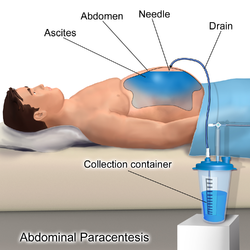
ICD-10-PCSIllustration depicting Paracentesis
ICD-9-CM54.91
MeSHD019152

Paracentesis (from Greek κεντάω, "to pierce") is a form of body fluid sampling procedure, generally referring to peritoneocentesis (also called laparocentesis or abdominal paracentesis) in which the peritoneal cavity is punctured by a needle to sample peritoneal fluid.[1][2]

The procedure is used to remove fluid from the peritoneal cavity, particularly if this cannot be achieved with medication. The most common indication is ascites that has developed in people with cirrhosis.

Indications

[edit]
Cytopathology of peritoneal fluid from paracentesis (Pap stain), showing typical features of adenocarcinoma

It is used for a number of reasons:[3]

Paracentesis for ascites

[edit]

The procedure is often performed in a doctor's office or an outpatient clinic. In an expert's hands, it is usually very safe,[4] although there is a small risk of infection, excessive bleeding or perforating a loop of bowel. These last two risks can be minimized greatly with the use of ultrasound guidance.[4][5]

Ultrasound guidance

[edit]
Large volume abdominal ascites

The use of ultrasound has become the standard of care when preparing a patient for paracentesis. Confirmation of an ascitic effusion reduces the risks associated with a dry or blind tap of the abdomen. Anatomic landmarks, such as the midline linea alba approach, were traditionally used as reference points for needle insertion. Phased array or curvilinear ultrasound transducers are typically used in the hospital and outpatient setting to identify ascites in the abdominal cavity. Fluid within the abdominal cavity appears hypoechoic or anechoic (black) on ultrasound. Morison's pouch (hepatorenal recess) is a common starting location in concordance with ultrasound FAST (focused assessment with sonography for trauma) exam. Fluid collection can occur in a number of different locations and may be difficult to find, especially if the patient only exhibits a small volume of ascites. Measurement of the amount of fluid within the abdominal cavity is not necessary or very successful. Identification of sufficient fluid within the abdominal cavity for fluid analysis or to achieve a therapeutic benefit is all that is required to proceed to paracentesis. Ultrasound guidance of the paracentesis can also be used as an additional safety measure to ensure the needle stays within the ascitic fluid and avoidance of important vessels within the abdominal cavity.[5]

Small fluid collection in Morison's pouch

Procedure overview

[edit]

The patient is requested to urinate before the procedure; alternately, a Foley catheter is used to empty the bladder. The patient is positioned in the bed with the head elevated at 45–60 degrees to allow fluid to accumulate in lower abdomen. After cleaning the side of the abdomen with an antiseptic solution, the physician numbs a small area of skin and inserts a large-bore needle with a plastic sheath 2 to 5 cm (1 to 2 in) in length to reach the peritoneal (ascitic) fluid. The needle is removed, leaving the plastic sheath to allow drainage of the fluid. The fluid is drained by gravity, a syringe, or by connection to a vacuum bottle. Several litres of fluid may be drained during the procedure; however, if more than two litres are to be drained, it will usually be done over the course of several treatments.[6] After the desired level of drainage is complete, the plastic sheath is removed and the puncture site bandaged.[6] The plastic sheath can be left in place with a flow control valve and protective dressing if further treatments are expected to be necessary.[6]

If fluid drainage in cirrhotic ascites is more than 5 litres, patients may receive intravenous serum albumin (25% albumin, 8 g/L) to prevent hypotension (low blood pressure).[7] There has been debate as to whether albumin administration confers benefit, but a recent 2016 meta-analysis concluded that it can reduce mortality after large-volume paracentesis significantly.[8] However, for every end-point investigated, while albumin was favorable as compared to other agents (e.g., plasma expanders, vasoconstrictors), these were not statistically significant and the meta-analysis was limited by the quality of the studies—two of which that were in fact unsuitable—included in it.[8]

The procedure generally is not painful and does not require sedation. The patient is usually discharged within several hours following post-procedure observation provided that blood pressure is otherwise normal and the patient experiences no dizziness.[1][9][10]

Complications

[edit]

Paracentesis is known to be a safe procedure when ascitic fluid is readily visible, so complications are typically rare. Possible complications following or during the procedure involve infection, bleeding, the leakage ascitic of fluid, or bowel perforation.[7][5] Of these, the most concerning in the immediate setting is bleeding within the peritoneal cavity.[11]

The z-tracking technique has held particular importance in performing paracentesis. A z-track is a technique that allows for decreased ascitic fluid leak following the paracentesis by displacing the needle tracks with respect to the epidermis and the peritoneum.[6]

Fluid analysis

[edit]

The serum-ascites albumin gradient can help determine the cause of the ascites.[7]

The color of the ascitic fluid can also be useful in analysis. Blood fluid can indicate trauma or malignancy. A milky appearance of the fluid can indicate lymphoma or malignant peritoneal ascites. Cloudy or turbid fluid can indicate possible infection or inflammation within the peritoneal cavity. Straw or light yellow colored fluid indicates more plasma-like and benign causes of peritoneal ascites.[3]

Ascitic fluid, 7 litres, drained during paracentesis

The ascitic white blood cell count can help determine if the ascites is infected. A count of 250 neutrophils per ml or higher is considered diagnostic for spontaneous bacterial peritonitis. Cultures of the fluid can be taken, but the yield is approximately 40% (72–90% if blood culture bottles are used). Empiric antibiotics are typically started when spontaneous bacterial peritonitis is highly suspected. A third-generation cephalosporin is typically started in these cases to cover the most common organisms, E. coli and Klebsiella, in SBP.[7]

Contraindications

[edit]

Mild hematologic abnormalities do not increase the risk of bleeding.[12][7] The risk of bleeding may be increased if:[13]

Absolute contraindication is the acute abdomen that requires surgery.

Relative contraindications are:[6]

  • Pregnancy
  • Distended urinary bladder
  • Abdominal wall cellulitis
  • Distended bowel
  • Intra-abdominal adhesions.[1]

See also

[edit]

References

[edit]
[edit]
Revisions and contributorsEdit on WikipediaRead on Wikipedia
from Grokipedia
Paracentesis is a minimally invasive that involves the insertion of a needle and into the to remove excess fluid accumulation known as from the . This fluid buildup occurs between the layers of the , the membrane lining the , and is most commonly caused by liver , though it can also result from conditions such as cancer, infections, , or . The procedure serves both diagnostic and therapeutic purposes: diagnostically, a small sample of fluid (typically 25-30 mL) is analyzed to identify underlying causes, such as or , through tests including cell counts, protein levels, and the (SAAG). Therapeutically, larger volumes—up to 5 liters or more in cases of large-volume paracentesis (LVP)—are drained to alleviate symptoms like , discomfort, , and reduced mobility associated with tense . It is indicated for new-onset , suspected , or respiratory compromise due to fluid pressure, and is particularly vital in patients with , where affects up to 50% of cases and carries significant mortality risk. Performed at the bedside or in an outpatient setting under and often with guidance for safety, paracentesis typically takes 20-45 minutes and involves positioning the patient , sterilizing the lower abdominal quadrant, numbing the site with lidocaine, and using a Z-track insertion technique to minimize leakage. Healthcare providers such as gastroenterologists or interventional radiologists conduct the procedure using specialized kits including 18-20 gauge needles, catheters, and drainage bags, with intravenous recommended after LVP exceeding 5 liters to prevent circulatory dysfunction. Although generally safe with low complication rates, potential risks include , , fluid leakage, bowel perforation, or , particularly in patients with or on blood thinners; absolute contraindications encompass acute surgical or severe bleeding disorders. Post-procedure recovery involves 24 hours of rest, monitoring for and signs of , wound care to address any seepage, and lifestyle measures like a low-sodium diet to manage recurrent , which may necessitate repeated procedures or indwelling catheters.

Overview

Definition and Types

Paracentesis is a that involves the percutaneous insertion of a needle or into the to aspirate fluid, primarily ascitic fluid, which accumulates abnormally due to conditions such as liver cirrhosis, , or . The term derives from the Greek "parakentein," meaning "to pierce at the side," reflecting its historical roots in targeting fluid buildup in the . There are two main types of paracentesis: diagnostic and therapeutic. Diagnostic paracentesis entails the removal of a small volume of ascitic fluid, typically 25 to 50 mL, for analysis to determine the underlying cause of or to exclude infections such as . In contrast, therapeutic paracentesis, often termed large-volume paracentesis (LVP), involves extracting larger quantities of fluid, generally exceeding 5 liters, to provide symptomatic relief in cases of tense . The primary purposes of paracentesis are both diagnostic and palliative. Therapeutically, it alleviates intra-abdominal pressure that contributes to symptoms like dyspnea, , and early , thereby improving patient comfort and . Diagnostically, it facilitates the identification of etiologies such as or through fluid examination. The procedure has been used since antiquity for management, with describing it around 400 BCE, and underwent significant modern refinements in the 20th century, including the integration of guidance for enhanced safety and precision. It is commonly performed for new-onset or suspected .

Epidemiology

Paracentesis is most commonly performed to address , a condition predominantly caused by , which accounts for 80-85% of all cases. Approximately 50% of patients diagnosed with develop within 10 years, marking a critical progression to decompensated . Other etiologies include (10%), (3%), and infections such as tuberculous peritonitis, though these are less frequent. The global burden of is disproportionately higher in regions with elevated rates of , particularly those driven by alcohol consumption or like and C. The clinical significance of ascites in cirrhosis is underscored by its impact on patient outcomes, with a 1-year mortality rate of 20% among affected individuals, compared to 7% in those with compensated cirrhosis without ascites. In cases of suspected spontaneous bacterial peritonitis (SBP), a common complication necessitating diagnostic paracentesis, delaying the procedure beyond 12 hours from admission increases in-hospital mortality by 2.7-fold, even after adjusting for factors like MELD score and renal dysfunction. These statistics highlight the procedure's role in timely diagnosis and management to mitigate poor prognosis. Recent trends as of reflect an expansion in the performance of paracentesis by advanced practice providers (APPs), such as nurse practitioners and physician assistants, particularly in and outpatient settings, driven by growing procedure volumes and reimbursement opportunities. This shift supports broader access to therapeutic paracentesis for refractory amid rising demand.

Indications and Contraindications

Indications

Paracentesis is indicated for both diagnostic and therapeutic purposes in patients with , particularly those associated with . Diagnostic paracentesis is recommended for all patients presenting with new-onset of unknown origin to determine the underlying etiology, such as via (SAAG) analysis. It is also essential in cases of suspected (SBP), including clinical features like fever, , or in cirrhotic patients, where ascitic fluid analysis for polymorphonuclear leukocyte count (>250 cells/mm³) and culture confirms the . Guidelines strongly advise performing diagnostic paracentesis on admission for all hospitalized patients with and , even in the absence of overt symptoms, to monitor for complications like SBP and assess disease progression. This is particularly relevant for evaluating potential malignancy through cytology or via acid-fast bacilli staining and levels in ascitic fluid when these etiologies are suspected. Therapeutic paracentesis, often as large-volume paracentesis (LVP) involving removal of more than 5 liters of fluid, is indicated for symptomatic tense unresponsive to diuretics, providing rapid symptom relief and improving . It is also recommended for refractory in end-stage , including scenarios of respiratory compromise due to diaphragmatic elevation, and as a palliative measure to alleviate discomfort in patients not eligible for . The alfapump system, approved by the US FDA in December 2024, is used for managing recurrent or refractory due to liver as an outpatient option; it continuously transfers ascitic fluid from the to the , reducing the need for repeated LVPs.

Contraindications

Paracentesis has few absolute contraindications, which represent conditions where the risks of the procedure significantly outweigh any potential benefits. These include an acute surgical abdomen, such as bowel requiring , (DIC) that is unresponsive to correction, and overt accompanied by systemic . Relative contraindications are more common and often can be managed or mitigated, though they warrant careful evaluation. Uncorrectable , such as a platelet count below 20 × 10³/μL or an international normalized (INR) greater than 2.0, is a key relative ; however, the overall bleeding risk associated with paracentesis remains low, at approximately 0.2-0.6%, even in patients with mild to moderate .30407-5/fulltext) Other relative contraindications include , due to potential risks to the ; bowel distention from or obstruction; and site-specific issues such as at the entry point, enlarged organs (), or vascular abnormalities like prominent vessels. Precautions are essential to minimize risks in patients with relative contraindications. Correctable coagulopathies should be addressed prior to the procedure, for example, through for severe or administration of or for elevated INR. The procedure should be avoided at sites with multiple prior paracenteses due to the risk of adhesions and bowel adherence. Ultrasound guidance can help identify safe entry sites to avoid relative risks such as vascular structures or organ enlargement. Given the low overall complication rate, guidelines support proceeding with paracentesis in most cases of relative contraindications after appropriate precautions.

Procedure

Preparation and Equipment

Patient preparation for paracentesis begins with obtaining , during which the clinician explains the procedure's purpose, potential risks such as or , benefits including symptom , and alternatives like medical management. The patient is positioned or semi-recumbent at a 30- to 45-degree angle to facilitate fluid pooling in the lower quadrants, with the emptied beforehand to reduce risk. , including and , are monitored before, during, and after the procedure to detect complications like . Prophylactic antibiotics are not routinely administered unless is suspected, in which case a third-generation may be given empirically if ascitic fluid count exceeds 250 cells/mm³. Coagulation status is assessed via international normalized ratio (INR) and platelet count, but routine correction of is unnecessary even with INR up to 8.7 or platelets below 20 × 10³/μL, as the bleeding risk remains low; may be considered only if counts are under 20 × 10³/μL. For large-volume paracentesis (LVP) involving removal of more than 5 L of fluid, intravenous is planned at 6 to 8 g of 25% albumin per liter removed to prevent post-paracentesis circulatory dysfunction. The procedure can be performed in a bedside, outpatient , or suite setting, with no fasting required. is often used briefly to identify and mark the optimal entry site in a safe fluid pocket deeper than 2 cm. Essential equipment includes a sterile preparation kit with or solution, sterile drapes, and gloves; 1% lidocaine (typically 5 to 10 mL) with 25- or 27-gauge needles for ; an 18- to 20-gauge access needle for diagnostic paracentesis; a catheter-over-needle system or 8- to 15-French angiocatheter for LVP; drainage tubing connected to a collection or vacuum bottles with up to 10 L capacity, or wall if available; and sample collection tubes (e.g., red-top, purple-top EDTA, and bottles) for 25 to 30 mL of diagnostic fluid. An machine with a low-frequency curvilinear (3.5 MHz) and sterile sheath is recommended for guidance. Additional items such as 5- to 60-mL syringes, a #11 , , and adhesive dressings ensure sterile technique and secure the site post-procedure.

Ultrasound Guidance

Ultrasound guidance in paracentesis serves to identify the optimal site for needle insertion by locating the deepest pocket of ascitic fluid, typically requiring a depth of at least 3 cm to ensure safe access, while avoiding interposed bowel, blood vessels, or solid organs such as the liver or . This approach enhances procedural safety, particularly in patients with or small-volume , where physical landmarks may be unreliable. The technique involves using a curvilinear probe with a of 3.5-5 MHz for initial detection due to its deeper penetration, or a linear (8-12 MHz) for superficial assessment and real-time needle visualization if needed. Scanning begins in the lower abdominal quadrants lateral to the , with the left side preferred to minimize from epigastric vessels; the is applied in sagittal and transverse planes to confirm depth and exclude vascular structures using color Doppler. The is marked 2-3 cm below the umbilicus at the site of maximal accumulation, either via static pre-procedure marking or dynamic real-time guidance during needle insertion. Guidelines from the Society of Hospital Medicine strongly recommend guidance for all paracentesis procedures to reduce serious complications, such as , with evidence from large cohort studies showing a 68% lower odds of (OR 0.32, 95% CI 0.25-0.41) compared to blind techniques. Complication rates drop from 4.7% without guidance to 1.4% with it (OR 0.349), and success rates improve to 95-100% versus 61% for landmark-based methods. Dynamic guidance is particularly beneficial for visualizing the needle in challenging cases, though static marking suffices for larger fluid volumes in experienced operators. Limitations include limited availability of ultrasound equipment in some settings, which may necessitate reliance on clinical expertise for site selection. Additionally, while real-time guidance offers superior precision, evidence for its incremental benefit over static methods remains limited, and proficiency requires dedicated .

Technique

Paracentesis is typically performed with the patient in a semi-recumbent position at 30 to 45 degrees to facilitate pooling in the lower and minimize discomfort. The preferred site for insertion is the left lower quadrant, approximately 2 cm medial and superior to the , lateral to the , to avoid major vessels and bowel loops. This location is selected after percussion or confirmation of a pocket greater than 2 cm deep, with the skin marked using a . The Z-track technique is employed by displacing the skin caudally prior to insertion to create a tortuous path that minimizes post-procedure leakage. After ensuring the is empty via voiding or catheterization, the area is prepared with or solution and sterile draping applied to create a working field. is achieved by raising a wheal with 1% lidocaine using a 25-gauge needle, followed by deeper infiltration along the planned tract to the using a 22-gauge needle, administering 5 to 10 mL total to anesthetize the , which may extend 2 to 4 cm in depth depending on habitus. A small nick in the is made with a No. 11 blade to facilitate entry. For insertion, an 18- to 20-gauge over-the-needle or angiocatheter is advanced to the skin in 5-mm increments while applying negative pressure with a to aspirate; entry into the is confirmed by the return of non-pulsatile ascitic fluid, at which point the needle is withdrawn and the advanced 2 to 5 mm further. In the Z-track method, the skin is held displaced during insertion and released afterward to seal the tract. For diagnostic paracentesis, a single puncture suffices to aspirate 25 to 50 mL of fluid directly into syringes for . If loculated is suspected, multiple punctures may be required at different sites. The procedure is terminated immediately if resistance is encountered, frank blood is aspirated, or the patient reports significant pain, indicating potential organ injury. For therapeutic large-volume paracentesis (LVP), the is connected via tubing to a collection bottle or drainage bag using a three-way stopcock, allowing controlled aspiration by or passive flow at a rate of 300 to 500 mL per minute to avoid rapid hemodynamic shifts. Drainage is halted once symptoms resolve. Intravenous (6 to 8 g per liter removed) is recommended if more than 5 L of fluid is removed to prevent circulatory dysfunction. The is then removed, and the site covered with a sterile dressing and pressure applied for 5 minutes to achieve . Variations include blind insertion in experienced hands for straightforward cases, though guidance is standard to enhance safety; for refractory , indwelling catheters like the Tenckhoff may be used for repeated access. The procedure duration is typically 15 to 30 minutes for diagnostic taps and 30 to 60 minutes for LVP, with continuous vital sign monitoring for or throughout.

Fluid Analysis

Sample Collection

During diagnostic paracentesis, an initial volume of 25 to 30 mL of ascitic fluid is collected for and divided into aliquots based on the suspected . Typical distribution includes approximately 10 mL for cell count and , 5 mL for total protein and (SAAG) determination, and additional volume (ideally ≥80 mL if available) for cytology when is suspected to enhance diagnostic yield. The fluid is obtained by attaching a 60-mL to a three-way stopcock connected to the paracentesis , allowing controlled aspiration and direct transfer into collection tubes or vials while minimizing air bubble introduction, which could compromise sample integrity. Cultures require immediate transport to the at , with on-site of at least 10 mL into each of two bottles recommended when (SBP) is suspected to maximize sensitivity. Special considerations include collecting separate aliquots for targeted tests, such as in cases of suspected or triglycerides for evaluating , using appropriate containers like sterile pots for biochemistry or serum-separating tubes. If processing is delayed, non-culture samples should be refrigerated at 4°C, while cytology specimens must avoid to prevent interference with cellular analysis.

Laboratory Tests and Interpretation

Laboratory analysis of ascitic fluid obtained via paracentesis is essential for diagnosing the underlying cause of and identifying complications such as . The gross appearance of the fluid provides initial clues: clear fluid is typical of uncomplicated cirrhotic , cloudy appearance suggests , milky fluid indicates chylous , and fluid may result from trauma during the procedure or underlying . The primary tests include total nucleated cell count with differential, , , total protein, and levels to calculate the (SAAG). (SBP) is diagnosed when the in the ascitic fluid is ≥250 cells/mm³, even in the absence of symptoms. and , with fluid inoculated directly into bottles at the bedside, identify the causative organism in approximately 80% of SBP cases, guiding . The is calculated as minus ascitic fluid ; a value ≥1.1 g/dL indicates with high accuracy. Additional tests are selected based on clinical suspicion. Cytology examines for malignant cells in cases of suspected . (LDH) and levels help identify secondary causes: elevated LDH (> upper limit of normal for serum) suggests exudative processes, while high points to pancreatic or gastrointestinal origins. levels >200 mg/dL confirm chylous , often due to lymphatic disruption. Interpretation of results differentiates ascites etiologies. A high (≥1.1 g/dL) with low total protein (<2.5 g/dL) strongly suggests cirrhosis-related portal hypertension. Conversely, a low (<1.1 g/dL) with high total protein (>2.5 g/dL) indicates non-portal hypertensive causes, such as . Culture-negative neutrocytic ascites, defined as neutrophil count ≥250 cells/mm³ with negative cultures, represents a variant of SBP and is managed similarly. These findings inform clinical management. For SBP, empirical antibiotics such as are initiated immediately, with adjustments based on culture results; resolution is confirmed by a drop in neutrophils to <250 cells/mm³. In endemic areas, additional testing for tuberculosis or fungi may be warranted if initial cultures are negative.

Complications

Types and Risks

Complications of paracentesis are generally uncommon, with overall rates reported between 1% and 2% across large prospective studies. These can be categorized as common (incidence 1-5%) or serious and rare (incidence <1%), with the majority being self-limited or manageable. Persistent ascitic fluid leak at the puncture site occurs in 0.8-1.7% of procedures and is more likely in patients with low serum albumin or tense ascites. Abdominal pain, often mild and transient, affects up to 5% of patients immediately post-procedure. Minor bleeding or hematoma formation at the site is reported in approximately 1% of cases, typically resolving without intervention. Serious complications occur in fewer than 1% of paracenteses but can be life-threatening. Bowel perforation, with an incidence of 0.3-0.5%, is a rare but critical event often linked to underlying adhesions or improper site selection. Vascular injury, leading to significant intra-abdominal hemorrhage, shares a similar low incidence of <1%. Iatrogenic infection, including secondary peritonitis, develops in 0.1-0.5% of procedures, based on data from over 600 cases showing three infections total. Clinically significant hypotension and post-paracentesis circulatory dysfunction (PPCD) after large-volume paracentesis (>5 L removed) without occur in approximately 15-20% of patients (subclinical PRA-based incidence up to 80%). PPCD is defined as a >50% increase in from baseline, measured on day 6 post-procedure, reaching levels >4 ng/mL/h. Certain risk factors elevate complication rates. Large-volume paracentesis without prophylaxis significantly heightens the risk of renal failure (approximately 10-20% without vs. <10% with ). or intra-abdominal adhesions increase the likelihood of bowel by complicating needle navigation. The overall mortality attributable to the procedure remains low at <0.2%, with fatal outcomes primarily tied to severe hemorrhage or in high-risk cohorts.

Prevention

Routine use of ultrasound guidance during paracentesis is recommended to identify optimal fluid pockets and reduce the risk of adverse events such as organ injury (reducing overall complications from 4.7% to 1.4%). Adherence to strict sterile technique, including skin preparation with or , sterile gloves, and drapes, is essential to minimize the risk of . Prior to the procedure, coagulopathy should be assessed and corrected if significant, such as through for counts below 20 × 10³/μL, although routine correction is not required for mild elevations in INR or platelets. For therapeutic paracentesis, fluid removal should be limited to less than 5 L without supplementation to avoid circulatory instability; for larger volumes, of 6-8 g of 25% per liter removed (up to a maximum of 200 g) is advised to prevent post-paracentesis circulatory dysfunction (PPCD).

Management

Post-procedure, patients should be monitored closely for , including and pulse every 15 minutes for the first 2 hours, to detect early signs of or other hemodynamic changes. Leaks at the puncture site can be managed by applying a single skin suture or manual . In cases of suspected infection such as , prompt administration of broad-spectrum antibiotics, such as third-generation cephalosporins, is indicated. requires immediate fluid , often with infusion if associated with large-volume paracentesis. , though rare, necessitates urgent surgical consultation for repair. In patients with (SBP), albumin administration at 1.5 g/kg on day 1 followed by 1 g/kg on day 3, alongside antibiotics, significantly reduces the incidence of (10% versus 33%) and mortality (10% versus 29%).

Post-Care

Following paracentesis, patients should undergo bed rest for 1-2 hours and observation for 4-6 hours to monitor for delayed complications. They should be advised to report any fever, increasing , or other concerning symptoms promptly to facilitate early intervention.

References

Add your contribution
Related Hubs
Contribute something
User Avatar
No comments yet.