Hubbry Logo
PedetidaePedetidaeMain
Open search
Pedetidae
Community hub
Pedetidae
logo
8 pages, 0 posts
0 subscribers
Be the first to start a discussion here.
Pedetidae
Pedetidae
from Wikipedia

Pedetidae
Temporal range: Early Miocene to Recent [1]
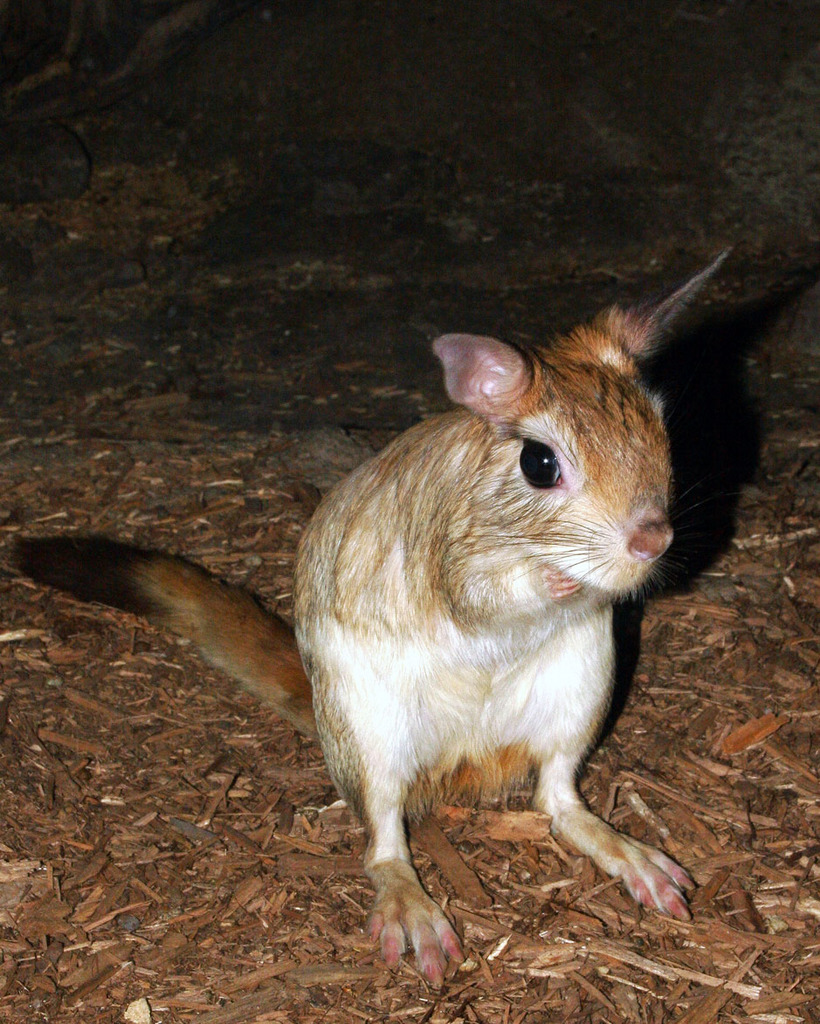
Springhare (Pedetes sp.)
Scientific classification Edit this classification
Kingdom: Animalia
Phylum: Chordata
Class: Mammalia
Order: Rodentia
Suborder: Anomaluromorpha
Family: Pedetidae
Gray, 1825[2][3]
Genera

See text

The Pedetidae are a family of rodents.[4][5][6][7][8][9] The two living species, the springhares, are distributed throughout much of Southern Africa and also around Kenya, Tanzania, and Uganda.[10] Fossils have been found as far north as Turkey.[11] Together with the anomalures and zenkerella, Pedetidae forms the suborder Anomaluromorpha. The fossil genus Parapedetes is also related.[11]

Taxonomy

[edit]

The family includes one living genus and four extinct genera. The Asian fossil Diatomys was previously included,[11] but is now classified in the family Diatomyidae with the Laotian rock rat.

References

[edit]

Further reading

[edit]
Revisions and contributorsEdit on WikipediaRead on Wikipedia
from Grokipedia
Pedetidae is a family of rodents in the order Rodentia and suborder Anomaluromorpha, comprising two extant of springhares in the genus Pedetes: the South African springhare (P. capensis) and the East African springhare (P. surdaster). These large, bipedal mammals are distinguished by their kangaroo-like hopping locomotion, long hind limbs, and nocturnal lifestyle, inhabiting sandy soils in savannas and grasslands across southern and eastern .

Taxonomy and Evolution

The family Pedetidae was established by John Edward Gray in 1825, with the type genus Pedetes described by Johann Karl Wilhelm Illiger in 1811. Phylogenetically, Pedetidae represents an early diverging lineage within Rodentia, sharing traits like multiserial enamel on incisors with other groups but positioned within the suborder Anomaluromorpha, which is part of the Simplicidentata clade, with molecular evidence supporting its placement as an early-diverging group among non-hystricomorph rodents. Fossil records indicate the family's origins in the Miocene epoch, with the extant genus Pedetes emerging in the Pliocene; up to five additional genera are known only from fossils, according to some classifications. The two living species diverged relatively recently, with P. capensis ranging from South Africa northward to southern Democratic Republic of Congo, and P. surdaster restricted to southern Kenya and Tanzania.

Physical Characteristics

Springhares are among the largest in their range, with adults measuring 31–39 cm in head-body length, 24–39 cm in length, and weighing 2.8–3.9 kg. Their is soft and silky, pale sandy brown above and white below, with a bushy, black-tipped roughly equal in length to the body that aids in balance during leaps of up to 2 meters. Key adaptations include enlarged hind feet with four toes (the fourth reduced), short forelimbs with five clawed digits for digging, large eyes for , and prominent, hare-like ears measuring 6–9 cm. The is robust with broad frontals, and the dental formula is 1/1, 0/0, 1/1, 3/3 = 20, featuring ever-growing cheek teeth suited to a grinding diet.

Habitat and Distribution

Pedetidae species occupy open, arid habitats with friable sandy soils ideal for burrowing, including savannas, grasslands, shrublands, and edges of agricultural fields. P. capensis is widespread in , from through , , and to , , and southern , while P. surdaster occurs in a more limited area of . They avoid dense forests and rocky terrains, preferring areas with sparse vegetation that facilitate their foraging and escape strategies.

Behavior and Ecology

Springhares are strictly nocturnal, emerging from complex burrow systems—up to 7 meters long with multiple chambers—at to forage. They exhibit ricochetal locomotion, bounding on hind legs when fleeing predators like , , and snakes, and use their tails as props when stationary. Socially, they live in loose colonies but forage solitarily or in small groups of 2–6 individuals, with burrows occupied by pairs or a female with young. Their diet is primarily herbivorous, consisting of grasses, bulbs, , seeds, and crops like and , though they occasionally consume ; this leads to conflicts with farmers, causing 10–15% crop losses in some regions. Reproduction involves a of 78–82 days, typically yielding one precocial young per litter, with females capable of 3–4 litters annually after reaching maturity at about 8 months.

Conservation Status

Both species are classified as Least Concern by the IUCN due to their wide distributions and presence in protected areas, though populations face localized threats from habitat conversion for , for (estimated at 2.5 million individuals annually in alone), and persecution as pests. Earlier assessments noted declines, but recent evaluations indicate stable trends overall.

Physical description

Morphology

Members of the family Pedetidae, commonly known as springhares, are medium-sized characterized by a body size that supports their saltatorial lifestyle. Adults typically weigh between 2.5 and 4.5 kg, with head-body lengths ranging from 31 to 39 cm and lengths of 30 to 48 cm. Their overall body structure resembles that of a or , featuring long hind limbs adapted for bipedal stance and short forelimbs that are robust but much smaller than the hind limbs. Distinctive external features include large eyes suited for nocturnal vision, rabbit-like ears that are long and thinly haired, and fur that varies from sandy to grayish or reddish-brown on the upper parts, with whitish underparts and a bushy tipped in black. Internally, the dental structure of Pedetidae is typical of herbivorous , with continuously growing incisors and molars designed for grinding vegetation. The dental formula is 1/1, 0/0, 1/1, 3/3 = 20, featuring ever-growing cheek teeth with simple occlusal surfaces and bilobed molars of approximately equal size. Skeletal adaptations emphasize the hind limbs, including elongated tarsal bones in the feet that contribute to their leaping capability, alongside a massive with broad frontals, nasals, and an inflated mastoid region. These features collectively distinguish Pedetidae from other families, highlighting their specialized morphology for a nocturnal, existence.

Adaptations for locomotion

Members of the Pedetidae family, commonly known as springhares, exhibit specialized anatomical features that facilitate their bipedal saltatorial locomotion and habits. Their hind limbs are markedly elongated, with extended femurs and tibiae that provide the leverage necessary for powerful leaps, enabling distances of up to 2 meters in a single bound. This elongation is complemented by a robust complex, including a thick plantaris with a cross-sectional area of approximately 0.084 cm², which stores during hopping and enhances force transmission for efficient, rapid movement at speeds up to 2.8 m/s without significant metabolic cost. The plays a crucial role in maintaining stability during these saltatorial movements, serving as a counterbalance to prevent forward pitching while hopping on hind limbs alone. Additionally, the functions as a prop when the animal sits upright to or groom, allowing it to support the body weight and free the forelimbs for manipulation. Forelimbs in Pedetidae are reduced in length relative to the hind limbs, featuring short but robust structures ending in five long, curved, and sharp claws specialized for excavating burrows. These claws enable the digging of extensive systems in sandy soils, with burrows reaching depths of up to 1.2 meters and lengths exceeding 7 meters, providing shelter from predators and diurnal heat. The hind feet are enlarged and adapted for and stability on loose substrates, possessing four toes with wide, hoof-like claws that distribute effectively for traction on . This , particularly the elongated third digit, supports high ground reaction forces during takeoff and landing in , minimizing slippage in arid environments.

Taxonomy

Classification

Pedetidae is a monotypic family of belonging to the suborder Anomaluromorpha within the order Rodentia. The family was established by in 1825, with the type genus Pedetes described by in 1811. The family includes a single living genus, Pedetes, which encompasses two extant species: Pedetes capensis (South African springhare) and Pedetes surdaster (East African springhare). Five extinct genera are recognized within Pedetidae, including Parapedetes from the Early Miocene of Africa, Megapedetes, Propedetes, Rusingapedetes, and Oldrichpedetes. The Pliocene Asian genus Diatomys, previously assigned to Pedetidae, has been reclassified into the distinct family Diatomyidae. The temporal range of Pedetidae extends from the Early to the .

Phylogenetic relationships

Pedetidae belongs to the suborder Anomaluromorpha within Rodentia, where it forms the to the clade comprising (scaly-tailed squirrels) and Zenkerellidae, a relationship supported by molecular evidence and some shared morphological traits. This positioning reflects convergent adaptations for arboreal or saltatorial lifestyles among these families, distinct from other rodent suborders. Molecular phylogenetic analyses, including those utilizing nuclear and sequences, consistently place Pedetidae as the basal within Anomaluromorpha, with the of Pedetidae from the Anomaluridae-Zenkerellidae lineage estimated at approximately 40-50 million years ago during the Eocene epoch. These studies, building on mitogenomic and multi-locus datasets, resolve Anomaluromorpha as a monophyletic group nested within the broader mouse-related of , emphasizing the ancient African origins of this suborder. Fossil evidence further illuminates the evolutionary history of Pedetidae, with transitional forms such as Parapedetes from deposits in demonstrating morphological links to early lineages through features like elongated hind limbs and specialized adapted for folivory. Despite superficial similarities in bipedal hopping, Pedetidae shows no close phylogenetic relation to Dipodidae (jerboas), a myomorph group; this represents driven by similar ecological pressures in arid environments. Reclassifications within rodent taxonomy have refined the boundaries of Pedetidae; for instance, the genus Diatomys, once tentatively placed in Pedetidae based on preliminary assessments, was reassigned to the distinct family Diatomyidae following detailed analysis of its unique dental morphology, including trilophodont cheek teeth with protruding cusps. This shift underscores the importance of integrating morphological and molecular data to resolve historical misplacements in rodent phylogeny.

Distribution and habitat

Geographic distribution

The family Pedetidae comprises two extant species with disjunct distributions across . The South African springhare (Pedetes capensis) occupies , ranging from through , , , , , , and into the southern . This species is patchily distributed within its range, favoring open landscapes separated by unsuitable habitats. In contrast, the East African springhare (Pedetes surdaster) is restricted to eastern , primarily central and southern and most of , with a single confirmed record near the Kenya-Uganda border at Mount Moroto. These populations are isolated from those of P. capensis by over 1,000 km, reflecting historical fragmentation in ecosystems. Fossil evidence reveals a historically broader distribution for Pedetidae. Miocene remains have been documented in (e.g., and ), (e.g., ), the , the , and as far north as (e.g., Paşalar locality), indicating a more extensive range. The modern range is confined to semi-arid savannas and avoids dense rainforests as well as hyper-arid deserts, such as the , where extreme conditions preclude suitable burrowing substrates. This limitation, combined with Pleistocene climate oscillations that promoted habitat contraction and isolation, has shaped the current disjunct pattern.

Habitat requirements

Members of the Pedetidae family, comprising the springhares Pedetes capensis and P. surdaster, primarily inhabit arid and semi-arid savannas and grasslands in southern and eastern . These environments provide the open spaces necessary for their bipedal locomotion and activities, while avoiding extreme deserts, dense forests, or rocky terrains that hinder burrowing. Essential to their habitat are loose, sandy or loamy soils that facilitate extensive burrowing, with a preference for deep, compact sands over clay or poorly drained substrates. Vegetation cover is typically sparse and low-growing, dominated by short grasses such as Cynodon species, which support their diet of roots, rhizomes, and green plant matter; they favor overgrazed or cultivated areas with such vegetation for enhanced visibility against predators, while shunning tall grasses or dense woody scrub like Mopane. Springhares occupy a broad altitudinal range from to over 2,000 meters, though they are most abundant in lowland plains and pan fringes. Microhabitats often feature systems in flat, open sandy areas, with tunnels spanning up to 170 m² and multiple entrances—typically three arranged in a circle—near isolated bushes or trees for partial cover; entrances are plugged with soil for protection, and systems may displace around one ton of subsoil.

Behavior

Daily activity and foraging

Springhares (Pedetidae) exhibit a strictly nocturnal , emerging from their burrows shortly after to and remaining active throughout most of the night, with activity levels peaking immediately after sunset and gradually declining 2–4 hours before sunrise. During the day, they retreat to burrows, where the stable of moderate temperatures and high humidity prevents overheating in arid environments, aiding by avoiding diurnal heat exposure above 30°C that could lead to . This pattern is influenced by environmental factors such as , under which above-ground activity decreases, with individuals shifting to darker, moonless periods to minimize predation risk. Movement during nocturnal activity is characterized by bipedal hopping on elongated hind limbs, enabling rapid traversal of open grasslands, with individuals utilizing multiple burrows scattered across home ranges of 0.6–28.5 hectares. Home ranges are marked through passive deposition from perianal glands during excursions, creating "scent highways" that guide return paths to burrows and may delineate spatial use without territorial defense. Distances between burrows can reach up to 1 km, and springhares frequently switch among 4–27 burrows within their range to optimize and access. Foraging occurs primarily in short-grass areas near burrows, with springhares adopting an upright bipedal stance supported by the to scan surroundings while using forelimbs to manipulate and excavate potential food sources such as roots. They rely heavily on olfaction for detecting resources and navigating scent-marked paths, augmented by acute hearing from elongated ears and large eyes adapted for low-light vision to facilitate detection in dim conditions. Their fur exhibits vivid biofluorescence under ultraviolet light, though its function remains unknown. This solitary foraging strategy emphasizes individual efficiency in open habitats, with minimal group formation except occasionally near burrow clusters.

Social behavior

Springhares (Pedetidae) exhibit predominantly solitary social structures, with individual burrows typically occupied by a single adult or a female accompanied by her single offspring. While , they occasionally form loose, transient groups of 2–6 individuals across all and age classes except adult males, but these assemblages show minimal cohesion, as members join or depart with little observable interaction or persistent bonding. Males maintain home ranges averaging 0.3–28 hectares, which they may defend aggressively near burrow entrances, though overall territoriality is weak and not strictly enforced across the landscape. No evidence of stable colonies or cooperative group living exists, emphasizing their largely independent lifestyle. Communication relies heavily on olfactory cues, with individuals passively depositing scent from a perianal gland onto and substrate during movements; this creates persistent "scent highways" that facilitate orientation and return to burrows without direct confrontation. Vocalizations are limited but include distress screams when threatened, and foot-thumping with hind limbs serves as an to nearby conspecifics. Mating interactions are fleeting and opportunistic, occurring year-round without seasonal peaks; pairs form briefly for copulation, after which the male deposits a plug to secure paternity before parting. Male-male during these encounters is infrequent but can involve upright posturing and paw strikes with forelimbs in a boxing-like display near contested burrows. Females provide exclusive , and protecting the altricial young within the for approximately 9 weeks until it reaches 1.3–1.5 kg and begins independent ; no or by other group members has been documented.

Ecology

Diet

Springhares (Pedetidae) are primarily herbivorous, consuming a diet dominated by materials such as , bulbs, stems, , fruits, grasses, corms, and rhizomes. Key food items include the leaves and rhizomes of and the tubers of , which together form a substantial portion of their intake, alongside other grasses like Eragrostis lehmanniana and geophytes such as permeabilis. Although occasional like locusts and beetles are consumed, there is no evidence of carnivory or significant animal matter in their diet. Dietary composition exhibits seasonal variation, with greater reliance on above-ground such as green grass seeds, stems, leaves, and fruits during wet periods when these resources are abundant and nutritious. In dry seasons, springhares shift to underground storage organs like roots, bulbs, corms, and rhizomes, which provide a stable supply even when surface vegetation becomes unpalatable. This adaptability favors geophytes in Pedetes capensis, the southern springhare, enabling persistence in arid environments. As fermenters, springhares possess an enlarged that serves as the primary site for microbial of fibrous plant material, breaking down after initial enzymatic in the . Stomach contents often show thoroughly masticated fibrous material, reflecting efficient initial processing. Foraging efficiency is enhanced by selective feeding on high-water-content , such as tubers and green seeds, particularly in dry conditions, which helps meet hydration needs. Springhares derive much of their from metabolic processes and preformed sources in , allowing them to maintain and survive extended water deprivation without significant physiological stress.

Reproduction

Breeding in Pedetidae, represented primarily by the South African springhare (Pedetes capensis), exhibits a pattern influenced by environmental conditions, with reproduction peaking during the from to in southern African populations. This seasonality aligns with periods of increased food availability, facilitating higher , although breeding can occur year-round in some regions. Ovulation in females is induced, typically triggered by , which supports the adaptive timing of pregnancies in variable habitats. Gestation lasts 77–80 days, after which females give birth to a single precocial young per litter (rarely two) in well-concealed burrows. These offspring are born fully furred, with eyes open and capable of limited movement, reflecting the family's adaptation to a fossorial lifestyle where immediate burrow security is essential. Litters are small, averaging one young, which contributes to a relatively slow reproductive rate compared to other rodents, with females producing up to three litters annually under optimal conditions. The lifecycle of P. capensis includes reached at 8–12 months of age, allowing individuals to begin breeding within their second year. In the wild, lifespan averages 7–9 years, limited by predation and environmental stressors, while in captivity, it can extend to 13–15 years with reduced threats and consistent resources. This extended lifespan relative to litter size underscores a strategy emphasizing offspring quality over quantity. Parental investment is primarily maternal, with females young for 2–3 months post-birth to support rapid growth from a birth weight of approximately 275 g to independence. Young become independent around 6–7 weeks, when occurs, but often remain in proximity to the maternal for additional until they reach about 1.5 kg and emerge fully at 9 weeks. Males provide no direct care, consistent with the species' solitary to loosely .

Conservation status

The Pedetidae family, comprising the two extant species Pedetes capensis (South African springhare) and Pedetes surdaster (East African springhare), is assessed as Least Concern globally by the , with assessments conducted in 2016 for both P. capensis and P. surdaster. Populations are presumed large and stable for both species, with no quantitative global abundance estimates available but national-level figures for P. capensis in suggesting 1.65–8.25 million mature individuals, far exceeding the 10,000 threshold for Least Concern status. Density estimates for P. capensis in optimal habitats, such as semi-arid grasslands and savannas near Kimberley, are approximately 3–6 individuals per km² based on distance sampling surveys, with higher localized densities up to 99 individuals per km² reported in the Province, while protected areas like support elevated numbers due to favorable conditions and reduced disturbance. Comparable data for P. surdaster are limited, but its occurrence across non-threatened habitats in and suggests similar density patterns in suitable environments. Historical population trends indicate no major global declines for Pedetidae species; P. capensis experienced an estimated 20% reduction in the due to localized pressures, leading to a Vulnerable listing in , but numbers have since stabilized without evidence of ongoing broad-scale loss. Minor local reductions have occurred since the in fragmented habitats, particularly in agricultural zones where grassland conversion has isolated populations, though overall abundance remains robust across the family's extensive range in southern and eastern . Population monitoring for Pedetidae relies primarily on indirect methods, including burrow counts to assess occupancy and activity, as well as camera traps for detecting individuals in burrow systems and foraging areas. Distance sampling along transects provides density estimates, but comprehensive subspecies-level data are unavailable due to the challenges of surveying nocturnal, burrowing across vast, arid landscapes.

Threats and protection

The primary threats to species in the Pedetidae family, including Pedetes capensis and Pedetes surdaster, stem from habitat loss and degradation driven by , by livestock, and associated land transformation. In , approximately 18% of the land surface has been irreversibly transformed, with higher rates in some regions exacerbating fragmentation of suitable grassy and sandy habitats. reduces cover essential for and burrow stability, while agricultural activities directly encroach on arid and semi-arid ecosystems preferred by these . Additionally, both species face persecution from farmers due to crop damage, with estimates indicating 10–15% losses to , , and other staples in affected areas like . Hunting poses a minor but localized threat, primarily through subsistence and recreational practices that target springhares as or pests. In , subsistence hunting was estimated to account for approximately 2.5 million individuals annually based on 1970s data, contributing to markets, though overall population impacts remain limited due to the ' wide distribution and high reproductive rates. For P. surdaster, similar low-level hunting occurs in rural East African communities, but non-threatened habitats mitigate broader declines. Protection efforts for Pedetidae rely on inclusion within broader protected areas rather than species-specific legislation, benefiting from general frameworks. P. capensis is safeguarded in reserves such as and in , where habitat integrity is maintained. Similarly, P. surdaster occurs in East African protected sites including , Masai Mara National Reserve, and , ensuring connectivity across non-threatened landscapes. No dedicated conservation plans exist, but recommendations emphasize long-term population monitoring and guidelines for sustainable harvesting to address localized pressures. Looking ahead, introduces additional risks through altered precipitation patterns, potentially increasing frequency and excessive rainfall that lead to and habitat inundation in arid zones. While overall distributions may remain stable under Least Concern status, ongoing from human activities could compound these effects, necessitating enhanced management of protected areas to preserve ecological corridors.

References

Add your contribution
Related Hubs
User Avatar
No comments yet.