Hubbry Logo
Tuning mechanisms for stringed instrumentsTuning mechanisms for stringed instrumentsMain
Open search
Tuning mechanisms for stringed instruments
Community hub
Tuning mechanisms for stringed instruments
logo
8 pages, 0 posts
0 subscribers
Be the first to start a discussion here.
Tuning mechanisms for stringed instruments
from Wikipedia
Violin pegbox, retouched image
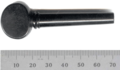
Medieval bone tuning pin. One end is pierced for the string; the other is squared off to fit in a tuning lever socket. The middle section, which would pass through the wood, is tapered.

A variety of methods are used to tune different stringed instruments. Most change the pitch produced when the string is played by adjusting the tension of the strings.

A tuning peg in a pegbox is perhaps the most common system. A peg has a grip or knob on it to allow it to be turned. A tuning pin is a tuning peg with a detachable grip, called a tuning lever. The socket on the tuning lever fits over the pin and allows it to be turned. Tuning pins are used on instruments where there is no space for a knob on each string, such as pianos and harps.

Turning the peg or pin tightens or loosens the string. Some tuning pegs and pins are tapered, some threaded. Some tuning pegs are ornamented with shell, metal, or plastic inlays, beads (pips) or rings.

Other tuning systems include screw-and-lever tuners, geared tuners, and the konso friction tuning system (using braided leather rings).

Pegbox or headstock

[edit]

A pegbox is the part of certain stringed musical instruments (the violin family: violin, viola, cello, double bass) that houses the tuning pegs. The corresponding part of the lute family (including guitar, mandolin, banjo, ukulele) is called the headstock.

Tapered pegs and pins

[edit]
Tuning pegs on a tro

A tapered peg is simply a smooth peg with a string wound around it. The tension of the string is controlled by turning the peg, and the peg is held in place by friction in its hole (in contrast to tuning machines, below).

A properly working peg will turn easily and hold reliably, that is, it will neither stick nor slip. Modern pegs for violin and viola have conical shafts, turned to a 1:30 taper, changing in diameter by 1 mm over a distance of 30 mm. Modern cello pegs have a slightly more aggressive 1:25 taper. 19th century and earlier pegs, for use with stretchier gut strings, typically had an even steeper taper of 1:20.

The taper allows the peg to turn more easily when pulled out slightly, and to hold firmly when pushed in while being turned. Since the typical wear pattern on a peg shaft interferes with this action, pegs occasionally require refitting, a specialized job which amounts to reshaping both pegs and holes to a smooth circular conical taper.

Tapered tuning pins are similar, but must be turned with a tuning tool, usually called a tuning key, tuning lever, or tuning wrench. Historically, pins were also tapered (see image of bone peg, right), but they are now generally threaded, instead (see below).

Use

[edit]
Tuning pegs with knobs on a veena.

Tapered pegs are a simple, ancient design, common in many musical traditions.

Tapered pegs are common on classical Indian instruments such as the sitar, the Saraswati veena, and the sarod, but some like the esraj and Mohan veena often use modern tuning machines instead. Tapered pegs are also used on older European instruments, such as the Bulgarian gadulka and the hurdy-gurdy, as well as on flamenco guitars.

Among modern Western musical instruments, tapered pegs are most often used on violin family instruments, though usually the double bass uses tuning machines.

Peg dope

[edit]
Two types of compound; bearing surfaces of peg are visible as shiny bands

"Peg dope" (also peg paste, peg stick, peg compound) is a substance used to coat the bearing surfaces[1] of the tapered tuning pegs of string instruments (mainly violins, violas, cellos, viols and lutes ). Manufactured varieties are generally sold in either a small stick (resembling lipstick), a block, or as a liquid in a bottle. Commonly used home expedient treatments may include soap, graphite, or talc.

Peg dope serves two different (and almost conflicting) purposes. It both lubricates the peg shaft so it turns easily in the pegbox and provides friction to keep the pegs from slipping with the force of string tension. Tuning pegs that are well fitted and properly doped will both turn smoothly throughout an entire rotation and hold firmly wherever the player wishes.

Without the proper amount of friction to hold the peg in place, a tapered tuning peg will tend to "slip", making a tuning setting virtually impossible to maintain. String instruments with pegs that are slipping can be tuned briefly, but will be out of tune within minutes as soon as the peg slips again. With too much friction, adjusting the tuning at all is impossible. If the pegs or their holes are not perfectly round, or if the bearing surfaces of the pegs are indented from wear, peg dope will not remedy the resulting problems.

Threaded pegs and pins

[edit]

Some pegs and pins are threaded with a shallow, fine thread. They are not tapered, but straight, and they go into straight-sided holes.

Like tapered pins, threaded pins must be set in a pin block of fairly hard wood, such as cherry or white oak, or they will not stay in tune well.[2] Some pin block woods come from endangered trees.[3] Some specialized plywoods can also be used (piano pin block stock or the die maker's ply used for rotary dies).[4]

Threaded tuners are durable, will take very high string tensions. They do not push outwards on the hole and wedge the wood apart, which can reduce the risk of splitting it. They can be set in blind holes, which allows the wood to retain more strength for a given weight.[5] They can, however, also be set in holes drilled right through the wood, to look like older pins. Threaded pins can be installed with an arbor press, and do not need to be re-set, but should be backed off a few turns when changing a string to keep pin height even.[6][7]

Use

[edit]

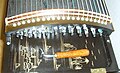
Tuning pins may be known as wrest pins or zither pins, regardless of the instrument on which they are used. They are used on instruments with many close strings, as they are more compact and cheaper. Modern pianos use threaded pins, as do many harps, psaltries, dulcimers, zithers, and other instruments.

Screw-and-lever tuners

[edit]
A violin tailpiece. Here, the two strings on the far side pass through the keyhole slots directly, but the nearer two strings use fine tuners.

Fine tuners are used on the tailpiece of some stringed instruments, as a supplement to the tapered pegs at the other end. Tapered pegs are harder to use to make small adjustments to pitch.

Fine tuners are not geared. They have a screw with a knurled head, whose lower end advances against one end of a lever with a right-angle bend in it. The string is fastened to the other end of the lever, and tightening the screw tightens the string.[8] With the screw at the lower limit of its travel, the lever can come close enough to the instrument's top to pose a risk of scarring it.[9] To avoid damage to the top, the screw may be turned out as far as it goes while still engaging the lever, and the string re-tuned using the peg.[10]

Fine tuners can buzz, and may cut strings if not filed smooth before use. They add weight and, when not built into the tailpiece, reduce string afterlength.[9] Fine tuners are common on cellos, but some violinists regard them as an aid for beginners who have not yet learned to tune precisely using pegs alone.[11]

Geared tuners

[edit]

Pegs for double bass and guitar family instruments are usually geared, and are called tuning machines or machine heads. They often use a worm gear. The gearing ratio varies; while higher ratios are more sensitive, they are also more difficult to manufacture precisely. Machine heads may be open, with exposed gears, or closed, with a casing around all the gears.

Geared pegs for violin family instruments also exist, although they have not gained wide use, which has to do with the extensive and irreversible physical modification that must be made to the peg box in order to mount them, which is often viewed as ruining the aesthetics of the instrument, combined with a bad reputation they acquired due to poorly designed early models that were prone to failure, often with catastrophically damaging results.

The most recently marketed pegs of this sort use planetary gears designed to fit inside a case shaped like a friction peg. They have seen some adoption as they look almost exactly like friction pegs, require no more modification of the instrument than a new set of friction pegs, and make fine tuners unnecessary. They are also durable and less sensitive to changes in temperature and humidity.[12] They are popular on banjos.[13]

Konso

[edit]
Jali Fily Sissokho playing a kora tuned with konso (braided leather ring) string terminations.

The konso system is traditionally used on koras. It consists of braided leather rings that wrap around the neck of the instrument. The rings are pulled along the neck of the instrument to change string tension. It can be quick to adjust but requires a fair degree of strength.[14]

Rong Kou

[edit]
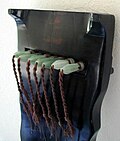
Tuning pegs of the guqin. The twisted Rong Kou cord goes through the bottom hole, through the side hole in the neck, around, under and through the hole in the neck again, and out the top hole. Pegs can be made from wood or jade

The 7-string Chinese Guqin uses braided cords or (rongkou/绒扣』) as a tuning mechanism. At one end, the zither's strings are looped around stationary pegs (fengzu 『鳳足』 "phoenix feet" or yanzu 『雁足』 "geese feet") at the underside of the instrument, across the nut (longyin 『龍齦』 dragon gums) before they pass over the face of the instrument. On the tuning end of each string (near the right hand of the player, at the bridge), a butterfly fly knot (shengtou jie/蝇头结』) is tied, and inserted through the loop end of a braided cord (traditionally made of silk due to its inelasticity) which passes through holes behind the bridge to the underside of the instrument. The Rong Kou cord is inserted through the centre of, and then twisted around, tuning pegs. When the strings are at tension, these pegs are held flush to the underside of the instrument in the peg pool (zhen chi/轸池』). The pegs are then twisted individually by hand to achieve the desired tension for each string.

See also

[edit]

References

[edit]
Revisions and contributorsEdit on WikipediaRead on Wikipedia
from Grokipedia
Tuning mechanisms for stringed instruments are specialized devices designed to adjust string tension, thereby controlling the pitch of notes produced by plucking, , or striking the strings, and they form a critical component in the construction and playability of chordophones such as violins, guitars, lutes, and harps. These mechanisms have evolved from ancient friction-based systems to modern geared designs, enabling greater precision, stability, and ease of use across diverse musical traditions. The origins of tuning mechanisms trace back to ancient Near Eastern and Roman innovations, where the tuning peg emerged as a pivotal around the 1st to 3rd centuries , allowing musicians to wind strings onto tapered wooden rods inserted into a pegbox or neck for adjustable tension, replacing earlier methods like twisting strings around fixed arms. This development facilitated compact instrument designs and more accurate pitch control, spreading from lutes and psalteries to influence a wide array of stringed instruments in , , and beyond by the medieval period. For instance, in four-course guitars, flat pegheads with seven wooden tuning pegs supported paired strings tuned in intervals such as perfect fourths and major thirds, as documented in treatises from the 1540s to 1610s. By the era, instruments like the employed four friction pegs in a slotted pegbox to tune strings in perfect fifths (G3, D4, A4, E5 at modern A=440 Hz standard), though historical pitch varied, with tunings often at A=415 Hz. Key types of tuning mechanisms include friction pegs, which rely on the tapered fit of wooden or synthetic rods in a pegbox to hold tension through friction, commonly used in classical string instruments like violins and cellos for coarse adjustments; geared machine heads, featuring metal and worm drives for finer control and slip resistance, which replaced wooden pegs on guitars and banjos starting in the late to accommodate metal strings and higher tensions; and fine tuners, small adjustable devices attached to the tailpiece, introduced around for violins to precisely tune thin steel that were difficult to adjust with pegs alone, now standard on many modern instruments including those with synthetic cores. Other variants encompass zither pins (robust metal pins turned with a for pianos and harps), rotating screws for simple tensioning in folk zithers, and vertical tension pegs on East Asian instruments like the qin, reflecting cultural adaptations for stability in humid climates or high-tension setups. These mechanisms must balance string elasticity against anchors—such as tailpieces, bridge pins, or direct soundboard holes—to maintain consistent tension, with materials evolving from rawhide and gut to lubricated composites for durability. Notable advancements continue to address challenges like and rapid retuning; for example, self-lubricating bushings in pegs prevent slipping in varying humidity, while locking machine heads on electric guitars ensure stability during performance. , or alternate tunings, relies on these mechanisms' versatility, as seen in 17th-century works retuning strings for . Overall, tuning mechanisms not only define an instrument's intonation but also influence its , , and historical authenticity in performance practice.

Structural Components

Pegbox and Headstock

The pegbox serves as the structural extension at the end of the neck on many bowed and plucked ed instruments, such as those in the (, viola, , and ) and lutes, housing the tuning pegs that allow performers to adjust tension for pitch control. This component typically features a curved or angled design to accommodate the pegs, which are inserted through precisely reamed holes, enabling the strings to be wound and secured under tension. In contrast, the functions similarly on fretted instruments like guitars and basses, acting as a flat or slightly angled extension at the neck's end where tuning machines are mounted to regulate pitch. Both structures ensure the strings are anchored securely away from the , facilitating precise intonation across the instrument's scale. Historically, these mounting structures evolved from rudimentary forms in ancient instruments to more sophisticated designs in later eras. Early lyres, dating back to prehistoric and civilizations, lacked a dedicated pegbox; instead, strings were tensioned using thongs, wooden slips, or simple hitches tied to a or crossbar atop the instrument's arms. By the medieval period, the introduction of pegs marked a significant advancement, with simple wooden boxes emerging on instruments like the , transitioning from flat, spade-shaped designs to angled pegboxes for better string control. In the , lutes developed ornate bent-back pegboxes, often carved from dense woods and integrated with the neck, reflecting aesthetic and functional refinements as the instrument gained prominence in polyphonic music; this evolution continued into the era with extended designs to support additional bass courses. For guitars, headstocks appeared in more standardized flat forms by the , evolving alongside the instrument's shift from vihuelas and guitars to modern classical and steel-string variants, with shapes varying to balance weight and enhance tuning stability. Materials for pegboxes and headstocks prioritize durability, density, and resistance to wear from string and environmental changes. Common woods include for the structural body of pegboxes, valued for its stability, while or is used for reinforcements and nuts to provide smooth surfaces and precise grooves that guide strings under tension. pegboxes historically employed , , or , sometimes inlaid with or mother-of-pearl for ornamental appeal in and examples. Guitar headstocks are typically crafted from the same hardwood as the , such as or , to maintain and structural integrity, with occasional metal reinforcements in modern designs for added strength. These choices help control and prevent warping, ensuring reliable performance over time. Variations in design reflect instrument-specific needs and traditions. Violin-family pegboxes often culminate in a decorative (volute), carved from a single piece of with the , promoting even spacing and a backward slope to enhance downforce at the nut. Lute pegboxes feature a pronounced backward bend, nearly 90 degrees in pre-Baroque models, to secure low-tension gut effectively. In guitars and basses, headstocks are generally straight or slightly angled, with configurations like 3-on-each-side for balanced distribution, though asymmetrical or slanted variations appear in electric models to optimize head mass and tuning machine placement. Installation and alignment of the pegbox or are critical to achieving even tension distribution, preventing uneven stress on the and bridge. During or repair, the component is aligned precisely with the and body centerline, often using measurements from the instrument's bouts to center the plane; peg holes are reamed at angles that ensure strings exit parallel to the , avoiding twists that could cause slippage or tonal inconsistencies. For optimal performance, strings are threaded through peg holes and wound in directed coils—counterclockwise for lower strings and for upper ones on violins—to create secure anchors that maintain consistent tension across all courses. The pegbox integrates with tapered pegs via friction-fit holes, allowing subtle adjustments while holding the strings firmly once set.

Tailpiece and Fine Tuners

The tailpiece serves as the primary anchor for the at the lower bout of bowed instruments such as the , viola, and , securing them to the instrument body via an endpin or while maintaining tension across the bridge. This anchoring mechanism ensures the strings remain taut and positioned correctly over the soundboard, facilitating the transmission of vibrations from the strings through the bridge to the instrument's body for . The tailpiece also influences tone through the "after-length"—the segment of string between the bridge and tailpiece—which can affect and overall sound projection when adjusted properly. Fine tuners, often integrated into the tailpiece as screw-based micrometers, provide secondary precision tuning for individual strings, allowing small adjustments to pitch without relying on the main pegs at the pegbox. These devices operate via threaded screws that slightly alter the effective vibrating length of the string by winding or unwinding it around a small wheel or hook, enabling fine control over tension—particularly useful for the high-tension E string on violins and violas. They complement the coarser adjustments made at the pegbox, enhancing overall tuning stability especially during performance. The adoption of fine tuners coincided with the introduction of strings in the late , with E strings emerging around the 1870s and gaining widespread use between 1918 and 1921 due to disruptions in gut string production. Early examples, such as the "Monarch Tuning Device" advertised in 1917, were developed specifically for the less elastic strings, which required more precise adjustments than stretchy gut. Prior to this, fine tuners were rare, as gut strings predominated and could be tuned sufficiently with pegs alone; they were virtually absent before the . Today, they are standard on student and intermediate instruments for all four strings, but often limited to the E string on professional setups to minimize added mass, and entirely omitted on historical replicas using gut strings to preserve authentic tone and response. Tailpieces and their integrated fine tuners are commonly crafted from dense woods like , boxwood, , or for optimal weight and , with modern alternatives including lightweight composites to reduce effects on . Hill-style fine tuners, named after the British luthier firm W.E. Hill & Sons, feature elegant, low-profile integrated designs that prioritize minimal interference with vibration while allowing easy string attachment.

Friction-Based Mechanisms

Tapered Pegs

Tapered pegs consist of wooden shafts with a conical shape that gradually narrows from the head to the tip, designed to fit into correspondingly reamed holes in the pegbox of stringed instruments. These pegs are typically crafted from dense hardwoods such as , , or boxwood to ensure durability and smooth operation under string tension. The taper allows the peg to wedge securely into the hole, relying on to maintain tuning once the string is wound around it. This design is standard on members of the , including violins, violas, and , where four pegs protrude laterally from a scrolled pegbox to adjust the G, D, A, and E strings. Tapered pegs are also employed on plucked instruments like lutes and historical guitars, where they facilitate direct winding of gut or wire strings onto the peg for pitch control. In these applications, the pegs enable compact headstocks without additional mechanical components, preserving the instrument's acoustic properties. To tune with tapered pegs, the musician turns the peg head to wind or unwind the while applying inward pressure to increase and prevent slippage, a that demands precise control to achieve stable intonation without over-tightening. The is adjusted by the depth of insertion into the tapered hole, allowing fine adjustments once the approximate pitch is set. This method requires , as improper handling can lead to the peg slipping under tension or binding in place. Peg compounds may be applied sparingly to enhance grip and smoothness during operation. The primary advantages of tapered pegs include their lightweight construction, which minimizes added mass to the instrument's head and contributes to responsive handling, and their ability to preserve traditional tonal qualities by avoiding metal gears that might introduce unwanted resonance. However, they are highly sensitive to environmental changes, particularly humidity fluctuations, which can cause the wooden pegs and pegbox to expand or contract at different rates, leading to slippage in dry conditions or sticking in humid ones. Early precursors to tuning pegs appeared in lyres from Mesopotamian cultures around 2500 BCE, where simple wooden or bone tuners were used. The tapered friction peg design emerged as a pivotal in Roman times (1st to 3rd centuries AD), allowing more precise control and compact designs, spreading from lutes and psalteries to influence a wide array of stringed instruments in , , and beyond by the medieval period. This mechanism represented a significant advancement over earlier methods like windings, enabling more reliable string tensioning and influencing the development of diverse string families.

Peg Compounds

Peg compounds are specialized mixtures applied to the bearing surfaces of tapered pegs and their corresponding holes in stringed instruments to regulate friction, enabling smooth adjustment while preventing unwanted slippage or sticking. These substances typically consist of ingredients like for added grip, for lubrication, and or china clay to balance slip and hold. Common types include "peg dope," which is often rosin-based to enhance and counteract slipping, and "peg compound," designed for more precise control between smooth turning and secure retention. Notable commercial examples are W.E. Hill & Sons Peg Compound, a blend of powder, , and china clay, and formulations from brands like Wittner, which provide tailored lubrication for professional use. W.E. Hill & Sons began producing their signature peg compound in 1880, marking a shift toward standardized, reliable products that addressed environmental variability in instrument performance. Application involves thoroughly the peg and pegbox to remove residue, then rubbing a small amount of the compound sparingly onto the contact areas—typically after removing the peg and string for access—followed by several rotations in the hole to distribute evenly. Over-application can cause excessive buildup, leading to sticking, so moderation is essential to maintain optimal function. Troubleshooting peg issues often reveals signs of wear, such as in low conditions where the pegbox wood shrinks, reducing , or sticking in high as the wood expands. In these cases, proper fitting with peg shaving tools—like adjustable shavers or reamers—is recommended to refine the peg's taper before reapplying compound, ensuring long-term stability without altering the instrument's structure.

Mechanical Peg Mechanisms

Threaded Tuners

Threaded tuners consist of pegs featuring internal or external threads that engage with a fixed nut or bushing mounted in the , enabling incremental adjustments through rotation of the peg. This design allows for precise winding without the wedging action of tapered pegs, reducing stress on the wood. These tuners are commonly employed on ukuleles, banjos, and certain classical guitars, where they offer finer control over pitch compared to plain mechanisms. In operation, the peg is rotated to wind or unwind the , held in position by adjusted via a small threaded that tightens against bushings or collars, providing inherent locking through frictional resistance. Threaded tuners emerged in the as an advancement over tapered pegs, enhancing tuning stability particularly for instruments under consistent tension. Variations include friction-threaded models, which depend on adjustable set screws or thread pitch for holding position, and self-locking types that utilize steeper thread angles to resist slippage without additional components. Common materials encompass for its and , alongside nickel-plated steel for added resistance and . This evolution paved the way for more complex geared systems in later designs.

Geared Tuners

Geared tuners, also known as machine heads, utilize a worm gear system to provide for precise string tension adjustment on stringed instruments. The core design features a small worm gear, acting as a , that meshes with a larger gear wheel attached to the string post, enabling smooth rotation with reduced effort compared to friction-based systems. Typical gear ratios range from 14:1 to 18:1, allowing for fine adjustments where multiple turns of the tuning knob correspond to minimal string post rotation, enhancing tuning accuracy. The mechanism operates by turning the knob, which rotates the worm gear and drives the larger gear, thereby multiplying the input motion to wind or unwind the around the post. This self-locking worm configuration prevents slippage under string tension, as the worm cannot be easily back-driven by the gear. In high-end models, precision-machined components and lubricants minimize backlash—the slight play between gears that can affect tuning stability—ensuring consistent performance. Historically, geared tuners were patented in the early by Viennese Johann Georg Stauffer, who developed an enclosed, in-line mechanical tuner system around 1820-1825 for guitars, marking a shift from friction pegs to more reliable mechanisms. By the early , these tuners had become widespread on factory-produced instruments, replacing traditional pegs on most Western stringed guitars due to their ease of use and stability. Geared tuners are standard on modern guitars, electric and acoustic basses, and many mandolins, where they are mounted on the of plucked instruments for convenient access. They come in open-gear variants, with exposed or gears for a aesthetic and easier maintenance, versus sealed or closed-back models that enclose the gears in metal housings to protect against dust and moisture, offering greater durability at the cost of added weight. Variations include locking geared tuners, which incorporate a clamping mechanism at the string post to secure the string end without additional wraps, reducing slippage during aggressive playing and speeding up string changes. Another common adaptation is staggered posts, where the string posts vary in height to align string break angles over the nut, improving intonation on guitars with straight headstocks.

Screw-and-Lever Tuners

Screw-and-lever tuners represent a hybrid mechanical system designed for stringed instruments, featuring a screw post integrated with an attached lever arm to provide mechanical leverage for string tension adjustment. The core design consists of a threaded screw that advances to engage the lever, which in turn pulls or releases the string wrapped around the post, allowing for controlled movement within the pegbox. This configuration is often implemented in variants adapted from fine tuner principles but positioned at the for primary tuning duties. In operation, the screw mechanism delivers precise, incremental adjustments ideal for fine tuning, while the lever arm enables rapid coarse tuning by amplifying the user's input through . The lever typically pivots on a fulcrum, transmitting to the string with enhanced efficiency, thereby reducing the physical effort required compared to pure or threaded systems. This dual-action approach ensures stability once set, minimizing slippage under . These tuners emerged in the late as an innovative alternative to fully geared systems, with notable examples including early types developed for improved tuning accuracy on bowed instruments. They gained traction in European trade instruments during the to , particularly on s and similar orchestral models, where traditional wooden pegs proved unreliable for consistent pitch control. Vintage designs, such as early mechanical pegs, incorporated this mechanism to address common issues like string stretch and . Commonly found on select orchestral stringed instruments and in historical replicas, screw-and-lever tuners offer compactness suited to the limited space of violin-family pegboxes, facilitating installation without major alterations. Their advantages include enhanced precision and ease of use, making them accessible for players requiring quick adjustments during . However, potential drawbacks encompass wear on the components over time, which can lead to looseness or inconsistent action, and higher maintenance needs due to the added mechanical parts.

Traditional and Regional Mechanisms

Konso Rings

Konso rings, known in Mandinka as konso, form the traditional tuning system for the kora, a 21-string harp-lute originating from the Mandinka people of West Africa's Mandé region. These rings encircle the instrument's long wooden , or faló, and serve as anchors for the strings, or juló, which are tied directly to them. Crafted from strips of cowskin or rawhide soaked in water, cut into thin strips, and tightly plaited or braided around the neck—often in a specialized "Turk's Head" knot—the rings create a secure yet adjustable hold once dried. The system enables rapid retuning to accommodate the kora's modal repertoire, a key feature for Mandinka jali (griots) who perform historical narratives and praise songs. By sliding the rings up or down the with thumb pressure, players adjust string tension to shift between modes, with from the tight plaiting holding the rings in position without slipping during play. Twenty-one konso rings are used, one for each string (comprising melody and drone strings), allowing individual adjustments that can be coordinated across related pitches for efficient retuning. This mechanism alters the vibrating length of the strings, raising pitch when rings are pushed upward (increasing tension) and lowering it when slid downward. Historically rooted in Mandinka culture predating the —with the kora's invention attributed to jali Mady Wuleng in 18th-century —the konso system reflects the instrument's evolution from earlier Mandé harps like the donsó ngoni. Pre-colonial jali lineages in regions spanning modern , , , and relied on this friction-based method, integral to oral traditions within the Mandé empire's legacy (1235–1469 CE). In contemporary practice, while traditional konso persist among purists, many modern koras hybridize the design by integrating geared tuners or machine heads at the neck's end, easing precise adjustments while retaining the rings for some strings or as aesthetic elements. Maintenance of konso rings involves periodic conditioning to preserve the leather's flexibility, as dry environments can cause hardening or cracking; makers soak fresh strips in water during construction, and players may lightly moisten aged rings to restore pliability. Tuning proceeds aurally, without electronic aids, aligning strings to heptatonic scales such as Tomora Ba (also called Silaba), the "main road" mode resembling scale and foundational to kora . Unlike friction-based tapered pegs in Western instruments, konso rings prioritize group adjustments for modal versatility over individual fine-tuning.

Rong Kou Cords

The rong kou cords, also known as twisted silk tassels, form a key component of the traditional tuning system for the Chinese guqin, a seven-stringed , by serving as intermediary anchors that connect the strings to the instrument's structure and tuning pegs. These cords act as primitive pegs, enabling precise adjustment of string tension without direct manipulation of the strings themselves, and are essential for achieving the guqin's characteristic resonant tone. Pure is the preferred material for the cords due to its elasticity and acoustic properties, which contribute to the instrument's subtle overtones and historical authenticity. In design, rong kou cords are looped through specific holes in the guqin's or pegs and tied directly to the ends of the strings, with the cords themselves featuring a twisted for durability and adjustability. They are positioned at both the yu end (the left tail side, where strings are secured to the instrument's stabilizing legs) and the long end (the right head side, where they interface with the wooden tuning pegs known as zhen). At the long end, the cord passes through the peg's bottom and side holes, wraps around, and extends under the string toward the bridge, with approximately 5 cm protruding for fine control. The tuning mechanism relies on tightening or loosening the cord by twisting it, which shortens or lengthens its effective span to modulate tension, while specialized secure the attachments. A common is the ying tou, or butterfly , tied near the cord's end to hold the in place, ensuring the rests evenly on the front of the yue shan bridge for optimal transfer. For construction, the cords are made by gathering 15 to 30 strands of fine thread (such as No. 30 gauge), twisting them counter-clockwise for about 150 turns over a spanned length, then clockwise for stability to create a looped form roughly 30 to 50 cm long before installation. Historically, rong kou cords trace back to pre-Han and artifacts from the region in present-day and provinces, where early wooden pegs featured lengthwise holes designed for such cord integrations, predating modern forms and also appearing in related se zithers. This cord-based approach represents an early friction system adapted for flexibility, distinguishing it from rigid peg mechanisms in other stringed instruments.

Harp-Specific Systems

Tuning Pins

Tuning pins, also known as zither or pins, are metal rods driven into a wooden wrest plank or of the , where strings are wound around their lower sections to secure and tension them. These tapered pins, typically cylindrical wedges, pass through pre-drilled holes in the plank, with the narrower end inserted first to create that holds the tension once set. The design allows for coarse adjustments to establish the instrument's fundamental pitch, distinguishing it from finer mechanical alterations. This pin-and-wrench system is standard on both concert pedal harps and lever harps, used for initial tuning to set the base diatonic pitch across the full range, such as from the below middle C to the high A on many lever models. Concert pedal harps typically feature over 40 such pins—specifically 47—to accommodate their extended count. To adjust, a inserts a chromatic tuning onto the square or rectangular head of the pin and turns it clockwise, which winds the tighter and increases tension to raise the pitch; the taper ensures the pin grips the wood without slipping under load. Modern pins are often made of blued steel for durability and corrosion resistance, paired with a specialized for precise control. Historically, tuning pins evolved from and wooden pegs used in medieval , such as a late medieval example from , to more robust metal versions by the . By the , brass pins with incised designs appeared on instruments like the Queen Mary , transitioning to iron and cruder brass in the as construction advanced toward modern concert forms. pins, refined for higher tension, became prevalent in the alongside developments in pedal mechanisms. These pins provide the stable foundation for pitch, which can then be chromatically adjusted using levers on compatible harps.

Levers and Pedals

Levers and pedals represent key innovations in harp design, enabling musicians to alter the pitch of strings dynamically during performance without retuning the instrument at the pins. In lever harps, these mechanisms consist of hand-operated levers mounted on the neck above each string, typically used in smaller instruments with 22 to 38 strings, though models range from 7 to 40 strings, making them popular for folk, Celtic, and solo music traditions. In contrast, pedal harps employ foot-operated pedals at the base of the instrument, connected via rods to the neck, and are standard in orchestral and classical settings with 47 strings, allowing for complex chromatic adjustments. The core mechanism in both systems involves raising a or metal plate, often called a fourchette in pedal harps, to shorten the vibrating length of the string by pressing against it just above the tuning pin. In single-action systems, this shortens the string by one to produce sharps; double-action mechanisms, however, allow for either a (for sharps) or a whole tone (for flats) via a forked or double-notched plate that engages differently with each pedal or position. This pitch alteration builds on the harp's initial diatonic tuning set via pins, providing on-the-fly chromatic capability essential for modulation in music. The single-action pedal harp emerged in the early 18th century, patented around 1720 by German instrument maker Jacob Hochbrucker, who added pedals linked by metal rods to hooks that shortened strings for sharps, addressing the limitations of diatonic tuning in earlier harps. This design gained popularity in by the mid-1700s, particularly in , where ornate single-action harps became status symbols. The double-action pedal system was invented by French maker , who patented it in 1810, introducing the fourchette mechanism that permitted full chromatic access across all keys, revolutionizing the harp's role in orchestral repertoire. Érard's 1818 refinements further perfected the rod linkages for smoother operation. Modern variations include Camac levers, developed by the French firm Camac Harps since the 1970s, which feature nickel-plated metal construction with colored indicators for quick visual identification and a smooth, quick-set action that minimizes string slippage during engagement. These are widely used on contemporary lever harps for their reliability in folk and professional settings. Common troubleshooting involves ensuring proper alignment between the lever's fork and the string's bridge pin; misalignment can cause buzzing or uneven sharpening, often resolved by gently tapping the bridge pin to adjust its height or tightening the lever assembly on the neck.

References

Add your contribution
Related Hubs
User Avatar
No comments yet.