


Community hub
Recent from talks
Contribute something
Nothing was collected or created yet.
Penelope Delta
View on Wikipedia | This article needs additional citations for verification. (April 2019) |
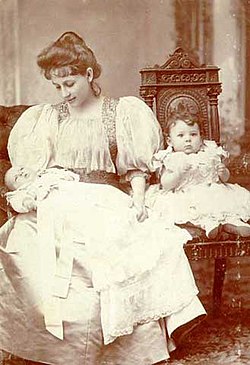
Penelope Delta (Greek: Πηνελόπη Δέλτα; 24 April 1874 – 2 May 1941) was a Greek author. She is widely celebrated for her contributions to the field of children's literature. Her historical novels have been widely read and have influenced popular modern Greek perceptions of national identity and history. Through her long-time association with Ion Dragoumis, Delta was thrust into the middle of turbulent early-20th-century Greek politics, ranging from the Macedonian Struggle to the National Schism.
Key Information


Early life
[edit]Delta was born Penelope Benaki (Greek: Πηνελόπη Μπενάκη) in Alexandria, in the Khedivate of Egypt,[1] to Virginia (née Choremi) and the wealthy cotton merchant Emmanouil Benakis.[2] She was the third of six children, her two older siblings being Alexandra and Antonis Benakis, whose Tom Sawyer-like mischiefs she immortalized in her book Trellantonis; her younger siblings were Constantine, who died at the age of two, Alexander, and Argine.[citation needed]
Marriage
[edit]The Benaki family temporarily moved to Athens in 1882. Penelope married a wealthy Phanariote entrepreneur, Stephanos Deltas, with whom she had three daughters, Sophia Mavrogordatou, Virginia Zanna, and Alexandra Papadopoulou. Stephanos Deltas was related to mathematician Constantin Carathéodory through his wife Sophia whose father was Alexander Karathéodori Pasha. They returned to Alexandria in 1905, where she met Ion Dragoumis, then the Vice-Consul of Greece in Alexandria. Dragoumis, like Penelope Delta, also wrote on the subject of the Macedonian Struggle. Personal recollections of his appear throughout his writings. A romantic relationship is said to have developed between the pair. Delta and Dragoumis decided to separate, but continued to correspond passionately until 1912, when Dragoumis started a relationship with the famous stage actress Marika Kotopouli. Penelope had, in the meantime, twice attempted suicide.[citation needed]
Writing career
[edit]Delta moved to Frankfurt, Germany in 1906. Her husband had chosen to relocate in order to manage the offices of the Khoremis-Benakis cotton business. Her first novel, Gia tēn Patrida (For the Sake of the Fatherland) was published in 1909. The novel is set during the Byzantine epoch. It was during this time that Delta had started to correspond with the historian Gustave Schlumberger, a renowned specialist on the Byzantine Empire. Their continued interaction provided the material for her second novel, Ton Kairo tou Voulgaroktonou (In the Years of the Bulgar-Slayer),[3] set during the reign of the Emperor Basil II.[4] The Goudi Pronunciamento in 1909 inspired her third novel, Paramythi Hōris Onoma (A Tale with No Name), published in 1911.
In 1913 the Deltas returned to Alexandria yet again, and in 1916, settled permanently in Athens. At this time, her father, Emmanuel Benakis, had been elected Mayor. They soon became close friends with Eleftherios Venizelos, whom they entertained regularly at their opulent mansion in the northern suburb of Kifisia. Penelope's father had been a political associate of Venizelos since his move to Athens in 1910, and had served as Finance Minister in the first Venizelos administration.[citation needed]
Her long correspondence with Bishop Chrysanthos, Metropolitan of Trebizond, provided the material for her 1925 book, The Life of Christ. In 1925, she was diagnosed with polio. In 1927, she started writing the trilogy Rōmiopoules (Young Greek Girls), a thinly veiled autobiography, which she did not finish until 1939. Set in Athens, the first part, To Xypnēma (The Awakening) covers the events from 1895 to 1907, the second part Hē Lavra (The Heat) covers 1907 to 1909, and the final part, To Souroupo (The Dusk), covers 1914 to 1920. Her personal acquaintance with the political events of this tumultuous era provided her with the materials for a convincing and detailed account. Her father was almost executed for treason by the Royalist Party. Ion Dragoumis was assassinated by Venizelos sympathizers in 1920. Following the death of Dragoumis, Delta would appear in nothing but black.
In the meantime she published her three major novels: Trellantōnēs (Crazy Anthony; 1932), which detailed her mischievous elder brother's Antonis Benakis childhood adventures in late 19th century Alexandria, Mangas (1935), which was about the not dissimilar adventures of the family's fox terrier dog, and Ta Mystika tou Valtou (The Secrets of the Swamp; 1937), which was set around Giannitsa Lake in the early 20th century, while the Greek struggle for Macedonia was unfolding.
While Penelope Delta received credit for transcribing the memories of that particular war, the actual narratives were collected in 1932–1935 by her secretary Antigone Bellou Threpsiadi - herself a daughter of a Macedonian fighter.[5]
During the daytime, Delta famously forbade her grandchildren from visiting her while writing. She would, however, spend the entire evening with family. It is said that in lieu of bedtime stories, Delta would read to them whatever she had managed to produce during the day.[citation needed]
Later life
[edit]During the final year of her life, in the midst of advancing paralysis, she received the diaries and archives of her lost love, Ion Dragoumis. These particular documents had been entrusted to her by Ion's brother, Philip. She managed to dictate approximately 1000 pages of commentary on Dragoumis' work, before deciding to take her own life. She committed suicide by taking poison on 27 April 1941, on the very day which Wehrmacht troops entered into Athens.[1][6] She died on 2 May 1941. At her request she was interred in the garden of the stately Delta mansion in Kifissia. Chrysanthos, the then Archbishop of Athens, officiated at the funeral. On her grave, in the garden of her house, the word σιωπή, siōpē ("silence") was engraved.[6]
Descendants
[edit]The Delta mansion was inherited by her three daughters, Sophia, Virginia, and Alexandra, who added a guesthouse they named "Sovirale", after the initial letters of their first names. Virginia married politician Alexander Zannas, and their daughter Lena was the mother of contemporary politician Antonis Samaras; their son, Pavlos (Paul) Zannas (1929–1989) was a prominent art critic as well as Modern Greek translator of Marcel Proust's "À la recherche du temps perdu". In 1989, Alexandra, then the last living Delta daughter, bequeathed the mansion to the Benaki Museum.
Works in English translation
[edit]- Secrets of the Swamp, translated by Ruth Bobick, Peter E. Randall Publisher, Portsmouth, NH 2012, ISBN 978-1931807876
- In the Heroic Age of Basil II: Emperor of Byzantium, translated by Ruth Bobick, Peter E. Randall Publisher, Portsmouth NH 2006, ISBN 978-1931807524
- A tale without a name, translated and illustrated by Mika Provata-Carlone Publisher Pushkin Press, London 2013 ISBN 978-1782270287
References
[edit]- ^ a b "Conference about Penelope Delta at the BA". Bibliotheca Alexandrina. April 5, 2009. Retrieved April 27, 2019.
- ^ "Biography of Penelope Delta". Benaki Museum. Archived from the original on 14 June 2011. Retrieved 25 May 2009.
- ^ Roderick Beaton (1999). An introduction to modern Greek literature. Oxford University Press. ISBN 9780198159742. Retrieved 23 April 2009.
- ^ Paul Stephenson (2003). The Legend of Basil the Bulgar-Slayer, Cambridge University Press. page 120
- ^ Marii︠a︡ Nikolaeva Todorova (2004). Balkan identities. C. Hurst & Co. Publishers. ISBN 9781850657156. Retrieved 21 April 2009.
- ^ a b Battersby, Eileen (25 January 2014). "A visit to the court of King Witless". The Irish Times. Retrieved 27 April 27, 2019.
External links
[edit]
- Works by Penelope Delta at Project Gutenberg
- Works by or about Penelope Delta at the Internet Archive
- Works by Penelope Delta at LibriVox (public domain audiobooks)


Penelope Delta
View on GrokipediaEarly Life
Family Origins and Childhood
Penelope Delta was born on April 24, 1874, in Alexandria, Egypt, as the third of six children to Emmanouil Benakis, a wealthy Greek cotton merchant and national benefactor, and Virginia Choremi, daughter of a prominent Alexandrian family.[11][12][13] The Benakis family belonged to the Greek upper bourgeoisie diaspora in Egypt, originating from Chios and other Aegean islands, where they had established commercial networks amid the Ottoman Empire's decline and the khedivate's economic opportunities.[14][11] Her siblings included two older ones—a brother and a sister—and three younger, among them Antonis Benakis, who later founded the Benaki Museum in Athens as a repository of Greek cultural artifacts.[12][15] The family resided in a grand mansion in Alexandria, reflecting their affluent status within the cosmopolitan Greek community, which numbered over 100,000 by the late 19th century and thrived on trade in cotton and other commodities.[16][14] Upbringing emphasized strict bourgeois values, including religious observance, multilingualism in Greek, French, and English, and exposure to European literature and customs, fostering a blend of Hellenic patriotism and cosmopolitan refinement.[16][17] Delta's early years were spent primarily in Alexandria, punctuated by annual summer travels to Greece for family visits and to European cities like Paris and London for leisure and cultural enrichment, a pattern common among elite Greek expatriates to maintain ties with the homeland.[17][18] The 1882 British occupation of Egypt introduced political uncertainties but did not immediately disrupt the family's prosperity, as Greek merchants often adapted to colonial administrations while preserving communal autonomy through institutions like the Greek Orthodox Patriarchate and schools.[17][14] These experiences instilled in her a dual identity—rooted in Egyptian-Greek mercantile life yet oriented toward Greek national revival—shaping her later literary focus on history and identity.[12][13]Education and Formative Influences
Penelope Delta, born in 1874 as the third of six children to the affluent Greek merchant Emmanouil Benakis and his wife Virginia Choremi, received her education through private home tutoring in Alexandria, Egypt, where the family resided amid the prosperous Greek diaspora community.[12] This bespoke instruction, common among elite bourgeois families, encompassed the Greek language primarily in its Katharevousa variant alongside multiple foreign languages, equipping her with linguistic proficiency suited to the multicultural Egyptian milieu.[11] Such an approach prioritized intellectual cultivation over formal schooling, allowing flexibility amid the family's commercial and philanthropic engagements.[13] Her formative years unfolded in a rigorous, aristocratic household environment characterized by strict parental oversight, particularly from her mother, which instilled a disciplined yet fragile disposition prone to introspection and melancholy.[12] Summers brought annual travels to Greece—visiting sites like Athens, Piraeus, and Chios—and select European locales such as Liverpool and Graz, juxtaposing Alexandria's luxurious cosmopolitanism against the homeland's more austere conditions post-1882 British occupation of Egypt.[11][13] These excursions heightened her awareness of Greek cultural heritage, evoking an emotional, if initially distanced, affinity for national identity amid familial narratives of diaspora resilience and historical ties to events like the Greek War of Independence.[13] Early intellectual stirrings manifested in Delta's nascent writing aptitude, nurtured by exposure to Greek historical lore and the Benakis family's emphasis on ethnic solidarity within Egypt's Hellenic circles, which founded educational institutions and supported repatriation efforts.[12] This backdrop, devoid of structured literary mentorship yet rich in oral traditions and printed Greek classics, primed her sensitivity to themes of patriotism and cultural continuity that later permeated her oeuvre.[13]Personal Life
Marriage to Stefanos Delta
In 1895, at the age of 21, Penelope Benaki married Stefanos Delta, a prosperous businessman from a distinguished Phanariote family with roots in Constantinople.[19][20] The marriage took place after her family's temporary relocation to Athens in 1882, where she first met Delta, a merchant whose suit was recommended by her uncle.[9] This arrangement aligned with broader familial objectives, including business alliances pursued by her father, Emmanuel Benakis, and enabled Penelope's detachment from the conservative and constraining Benaki household.[19][21] The union offered financial security and a culturally vibrant setting that fostered her emerging intellectual independence, marking the onset of her personal maturation beyond family oversight.[12][22]Family Dynamics and Descendants
Penelope Delta married Stefanos Delta, a wealthy Phanariote businessman, on April 4, 1895, in an arranged union facilitated by her parents despite her initial reluctance.[23] The couple resided primarily in Alexandria, Egypt, until relocating to Athens around 1910, where they maintained a stable household amid Delta's growing literary pursuits.[24] Stefanos, described as kind and supportive, enabled her intellectual activities, though Delta harbored unrequited romantic sentiments toward diplomat Ion Dragoumis from 1906 onward, conducting a profound platonic correspondence that spanned decades without disrupting her marital commitments.[25] Delta and Stefanos had three daughters: Sophia (born 1896), Virginia (born 1898), and Alexandra (born 1905), whom she raised with exceptional dedication, instilling values of education, patriotism, and cultural heritage in a nurturing environment.[19] [9] Her maternal role was exemplary, as evidenced by her personal involvement in their upbringing and the transmission of family traditions, even as she balanced writing and social engagements.[19] The family dynamics reflected a blend of bourgeois stability and intellectual fervor, with Delta's close bond to her brother Antonis Benakis further enriching familial ties through shared cultural interests.[26] Following Delta's suicide on April 27, 1941, as Nazi forces approached Athens, her daughters inherited the family mansion in Kifisia, to which they added a guesthouse named "Sovirale," derived from the initials of their first names (So-phia, Vir-ginia, Ale-xandra).[20] [4] The daughters each married and bore children, perpetuating the lineage; notable modern descendants include figures in Greek politics and society, underscoring the enduring influence of the Benakis-Delta lineage.[20]Literary Beginnings
Transition to Writing
Delta's entry into literature was shaped by her extensive self-education in Greek history and philology, coupled with a growing awareness of the deficiencies in contemporary Greek children's books, which she viewed as inadequately suited for moral and linguistic development.[10] [6] Her initial forays involved unpublished diaries and letters, reflecting personal reflections on national identity amid Greece's irredentist struggles, before progressing to formal composition.[9] A pivotal influence emerged from her correspondence with French Byzantinist Gustave Schlumberger, begun during European travels in the mid-1900s, which furnished historical rigor for narratives drawing on Byzantine sources.[9] In 1906, while residing in Frankfurt, Germany, with her husband and children for medical treatment, Delta drafted her first novel, For the Homeland (Για την Πατρίδα), an intrigue-laden tale set in the 10th-century Byzantine court under Emperor Nikephoros II Phokas. Published in 1909 by Estia Press in Athens, it marked her debut as a novelist and emphasized themes of loyalty and espionage resonant with contemporary Macedonian conflicts.[18] [27] Preceding this, Delta had published short stories and fairy tales in periodicals as early as the 1900s, experimenting with demotic Greek to craft accessible yet patriotic content for young readers.[10] This phase reflected her conviction that literature should educate youth in simple, spoken language while instilling historical consciousness, addressing a perceived void in Greek publishing dominated by katharevousa or foreign imports.[6] Her works quickly gained traction, blending factual historical detail—drawn from primary sources like Schlumberger's studies—with narrative appeal, establishing her as a proponent of demotic prose in juvenile fiction.[9]Early Novels and Themes
Delta's literary career began with historical novels rooted in Byzantine history, reflecting her growing interest in Greece's imperial past amid contemporary national awakening. Her debut work, Για την Πατρίδα (For the Homeland), published in 1909, is set during the reign of Emperor Basil II Bulgaroktonos around 995 AD, depicting the capture of two young Byzantine Greeks, Asotis Taronitis and Alexios Argros, by Bulgarian forces under Tsar Samuel during the emperor's absence on campaign.[28] The narrative follows their enslavement, a Bulgarian princess's forbidden love for Asotis, and their eventual escape and contributions to Byzantine victories, culminating in themes of loyalty and redemption through service to the empire.[29] This novel, written while Delta resided in Frankfurt, drew inspiration from her correspondence with French Byzantinist Gustave Schlumberger, emphasizing empirical historical details blended with fictional elements to evoke patriotism.[9] Following it, Παραμύθι χωρίς όνομα (A Fairy Tale Without a Name), released in 1910, marked her initial foray into accessible narratives for younger readers, featuring princely siblings confronting kingdom-wide decline through moral trials, though still infused with undertones of resilience and ethical duty.[30] In 1911, she published Τον καιρό του Βουλγαροκτόνου (In the Time of the Bulgar-Slayer), extending the Byzantine focus to Basil II's campaigns, portraying adolescent protagonists navigating captivity and espionage amid Greco-Bulgarian conflicts, with vivid depictions of military strategy and personal valor.[10] Recurring themes across these early works include unyielding devotion to the homeland (patris), individual sacrifice for collective survival, and the interplay of personal romance with national destiny, often framed through first-person or close third-person perspectives to humanize historical upheavals.[29] Delta employed demotic Greek, aligning with the linguistic reform movement to make literature relatable to broader audiences, while prioritizing causal chains of historical causation—such as imperial overextension enabling invasions—over romanticized myth-making.[31] These novels, though initially aimed at educated adults, laid groundwork for her later adaptations toward youth, fostering a realist appreciation of Greece's resilient heritage against existential threats.[32]Advancements in Children's Literature
Pioneering Demotic Greek Usage
Penelope Delta actively supported the demoticist movement during the Greek language question, advocating for the use of vernacular Demotic Greek over the archaizing Katharevousa in literature and education.[31] Influenced by figures like Ion Dragoumis and encouraged by linguist Manolis Triantafyllidis, who in 1909 urged her to produce schoolbooks in spoken Greek, Delta applied these principles to her writing for young audiences.[33] Her commitment reflected a broader effort to align literary language with everyday speech, making historical and moral narratives accessible to children unfamiliar with formal registers.[10] In children's literature, Delta pioneered the exclusive employment of pure Demotic prose, eschewing Katharevousa elements that dominated earlier works and official texts until the 1920s.[34] This approach rendered her stories, such as those in Τρελαντώνης (1927) and Μάγκας (1935), immediate and relatable, employing colloquial syntax, vocabulary, and rhythms to mirror oral traditions while embedding educational content on national history and values.[34] By prioritizing linguistic simplicity without sacrificing literary quality, she addressed the pedagogical need for materials that children could comprehend intuitively, contrasting with the elite, purified style prevalent in prior Greek juvenile fiction.[10] Delta's demotic usage extended to fairy tales and historical novels, where she integrated regional dialects and idiomatic expressions to evoke authenticity, fostering a sense of cultural continuity from folk sources to printed form.[31] Her insistence on vernacular forms, rooted in personal multilingual experiences from her Alexandrian upbringing, challenged institutional resistance and contributed to the gradual acceptance of Demotic in schools post-1911 reforms.[10] This innovation not only elevated children's literature as a genre but also modeled democratic language access, influencing subsequent authors to adopt spoken Greek for youth readership.[34]Iconic Children's Works
Delta's most celebrated contributions to children's literature feature adventurous narratives with young protagonists or anthropomorphic animals, emphasizing themes of courage, loyalty, and Greek cultural identity. Among these, Trellantonis (1932) follows the escapades of a mischievous boy in early 20th-century Athens, blending humor with moral lessons on responsibility and family bonds, and remains a staple in Greek school curricula for its vivid portrayal of urban childhood.[35] [5] Another landmark work, Mangas (1935), centers on a loyal hunting dog navigating dangers in the Macedonian countryside, marking one of the earliest instances in global literature of a quadruped as the primary protagonist to convey human-like virtues such as bravery and fidelity. The novel's episodic structure and naturalistic descriptions drew from Delta's observations of rural Greece, fostering empathy for animals while subtly instilling nationalist sentiments through settings tied to Greek irredentist struggles.[36] [5] Sta mystika tou valtou (Secrets of the Swamp, circa 1937) depicts the Macedonian Struggle through the eyes of Greek fighters in the Giannitsa marshes, combining historical realism with adventure to educate young readers on patriotism and resilience against Ottoman and Bulgarian forces. This young adult tale highlights tactical ingenuity and communal solidarity, reflecting Delta's commitment to demotic Greek and authentic folk elements, and has endured as a tool for transmitting national history to successive generations.[5]Nationalist Writings and Historical Narratives
Focus on Macedonian Struggle
Penelope Delta's engagement with the Macedonian Struggle, a clandestine Greek resistance effort against Bulgarian irredentist groups in Ottoman Macedonia from 1904 to 1908, primarily manifested through her historical research and literary output rather than direct participation. Beginning in the 1910s, she systematically collected oral histories from Greek fighters and komitadjis who had operated in the region, preserving firsthand accounts of guerrilla tactics, village defense strategies, and inter-ethnic conflicts that shaped Greek national consciousness. These memoirs, drawn from veterans including figures active around Lake Giannitsa, served as primary sources for her works, emphasizing Greek resilience against Bulgarian exarchist influences and Ottoman authorities.[19][24] Her seminal contribution to this theme is the novel Τα μυστικά του βάλτου (Secrets of the Swamp), published in 1937, which dramatizes the armed clashes in the marshlands of Lake Giannitsa (modern Giannitsa) during the struggle's peak years. Set amid the "land and water" warfare involving Greek andartes navigating swamps to ambush Bulgarian bands, the book features protagonists inspired by real events, such as ambushes and sabotage operations that disrupted enemy supply lines. Delta's narrative underscores the ethnic Greek majority's determination to assert cultural and territorial claims, portraying Bulgarian komitadjis as aggressors backed by external propaganda, while highlighting the role of local leaders in fostering Hellenic identity through education and armed self-defense.[37][24][19] Complementing her literary efforts, Delta undertook practical support in 1918, participating in two relief missions to Eastern Macedonia to aid Greek hostages repatriating from Bulgarian captivity following the Balkan Wars. These expeditions involved distributing aid and documenting survivor testimonies, which reinforced her commitment to irredentist causes aligned with figures like Ion Dragoumis, whose own writings echoed her focus on Macedonia's Hellenic heritage. Her approach privileged empirical reconstruction over romanticization, grounding depictions in verifiable incidents like the 1905-1907 skirmishes near Vodena and Thessaloniki, though critics note the inherent Greek-centric lens that downplays Slavic linguistic elements in the region's demographics.[19][19]Byzantine and Historical Epics
Penelope Delta's Byzantine-themed historical novels, published in the early 1900s, drew on the grandeur of the Byzantine Empire to foster Greek national pride and historical consciousness. Her first such work, Για την Πατρίδα (For the Fatherland), appeared in 1909 and is set amid the empire's struggles, portraying themes of sacrifice and loyalty to the homeland through fictional narratives inspired by Byzantine valor.[38] This novel exemplifies Delta's approach to blending historical events with moral lessons on patriotism, aimed at educating youth about ancestral resilience.[39] In 1911, Delta published Τον καιρό του Βουλγαροκτόνου (In the Time of the Bulgar-Slayer), later translated into English as In the Heroic Age of Basil II: Emperor of Byzantium. The story unfolds around 1004 during Emperor Basil II's campaigns against the Bulgarians, following two young Greeks drawn into the emperor's wars, highlighting themes of heroism, military triumph, and imperial might at the Byzantine Empire's zenith.[38] These epics romanticize Basil II's epithet as "Bulgar-Slayer" for his decisive victories, such as the Battle of Kleidion in 1014, to evoke a sense of continuity in Greek martial tradition.[40] Delta employed demotic Greek to make the narratives accessible, reinforcing linguistic nationalism while embedding causal links between Byzantine successes and enduring Hellenic identity.[41] Both novels served as vehicles for irredentist sentiments, portraying Byzantium not merely as a historical phase but as a foundational pillar of modern Greek self-conception, countering Ottoman legacies through vivid depictions of imperial defense and cultural perseverance. Critics note their role in shaping popular historiography, though some academic analyses question the historical liberties taken to prioritize inspirational over strictly factual accounts.[39] Delta's focus on epic-scale conflicts avoided anachronistic projections, grounding stories in verifiable Byzantine chronicles while emphasizing individual agency in national survival.[38]Political Involvement
Alliance with Ion Dragoumis
Penelope Delta met Ion Dragoumis in 1905 in Alexandria, Egypt, where he served as the Greek vice-consul, during a period when Delta had returned briefly to her hometown with her family.[20] [42] Their encounter sparked a profound romantic attachment, despite Delta's marriage to Stephanos Delta and her role as mother to three daughters; the relationship remained unconsummated in a physical sense due to social and familial constraints, with Delta refusing divorce.[20] [42] This personal bond evolved into an intellectual and ideological alliance centered on Greek nationalism, particularly the Macedonian Struggle against Ottoman rule, as both shared a commitment to irredentist goals and cultural revival.[42] Dragoumis, a diplomat and writer with firsthand experience in Macedonia, profoundly influenced Delta's political awakening and literary output, drawing her into the turbulent currents of early 20th-century Greek affairs from the Macedonian issue to the National Schism.[20] [42] Their correspondence, which continued passionately after their physical separation out of respect for her family, sustained this alliance until 1912, when Dragoumis pursued other relationships; letters, such as one dated July 27, 1906, reveal Delta's intense emotional turmoil and suicidal ideation amid her devotion.[42] Delta's early nationalist novel Gia tin Patrida (For the Fatherland, 1909) reflects this influence, incorporating themes of sacrifice and resistance aligned with Dragoumis's writings on Macedonia.[42] The alliance persisted beyond romance, as Delta later engaged with Dragoumis's legacy following his execution by pro-Venizelist forces on November 19, 1920, an event she mourned deeply despite her eventual alignment with Venizelos; she donned black attire for the remainder of her life and, in her final year, was entrusted by Dragoumis's brother Philip with his diaries and documents for safeguarding and analysis.[20] This enduring connection underscored Delta's prioritization of ethnonationalist ideals over personal or partisan divisions, shaping her contributions to Greek irredentist discourse.[20] [42]Contributions to Greek Irredentism
Delta's literary efforts advanced Greek irredentist aspirations by embedding narratives of territorial reclamation into popular culture, particularly through depictions of the Macedonian Struggle—a clandestine Greek campaign from 1904 to 1908 aimed at countering Bulgarian irredentist incursions in Ottoman Macedonia and securing the region for eventual Greek incorporation. Her novel Στα μυστικά του βάλτου (The Secrets of the Swamp), published in 1937, romanticizes the exploits of Greek makedonomachoi fighters around Lake Giannitsa, framing their armed resistance as heroic defense of Hellenic identity against Slavic encroachments, and involves young protagonists aiding the cause to instill irredentist fervor in child readers.[43] [44] This work, drawing on veteran accounts, contributed to mythologizing Greek precedence in Macedonia, aligning with broader Megali Idea goals of expanding the Greek state to encompass ethnic Greek enclaves.[19] Complementing her writings, Delta undertook field activities in irredentist hotspots during World War I's aftermath, when Macedonian territories remained flashpoints between Greece, Bulgaria, and emerging nationalisms. In 1918, she joined two relief missions in Eastern Macedonia to support ethnic Greek hostages repatriating from Bulgarian captivity, providing aid amid population exchanges and ethnic strife that tested Greek administrative control post-Balkan Wars.[19] [9] These efforts, conducted under trying conditions, reinforced Greek communal ties in the region and countered rival propaganda by documenting Bulgarian atrocities through direct witness, as evidenced in her contemporaneous reports.[44] Delta further documented irredentist history by compiling oral memoirs from Macedonian Struggle participants, archiving firsthand Greek perspectives on the conflict's ethnic dimensions and Bulgarian guerrilla tactics, which served to substantiate Hellenic historical claims against competing narratives from Slavic sources.[19] Such archival work, pursued amid the National Schism's divisions, prioritized empirical preservation of Greek agency in Macedonia over politically aligned historiography, though her outputs inherently favored the irredentist viewpoint of territorial integration.[44]Later Years
Return to Athens and Social Engagement
In 1916, amid World War I, Penelope Delta and her family settled permanently in Athens, relocating to a mansion in the suburb of Kifissia that her father, Emmanouil Benakis, had purchased in 1912.[23] This move marked a shift from her earlier peripatetic life between Alexandria and Greece, allowing her to deepen her involvement in national affairs from a fixed base in the Greek capital.[19] Delta's social engagement in Athens centered on humanitarian efforts and cultural preservation. In 1918, she participated in two missions to Eastern Macedonia to aid Greek hostages returning from Bulgarian captivity, demonstrating her commitment to supporting victims of regional conflicts.[19] She extended this activism during the Asia Minor Catastrophe of 1922, contributing to relief operations for displaced Greeks, and later during the Greco-Italian War in 1940.[19] As a prominent member of the Hellenic Red Cross, she collaborated with figures like Ellie Adosidou in coordinating aid, often interfacing with international organizations such as the American Red Cross to address wartime and refugee needs.[45] Beyond direct relief work, Delta engaged in intellectual and societal initiatives to safeguard Greek heritage. She collected oral testimonies from veterans of the Macedonian Struggle and other historical events, compiling these accounts to preserve firsthand narratives of national resilience.[19] Elected to multiple learned associations and societies, she advocated for the promotion of literature and culture, influencing educational and patriotic discourse in interwar Greece.[19] In 1930, the Athens Academy honored her contributions with an award, recognizing her multifaceted role in fostering national consciousness through both writing and civic action.[23]Health Struggles and Isolation
In the years following the execution of Ion Dragoumis in 1920, Delta experienced profound emotional distress, including recurrent spells of depression documented in her personal journals, which contributed to her growing withdrawal from public life.[46] Her mental fragility, exacerbated by unrequited affections and national political upheavals, led to two prior suicide attempts, reflecting a deepening psychological isolation.[5] Delta's physical health deteriorated significantly in 1925 with a diagnosis of poliomyelitis, which progressed to partial paralysis over the subsequent years, confining her increasingly to her residence in Kifisia, a suburb of Athens.[20] This condition rendered her bedridden by the late 1930s, limiting mobility and social interactions, as she relied on family care amid chronic pain and fatigue.[47] Despite these afflictions, she persisted in limited literary correspondence from her secluded home, though her output waned as isolation intensified her sense of entrapment.[9] The combined toll of polio and depression fostered a profound personal seclusion, distancing her from the vibrant intellectual circles she had once engaged.[48]Death
Prelude to German Occupation
As Greece repelled the Italian invasion launched on October 28, 1940, Penelope Delta, residing in her home in Kifissia near Athens, followed the national resistance efforts amid her advancing multiple sclerosis, a condition that had first manifested around 1925 and progressively confined her to wheelchair use by the early 1940s.[9][20] The Greek counteroffensive into Albania initially boosted morale, but stalemate ensued, straining resources and exposing vulnerabilities to Axis intervention.[19] By early 1941, Delta's frailty intensified her isolation; bedridden and dependent on caregivers, she maintained a lifelong mourning attire in black, symbolizing unresolved personal grief from her earlier unrequited attachment to Ion Dragoumis, executed by German forces in 1920.[49] Reports of German troop buildups in Bulgaria and the March 1941 coup in Yugoslavia heightened fears of a broader invasion, which materialized on April 6 when Wehrmacht forces launched Operation Marita, swiftly overrunning Greek and British defenses in Macedonia and Thrace.[20][19] The rapid German advance southward, culminating in the fall of strategic positions like Mount Olympus passes by mid-April, filled Delta with profound despair over the impending subjugation of Greece, a nation she had championed through her irredentist writings.[19] Evacuations and refugee flows disrupted Athens suburbs, compounding her physical immobility and emotional torment as radio broadcasts and eyewitness accounts foretold the occupiers' arrival.[20] Her deteriorating condition, marked by chronic pain and limited mobility, rendered escape or active resistance impossible, leaving her to confront the Axis triumph in solitude.[9][50]Act of Suicide and Motivations
On April 27, 1941, coinciding with the entry of Wehrmacht troops into Athens during the Axis invasion of Greece, Penelope Delta ingested a lethal dose of poison she had kept nearby.[20][51] She lingered for several days before succumbing on May 2, 1941.[5] Prior to her death, Delta left a brief note for her children specifying her burial preferences: no priest, no open coffin, interment in the garden of the family home in Athens' Kifissia suburb, and a message not to mourn, as she was departing for "a nice place."[20] Contemporary accounts and biographical analyses attribute the act primarily to Delta's despair over the German occupation, which represented a profound national defeat for a figure deeply invested in Greek irredentist causes and cultural revival.[20][26] The invasion's timing—mere weeks after Greece's military resistance collapsed following the Italian and German assaults—exacerbated her sense of futility, as evidenced by the deliberate alignment of her suicide with the occupiers' arrival in the capital.[46] This interpretation aligns with her lifelong nationalist commitments, including support for the Macedonian Struggle and alliances with figures like Ion Dragoumis, though no explicit political manifesto accompanied her final note. Delta's decision was also influenced by longstanding personal frailties, including documented episodes of depression and two prior suicide attempts in the early 1900s amid emotional turmoil from an unconsummated affair.[46] Her health had deteriorated progressively, marked by mobility issues and isolation, conditions that intensified under wartime stress and left her psychologically vulnerable.[9] While some later reflections speculate on unresolved romantic regrets as a latent factor, the immediacy of the 1941 event points to the occupation as the precipitating catalyst, rather than isolated personal grievance.[52] Delta's preparedness with poison suggests premeditation tied to anticipated national collapse, underscoring a resolve to evade subjugation on her own terms.[53]Legacy and Critical Reception
Achievements in Shaping National Consciousness
Penelope Delta's literary works, particularly her historical novels for children, played a pivotal role in fostering Greek national pride by embedding themes of heroism, historical continuity, and territorial irredentism. Written in demotic Greek during the early 20th century, books such as In the Time of the Bulgars (1925) and For the Homeland (1937) dramatized events like the Macedonian Struggle (1904–1908), portraying Greek fighters as defenders of ethnic identity against Ottoman and Bulgarian encroachments, thereby reinforcing a narrative of resilience and cultural primacy among young readers.[31] [54] These narratives aligned with the demoticist movement's push for accessible language, making national history relatable and instilling a sense of duty to the Megali Idea—the vision of reclaiming historically Greek lands.[31] Her emphasis on education as a vehicle for national consciousness is evident in her advocacy for literature that taught moral values like self-sacrifice and love of homeland, countering what she viewed as inadequate foreign-influenced children's books.[10] Delta's protagonists, often embodying virtues of bravery and ingenuity—such as in Crazy Tony (1932), which promoted self-reliance amid adventure—served as models for Greek youth navigating post-Balkan Wars (1912–1913) and Asia Minor Catastrophe (1922) traumas.[9] By 1937, her approach to "national literature" had demonstrably heightened public engagement with ethnic history, as her novels became staples in school curricula, shaping intergenerational views of Greece's past as a foundation for future sovereignty.[39] [55] Delta's influence extended beyond fiction through her biographical sketches of irredentist figures like Pavlos Melas, whose 1904 exploits she chronicled to exalt individual agency in collective national revival.[19] This body of work, read by millions over decades, solidified popular perceptions of Greek identity as rooted in ancient heroic archetypes blended with modern struggles, contributing to a cohesive cultural narrative amid 1920s–1930s nation-building efforts under governments promoting historical education.[5] Her deliberate integration of folklore and history cultivated an affective bond to the nation, evidenced by the enduring adoption of her texts in Greek pedagogy, which prioritized ethnic self-awareness over cosmopolitan alternatives.[56]Criticisms of Nationalist Bias
Some scholars have critiqued Penelope Delta's historical novels for embedding a nationalist bias that prioritizes Greek ethnic claims over historical nuance, particularly in depictions of irredentist struggles. In Τα μυστικά του βάλτου (Secrets of the Swamp, published 1937), Delta romanticizes the Macedonian Struggle (1904–1908) by focusing on Greek irregular fighters' heroism against Bulgarian komitadjis, framing the conflict as a binary ethnic contest that aligns with Megali Idea aspirations but marginalizes evidence of mixed Slavic-Greek populations and local complexities in Ottoman Macedonia.[57] This portrayal, while rooted in participant accounts like those of informants for the Greek cause, has been argued to serve propagandistic ends by simplifying motivations to foster unalloyed national loyalty among young readers.[58] Analyses of her children's literature highlight ethnocentric elements in leveraging Byzantine history for modern nationalism, as in Ο καιρός του Βουλγαροκτόνου (The Time of the Bulgar-Slayer, 1935), where Delta evokes Basil II's 11th-century campaigns to symbolize enduring Greek superiority over Bulgarians, subordinating pan-Orthodox ties to ethnic antagonism despite shared religious heritage.[58] Critics contend this approach, emblematic of early 20th-century romantic nationalism, conditions juvenile audiences to view historical adversaries monolithically, potentially distorting causal understandings of Balkan conflicts by emphasizing heroism over geopolitical contingencies.[58] Advocacy organizations aligned with Slavic Macedonian interests have labeled Delta's narratives as outright ethnocentric propaganda, accusing them of denying indigenous Slavic elements in Macedonia's demographic history and promoting "paranoid nationalist pretensions" through idealized Greek exclusivity.[59] These views, however, originate from partisan sources contesting Greek territorial narratives, which often reflect broader geopolitical disputes rather than disinterested historiography; Delta's accounts, conversely, draw from empirical records of Greek guerrilla activities and state-sanctioned ethnographies of the period, such as those supporting incorporation post-1912 Balkan Wars. Such critiques underscore tensions in Balkan historiography but are frequently amplified by institutional biases in academia favoring multicultural reinterpretations over primary nationalist testimonies.Ongoing Scholarly Debates and Translations
Scholars continue to examine the interplay between nationalism and gender in Delta's oeuvre, particularly how her historical novels and biographical elements reinforce traditional female roles while asserting agency within irredentist narratives.[60] A 2010 dissertation posits that Delta's writings reflect tensions in early 20th-century Greek society, where women's contributions to nation-building were channeled through domestic and literary spheres rather than direct political participation.[61] This analysis highlights her portrayal of heroines in works like In the Heroic Age of Basil II as embodying sacrificial patriotism, prompting debates on whether such depictions empowered or constrained female identity amid the Megali Idea.[62] Another focal point involves the hybridity of Delta's fairy tales, which blend indigenous Greek folklore with Northwestern European motifs, challenging binary views of cultural purity in her nationalist framework.[10] Academic analyses argue this synthesis stems from her Alexandrian diaspora upbringing, fostering a narrative style that mediated between local traditions and imported Romantic influences, as seen in tales incorporating Andersen-like structures with Balkan elements.[63] Critics debate the extent to which this hybridity undermines or enriches her promotion of Hellenic identity, with some viewing it as an inadvertent critique of ethnocentric isolationism.[10] Delta's Secrets of the Swamp (1937) remains contentious for blurring historical fiction and factual reporting on the Macedonian Struggle (1904–1908), long serving as a primary extraliterary source despite its novelistic form.[57] Scholars question its reliability in shaping public memory, noting how its dramatized accounts of guerrilla tactics influenced perceptions of ethnic conflicts without rigorous sourcing, fueling ongoing reassessments of literature's role in historiographical distortions.[57] Translations of Delta's works into English have been sporadic, limiting global scholarly engagement. Secrets of the Swamp appeared in Ruth Bobick's 2006 rendition, emphasizing its adventure elements for young readers.[64] In the Heroic Age of Basil II followed in a similar Bobick translation, preserving the Byzantine revivalist themes central to her irredentism. More recently, A Tale Without a Name received Mika Provata-Carlone's English version in the Pushkin Collection, highlighting fairy tale universality.[65] These efforts, primarily post-2000, underscore debates on accessibility: proponents argue fuller translations could facilitate comparative studies with European children's literature, while skeptics note selection biases toward her less politically charged works, sidelining nationalist texts.[10]References
- https://www.[goodreads](/page/Goodreads).com/book/show/14629463-secrets-of-the-swamp