


Community hub
Recent from talks
Contribute something
Nothing was collected or created yet.
Periodical cicadas
View on Wikipedia
| Periodical cicada | |
|---|---|

| |
| Specimen of Magicicada septendecim in the Bavarian State Collection of Zoology, Munich (2015) | |
| A Magicicada chorus with M. septendecim, M. cassini, and M. septendecula | |
Scientific classification 
| |
| Kingdom: | Animalia |
| Phylum: | Arthropoda |
| Class: | Insecta |
| Order: | Hemiptera |
| Suborder: | Auchenorrhyncha |
| Family: | Cicadidae |
| Subfamily: | Cicadettinae |
| Tribe: | Lamotialnini |
| Genus: | Magicicada W. T. Davis, 1925 |
| Type species | |
| Magicicada septendecim[1] | |
The term periodical cicada is commonly used to refer to any of the seven species of the genus Magicicada of eastern North America, the 13- and 17-year cicadas. They are called periodical because nearly all individuals in a local population are developmentally synchronized and emerge in the same year. Although they are sometimes called "locusts", this is a misnomer, as cicadas belong to the taxonomic order Hemiptera (true bugs), suborder Auchenorrhyncha, while locusts are grasshoppers belonging to the order Orthoptera.[2] Magicicada belongs to the cicada tribe Lamotialnini, a group of genera with representatives in Australia, Africa, and Asia, as well as the Americas.[3]
Magicicada species spend around 99.5% of their long lives underground in an immature state called a nymph. While underground, the nymphs feed on xylem fluids from the roots of broadleaf forest trees in the eastern United States.[4] In the spring of their 13th or 17th year, mature cicada nymphs emerge between late April and early June (depending on latitude), synchronously and in tremendous numbers.[5][6] The adults are active for only about four to six weeks after the unusually prolonged developmental phase.[7]
The males aggregate in chorus centers and call there to attract mates. Mated females lay eggs in the stems of woody plants. Within two months of the original emergence, the life cycle is complete and the adult cicadas die. Later in that same summer, the eggs hatch and the new nymphs burrow underground to develop for the next 13 or 17 years.
Periodical emergences are also reported for the "World Cup cicada" Chremistica ribhoi (every 4 years)[8] in northeast India and for a cicada species from Fiji, Raiateana knowlesi (every 8 years).[9]
Description
[edit]The winged imago (adult) periodical cicada has two red compound eyes, three small ocelli, and a black dorsal thorax. The wings are translucent with orange veins. The underside of the abdomen may be black, orange, or striped with orange and black, depending on the species.[10]
Adults are typically 2.4 to 3.3 cm (0.9 to 1.3 in), depending on species, generally about 75% the size of most of the annual cicada species found in the same region. Mature females are slightly larger than males.[11]
Magicicada males typically form large aggregations that sing in chorus to attract receptive females. Different species have different characteristic calling songs. The call of decim periodical cicadas is said to resemble someone calling "weeeee-whoa" or "Pharaoh".[12] The cassini and decula periodical cicadas (including M. tredecula) have songs that intersperse buzzing and ticking sounds.[11]
Cicadas cannot sting and do not normally bite. Like other Auchenorrhyncha (true) bugs, they have mouthparts used to pierce plants and suck their sap. These mouthparts are used during the nymph stage to tap underground roots for water, minerals and carbohydrates and in the adult stage to acquire nutrients and water from plant stems. An adult cicada's proboscis can pierce human skin when it is handled, which is painful but in no other way harmful. Cicadas are neither venomous nor poisonous and there is no evidence that they or their bites can transmit diseases.[13]
Oviposition by female periodical cicadas damages pencil-sized twigs of woody vegetation. Mature trees rarely suffer lasting damage, although peripheral twig die-off or "flagging" may result.[14] Planting young trees or shrubs is best postponed until after an expected emergence of the periodical cicadas. Existing young trees or shrubs can be covered with cheesecloth or other mesh netting with holes that are 3⁄8 in (1.0 cm) in diameter or smaller to prevent damage during the oviposition period,[15] which begins about a week after the first adults emerge and lasts until all females have died.
Life cycle
[edit]
Nearly all cicadas spend years underground as juveniles, before emerging above ground for a short adult stage of several weeks to a few months. The seven periodical cicada species are so named because, in any one location, all members of the population are developmentally synchronized—they emerge as adults all at once in the same year. This periodicity is especially remarkable because their life cycles are so long—13 or 17 years.
In contrast, for nonperiodical species, some adults mature each summer and emerge while the rest of the population continues to develop underground. Many people refer to these nonperiodical species as annual cicadas because some are seen every summer. This may lead some to conclude that the non-periodic cicadas have life cycles of 1 year. This is incorrect. The few known life cycles of "annual" species range from two to 10 years, although some could be longer.[citation needed]
The nymphs of the periodical cicadas live underground, usually within 2 ft (61 cm) of the surface, feeding on the juices of plant roots.[16] The nymphs of the periodical cicada undergo five instar stages in their development underground. The difference in the 13- and 17-year life cycle is said to be the time needed for the second instar to mature. When underground the nymphs move deeper below ground, detecting and then feeding on larger roots as they mature.[17]
The nymphs seem to track the number of years by detecting the changes in the xylem caused by abscission of the tree. This was supported experimentally by inducing a grove of trees to go through two cycles of losing and re-growing leaves in one calendar year. Cicadas feeding on those trees emerged after 16 years instead of 17.[9]
In late April to early June of the emergence year, mature fifth-instar nymphs construct tunnels to the surface and wait for the soil temperature to reach a critical value.[7][18] In some situations, nymphs extend mud turrets up to several inches above the soil surface.[19] The function of these turrets is not known, but the phenomenon has been observed in some nonperiodical cicadas, as well as other tunneling insects.[20]
The nymphs first emerge on a spring evening when the soil temperature at around 20 cm (8 in) of depth is above 17.9 °C (64 °F). The crepuscular emergence is thought to be related to the fact that maximum soil temperatures lag behind maximum insolation by several hours, conveniently providing some protection for the flightless nymphs against diurnal sight predators such as birds. For the rest of their lives the mature periodical cicadas will be strongly diurnal, with song often nearly ceasing at night.
During most years in the United States this emergence cue translates to late April or early May in the far south, and late May to early June in the far north. Emerging nymphs may molt in the grass or climb from a few centimeters to more than 100 feet (30 m) to find a suitable vertical surface to complete their transformation into adults. After securing themselves to tree trunks, the walls of buildings, telephone poles, fenceposts, hanging foliage, and even stationary automobile tires, the nymphs undergo a final molt and then spend about six days in the trees to await the complete hardening of their wings and exoskeletons. Just after emerging from this final molt the teneral adults are off-white, but darken within an hour.
Adult periodical cicadas live for only a few weeks; by mid-July, all have died. Their ephemeral adult forms are adapted for one purpose: reproduction. Like other cicadas the males produce a very loud species-specific mating song using their tymbals. Singing males of the same Magicicada species tend to form aggregations called choruses whose collective songs are attractive to females. Males in these choruses alternate bouts of singing with short flights from tree to tree in search of receptive females.[2] Most matings occur in so-called chorus trees.[10]
Receptive females respond to the calls of conspecific males with timed wing-flicks (visual signaling is apparently a necessity in the midst of the males' song) which attract the males for mating.[21] The sound of a chorus can be literally deafening and depending on the number of males composing it, may reach 100 dB in the immediate vicinity. In addition to their "calling" or "congregating" songs, males produce a distinctive courtship song when approaching an individual female.[10]
Both males and females can mate multiple times, although most females seem to mate only once [citation needed]. After mating, the female cuts V-shaped slits in the bark of young twigs and lays about 20 eggs in each, for a total clutch of 600 or more. After about 6–10 weeks, the eggs hatch and the nymphs drop to the ground, where they burrow and begin another 13- or 17-year cycle.
-
 Magicicada nymph emergence holes
 -
 Mud turrets that emergent Brood X Magicicada nymphs created in Potomac, Maryland near Washington, D.C. (June 30, 2021)
 -
 Brood XIII Magicicada nymph prior to final molt in suburban Chicago (May 24, 2007)
 -
 Magicicada molting
 -
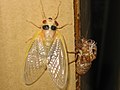 Teneral adult Brood XIII Magicicada and exuviae after molting in Highland Park, Illinois near Chicago. (May 2007)
 -
 Teneral adult Brood XIII Magicicada in suburban Chicago (May 24, 2007)
 -
 Mass of Magicicada Teneral adults and exuviae on vegetation
 -
 An adult Brood X Magicicada septendecim in Princeton, New Jersey (June 6, 2004)
 -
 Two Brood X Magicicadas mating in Bethesda, Maryland near Washington, D.C. (May 31, 2021)
 -
 A Brood X Magicicada ovipositing eggs in a tree branch near Baltimore, Maryland (May 26, 2021)
 -
A Brood X Magicicada laying eggs in a tree branch (video) (June 1, 2021)
-
 Magicicada egg slits (circled in red) (June 6, 2004)


Predator satiation survival strategy
[edit]The nymphs emerge in very large numbers at nearly the same time, sometimes more than 1.5 million individuals per acre (370 individuals per m2).[22] Their mass emergence is, among other things, an adaptation called predator satiation. Although periodical cicadas are easy prey for reptiles, birds, squirrels, cats, dogs and other small and large mammals[7][23], there are after synchronized emergence simply too many individuals for the predators to consume; many individuals thus remain behind to procreate.
It has been hypothesized that the prime-number development times (13 and 17 years) improve avoidance of predators with shorter reproductive cycles and for this reason have been selected for. A predator with, for example, a three-year reproductive cycle, which happened to benefit from a brood emergence in a given year, will have gone through either four cycles plus one year (12 + 1) or five cycles plus two years (15 + 2) by the next time that the same brood emerges. In this way cicada generations always emerge when some portion of the predators they will confront are sexually immature and therefore incapable of taking maximum advantage of the momentarily limitless food supply.[24]
A second hypothesis posits that the prime-numbered developmental times are an adaptation that prevents hybridization between broods. Under extremely harsh conditions, mutations producing extremely long development times are selected for. A mechanism, such as reproducing only after prime-numbered intervals, that reduces the frequency of cicadas mating with cicadas that may lack the long-development trait will also be selected for. The North American Pleistocene glacial stadia are instances of such extremely harsh conditions. On this hypothesis, predator satiation reinforces a longer-term survival strategy of protecting the long-development trait from hybridizations that might dilute it.[25] This hypothesis has been supported by mathematical modeling.[26]
The length of the cycle was hypothesized to be controlled by a single gene locus, with the 13-year cycle dominant to the 17-year one,[27] but this interpretation remains controversial and unsubstantiated at the level of DNA.
Impact on other populations
[edit]Cycles in cicada populations are significant enough to affect other animal and plant populations. For example, tree growth has been observed to decline the year before the emergence of a brood because of the increased feeding on roots by the growing nymphs.[28] Moles, which feed on nymphs, have been observed to do well during the year before an emergence, but suffer population declines the following year because of the reduced food source.[29] Wild turkey populations respond favorably to increased nutrition in their food supply from gorging on cicada adults on the ground at the end of their life cycles. Uneaten carcasses of periodical cicadas decompose on the ground, providing a resource pulse of nutrients to the forest community.[28]
Cicada broods may also have a negative impact. Eastern gray squirrel populations have been negatively affected, because the egg-laying activity of female cicadas damaged upcoming mast crops.[30]
Broods
[edit]Periodical cicadas are grouped into geographic broods based on the calendar year when they emerge. For example, in 2014, the 13-year Brood XXII emerged in Louisiana and the 17-year Brood III emerged in western Illinois and eastern Iowa.
In a 1907 journal article, entomologist Charles Lester Marlatt assigned Roman numerals to 30 different broods of periodical cicadas: 17 distinct broods with a 17-year life cycle, to which he assigned brood numbers I through XVII (with emerging years 1893 through 1909); plus 13 broods with a 13-year cycle, to which he assigned brood numbers XVIII through XXX (1893 through 1905).[31] Marlatt noted that the 17-year broods are generally more northerly than are the 13-year broods.[32]
Many of these hypothetical 30 broods have not been observed. Marlatt noted that some cicada populations (especially Brood XI in the valley of the Connecticut River in Massachusetts and Connecticut) were disappearing, a fact that he attributed to the reduction in forests and the introduction and proliferation of insect-eating "English sparrows" (House sparrows, Passer domesticus) that had followed the European settlement of North America.[33] Two of the broods that Marlatt named (Broods XI and XXI) have become extinct. His numbering scheme has been retained for convenience (and because it clearly separates 13- and 17-year life cycles), although only 15 broods are known to survive.[34]
| Name | Nickname | Cycle (yrs) | Last emergence | Next emergence | Extent |
|---|---|---|---|---|---|
| Brood I | Blue Ridge brood | 17 | 2012 | 2029 | Western Virginia, West Virginia |
| Brood II | East Coast brood | 17 | 2013 | 2030 | Connecticut, Maryland, North Carolina, New Jersey, New York, Pennsylvania, Delaware, Virginia, District of Columbia |
| Brood III | Iowan brood | 17 | 2014 | 2031 | Iowa |
| Brood IV | Kansan brood | 17 | 2015 | 2032 | Eastern Nebraska, southwestern Iowa, eastern Kansas, western Missouri, Oklahoma, north Texas[35] |
| Brood V | 17 | 2016 | 2033 | Eastern Ohio, Western Maryland, Southwestern Pennsylvania, Northwestern Virginia, West Virginia, New York (Suffolk County)[36] | |
| Brood VI | 17 | 2017 | 2034 | Northern Georgia, western North Carolina, northwestern South Carolina | |
| Brood VII | Onondaga brood | 17 | 2018 | 2035 | Central New York (Onondaga, Cayuga, Seneca, Ontario, Yates counties)[Note 1] |
| Brood VIII | 17 | 2019 | 2036 | Eastern Ohio, western Pennsylvania, northern West Virginia | |
| Brood IX | 17 | 2020 | 2037 | southwestern Virginia, southern West Virginia, western North Carolina | |
| Brood X | Great eastern brood | 17 | 2021 | 2038 | New York, New Jersey, Pennsylvania, Delaware, Maryland, District of Columbia, Virginia, West Virginia, North Carolina, Georgia, Tennessee, Kentucky, Ohio, Indiana, Illinois, Michigan[37][Note 2] |
| Brood XI | 17 | 1954 | Extinct | Connecticut, Massachusetts, Rhode Island. Last seen in 1954 in Ashford, Connecticut along the Fenton River | |
| Brood XIII | Northern Illinois brood | 17 | 2024 | 2041 | Northern Illinois and in parts of Iowa, Wisconsin, and Indiana[Note 3] |
| Brood XIV | 17 | 2025 | 2042 | Southern Ohio, Kentucky, Tennessee, Massachusetts, Maryland, North Carolina, Pennsylvania, northern Georgia, Southwestern Virginia and West Virginia, and parts of New York and New Jersey | |
| Brood XIX | Great Southern Brood | 13 | 2024 | 2037 | Alabama, Arkansas, Georgia, Indiana, Illinois, Kentucky, Louisiana, Maryland, Missouri, Mississippi, North Carolina, Oklahoma, South Carolina, Tennessee, and Virginia[Note 4] |
| Brood XXI | Floridian Brood | 13 | 1870 | Extinct | Last recorded in 1870, historical range included the Florida panhandle[41] |
| Brood XXII | Baton Rouge Brood[42] | 13 | 2014 | 2027 | Louisiana, Mississippi[Note 5] |
| Brood XXIII | Mississippi Valley Brood[43] | 13 | 2015 | 2028 | Arkansas, Illinois, Indiana, Kentucky, Louisiana, Missouri, Mississippi, Tennessee |
| |||||
Periodical cicadas that emerge outside the expected time frame are called stragglers. Although they can emerge at any time, they usually do so one or four years before or after most other members of their broods emerge.[44] Stragglers with a 17-year life cycle typically emerge four years early. Those with a 13-year cycle typically emerge four years late.[45] The emergence of stragglers may in theory be indicative of a brood shifting from a 17-year cycle to a 13-year one.[46]
Brood XIII of the 17-year cicada, which reputably has the largest emergence of cicadas by size known anywhere, and Brood XIX of the 13-year cicada, arguably the largest (by geographic extent) of all periodical cicada broods, were expected to emerge together in 2024 for the first time since 1803. However, the two broods were not expected to overlap except potentially in a thin area in central and eastern Illinois (Macon, Sangamon, Livingston, and Logan counties).[47] The next such dual emergence of these two particular broods will occur in 2245, 221 years after 2024. Many other 13-year and 17-year broods emerge during the same years, but the broods are not geographically close.[48]
Map of brood locations
[edit]
Taxonomy
[edit]Phylogeny
[edit]Magicicada is a member of the cicada tribe Lamotialnini, which is distributed globally aside from South America. Despite Magicicada being only found in eastern North America, its closest relatives are thought to be the genera Tryella and Aleeta from Australia, with Magicicada being sister to the clade containing Tryella and Aleeta.[49] Within the Americas, its closest relative is thought to be the genus Chrysolasia from Guatemala.[50]
Species
[edit]Seven recognized species are placed within Magicicada—three 17-year species and four 13-year species. These seven species are also sometimes grouped differently into three subgroups, the so-called Decim species group, Cassini species group, and Decula species group, reflecting strong similarities of each 17-year species with one or more species with a 13-year cycle.[51]
| 17-year cycle | Species group |
13-year cycle | ||||||
|---|---|---|---|---|---|---|---|---|
| Image | Scientific name | Common name | Distribution | Image | Scientific name | Common name | Distribution | |
.jpg)
|
M. septendecim (Linnaeus, 1758) |
17-year locust, Pharaoh cicada |
Canada, United States |
Decim | 
|
M. tredecim (Walsh & Riley, 1868) |
Southeastern United States | |
| M. neotredecim Marshall & Cooley, 2000 |
United States | |||||||
_(Flint_Ridge,_Ohio,_USA)_(27294270804).jpg)
|
M. cassini [52] (Fisher, 1852) |
17-year cicada, dwarf periodical cicada |
United States | Cassini | 
|
M. tredecassini Alexander & Moore, 1962 |
United States | |
_-_journal.pone.0000892.g003C.png)
|
M. septendecula Alexander & Moore, 1962 |
United States | Decula | 
|
M. tredecula Alexander & Moore, 1962 |
United States | ||
Evolution and speciation
[edit]Not only are the periodical cicada life cycles curious for their use of the prime numbers 13 or 17, but their evolution is also intricately tied to one- and four-year changes in their life cycles.[25][27] One-year changes are less common than four-year changes and are probably tied to variation in local climatic conditions. Four-year early and late emergences are common and involve a much larger proportion of the population than one-year changes. The different species are well-understood to have originated from a process of allochronic speciation,[53][54] in which species subpopulations that are isolated from one another in time eventually become reproductively isolated as well.
Research suggests that in extant periodical cicadas, the 13- and 17-year life cycles evolved at least eight different times in the last 4 million years and that different species with identical life cycles developed their overlapping geographic distribution by synchronizing their life cycles to the existing dominant populations.[54] The same study estimates that the Decim species group split from the common ancestor of the Decula plus Cassini species groups around 4 million years ago (Mya). At around 2.5 Mya, the Cassini and Decula groups split from each other.
The Sota et al. (2013) paper also calculates that the first separation of extant 13-year cicadas from 17-year cicadas took place in the Decim group about 530,000 years ago when the southern M. tredecim split from the northern M. septendecim. The second noteworthy event took place about 320,000 years ago with the split of the western Cassini group from its conspecifics to the east. The Decim and the Decula clades experienced similar western splits, but these are estimated to have taken place 270,000 and 230,000 years ago, respectively. The 13- and 17-year splits in Cassini and Decula took place after these events.
The 17-year cicadas largely occupy formerly glaciated territory, and as a result their phylogeographic relationships reflect the effects of repeated contraction into glacial refugia (small islands of suitable habitat) and subsequent re-expansion during multiple interglacial periods. In each species group, Decim, Cassini, and Decula, the signature of the glacial periods is manifested in three phylogeographic genetic subdivisions: one subgroup east of the Appalachians, one midwestern, and one on the far western edge of their range.
The Sota et al. data suggest that the founders of the southern 13-year cicada populations originated from the Decim group. These were later joined by Cassini originating from the western Cassini clade and Decula originating from eastern, middle, and western Decula clades. As Cassini and Decula invaded the south, they became synchronized with the resident M. tredecim. These Cassini and Decula are known as M. tredecassini and M. tredecula. More data is needed to lend support to this hypothesis and others hypotheses related to more recent 13- and 17-year splits involving M. neotredecim and M. tredecim.
Distribution
[edit]The 17-year periodical cicadas are distributed from the Eastern states, across the Ohio Valley, to the Great Plains states and north to the edges of the Upper Midwest, while the 13-year cicadas occur in the Southern and Mississippi Valley states, with some slight overlap of the two groups. For example, broods IV (17-year cycle) and XIX (13-year cycle) overlap in western Missouri and eastern Oklahoma.[55][56] Their emergences should again coincide in 2219, 2440, 2661, etc., as they did in 1998[57] (although distributions change slightly from generation to generation and older distribution maps can be unreliable[56]).
An effort sponsored by the National Geographic Society is underway as of April 2021 at the University of Connecticut to generate new distribution maps of all periodical cicada broods.[58] The effort uses crowdsourced data and records that entomologists and volunteers collect.[59]
Parasites, pests and pathogens
[edit]Although it usually feeds on oak leaf gall midge (Polystepha pilulae) larvae and other insects, the oak leaf gall mite ("itch mite") (Pyemotes herfsi) becomes an ectoparasite of periodical cicada eggs when these are available. After cicadas deposit their eggs in the branches of trees, feeding mites reproduce and their numbers increase.[60]

After cicada emergences have ended, many people have therefore developed rashes, pustules, intense itching and other mite bite sequelae on their upper torso, head, neck and arms. Rashes and itching peaked after several days, but lasted as long as two weeks. Anti-itch treatments, including calamine lotion and topical steroid creams, did not relieve the itching.[60]
Massospora cicadina is a pathogenic fungus that infects only 13 and 17 year periodical cicadas. Infection results in a "plug" of spores that replaces the end of the cicada's abdomen while it is still alive, leading to infertility, disease transmission, and eventual death of the cicada.[61]
Symbiosis
[edit]Magicicada are unable to obtain all of the essential amino acids from the dilute xylem fluid that they feed upon, and instead rely upon endosymbiotic bacteria that provide essential vitamins and nutrients for growth.[62] Bacteria in the genus Hodgkinia live inside periodical cicadas, and grow and divide for years before punctuated cicada reproduction events impose natural selection on these bacteria to maintain a mutually beneficial relationship. As a result, the genome of Hodgkinia has fractionated into three independent bacterial species each containing only a subset of genes essential for this symbiosis. The host requires all three subgroups of symbionts, as only the complete complement of all three subgroups provides the host with all its essential nutrients.[63] The Hodgkinia–Magicicada symbiosis is a powerful example of how bacterial endosymbionts drive the evolution of their hosts.
History
[edit]Marlatt wrote in his 1907 journal article that the earliest published account of the periodical cicada which had come under his observation appeared in a 1666 issue of the journal Philosophical Transactions of the Royal Society,[32] which at the time had the name Philosophical Transactions.[64] The account stated:
A great Observer, who hath lived long in New England, did upon occasion, relate to a Friend of his in London, where he lately was, That some few Years since there was such a swarm of a certain sort of Insects in that English Colony, that for the space of 200 Miles they poyson'd and destroyed all the Trees of that Country; there being found innumerable little holes in the ground, out of which those Insects broke forth in the form of Maggots, which turned into Flyes that had a kind of taile or sting, which they struck into the Tree, and thereby envenomed and killed it.[64]
Marlatt also wrote that the next report of the cicada appeared in a work entitled New-Englands Memoriall, which was printed in Cambridge, Massachusetts in 1669. After describing a "pestilent fever" that had swept through the Plymouth Colony and neighboring Indians in 1633, the New-Englands Memoriall's account stated:
It is to be observed that, the spring before this sickness, there was a numerous company of Flies which were like for bigness unto Wasps or Bumble-Bees; they came out of little holes in the ground, and did eat up the green things, and made such a constant yelling noise as made the woods ring of them, and ready to deafen the hearers; they were not any seen or heard by the English in this country before this time; but the Indians told them that sickness would follow, and so it did, very hot, in the months of June, July, and August of that summer.[32][65]
(Elaborating on an observation that Marlatt had reported in 1907,[32] Gene Kritsky suggested in 2001 that the account of the 1633 emergence is misdated, as Broods XI and XIV would have emerged in Plymouth in 1631 and 1634, respectively, while no presently known brood would have emerged there in 1633. Kritsky also noted that William Bradford, the governor of the Plymouth Colony, had reportedly written in 1633 the same account of the cicada emergence that the New-Englands Memoriall published in 1669.[66] However, a reprint of Bradford's History of Plymouth Plantation: 1606-1646 contains a different account of that emergence.[67])
Historical accounts cite reports of 15- to 17-year recurrences of enormous numbers of noisy emergent cicadas ("locusts") written as early as 1733.[68][69] John Bartram, a noted Philadelphia botanist and horticulturist, was among the early writers that described the insect's life cycle, appearance and characteristics.[70]
On May 9, 1715, Andreas Sandel, the pastor of Philadelphia's "Gloria Dei" Swedish Lutheran Church, described in his journal an emergence of Brood X.[71] Pehr Kalm, a Finnish naturalist visiting Pennsylvania and New Jersey in 1749 on behalf of the Royal Swedish Academy of Sciences, observed in late May another emergence of that brood.[72][73] When reporting the event in a paper that a Swedish academic journal published in 1756, Kalm wrote:
The general opinion is that these insects appear in these fantastic numbers in every seventeenth year. Meanwhile, except for an occasional one which may appear in the summer, they remain underground.
There is considerable evidence that these insects appear every seventeenth year in Pennsylvania.[73]
Kalm then described Sandel's report and one that he had obtained from Benjamin Franklin that had recorded in Philadelphia the emergence from the ground of large numbers of cicadas during early May 1732. He noted that the people who had prepared these documents had made no such reports in other years.[73]
Kalm further noted that others had informed him that they had seen cicadas only occasionally before the insects emerged from the ground in Pennsylvania in large swarms on May 22, 1749.[73] He additionally stated that he had not heard any cicadas in Pennsylvania and New Jersey in 1750 in the same months and areas in which he had heard many in 1749.[73] The 1715 and 1732 reports, when coupled with his own 1749 and 1750 observations, supported the previous "general opinion" that he had cited.
Kalm summarized his findings in a book translated into English and published in London in 1771,[74] stating:
There are a kind of Locusts which about every seventeen years come hither in incredible numbers ... In the interval between the years when they are so numerous, they are only seen or heard single in the woods.[68][75]
Based on Kalm's account and a specimen that Kalm had provided, in 1758 Carl Linnaeus named the insect Cicada septendecim in the tenth edition of his Systema Naturae.[10][76]
Moses Bartram, a son of John Bartram, described the next appearance of the brood (Brood X) that Kalm had observed in 1749 in an article entitled Observations on the cicada, or locust of America, which appears periodically once in 16 or 17 years that he wrote in 1766. Bartram's article, which a London journal published in 1768, noted that upon hatching from eggs deposited in the twigs of trees, the young insects ran down to the earth and "entered the first opening that they could find". He reported that he had been able to discover them 10 feet (3 m) below the surface, but that others had reportedly found them 30 feet (9 m) deep.[77]
In 1775, Thomas Jefferson recorded in his "Garden Book" Brood II's 17-year periodicity, writing that an acquaintance remembered "great locust years" in 1724 and 1741, that he and others recalled another such year in 1758 and that the insects had again emerged from the ground at Monticello in 1775. He noted that the females lay their eggs in the small twigs of trees while above ground.[78]
The 1780 emergence of the Brood VII cicadas (also known as the Onondaga brood) during the American Revolutionary War, coincided with the aftermath of the military operation known as the Sullivan Expedition which devastated the indigenous Onondagan communities and destroyed their crops. The sudden arrival of such a substantial quantity of the cicadas provided a source of sustenance for the Onondaga people who were experiencing severe food insecurity following the Sullivan campaigns and the subsequent brutal winter.[79] The seemingly miraculous arrival of the cicadas is commemorated by the Onondaga as though it were an intervention by the Creator to ensure their survival after such a traumatizing, catastrophic event.[80]

In April 1800, Benjamin Banneker, who lived near Ellicott's Mills, Maryland, wrote in his record book that he recalled a "great locust year" in 1749, a second in 1766 during which the insects appeared to be "full as numerous as the first", and a third in 1783. He predicted that the insects (Brood X) "may be expected again in they year 1800 which is Seventeen Since their third appearance to me".[81] Describing an effect that the pathogenic fungus, Massospora cicadina, has on its host,[82] Banneker's record book stated that the insects:
... begin to Sing or make a noise from first they come out of the Earth till they die. The hindermost part rots off, and it does not appear to be any pain to them, for they still continue on Singing till they die.[83]
In 1845, Dr. D.L. Pharas of Woodville, Mississippi, announced the 13-year periodicity of the southern cicada broods in a local newspaper, the Woodville Republican.[32] In 1858, Pharas placed the title Cicada tredecim in a subsequent article that the newspaper published on the subject 13 years later.[32]
Ten years afterwards, Benjamin Dann Walsh and Charles Valentine Riley authored a paper that the American Entomologist published in December 1868 which also reported the 13-year periodicity of the southern cicada broods. Walsh and Riley "for convenience sake", named the 13-year brood Cicada tredecim, in contradistinction to Cicada septemdecim, the 17-year brood.[32][84]
Walsh's and Riley's paper, which Scientific American reprinted with some revisions in January 1869, illustrated the interior and exterior characteristics of the nymphs' emergence holes and raised turrets.[85] Their articles, which did not cite Pharas' reports, were the first to describe the southern cicadas' 13-year periodicity that received widespread attention.[32] Riley later acknowledged Pharas' work in an 1885 publication on periodical cicadas that he authored.[32][86]

In 1998, an emergence contained a brood of 17-year cicadas (Brood IV) in western Missouri and a brood of 13-year cicadas (Brood XIX) over much of the rest of the state. Each of the broods are the state's largest of their types. As the territories of the two broods overlap (converge) in some areas, the convergence was the state's first since 1777.[87]
In 2007 and 2008, Edmond Zaborski, a research scientist with the Illinois Natural History Survey, reported that the oak leaf gall mite ("itch mite") (Pyemotes herfsi) is an ectoparasite of periodical cicada eggs. While investigating with the help of others the mysterious itchy welts and rashes that people were developing in Chicago's suburbs after the end of a 2007 Brood XIII emergence, he attributed the event to bites by mites whose populations had quickly increased while parasitizing those eggs.[88] Similar events occurred in Cincinnati after a Brood XIV emergence ended in 2008,[89] in Cleveland and elsewhere in northern and eastern Ohio after a Brood V emergence ended in 2016,[90] in the Washington, D.C., area after a Brood X emergence ended in 2021,[91] and again in the Chicago area after the next Brood XIII emergence ended in 2024.[92]
Use as human food
[edit]Magicicada species are edible when cooked for people who lack allergies to similar foods. A number of recipes are available for this purpose. Some recommend collecting the insects shortly after molting while still soft. Others exhibit preferences for emergent nymphs or hardened adults.[93]
The insects have historically been eaten by Native Americans, who fried them or roasted them in hot ovens, stirring them until they were well browned.[94][95] Marlatt wrote in 1907:
The use of the newly emerged and succulent cicadas as an article of human diet has merely a theoretical interest, because, if for no other reason, they occur too rarely to have any real value. There is also the much stronger objection in the instinctive repugnance which all insects seem to inspire as an article of food to most civilized nations. Theoretically, the Cicada, collected at the proper time and suitably dressed and served, should be a rather attractive food. The larvae have lived solely on vegetable matter of the cleanest and most whole-some sort, and supposedly, therefore, would be much more palatable and suitable for food than the oyster, with its scavenger habit of living in the muddy ooze of river bottoms, or many other animals which are highly prized and which have not half so clean a record as the periodical Cicada.[95]
Notes
[edit]- ^ Maxine Shoemaker Heath (1978). Genera of American cicadas north of Mexico (PDF) (PhD thesis). University of Florida. doi:10.5962/bhl.title.42291.
- ^ a b "General Periodical Cicada Information". Cicadas. Storrs, Connecticut: University of Connecticut. February 16, 2017. Archived from the original on May 11, 2021. Retrieved May 11, 2021.
- ^ Marshall, DC; Moulds, M; Hill, KBR; Price, BW; Wade, EJ; Owen, CO; Goemans, G; Marathe, K; Sarkar, V; Cooley, JR; Sanborn, AF; Kunte, K; Villet, MH; Simon, C (2018). "A molecular phylogeny of the cicadas (Hemiptera: Cicadidae) with a review of tribe and subfamily classification". Zootaxa. 4424 (1): 1–64. doi:10.11646/zootaxa.4424.1.1. PMID 30313477. S2CID 52976455. Archived from the original on August 23, 2018.
- ^ Lloyd, M. & H.S. Dybas (1966). "The periodical cicada problem. I. Population ecology". Evolution. 20 (2): 133–149. doi:10.2307/2406568. JSTOR 2406568. PMID 28563627.
- ^ "Magicicada". Cicada Mania.
- ^ "CICADAS IN ILLINOIS 2024". Field Museum.
- ^ a b c Williams, K.S. & C. Simon (1995). "The ecology, behavior, and evolution of periodical cicadas" (PDF). Annual Review of Entomology. 40: 269–295. doi:10.1146/annurev.en.40.010195.001413. Archived (PDF) from the original on July 29, 2010.
- ^ Hajong, Sudhanya Ray; Yaakop, Salmah (August 29, 2013). "Chremistica ribhoi sp. n. (Hemiptera: Cicadidae) from North-East India and its mass emergence". Zootaxa. 3702 (5): 493–500. doi:10.11646/zootaxa.3702.5.8. PMID 26146742.
- ^ a b Simon, Chris; Cooley, John R.; Karban, Richard; Sota, Teiji (January 7, 2022). "Advances in the Evolution and Ecology of 13- and 17-Year Periodical Cicadas". Annual Review of Entomology. 67 (1): 457–482. doi:10.1146/annurev-ento-072121-061108. PMID 34623904. S2CID 238529885.
- ^ a b c d Alexander, Richard D.; Moore, Thomas E. (1962). "The Evolutionary Relationships of 17-Year and 13-Year Cicadas, and Three New Species (Homoptera, Cicadidae, Magicicada)" (PDF). University of Michigan Museum of Zoology. Archived (PDF) from the original on August 1, 2012.
- ^ a b Capinera, John L. (2008). Encyclopedia of Entomology. Springer. pp. 2785–2794. ISBN 978-1-4020-6242-1. Archived from the original on June 24, 2016.
- ^ Stranahan, Nancy. "Nature Notes from the Eastern Forest". Arc of Appalachia. Archived from the original on October 5, 2011. Retrieved June 10, 2011.
- ^ Multiple sources:
- Dan (June 28, 2008). "Do cicadas bite or sting?". Cicada Mania. Archived from the original on May 7, 2021. Retrieved May 11, 2021.
- Miller, Korin (March 24, 2021). "How to Prepare for a Swarm of Cicadas This Year—and Why You Should Never Kill Them". Prevention. Hearst Magazine Media, Inc. Archived from the original on May 6, 2021. Retrieved May 11, 2021.
- West Virginia University (July 27, 2020). "Return of the zombie cicadas: Manipulative qualities of fungal-infected flyers". Science Daily. Archived from the original on May 5, 2021. Retrieved May 11, 2021.
- ^ Cook, William M.; Robert D. Holt (2002). "Periodical cicada (Magicicada cassini) oviposition damage: visually impressive yet dynamically irrelevant" (PDF). American Midland Naturalist. 147 (2): 214–224. doi:10.1674/0003-0031(2002)147[0214:PCMCOD]2.0.CO;2. S2CID 45098071. Archived from the original (PDF) on August 7, 2011.
- ^ Multiple sources:
- Cox, Lauren; Hernandez, Daisy (June 14, 2020). "How to Deal With the Cacophony of Brood X Cicadas This Spring". Popular Mechanics. Hearst Magazine Media, Inc. Archived from the original on April 6, 2021. Retrieved May 11, 2021.
- Raupp, Michael J. (May 15, 2013). "Brood II Up In Maryland, Magicicada spp." Bug Of The Week. University of Maryland Extension. Retrieved May 11, 2021.
- ^ Marlatt, C. L. (1907). "The Habits of the Larva and Pupa.: The Food of the Larva and Pupa.". The Periodical Cicada (71 ed.). Washington, D.C.: United States Department of Agriculture, Bureau of Entomology: Government Printing Office. pp. 123–125. LCCN agr07001971. OCLC 902809085. Retrieved July 26, 2021 – via Internet Archive.
- ^ White, J; Lloyd, M. (1979). "Seventeen year cicadas emerging after eighteen years-a new brood?". Evolution. 33 (4): 1193–1199. doi:10.2307/2407477. JSTOR 2407477. PMID 28563914.
- ^ Heath, J.E. (1968). "Synchronization of Emergence in Periodical "17-year" Cicadas (Homoptera, Cicadidae, Magicicada)". American Midland Naturalist. 80 (2): 440–448. doi:10.2307/2423537. JSTOR 2423537.
- ^ Marlatt, C.L (1907). "Transformation to the Adult Stage.: Cicada Huts, or Cones.". The Periodical Cicada (71 ed.). Washington, D.C.: United States Department of Agriculture, Bureau of Entomology: Government Printing Office. pp. 91–98. OCLC 902809085. Retrieved July 26, 2021 – via Internet Archive.
- ^ Betard, F. (2020). "Insects as zoogeomorphic agents: an extended review" (PDF). Earth Surface Processes and Landforms. 46: 89–109. doi:10.1002/esp.4944. S2CID 225534427.
- ^ "Sexual Signals in Periodical Cicadas" (PDF). Behaviour. Archived (PDF) from the original on June 16, 2013. Retrieved January 17, 2014.
- ^ Dybas, H. S.; Davis, D. D. (1962). "A populations census of seventeen-year periodical cicadas (Homoptera: Cicadidae: Magicicada)". Ecology. 43 (3): 432–444. Bibcode:1962Ecol...43..432D. doi:10.2307/1933372. JSTOR 1933372.
- ^ Williams, K. S.; Smith, K. G.; Stephen, F. M. (1993). "Emergence of 13-year periodical cicadas (Cicadidae, Magicicada): phenology, mortality, and predator satiation". Ecology. 74 (4): 1143–1152. Bibcode:1993Ecol...74.1143W. doi:10.2307/1940484. JSTOR 1940484.
- ^ Goles, E.; Schulz, O.; Markus, M. (2001). "Prime number selection of cycles in a predator-prey model". Complexity. 6 (4): 33–38. Bibcode:2001Cmplx...6d..33G. doi:10.1002/cplx.1040.
- ^ a b Cox, R. T. & C. E. Carlton (1988). "Paleoclimatic influences in the evolution of periodical cicadas (Homoptera: Cicadidae: Magicicada spp.)". American Midland Naturalist. 120 (1): 183–193. doi:10.2307/2425898. JSTOR 2425898. S2CID 4213280.
- ^ Tanaka, Y; Yoshimura, J.; Simon, C.; Cooley, J.; Tainaka, K. (2009). "Allee effect in the selection for prime-numbered cycles in periodical cicadas". Proceedings of the National Academy of Sciences. 106 (22): 8975–8979. Bibcode:2009PNAS..106.8975T. doi:10.1073/pnas.0900215106. PMC 2690011. PMID 19451640.
- ^ a b Cox, R. T. & C. E. Carlton (1991). "Evidence of genetic dominance of the 13-year life cycle in periodical cicadas (Homoptera: Cicadidae: Magicicada spp.)". American Midland Naturalist. 125 (1): 63–74. doi:10.2307/2426370. JSTOR 2426370.
- ^ a b Yang, Louie H. (2004). "Periodical Cicadas as Resource Pulses in North American Forests". Science. 306 (5701): 1565–1567. Bibcode:2004Sci...306.1565Y. doi:10.1126/science.1103114. PMID 15567865. S2CID 27088981.
- ^ "National Geographic: Cicada Outbreaks Linked to Other Animals' Booms, Busts". Archived from the original on July 22, 2008. Retrieved June 23, 2009.
- ^ "Cicadas - The Rise of Brood X". Bel Air, Maryland: The Mill of Bel Air. April 23, 2021. Archived from the original on August 3, 2025. Retrieved August 3, 2025.
The egg laying activity of female cicadas may also affect mast crops (nuts, acorns) which reduces food for squirrels. It is noted that Eastern gray squirrel populations often decline after a cicada cycle.
- ^ Marlatt, C. L. (1907). "The Periodical Cicada". United States Department of Agriculture Bureau of Entomology Bulletin. 71 (The Classification of the Broods). Washington, D.C.: United States Department of Agriculture, Bureau of Entomology: Government Printing Office: 28–30. LCCN agr07001971. OCLC 902809085. Retrieved July 26, 2021 – via Internet Archive.
- ^ a b c d e f g h i Marlatt, C. L. (1907). "The Periodical Cicada". United States Department of Agriculture Bureau of Entomology Bulletin. 71 (The Periodical Cicada in Literature). Washington, D.C.: United States Department of Agriculture, Bureau of Entomology: Government Printing Office: 146. LCCN agr07001971. OCLC 902809085. Retrieved July 26, 2021 – via Internet Archive.
- ^ Marlatt, C.L (1907). "Summary of the Habits and Characteristics of the Cicada.". The Periodical Cicada (71 ed.). Washington, D.C.: United States Department of Agriculture, Bureau of Entomology: Government Printing Office. pp. 13–14. OCLC 902809085. Retrieved July 26, 2021 – via Internet Archive.
- ^ Post, Susan L. (2004). "A Trill of a Lifetime". The Illinois Steward. Archived from the original on May 10, 2007.
- ^ "Brood IV". Cicadas. Storrs, Connecticut: University of Connecticut. February 21, 2017. Archived from the original on April 21, 2021. Retrieved July 25, 2021.
- ^ "Periodical Cicada - Brood V". United States Department of Agriculture: United States Forest Service. April 15, 2016. Archived from the original on April 7, 2016.
- ^ "Brood X (17-year)". Ann Arbor, Michigan: Division of Insects: Museum of Zoology: University of Michigan College of Literature, Science, and the Arts. Archived from the original on September 27, 2015. Retrieved March 13, 2024.
- ^ Sheikh, Knvul (May 27, 2017). "Brood Awakening: 17-Year Cicadas Emerge 4 Years Early". Scientific American. Archived from the original on January 25, 2024. Retrieved March 13, 2024.
- ^ Schuster, James; Nixon, Philip. "Timed to perfection: Cicada's biological clock determines emergence". Insects: Cicadas. Urbana, Illinois: University of Illinois Urbana-Champaign College of Agricultural, Consumer and Environmental Sciences: Illinois Extension. Archived from the original on March 10, 2024. Retrieved March 12, 2024.
The northern Illinois brood, which will emerge in late May 2024, has a reputation for the largest emergence of cicadas known anywhere. This is due to the size of the emergence and the research and subsequent reporting over the years by entomologists Monte Lloyd and Henry Dybas at the Field Museum in Chicago. During the 1956 emergence, they counted an average of 311 nymphal emergence holes per square yard of ground in a forested floodplain near Chicago. This translates to 1½ million cicadas per acre. In upland sites, they recorded 27 emergence holes per square yard, translating to about 133,000 per acre. This number is more typical of emergence numbers but is still a tremendous number of insects. .... 2020 | Northern Illinois Sub-Brood (part of Marlatt's XIII)
- ^ "Brood XIX: The Great Southern Brood". Biodiversity Research Collections: Periodical Cicada Information Pages. Storrs, Connecticut: University of Connecticut. February 21, 2017. Archived from the original on February 24, 2024. Retrieved March 13, 2024.
Brood XIX is arguably the largest (by geographic extent) of all periodical cicada broods, with records along the east coast from Maryland to Georgia and in the Midwest from Iowa to Oklahoma.
- ^ Marlatt, C.L. (1907). The Periodical Cicada (71 ed.). Washington, D.C.: United States Department of Agriculture, Bureau of Entomology: Government Printing Office. OCLC 902809085. Retrieved July 26, 2021 – via Internet Archive.
- ^ "Brood XXII (13-year) The Baton Rouge Brood". National Geographic Society. Archived from the original on September 3, 2011. Retrieved August 28, 2011.
- ^ "Brood XXIII". February 2021. Retrieved February 24, 2022.
- ^ "Stragglers". Biodiversity Research Collections: Periodical Cicada Information Pages. Storrs, Connecticut: University of Connecticut. January 25, 2021. Archived from the original on February 26, 2024. Retrieved March 13, 2024.
- ^ "What are stragglers?". Cicada Mania. June 27, 2015. Archived from the original on March 8, 2024. Retrieved March 13, 2024.
Typically cicadas with a 17-year life cycle will emerge 4 years early, and cicadas with a 13-year cycle will emerge 4 years late.
- ^ "Hordes of cicadas are emerging simultaneously in America". The Economist. May 28, 2024. Retrieved May 29, 2024.
- ^ Multiple sources:
- "2024 Cicada Forecast". Cicada Mania. February 10, 2024. Archived from the original on March 8, 2024. Retrieved March 13, 2024.
Both Brood XIX and XIII exist in Macon, Sangamon, Livingston and Logan counties in Illinois. The easily accessible place they come closest to overlapping is Springfield, Illinois, which is in Sangamon County.
- Schuster, James; Nixon, Philip. "Timed to perfection: Cicada's biological clock determines emergence". Insects: Cicadas. Urbana, Illinois: University of Illinois Urbana-Champaign College of Agricultural, Consumer and Environmental Sciences: Illinois Extension. Archived from the original on March 10, 2024. Retrieved March 12, 2024.
The northern Illinois brood, which will emerge in late May 2024, has a reputation for the largest emergence of cicadas known anywhere. This is due to the size of the emergence and the research and subsequent reporting over the years by entomologists Monte Lloyd and Henry Dybas at the Field Museum in Chicago. During the 1956 emergence, they counted an average of 311 nymphal emergence holes per square yard of ground in a forested floodplain near Chicago. This translates to 1½ million cicadas per acre. In upland sites, they recorded 27 emergence holes per square yard, translating to about 133,000 per acre. This number is more typical of emergence numbers but is still a tremendous number of insects.
- "The 2024 Periodical Cicada Emergence". Biodiversity Research Collections: Periodical Cicada Information Pages. Storrs, Connecticut: University of Connecticut. Archived from the original on March 12, 2024. Retrieved March 13, 2024.
In 2024, 13-year Brood XIX, which is the largest of all periodical cicada broods, will co-emerge with 17-year Brood XIII; these two broods are adjacent (but not significantly overlapping) in north-central Illinois.
- "Brood XIX: The Great Southern Brood". Biodiversity Research Collections: Periodical Cicada Information Pages. Storrs, Connecticut: University of Connecticut. February 21, 2017. Archived from the original on February 24, 2024. Retrieved March 13, 2024.
Brood XIX is arguably the largest (by geographic extent) of all periodical cicada broods, with records along the east coast from Maryland to Georgia and in the Midwest from Iowa to Oklahoma.
- "2024 Cicada Forecast". Cicada Mania. February 10, 2024. Archived from the original on March 8, 2024. Retrieved March 13, 2024.
- ^ Multiple sources:
- Ortiz, Aimee (January 19, 2024). "The World Hasn't Seen Cicadas Like This Since 1803". The New York Times. Archived from the original on March 9, 2024. Retrieved March 13, 2024.
Brood XIX and Brood XIII will both emerge this spring. The last time these bugs showed up at the same time in the United States, Thomas Jefferson was president. After this spring, it'll be another 221 years before the broods, which are geographically adjacent, appear together again.
- Matthews, Carys (May 29, 2024). "Cicada double brood event: What to expect as trillions of bugs emerge in Eastern US". Live Science. Archived from the original on June 29, 2024. Retrieved September 1, 2024.
Billions, even trillions, of cicadas are going to emerge at the same time across 17 states," Chris Simon, a professor at UConn's Department of Ecology and Evolutionary Biology and one of the scientists who runs the database told Life Science. ... Despite the huge volumes of insects set to emerge, the co-emergence of Brood XIII and XIX likely won't look much different from other periodical cicada emergences. That's because, for the most part, they won't emerge from the same locations. There's only a small woodland area in Springfield, Illinois, where the two broods may co-emerge. "The broods won't overlap significantly due to the latitudinal spread involved," John Cooley, founder of the Periodical Cicada Project and a professor in UConn's Department of Ecology and Evolutionary Biology, told Live Science. .... It is a rare occurrence for two specific periodical broods of different life cycles to emerge at the same time and overrlap in location. "The co-emergence of any two broods of different cycles is rare, because the cycles are both prime numbers," Cooley said. "Any given 13- and 17-year broods will only co-emerge once every 13 x 17 = 221 years." Despite their geographic proximity, the two broods have not emerged at the same time for 221 years, although many other 13-year and 17-year broods have appeared in the same year. "2015 was the last time a 13-year brood emerged with a 17-year brood, when Brood XXIII emerged with Brood IV. However, the two broods weren't geographically close," Simon told Live Science. "Similarly, adjacent Brood IV and Brood XIX both appeared in 1998 but, again, weren't close.
- Ortiz, Aimee (January 19, 2024). "The World Hasn't Seen Cicadas Like This Since 1803". The New York Times. Archived from the original on March 9, 2024. Retrieved March 13, 2024.
- ^ Marshall, David C.; Moulds, Max; Hill, Kathy B. R.; Price, Benjamin W.; Wade, Elizabeth J.; Owen, Christopher L.; Goemans, Geert; Marathe, Kiran; Sarkar, Vivek; Cooley, John R.; Sanborn, Allen F. (May 28, 2018). "A molecular phylogeny of the cicadas (Hemiptera: Cicadidae) with a review of tribe and subfamily classification". Zootaxa. 4424 (1): 1–64. doi:10.11646/zootaxa.4424.1.1. ISSN 1175-5334. PMID 30313477. S2CID 52976455.
- ^ says, Dave (January 10, 2019). "Chrysolasia guatemalena (Distant, 1883)". Cicada Mania. Retrieved May 15, 2021.
- ^ "Magicicada species". National Geographic Society. Archived from the original on February 26, 2017. Retrieved June 12, 2011.
- ^ Marshall, David C. (April 8, 2022). "On the spelling of the name of Cassin's 17-Year Cicada, Magicicada cassini (Fisher, 1852) (Hemiptera: Cicadidae)". Zootaxa. 5125 (2): 241–245. doi:10.11646/zootaxa.5125.2.8. PMID 36101217. S2CID 248041307. [open access]
- ^ Multiple sources:
- Rebecca S. Taylor and Vicki L. Friesen (2017). "The role of allochrony in speciation". Molecular Ecology. 26 (13): 3330–3342. Bibcode:2017MolEc..26.3330T. doi:10.1111/mec.14126. PMID 28370658. S2CID 46852358.
- Marshall, D. C.; Cooley, J. R. (2000). "Reproductive character displacement and speciation in periodical cicadas, with description of new species, 13-year Magicicada neotredecem". Evolution. 54 (4): 1313–1325. Bibcode:2000Evolu..54.1313M. doi:10.1111/j.0014-3820.2000.tb00564.x. hdl:2027.42/73691. PMID 11005298. S2CID 28276015.
- Simon, C.; Tang, J.; Dalwadi, S.; Staley, G.; Deniega, J.; Unnasch, T. R. (2000). "Genetic evidence for assortative mating between 13-year cicadas and sympatric '17-year cicadas with 13-year life cycles' provides support for allochronic speciation". Evolution. 54 (4): 1326–1336. doi:10.1111/j.0014-3820.2000.tb00565.x. PMID 11005299. S2CID 19105047.
- ^ a b Sota, Teiji; Yamamoto, Satoshi; Cooley, John R.; Hill, Kathy B. R.; Simon, Chris; Yoshimura, Jin (April 23, 2013). "Independent divergence of 13- and 17-y life cycles among three periodical cicada lineages". Proceedings of the National Academy of Sciences of the United States of America. 110 (17): 6919–6924. Bibcode:2013PNAS..110.6919S. doi:10.1073/pnas.1220060110. PMC 3637745. PMID 23509294.
- ^ "Broods". Cicadas. University of Connecticut. February 27, 2017. Archived from the original on March 31, 2021. Retrieved April 18, 2021.
- ^ a b See Figure 1, p. 107 in Cooley, John R.; Kritsky, Gene; Edwards, Marten J.; Zyla, John D.; Marshall, David C.; Hill, Kathy B. R.; Krauss, Rachel; Simon, Chris. "The distribution of periodical cicadas" (PDF). American Entomologist. 55 (2): 106–112. doi:10.1093/ae/55.2.106. Archived (PDF) from the original on July 26, 2011.
- ^ Omara-Otunnu, Elizabeth (April 26, 2004). "Life cycles Of Cicada Species Are Focus Of Biologist's Research". The UConn Advance. University of Connecticut. Archived from the original on June 22, 2010. Retrieved April 18, 2021.
- ^ "Making Modern Maps: A National Geographic Society sponsored project". Cicadas. University of Connecticut. February 18, 2017. Archived from the original on March 27, 2021. Retrieved April 18, 2021.
To date, we have surveyed and mapped over 10,000 localities within periodical cicada emergences, using detailed base maps and GPS technology, such as the custom GPS datalogger ... .
- ^ Multiple sources:
- "Crowdsourcing". Cicadas. University of Connecticut. January 25, 2021. Archived from the original on March 27, 2021. Retrieved April 18, 2021.
You can report periodical cicadas using the Cicada Safari App, available on the Google Play Store or the Apple Store.
- "Mapping Techniques". Cicadas. University of Connecticut. May 19, 2020. Archived from the original on March 27, 2021. Retrieved April 18, 2021.
- "Crowdsourcing". Cicadas. University of Connecticut. January 25, 2021. Archived from the original on March 27, 2021. Retrieved April 18, 2021.
- ^ a b Multiple sources:
- Centers for Disease Control and Prevention (CDC) (September 2005). "Outbreak of pruritic rashes associated with mites – Kansas, 2004". Morbidity and Mortality Weekly Report (MMDR Weekly). 54 (38). Atlanta, Georgia: 952–955. PMID 16195693. Archived from the original on November 29, 2023. Retrieved March 11, 2024.
- Keith, David; Karstens, Sandi Alswager (May 2, 2005). "Itch Mites Are Back, Entomologist Warns". IANR News Story. Lincoln, Nebraska: University of Nebraska - Lincoln: Institute of Agriculture and Natural Resources. Archived from the original on August 16, 2007.
- Keith, David; Moser, Dan (July 15, 2005). "Itch Mite Population About to Increase, Entomologist Warns". IANR News Story. Lincoln, Nebraska: University of Nebraska - Lincoln: Institute of Agriculture and Natural Resources. Archived from the original on May 9, 2006.
- Broce, Alberto B.; Zurek, Ludek; Kalisch, James A.; et al. (May 2006). "Pyemotes herfsi (Acari: Pyemotidae), a Mite New to North America as the Cause of Bite Outbreaks" (PDF). Journal of Medical Entomology. 43 (3): 610–613. doi:10.1093/jmedent/43.3.610. PMID 16739423. Archived (PDF) from the original on January 27, 2024. Retrieved March 11, 2024.
- "Mite invasion tied to cicada cycle". Chicago Tribune. September 30, 2007. Archived from the original on March 11, 2024. Retrieved March 11, 2024. First report of Pyemotes herfsi parasitism on periodical cicada eggs.
- Broce, Alberto B.; Kalisch, James (October 2007). "Oak leaf itch mite" (PDF). Pests That Affect Human Health. Kansas State University Agricultural Experiment Station and Cooperative Extension Service. MF-2806. Archived from the original (PDF) on July 16, 2011.
- Zaborski, Edmond R. (May 20, 2008). "2007 Outbreak of Human Pruritic Dermatitis in Chicago, Illinois Caused by an Itch Mite, Pyemotes herfsi (Oudemans, 1936) (Acarina: Heterostigmata: Pyemotidae". Illinois Natural History Survey Technical Report. Champaign, Illinois: Illinois Natural History Survey. NHS Technical Report 2008 (17). Archived from the original on January 28, 2024. Retrieved January 28, 2024.
- Zaborski, Edmond R. (May 20, 2008). "Itch Mite Update: Conclusions from "2007 Outbreak of Human Pruritic Dermatitis in Chicago, Illinois Caused by an Itch Mite, Pyemotes herfsi": Illinois Natural History Survey Technical Report 2008 (17)". Springfield, Illinois: Illinois Department of Public Health. Archived from the original on July 13, 2022. Retrieved January 27, 2024.
- Cloyd, Raymond (November 3, 2016). "Oak Leaf Itch Mite". Extension Entomology. Manhattan, Kansas: Kansas State University Department of Entomology. Archived from the original on August 14, 2020. Retrieved January 27, 2024.
- Wilder, Drew (July 30, 2021). "Mysterious, Nasty Bug Bites Stump Arlington Health Officials". NBC4 Washington. Washington, D.C. Archived from the original on December 9, 2023. Retrieved March 10, 2024. Contains 1:38 minute video showing images and descriptions of Pyemotes herfsi bites.
- Silverman, Ellie (July 30, 2021). "Oak-mite bites: Cicadas may have left D.C. region an itchy gift". The Washington Post. Washington, D.C. Retrieved January 27, 2024.
- Shrewsbury, Paula (August 13, 2021). "Oak Leaf Itch Mites and Periodical Cicada Eggs". University of Maryland Extension. University of Maryland College of Agriculture and Natural Resources. Archived from the original on June 4, 2023. Retrieved January 27, 2024.
- ^ Cooley, John R.; Marshall, David C.; Hill, Kathy B. R. (January 23, 2018). "A specialized fungal parasite (Massospora cicadina) hijacks the sexual signals of periodical cicadas (Hemiptera: Cicadidae: Magicicada)" (PDF). Scientific Reports. 8 (1432). Springer Nature: 1432. Bibcode:2018NatSR...8.1432C. doi:10.1038/s41598-018-19813-0. ISSN 2045-2322. PMC 5780379. PMID 29362478. Archived (PDF) from the original on August 30, 2021. Retrieved August 29, 2021.
- ^ Hilary Christensen & Marilyn L. Fogel (2011) Feeding ecology and evidence for amino acid synthesis in the periodical cicada (Magicicada). Journal of Insect Physiology 57: 211–219
- ^ Campbell, Matthew A.; Łukasik, Piotr; Simon, Chris; McCutcheon, John P. (2017). "Idiosyncratic Genome Degradation in a Bacterial Endosymbiont of Periodical Cicadas". Current Biology. 27 (22): 3568–3575.e3. Bibcode:2017CBio...27E3568C. doi:10.1016/j.cub.2017.10.008. PMC 8879801. PMID 29129532.
- ^ a b "Some Observations of Swarms of Strange Insects, and the Mischiefs Done by Them". Philosophical Transactions. 1. Henry Oldenburg: 137–138. 1665–1666. Bibcode:1665RSPT....1..137.. JSTOR 101462.
- ^ Multiple sources:
- New-Englands Memoriall. Boston: The Club of Odd Volumes. 1903. pp. 90—91. LCCN 03017519. OCLC 1313191286. Retrieved October 17, 2025 – via Library of Congress. Facsimile reproduction of original edition: "New-Englands MEMORIALL: OR, A brief relation of the most Memorable and Remarkable passages of the Providence of God, manifested to the PLANTERS of New-England in America; with special Reference to the first Colony thereof, Called New-Plimouth: As also a Nomination of divers of the most Eminent Instruments deceased, both of Church and Common-wealth, improve in the first beginning and after-progress of sundry and respective Jurisdictions in those Parts; in reference unto sundry Exemplary Passages of their LIVES, and the time of their DEATH.: Published for the Use and Benefit of present and future Generations by NATHANIAL MORTON. Secretary of the Court for the Jurisdiction of New-Plimouth." . Cambridge, Massachusetts: S.G. and M.J. [i.e, Samuel Green and Marmaduke Johnson] for John Usher of Boston. 1669. LCCN 03017519. OCLC 85792540.
- Marlatt, C. L. (1898). "The Periodical Cicada: An Account of Cicada Septendecim, Its Natural Enemies and the Means of Preventing its Injury, Together with a Summary of the Distribution of the Different Broods". United States Department of Agriculture Bureau of Entomology Bulletin. 14, New Series (The Periodical Cicada in Literature). Washington, D.C.: United States Department of Agriculture, Bureau of Entomology: Government Printing Office: 112—118. OCLC 902809085. Retrieved July 29, 2021 – via Internet Archive.
- ^ Kritsky, Gene (July 1, 2001). "Periodical Revolutions and the Early History of the "Locust" in American Cicada Terminology". American Entomologist. 47 (3): 186–188. doi:10.1093/ae/47.3.186. OCLC 5710011450.
- ^ Davis, William T., ed. (1908). "The 2. Booke.: Anno Dom: 1633.". Bradford's History of Plymouth Plantation: 1606-1646 1606-1646. Original Narratives of Early American History. New York: Charles Scribner's Sons. pp. 302—303. LCCN 08007375. OCLC 954260374. Retrieved November 7, 2025 – via HathiTrust Digital Library.
- ^ a b Marlatt, C. L. (1907). "The Periodical Cicada". United States Department of Agriculture Bureau of Entomology Bulletin. 71 (Brood XIV—Septendecim—1923). Washington, D.C.: United States Department of Agriculture, Bureau of Entomology: Government Printing Office: 58. LCCN agr07001971. OCLC 902809085. Retrieved July 26, 2021 – via Internet Archive.
- ^ Dudley, Paul (1733). Periodical Revolutions. Additional Manuscripts 4433, Folios 4-11, Division of Manuscripts of the British Library, London. Cited in Kritsky, Gene (2004). "John Bartram and the Periodical Cicadas: A Case Study". In Hoffmann, Nancy E.; Van Horne, John C. (eds.). America's Curious Botanist: A Tercentennial Reappraisal of John Bartram 1699-1777. Philadelphia: The American Philosophical Society. p. 49 (Reference No. 16). ISBN 978-0-87169-249-8. LCCN 2003050212. OCLC 891409264. Retrieved July 29, 2021 – via Google Books.
Moreover, the first time the Society had heard about periodical cicadas was from Paul Dudley, who sent a manuscript to the Society in 1733. .... Dudley correctly noted the seventeen-year life cycle and provided evidence. However, Collinson's paper shows that he used Bartram's claim of a fifteen-year cycle in his paper.
- ^ Multiple sources:
- Kritsky, Gene (2004). "John Bartram and the Periodical Cicadas: A Case Study". In Hoffmann, Nancy E.; Van Horne, John C. (eds.). America's Curious Botanist: A Tercentennial Reappraisal of John Bartram 1699-1777. Philadelphia: The American Philosophical Society. p. 44. ISBN 978-0-87169-249-8. LCCN 2003050212. OCLC 891409264. Retrieved July 29, 2021 – via Google Books.
- Barton, Benjamin Smith, ed. (1805). "On the Locust of North America: XVI. Additional Observations on the Cicada Septindecim. By the late Mr. John Bartram. From a MS in the possession of the Editor". The Philadelphia Medical and Physical Journal. Vol. 1. Philadelphia: J. Conrad & Co. pp. 56–59. LCCN sf88091541. OCLC 565367549. Retrieved November 7, 2025 – via HathiTrust Digital Library.
- ^ Sandel, Andreas (January 1906). "Extracts from the Journal of Rev. Andreas Sandel, Pastor of "Gloria Dei" Swedish Lutheran Church, Philadelphia, 1702-1719: May 9, 1715". The Pennsylvania Magazine of History and Biography. Vol. 30. Philadelphia: The Historical Society of Pennsylvania. pp. 448–449. ISSN 0031-4587. JSTOR 20085357. OCLC 1762062. Retrieved October 7, 2020 – via Google Books.
- ^ Kalm, Peter (1772). "Preface". Travels into North America; Containing Its Natural History, and a Circumstantial Account of Its Plantations and Agriculture in General, with the Civil, Ecclesiastical and Commercial State of the Country, the Manners of the Inhabitants, and Several Curious and Important Remarks on Various Subjects. Translated into English by John Reinhold Forster. Vol. 1 (2nd ed.). London: Printed for T. Lowndes, No. 77, in Fleet-street. pp. v–vii. ISBN 978-0-665-51501-9. LCCN 02013569. OCLC 1042021758. Retrieved August 24, 2021 – via Internet Archive.
{{cite book}}: ISBN / Date incompatibility (help) - ^ a b c d e Davis, J.J. (May 1953). "Pehr Kalm's Description of the Periodical Cicada, Magicicada septendecim L., from Kongl. Svenska Vetenskap Academiens Handlinger, 17:101-116, 1756, translated by Larson, Esther Louise (Mrs. K.E. Doak)" (PDF). The Ohio Journal of Science. 53: 139–140. hdl:1811/4028. Archived (PDF) from the original on May 29, 2019. Republished by "Knowledge Bank". The Ohio State University Libraries and Office of the Chief Information Officer. Archived from the original on January 26, 2021. Retrieved October 2, 2012.
- ^ Kalm, Peter (1771). Travels into North America: Translated into English, By John Reinhold Foster. Vol. 2. London: T. Lowndess. pp. 212–213. Archived from the original on May 5, 2012. Retrieved September 10, 2020 – via Google Books..
- ^ Kalm, Peter (1771). Travels into North America: Translated into English, By John Reinhold Foster. Vol. 2. London: T. Lowndess. pp. 6–7. Retrieved September 10, 2020 – via Google Books.
- ^ Linnaei, Caroli (1758). Systema Naturae Per Regna Tria Naturae, Secundum Classes, Ordines, Genera, Species, Cum Characteribus, Differentiis, Synonymis, Locis: Insecta. Hemiptera. Cicada. Mannifera. septendecim. Vol. 1 (10 ed.). Stockholm, Sweden: Laurentii Salvii. pp. 436–437. Archived from the original on March 25, 2017. Retrieved May 24, 2017 – via Biodiversity Heritage Library (BHL).
- ^ Bartram, Moses (1766). "Observations on the cicada, or locust of America, which appears periodically once in 16 or 17 years. Communicated by the ingenious Peter Collinson, Esq.". The Annual Register, or a View of the History, Politicks, and Literature, for the Year 1767. London: Printed for J. Dodsley (1768). pp. 103–106. OCLC 642534652. Retrieved May 21, 2017 – via Google Books.
- ^ Jefferson, Thomas (1775). Betts, Edward Morris (ed.). "Thomas Jefferson's garden book, 1766-1824, with relevant extracts from his other writings". Memoirs of the American Philosophical Society. 22. Philadelphia: 68. LCCN 45001776. OCLC 602659598. Retrieved July 14, 2025 – via Internet Archive.
Dr. Walker sais he remembers that the years 1724 & 1741 were great locust years. we all remember that 1758. was and now they are come again this year 1775. it appears then that they come periodically once in 17 years. they come out of the ground from a prodigious depth. it is thought that they eat nothing while in this state, laying their eggs in the small twigs of trees seems to be their only business. The females make a noise well known. The males are silent.
- ^ Rojas, Rick (June 22, 2018). "A Story of Survival Revived by the Cicadas' Loud (and Crunchy) Return". The New York Times. Retrieved March 23, 2024.
- ^ "Ogweñ•yó'da' déñ'se' Hanadagá•yas: The Cicada and George Washington". Onondaga Nation. May 14, 2018. Retrieved March 24, 2024.
- ^ Multiple sources:
- Latrobe, pp. 11–12.
- Barber, Janet E.; Nkwanta, Asamoah (2014). "Benjamin Banneker's Original Handwritten Document: Observations and Study of the Cicada". Journal of Humanistic Mathematics. 4 (1): 112–122. doi:10.5642/jhummath.201401.07. ISSN 2159-8118. OCLC 700943261. Archived from the original on August 27, 2014. Retrieved August 26, 2014. Page 115, Fig. 3: Image of page in Benjamin Banneker's Astronomical Journal, 1791-1806. Manuscript written by Benjamin Banneker (MS 2700). Special Collection. Maryland Historical Society, Baltimore, Maryland: "The first great Locust year that I can Remember was 1749. ....".
- ^ Cooley, John R.; Marshall, David C.; Hill, Kathy B. R. (January 23, 2018). "A specialized fungal parasite (Massospora cicadina) hijacks the sexual signals of periodical cicadas (Hemiptera: Cicadidae: Magicicada)" (PDF). Scientific Reports. 8 (1432). Springer Nature: 1432. Bibcode:2018NatSR...8.1432C. doi:10.1038/s41598-018-19813-0. ISSN 2045-2322. PMC 5780379. PMID 29362478. Archived (PDF) from the original on August 30, 2021. Retrieved August 29, 2021.
- ^ Multiple sources:
- Latrobe, p. 12.
- Barber, Janet E.; Nkwanta, Asamoah (2014). "Benjamin Banneker's Original Handwritten Document: Observations and Study of the Cicada". Journal of Humanistic Mathematics. 4 (1): 112–122. doi:10.5642/jhummath.201401.07. ISSN 2159-8118. OCLC 700943261. Archived from the original on August 27, 2014. Retrieved August 26, 2014. Page 115, Fig. 3: Image of page in Benjamin Banneker's Astronomical Journal, 1791-1806. Manuscript written by Benjamin Banneker (MS 2700). Special Collection. Maryland Historical Society, Baltimore, Maryland: "I like to forget that I inform to report that if their lives are Short they are merry, they begin to Sing or make a noise from first they come out of the Earth till they die. The hindermost part rots off, and it does not appear to be any pain to them, for they still continue on Singing till they die".
- ^ Walsh, Benjamin D.; Riley, Charles V., eds. (December 1868). "The Periodical Cicada: Seventeen and Thirteen Year Broods". The American Entomologist. 1 (4). St. Louis, Missouri: R.P. Studley & Co.: 63–72. LCCN 03026802. OCLC 298340156 – via Internet Archive.
- ^ "Seventeen and thirteen year locusts". Scientific American. New series. 20 (13). New York: Munn & Company: 195–196. March 27, 1869. Retrieved July 24, 2021 – via Google Books.
- ^ Riley, Charles V. (1885). "The Periodical or Seventeen–Year Cicada And Its Thirteen-Year Race". The Periodical Cicada. An Account of Cicada Septendecim And Its Tredecim Race. With A Chronology of All Broods Known.: United States Department of Agriculture, Division of Entomology. Bulletin No. 8 (Second ed.). Washington, D.C.: Government Printing Office. pp. 5–6. LCCN unk82081627. OCLC 868033643. Retrieved July 26, 2021 – via Internet Archive.
- ^ Multiple sources:
- "Brood History and Outlook". Periodical Cicadas. Missouri Department of Conservation. Archived from the original on May 13, 2021. Retrieved July 15, 2021.
- Uhlenbrock, Tom (May 19, 1998). "From 1998: 13- and 17-year cicadas coincided for first time since 1777". St. Louis, Missouri: St. Louis Post-Dispatch. Archived from the original on June 2, 2021. Retrieved July 25, 2021.
- ^ Multiple sources:
- "Mite invasion tied to cicada cycle". Chicago Tribune. September 30, 2007. Archived from the original on March 11, 2024. Retrieved March 11, 2024.
- Zaborski, Edmond R. (May 20, 2008). "2007 Outbreak of Human Pruritic Dermatitis in Chicago, Illinois Caused by an Itch Mite, Pyemotes herfsi (Oudemans, 1936) (Acarina: Heterostigmata: Pyemotidae". Illinois Natural History Survey Technical Report. Champaign, Illinois: Illinois Natural History Survey. NHS Technical Report 2008 (17). Archived from the original on January 28, 2024. Retrieved January 28, 2024.
- Zaborski, Edmond R. (May 20, 2008). "Itch Mite Update: Conclusions from "2007 Outbreak of Human Pruritic Dermatitis in Chicago, Illinois Caused by an Itch Mite, Pyemotes herfsi": Illinois Natural History Survey Technical Report 2008 (17)". Springfield, Illinois: Illinois Department of Public Health. Archived from the original on July 13, 2022. Retrieved January 27, 2024.
- ^ Multiple sources:
- Shetlar, Dave (August 29, 2016). "Oak Itch Mites Attack!". Buckeye Yard and Garden Online. Ohio State University Extension, College of Food, Agricultural, and Environmental Sciences, Ohio State University. Archived from the original on January 22, 2024. Retrieved September 3, 2024.
Folks in Northeastern Ohio complain of itchy welts on their heads, neck and upper torso. The oak itch mite, Pyemotes herfsi, has been identified as the culprit. The last time Ohio suffered an outbreak was in 2008 in the Cincinnati area. At that time, walkers, joggers and cyclists were complaining that when they followed trails that were overhung by oak trees, they would end up with itchy welts the following day. At that time, the oak itch mite had been recorded as being a periodic pest from Nebraska to Texas and eastward to Tennessee. The bites were most common in July and August, but the following summer, there were no complaints!
- "Cincinnati braces for cicada swarm". The Columbus Dispatch. Columbus, Ohio. April 30, 2008. Archived from the original on September 3, 2024. Retrieved September 3, 2024.
Cicadas, those big, noisy, clumsy, red-eyed bugs that periodically swarm sections of Ohio, will be emerging again in just a few weeks. This year's infestation will be the heaviest in Cincinnati-area neighborhoods around and east of I-71, experts say. ... In all, the cicadas will swarm throughout south central Ohio, the entire eastern half of Kentucky and parts of 10 other states. These are the babies of the cicada family named Brood XIV. Known as 17-year cicadas, their last emergence occurred in 1991.
- Cooley, John R.; Kritsky, Gene; Edwards, Marten J.; et al. (Fall 2011). "Periodical cicadas Periodical cicadas (Magicicada spp.): A GIS-based map of Broods XIV in 2008 and "XV" in 2009". American Entomologist. 57 (3): 144–150. doi:10.1093/ae/57.3.144.
The largest section of Brood XIV was found in a contiguous region roughly occupying portions of the Ohio Valley, part of the Cumberland Plateau, and the mountains to its south and east.
- Shetlar, Dave (August 29, 2016). "Oak Itch Mites Attack!". Buckeye Yard and Garden Online. Ohio State University Extension, College of Food, Agricultural, and Environmental Sciences, Ohio State University. Archived from the original on January 22, 2024. Retrieved September 3, 2024.
- ^ Multiple sources:
- Johnson, Mark (Scripps National Desk) (August 24, 2016). "Those red bites on your arm might be Oak Mites". ABC Action News. Tampa, Florida. Archived from the original on May 26, 2024. Retrieved September 1, 2024.
- Bamforth, Emily (August 24, 2016). "Introducing the oak itch mite: Chigger-like bites on upper body confuse Clevelanders". Cleveland.com. Cleveland, Ohio. Archived from the original on February 11, 2021. Retrieved September 1, 2024.
- Shetlar, Dave (August 29, 2016). "Oak Itch Mites Attack!". Buckeye Yard and Garden Online. Ohio State University Extension, College of Food, Agricultural, and Environmental Sciences, Ohio State University. Archived from the original on January 22, 2024. Retrieved September 3, 2024.
- United States Department of Agriculture. "2016 Forest Health Highlights: Ohio" (PDF). Archived (PDF) from the original on January 6, 2023. Retrieved September 1, 2024.
Periodical Cicadas: Brood V of the 17-year periodical cicadas emerged across much of eastern Ohio in the spring of 2016. Peak activity for the cicadas was during most of the month of June.
- ^ Multiple sources
- DeVoe, Jo (July 28, 2021). "Residents Abuzz Over Mysterious Bug Bites Possibly Tied to Cicadas". ARLnow. Arlington County, Virginia. Archived from the original on May 28, 2024. Retrieved September 1, 2024.
- Wilder, Drew (July 30, 2021). "Mysterious, Nasty Bug Bites Stump Arlington Health Officials". NBC4 Washington. Washington, D.C. Archived from the original on December 9, 2023. Retrieved March 10, 2024. Contains a 1:38 minute video showing images and descriptions of Pyemotes herfsi bites.
- Silverman, Ellie (July 30, 2021). "Oak-mite bites: Cicadas may have left D.C. region an itchy gift". The Washington Post. Washington, D.C. Retrieved January 27, 2024.
- Vargas, Steven (August 4, 2021). "Cicadas may be gone, but here come itch mites causing mysterious bites in Washington, DC, region". USA Today. Tysons, Virginia. Archived from the original on August 11, 2024. Retrieved September 3, 2024.
- Shrewsbury, Paula (August 13, 2021). "Oak Leaf Itch Mites and Periodical Cicada Eggs". University of Maryland Extension. University of Maryland College of Agriculture and Natural Resources. Archived from the original on June 4, 2023. Retrieved January 27, 2024.
- Tan, Shen Wu (August 24, 2021). "Oak mites making D.C.-area residents itchy; tiny bugs feed on cicadas". The Washington Times. Washington, D.C. Archived from the original on October 1, 2022. Retrieved September 3, 2024.
- ^ Multiple sources:
- Lowe, Mike; Lutz, BJ (August 7, 2024). "Mystery bug bites have some across Chicagoland itching for answers". WGN9. Chicago, Illinois. Archived from the original on August 10, 2024. Retrieved September 2, 2024.
- Fisher, Alex (August 28, 2024). "How long should you watch for mite bites in Chicago area?: Across the Chicago area, seemingly mysterious bug bites have been on the rise in recent weeks". NBC 5 Chicago. Chicago, Illinois. Archived from the original on September 2, 2024. Retrieved September 2, 2024.
According to cicada expert Dr. Gene Kritsky with Mount St. Joseph University, a particular mite known as the "oak leaf itch mite" can be seen in large amounts following a cicada emergence. Kritsky noted that in 2007, "people in Chicago who had oak trees in the yards, started to complain of bites after the cicada emergence." "It turned out that the oak itch mite was found in the egg nests of Brood XIII cicadas," Kritsky told NBC Chicago. That same brood was one of the two to emerge in Illinois during 2024's historic event, which Kritsky described as "biblical."
- ^ Multiple sources:
- Would you Cook and Eat Cicadas? on YouTube. May 16, 2021, Arlington County, Virginia: Hank Productions. Retrieved July 27, 2021. (video, 7:18 minutes)
- Cooking with cicadas on YouTube. May 24, 2021, Knoxville, Tennessee: WBIR Channel 10. Retrieved July 27, 2021. (video, 6:23 minutes)
- Frothingham, R. Scott (2013). Cooking with Cicadas. FastForward Publishing. ISBN 978-1-4849-7638-8. OCLC 892659744. Archived from the original on July 27, 2021. Retrieved July 27, 2021 – via Goodreads.
- Jadin, Jenna; University of Maryland Cicadamaniacs (2004). "Cicada-Licious: Cooking and Enjoying Periodical Cicadas" (PDF). Tullabs.com. Archived (PDF) from the original on July 20, 2021. Retrieved July 27, 2021.
- "If You Can't Beat 'Em, Eat 'em! (Cicada Recipes)". Cicada Invasion: Tracking the Outbreak of the Great East Coast Brood. Nashville, Tennessee: Anderson Design Group. April 27, 2011. Archived from the original on December 19, 2020. Retrieved June 4, 2021 – via Blogger.
- Sonde, Kari (May 5, 2021). "Can you eat cicadas? Yes, and here's the best way to catch, cook and snack on them". The Washington Post. Archived from the original on May 6, 2021. Retrieved May 6, 2021.
- Larkin, Ximena N. (April 28, 2021). "What To Know About Cooking Cicadas Before Brood X Emerges in Your Backyard: Chef Joseph Yoon of Brooklyn Bugs shares his advice on the best way to enjoy the delicacy". thrillist. Group Nine Media. Archived from the original on May 10, 2021.
- Hunter, Paul (June 13, 2021). "How to cook the perfect cicada: Chef thinks the beady-eyed insects are best when they're 'extra crispy'". Canada: CBC News. Archived from the original on June 17, 2021. Retrieved July 27, 2021.
- ^ Davis, J.J. (May 1953). "Pehr Kalm's Description of the Periodical Cicada, Magicicada septendecim L., from Kongl. Svenska Vetenskap Academiens Handlinger, 17:101-116, 1756, translated by Larson, Esther Louise (Mrs. K.E. Doak)" (PDF). The Ohio Journal of Science. 53: 141. hdl:1811/4028. Archived (PDF) from the original on May 29, 2019.
During the period of infestation, Indian women and children collect the insects in baskets and carry them home. They are then fried and eaten as a delicacy.
Republished by "Knowledge Bank". The Ohio State University Libraries and Office of the Chief Information Officer. Archived from the original on January 26, 2021. Retrieved October 2, 2012. - ^ a b Marlatt, C. L. (1907). "The Cicada as an Article of Food". The Periodical Cicada (71 ed.). Washington, D.C.: United States Department of Agriculture, Bureau of Entomology: Government Printing Office. pp. 102–104. LCCN agr07001971. OCLC 902809085. Retrieved July 26, 2021 – via Internet Archive.
References
[edit]- Latrobe, John H. B. (1845). Memoir of Benjamin Banneker: Read before the Maryland Historical Society at the Monthly Meeting, May 1, 1845. Baltimore, Maryland: Printed by John D. Toy. LCCN rc01003345. OCLC 85791076. Retrieved February 29, 2020 – via Internet Archive.
Further reading
[edit]- Wikipedia Cicada page.
- Kritsky, Gene (2004). Periodical Cicadas: The Plague and the Puzzle. Indiana Academy of Science. ISBN 1-883362-13-X. LCCN 2004105895. OCLC 55627889. Retrieved August 23, 2021 – via Google Books.
External links
[edit]

- The Periodical Cicada Page Informational page about periodical cicadas that supersedes www.magicicada.org. Has maps and 3-D models.
- Block, Melissa (May 21, 2004). "Roar of the Cicada: Brood X Is Above Ground and Screaming for Love". Washington, D.C.: National Public Radio (NPR). Archived from the original on March 8, 2016. Retrieved May 6, 2021.
- Cicada Mania
- Dwyer, Erin; Simon, Chris (June 14, 2013). "Experimental Studies of the Biology of 13- and 17-year Periodical Cicadas: A Laboratory Exercise for University and AP Biology Laboratory Classes" (PDF). Storrs, Connecticut: University of Connecticut: Ecology & Evolutionary Biology Department. Archived (PDF) from the original on July 26, 2021. Retrieved July 25, 2021.
- GIGAmacro has a zoomable, very high-resolution image of the male, female & nymph cicada
- InsectSingers.com Recordings of species-specific songs of many North American cicada species.
- Liebhold, A.M.; Bohne, M.J.; Lilja, R.L. "Active Periodical Cicada Broods of the United States" (map). USDA Forest Service Northern Research Station, Northeastern Area State and Private Forestry. 2013.
- Marcus, Stephanie (March 2017). "Selected Internet Resources – 17-Year Periodical Cicadas". Science Reference Services. Library of Congress. Archived from the original on March 8, 2021. Retrieved May 6, 2021.
- Massachusetts Cicadas describes behavior, sightings, photos, "how to find" guide, videos and distribution maps of New England and U.S. periodical and annual cicada species including Brood X, Brood XIII, Brood XIV and Brood XIX
| National | |
|---|---|
| Other | |

Periodical cicadas
View on GrokipediaPhysical Characteristics
Morphology and Identification
Periodical cicadas exhibit a distinctive morphology adapted to their subterranean and arboreal lifestyles. Adult individuals measure 2.5 to 3.5 cm in length, possessing a robust build with broad heads, large compound eyes that are typically red but can vary to orange or black, three simple ocelli positioned on the vertex, and short bristle-like antennae.[4][5] Their wings are hyaline and span approximately 3 to 8 cm when fully extended, often held roof-like over the abdomen at rest, featuring prominent orange or reddish veins and a characteristic black "W"-shaped marking near the tips of the forewings.[6][4] Sexual dimorphism is evident in the abdominal structures related to reproduction and communication. Males possess tymbals—paired ribbed membranes on the sides of the first abdominal segment—that enable sound production through rapid vibration, while females lack these organs but have a robust, pointed abdomen terminating in a sword-like ovipositor used to slit tree bark for egg deposition.[4][6] The overall body is predominantly black, providing camouflage against tree trunks, with the eyes and wing veins offering key visual cues.[7] Nymphs, the immature stage, are wingless and adapted for underground life, measuring 2.5 to 5 cm when mature, with a pale, ant- or crayfish-like appearance.[8] They feature strong, rake-like forelegs equipped with spines and notches for efficient burrowing through soil, while the hind legs are suited for propulsion in their subterranean tunnels.[8][9] Identification of periodical cicadas relies on a combination of morphological traits that distinguish them from annual cicadas and among species. Key features include the robust body size, striking eye coloration, and orange-tinged wing veins, with species variations such as larger body size in Magicicada septendecim (up to 3.5 cm) and more pronounced orange venation compared to smaller species like M. cassini.[6][4] The presence of three ocelli and the specific wing vein patterns further aid in confirming genus affiliation, though eye color polymorphisms (e.g., rare black-eyed individuals) can occur naturally across populations.[5]Coloration and Sexual Dimorphism
Periodical cicadas of the genus Magicicada exhibit a striking coloration dominated by a glossy black exoskeleton, complemented by vivid red to orange compound eyes, orange tarsi on the legs, and orange venation in the translucent wings.[2] The abdomen often features orange markings that vary significantly among species, serving as key visual traits alongside their overall robust, cylindrical body form.[1] These color elements contribute to camouflage against forest floors and understory vegetation during emergences, while also aiding in species recognition.[10] Species-specific variations in coloration are most evident in the extent and pattern of orange pigmentation on the abdominal venter. The Decim group (M. septendecim, M. neotredecim, M. tredecim) displays broad orange stripes across most abdominal segments, often with an additional orange patch posterior to the eyes.[10] In contrast, the Decula group (M. septendecula, M. tredecula) has narrower, more defined orange stripes confined to fewer segments, lacking the postocular orange spot.[11] The Cassini group (M. cassini, M. tredecassini) is notably more melanistic, with a fully black abdomen devoid of orange stripes, though rare individuals in western populations may show faint yellowish ventral marks.[12] Eye color is uniformly red in typical individuals, but natural genetic variations produce rare white- or blue-eyed forms, estimated at about 1 in 1,000 emergences, without altering other pigmentation.[5] Sexual dimorphism in periodical cicadas primarily manifests in body size, with females consistently larger than males across all species, a pattern linked to the demands of egg production and oviposition.[13] For instance, in M. septendecim, females average longer forewing lengths than males, enhancing their durability for laying up to 600 eggs.[14] Coloration remains largely uniform between sexes within species, though subtle differences in orange intensity may occur due to individual variation rather than consistent dimorphism.[10] These coloration patterns play a crucial role in field identification, allowing rapid distinction among sympatric species during mass emergences. For example, the broad orange abdominal stripes of M. septendecim—known as the "Pharaoh" type—contrast sharply with the stripe-less black abdomen of M. cassini, enabling observers to differentiate them without relying solely on song or size.[15] Such visual markers are particularly useful in mixed-brood areas, where 13-year and 17-year species may co-occur.[10]Taxonomy and Evolution
Species Classification
Periodical cicadas belong to the genus Magicicada within the family Cicadidae, encompassing seven recognized species endemic to eastern North America. These species are classified into two main groups based on their life cycle durations: three species with a 17-year cycle and four with a 13-year cycle. This taxonomic division reflects parallel evolutionary lineages, with each group containing species that share similar morphological and acoustic traits but differ in periodicity. The classification was initially established through comparative studies of morphology, songs, and life histories, with subsequent refinements identifying additional species.[16] The 17-year species include Magicicada septendecim (Linnaeus, 1758), Magicicada cassini (Fisher, 1852), and Magicicada septendecula (Alexander and Moore, 1962). The 13-year species comprise Magicicada tredecim (Walsh and Riley, 1868), Magicicada neotredecim (Marshall and Cooley, 2000), Magicicada tredecassini (Alexander and Moore, 1962), and Magicicada tredecula (Alexander and Moore, 1962). These species are further subgrouped into -decim, -cassini, and -decula categories based on shared characteristics such as body size and coloration patterns.[10]| Species | Group | Cycle Length | Key Distinctions |
|---|---|---|---|
| M. septendecim | -decim | 17 years | Largest size; broad orange abdominal stripes; characteristic "wee-oh" or "pharaoh" calling song with a low-pitched phrase followed by a higher one. |
| M. cassini | -cassini | 17 years | Lacks abdominal stripes; continuous buzzing call with trailing clicks. |
| M. septendecula | -decula | 17 years | Smaller size; narrow orange abdominal stripes; similar song to M. cassini but with shorter phrases. |
| M. tredecim | -decim | 13 years | Similar to M. septendecim but smaller; broad stripes; lower-pitched song in overlap zones. |
| M. neotredecim | -decim | 13 years | Resembles M. tredecim but with darker stripes and higher-pitched song for species recognition. |
| M. tredecassini | -cassini | 13 years | No abdominal stripes; buzzing call akin to M. cassini. |
| M. tredecula | -decula | 13 years | Narrow stripes; song similar to M. cassini and M. septendecula. |
Phylogenetic Relationships
The genus Magicicada forms a monophyletic clade within the family Cicadidae, as evidenced by analyses of both mitochondrial and nuclear genetic markers.[22] The periodical cicadas are organized into three distinct species groups—Decim, Cassini, and Decula—each typically comprising one 17-year species and one or two 13-year species. Phylogenetic reconstructions indicate that the Decim group occupies a basal position, serving as the sister lineage to a clade formed by the Cassini and Decula groups. The divergence between Decim and this sister clade is estimated at approximately 3.9 million years ago, while the split between Cassini and Decula occurred around 2.5 million years ago.[22][23] Within each species group, the 17-year lineages are basal, with the 13-year species derived from ancestors resembling modern 17-year forms, such as M. septendecim in the Decim group. For instance, in Decim, M. neotredecim (13-year) branches as the sister taxon to M. septendecim (17-year), while M. tredecim (13-year) represents a more basal divergence within the group. Similar derived positions for 13-year species are observed in Cassini (M. tredecassini from M. cassini) and Decula (M. tredecula from M. septendecula). These relationships highlight parallel evolutionary patterns across groups, where 13-year cycles emerged independently from 17-year ancestors.[24][22] Genetic evidence from mitochondrial DNA (including COI, COII, and tRNA-Leu) and nuclear loci (such as 18S rRNA, wingless, EF1-α, and calmodulin) underscores the close affinities between 13-year and 17-year taxa within groups, with shared haplotypes and low sequence divergence indicating recent origins and occasional gene flow. Amplified fragment length polymorphism (AFLP) markers further confirm differentiation primarily by life cycle and geographic region rather than strict species boundaries.[22] Molecular clock analyses, employing substitution rates of approximately 0.024 substitutions per site per million years and calibrated against the most recent common ancestor (MRCA) of the groups, date the initial 13-year divergences to the Pleistocene epoch. The earliest such split, within Decim, is timed to about 0.5 million years ago, with subsequent events in Cassini and Decula occurring 0.1–0.2 million years ago, aligning with glacial-interglacial climate fluctuations that likely facilitated sympatric divergence through allochronic mating isolation.[23][22]Evolutionary Origins and Speciation
Periodical cicadas of the genus Magicicada evolved in eastern North America from ancestors with more variable, annual-like life cycles, with molecular clock estimates placing the most recent common ancestor around 3.6 million years ago. This divergence is supported by mitochondrial DNA analyses showing sequence divergence consistent with a mid-Pliocene origin. The transition to strict periodicity likely occurred through the rigidification of developmental cycles, where variable emergence times in progenitor populations became synchronized and extended, possibly in response to climatic cooling during Pleistocene glacial periods that reduced nymphal growth rates and prolonged underground development. Simulations suggest this fixation of long cycles could have taken 10,000 to 30,000 years under selective pressures favoring synchronization. The adoption of prime-numbered cycles—13 years in southern populations and 17 years in northern ones—represents an adaptive refinement following the establishment of periodicity. These odd, prime lengths minimize periodic overlap with predators possessing shorter cycles (e.g., 2–4 years), reducing the frequency of synchronized attacks and enhancing survival through intermittent predator satiation during mass emergences. Modeling indicates that such cycle lengths provide an evolutionary advantage by avoiding regular coincidences with potential predators' life histories, contributing to the persistence of these traits over millions of years. Speciation within Magicicada is driven primarily by allochronic isolation, where shifts in cycle length (e.g., from 17 to 13 years via 4-year accelerations) create temporal barriers to mating, leading to reproductive character displacement in songs and morphologies. Hybridization remains rare due to the asynchrony of broods, which prevents gene flow between differing cycles despite occasional spatial overlap. Recent genetic studies reveal a rapid post-glacial radiation, with phylogeographic patterns indicating population expansions from southern refugia around 10,000 years ago, coinciding with Holocene warming and northern range recolonization. Fossil evidence for Magicicada is scarce, but related cicada lineages have records from the Miocene (approximately 8–5 million years ago), underscoring the ancient origins of the group's developmental strategies.Life Cycle
Nymphal Development
Periodical cicada nymphs spend the majority of their life cycle—either 13 or 17 years, depending on the species—underground, progressing through five distinct instar stages of development.[25] This prolonged nymphal phase allows for gradual growth in the subterranean environment, with molting events synchronized across individuals within a brood based on physiological age, which is determined by the accumulation of thermal units or degree-days above a developmental threshold.[26] The exact mechanism for tracking this cumulative temperature remains under study, but it ensures that nymphs reach maturity in unison, minimizing predation risks during the vulnerable transition to adulthood.[27] During this underground period, nymphs sustain themselves by feeding on xylem sap drawn from the roots of deciduous trees and shrubs via a specialized proboscis that pierces vascular tissues.[28] Xylem fluid is nutrient-poor, consisting primarily of water, minerals, and trace amino acids, which necessitates large volumes of intake and contributes to the exceptionally slow growth rate observed over their multi-year development. This feeding strategy ties nymphal survival directly to the health and availability of host root systems in forested or wooded habitats.[28] Nymphs are adept burrowers, using robust forelegs to excavate tunnels typically at depths of 5 to 60 cm (2 to 24 inches), where they remain close to root networks for feeding access.[29] In areas with high soil moisture, particularly during rainy periods, they construct mud chimneys or turrets—small soil mounds up to 15 cm tall—above their exit holes to prevent flooding and maintain airflow within the burrow.[30] Burrowing depth and the frequency of chimney building are influenced by local soil moisture levels and the density of tree roots, with denser root zones allowing shallower tunnels and more efficient foraging. Toward the end of their development, environmental cues such as rising soil temperatures play a critical role in signaling preparation for the final molt. In the spring of their emergence year, fifth-instar nymphs initiate the construction or enlargement of vertical exit tunnels a few weeks before emergence, positioning themselves just below the surface.[31][4] Emergence occurs when soil temperatures at a depth of about 20 cm (8 inches) reach approximately 18°C (64°F).[2] This temperature threshold ensures synchronized activity in response to seasonal warming, optimizing conditions for the transition to the adult stage.[26]Emergence and Adult Behavior
Periodical cicadas emerge en masse from the soil when temperatures at a depth of 7-8 inches reach approximately 64°F (18°C), typically after a warming period in late spring.[1] Nymphs, having completed their underground development, exit burrows primarily after sunset, climb nearby vegetation such as tree trunks or shrubs, and undergo their final molt to become adults.[1] This transformation produces pale, soft-bodied teneral adults that require 4-6 days to fully harden and darken before engaging in reproductive activities.[1] As adults, periodical cicadas have a brief lifespan of 4-6 weeks, during which their primary focus is reproduction.[32] Males aggregate in choruses, producing species-specific songs through tymbal vibrations to attract females; these choruses can reach sound levels exceeding 90 decibels.[33] Once mated, females use their ovipositors to carve slits into living twigs of deciduous trees, creating Y-shaped nests where they deposit 20-30 eggs each, potentially laying up to 600 eggs across dozens of such slits.[1] The eggs hatch after 6-10 weeks, and the resulting nymphs drop to the ground, burrowing into the soil to begin their long subterranean phase.[1] Following oviposition, adults undergo rapid senescence, with both males and females dying within weeks of emergence, often leaving behind empty exoskeletons (exuviae) on vegetation as remnants of the event.[1]Broods and Distribution
Brood Cycles and Synchronization
Periodical cicadas are organized into distinct broods, each representing a synchronized population that emerges on a precise 13- or 17-year cycle. The brood numbering system, established by entomologist C. L. Marlatt in 1902, designates 30 possible broods using Roman numerals I through XXX, with I–XVII reserved for 17-year cycles and XVIII–XXX for 13-year cycles. Currently, 12 broods are active on the 17-year cycle, including notable examples like Brood X, which emerged across 15 states in 2021, and Brood XIV, which emerged in 2025 in parts of the eastern U.S. In contrast, only three broods remain active on the 13-year cycle: Broods XIX, XXII, and XXIII, with Brood XIX—the largest—emerging in 2024 across 13 southern and midwestern states. Several broods are considered extinct or empty, such as the 17-year Brood XI (last recorded in 1954) and various 13-year broods like XXI (last in 1870), due to habitat loss and other factors.[34][35] Within each brood, all individuals emerge synchronously after exactly 13 or 17 years underground, a phenomenon driven by precise developmental timing that ensures mass appearances typically spanning late April to early June, depending on latitude and soil temperature. This synchronization is remarkably tight, with populations in a given region emerging en masse to overwhelm predators through sheer numbers, though off-cycle emergences known as stragglers—individuals appearing one to four years early or late—do occur rarely, often in low densities and with reduced reproductive success, rendering them non-viable for sustaining the brood. Broods lack sub-broods or internal divisions; instead, their separation is maintained by geographic isolation, where populations in adjacent areas are offset by years in their cycles—for instance, Brood II (next in 2030) and Brood III (next in 2031) occupy overlapping but distinct ranges in the Northeast, preventing overlap and interbreeding.[34][36] Rare dual emergences highlight the independence of these cycles, as 13- and 17-year broods occasionally coincide due to their prime-number periodicity. In 2024, Brood XIII (17-year) in the Midwest and Brood XIX (13-year) in the South emerged simultaneously across overlapping regions like Illinois and Indiana, creating unprecedented densities estimated in the trillions and marking the first such event since 1803. These overlaps amplify ecological impacts but do not disrupt long-term brood integrity, as geographic barriers limit widespread hybridization.[37][38]Geographical Range
Periodical cicadas are endemic to North America, with their primary range spanning the eastern and midwestern United States, from northern Georgia northward to Iowa and generally confined to areas east of the Great Plains. This distribution encompasses states including Alabama, Arkansas, Illinois, Indiana, Kentucky, Maryland, Missouri, New York, North Carolina, Ohio, Pennsylvania, Tennessee, Virginia, and West Virginia, among others. The range is discontinuous and patchy, shaped by historical events such as the Pleistocene glaciation, which restricted populations to southern refugia during ice ages, and later recolonization that left gaps in formerly glaciated northern territories. Additionally, widespread deforestation during European settlement in the 18th and 19th centuries fragmented suitable habitats, leading to local extirpations and further discontinuities in brood distributions.[39][26] These insects exhibit strong habitat preferences for deciduous woodlands, where underground nymphs feed on the xylem sap of roots from hardwood trees such as oaks (Quercus spp.), maples (Acer spp.), hickories (Carya spp.), and willows (Salix spp.). They thrive in areas with well-drained, loamy soils that support these host plants and allow for nymphal burrowing up to 2 meters deep. Periodical cicadas are notably absent from coniferous forests, arid or semi-arid regions like the southwestern deserts, and intensively agricultural or urbanized landscapes lacking mature deciduous vegetation.[39][6][40] Over time, the overall range has contracted due to habitat loss from agricultural expansion and urbanization since European colonization. Climate change may influence future distributions, with warmer temperatures potentially enabling earlier emergences and slight expansions into marginal habitats, though ongoing habitat fragmentation poses a countervailing risk of further decline. In regions of sympatry, such as parts of Oklahoma and the Midwest, 13-year and 17-year broods coexist spatially but emerge asynchronously, preventing direct temporal overlap in mass events.[39][1][41]Mapping Emergence Locations
Mapping emergence locations of periodical cicadas relies on specialized databases and geographic information system (GIS) tools that compile historical records, verified observations, and projected cycles to visualize brood distributions across the eastern United States. The University of Connecticut's Periodical Cicada Information Pages maintain an interactive database featuring point-based maps derived from field-verified presence and absence data, avoiding generalized boundaries to reflect the patchy nature of emergences.[42] These maps use symbols to denote confirmed cicada occurrences (e.g., black cicada icons), absences (red symbols), and historical records from sources like Simon (1988) and Marlatt (1923), allowing users to assess density gradients and potential overlap zones between broods.[34] The USDA Forest Service provides complementary GIS layers through its Enterprise Data Warehouse, offering county-level polygons for active broods that integrate historical emergence data with expected future cycles, such as 13- and 17-year schedules.[35] These static and dynamic maps, updated as of 2013 with references to seminal works like Marlatt (1907) and Koenig et al. (2011), facilitate spatial planning by highlighting the geographic extent of broods and their relationships to habitat loss.[43] For instance, Brood X's 2021 emergence was mapped across a vast area including dense populations in Ohio and Pennsylvania, where interactive UConn visualizations showed high-density choruses in urban-adjacent woodlands and lower densities near state borders.[44] The concurrent 2024 emergences of Broods XIII and XIX exemplified dual-brood mapping challenges, with GIS layers depicting Brood XIII's core in northern Illinois—verified through Stannard (1975) delineations and recent citizen reports—and Brood XIX's expansive footprint extending into Missouri's Ozark regions, where density gradients tapered from full emergences in river valleys to stragglers in peripheral counties.[45][46] The 2025 emergence of Brood XIV occurred in four distinct patches as projected via UConn's point maps, including a large central area from northeast Georgia to southern Ohio and smaller disjunct populations in central Pennsylvania, with visualizations emphasizing overlap risks near boundaries shared with Brood XIX.[47] Historical mapping reveals shifts due to habitat fragmentation, as seen with extinct Brood XXI, last recorded in 1870 along Florida's Apalachicola River Valley and now mapped as absent using blue symbols for low-certainty historical sites, linking its decline to agricultural expansion and urbanization.[48] Citizen science apps and protocols, such as those outlined by Cooley et al. (2013), have enhanced accuracy by crowdsourcing georeferenced photos, audio recordings, and density assessments (categorized from stragglers to full choruses), refining older maps that overestimated extents by including off-cycle individuals.[42] These tools collectively support predictive modeling for future emergences, with interactive features on platforms like UConn's site enabling users to zoom into density hotspots and export data for local risk assessments.[31]Ecology and Interactions
Predator Satiation Mechanism
Periodical cicadas employ a predator satiation strategy through synchronized mass emergences, where billions of adults surface simultaneously across large areas, overwhelming the consumption capacity of predators such as birds and small mammals. This tactic ensures that, despite heavy initial predation, a sufficient number of individuals survive to reproduce, as predators become temporarily satiated and unable to consume the entire population.[49][50] Empirical evidence supports this mechanism, with studies documenting temporary booms in predator populations following emergences due to the abundant food supply. For instance, during the 2021 Brood X emergence, over 80 bird species shifted their diets to cicadas, leading to higher nestling survival rates and subsequent increases in populations of species like blue jays and grackles one to three years later.[49][50] The mathematical foundation of satiation relies on density-dependent predation models, such as the Holling Type II functional response, where predator intake rate increases with prey density but plateaus at a satiation threshold beyond which additional prey have minimal impact on consumption. Survival rates become positively density-dependent above critical emergence densities, typically exceeding 1 million individuals per acre, allowing a substantial fraction of the brood to evade predation. For example, at high densities during the 1985 Brood IX emergence, avian predators consumed only 15-40% of available cicadas after initial satiation, compared to near-total predation at lower densities.[51][52][1] This strategy is most effective against generalist predators that opportunistically feed on cicadas but is less reliable against specialized predators adapted to exploit them. Additionally, off-schedule "straggler" cicadas emerging outside the main brood are highly vulnerable, facing predation rates up to 20 times higher than synchronous individuals due to insufficient numbers for satiation.[36][53]Ecosystem Impacts
Periodical cicada emergences deliver a massive pulse of nutrients to forest ecosystems through the decomposition of adult carcasses, which can number in the millions per hectare (up to approximately 3.7 million) and contain approximately 10% nitrogen by dry weight, exceeding typical leaf litter. This influx enriches soil with nitrogen and phosphorus, elevating plant-available nutrient levels and stimulating microbial activity that enhances nutrient cycling. For instance, studies have documented increased ammonium and nitrate availability in soils following emergences, leading to higher foliar nitrogen concentrations in understory plants, with some species showing up to a 20% increase in leaf nitrogen content.[54][55][49][1] While female cicadas cause localized tree damage by slashing slits into twigs and branches during oviposition, resulting in branch dieback known as "flagging" where affected tips wilt and die, this injury is typically superficial in mature forests and does not compromise overall tree health. The nutrient enrichment from decomposing adults often outweighs these effects, promoting aboveground plant biomass growth by up to 50% in some cases and improving long-term forest productivity through enhanced soil fertility.[7][56][49] Trophically, the enormous biomass input—equivalent to several tons per hectare—triggers surges in predator populations, with birds and small mammals like shrews exhibiting increased reproduction and abundance during emergence years due to the superabundant food source. Over 80 bird species shift foraging behaviors to exploit cicadas, temporarily reducing predation on other insects and causing herbivore populations, such as caterpillars, to double in density, which in turn boosts leaf herbivory on trees like oaks. This dominance temporarily disrupts herbivore dynamics, as the cicada pulse overshadows alternative food resources for generalist consumers.[49][54][57] Long-term, these events enhance forest biodiversity by rewiring food webs and providing sporadic boosts to multiple trophic levels, with 2023 research demonstrating that the biomass influx acts as a "trophic veto," altering community interactions for years afterward, such as reduced acorn production in oaks due to heightened herbivory. Emergence years thus foster greater ecological connectivity, supporting diverse wildlife while cycling nutrients that sustain forest resilience over decadal cycles. Post-2024 studies on the dual Broods XIII and XIX emergence continue to investigate similar trophic and nutrient effects, with results expected to align with patterns observed in prior events like Brood X.[49][58][59]Parasites, Pathogens, and Pests
Periodical cicadas are primarily affected by the fungal pathogen Massospora cicadina, which infects adults during emergence and induces altered behaviors often described as "zombie-like." This fungus replaces the cicada's abdomen and genitals with a mass of spores, rendering the host sterile while manipulating its actions to facilitate spore dispersal through continued mating attempts, including hypersexual behavior in males that mimic female signals to attract others. In dense broods, infection rates can reach up to 23%, with higher prevalence in areas of high cicada density, though asymptomatic carriers also contribute to spread.[60][61] Other parasites, including protozoans and nematodes, occasionally infect periodical cicadas but exert limited overall impact due to the adults' brief lifespan of 2–5 weeks. Nematodes such as those in the genus Mermis can parasitize nymphs or adults, reducing host longevity by feeding internally, while protozoan infections like gregarine species may cause sublethal effects on gut function; however, these are rare and do not significantly regulate population sizes given the synchronized mass emergence. Mites, particularly Pyemotes herfsi, attach to adults and feed on hemolymph, shortening lifespan but affecting only a small fraction of individuals in most broods.[62][63] As pests, periodical cicadas pose minor threats mainly through egg-laying damage to trees, where females use their ovipositors to slit twigs of young saplings, orchards, and shrubs, causing wilting and dieback known as "flagging." This injury is most concerning in commercial orchards and nurseries, potentially killing branches on trees under 10 feet tall, though mature forests recover quickly without intervention. There are no significant human health risks from periodical cicadas, as they lack venom, do not bite, and their cast skins or remains pose no toxicological concerns.[64][65][7] Recent 2024 studies on Brood XIII cicadas revealed that bacterial microbiome diversity varies by species and location across northern Illinois forest preserves, with higher diversity linked to lower Massospora cicadina infection rates, suggesting a potential role in pathogen resistance through microbial competition or immune modulation. These findings highlight how environmental factors influence microbial communities, which may buffer against parasitic pressures during vulnerable emergence periods.[61]Symbiotic Associations
Periodical cicadas maintain mutualistic relationships with microbial symbionts that are essential for their survival on a nutrient-poor diet of xylem sap during the prolonged nymphal stage. The primary bacterial endosymbionts, Sulcia muelleri and Hodgkinia cicadicola, reside in specialized bacteriomes within the cicada's gut and synthesize essential amino acids and vitamins absent or scarce in xylem fluid.[66] These ancient co-obligates enable the cicadas to extract sufficient nutrition from tree roots over 13 or 17 years underground, a symbiosis that has co-evolved over millions of years to support their unique life cycles.[67] Without these symbionts, the cicadas could not complete their development, highlighting the intimate integration of host and microbe genomes for metabolic provisioning.[68] Recent analyses of the gut microbiomes in periodical cicadas reveal species-specific variations that influence nutritional efficiency and host fitness. During the 2024 emergence of Brood XIII, sampling across ecologically distinct sites in northern Illinois showed that Sulcia and Hodgkinia dominated profiles but exhibited differences in relative abundance and associated taxa among Magicicada species, such as M. septendecim and M. cassini.[61] These variations, potentially shaped by local environmental factors and host genetics, underscore how microbiome composition adapts to support xylem digestion in diverse populations.[69] Beyond the core endosymbionts, transient gut bacteria contribute to secondary metabolic functions, though the obligates remain pivotal for long-term nutrient supplementation.[66] Fungal symbionts also play a role in cicada nutrition, particularly in lineages where bacterial partners are reduced or absent, providing an alternative pathway for essential nutrient acquisition. Yeast-like fungal symbionts (YLS), harbored in fat bodies or bacteriomes, supply amino acids and carotenoids, compensating for gaps in bacterial provisioning and enhancing overall host resilience during root-feeding.[70] In periodical cicadas, such fungal associations may indirectly bolster host plant health through endophytic fungi in tree roots, which improve nutrient uptake and stress tolerance in hosts like oaks, thereby sustaining the xylem resources critical for nymphal development.[71] These fungal partnerships, while less dominant than bacterial ones in Magicicada, illustrate the flexibility of symbiotic networks in enabling extended subterranean life.[72] A minor reciprocal interaction occurs between emerging adult periodical cicadas and ants, where cicadas excrete honeydew-like fluids from xylem feeding that serve as a food source for ants. In response, ants may deter certain herbivores from host trees, indirectly benefiting cicada oviposition sites, though this mutualism is opportunistic and not as structured as in aphid-ant systems.[73] Such exchanges contribute to broader trophic dynamics but remain peripheral to the cicadas' primary microbial dependencies.[74] The evolutionary history of these symbioses reveals deep co-speciation, with bacterial and fungal partners undergoing genome streamlining to match the cicadas' extreme life cycles. Ancient acquisitions of Sulcia and Hodgkinia, dating back over 100 million years in Auchenorrhyncha lineages, have fragmented in long-cycle species like periodical cicadas, leading to population-level symbiont diversity that supports prolonged nymphal dormancy.[68] No obligate symbionts beyond the core bacteria have been identified as universally required, but the system's modularity—evident in recurrent fungal recruitments—has facilitated the evolution of 13- and 17-year periodicities by optimizing nutrient extraction from impoverished diets.[70] This co-evolutionary framework underscores how symbioses underpin the ecological success of periodical cicadas.[75]Human Aspects
Historical Observations
Native American oral histories document periodical cicadas as recurring natural phenomena, with accounts of their massive emergences predating European contact in the 1600s; these indigenous knowledge systems recognized the insects' synchronized cycles, distinguishing them from annual species and integrating observations into cultural narratives across eastern North American tribes.[76] The earliest written European observations date to 1634, when Plymouth Colony governor William Bradford described swarms of "flies" emerging en masse from the soil in New England, likening them to biblical plagues but noting their 17-year recurrence based on local reports. By the late 18th century, naturalist Charles Willson Peale documented a Brood I emergence in 1800 through detailed engravings and museum displays in Philadelphia, capturing the insects' life stages and contributing to early visual records of their biology. In the mid-18th century, Swedish naturalist Pehr Kalm's fieldwork in 1748–1749 provided the first systematic scientific study, confirming the 17-year cycle through observations in New Jersey and predicting future emergences that were verified in 1766.[77] Also in the 18th century, African American astronomer and naturalist Benjamin Banneker documented periodical cicada emergences in Maryland and predicted future cycles based on local observations, contributing to early understanding of their periodicity.[77] During the 19th century, entomologists Benjamin D. Walsh and Charles V. Riley advanced knowledge through their 1868 study of Brood X, producing the first comprehensive brood maps based on field reports from across the Midwest and East, which delineated geographical distributions and cycles.[78] Misconceptions persisted, with periodical cicadas often called "locusts" due to their swarming behavior, until C. L. Marlatt's 1907 U.S. Department of Agriculture bulletin clarified their true identity as harmless Hemiptera, not destructive Acrididae, while expanding on distribution and ecology with updated maps.[79] Key events included accurate predictions of emergences since Kalm's work, demonstrating the reliability of the 13- and 17-year cycles; however, habitat loss began impacting broods, with Brood XI showing signs of decline by the early 20th century and failing to emerge after 1954, marking it as extinct due to deforestation in Connecticut.[80]Culinary and Cultural Uses
Periodical cicadas are edible and have been consumed by humans in various cultures, particularly when harvested as tenerals shortly after molting, when their exoskeletons are soft and easier to digest.[81] Preparation methods include blanching to remove potential bacteria from soil, followed by roasting, frying, or sautéing, which yields a nutty flavor.[81] Regional recipes, such as cicada tacos from Appalachian and Midwestern traditions, involve marinating the insects in lime and chili before frying and serving in corn tortillas with toppings like avocado and cilantro.[82] These insects pose a low allergen risk for most people, though individuals with shellfish allergies should exercise caution due to structural similarities in chitin; no major toxicity has been reported when properly prepared.[81] Nutritionally, periodical cicadas offer high protein content, approximately 50% by dry weight, along with essential minerals, vitamins, and low levels of fat and cholesterol, making them comparable to lean meats like beef.[83] Their abundance during emergences supports sustainable harvesting potential as an alternative protein source, requiring fewer resources than traditional livestock and contributing to reduced environmental impact.[83] For instance, a single emergence can produce billions of individuals, allowing for opportunistic collection without threatening populations. In cultural contexts, periodical cicadas have often been conflated with biblical locusts, symbolizing plagues or divine judgment, as seen in interpretations of the Exodus plagues where early European settlers mistook emergences for the described swarms.[85] This association persists in folklore, with some Native American groups viewing cicadas as harbingers of renewal or immortality due to their underground life and dramatic rebirth.[76] Modern media has amplified their symbolic role, particularly during the 2024 dual-brood emergence dubbed the "cicadapocalypse," which generated widespread hype in outlets portraying the event as an overwhelming natural spectacle.[86] Emergence years often inspire community festivals, such as the 2021 Brood X Cicadafest events in Maryland and Ohio, featuring educational programs, art exhibits, and culinary demonstrations to celebrate the phenomenon.[87]Recent Research and Conservation
The 2024 emergence marked a rare dual event involving Brood XIII (17-year cycle) and Brood XIX (13-year cycle), the first major overlap since 1803, spanning 221 years and covering parts of the Midwest and Southeast United States.[38][88] This synchrony provided an unprecedented opportunity to study inter-brood interactions, with researchers documenting amplified trophic boosts as the combined biomass—estimated in the trillions—disrupted forest food webs, prompting shifts in avian foraging behaviors across over 80 bird species and enhancing predator populations for years post-emergence.[89][49] Microbiome analyses from Brood XIII samples revealed significant variation by species and location, with distinct bacterial communities in ecologically diverse forest preserves, potentially influencing host fitness and adaptation during mass emergences; similar investigations into Brood XIX highlighted symbiotic microbial roles in nutrient cycling amid the heightened ecological pulse.[61][90] Climate change poses emerging threats to periodical cicada life cycles, with rising temperatures likely advancing emergence timing by altering soil warmth thresholds and potentially desynchronizing broods through accelerated development.[91][39] Evolutionary models suggest that prolonged warming could shift 17-year broods toward 13-year cycles or cause straggling, disrupting the precise synchronization that underpins predator satiation.[92] Habitat suitability projections indicate northward range expansions for some broods, with single-generation shifts already documented at rates of several kilometers per decade, potentially leading to 10-20% distributional changes by 2100 under moderate warming scenarios.[93][94] Conservation efforts emphasize habitat preservation, as periodical cicadas depend on contiguous eastern deciduous forests; reforestation initiatives in fragmented landscapes have been linked to population recovery by restoring woodland connectivity essential for brood persistence.[39][95] Monitoring programs target locally extinct or contracting broods, such as Brood XI (last recorded in 1954) and Brood VII (historically diminished in upstate New York), using historical records and field surveys to assess revival potential amid habitat loss.[80][96] Citizen science platforms like iNaturalist have proven vital, aggregating thousands of observations during the 2024 emergences to map distributions, detect stragglers, and inform predictive models for future broods.[97] Genomic research has advanced understanding of cycle evolution, with a 2024 chromosome-level assembly of Magicicada septendecula revealing genetic mechanisms underlying periodical timing and symbiosis, including reduced genomes in bacterial partners that stabilize long underground development.[98] Papers from 2025 explore multigenerational trends, analyzing Brood X data across 1987, 2004, and 2021 emergences to quantify density declines in urban habitats and phenological advances linked to warming.[99] Concurrent studies on pathogen dynamics highlight the fungal pathogen Massospora cicadina, synchronized to cicada cycles, whose spore transmission surges during mass events; microbiome profiling from 2024 Brood XIII samples further elucidates how microbial communities modulate infection resistance over generations.[100][61]References
- https://extension.[illinois](/page/Illinois).edu/blogs/commercial-fruit-and-vegetable-growers/2024-02-20-considering-eating-periodical-cicada