Hubbry Logo
Pierre NoraPierre NoraMain
Open search
Pierre Nora
Community hub
Pierre Nora
logo
8 pages, 0 posts
0 subscribers
Be the first to start a discussion here.
Pierre Nora
Pierre Nora
from Wikipedia

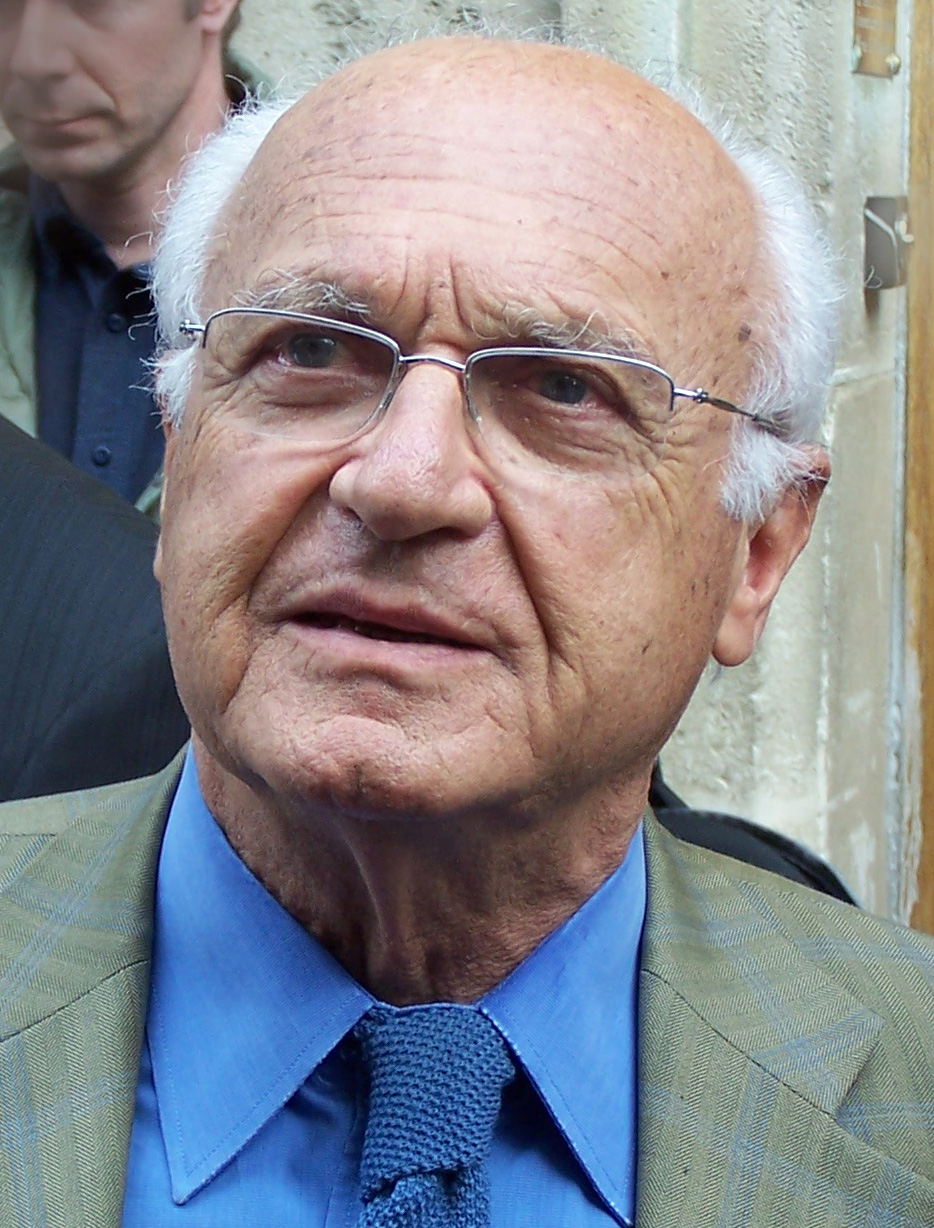
Pierre Charles Nora (French: [pjɛʁ ʃaʁl(ə) nɔʁa]; 17 November 1931 – 2 June 2025) was a French historian elected to the Académie Française on 7 June 2001.[1] As editor at Éditions Gallimard, he established the Library of Social Sciences in 1966 and the Library of Histories in 1970. He was director of studies at the School for Advanced Studies in the Social Sciences from 1977 for four decades. Nora is known for having directed Les Lieux de Mémoire, four volumes focused on places and objects of remembrance which incarnate the national memory of the French, writing a new history (nouvelle histoire).

Key Information

Early life and education

[edit]

Nora was born in Paris on 17 November 1931,[2][3] the youngest son of four children – the others were Simon, Jean and Jacqueline – born to Gaston Nora, a prominent Parisian urologist,[a] and his wife, Julie Lehman.[4] During the war, he became acquainted with intellectuals Jean Prévost and Jean Beaufret, who was to become a major figure in the introduction of Heidegger's philosophy to France.[5] In the 1950s, together with Jacques Derrida,[6] he took hypokhâgne and khâgne at the Lycée Louis-le-Grand but, contrary to popular belief, he thrice failed to be accepted at the École Normale Supérieure.[2][7] This setback, which he shared with his school-mate Pierre Vidal-Naquet, was one which Nora came to regard as a stroke of luck, particularly in terms of the example set by another friend, Jean-François Revel,[8] since it made him believe he was led to live a far more interesting life than would otherwise have been the case, contrasting his own situation with that of Gérard Granel.[9][10] Around this time, the poet René Char came to play an important role in his formation. Through him Nora met his first love, Madagascan Marthe Cazal (1907–1983), a major model for the figure of Justine in Lawrence Durrell's The Alexandria Quartet.[11] Thereafter, he obtained a licence de lettres (equivalent to the Bachelor of Arts) degree in philosophy.[2][3] He passed the agrégation d'histoire in 1958.[3][12]

Career

[edit]

Nora taught at the Lycée Lamoricière d'Oran in Algeria from 1958 until 1960. He wrote a book about his experiences, published under the title Les Français d'Algérie ("The French of Algeria") (1961).[2] In 1962, when the Évian peace treaty was signed – later confirmed by a subsequent referendum – which ended the Algerian War, a ceasefire came into effect. Nora, despite not knowing a word of Hebrew was asked to travel there and both look into the situation of Algerian Jews and secure their archives for repatriation. He met Ben Bella who, embracing him, asked Nora to sit by his side as his motorcade drove into Algiers the following day. Ben Bella was under the impression that Nora, whose account of Algeria he had read with admiration while in prison, was a member of the local Algerian Jewish community. During the same May week, he was stopped with several others by a group of insurgents and stood against a wall for execution, a fate avoided by the timely intervention of the local police.[2][13]

From 1961 to 1963, he was a resident at the Fondation Thiers. From 1965 to 1977 he was first assistant and then lecturer at the Institut d'Études Politiques de Paris (Paris Institute of Political Science). [3] From 1977 he was the director of studies at the École des hautes études en sciences sociales (School for Advanced Studies in the Social Sciences), holding the post for four decades.[2][3] In 2014, Nora received the Dan David Prize for his contribution to "History and Memory."[14][15]

Publishing

[edit]

Concurrently, Nora had pursued an important career in publishing. He joined Éditions Julliard in 1964, where he created the Archives paperback collection.[1] In 1965 he joined Éditions Gallimard:[1] the publishing house, which already had a good market share in literature, wanted to develop its social sciences sector. It was Pierre Nora who achieved this mission by creating two important collections, the Library of social sciences in 1966 and the Library of histories in 1970, as well as the Témoins collection in 1967.[1][2][16] At Éditions Gallimard, under Nora's direction many major works of scholarship were published that became landmarks in their respective fields, such as books by Raymond Aron, Michel Foucault, Emmanuel Le Roy Ladurie,[2] Georges Duby, Georges Dumézil, François Furet and, Jacques Le Goff, and translations of books by Elias Canetti, Ernst Kantorowicz and Thomas Nipperdey.[17]

This important role gave to Nora a certain power in French publishing and he was also the object of criticism. He declined to translate Eric Hobsbawm's work, The Age of Extremes (1994). Nora admired the book, admitted its high quality but after a long delay, turned it down, telling Hobsbawm that the high costs of translation would make its sale price prohibitive, and the French left itself, given the times, would be hostile. A further reason, Nora mentioned to a third party, was that the Shoah by then had moved to the centre of cultural memory and the word Auschwitz only appeared once in Hobsbawm's book.[18] Publicly, he stated in 1997 that his rejection stemmed from the author's "attachment to the revolutionary cause". Nora explained that context of hostility towards Communism in France was not appropriate to that type of publication, that all the editors, "like it or not, had an obligation to take account of the intellectual and ideological situation in which they had written their works".[19]

Intellectual life

[edit]

In May 1980, Nora founded at Gallimard the review Le Débat[1] with philosopher Marcel Gauchet; this quickly became one of the major French intellectual reviews.[2][16] In 1983, French historian Jacques Julliard judged Nora to be the natural heir to the role played by Raymond Aron.[20].[b] This law, at line 2 of article 4, was abrogated on 15 February 2006, establishing that research programmes must be accorded more importance in lieu of French overseas presence and that the programmes of study came to recognize the positive role. - bring back only with a ref --> Nora was well known for having directed Les Lieux de Mémoire, three volumes which gave as their point the work of enumerating the places and the objects in which are the incarnate national memory of the French.[2] Nora's book Les Français d'Algérie ("The French of Algeria") (1961) has received scholarly criticism for its alleged bias against French Algerians ("Pieds-Noirs") – a prejudice held by many French intellectuals of the time. Nora posited that the French Algerians (or settlers) were different from the French of the Metropol. His opinions were developed from his two years as a high school teacher in Algiers. "The French of Algeria" is described as synthesizing "a self-righteous anti-pied noir discourse".[21] "The French of Algiers" is often cited as a scholarly work, though some dissent. David Prochaska, American historian of French Algeria argues that it is in fact "not based on original research and is devoid of the usual scholarly apparatus".[22][23]

Personal life

[edit]

Nora was the brother of Simon Nora, a senior French administrative professional. He was the uncle of Olivier Nora, the president and publisher of the French publishing house Editions Grasset.[24]

He was married to art historian and curator Françoise Cachin from 1964 to 1976,[2][25] and had a 40-year relationship with Gabrielle van Zuylen,[2][26] who died in 2010. After 2012, he lived with French journalist and TV anchor Anne Sinclair, ex-wife of journalist Ivan Levaï and of former politician Dominique Strauss-Kahn.[27][28] He had a son, now a biologist in San Francisco,[2] by a third companion.[9][29]

Nora was an Ashkenazi Jew.[c][d] In 2001, on the occasion of his induction into the Académie française in the wake of the death of the novelist Michel Droit, he had his ceremonial sword inscribed with the Star of David to attest to his feeling that 'the Jewish contribution to the world belongs to things of the mind more than to weaponry. Because I shall consider myself Jewish as long as somewhere a Jew is threatened because of his identity.'[33]

Nora died in Paris on 2 June 2025, at the age of 93.[1][2][34]

Honours and awards

[edit]

Honours

[edit]

Awards

[edit]

Honorary degrees

[edit]

Bibliography

[edit]

See also

[edit]

Notes

[edit]
[edit]
Revisions and contributorsEdit on WikipediaRead on Wikipedia
from Grokipedia
Pierre Nora (17 November 1931 – 2 June 2025) was a French historian, essayist, editor, and public intellectual best known for conceiving and directing the monumental multi-volume project Les Lieux de mémoire, which analyzed the symbols, sites, and practices embodying French national memory and identity. Born in to a Jewish family, Nora pursued studies at the and initially specialized in Algerian history before shifting focus to the cultural and memorial dimensions of French history. As an editor at from 1966 onward, Nora played a pivotal role in shaping postwar French intellectual discourse by directing influential collections such as the Bibliothèque des histoires, which revived interest in , and by key works from thinkers like . His Les Lieux de mémoire, launched in 1984 and spanning seven volumes by 1992, introduced the concept of "lieux de mémoire" as realms where memory crystallizes in the absence of living tradition, fundamentally influencing on and worldwide. Elected to the in 2001, Nora's career bridged academic rigor with public engagement, critiquing the acceleration of history and the in modern societies while defending a nuanced understanding of France's republican heritage against reductive ideological interpretations.

Early Life and Education

Family Background and Childhood

Pierre Nora was born on November 17, 1931, in 's 8th arrondissement, the youngest of four children—siblings Simon, Jean, and Jacqueline—in a prosperous, assimilated family of the Parisian bourgeoisie. His father, Gaston Nora, was a renowned urologist, veteran, and decorated physician who continued practicing in occupied Paris despite risks, embodying a staunch outlook that viewed French Jews as indigenous rather than Eastern migrants. His mother, Julie Lehman, descended from an Alsatian Jewish lineage, and the family maintained a secular, republican ethos prioritizing integration into French society over overt religious observance. Nora's early childhood unfolded amid the comforts of bourgeois , initially on rue La Boétie, marked by familial contrasts: a dynamic household blending intellectual rigor, medical prestige, and subtle Jewish traditions subdued by assimilationist ideals. The outbreak of at age eight thrust the family into peril under France's anti-Semitic statutes; in 1940, Nora, his mother, and siblings fled to the unoccupied southern zone, evading deportations and internment that claimed over 75,000 French , while his father remained in treating patients under German oversight. These years of concealment, relocation, and fragmented family life—from ages nine to thirteen—instilled a acute awareness of vulnerability and identity erosion, experiences Nora later reflected upon as pivotal to his preoccupation with . From this wartime crucible emerged Nora's foundational immersion in and , facilitated by family discussions, clandestine readings, and encounters with Resistance-linked intellectuals like Jean Prévost, nurturing a hybrid identity—deeply French yet shadowed by Jewish marginality—that subtly prefigured his analytical focus on sites of as anchors against historical . The emphasis on resilience and cultural fidelity in his upbringing, rather than overt victimhood, underscored a pragmatic adaptation that distanced the family from both collaboration and post-war compensatory narratives.

Academic Training

Nora pursued his secondary education at the in before relocating to in the early 1950s for advanced preparatory studies. In , he attended the and , completing the demanding curriculum designed to prepare students for elite institutions such as the . Although he failed the entrance examination for the , Nora continued his university studies, earning a licence in philosophy. His academic grounding in history emphasized rigorous examination of primary sources and structural analysis, aligning with the empirical traditions of the , which prioritized long-term social and economic processes over event-based or ideological interpretations. In 1958, at age 26, he successfully passed the national competition in , a highly selective qualification enabling advanced teaching roles and further research. This credential marked the culmination of his formal training, equipping him with skills in archival methods and critical focused initially on socioeconomic dimensions of the past.

Professional Career

Early Academic Roles

Nora defended his doctoral thesis in 1963 on (1795–1856), a pioneering liberal historian whose work emphasized and national origins, thereby aligning himself with the Annales school's emphasis on interdisciplinary and structural approaches to the past. This research focused on 19th-century , exploring Thierry's influence on and education through romantic and positivist lenses. From 1965 to 1977, he held positions as maître-assistant () and then at the Institut d'Études Politiques de (), teaching courses in and while advancing research tied to the Annales under figures like . In this role, Nora contributed to collective projects on structural , publishing analyses in journals such as Annales: Économies, Sociétés, Civilisations that examined long-term cultural and institutional developments rather than event-based narratives. By the mid-1960s, amid his tenure, Nora began transitioning from the Annales' quantitative and socioeconomic emphases toward cultural and intellectual themes, critiquing the school's evolving Marxist orientations as overly deterministic. This shift marked his early establishment as a bridging with reflections on and in modern .

Editorial Positions at Gallimard

Pierre Nora joined Éditions Gallimard in 1965, initially directing the Bibliothèque des sciences humaines collection, which focused on interdisciplinary works in history, sociology, and philosophy. In 1971, he founded the Bibliothèque des Histoires, a series dedicated to revitalizing historical narrative by emphasizing storytelling and event-centered accounts over the dominant structuralist and analytic approaches of the Annales school. This collection, co-directed with Jacques Le Goff, included seminal volumes such as Faire de l'histoire (1974), which Nora co-edited, advocating for a return to histoire-problème that integrated narrative flair with rigorous analysis to engage broader readerships. As an editor, Nora championed historians challenging Marxist interpretations of the past, notably overseeing François Furet's Penser la Révolution française (1978), which critiqued teleological views of the as an inevitable progression toward . He facilitated the publication of dissident intellectuals opposing the post-1968 dominance of leftist and , including works by and other anti-totalitarian thinkers, thereby countering the ideological conformity prevalent in French academia during that era. Nora's curatorial choices prioritized texts exploring French national heritage and identity, such as monographs on , republics, and cultural symbols, which helped steer public discourse toward reflective amid deconstructive trends in . By 1980, his influence extended to founding Le Débat under Gallimard's imprint, though his editorial tenure emphasized commissioning manuscripts that privileged empirical scrutiny over ideological abstraction, shaping the publisher's output in humanities for decades.

Directorship and Institutional Roles

Nora was appointed director of studies at the École des Hautes Études en Sciences Sociales (EHESS) in 1977, a role he held for over four decades until his retirement. In this capacity, he led seminars and research initiatives in , promoting interdisciplinary approaches to that influenced subsequent at the institution. His tenure at EHESS extended his editorial influence into academic governance, where he supervised doctoral training and collaborative projects on French historical consciousness. During the 1980s, amid debates on and patrimony, Nora engaged in discussions shaping French cultural policy, particularly regarding heritage preservation, as evidenced by his commentaries on the societal role of historical sites and traditions. These interventions complemented his institutional work, bridging academic with broader policy considerations on cultural continuity. On June 6, 2001, Nora was elected to the in the first round of voting, securing 18 votes against competitors including Henri Amoroso, Christian Dedet, and Gonzague Saint-Bris. This induction affirmed the French establishment's recognition of his scholarly framework, which integrated empirical analysis of memory sites with critical reflections on national narrative evolution.

Intellectual Contributions

The Concept of Lieux de Mémoire

Pierre Nora introduced the concept of lieux de mémoire (sites or realms of memory) in his editorial introduction to the multi-volume project Les Lieux de mémoire, published by Gallimard from 1984 to 1992 across seven volumes in three parts. This framework posits that modern societies, particularly post-Revolutionary , have lost the organic, unselfconscious milieux de mémoire—embedded environments where fused seamlessly with lived experience and ritual—due to profound social transformations that historicize the past. In their place, lieux de mémoire emerge as deliberate, constructed symbols, monuments, rituals, or institutions that serve as compensatory mechanisms, preserving a sense of continuity amid discontinuity. Central to Nora's analysis is the "acceleration of history," a process driven by industrialization, democratization, and secularization since the late , which erodes spontaneous generational transmission of and replaces it with archival, reflective . This shift, Nora argues, compels societies to fabricate sites of to evoke what has vanished, revealing causal mechanisms whereby commemorative practices—such as annual reenactments or symbolic appropriations—sustain national identity by ritualizing shared narratives. The project catalogs over 130 such sites, including figures like , events such as the on July 14, 1789, and emblems like the tricolor flag, each dissected through interdisciplinary essays to trace how they crystallize collective self-understanding. Nora's framework underscores the fragility of in accelerated , where lieux de mémoire function not as inert relics but as active loci fostering cohesion through repeated invocation, countering fragmentation from universalist ideologies that dilute particularist ties. Critics, often from academic circles inclined toward postmodern or multicultural perspectives, have labeled the approach nostalgic for an idealized pre-modern unity, accusing it of overlooking exclusions like colonial legacies in French memory. However, Nora defends it as an empirical grounded in observable historical rupture, not , emphasizing that without such sites, nations amnesia amid relentless change. This realism highlights how commemoration causally reinforces social bonds, even if artificially sustained.

Historiographical Innovations

Pierre Nora advanced the methodological approach known as histoire du temps présent, or "history of the present," which emphasized deep and narrative reconstruction to interpret contemporary phenomena through their historical roots, rather than abstract models. This shift responded to what he perceived as the "acceleration of history" following the decline of rural and traditional memory transmission in the post-World War II era, urging historians to engage directly with the immediacy of lived experience while maintaining critical distance. In his 1984 essay "Entre mémoire et histoire: La problématique des lieux de mémoire," Nora delineated a fundamental distinction between mémoire—a spontaneous, , and non-transferable form of remembrance tied to lived environments—and histoire, a deliberate, reconstructive discipline that scrutinizes and often supplants fading memory. He argued that modern societies, severed from organic memory by and , compensate through deliberate commemorations, necessitating historiography that probes these mechanisms empirically rather than ideologically. Nora critiqued the later phases of the for overemphasizing socio-economic , quantitative methods, and long-term mentalités at the expense of narrative causality and event-specific analysis, viewing them as detached from the concrete contingencies shaping historical outcomes. Instead, he prioritized causal realism by reconstructing pivotal sequences—such as the French Revolution's engendering both national cohesion and enduring fractures—through primary sources, rejecting deterministic frameworks that obscured human agency and contingency. This approach debunked teleological myths, including notions of inexorable republican advancement, by grounding interpretations in verifiable archival traces rather than projected ideologies. While Nora's framework influenced international by highlighting the constructed nature of national narratives, he insisted on empirical specificity to national contexts, cautioning against universalist abstractions that dilute causal particularities. His innovations thus fostered a attuned to the interplay of rupture and continuity in the present, informed by rigorous over postmodern or institutional orthodoxies.

Key Essays on Memory and History

In his 1989 essay "Between and : Les Lieux de Mémoire," Pierre Nora articulates a fundamental rupture between organic —rooted in perpetual, unreflective communal bonds to the past—and reconstructive , accelerated by modern societal changes that dissolve traditional milieux de mémoire. He argues that this temporal dislocation, evident in the erosion of spontaneous cultural transmission since the late 19th century, compels societies to fabricate deliberate sites of remembrance, as genuine memory environments vanish under urbanization and secularization. Nora extends this analysis in standalone reflections, critiquing patrimonialization as a mechanism where state-driven heritage efforts—such as monumental preservation and official commemorations—usurp lived communal , substituting empirical traditions with abstracted, top-down narratives. Drawing on French case studies, including rural depopulation's role in severing generational ties to agrarian rituals by the mid-20th century, he posits that this process fosters inert symbols over dynamic causal anchors, diminishing identity's organic resilience. Post-1990s abridgments like those in Les Lieux de mémoire: La Nation adapt these arguments to national identity formation, rooted in verifiable French data such as evolving patriotic observances, while suggesting applicability to other contexts where memory's commodification mirrors similar empirical declines in ritual efficacy. Nora emphasizes rituals like July 14 celebrations—standardized since 1880 as Bastille Day—as concrete, repeatable anchors for collective continuity, countering abstract ideological impositions by grounding transmission in observable, participatory acts rather than doctrinal universality. In a 2001 essay, he further diagnoses a global "tidal wave" of memory sacralization, where personal recollections eclipse historical rigor, exacerbating cultural fragmentation absent robust, evidence-based anchors.

Political and Cultural Views

Defense of French National Identity

Nora portrayed France as a "memory-nation," the culmination of a historical unification of and that persisted until disruptions from the two World Wars and modernization fragmented collective remembrance into isolated, milieu-bound experiences. In this framework, lieux de mémoire—material, symbolic, or functional sites such as monuments, rituals, and archives—emerged as compensatory mechanisms to reconstruct and sustain amid the erosion of spontaneous, living . These sites, deliberately cultivated in a deritualized era, preserve France's particularist heritage by crystallizing commemorative patterns that link past continuity to present cohesion, countering the pedagogical void left by history's critical detachment. He critiqued radical laïcité for accelerating the dilution of Catholicism's deep roots in French identity, tracing the decline of this religio-national conjunction to events like Vatican II in the 1960s, which severed longstanding ties between faith and the "profonde France" of rural, monarchical traditions. Nora advocated a balanced recognition of monarchy-republic tensions, viewing the effective end of monarchical resonance with Charles de Gaulle's death in 1970 and the marginalization of republican symbols like Marianne as symptoms of unresolved heritage loss, rather than grounds for further secular erasure. This stance positioned Catholic-inflected elements as integral to resisting homogenizing pressures, including global cultural imports that threaten France's distinct symbolic repertoire. Commemoration patterns in Nora's analysis provide empirical grounding for memory sites' contributions to social cohesion, as seen in the surge of —43% devoted to —reflecting a broader revival of national practices to mend societal fractures. He emphasized privileging these French-centric lieux over supranational identities, such as those promoted by the , which he implicitly critiqued as extensions of modern forces eroding particularist anchors in favor of abstracted, future-oriented unifications. By anchoring cohesion in tangible national symbols like and , Nora argued, could fortify its heritage against such dilutions.

Critiques of Modern Republicanism and Universalism

Pierre Nora contended that modern French Republicanism, particularly its Third Republic incarnation, fabricated a veneer of historical continuity by deploying abstract universalist principles that obscured the seismic memory ruptures induced by the Revolution of 1789. In his essay "Between Memory and History: Les Lieux de Mémoire" (1989), he described how positivist —from Augustin Thierry's works in 1827 to Charles Seignobos's syntheses in 1933—sought to forge a "true" national through scientific rigor, linking Greco-Roman origins seamlessly to Third Republic colonies and ignoring the Revolution's destruction of organic, milieu-based traditions. This imposed synthesis, Nora argued, suppressed spontaneous in favor of state-orchestrated narratives, as " is perpetually suspicious of , and its true mission is to suppress and destroy it." Nora specifically cited Third Republic educational reforms as mechanisms for this fabrication, noting how standardized school curricula under figures like Ernest Lavisse promoted Republican myths via textbooks such as Le Tour de la France par deux enfants (1877), which evoked a nostalgic, unified past to indoctrinate youth while erasing pre-revolutionary cultural discontinuities. These reforms, implemented amid post-1870 consolidation efforts, prioritized universalist ideals of citizenship over empirical historical gaps, contributing to the "acceleration of history" that severed societies from their ancestral reference points. He further dismantled leftist historiographical claims of inexorable progress by exposing causal failures in Republican universalism, such as the regime's suppression of colonial memories to sustain egalitarian pretensions despite policies entailing atrocities and repression from the onward. In Les Lieux de mémoire, Nora portrayed these omissions as symptomatic of 's abstract detachment from particular realities, where colonial expansion contradicted the Revolution's fraternity while leftist narratives retrofitted to imply linear advancement. Advocating instead a grounded realism, Nora emphasized France's "immemorial" pre-revolutionary heritage—rooted in monarchical continuity and Catholic traditions—as vital for authentic national stability, preserved through lieux de mémoire rather than dissolved by universalist critiques. This perspective countered Republican legacies by privileging empirical traditions over fabricated unities, recognizing the Revolution's trauma as a persistent identity fracture that abstract ideologies only exacerbate.

Engagements with Jewish Memory and Assimilation

Pierre Nora, born to an assimilated Jewish of Algerian origin that had integrated into the French Republic by changing its from Aron to Nora, approached Jewish through the lens of his secular, republican upbringing, emphasizing the dissolution of particularist identities in favor of citizenship. This background informed his distinction between French narrative-based collective memory, rooted in historical events and spatial lieux de mémoire, and Jewish as ritualized "recitation," which lacks territorial anchorage and draws minimally from empirical history. In essays within Rethinking France (the English translation of Les Lieux de mémoire), Nora highlighted this contrast, drawing on Hayim Yerushalmi's Zakhor to argue that Jewish tradition prioritizes mnemonic recitation over historiographical narrative, rendering it a "non-place" within 's republican framework. Nora's Les Lieux de mémoire project incorporated Jewish elements, such as the , as a pivotal that embedded the into French national consciousness, symbolizing both republican integration successes—where Jews aligned with secular universalism—and underlying tensions of assimilation. He credited the Third Republic's emancipatory model with enabling Jewish identification with France's secular values, fostering empirical achievements in communal integration, yet critiqued the Vichy regime's state as a catastrophic failure that exposed the fragility of this republican pact and revived the ancient Jewish imperative zakhor (to remember). This era's amnesia, Nora argued, suppressed particular French-Jewish memory sites amid postwar narratives of resistance, delaying reckoning with collaboration until revelations in the 1970s. Post-Holocaust, Nora observed the emergence of a distinct Jewish "memory" in France, coinciding with intensified focus on Vichy, but warned of a widening gap between Jews as eternal "reciters" and French citizens bound by narrative history, implicitly challenging universalist abstractions that dilute specific lieux de mémoire. He advocated preserving empirically grounded Jewish-French memory sites—such as Dreyfus-era symbols—against erosion by disembodied commemoration, balancing recognition of assimilation's triumphs with the causal reality of historical ruptures like Vichy that necessitated targeted memorialization over generalized victimhood. This stance reflected his commitment to causal realism in historiography, prioritizing verifiable communal dynamics over ideologically driven universalism.

Controversies and Public Debates

Statements on Genocide Recognition

On October 12, 2011, during an on radio, Pierre Nora described the Armenian events of 1915 as a "very complicated affair" involving immense numbers of victims, but cautioned against the automatic use of the term "," arguing that the word had become "totally coded, politicized, and instrumentalized" in contemporary discourse. These comments occurred amid parliamentary debates over a proposed French law to penalize denial of the Armenian massacres, which Nora opposed as an infringement on historical inquiry, consistent with his earlier "Liberté pour l'Histoire" manifesto against "memory laws." The remarks provoked immediate backlash from Armenian advocacy groups and intellectuals, who interpreted them as a form of minimization or denial, accusing Nora of selective outrage that ignored Turkish state negationism while critiquing French recognition efforts. In response, Nora published a December 28, 2011, in , defending the need for historians to examine archival evidence—including recently disclosed Ottoman documents—without preconceived legal labels, highlighting causal factors like the empire's wartime collapse, internal rebellions, and mass deportations amid rather than a premeditated extermination campaign akin to . Nora's position underscored his longstanding distinction between subjective , prone to retrospective amplification of victimhood, and objective grounded in empirical variances across sources, rejecting in favor of that avoids inflating terminological precision for diplomatic or commemorative ends. This intervention exemplified his broader resistance to state-imposed narratives on contested historical tragedies, prioritizing evidentiary rigor over politicized consensus.

Clashes with Annales School and Postmodern Historians

By the 1970s, Pierre Nora diverged from the 's structuralist framework, particularly Fernand Braudel's emphasis on and collective mentalités as enduring, continuous undercurrents shaping societies. Nora contended that such approaches neglected the inherent discontinuity of memory, which manifests through ruptures tied to symbolic events rather than seamless structural evolutions, rendering total history—an Annales ideal—an unattainable unification of past and present. His alternative, evident in early essays and later crystallized in Les Lieux de mémoire (launched 1984 but conceived amid 1970s historiographical shifts), prioritized memory's fragmented persistence over structural determinism, reintroducing political and event-based analysis sidelined by Annales' focus on quantifiable social depths. Nora's extended to confrontations with postmodern theorists, including Michel Foucault's conception of , where historical "truth" emerges solely from discursive formations without anchor in verifiable events. Nora rejected this deconstructive lens, advocating for historiography grounded in causal sequences and documentary evidence to discern real discontinuities from interpretive overlays, thereby safeguarding history's reconstructive rigor against relativist dissolution. These positions reinvigorated by elevating memory sites as empirical touchstones for national and cultural causality, countering Annales' aversion to histoire événementielle. Yet peers in circles, wedded to structural and quantitative methods, labeled Nora's turn conservative, accusing it of romanticizing discontinuity at the expense of materialist analysis.

Responses to Multiculturalism and National Decline

In his later commentaries, Pierre Nora warned that and sustained since the had fragmented France's shared lieux de mémoire by promoting insular minority communities over a unified national narrative. He identified a critical in the and , where social identities supplanted the cohesive forged through , resulting in the emergence of groups maintaining their "in the intimacy of their own community" rather than integrating into broader French commemorative practices. This shift, Nora argued, eroded the essential for national continuity, as evidenced by the diminished transmission of heritage and the rise of parallel cultural enclaves. Nora critiqued the normalization of hybrid identities in media and , viewing it as detached from causal realities of assimilation challenges, particularly with immigrants resistant to republican norms on and law. While acknowledging immigration's role as one factor among broader declines—like decolonization's aftermath and European sovereignty losses—he rejected but stressed its exacerbation of identity dilution, where minority memories increasingly supplanted centralized historical unity. Proponents of pluralism, often aligned with frameworks, defended for injecting diverse cultural inputs and challenging monolithic histories; Nora countered with evidence of resulting cohesion risks, including faltering national projects and a present-oriented society lacking future-oriented shared anchors. To counter this decline, Nora advocated realist integration rooted in historical , emphasizing chronological of successive French identities—from feudal to republican—to rebuild communal bonds and prevent further erosion of lieux de mémoire. He posited that without such anchors, risked perpetual identity troubles, as grand national narratives yielded to fragmented, reactive sentiments. This perspective, grounded in his analysis of post-1960s societal mutations, highlighted causal links between unanchored diversity and weakened social fabric, prioritizing empirical observation of heritage transmission failures over idealized pluralism.

Personal Life and Death

Family and Personal Relationships

Pierre Nora was born on November 17, 1931, in , to Gaston Nora, a physician, and Julie Lehman, as the youngest of four siblings in a Jewish Ashkenazi family; his siblings included brothers Simon Nora, a prominent civil servant who predeceased him in 2006, and Jean, as well as sister Jacqueline. Nora married art historian and director Françoise Cachin in 1964; the couple divorced in 1976 after 12 years, during which they had one son, Elphège Nora, a cardiovascular researcher based in . Cachin, who died in 2011, maintained her own distinguished career separate from Nora's historical pursuits. Following his divorce, Nora entered a long-term relationship with Gabrielle van Zuylen, a Dutch-born author and intellectual, which lasted approximately 40 years and overlapped with aspects of his professional life in subtle ways, though details remained private. In his later years, from around 2012, he partnered with Anne Sinclair, with whom he shared a stable companionship until his death. Despite his prominence in French intellectual circles, Nora kept his family life notably discreet, prioritizing personal stability amid intense public engagements on history and memory; he was uncle to publisher Olivier Nora, son of his brother Simon. This reticence contrasted with his more visible collaborations, such as those with historian , which stemmed from personal friendships but did not extend to family integration.

Health Decline and Death in 2025

In his early 90s, Pierre Nora faced the typical frailties associated with advanced age, though specific public accounts of his health trajectory in the early remain limited. He continued intellectual output into this period, including the 2021 publication of his Jeunesse, which examined connections between personal youth experiences and broader themes of . Nora died on June 2, 2025, at the age of 93, in a hospital. His son, Elphège Nora, confirmed the cause as multiple organ failure. The family provided no additional details on preceding medical conditions to , maintaining privacy amid the announcement. His passing occurred against a backdrop of persistent public debates on French , themes to which Nora had contributed extensively earlier in his career, though he withdrew from active commentary in his final years.

Honors, Legacy, and Reception

Major Awards and Academic Recognitions

Pierre Nora was elected to the Académie française on June 6, 2001, securing the seat with 18 votes on the first ballot, a recognition of his stature as a leading French historian and intellectual. This election affirmed his contributions to French cultural and historiographic discourse, particularly through editorial and scholarly work that emphasized national memory over ideological historiography. In 2014, Nora received the Dan David Prize, awarded by for outstanding contributions to "History and Memory," highlighting his pioneering concept of lieux de mémoire as a framework for understanding and historical consciousness. The prize, valued at $1 million and shared among laureates, underscored his influence in establishing interpretive categories that prioritize empirical sites of remembrance in . Nora was also honored with the rank of Grand Officer of the Legion of Honour and Grand Cross of the National Order of Merit, distinctions reflecting state acknowledgment of his lifelong advancements in publishing, editing, and historical scholarship that favored substantive intellectual rigor over politicized narratives. These French honors, among the highest civilian awards, were conferred for his role in shaping debates on memory and national patrimony through works like the multi-volume Les Lieux de mémoire.

Influence on Memory Studies and National Discourse

Nora's conceptualization of lieux de mémoire in his seven-volume collaborative project Les Lieux de mémoire (1984–1992) established a foundational paradigm in by positing these sites—monuments, rituals, and symbols—as compensatory mechanisms for the erosion of organic, milieu-based under modern conditions of historical acceleration. This distinction between unselfconscious memory and deliberate historical reconstruction prompted a surge in interdisciplinary scholarship, with Nora's framework adapted to analyze national identities beyond , including studies of American and German commemorative practices that cite his work as a methodological . Empirical evidence of its academic traction includes its integration into curricula and research programs in , where it has facilitated over 10,000 scholarly references in databases like by the early 2000s, reflecting a post-1990s expansion amid debates on globalization's impact on tradition. In French national discourse, Nora's emphasis on as a bulwark against relativist influenced policy-oriented reflections on , notably informing the Fifth Republic's post-1980s initiatives to elevate patrimonial awareness, such as the 1980 Heritage Year campaigns that aligned with his advocacy for crystallizing national symbols to foster continuity. His ideas bolstered defenses of traditions in intellectual circles skeptical of structuralist dominance, reviving centered on narratives and symbolic anchors that sustain civic cohesion without descending into . This causal role is evident in the project's consecration as a reference for public intellectuals addressing identity fragmentation, evidenced by its invocation in policy documents on museum curation and commemorative events during the cultural reforms under figures like Jack Lang. Critiques highlight limitations in Nora's model, including an alleged Eurocentric orientation that prioritizes metropolitan France's symbolic repertoire over colonial legacies, as seen in the marginal treatment of overseas territories' despite visual traces in the volumes. Detractors argue this elite-centric focus—emphasizing high-cultural artifacts like the or —underplays subaltern or migratory experiences, constraining its utility for pluralistic societies, though proponents counter that such specificity enabled a rigorous causal mapping of how sustains national resilience against ideological dissolution.

Critical Assessments and Enduring Debates

Pierre Nora's framework in Les Lieux de mémoire, distinguishing spontaneous, from critical history, has been lauded for elucidating the causal mechanisms of identity erosion in accelerated modern societies, where organic traditions dissolve into deliberate, symbolic sites of remembrance. Scholars such as those in commend this as a prescient diagnosis of how post-1960s and fragmented France's lived historical consciousness, prompting compensatory national myth-making verifiable in the proliferation of heritage institutions and commemorations since the . Critics, particularly from postcolonial and left-leaning academic circles, argue that Nora's paradigm exhibits nostalgic conservatism by prioritizing a republican, "hexagonal" French identity while marginalizing power dynamics inherent in imperial legacies and . Works like Postcolonial Realms of Memory highlight empirical gaps, such as the exclusion of colonial sites from Nora's volumes, which obscured how France's overseas shaped domestic , evidenced by unaddressed traces in his own pictorial entries that inadvertently reveal suppressed extraterritorial influences. This omission, they contend, reflects a selective verifiability favoring , assimilationist narratives over subaltern perspectives, as seen in the minimal treatment of North African migration's impact on national symbols post-1970s. Enduring debates center on the tension between memory's purported particularity and history's universality, with Nora positing memory as an eternal present antithetical to historical relativism, yet challenged by counterexamples of resilient communal memories in diaspora groups that persist without formal lieux. For instance, persistent ethnic narratives among Algerian-French communities demonstrate memory's adaptability beyond Nora's "end of memory" thesis, suggesting his model underestimates globalization's hybridizing effects rather than pure erosion. Recent obituaries underscore this duality: portrayed Nora as an intellectual innovator whose memory probes reshaped globally, while emphasized his role as a historian resisting cultural fragmentation, yet both noted tensions with postmodern and multicultural paradigms. These assessments affirm the paradigm's enduring influence—cited in over 5,000 academic works since 1984—while debates persist on its verifiability amid empirical shifts like rising , where memory sites increasingly incorporate contested, non-national elements.

References

Add your contribution
Related Hubs
User Avatar
No comments yet.