Hubbry Logo
Pyura chilensisPyura chilensisMain
Open search
Pyura chilensis
Community hub
Pyura chilensis
logo
8 pages, 0 posts
0 subscribers
Be the first to start a discussion here.
Pyura chilensis
Pyura chilensis
from Wikipedia

Pyura chilensis
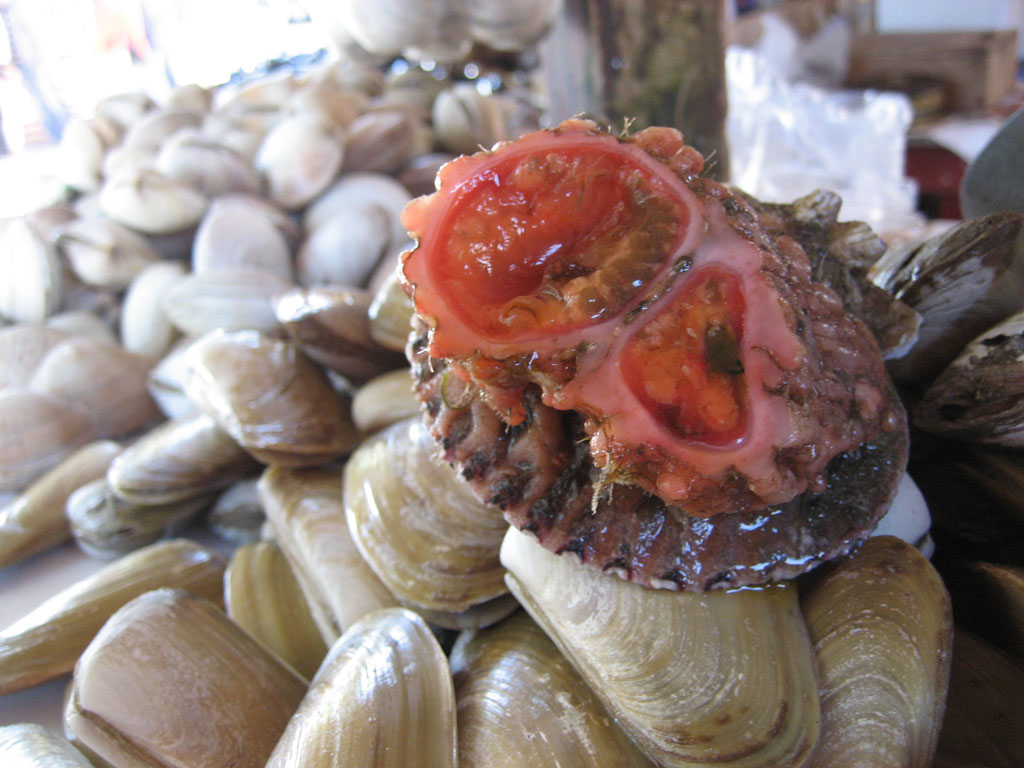
Piure on a bed of clams, harvested in the Valparaíso Region
Scientific classification Edit this classification
Kingdom: Animalia
Phylum: Chordata
Subphylum: Tunicata
Class: Ascidiacea
Order: Stolidobranchia
Family: Pyuridae
Genus: Pyura
Species:
P. chilensis
Binomial name
Pyura chilensis
(Molina, 1782)

Pyura chilensis, called piure in Spanish and piür or piwü in Mapudungun,[1] is a tunicate of the family Pyuridae. It was described in 1782 by Juan Ignacio Molina.[2]

Taxonomy

[edit]

The earliest mention of the P. chilensis was in 1782 by Juan Ignacio Molina in his book Saggio Sulla Storia Naturale del Chili. Molina, a Chilean abbot who was shunned from Chile along with the rest of the Jesuit missionaries, wrote this book to describe the life lived by the Chileans in the Chiloe Archipelago.[3] He briefly describes the natives' fondness of fishing and mentions the piure as another form of sustenance for the people.[4]

Description

[edit]

Pyura chilensis is a tunicate that somewhat resembles a mass of organs inside a rock. It is often found in dense aggregations in the intertidal and subtidal coast of Chile and Peru. It is a filter feeder that eats by sucking in seawater and filtering out microorganisms.

Pyura chilensis has some basic characteristics common to chordates, such as the notochord and a perforated pharynx. It is born male, becomes hermaphroditic at puberty, and reproduces by releasing clouds of sperm and eggs into the surrounding water. If alone, they will procreate by self-fertilization.[5]

Its blood is clear and can contain high concentrations of vanadium, which may be ten million times that found in surrounding seawater, although the source and function of this element's concentrations are unknown.[6]

Fishery

[edit]

On the Chilean coast, banks of P. chilensis are heavily fished.[7] The animal is also one of the main food sources for other local aquatic species such as the Chilean abalone (Concholepas concholepas), whose proliferation has threatened P. chilensis and severely restricted its growth for more than two decades.

Many locals gather the delicacy, mostly in rocky areas close to shore, but occasionally farther out to sea.

A specimen of Pyura chilensis being cut open to pull out the siphons from the carapace in the port of Arica, Chile.

Fishermen typically cut P. chilensis into slices with a handsaw, then use their fingers to pull out the siphons (which they refer to as tetas, or "tits") from the carapace, which is discarded. The flesh is usually sold in strips, but may be canned. It is exported to numerous countries, including, as of 2007, Sweden (32.5% of exports) and Japan (24.2%).[8]

Cuisine

[edit]
Raw piure in Valparaíso

The meat, which has a strong flavor, can be eaten raw or cooked. Its taste has been described as like that of iodine[9] or "something like a sea urchin though less delicate in flavor" and a "slightly bitter, soapy taste".[10][unreliable source?] It is usually cut into small pieces, and flavored with chopped onion, cilantro, and lemon. Minced and boiled, it serves as an element of many dishes, particularly arroz con piure picado, or "rice with minced piure". It can also be fried and eaten on bread. A similar edible tunicate in the Mediterranean is Microcosmus sabatieri, also called a sea violet or sea fig.[11]

P. chilensis has a high concentration of vanadium, with up to 1.9 mg/kg found in dry blood plasma.[12]

Effects on human reproduction

[edit]

On Chiloé Island of Chile, women who consumed increased amounts of piure during pregnancy were purported to have had greater incidency of multiple births.[13] However, the veracity of such claims, in light of mechanisms of human reproduction, remain dubious.[citation needed]

It is said to possess aphrodisiac properties and to have a significant sildenafil-like effect on men for a period of time after consumption.[14][15]

References

[edit]
Revisions and contributorsEdit on WikipediaRead on Wikipedia
from Grokipedia
Pyura chilensis, commonly known as piure or the edible sea squirt, is a sessile marine invertebrate in the Pyuridae that resembles a rock-like mass with vibrant red internal tissues encased in a hard, protective . This filter-feeding can grow up to 15 cm in diameter and weigh as much as 112 g, with two siphons for drawing in and expelling water; its blood is clear and notably rich in at concentrations up to 10 million times that of . Native to the southeastern Pacific coast from southern to southern and (approximately 18°S to 55°S), it thrives in temperate waters of the low intertidal to subtidal zones, preferring temperatures around 12°C. First described by Juan Ignacio Molina in 1782, P. chilensis is classified in the order Stolidobranchia of the class , subphylum Tunicata, and phylum Chordata. Its pyriform body attaches to rocky substrates, often forming dense aggregations that enhance habitat complexity. The species exhibits genetic differentiation with three mitochondrial lineages along its range. As a simultaneous , P. chilensis reproduces via broadcast spawning, producing lecithotrophic larvae that settle nearby to form aggregations. It acts as a and in the System, dominating hard-bottom communities and supporting , though populations face over-exploitation from fisheries. In , particularly among communities, it is valued for its intense flavor and consumed raw, cooked, or smoked, despite potential from its vanadium-rich blood in large amounts; is essential given depletion since the 1990s.

Taxonomy

Classification

_Pyura chilensis is classified within the kingdom Animalia, phylum Chordata, subphylum Tunicata, class , order Stolidobranchia, family Pyuridae, genus Pyura, and P. chilensis (Molina, 1782). This taxonomic placement reflects its status as an accepted with several junior synonyms listed in primary marine databases. Known synonyms include Ascidia pyura Gmelin, 1791; Cynthia chilensis (Molina, 1782); Pyura molinae Blainville, 1824; and others, all considered unaccepted. As a member of the subphylum Tunicata, Pyura chilensis exhibits key chordate characteristics during its larval stage, including a notochord that provides structural support in the tail region, a dorsal hollow nerve cord, and pharyngeal slits for filter feeding. These features underscore its phylogenetic proximity to vertebrates, distinguishing tunicates from other invertebrate groups despite the loss of the notochord in the sessile adult form. Pyura chilensis is distinguished from other species in the genus Pyura, such as Pyura stolonifera, by its endemic distribution along the southeastern Pacific coast of and significant genetic divergence, with approximately 25% base pair differences in sequences. In contrast, Pyura stolonifera belongs to a species complex distributed across , , and parts of , often exhibiting stoloniferous growth forms not observed in P. chilensis.

Discovery and Naming

Pyura chilensis was first described by the Chilean naturalist Juan Ignacio Molina in 1782, in his work Saggio sulla storia naturale del Chili, where he documented it as a marine organism native to Chilean waters. Molina, an abbot and early natural historian, provided one of the initial scientific accounts of the species based on observations from the region's coastal ecosystems. The species is known by several common names reflecting its cultural and regional significance, including "piure" in and "piür" or "piwü" in Mapudungun, the language of the indigenous people. In English, it is referred to as the edible sea squirt or red sea squirt, highlighting its appearance and edibility, while popular descriptions sometimes call it the "living rock" due to its rock-like exterior. Taxonomically, Pyura chilensis has several junior synonyms recorded, such as Ascidia pyura and chilensis, and its original binomial name has been upheld as valid in contemporary classifications. The (WoRMS) confirmed its status in a 2007 update, integrating it within the family Pyuridae without significant revisions to Molina's .

Biology

Morphology and Physiology

Pyura chilensis is a solitary characterized by its ovoid, rock-like external appearance, formed by a tough, leathery composed primarily of tunicin, a cellulose-like . The is typically wrinkled with protuberances and papillae, exhibiting colors ranging from orange to brown-black, and can reach up to 22 cm in height, though individuals are often smaller, around 5 cm in diameter. Two prominent s protrude from the upper surface: the incurrent (oral) for drawing in and the excurrent (atrial) for expelling filtered and waste; these s are quadrangular, red-colored, and positioned relatively close together, with the internal lining featuring pointed spinules for protection. The is semi-transparent in places, allowing visibility of internal organs such as the vividly orange mantle, which transitions to near the siphons. Internally, P. chilensis possesses a robust muscular that contracts to facilitate water movement. The oral leads to more than 18 branched tentacles for initial particle screening. The branchial sac, or basket, is a key structure for filter feeding, featuring six longitudinal folds per side (with the ventral-most fold less developed), 19–25 longitudinal vessels per fold, 3–6 vessels between folds, and up to nine per mesh, enabling efficient particle capture via a mucous net. The digestive system forms an open primary loop with a slight secondary loop, including a voluminous hepatic branching from the for processing; gonads are present as one per side, with the left within the primary loop and the right bent posteriorly, consisting of alternating lobes with proximal and distal components. Notably, the of P. chilensis is clear and contains high concentrations of , up to 10 million times that of , contributing to potential chemical defenses. As a sessile , P. chilensis leads an attached lifestyle after larval settlement, relying on ciliary action and muscular contractions of to drive its . Filter feeding occurs through the incurrent , where (estimated at 10–100 liters per day for mature individuals, scaled from rates in similar ascidians) is pumped into the branchial sac, trapping and organic particles on sheets that are directed to the digestive tract. Respiration and also occur via the branchial sac, where oxygen is extracted from the incoming before expulsion through the excurrent , supporting the organism's metabolic needs in oxygen-limited intertidal conditions.

Habitat and Distribution

Pyura chilensis is endemic to the southeastern , with a geographic distribution extending from central , near Ancón at approximately 11°S, to southern , including at around 42°S, spanning roughly 30° of along the coasts influenced by the [Humboldt Current](/page/Humboldt Current). This range encompasses diverse coastal environments from the arid north to the temperate south, where the species forms part of the dominant benthic communities on hard substrates. The species occupies the low intertidal zone down to subtidal depths of up to 70 m, primarily on rocky shores where it attaches to boulders, crevices, and other hard substrates. It forms dense aggregations in these habitats, which provide stability against currents and waves, and shows a preference for semi-protected areas while tolerating moderate wave exposure typical of exposed rocky coasts. Pyura chilensis thrives in waters with temperatures ranging from 12 to 20°C, characteristic of the -driven coastal regime, and salinities of 30 to 35 ppt, though it can tolerate lower salinities down to 25 ppt in central Chilean populations. Environmental variability, particularly during El Niño events that elevate sea surface temperatures and alter patterns, influences its distribution by causing interannual fluctuations in population densities and potential temporary range expansions or contractions.

Ecology and Life History

Feeding and Behavior

Pyura chilensis is a sessile suspension feeder that captures and organic particles from using ciliary action within its branchial basket. is drawn in through the inhalant and filtered across the branchial basket, where traps food particles for , while clean exits via the exhalant . This mechanism allows the organism to process substantial volumes of , supporting its growth in nutrient-rich coastal environments. As adults, P. chilensis remain permanently attached to substrates, exhibiting limited mobility beyond siphon adjustments for feeding and waste expulsion. Larvae, however, display active behaviors during settlement: they exhibit negative phototaxis, preferring shaded microhabitats with low light intensity (approximately 10 µE m⁻² min⁻¹) over illuminated areas (approximately 1000 µE m⁻² min⁻¹), which promotes settlement in crevices and under algal holdfasts. Additionally, larvae show positive rheotaxis in weak currents (1–3 cm s⁻¹), orienting upstream toward conspecific cues, but avoid high-flow conditions (21–30 cm s⁻¹) that hinder attachment. These behaviors contribute to gregarious settlement, forming dense aggregations with densities reaching up to 1000 individuals per square meter near protective structures like holdfasts. Aggregation patterns in P. chilensis are influenced by kin clustering, as revealed by genetic analyses showing higher relatedness among individuals within small-scale clusters (less than 1 meter apart). A 2019 study documented fine-scale hierarchical genetic structure, with full-sibling proportions of 2.5%–3.2% within aggregations, suggesting limited larval dispersal and localized that enhances through kin proximity. Such aggregations, often comprising dozens of individuals per clump, provide mutual benefits like reduced predation risk and improved feeding efficiency in flow-sheltered microhabitats. Ecologically, P. chilensis serves as a habitat provider for small , creating three-dimensional structures on rocky shores and artificial substrates that support diverse epifaunal . Its dense colonies offer refuge and attachment sites, fostering and biotic resistance against . As prey, it is consumed by local aquatic predators including and mollusks, contributing to trophic dynamics in intertidal ecosystems. Furthermore, P. chilensis contributes to on pilings and other structures, achieving up to 75% cover and influencing succession by facilitating native predator .

Reproduction

Pyura chilensis is a protandrous , beginning life with male gonads before developing female gonads later, resulting in simultaneous hermaphroditism with separate structures. Individuals first function as males at small sizes (mantle length <1 cm) and transition to hermaphroditism as they grow larger. As a broadcast spawner, it releases eggs and into the surrounding for , with cross-fertilization preferred when conspecifics are nearby. Although cross-fertilization predominates, P. chilensis is capable of self-fertilization, particularly under isolation; viable progeny develop after prolonged , such as 4 months, as demonstrated in laboratory experiments where isolated individuals produced fertilized eggs. Fertilization success rates show no significant differences between self- and outcrossed gametes, with comparable settlement and outcomes for progeny from both modes. The life cycle features a lecithotrophic, planktonic possessing a , which remains free-swimming for 12–24 hours before settling on suitable substrates and metamorphosing into a sessile adult. is high, with individuals capable of releasing up to 600,000 eggs per spawning event, alongside vast quantities of sperm (averaging 1.6 × 10¹⁷ per episode). Spawning occurs year-round, though it peaks during the austral summer months of to . The capacity for self-fertilization and short larval duration contribute to low dispersal, fostering genetic isolation by distance; however, spatio-temporal genetic analyses reveal admixture among mitochondrial haplogroups, indicating occasional despite predominant spatial structuring across its range.

Human Use

Fishery

Pyura chilensis is commercially harvested primarily by artisanal fishers in through manual collection in rocky intertidal habitats, where dense aggregations form. Traditional methods rely on free-diving for intertidal populations. This fishery holds economic significance for coastal communities in southern , contributing to exports of processed product to markets including and (as of 2007). Intensive harvesting has driven , resulting in population densities at exploited sites dropping to less than 1 individual per square meter—up to three orders of magnitude lower than in protected reserves—and mean individual sizes rarely exceeding 20 grams, limiting reproductive output to about 6% of harvested populations. Management efforts include the designation of marine reserves, such as the Mehuín Reserve, which exclude harvesting to allow recovery, and regulated Territorial Use Rights in Fisheries (TURF) systems under Management and Exploitation Areas for Benthic Resources (MEABR). Restocking initiatives by fishers' associations have released approximately 35,100 juveniles and adults across six projects, sourcing from both wild and hatchery-reared stocks to bolster depleted areas. Overfishing has caused notable declines in northern Chile, exacerbated by illegal extraction, prompting calls for expanded reserves covering more of the coastline. Genetic studies reveal three distinct lineages with spatial differentiation and temporal stability, informing sustainable practices by recommending lineage-specific sourcing for restocking to preserve diversity and avoid maladaptive admixture. A 2021 analysis of spatio-temporal structure across 24°–42°S underscores the need for targeted monitoring amid environmental variability, such as El Niño events, to support recovery. As of 2025, intensive harvesting continues to alter seabeds, affecting associated biodiversity. Aquaculture remains experimental, with limited hatchery production aiding stocking but no large-scale commercial cultivation established.

Cuisine

In Chilean and , Pyura chilensis is commonly known as piure and valued for its fleshy, red interior, which is harvested by discarding the tough outer . The edible portion is prized for its intense, iodine-rich flavor reminiscent of , making it a distinctive ingredient. Preparation methods emphasize enhancing its bold taste and firm texture, often requiring tenderizing through or cooking. It is frequently consumed raw in , marinated with juice, onions, , and chili to "cook" the flesh in citrus acids, a popular dish along the . Cooked preparations include stews and soups where the piure is minced and boiled, grilled on skewers with herbs, or smoked for added depth; in southern , it is sometimes dried on ropes before incorporation into broths. Traditional dishes feature it in empanadas filled with chopped piure, onions, , and cheese, or in sea blended with and served over mixed stews. Modern recipes, such as piure salads with , , and pairings, have gained traction in urban settings. Culturally, piure holds significance as a among coastal fishing communities, particularly the people who refer to it as piür or piwü, and it features prominently in costumbrista festivals celebrating Chilean heritage. It is seasonally available, with peak harvests tied to intertidal accessibility during calmer summer months ( to in the ), though sustainable practices allow year-round supply in markets. Sold fresh in coastal markets like Valparaíso's Mercado Central and port stalls, it commands high prices due to labor-intensive harvesting. Nutritionally, piure offers high protein content (12.3–16.6% on a wet weight basis) and is rich in iodine, iron, and vitamins, contributing essential minerals to local diets, though its firm texture benefits from prolonged cooking or acidification to improve palatability. Global interest in piure has surged since the early 2020s, driven by trends and its "ugly but appealing" aesthetic, as highlighted in a 2023 BBC feature that showcased its rise from local bays to Santiago's fine-dining scenes at restaurants like Boragó and La Calma. This exposure has introduced innovative recipes, such as piure-infused pestos and ceviches, to international audiences seeking novel, nutrient-dense marine ingredients.

Health Effects

Pyura chilensis offers several nutritional benefits when consumed as a , primarily due to its high-quality protein content and . The edible portions contain approximately 12.3% crude protein, characterized by a favorable profile with ratios ranging from 32% to 50% of total , making it a valuable source for muscle repair and overall . It is also low in lipids at about 1.4% crude fat, predominantly composed of beneficial ω-3 polyunsaturated fatty acids such as (EPA) and (DHA), which support cardiovascular health. It is rich in minerals like (higher than in many other marine species), iron, and iodine, the latter aiding hormone production and metabolic regulation. Despite these advantages, consumption carries potential risks, particularly related to trace elements and allergens. Pyura chilensis accumulates in its tissues, a heavy metal present in concentrations up to 1.9 mg/kg in dry , though levels have not been linked to in humans at moderate intake levels from culinary portions. Heavy metal levels, including lead and , generally remain below national safety standards in monitored populations, though from polluted coastal waters could elevate exposure in contaminated areas. Individuals with allergies may experience adverse reactions, as like Pyura chilensis share allergenic proteins with other , potentially triggering symptoms such as or . No peer-reviewed evidence supports claims of reproductive effects in humans, such as impacts, which appear to stem from misinterpretations of the organism's hermaphroditic rather than consumption data. To mitigate risks, moderation is advised, especially for pregnant individuals, where excess iodine intake could disrupt function and fetal development. Recent analyses from the confirm safe consumption levels without links to issues, emphasizing sourcing from clean habitats and limiting intake to recommended portions (e.g., 100–200 g weekly) to balance benefits like peptides with minimal hazards.

References

Add your contribution
Related Hubs
User Avatar
No comments yet.