Hubbry Logo
MolybdateMolybdateMain
Open search
Molybdate
Community hub
Molybdate
logo
8 pages, 0 posts
0 subscribers
Be the first to start a discussion here.
Contribute something
Molybdate
Molybdate
from Wikipedia
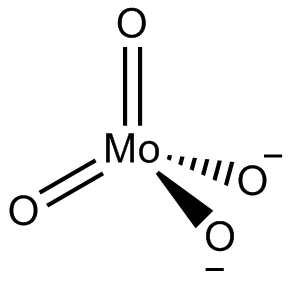
Structure of molybdate
3D model of the molybdate ion

In chemistry, a molybdate is a compound containing an oxyanion with molybdenum in its highest oxidation state of +6: O−Mo(=O)2−O. Molybdenum can form a very large range of such oxyanions, which can be discrete structures or polymeric extended structures, although the latter are only found in the solid state. The larger oxyanions are members of group of compounds termed polyoxometalates, and because they contain only one type of metal atom are often called isopolymetalates.[1] The discrete molybdenum oxyanions range in size from the simplest MoO2−
4
, found in potassium molybdate up to extremely large structures found in isopoly-molybdenum blues that contain for example 154 Mo atoms. The behaviour of molybdenum is different from the other elements in group 6. Chromium only forms the chromates, CrO2−
4
, Cr
2
O2−
7
, Cr
3
O2−
10
and Cr
4
O2−
13
ions which are all based on tetrahedral chromium. Tungsten is similar to molybdenum and forms many tungstates containing 6 coordinate tungsten.[2]

Examples of molybdate anions

[edit]

Examples of molybdate oxyanions are:

The naming of molybdates generally follows the convention of a prefix to show the number of Mo atoms present. For example, dimolybdate for 2 molybdenum atoms; trimolybdate for 3 molybdenum atoms, etc.. Sometimes the oxidation state is added as a suffix, such as in pentamolybdate(VI). The heptamolybdate ion, Mo
7
O6−
24
, is often called "paramolybdate".

Structure of molybdate anions

[edit]

The smaller anions, MoO2−
4
and Mo
2
O2−
7
feature tetrahedral centres. In MoO2−
4
the four oxygens are equivalent as in sulfate and chromate, with equal bond lengths and angles. Mo
2
O2−
7
can be considered to be two tetrahedra sharing a corner, i.e. with a single bridging O atom.[1] In the larger anions molybdenum is generally, but not exclusively, 6 coordinate with edges or vertices of the MoO6 octahedra being shared. The octahedra are distorted, typical M-O bond lengths are:

  • in terminal non bridging M–O approximately 1.7 Å
  • in bridging M–O–M units approximately 1.9 Å

The Mo
8
O4−
26
anion contains both octahedral and tetrahedral molybdenum and can be isolated in 2 isomeric forms, alpha and beta.[2]

The hexamolybdate image below shows the coordination polyhedra. The space filling model of the heptamolybdate image shows the close packed nature of the oxygen atoms in the structure. The oxide ion has an ionic radius of 1.40 Å, molybdenum(VI) is much smaller, 0.59 Å.[1] There are strong similarities between the structures of the molybdates and the molybdenum oxides, (MoO3, MoO2 and the "crystallographic shear" oxides, Mo9O26 and Mo10O29) whose structures all contain close packed oxide ions.[9]

Equilibrium in aqueous solution

[edit]

When MoO3, molybdenum trioxide is dissolved in alkali solution the simple MoO2−4 anion is produced:

As the pH is lowered, condensations ensue, with loss of water and the formation of Mo–O–Mo linkages. The stoichiometry leading to hexa-, hepta-, and octamolybdates are shown:[1][10]

[2]
[2]

Peroxomolybdates

[edit]

Many peroxomolybdates are known. They tend to form upon treatment of molybdate salts with hydrogen peroxide. Notable is the monomer–dimer equilibrium:

Also known but unstable is [Mo(O2)4]2− (see potassium tetraperoxochromate(V)). Some related compounds find use as oxidants in organic synthesis.[11]

Tetrathiomolybdate

[edit]

The red tetrathiomolybdate anion results when molybdate solutions are treated with hydrogen sulfide:

Like molybdate itself, MoS2−4 undergoes condensation in the presence of acids, but these condensations are accompanied by redox processes.

Industrial uses

[edit]

Catalysis

[edit]

Molybdates are widely used in catalysis. In terms of scale, the largest consumer of molybdate is as a precursor to catalysts for hydrodesulfurization, the process by which sulfur is removed from petroleum. Bismuth molybdates, nominally of the composition Bi9PMo12O52, catalyzes ammoxidation of propylene to acrylonitrile. Ferric molybdates are used industrially to catalyze the oxidation of methanol to formaldehyde.[12]

Corrosion inhibitors

[edit]

Sodium molybdate has been used in industrial water treatment as a corrosion inhibitor. It was initially thought that it would be a good replacement for chromate, when chromate was banned for toxicity. However, molybdate requires high concentrations when used alone, therefore complementary corrosion inhibitors are generally added,[13] and is mainly used in high temperature closed-loop cooling circuits.[14] According to an experimental study, molybdate has been reported as an efficient biocide against microbiologically induced corrosion (MIC), where adding 1.5 mM MoO2−
4
/day
resulted in a 50 % decrease in the corrosion rate.[15]

Supercapacitors

[edit]

Molybdates (especially FeMoO4, Fe2(MoO4)3, NiMoO4, CoMoO4 and MnMoO4) have been used as anode or cathode materials in aqueous capacitors.[16][17][18][19] Due to pseudocapacitive charge storage, specific capacitance up to 1500 F g−1 has been observed.[17]

Medicine

[edit]

Radioactive molybdenum-99 in the form of molybdate is used as the parent isotope in technetium-99m generators for nuclear medicine imaging.[20]

Other

[edit]

Nitrogen fixation requires molybdoenzymes in legumes (e.g., soybeans, acacia, etc.). For this reason, fertilizers often contain small amounts of molybdate salts. Coverage is typically less than a kilogram per acre.[12]

Molybdate chrome pigments are speciality but commercially available pigments.[12] Molybdate (usually in the form of potassium molybdate) is also used in the analytical colorimetric testing for the concentration of silica in solution, called the molybdenum blue method.[21] Additionally, it is used in the colorimetric analysis of phosphate concentration in association with the dye malachite green.

Molybdovanadate reagents contain both molybdate and vanadate ions. They are used in the determination of phosphate ion content in the analysis of wine and other fruit based products.[22]

Natural gems

[edit]

Molybdate crystals as collected by gem enthusiasts with the world's best samples of crystalized molybdate coming from Madawaska Mine in Ontario (Canada).[23]

References

[edit]
Revisions and contributorsEdit on WikipediaRead on Wikipedia
from Grokipedia
Molybdate is a polyatomic anion with the chemical formula [MoO₄]²⁻, consisting of a central atom coordinated to four oxygen atoms in a tetrahedral . This divalent inorganic is derived from molybdic acid (H₂MoO₄) by the removal of two protons and represents the simplest and most stable oxyanion of in its highest oxidation state. Molybdate compounds, such as sodium molybdate (Na₂MoO₄) and ammonium molybdate ((NH₄)₂MoO₄), are white, crystalline solids that are highly soluble in water and play key roles in chemistry, biology, and industry. In aqueous solutions, molybdate ions remain monomeric at neutral or basic pH but undergo in acidic conditions to form a variety of polymolybdate , such as [Mo₇O₂₄]⁶⁻ or [Mo₈O₂₆]⁴⁻, which exhibit complex structural motifs like wheels or cages. These structural versatility and make molybdates valuable in coordination chemistry and , where they display applications in luminescent materials, piezoelectric devices, and photocatalysts to their electronic and optical characteristics. Thermodynamically, the molybdate ion is stable, with formation constants that govern its behavior in geochemical and biological systems. Biologically, molybdate serves as the primary bioavailable form of molybdenum, an essential trace element required for the function of key enzymes in plants, animals, and microorganisms. It acts as a cofactor in molybdopterin-containing enzymes, including nitrogenase for nitrogen fixation in bacteria and plants, xanthine oxidase for purine metabolism in mammals, and sulfite oxidase for sulfur amino acid catabolism, preventing toxic sulfite accumulation. Molybdenum deficiency, often addressed by molybdate supplementation, impairs these processes, leading to reduced crop yields and health issues in livestock. In agriculture, sodium molybdate is used as a micronutrient fertilizer to enhance legume nodulation and overall plant productivity, with applications as low as 0.4 lb Mo per acre significantly boosting yields in molybdenum-deficient soils. Industrially, molybdate compounds are widely employed as corrosion inhibitors in cooling water systems, hydraulic fluids, and automotive formulations, where they form protective passive on metal surfaces like iron and aluminum. Additional uses include retardants in polymers, catalysts in , and pigments in ceramics, underscoring molybdate's versatility across chemical and materials sectors.

Fundamentals

Definition and Nomenclature

Molybdate refers to salts or esters containing the molybdate anion, \ceMoO42\ce{MoO4^2-}, in which is in the +6 . This divalent inorganic anion is obtained by the removal of both protons from molybdic , \ceH2MoO4\ce{H2MoO4}. The anion features a tetrahedral of four oxide ligands around the central atom, though detailed structural aspects are addressed elsewhere. Nomenclature for molybdates follows standard inorganic conventions, with simple molybdates named as salts of the mononuclear anion, such as , \ceNa2MoO4\ce{Na2MoO4}. For polymolybdates, which consist of condensed clusters of molybdenum-oxygen polyhedra, Greek numerical prefixes indicate the number of metal centers, combined with the suffix "-molybdate" and the charge in parentheses; examples include paramolybdate for \ce[Mo7O24]6\ce{[Mo7O24]^6-} and octamolybdate for \ce[Mo8O26]4\ce{[Mo8O26]^4-}. Systematic IUPAC names employ an additive approach, specifying ligands and bridging oxo groups, such as tetraoxomolybdate(2-) for the simple anion or more complex descriptors for polyforms like di-μ4\mu_4-oxo-di-μ3\mu_3-oxo-octa-μ\mu-oxo-dodecaoxoheptamolybdate(6-) for \ce[Mo7O24]6\ce{[Mo7O24]^6-}. The term "" derives from , the primary source of (\ceMoS2\ce{MoS2}), which was recognized as a distinct in 1778 by after initial with due to its soft, lead-like appearance; the name stems from the Greek molybdos, meaning lead. Early 19th-century discoveries, including Jöns Jacob Berzelius's isolation of the element in 1817, established the for its oxyanions. Molybdate is distinguished from analogous oxyanions like tungstate (\ceWO42\ce{WO4^2-}), sharing chemical similarities as tetrahedral group 6 metal oxoanions in the +6 oxidation state but differing in atomic radius and coordination preferences, which influence their reactivity and biological roles.

Physical and Chemical Properties

Molybdate compounds, particularly simple salts like sodium molybdate (Na₂MoO₄), typically appear as colorless or white crystalline solids, with the dihydrate form (Na₂MoO₄·2H₂O) forming orthorhombic crystals that are stable under ambient conditions. These crystals exhibit a density of approximately 3.28 g/cm³ for the dihydrate and 3.78 g/cm³ for the anhydrous form, reflecting their compact ionic lattice structures. Ammonium molybdate, another common representative, loses water molecules around 90°C and decomposes further at about 190°C, releasing ammonia and forming molybdenum trioxide without a distinct melting point. In contrast, anhydrous sodium molybdate has a high melting point of 687°C, indicating strong thermal stability for many molybdate salts in their hexavalent molybdenum state. Molybdate salts demonstrate high in , with dissolving at approximately 63 g/100 mL at 20°C and up to 84 g/100 mL at 100°C, facilitating their use in aqueous solutions. They are generally insoluble in organic solvents such as hydrocarbons and acetone, which limits their reactivity in non-aqueous environments and underscores their polar, ionic . Chemically, molybdate ions (MoO₄²⁻) act as mild oxidizing agents, particularly in acidic media where they can be reduced to lower oxidation states like Mo(V) by agents such as tin(II) chloride, with the Mo(VI)/Mo(V) redox couple exhibiting a standard potential of approximately 0.3 V versus the standard hydrogen electrode (SHE) under typical conditions. In basic conditions, molybdate ions remain stable as discrete tetrahedral anions, resisting oxidation or reduction without strong external influences. Molybdate compounds exhibit low , with an oral LD₅₀ for in rats ranging from 2,733 to 6,556 mg/kg, classifying them as relatively for short-term exposure compared to more potent toxins. However, chronic exposure to excess from molybdates can lead to risks such as molybdenosis in animals or potential imbalances in humans, while deficiency may impair functions involving cofactors; these effects highlight the need for balanced , typically 45–2,000 μg/day for adults.

Structural Chemistry

Mononuclear Molybdate Ion

The mononuclear molybdate ion, denoted as [MoO₄]²⁻, consists of a central atom in the +6 coordinated to four oxygen atoms. This adopts a tetrahedral , with the atom at the center of a regular tetrahedron formed by the oxygen ligands, belonging to the Td point group symmetry. This high-symmetry arrangement arises from the isolated nature of the ion in suitable crystalline environments or solutions, where no additional coordination or condensation occurs. The Mo–O bond lengths in [MoO₄]²⁻ are approximately 1.76 , reflecting the covalent character of these bonds influenced by the dative interaction from oxygen p-orbitals to the empty d-orbitals of . This distance is notably than the S–O bond length of about 1.49 Å in the analogous [SO₄]²⁻, primarily to the larger of compared to , which accommodates a more diffuse bonding orbital. Electronically, [MoO₄]²⁻ features a d⁰ configuration for the Mo(VI) center, resulting in a closed-shell ground state with no partially filled degenerate orbitals. Consequently, the ion experiences no Jahn-Teller distortion, preserving its ideal tetrahedral symmetry without geometric instability. Vibrational analysis further supports this structure, with characteristic modes including the symmetric stretching vibration (ν₁) appearing at approximately 890 cm⁻¹ in infrared spectra, corresponding to the collective motion of the Mo–O bonds in phase./Coordination_Chemistry/Structure_and_Nomenclature_of_Coordination_Compounds/Coordination_Numbers_and_Geometry/Jahn-Teller_Distortions) Spectroscopic characterization of [MoO₄]²⁻ includes a strong UV-Vis absorption band near 210 nm, assigned to oxygen-to-molybdenum ligand-to-metal charge-transfer transitions, which dominate the electronic to the absence of d–d transitions in the d⁰ . In , the ⁹⁵Mo nucleus of simple molybdate species exhibits a of 0 ppm, serving as the standard reference for such measurements in aqueous solutions.

Polymolybdate Anions

Polymolybdate anions represent condensed polyoxomolybdate species composed of multiple centers linked through oxygen bridges, formed via the of simpler molybdate where tetrahedral MoO₄²⁻ units protonate and rearrange into edge- or vertex-sharing octahedral MoO₆ polyhedra. These clusters exhibit diverse architectures, with the octahedral MoO₆ units serving as the fundamental building blocks that polymerize to create , discrete anionic structures. A prominent example is the Lindqvist anion, [Mo₆O₁₉]²⁻, which features six distorted MoO₆ octahedra arranged around a central μ₆-oxo atom, connected via twelve edge-sharing bonds to form a compact, pseudo-spherical cage with Oh . In this , each bears one terminal oxo , and the overall assembly is stabilized by the symmetric distribution of charge and multiple bridging oxygens. Another key is the heptamolybdate anion, [Mo₇O₂₄]⁶⁻, comprising seven MoO₆ octahedra where a central octahedron shares edges with six surrounding ones, creating a more open, wheel-like configuration. The octamolybdate anion, [Mo₈O₂₆]⁴⁻, provides further variety, particularly in its β-isomer, which adopts a compact, barrel-shaped arrangement of eight edge- and corner-sharing MoO₆ octahedra, contrasting the more ring-like α-isomer. Characteristic bond lengths in these anions reflect the coordination environments: terminal Mo–O bonds, associated with double-bond character, typically measure around 1.7 Å, while bridging Mo–O bonds in edge- or corner-shared units extend to approximately 1.9 Å; Mo–Mo separations across μ-oxo bridges average about 2.3 Å in close-contact pairs, as observed in the central regions of heptamolybdate. For instance, in [Mo₇O₂₄]⁶⁻, terminal Mo–O distances range from 1.686 to 1.734 Å, and bridging Mo–O from 1.846 to 2.303 Å, underscoring the distortion in the octahedra due to varying oxygen environments. Similarly, in β-[Mo₈O₂₆]⁴⁻, terminal bonds are 1.70–1.75 Å, with bridging bonds up to 2.35 Å, contributing to the structural rigidity. The stability of these polymolybdates arises from their closed-shell electronic configurations and geometric constraints, with isomerism influenced by synthetic conditions; for example, the α-octamolybdate is thermodynamically more stable than the β-form. structures of these anions, primarily elucidated through single-crystal , were first reported for heptamolybdate in the mid-20th century, with refinements confirming the polyhedral connectivities in salts like (NH₄)₆[Mo₇O₂₄]·4H₂O. These structural insights, derived from early studies dating back to the 1930s for related molybdates, have informed the understanding of cluster assembly and in isopolyoxometalates.

Solution Behavior

Hydrolysis Equilibria

In aqueous solutions, molybdate ions (MoO₄²⁻) exhibit pH-dependent , beginning with stepwise in mildly acidic conditions to form such as HMoO₄⁻ and H₂MoO₄, with the first equilibrium characterized by log K = 3.40 at 25°C and ionic strength μ = 2 M. Under more acidic conditions (pH < 1), further leads to dioxomolybdate like MoO₂²⁺, approximated by the overall reaction MoO₄²⁻ + 4 H⁺ ⇌ MoO₂²⁺ + 2 H₂O. The hydrolysis is dominated by condensation reactions at intermediate pH values and higher molybdate concentrations (>10⁻³ ), where mononuclear species polymerize via to form polynuclear anions. A key example is the formation of the heptamolybdate ion, governed by the equilibrium 7 MoO₄²⁻ + 8 H⁺ ⇌ [Mo₇O₂₄]⁶⁻ + 4 H₂O, with an overall formation constant log Kc = 54.07 at 25°C and μ = 2 . This species protonates further, yielding H[Mo₇O₂₄]⁵⁻ (pKa = 4.38), H₂[Mo₇O₂₄]⁴⁻ (pKa = 3.38), and H₃[Mo₇O₂₄]³⁻ (pKa = 1.87). Similarly, the octamolybdate ion β-[Mo₈O₂₆]⁴⁻ forms via 8 MoO₄²⁻ + 12 H⁺ ⇌ β-[Mo₈O₂₆]⁴⁻ + 6 H₂O, with log Kc = 74.10 under the same conditions, and protonates to β-H[Mo₈O₂₆]³⁻ (pKa = 1.83). These condensation equilibria are reversible and establish rapidly, influenced by factors such as ionic strength and temperature. Speciation diagrams for molybdate solutions reveal distinct pH regimes: the mononuclear dominates above 7, comprising nearly 100% of in dilute alkaline media; the heptamolybdate [Mo₇O₂₄]⁶⁻ (and its protonated forms) prevails at 4–6, reaching up to 75–100% abundance around 5.5; and the octamolybdate β-[Mo₈O₂₆]⁴⁻ becomes prominent at 2–4.5, coexisting with protonated heptamolybdates in more acidic environments. These distributions shift with total molybdenum concentration, favoring at higher levels. Analytical characterization of these equilibria relies on potentiometric titration, which monitors pH changes to derive formation constants and construct speciation models, often using specific ion meters for precise H⁺ quantification. Complementary identification of polynuclear species employs ⁹⁵Mo NMR spectroscopy, which distinguishes monomers (δ ≈ 0 ppm relative to MoO₄²⁻), heptamolybdates (signals at δ = 210, 32, 15 ppm), and octamolybdates (δ = 100, 10 ppm), though line broadening from the quadrupole moment requires high-field instruments for resolution.

Peroxo and Thio Derivatives

Peroxomolybdates represent a class of modified molybdate anions where peroxo (O₂²⁻) ligands replace oxo groups, forming species such as the di-peroxo complex [MoO(O₂)₂]²⁻. This mononuclear anion features a distorted pentagonal bipyramidal coordination geometry around the central molybdenum(VI) atom, with one terminal oxo ligand and two bidentate η²-peroxo ligands occupying the equatorial positions, while axial sites are completed by solvent molecules or counterions in solution. The O–O bond length in the peroxo units is approximately 1.48 Å, characteristic of side-on bound peroxide ligands. These complexes form through equilibrium reactions between molybdate ions (MoO₄²⁻) and hydrogen peroxide (H₂O₂), such as MoO₄²⁻ + 2H₂O₂ ⇌ [MoO(O₂)₂(H₂O)₂] + 2OH⁻, with speciation favoring the di-peroxo species at H₂O₂/Mo ratios ≥ 2 and pH around 6.5. At neutral pH, the equilibria involve protonated intermediates and can lead to dimeric forms like [{MoO(O₂)₂}₂(μ-O)]²⁻ under controlled conditions. Peroxomolybdates serve as effective oxidants, particularly in epoxidation reactions of olefins, where the electrophilic oxygen from the peroxo ligand is transferred to the substrate, enabling selective oxidation under mild aqueous conditions. Thiomolybdates, in contrast, incorporate (S²⁻) ligands, with the tetrathiomolybdate anion [MoS₄]²⁻ being the most prominent example. This complex maintains a tetrahedral geometry akin to the molybdate , but with slightly distorted S–Mo–S bond angles averaging approximately 109°, reflecting the larger size and softer nature of donors compared to oxygen. Synthesis typically involves the reaction of molybdate salts with (H₂S) in aqueous or ammoniacal media, as in (NH₄)₂MoO₄ + 4H₂S → (NH₄)₂MoS₄ + 4H₂O, yielding stable salts like tetrathiomolybdate. Tetrathiomolybdates exhibit distinct reactivity due to the labile Mo–S bonds, facilitating sulfur transfer and cluster formation. In , [MoS₄]²⁻ serves as a key precursor for synthetic models of the iron-molybdenum cofactor (FeMo-co) in nitrogenase, enabling the assembly of heterometallic Mo–Fe–S clusters that mimic the enzyme's for studies.

Occurrence and Synthesis

Natural Occurrence

Molybdenum primarily occurs in nature as the sulfide mineral molybdenite (MoS₂), which serves as the main ore for extracting the element and is found in porphyry copper deposits, pegmatites, and hydrothermal veins. In oxidizing environments, such as the supergene zones of these deposits, molybdenite weathers to form secondary molybdate minerals, including wulfenite (PbMoO₄) and powellite (CaMoO₄), which are lead and calcium molybdates, respectively. These secondary minerals are typically associated with oxidized lead-zinc or molybdenum-bearing deposits and contribute to the dispersion of molybdenum in the Earth's crust. Key molybdate minerals like wulfenite and powellite are relatively uncommon but occur worldwide in arid or semi-arid regions where oxidation processes . forms vibrant orange-red in the oxidation zones of lead veins, often alongside cerussite and vanadinite, while powellite appears as white to pale in molybdenum-rich skarns and tactites. Rare earth molybdates, such as those in complex oxide clusters, are less common and typically found in specialized granitic pegmatites or alkaline rocks, though they play a minor role in overall molybdenum . Major global deposits of molybdenum-bearing minerals are concentrated in a few key regions, with significant production from the in , ; the and El Teniente mines in ; and numerous porphyry deposits in . These sites account for the bulk of supply, as , , the , , and together provided over 90% of world output. In 2024, global molybdenum mine production reached approximately 260,000 metric tons, reflecting a modest increase driven by demand in steel alloys and catalysts. Molybdenum cycles through the environment as a essential for and function, with influenced by and conditions—higher in alkaline soils enhances plant . In seawater, dissolved molybdate (MoO₄²⁻) maintains a conservative concentration of about 10 µg/L, sourced from riverine inputs and hydrothermal vents, supporting marine microbial processes. Atmospheric deposition and further distribute , though anthropogenic can elevate local and water levels.

Preparation Methods

Molybdate compounds are commonly prepared in laboratories by dissolving (MoO₃) in aqueous (NaOH) to form (Na₂MoO₄). This reaction proceeds as follows: MoO3+2NaOHNa2MoO4+H2O\text{MoO}_3 + 2\text{NaOH} \rightarrow \text{Na}_2\text{MoO}_4 + \text{H}_2\text{O} The resulting solution can be evaporated to yield the dihydrate form, Na₂MoO₄·2H₂O, which serves as a versatile precursor for other molybdates. Polymolybdate anions are synthesized by acidifying solutions of mononuclear molybdates, such as Na₂MoO₄, which induces polymerization through condensation reactions. For instance, acidification to pH 5–6 with hydrochloric acid (HCl) produces the heptamolybdate ion, as represented by: 7[MoO4]2+10H+[Mo7O24]6+5H2O7 [\text{MoO}_4]^{2-} + 10 \text{H}^+ \rightarrow [\text{Mo}_7\text{O}_{24}]^{6-} + 5 \text{H}_2\text{O} This process is pH-dependent, with heptamolybdate ([Mo₇O₂₄]⁶⁻) forming at pH 5–6 and octamolybdate ([Mo₈O₂₆]⁴⁻) at pH 3–5, allowing control over the polyoxometalate structure. On an industrial scale, sodium molybdate is produced from molybdenite (MoS₂) concentrates by roasting with sodium carbonate (Na₂CO₃) at approximately 600°C, converting the sulfide to molybdate while releasing sulfur dioxide. The roasted product is then leached with water to extract Na₂MoO₄, followed by purification through solvent extraction to remove impurities like rhenium and silica, achieving high-purity grades suitable for catalysis and alloys. Ammonium molybdate, particularly tetrahydrate ((NH₄)₆Mo₇O₂₄·4H₂O), is a key intermediate obtained by acidifying solutions to precipitate the heptamolybdate, often via to replace sodium with ions, followed by . This method yields over 95% recovery of pure product, making it efficient for downstream applications in fertilizers and pigments. Recent advancements include microwave-assisted synthesis for molybdate nanoparticles, enabling rapid, uniform formation of structures like molybdate (Ce₂(MoO₄)₃) or molybdate (CdMoO₄) under controlled heating, reducing reaction times to minutes while improving dispersibility for . These post-2020 techniques leverage to enhance and growth, as demonstrated in preparations achieving particle sizes below 50 nm.

Applications

Industrial Catalysis

Molybdates play a pivotal role in industrial catalysis, particularly in hydrodesulfurization (HDS) processes used in oil refineries to remove sulfur impurities from fuels. In HDS, molybdenum disulfide (MoS₂) serves as the primary active component, often promoted by cobalt (Co) or nickel (Ni) to enhance activity and selectivity. These catalysts, typically supported on alumina, facilitate the hydrogenation and cleavage of C-S bonds in sulfur-containing compounds like thiophenes and dibenzothiophenes, achieving sulfur removal efficiencies exceeding 99% under typical refinery conditions of 300–400°C and 30–100 bar hydrogen pressure. The Co- or Ni-promoted MoS₂ systems are highly stable, enabling continuous operation in large-scale fixed-bed reactors to produce ultra-low-sulfur diesel and gasoline compliant with environmental regulations. Beyond HDS, molybdate-derived catalysts are employed in for production and synthesis. Supported systems, often prepared from molybdate precursors like on alumina or silica, catalyze the of olefins such as propene in processes like the Phillips Triolefin . These heterogeneous catalysts operate at moderate temperatures (100–200°C) and enable the conversion of and to propene, a key for production, with high selectivity and recyclability. Thio derivatives of molybdates, such as thiomolybdates, can be briefly referenced as precursors to enhance sulfidation in these supported systems. In oxidation reactions, phosphomolybdic acid (H₃PMo₁₂O₄₀), a Keggin-type heteropolyoxomolybdate, acts as an efficient catalyst for alkene epoxidation, particularly with hydrogen peroxide or molecular oxygen as oxidants. This acid promotes selective oxygen transfer to form epoxides, such as in the production of propylene oxide, with turnover numbers reaching up to 10⁴ under mild conditions (e.g., 50–80°C in organic solvents). The catalyst's robustness allows for easy recovery and reuse, minimizing waste in fine chemical manufacturing. The efficacy of these molybdate-based catalysts stems from redox cycling between Mo(VI) and Mo(IV) oxidation states, which facilitates during reaction cycles. In supported forms, such as on alumina, the molybdenum species undergo reversible reduction-oxidation, enabling high activity while maintaining structural integrity over extended operations. This mechanism underpins both hydrogenation in HDS and oxygen activation in epoxidations, with promoters like Co or Ni modulating the redox potentials for optimized performance.

Corrosion Inhibition and Pigments

Molybdates, particularly (Na₂MoO₄), serve as effective non-toxic inhibitors in cooling water systems for protecting mild and other metals. These compounds are commonly added to recirculating water in industrial applications, such as power and HVAC systems, to prevent pitting and general . Studies demonstrate high inhibition efficiencies, with achieving up to 93.5% inhibition via AC impedance measurements at concentrations of 1000 ppm in simulated cooling . At lower doses around 50-100 ppm, it provides comparable to higher concentrations of other inhibitors like , reducing rates significantly while maintaining system efficiency. The mechanism of corrosion inhibition by molybdate involves anodic passivation, where molybdate ions adsorb onto the metal surface in the presence of dissolved oxygen, strengthening the existing oxide film and blocking active sites for corrosion initiation. This process forms a protective layer that repairs defects in the passive film, particularly effective against localized corrosion like pitting in aerated neutral environments. As an environmentally friendly alternative to hexavalent chromates, sodium molybdate gained prominence following stricter regulations in the 2000s, such as those under the U.S. EPA and EU REACH, which restricted chromate use due to its carcinogenicity and toxicity. In pigment applications, lead molybdate (PbMoO₄) is a key component in chrome molybdate yellow and orange pigments, valued for their bright color and opacity in paints, coatings, and ceramics. These pigments exhibit good heat stability up to 200-240°C, making them suitable for high-temperature formulations like automotive paints and industrial enamels. However, due to lead's toxicity and post-2010 regulatory pressures, including global bans on lead in consumer paints under the UNEP's Strategic Approach to International Chemicals Management, there has been a shift toward lead-free alternatives such as zinc molybdate (ZnMoO₄). Zinc molybdate serves as a white anti-corrosive pigment, providing similar protective properties in primers without the environmental hazards of lead-based options.

Materials and Energy Storage

Molybdates, particularly (MoO₃) and metal molybdates like molybdate (NiMoO₄), serve as promising materials in supercapacitors due to their pseudocapacitive properties arising from reversible reactions involving Mo(VI)/Mo(IV) transitions. These materials exhibit high specific capacitances, with NiMoO₄ nanostructures achieving 1947 F/g at optimized conditions, efficient charge storage through faradaic processes that complement electric double-layer capacitance. The layered of orthorhombic MoO₃ facilitates intercalation, enhancing in aqueous electrolytes while maintaining structural over repeated . In lithium-ion batteries, molybdate-based nanostructures such as NiMoO₄ nanowires demonstrate superior as anodes, offering high reversible capacities around 940 mAh/g and volumetric densities exceeding mAh/cm³ to their one-dimensional morphology that accommodates volume expansion during lithiation. These nanowires provide excellent cycle life, retaining over 84% capacity after 750 cycles at moderate rates, attributed to the metallic 1T-phase MoS₂ integration that improves conductivity and buffers mechanical stress. The pseudocapacitive contribution from Mo pairs further extends their applicability in high-rate scenarios. Ammonium octamolybdate (AOM) functions as an effective flame retardant in polymer matrices, such as PVC, by decomposing at elevated temperatures to release MoO₃, which acts as a smoke suppressant and promotes char formation. This additive enhances limiting oxygen index values up to 30.6% and reduces total smoke production by catalyzing the oxidation of soot precursors, synergizing with antimony oxides to achieve V-0 flame ratings without compromising mechanical properties. The Lewis acid nature of released MoO₃ facilitates dehydrochlorination, forming a protective carbon layer that inhibits flame propagation. Recent research from 2023 onward highlights hybrid molybdate- composites, such as NiMoO₄/reduced oxide (rGO), which achieve specific capacitances of 1888 F/g at 1 A/g with 95% retention over 2300 cycles, owing to 's role in enhancing electrical conductivity and preventing particle agglomeration. These composites exhibit improved rate capability and densities 15.6 Wh/kg in asymmetric devices, leveraging the multidimensional morphology of molybdates with 's high surface area for superior transport in both supercapacitors and battery electrodes.

Medical and Biological Uses

Molybdenum serves as an essential trace element in biological systems, primarily functioning through the molybdenum cofactor (Moco), a complex that enables the catalytic activity of key enzymes. In humans, Moco is integral to four enzymes: xanthine oxidase, which catalyzes the oxidation of hypoxanthine to xanthine and xanthine to uric acid in purine metabolism; aldehyde oxidase, involved in the oxidation of various aldehydes and nitrogen-containing compounds; sulfite oxidase, essential for detoxifying sulfite to sulfate; and the mitochondrial amidoxime reducing component (mARC), which reduces N-hydroxylated compounds. These enzymes support critical processes including nitrogen metabolism, drug detoxification, and prevention of toxic sulfite accumulation. The recommended dietary allowance for molybdenum in adults is 45 micrograms per day, with the tolerable upper intake level set at 2 milligrams per day to avoid potential adverse effects. In medical applications, molybdenum-99 (⁹⁹Mo) is a cornerstone of , serving as the parent isotope in generators that decay to produce (⁹⁹ᵐTc), the most widely used radioisotope for diagnostic in procedures such as myocardial scans, scans, and . Over 40,000 procedures daily worldwide rely on ⁹⁹ᵐTc, with the global weekly supply of ⁹⁹Mo meeting this demand at approximately 12,000 curies (6-day activity). Additionally, tetrathiomolybdate, a sulfur-containing molybdenum compound, is utilized in the chelation therapy for Wilson's disease, an autosomal recessive disorder causing copper accumulation in tissues; it forms insoluble complexes with copper and proteins, effectively reducing free serum copper levels and alleviating neurological symptoms in affected patients, as demonstrated in clinical trials. Molybdenum deficiency disrupts Moco-dependent enzyme functions and has been linked to health risks, including an elevated incidence of esophageal cancer in regions with low soil molybdenum levels, such as Linxian in northern China, where dietary intake below optimal thresholds impairs carcinogen detoxification. In contrast, excess molybdenum primarily affects ruminants, inducing molybdenosis through interference with copper absorption in high-soil molybdenum areas; symptoms include chronic diarrhea, weight loss, and depigmentation due to secondary hypocuprosis. Human toxicity from excess molybdenum is rare and typically manifests as gout-like joint pain or elevated uric acid at intakes exceeding 10 milligrams per day, though the upper limit of 2 milligrams per day provides a safety margin. Sodium molybdate is commonly incorporated into dietary supplements to address potential deficiencies, delivering bioavailable molybdenum to support enzymatic roles without exceeding safe levels.

Minerals and Gems

Molybdate Minerals

Molybdate minerals are a class of compounds containing the molybdate anion (MoO₄²⁻) combined with various metal cations, primarily forming in oxidized zones of hydrothermal deposits associated with molybdenum ores. These minerals often occur as secondary phases derived from the primary sulfide mineral molybdenite (MoS₂). The scheelite group includes powellite, with the composition CaMoO₄, which forms a solid solution series with scheelite (CaWO₄). Powellite crystallizes in the tetragonal system and is isostructural with scheelite, adopting the scheelite structure type. It serves as the molybdenum analog to stolzite (PbWO₄), where wulfenite (PbMoO₄) represents the corresponding molybdenum variant in the group. Wulfenite, PbMoO₄, is a prominent characterized by its , often forming tabular or pyramidal . It exhibits a Mohs of 2.75–3 and belongs to the I4₁/a. This typically develops in the oxidation zones of lead-bearing molybdenum deposits. Ferrimolybdite, Fe₂(MoO₄)₃·nH₂O (where n ≈ 8), is a hydrous iron molybdate that appears as yellow, earthy coatings or fibrous aggregates. It forms as an alteration product of molybdenite through supergene oxidation processes. Rare molybdate minerals include pseudomorphs after molybdenite where molybdates like powellite replace the original sulfide crystals while preserving their hexagonal form. These rare variants often share tetragonal crystal systems and space groups like I4₁/a, similar to wulfenite.

Gemstone Varieties

Wulfenite (PbMoO₄), a prominent molybdate mineral prized for its gem potential, occurs as bright orange-red crystals, particularly from the San Francisco Mine in Sonora, Mexico, where specimens often exhibit vibrant hues and tabular habits suitable for cutting. These crystals are typically cut as cabochons to accommodate their thin, platy form, showcasing a high refractive index of approximately 2.3 that enhances their fiery luster. Powellite, another collectible molybdate, captivates with its fluorescence under ultraviolet light, glowing in creamy white to golden yellow tones, making it a favorite for aesthetic display. Notable varieties hail from Russian localities like the Keivy Mountains and U.S. sites including Crestmore in , where crystals form in oxidized molybdenum deposits. In the gem market, fine wulfenite specimens, especially faceted pieces over one carat from classic localities, can command $50–$700 per carat, though their softness (Mohs hardness 3) limits durability for everyday wear, often restricting use to collector items. The collecting history of wulfenite gems traces prominently to the Red Cloud Mine in La Paz County, Arizona, discovered in 1878 and patented in 1885, yielding world-class red crystals that now grace museum collections worldwide, including the Arizona Capitol Museum.

References

Add your contribution
Related Hubs
Contribute something
User Avatar
No comments yet.