


Quartic function
View on Wikipedia

In algebra, a quartic function is a function of the formα

where a is nonzero, which is defined by a polynomial of degree four, called a quartic polynomial.
A quartic equation, or equation of the fourth degree, is an equation that equates a quartic polynomial to zero, of the form

where a ≠ 0.[1] The derivative of a quartic function is a cubic function.
Sometimes the term biquadratic is used instead of quartic, but, usually, biquadratic function refers to a quadratic function of a square (or, equivalently, to the function defined by a quartic polynomial without terms of odd degree), having the form

Since a quartic function is defined by a polynomial of even degree, it has the same infinite limit when the argument goes to positive or negative infinity. If a is positive, then the function increases to positive infinity at both ends; and thus the function has a global minimum. Likewise, if a is negative, it decreases to negative infinity and has a global maximum. In both cases it may or may not have another local maximum and another local minimum.
The degree four (quartic case) is the highest degree such that every polynomial equation can be solved by radicals, according to the Abel–Ruffini theorem.
History
[edit]Lodovico Ferrari is credited with the discovery of the solution to the quartic in 1540, but since this solution, like all algebraic solutions of the quartic, requires the solution of a cubic to be found, it could not be published immediately.[2] The solution of the quartic was published together with that of the cubic by Ferrari's mentor Gerolamo Cardano in the book Ars Magna.[3]
The proof that four is the highest degree of a general polynomial for which such solutions can be found was first given in the Abel–Ruffini theorem in 1824, proving that all attempts at solving the higher order polynomials would be futile. The notes left by Évariste Galois prior to dying in a duel in 1832 later led to an elegant complete theory of the roots of polynomials, of which this theorem was one result.[4]
Applications
[edit]Each coordinate of the intersection points of two conic sections is a solution of a quartic equation. The same is true for the intersection of a line and a torus. It follows that quartic equations often arise in computational geometry and all related fields such as computer graphics, computer-aided design, computer-aided manufacturing and optics. Here are examples of other geometric problems whose solution involves solving a quartic equation.
In computer-aided manufacturing, the torus is a shape that is commonly associated with the endmill cutter. To calculate its location relative to a triangulated surface, the position of a horizontal torus on the z-axis must be found where it is tangent to a fixed line, and this requires the solution of a general quartic equation to be calculated.[5]
A quartic equation arises also in the process of solving the crossed ladders problem, in which the lengths of two crossed ladders, each based against one wall and leaning against another, are given along with the height at which they cross, and the distance between the walls is to be found.[6]
In optics, Alhazen's problem is "Given a light source and a spherical mirror, find the point on the mirror where the light will be reflected to the eye of an observer." This leads to a quartic equation.[7][8][9]
Finding the distance of closest approach of two ellipses involves solving a quartic equation.
The eigenvalues of a 4×4 matrix are the roots of a quartic polynomial which is the characteristic polynomial of the matrix.
The characteristic equation of a fourth-order linear difference equation or differential equation is a quartic equation. An example arises in the Timoshenko-Rayleigh theory of beam bending.[10]
Intersections between spheres, cylinders, or other quadrics can be found using quartic equations.
Inflection points and golden ratio
[edit]Letting F and G be the distinct inflection points of the graph of a quartic function, and letting H be the intersection of the inflection secant line FG and the quartic, nearer to G than to F, then G divides FH into the golden section:[11]

Moreover, the area of the region between the secant line and the quartic below the secant line equals the area of the region between the secant line and the quartic above the secant line. One of those regions is disjointed into sub-regions of equal area.
Solution
[edit]Nature of the roots
[edit]Given the general quartic equation

with real coefficients and a ≠ 0 the nature of its roots is mainly determined by the sign of its discriminant

This may be refined by considering the signs of four other polynomials:
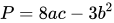
such that P/8a2 is the second degree coefficient of the associated depressed quartic (see below);

such that R/8a3 is the first degree coefficient of the associated depressed quartic;

which is 0 if the quartic has a triple root; and

which is 0 if the quartic has two double roots.
The possible cases for the nature of the roots are as follows:[12]
- If ∆ < 0 then the equation has two distinct real roots and two complex conjugate non-real roots.
- If ∆ > 0 then either the equation's four roots are all real or none is.
- If P < 0 and D < 0 then all four roots are real and distinct.
- If P > 0 or D > 0 then there are two pairs of non-real complex conjugate roots.[13]
- If ∆ = 0 then (and only then) the polynomial has a multiple root. Here are the different cases that can occur:
- If P < 0 and D < 0 and ∆0 ≠ 0, there are a real double root and two real simple roots.
- If D > 0 or (P > 0 and (D ≠ 0 or R ≠ 0)), there are a real double root and two complex conjugate roots.
- If ∆0 = 0 and D ≠ 0, there are a triple root and a simple root, all real.
- If D = 0, then:
- If P < 0, there are two real double roots.
- If P > 0 and R = 0, there are two complex conjugate double roots.
- If ∆0 = 0, all four roots are equal to −b/4a
There are some cases that do not seem to be covered, but in fact they cannot occur. For example, ∆0 > 0, P = 0 and D ≤ 0 is not a possible case. In fact, if ∆0 > 0 and P = 0 then D > 0, since so this combination is not possible.

General formula for roots
[edit]

The four roots x1, x2, x3, and x4 for the general quartic equation

with a ≠ 0 are given in the following formula, which is deduced from the one in the section on Ferrari's method by back changing the variables (see § Converting to a depressed quartic) and using the formulas for the quadratic and cubic equations.
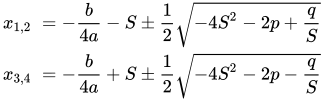
where p and q are the coefficients of the second and of the first degree respectively in the associated depressed quartic
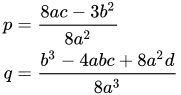
and where
![{\displaystyle {\begin{aligned}S&={\frac {1}{2}}{\sqrt {-{\frac {2}{3}}\ p+{\frac {1}{3a}}\left(Q+{\frac {\Delta _{0}}{Q}}\right)}}\\Q&={\sqrt[{3}]{\frac {\Delta _{1}+{\sqrt {\Delta _{1}^{2}-4\Delta _{0}^{3}}}}{2}}}\end{aligned}}}](https://wikimedia.org/api/rest_v1/media/math/render/svg/a2123cde7bdf9a645323f6ccdc74817db4ddaf3b)
(if S = 0 or Q = 0, see § Special cases of the formula, below)
with

and
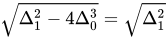
- where is the aforementioned discriminant. For the cube root expression for Q, any of the three cube roots in the complex plane can be used, although if one of them is real that is the natural and simplest one to choose. The mathematical expressions of these last four terms are very similar to those of their cubic counterparts.


Special cases of the formula
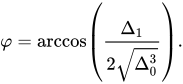
[edit]- If the value of is a non-real complex number. In this case, either all roots are non-real or they are all real. In the latter case, the value of is also real, despite being expressed in terms of this is casus irreducibilis of the cubic function extended to the present context of the quartic. One may prefer to express it in a purely real way, by using trigonometric functions, as follows:


- where

- If and the sign of has to be chosen to have that is one should define as maintaining the sign of
- If then one must change the choice of the cube root in in order to have This is always possible except if the quartic may be factored into The result is then correct, but misleading because it hides the fact that no cube root is needed in this case. In fact this case[clarification needed] may occur only if the numerator of is zero, in which case the associated depressed quartic is biquadratic; it may thus be solved by the method described below.
- If and and thus also at least three roots are equal to each other, and the roots are rational functions of the coefficients. The triple root is a common root of the quartic and its second derivative it is thus also the unique root of the remainder of the Euclidean division of the quartic by its second derivative, which is a linear polynomial. The simple root can be deduced from
- If and the above expression for the roots is correct but misleading, hiding the fact that the polynomial is reducible and no cube root is needed to represent the roots.








Simpler cases
[edit]Reducible quartics
[edit]Consider the general quartic

It is reducible if Q(x) = R(x)×S(x), where R(x) and S(x) are non-constant polynomials with rational coefficients (or more generally with coefficients in the same field as the coefficients of Q(x)). Such a factorization will take one of two forms:

or

In either case, the roots of Q(x) are the roots of the factors, which may be computed using the formulas for the roots of a quadratic function or cubic function.
Detecting the existence of such factorizations can be done using the resolvent cubic of Q(x). It turns out that:
- if we are working over R (that is, if coefficients are restricted to be real numbers) (or, more generally, over some real closed field) then there is always such a factorization;
- if we are working over Q (that is, if coefficients are restricted to be rational numbers) then there is an algorithm to determine whether or not Q(x) is reducible and, if it is, how to express it as a product of polynomials of smaller degree.
In fact, several methods of solving quartic equations (Ferrari's method, Descartes' method, and, to a lesser extent, Euler's method) are based upon finding such factorizations.
Biquadratic equation
[edit]If a3 = a1 = 0 then the function

is called a biquadratic function; equating it to zero defines a biquadratic equation, which is easy to solve as follows
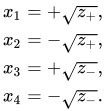
Let the auxiliary variable z = x2. Then Q(x) becomes a quadratic q in z: q(z) = a4z2 + a2z + a0. Let z+ and z− be the roots of q(z). Then the roots of the quartic Q(x) are
Quasi-palindromic equation
[edit]The polynomial

is almost palindromic, as P(mx) = x4/m2P(m/x) (it is palindromic if m = 1). The change of variables z = x + m/x in P(x)/x2 = 0 produces the quadratic equation a0z2 + a1z + a2 − 2ma0 = 0. Since x2 − xz + m = 0, the quartic equation P(x) = 0 may be solved by applying the quadratic formula twice.
Solution methods
[edit]Converting to a depressed quartic
[edit]For solving purposes, it is generally better to convert the quartic into a depressed quartic by the following simple change of variable. All formulas are simpler and some methods work only in this case. The roots of the original quartic are easily recovered from that of the depressed quartic by the reverse change of variable.
Let

be the general quartic equation we want to solve.
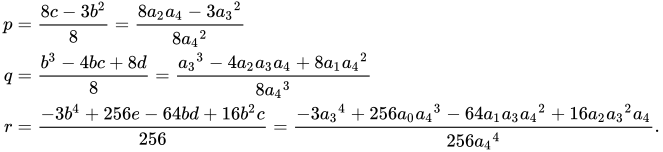
Dividing by a4, provides the equivalent equation x4 + bx3 + cx2 + dx + e = 0, with b = a3/a4, c = a2/a4, d = a1/a4, and e = a0/a4. Substituting y − b/4 for x gives, after regrouping the terms, the equation y4 + py2 + qy + r = 0, where
If y0 is a root of this depressed quartic, then y0 − b/4 (that is y0 − a3/4a4) is a root of the original quartic and every root of the original quartic can be obtained by this process.
Ferrari's solution
[edit]As explained in the preceding section, we may start with the depressed quartic equation

This depressed quartic can be solved by means of a method discovered by Lodovico Ferrari. The depressed equation may be rewritten (this is easily verified by expanding the square and regrouping all terms in the left-hand side) as

Then, we introduce a variable m into the factor on the left-hand side by adding 2y2m + pm + m2 to both sides. After regrouping the coefficients of the power of y on the right-hand side, this gives the equation
| 1 |

which is equivalent to the original equation, whichever value is given to m.
As the value of m may be arbitrarily chosen, we will choose it in order to complete the square on the right-hand side. This implies that the discriminant in y of this quadratic equation is zero, that is m is a root of the equation

which may be rewritten as
| 1a |

This is the resolvent cubic of the quartic equation. The value of m may thus be obtained from Cardano's formula. When m is a root of this equation, the right-hand side of equation (1) is the square
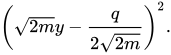
However, this induces a division by zero if m = 0. This implies q = 0, and thus that the depressed equation is bi-quadratic, and may be solved by an easier method (see above). This was not a problem at the time of Ferrari, when one solved only explicitly given equations with numeric coefficients. For a general formula that is always true, one thus needs to choose a root of the cubic equation such that m ≠ 0. This is always possible except for the depressed equation y4 = 0.
Now, if m is a root of the cubic equation such that m ≠ 0, equation (1) becomes

This equation is of the form M2 = N2, which can be rearranged as M2 − N2 = 0 or (M + N)(M − N) = 0. Therefore, equation (1) may be rewritten as

This equation is easily solved by applying to each factor the quadratic formula. Solving them we may write the four roots as
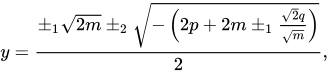
where ±1 and ±2 denote either + or −. As the two occurrences of ±1 must denote the same sign, this leaves four possibilities, one for each root.
Therefore, the solutions of the original quartic equation are

A comparison with the general formula above shows that √2m = 2S.
Descartes' solution
[edit]Descartes[14] introduced in 1637 the method of finding the roots of a quartic polynomial by factoring it into two quadratic ones. Let

By equating coefficients, this results in the following system of equations:
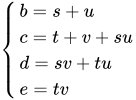
This can be simplified by starting again with the depressed quartic y4 + py2 + qy + r, which can be obtained by substituting y − b/4 for x. Since the coefficient of y3 is 0, we get s = −u, and:
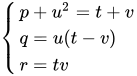
One can now eliminate both t and v by doing the following:
![{\displaystyle {\begin{aligned}u^{2}(p+u^{2})^{2}-q^{2}&=u^{2}(t+v)^{2}-u^{2}(t-v)^{2}\\&=u^{2}[(t+v+(t-v))(t+v-(t-v))]\\&=u^{2}(2t)(2v)\\&=4u^{2}tv\\&=4u^{2}r\end{aligned}}}](https://wikimedia.org/api/rest_v1/media/math/render/svg/3872dc7d07870b83c8d97f4fda44076625f066fe)
If we set U = u2, then solving this equation becomes finding the roots of the resolvent cubic
| 2 |

which is done elsewhere. This resolvent cubic is equivalent to the resolvent cubic given above (equation (1a)), as can be seen by substituting U = 2m.
If u is a square root of a non-zero root of this resolvent (such a non-zero root exists except for the quartic x4, which is trivially factored),
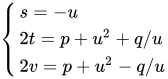
The symmetries in this solution are as follows. There are three roots of the cubic, corresponding to the three ways that a quartic can be factored into two quadratics, and choosing positive or negative values of u for the square root of U merely exchanges the two quadratics with one another.
The above solution shows that a quartic polynomial with rational coefficients and a zero coefficient on the cubic term is factorable into quadratics with rational coefficients if and only if either the resolvent cubic (2) has a non-zero root which is the square of a rational, or p2 − 4r is the square of rational and q = 0; this can readily be checked using the rational root test.[15]
Euler's solution
[edit]A variant of the previous method is due to Euler.[16][17] Unlike the previous methods, both of which use some root of the resolvent cubic, Euler's method uses all of them. Consider a depressed quartic x4 + px2 + qx + r. Observe that, if
- x4 + px2 + qx + r = (x2 + sx + t)(x2 − sx + v),
- r1 and r2 are the roots of x2 + sx + t,
- r3 and r4 are the roots of x2 − sx + v,
then
- the roots of x4 + px2 + qx + r are r1, r2, r3, and r4,
- r1 + r2 = −s,
- r3 + r4 = s.
Therefore, (r1 + r2)(r3 + r4) = −s2. In other words, −(r1 + r2)(r3 + r4) is one of the roots of the resolvent cubic (2) and this suggests that the roots of that cubic are equal to −(r1 + r2)(r3 + r4), −(r1 + r3)(r2 + r4), and −(r1 + r4)(r2 + r3). This is indeed true and it follows from Vieta's formulas. It also follows from Vieta's formulas, together with the fact that we are working with a depressed quartic, that r1 + r2 + r3 + r4 = 0. (Of course, this also follows from the fact that r1 + r2 + r3 + r4 = −s + s.) Therefore, if α, β, and γ are the roots of the resolvent cubic, then the numbers r1, r2, r3, and r4 are such that
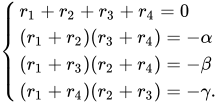
It is a consequence of the first two equations that r1 + r2 is a square root of α and that r3 + r4 is the other square root of α. For the same reason,
- r1 + r3 is a square root of β,
- r2 + r4 is the other square root of β,
- r1 + r4 is a square root of γ,
- r2 + r3 is the other square root of γ.
Therefore, the numbers r1, r2, r3, and r4 are such that
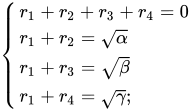
the sign of the square roots will be dealt with below. The only solution of this system is:
![{\displaystyle \left\{{\begin{array}{l}r_{1}={\frac {{\sqrt {\alpha }}+{\sqrt {\beta }}+{\sqrt {\gamma }}}{2}}\\[2mm]r_{2}={\frac {{\sqrt {\alpha }}-{\sqrt {\beta }}-{\sqrt {\gamma }}}{2}}\\[2mm]r_{3}={\frac {-{\sqrt {\alpha }}+{\sqrt {\beta }}-{\sqrt {\gamma }}}{2}}\\[2mm]r_{4}={\frac {-{\sqrt {\alpha }}-{\sqrt {\beta }}+{\sqrt {\gamma }}}{2}}{\text{.}}\end{array}}\right.}](https://wikimedia.org/api/rest_v1/media/math/render/svg/37f811e5a1fae80ee4814a27578d9ebf90528a07)
Since, in general, there are two choices for each square root, it might look as if this provides 8 (= 23) choices for the set {r1, r2, r3, r4}, but, in fact, it provides no more than 2 such choices, because the consequence of replacing one of the square roots by the symmetric one is that the set {r1, r2, r3, r4} becomes the set {−r1, −r2, −r3, −r4}.
In order to determine the right sign of the square roots, one simply chooses some square root for each of the numbers α, β, and γ and uses them to compute the numbers r1, r2, r3, and r4 from the previous equalities. Then, one computes the number √α√β√γ. Since α, β, and γ are the roots of (2), it is a consequence of Vieta's formulas that their product is equal to q2 and therefore that √α√β√γ = ±q. But a straightforward computation shows that
- √α√β√γ = r1r2r3 + r1r2r4 + r1r3r4 + r2r3r4.
If this number is −q, then the choice of the square roots was a good one (again, by Vieta's formulas); otherwise, the roots of the polynomial will be −r1, −r2, −r3, and −r4, which are the numbers obtained if one of the square roots is replaced by the symmetric one (or, what amounts to the same thing, if each of the three square roots is replaced by the symmetric one).
This argument suggests another way of choosing the square roots:
- pick any square root √α of α and any square root √β of β;
- define √γ as .

Of course, this will make no sense if α or β is equal to 0, but 0 is a root of (2) only when q = 0, that is, only when we are dealing with a biquadratic equation, in which case there is a much simpler approach.
Solving by Lagrange resolvent
[edit]The symmetric group S4 on four elements has the Klein four-group as a normal subgroup. This suggests using a resolvent cubic whose roots may be variously described as a discrete Fourier transform or a Hadamard matrix transform of the roots; see Lagrange resolvents for the general method. Denote by xi, for i from 0 to 3, the four roots of x4 + bx3 + cx2 + dx + e. If we set
![{\displaystyle {\begin{aligned}s_{0}&={\tfrac {1}{2}}(x_{0}+x_{1}+x_{2}+x_{3}),\\[4pt]s_{1}&={\tfrac {1}{2}}(x_{0}-x_{1}+x_{2}-x_{3}),\\[4pt]s_{2}&={\tfrac {1}{2}}(x_{0}+x_{1}-x_{2}-x_{3}),\\[4pt]s_{3}&={\tfrac {1}{2}}(x_{0}-x_{1}-x_{2}+x_{3}),\end{aligned}}}](https://wikimedia.org/api/rest_v1/media/math/render/svg/6b31fb6bba5dc3d511b8fdf04a9581d454224f7b)
then since the transformation is an involution we may express the roots in terms of the four si in exactly the same way. Since we know the value s0 = −b/2, we only need the values for s1, s2 and s3. These are the roots of the polynomial

Substituting the si by their values in term of the xi, this polynomial may be expanded in a polynomial in s whose coefficients are symmetric polynomials in the xi. By the fundamental theorem of symmetric polynomials, these coefficients may be expressed as polynomials in the coefficients of the monic quartic. If, for simplification, we suppose that the quartic is depressed, that is b = 0, this results in the polynomial
| 3 |

This polynomial is of degree six, but only of degree three in s2, and so the corresponding equation is solvable by the method described in the article about cubic function. By substituting the roots in the expression of the xi in terms of the si, we obtain expression for the roots. In fact we obtain, apparently, several expressions, depending on the numbering of the roots of the cubic polynomial and of the signs given to their square roots. All these different expressions may be deduced from one of them by simply changing the numbering of the xi.
These expressions are unnecessarily complicated, involving the cubic roots of unity, which can be avoided as follows. If s is any non-zero root of (3), and if we set
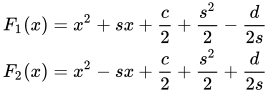
then

We therefore can solve the quartic by solving for s and then solving for the roots of the two factors using the quadratic formula.
This gives exactly the same formula for the roots as the one provided by Descartes' method.
Solving with algebraic geometry
[edit]There is an alternative solution using algebraic geometry[18] In brief, one interprets the roots as the intersection of two quadratic curves, then finds the three reducible quadratic curves (pairs of lines) that pass through these points (this corresponds to the resolvent cubic, the pairs of lines being the Lagrange resolvents), and then use these linear equations to solve the quadratic.
The four roots of the depressed quartic x4 + px2 + qx + r = 0 may also be expressed as the x coordinates of the intersections of the two quadratic equations y2 + py + qx + r = 0 and y − x2 = 0 i.e., using the substitution y = x2 that two quadratics intersect in four points is an instance of Bézout's theorem. Explicitly, the four points are Pi ≔ (xi, xi2) for the four roots xi of the quartic.
These four points are not collinear because they lie on the irreducible quadratic y = x2 and thus there is a 1-parameter family of quadratics (a pencil of curves) passing through these points. Writing the projectivization of the two quadratics as quadratic forms in three variables:

the pencil is given by the forms λF1 + μF2 for any point [λ, μ] in the projective line — in other words, where λ and μ are not both zero, and multiplying a quadratic form by a constant does not change its quadratic curve of zeros.
This pencil contains three reducible quadratics, each corresponding to a pair of lines, each passing through two of the four points, which can be done = 6 different ways. Denote these Q1 = L12 + L34, Q2 = L13 + L24, and Q3 = L14 + L23. Given any two of these, their intersection has exactly the four points.

The reducible quadratics, in turn, may be determined by expressing the quadratic form λF1 + μF2 as a 3×3 matrix: reducible quadratics correspond to this matrix being singular, which is equivalent to its determinant being zero, and the determinant is a homogeneous degree three polynomial in λ and μ and corresponds to the resolvent cubic.
See also
[edit]- Linear function – Linear map or polynomial function of degree one
- Quadratic function – Polynomial function of degree two
- Cubic function – Polynomial function of degree 3
- Quintic function – Polynomial function of degree 5
Notes
[edit]- ^α For the purposes of this article, e is used as a variable as opposed to its conventional use as Euler's number (except when otherwise specified).
References
[edit]- ^ Weisstein, Eric W., "Quartic Equation", MathWorld
- ^ O'Connor, John J.; Robertson, Edmund F., "Lodovico Ferrari", MacTutor History of Mathematics Archive, University of St Andrews
- ^ Cardano, Gerolamo (1993) [1545], Ars magna or The Rules of Algebra, Dover, ISBN 0-486-67811-3
- ^ Stewart, Ian, Galois Theory, Third Edition (Chapman & Hall/CRC Mathematics, 2004)
- ^ "DIFFERENTIAL GEOMETRY: A First Course in Curves and Surfaces, p. 36" (PDF), math.gatech.edu
- ^ Weisstein, Eric W., "Crossed Ladders Problem", MathWorld
- ^ O'Connor, John J.; Robertson, Edmund F., "Abu Ali al-Hasan ibn al-Haytham", MacTutor History of Mathematics Archive, University of St Andrews
- ^ MacKay, R. J.; Oldford, R. W. (August 2000), "Scientific Method, Statistical Method and the Speed of Light", Statistical Science, 15 (3): 254–78, doi:10.1214/ss/1009212817, MR 1847825
- ^ Neumann, Peter M. (1998), "Reflections on Reflection in a Spherical Mirror", American Mathematical Monthly, 105 (6): 523–528, doi:10.2307/2589403, JSTOR 2589403
- ^ Shabana, A. A. (8 December 1995), Theory of Vibration: An Introduction, Springer Science & Business Media, ISBN 978-0-387-94524-8
- ^ Aude, H. T. R. (1949), "Notes on Quartic Curves", American Mathematical Monthly, 56 (3): 165–170, doi:10.2307/2305030, JSTOR 2305030
- ^ Rees, E. L. (1922), "Graphical Discussion of the Roots of a Quartic Equation", The American Mathematical Monthly, 29 (2): 51–55, doi:10.2307/2972804, JSTOR 2972804
- ^ Lazard, D. (1988), "Quantifier elimination: Optimal solution for two classical examples", Journal of Symbolic Computation, 5 (1–2): 261–266, doi:10.1016/S0747-7171(88)80015-4
- ^ Descartes, René (1954) [1637], "Book III: On the construction of solid and supersolid problems", The Geometry of Rene Descartes with a facsimile of the first edition, Dover, ISBN 0-486-60068-8, JFM 51.0020.07
{{citation}}: CS1 maint: ignored ISBN errors (link) - ^ Brookfield, G. (2007), "Factoring quartic polynomials: A lost art" (PDF), Mathematics Magazine, 80 (1): 67–70, doi:10.1080/0025570X.2007.11953453, S2CID 53375377
- ^ van der Waerden, Bartel Leendert (1991), "The Galois theory: Equations of the second, third, and fourth degrees", Algebra, vol. 1 (7th ed.), Springer-Verlag, ISBN 0-387-97424-5, Zbl 0724.12001
- ^ Euler, Leonhard (1984) [1765], "Of a new method of resolving equations of the fourth degree", Elements of Algebra, Springer-Verlag, ISBN 978-1-4613-8511-0, Zbl 0557.01014
- ^ Faucette, William M. (1996), "A Geometric Interpretation of the Solution of the General Quartic Polynomial", American Mathematical Monthly, 103 (1): 51–57, doi:10.2307/2975214, JSTOR 2975214, MR 1369151
Further reading
[edit]- Carpenter, W. (1966), "On the solution of the real quartic", Mathematics Magazine, 39 (1): 28–30, doi:10.2307/2688990, JSTOR 2688990
- Yacoub, M.D.; Fraidenraich, G. (July 2012), "A solution to the quartic equation", Mathematical Gazette, 96: 271–275, doi:10.1017/s002555720000454x, S2CID 124512391
External links
[edit]Quartic function
View on GrokipediaDefinition and Forms
General Polynomial Form
A quartic function is a polynomial function of degree four, expressed in the general form $ f(x) = ax^4 + bx^3 + cx^2 + dx + e $, where $ a \neq 0 $ is the leading coefficient and $ b, c, d, e $ are constant coefficients.[2] This form represents the most general quartic polynomial, encompassing all possible terms up to the fourth degree.[6] The leading coefficient $ a $ primarily determines the end behavior of the function: if $ a > 0 $, both ends of the graph approach positive infinity as $ x $ tends to positive or negative infinity, resulting in an upward-opening shape; if $ a < 0 $, both ends approach negative infinity, creating a downward-opening shape.[6] The remaining coefficients $ b, c, d, $ and $ e $ shape the function's overall form and position: $ b $ introduces asymmetry via the cubic term, $ c $ affects the quadratic curvature, $ d $ influences the linear slope near the origin, and $ e $ sets the y-intercept at $ (0, e) $.[1] Unlike quadratic functions (degree 2), which have at most one turning point, or cubic functions (degree 3), which have at most two, a quartic function's first derivative is a cubic polynomial that can have up to three real roots, allowing for up to three turning points and more intricate variations in the graph's direction.[6] This higher degree enables behaviors such as a local maximum, local minimum, and another local maximum (or similar configurations), distinguishing quartics in modeling scenarios requiring greater flexibility.[1] For illustration, consider the monic quartic equation $ x^4 - 1 = 0 $, a simplified case with $ a = 1 $, $ b = c = d = 0 $, and $ e = -1 $; its roots are $ x = \pm 1 $ (real) and $ x = \pm i $ (complex), demonstrating how quartics can balance real and non-real solutions.[2]Depressed Quartic Form
The depressed quartic form simplifies the general quartic equation by eliminating the cubic term, which introduces asymmetry and complicates algebraic manipulations for finding roots. This transformation is a standard preliminary step in solving quartic equations, as it reduces the equation to a more symmetric structure amenable to further resolution techniques, such as Ferrari's method.[7] Consider the general monic quartic equation . To depress it, perform the substitution , which shifts the variable to remove the term. This choice of shift is derived by expanding the substituted polynomial and setting the coefficient of to zero, yielding the specific offset .[7] Substituting and expanding leads to the depressed quartic , where the coefficients are given by:Properties
Graphical Behavior and Extrema
The graphical behavior of a quartic function , where , is characterized by its even degree, leading to symmetric end behavior on both sides of the graph. As , approaches if , resulting in an overall upward-opening shape, or if , yielding a downward-opening graph. This end behavior mirrors that of quadratic functions but allows for more complex intermediate features due to the higher degree.[8] The overall shape of the graph can vary significantly based on the coefficients, commonly forming U-shaped (similar to a parabola with no turning points in between), M-shaped (one local maximum flanked by two local minima), or W-shaped (two local minima separated by a local maximum) configurations. These shapes arise from the interaction of up to three critical points and the function's roots, influencing the number of "hills" and "valleys." A quartic function exhibits even symmetry about the y-axis if and , meaning and the graph is mirror-symmetric; such functions consist solely of even-powered terms. Quartics cannot be odd functions, as even-degree polynomials do not satisfy except in the trivial zero case.[8][9] To identify local extrema, compute the first derivative , set it equal to zero, and solve the resulting cubic equation for critical points; this equation can yield up to three real roots, each representing a potential turning point. The nature of each critical point—local maximum or minimum—is determined using the second derivative test: compute ; if at a critical point , it is a local minimum, while indicates a local maximum; if , further analysis is needed. If the cubic has fewer than three real roots, the graph has fewer turning points, simplifying to fewer extrema.[8][10] For example, consider the quartic function . Its first derivative is , with critical points at and . The second derivative evaluates to (local maximum at (0, 4)) and (local minima at approximately (, -2.25)). This configuration produces a W-shaped graph with two symmetric minima and a central maximum, illustrating the potential for three extrema in a positive-leading-coefficient quartic.[8]Inflection Points and Golden Ratio
For a general quartic function $ f(x) = a x^4 + b x^3 + c x^2 + d x + e $, the inflection points occur where the second derivative $ f''(x) = 12 a x^2 + 6 b x + 2 c = 0 $.[11] This is a quadratic equation in $ x $, with solutions given by the quadratic formula:Discriminant and Root Analysis
The discriminant of a quartic polynomial $ p(x) = a x^4 + b x^3 + c x^2 + d x + e $, with $ a \neq 0 $, is a homogeneous polynomial of degree 6 in the coefficients that provides information about the nature and multiplicity of its roots without requiring their explicit computation. It is defined as $ D = a^{6} \prod_{i < j} (r_i - r_j)^2 $, where $ r_1, r_2, r_3, r_4 $ are the roots (counted with multiplicity) of $ p(x) = 0 $. Equivalently, $ D $ can be expressed directly in terms of the coefficients as the 16-term formula:Historical Development
Early Contributions
The earliest encounters with problems resembling quartic equations trace back to ancient Babylonian mathematics around 2000 BCE, where scholars developed algorithmic procedures for calculations involving areas and volumes that occasionally led to higher-degree relations, though solved through approximations rather than general algebraic methods. These practical computations, such as determining field dimensions or irrigation volumes, implicitly required handling expressions akin to quartics in geometric contexts, but the Babylonians lacked a formal equation concept and focused primarily on positive quantities using table-based approximations.[17][18] In ancient Greece, mathematicians like Archimedes (c. 287–212 BCE) advanced the study of curves beyond linear and quadratic forms, employing the method of exhaustion to compute areas and volumes under parabolas and spirals, which anticipated techniques for higher-degree curves but did not yield a general solution for quartic equations. Archimedes' geometric investigations, detailed in works such as On Spirals and The Quadrature of the Parabola, emphasized rigorous proofs for curved figures, setting a foundation for analyzing polynomial behaviors without algebraic symbolism.[19][20] During the medieval Islamic Golden Age, Al-Khwarizmi (c. 780–850 CE) systematized solutions for quadratic equations in his Al-Kitab al-mukhtasar fi hisab al-jabr wal-muqabala, using geometric completion of squares to handle cases like , but his work did not extend to general higher degrees. This algebraic framework was built upon by Omar Khayyam (1048–1131 CE), who in his Treatise on Demonstration of Problems of Algebra employed intersections of conic sections—such as circles and hyperbolas—to geometrically resolve cubic equations and certain biquadratic forms, marking a significant shift toward visualizing higher-degree solutions.[17][21][22] In parallel, Indian mathematics saw Bhaskara II (1114–1185 CE) address biquadratic equations in Lilavati and Bijaganita, reducing forms like to quadratics by substitution and incorporating conic-based geometric interpretations for verification and special cases. Bhaskara's methods emphasized practical resolution, including positive roots and approximations, within a broader treatment of indeterminate equations and progressions.[23][24] As these geometric and proto-algebraic approaches matured by the late medieval period, the transition to the Renaissance highlighted a pivot toward symbolic algebra, exemplified by Gerolamo Cardano's (1501–1576 CE) focus on cubic equations in Ars Magna (1545), which inadvertently underscored the unresolved challenge of general quartics and paved the way for subsequent innovations.[17][25]Renaissance and Modern Solutions
In 1540, Italian mathematician Lodovico Ferrari developed the first general algebraic solution to the quartic equation, reducing it to the resolution of a cubic equation through a method that involved completing the square on a cubic resolvent polynomial.[26] This breakthrough, achieved while Ferrari served as a lecturer in Milan, relied on prior advances in solving cubics and marked a significant step in algebraic theory, though it remained unpublished during his lifetime. Ferrari's mentor, Gerolamo Cardano, included the solution in his seminal work Ars Magna in 1545, ensuring its dissemination and crediting Ferrari posthumously after his death in 1565.[27] The approach demonstrated that quartics could be solved by radicals, building on the depressed form of the equation where the cubic term is eliminated. By the mid-17th century, geometric interpretations of algebraic solutions gained prominence, with René Descartes outlining methods in his 1637 treatise La Géométrie to construct roots of quartic equations through intersections of conic sections and circles.[28] Descartes' analytic geometry framework allowed for the visualization and resolution of higher-degree equations, including quartics, by translating algebraic problems into geometric constructions that could be performed with ruler and compass.[29] Contemporaneously, Girard Desargues contributed early resolvent techniques in his work on conic sections around 1639, publishing solutions to quartic equations derived from Ferrari and Tartaglia, and integrating projective methods to handle the symmetries of root configurations.[30] These efforts shifted focus toward both geometric and algebraic resolvents, laying groundwork for later simplifications. In the 18th century, Leonhard Euler refined the solution process in works such as his Elements of Algebra (1770), introducing trigonometric and hyperbolic identities to express the roots of the depressed quartic more elegantly than Ferrari's radical-heavy approach.[31] Euler emphasized the resolvent cubic's role, showing how its roots could be paired using sums of square roots, and developed formulas that avoided excessive nesting of radicals by leveraging identities like those for cosine of multiple angles.[32] His methods, detailed in correspondence and treatises from the 1740s onward, highlighted the quartic's solvability while anticipating connections to elliptic functions, influencing subsequent algebraic developments.[33] The 19th and early 20th centuries saw deeper theoretical insights through Évariste Galois' group theory (1831), which classified the Galois groups of irreducible quartics as transitive subgroups of the symmetric group , including , , the dihedral group , the Klein four-group , and the cyclic group .[34] This framework proved all quartics solvable by radicals, as their Galois groups are solvable, contrasting with the general quintic's group, which is not. Refinements to the Tschirnhaus transformation, originally proposed in 1683, emerged in the 19th century through extensions by mathematicians like Charles Hermite and Felix Klein, who used quadratic substitutions to further depress quartics and analyze their resolvents under Galois actions, facilitating discriminant computations and root separation.[35] These advances, building on Galois' memoir, solidified the algebraic structure of quartic solutions by the early 1900s. In modern mathematics, computer algebra systems such as Mathematica and Maple implement explicit radical solutions for quartics using Ferrari's or Euler's methods, enabling symbolic computation of roots with high precision for practical applications, while numerical algorithms like those based on eigenvalue decomposition handle ill-conditioned cases efficiently.[36] Unlike quintics, which lack general radical solutions per Abel-Ruffini, quartics remain fully hand-solvable, though computational tools streamline the often cumbersome expressions involving nested radicals.[37] This timeline—from Ferrari's 1540 innovation to 20th-century theoretical closure—underscores the quartic's pivotal role in the evolution of solvable polynomials.Applications
In Physics and Mechanics
Quartic functions play a significant role in modeling potential energy in anharmonic oscillators, where deviations from simple harmonic motion are captured by including higher-order terms in the potential. A common form is the quartic potential $ V(x) = \frac{1}{2} k x^2 + \lambda x^4 $, with $ k > 0 $ representing the harmonic stiffness and $ \lambda > 0 $ introducing nonlinearity that leads to asymmetric or bounded motion depending on energy levels. This model is widely used for nonlinear springs in mechanical systems, where large displacements cause stiffening or softening effects.[38] In beam deflection analysis under the Euler-Bernoulli theory, the governing equation for transverse displacement $ w(x) $ of a beam under distributed load $ q(x) $ is the fourth-order differential equation $ EI \frac{d^4 w}{dx^4} = q(x) $, where $ E $ is the modulus of elasticity and $ I $ is the moment of inertia. For curved beams subjected to loads, integrating this equation yields solutions where the deflection profile involves quartic polynomials, particularly for uniform or linearly varying loads, allowing precise prediction of bending behavior in arched or circular structures.[39] In orbital mechanics, quartic perturbations arise in the effective potential for the perturbed Kepler problem, modifying the standard inverse-square gravitational potential to account for multipolar expansions or additional forces in multi-body systems. The effective potential can include quartic terms in the radial coordinate expansion, influencing orbital stability and precession in systems like binary stars or planetary rings, where small deviations lead to bounded or chaotic trajectories. Quartic anharmonicity is essential in quantum mechanics for perturbation theory applied to molecular vibrations, where the potential energy surface expands as $ V(q) = \frac{1}{2} \omega^2 q^2 + \frac{1}{3!} \phi_3 q^3 + \frac{1}{4!} \phi_4 q^4 + \cdots $, with the quartic term $ \phi_4 q^4 $ correcting harmonic approximations for overtone frequencies and Fermi resonances in diatomic or polyatomic molecules. This approach computes anharmonic corrections to vibrational spectra by treating the quartic contribution as a perturbation to the unperturbed harmonic oscillator Hamiltonian.[40] A prominent example is the Duffing equation, $ \ddot{x} + \delta \dot{x} + \alpha x + \beta x^3 = \gamma \cos(\omega t) $, which stems from a quartic potential $ V(x) = \frac{1}{2} \alpha x^2 + \frac{1}{4} \beta x^4 $ and models nonlinear oscillations in driven systems like mechanical resonators. In phase space, trajectories approximate closed curves for low energies but exhibit bistability and chaos for higher drives, with quartic terms enabling analysis of amplitude-dependent frequency shifts via perturbation methods.[41]In Geometry and Other Fields
In algebraic geometry, plane quartic curves, defined by homogeneous polynomials of degree four in the projective plane , serve as canonical models for smooth, non-hyperelliptic curves of genus three. The genus of a smooth plane curve of degree is computed via the formula , reflecting their role in studying linear series, Weierstrass points (with 24 such points on a smooth quartic), and moduli spaces.[42] These curves also arise as complete intersections of two quadric surfaces in , yielding space quartics of degree four, often elliptic (genus one) when smooth, which embed them in higher-dimensional projective spaces for enumerative purposes.[43] The Cayley-Bacharach theorem and its generalizations apply to quartic curves in enumerative geometry, asserting that for two plane curves of degrees and intersecting transversely at points, any curve of degree passing through all but one of these points must pass through the remaining point. For instance, when , such as the intersection of a line and a sextic (yielding six points) or a conic and a quintic (yielding ten points), the theorem constrains quartic curves through all but one of them to include the last point, aiding in counting configurations like bitangents on quartics.[44] Beyond geometry, quartic functions appear in optimization problems, such as quartic Bézier curves in computer graphics, where a degree-four parametric polynomial $ \mathbf{B}(t) = \sum_{i=0}^{4} \binom{4}{i} (1-t)^{4-i} t^i \mathbf{P}_i $ (with control points ) models complex smooth paths for rendering and animation, offering greater flexibility than cubics while maintaining continuity at joins.[45] In economics, quartic objective functions model nonlinear cost or utility surfaces in multivariate optimization, capturing higher-order interactions in resource allocation beyond quadratic approximations.[46] In statistics, the quartic (fourth) moment enters higher-order cumulants, such as the fourth cumulant , which quantify non-Gaussian deviations in distributions for tail analysis and independence testing.[47] A representative example is the Cassini oval, a lemniscate-like quartic curve defined by , where the product of distances from any point to two fixed foci (at ) equals ; for , it forms a single oval, at a figure-eight lemniscate, for a dog-bone shape, and for two separate ovals, illustrating quartic symmetry in polar coordinates.[48]Solving Methods
Reduction Techniques
Reduction techniques for quartic equations involve algebraic substitutions and factorizations that simplify the general form $ ax^4 + bx^3 + cx^2 + dx + e = 0 $ before applying more advanced solution methods. These approaches aim to eliminate specific terms or decompose the polynomial into lower-degree factors solvable by radicals.[49] The Tschirnhaus transformation is a key substitution method that maps the variable $ x $ to a rational function $ y = g(x)/h(x) $, where $ g $ and $ h $ are polynomials, to simplify the equation by removing higher-degree coefficients. For quartics, after the initial depression to eliminate the cubic term (via $ x = y - b/(4a) $), further Tschirnhaus transformations can target the quadratic term, reducing the equation to a form like $ y^4 + py^2 + qy + r = 0 $ or even a biquadratic. This involves solving for transformation parameters that satisfy conditions derived from coefficient matching, often leading to a cubic auxiliary equation. Such reductions facilitate subsequent factoring or resolution.[49][50] A common reduction exploits the possibility of factoring the quartic into two quadratics over the rationals, assuming $ ax^4 + bx^3 + cx^2 + dx + e = (x^2 + px + q)(x^2 + rx + s) $ after scaling to monic form and depressing. Expanding yields the system: $ p + r = b/a $, $ q + s + pr = c/a $, $ ps + qr = d/a $, $ qs = e/a $. Solving this nonlinear system determines if rational $ p, q, r, s $ exist, often via a resolvent cubic in a variable like $ z = (p - r)^2 $.[51] Reducibility over the rationals is checked first by the rational root theorem, which tests possible linear factors $ \pm $ factors of $ e/a $ divided by factors of $ a $; if a rational root $ \rho $ is found, synthetic division yields a cubic factor. For irreducible linear factors but possible quadratic ones, the resolvent cubic must have a positive rational root that is a perfect square, confirming the factorization. If the resolvent has no such root and no linear factors exist, the quartic is irreducible over the rationals.[51] For illustration, consider the reducible quartic $ x^4 + 5x^2 + 4 = 0 $, which factors as $ (x^2 + 1)(x^2 + 4) = 0 $ by assuming quadratic factors with zero linear terms and solving the resulting system for the constants.[51] A special case is the biquadratic equation $ x^4 + ax^2 + b = 0 $, where odd-powered terms vanish. This reduces to a quadratic via the substitution $ y = x^2 $, yielding $ y^2 + ay + b = 0 $, solved by the quadratic formula $ y = \frac{-a \pm \sqrt{a^2 - 4b}}{2} $; the roots are then $ x = \pm \sqrt{y} $ for each positive real $ y $. This form arises naturally after depressing a general quartic with zero linear and cubic coefficients.[52]Ferrari's Solution
Lodovico Ferrari developed a method in the 1540s to solve the general quartic equation by first reducing it to the depressed form $ y^4 + p y^2 + q y + r = 0 $, where the linear term is absent, and then introducing a parameter that leads to a resolvent cubic equation whose solution allows factorization into quadratics.[2] This approach, published posthumously in Gerolamo Cardano's Ars Magna (1545), expresses the roots using nested radicals, building on Cardano's cubic solution. The resolvent cubic arises from completing the square and setting the expression as a difference of squares involving an auxiliary variable. The resolvent cubic for the depressed quartic $ y^4 + p y^2 + q y + r = 0 $ isAlternative Approaches
Descartes developed a geometric construction for solving the depressed quartic equation by finding the intersection points of a parabola and a suitably chosen circle. The equation is rewritten by splitting the term and substituting , yielding ; completing the square in both and the linear terms in transforms the second part into a circle equation, such as for appropriate . The real roots correspond to the x-coordinates of these intersection points, providing a ruler-and-compass constructible solution when intersections exist in the real plane.[54] Euler offered an alternative algebraic resolution for the depressed quartic , expressing each root as a combination of square roots: , where the are positive roots of the resolvent cubic . The correct sign choices are selected to satisfy , ensuring the roots sum appropriately to match the coefficients; this method highlights the quartic's solvability by radicals without introducing auxiliary cubics beyond the resolvent. For cases with all real roots or specific coefficient relations, hyperbolic functions can express the roots explicitly, replacing square roots with forms like , to avoid complex intermediates. Trigonometric identities apply in restricted scenarios, such as when the quartic admits roots expressible via multiple angles.[31] A concrete illustration of Euler's trigonometric adaptation arises for the equation . By scaling and aligning coefficients with the quadruple-angle formula , the equation reduces to solving for such that equals a constant derived from ; the four roots then follow as for , leveraging known identities for angle addition. This approach simplifies computation when the discriminant indicates four real roots aligned with angular separations.[55] Lagrange advanced the resolution of quartics through resolvents, treating the roots of (first depressed if needed) and forming symmetric functions like . The orbit of under the action of the symmetric group generates a cubic resolvent polynomial in the elementary symmetric polynomials (the coefficients ), solvable to yield the ; pairing these then allows quadratic factorizations to recover the . This framework, rooted in permutations of roots, prefigures Galois theory by revealing the quartic's Galois group as a subgroup of with a quotient isomorphic to , thus explaining the resolvent cubic's role in the splitting field.[56] From an algebraic geometry perspective, the roots of a general quartic can be interpreted geometrically as the intersection points (in suitable coordinates) of two quadric hypersurfaces in projective 3-space . Embedding the affine equation into homogeneous coordinates transforms it into a system of two quadratic equations defining the quadrics; parameterizing their intersection curve (a genus-1 curve) via projection or birational maps to a plane conic yields explicit radical expressions for the points, aligning with classical solutions while facilitating computational verification through resultant computations or eigenvalue methods on the quadric pencils.[57] These alternative methods often simplify under symmetry conditions; notably, Euler's resolvent approach streamlines for palindromic quartics like , where roots appear in reciprocal pairs . The substitution reduces the equation to a biquadratic wait, actually to a quadratic in , solvable directly, with roots then found via quadratics , avoiding the full cubic resolvent.[58]Special Solvable Cases
Certain subclasses of quartic equations admit simplified solution procedures that reduce them to quadratics or lower-degree equations, avoiding the full complexity of the general case.[2] The biquadratic equation is solved by the substitution , which transforms it into the quadratic equation . The solutions are , and the corresponding -roots are for each valid . For example, the equation yields , with roots and , so .[52] Reducible quartics factor into products of quadratics, such as , allowing the roots to be found by solving each quadratic factor separately via the quadratic formula. To determine the factorization over the rationals, one computes the resolvent cubic (for the depressed form ) and checks for rational square roots among its roots, which provide the linear coefficients for the factors.[51] Quasi-palindromic or reciprocal quartics, of the form , are addressed by dividing by (assuming ) to obtain , or equivalently . The substitution reduces this to the quadratic . Solving for and then solving for each yields the roots, which come in reciprocal pairs.[59] Trinomial quartics of the form (a depressed case with no or terms) can be resolved into quadratics by assuming a factorization , which leads to the system , , and . This requires solving the auxiliary cubic equation for , after which the quadratics are solved.[51]Numerical and Computational Methods
Numerical methods provide efficient approximations for the roots of general quartic polynomials, particularly when symbolic solutions are cumbersome or when high precision is required for ill-conditioned cases. These techniques are essential in computational software and scientific applications where exact radical expressions may lead to numerical instability due to floating-point arithmetic limitations. The Newton-Raphson iteration is a widely used root-finding method for quartic equations, applicable to the univariate case $ f(x) = a_4 x^4 + a_3 x^3 + a_2 x^2 + a_1 x + a_0 = 0 $. The update rule is given byNSolve function applies hybrid numerical methods, including eigenvalue solvers, to quartic polynomials, supporting arbitrary precision to mitigate rounding errors. Similarly, NumPy's numpy.roots function in Python computes roots via the companion matrix and QR decomposition, but exhibits precision loss for ill-conditioned coefficients spanning multiple orders of magnitude, as seen in Wilkinson's examples where tiny perturbations shift roots dramatically.
To illustrate sensitivity, consider the quartic $ x^4 + 0.0001 x^3 - x + 1 = 0 $, where the small cubic coefficient introduces near-degeneracy. Numerical evaluation using eigenvalue methods yields approximate roots around $ 0.25 \pm 0.93i $ and $ -0.75 \pm 0.25i $, but perturbing the coefficient by even $ 10^{-6} $ can alter real parts by up to 0.1, highlighting multiple root vulnerability in floating-point computations. Such cases underscore the need for condition number assessment via the discriminant before applying iterative solvers.
Compared to symbolic methods like Ferrari's solution, numerical approaches offer advantages in speed and robustness for near-degenerate quartics, avoiding catastrophic cancellation in radical expressions and enabling scalable implementation on modern hardware. They handle arbitrary coefficients without overflow risks inherent in exact formulas, making them preferable for engineering simulations and large-scale data analysis.[36]