Hubbry Logo
King-in-ParliamentKing-in-ParliamentMain
Open search
King-in-Parliament
Community hub
King-in-Parliament
logo
8 pages, 0 posts
0 subscribers
Be the first to start a discussion here.
Contribute something
King-in-Parliament
King-in-Parliament
from Wikipedia

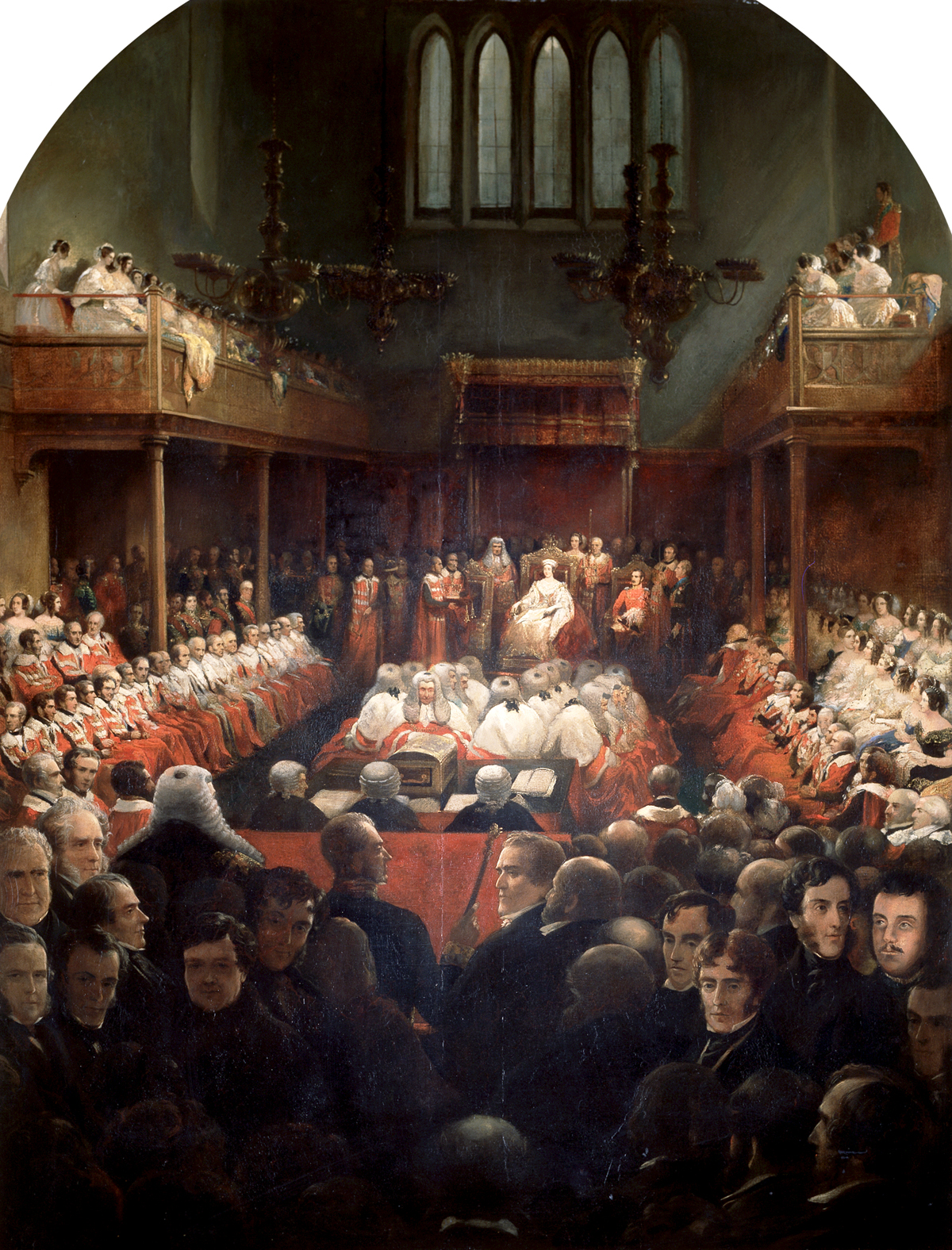
Queen Victoria Opening Parliament, 1845, a painting by Alexander Blaikley depicting Queen Victoria "sitting on her Throne with the Lords of Parliament sitting before her and the Commons standing at the Bar."[1]

In the Westminster system used in many Commonwealth realms, the King-in-Parliament (Queen-in-Parliament during the reign of a queen) is a constitutional law concept that refers to the components of parliament – the sovereign (or vice-regal representative) and the legislative houses – acting together to enact legislation.[1][2][3][4][5]

Parliamentary sovereignty is a concept in the constitutional law of Westminster systems that holds that parliament has absolute sovereignty and is supreme over all other government institutions. The King-in-Parliament as a composite body (that is, parliament) exercises this legislative authority.

Bills passed by the houses are sent to the sovereign or their representative (such as the governor-general, lieutenant-governor, or governor), for royal assent in order to enact them into law as acts of Parliament. An Act may also provide for secondary legislation, which can be made by executive officers of the Crown such as through an order in council.[6][7]

Fusion of powers

[edit]

The concept of the Crown as a part of parliament is related to the idea of the fusion of powers, meaning that the executive branch and legislative branch of government are fused together. This is a key concept of the Westminster system of government, developed in England and used in countries in the Commonwealth of Nations and beyond. It is in contradistinction to the idea of the separation of powers.

In Commonwealth realms that are federations, the concept of the King in parliament applies within that specific parliament only, as each sub-national parliament is considered separate and distinct from each other and from the federal parliaments (such as Australian states or the Canadian provinces).

United Kingdom

[edit]
Queen Anne in the House of Lords, c. 1708–1714, by Peter Tillemans

According to constitutional scholar A.V. Dicey, "Parliament means, in the mouth of a lawyer (though the word has often a different sense in ordinary conversation), the King, the House of Lords, and the House of Commons; these three bodies acting together may be aptly described as the 'King in Parliament,' and constitute Parliament."[2] Legal philosopher H. L. A. Hart wrote that the Queen-in-Parliament is “considered as a single continuing legislative entity”.[8]

Constitutional scholar Ivor Jennings described the Queen-in-Parliament as "a purely formal body consisting of the Queen sitting on her Throne with the Lords of Parliament sitting before her and the Commons standing at the Bar."[1] This formal gathering was historically the only process by which legislation could be enacted. The Royal Assent by Commission Act 1541 allowed Lords Commissioners to stand in for the monarch, and the Royal Assent Act 1967 allowed legislation to be enacted by pronunciation, without a physical gathering. The assembling of the King, Lords, and Commons as the King-in-Parliament is now "notional rather than real",[9] only occurring ceremonially at the annual State Opening of Parliament.[1][10]

The composition of the King-in-Parliament is reflected in the enacting clause of acts of the British Parliament with: "Be it enacted by the King's most Excellent Majesty, by and with the advice and consent of the Lords Spiritual and Temporal, and Commons, in this present Parliament assembled, and by the authority of the same, as follows...".

Development of parliamentary sovereignty

[edit]
Opening of Parliament in 1523, from the Wriothesley Garter Book. Depicted are the King (Henry VIII) on his throne, the seated Lords Spiritual and Temporal, and, along the bottom, members of the House of Commons standing at the bar (including Speaker Thomas More).[11]

In England, by the mid-16th century, it was established that the "King in Parliament" held supreme legislative authority.[12] However, this phrase was subject to two competing theories of interpretation.[12][13][14] The Royalist view interpreted the phrase as "King, in Parliament"; that is, the King acting with the consent of the Lords and Commons, but ultimately exercising his own sovereign authority.[13] The Parliamentarian view was that legislative authority was exercised by the "King-in-Parliament”, a composite institution of the King, Lords, and Commons acting together.[13]

As described by Jeffrey Goldsworthy, "The question that divided them was whether [the] final, unchallengeable decision-maker was the king alone, or the King, Lords, and Commons in parliament."[12] The dispute had implications for the ability of Parliament to limit the monarch’s powers, or "the supremacy of the King in Parliament over the King out of Parliament."[15] The clash between the Royalist and Parliamentarian views continued through the 16th century and much of the 17th, and was a factor in the English Civil War (1642-1651) and the execution of Charles I (1649).[13][16]

The Parliamentarian position ultimately prevailed with the Glorious Revolution (1688–89) and subsequent passing of the Bill of Rights 1689, which significantly limited the day-to-day powers of the monarch, including removing prerogative powers to unilaterally suspend or dispense with statutes.[17]

Balance of power within the King-in-Parliament

[edit]
2023 State Opening of Parliament

The concept of the King-in-Parliament holding supreme legislative authority is a core tenet of the Constitution of the United Kingdom and has application in the Westminster system more generally.[18] As a concept, legislative authority being exercised by the King-in-Parliament is compatible with different distributions of power among its three components.[12][19] This allowed for increasing limitations on the monarch’s direct and unilateral influence within Parliament over the 18th and 19th centuries.[20] The influence of the House of Lords has also been significantly limited, most notably by the Parliament Acts 1911 and 1949, which allow money bills to be passed against the wishes of the House of Lords. Such legislation can still be understood in a constitutional sense to be an act of the King-in-Parliament, that is by the King, Lords, and Commons acting jointly as a single body known as parliament.[21]

Rules and procedures

[edit]

In order to act as the King-in-Parliament, the individual components must act according to their established rules and procedures. The individuals involved must be "constituted as a public institution qua Parliament (on the basis of some rules and under certain circumstances)" in order to "[enjoy] the power to legislate as 'the [King] in Parliament' i.e., the ultimate legislature."[22] This creates a potential paradox when determining Parliament’s ability to modify its own rules or composition.[22]

Canada

[edit]
King George VI, accompanied by Queen Elizabeth, grants royal assent to laws in the Canadian Senate, 19 May 1939

Section 17 of Canada's Constitution Act, 1867 establishes the Parliament of Canada as the legislative authority for the country, defining it as consisting of "the Queen [or King], an Upper House styled the Senate, and the House of Commons." The Parliament of Canada may be referred to as the King-in-Parliament,[4] and its three-part composition is based on "the British model of legislative sovereignty vesting in the [King]-in-Parliament".[23] Canadian acts of Parliament use the enacting clause: "Now, therefore, His Majesty, by and with the advice and consent of the Senate and House of Commons of Canada, enacts as follows..."

Canada's provincial legislatures are constitutionally defined as consisting of the province's lieutenant governor (as the representative of the King) and a popularly elected legislative assembly. The concept of King-in-Parliament also applies to these sub-national legislatures.[4]

Legal scholar Paul McHugh describes Canada as having "a crisis of constitutional identity" in the later 20th century, finding "the old Whig narrative of an absolute sovereign self (the Crown in Parliament)" to be inadequate. The Canadian response was to "not seek to refurbish a historical order so much as to fundamentally reorder it by adopting the Charter of Rights and Freedoms limiting the power of government, the Crown in Parliament (federal and provincial) included."[18]

New Zealand

[edit]

References

[edit]
Revisions and contributorsEdit on WikipediaRead on Wikipedia
from Grokipedia
The King-in-Parliament denotes the supreme legislative authority in the , constituted by the conjunction of the , the , and the acting together to enact statutes that possess overriding legal force. This composite entity embodies the principle of , under which no court or other institution may invalidate its enactments, and future Parliaments remain unbound by prior ones. Originating in medieval assemblies where monarchs consulted nobles and for counsel and taxation, the concept evolved through conflicts such as the and , culminating in the assertion that legislative supremacy resides in Parliament rather than the Crown alone. In practice, the monarch's role has become ceremonial—limited to granting , which has not been withheld since 1708—while effective power lies with the elected , advised by the government. The doctrine underpins the unwritten constitution, enabling radical policy shifts without entrenched rights or supermajority requirements, though it faces scrutiny amid , international obligations, and judicial assertions of limits in cases like R (Miller) v for Exiting the .

Conceptual and Theoretical Foundations

Definition and Core Principles

The King-in-Parliament denotes the unified sovereign legislative body in the United Kingdom, consisting of the reigning monarch, the House of Lords, and the House of Commons acting in concert. This composite entity holds supreme authority to enact laws, with validity requiring passage through both parliamentary houses followed by the monarch's royal assent, which has not been withheld since 1708. The doctrine emphasizes the indivisibility of these components: no legislation binds without the concurrence of all three, ensuring a singular point of sovereign decision-making rather than fragmented authority. At its core lies the principle of absolute legislative , whereby statutes passed by the King-in-Parliament cannot be overridden, repealed, or limited by any other domestic institution, including courts or executive bodies. As formulated by constitutional theorist in 1885, this entails the right to make or unmake any law, with no legal recognition of superior authority to challenge parliamentary enactments. The power is non-delegable in essence, though Parliament may authorize subordinate legislation; ultimate remains vested exclusively in the tripartite body, preventing dilution through permanent transfers to other entities. This framework contrasts with , under which the sovereign could legislate unilaterally without parliamentary input, as seen in pre-1689 Stuart practices. It also diverges from abstract models of parliamentary supremacy excluding , as the monarch's formal assent—conventionally granted on ministerial advice—anchors the process, unifying deliberative and executive elements to avert legislative instability from divided powers.

Distinction from Executive Prerogatives and Judicial Review

The King-in-Parliament represents the fused legislative authority of , , and , distinct from the executive prerogatives exercised by in its administrative capacity. These prerogatives, such as the power to prorogue or dissolve , originate from residues attached to the but are conventionally wielded on ministerial advice and serve to facilitate rather than supplant . As observed in (1867), this arrangement embodies a "" where the executive's role reinforces the legislature's primacy, with the 's ceremonial functions providing continuity amid democratic flux, without independent over enacted laws. may curtail or abolish prerogatives through statute, ensuring their subordination, as evidenced by the (repealed in 2022), which temporarily vested dissolution in parliamentary vote rather than prerogative. In contrast to executive prerogatives, in the cannot invalidate primary passed by the King-in-Parliament, upholding the doctrine that courts lack authority to question the validity of parliamentary enactments. This principle was affirmed in Pickin v AC 765, where the ruled that allegations of procedural irregularity in passing the British Railways Act 1968 could not be adjudicated externally, as such inquiries would infringe on legislative autonomy and the separation of judicial from parliamentary functions. The decision reinforces that enrolled Acts are conclusive evidence of validity, preventing extra-parliamentary challenges and preserving legislative exclusivity against judicial override. This framework empirically sustains legislative primacy through institutional design, where reserve aspects of powers—exercisable independently of advice in extremis—offer a latent check against governmental overreach or invalid parliamentary maneuvers, without the rigid separation seen in systems like the , where judicial nullification of statutes is routine. Historical non-exercise of such reserves, as in refusals of dissolution under the (1950), demonstrates causal efficacy in stabilizing governance amid potential populist or procedural excesses, prioritizing continuity over adversarial checks. Unlike American constitutionalism, where enumerated powers enable frequent judicial intervention, the British model's integrated structure minimizes veto points, empirically correlating with higher legislative throughput and adaptability, though reliant on convention for restraint.

Historical Development in the United Kingdom

Medieval Precedents and Tudor Absolutism

The roots of King-in-Parliament lie in medieval 's feudal assemblies, where monarchs sought consent from elites to legitimize taxation amid baronial challenges. The of 1215, sealed by King John under pressure from rebellious barons, explicitly curtailed royal authority by prohibiting arbitrary taxation, feudal reliefs exceeding customary amounts, and without the "common counsel" of the kingdom. This charter marked an early empirical check on monarchical power, as reissues under subsequent kings, such as Henry III in 1225, integrated these principles into statutory form, fostering regular consultations to secure fiscal support for royal endeavors like wars against . By the late 13th century, these consultations evolved into more structured bodies. King Edward I, facing financial demands from prolonged conflicts including the Welsh and Scottish campaigns, convened the on November 24, 1295, summoning not only magnates and but also two knights from each shire and burgesses from select towns. This assembly, convened primarily to approve extraordinary taxes like the ninth granted in 1297, represented a proto-bicameral structure that diluted baronial dominance by incorporating broader propertied interests, enabling to forge pragmatic alliances against feudal fragmentation. Such mechanisms empirically stabilized , as evidenced by Edward's successful mobilization of resources that sustained military efforts despite intermittent baronial opposition, laying groundwork for parliamentary consent as a fiscal necessity rather than mere formality. The Tudor era intensified monarchical authority yet paradoxically entrenched Parliament's legislative role. Henry VIII, pursuing dynastic and religious reforms amid the break with , dominated the Reformation Parliament from November 3, 1529, to April 14, 1536, which enacted over 130 statutes including the Act in Restraint of Appeals (1533) and Act of Supremacy (1534). These measures, leveraging to dissolve papal jurisdiction and authorize monastic seizures yielding £1.3 million by 1540, illustrated the king's instrumental use of the body to enact absolutist policies while binding future actions to statutory form, subtly advancing the notion of indivisible legislative power vested in the King-in-Parliament construct. This period's causal dynamic—crown-orchestrated sessions countering noble resistance through legal enactment—foreshadowed constitutional evolution by normalizing Parliament as the medium for transformative governance, even under a ruler whose approached unchecked .

Key Milestones: Bill of Rights 1689 and Act of Settlement 1701

The emerged directly from the of 1688, when invited William of Orange and Mary II to replace the deposed James II, marking a decisive rejection of in favor of parliamentary authority. Enacted on 16 December 1689, the statute declared James II's actions—such as suspending laws without consent and maintaining a in peacetime—treasonous and void, thereby prohibiting future monarchs from exercising such prerogatives unilaterally. It mandated frequent parliaments, free elections, and within , while requiring parliamentary consent for taxation and prohibiting the executive from interfering in elections or legal proceedings. These provisions entrenched the principle that legislative power resides in the King-in-Parliament, comprising the monarch, Lords, and Commons, rendering royal veto or dispensation ineffective without tripartite agreement. Building on this foundation, the Act of Settlement 1701 addressed the looming crisis in Protestant succession following the death of Princess Anne's last child, Duke William of Gloucester, in 1700, which threatened to exhaust the lines established by the Bill of Rights. Passed on 12 June 1701, the act settled the crown on Electress —granddaughter of James I—and her Protestant heirs, explicitly excluding Catholics from the throne and disqualifying any monarch who married a Catholic. It further reinforced by stipulating that judges serve during good behavior, removable only by parliamentary process rather than royal whim, and barring the sovereign from leaving the realm or engaging in foreign wars without legislative consent. Provisions against granting offices or pardons to Catholics or foreigners without parliamentary approval underscored the legislature's oversight of executive appointments, embedding and dynastic control within the tripartite structure. Together, these enactments causally shifted constitutional authority from divine-right absolutism to a framework where the monarch's role became ceremonial and dependent on parliamentary will, as evidenced by the peaceful Hanoverian accession of George I in 1714 despite Jacobite challenges—contrasting with the civil strife of the 1640s and averting similar disruptions through institutionalized limits on royal power. The acts' emphasis on Protestant continuity and legislative primacy ensured dynastic stability without reliance on personal loyalty to the sovereign, fostering a where inhered in the united rather than alone. This tripartite model—monarch assenting to bills passed by Lords and —formalized King-in-Parliament as the indivisible source of , with empirical durability demonstrated by over three centuries of unbroken operation absent revolutionary upheaval.

Evolution Toward Modern Parliamentary Sovereignty

The nineteenth-century progressively democratized the while upholding the indivisibility of King-in-Parliament's sovereignty. The Representation of the People Act 1832 abolished rotten boroughs, redistributed seats from rural to urban areas, and enfranchised middle-class male householders, expanding the electorate from approximately 400,000 to 650,000 voters. The Second Reform Act 1867 extended the vote to urban working-class males owning property above a £10 threshold, doubling the electorate to about 2 million, and the Third Reform Act 1884 incorporated rural laborers, bringing male suffrage close to universality with over 5 million voters by 1885. These reforms shifted power toward elected representatives but did not encroach on Parliament's supreme authority to legislate without legal restraint, as affirmed in A.V. Dicey's contemporaneous doctrine of , which emphasized unlimited legislative competence continuing indefinitely. Imperial expansion necessitated adaptations that extended the model outward without fracturing its core unity in the . Dominion parliaments in self-governing colonies, such as Canada's in 1867 and Australia's in 1901, initially derived authority from acts of the imperial , which retained legislative supremacy over them. The formalized dominion autonomy by declaring that no UK law would extend to a unless requested, empowering their parliaments with extraterritorial legislative capacity and equality in status, yet preserving the UK's internal sovereignty intact. This evolution accommodated empire-scale governance through delegated structures subordinate to the originating King-in-Parliament. Twentieth-century reforms refined internal balances, reinforcing ' primacy under formal monarchical assent. The ended the Lords' absolute veto on public bills, substituting a suspensory delay of up to two years (reduced to one by the Act), while exempting money bills entirely and preserving as a ceremonial formality never withheld since 1708. Post-World War II, the Attlee government enacted cornerstone measures—including the establishing universal healthcare and the National Insurance Act 1948 creating social security—via ordinary parliamentary process, illustrating the model's adaptability to comprehensive state expansion without constitutional rupture. in the late twentieth century, as with the creating a with tax-varying powers over devolved matters like health and education, operated as revocable delegation; section 28(7) explicitly voids Scottish acts to , affirming Parliament's continuing, undivided to legislate on any topic. This resilience empirically contrasts with frailer systems, such as Germany's and fragmented , which enabled executive overreach leading to in 1933, whereas conventions channeled post-war pressures through sovereign legislation.

Operational Mechanics in the United Kingdom

Composition: Monarch, Lords, and Commons

The King-in-Parliament denotes the unified legislative authority of the , comprising the , the , and the as co-essential components whose combined action enacts statutes binding on all subjects. This doctrine underscores that no bill becomes law without passage through both houses and the 's formal approval via , distinguishing it from mere by integrating as an active, albeit conventionally constrained, partner in . The , currently King Charles III, fulfills a constitutional role in by summoning, proroguing, and dissolving sessions, delivering at the State Opening to outline the legislative agenda, and granting to bills approved by both chambers. , the final step transforming a bill into an , has been a formality since Queen Anne withheld it from the on 11 March 1708—the last such instance—due to evolving conventions that bind the sovereign to act on ministerial advice, ensuring no veto disrupts parliamentary will. Absent assent, a bill lapses, but this power's dormancy reflects practical causality: monarchs risk political crisis by exercising it independently, as historical precedents like the 1708 event contributed to the Hanoverian succession's stability under parliamentary dominance. The functions as the revising chamber, with membership totaling 827 eligible peers as of October 2025, predominantly life peers (approximately 712) created under the and Appellate Jurisdiction Act 1876 for judicial roles, supplemented by 85 elected hereditary peers (remnants post-House of Lords Act 1999, facing further reduction via the 2024 Hereditary Peers Bill), and 26 comprising the Archbishops of and plus 24 diocesan bishops of the . Appointments occur via the on prime ministerial recommendation, prioritizing expertise in , , , and other fields, though critics note potential for ; hereditary peers' limited role stems from 1999 reforms capping them at 92 to avert dominance by unelected aristocrats, with by-elections filling vacancies among them until prospective abolition. Lords amend but rarely block Commons' will indefinitely, per the , which enable overrides after delay. The , elected every five years or earlier via dissolution, holds 650 members representing geographic constituencies under , with 533 from , 59 from , 40 from , and 18 from following boundary reviews like the 2023 revisions effective for the 2024 election. As the democratic core, it initiates public bills and all money (per constitutional convention), reflecting through majority party formation of government; its primacy over the Lords ensures responsiveness to electoral mandates, empirically evidenced by fewer than 10% of government bills rejected outright since 1950. This composition balances representation with expertise, though Commons' electoral system favors larger parties, yielding disproportionate seat shares relative to vote totals, as in Labour's 411 seats from 33.7% of votes in 2024.

Legislative Procedures and Royal Assent

![Lords Chamber during State Opening](.assets/Lords_Chamber_StateOpening2023State_Opening_2023 Public bills in the , which form the bulk of legislation, may originate in either the or the , except for money bills that must start in the Commons. The process in each House consists of five main stages: first reading, second reading, committee stage, report stage, and third reading. The first reading is formal, involving only the bill's title and ordering of print without debate. The second reading focuses on the bill's general principles and merits, allowing for substantive debate and a vote on whether to proceed. During the committee stage, the bill undergoes detailed line-by-line scrutiny, where amendments can be proposed and debated; in the Commons, this typically occurs in public bill committees, while in the Lords, it may involve grand committee or full House sittings. The report stage follows, enabling further amendments based on committee proceedings or new issues, with debates on each. The third reading is the final debate on as amended, usually without further changes unless exceptional circumstances apply, culminating in a vote. Upon completion in the originating House, the bill proceeds to the other House for identical stages; disagreements lead to amendments shuttled back and forth, potentially invoking the to limit Lords' delaying powers on non-money bills. Once both Houses agree on the bill's text, it is presented for , the final step transforming it into an . is formally granted by the , but in practice, it is a ceremonial formality exercised on the advice of ministers, with the last personal granting by a monarch occurring in 1854 and the last withholding in 1708 by Queen Anne for the . Typically, assent is signified by Lords Commissioners in the , who declare "La Reyne le veult" (or equivalent for the King) for each bill, with notification to the Commons; since the Royal Assent Act 1967, it may also occur via written notification by Speakers when Parliament is not sitting. This procedure underscores the constitutional convention that the monarch acts on parliamentary advice, rendering refusal incompatible with modern .

Internal Balances and Constitutional Conventions

The internal balances within the King-in-Parliament are sustained by constitutional conventions and statutory mechanisms that prevent any single component—the , , or —from dominating the legislative process. The House of Commons holds primacy over financial matters, originating all bills related to taxation and public expenditure, with the Lords conventionally unable to amend or reject such money bills. This convention, rooted in the Commons' status as the elected chamber, ensures fiscal decisions reflect electoral mandates while allowing the Lords to scrutinize non-financial legislation through amendments and expertise-driven revisions, thereby averting unilateral Commons dominance. A key convention is the Salisbury-Addison Convention, under which the refrains from blocking or significantly delaying government bills explicitly promised in the governing party's election manifesto, facilitating the elected ' priorities. Complementing this are the Parliament Acts of 1911 and 1949, which statutorily limit the Lords' ability to veto legislation: the 1911 Act treats money bills as passed after one month of Lords consideration or disagreement, while non-money bills can be enacted without Lords consent after delays of two years (reduced to one year by the 1949 Act). These measures collectively maintain equilibrium by empowering the Commons on core and , while preserving the Lords' revising role to refine bills based on specialized , reducing the risk of hasty or unexamined laws. In practice, these balances have demonstrated causal efficacy in preventing legislative gridlock, as evidenced during the Brexit process from 2017 to 2020. The House of Lords extensively amended bills like the European Union (Withdrawal) Act 2018, incorporating over 100 changes on issues such as citizens' rights and regulatory alignment, yet ultimately deferred to the Commons' will under convention, enabling passage without indefinite blockage. Similarly, judicial interventions in cases such as R (Miller) v Secretary of State for Exiting the European Union (2017), where the Supreme Court ruled that executive triggering of Article 50 required parliamentary approval, and R (Miller) v The Prime Minister (2019), which declared prorogation unlawful and restored Parliament's sittings, tested but ultimately reinforced the sovereignty of King-in-Parliament by subordinating executive actions to legislative consent. These instances illustrate how conventions and checks preserve functional equilibrium, ensuring the composite body's deliberative output amid political pressures like EU withdrawal and devolution strains.

Adaptations in Commonwealth Realms

Canada: Federalism and Provincial Parallels

In Canada, the federal consists of the monarch, represented by the , the , and the , embodying within the division of powers established by the Constitution Act, 1867. This structure allows the federal to legislate on matters such as , , taxation, and national defense under section 91, while provinces handle , civil , and municipal institutions under section 92. The absence of cross-level vetoes reinforces each legislature's autonomy in its jurisdiction, preventing federal bills from requiring provincial approval and vice versa. Provincial legislatures operate analogously as King-in-Provincial-Parliament, comprising the monarch, represented by the Lieutenant Governor, and the unicameral provincial assembly in most cases. The Lieutenant Governor assents to provincial bills, summons and prorogues the assembly, and ensures executive formation, mirroring federal conventions but confined to provincial competencies. This parallel structure upholds federalism's causal balance, where enumerated powers allocate authority without hierarchical override, fostering stability through clear jurisdictional boundaries rather than centralized dominance. The , the constitution from the , enacting an amending formula and terminating the British Parliament's authority to alter Canadian constitutional provisions, thereby affirming the full of Canadian King-in-Parliament at both levels. Judicial appeals to the UK had ceased earlier, but patriation eliminated residual dependencies, enabling domestic resolution of federal-provincial disputes via the . Following the accession of King Charles III on September 8, 2022, Canadian titles transitioned from "Queen" to "King," formalized by the Canadian Royal Styles and Titles Act, 2023, which omitted references to the United Kingdom and "Defender of the Faith" to reflect Canada's distinct realm status. Amid federal-provincial tensions, including Quebec sovereignty referendums in 1980 (59.3% No) and 1995 (50.6% No), the monarchical framework has empirically sustained unity, with recent polls indicating 65% opposition to independence despite ongoing separatist advocacy. This resilience underscores the system's causal efficacy in accommodating regional autonomy without fragmentation.

Australia: Dual Sovereignty at Federal and State Levels

In , the concept of King-in-Parliament operates at both federal and state levels, establishing dual within a federal system. The federal , as defined in Chapter I, Section 1 of the enacted in 1901, vests legislative power in a body consisting of the King, the , and the . The covering clauses of the Commonwealth of Australia Constitution Act 1900, which form the introductory provisions, preserve the Westminster model by integrating the into the parliamentary structure, with bills requiring exercised by the as the King's representative. This assent is a formality, granted on the advice of ministers, ensuring the executive's role in the legislative process aligns with constitutional conventions. At the state level, each of Australia's six states maintains its own King-in-Parliament, comprising the King (represented by a state Governor), a Legislative Council (in bicameral states), and a Legislative Assembly. The Australia Acts 1986, passed concurrently by the UK Parliament and Australian legislatures, terminated the UK Parliament's authority to legislate for any state or the Commonwealth, thereby affirming the full sovereignty of state parliaments over their residual powers not assigned to the federation. These acts also empowered state parliaments to enact laws with extraterritorial effect and ended the requirement for state bills to receive reservation of royal assent by the Governor-General, solidifying local legislative independence post-1986. Consequently, state parliaments exercise plenary power within their domains, unbound by UK oversight since the acts' commencement on March 3, 1986. The High Court's decision in Amalgamated Society of Engineers v Steamship Co Ltd (1920) interpreted the Constitution's division of powers literally, rejecting prior doctrines of reserved state powers and implied immunities, which expanded federal legislative authority under Section 51 . Despite this centralizing shift, the ruling preserved the indivisibility of sovereignty at each level: the federal cannot encroach on exclusive state matters, and vice versa, maintaining dual King-in-Parliament structures without merger. This balance has endured unamended, even amid republican debates; polls in 2024 indicated 45% support for retaining the against 33% for a , with Albanese ruling out a during his term as of September 2025. No constitutional alteration has altered the monarchical element, underscoring the entrenched dual sovereignty.

New Zealand: Transition to Unicameral Legislature

New Zealand's upper legislative chamber, the , was abolished through the Legislative Council Abolition Act 1950, which received on 1 November 1950 and took effect on 1 January 1951, following the chamber's final sitting on 1 December 1950. The National Party government under Prime Minister appointed 25 members—derisively called the "suicide squad"—specifically to vote for the bill's passage, overcoming prior resistance from the appointed body's conservative nature. This transition rendered unicameral, comprising the (represented by the ) and the , thereby adapting the King-in-Parliament doctrine to a single elected chamber while preserving monarchical elements in legislative sovereignty. Post-abolition, the exercises reserve powers on behalf of the King, including summoning or dissolving , granting to bills, and, in exceptional circumstances, appointing or dismissing the or refusing a dissolution request. These prerogatives underscore the retention of King-in-Parliament as the supreme legislative authority, with holding unfettered supremacy to enact, amend, or repeal any law, unconstrained by entrenched constitutional limits. The Electoral Act 1993 introduced mixed-member proportional (MMP) representation, shifting from first-past-the-post to a system allocating seats proportionally based on party votes, effective from the 1996 election; however, this reform altered electoral mechanics without impinging on or the King-in-Parliament framework. The , signed in 1840, exerts moral and political influence on legislation—particularly through principles incorporated in statutes like the State-Owned Enterprises Act 1986—but remains subordinate to , as Parliament retains the capacity to override Treaty-based obligations via ordinary legislation. The 1950 abolition proceeded without discernible institutional instability, enabling efficient lawmaking unhindered by bicameral delays, in contrast to persistent gridlock in jurisdictions retaining upper houses. This pragmatic shift reinforced New Zealand's unitary system, where the King-in-Parliament continues to embody legislative authority through the Governor-General's formal role and the House's deliberative primacy.

Variations in Other Realms and Decolonization Effects

In smaller realms such as and the , the King-in-Parliament framework endures through bicameral parliaments modeled on Westminster principles, with the routinely granting to bills as the monarch's representative, ensuring legislative validity without direct royal intervention. These Pacific nations, independent since 1975 and 1978 respectively, have maintained this structure amid local adaptations, including customary influences on parliamentary proceedings in , yet without eroding the formal assent process central to the model's operation. The Bahamas and Grenada exemplify procedural variations in Caribbean realms, where the governor-general's role in remains constitutionally mandated for enacting laws in the monarch's name, but recent reforms signal incremental divergence; in Grenada, legislation assented to on August 1, 2025, shifted oaths of office from to the monarch to the state itself, a step interpreted by observers as preparatory for potential while preserving assent mechanics in the interim. Decolonization profoundly altered the model's reach, as over 50 former British colonies opted for republican constitutions upon between 1947 and 1980, forsaking the monarchical component despite inheriting Westminster parliamentary scaffolds that empirically facilitated early governance stability through familiar checks and representative norms. , for example, proclaimed itself a on , 1950, via , prioritizing sovereign self-definition over retained ties to , a pattern repeated in nations like (1960) and (1963) where localist pressures—rooted in anti-imperial and elite preferences for elective heads of state—overrode the stabilizing continuity of the King-in-Parliament inheritance. This causal trajectory underscores how imported institutions, while enabling initial order amid power vacuums, yielded to endogenous demands for symbolic , contributing to the model's confinement to 15 realms by 2025. Post-Queen Elizabeth II's death in September 2022, several lesser realms conducted constitutional reviews amid heightened republican advocacy, with Barbados's November 30, 2021, republic declaration—effectuated without via parliamentary vote—serving as a procedural precedent that emboldened discussions in , , and , though no transitions materialized by October 2025 due to logistical hurdles like requirements and divided . These deliberations reflect ongoing tensions between the model's entrenched legal functionality and resurgent localism, yet empirical retention in stable realms like the suggests that legacies persist where republican alternatives lack broad causal traction for reform.

Criticisms, Defenses, and Contemporary Debates

Republican Challenges to Monarchical Legitimacy

Republicans argue that the hereditary nature of the introduces an inherent into the King-in-Parliament doctrine, as the sovereign's position is determined by rather than electoral , allowing an unelected figure to nominally share legislative supremacy with elected bodies. Organizations like contend that this arrangement violates egalitarian principles, positioning the monarch above democratic scrutiny and perpetuating elitism in a modern constitutional framework. In Australia, the Australian Republic Movement has sustained critiques of hereditary succession following the 1999 referendum's rejection of a republican model, emphasizing how it entrenches inequality through practices like male and foreign headship, which they claim alienate . Polls in 2024-2025 reflect ongoing division, with 41-43% of favoring a despite majority retention of the . Similar sentiments appear in , where 2023-2025 surveys show 46% preferring a , citing the undemocratic optics of a distant hereditary in a federal . Financial burdens and personal scandals further fuel republican challenges, with the Sovereign Grant allocated at £86.3 million for 2024-2025 to cover official duties, though critics estimate the total taxpayer cost, including security and maintenance, approaches £510 million annually. The 2025 controversies over Prince Andrew's opaque funding for —despite severed official allowances—have amplified claims of unaccountable privilege, as details on private benefactors remain undisclosed, prompting calls for transparency reforms. Republicans also posit that , the , and prior EU integrations have incrementally constrained , rendering the monarchical component a vestigial incompatible with substantive democratic self-rule, as unelected clashes with evolving limits on absolute legislative power.

Empirical and Causal Arguments for Monarchical Stability

Empirical evidence indicates that constitutional monarchies, including the and its Commonwealth realms, have demonstrated greater long-term political stability compared to many republican systems since the establishment of the post-Glorious Revolution framework in 1689. The has experienced no successful coups d'état, revolutions, or civil wars that overturned its core governmental structure in the intervening centuries, attributing this continuity to entrenched and respect for . In contrast, the (1870–1940) suffered chronic governmental instability, with over 100 cabinets forming and collapsing due to partisan rivalries and weak executive , ultimately succumbing to authoritarian collapse amid external pressures in 1940. Comparative analyses similarly highlight monarchies' role in mitigating transitions and preserving order during crises, reducing the incidence of violent upheavals relative to republics where contests often exacerbate divisions. Causally, the monarch's position as a hereditary, non-partisan serves as a neutral arbiter, depersonalizing executive authority and deterring partisan entrenchment that could deadlock . This mechanism lowers the perceived stakes of electoral by providing an apolitical backstop, thereby sustaining democratic equilibria against populist or factional overreach. A concrete illustration occurred in in 1975, when Sir John Kerr invoked reserve powers to dismiss Gough amid a parliamentary over supply bills, averting a without resorting to extra-legal means and facilitating a until elections resolved the deadlock. Such reserve powers, vested in the Crown's representative, function as a latent deterrent against executive or legislative excess, as their mere existence discourages actors from pushing institutions to breaking points, unlike purely elective systems prone to zero-sum power struggles. Economic outcomes further underscore this resilience, with constitutional monarchies consistently outperforming republics in metrics of prosperity and institutional quality. Studies examining property rights protection—a key driver of and growth—find monarchies yielding higher GDP through stable, predictable rule that insulates from short-term political cycles. Differential analyses of growth rates confirm no significant disadvantage for monarchies versus republics, but highlight advantages in policy continuity that foster sustained development. This challenges portrayals of the as a mere ceremonial vestige, as the Crown's structural role enforces and horizon-extending decision-making, empirically linked to superior durability over republican alternatives susceptible to frequent turnover.

Recent Developments and Republican Pressures Under King Charles III

Following the death of Queen Elizabeth II on September 8, 2022, King Charles III's accession proceeded without disruption across the 15 realms, with automatic succession under existing constitutional arrangements. However, the transition intensified pre-existing republican sentiments, particularly in nations; Jamaica's government tabled a bill in December 2024 to amend its constitution, removing the monarch as and establishing a with a non-executive president, a process advancing into 2025 amid commitments from . Similar pressures emerged in and , where leaders expressed intent to hold referendums, though no binding votes had materialized by October 2025. In , the October 14, 2023, defeat of the Indigenous Voice —rejected by 60% of voters—did not directly precipitate monarchical reform but instead bolstered conservative defenses of the , with figures like former arguing the outcome safeguarded against immediate republican pushes. Anthony Albanese's prior indications of a potential receded post-failure, rendering such changes "doomed for a generation" according to analysts, as public fatigue with constitutional upheaval prevailed. In , King Charles III delivered the on May 27, 2025, outlining government priorities including immigration reforms to "restore balance" via caps on temporary foreign workers and international students starting 2027, amid broader efforts—demonstrating the monarch's ceremonial role in federal parliamentary proceedings without altering sovereignty dynamics. UK-based scandals amplified abolition calls, notably parliamentary scrutiny of Prince Andrew in October 2025 over his associations, occupancy, and potential dukedom revocation, prompting debates on royal funding transparency. Despite media emphasis on decline, empirical data indicates institutional stability: polling in August 2025 found 65% of Britons favoring retention of the over an elected , while Canadian surveys showed improved perceptions of by March 2025. King Charles's tours, including visits to and in 2024 and in May 2025, reinforced ceremonial continuity and public engagement, countering narratives of erosion without triggering disruptions. No has exited the model since 2022, underscoring its resilience amid vocal but non-systemic pressures.

References

Add your contribution
Related Hubs
Contribute something
User Avatar
No comments yet.