Hubbry Logo
Component videoComponent videoMain
Open search
Component video
Community hub
Component video
logo
8 pages, 0 posts
0 subscribers
Be the first to start a discussion here.
Component video
Component video
from Wikipedia
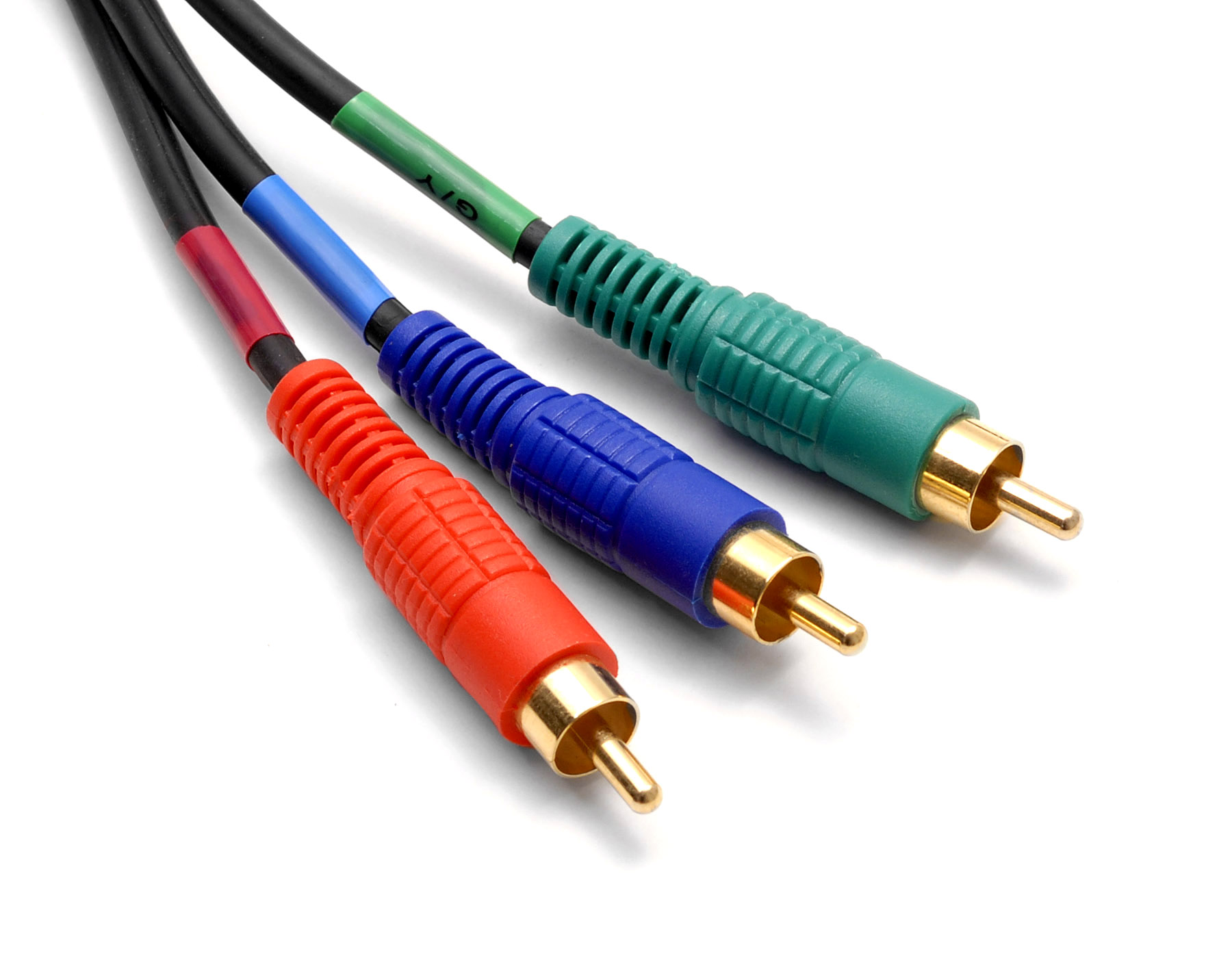
Three cables, each with RCA plugs at both ends, are often used to carry YPbPr analog component video.

Component video is an analog video signal that has been split into two or more component channels. In popular use, it refers to a type of component analog video (CAV) information that is transmitted or stored as three separate signals. Component video can be contrasted with composite video in which all the video information is combined into a single signal that is used in analog television. Like composite, component cables do not carry audio and are often paired with audio cables.

When used without any other qualifications, the term component video usually refers to analog YPBPR component video with sync on luma (Y) found on analog high-definition televisions and associated equipment from the 1990s through the 2000s when they were largely replaced with HDMI and other all-digital standards. Component video cables and their RCA jack connectors on equipment are normally color-coded red, green and blue, although the signal is not in RGB. YPbPr component video can be losslessly converted to the RGB signal that internally drives the monitor; the encoding is useful as the Y signal will also work on black and white monitors.

Analog component video

[edit]

Reproducing a video signal on a display device (for example, a cathode-ray tube; CRT) is a straightforward process complicated by the multitude of signal sources. DVD, VHS, computers and video game consoles all store, process and transmit video signals using different methods, and often each will provide more than one signal option. One way of maintaining signal clarity is by separating the components of a video signal so that they do not interfere with each other. A signal separated in this way is called "component video". S-Video, RGB and YPBPR signals comprise two or more separate signals and thus are all component-video signals. For most consumer-level video applications, the common three-cable system using BNC or RCA connectors analog component video was used. Typical formats are 480i (480 lines visible, 525 full for NTSC) and 576i (576 lines visible, 625 full for PAL). For personal computer displays the 15-pin DIN connector (IBM VGA) provided screen resolutions including 640×480, 800×600, 1024×768, 1152×864, 1280×1024.

RGB analog component video

[edit]
A 15-pin VGA connector for a personal computer
A 21-pin SCART or JP21 connector for a television

The various RGB (red, green, blue) analog component video standards (e.g., RGBS, RGBHV, RGsB) use no compression and impose no real limit on color depth or resolution, but require large bandwidth to carry the signal and contain a lot of redundant data since each channel typically includes much of the same black-and-white image. Early personal computers such as the IBM PS/2 offered this signal via a VGA port. Many televisions, especially in Europe, can utilize RGB via the SCART connector.[citation needed]

In addition to the red, green and blue color signals, RGB requires two additional signals to synchronize the video display. Several methods are used:

  • Composite sync, where the horizontal and vertical signals are mixed together on a separate wire (the S in RGBS)
  • Separate sync, where the horizontal and vertical are each on their own wire (the H and V in RGBHV; also the acronym HD/VD, meaning horizontal deflection/vertical deflection, is used)
  • Sync on green, where a composite sync signal is overlaid on the wire used to transport the green signal (SoG, Sync on G, or RGsB).
  • Sync on red or sync on blue, where a composite sync signal is overlaid on either the red or blue wire
  • Sync on composite (not to be confused with composite sync), where the signal normally used for composite video is used alongside the RGB signal only for the purposes of sync.
  • Sync on luma, where the Y signal from S-Video is used alongside the RGB signal only for the purposes of sync.

Composite sync is common in the European SCART connection scheme (using pins 17 [ground] and 19 [composite-out] or 20 [composite-in]). RGBS requires four wires – red, green, blue and sync. If separate cables are used, the sync cable is usually colored yellow (as is the standard for composite video) or white.

Separate sync is most common with VGA, used worldwide for analog computer monitors. This is sometimes known as RGBHV, as the horizontal and vertical synchronization pulses are sent in separate channels. This mode requires five conductors. If separate cables are used, the sync lines are usually yellow (H) and white (V), yellow (H) and black (V), or gray (H) and black (V).

Sync on Green (SoG) is less common, and while some VGA monitors support it, most do not. Sony is a big proponent of SoG, and most of their monitors (and their PlayStation line of video game consoles) use it. Like devices that use composite video or S-video, SoG devices require additional circuitry to remove the sync signal from the green line. A monitor that is not equipped to handle SoG will display an image with an extreme green tint, if any image at all, when given a SoG input.

Sync on red and sync on blue are even rarer than sync on green and are typically used only in certain specialized equipment.

Sync on composite, not to be confused with composite sync, is commonly used on devices that output both composite video and RGB over SCART. The RGB signal is used for color information, while the composite video signal is only used to extract the sync information. This is generally an inferior sync method, as this often causes checkerboards to appear on an image, but the image quality is still much sharper than standalone composite video.

Sync on luma is much similar to sync on composite but uses the Y signal from S-Video instead of a composite video signal. This is sometimes used on SCART since both composite video and S-Video luma ride along the same pins. This generally does not suffer from the same checkerboard issue as sync on composite, and is generally acceptable on devices that do not feature composite sync, such as the Sony PlayStation and some modded Nintendo 64 models.

Luma-based analog component video

[edit]
YPBPR component video out on a consumer electronics device, a Sony DVD player

Further types of component analog video signals do not use separate red, green and blue components but rather a colorless component, termed luma, which provides brightness information (as in black-and-white video). This combines with one or more color-carrying components, termed chroma, that give only color information. Both the S-Video component video output (two separate signals) and the YPBPR component video output (three separate signals) seen on DVD players are examples of this method.

Converting video into luma and chroma allows for chroma subsampling, a method used by JPEG and MPEG compression schemes to reduce the storage requirements for images and video (respectively).

Many consumer TVs, DVD players, monitors, video projectors and other video devices at one time used YPBPR output or input.

When used for connecting a video source to a video display where both support 4:3 and 16:9 display formats, the PAL television standard provides for signaling pulses that will automatically switch the display from one format to the other.

Connectors used

[edit]

Synchronization

[edit]

Component video requires an extra synchronization signal to be sent along with the video. Component video sync signals can be sent in several different ways:

Separate sync
Uses separate wires for horizontal and vertical synchronization. When used in RGB (i.e. VGA) connections, five separate signals are sent (red, green, blue, horizontal sync, and vertical sync).
Composite sync
Combines horizontal and vertical synchronization onto one wire. When used in RGB connections, only four separate signals are sent (red, green, blue, and composite sync).
Sync-on-green (SOG)
Combines composite sync with the green signal in RGB. Only three signals are sent (red, green with sync, and blue). This synchronization system is used in, among other applications, many systems by Silicon Graphics and Sun Microsystems through a DB13W3 connector.
Sync-on-luminance
Similar to sync-on-green, but combines sync with the luminance signal (Y) of a color system such as YPbPr and S-Video. This is the synchronization system normally used in home theater systems.
Sync-on-composite
The connector carries a standard composite video signal along with the RGB components, for use with devices that cannot process RGB signals. For devices that do understand RGB, the sync component of that composite signal is used along with the color information from the RGB lines. This arrangement is found in the SCART connector in common use in Europe and some other PAL/SECAM areas.

Digital component video

[edit]

Digital component video makes use of single cables with signal lines/connector pins dedicated to digital signals, transmitting digital color space values allowing higher resolutions up to 1080p.[1]

RGB component video has largely been replaced by modern digital formats, such as DisplayPort or Digital Visual Interface (DVI) digital connections, while home theater systems increasingly favor High-Definition Multimedia Interface (HDMI), which support higher resolutions,[2] higher dynamic range, and can be made to support digital rights management. The demise of analog is largely due to screens moving to large flat digital panels as well as the desire for having a single cable for both audio and video, but also due to a slight loss of clarity when converting from a digital media source to analog and back again for a flat digital display, particularly when used at higher resolutions where analog signals are highly susceptible to noise.

International standards

[edit]

Examples of international component video standards are:

Component versus composite

[edit]

In a composite signal, such as NTSC, PAL or SECAM, the luminance, Brightness (Y) signal and the chrominance, Color (C) signals are encoded together into one signal. When the color components are kept as separate signals, the video is called component analog video (CAV), which requires three separate signals: the luminance signal (Y) and the color difference signals (R-Y and B-Y).

Since component video does not undergo the encoding process, the color quality is noticeably better than composite video.[3]

Component video connectors are not unique in that the same connectors are used for several different standards; hence, making a component video connection often does not lead to a satisfactory video signal being transferred. Many DVD players and TVs may need to be set to indicate the type of input/output being used, and if set incorrectly the image may not be properly displayed. Progressive scan, for example, is often not enabled by default, even when component video output is selected.

See also

[edit]

References

[edit]

Further reading

[edit]
[edit]
Revisions and contributorsEdit on WikipediaRead on Wikipedia
from Grokipedia
Component video is an analog video signal format that separates the color picture information into multiple independent channels, typically consisting of a signal (Y') and two difference signals (Pb and Pr in the ), allowing for higher fidelity transmission and processing compared to by avoiding the and bandwidth limitations inherent in combined signals. This separation enables full bandwidth for the component while chroma signals are filtered to half or quarter bandwidth, preserving visual quality without excessive transmission demands. Originating in the early days of in the 1950s as an intermediate processing step in broadcast facilities, component video evolved from the need to add color to signals without tripling bandwidth requirements, with early formats like and used in systems. By the 1970s and 1980s, it became prominent in professional through formats such as and , standardized variably by organizations like the Society of Motion Picture and Television Engineers (SMPTE) and the (ITU). Key standards include BT.601 for the underlying digital sampling that informs analog scaling, with coefficients defining signal amplitudes (e.g., Y' at 714 mV peak for , Pb/Pr at 700 mV p-p for 75% saturation). In consumer electronics, YPbPr component video gained popularity in the mid-1990s as a high-definition capable interface for DVD players, HDTVs, and game consoles, using three RCA connectors (red, green, blue) to carry Pr, Y, and Pb respectively, supporting resolutions up to 1080i or 1080p with multiscan flexibility for various frame rates and line counts. Its advantages include reduced artifacts like dot crawl and color bleeding, making it superior to S-Video and composite for home theater applications, though it requires careful cable quality (75-ohm coaxial) to minimize signal degradation over distance. Despite the shift to digital interfaces like HDMI in the 2000s, component video remains relevant for legacy equipment and retro gaming due to its backward compatibility and robust analog performance.

Fundamentals

Definition and Signal Composition

Component video is an analog or digital video signal format that divides the video information into multiple independent channels, primarily separating the luminance (brightness) from the chrominance (color) components to minimize cross-interference and artifacts such as dot crawl that occur in composite signals. This separation allows each component to be transmitted and processed independently, preserving higher quality throughout the signal chain compared to formats where luminance and chrominance are combined. The core signal composition includes the luminance channel (Y), which encodes the intensity and detail information derived from the red (R), green (G), and blue (B) primary signals, and chrominance channels that capture color differences. In luma-based formats like , chrominance is represented by scaled color-difference signals Pb (blue-luminance) and Pr (red-luminance), computed as Pb=0.564(BY)P_b = 0.564(B - Y) and Pr=0.713(RY)P_r = 0.713(R - Y), where the is defined by the standard formula Y=0.299R+0.587G+0.114BY = 0.299R + 0.587G + 0.114B per BT.601. Alternatively, RGB component formats transmit the three primary color signals directly without deriving differences. Bandwidth allocation prioritizes luminance with a higher frequency range—up to 5-6 MHz in analog standard-definition systems—to maintain sharp detail, while chrominance signals are subsampled at roughly half or quarter that rate to exploit human visual sensitivity and reduce overall transmission demands. This approach enables superior color accuracy and spatial resolution in applications like 480i (525-line) or 576i (625-line) video, outperforming composite signals by avoiding bandwidth sharing and modulation artifacts.

Historical Development

The development of component video began in the early 1950s amid efforts to introduce color broadcasting compatible with existing monochrome television systems. In June 1953, RCA and NBC petitioned the Federal Communications Commission (FCC) for approval of a color television standard that separated the video signal into luma (brightness) and chroma (color) components, allowing transmission within the 6 MHz monochrome channel while minimizing interference. This approach, formalized as the NTSC color standard and approved by the FCC in December 1953, marked the foundational experiments in signal separation for broadcast television. During the 1970s, component video principles extended to , with RGB formats emerging as a direct separation of , , and signals for improved color fidelity. A key milestone came in 1981 with IBM's introduction of the (CGA), which utilized digital RGBI (, , , intensity) outputs via a DE-9 connector, enabling 16-color palettes in early personal computers. In the realm of (HDTV), Japan's demonstrated its Hi-Vision prototype in 1982, employing component signals akin to for analog HDTV production to achieve higher resolution and quality. The Society of Motion Picture and Television Engineers (SMPTE) advanced standardization in the 1980s, with demonstrations of component-coded in February 1981 and formal adoption of related parameters by March 1981, culminating in ITU Recommendation 601 in 1982 for 4:2:2 component digital systems. SMPTE further defined analog HDTV component parameters in its 240M standard, initially published in 1987, specifying signals for 1125-line systems. Component video saw widespread consumer adoption in the , particularly with the rise of DVD players and analog HDTVs, which leveraged connections for superior picture quality over composite signals. The transition to digital formats accelerated in the early 2000s; the (DVI) specification emerged in 1999, followed by 's release in 2002, which integrated uncompressed and audio into a single cable, diminishing the need for multiple analog component connections. By the , analog component video had become obsolete in mainstream consumer markets due to the dominance of digital interfaces like , though it persisted in professional legacy equipment for compatibility. As of 2025, component video maintains niche applications in the restoration of analog and video archives, where it facilitates high-fidelity transfer from legacy sources, as well as in vintage gaming communities relying on original hardware like early consoles and CRT displays. It also endures in select broadcast studios for interfacing with older production gear, though IP-based workflows have largely supplanted it in modern applications.

Analog Component Video

RGB Format

The RGB format in analog component video transmits three independent analog signals corresponding to the red, , and channels, delivering complete colorimetric information without decomposing the signal into and components. This direct approach preserves the full spectral fidelity of the original image, making it particularly effective for applications requiring precise color accuracy, such as computer-generated . Each channel carries the intensity levels for its respective color, typically ranging from 0 to 0.7 V peak-to-peak, with at 0 V and white at the maximum voltage. Common variants of the RGB format adapt the synchronization mechanism to different while maintaining the core three-color structure. RGsB embeds both horizontal and vertical sync pulses onto the channel, reducing cabling needs to four lines total and leveraging the human eye's sensitivity to green for minimal perceptual impact. RGBS employs a dedicated composite sync line that combines horizontal and vertical timing into a single signal, also using four connections for compatibility with legacy equipment. RGBHV, the most flexible variant, separates horizontal and vertical sync onto individual lines, requiring five cables but offering superior timing control for high-resolution displays. These variants emerged in professional and environments to balance with practical interconnection. In terms of performance, analog RGB supports resolutions up to 1280x1024 at 60 Hz, with each channel demanding a bandwidth of about 50 MHz to accommodate the pixel clock rates and avoid signal attenuation—exemplified by the VGA standard's 25.175 MHz clock for 640x480 mode, which scales to higher frequencies (e.g., 108 MHz for 1280x1024 at 60 Hz) for extended resolutions. This capability enabled sharp, artifact-free imagery in graphics-intensive tasks. Introduced by in 1987 as part of the (VGA) for the PS/2 computer line, analog RGB succeeded the digital RGBI interfaces of earlier CGA (1981) and EGA (1984) standards, transitioning to continuous-tone color support with 256 shades from an 18-bit palette (6 bits per channel) at 640x480, revolutionizing PC visual output for software and games. Despite its strengths, the RGB format's reliance on multiple discrete analog lines introduces challenges, including heightened cabling complexity—often necessitating five or shielded twisted-pair connections for RGBHV to maintain —and increased vulnerability to and over distances beyond 100 feet without amplification, leading to color imbalance or ghosting without the bandwidth efficiencies of luma-optimized alternatives.

Luma-Based Formats

Luma-based formats in analog component video separate the signal into (Y) and two chrominance difference components, Pb and Pr, where Y provides monochrome compatibility by carrying brightness and detail information compatible with black-and-white displays, while Pb represents the blue- difference and Pr the red- difference to encode color without requiring full bandwidth for each primary. These formats often limit bandwidth to half that of to optimize transmission efficiency while preserving perceived quality, analogous to digital 4:2:2 subsampling, or match full bandwidth to luma for professional applications. YPbPr evolved as a high-definition extension of earlier separated formats like , which combined and multiplexed , by fully decoupling the color differences into independent Pb and Pr channels to support higher resolutions such as without the bandwidth limitations of combined chroma. In high-definition implementations, bandwidth is typically limited to about half that of , for example 15 MHz for chroma versus 30 MHz for luma in formats, enabling efficient transmission over consumer cabling while maintaining compatibility with progressive and interlaced scanning. Specific implementations include the professional format introduced by in 1982, which utilized signaling—a precursor to —with separate and color difference tracks recorded on half-inch tape for broadcast production, offering superior quality over composite systems through this component separation. In the consumer domain, gained prominence in the 1990s with the rise of DVD players and early HDTV sets, standardized under EIA-770 for interfaces supporting conversion to enhance motion rendering in formats like and . The primary quality benefits of YPbPr stem from minimized crosstalk between luminance and chrominance signals due to dedicated channels, resulting in sharper edges and more accurate colors compared to S-Video, while enabling support for progressive modes such as 480p in NTSC regions and 576p in PAL, which reduce flicker and improve vertical resolution for smoother playback.

Connectors and Interfaces

Analog component video transmission commonly employs three RCA connectors for consumer applications, color-coded green for the Y (luminance) signal, blue for Pb (blue-difference), and red for Pr (red-difference). These RCA plugs carry unbalanced signals with a nominal amplitude of 1 V peak-to-peak (Vpp) for the Y channel (including sync, sync tip at 0 V) and 0.7 Vpp for the Pb and Pr channels (ranging 0-0.7 V, neutral at 0.5 V DC). This color-coding follows standards such as CEA-770.3 for high-definition analog component interfaces, ensuring consistent interconnection between devices like DVD players and televisions. In professional environments, BNC connectors are preferred for their robustness and support for 75-ohm coaxial cabling, often used for both YPbPr and RGB formats. These balanced connectors maintain signal integrity over longer distances, with the same voltage specifications as RCA but benefiting from better shielding against interference. For example, RGBHV signals via five BNC connectors (red, green, blue, horizontal sync, vertical sync) can extend up to 100 meters using low-loss coaxial cable without significant degradation. Other interfaces include the 21-pin connector, prevalent in European , which supports RGB or transmission with composite sync on dedicated pins—such as pin 20 for Y (1 Vpp, 75 ohms), and RGB pins 15, 11, and 7 for Pr, Y, and Pb respectively in some implementations. The (Video Graphics Array) interface uses a 15-pin connector for analog RGBHV signals, with pin 1 for red (0.7 Vpp, 75 ohms), pin 2 for green, pin 3 for blue, pin 13 for horizontal sync, and pin 14 for vertical sync, supporting resolutions up to 1920×1200. Compatibility challenges arise with color-coding adherence to standards like CEA-770, where mismatched connections can lead to incorrect color reproduction. Adapters from lower-bandwidth formats such as composite or to component require active signal conversion to separate luma and chroma properly, as passive adapters cannot upscale the encoded signals without quality loss. A common workaround involves connecting the composite video cable (yellow RCA) directly to the green Y port on a component input. This supplies the luminance signal plus modulated chrominance information to the Y channel, but most component inputs do not decode the color subcarrier, resulting in a black-and-white picture only. The red (Pr) and blue (Pb) ports should be left unconnected, while audio cables (red/white) connect normally to the corresponding audio inputs. For full color reproduction, an active composite-to-component converter or upscaler is required to properly separate and map the signals.

Synchronization

Analog Synchronization Methods

In analog component video systems, synchronization ensures precise timing alignment between the separated color channels and the display's scanning mechanism, preventing image distortion or misalignment. The primary methods involve embedding or dedicating signals for horizontal (H-sync) and vertical (V-sync) pulses, which define line and frame rates, respectively. These techniques are essential for maintaining in formats like RGB, where color components are transmitted independently. In luma-based formats such as , composite sync is embedded in the (Y) signal, enabling three-wire transmission similar to sync-on-green but applied to the Y channel. Separate H/V sync, often implemented in the RGBHV configuration, uses dedicated lines for horizontal and vertical pulses alongside the red, green, and blue video signals, resulting in a five-wire setup. This method provides the highest precision for and monitor applications, as it avoids interference with video channels. In contrast, composite sync (CSYNC) combines H-sync and V-sync into a single line, forming the RGBS format with four wires total, which reduces cabling complexity while preserving timing accuracy. Sync-on-green (SOG), or RGsB, further simplifies to three wires by modulating the composite sync onto the green channel, superimposing negative-going pulses below the . Sync pulses typically exhibit amplitudes of approximately 0.3 V peak-to-peak, with the sync tip at -300 mV relative to the 0 V in standard graphics RGB systems, ensuring reliable detection by receivers. For NTSC-compatible analog component video, the horizontal sync is standardized at 15.734 kHz, corresponding to per frame at a frame rate of 29.97 Hz (field rate of 59.94 Hz), while vertical sync operates at 59.94 Hz to align with interlaced scanning. These parameters adhere to EIA RS-170 specifications, allowing across devices. In practical applications, interfaces commonly employ composite sync on pin 20 to deliver timing signals alongside RGB components, supporting European with minimal wiring. VGA connections, prevalent in , utilize RGBHV for robust in high-resolution displays, enabling precise up to 31 kHz horizontal rates. These methods suit environments requiring stable timing, such as home entertainment and professional setups. A key challenge in analog synchronization arises from jitter accumulation over long cable runs, where signal propagation delays and noise degrade pulse timing, potentially causing horizontal shifts or frame instability. To mitigate this in multi-device scenarios, genlock (generator locking) synchronizes sources to a common reference signal, such as a black burst or , ensuring phase alignment in broadcast production. This technique is vital for applications like video switching, where even minor timing offsets can disrupt seamless transitions.

Digital Synchronization Techniques

In digital component video systems, synchronization is achieved by embedding timing information directly into the serialized data stream, enabling precise alignment of and components without external reference signals. This approach contrasts with analog methods by integrating sync data as part of the digital payload, such as through timing reference signals (TRS) in formats like (SDI). TRS packets, consisting of specific 10-bit word sequences, mark the start of active video (SAV) and end of active video (EAV) for each line, ensuring frame and field timing integrity in YCbCr-encoded signals. Ancillary data spaces within the SDI stream further support embedded synchronization by carrying additional timing metadata, such as line and field identifiers. Key standards define these techniques for high-reliability transmission. In HD-SDI, SMPTE ST 292 specifies a 1.485 Gbps data rate with TRS-ID words—extended TRS sequences that include identification codes for error checking and precise timing recovery—allowing synchronization of . Similarly, HDMI employs (TMDS) across three data channels and a dedicated clock channel, where horizontal and vertical sync pulses are embedded during blanking intervals, and infoframes transmit supplementary timing data like pixel clock rates and frame durations to coordinate source-sink alignment. Clock-data recovery (CDR) circuits complement these methods by extracting the embedded clock from the NRZ-encoded serial stream in SDI, retiming the data to minimize accumulated without requiring separate clock lines. These digital techniques provide significant advantages over traditional approaches, including high immunity to and due to the inherent error-detection capabilities of digital encoding, which prevent sync loss in long cable runs. They also enable support for variable frame rates, such as 23.976 fps used in cinematic production, by flexibly adjusting TRS positioning and without hardware reconfiguration. In multi-link configurations, like dual-link HD-SDI for deeper color formats, lock detection algorithms analyze TRS pattern validity and disparity across links to confirm , ensuring seamless integration of parallel data streams.

Digital Component Video

Core Formats and Encoding

Digital component video primarily employs the color space, which serves as the digital equivalent of the analog format, separating (Y) from chrominance components (Cb and Cr) to optimize bandwidth while preserving perceptual quality. This format is standardized by the (ITU) for (HDTV) and beyond, enabling efficient transmission of video signals in professional and consumer applications. In contrast, RGB remains a core format for and some high-end video workflows, typically encoded at 24 bits per pixel (8 bits each for red, green, and blue) to support full-color fidelity without subsampling. YCbCr supports various sampling structures to balance quality and data efficiency, with 4:2:2 and being the most prevalent. In 4:2:2 sampling, the is sampled at full resolution (e.g., 1920 samples per line for ), while components are subsampled horizontally by a factor of 2 (960 samples each per line), reducing bandwidth by approximately 33% compared to full sampling without significant visible loss due to human vision sensitivity. The structure samples all components at full resolution, ideal for or scenarios requiring precise color reproduction, such as post-production . These structures adhere to orthogonal sampling lattices as defined in BT.709, with sampling frequencies like 74.25 MHz for Y in 1080-line systems. Encoding in YCbCr involves linear matrix transformations from RGB primaries, using coefficients specified in BT.709 for HDTV. The luma component is derived as: Y=0.2126R+0.7152G+0.0722BY' = 0.2126 R' + 0.7152 G' + 0.0722 B' where primed values indicate gamma-corrected inputs. Chroma components are then computed as differences: CB=0.5(BY)/0.9278C_B' = 0.5 (B' - Y') / 0.9278 and CR=0.5(RY)/0.7874C_R' = 0.5 (R' - Y') / 0.7874, normalized to maintain unity gain. These signals are quantized to discrete levels, commonly at 8-bit (levels 16-235 for Y, 16-240 for Cb/Cr), 10-bit (64-940 for Y, 64-960 for Cb/Cr), or 12-bit depths in advanced systems, allowing for extended and reduced quantization noise in professional environments. Uncompressed digital component video relies on intra-frame encoding without inter-frame compression, resulting in high that scale with resolution and sampling. For example, at 60 Hz in 4:2:2 10-bit requires approximately 3 Gbps, reflecting the raw pixel data payload excluding overhead. Modern standards extend support to 4K (3840×2160) via SMPTE ST 2082 (12G-SDI) and 8K (7680×4320) through quad-link configurations, maintaining formats up to 12-bit depths for ultra-high-definition production. Unlike analog component video, which uses continuous waveforms prone to accumulation, digital formats employ bit-parallel or serial transmission (e.g., via SDI interfaces) for discrete , enabling robust error detection through cyclic redundancy checks (CRC) embedded in each line or field. This CRC mechanism verifies by comparing transmitted checksums against recalculated values, flagging errors without correction in base standards.

Transmission Standards and Interfaces

Component video transmission standards encompass both analog and digital protocols designed for reliable signal delivery in professional environments. Complementing this, EIA-770 outlines the specifications for RGB analog video, supporting high-definition formats with defined voltage levels and sync timing to ensure compatibility across consumer and broadcast equipment. Digital transmission standards build on these foundations to handle higher resolutions and data rates. SMPTE ST 125:2013 defines the component video signal coding for and 4:2:2 in SDTV systems at 13.5 MHz and 18 MHz sampling rates. SMPTE ST 259:2008 defines the (SDI) for standard-definition video at rates up to 360 Mb/s, facilitating uncompressed component transport over links in production workflows. For high-definition applications, SMPTE ST 292-1:2018 establishes the 1.5 Gb/s HD-SDI interface, which carries or RGB component signals for /60 or formats, widely adopted in and . Modern interfaces extend these standards for ultra-high-definition content. BNC connectors, compliant with SMPTE ST 2082-1:2015 for 12G-SDI, support 4K transmission at up to 12 Gb/s over distances of 100 meters using RG-6 cabling, minimizing signal degradation in studio interconnects. For longer distances, optic interfaces enable SDI signals to travel up to 10 km without , as implemented in broadcast systems like Grass Valley's transmission solutions, ideal for remote production and venue-to-control room links. For IP-based transmission, the SMPTE ST 2110 suite (as of 2025) enables uncompressed digital component video (in YCbCr or RGB formats with sampling like 4:2:2 or 4:4:4) over standard Ethernet networks, separating video essence (ST 2110-20), audio (ST 2110-30), and ancillary data (ST 2110-40) for flexible, scalable routing in professional broadcast and production environments. Consumer and hybrid professional setups leverage versatile digital interfaces. HDMI 2.2, with its 96 Gbps bandwidth as of 2025, carries YCbCr component video in 8K/60Hz formats with enhanced support for dynamic HDR and backward compatibility with legacy SDI workflows. Similarly, DisplayPort 2.1 supports uncompressed RGB or YCbCr component transmission at 8K/60Hz with 4:4:4 chroma, offering up to 80 Gbps throughput. These interfaces ensure interoperability in mixed analog-digital environments, with HDMI's higher tiers enabling 4K/60Hz 4:4:4 without compression in hybrid broadcast setups as of 2025.

Applications

Consumer and Home Entertainment

In the late and early , component video in the format using RCA connectors became a standard for connecting DVD players to high-definition televisions (HDTVs), enabling output at and interlaced signals up to for improved picture quality over . This setup was particularly popular during the home theater boom, as it allowed consumers to upscale standard-definition DVD content to match the capabilities of emerging HDTVs without the color bleeding and lower resolution associated with earlier analog formats. DVD players from manufacturers like and Pioneer commonly included outputs, making it accessible for average households transitioning from CRT to plasma or LCD displays. Adoption peaked in the mid-2000s alongside the introduction of Blu-ray players, which initially supported full output via component cables for high-definition movie playback in living rooms. Gaming consoles exemplified this era's widespread use; the , launched in 2006, offered official component AV cables as an optional accessory to deliver up to gaming and Blu-ray video on compatible HDTVs, appealing to gamers without -equipped setups. However, by the late 2000s, the rise of began phasing out component video, with Blu-ray standards enforcing downconversion to on component outputs starting in 2011 to address content protection concerns, pushing consumers toward digital interfaces. As of 2025, component video persists in niche consumer applications, primarily through adapters and upscaling devices that convert signals from legacy sources to for modern 4K smart TVs. Retro gaming enthusiasts, for instance, use these adapters to connect consoles like the Wii U—which natively supports component output—to current displays, preserving analog signal integrity while enabling upscaling to higher resolutions for clearer visuals on large screens. Devices such as converters with built-in scalers allow analog sources to integrate into home entertainment systems without native component inputs, catering to collectors maintaining vintage setups amid the dominance of streaming and . A key limitation of component video in home entertainment is its inability to transmit audio, requiring separate RCA or optical cables for sound, which complicates wiring compared to HDMI's single-cable solution for both video and multi-channel audio. This multi-cable setup increases installation complexity, especially in cluttered entertainment centers, and demands careful matching of cable lengths to avoid signal degradation over distances greater than 3 meters.

Professional and Broadcast Use

In professional video production and broadcast environments, component video signals, particularly in digital YCbCr format transmitted via Serial Digital Interface (SDI), are widely employed in editing suites for their high-fidelity color separation and compatibility with nonlinear editing systems. For instance, Avid Media Composer workstations support YCbCr component video inputs through SDI connections, enabling precise editing of broadcast-quality footage with minimal signal degradation across multiple generations of processing. Similarly, RGB component formats are favored in post-production color grading workflows, where the direct red, green, and blue channels allow for accurate manipulation of hue, saturation, and luminance without the artifacts introduced by composite encoding, ensuring compliance with broadcast standards like ITU-R BT.709. Historically, component video played a pivotal role in early (HDTV) development during the , with Japan's laboratories utilizing analog Y, B-Y, R-Y component signals in experimental HDTV trials to achieve wider bandwidths and improved resolution over standard broadcasts. These efforts, which included satellite transmission tests starting in the early , laid the groundwork for analog HDTV systems like Hi-Vision, influencing global standards through collaborations with organizations like the Electronic Industries Association (EIA). As of 2025, component video persists in hybrid analog-digital workflows, particularly for archiving legacy content such as film-to-digital transfers, where analog component outputs from machines are captured via SDI converters to preserve original color fidelity during digitization. Professional equipment commonly integrates component video for reliability in demanding settings. Cameras like Sony's series output analog component signals (Y, R-Y, B-Y) through multi-pin or BNC connectors, providing broadcast-grade quality for field acquisition in news and documentary production. In live event broadcasting, video switchers equipped with BNC inputs handle multiple component video feeds, facilitating seamless transitions between sources like cameras and graphics generators while maintaining over long cable runs. Key advantages of component video in these contexts include its inherently low latency in analog implementations, which avoids the processing delays of digital compression, making it suitable for real-time applications like live sports and news switching. In digital form, SDI-based component video scales effectively to 4K resolutions via extensions like 12G-SDI, supporting uncompressed 4:2:2 transport for high-bandwidth broadcast pipelines without requiring full IP infrastructure overhauls. These attributes underscore its enduring value for standards-compliant, rugged operations in studios and transmission facilities.

Comparisons

Versus Composite Video

Component video transmits luminance (Y) and two color difference signals (Pb and Pr, derived from blue and red luminances) as separate analog signals, avoiding the signal mixing inherent in , where luminance and chrominance are combined into a single channel. This separation in component video eliminates between luminance and chrominance, preventing artifacts such as cross-color interference (e.g., rainbow-like patterns on fine details) that plague composite signals due to their overlapping spectra. In contrast, composite video's modulation of chrominance onto a subcarrier (3.58 MHz for ) causes imperfect separation during decoding, leading to visible dot crawl—crawling dots at boundaries between high-contrast colors—and color bleeding, where hues smear into adjacent areas. These issues degrade overall image fidelity in composite systems, particularly noticeable in standard-definition content like or formats. In terms of quality metrics, component video supports significantly higher color resolution, achieving up to 240 horizontal TV lines for chrominance in standard-definition applications, matching or approaching the luminance resolution of approximately 240-270 lines. Composite video, however, is limited to about 40-50 horizontal TV lines for effective color resolution due to its restricted chrominance bandwidth (around 0.5-1.3 MHz in NTSC), resulting in softer, less detailed colors and reduced sharpness in chroma-heavy scenes. This disparity makes component video particularly superior for standard-definition signals (480i/576i), where it preserves finer color gradients and spatial detail without the filtering compromises required in composite decoding. Component video found primary use cases in consumer applications like DVD players and early HDTV inputs during the late 1990s and early 2000s, enabling higher-quality playback of enhanced content without the artifacts common in legacy systems. , by comparison, remained the standard for older formats such as tapes and basic connections, where its single-cable simplicity suited low-bandwidth sources but at the cost of visible quality limitations. As a transitional technology, component video served as a bridge from composite-era analog broadcasting to emerging digital formats, offering improved analog performance for DVD adoption and HDTV readiness before widespread integration. Although component video is not designed for direct compatibility with composite video, a common workaround exists for connecting legacy composite sources to component inputs on many televisions: the yellow composite video cable can be plugged into the green Y (luminance) port, with the Pb and Pr ports left unconnected. This typically produces a black-and-white picture, as the television extracts the luminance component from the composite signal but does not decode the modulated chrominance subcarrier for color reproduction. Audio cables (red/white) connect normally to the audio inputs. For full color reproduction, an external composite to component converter or upscaler is required. This limited workaround demonstrates the necessity of separate color difference signals for accurate color fidelity in component video, while facilitating connectivity in transitional setups from older composite sources. S-Video represents an intermediate step between composite and component by separating luminance from chrominance but combining the color differences, yielding better results than composite yet inferior to component's full separation.

Versus Other Separated Formats

Component video offers superior chrominance handling compared to S-Video, another partially separated analog format, by further dividing the chroma signal into two distinct components—Pb (blue-luminance difference) and Pr (red-luminance difference)—which preserves full color detail and hue accuracy without the bandwidth limitations of a combined chroma channel. In contrast, S-Video transmits luminance (Y) separately from a combined chrominance (C) signal, which merges the color information into a single modulated carrier, resulting in reduced hue precision and potential color artifacts due to the shared bandwidth for I and Q (in-phase and quadrature) components. This separation in component video allows for more accurate color reproduction, effectively doubling the color resolution compared to S-Video's typical capabilities. Regarding resolution and bandwidth, component video supports high-definition formats such as , enabling sharper images with options up to , while is limited to standard-definition at a maximum of . The total bandwidth for component video in standard applications reaches approximately 4.2 MHz for the Y signal combined with separate Pb and Pr channels (each around 2 MHz), providing higher overall capacity for detail. , however, allocates only about 1.3 MHz to its chroma signal, constraining color bandwidth and preventing HD transmission. These differences make component video more suitable for advanced displays. Connectors also differ, with component video typically using three RCA plugs (color-coded red, green, and blue for Pr, Y, and Pb) or professional BNC connectors for reliable signal integrity over longer runs. employs a compact 4-pin that carries both Y and C signals in a single plug. Historically, gained popularity in the for consumer applications like camcorders and VCRs due to its simplicity and improvement over composite. Component video, originating from broadcast technology, saw widespread consumer adoption in the and beyond with the rise of HDTV and DVD players, positioning it as a bridge to higher-quality home entertainment.

Versus Modern Digital Interfaces

Component video, as an analog interface, separates luminance and chrominance signals into distinct channels (typically Y, Pb, and Pr), making it susceptible to electromagnetic interference, signal attenuation over distance, and gradual degradation during transmission, which can manifest as color shifts, noise, or loss of detail. In contrast, modern digital interfaces like HDMI transmit video as packetized digital data in formats such as YCbCr or RGB, employing transition-minimized differential signaling (TMDS) with error detection mechanisms to maintain signal integrity, minimizing artifacts from noise or cable length up to specified limits. HDMI 2.1, the prevailing standard in 2025, supports bandwidths up to 48 Gbps, enabling uncompressed transmission of high-resolution content without the analog limitations that cap component video at approximately 30 MHz per channel for high-definition signals. A key advantage of HDMI over component video lies in its integrated features: it carries both uncompressed audio (up to 32 channels via eARC) and video over a single cable, while component requires separate analog audio connections, complicating setups and potentially introducing additional noise. also incorporates (CEC), allowing device synchronization such as unified remote control across TVs, players, and receivers—functionality absent in component interfaces. Furthermore, natively supports resolutions up to 8K at 60 Hz or 4K at 120 Hz with HDR, far exceeding component's practical analog limit to , beyond which signal fidelity deteriorates due to bandwidth constraints. By 2025, component video persists primarily in legacy applications, where upconversion devices—such as analog-to-digital converters—transform its signals into for compatibility with modern displays lacking analog inputs, ensuring older equipment like DVD players or retro consoles can interface with 4K/8K systems. However, new have fully phased out component ports in favor of and other digital standards, driven by the latter's superior reliability, higher bandwidth (starting at 18 Gbps for 2.0 and scaling to 48 Gbps), and support for advanced features like variable refresh rates, rendering component obsolete for contemporary production and distribution.

References

Add your contribution
Related Hubs
User Avatar
No comments yet.