Hubbry Logo
ResafaResafaMain
Open search
Resafa
Community hub
Resafa
logo
8 pages, 0 posts
0 subscribers
Be the first to start a discussion here.
Resafa
Resafa
from Wikipedia

Resafa (Arabic: الرصافة, romanizedReṣafa), sometimes spelled Rusafa, and known in the Byzantine era as Sergiopolis (Greek: Σεργιούπολις or Σεργιόπολις, lit.'city of Saint Sergius') and briefly as Anastasiopolis (Αναστασιόπολις, lit.'city of Anastasius'), was a city located in the Roman province of Euphratensis, in modern-day Syria. It is an archaeological site situated southwest of the city of Raqqa and the Euphrates.

Key Information

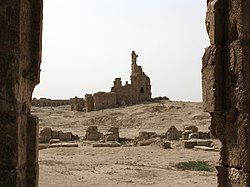
Procopius describes at length the ramparts and buildings erected there by Justinian.[2] The walls of Resafa, which are still well preserved, are over 1600 feet in length and about 1000 feet in width; round or square towers were erected about every hundred feet; there are also ruins of a church with three apses.

Names

[edit]

Resafa corresponds to the Akkadian Raṣappa and the Biblical Rezeph (Septuagint; Koine Greek: Ράφες), where it is mentioned in Isaiah 37:12;[3][4] cuneiform sources give Rasaappa, Rasappa, and Rasapi.[5][4]

Ptolemy calls it Rhesapha (Koine Greek: Ρεσαφα).[6] In the late Roman Tabula Peutingeriana, it is called Risapa.[4] In the Notitia dignitatum, it is Rosafa.[4]

Procopius write that it was called Sergiopolis after the Saint Sergius.[7]

History

[edit]

Antiquity

[edit]

The site dates to the 9th century BC, when a military camp was built by the Assyrians.[8]

During Roman times, it was a desert outpost fortified to defend against the Sasanian Empire and a station on the Strata Diocletiana.[8] It flourished as its location on the caravan routes linking Aleppo, Dura-Europos, and Palmyra was ideal.[9]

Resafa had no spring or running water, so it depended on large cisterns to capture the winter and spring rains.[9]

In the 4th century, it became a pilgrimage town for Christians coming to venerate Saint Sergius, a Christian Roman soldier said to have been martyred in Resafa during the Diocletianic Persecution. A church was built to mark his grave, the city was renamed Sergiopolis and began to grow massively. Indeed, it became, after Jerusalem, "most important pilgrimage center in Byzantine Orientis in [the] proto-Byzantine period", with a special appeal to the local Arabs, especially the Ghassanids.[8] Resafa was located in the area of the Roman–Persian Wars, and was therefore a well-defended city that had massive walls that surrounded it without a break.[10]

By the late 6th century, the Ghassanids' tribal Arab ally the Bahra' were tasked with guarding Resafa and its shrine from nomadic marauders and the Lakhmids of Mesopotamia.[11]

Muslim conquest to 13th century

[edit]
North gate of the city of Resafa, site of Hisham's palace and court

The city was lost by the Byzantines in the 7th century when the Arabs won the final victory at the Battle of Yarmouk in the year 636. In the eighth century, the Umayyad caliph Hisham ibn Abd al-Malik (r. 724–743) made the city his favoured residence, and built several palaces around it,[12] which are counted among the qasr or desert castle category.[13]

The city was finally abandoned in the 13th century when the Mongols invaded the area.

Civil War, 2011-2017

[edit]

In the Syrian Civil War, the town was occupied by ISIS, before being liberated by Government forces on 19 June 2017 during the Southern Raqqa Offensive.[14]

Ecclesiastical history

[edit]

Sergiopolis's first bishop was appointed shortly after 431 by John of Antioch, in spite of the opposition of the Metropolitan of Hierapolis Bambyce, on whom that church had till then depended. Later, Marianus attended a Council of Antioch.

Sergiopolis obtained the title of metropolis from Emperor Anastasius I. With five suffragan sees, it figures in the Notitia episcopatuum of Antioch in the sixth century. A bishop named Sergius or George was an envoy of Justinian to the Lakhmids around 524. At the fifth general council (Second Council of Constantinople) in 553, Abraham signed as metropolitan. The favors of Anastasius obtained for the city the name of Anastasiopolis, which it still retained at the beginning of the seventh century. Bishop Candidus, at the time of the Sassanian Persian siege of the city by Khosrau I (in 543), ransomed 1,200 captives for two hundred pounds of gold,[15] and, in 1093, Metropolitan Simeon restored the great Basilica ("Échos d'Orient", III, 238); which attests to the continuing existence of Christianity in Rasafa.[16][17]

Titular see(s)

[edit]

The (arch)diocese of Sergiopolis was nominally restored as a Roman Catholic titular bishopric, initially of the lowest (episcopal) rank, and under the curiate name Sergiopolis antea Resapha (having namesakes see Sergiopolis), and had the following incumbents as such:

  • Titular Bishop Ján Gustíni-Zubrohlavský (1762.05.13 – 1763.11.29)
  • Titular Bishop Eugenio Giovanni Battista Cerina, Friars Minor (O.F.M.) (1803.09.26 – 1827.05.30)
  • Titular Bishop Adrien-Hyppolyte Languillat (郎懷仁), Jesuits S.J. (1856.05.27 – 1878.11.30)
  • Titular Bishop Gaetano Blandini (1881.05.13 – 1885.02.02)
  • Titular Bishop John Rooney (1886.01.29 – 1927.02.26)

In 1925, it was promoted to titular archbishopric of the highest, Metropolitan rank, and its name was shortened to Sergiopolis. As such, it has had the following incumbents, the first two however still only as titular bishop :

  • Titular Bishop Hector-Raphaël Quilliet (1928.03.23 – 1928.11.26)
  • Titular Bishop François-Marie Kersuzan (1929.02.04 – 1935.07.23)
  • Titular Archbishop Adolfo Alejandro Nouel y Boba-Dilla (1935.10.11 – 1937.06.26)
  • Titular Archbishop Basile Khoury (1938.10.15 – 1941.11.21)
  • Titular Archbishop Natale Gabriele Moriondo, Dominican Order (O.P.) (1943.06.01 – 1946.01.03)
  • Titular Archbishop Antonio Taffi (1947.05.14 – 1970.01.06).
[edit]

References

[edit]

Further reading

[edit]
[edit]
Revisions and contributorsEdit on WikipediaRead on Wikipedia
from Grokipedia
Resafa, known in antiquity as Sergiopolis and later as Rusafa, is a ruined ancient city in eastern Syria, situated in the desert about 35 kilometers south of the Euphrates River and southwest of modern Raqqa. Originally a Roman military outpost on the eastern frontier, it transformed into a prominent Christian pilgrimage center following the martyrdom of Saint Sergius, a Roman soldier executed around 303 AD, whose cult drew devotees and spurred urban development in Late Antiquity. The city featured multiple basilicas, including a grand martyrium church, extensive defensive walls renewed under Emperor Justinian I in the mid-6th century, and sophisticated water cisterns to harness rare desert floods for sustenance in the arid environment. Under Umayyad rule from the 7th to 8th centuries, Resafa served as a royal residence, exemplified by the palace complex built by Caliph Hisham ibn Abd al-Malik, blending Byzantine and Islamic architectural elements amid continued settlement until its decline by the 13th century. Today, the site's well-preserved ruins, encompassing churches, gates, and fortifications, highlight its historical significance as a crossroads of Roman, Byzantine, and early Islamic civilizations, though it has suffered from looting and environmental damage in recent decades.

Names and Etymology

Historical Designations

Resafa's earliest known designation appears in Assyrian records as Raṣappa, dating to the 9th century BCE, when it served as a settlement in the region. This name is corroborated in sources as variants like Rasappa and Rasapi, reflecting its Mesopotamian origins. In the , it is identified as Rezeph, a town conquered by Assyrian forces under around 715–712 BCE, with the rendering it as Ràphes. During the Hellenistic and Roman periods, the site retained Semitic roots but appeared in Greek and Latin texts with adapted forms, including Rhesapha in Ptolemy's Geography ( CE) and Risapa in the (late 4th century CE), as well as Rosafa in the (late Roman military listings). These designations marked its role as a frontier outpost in the province of Euphratensis. The Christian era brought significant renamings tied to the martyrdom of Saint Sergius (c. 303 CE) at the local site, transforming Resafa into a pilgrimage hub; by the , it was redesignated Sergiopolis (Greek: Σεργιόπολις, "city of Sergius"), a name formalized under Byzantine emperors Anastasius I (r. 491–518 CE) and (r. 527–565 CE), who fortified the city and elevated its ecclesiastical status. Briefly, during Anastasius I's reign, it received the honorific Anastasiopolis upon achieving metropolitan bishopric rank, though this was short-lived and Sergiopolis soon predominated. Post-Islamic conquest in the CE, the al-Ruṣāfa (الرصافة) emerged, emphasizing its desert location ("the lead" or "the forefront"); under Umayyad Caliph (r. 724–743 CE), it gained the specific epithet Rusafat Hisham for his palace complex, underscoring its administrative prominence. These Islamic designations persisted into modern usage, adapting the pre-Islamic toponym.

Linguistic Origins and Modern Variants

The name Resafa traces its linguistic roots to ancient , with attestations as Rasappa in Assyrian records and Rezeph in biblical texts such as 2 Kings 19:12 and Isaiah 37:12, referring to a locality captured by Assyrian forces in the 8th century BCE. In Greco-Roman sources, the settlement appears as Rhesafa in Greek and Risafa or Rosafa in Latin, reflecting phonetic adaptations of the Semitic form during Hellenistic and imperial Roman administration. By , amid the rise of centered on the martyrdom of Saint Sergius circa 303 CE, Byzantine authorities renamed the city Sergiopolis ("city of Sergius") in the early , emphasizing its role as a cult site rather than altering the underlying toponym. This designation persisted alongside the indigenous name until the Islamic conquests, after which Arabic forms emerged as al-Ruṣāfa, a direct from Syriac-Aramaic precedents, with a temporary Umayyad-era variant Ruṣāfat Hishām honoring Caliph (r. 724–743 CE). In modern usage, the site's Arabic name remains al-Ruṣāfa (الرصافة), transliterated variably as Resafa, Rusafa, or Rassafah in scholarly and cartographic contexts, preserving the Semitic phonetic core without significant semantic shifts. English-language references predominantly employ "Resafa" for the archaeological locale in , , while "Rusafa" appears in some historical Arabic-derived , though distinct from homonymous sites like Baghdad's al-Rusafa . These variants reflect orthographic conventions rather than substantive linguistic evolution, with no evidence of folk etymologies supplanting the ancient Semitic base.

Geography and Administration

Location and Physical Features

Resafa is situated in northern within the , approximately 30 kilometers west of the city of and 35 kilometers south of the River. The site's coordinates are roughly 35°38′ N latitude and 38°46′ E longitude. It lies at the edge of the in a semi-arid steppe zone, at the confluence of several systems draining the surrounding undulating terrain. The physical layout of Resafa features a fortified forming an irregular rectangle, with wall lengths of 536 meters on the north, 411 meters on the west, 549 meters on the south, and 350 meters on the east. These walls, originally up to 15 meters high and 3 meters thick, incorporate 21 towers and four gates, encompassing an area of about 400 by 600 meters on firm soil. The terrain is characterized by low elevation around 293 meters above , with the ruins positioned on a flat to gently undulating landscape lacking natural sources, necessitating ancient floodwater harvesting systems due to the harsh climate with annual rainfall of 100-200 mm.

Administrative Divisions and Boundaries

Resafa is situated in the southern part of Ar-Raqqah Governorate, one of Syria's 14 governorates, located in the northern region of the country along the River valley. The governorate encompasses approximately 25,210 square kilometers and borders to the north, to the northeast, to the southeast, to the west, and to the southwest. The modern village and archaeological site of Resafa fall under the standard Syrian administrative hierarchy of governorates, districts (manāṭiq), and subdistricts (nawāḥī), but it does not form an independent district or subdistrict itself. Instead, it is integrated into the southern rural expanse of Ar-Raqqah Governorate, roughly 35 kilometers southwest of the provincial capital, , and 25 kilometers south of the Euphrates River. Boundaries in this arid zone are primarily defined by natural features like wadis and the river, with limited formal demarcation for small settlements amid the region's focus on and historical preservation. Ongoing instability from the has disrupted administrative enforcement, with the area around Resafa experiencing shifts in control, including occupation by until June 2017 and subsequent influence by Iranian-backed militias in the valley as of 2020. This has rendered precise boundary implementation secondary to security dynamics in official records.

Historical Development

Pre-Islamic and Antiquity Foundations

Resafa's antiquity traces to the BCE, when Assyrian records identify it as Raşappa, a site also referenced in the as Rezeph, a whose inhabitants were deported by Assyrian forces. Archaeological evidence indicates continuity as a modest settlement, but its strategic role emerged prominently in Roman times as a fortified on the eastern limes, approximately 25 km south of the River, established by the late BCE to counter threats from Parthian and later Sasanian forces. By the CE, Resafa served as a base for units and formed part of Emperor Diocletian's Strata Diocletiana, a fortified desert road linking Sura to for rapid troop movements against Persian incursions. The site's transformation into a major Christian center began with the martyrdom of Saint Sergius, a Roman officer executed around 303 CE under Emperor for refusing to sacrifice to pagan gods, alongside his companion Bacchus; their relics drew early pilgrims, prompting construction of a martyrion by the late . Resafa, elevated to a bishopric by 454 CE, was briefly renamed Anastasiopolis under Emperor Anastasius I (r. 491–518), who expanded B, before reverting to Sergiopolis in 527 under to honor the saint. Emperor (r. 527–565) significantly fortified the city with walls reaching 15 meters in height and 3 meters in thickness, featuring 21 towers and four gated entrances, alongside stoas, cisterns for water storage, and the grand A completed in 559/560 CE, underscoring its role as a hub and defensive stronghold amid Roman-Persian conflicts. The Ghassanid , Byzantine client allies, maintained a presence from the late , utilizing the site for military headquarters north of the main fortress. Persian forces under captured and damaged the city in 610 CE, but it was recaptured by Emperor , who added a , preserving its pre-Islamic Byzantine character until the Arab conquest in 636 CE.

Islamic Conquest and Abbasid Era

The city of Resafa, known as Sergiopolis in Byzantine times, fell to Muslim Arab forces during the conquest of the in the mid-7th century, with the region around it captured circa 636 AD following the Battle of Yarmouk. As part of the broader Caliphate's expansion into , Resafa transitioned from Byzantine control without recorded major resistance, maintaining its role as a pilgrimage center dedicated to Saint Sergius while integrating into the new Islamic administrative framework. Under the , Resafa gained prominence as a caliphal residence during the reign of (724–743 AD), who expanded the settlement and constructed a complex at the north gate, alongside a built adjacent to the existing of Saint Sergius to accommodate both Muslim and continuing Christian practices. This development reflected early Islamic adaptation of Late Antique urban structures, with Hisham's investments enhancing water management systems and fortifications to support seasonal court residences in the desert periphery. The site's strategic location between the and Palmyrene desert facilitated its use for governance and , blending Ghassanid sedentarization influences with Umayyad palatial . Following the Abbasid Revolution in 750 AD, Resafa experienced a shift as the new dynasty consolidated power, including a reported pursuit and massacre of Umayyad remnants near the site, signaling the end of its Umayyad-era centrality. The Abbasids established a new fortress in nearby , diverting regional focus, though Resafa persisted as a settlement with evidence of occupation through the 8th and 9th centuries, marked by minor architectural adaptations and continued use of its cisterns and walls. By the late Abbasid period (late 10th–11th centuries), nomadic influences predominated, indicating gradual depopulation amid broader economic shifts, yet the city retained monumental structures until Mongol invasions in the 13th century prompted final abandonment.

Medieval Period to Mongol Invasions

During the post-Abbasid medieval period, Resafa persisted as a modest settlement in northern 's Euphrates region, overshadowed by the emerging Abbasid stronghold of al-Raqqa to the northwest, which drew administrative and military focus after the dynasty's consolidation in 750 CE. An earthquake in the late inflicted significant structural damage, accelerating the site's diminishing role from its earlier prominence as a pilgrimage center for Saint Sergius. Archaeological evidence indicates continuity of occupation, with the city's late Roman walls—originally fortified under in the 6th century and later adapted—serving defensive purposes amid shifting regional powers, though no major Islamic-era expansions or monuments from the 9th to 12th centuries have been documented at the site. The area fell under the influence of successive dynasties governing Jazira and , including the Hamdanids (890–1004 CE), who controlled nearby territories, followed by the Seljuk Turks after their victory at Manzikert in 1071 CE, which extended Turkic authority over northern Syrian routes. Resafa's strategic location along desert trade paths sustained limited habitation, potentially as an outpost, but economic and demographic stagnation is evident from the absence of new ceramic or architectural layers attributable to these eras, contrasting with vibrant developments in urban centers like or . By the Ayyubid period (1171–1260 CE), under rulers like who prioritized fortifications in against Crusader threats, Resafa appears to have been a peripheral site with no recorded restorations or garrisons, reflecting broader rural depopulation trends in the due to nomadic pressures and fiscal strains. The Mongol incursions under Hulagu Khan culminated in the sack of in 1258 CE and subsequent raids into , devastating cities like in early 1260 CE; Resafa, lying en route to the crossings, suffered destruction that rendered it uninhabitable. Historical accounts and excavations confirm the site's abandonment by 1269 CE, with the final fleeing amid the Ilkhanid campaigns, marking the end of continuous occupation that had spanned over a . Post-invasion surveys reveal no evidence of Mamluk-era repopulation or repair, underscoring how the ' scorched-earth tactics—targeting systems and fortifications—precipitated irreversible decline in marginal desert settlements like Resafa.

Ottoman Rule and Decline

Following the Mongol invasion of 1260, which initially spared the inhabitants of Resafa (al-Ruṣāfa), the city experienced a brief period of administration after their reconquest of the region, with a stationed there until 1269–1270. Instability, including further raids and in the frontier zone, led to the complete abandonment of the settlement by 1269, ending its continuous occupation since antiquity. The site's monumental structures, including churches and cisterns, fell into disuse and decay, with no evidence of sustained habitation or administrative function thereafter. Syria, including the Raqqa region encompassing Resafa's ruins, came under Ottoman control after Selim I's conquest from the Mamluks in 1516, organized initially as part of the Eyalet of Damascus and later the Rakka Eyalet by the . However, Resafa itself remained desolate and uninhabited throughout the Ottoman period (1516–1918), serving no documented role in imperial governance, trade, or military operations, as the focus shifted to nearby and nomadic control of the . The ruins were largely forgotten, with local knowledge limited to oral traditions among tribes, and no Ottoman or structures indicate exploitation or restoration at the site. European rediscovery occurred in 1691, when English merchants documented the during travels in the , highlighting their preserved walls and basilicas but noting the absence of settlement. This event preceded systematic archaeological interest by over two centuries, underscoring Resafa's prolonged obscurity under Ottoman neglect, which perpetuated the decline initiated by 13th-century disruptions. The site's isolation in the , coupled with the empire's prioritization of fertile riverine centers, ensured its marginalization until modern excavations began in the early 20th century.

20th Century Modernization and Conflicts

In the early , Resafa transitioned from obscurity to scholarly focus through initial archaeological excavations begun by German researchers in 1907, which systematically uncovered and documented the site's Byzantine and early Islamic structures, including fortifications and cisterns. These efforts represented the primary form of modernization at the remote location, emphasizing preservation and academic study over infrastructural development, as the sparsely populated area lacked significant urban expansion or economic projects until later regional initiatives. Systematic investigations intensified under the auspices of the starting in 1976, targeting areas like Rusafat Hisham—the Umayyad palace complex—and employing geophysical surveys and surface analyses to map settlement patterns and urban evolution, thereby enhancing global awareness of Resafa's historical layers without substantial contemporary habitation growth. This period aligned with Syria's post-independence emphasis on , though the site's isolation in the Syrian limited integration into national modernization drives, such as Euphrates Valley irrigation schemes that primarily benefited nearby . Resafa experienced no major documented conflicts specific to the site during the , spared from the French Mandate-era revolts of the , post-1946 political coups, or Ba'athist consolidations that destabilized central , owing to its peripheral status and minimal strategic value beyond archaeological interest. Local presence persisted without recorded upheavals tied to the , preserving the physical remains intact until 21st-century disruptions.

Religious and Ecclesiastical History

Islamic Religious Sites and Significance

The principal Islamic religious site in Resafa is the Great Mosque, erected by Umayyad Caliph (r. 724–743 CE) adjacent to the northern courtyard of Basilica A, the primary shrine of St. Sergius. This structure, built during Hisham's frequent residences at the site as a caliphal retreat, incorporated elements of the surrounding Christian complex while establishing a distinct space for Muslim prayer, marking it as one of the earliest mosques in the Syrian steppe. Archaeological evidence indicates the mosque's foundations integrated re-used materials from nearby Byzantine structures, underscoring the transitional architectural practices of the early Islamic period in formerly Christian-dominated areas. The mosque's significance stems from its role in fostering syncretic religious practices, as Hisham actively promoted the cult of St. Sergius—known to as a righteous akin to prophetic figures—among Islamic pilgrims, who continued to visit the adjacent alongside Christian devotees. Historical accounts attribute to Hisham the explicit encouragement of this shared veneration, viewing the saint's intercessory powers as compatible with Islamic piety, which helped maintain Resafa's status as a regional hub into the Abbasid era despite its remote desert location. No major expansions or additional mosques are documented under Abbasid rule (750–1258 CE), though the site's palaces and cisterns supported ongoing caliphal visits, indirectly sustaining its religious infrastructure until Mongol invasions disrupted the region around 1260 CE. Today, the survives primarily as ruins integrated into the broader UNESCO-listed archaeological zone, with its layout discernible through excavations revealing a rectangular prayer hall oriented toward . This proximity to Christian relics exemplifies early Umayyad strategies of religious accommodation rather than outright replacement, contrasting with more transformative mosque constructions in urban centers like or .

Christian Heritage and Titular Sees

Resafa's Christian heritage originated with the martyrdom of Saints , Roman military officers executed around 303 AD under for refusing to renounce their faith and sacrifice to pagan gods. Sergius, in particular, was beheaded at the site after his companion Bacchus succumbed to torture earlier, establishing Resafa as the locus of their cult. By the late , a martyrion had been constructed to house Sergius's relics, drawing pilgrims and elevating the settlement's prominence as a veneration center for the saint, revered as a protector of soldiers across the . The site flourished as a major pilgrimage destination in , with multiple dedicated to Sergius, including the expanded B under Emperor Anastasius I (r. 491–518), which prompted the renaming to Sergiopolis. Emperor (r. 527–565) further enhanced its defenses with massive walls up to 15 meters high, featuring 21 towers and four gates, alongside civic structures like stoas and cisterns, while dedicating A to the Holy Cross in 559/560 AD. These developments underscored Resafa's strategic and spiritual role, repelling Sasanian incursions, such as Khusrau II's failed siege. endured post-Islamic conquest, with the city hosting synods and maintaining active worship until Mongol invasions in the 13th century led to abandonment. Ecclesiastically, Resafa emerged as a bishopric shortly after 431 AD, when John of Antioch appointed its first , Marianus (or Marinianus), despite opposition from the Metropolitan of ; it was formally recognized at the Council of Antioch in 445 AD. By the , under Anastasius I, it attained metropolitan status with five suffragan sees in the province of Augusta Euphratensis. Notable include Candidus, who ransomed 1,200 Persian captives in 543 AD; Abraham, who signed as metropolitan at the Fifth Ecumenical Council in 553 AD; and Simeon, metropolitan in 1093 AD. In the modern , Sergiopolis (Resafa) persists as a , originally suffragan to , reflecting its historical ecclesiastical hierarchy without a residential since . This status honors its ancient role while acknowledging the site's , which preserve basilical remnants central to its heritage as a key Eastern hub.

Modern Conflicts and Sectarian Dynamics

Post-2003 Insurgency and Civil War

The outbreak of the in March 2011 extended to , where Resafa is situated southwest of city, as protests against Bashar al-Assad's regime escalated into armed clashes between demonstrators, defected soldiers, and government forces. Local tribal networks in the desert region, predominantly Sunni, initially supported opposition groups amid grievances over repression and economic marginalization, leading to the formation of Free Syrian Army-affiliated militias by mid-2011. The government's response involved artillery shelling and aerial bombardment of rebel-held areas, displacing populations and disrupting access to remote sites like Resafa, though no major battles directly targeted the archaeological ruins during this early phase. By March 2013, opposition forces captured city after intense fighting that killed over 100 regime troops and civilians, marking the first provincial capital lost to rebels and extending their control to surrounding desert expanses including the Resafa crossroads—a strategic route linking to eastern . This period saw increased smuggling of weapons and fighters across the border, with jihadist elements like Jabhat al-Nusra gaining influence amid rebel infighting, heightening sectarian risks in tribal areas near Resafa. The unsecured environment facilitated looting at archaeological sites across province, with over 100 locations, including those proximate to Resafa, reporting encroachments and illicit digs by 2017 due to diminished oversight since 2012. Reports from monitoring projects indicate early war-related threats to Resafa's structures, such as basilicas and cisterns, from neglect and opportunistic excavations rather than deliberate destruction. As the evolved into full-scale by 2013–2014, the Resafa became a conduit for opposition , with sporadic regime counteroffensives targeting supply lines but yielding limited territorial gains in the arid . Tribal defections and foreign fighter inflows exacerbated violence, contributing to an estimated 500,000 total Syrian deaths by 2020, though province-specific casualties near Resafa remain underdocumented. The phase underscored causal factors like regime overreach and jihadist opportunism, with sources from conflict trackers noting how desert mobility enabled insurgents to evade superior firepower.

ISIS Occupation and Liberation (2014-2017)

In mid-2014, the () consolidated control over much of , including the Resafa area, following their seizure of city as their capital in June of that year. Resafa, an sparsely populated with limited presence, held strategic importance due to its position along crossroads southeast of , facilitating supply lines and defensive positions in the valley. Under rule, the group imposed its strict interpretation of law on any remaining locals and used the site's ruins, including Byzantine-era structures like the of St. Sergius, for potential military fortification or as cover, though no verified reports detail systematic destruction there akin to . taxation and resource extraction extended to nearby rural areas, funding operations through oil and agricultural seizures, with Resafa serving as a peripheral node in their territorial hold spanning approximately 30 kilometers from . By early 2017, ISIS faced multi-front pressures in , with U.S.-backed (SDF) besieging city from the north and Russian-supported Syrian Arab Army (SAA) advancing from the south. On July 14, 2017, the SAA, alongside allied militias including and the National Defense Forces, launched the Southern Raqqa offensive targeting ISIS pockets in the province's desert expanse. SAA units rapidly progressed toward Resafa, capturing the town and its key road junctions by July 17 after intense clashes, reportedly killing over 50 ISIS fighters and destroying multiple militant positions. This advance severed ISIS escape routes south toward and marked a significant erosion of their territorial contiguity in , though sporadic ISIS guerrilla activity persisted in the vicinity post-liberation. The operation involved artillery barrages and limited airstrikes, contributing to the broader collapse of ISIS's caliphate claim by late 2017, with Resafa's recapture enabling SAA pushes further east along the .

Reconstruction Efforts and Ongoing Security Challenges

Following the liberation of Resafa from ISIS control by Syrian Arab Army forces on 19 June 2017 during the Southern Raqqa Offensive, reconstruction efforts have primarily emphasized site stabilization and basic preservation rather than large-scale rebuilding. The ancient ruins, including Byzantine basilicas and city walls, experienced limited documented damage during ISIS occupation, with no reports of the systematic iconoclastic destruction seen at sites like Palmyra. Efforts by organizations such as the German Archaeological Institute's Damascus branch (DAISyria) have involved local masons in maintenance work at structures like Basilica A, focusing on structural assessments and minor repairs amid resource constraints. However, broader infrastructure rehabilitation in the surrounding rural area has been negligible, hampered by the site's isolation in the Euphrates steppe and the diversion of national resources to urban centers. Post-liberation priorities shifted to military consolidation, leaving Resafa vulnerable to neglect as the persisted until the Assad regime's collapse in December 2024. International heritage bodies, including , have advocated for emergency safeguarding in but reported no dedicated funding or projects for Resafa by mid-2025, with aid skewed toward SDF-controlled city. Local tribal dynamics and economic isolation further stalled civilian-led initiatives, resulting in partial repopulation but persistent underdevelopment. Ongoing security challenges in Resafa stem from remnants exploiting the desert terrain for guerrilla operations, including ambushes and bombings in eastern since 2017. Under Syrian control until 2024, the area faced sporadic clashes with opposition factions and cross-border threats, transitioning to vulnerabilities under the post-Assad transitional authority by 2025. These include fragmented security arrangements, risks of jihadist resurgence amid institutional reforms, and inter-communal tensions in a predominantly Sunni Arab region. Despite reduced large-scale fighting, unresolved territorial disputes with Kurdish-led forces in nearby areas exacerbate instability, limiting sustained reconstruction.

Demographics and Societal Impacts

Population Shifts and Sectarian Composition

Resafa's population in was shaped by its status as a hub centered on the cult of Saint Sergius, a 3rd-century Roman martyred locally, drawing primarily Syriac-speaking Monophysite Christians and Byzantine Greek pilgrims, alongside Arab Christian Ghassanid tribes. The city's expansion under Emperor (r. 527–565), who enclosed it within massive walls and built extensive cisterns for , supported a peak population likely exceeding several thousand residents and seasonal visitors, sustained by trade routes and . The Arab Muslim conquest of the region in 634–640 CE introduced a gradual sectarian shift, as the city surrendered peacefully and retained its Christian communities while attracting Arab Muslim settlers; Umayyad Caliph (r. 724–743) further developed it with palaces and audience halls, indicating an elite Muslim presence amid a mixed populace where conversions and intermarriage promoted Sunni Islamization over subsequent centuries. By the Abbasid era (post-750 CE), the core inhabitants had transitioned to a , though pockets of persisted until environmental catastrophes— including severe earthquakes in 1152 and 1171 CE—and invasions by Seljuks and triggered depopulation, reducing the once-thriving settlement to ruins by the 13th century. In contemporary times, Resafa functions solely as an uninhabited archaeological site in , with no recorded permanent or data for settlements within its bounds, reflecting centuries of abandonment exacerbated by its arid locale unsuitable for sustained habitation without ancient . Surrounding rural areas feature transient Arab tribes, predominantly Sunni Muslim, but the site's isolation has precluded modern demographic establishments. The (2011–present) saw seize Resafa in 2014 for its defensible ruins, using it as a tactical outpost during their phase, though this involved no resident civilians and ended with recapture by Syrian Arab Army forces in mid-2017; broader regional displacements—driven by combat, atrocities, and coalition airstrikes—depleted nearby populations, such as Raqqa city's pre-war 220,000 residents dropping by over 80% through exodus and casualties, reinforcing Sunni Arab dominance in residual nomadic or military holdouts while minorities consolidated elsewhere under regime influence.

Economic and Social Consequences of Violence

The ISIS occupation of Resafa, beginning around and ending with its capture by Syrian government forces on June 19, 2017, imposed extortionate taxes and resource extraction on locals, crippling small-scale agriculture and trade reliant on the River valley. This mirrored wider patterns in ISIS-held territories, where fighters diverted economic output for their operations, reducing household incomes and exacerbating food shortages amid national-level destruction of 20 percent of productive capital by early 2017. Socially, the period fostered isolation and fear, with enforcing ideological conformity through public punishments and surveillance, fracturing community ties in this rural Sunni-majority area. Liberation fighting added to casualties and property loss, prompting temporary displacement of residents to nearby government-held zones, though exact figures for Resafa remain undocumented amid sparse reporting on peripheral sites. Post-2017, Iranian-backed militias' control over the town has sustained sectarian mistrust and restricted mobility, impeding family reunifications and local governance. These dynamics contributed to enduring , with war-induced tripling nationally and deficits—such as damaged roads and irrigation—preventing agricultural rebound in arid locales like Resafa. Social fragmentation persists via remnants' sporadic attacks, undermining trust and perpetuating cycles of vengeance in a marked by dominance.

Cultural and Archaeological Preservation

Key Historical Sites and Artifacts

The , also designated as Basilica A or the Great Basilica, constitutes the foremost historical monument in Resafa, erected in the CE as the primary for the veneration of the martyr saint Sergius. This structure adopted a classic basilical plan with a spacious central and flanking aisles divided by arcades supported on half piers and arches, terminating in an and accompanied by a northern courtyard. Construction phases included an initial dedication around 518 CE for a predecessor structure to accommodate the saint's relics, with the main edifice consecrated in 559/560 CE per Seleucid dating. The basilica safeguarded relics purportedly in a silver chest atop a stone , corroborated by excavations yielding fragmented pilgrim ampullae and flasks indicative of extensive devotional traffic. Resafa's defensive perimeter, bolstered under Byzantine Emperor (r. 527–565 CE), comprises robust limestone walls enclosing an area roughly 500 meters long by 300 meters wide, reinforced with alternating round and square towers positioned at intervals of approximately 30 meters. These fortifications, integral to the city's Late Antique urban layout, initially emphasized representative and protective functions amid Persian threats, later adapting through vaulting and infilling to prioritize concealment amid shifting geopolitical pressures. Subterranean hydraulic infrastructure features prominently among the site's engineering feats, with Late Antique cisterns designed for capacity regulation and in the locale; the largest, termed the Great Cistern, held up to 12,600 cubic meters via vaulted reservoirs fed by conduits. Umayyad enhancements incorporated twelve arched cisterns beneath the central to sustain pilgrim caravans toward , extending the system's utility into the Islamic era. Notable artifacts encompass Greek inscriptions chronicling basilical dedications and cultic activities, such as a 6th-century text marking construction in the indiction year 870 (Seleucid), alongside the saint's relics and votive vessels attesting to Resafa's prominence in early networks. The complex further includes vestiges of four additional basilicas, a martyrion, and an Umayyad-period repurposed from fabric, evidencing continuous sacral adaptation.

Threats and Conservation Initiatives

The archaeological site of Resafa faces multiple threats, primarily stemming from the and its aftermath. Looting and illegal excavations have been documented, with Syria's of Antiquities and Museums (DGAM) reporting such activities at the site on January 21, 2015, which compromise structural integrity and lead to the loss of artifacts. Armed conflict has caused direct damage, including reported impacts to the Great Basilica from and military operations. Following the fall of the Assad regime in 2024, increased looting has emerged as a heightened risk across Syrian heritage sites, driven by economic desperation and weak governance, further endangering Resafa's exposed ruins. Natural hazards compound these anthropogenic threats. Heavy rainfall in March 2018 triggered floods that inundated parts of the Sergiopolis-Resafa , affecting low-lying structures and the surrounding desert steppe, as revealed by analysis from /2 and sensors. Such events exploit the site's vulnerability due to its ancient floodwater harvesting systems, now degraded, highlighting how climate variability in the arid region amplifies preservation challenges. Conservation initiatives, though constrained by ongoing instability, rely heavily on remote and digital methods. Satellite-based monitoring has enabled assessment from floods and potential conflict impacts without on-site access, providing data for future interventions. The NPAPH (Non-Profit Association for the Preservation of Heritage) compiles visual of Resafa's structures to safeguard records and support public awareness, archiving photographs amid physical risks. Targeted restoration efforts include a long-term program for the of St. Sergius, focusing on condition-based repairs to maintain its historic form, led by international architectural expertise pre- and early conflict. Research , such as those examining ancient water management systems, inform adaptive strategies against environmental threats like recurrent flooding. Local and international collaboration, including DGAM oversight, emphasizes over physical intervention given security limitations, with potential for expanded efforts post-2024 stabilization.

References

Add your contribution
Related Hubs
User Avatar
No comments yet.