Hubbry Logo
RationalWikiRationalWikiMain
Open search
RationalWiki
Community hub
RationalWiki
logo
8 pages, 0 posts
0 subscribers
Be the first to start a discussion here.
RationalWiki
RationalWiki
from Wikipedia

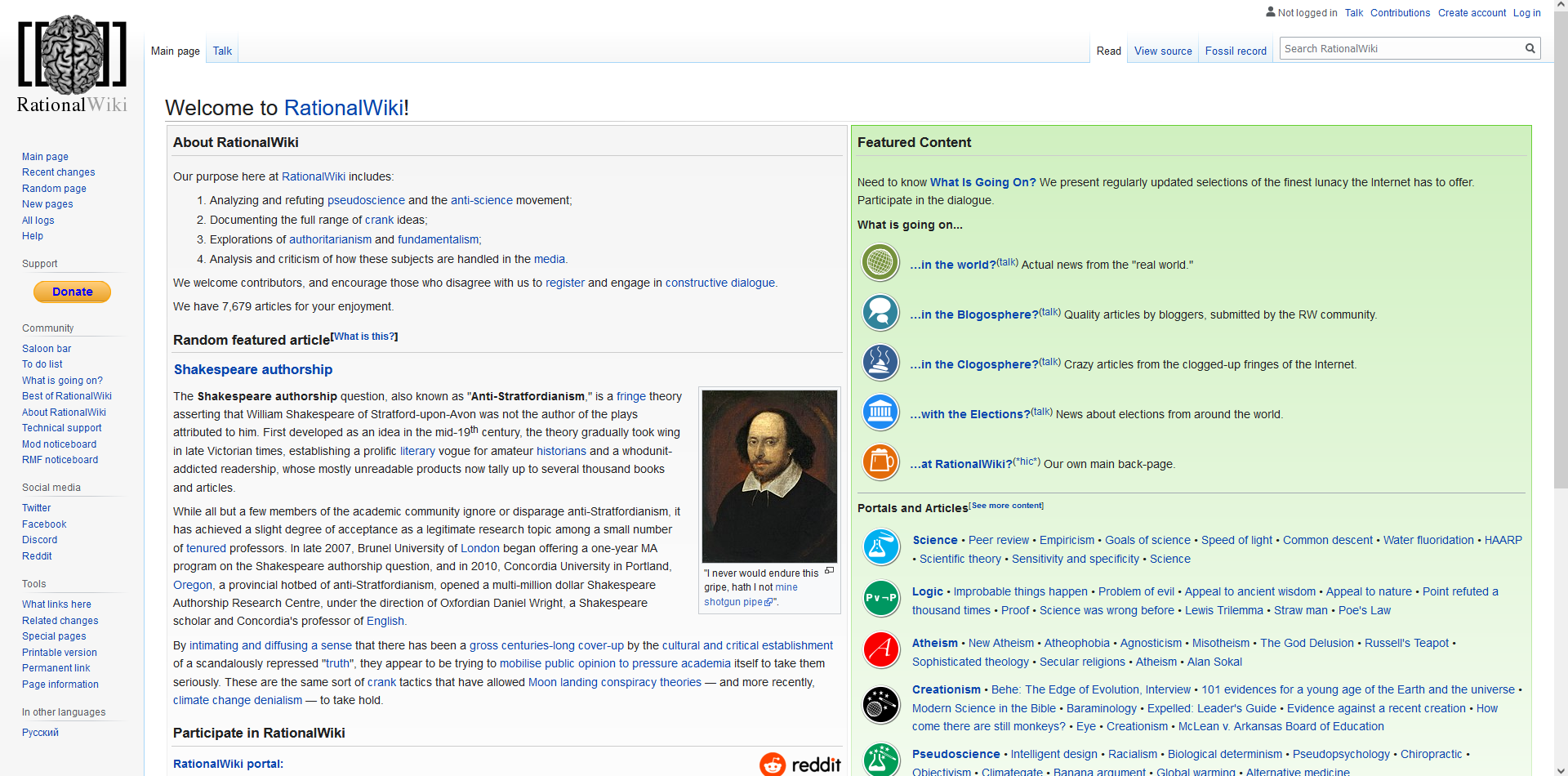
RationalWiki is an online wiki which is written from a scientific skeptic, secular, and progressive perspective. Its stated goals are to "analyze and refute pseudoscience and the anti-science movement, document crank ideas, explore conspiracy theories, authoritarianism, and fundamentalism, and analyze how these subjects are handled in the media."[8] It was created in 2007 as a counterpoint to Conservapedia, a Christian fundamentalist website, after an incident in which some editors of Conservapedia were banned.[6][9] RationalWiki has been described as liberal in contrast to Conservapedia.[10][11]

Key Information

History

[edit]

Origin

[edit]

In April 2007, Peter Lipson, a doctor of internal medicine, attempted to edit Conservapedia's article on breast cancer to include evidence against Conservapedia's claim that abortion was linked to the disease. Conservapedia is an encyclopedia established by Andy Schlafly as an alternative to Wikipedia, which Schlafly perceived as suffering from a liberal, atheist, and "anti-American" bias. He and Conservapedia administrators "questioned [Lipson's] credentials and shut down debate". After being reverted and blocked, "Lipson and several other contributors quit trying to moderate the articles [on Conservapedia] and instead started their own website, RationalWiki".[9][12]

RationalMedia Foundation

[edit]

Prior to 2010, RationalWiki's domains were registered to Trent Toulouse, and the wiki was hosted from a server located in his home.[6] In 2010, Trent Toulouse incorporated a nonprofit organization, the RationalWiki Foundation Inc., to manage the affairs and pay the operational expenses of the website.[2] In July 2013, the RationalWiki Foundation changed its name to the RationalMedia Foundation, stating that its aims extended beyond the RationalWiki site alone.[13]

In April 2025, the RationalMedia Foundation was sued for defamation by various plaintiffs who were covered on RationalWiki. In the same month, despite concerns about the foundation dissolving, it reached an out of court settlement with the plaintiffs where it agreed to delete their articles.[14]

Content

[edit]
Partial screenshot of their "Alt-right glossary" article,[15] a comprehensive collection of purported hate symbols
Screenshot of RationalWiki's article on goats. The humor in the article is a running gag in the wiki and is not the result of vandalism.

RationalWiki aims to provide information about pseudoscientific theories[16] and to educate "individuals with unorthodox views".[17]

RationalWiki differs in several ways from the philosophy of Wikipedia and some other informational wikis. It is written from a self-described "snarky point of view" and "scientific point of view" (both abbreviated as SPOV) rather than a "neutral point of view" (NPOV), and publishes opinion, speculation, and original research.[18] Many RationalWiki articles satirically describe beliefs that RationalWiki opposes, especially when covering topics such as alternative medicine or fundamentalist Christians.[12]

Some activity on RationalWiki was used for critiquing and "monitor[ing] Conservapedia".[9] RationalWiki contributors, some of whom are former Conservapedia contributors, are often highly critical of Conservapedia. According to a 2007 Los Angeles Times article, RationalWiki members "by their own admission" vandalize Conservapedia.[9] Lester Haines of The Register stated: "Its entry entitled 'Conservapedia:Delusions' promptly mocks the claims that 'Homosexuality is a mental disorder', 'Atheists are sociopaths', and 'During the 6 days of creation G-d placed the Earth inside a black hole to slow down time so the light from distant stars had time to reach us'."[12]

Both Yan et al. 2019[10] and Knoche et al.,[11] two articles about classifying a writer's biases via text analysis, asserted that Conservapedia was "conservative" and RationalWiki was "liberal". Mic described RationalWiki as "progressive".[19]

When Krebs et al. 2023 compared text on controversial topics across multiple community-managed wikis, they found that content and contributors on RationalWiki leaned liberal while Conservapedia leaned conservative. In contrast, Wikipedia's content was comparable to the Encyclopedia Britannica, leaned slightly liberal and its editors leaned centrist. Both RationalWiki and Conservapedia were "more loaded with moral content".[20][clarification needed]

Reception

[edit]

Analysis

[edit]

Andrea Ballatore, a lecturer in GIS at Birkbeck, University of London, categorizes RationalWiki as similar in tone to Snopes in a 2015 study, finding it to be the third-most-visible website when researching conspiracy theories in terms of Google and Bing search results, and the most visible among those sites that made openly negative value judgments about conspiracy theories.[21] In Intelligent Systems 2014, Alexander Shvets found RationalWiki to be one of the few online resources that "provide some information about pseudoscientific theories".[16] Likewise, Keeler et al. believe that sites like RationalWiki can help to "sort out the complexities" that arise when "distant and unfamiliar and complex things are communicated to great masses of people".[8]

A 2019 study of bias analysis based on word embedding in RationalWiki, Conservapedia, and Wikipedia by researchers from RWTH Aachen University found all had significant gender biases, reflecting classical gender stereotypes, but these biases were less pronounced in RationalWiki.[11]

Usage

[edit]

In Critical Thinking: Pseudoscience and the Paranormal, Jonathan C. Smith lists RationalWiki in an exercise on finding and identifying fallacies.[22]

Writing in The Verge, Adi Robertson stated that RationalWiki provided a good explanation of Time Cube, though conveying the "full impression" of the original Time Cube website was all but impossible.[23]

RationalWiki tries to track all the places they are either mentioned or cited.[24]

See also

[edit]

Notes

[edit]

References

[edit]
[edit]
Revisions and contributorsEdit on WikipediaRead on Wikipedia
from Grokipedia
RationalWiki is an online founded in March 2007 by user ColinR as a reaction to the perceived irrationality and biases of , evolving into a collaborative platform dedicated to advancing , , and critical analysis of , theories, , and . Launched formally as RationalWiki 2.0 on May 22, 2007, it operates under the nonprofit RationalMedia Foundation, which was incorporated in to manage its operations and hosts over 8,000 articles with contributions from hundreds of monthly editors. The site's stated mission emphasizes refuting anti-science movements, documenting and crank ideas, and examining how such topics are portrayed in media, , and , often prioritizing over strict neutrality on contentious issues. While RationalWiki has garnered attention for its detailed deconstructions of fringe beliefs and promotion of rational inquiry, it has also drawn significant criticism for exhibiting a pronounced left-leaning , particularly in its treatment of conservative figures, religious doctrines, and politically charged topics, where and selective sourcing undermine claims of objectivity. Independent assessments rate it as left-center biased with high factual accuracy on non-ideological subjects but note tendencies toward ideological slant that mirror systemic biases in skeptical communities influenced by academic and media institutions. This has led to accusations from various quarters, including rationalist forums, of unreliability on controversial matters, positioning it more as an advocacy tool than an impartial reference. Despite these controversies, its archival role in tracking pseudoscientific claims and historical wiki feuds remains a notable contribution to online discourse on .

History

Founding and Early Motivations

RationalWiki originated in early 2007 as a direct response to , an online encyclopedia launched earlier that year by to counter what he perceived as liberal bias in . In April 2007, Peter Lipson, a doctor of , attempted to edit Conservapedia's entry on to include refuting claims—promoted on the site—that increases breast cancer risk; his edits were reverted, and he was subsequently blocked, along with other contributors attempting similar corrections. This incident prompted Lipson and associates to establish RationalWiki as an alternative platform for evidence-based editing and critique of Conservapedia's ideological assertions, particularly those blending conservative politics with unsubstantiated scientific claims. The site's initial incarnation, known internally as RationalWiki 1.0, emerged in March 2007 under the username ColinR (potentially linked to early contributors like Lipson), focusing on informal discussions and articles dissecting 's content for factual inaccuracies and practices. Motivations centered on exposing what founders viewed as pseudoscientific and authoritarian tendencies in , such as its rejection of , promotion of young-Earth , and suppression of dissenting views under the guise of neutrality. By May 2007, following 's mass banning of suspected RationalWiki sympathizers in an event dubbed the "Night of the Blunt Knives," the project formalized into RationalWiki 2.0 on , introducing open editing, community guidelines, and a structure emphasizing and . Key early figures included Trent Toulouse (username Tmtoulouse), who collaborated with ColinR to build the wiki's foundational tools like userboxes and a . Early content prioritized refuting Conservapedia's entries on topics like , , and global warming denialism, framing RationalWiki as a bastion for rational inquiry against what it portrayed as dogmatic . This adversarial origin shaped its polemical tone from inception, prioritizing debunking over neutral encyclopedic detachment, though proponents argued it filled a gap left by Wikipedia's policies against overt advocacy. The site's growth was fueled by invitations to Conservapedia exiles and online skeptics disillusioned with both mainstream and conservative wikis' handling of contentious issues.

Migration and Expansion

Following the establishment of RationalWiki 1.0 in March 2007 by user ColinR as a reaction to perceived inaccuracies on , the project quickly encountered resistance when Conservapedia administrators banned suspected RationalWiki contributors during the " the Blunt Knives" on May 16-17, 2007. This event prompted the launch of RationalWiki 2.0 on May 22, 2007, as an independent, open-editing wiki with a cleared database, userboxes for customization, and a formalized emphasizing critique of and . To accommodate growing participation and address server limitations at host , RationalWiki underwent its first major technical migration on September 10, 2007, debuting version 2.1 with enhancements including article voting systems and "WIGO" (What Is Going On) pages for real-time commentary on external sites like . A subsequent server relocation in January 2009 initiated version 2.2, further stabilizing operations amid increasing edit volumes. These migrations supported content expansion, as initial articles focused heavily on debunking entries evolved into broader coverage of topics such as , , and conspiracy theories. By November 2010, another migration to commercial hosting enabled a MediaWiki software upgrade and adoption of the Vector interface, improving scalability and user experience to handle expanded traffic and article contributions. This period marked a shift from primarily reactive commentary on Conservapedia—which had dominated early efforts—to proactive skeptical analysis across diverse subjects, though the site's progressive ideological leanings increasingly shaped editorial priorities beyond neutral debunking. The expansions reflected organic growth driven by volunteer editors, transitioning RationalWiki from a niche counter-site to a platform with thousands of entries by the early 2010s.

Formation of RationalMedia Foundation

The RationalMedia Foundation originated from the incorporation of the RationalWiki Foundation Inc. in the summer of 2010 as a non-profit entity to manage the operational affairs, expenses, and legal responsibilities of the RationalWiki website. This step was taken by Trent Toulouse, a key early contributor, amid growing needs for formalized structure following RationalWiki's launch in 2007 as a of . The incorporation aimed to provide a dedicated organization for handling donations, server costs, and potential liabilities, separate from individual volunteers. In July 2013, the RationalWiki Foundation rebranded to the RationalMedia Foundation to better align with its evolving mission, which extended to potential projects beyond RationalWiki, such as additional media and educational initiatives promoting and . The organization is structured as a non-profit corporation under New Mexico state laws, with operations based in , and claims tax-exempt status as a 501(c)(3) public charity under the U.S. . By 2025, amid legal challenges including multiple defamation lawsuits filed in federal court, the original RationalWiki Foundation entity was dissolved, with control of RationalWiki transferring fully to the RationalMedia Foundation. This restructuring addressed incomplete aspects of the prior and aimed to streamline under a board of trustees elected by RationalWiki users. The foundation's bylaws emphasize advancing and public discourse through open forums, though its 501(c)(3) application faced IRS delays as of mid-2025.

Organizational Structure

Governance and Leadership

The RationalMedia Foundation, a 501(c)(3) non-profit established in 2010, functions as the governing body for RationalWiki, handling legal, financial, and operational oversight. The foundation's structure emphasizes community involvement, with a Board of Trustees elected annually from among active RationalWiki users to ensure alignment with the site's skeptical mission. The board, typically comprising 3 to 5 members, appoints the Operations Manager—who manages day-to-day site administration—and oversees budgeting, fundraising, and technical maintenance, including server operations. Elections occur via voting on the , with trustees serving one-year terms; by-laws outline eligibility, requiring candidates to be longstanding contributors without significant community disputes. Due to the foundation's modest size and volunteer-driven nature, roles are informal, with members collaborating equally rather than adhering strictly to hierarchical titles like president or , though such designations satisfy non-profit legal requirements. As of July 2025, the board consists of Cosmikdebris (president), Stabby the Misanthrope (treasurer), and Spud, all pseudonymous RationalWiki editors with editing histories focused on , debunking, and site policy. Cosmikdebris and Spud maintain active wiki presence, while Stabby contributes primarily through backend and coordination. This pseudonymous leadership reflects RationalWiki's emphasis on content over personal identity, though it has drawn criticism for opacity in decision-making. In early 2025, the foundation encountered internal disruptions, including resignations of the operations manager Trent Toulouse and at least one amid multiple lawsuits alleging , facilitation, and governance failures by board members. These events, filed in U.S. federal court, highlighted tensions between the board's authority and external , prompting some members to form alternative organizations while the core board stabilized operations. Despite such challenges, the structure remains trustee-led, with no formal executive beyond the board and manager.

Funding and Operations

The RationalMedia Foundation (RMF), a non-profit that owns and operates RationalWiki, relies primarily on public donations for its funding. As a 501(c)(3) tax-exempt public charity under U.S. Section 501(c)(3), contributions to RMF are tax-deductible for donors, supporting server maintenance, legal expenses, and other operational costs. Fundraisers are periodically conducted, such as those aimed at covering legal assistance for ongoing litigation, with no evidence of alternative revenue streams like grants, advertising, or corporate sponsorships. RMF's operations are volunteer-driven, with content creation and editing handled by a of unpaid contributors following wiki-style collaboration. The foundation's —comprising individuals such as Cosmikdebris, Spud, and others who are also active RationalWiki editors—oversees governance, finances, and strategic decisions, including monitoring for mission alignment with promoting and debunking . System administration, moderation, and technical maintenance are performed by volunteer administrators, ensuring site functionality without dedicated paid staff. Legal challenges, including multiple libel lawsuits filed against RMF since 2024, have prompted dedicated fundraising efforts and strained resources, highlighting vulnerabilities in the donation-dependent model. The foundation, incorporated under law but based in , maintains transparency through bylaws and public contact channels, though detailed financial reports beyond tax status are not prominently published.

Content and Editorial Practices

Scope and Topics

RationalWiki's content primarily encompasses topics related to , skepticism, and critical thinking, with an emphasis on refuting , documenting unconventional or fringe ideas, and examining social and political phenomena through a rationalist lens. The site's stated mission includes analyzing and refuting pseudoscientific claims and anti-science movements, cataloging "crank" theories such as those in or , and exploring theories, authoritarian ideologies, and religious . This scope extends to media analysis, evaluating how institutions portray or propagate such ideas, often incorporating original commentary rather than strict encyclopedic neutrality. Key portals and categories organize content into areas like pseudoscience and crank ideas, covering topics such as , , and climate change denial; politics and society, including critiques of , , and specific figures or movements; religion, targeting dogmatic beliefs and ; and applied philosophy, addressing logical fallacies and ethical debates. Articles frequently intersect these domains, for instance, linking conspiracy theories to political extremism or to public health misinformation. While the site claims to address cranks across the ideological spectrum, empirical reviews indicate a heavier focus on right-leaning or traditionalist targets, with lighter scrutiny of progressive-aligned pseudosciences like certain theories. As of 2024, the wiki hosts thousands of articles, prioritizing those that advance its rationalist perspective over comprehensive coverage of mainstream topics. The editorial guidelines permit humorous, satirical, or opinionated treatments to engage readers, distinguishing RationalWiki from drier skeptical resources, though this can blur lines between analysis and advocacy on sociopolitical issues. Topics explicitly tied to the site's origins, such as responses to Conservapedia's perceived biases, underscore an initial but enduring emphasis on countering conservative pseudoscholarship, evolving into broader cultural commentary.

Tone, Style, and Policies

RationalWiki maintains a distinctive editorial tone defined by its "Snarky Point of View" (SPOV), which explicitly incorporates humor, , , , and wit to critique , , and , aiming to produce engaging content rather than "bland regurgitation of facts." This approach, also termed the "scientific point of view," prioritizes alignment with while rejecting Wikipedia's neutral point of view (NPOV) in favor of pointed debunking. The tone is intentionally irreverent, with guidelines encouraging editors to "spice up" articles to differentiate them from drier encyclopedic sources, though it cautions against excess that could undermine factual accuracy. Stylistically, RationalWiki's manual of style emphasizes clarity and structure while accommodating its skeptical bent. Articles must feature the title bolded in its first mention, use headers for organization, and adhere to sentence case for titles and categories; first- and second-person pronouns are avoided to preserve impersonality, with complete sentences and proper grammar preferred over abbreviations or casual . Inside jokes and obscure are discouraged in mainspace articles to ensure , and claims require backing from credible sources to substantiate critiques. Formatting conventions include specific templates for quotes and , promoting consistency without mandating encyclopedic neutrality. Policies governing content and editing prioritize community-driven skepticism over impartiality. Community standards prohibit vandalism, harassment, personal attacks, and edit wars, instead urging bold edits, good-faith assumptions, and via talk pages; users face restrictions like a "vandal bin" limiting edits to prevent . Editorial conduct requires evidence-based assertions, with outrageous claims needing robust references, and frowns upon inserting meta-commentary on article quality. While diverse religious views among editors are tolerated, the overarching policy enforces a science-aligned lens, explicitly diverging from neutral wikis to foster critical analysis through snark.

Comparison to Neutral Skeptical Sources

Neutral skeptical sources, such as the (CSI) and , prioritize the systematic application of scientific methods to evaluate extraordinary claims, including those involving , the , and unverified assertions, without embedding overt political advocacy. CSI, established in 1976, publishes , which focuses on peer-reviewed critiques of topics like and , rated as having minimal bias and high factual reliability due to reliance on empirical data over ideological framing. Similarly, , founded by in 1991, promotes inquiry into fringe beliefs through Skeptic magazine and events, critiquing irrationality across spectra, including defenses of orthodoxy that veer into dogmatism on both political left and right. In comparison, RationalWiki diverges by incorporating progressive political lenses into its skeptical analyses, resulting in selective scrutiny where conservative-associated claims face heightened ridicule, while left-leaning orthodoxies receive milder treatment. assesses RationalWiki as left-center biased, noting its use of loaded, satirical language against conservatives—such as labeling figures or views as "crank magnetism" or employing ironic asides—contrasting with the formal, evidence-centric tone of CSI or Shermer's publications. For instance, RationalWiki's coverage of climate skepticism emphasizes debunking with snark directed at denialists, often tying it to broader "," whereas neutral sources like dissect scientific denialism (e.g., anti-vaccine movements) through alone, avoiding partisan extrapolation. This partisan inflection manifests in RationalWiki's editorial practices, where appears uneven: pseudoscientific claims aligned with progressive causes, such as certain gender ideology assertions, encounter less rigorous dissection compared to right-wing equivalents like , which traditional skeptics uniformly reject based on criteria. Critics, including analyses from rationalist communities, argue this reflects a "tribal" , prioritizing cultural warfare over impartial , unlike CSI's charter commitment to "critical investigation... proposed as true" devoid of ideological priors. Shermer, for example, has applied to "" excesses in science, a stance RationalWiki's tone implicitly resists, highlighting how neutral organizations sustain broader credibility by eschewing such selectivity.

Ideological Framework

Stated Skeptical Mission

RationalWiki's mission statement delineates its core objectives as analyzing and refuting pseudoscience alongside the anti-science movement, documenting the spectrum of crank ideas, exploring authoritarianism and fundamentalism, and critiquing media portrayals of these phenomena. This framework positions the project as a platform for scientific skepticism, emphasizing empirical scrutiny of unsubstantiated claims over uncritical acceptance. Founded in 2007 as a counterpoint to Conservapedia's perceived ideological distortions, RationalWiki frames its skeptical endeavor as a defense of rational inquiry against irrationalism, with a focus on evidence-derived conclusions. Central to its stated approach is the application of to dismantle pseudoscientific assertions, such as those in , conspiracy theories, and supernatural beliefs, while upholding as the arbiter of validity. The site asserts that entails constant questioning and doubt toward extraordinary claims absent robust evidence, aligning with methodologies employed by organizations like the . RationalWiki's guidelines permit original research and opinionated analysis, rejecting Wikipedia-style neutrality in favor of explicit advocacy for rational positions when evidence overwhelmingly supports them. In practice, this mission manifests in articles that juxtapose fringe views against mainstream scientific rebuttals, with the explicit goal of "calling it like we sees it" rather than feigning equivalence between consensus-backed facts and minority dissent. Proponents within the community describe this as empowering users to engage proactively, fostering a of debunking over passive documentation. However, the mission's emphasis on refutation over comprehensive balance has drawn internal acknowledgment that it diverges from traditional encyclopedic , prioritizing ideological clarity in combating perceived threats to .

Progressive and Anti-Religious Slant

RationalWiki's content frequently demonstrates a progressive slant through the use of loaded, derogatory terminology when addressing conservative politicians and ideologies, while adopting a more accommodating tone toward left-leaning social positions. For instance, its article on Donald Trump labels him a "scammer," "fascist," and "rapist," highlighting business bankruptcies, legal convictions—including 34 felony counts in 2024—and authoritarian rhetoric such as references to political opponents as "vermin," framing these as evidence of systemic fraud and threats to democracy. In contrast, coverage of progressive variants within religious contexts, such as progressive Christianity, portrays them favorably as emphasizing social justice, tolerance, and Jesus' teachings of love, while critiquing conservative Christianity for promoting war, racial and sexual exclusion, and neglect of the poor. This differential treatment aligns with assessments from media bias evaluators, which identify RationalWiki's employment of emotionally charged language against conservatives as indicative of a left-center ideological bias, despite generally high factual accuracy in verifiable claims. Complementing this political orientation is a pronounced anti-religious perspective, rooted in its self-proclaimed secular mission to combat and dogma. The site's Religion article asserts that religions foster irrational beliefs like and unquestioned authority, quoting figures such as on their promotion of practices like celibacy and self-denial without evident utility, and on their reliance on civil coercion for survival. Such entries often incorporate sarcastic mockery, equating religious mysteries to trivialities like "where do lost socks go?" and portraying adherents as susceptible to manipulation, with little distinction made to spare moderate or non-Abrahamic faiths from broad indictments of anti-scientific conflict. This approach extends to political-religious intersections, where the Religious Right is derisively termed the "religious wrong" and linked to voting blocs driven by irrational motivations rather than policy substance. Critics, including researchers targeted by the site, argue that this combination results in selective , wherein religious claims and conservative viewpoints undergo intense deconstruction—often equating them with fallacy-laden crankery—while progressive-leaning ideologies, such as certain secular "religions" or frameworks, receive minimal analogous scrutiny despite potential empirical weaknesses. For example, logical fallacy explanations disproportionately draw anti-religious illustrations, as noted in internal forum discussions where users expressed preference for neutral abstracts over faith-based critiques, underscoring an embedded prioritization of debunking traditionalism over balanced . This pattern, evident since the site's founding as a counter to conservative wikis like , reflects a causal alignment with progressive cultural norms prevalent in skeptical communities, where empirical challenges to left-leaning orthodoxies are rarer, potentially undermining the site's claim to universal rational analysis.

Evidence of Selective Skepticism

Critics have argued that RationalWiki exhibits selective skepticism by rigorously scrutinizing claims associated with conservative or right-wing perspectives while applying less stringent standards to analogous progressive or left-leaning assertions. For instance, its articles frequently employ sarcasm and loaded language to dismantle topics like denial, , and election fraud allegations linked to figures such as , framing them as pseudoscientific or conspiratorial without equivalent dissection of overstatements in areas like systemic racism narratives or the empirical basis for certain equity policies. This pattern is evident in RationalWiki's "A comparative guide to science denial," which parallels tactics used by defenders, creationists, and climate skeptics—predominantly right-coded examples—without a symmetric guide critiquing left-associated science denial, such as exaggerated claims about timelines or anti-nuclear activism despite evidence of nuclear power's low-carbon efficacy. Further evidence includes RationalWiki's treatment of intelligence research, where works challenging egalitarian assumptions, such as , receive pseudoscientific labeling aligned with left-center ideological rejection, rather than Bayesian or empirical reevaluation urged in their own essays on . Similarly, biographical entries target scholars like for exploring politically sensitive topics on and gender differences, portraying their work as biased or harmful without proportionally questioning activist-driven research in social sciences that downplays biological sex differences. RationalWiki's own essay on common criticisms acknowledges informational bias but defends it as inherent to opinion-forming, rather than addressing how this undermines claims of universal rational inquiry. This selectivity aligns with broader assessments of RationalWiki as left-center biased in tone and topic selection, where high factual accuracy on debunked claims coexists with partisan framing that prioritizes refuting right-wing "cranks" over equivalent progressive ones, such as uncritical acceptance of certain gender ideology assertions amid ongoing debates in developmental biology. In 2016, an editor attempted to add sourced content to RationalWiki's article on female genital mutilation highlighting its associations with Islam, including direct quotations and evidence; the additions, along with existing sections on the topic, were promptly reverted and removed by other editors, reducing the number of sources and interpreted by critics as ideological resistance to linking the practice to religious contexts despite empirical prevalence in certain Muslim-majority regions. Community discussions, including on platforms like LessWrong and Reddit, highlight this as a form of tribal epistemology, where skepticism serves ideological cohesion among atheist and progressive contributors rather than impartial application. While RationalWiki counters that current pseudoscience prevalence skews rightward, this rationale does not explain the absence of parallel rigor toward left-leaning fallacies, such as balance fallacy invocations to dismiss conservative viewpoints without evidential weighting.

Reception and Criticisms

Positive Assessments

RationalWiki has received praise from skeptical organizations for its contributions to countering and fringe beliefs. Publications from the , such as , have referenced RationalWiki articles as supporting sources in discussions of topics like statin denialism and pseudoscientific promoters, indicating its utility in providing detailed critiques backed by evidence. The , a longstanding resource on authored by Robert T. Carroll, has cited RationalWiki positively for compiling examples of phenomena like , where satirical critiques of irrationality are mistaken for endorsements, highlighting its role in illustrating skeptical concepts. Academic works have utilized RationalWiki as a reference tool; for example, a 2025 philosophical analysis of paradigms consulted its curated list of pseudosciences to survey potential candidates, treating it as a practical starting point for identifying non-paradigmatic claims. Media rating site assessed RationalWiki in May 2025 as having high factual reporting, crediting its articles with proper sourcing, , and a track record of accurate information on scientific and skeptical topics, even while noting a left-center in selection and tone.

Accusations of Partisan Bias

Critics have accused RationalWiki of exhibiting a left-wing partisan , manifested through selective that disproportionately targets conservative ideologies, figures, and claims while showing leniency toward progressive counterparts. For instance, the site has been rated as left-center biased by , which highlights its use of against conservatives, such as pejorative terms in articles on topics like denial or Trump administration policies, contrasted with more neutral or affirmative treatment of left-leaning positions on issues like or economic interventionism. This assessment notes that while RationalWiki maintains high factual reporting through sourcing, its editorial slant favors progressive narratives under the guise of rational analysis. Sociologist , who faced professional repercussions for research on immigration patterns conflicting with progressive orthodoxy, described RationalWiki as "a left-wing version of " that systematically targets individuals whose work challenges left-wing views, exemplified by its critical articles on academics and thinkers like himself. Similarly, rationalist communities have pointed to attacks on figures such as Scott Alexander (of ) and , portraying them as emblematic of a "cancel community" where is applied unevenly—rigorously to libertarian or contrarian rationalists but overlooked for ideological allies. These critiques argue that RationalWiki's self-proclaimed mission of combating "crankery" serves as a veneer for partisan advocacy, with articles on often framing it as inherently irrational or psychologically deficient, while analogous progressive flaws receive minimal scrutiny. Such accusations extend to RationalWiki's handling of controversial topics, where contributors allegedly prioritize debunking right-leaning (e.g., or linked to conservative demographics) over left-associated equivalents, like exaggerated claims in or certain environmental alarmism, leading to claims of ideological filtering rather than impartial inquiry. Independent analyses, including comparisons to explicitly ideological wikis like , suggest RationalWiki's content imbalance mirrors mirror-image biases, undermining its neutrality pretensions despite protestations of mere "opinion-having." Critics from skeptic and rationalist circles contend this selectivity erodes trust, positioning the site as a tool for progressive enforcement rather than universal truth-seeking.

Impact on Public Discourse

RationalWiki's influence on public discourse remains niche, largely confined to online skeptic, atheist, and progressive communities where its articles serve as reference points for critiquing , theories, and right-leaning ideologies. With a modest audience—evidenced by its absence from major traffic rankings alongside giants like —its broader societal footprint is limited, often manifesting as citations in forum debates or posts rather than shaping mainstream narratives. This constrained reach stems from its origins as a counter to , positioning it within inter-wiki rivalries that prioritize ideological combat over consensus-building. Critics contend that RationalWiki's selective —rigorous toward conservative or religious targets but lenient on progressive orthodoxies—undermines its claimed mission, fostering a partisan variant of rational that polarizes within the skepticism movement. For instance, rationalist observers have highlighted how its coverage of topics like or gender issues exemplifies "rationalized pseudo-skepticism," where snark substitutes for evidence, eroding trust in skepticism as an impartial tool and encouraging tribal entrenchment. Such patterns contribute to a fragmented skeptical landscape, where adherents adopt its tone, amplifying in online exchanges and associating with left-wing advocacy. In specific controversies, like Gamergate, RationalWiki's entries have fueled one-sided arguments, providing fodder for anti-harassment narratives while facing accusations of cherry-picking evidence and ignoring counterexamples, thus exemplifying how biased wikis can entrench positions in culture war debates. Academic references to RationalWiki, though rare, often frame it as a foil to neutral platforms like Wikipedia, illustrating risks of ideological editing in crowdsourced knowledge and its potential to model echo-chamber dynamics in public argumentation. Overall, while it debunks fringe claims effectively in aligned circles, its ideological framework risks causal distortions, prioritizing narrative alignment over undiluted empirical scrutiny, which may subtly normalize bias under the guise of reason in niche but vocal segments of online discourse.

Major Content Disputes

One prominent content dispute involves the longstanding rivalry between RationalWiki and , which originated in 2007 when RationalWiki was established partly as a counter to Conservapedia's conservative Christian perspective on topics like , , and liberal figures. RationalWiki's articles frequently critique Conservapedia's entries as factually distorted or ideologically driven, documenting instances such as alleged , selective quoting of sources to fit preconceptions, and deletions of dissenting edits—practices RationalWiki labels as "burning the evidence" to maintain narrative control. In response, Conservapedia implemented policies prohibiting any reference to RationalWiki, including automated spam filters that block edits containing the term, framing such mentions as disruptive or profane. This mutual exclusion has fueled perpetual edit blocks and cross-accusations, with RationalWikians often banned from Conservapedia for attempts to correct perceived errors, while Conservapedia portrays RationalWiki's content as undermining traditional values. Beyond this foundational feud, content disputes arise in RationalWiki's treatment of pseudoscience and political ideologies, where critics contend that articles exhibit selective application of , prioritizing debunking of right-leaning views while downplaying similar issues on the left. For instance, external commentators have highlighted purported factual inaccuracies in RationalWiki's coverage of conservative personalities and movements, such as oversimplifications or unsubstantiated claims in entries on figures like or events like , leading to complaints of smear tactics over empirical analysis. These challenges often manifest as external demands for revisions or retractions, though RationalWiki maintains that its snarky style and opinionated tone are intentional departures from neutral encyclopedias, defending content as rooted in verifiable evidence against crankery. Internal community disputes over content moderation further illustrate tensions, particularly in articles on high-stakes topics like climate denialism or , where edit wars erupt between contributors advocating stricter ideological framing and those pushing for more balanced sourcing. Moderators have proposed guidelines to curb repeated reversions, emphasizing consensus on factual disputes but acknowledging that factional conflicts can prioritize narrative alignment over dispassionate revision. Such incidents underscore RationalWiki's self-described departure from Wikipedia's neutral point of view policy, which it views as susceptible to infiltration, but critics argue this fosters echo-chamber effects that undermine claims of rational inquiry.

Libel Lawsuits and Defamation Claims

RationalWiki and its operating entity, the RationalMedia Foundation (formerly RationalWiki Foundation), have faced multiple lawsuits alleging libel, defamation, and related torts, primarily from individuals whose pseudoscientific or controversial views have been critiqued in site articles. These claims often center on assertions that RationalWiki's content contains false statements harming professional reputations, though the site invokes defenses including truth, fair comment, and protections under Section 230 of the Communications Decency Act for user-generated content. Outcomes have varied, with some early cases dismissed and recent filings ongoing as of October 2025. In one of the earliest actions, Alexander Otis Matthews filed a pro se complaint on February 25, 2014, in the U.S. District Court for the Eastern District of Virginia (Case No. 1:2014cv00257), accusing RationalWiki of per se libel, libel, and injurious falsehood based on article content portraying him negatively in connection with sovereign citizen ideologies. The district court dismissed the case for failure to prosecute, and the U.S. Court of Appeals for the Fourth Circuit affirmed the dismissal in 2017, finding no reversible error. Kent Hovind, a creationist convicted of tax-related felonies, initiated a pro se libel suit against the RationalMedia Foundation on or around February 24, 2014, in the U.S. District Court for the Southern District of Mississippi, claiming defamatory statements in a RationalWiki article published February 8, 2014, falsely accused him of fraud and other misconduct. The case has protracted due to procedural issues, including repeated failures to effect proper service on defendants; as of July 2025, a corrected order addressed attorney concerns but left the suit unresolved. More recently, Nassim Haramein, a proponent of fringe physics theories, filed on August 1, 2024, in the U.S. District Court for the District of (Case No. 1:2024cv00775), alleging , , and invasion of privacy over a RationalWiki article criticizing his work as and detailing alleged financial improprieties. The filing prompted temporary revisions to the article amid legal pressures, though the case remains pending without a final disposition as of October 2025. A cluster of suits emerged in early 2025 from researchers linked to human biodiversity and intelligence research topics often labeled pseudoscientific by RationalWiki critics. Jonathan Anomaly filed on March 6, 2025, in the District of (Case No. 1:2025cv00233), claiming libel over article content. Jelte M. te Nijenhuis sued around March 21, 2025, in unspecified federal court for libel and slander (Case No. 1:25-cv-00295). Michael Woodley of Menie filed a verified for on March 23, 2025 (Case No. 1:25-cv-00296), targeting similar claims. Emil Kirkegaard Pallesen followed on March 26, 2025 (Case No. 1:25-cv-00305), alleging libel against the foundation and individual editors. These actions, described by some observers as potential strategic lawsuits against public participation (SLAPP), underscore tensions between RationalWiki's critique style and subjects' legal recourse, with no reported settlements or dismissals by late 2025.

Internal and Community Conflicts

RationalWiki's community has experienced recurrent internal conflicts, often escalating into what the site itself terms "Headless Chicken Mode" (HCM), characterized by chaotic edit wars, personal insults, and unresolved disputes that frequently result in users being blocked or voluntarily departing (colloquially "LANCB" or "Leave And Never Come Back"). These episodes typically arise from disagreements over , guideline enforcement, or ideological clashes on topics such as and political events. One notable incident, the "Great TK Banning," stemmed from controversial comments by user TK, triggering widespread debate and blocks that exemplified pre-HCM stress responses within the community. Similarly, the "Kip the Dip Incident" involved administrator AKjeldsen blocking user SusanG amid escalating tensions, while the "Great Pissing Contest" saw user MarcusCicero exchanging insults with SusanG, highlighting interpersonal animosities among prominent editors. In another case, the "People v. Nobs" dispute pitted users DuceMoosolini and Knight Commander against Nobs over interpretations of the January 6, 2021, U.S. Capitol events, leading to two user departures and broader doubts about moderation efficacy. Sysop (administrator) roles have been a flashpoint, with forums debating promotions and demotions amid accusations of abuse. For instance, a 2023 forum thread questioned restoring sysop rights to Rob Smith (RobS), citing prior de-sysopping due to disputes involving insults and trolling, which deferred to community "mob" decisions rather than structured resolution. Earlier, a 2010 debate on granting sysop status to TK devolved into a "mud pit" of acrimony, underscoring resistance to expanding administrative powers without consensus. To mitigate such issues, RationalWiki implemented policies limiting sysop authority in disputes, emphasizing equal footing for all users in moderation talks and discouraging prolonged blocks except for vandalism. These conflicts reflect broader challenges in maintaining cohesion in a volunteer-driven with permissive norms, often amplified by off-wiki flamewars archived in dedicated " dump" forums. Despite mechanisms like the "Chicken Coop" for containment, HCM-level escalations—reaching peak chaos (HCM 0) twice historically, including at the end of RationalWiki 1.0 and in May 2011—have periodically disrupted operations and contributor retention.

Recent Developments

Board and Operational Changes

In 2024, the RationalMedia Foundation (RMF), which operates , held its annual board of trustees election, with nominations running from July 27 to August 10; two trustees were elected to serve terms from 2024 to 2026. The foundation's bylaws stipulate board terms of one year, with directors numbering between three and seven, and allow for unlimited re-elections; directors operate as equals despite formal titles like secretary, which are required for nonprofit compliance but not strictly enforced given the organization's small scale. Operational challenges emerged in late 2024, including the revelation that the foundation's 2013 name change from RationalWiki Foundation to RationalMedia Foundation had not been properly completed, complicating legal and administrative functions. In response, the board planned re-incorporation of the entity in 2025, with an official announcement scheduled for mid-December 2024, alongside steps like establishing dedicated email addresses for business, finances, and public inquiries, and securing a managed . Amid a series of libel lawsuits filed against the RMF starting in 2024—including cases by Nassim Haramein in August 2024 and in April 2025—key personnel departed. Trent Toulouse, who served as , resigned effective May 7, 2025, as documented in court filings related to ongoing litigation. Board member Ephrom also resigned on June 27, 2025. By mid-2025, the active board consisted of directors Cosmikdebris, Spud, and Stabby, with the latter focusing primarily on backend tasks via rather than direct editing. The RMF continued pursuing 501(c)(3) tax-exempt status in 2025, though the application faced delays due to IRS procedural updates that year. These shifts occurred against a backdrop of multiple claims—totaling at least six by early 2025—targeting the foundation and its personnel, some of which were voluntarily dismissed, such as Jonathan Anomaly's suit in 2025. In early 2025, the RationalMedia Foundation, which operates RationalWiki, encountered a wave of lawsuits filed in U.S. federal courts, primarily in , targeting articles that portrayed plaintiffs as proponents of , , or fringe ideologies. These actions included suits from individuals such as Jonathan Anomaly, a bioethicist accused in RationalWiki's entry of advancing eugenics-adjacent views and associating with alt-right figures; the complaint alleged false categorization under topics like "" and "Racialism," seeking damages for reputational harm. Similarly, Te Nijenhuis filed a libel and slander claim in March 2025, contesting depictions in RationalWiki content. By March, at least six separate libel suits had been lodged against the foundation, reflecting coordinated legal challenges from subjects of its critical biographies. A notable cluster emerged as a de facto mass action involving eight plaintiffs, prompting settlements with seven by April 19, 2025; these agreements required RationalWiki to delete the disputed articles, though the foundation did not admit liability. The remaining suit continued, contributing to internal discussions on liability mitigation, including proposals to dissolve the New Mexico-based RationalWiki Foundation to shield board members from personal exposure. Preceding this, Nassim Haramein, a physicist critiqued for pseudoscientific theories, initiated a lawsuit in August 2024 over an article labeling his work as crankery, which RationalWiki editors acknowledged publicly. These legal pressures have imposed financial and operational strains, with settlements reportedly involving confidential terms and ongoing risks of further suits over archived or hosted content. External scrutiny intensified from online forums and critics, who highlighted RationalWiki's volunteer-driven model and lack of editorial oversight as vulnerabilities enabling unsubstantiated claims, potentially deterring contributions amid fears of personal liability. The foundation's legal FAQ, updated in July 2025, addresses defamation protocols by emphasizing reliance on public records and disclaimers of liability for user-generated content, yet critics argue this fails to prevent actionable falsehoods. As of October 2025, no comprehensive resolution has been reached for all claims, sustaining pressure on the site's sustainability and prompting debates over wiki accountability in an era of heightened litigation against online critics.

References

  1. https://rationalwiki.org/wiki/RationalWiki:Timeline
  2. https://rationalwiki.org/wiki/RationalWiki
  3. https://rationalwiki.org/wiki/Main_Page
  4. https://rationalwiki.org/wiki/RationalWiki:Pissed_at_us
  5. https://rationalwiki.org/wiki/Conservapedia:On_liberalism
  6. https://rationalwiki.org/wiki/RationalWiki:RationalWiki_Foundation
  7. https://rationalwiki.org/wiki/RationalWiki:RationalMedia_Foundation
  8. https://rationalwiki.org/wiki/RationalWiki:RationalMedia_Foundation/Board_of_Directors
  9. https://rationalwiki.org/wiki/RationalWiki:System_administrators
  10. https://rationalwiki.org/wiki/RationalWiki:The_RationalWiki_Foundation/List_of_board_members
  11. https://rationalwiki.org/wiki/RationalWiki:Site_support
  12. https://rationalwiki.org/wiki/RationalWiki:Fundraiser
  13. https://rationalwiki.org/wiki/RationalWiki:RationalMedia_Foundation/Bylaws
  14. https://rationalwiki.org/wiki/RationalWiki:Contents
  15. https://rationalwiki.org/wiki/RationalWiki:What_is_a_RationalWiki_article%3F
  16. https://rationalwiki.org/wiki/RationalWiki:Newcomers
  17. https://rationalwiki.org/wiki/RationalWiki:History
  18. https://rationalwiki.org/wiki/RationalWiki:Community_Standards
  19. https://rationalwiki.org/wiki/Neutral_point_of_view
  20. https://rationalwiki.org/wiki/Help:Manual_of_style
  21. https://rationalwiki.org/wiki/RationalWiki:Blocking_policy
  22. https://rationalwiki.org/wiki/Michael_Shermer
  23. https://rationalwiki.org/wiki/RationalWiki:Mission
  24. https://rationalwiki.org/wiki/Skepticism
  25. https://rationalwiki.org/wiki/Donald_Trump
  26. https://rationalwiki.org/wiki/Progressive_Christianity
  27. https://rationalwiki.org/wiki/Religion
  28. https://rationalwiki.org/wiki/Religious_Right
  29. https://rationalwiki.org/wiki/Forum:This_site_is_cheapened_considerably_by_its_bias.
  30. https://rationalwiki.org/wiki/A_comparative_guide_to_science_denial
  31. https://rationalwiki.org/wiki/Essay:Common_criticisms_of_RationalWiki
  32. https://rationalwiki.org/wiki/Balance_fallacy
  33. https://rationalwiki.org/wiki/RationalWiki:Mentions
  34. https://rationalwiki.org/wiki/Essay:The_Conservapedia_RationalWiki_War
  35. https://rationalwiki.org/wiki/Conservapedia:Burning_the_Evidence
  36. https://rationalwiki.org/wiki/RationalWiki_talk:All_things_in_moderation/Archive21
  37. https://rationalwiki.org/wiki/Kent_Hovind
  38. https://rationalwiki.org/wiki/RationalWiki:Headless_Chicken_Mode
  39. https://rationalwiki.org/wiki/User:Blue/RWW/The_Great_TK_Banning_Incident
  40. https://rationalwiki.org/wiki/User:SusanG/RWW#Kip_the_Dip_Incident
  41. https://rationalwiki.org/wiki/RationalWiki:Chicken_coop/Archive118#Alright.2C_let.27s_vote:_Block.2Fban_for_RobSmith.27s_1.2F6_denialist_trolling_and_general_long-term_trolling_that_has_caused_major_editors_to_LANCB_and_sowed_doubt_about_how_effectively_moderated_our_site_is
  42. https://rationalwiki.org/wiki/Forum:Should_RobS_get_his_Sysopship_back%253F
  43. https://rationalwiki.org/wiki/Debate:Make_TK_a_sysop%253F
  44. https://rationalwiki.org/wiki/Forum:Plan_of_action_for_user_rights_and_moderation
  45. https://rationalwiki.org/wiki/Forum:Drama_dump
  46. https://rationalwiki.org/wiki/RationalWiki:Chicken_coop
  47. https://rationalwiki.org/wiki/RationalWiki:Board_of_trustees_election/Schedule
  48. https://rationalwiki.org/wiki/RationalWiki:2024_board_of_trustees_election/Campaigning
  49. https://rationalwiki.org/wiki/RationalWiki:RationalWiki_Foundation/2024_10_20_minutes
  50. https://rationalwiki.org/wiki/RationalWiki_talk:RationalWiki_Foundation/Archive7
  51. https://rationalwiki.org/wiki/RationalWiki_talk:RationalMedia_Foundation
  52. https://rationalwiki.org/wiki/RationalWiki:Legal_FAQ
Add your contribution
Related Hubs
User Avatar
No comments yet.