Hubbry Logo
search
logo
2099524

Regiment van Heutsz

logo
Community Hub0 Subscribers
Read side by side
from Wikipedia
Regiment Van Heutsz
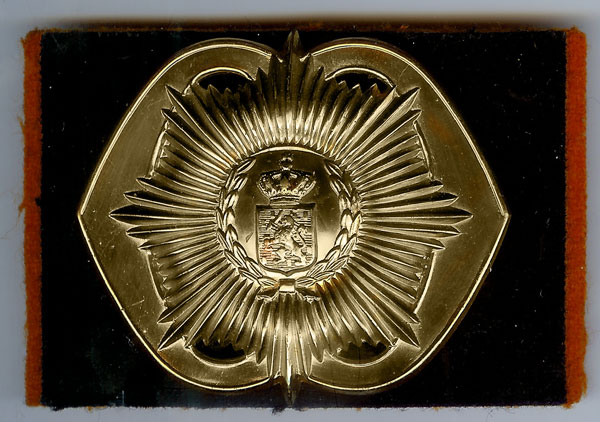
Cap badge of the Regiment Van Heutsz with backing
Active1 July 1950–Present
Country Netherlands
Allegiance United Nations
Netherlands
BranchArmy
TypeLine infantry
RoleAir Assault Infantry
Size1 battalion
Garrison/HQSchaarsbergen
PatronJo van Heutsz
ColorsBlack and Orange
MarchVan Heutsz Mars
EngagementsKorean War War in Afghanistan
DecorationsMilitary William Order,
US Presidential Unit Citation,
ROK Presidential Unit Citation,
Dutch Cross for Justice and Freedom
Battle honoursHoensong-Wonju
Soyang
Commanders
Notable
commanders
Lt. Col. M.P.A. den Ouden [1]
Lt. Col. W.D.H. Eekhout[1]
Lt. Col. G.H. Christian[1]
Lt. Col. C.M. Schilperoord[1]
Surinamese Korea Volunteers from the regiment at training camp in Roosendaal

The Regiment Van Heutsz is a line infantry regiment of the Royal Netherlands Army. The regiment was named after J.B. van Heutsz, a former Governor-General of the Dutch East Indies who successfully brought the Aceh War closer to an end, and was formed on July 1, 1950. It is notable for its service as part of the United Nations force sent to fight during the Korean War. It is still operational and has served tours as part of the ISAF Afghanistan mission.

Origin

[edit]

From 1832 to 1950 a substantial colonial army was maintained in the Dutch East Indies under the title of the Royal Netherlands East Indies Army (KNIL). Following Indonesian independence the Dutch and indigenous personnel of this force were demobilised but with the establishment of the Regiment Van Heutsz on July 1, 1950, the traditions and distinctions of the KNIL were transferred to the new regiment. These included the inscription 'Military Operations Royal Dutch East Indies Army 1816-1950', still carried on the King's Colour.

Korean War

[edit]

The Van Heutsz Regiment was incorporated into the Nederlands Detachement Verenigde Naties (NDVN) (Netherlands Detachment United Nations), which also included the Dutch Naval component sent to Korea. While 16,225 people volunteered for service in Korea, only 3,418 men were accepted and sent. 2,980 of those participated in the actual war, as the units that arrived after the armistice (July 27, 1953) did not participate in any fighting.[2]

The Korean War battalion of Regiment Van Heutsz was formed on 9 September 1950. They left the Netherlands on October 26, 1950, and arrived Pusan on 23 November 1950, but took the detachment as its first battalion. The regiment has the battle honor Korea 1950–1954 on its colors. In Korea, the Van Heutsz troops (being understrength) were re-enforced by South Korean "KATCOM" troops. The Dutch served at three key battles, all around the Iron Triangle sector between 1951 and 1953.

Since the Regiment Van Heutsz did not have its colors in 1950, a Dutch flag that was used in Korea as the battle flag of the Nederlands Detachement Verenigde Naties became the regimental colour. This flag now has official status and is shown on every parade and function of the regiment in tandem with the Sovereign's Colour awarded years after (which makes the regiment the only one in the RNA to carry a UK-style strand of colours). American and Korean battle streamers, representing the US Presidential Unit Citation, are attached to this flag.[2]

The Regiment suffered 116 Dutch and 20 attached-Korean soldiers killed in action, three soldiers are still MIA, while one Dutchman was taken prisoner and died in a North Korean POW camp. The Dutch casualties are buried at the United Nations Memorial Cemetery in Busan, including their commander, Lt. Col. Marinus Petrus Antonius den Ouden, who was killed in action during the Battle of Hoengsong in February 1951 (Den Ouden posthumously received the Netherlands' highest military award, the Military Order of William). A total of 381 soldiers were wounded.[2] A total of 115 Surinamese soldiers also fought together with the Dutch, at least two died.[3][4]

Post Korean service and ISAF deployment

[edit]

The traditions of the Regiment Van Heutsz are currently maintained by one battalion serving as part of 11 Luchtmobiele (Airmobile) Brigade:[5]

  • 12th Ranger Battalion RVH (formerly 12th Infantry Battalion 1st RVH) is one of three air assault infantry battalions within the air mobile brigade.

From 2006 to 2010, the battalion formed the basis of the battlegroup attached to Task Force Uruzgan, the primary Dutch component of the multi-national forces in Afghanistan. For this, the regiment was awarded with the battle honour "Noord-Kandahar 2006 en Uruzgan 2006-2009" for operations in Afghanistan, especially for combat operations in 2006 and 2007, the operation Tura Ghar in 2008-2009 and the actions of the doorgunners between 2006 and 2009.

See also

[edit]

References

[edit]

Further reading

[edit]
[edit]
Revisions and contributorsEdit on WikipediaRead on Wikipedia
from Grokipedia
The Regiment van Heutsz is an active infantry regiment of the Royal Netherlands Army, specializing in air assault and special operations support.[1] Named after Lieutenant General Joannes Benedictus van Heutsz, a former Governor-General of the Dutch East Indies known for his role in the Aceh War, the regiment was established on 1 July 1950 as a unit dedicated to overseas deployments, inheriting the traditions of the disbanded Royal Netherlands East Indies Army (KNIL).[2][3] Its early history is marked by significant combat service in the Korean War, where a battalion contingent participated in key battles such as Hoengseong, Wonju, and Inje, contributing to United Nations efforts against North Korean and Chinese forces from 1950 to 1953.[4] Today, embodied primarily by the 12th Infantry Battalion (Ranger) within the 11th Airmobile Brigade, it maintains a focus on rapid reaction capabilities and ranger training, reflecting its evolution from colonial-era lineage to modern expeditionary infantry.[5]

Formation and Early History

Establishment in 1950

The Regiment van Heutsz was officially established on 1 July 1950 as part of the post-World War II reorganization of the Royal Netherlands Army, following the dissolution of the Royal Netherlands East Indies Army (KNIL) after Indonesian independence in 1949.[6][7] This creation aligned with the incorporation of seven new infantry regiments into the Dutch forces, each adopting historical names to preserve military traditions amid the transition from colonial to metropolitan army structures.[8] The regiment was initially formed as a training unit within the Infantry Arm of Service, tasked with preparing personnel for potential overseas deployments in the emerging Cold War context.[9] Named after Lieutenant General Joannes Benedictus van Heutsz, a key figure in the Dutch colonial campaigns in Aceh who served as Governor-General of the Dutch East Indies from 1904 to 1909, the regiment explicitly continued the operational and ceremonial traditions of the KNIL, including its emphasis on mobile infantry tactics suited for expeditionary warfare.[6][7] At inception, it lacked a dedicated battle flag, leading to the provisional use of the Netherlands national flag as regimental colors during early operations.[10] The establishment decree emphasized maintaining the KNIL's legacy of resilience and adaptability, drawing from its historical role in suppressing rebellions and conducting counterinsurgency in Southeast Asia, though adapted to NATO-aligned commitments.[11] By late 1950, the regiment's structure included cadre for battalion-level formations, with its first active unit rapidly organized in response to international calls for support, reflecting the Dutch government's commitment to United Nations collective security post-colonial retrenchment.[12] Initial staffing drew from veterans of the Indonesian campaigns and new recruits, totaling several hundred personnel focused on infantry training at bases in the Netherlands.[13] This foundational setup positioned the regiment as a specialized overseas service unit, distinct from standard territorial defense regiments in the restructured army.[9]

Naming After J.B. van Heutsz and Colonial Legacy

The Regiment van Heutsz was named after Joannes Benedictus van Heutsz (1851–1924), a Dutch general who served as Governor-General of the Dutch East Indies from 1904 to 1909 and is credited with subduing Acehnese resistance during the Aceh War (1873–1904).[14] Appointed military and civil governor of Aceh in 1899, van Heutsz employed combined military and administrative strategies, advised by orientalist Christiaan Snouck Hurgronje, to achieve pacification after decades of inconclusive fighting, marking the effective end of major hostilities by 1904.[15] Established on 1 July 1950 as a volunteer unit for United Nations service in the Korean War, the regiment adopted van Heutsz's name to honor his embodiment of Dutch colonial infantry traditions from the Royal Netherlands East Indies Army (KNIL), which had been disbanded following Indonesian independence in 1949.[13] This choice symbolized continuity of military heritage amid the transition to a post-colonial force, drawing on van Heutsz's reputation for resolute leadership in protracted counterinsurgency operations.[9] Van Heutsz's legacy, however, is tied to the violent colonial expansion in Aceh, where Dutch campaigns under his command resulted in substantial Acehnese casualties, estimated between 50,000 and 100,000 deaths, alongside the displacement of populations into controlled zones to break guerrilla resistance.[16] While Dutch accounts often portray him as the "Pacifier of Aceh" for restoring order after prolonged anarchy, Indonesian perspectives and modern critiques label his methods ruthless, including summary executions and scorched-earth tactics, fostering enduring resentment symbolized by the destruction of his monuments during decolonization struggles.[17][18] In the Netherlands, van Heutsz's commemoration has sparked debate, with statues and memorials facing protests and calls for contextualization amid broader reckonings with imperial history, as seen in recent biographies highlighting the ethical complexities of his governance.[19] The persistence of the regiment's name reflects institutional adherence to historical military nomenclature, yet it underscores tensions between honoring operational achievements and addressing the human costs of colonial warfare in an era of heightened scrutiny over empire's legacies.[20]

Korean War Service

Deployment as Dutch Detachment to the UN (1950-1951)

The Nederlands Detachement Verenigde Naties (NDVN), serving as the inaugural battalion of the Regiment van Heutsz, was formally established on 15 October 1950 pursuant to a Dutch Minister of War decree dated 25 September 1950.[21] This volunteer infantry unit was structured with two rifle companies, a support company, and a headquarters company, drawing personnel from the Dutch military, including volunteers from Suriname.[22] Approximately 1,670 individuals volunteered for service, reflecting the all-volunteer nature of the force amid the ongoing Korean conflict.[23] Pre-deployment training occurred in the Netherlands, including exercises at camps like Roosendaal, where Surinamese troops participated alongside Dutch personnel to prepare for UN operations. The initial contingent, comprising 636 soldiers and two nurses from the Vrouwen Hulp Korps, departed from the Netherlands on 26 October 1950 aboard transport ships.[24] An advance party had already reached Korea on 24 October 1950, facilitating initial logistics ahead of the main body's arrival at Pusan harbor on 23 November 1950.[25] Following disembarkation, the NDVN conducted adaptation training in Korea, acclimating to local conditions and integrating with UN command structures, with completion by late December 1950.[25] This period marked the unit's transition from national formation to multinational coalition readiness, without engaging in combat during 1950 as the front stabilized south of the 38th parallel. By early January 1951, the detachment was attached to the U.S. 2nd Infantry Division for subsequent operations.[22]

Major Battles and Combat Operations (1951-1953)

The Netherlands Battalion, administratively part of the Regiment van Heutsz, conducted combat operations primarily in central Korea during 1951, supporting UN counteroffensives against Chinese People's Volunteer Army (CPVA) advances. In February 1951, during the Battle of Hoengsong (11–15 February), the battalion covered the retreat of the US 2nd Infantry Division amid a CPVA surprise offensive, repelling attacks on 12 February that resulted in 15 Dutch casualties, including the death of commanding officer Lieutenant Colonel W.R.A. den Ouden. By 15 February, the unit captured Hill 325, contributing to stabilization of the line near Wonju.[26][27] These actions were part of broader engagements around Wonju and the Soyang River in spring 1951, where the Dutch helped blunt CPVA offensives through defensive stands and patrols.[25] In May 1951, attached to the US 3rd Infantry Division, the battalion participated in the UN counteroffensive at Inje, entrenching positions and repelling two nighttime CPVA assaults, incurring 20 killed and 31 wounded while inflicting significant enemy losses.[26] Operations shifted to static warfare by late 1951, with the unit integrated into the British Commonwealth Division's 29th Brigade for patrols and raids in the Iron Triangle sector (encompassing Chorwon, Kumhwa, and Pyonggang) from December 1951 to April 1952 and August to December 1952. Here, the Dutch captured key elevations, served as regimental reserve on two occasions, and engaged in small-unit actions to disrupt CPVA supply lines and fortifications.[26][25] During the final phase in 1953, amid armistice negotiations, the battalion defended positions along the Samichon River (Imjin River sector) in March, fending off four coordinated CPVA attacks that killed 8 Dutch soldiers and wounded dozens, while holding ground critical to UN bargaining positions.[26] These operations emphasized infantry assaults, artillery support coordination, and integration with allied units, reflecting the regiment's adaptation to mountainous terrain and harsh winters, with total combat rotations yielding 121 fatalities and over 380 wounded across the war.[25][26]

Withdrawal, Casualties, and Recognitions (1953-1954)

Following the Korean Armistice Agreement signed on July 27, 1953, the Netherlands Detachment to the United Nations (NDVN), drawn from the Regiment van Heutsz, continued operations in support of stabilization efforts along the demilitarized zone.[23] The unit, attached to the U.S. 2nd Infantry Division, participated in patrols and defensive duties amid sporadic post-armistice incidents, with the final three Dutch fatalities occurring on July 26, 1953, just prior to the ceasefire.[10] Rotational detachments persisted into 1954, with the 26th and last group of 143 personnel departing Korea in July 1954, marking the complete withdrawal of Dutch ground forces after a total rotation of approximately 5,322 volunteers from the Netherlands and Suriname.[28] The Regiment van Heutsz's Korean service resulted in 120 Dutch soldiers killed in action or missing, alongside 463 wounded, with an additional 20 attached South Korean KATUSA (Korean Augmentation to the United States Army) personnel killed; overall casualties totaled 768.[29] These losses, incurred across 26 rotational detachments from 1950 to 1954, reflected the unit's understrength composition supplemented by KATUSA troops and its repeated exposure to intense combat, particularly in battles like those at Hoengsong and Wonju.[30] For its contributions, the NDVN received two U.S. Presidential Unit Citations, the second denoted by an oak leaf cluster, recognizing extraordinary heroism in engagements such as the defense of key positions against Chinese offensives.[31] The unit was also awarded two Republic of Korea Presidential Unit Citations and various Korean Orders of Military Merit, including Ulchi and Chungmu medals with stars for distinguished service.[10] The regiment subsequently inscribed the battle honor "Korea 1950–1954" on its colors, honoring the sustained commitment beyond the armistice.[9]

Post-Korean Developments

Reintegration and Cold War Roles

Following the Korean War armistice in July 1953, the Regiment van Heutsz underwent formal reintegration into the Royal Netherlands Army structure, achieving equal status with other infantry regiments on 1 June 1953.[32] This process incorporated returning Netherlands Detachment veterans, who numbered over 5,000 personnel across rotations, into a permanent framework that expanded beyond expeditionary roles to include domestic training responsibilities.[32] By late 1953, the regiment had formalized its organization with 17 companies and one detachment, adopting a new sun emblem and receiving its first battle flag in January 1954 to symbolize its established lineage.[33] In the immediate postwar years, the regiment assumed key training duties at Oirschot barracks, preparing volunteer infantry for Surinamese garrisons—essential for maintaining Dutch oversight in the overseas territory until its independence in 1975—and for United Nations peacekeeping contingents.[32] This role reflected the Netherlands' shifting post-colonial priorities, leveraging the regiment's expeditionary expertise amid decolonization while transitioning from ad hoc overseas deployments to standardized army integration.[8] By the mid-1950s, it had evolved into a versatile line infantry unit, preserving traditions from the disbanded Royal Netherlands East Indies Army, including rigorous foot soldier tactics suited to both tropical and temperate operations.[9] During the Cold War, elements of the Regiment van Heutsz contributed to NATO's forward defense posture through the Royal Netherlands Army's 1st Corps deployment in West Germany under the Northern Army Group (NORTHAG).[34] Notably, the 48th Mechanized Infantry Battalion Regiment van Heutsz, based in 's-Hertogenbosch, operated as a frontline mechanized unit equipped with approximately 70 YPR-765 infantry fighting vehicles and 16 YPR-765 PRAT anti-tank variants, designed for rapid armored assaults against potential Warsaw Pact incursions.[35] This battalion formed part of the corps' armored divisions, participating in exercises simulating high-intensity European warfare, though the regiment's overall focus remained on adaptable infantry capabilities rather than exclusive mechanization.[34] Such assignments underscored the Netherlands' alliance commitments, with the regiment's personnel rotating through NORTHAG positions until the late 1980s, amid broader army reductions post-detente.

ISAF Mission in Afghanistan

The 12th Air Assault Infantry Battalion of the Regiment van Heutsz formed the core maneuver element of the Dutch Task Force Uruzgan (TFU), deployed under NATO's International Security Assistance Force (ISAF) to Uruzgan province from August 2006 to August 2010.[36] This rotation involved approximately 1,200 to 1,400 Dutch personnel at peak strength, with the battalion providing infantry for patrols, ambushes, and counter-insurgency operations aimed at disrupting Taliban networks and securing key districts like Tarin Kowt and Chora.[37] The unit, part of the 11th Airmobile Brigade, specialized in airmobile assaults and partnered with Afghan National Army and Police forces to extend government control in Taliban strongholds.[38] Operations intensified in 2007, with the battalion engaging in heavy fighting during the Battle of Chora in June, where Dutch forces repelled a Taliban offensive involving hundreds of insurgents, resulting in dozens of enemy casualties but also significant Dutch losses from IEDs and small-arms fire.[36] The regiment's elements conducted village stabilization missions, such as in Deh Rawod, where a 200-man company trained local Afghan police and secured outposts against ambushes, emphasizing a "Dutch approach" of combining kinetic operations with civil-military reconstruction to build local alliances.[38] By 2009-2010, focus shifted toward transitioning security responsibilities to Afghan forces, including joint patrols and mentoring, amid rising IED threats that accounted for most casualties.[39] The deployment incurred heavy tolls, with at least 25 Dutch fatalities across TFU, including multiple from the 12th Battalion such as Sergeant Mark Weijdt, killed by small-arms fire on April 17, 2008, during a patrol near Deh Rawod.[40] Wounded-in-action numbered over 100, primarily from the infantry battlegroup exposed to direct combat.[36] Upon withdrawal in 2010, the regiment received a battle honor inscribed on its standards for "Military Operations Royal Dutch Army Afghanistan," recognizing sustained combat effectiveness despite political debates over mission extension.[36]

Modern Operations and Training Exercises

The 12th Infantry Battalion Regiment van Heutsz, as part of the 11th Airmobile Brigade, has contributed to NATO's force protection efforts in Iraq under the NATO Mission Iraq (NMI). In May 2024, elements of the battalion assumed responsibility for securing military and civilian advisors in Baghdad, focusing on defensive operations amid regional instability to support training and advisory roles against ISIS remnants.[41][42] This deployment emphasized rapid response capabilities and urban security tactics, with personnel conducting patrols and base protection in coordination with coalition partners. In 2023, Charlie Company of the battalion participated in NATO's enhanced Forward Presence on Romania's eastern flank, providing infantry support in multinational battlegroups before redeploying to the Netherlands in July.[43] These operations highlighted the regiment's role in collective defense, involving joint maneuvers with allied forces to deter aggression. Training exercises have centered on enhancing ranger and air assault proficiencies through international partnerships. In 2024, rangers conducted the American Falcon exercise in Indiana, utilizing the Muscatatuck Urban Training Center for scenario-based drills incorporating sniper systems, mortars, and urban combat simulations with U.S. National Guard units from the 151st Infantry Regiment.[44] Additional 2024 activities included a non-combatant evacuation operation (NEO) exercise at Oostwold Air Base, where rangers from Charlie Company collaborated with Korps Commandotroepen on extraction scenarios under simulated threats.[45] Further exercises in 2025 involved riverine operations at a NASA facility, integrating patrol craft training with special forces for amphibious insertions, and squad-level maneuvers in Texas emphasizing infantry tactics.[46] In Poland during 2023, the battalion led a three-week multinational training event with over 700 participants, focusing on live-fire and maneuver integration across four nations.[47] These activities underscore adaptations to hybrid threats, with emphasis on physical conditioning, instruction from the Ranger Instruction Group, and interoperability for expeditionary deployments.[48]

Current Organization and Capabilities

Structure within 11 Airmobile Brigade

The traditions of the Regiment van Heutsz are upheld by the 12th Infantry Battalion (Air Assault), one of three maneuver battalions in the 11 Airmobile Brigade, headquartered in Schaarsbergen. This battalion functions as a light infantry unit optimized for air assault operations, emphasizing rapid deployment via helicopter, foot, or light vehicles, and integrates with the brigade's overall capability for global projection within 7 to 20 days.[49][1] The battalion's structure aligns with standard air assault infantry organization: three line infantry companies for direct combat, a specialized patrol company trained in reconnaissance and ranger tactics, and a staff and communications company handling command, logistics, and signals support. It further distinguishes itself through dedicated specialization in augmenting special operations for the Korps Commandotroepen, including force protection, reconnaissance, and rapid reaction tasks via a rotating company on high alert. As of March 2024, the unit operates under the "ranger" designation, with all personnel qualified via Ranger training, enhancing its role in extended patrols and unconventional warfare support within brigade operations.[1][50][1] Equipment includes standard Dutch Army small arms such as the Glock 17 pistol, FN SCAR-L rifle, and MG4 machine gun, supplemented by brigade-level assets like Fennek reconnaissance vehicles and Spike anti-tank missiles for mobility and fire support in airmobile contexts. The battalion maintains interoperability with NATO allies, participating in joint exercises that leverage its ranger proficiency for tasks like village clearing and objective seizure, as demonstrated in multinational training with U.S. and German forces.[1][51]

Specializations in Ranger and Infantry Tactics

The 12th Infantry Battalion Regiment van Heutsz specializes in ranger tactics as an air assault unit within the 11 Airmobile Brigade, emphasizing advanced small-unit infantry operations for rapid reaction and special operations support. This focus evolved from conceptual development and experimentation starting around 2016, culminating in the battalion's redesignation as a ranger battalion in December 2023, which included awarding the Ranger skill badge to all members for proven expertise in ranger disciplines.[52][48] The specialization addresses evolving threats by integrating enhanced training, equipment, and a Rapid Reaction Company structure for quick deployment in high-risk environments.[48] Core ranger tactics include reconnaissance, ambushes, raids, and close-quarters combat, executed in airborne and air assault contexts to support Korps Commandotroepen special operations. Soldiers master action intelligence—rapid decision-making under fire in confined urban or indoor settings—through specialized drills that prioritize stealth, maneuver, and integration with air assets.[1][53] These tactics are refined via multinational exercises, such as 2024 training in Indiana with U.S. forces, focusing on tactical scenarios involving patrols, force protection, and interoperability in diverse terrains.[44] Infantry specializations extend to riverine operations, non-combatant evacuations, and force protection for NATO missions, blending ranger mobility with conventional infantry fire and movement principles. In 2024-2025 exercises, the battalion practiced insertions via patrol craft and simulated extractions, enhancing capabilities for hybrid threats combining ground, water, and air elements.[46][45] This training regimen, exceeding standard infantry requirements, equips the unit for autonomous platoon- and company-level actions in contested areas, with emphasis on adaptability to support broader brigade air-mobile maneuvers.[54]

Legacy and Debates

Military Achievements and Traditions

The Regiment van Heutsz earned significant recognition for its combat performance during the Korean War, where it formed the core of the all-volunteer Netherlands Detachment United Nations (NDVN), deploying approximately 5,322 personnel between 1950 and 1954.[30] The unit participated in key engagements, including the defense of Hills 325 and 340 in the Iron Triangle, the Battles of Hoengseong and Wonju, and the suppression of the Koje-do Island prisoner-of-war revolt in 1952.[13] For extraordinary heroism in these actions, particularly around the 38th parallel, the regiment received two United States Presidential Unit Citations—the only foreign unit to achieve this distinction—and two Republic of Korea Presidential Unit Citations, with American and Korean battle streamers attached to its colors bearing the honor "Korea 1950–1954."[31] [30] In modern operations, elements of the regiment, notably the 12th Infantry Battalion (Air Assault), contributed to the ISAF mission in Afghanistan, forming the core of Task Force Uruzgan and supporting special operations, police training, and reconstruction efforts in Deh Rawod from 2006 onward.[36] These deployments added Afghanistan honors to the regiment's standards, underscoring its role in expeditionary infantry tactics within the 11th Airmobile Brigade.[36] The regiment upholds traditions rooted in the Royal Netherlands East Indies Army (KNIL), which it perpetuates as the designated tradition-bearer since its founding on July 1, 1950, including those of KNIL units awarded the Military William Order in 1849, 1877, and 1930.[6] [55] In 1954, it assumed the legacy of the NDVN Korean contingent, maintaining ceremonial duties, historical collections, and veteran associations dedicated to preserving KNIL-era narratives, Korean War artifacts, and infantry heritage through events, herdenkingen, and reenactments. The regiment also maintains an affiliation with the Het Haagsch Studenten Schutters Korps "Pro Libertate," a student defense association in The Hague that regards it as its mother regiment and participates in joint training and heritage preservation activities.[56][57] The regimental emblem features the Dutch coat of arms encircled by laurel branches within an octagonal shield, symbolizing resilience and victory, worn on berets and standards to embody these enduring customs.[58]

Controversies Over Namesake and Colonial Associations

The Regiment van Heutsz bears the name of Johannes Benedictus van Heutsz (1851–1924), a Dutch officer who commanded forces during the Aceh War (1873–1914), employing counterinsurgency tactics including mobile columns, village razings, and concentration policies that contributed to an estimated 72,000 to 100,000 Acehnese deaths from combat, famine, and disease.[59] Van Heutsz's methods, advised by ethnologist Christiaan Snouck Hurgronje, emphasized breaking resistance through exemplary violence and separation of combatants from civilians, achieving military subjugation by 1904 but drawing contemporary and later rebuke for excesses such as summary executions and scorched-earth operations. While Dutch military historians often credit him with efficient pacification, left-leaning critics in the Netherlands highlighted the disproportionate casualties and framed his legacy as emblematic of imperial brutality, influencing post-1945 reevaluations of colonial figures.[59] Established in 1947 as an infantry regiment within the Royal Netherlands Army, the unit inherited traditions linked to colonial-era forces, including the Koninklijk Nederlandsch-Indisch Leger (KNIL), though it primarily served in post-colonial roles such as the Korean War and NATO deployments.[60] The naming evoked van Heutsz's reputation for disciplined conquest, but by the 2010s, amid broader Dutch reckonings with colonial history—including the 2020 biography Uit naam van de majesteit portraying him as a pragmatic enforcer of empire—activists and some cultural institutions questioned perpetuating such associations in modern military nomenclature.[19] Monuments honoring van Heutsz, like the former Van Heutsz Monument in Amsterdam (renamed Monument Indië-Nederland in 2003), were altered due to perceptions of the name as tainted by colonial violence, paralleling scrutiny of the regiment's symbolic role.[61] Specific controversies arose in commemorative contexts, such as the Nationale Indië Herdenking, where the regiment's guard of honor and vaandel (regimental standard) faced exclusion in 2023 by organizers citing discomfort with colonial symbolism, prompting backlash from veterans' groups and the Federation of Indo-Dutch for sidelining military heritage.[62] In response, the Party for Freedom (PVV) introduced a 2024 motion to reinstate the regiment's participation, arguing that erasing such traditions distorts historical service in the Dutch East Indies and ignores the unit's non-colonial contributions.[63] Mainstream outlets like NOS have noted ongoing tensions, with critics viewing the name as an unexamined relic of empire, while defenders emphasize van Heutsz's era-specific effectiveness and the regiment's evolution into a professional force unburdened by direct colonial actions.[64] These debates reflect polarized interpretations of Dutch military history, where empirical assessments of wartime necessity clash with moral retrospectives prioritizing victim narratives over strategic outcomes.

References

User Avatar
No comments yet.