Hubbry Logo
ReligieuseReligieuseMain
Open search
Religieuse
Community hub
Religieuse
logo
8 pages, 0 posts
0 subscribers
Be the first to start a discussion here.
Religieuse
Religieuse
from Wikipedia
Religieuse
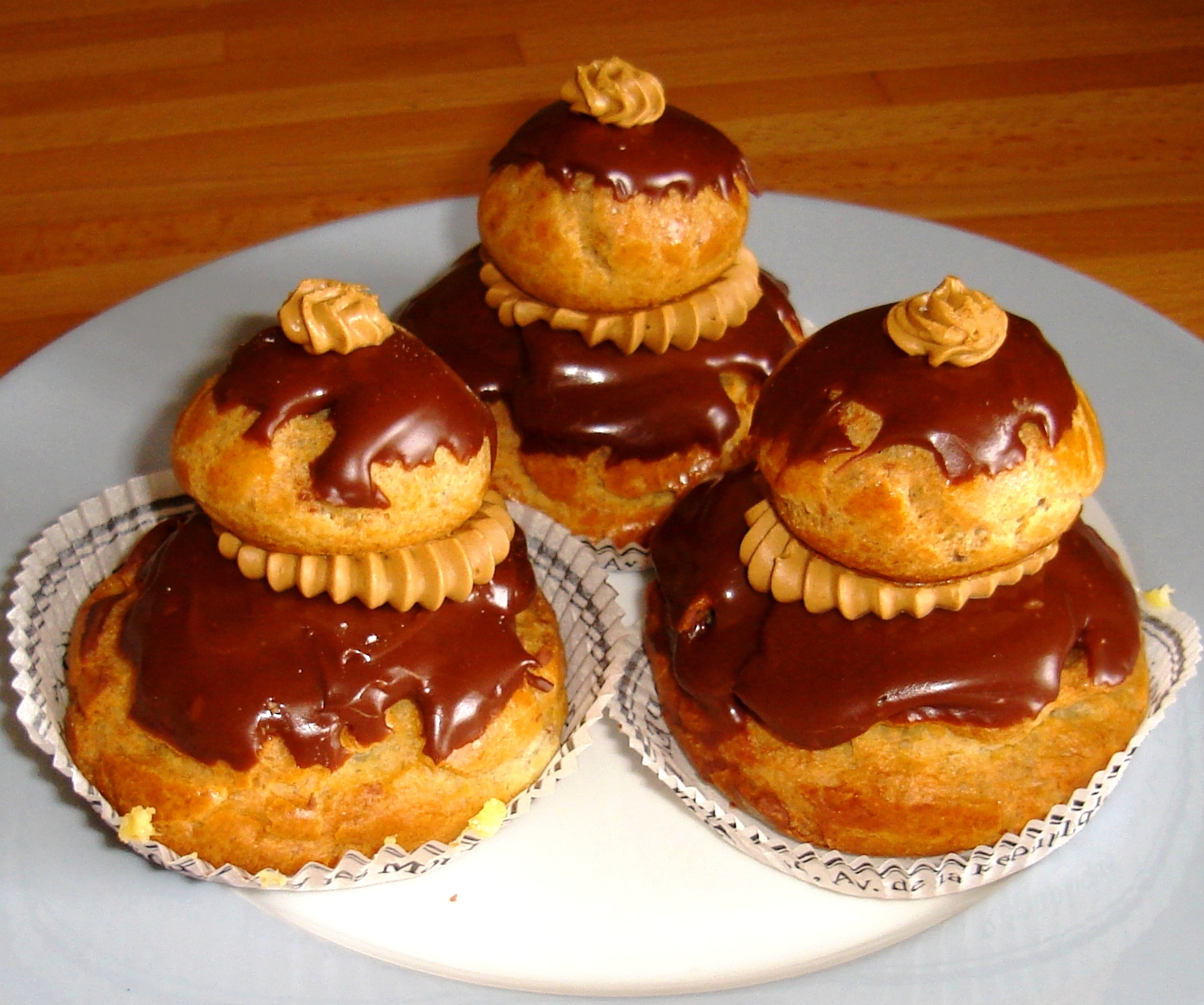
Religieuses au chocolat
CourseDessert
Place of originFrance
Main ingredientsFlour and crème pâtissière
  •   Media: Religieuse

A religieuse (French pronunciation: [ʁəliʒjøz] ) is a French pastry made of a small choux pastry case stacked on top of a larger one, both filled with crème pâtissière, commonly flavoured with chocolate[1] or mocha. Each case is topped with a ganache of the same flavour as the filling, then attached to each other using piped buttercream icing. It is a type of éclair.[2]

The pastry, whose name means "nun", is supposed to represent the papal mitre. The religieuse was supposedly conceived in the mid-nineteenth century; choux pastry was invented in the 16th century.

A derivation called courtesan au chocolat, filled with chocolate custard and with the glazing coloured pink, lavender and pale green, was invented for Wes Anderson’s 2014 film The Grand Budapest Hotel, commissioned to Anemone Müller of Cafe CaRe, a local baker of Görlitz, where the film was shot.[3]

See also

[edit]

References

[edit]
Revisions and contributorsEdit on WikipediaRead on Wikipedia
from Grokipedia
The religieuse is a classic French choux pastry dessert consisting of two stacked cream puffs—a larger one at the base and a smaller one on top—filled with flavored pastry cream such as , , or , then coated in smooth or icing and often adorned with piped rosettes. The name "religieuse," meaning "" in French, alludes to the pastry's shape, which is said to resemble a nun's or a portly figure in clerical attire. Originating in Paris during the mid-19th century, the religieuse was invented around 1850–1856 by an Italian-born pastry chef named Frascati, who adapted the versatile choux pastry technique refined earlier by Antonin Carême. This indulgent treat quickly became a staple of French pâtisserie, prized for its light yet creamy texture and elegant presentation, with variations incorporating modern flavors like salted caramel or fruit infusions while preserving its iconic silhouette. Preparation involves baking the pâte à choux into hollow spheres, injecting them with crème pâtissière made from milk, eggs, sugar, and flour, and finishing with a glossy glaze for a sophisticated finish suitable for tea time or special occasions.

Description

Composition

The religieuse pastry consists of two choux pastry cases stacked vertically, with a larger base and a smaller top, both filled with crème pâtissière. This structure creates a tall, elegant form reminiscent of a nun's , similar to how forms the base for éclairs. The itself is made from a precise combination of ingredients that enable its characteristic puffing during baking, including , water or milk, , eggs, salt, and a small amount of . Typically, these are proportioned such that for a standard batch yielding multiple pastries, approximately 125 grams of pairs with 250 milliliters of liquid (water or a water-milk mix), 100 grams of , four eggs, a pinch of salt, and optional for subtle sweetness. At its core, the filling is crème pâtissière, a thick prepared from , egg yolks, , cornstarch or as a thickener, and for flavor, resulting in a smooth, creamy texture that holds its shape within the choux shells. For chocolate variations, cocoa or melted chocolate is incorporated into the base mixture to infuse a rich flavor while maintaining the custard's consistency. The exterior coating typically involves or poured fondant, applied in white or tinted shades to evoke the appearance of a nun's , though serves as a common alternative for deeper flavor. Additionally, a decorative "collar" of piped or encircles the base of the larger choux case, adding both visual detail and textural contrast.

Appearance and Naming

The religieuse pastry features a distinctive visual structure consisting of two balls: a larger one at the base representing the body and a smaller one perched atop it, symbolizing the head, with the pair connected by a collar of piped or filling that evokes the of a standing figure. This design mimics the form of a 19th-century in traditional attire, where the rounded shapes and vertical alignment suggest a modest, elongated . In terms of color scheme, the pastry is classically finished with a uniform coating of fondant or ganache—often chocolate for a dark glaze—to represent the habit, accented by white buttercream piping around the junction to imitate the wimple or collar and create a contrasting black-and-white palette. These elements enhance the symbolic resemblance to religious garb while maintaining an elegant, restrained aesthetic typical of French patisserie. The name "religieuse," which translates to "" in French, derives directly from this visual to a nun's , particularly the black-and-white attire prevalent in 19th-century Catholic in . The stacked form and encircling "collar" thus serve as playful yet reverent nods to dress, embedding the within 's rich tradition of anthropomorphic pastries.

History

Origins

The origins of the religieuse pastry trace back to the mid-19th century in , building upon the foundational technique that had been developed centuries earlier. , a light made by cooking flour, water, butter, and eggs to create a versatile base that puffs dramatically when baked due to steam expansion, is believed to have originated in 16th-century , though details remain uncertain. This early form laid the groundwork for subsequent refinements, including those by the renowned Antonin Carême in the early , who perfected and popularized the —renaming it pâte à choux—for elaborate desserts in Parisian high society. The religieuse itself is attributed to around 1856 as an innovative adaptation of by Frascati, an Italian pastry chef working in , who stacked small cream-filled choux balls and coated them in icing to evoke the silhouette of a in . This creation reflected the era's blend of Italian culinary influences in French patisserie, as Italian chefs like Frascati contributed to the diversification of Parisian sweets amid a burgeoning cafe and . Introduced as a novelty in elite Parisian establishments, the religieuse quickly captured attention for its whimsical design and delicate flavors, aligning with the period's emphasis on visually striking confections. Early documentation of the religieuse was sparse, with no precise recipes appearing until the late 19th century, though it gained recognition in French pastry texts by the early 20th century, solidifying its place in the canon of classic desserts.

Evolution in French Pastry

Following its invention in the mid-19th century by the Parisian pastry chef Frascati, the religieuse underwent refinement in haute patisserie circles, building on the choux pastry techniques pioneered by Antonin Carême (1784–1833). Successors to Carême, including prominent chefs in Parisian establishments, integrated the pastry into elevated dessert offerings, focusing on meticulous precision in stacking the smaller choux case atop the larger one and applying smooth, glossy icing to evoke the layered habit of a nun. This emphasis on structural elegance and decorative finesse elevated the religieuse from a novelty to a symbol of technical mastery in French confectionery. By the early 20th century, the religieuse achieved greater standardization, appearing in authoritative French culinary texts that codified classic desserts. For instance, Auguste Escoffier's (1903) references preparations à la religieuse, such as poires à la religieuse, adapting the stacked choux format to fruit-based desserts and solidifying its place in professional repertoires. Through the and , the pastry became a fixture in patisserie cookbooks and menus. The post-World War II era marked a surge in the religieuse's cultural embedding, coinciding with the broader resurgence of choux-based desserts amid France's economic reconstruction and renewed interest in indulgent patisserie. Butter during the 1940s occupation and into the 1950s affected French baking in general, contributing to the pastry's continuity in home and professional settings. These shifts ensured adaptations in French culinary institutions like , which disseminated the technique globally from the 1950s onward.

Preparation

Making Choux Pastry

Choux pastry, or pâte à choux, forms the foundational base for the religieuse, consisting of small and large puffs that must be light, hollow, and crisp to support the filling and toppings. The classic ratio for this dough uses 1 cup (128g) all-purpose , 1 cup (235ml) or , 6 tablespoons (84g) unsalted butter, 4 large eggs, 1/2 teaspoon (or 2 teaspoons sugar optional) for balance. This combination of or in the liquids promotes tenderness while maintaining structure, as the milk adds subtle richness without compromising the puff. To prepare the dough, first combine the or , , and salt in a saucepan and bring to a rolling over medium heat until the fully melts, which takes about 2 minutes. Remove from the heat and immediately add the all at once, stirring vigorously with a to form a smooth paste known as a panade. Return the mixture to medium-high heat and cook, stirring constantly, until the pulls away from the sides of the pan and forms a ball, reaching an internal temperature of around 175°F (80°C) to fully hydrate the and evaporate excess moisture—this step typically lasts 1-2 minutes. Allow the panade to cool slightly to about 145°F (63°C), either by spreading it on a plate or beating in a stand mixer on low speed, to prevent the eggs from curdling when added. Gradually incorporate the eggs one at a time, beating thoroughly after each addition until the batter is smooth, glossy, and ribbon-like when lifted from the spoon; the final consistency should hold its shape but drop slowly. For shaping the puffs specific to the religieuse, transfer the batter to a piping bag fitted with a plain round tip (about 1/2-inch opening). Pipe mounds onto parchment-lined sheets: small 1-inch rounds for the tops and larger 2-inch mounds for the bases, spacing them 2 inches apart to allow for expansion. Gently smooth any peaks with a damp finger to ensure even rising. Bake in a preheated at 400°F (200°C) for 20-25 minutes, or until the puffs are , puffed, and firm to the touch; avoid opening the during the first 15 minutes to preserve the that causes the dramatic rise. To check , tap the bottom of a puff—it should produce a hollow sound, indicating a dry interior. Proper cooling is crucial to prevent sogginess, which can collapse the structure needed for assembly. Immediately after , pierce the side of each puff with a small or to release residual steam, then return them to the turned-off with the slightly ajar for 10-15 minutes to further dry out. Transfer to a wire rack to cool completely at , where they can hold for up to 2 hours before filling. This recipe yields approximately 12-16 puffs, sufficient for 6-8 religieuses, depending on exact size; for best results, use an oven thermometer to verify temperature accuracy and bake in batches if necessary to avoid overcrowding.

Filling, Coating, and Assembly

The preparation of the filling for a religieuse begins with making crème pâtissière, a custard-like pastry cream that provides the core flavor and texture. To create it, whole is heated to a simmer along with seeds scraped from a pod (or extract for flavoring), then removed from heat to infuse for 30 minutes. In a separate bowl, egg yolks are whisked with caster sugar until pale and thickened, followed by the addition of cornstarch to form a smooth paste that prevents lumps during cooking. The hot is gradually tempered into the yolk mixture while whisking continuously to avoid , after which the combined ingredients are returned to the pan and cooked over medium heat, stirring constantly, until the mixture boils and thickens to a pudding-like consistency, typically taking about 5 minutes plus 1 minute boiling. For chocolate variations, is stirred in off the heat until melted and incorporated, enhancing richness. The crème pâtissière is then strained through a fine-mesh to remove any solids, covered directly with to prevent a skin from forming, and chilled in the for at least 2 hours until firm. Once cooled, the cases—baked and fully cooled from the prior preparation—are filled with the crème pâtissière. A small hole is pierced in the bottom or side of each case using a or to create an entry point without deflating the structure. The chilled cream is whisked lightly to loosen it, then transferred to a piping bag fitted with a long, thin (such as a Bismarck tip, 6-8 mm in diameter). The is inserted into the hole, and pressure is applied to pipe the filling evenly inside, moving the bag slightly to distribute it throughout. Excess cream is wiped away from the exterior with a or finger to ensure a clean surface. The filled cases are refrigerated briefly to set the interior before proceeding. Coating the filled choux cases follows, traditionally using either fondant icing for a glossy finish or chocolate ganache for a richer sheen, applied while warm to ensure even coverage. For fondant, white fondant icing (a prepared sugar paste) is softened gently over a bain-marie to 37-40°C, then flavored and colored by stirring in cocoa powder (40-60 grams per 500 grams fondant) until smooth and pourable; the tops of the cases are dipped or poured over, allowing excess to drip off on a wire rack. Alternatively, ganache is prepared by bringing equal parts heavy cream and dark chocolate (such as 70% cocoa solids) to a gentle boil—cream heated separately and poured over chopped chocolate in stages, stirring until emulsified and glossy—then cooled until thick but fluid. The case tops are dipped halfway up the sides into the ganache, which sets as it cools. In both methods, the coated cases are allowed to dry at room temperature or in a cool area until the surface firms, preventing smudges during handling. Assembly completes the religieuse by stacking the coated components and adding decorative elements for stability and appearance. A small filled and coated choux case is placed atop a larger one, secured either by the residual wet coating or a dab of extra crème pâtissière piped as "glue" at the base. —double cream beaten to soft peaks with a touch of —is piped around the using a star-tipped to form a ruffled collar, mimicking a nun's and providing visual contrast. The assembled pastries are best served the same day, as the choux softens over time due to from the filling and cream.

Variations and Cultural Impact

Flavor Variations

The traditional religieuse features a crème pâtissière filling and corresponding icing or coating, with the most classic variants centered on , , and coffee flavors. In the version, the pastry cream is enriched with cocoa powder or melted during preparation, providing a rich, bittersweet profile, while the exterior is coated in a glossy dark made from high-quality bittersweet and for a smooth, intense finish. This combination emphasizes the harmony between the light choux pastry and the decadent filling, as seen in longstanding French patisserie recipes. For a purer expression, the vanilla religieuse uses an unadulterated crème pâtissière infused with vanilla beans or extract, maintaining a delicate custard-like sweetness, topped with white fondant icing to evoke simplicity and elegance. Coffee variations incorporate espresso or strong brewed coffee into the pastry cream for a robust, aromatic note, often paired with a mocha-tinted fondant or ganache that enhances the beverage-inspired theme without overpowering the pastry's structure. Beyond these staples, and nut-infused adaptations introduce brighter contrasts, such as raspberry-filled religieuses where a or is folded into the cream for tartness. cream, made by blending ground nuts into the base , offers a nutty, subtly sweet filling often accented with green-tinted icing, while praline variations use or praline paste for a caramelized depth. These flavor profiles maintain the religieuse's elegant form while allowing for seasonal or creative diversification in professional bakeries.

Modern Adaptations and Popularity

In contemporary patisserie, the religieuse has seen adaptations in size and form to suit various occasions, including mini versions presented as petit fours for high-end events and platters. These smaller iterations maintain the stacked choux structure but allow for easier serving at weddings or receptions, while deconstructed presentations in reimagine the components—such as separate choux elements, cream, and —into plated s for a more artistic, shareable experience. Ingredient innovations have expanded accessibility, with vegan options utilizing as an egg substitute in alongside plant-based creams for fillings, enabling the creation of eggless religieuses that mimic the traditional light texture. Similarly, gluten-free flour blends, often combining and flours, produce viable choux shells suitable for the pastry's base, broadening its appeal to dietary-restricted consumers without compromising structure. The religieuse has gained global popularity, appearing in baking competitions like during its 2013 pastry week technical challenge, where contestants crafted the stacked choux buns under time constraints. It is widely available in international patisseries, such as outposts in New York offering pistachio-flavored versions and Bakery in featuring a playful "Monkey Religieuse" as a localized twist. As a symbol of French elegance, the religieuse has appeared in media, including Wes Anderson's 2014 film , where similar stacked choux pastries evoke refined sophistication. Sales often peak during holidays and weddings, with seasonal flavors like or enhancing its role in celebratory menus. However, preservation challenges arise in humid climates, where the choux can soften quickly; bakers recommend storing unfilled shells in airtight containers with to absorb excess moisture, or freezing them for up to two months before assembly to maintain crispness.

References

Add your contribution
Related Hubs
User Avatar
No comments yet.