Hubbry Logo
KnafehKnafehMain
Open search
Knafeh
Community hub
Knafeh
logo
8 pages, 0 posts
0 subscribers
Be the first to start a discussion here.
Knafeh
Knafeh
from Wikipedia

Knafeh
Alternative names
  • Kunafeh
  • Kunafa
  • Kanafeh
  • Konafi
  • Kunaftah
  • Künefe
  • Kinafa
TypeDessert
Region or stateArab world
Serving temperatureWarm, room temperature, or cold (qishta variety)
Main ingredients
VariationsMultiple
  •   Media: Knafeh

Knafeh[1] (Arabic: كنافة) is a traditional Arab dessert made with kadayif (spun pastry dough)[2][3] layered with cheese and soaked in a sweet, sugar-based syrup called attar.[4] Knafeh is popular throughout the Arab world, especially in Egypt,[5] and the Levant.[6] Knafeh is often served on special occasions, holidays and celebrating the month of Ramadan.[4][7][8] The most common variant of knafeh in Jordan and Palestine, Knafeh Nabulseyeh, originated in the Palestinian city of Nablus.[9][6][10][8]

Etymology

[edit]

English borrowed the word knafeh from Levantine and Egyptian Arabic, and transliterates it as kanafeh, kenafeh, knafeh, kunafah, kunafeh, konafa, knéfé, kunafa, and similar variations.[11][12]

The ultimate origin of the word is debated. It may come from the Coptic Egyptian kenephiten, a bread or cake.[13][14][11][15] Or it may come from a Semitic root meaning "side" or "wing", and from the Arabic kanafa, "to flank or enclose".[16][17] Early uses appear in One Thousand and One Nights,[11] a collection of Middle Eastern folk Tales.

History

[edit]

A common story is that the knafeh was created to satisfy the hunger of caliphs during Ramadan. The story, which dates in writing as early as the 10th century, is variously said to have occurred in Fatimid Egypt[18][19][20] or in the Umayyad Caliphate in Damascus, Syria, where Levantine dessert makers preparing it for Mu'awiya I.[21][22]

Homemade Knafeh from Feast: Food of the Islamic World by Anissa Helou, page 444

Ibn Sayyar al-Warraq's tenth century Arabic cookbook, Kitab al-Tabikh (Book of Dishes), which documented many recipes from Abbasid courts, does not mention or describe knafeh. However, it does feature a chapter on qatayif, an Arabic pancake dumpling dessert that originated in the Fatamid Empire.[23][4] The 13th century cookbook, Kitab al tabikh fi-l-Maghrib wa-l-Andalus (Book of Dishes from Maghreb and Al-Andalus), of unknown author, gives a number of recipes for knafeh, which it describes as a pancake dumpling thinner than qatayif prepared on a flat pan. Some of the knafeh recipes in the cookbook call for layering the thin pancake with fresh cheese, baking it, and topping it with honey and rose syrup.[24][4]

Ibn al-Jazari gives an account of a 13th-century Mamluk period market inspector who rode through Damascus at night ensuring the quality of knafeh, qatayif, and other foods associated with Ramadan.[25] Over time, new knafeh preparation methods were developed, including a technique of dripping thin batter onto a metal sheet from a perforated container, creating hair-like strings. A mid-15th century Ottoman Turkish translation of Muhammad bin Hasan al-Baghdadi's Kitab al-Tabikh added several new contemporary knafeh recipes, though it does not specify where they originated from.[26] Today, knafeh is served throughout the Middle East, although it is "particularly associated with Nablus"[9] and considered to be a "cultural touchstone for Palestinian identity".[2]

Common variants

[edit]
Knafeh Nabulseyeh served in a Nablus souk, or street market

Knafeh Nabulseyeh (Nablus, Palestine)

[edit]

Knafeh has been described as a "Palestinian Institution."[9] Knafeh Nabulseyeh is a popular version of knafeh originated in the Palestinian city of Nablus,[6][10] hence the name Nabulseyeh (also spelled as Nabilsiyeh).[6] Nablus is still renowned in for its knafeh, which "is filled with the city’s trademark firm, white, salty nabulsi cheese" and covered with sweet syrup.[9][27]

Today, knafeh Nabulseyeh is the most common variant of knafeh in Jordan and Palestine.[6] As a result, academics have described Nablus as the modern-day knafeh capital.[2]

Knafeh Ghazawiya (Gaza Strip, Palestine)

[edit]

Knafeh Ghazawiya is a Palestinian variant of knafeh unique to the Gaza Strip. It is made with a variety of Gazan nuts and spices, with "nutmeg and cinnamon replacing the cheese."[28]

Künefe (Hatay, Turkey)

[edit]

Künefe is a variant of knafeh believed to have originated in Hatay Province, Turkey.[29][30] It is filled with a mozzarella-like local Hatay cheese and coated in "a syrup made of water, sugar and lemon juice."[29] In 2012, the EU Commission approved Antakya Künefesi, a variant of both kadayif and künefe, as a Protected Geographical Indication (PGI).[30]

Dubai chocolate

[edit]

Dubai chocolate is a chocolate bar with a knafeh and pistachio filling. It was first produced by Fix Dessert in Dubai, but versions are now sold worldwide.[31]

Sandwiched knafeh

[edit]

In Lebanon, kaak knafeh is a popular street food, its made of a knafeh sandwiched in sesame-coated bread.[32]

In Nablus, knafeh is sandwiched in pita bread and eaten for breakfast.[33][34]

Preparation

[edit]
Mabruma (twined) knafeh

There are several types of knafeh pastry:[35][better source needed]

  • khishnah (Arabic: خشنة, rough): a crust made from long thin noodle threads.
  • nāʿimah (Arabic: ناعمة, fine): a semolina dough.
  • muhayara (Arabic: محيرة, mixed): a mixture of khishnah and na'ama.
  • mabruma (Arabic: مبرومة, twined): a noodle pastry

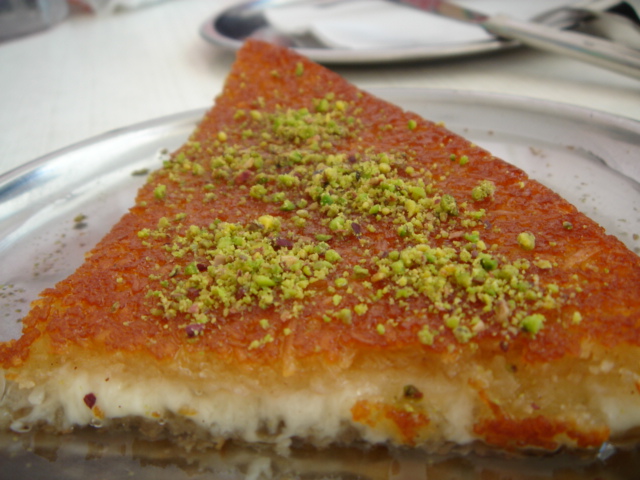
The knafeh pastry is heated in butter, margarine, palm oil, or traditional semneh, spread with soft sweet cheese, such as Nabulsi cheese, and topped with additional pastry. In khishnah knafeh the cheese is rolled in the pastry. During the final minutes of cooking, thick sweet sugar syrup, water, and a few drops of rose water or orange blossom water are poured on the pastry. The top layer of pastry is sometimes tinted red or orange, and crushed pistachios are often sprinkled as a garnish.[9]

[edit]

See also

[edit]

References

[edit]
[edit]
Revisions and contributorsEdit on WikipediaRead on Wikipedia
from Grokipedia
Knafeh, also known as kunafa or künefe, is a traditional Levantine Arab composed of fine strands of kataifi coated in or , layered around a filling of melted cheese such as Nabulsi or , then soaked in hot sugar syrup flavored with or water, and often garnished with crushed pistachios. Its preparation involves spreading the buttered kataifi in a pan, adding the cheese filling, topping with more kataifi, or until golden and crispy, inverting onto a plate, and immediately drenching in to achieve a contrasting texture of crunchy exterior and gooey, salty-sweet interior. The dish traces its roots to medieval Middle Eastern culinary traditions, with the earliest recorded recipes appearing in 13th-century cookbooks like Kitab al-Tabikh fi-l-Maghreb wa-l-Andalus, describing kunafa as a thin crepe or flatbread (sometimes cut into strips) stuffed with cheese, distinct from the modern dripped shredded kataifi form. The distinctive fine shredded strand technique, achieved by dripping batter through perforated ladles onto hot surfaces, emerged in 15th-century Ottoman adaptations, as documented in Turkish recipes and translations like those by Muhammed bin Mahmud Şirvani. The most iconic variant, knafeh Nabulseyeh, originated in Nablus, , where it employs local brined and is celebrated as a cultural staple, though debates persist over precise invention amid claims linking it to Umayyad or Fatimid . Ottoman adaptations popularized it across as künefe with fresh cheese and , while variations using dough or alternative fillings like cream extend its reach to , the , and beyond. Knafeh holds enduring popularity for its sensory appeal—crisp, syrupy richness paired with the pull of molten cheese—and serves as a symbol of Levantine heritage, especially in , where massive communal trays underscore festive and communal traditions.

Etymology

Linguistic Roots and Variations

The name knafeh originates from the triliteral root k-n-f (ك-ن-ف), specifically the verb kanafa (كَنَفَ), which means "to shelter," "to cover," or "to encase." This aptly describes the dessert's construction, where fine strands of dough envelop a soft cheese filling before being baked and drenched in . Regional linguistic variations reflect dialectical differences and transliteration conventions. In (including Palestinian, Syrian, and Lebanese dialects), it is typically rendered as knafeh or kanafeh, while favors kunafa or kunafah. Turkish adaptations use künefe, often paired with the term tel kadayıf for the shredded dough. Other transliterations include kenafeh, knefeh, and konafa, with Greek-influenced variants like konafi appearing in Balkan contexts; these stem from phonetic adaptations rather than distinct semantic shifts. In some Palestinian dialects, such as those in rural areas, it may be pronounced as chnafa, highlighting local phonetic evolution from forms.

Historical Development

Early References and Possible Origins

Some scholars connect the name kunāfa to the Coptic term kenefiten, glossed as a type of loaf or cake, but this debated etymology does not establish the origin or development of the modern dessert. Legends commonly associate knafeh's invention with the (661–750 CE), positing that it was crafted in or to provide a filling pre-dawn meal (suhoor) for fasting caliphs during , such as (r. 661–680) or (r. 715–717). These stories, first committed to writing around the , portray the dessert as a royal innovation to curb hunger without breaking the fast, but they rely on without supporting archaeological or textual artifacts from the era, rendering them folkloric rather than historical fact. The earliest verifiable references to kunāfa appear in medieval Arabic culinary manuscripts from the 10th to 13th centuries, describing it as a simple, thin crepe-like flatbread or pancake made from batter or ruqāq (thin sheet dough), fried or cooked on a griddle, often rolled up, cut, or layered minimally with honey, nuts, or cheese. This form, far removed from the modern shredded-dough pastry, aligns with early Levantine traditions as a humble bread-like treat, as noted in sources like the anonymous Kitab al-Tabikh fi-l-Maghrib wa-l-Andalus (Book of Cooking in the and ) and Muhammad ibn al-Hasan al-Baghdadi's Kitab al-Tabikh (c. 1226). These texts confirm its presence in Abbasid-era (750–1258 CE) by the medieval period, amid exchanges of basic pastries from Byzantine and Persian traditions, but without the layered, crispy shredded structure or cheese-pull effect of later versions.

Evolution in the Ottoman Era and Beyond

During the Ottoman Empire (1299–1922), kunāfa underwent a radical reinvention from the medieval flatbread form into the modern dessert featuring shredded, noodle-like kataifi (or tel kadayif) dough—created by dripping or extruding batter through perforated tools to form fine vermicelli strands—layered with melting cheese or kaymak, baked in trays, and soaked in syrup for a contrasting crisp exterior and gooey interior. This Ottoman palace innovation, documented in 15th-century texts, elevated it into a luxurious treat unknown in earlier Arab cookbooks, proliferating via trade and administration across the Levant, Anatolia, and Egypt. By the 18th century, cheese fillings became prominent, enhancing textural contrasts akin to baklava developments. In under Ottoman rule, emerged as a production hub, where knafeh incorporated brined and syrups flavored with rosewater or , solidifying its status as a local specialty tied to festive occasions like . Jewish communities traversing the empire adopted the dish, contributing to its dissemination beyond core regions and embedding it in diaspora traditions. In , particularly Hatay (ancient Antioch), it developed into künefe, using fresh local cheeses akin to and cooked on rotating copper trays, reflecting the province's multicultural culinary heritage as a trade crossroads. Post-Ottoman dissolution in , knafeh persisted in national cuisines of successor states, with traditional methods enduring in places like , where shops have maintained techniques—such as layering or kataifi with cheese and pistachios—for approximately 300 years. In , künefe remained central to Hatay's identity, with over 30 specialized shops operating before the 2023 earthquakes (magnitudes 7.8 and 7.5), several reopening amid recovery efforts to preserve communal rituals often paired with or raki. Modern evolutions include global adaptations, such as Australian outlets using local ingredients while retaining family recipes, and innovations like vegan cheese fillings or fusions including knafeh in and frozen retail versions in the United States. Despite these, core preparations—drizzling batter for threads, baking until golden, and drenching in sugar-lemon sherbet—continue to dominate, underscoring the dessert's resilience from imperial refinement to contemporary appeal.

Regional Variants

Palestinian Variants

The primary Palestinian variant, known as knafeh Nabulsieh or knafeh Na'ameh, originates from in the and is distinguished by its use of , a semi-hard, made from sheep's or goat's that becomes elastic and stretchy when heated. This cheese is soaked in water for several hours or overnight to remove excess salt before preparation, ensuring a balanced salty-sweet profile when combined with the dessert's syrup. The dough consists of kataifi, fine shredded phyllo pastry, often tinted orange with food coloring derived from extract or synthetic dyes for visual appeal, particularly in Nablus-style preparations. Preparation involves melting or and mixing it with the kataifi to coat the strands, then pressing half into a greased pan to form a base layer. The softened is crumbled or sliced and spread evenly over this base, followed by a top layer of the remaining kataifi mixture. The assembly is at around 400°F (200°C) until golden brown, typically 20-30 minutes, then inverted onto a serving plate to expose the crispy bottom as the new top. Immediately after baking, hot qataif —made from , , juice, and often rose or —is poured over the hot knafeh to soak in, creating a gooey, aromatic contrast to the crunch. It is traditionally served hot, garnished with ground pistachios, and prized for the cheese's stringy pull when eaten. Regional adaptations within include variations in Gaza, where knafeh Ghazawiya incorporates local nuts such as almonds or walnuts mixed with the cheese for added texture and flavor, diverging from the cheese-centric style. Some Palestinian preparations substitute or layer (ashta) alongside or instead of cheese, though purists maintain that defines the authentic Nabulsieh variant. These differences reflect local ingredient availability and preferences, with versions emphasizing the cheese's melt and stretch as a hallmark of quality.

Turkish and Levantine Variants

Künefe, the Turkish variant of knafeh, originated in Hatay Province and is characterized by its use of fine, shredded kadayif dough layered with unsalted, stringy Hatay künefe peyniri (also known as künefe peyniri), a fresh cheese made from goat or cow milk that melts smoothly when heated, similar to mozzarella. The dish is prepared by buttering the kadayif, arranging half in a copper pan, adding the cheese filling, covering with the remaining dough, and cooking on the stovetop until the bottom achieves a crispy, sizzling golden crust, typically taking 10-15 minutes per side. It is then soaked in hot sugar syrup flavored with lemon juice or orange blossom water and often garnished with ground pistachios for added crunch and flavor. Levantine variants in Syria, Lebanon, and Jordan share the core elements of shredded and cheese but feature regional adaptations in fillings and techniques. In , knafeh typically combines crunchy kadaif with cheese or (ashta), yielding a creamy, less salty profile compared to some other versions, and is baked until golden before syrup immersion. Lebanese preparations often employ kataifi dough filled with mild cheese like , infused with syrup, and baked in trays for a balanced sweet-savory contrast, with some recipes emphasizing a gooey cheese pull. Jordanian knafeh mirrors this structure, using thin kataifi strands and cheese soaked in aromatic syrup, commonly served warm as a staple in local . These variants highlight subtle differences in cheese selection—favoring milder, brined over saltier options—and cooking methods, such as oven baking prevalent in Levantine traditions versus the stovetop pan-frying in Turkish künefe, reflecting local ingredient availability and culinary preferences.

Other Regional Adaptations

In Egypt, kunafa represents a distinct adaptation characterized by frequent use of semolina custard or clotted cream fillings alongside the shredded kataifi dough, often assembled into compact rolls or trays and drenched in orange blossom-infused syrup, diverging from cheese-dominant recipes by prioritizing creamy, pudding-like interiors. This version proliferates during Ramadan, with Cairo's confectioners producing variations that incorporate local flavors like coconut or nuts for enhanced texture contrast. Greek kataifi employs the same spun pastry but typically omits cheese, instead encasing chopped walnuts, almonds, or cinnamon-spiced nuts within coiled or layered structures, baked until crisp and immersed in honey-lemon syrup for a lighter, nut-forward profile suited to Mediterranean palates. Similar nut-centric preparations prevail in and the under names like kadaif, where the dessert integrates regional syrups such as or fruit-based reductions, reflecting Ottoman culinary legacies adapted to local ingredient availability since the . In Gulf countries including and the UAE, kunāfah emphasizes enriched cheese cream blended with ashta, sandwiched between buttered kataifi layers, then flavored with syrup and garnished with s, yielding a denser, floral iteration popular at communal feasts. Recent innovations, such as the 2024 emergence of " chocolate" bars embedding kataifi strands with pistachio paste in shells, have globalized these elements, originating from Dubai's Fix Dessert Chocolatier and achieving viral status through by late 2024.

Preparation and Ingredients

Core Components

The core components of traditional knafeh consist of kataifi pastry, unsalted cheese, or , and a simple sugar syrup. Kataifi, a shredded wheat-based dough resembling fine or shredded phyllo, serves as the structural base, providing crispiness when baked after being coated in fat. The unsalted cheese, typically Nabulsi or varieties from the , forms the filling; these fresh, brined cheeses are soaked to remove excess salt, yielding a mild, semi-soft texture that melts into a stretchy consistency without overpowering sweetness. Clarified butter (ghee) or unsalted butter is essential for coating the kataifi, enhancing flavor and achieving the golden, crunchy exterior through during baking at temperatures around 350–400°F (175–200°C). The , prepared by boiling and water with or to prevent , is poured hot over the baked knafeh to infuse moisture and sweetness, often flavored minimally with or for aroma. While pistachios or other nuts may garnish variants for texture and visual appeal, they are not integral to the foundational , which emphasizes the contrast between the savory cheese and syrup-soaked . In authentic preparations, quantities typically scale to 1 pound (450g) kataifi, 1–1.5 pounds (450–680g) cheese, 1 cup (225g) , and 2 cups (400g) for , yielding a dish for 8–12 servings.

Traditional Preparation Techniques

Traditional preparation of knafeh centers on kataifi dough, a fine, shredded phyllo pastry, which is meticulously coated with melted or to achieve crispiness. The , often fresh or thawed from frozen, is gently shredded by hand or with a to separate strands, then tossed evenly with the fat—typically at a of about 1/3 cup per 375 grams of —to ensure every filament absorbs the moisture without clumping. This step, performed at , prevents sogginess during and is essential for the signature crunchy texture observed in Nablus-style knafeh. The cheese filling, traditionally unsalted Nabulsi or , undergoes desalting by soaking in cold water for 8-24 hours, with changes every few hours to remove excess salt, followed by draining and sometimes brief to achieve a semi-melted consistency. Shredded or sliced into thin layers, the cheese—around 500-700 grams for a standard tray—weighs down the structure during assembly, allowing it to ooze molten when heated. Assembly occurs in a buttered metal tray, often 25-30 cm in diameter for home preparation or larger pans in commercial settings. Half the buttered kataifi is pressed firmly into the base to form a compact layer, topped by the cheese, then covered with the remaining dough, which is smoothed and compacted to seal the filling. follows in a preheated at 200°C (400°F) for 30-45 minutes until the top turns golden-brown and emits a nutty aroma, signaling of the strands. Immediately after, the knafeh is inverted onto a serving plate to expose the crispy underside, and hot simple syrup—prepared by boiling sugar, water, lemon juice, and floral waters like —is poured generously over the surface, allowing absorption while the dessert remains warm. This technique, rooted in Levantine practices, balances the heat to soften the cheese without wilting the crust. In historic contexts, such as Ottoman-era production, similar layering occurred but with variations like semolina-based dough in some Turkish regions, fried on stovetops rather than baked, though Palestinian traditions emphasize oven-baking for uniformity in large batches. Garnishing with ground pistachios follows syrup infusion, enhancing visual appeal and nutty flavor without altering core techniques.

Cultural Significance

Role in Levantine Societies

In Levantine societies, knafeh functions as a shared that strengthens communal ties during family gatherings, celebrations, and daily social interactions. Large trays of the syrupy pastry are commonly distributed among relatives and friends to commemorate significant life events, including marriages, property acquisitions, and career advancements, thereby reinforcing social networks and expressions of joy. This practice underscores knafeh's role in promoting hospitality and collective indulgence across the region, from to . Within Palestinian communities, particularly in , knafeh holds profound cultural prominence as a symbol of local identity and artisanal expertise, with production concentrated in family-run shops that have preserved traditional methods for generations. These establishments, such as those in Nablus's historic markets, serve knafeh as both an everyday treat and a marker of regional pride, akin to iconic staples in other culinary traditions. In , it frequently appears at breakfasts and festive meals, embodying themes of togetherness and sensory pleasure that enhance familial bonds. Across , , , and , knafeh's preparation and consumption reflect enduring Levantine values of craftsmanship and communal feasting, often tied to urban souks where vendors specialize in its labor-intensive assembly. Its ubiquity in social settings contributes to economic activity in trades, sustaining livelihoods while evoking shared heritage amid regional diversity.

Traditions and Symbolism

Knafeh is traditionally prepared and shared during religious observances such as Ramadan, where its rich, calorie-dense composition provides sustenance for breaking the fast, a practice linked to historical accounts from the 10th century suggesting it was crafted to sustain caliphs through daylight fasting hours. In Palestinian and broader Levantine communities, it features prominently at Eid celebrations, weddings, and family iftars, often served warm in large trays to symbolize communal joy and abundance. Beyond festive contexts, knafeh carries symbolic weight as a gesture of and goodwill, frequently delivered to resolve disputes, mark personal milestones like graduations or new purchases, or extend hospitality after conflicts. Its contrasting textures—crisp exterior yielding to molten cheese and syrup—evoke themes of harmony amid diversity, mirroring the multicultural fabric of Levantine societies where the transcends ethnic boundaries yet retains strong ties to Palestinian heritage as an emblem of cultural resilience. In Turkish variants like künefe, it similarly represents regional fusion and renewal, particularly in post-earthquake recovery efforts symbolizing communal rebuilding.

Controversies and Origin Disputes

Claims of Exclusive National Ownership

Palestinians, particularly those from in the , assert exclusive ownership of knafeh, tracing its definitive form—known as knafeh Nabulsi—to the city as early as the , using local soaked in whey for preservation and distinguishing it from regional variants through its gooey, salty-sweet profile. This claim positions as the "capital of knafeh," with historic shops like Sweets producing massive trays daily, symbolizing Palestinian culinary heritage amid broader identity struggles. Such assertions often frame adaptations elsewhere, especially in , as cultural appropriation, ignoring Palestinian roots despite knafeh's pre-1948 presence in shared Levantine markets. In , künefe is claimed as a native specialty originating in during the Ottoman era, with locals emphasizing its coarse shredded dough (kadayıf), unsalted cheese, and filling as distinctly Turkish innovations refined post-1939 when Hatay joined the republic. Proponents highlight Hatay's as the invention site, crediting Circassian or influences under Ottoman rule but asserting Turkish evolution through techniques like toppings and regional eateries producing over 1,000 kilograms daily. These claims portray künefe as integral to Turkish post-earthquake recovery in Hatay, downplaying Levantine parallels despite shared medieval cookbook references predating Ottoman standardization. Broader historical evidence, including 13th-century Arab texts like Kitab al-Tabikh, suggests knafeh/künefe evolved from shared Fatimid or Umayyad pastry traditions across , , and , undermining exclusive in favor of transregional diffusion via and . Palestinian and Turkish assertions, while rooted in local pride and post-colonial identity, often overlook this continuum, with disputes amplified by modern geopolitics rather than primary culinary records.

Politicization and Cultural Appropriation Narratives

Knafeh has become entangled in narratives of cultural appropriation, particularly within the Israeli-Palestinian conflict, where some Palestinian commentators argue that Israeli adoption and rebranding of the dessert erases its Levantine heritage and contributes to broader . For instance, in 2014, a sponsored article by described knafeh as originating from "," prompting backlash from Palestinian advocates who viewed it as an erasure of the dish's association with , leading to the post's removal. Similar sentiments appeared in a 2020 Washington Post by a Palestinian writer, who contended that labeling Levantine dishes like knafeh as "Israeli " denies Palestinian contributions and historical presence in the region. These appropriation claims often intensify around culinary innovations by Israeli chefs, such as a 2020 attempt to create a "beef knafeh" savory variant, which drew mockery from Palestinian social media users as a distortion of the traditional sweet pastry tied to Arab culinary identity. Pro-Palestinian sources, including outlets like Electronic Intifada, frame such instances as part of a pattern where Israeli marketing appropriates Palestinian staples—echoing disputes over hummus and falafel—to assert cultural dominance, though these narratives typically downplay the dish's pre-modern, shared Ottoman-era diffusion across the Levant, Anatolia, and beyond. Critics of these claims, including some food historians, note that knafeh's origins trace to at least the Umayyad period in Damascus or earlier Abbasid influences, predating nationalist boundaries and supporting its status as a regional inheritance rather than exclusive property. Comparisons with Turkish künefe highlight milder tensions, with informal debates on platforms like attributing the dessert's Levantine form to Palestinian innovations in before Ottoman adoption, yet without widespread politicization; users often describe it as a shared Middle Eastern treat rather than a zero-sum . In contrast, Palestinian narratives emphasize knafeh's role in resisting erasure, as articulated in literary reflections where it symbolizes enduring identity amid displacement, though such views risk overstating exclusivity given the dish's historical spread via and migration. These debates reflect broader , where empirical culinary history—rooted in ancient shredded dough techniques—clashes with identity-driven claims, often amplified by biased advocacy sources on both sides.

Modern Developments

Commercialization and Global Spread

Commercial production of knafeh initially centered on family-run bakeries in cities like , where recipes remain closely guarded trade secrets passed down through generations. Over time, advancements in enabled the development of frozen knafeh products, allowing for easier distribution and export from producers in the and beyond, such as Zalatimo Brothers and Habibah Sweets, which offer shock-frozen varieties packaged for international travel. These innovations facilitated commercialization by extending and reducing preparation barriers, transforming knafeh from a labor-intensive local to a viable for wider markets. The global spread of knafeh accelerated through Arab diaspora communities in Western countries, where immigrant-owned patisseries introduced it to non-Middle Eastern audiences, shifting its consumption from seasonal occasions like Ramadan to year-round availability in urban areas of the United States and Australia. A significant catalyst occurred in 2021 with the launch of "Dubai chocolate" by Fix Dessert Chocolatier, incorporating knafeh filling into pistachio-stuffed bars branded "Can't Get Knafeh of It," which exploded in popularity after a 2024 TikTok video garnered over 120 million views, sparking international demand and supply chain strains including pistachio shortages. This prompted multinational corporations like Mars to enter the market with Galaxy kunafa-infused chocolate lines in 2025, while UAE-based manufacturers expanded production for export to diverse global consumers, embedding knafeh in fusion desserts and boosting its visibility far beyond traditional Levantine spheres. , the dessert's rising profile has fostered cross-cultural appreciation, with shops reporting sustained sales and adaptations that connect immigrants to their heritage while attracting broader demographics. In late 2023, a chocolate bar filled with knafeh-inspired elements emerged as a major viral trend on TikTok, originating from Fix Dessert Chocolatier in Dubai. Dubbed "Can't Get Knafeh of It," the bar combines a milk chocolate exterior with a filling of crispy kataifi (shredded phyllo dough used in knafeh), pistachio cream, and tahini, priced at approximately 68 AED (about £15). A single TikTok video showcasing the bar garnered over 100 million views, propelling it to global popularity and inspiring widespread copycat recipes and commercial products. The trend's appeal lies in its textural contrast—crunchy knafeh against creamy and smooth —optimized for videos emphasizing "texture theater." By mid-2025, it influenced menus worldwide, with 25% of knafeh-serving restaurants adding Dubai-style desserts and supermarket chains like introducing versions. This fusion represents a commercialization of traditional knafeh elements, adapting the Levantine dessert's shredded for portable, chocolate-encased treats that blend Middle Eastern flavors with Western norms. Beyond the , innovations include knafeh fusions with in layered desserts and kunafa chocolate bites, which incorporate crispy kunafa into chocolate cups for bite-sized indulgences. Modern recipes often substitute traditional with or for better meltability, enabling creations like kunafa rolls and bird's nest-style presentations that merge Arabic pastry techniques with contemporary baking. These adaptations, popularized via platforms like and since 2023, emphasize ease of preparation with minimal ingredients while preserving knafeh's signature crunch and syrupy sweetness.

References

Add your contribution
Related Hubs
User Avatar
No comments yet.