Hubbry Logo
E. Remington and SonsE. Remington and SonsMain
Open search
E. Remington and Sons
Community hub
E. Remington and Sons
logo
8 pages, 0 posts
0 subscribers
Be the first to start a discussion here.
E. Remington and Sons
from Wikipedia

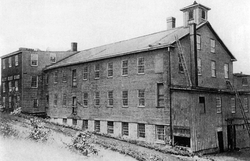
E. Remington and Sons (1816–1896) was a manufacturer of firearms and typewriters. Founded in 1816 by Eliphalet Remington II in Ilion, New York, on March 1, 1873, it became known for manufacturing the first commercial typewriter.

Key Information

History

[edit]
Eliphalet Remington II
Philo Remington
Samuel Remington
Eliphalet Remington III

The rifle barrel

[edit]

There are two versions of the origin story of the first Remington rifle barrel. One holds that the younger Remington wanted to purchase a rifle and lacked the money to buy one, so he made his own. The other states that he forged a barrel from wrought iron to see if he could build a better rifle than he could buy.[1] Both versions have him taking the barrel to a gunsmith to have it rifled.[2]

Eliphalet II forged his first rifle barrel as a young blacksmith in 1816 and finished second place in a local shooting match with it. Despite not winning the match, he proceeded to make barrels to meet the growing demand for flintlock rifles in the Mohawk Valley. With the completion of the Erie Canal, connecting Buffalo with Albany, commerce in the Mohawk Valley expanded remarkably, as did the demand for rifle barrels.[3]

To meet the increased demand for rifle barrels, in 1828 the Remingtons moved their forge and foundry from its rural setting to 100 acres (0.40 km2) of land they had purchased astride the canal and abutting the Mohawk River near a town then called Morgan's Landing (later Ilion), New York.[4] The move coincided with the elder Eliphalet's death, and Eliphalet II assumed control of the business.[5]

Becoming "E. Remington & Sons"

[edit]

In 1839 Eliphalet was joined by his oldest son, Philo Remington (to make the business "E. Remington & Son"); in 1845, his second son, Samuel, also joined the company, afterward called "E. Remington & Sons".[4] Remington's third son, Eliphalet Remington III, would later join the company as well. During this period, the Remingtons specialized almost exclusively in manufacturing rifle barrels. These barrels, marked with the distinctive "REMINGTON" stamp near their breeches, were recognized for their quality and reasonable price. Many, if not most, of the independent gunsmiths in the Mohawk Valley purchased completed (but not rifled) barrels from Remington and assembled them into firearms custom ordered by their customers. As demand increased, the Remingtons added other parts to their inventory, first percussion locks made in Birmingham, England but marked with their stamp "REMINGTON", and later sets of brass gun furniture, including trigger guards, butt plates, and patch boxes. After 1846, martial longarm and then revolver production dominated the company's workforce.[5][6]

In 1848, the company purchased gun-making machinery from the Ames Manufacturing Company of Chicopee, Massachusetts and took over a contract for Jenks breechloading percussion carbines for the U.S. Navy. Remington supplied the U.S. Navy with its first breech-loading rifle. Remington supplied the U.S. Army with rifles in the Mexican–American War (1846 to 1848). Shortly after, Remington took over a defaulted contract (by John Griffith of Cincinnati) for 5,000 U.S. Model 1841 Percussion Mississippi rifles. Based on the success of filling these orders, subsequent contracts followed in the 1850s.[4][5]

In 1856 the company expanded to manufacturing agricultural implements. Upon Eliphalet's death in 1861, his son, Philo, took over the firm during the Civil War and diversified the product line to include sewing machines (manufactured from 1870 to 1894) and typewriters (1873), both of which were exhibited at the Centennial Exposition in Philadelphia in 1876.[citation needed]

Remington's typewriter

[edit]
Sholes & Glidden Typewriter, 1876

On June 23, 1868, a patent was granted to Christopher Sholes, Carlos Glidden, and Samuel W. Soule for a "Type-Writer" which was eventually developed into the Sholes and Glidden typewriter, the first device that allowed an operator to type substantially faster than a person could write by hand. The patent (U.S. 79,265) was sold for $12,000 to Densmore and Yost, who agreed with E. Remington and Sons (then famous as a manufacturer of sewing machines) to commercialize what was known as the Sholes and Glidden Type-Writer. Remington started production of their first typewriter on March 1, 1873, in Ilion, New York. The Type-Writer introduced the QWERTY, designed by Sholes, and the success of the follow-up Remington No. 2 of 1878 – the first typewriter to include both upper and lower case letters via a shift key – led to the popularity of the QWERTY layout.[7] E. Remington and Sons eventually sold their typewriter sector to the Standard Typewriter Manufacturing Company, which merged with the Rand Kardex Corporation in 1927 to form Remington-Rand Incorporated. They continued to be a major manufacturer in the typewriter industry throughout the 20th century.[8]

Successor companies

[edit]

Remington Arms

[edit]
Remington-Rider
Remington .46 Conversion display

E. Remington & Sons supplied a large proportion of the small arms used by the United States government in the Civil War (1861 to 1865). On March 7, 1888, ownership of E. Remington & Sons left possession of the Remington family and was sold to new owners Hartley and Graham of New York, New York, and the Winchester Repeating Arms Company of New Haven, Connecticut, at which time the name was formally changed to the Remington Arms Company.[9]

Remington, in addition, was one of the most successful gun manufacturers in the world arms trade between 1867 and 1900, specifically through the export of the Remington Rolling Block action rifle. This single-shot, large-caliber black-powder cartridge rifle was exported in the millions all over the world, including shipments to France, Egypt, Denmark, Norway, Sweden, Belgium, Argentina, Mexico, and the Papal States. It was a critical gun supplier of small arms used by the United States government in World War I (U.S. involvement 1917 to 1918) and World War II (U.S. involvement 1941 to 1945)

Remington Typewriter Company

[edit]
1909 advertisement for the Remington No. 10 and 11

In 1886, E. Remington and Sons sold its typewriter business to the Standard Typewriter Manufacturing Company, Inc. Included were the rights to use the Remington name. The buyers were William O. Wyckoff, Harry H. Benedict, and Clarence Seamans, all of whom worked for Remington.

Standard Typewriter changed its name in 1902 to Remington Typewriter Company.[10] This company merged in 1927 with Rand Kardex Bureau to form Remington Rand,[11] which continued to manufacture office equipment and later became a major computer company, as well as manufacturing electric razors.

References

[edit]
Revisions and contributorsEdit on WikipediaRead on Wikipedia
from Grokipedia
E. Remington and Sons was an American manufacturing company renowned for producing firearms and, later, typewriters, operating from its founding in 1816 until reorganization in 1886. Established by II in , the firm initially focused on crafting high-quality rifles using forged barrels, which gained popularity for their reliability and accuracy among hunters and frontiersmen. In 1856, Remington's sons—Philo, Samuel, and Eliphalet III—joined the enterprise, renaming it E. Remington and Sons and expanding production to include revolvers, muskets, and machinery such as plows and sewing machines. The company became a key supplier of rifles and ammunition during the , leveraging innovative manufacturing techniques to meet demand. A pivotal diversification occurred in 1873 when E. Remington and Sons produced the first commercially viable , based on patents by and Carlos Glidden, marking a shift toward office machinery. Financial strains from overexpansion and market competition culminated in bankruptcy in 1886, leading to the separation of operations: the typewriter division was sold to the Standard Typewriter Manufacturing Company, while the firearms business reemerged as the under new ownership. This era established Remington's legacy in and , influencing both sporting arms and mechanical typing technologies.

Founding and Early Development

Eliphalet Remington's Origins and First Rifle Barrel

Eliphalet Remington II was born on October 28, 1793, in Suffield, , to Sr., a of English descent, and his wife Elizabeth Kilbourn Remington. As the only surviving son among four children, he apprenticed under his father in the blacksmith trade from a young age, gaining skills in that would prove foundational to his later endeavors. The family later relocated to the region of New York, where Remington Sr. established a forge near Illion Gulch to support local agricultural and frontier needs. In 1816, at the age of 23, forged his first barrel from scrap iron in his father's forge, motivated by dissatisfaction with the quality of barrels available from traveling and a confidence in his ability to produce a more accurate and durable product. Lacking the facilities to complete the himself, he transported the barrel to a in nearby Utica, who fitted it with a purchased and walnut stock to assemble a complete . This inaugural rifle demonstrated exceptional accuracy during local shooting competitions, outperforming competitors and generating immediate orders for additional barrels from regional frontiersmen. The success validated Remington's craftsmanship and marked the inception of what would evolve into a specialized barrel manufacturing operation, laying the groundwork for the that expanded under E. Remington and Sons.

Expansion Through Family Involvement

In 1839, Eliphalet Remington's eldest son, Philo Remington, joined the business, prompting a shift to the name E. Remington & Son as the firm transitioned from a small to more structured operations focused on rifle barrel production and assembly. Philo's involvement emphasized craftsmanship and improvements, enabling the company to refine forging techniques and increase output to meet growing regional demand for reliable firearms. By 1845, second son Samuel Remington entered the enterprise, bringing expertise in business operations and sales, which facilitated the securing of the firm's first U.S. and the development of the first solid —a technological advancement that enhanced durability and reputation. The addition of youngest son Eliphalet Remington III shortly thereafter allowed for division of labor, with Samuel handling commercial expansion including overseas markets, Philo overseeing production quality, and Eliphalet III managing administrative duties. This family collaboration formalized in as E. Remington and Sons, marking a pivotal expansion phase where the company constructed additional factory buildings adjacent to the for efficient material transport and water-powered machinery, boosting capacity from handmade items to semi-industrial volumes. By the late , the sons' efforts diversified the product line to include revolvers like the Beal and Rider models, while installing power systems in temporary facilities to scale production ahead of surging demand.
These developments under family stewardship transformed the operation from a local gunsmithing venture into a competitive manufacturer, laying groundwork for larger contracts and innovations prior to the Civil War, though sustained growth relied on the sons' complementary skills rather than any singular innovation. The incorporation in 1865, with as president, as vice-president, and Eliphalet III as secretary-treasurer, further institutionalized this structure, supporting diversification into agricultural implements by 1856.

Firearms Manufacturing Era

Key Rifle and Shotgun Innovations

E. Remington and Sons pioneered the breech-loading mechanism for , debuting the design in the Model 1866, which featured a cylindrical that rolled sideways via a thumb lever to lock and unlock the chamber, enabling reliable cartridge loading and extraction while maintaining structural strength under . This addressed limitations of earlier muzzle-loaders and fragile breech systems, allowing production in calibers like , with the U.S. Army adopting it as its first official metallic-cartridge in 1867 for its simplicity, durability, and ease of manufacturing. By 1868, the Remington No. 1 entered civilian and military markets, with placing the first major order of 42,000 and carbines that year, followed by widespread adoption across more than half the world's armies due to its versatility in rimfire and centerfire configurations. The company also produced revolving-cylinder rifles in the 1850s and 1860s, adapting multi-shot designs like the revolver principles to long arms chambered in .38 and , though these faced challenges with gas leakage and chain-firing risks inherent to open-top cylinders, limiting their commercial success compared to the later single-shot rolling blocks. Production scaled rapidly post-Civil War, reaching 1,000 rolling-block rifles daily by 1872, underscoring the mechanism's role in the firm's financial recovery through efficient of refined since the late 1840s. For shotguns, E. Remington and Sons entered the market in the with hammer double-barrel designs, including side-by-side models produced from to that incorporated lifter breech actions for smoother reloading, as seen in high-grade examples dating 1875–1878 featuring barrels and checkered stocks for sporting use. These represented an adaptation of the company's rifle-making expertise to fowling pieces, emphasizing quality craftsmanship over radical mechanical novelty, with receivers evolving toward the configurations later refined by successors. Earlier experiments included revolving-cylinder shotguns, mirroring rifle efforts but similarly constrained by reliability issues in multi-shot black-powder eras. Overall, while rifle innovations like the drove military contracts and exports, shotgun developments focused on refining traditional break-action reliability for civilian hunters and sportsmen.

Civil War Contracts and Production Scale

The outbreak of the in April 1861 led E. Remington and Sons to obtain several contracts from the U.S. Ordnance Department, capitalizing on the urgent demand for reliable small arms by Union forces. Early in the conflict, the company secured an order for 5,000 Harper's Ferry-pattern rifles, a muzzle-loading design that required two years to fulfill due to production ramp-up. These contracts marked a shift from primarily civilian sporting arms to military-grade production, with the firm leveraging its expertise in precision barrel forging and breech mechanisms. Remington's most significant contributions involved percussion revolvers, particularly the in .44 caliber. On June 13, 1862, the company entered two U.S. Army contracts totaling 20,000 revolvers, including 5,000 .36-caliber Navy models and 15,000 .44-caliber Army variants, delivered at rates of about $12–$15 per unit. Subsequent orders expanded this to nearly 110,000 New Model revolvers purchased by the federal government by war's end in 1865, priced between $10.82 and $15.50 each, outpacing Colt's equivalent production in volume and often at lower cost. These arms proved durable in field use, with solid-frame construction reducing breakage compared to competitors. Rifle and carbine contracts were smaller but notable, including the Model 1863 percussion contract rifle (also called the "Zouave" due to its brass fittings and short barrel), a .58-caliber muzzle-loader patterned after Harpers Ferry designs. Over 12,000 of these were manufactured in 1863 alone under Ordnance specifications, equipping state militias and some regular units. Carbines, such as breech-loading variants, supplemented revolver output but in limited quantities. Overall, war demands drove factory expansion in Ilion, New York, from a modest operation to one producing tens of thousands of units annually, with total small arms output under contracts reaching approximately 250,000 rifles, carbines, and revolvers—rivaling major competitors like Colt. This scale-up involved hiring additional workers, installing new machinery, and prioritizing government orders over civilian sales, though quality remained high due to Remington's established forging techniques.

Post-Civil War Advancements and Challenges

Following the conclusion of the American Civil War in 1865, E. Remington and Sons shifted focus from large-scale military production to innovations in breech-loading firearms suited for civilian and export markets. The company introduced the Rolling Block rifle in 1866, a single-shot breechloader designed by Leonard Geiger based on earlier split-breech prototypes developed during the war, which facilitated the use of metallic cartridges and marked a significant advancement over muzzle-loading designs. This rifle achieved widespread adoption, with production exceeding one million units by the 1880s, including substantial exports to foreign militaries such as those of Denmark, Egypt, and Sweden, bolstering the firm's international reputation. Remington also expanded into cartridge s and s to diversify its portfolio amid declining domestic military demand. In 1875, the company launched the Model 1875 Single Action Army , chambered in and designed to rival Colt's offerings, featuring a solid-top frame for enhanced strength; approximately 25,000 were produced before discontinuation in 1889 due to limited commercial success. Concurrently, Remington entered the market with models like the side-by-side designs, targeting sporting hunters and contributing to the firm's adaptation to peacetime civilian needs. Despite these innovations, the postwar era presented severe challenges as federal contracts, which had peaked during the war, evaporated, leaving surplus capacity and forcing reliance on volatile export orders. The transition to a civilian-oriented economy intensified competition from rivals like Colt and , while attempts at diversification into non-firearms ventures, such as s, faltered—exemplified by the destruction of Remington's Chicago facility in the of 1871. These pressures culminated in in 1886 and in , attributed to overextension, inconsistent demand, and inadequate adaptation to technologies that overshadowed single-shot designs like the Rolling Block.

Entry into Typewriter Production

Acquisition of Typewriter Technology

In March 1873, E. Remington and Sons, an established firearms manufacturer facing reduced demand after the , signed a with inventors , Carlos Glidden, and James Densmore to acquire manufacturing rights for their prototype. The device, originally patented by Sholes in 1868 and refined through multiple iterations, had seen limited commercial success under prior small-scale production attempts by the inventors, prompting them to seek a capable industrial partner. Remington's expertise in precision , derived from barrels and sewing machine components, positioned the company to scale production effectively. The agreement allowed Remington to refine and commercialize the machine as the Remington No. 1, with initial units entering the market in September 1874 at a price of $125 each. Sholes and his partners received royalties alongside an upfront , though exact financial terms beyond the inventors' settlement remain sparsely documented in primary records. This acquisition marked Remington's strategic pivot into office machinery, leveraging their facilities to produce approximately 2,500 typewriters in the first year, establishing the foundation for the industry's growth.

Manufacturing and Market Introduction

In early 1873, E. Remington and Sons established typewriter production at their existing factory in , leveraging facilities originally built for firearms, sewing machines, and farm implements to diversify beyond arms manufacturing. Production of the Sholes and Glidden commenced on March 1, 1873, following acquisition of the design rights; the company refined the mechanism, incorporating durable metal components and a carriage mechanism adapted from their precision machining expertise in gun barrels. The initial model, designated Remington No. 1, featured an up-strike design where typebars struck the underside of the platen, producing uppercase letters only via a keyboard layout to minimize jamming, with output limited to about eight characters per second. Remington committed to an initial run of 1,000 units under a contract valued at $10,000, employing skilled machinists from their firearms operations to hand-assemble the machines, which required approximately 2,500 parts per unit including intricate typebar linkages. Manufacturing emphasized reliability over speed, drawing on the firm's experience with interchangeable parts from rifle production, though early output was constrained by setup challenges and the novelty of the product. Market introduction occurred on July 1, 1874, with the Sholes and Glidden Type-Writer priced at $125, targeted primarily at businesses for correspondence and legal documents rather than personal use. Initial sales were modest, reflecting skepticism toward the device's practicality and the need for operator training, but adoption grew among offices, with cumulative production of the No. 1 model reaching several thousand units by 1878 before transition to the shift-equipped No. 2. The machine's durability and visibility of typing—enabled by a glass-covered platen—facilitated its positioning as a tool, though competitors like the Caligraph soon emerged, prompting Remington to emphasize demonstrations by trained typists.

Financial Strains and Company Dissolution

Economic Pressures and Bankruptcy

Following the , E. Remington and Sons faced a sharp decline in demand as lucrative government contracts for muskets and rifles evaporated, compelling the firm to pivot toward civilian and international markets amid the , which triggered a severe depression lasting until 1879 and curtailing on discretionary items like firearms. Breech-loading rifle innovations initially bolstered sales, but by the late 1870s, foreign military orders slowed due to geopolitical shifts and competition from European manufacturers, exacerbating cash flow strains in an era of overexpansion and high fixed costs for machinery and labor in . To sustain employment for its workforce and offset arms sector volatility, the Remington brothers—Philo, Samuel (who died in 1882), and Eliphalet III—pursued aggressive diversification into non-firearms products, including typewriters licensed from the Sholes and Glidden design in 1873, sewing machines, bicycles, and steam-powered vehicles. These ventures demanded substantial capital investment in retooling factories and marketing, yet yielded limited returns; for instance, the 1874 Great Chicago Fire destroyed the firm's sewing machine operations, wiping out inventory and insurance recovery prospects, while typewriter production ramped up slowly against nascent market demand and patent disputes. Bond issuances in the early 1880s provided temporary relief but deepened indebtedness without resolving underlying overdiversification and operational inefficiencies. These cumulative pressures culminated in in 1886, when courts appointed overseers to manage assets amid , followed by formal proceedings that liquidated family control and highlighted the perils of debt-fueled expansion in a post-war economy marked by and industrial consolidation. The failure stemmed not from core firearms incompetence—evidenced by prior innovations—but from misallocated resources into unproven sidelines that failed to generate sufficient revenue to service obligations, a pattern common among 19th-century manufacturers navigating economic cycles without modern financial safeguards.

Asset Sales and Reorganization

In March 1886, E. Remington & Sons entered amid financial collapse, prompting the of its assets to settle debts exceeding $500,000, primarily from overexpansion into typewriters and post-Civil War market contractions. The typewriter division, which had generated significant revenue since its 1873 introduction but strained resources due to high production costs, was divested first; its patents, manufacturing rights, and branding were sold to the Standard Typewriter Manufacturing Company, Inc., for an undisclosed sum, allowing the buyer to continue operations under the Remington name while freeing the parent firm from ongoing liabilities. The firearms assets, including machinery, inventory, and the Ilion, New York, factory, remained under court oversight through 1887 as receivers sought buyers amid depressed demand for sporting arms. In March 1888, New York City sporting goods magnate Marcellus Hartley, along with partners including his associate John T. Metcalf, acquired these assets for approximately $25,000, a fraction of their pre-bankruptcy value, enabling a streamlined focus on rifles and shotguns without the typewriter overhead. This purchase reorganized the entity as the Company, Inc., with Hartley as principal owner; the new firm retained core manufacturing expertise but reduced workforce from over 1,000 to about 300, emphasizing efficiency and export markets to . The dual sales preserved operational continuity for both product lines under separate ownership, averting total industry loss; however, the typewriter successor faced its own challenges, eventually merging into later conglomerates, while the reorganized arms business endured multiple ownership changes before modern iterations. Creditors recovered partial value through these transactions, though the original Remington family retained no control, marking the end of familial established in 1856.

Successors and Long-Term Legacy

Evolution of the Firearms Business

Following the 1886 receivership of E. Remington and Sons, the firearms assets were purchased in March 1888 by a syndicate led by Marcellus Hartley, a prominent sporting goods distributor and Remington salesman, who reorganized the operation as Remington Arms Company, Inc., retaining the Ilion, New York, manufacturing site. This transition refocused the business on sporting arms, including rifles and shotguns, while securing military orders that sustained growth, such as a major contract for Krag-Jørgensen rifles during the Spanish-American War in 1898. Plant expansions in 1915 and 1916 supported increased production capacity amid rising demand for civilian and export markets. Economic pressures during the prompted E.I. du Pont de Nemours and Company to acquire a 60% stake in 1933, completing full ownership by 1980 through strategic investments that modernized machinery and emphasized quality control. contracts, including rifle production exceeding two million units by 1942 and management of government ammunition facilities, drove wartime expansion and postwar recovery. Iconic postwar innovations solidified market leadership, such as the Model 870 pump-action shotgun introduced in 1950 and the Model 700 bolt-action rifle launched in 1962, which became staples for hunting and due to their reliability and adaptability. DuPont sold the company in 1993 to private equity firm for about $300 million, marking a shift toward leveraged operations and diversification into accessories amid intensifying foreign competition that halved revenues to $200 million by 1986. The brought recovery through a new plant opened in 1997 and cartridge developments like the .300 Remington Ultra Mag in 1999, boosting sales to around $400 million by the early 2000s. Later acquisitions by in 2007, forming , encountered debt burdens and market volatility, culminating in Chapter 11 bankruptcies in 2018 and 2020; core firearms assets were then acquired by RemArms, LLC (under Roundhill Group), relocating primary production from Ilion while preserving the brand's focus on , shotguns, and .

Typewriter Business Trajectory and Descendants

Following the 1886 bankruptcy of E. Remington and Sons, the typewriter operations were divested from the firearms division and acquired by the investment firm Wyckoff, Seamans & Benedict, who incorporated the Remington Standard Typewriter Company in 1888 as an independent entity focused exclusively on typewriter production. This separation allowed the typewriter business to continue uninterrupted in , while the arms manufacturing reorganized separately. The Remington Standard Typewriter Company, later known as the Remington Typewriter Company, expanded its product line with innovations including visible writing mechanisms and portable models in the early , such as the frontstroke typewriter acquired through control of the Smith Premier company around 1900. In 1924, it merged with the Noiseless Typewriter Company to produce quieter models featuring damped keys, enhancing market appeal for office environments. In 1927, the Remington Typewriter Company merged with Rand Kardex Corporation, a visible filing system manufacturer, to form Inc., which broadened into office machinery including tabulators and devices while maintaining production. This entity sustained manufacturing through the mid-20th century, introducing electric models before the mechanical market declined with the rise of computers. Remington Rand's typewriter lineage effectively ended as the company pivoted to data processing, contributing to early computers like the in 1951, before its 1955 acquisition by formed Sperry Rand, which evolved into Corporation in 1986 after further mergers and divestitures.

References

Add your contribution
Related Hubs
User Avatar
No comments yet.