


Community hub
Recent from talks
Contribute something
Nothing was collected or created yet.
Riehen
View on WikipediaRiehen (Swiss Standard German pronunciation: [ˈriːən] ⓘ; Swiss German: Rieche) is a municipality in the canton of Basel-Stadt in Switzerland. Together with the city of Basel and Bettingen, Riehen is one of three municipalities in the canton.
Key Information


Riehen hosts the Fondation Beyeler (a privately owned art gallery) as well as a toy museum and several parks.
Riehen was the first municipality in Switzerland to elect a woman, Trudy Späth-Schweizer to political office, in 1958.[1]
The mathematician Leonhard Euler and the tennis player Roger Federer lived in Riehen during their childhood years.
History
[edit]Riehen is first mentioned in 1157 as Rieheim.[2]
Neighbourhood
[edit]Riehen is bounded by two different municipalities in Switzerland and Germany.
| Lörrach (D) | ||
| Weil am Rhein (D) | Inzlingen (D) | |

|
||
| Basel | Birsfelden | Bettingen Grenzach-Wyhlen (D) |
Geography
[edit]

Riehen has an area, as of 2009[update], of 10.86 square kilometers (4.19 sq mi). Of this area, 2.78 km2 (1.07 sq mi) or 25.6% is used for agricultural purposes, while 2.74 km2 (1.06 sq mi) or 25.2% is forested. Of the rest of the land, 5.19 km2 (2.00 sq mi) or 47.8% is settled (buildings or roads), 0.23 km2 (0.089 sq mi) or 2.1% is either rivers or lakes.[3]
Of the built up area, housing and buildings made up 28.0% and transportation infrastructure made up 7.7%. while parks, green belts and sports fields made up 11.3%. Out of the forested land, 23.8% of the total land area is heavily forested and 1.4% is covered with orchards or small clusters of trees. Of the agricultural land, 14.2% is used for growing crops and 7.3% is pastures, while 4.1% is used for orchards or vine crops. Of the water in the municipality, 0.2% is in lakes and 1.9% is in rivers and streams.[3]
The municipality is located on the right bank of the Rhine on the Swiss-German border between Wiese and the Chrischonahügel. A salient around 2 km in length protrudes from the northeast, over the Herrenwald forest.
Coat of arms
[edit]The blazon of the municipal coat of arms is Azure, six Bricks Argent one, two and three.[4]
Demographics
[edit]

Riehen has a population (as of July 2021[update]) of 21,788.[5] As of 2008[update], 18.3% of the population are resident foreign nationals.[6] Over the last 10 years (1999–2009 ) the population has changed at a rate of -0.2%. It has changed at a rate of 4.9% due to migration and at a rate of -4.9% due to births and deaths.[7]
Most of the population (as of 2000[update]) speaks German (18,509 or 90.9%), with French being second most common (365 or 1.8%) and Italian being third (355 or 1.7%). There are 29 people who speak Romansh.[8]
Of the population in the municipality 4,549 or about 22.3% were born in Riehen and lived there in 2000. There were 4,939 or 24.2% who were born in the same canton, while 5,700 or 28.0% were born somewhere else in Switzerland, and 4,420 or 21.7% were born outside of Switzerland.[8]
In 2008[update] there were 94 live births to Swiss citizens and 33 births to non-Swiss citizens, and in same time span there were 226 deaths of Swiss citizens and 5 non-Swiss citizen deaths. Ignoring immigration and emigration, the population of Swiss citizens decreased by 132 while the foreign population increased by 28. There were 4 Swiss men who emigrated from Switzerland and 22 Swiss women who immigrated back to Switzerland. At the same time, there were 73 non-Swiss men and 41 non-Swiss women who immigrated from another country to Switzerland. The total Swiss population change in 2008 (from all sources, including moves across municipal borders) was a decrease of 95 and the non-Swiss population increased by 117 people. This represents a population growth rate of 0.1%.[6]
As of 2000[update], there were 7,169 people who were single and never married in the municipality. There were 10,466 married individuals, 1,621 widows or widowers and 1,114 individuals who are divorced.[8]
As of 2000[update], there were 9,201 private households in the municipality, and an average of 2.1 persons per household.[7] There were 3,248 households that consist of only one person and 409 households with five or more people. Out of a total of 9,315 households that answered this question, 34.9% were households made up of just one person and there were 82 adults who lived with their parents. Of the rest of the households, there are 3,073 married couples without children, 2,232 married couples with children There were 468 single parents with a child or children. There were 98 households that were made up of unrelated people and 114 households that were made up of some sort of institution or another collective housing.[8]
In 2000[update] there were 2,460 single-family homes (or 63.2% of the total) out of a total of 3,894 inhabited buildings. There were 999 multi-family buildings (25.7%), along with 337 multi-purpose buildings that were mostly used for housing (8.7%) and 98 other use buildings (commercial or industrial) that also had some housing (2.5%). Of the single-family homes 124 were built before 1919, while 206 were built between 1990 and 2000. The greatest number of single-family homes (852) were built between 1946 and 1960.[9]
In 2000[update] there were 9,740 apartments in the municipality. The most common apartment size was 3 rooms of which there were 2,998. There were 353 single-room apartments and 2,649 apartments with five or more rooms. Of these apartments, a total of 9,063 apartments (93.0% of the total) were permanently occupied, while 453 apartments (4.7%) were seasonally occupied and 224 apartments (2.3%) were empty.[9] As of 2009[update], the construction rate of new housing units was 2.1 new units per 1000 residents.[7] The vacancy rate for the municipality, in 2010[update], was 0.52%.[7]
The historical population is given in the following chart:[2][10]

Heritage sites of national significance
[edit]The Beyeler Foundation, the Cemetery am Hörnli with crematorium, the New and Old Wenkenhof with Park, the Reformed Village Church of St Martin with Meierhof and ring wall, the Wettsteinhäuser (Toy Museum and Village Museum), the Colnaghi House, Huber House and Schaeffer-von Déchend House are listed as Swiss heritage site of national significance. The entire town of Riehen is part of the Inventory of Swiss Heritage Sites.[11]
-
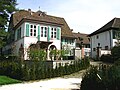 Old Wenkenhof
 -
 New Wenkenhof
 -
 Beyeler Foundation
 -
 Toy Museum
 -
 Franziskus Church (1950, by Fritz Metzger)


Politics
[edit]In the 2007 federal election the most popular party was the SP which received 24.29% of the vote. The next three most popular parties were the SVP (21.11%), the LPS Party (14.32%) and the FDP (13.19%). In the federal election, a total of 8,209 votes were cast, and the voter turnout was 58.6%.[12]
Economy
[edit]As of 2010[update], Riehen had an unemployment rate of 2.1%. As of 2008[update], there were 33 people employed in the primary economic sector and about 11 businesses involved in this sector. 552 people were employed in the secondary sector and there were 88 businesses in this sector. 3,392 people were employed in the tertiary sector, with 506 businesses in this sector.[7] There were 8,930 residents of the municipality who were employed in some capacity, of which females made up 45.2% of the workforce.
In 2008[update] the total number of full-time equivalent jobs was 3,120. The number of jobs in the primary sector was 22, of which 15 were in agriculture and 7 were in forestry or lumber production. The number of jobs in the secondary sector was 514 of which 134 or (26.1%) were in manufacturing and 363 (70.6%) were in construction. The number of jobs in the tertiary sector was 2,584. In the tertiary sector; 388 or 15.0% were in wholesale or retail sales or the repair of motor vehicles, 115 or 4.5% were in the movement and storage of goods, 152 or 5.9% were in a hotel or restaurant, 60 or 2.3% were in the information industry, 79 or 3.1% were the insurance or financial industry, 190 or 7.4% were technical professionals or scientists, 366 or 14.2% were in education and 713 or 27.6% were in health care.[13]
In 2000[update], there were 3,207 workers who commuted into the municipality and 6,673 workers who commuted away. The municipality is a net exporter of workers, with about 2.1 workers leaving the municipality for every one entering. About 21.0% of the workforce coming into Riehen are coming from outside Switzerland, while 1.1% of the locals commute out of Switzerland for work.[14] Of the working population, 41.7% used public transportation to get to work, and 31.4% used a private car.[7]
Religion
[edit]
From the 2000 census[update], 4,683 or 23.0% were Roman Catholic, while 7,464 or 36.6% belonged to the Swiss Reformed Church. Of the rest of the population, there were 213 members of an Orthodox church (or about 1.05% of the population), there were 56 individuals (or about 0.27% of the population) who belonged to the Christian Catholic Church, and there were 1,030 individuals (or about 5.06% of the population) who belonged to another Christian church. There were 95 individuals (or about 0.47% of the population) who were Jewish, and 272 (or about 1.34% of the population) who were Islamic. There were 53 individuals who were Buddhist, 48 individuals who were Hindu and 36 individuals who belonged to another church. 5,731 (or about 28.13% of the population) belonged to no church, are agnostic or atheist, and 689 individuals (or about 3.38% of the population) did not answer the question.[8]
Climate
[edit]Riehen has an average of 123.3 days of rain or snow per year and on average receives 763 mm (30.0 in) of precipitation. The wettest month is June during which time Riehen receives an average of 88 mm (3.5 in) of rain or snow. During this month there is precipitation for an average of 11.6 days. The month with the most days of precipitation is May, with an average of 12.7, but with only 86 mm (3.4 in) of rain or snow. The driest month of the year is March with an average of 49 mm (1.9 in) of precipitation over 10.7 days.[15]
Education
[edit]In Riehen about 8,191 or (40.2%) of the population have completed non-mandatory upper secondary education, and 4,205 or (20.6%) have completed additional higher education (either university or a Fachhochschule). Of the 4,205 who completed tertiary schooling, 53.5% were Swiss men, 29.0% were Swiss women, 10.2% were non-Swiss men and 7.3% were non-Swiss women.[8]
As of 2000[update], there were 310 students in Riehen who came from another municipality, while 1,280 residents attended schools outside the municipality.[14]
Riehen is home to the Gemeindebibliothek Riehen (municipal library of Riehen). The library has (as of 2008[update]) 37,413 books or other media, and loaned out 149,733 items in the same year. It was open a total of 310 days with average of 24 hours per week during that year.[16]
Transport
[edit]The municipality has two railway stations, Riehen and Riehen Niederholz, with frequent service to Basel. In addition, the Basel tram network runs through the municipality to the German border.
Notable people
[edit]
- Leonhard Euler (1707–1783), mathematician, grew up in Riehen
- Pauline Fatme (c1831–1855), East African Protestant missionary, buried at Riehen
- Leopold Courvoisier (1873–1955), astronomer, chief observer at the Babelsberg observatory 1905–1938
- Trudy Späth-Schweizer (1908–1990) in 1958 became the first woman to hold a political office in Switzerland
- Albert Scherrer (1908–1986), a racing driver
- Ernst Ehrlich (1921–2007), German-born Swiss Jewish religious philosopher
- Josef Hügi (1930–1995), international footballer, 322 club caps and 34 for Switzerland
- Marcel Kunz (1943–2017), a football goalkeeper
- Rolf M. Zinkernagel (born 1944), Professor of Experimental Immunology at the University of Zurich, awarded the Nobel Prize in Physiology or Medicine in 1996
- Bettina Skrzypczak (born 1962), a Polish composer, won the 2004 Cultural Prize of the City of Riehen
- Gianna Hablützel-Bürki (born 1969), a female épée fencer
- Roger Federer (born 1981), professional tennis player, lived in Riehen until the age of 10.[17]
- Beat Jans (born 1964), member of the federal council since 2023, grew up in Riehen
See also
[edit]References
[edit]- ^ Manz, Ev (July 23, 2010). "Die Wegbereiterin aller Bundesrätinnen". Tages-Anzeiger (in German). Archived from the original on March 31, 2020. Retrieved July 23, 2010.
- ^ a b Riehen in German, French and Italian in the online Historical Dictionary of Switzerland.
- ^ a b Swiss Federal Statistical Office-Land Use Statistics Archived 2009-03-27 at the Wayback Machine 2009 data (in German) accessed March 25, 2010
- ^ Flags of the World.com Archived 2012-10-20 at the Wayback Machine accessed 18-April-2011
- ^ Canton of Basel-Stadt Statistics, MS Excel document – T01.0.01 - Bevölkerungsstand 31 July 2021 numbers (in German) accessed 21 September 2021
- ^ a b Swiss Federal Statistical Office - Superweb database - Gemeinde Statistics 1981-2008 Archived June 28, 2010, at the Wayback Machine (in German) accessed June 19, 2010
- ^ a b c d e f Swiss Federal Statistical Office Archived January 5, 2016, at the Wayback Machine accessed 18-April-2011
- ^ a b c d e f STAT-TAB Datenwürfel für Thema 40.3 - 2000 Archived August 9, 2013, at the Wayback Machine (in German) accessed February 2, 2011
- ^ a b Federal Statistical Office STAT-TAB - Datenwürfel für Thema 09.2 - Gebäude und Wohnungen Archived January 21, 2015, at the Wayback Machine (in German) accessed January 28, 2011
- ^ Swiss Federal Statistical Office STAT-TAB Bevölkerungsentwicklung nach Region, 1850-2000 Archived September 30, 2014, at the Wayback Machine (in German) accessed January 29, 2011
- ^ "Kantonsliste A-Objekte:Basel-Stadt" (PDF). KGS Inventar (in German). Federal Office of Civil Protection. 2009. Archived from the original (PDF) on September 28, 2011. Retrieved July 12, 2010.
- ^ Swiss Federal Statistical Office, Nationalratswahlen 2007: Stärke der Parteien und Wahlbeteiligung, nach Gemeinden/Bezirk/Canton Archived May 14, 2015, at the Wayback Machine (in German) accessed May 28, 2010
- ^ Swiss Federal Statistical Office STAT-TAB Betriebszählung: Arbeitsstätten nach Gemeinde und NOGA 2008 (Abschnitte), Sektoren 1-3 Archived December 25, 2014, at the Wayback Machine (in German) accessed January 28, 2011
- ^ a b Swiss Federal Statistical Office - Statweb (in German) accessed June 24, 2010
- ^ "Temperature and Precipitation Average Values-Table, 1961-1990" (in German, French, and Italian). Federal Office of Meteorology and Climatology - MeteoSwiss. Archived from the original on June 27, 2009. Retrieved May 8, 2009., the Riehen weather station elevation is 260 meters above sea level.
- ^ Swiss Federal Statistical Office, list of libraries Archived July 6, 2015, at the Wayback Machine (in German) accessed May 14, 2010
- ^ "Wem "gehört" Roger Federer?". bz Basel (in Swiss High German). August 2, 2016. Archived from the original on January 15, 2019. Retrieved January 14, 2019.
External links
[edit] Media related to Riehen at Wikimedia Commons

| International | |
|---|---|
| National | |
| Geographic | |
| Other | |

Riehen
View on GrokipediaGeography and Location
Physical Features
Riehen spans an area of 10.87 km², primarily consisting of gently undulating terrain along the Rhine Valley.[8] The municipality occupies the right bank of the Rhine River, which demarcates its eastern boundary with Germany and lies at an elevation of approximately 260 m above sea level near the river.[9] Elevations rise gradually southward from the floodplain, reaching averages around 278–283 m in central areas and extending into foothills up to several hundred meters.[10] [11] The landscape features a mix of alluvial plains, meadows, and forested hills, with the Wiese River contributing to wetland and riparian zones in the southern portion.[12] Notable natural elements include the Wiese Landscape Park, encompassing expansive grasslands, orchards, ditches, and forests that support diverse flora and fauna.[13] This park, spanning about 600 hectares across borders, highlights the region's emphasis on preserved open spaces amid proximity to urban Basel.[14] The underlying geology reflects the Upper Rhine Graben's sedimentary deposits, fostering fertile soils suitable for agriculture and green areas.[15]Border and Tripoint Significance
Riehen's eastern boundary forms part of the Switzerland-Germany border, delineated by the Rhine River for approximately 5 kilometers, connecting to the neighboring German municipalities of Lörrach and Weil am Rhein. This fluvial demarcation originated from medieval territorial divisions but was precisely defined through 19th-century treaties following the Congress of Vienna in 1815, with further adjustments via the 1818 Baden-Switzerland treaty and subsequent Rhine corrections to mitigate flooding and enhance navigation. The Rhine's regulated course, initiated in 1826 and continuing into the 20th century, shifted minor border segments while preserving the river's thalweg as the primary line, underscoring the border's role in regional hydrology and transport infrastructure.[16][17] Historically, the border's permeability has enabled robust cross-border exchanges but also illicit activities amid economic gradients. Post-World War II, disparities in pricing—Swiss goods like coffee, chocolate, and tobacco commanding premiums abroad—fueled smuggling operations across the Rhine, often via small boats or hidden paths, sustaining local economies strained by rationing in Germany until the 1950s. During the Nazi period from 1933 to 1945, the Riehen-Lörrach tram line facilitated covert transport of anti-regime leaflets and intelligence into Germany, exemplifying the border's utility for resistance networks despite Swiss neutrality and tightened controls. Refugee crossings, particularly Jewish attempts to flee persecution, peaked here in 1938–1939, though Swiss policies restricted entries, with many turned back at checkpoints.[18][19] Riehen's adjacency to the Dreiländereck tripoint—located about 4 kilometers south where Switzerland, Germany, and France converge at the Rhine—amplifies its geopolitical weight within the Basel trinational agglomeration. This proximity fosters cooperative frameworks like the Triregio initiative and the 3Land cross-border urban project, launched in 2011, which integrate Riehen with German and French counterparts for shared infrastructure, environmental management, and economic development spanning the three nations. Switzerland's integration into the Schengen Area on December 12, 2008, eliminated routine border checks, boosting daily commuting—over 60,000 cross-border workers in the Basel region—and reinforcing Riehen's status as an affluent commuter enclave leveraging German-side affordability for housing and services while accessing Swiss wages and amenities.[20][21][22]History
Origins and Medieval Period
Archaeological evidence indicates human presence in the Riehen area during the Neolithic period, though specific settlements remain sparsely documented.[23] Roman occupation occurred from the 1st to 3rd centuries AD, with settlements established across the municipality and a Gallo-Roman temple uncovered in 1921 at the Pfaffenloh locality, featuring a small cella measuring 4 by 4.60 meters within a nearly square structure.[5][24] Place-name etymology suggests origins of the settlement in the 7th century or earlier, linked to Frankish and Alemannic colonization, potentially evidenced by the dedication of the local church to St. Martin, indicative of Merovingian-era foundations over 1,300 years old.[25] The earliest written reference to Riehen dates to April 7, 1113, in a donation charter by the noble Walcho von Waldeck and his wife Mathilde to the St. Blasien monastery, encompassing goods and lands within the village area; this act aligned with 12th-century practices of aristocratic endowments to monasteries for spiritual salvation.[25] A manor at Wenken, part of Riehen, appears in records as early as 751, held by the St. Gallen monastery.[5] The village church, central to early medieval Riehen, originated possibly in the first millennium with a wooden precursor surrounded by palisades and a moat; a stone Romanesque structure emerged by the early 11th century, incorporating a main choir and northern semi-circular side apse, with remnants preserved in the present north wall.[26] Fortifications developed progressively, including an 11th-century ring wall of 1.1-meter-thick limestone and sandstone, partially infilling the moat, and 12th-century storehouses integrated into the inner defenses, some later repurposed as the "Klösterli."[26] By the 12th century, this evolved into a fortified church complex serving as the communal hub amid consolidating settlements.[23] Riehen's medieval lordship shifted frequently among nobles and monasteries until August 17, 1270, when knight Dietrich Snewlin of Freiburg exchanged his jurisdictional rights (Twing und Bann) and properties in Riehen—along with holdings in Hölstein, Inzlingen, and Weil—for the Bishop of Basel's estates in Breisgau and 128 marks of silver, placing the village under episcopal control.[27] The bishop appointed a Vogt for administration but often pledged the territory to creditors, exemplifying feudal fragmentation.[27] Church expansions in the 13th and 14th centuries added a broader nave, polygonal choir, and tower in place of the northern transept.[26] The area suffered plunder and arson from 1444 to 1446 amid the Battle of St. Jakob an der Birs conflicts.Early Modern Era to 19th Century
In 1522, the city of Basel purchased the village of Riehen, integrating it into its territorial holdings and shifting control from episcopal oversight to urban patrician influence.[5] [2] This acquisition was followed by the adoption of the Reformation in Riehen by 1528, aligning the municipality with Basel's Protestant orientation and leading to the secularization of local religious institutions.[28] Governance thereafter occurred under a bailiff appointed by Basel, with Riehen forming part of a rural district where residents remained subject to urban authority, including serf-like obligations until their abolition in 1798.[29] [30] From the 1540s onward, affluent Basel patrician families increasingly acquired land in Riehen, establishing country estates that served as summer residences and agricultural holdings, transforming the area's landscape with stately homes and parks.[5] [2] The economy centered on agriculture and milling, with improved productivity noted from the mid-16th century amid population recovery and expanded arable output.[31] A notable example is Johann Rudolf Wettstein, Basel's mayor and former bailiff of Riehen from 1626 to 1635, who owned local estates and played a pivotal role in negotiating Switzerland's de facto independence via the 1648 Peace of Westphalia.[5] Community infrastructure advanced with the construction of the first parish hall in 1609.[5] [28] The 19th century brought administrative reconfiguration through the 1833 cantonal split, assigning Riehen to the newly formed half-canton of Basel-Stadt while severing ties with Basel-Landschaft.[5] [28] The municipality retained its agrarian character dominated by patrician estates, though enhanced connectivity arrived with the Wiesentalbahn railway's opening in 1862, facilitating trade and passenger links to the Upper Rhine region.[5] [28] Population stability and limited industrialization preserved Riehen's role as a bucolic extension of Basel's elite retreats into the late 1800s.[2]20th Century Developments and Post-War Growth
In the early 20th century, Riehen transitioned from a predominantly agricultural village to a more connected suburb of Basel, marked by the opening of the tramline to Basel in 1908, which improved transport and spurred initial population growth. The construction of the Burgschulhaus school in 1911 accommodated rising student numbers, reflecting expanding residential development. During the interwar period, initiatives like the Heimstättengenossenschaft Gartenfreund housing cooperative in 1923 built 54 homes, while the Zentralfriedhof am Hörnli cemetery opened in 1932 on 48 hectares to serve the growing community. Switzerland's neutrality during World War II isolated Riehen due to its tripoint location, with the border crossing at Weilstrasse symbolizing the war's end on May 8, 1945.[32] Post-World War II growth accelerated as Riehen evolved into a residential municipality, with the consecration of St. Franziskus Church in 1950 catering to a rising Catholic population that reached 30% by 1970. Infrastructure expanded with the new Gemeindehaus municipal building in 1961, supporting administrative needs amid suburbanization driven by Basel's economic boom. Politically, Riehen pioneered women's suffrage in its citizens' commune in 1958, electing Trudy Späth-Schweizer as the first female officeholder in Switzerland, years before national enfranchisement. Efforts to preserve green spaces, such as the 1982 referendum protecting the Bäumlihof area at a cost exceeding 5 million CHF, balanced development with environmental concerns.[32][5][33] Late-century innovations included geothermal energy projects, with drilling starting in 1988 to 1,547 meters depth and Switzerland's first geothermal heating network commissioned in 1994. The cultural landscape transformed with the 1997 opening of the Fondation Beyeler, designed by Renzo Piano to house Ernst and Hildy Beyeler's art collection, drawing international visitors and elevating Riehen's status. Events like Christo and Jeanne-Claude's "Wrapped Trees" installation in 1998 further highlighted the area, attracting thousands and underscoring post-war economic and cultural vitality that grew the population to over 20,000 by 2000.[32][34]Demographics
Population Composition and Trends
As of 31 December 2024, Riehen's permanent resident population stood at 22,534, reflecting steady growth driven primarily by net migration.[35] The municipality recorded an average annual population increase of 0.94% between 2020 and 2024, with the total rising from approximately 21,705 in 2020.[35] Historical data indicate expansion from 20,611 residents around 2000 to the current figure, a cumulative growth of about 9.3% over two decades, consistent with suburban development near Basel and cross-border commuter influences.[35] The population composition features a gender imbalance favoring females at 52.6%, with males comprising 47.4%.[4] Foreign nationals account for 29.0% of residents, up from 18.3% in 2008, reflecting broader regional trends in international mobility near the Swiss-French-German tripoint.[4] The average age is 45.7 years, indicative of an aging demographic structure.[4] Age distribution underscores this maturation: approximately 19.6% (4,411 individuals) are aged 0-17, 55.0% are in the working-age group of 18-64, and 25.4% (5,725 individuals) are 65 or older as of 2024 estimates.[35] The old-age dependency ratio reached 47.5 in 2023, meaning 47.5 persons aged 65+ per 100 in the 20-64 cohort, higher than national averages and signaling potential pressures on local services amid low natural increase.[36] Over 30% of the population exceeds 60 years, with growth concentrated in senior cohorts due to longer life expectancies and inward migration of retirees.[37]Socioeconomic Indicators
Riehen residents exhibit high income levels relative to Swiss averages, with the municipality's mean taxable income recorded at 113,079 Swiss francs, ranking in the 92nd percentile nationwide.[38] This figure surpasses the Basel-Stadt cantonal average of 73,400 francs in 2020 and underscores Riehen's status as an affluent commuter locale adjacent to Basel's pharmaceutical and financial sectors.[39] Employment participation is robust, at approximately 80.8% of the working-age population, based on federal structural surveys aggregated with neighboring Bettingen to ensure statistical reliability.[40] Unemployment stands low at 2.5%, drawn from the same 2010–2014 period data, reflecting limited labor market disruptions in this high-skill, border-proximate economy.[40] Cantonal trends in Basel-Stadt, hovering around 4% in 2024, align with broader Swiss stability but highlight Riehen's relative resilience amid periodic upticks.[41] Educational attainment exceeds cantonal norms, with sampled data indicating over 57% of residents holding gymnasium-equivalent qualifications, indicative of a professional demographic drawn to knowledge-intensive industries.[40] Mean net wealth further bolsters socioeconomic security, averaging 670,000 francs per household—well above national medians—and contributes to low reliance on social assistance, though local services have noted rising case complexity since 2016 amid isolated vulnerabilities.[42][43]| Indicator | Value | Year/Period | Source |
|---|---|---|---|
| Mean Income | 113,079 CHF | Recent tax data | Immofacts (federal tax stats)[38] |
| Unemployment Rate | 2.5% | 2010–2014 | Basel-Stadt data portal (SECO/BFS)[40] |
| Employment Rate | 80.8% | 2010–2014 | Basel-Stadt data portal (BFS)[40] |
| Gymnasium Attainment | >57% | Sampled | Basel-Stadt data portal[40] |
Government and Politics
Municipal Governance Structure
Riehen's municipal governance operates within the framework of the canton of Basel-Stadt, featuring a bicameral structure with a legislative assembly and an executive council, as is standard for the canton's rural municipalities distinct from urban Basel.[44] The legislative body, known as the Einwohnerrat, serves as the communal parliament with 40 members elected every four years via proportional representation to deliberate and approve ordinances, budgets, and key policies.[45] Sessions occur in the Gemeindehaus at Wettsteinstrasse 1.[46] The executive branch, the Gemeinderat, consists of seven members who manage daily administration, implement decisions, and oversee departments such as education, infrastructure, and social services.[47] It includes the Gemeindepräsident (municipal president), who chairs the council and represents the municipality externally, alongside six councilors elected for four-year terms.[47] The Gemeinderat coordinates with the cantonal government on shared competencies like policing and taxation while retaining local autonomy in areas such as zoning and community facilities.[1] Supporting the political bodies is the Gemeindeverwaltung, the professional administration employing approximately 700 staff across seven departments, including education (with 26 classes), public works, and cultural services.[48] Led by Director Dr. Jens van der Meer since at least 2023, it handles operational execution under the Gemeinderat's direction, ensuring compliance with cantonal laws while addressing Riehen-specific needs like border management and green space preservation.[48] Elections for both the Einwohnerrat and Gemeinderat occur concurrently every four years, with the most recent held on October 19, 2025, emphasizing proportional outcomes reflective of voter preferences across parties.[49]Electoral History and Political Dynamics
Riehen exhibits a center-right political orientation, with bourgeois parties—encompassing the Swiss People's Party (SVP), FDP.The Liberals, Liberal Democratic Party (LDP), Evangelical People's Party (EVP), and The Center—consistently dominating local elections, reflecting the municipality's affluent, suburban character in contrast to the left-leaning urban core of Basel.[49] In federal elections, the SVP emerged as the strongest party in Riehen during the 2023 National Council vote, securing 22.6% of the vote share, ahead of the Social Democratic Party (SP) at 19.71%.[50] This aligns with a broader pattern of conservative voter preferences in peripheral Basel-Stadt municipalities, where turnout and support for immigration restriction and fiscal conservatism tend higher than canton-wide averages.[51] The 40-seat Einwohnerrat (municipal council) is elected every four years via proportional representation. Prior to the 2025 renewal, bourgeois factions held a majority, with the SP at 11 seats, SVP at 7, LDP at 6, FDP and EVP at 5 each, and smaller shares for GLP (2), The Center (3), Greens (1), and Basta (1).[52] In the October 19, 2025, elections, the SP lost three seats to reach 8, while the Greens/Basta and GLP each gained one to hold 3 seats apiece; the SVP retained 7 seats despite vote gains, maintaining bourgeois control at approximately 26 seats overall.[53] [54] The seven-member Gemeinderat (executive council), led by the Gemeindepräsidentin, operates collegially. In the 2025 first round, EVP's Christine Kaufmann was re-elected president with 83.77% (4,128 votes), surpassing the absolute majority threshold of 2,609; four incumbents—Patrick Huber (The Center), Daniel Hettich (LDP), Silvia Schweizer (FDP), and Stefan Suter (SVP)—also secured re-election with votes exceeding the 2,819 majority requirement.[53] SVP's Felix Wehrli narrowly missed with 2,708 votes, prompting a November 30 runoff backed by a Bürgerliche Allianz of SVP, LDP, FDP, and EVP, underscoring coalition dynamics to preserve center-right governance amid challenges like infrastructure and border management.[55] Cantonal trends reinforce this, with Riehen showing a rightward shift in the 2024 Grand Council elections relative to Basel city.[51]Policy Priorities and Voter Initiatives
Riehen's municipal policy priorities emphasize preserving its identity as a "large green village" with high living quality, focusing on sustainable finances, environmental protection, and balanced infrastructure development. The Gemeinderat's legislative goals, adopted in October 2022, prioritize Riehen as an attractive residential location through measures like safeguarding green spaces and promoting fiscal prudence to avoid debt accumulation. Key focus areas include finances and real estate management to ensure long-term stability; health and social services for vulnerable residents; education and family support via local schools and childcare; culture, leisure, and sports to enhance community life; spatial planning and infrastructure to integrate transport without urbanizing the landscape; and operational services like waste management.[56][57] The Politikplan for 2023–2026 outlines strategic objectives under the transitioning New Steering Model (NSR), effective from January 2024, which decentralizes decision-making while maintaining oversight on core issues like climate adaptation and local mobility. Environmental priorities feature prominently, with commitments to geothermal energy expansion—Riehen pioneered Switzerland's first such plant in 1994—and opposition to landscape-altering projects, such as the 2022-formed committee against double-tracking the Wiesentalbahn to protect the village aesthetic. Fiscal conservatism drives efforts to stabilize communal budgets amid rising costs, reflected in parties' 2025 election platforms: the Bürgerliche Allianz (FDP, LDP, Die Mitte, SVP) advocates pragmatic governance and autonomy from Basel-Stadt's policies, while left-leaning groups like SP, EVP, and Grüne push for inclusive social spending without cuts to education or family programs.[58][5][59] Voter initiatives and direct democracy play a central role, with Riehen's eight-party Einwohnerrat fostering high participation rates in communal, cantonal, and federal votes. Local referendums often address land use and infrastructure; for instance, residents have historically engaged in preserving historical sites and green belts against development pressures. While specific communal Wählerinitiativen are infrequent due to the small scale, participation in broader abstimmungen remains robust, as seen in the 61.9% turnout for the 2010 federal Ausschaffungsinitiative, where 51.9% voted against. Recent electoral dynamics, including the October 19, 2025, renewal of the Gemeinderat and Einwohnerrat, highlight divides: the GLP gained seats emphasizing green-liberal balance, amid competition between the dominant Bürgerliche Allianz and progressive lists prioritizing climate ambition and social equity.[60][61][62]Economy
Economic Structure and Key Sectors
Riehen functions primarily as a residential commuter municipality within the Basel-Stadt canton, with its economy oriented toward supporting high living standards rather than large-scale commercial or industrial activity. Local employment is limited relative to the working-age population, as many residents commute to Basel for jobs in the canton's dominant sectors, including life sciences and finance. The municipality's economic policy emphasizes vitality through small-scale, community-oriented businesses that provide essential goods and services without encroaching on residential quality.[63][64] Key sectors include trades and small production (Gewerbe), such as construction, alongside services in health, education, and life sciences. Retail and gastronomy are concentrated in village centers to ensure basic supply security, while cultural institutions like the Fondation Beyeler drive limited tourism-related activity. These areas are promoted to foster local jobs and economic diversity, though commercial spaces remain scarce, leading to criticism of insufficient business development proportional to population size.[63][65] Challenges persist due to competition from Basel and neighboring regions for retail and services, prompting policies for targeted area development and optimized conditions for existing enterprises. The 2022 Economic Development Plan (Wirtschaftsleitbild) prioritizes future-oriented employment in compatible sectors, leveraging Riehen's strengths in residential appeal and cultural assets to sustain modest growth.[63][66]Employment and Income Levels
Riehen maintains high employment participation rates, with a significant portion of its working-age population engaged in gainful employment, primarily in commuting roles to the nearby Basel economic center. As of recent Swiss Federal Statistical Office data, the municipality's structure reflects low unemployment, estimated at approximately 2.1%, lower than the cantonal average for Basel-Stadt, which reached 3.8% in July 2024.[67][68] This resilience stems from proximity to Basel's robust job market in pharmaceuticals, chemicals, and finance, where many Riehen residents find employment despite limited local industrial bases.[69] Income levels in Riehen are among the highest in Switzerland, underscoring its status as an affluent residential enclave. In 2020, the average taxable income per taxpayer was CHF 111,033, exceeding the national median gross monthly salary of around CHF 6,788 by a substantial margin and reflecting the high-value sectors dominating regional employment.[70][71] For Basel-Stadt overall, the median annual wage was CHF 79,322 based on 2023 data, but Riehen's figures benefit from its demographic of professionals and executives, contributing disproportionately to cantonal income tax revenue at CHF 179 million in recent years.[72][73] These elevated incomes support a high quality of life, though they align with Switzerland's overall high cost of living, where disposable household income nationally averaged CHF 6,902 monthly in 2022.[74]Infrastructure and Services
Transportation Networks
Riehen's transportation networks integrate closely with the Basel metropolitan area, prioritizing efficient public transport through the Basler Verkehrs-Betriebe (BVB) and Tarifverbund Nordwestschweiz (TNW). The system features a dense array of trams, buses, and regional trains, facilitating connectivity to Basel, neighboring cantons, and Germany. Tram line 6 operates from Allschwil Dorf through central Basel to Riehen Grenze, with frequent services stopping at Riehen Dorf and other local points, enabling quick access to key districts.[75][76] Bus services complement trams, including line 34 running every 15 minutes from Riehen Mühlestieg to Basel Wettsteinplatz, alongside lines 35 and 45 for intra-municipal routes. Evening and off-peak mobility is supported by Ruftaxi, a free door-to-door call service available from 20:00 daily and from 09:00 on Sundays/holidays when regular buses are reduced, bookable via phone from designated points like Riehen Dorf. The TNW night network provides extended coverage on weekends into early morning. Riehen railway station offers Regio S-Bahn connections on the Basel-Rheinfelden line, linking to Basel SBB and regional stops.[77][78][79] Road infrastructure includes an extensive network of local and cantonal roads, such as Hauptstrasse, providing direct links to Basel city center and border crossings to Germany via routes like Grenzacherstrasse. Emphasis is placed on sustainable options, with well-developed pedestrian paths and cycling networks to balance traffic, residential quality, and environmental concerns, limiting new road constructions in favor of multimodal access.[80]Education System
The compulsory education system in Riehen aligns with the Canton of Basel-Stadt framework, comprising 11 years from age 4 to 15, divided into two years of kindergarten, six years of primary school, and three years of secondary school.[81][82] Public schools are tuition-free and managed locally by the Gemeindeschulen Bettingen und Riehen authority, which oversees kindergarten and primary education across multiple sites in the municipality.[83][84] Kindergarten emphasizes play-based learning and runs Monday to Friday from 8:00 to 12:00, with one optional afternoon session from 14:00 to 16:00; it integrates children from age 4, with German language support available for non-native speakers prior to entry.[82] Primary school follows, covering ages 6 to 12 with instruction from 8:00 to 12:15 daily, plus 1 to 3 afternoon sessions weekly until 15:45 or 16:30; the curriculum includes core subjects like mathematics, languages (German, French from third year, English from fifth), sciences, and arts, with placement allocated based on residential proximity.[82] Key primary school locations in Riehen include Primarschule Niederholz, Primarschule Wasserstelzen, Primarschule Erlensträsschen, and Primarschule Burgstrasse, serving over 2,000 children across the Gemeindeschulen network that includes 26 kindergartens and six primary sites shared with neighboring Bettingen.[83][84] Secondary education, also compulsory, divides students into three performance tracks (A for advanced, E for standard, P for basic) based on primary grades, focusing on preparation for vocational apprenticeships or upper secondary qualifications; Riehen students typically attend nearby public institutions such as Sekundarschule Bäumlihof, located on the Basel-Riehen border, or Sekundarschule Drei Linden adjacent to the municipality.[85][86][87] Day-care options, or Tagesstrukturen, supplement school hours at all levels to support working parents.[83] Private alternatives exist, such as PRISMA Schulen in Riehen, a non-profit offering kindergarten through secondary under cantonal oversight, emphasizing individualized learning.[88] Post-compulsory options include vocational training or gymnasiums leading to university, with proximity to the University of Basel facilitating higher education access for residents.[82]Public Services and Utilities
Electricity, gas, and water supplies in Riehen are provided by the Industrielle Werke Basel (IWB), a regional utility company serving the Basel area.[89] District heating is managed separately by the Wärmeverbund Riehen AG, which draws from a geothermal aquifer supplying approximately 25 kg/s of water at 65°C to support the local heating network.[89][90] Waste management is handled municipally through the Werkdienste department, with Riehen and neighboring Bettingen pioneering free collection of kitchen waste integrated with green waste removal as the first municipalities in northwest Switzerland to implement this system.[91] Special waste disposal occurs at designated facilities, emphasizing separation to prevent chemical reactions and ensure safe storage.[92] Public safety services include a local police post at Erlensträsschen 2, accessible via the cantonal emergency number 117 for police matters.[93] Fire services are coordinated canton-wide through the 118 emergency line, while medical emergencies use 144, with additional support from the Spitex notfall service at 061 261 15 15 for out-of-hours care.[94][95] Social services are administered locally under the Sozialdienste Riehen framework, addressing community welfare needs.[96]Culture and Heritage
Architectural and Historical Sites
Riehen's architectural landscape features a mix of medieval fortifications, Renaissance-era structures, and modern designs, with several sites recognized for their national historical significance. The historic center is characterized by densely developed buildings, including houses from the Renaissance and Baroque periods surrounding the medieval fortified church complex.[2] The Dorfkirche St. Martin, located at Baselstrasse, serves as the village's central landmark with origins tracing to the early Middle Ages, suggested by its patron saint Martin under Frankish influence. The church complex includes defensive elements typical of medieval ecclesiastical architecture in the region.[97] The Wenkenhof complex comprises the Old Wenkenhof, first documented in 751 as a manorial estate during the Carolingian era, and the New Wenkenhof, a later villa reflecting bourgeois residential development. These structures highlight Riehen's evolution from agrarian roots to a suburban extension of Basel's patrician influence after the municipality's acquisition by the city in 1522.[98][99] The Fondation Beyeler, opened in 1997, exemplifies contemporary architecture through Renzo Piano's design, featuring red porphyry walls, a cantilevered glass roof for diffused natural light, and integration with surrounding parkland to harmonize art, nature, and built form.[100][101] The St. Franziskus Church, consecrated on June 25, 1950, represents post-war modernism as a pioneering work by architect Fritz Metzger, constructed in just two years with innovative spatial and material elements.[102][103] The MUKS Museum Kultur & Spiel, housed in the 17th-century Alte Wettsteinhaus, preserves Riehen's village heritage alongside toy collections, offering insight into local craftsmanship and domestic history.[104]Cultural Institutions and Museums
The Fondation Beyeler, located in Riehen, serves as a premier museum for modern and contemporary art, emphasizing encounters between visitors, artworks, nature, and architecture. Established by art collectors Ernst and Hildy Beyeler, the foundation was formally created in 1982 to preserve and exhibit their private collection, which includes masterpieces by artists such as Pablo Picasso, Claude Monet, Wassily Kandinsky, and Mark Rothko. The museum building, designed by Italian architect Renzo Piano, opened to the public on May 3, 1997, in a former private park featuring venerable trees that integrate with the structure's minimalist design. Annual exhibitions draw international visitors, with the permanent collection showcasing over 200 works acquired through strategic purchases and donations.[105][106][101] Riehen's other notable cultural institution is the MUKS – Museum Kultur & Spiel, a hands-on family-oriented museum housed in the 17th-century Alte Wettsteinhaus in the historic village center. Originally known as the Spielzeugmuseum, Dorf- und Rebbaumuseum, it focuses on human culture through interactive exhibits on play, village history, and local traditions, including collections of dolls, model railways, wooden toys, and vintage building sets. Visitors are encouraged to engage directly with displays, such as handling artifacts or participating in play activities, to explore themes like childhood technology and regional heritage. Permanent sections on "Spiel" (play) and "Dorf" (village) complement rotating special exhibitions, fostering educational experiences for all ages.[104][107][108] Beyond these museums, Riehen supports a network of cultural associations dedicated to music, literature, and theater, with municipal backing for events that enrich community life, though no dedicated large-scale theaters or performing arts venues are prominently established within the municipality.[109]Symbols and Identity Markers
The coat of arms of Riehen features a blue field with six silver bricks arranged in a stepped pyramid formation—one at the top, two in the middle row, and three at the base—with the bricks' proportions adhering to the golden ratio for their sides. This standardized design was officially adopted on March 31, 1948, via a decree from the cantonal government of Basel-Stadt, following proposals from the municipal council to refine earlier variations for heraldic accuracy.[110][111] Historically, the emblem derives from the arms of the medieval noble family von Riehen, first documented in 1392, which depicted a castle silhouette or fortified wall possibly representing local topography or the Riehener Bann jurisdiction. By 1530, it appeared in Conrad Schnitt's armorial as the community's symbol, with blue and white tinctures inherited from the associated Üsenberg-Waldeck family; an early communal use is recorded in the 1531 Kirchengutsrechnung. Evolving depictions in 16th-century sources, such as Christian Wurstisen's chronicle from 1580, showed a tapering wall form before the 1948 clarification.[112][113] The municipal flag mirrors the coat of arms, displaying the six silver bricks on an azure field, used in official capacities to represent Riehen's identity.[114] Riehen promotes itself with the descriptor "das Grosse Grüne Dorf mit hoher Wohnqualität," highlighting its preservation as a large green village amid urban proximity, with emphasis on maintaining rural character as expressed in local sentiments like "Riehen soll ein Dorf bleiben." This underscores a communal identity tied to green spaces, historical autonomy, and high living standards rather than urban development.[96][112]Religion and Society
Religious Composition
In 1529, Riehen officially adopted the Reformation, establishing the Evangelisch-reformierte Kirche as the dominant faith, with over 96% of the population affiliated by 1811.[115] Roman Catholicism re-emerged as a minority presence in the early 19th century, growing from 1.2% in 1811 to a peak of 30.1% in 1970 amid industrialization and immigration, before stabilizing and declining.[115] As of 2022, the Evangelisch-reformierte Kirchgemeinde Riehen-Bettingen, serving Riehen (population approximately 21,500) and adjacent Bettingen (1,500), reported 4,195 members, representing about 19% of the combined population and reflecting a decline from 5,768 in 2013.[116] The Römisch-katholische Pfarrei St. Franziskus, also spanning both municipalities, had 2,996 members in 2020, down from 3,756 in Riehen alone in 2009.[117] [115] Detailed 2009 data for Riehen indicate a shift toward non-affiliation, with unaffiliated, lapsed, or unspecified individuals comprising roughly 46% of residents amid national trends of secularization driven by urbanization and generational change.[115]| Religious Group (2009) | Percentage | Members (out of 20,588) |
|---|---|---|
| Evangelisch-reformiert | 28.16% | 5,797 |
| Römisch-katholisch | 18.24% | 3,756 |
| Unaffiliated/None | 14.98% | 3,085 |
| Islam | 2.65% | 545 |
| Evangelical Free Churches | 0.70% | 145 |
| Buddhism | 0.35% | 72 |
| Judaism | 0.14% | 29 |