Hubbry Logo
AllianzAllianzMain
Open search
Allianz
Community hub
Allianz
logo
8 pages, 0 posts
0 subscribers
Be the first to start a discussion here.
Contribute something
Allianz
Allianz
from Wikipedia

Allianz SE (/ˈæliənts/ AL-ee-ənts, German: [aˈli̯ants] ) is a German multinational financial services company headquartered in Munich, Germany. Its core businesses are insurance and asset management.

Key Information

Allianz is the world's largest insurance company and the largest financial services company in Europe.[2] In 2023, the company was ranked 37th in the Forbes Global 2000.[3] Also it is a component of the Euro Stoxx 50 stock market index.[4]

Its asset management division, which consists of PIMCO and Allianz Global Investors, has €2,432 billion of assets under management (AUM), of which €1,775 billion are third-party assets (Q1 2021).[5]

Allianz sold Dresdner Bank to Commerzbank in November 2008.[6] Allianz was a major supporter of the Nazi movement[7] and was an insurer of the Auschwitz concentration camp.

History

[edit]

Foundation

[edit]
Share of the Allianz Versicherungs-AG, issued 5 February 1890
An early Allianz agent's plaque

Allianz AG was founded in Munich in 1889, but started its activities in Berlin on 5 February 1890, by the then-director of the Munich Reinsurance Company Carl von Thieme (a native of Erfurt, whose father was the director of the Thuringia insurance company) and Wilhelm von Finck (co-owner of the Merck Finck & Co. Bank). The joint company was listed in Berlin's trade register[8] under the name Allianz Versicherungs-Aktiengesellschaft.[9] The company was established with a start-up capital of 4 million marks.[10] The first Allianz products were marine and accident policies that were initially sold only in Germany. However, in 1893, Allianz opened its first international branch office in London, distributing marine insurance coverage to German clientele looking for coverage abroad.[10]

In 1900, the company became the first insurer to obtain a license to distribute corporate policies. In 1904, Paul von Naher took over the sole leadership of the company, as it moved into the US and other markets. Markets entered by 1914 included the Netherlands, Italy, Belgium, France, the Scandinavian countries and the Baltic states, and Allianz had become the largest maritime insurer in Germany.[10] The company suffered an early disaster in expansion when the 1906 San Francisco earthquake caused the company to sustain 300,000 marks in losses. In 1905, the company acquired Fides Insurance Company, a firm that had innovated the first form of home invasion insurance.[11] Other places expanded into during the 1910s and 1920s included Palestine, Cyprus, Iraq, China, the Dutch Indies (now Indonesia), Ceylon (now Sri Lanka), and Siam (now Thailand).[12]

20th-century developments

[edit]

In 1905, the company began to offer fire insurance, and in 1911 it began to sell machinery breakdown policies. Allianz remained the only company in the world that sold machine breakdown insurance until 1924. In 1918, it began offering automobile insurance as well through a joint venture called Kraft Versicherungs-AG.[10] In 1921, Von Naher died and was succeeded by Kurt Schmitt. The company would begin to offer life insurance as of 1922, becoming Europe's largest offerer of the policies by the end of the 1920s.

In 1927, Allianz merged with Stuttgarter Verein Versicherung AG, which was then the leading accident and third-party liability insurer.[10] Two years later, it acquired the insurance businesses of Favag, a large German insurer that declared bankruptcy due to the onset of the Great Depression.[13] Expansion of the company then slowed until 1938[14] at which point it employed more than 24,000 people.[15] Christian Stadler wrote of the history of Allianz that it "shows how important it is to diversify into related areas to hedge against the risk of fundamental changes in markets and economies".[16]

Allianz was a major supporter of the Nazi movement, and Hitler's first cabinet included the head of Allianz as a cabinet member. Allianz provided massive financial support at a crucial time for the expansion of the NSDAP. On 30 June 1933, Kurt Schmitt, Allianz Director-General, was appointed Economics Minister for Nazi Germany under Adolf Hitler and became an SS honorary member.[17] He was a supporter of 'Aryanization' and pushing out Jews from public life in Germany. He later received various honours from the SS including the Deaths Head and Iron Cross. From 1933 to 1945, Allianz insured sub-organizations of the NSDAP and opened up new areas of business as the German Reich expanded. Among other things, the customer base was expanded through the takeover of Jewish insurance houses as part of the Aryanization initiative (seizing Jewish businesses to put in non-Jewish hands). Allianz profited directly from deportations. From 1940 onwards, Allianz insured SS armaments factories, prisoners' barracks, material stores and vehicle fleets in concentration camps, including Auschwitz, Buchenwald and Dachau. Allianz employees regularly inspected concentration camps.[18]

During World War II, the Berlin headquarters of Allianz were destroyed by Allied bombing runs.[19] Following the end of the war in 1945, Hans Heß became head of the company, and Allianz shifted its headquarters to Munich in 1949 due to the split between East and West Germany. Heß only held the position until 1948, when he was replaced by Hans Goudefroy. In 1956, Allianz became the first major European Insurance company to install a mainframe computer, taking delivery of a IBM 650 which provided cost savings within three years of delivery.[20][21] After World War II, global business activities were gradually resumed. Allianz opened an office in Paris in 1959 and started repurchasing stakes in former subsidiaries in Italy and Austria. In 1971, Wolfgang Schieren became the head of the company.

These expansions were followed in the 1970s by the establishment of business in the United Kingdom, the Netherlands, Spain, Brazil and the United States. In 1986, Allianz acquired Cornhill Insurance in London, and the purchase of a stake in Riunione Adriatica di Sicurtà (RAS) in Milan, strengthened its presence in western and southern Europe in the 1980s.

In 1990, Allianz started an expansion into eight eastern European countries by establishing a presence in Hungary. In the same decade, Allianz also acquired Fireman's Fund, an insurer in the United States, which was followed by the purchase of Assurances Générales de France. These acquisitions were followed by the expansion into Asia with several joint ventures and acquisitions in China and South Korea and the acquisition of Australia's Manufacturers Mutual Insurance. Around this time, Allianz expanded its asset management business as well by purchasing asset management companies in California.[10]

In 1999, Allianz purchased investment management firm PIMCO for approximately US$3.3 billion.[22]

21st-century developments

[edit]
The original Allianz logo, designed in 1923 by Karl Schulpig
Allianz's current head office is located in Munich.

In April 2001, Allianz agreed to acquire the 80 per cent of Dresdner Bank that it did not already own, for US$20 billion. As part of the transaction, Allianz agreed to sell its 13.5 per cent stake in HypoVereinsbank to Munich Re and to acquire Munich Re's 40 per cent stake in Allianz Leben.[23] Following the completion of the acquisition, Allianz and Dresdner Bank combined their asset management activities by forming Allianz Global Investors. In 2002, Michael Diekmann succeeded Henning Schulte-Noelle as CEO. In June 2006, Allianz announced the layoff of 7,280 employees, about 4 percent of its worldwide workforce at the time, as part of a restructuring program aimed at raising profitability ("Allianz Sustainability P&C and Life"). The reductions comprised 5,000 staff members at Allianz insurance operations and 2,480 at Dresdner Bank. In the same month, Allianz announced that its Dresdner Kleinwort Wasserstein investment banking operation would be renamed as simply Dresdner Kleinwort.[24]

In September 2005, Allianz announced that it would convert its holding company into a societas europaea. The conversion was made in conjunction with Allianz's acquisition of 100 per cent control of its principal Italian subsidiary Riunione Adriatica di Sicurtà for around US$7 billion. The conversion to an SE was completed on 13 October 2006.[25] The Allianz Group also simplified its brand strategy from 2006 and their previous emblem was replaced by the current combination mark.[26] By 2008 the company was Europe's largest insurer.[27]

In 2007, it was a founder member of the Hedge Fund Standards Board, which sets a voluntary code of standards of best practice endorsed by its members.[28]

On 31 August 2008, it was announced that Allianz had agreed to sell 60.2 per cent of Dresdner Bank to Commerzbank for €9.8 billion (US$14.4 billion), with an agreement that Commerzbank would acquire the remainder of Dresdner Bank by the end of 2009.[29] After renegotiations, it was announced in November 2008 that Commerzbank would acquire the 100% ownership of Dresdner Bank earlier (12 January 2009). The sale price was lowered to 5.5 billion Euro. Shortly after the transaction completed, Commerzbank was partially nationalized by the German government to save it from bankruptcy. Allianz currently retains a stake of around 14% in Commerzbank.[30]

Allianz X, founded in 2013 and headed by Nazim Cetin, is Allianz's technology investment fund.[31]

In August 2015, a consortium led by Allianz acquired German motorway service station group Tank & Rast for an undisclosed sum believed to be in the region of €3.5 billion.[32]

In April 2018, TH Real Estate and Allianz partnered to provide £100m in debt finance to developers YardNine, for the development of 80 Fenchurch Street, a 240,000 sq ft office development in London.[33]

In October 2020, Allianz was named the world's top insurance brand by the Interbrand's Best Global Brands Ranking.[34]

On 1 August 2021, Allianz disclosed that the United States Department of Justice had launched a probe into Allianz to determine the role that executives had played in the loss of billions of euros from Allianz Global's Structured Alpha Funds.[35][36] In September 2021, the German Federal Financial Supervisory Authority launched its own probe.[37][38] On September 30, 2021, it was reported that asset management chief Jacqueline Hunt would step down as part of a shake up that followed the investigations into the losses, staying on as a consultant to Bäte.[39]

On 17 May 2022, Allianz SE has agreed to pay $6 billion in the U.S. fraud case due to the collapse of its Structured Alpha funds during the COVID-19 pandemic.[40]

In April 2023, Allianz put its 5% stake in fintech company N26 up for sale, with N26 valued at $3 billion (€2.7 billion). Meanwhile, N26 was valued at $9 billion at its last funding round in October 2021.[41]

In December 2024, Allianz announced to withdraw its offer to acquire at least 51% of Singapore's Income Insurance which cost around $1.63 billion. This offer was initial put forward in July 2024 but later sparked criticism in Singapore as it concerned that  it would detract from the mission of providing an affordable insurance for lower-income workers.[42]

In June 2025, Allianz was included in a UN expert's report of companies supporting Israel's genocide in Gaza.[43][44]

Finances

[edit]
Sales by business (2024)[45]
Region Share
Property/Casualty 70%
Life/Health 22%
Asset Management 8%

As of 2022, Allianz was the world's largest insurance company with US$1.02 trillion in assets according to Forbes. For the fiscal year 2022, Allianz reported earnings of €7.2 billion, with an annual revenue of €152.7 billion, an increase of 2.8% over the previous fiscal cycle.[46]

Year Revenue
in bn. €
Net income
in bn. €
Total assets
in bn. €
Employees
2009 97.4 4.3
2010 106.5 5.2
2011 103.6 5.5
2012 106.4 5.6
2013 110.8 6.0 711.5 147,627
2014 122.3 6.2 805.8 147,425
2015 125.2 6.6 848.9 142,459
2016 122.4 6.9 883.8 140,253
2017 126.1 6.8 901.3 140,553
2018 132.3 7.7 897.6 142,460
2019 142.4 8.3 1,011.1 147,268
2020 140.5 7.1 1,060.0 150,269
2021 148.5 7.1 1,139.0 155,411
2022 152.7 6.9 1,022.0 159,253
2023 161.7 9.0 983.0 157,883
2024 179.8 10.5 1,045.0 156,626

Operations

[edit]

Allianz has operations in over 70 countries and has around 150,000 employees. The parent company, Allianz SE, is headquartered in Munich. Allianz has more than 100 million customers worldwide and its services include property and casualty insurance, life and health insurance and asset management.[19] In 2013, it was number 25 on the global Forbes 2000 list.[47]

Countries served by Allianz as of May 2022

Australia

[edit]

Allianz Australia Insurance Limited was founded 1914 as Manufacturers Mutual Insurance (MMI). Allianz acquired MMI in 1998.[48]

Allianz Australia operates throughout Australia and New Zealand and through its subsidiaries offers a range of insurance and risk management products and services.[49] Subsidiaries of Allianz Australia include Club Marine, Allianz Life, Allianz Partners and Territory Insurance Office (TIO).[50]

In 2012, Allianz Australia became the naming rights sponsor of the former Sydney Football Stadium.[51] In 2022, the deal was renewed for a further six years and a newly rebuilt Allianz Stadium, designed by Cox Architecture, opened its doors in 2022. Allianz is also an ongoing partner of the Australian Olympic Team, Paralympics Team and Football Australia.

Allianz Australia acquired Westpac Banking Corporation's general insurance arm in 2021. They entered an exclusive agreement to distribute general insurance products to the bank's customers for 20 years.[52]

In January 2025, it was announced that Allianz Australia would sell its subsidiary Hunter Premium Funding to Pemba Capital Partners.[53]

Later during that same year on 28 February 2025, Allianz Australia and AWP Australia were fined $16.8m for false and misleading statements by Commonwealth Director of Public Prosecutions after investigation and referral by the Australia Securities & Investments Commission (ASIC).[54]

On 12 June 2025, Allianz Australia received regulatory approval to begin its partnership with the Royal Automobile Association of South Australia Incorporated (RAA), including acquiring RAA's general insurance business and a 20-year exclusive distribution agreement for RAA's Home and Motor insurance lines.[55]

Belgium

[edit]

Belgium, previously AGF Belgium which has been re-branded to Allianz Belgium in November 2007.[56]

In 2012, Allianz Belgium (including Luxembourg) and Allianz Netherlands were integrated to become Allianz Benelux.[57] In August 2020, they announced the selling of its closed classical life insurance retail insurance book with covering assets such as mortgages to Monument Re.[58]

Bulgaria

[edit]
Allianz Bank Bulgaria headquarters in Sofia

Allianz Bank Bulgaria is a universal commercial bank having its headquarters in Sofia. It was established in 1991. On 13 October 2003 the bank received the name of its principal shareholder – Allianz Bulgaria Holding. Before that the bank was named 'Bulgaria Invest' Commercial Bank. Allianz Bank Bulgaria offers its products in more than hundred branches and offices all over the country, as well as through the broad agents' network of Allianz Bulgaria Holding. The bank possesses a full banking license for carrying out banking and financial transactions.[59]

Canada

[edit]

Allianz entered the Canadian market in the early 1990s through an acquisition of several North American insurers, namely the American Firemans Fund[60] and the Canadian Surety.[61] Upon the market exit the personal and commercial lines unit was sold off to the market leader ING Canada (Now Intact), and Allianz Canada continues operations in Cambridge, Ontario. Allianz Canada has also merged with TIC Travel Insurance in 2014 and has become one of the largest insurance companies in Canada as a result.[62][63]

On 18 February 2025, the firm was identified as the lead insurer for the crash of Delta Connection Flight 4819 from Minneapolis which crashed at Toronto Pearson International Airport.[64][65]

China

[edit]

In January 2021, the China Banking and Insurance Regulatory Commission authorized the Allianz group to establish Allianz Insurance Asset Management, owned by Allianz China Iamc and based in Beijing.[66] The next month, Allianz agreed with CITIC Trust the acquisition of the 49% minority stake of Allianz China Life Insurance Co, realizing the "China’s first wholly foreign-owned insurance asset management company".[67][68]

The company announced on 13 January 2025 a collaboration between itself and Fudan University to support research into finance and insurance as well sponsoring Allianz Auditorium.[69]

Colombia

[edit]
Allianz Colombia headquarters in Bogotá

In 1999, Allianz acquired 60% of the shares of Colombian insurer Colseguros. Three years later, in 2002, it increased its shareholding, becoming the sole owner of the company in Colombia. After almost 10 years in 2012 and with an evolutionary change of brand Colseguros was retired as an official name and the entire operation in Colombia was consolidated under the name of Allianz.[70]

Finland

[edit]

In 2017, Allianz alongside Macquarie Group and Valtion Eläkerahasto acquired Elenia taking ownership of Finland's second largest power distribution system operator and ninth largest district heating network.[71]

Germany

[edit]
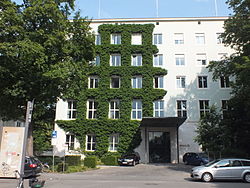
The Allianz complex in Alt-Treptow, Berlin

Allianz offers a wide range of general, life and health insurance products in Germany through its Allianz Deutschland AG subsidiary. It is the market leader in both the general and life insurance markets. Allianz products are distributed principally through a network of full-time tied agents. Since September 2010 Allianz products have also been sold through Commerzbank branches.

On 19 March 2025, it was announced as part of a consortium the purchase of Viridum Group in a €3.5bn deal with BlackRock and T&D Holdings which is a life insurer consolidation platform specialising in the run-off from Cinven with Generali Financial Holdings and Hanover Re remaining as investors.[72]

Greece

[edit]

In Greece Allianz began to work on 2 December 1985. Then was established the first Company's Office in Ampelokipoi, Athens. Now Allianz has almost 500 Offices in Greece and a lot of people buy the products of the company.

In February 2022, it was announced Allianz had acquired 72% of European Reliance for €207 million.[73]

India

[edit]

In India[74] Allianz primarily operates through Bajaj Allianz Life Insurance Company & Bajaj Allianz General Insurance Company Limited, a joint venture between Allianz and Bajaj Finserv Limited. Bajaj Allianz has around 1,200 branches across India and offers services including unit-linked, traditional, health, child and pension policies.[75]

On 19 March 2025, it was agreed that Allianz would exit the joint venture for approximately €2.6bn selling its 26% stake to Bajaj Finserv.[76]

Indonesia

[edit]

Allianz started its operations in Indonesia with a representative office in 1981.[77] In 1989, Allianz established PT Asuransi Allianz Utama Indonesia, a general insurance company.[78] Furthermore, Allianz entered the Indonesian life insurance market by opening PT Asuransi Allianz Life Indonesia in 1996.[79]

Ireland

[edit]

Allianz plc in Ireland employs over 1,700 people. Established in 1902,[80] Allianz plc is active in both the Republic of Ireland and Northern Ireland, providing car, home, pet, boat, and travel products, as well as SME (small to medium enterprise) products including van, business, and schools insurance. Today, Allianz in Ireland insures over half a million customers across the country[81] through its portfolio of personal and commercial insurance products.[82] In 1999, through their acquisition of AGF, Allianz SE acquired AGF Irish Life Holdings plc in Ireland, which at the time owned Insurance Corporation of Ireland and Church and General Insurance.[83] Following their purchase, and despite a minority shareholding by Irish Life, both companies changed their names to Allianz plc, trading simply as Allianz. In 2017, Allianz plc became a wholly owned entity of Allianz SE.

Israel

[edit]

On 9 April 2019, Allianz started cooperation with Cynet,[84] a cybersecurity company in the field of threat detection and response to address security threats and improve its resilience.

Italy

[edit]
The Allianz Tower in Milan

The Allianz Group in Italy is headed by composite insurance company Allianz SpA and it ranks second in terms of premiums written and fifth in terms of assets under management as well as fourth for financial advisors.

The Italian parent company, Allianz SpA, resulted from the integration, in October 2007, of three former insurance companies: RAS ("Riunione Adriatica di Sicurtà", Assurance Adriatic Reunion), established in Trieste in 1838 and based in Milan (part of the Allianz Group since 1987), Lloyd Adriatico, established in 1836 and based in Trieste (part of the Allianz Group since 1995) and Allianz Subalpina, established in 1928 and based in Turin (formerly a subsidiary of RAS).

Kenya

[edit]

On 25 November 2016, Allianz opened a new office in Kenya.[85]

Luxembourg

[edit]

Allianz's subsidiary Allianz Global Partners was fined €283,000 for breaching the country's Anti-Laundering laws. The fine was issued in 2022, Allianz appealed but was upheld by the Administrative Court in February.[86]

Mexico

[edit]

Allianz Mexico started operations in 1987.[87]

Philippines

[edit]

In 2003, Allianz AG began its operation in the Philippines under the joint venture partnership with Pioneer Life Incorporated which lasted for five years.[88]

Allianz returned its operations in the country in 2016 as a subsidiary group with an exclusive distribution partnership with the Philippine National Bank. They are currently operated under the name of Allianz - PNB Life Insurance Incorporated.[89]

Portugal

[edit]

In 2018 Allianz, via Allianz Capital Partners, acquired the largest subsidy-free solar project in Portugal.[90]

Russia

[edit]

Allianz started operations in Russia in 1990, with the following acquisition of one of the largest Russian insurance companies ROSNO. In 2018, after the global acquisition of Euler Hermes, Allianz presence in Russian Federation was extended by its local credit insurance branch – Euler Hermes Russia.[91] In June 2022, in the wake of the Russian invasion of Ukraine Allianz sold a 50.1% stake in its Russian operations to Russian company Interholding LLC, while retaining a 49.9% stake there. This was widely criticized by international activists.[92][93]

Slovakia

[edit]
The headquarters of Allianz – Slovenská poisťovňa in Bratislava

Allianz started its life and Property & Casualty (P&C) operation in Slovakia in 1993. In 2001 Allianz AG bought a majority stake in the state-owned Slovenská poisťovňa (SP, Slovak Insurance Company). Upon the purchase SP held a market share of well over 50%. Upon the purchase the local Allianz operation was merged with SP creating a new company Allianz – Slovenská poisťovňa.[94]

Sri Lanka

[edit]

On 26 March 2025, it was announced that Allianz's life operations in Sri Lanka would be acquired by Softlogic Life Insurance.[95]

Turkey

[edit]
Allianz Tower in Ataşehir, Istanbul[96][97]

The affiliated services of Allianz in Turkey (through Şark Sigorta) started in 1923, while the direct presence of Allianz in the country began in 1988,[98] when the company partnered with Şark Sigorta together with the Tokio Marine insurance company of Japan.[98] In 1991, Şark Hayat Sigorta was founded.[98] In 1998, the two companies changed their names as Koç Allianz Sigorta and Koç Allianz Hayat Sigorta, respectively, and started operating under Allianz Sigorta and Allianz Hayat ve Emeklilik business titles,[98] upon the takeover of Koç Holding's shares by Allianz in 2008.[98] Allianz Group made a new investment in Turkey in 2013 by acquiring Yapı Kredi Sigorta and Yapı Kredi Emeklilik.[98] In October 2013, Yapı Kredi Emeklilik was renamed as Allianz Yaşam ve Emeklilik.[98] In 2014, Allianz Sigorta and Yapı Kredi Sigorta were merged and the insurance operations were combined under the roof of Allianz Sigorta.[98]

In 2015, Allianz Turkey moved its head office to Allianz Tower in the Ataşehir district of Istanbul.[97][96][98][99] Ataşehir is home to the Istanbul Financial Center (IFC), opened in 2023.[100][101][102][103] The Allianz Campus operation center will be opened in İzmir.[98]

United Kingdom

[edit]

Allianz acquired British insurance company Cornhill Insurance plc in 1986, subsequently renamed Allianz Cornhill Insurance plc. This then simply became Allianz Insurance plc in April 2007.[104] Allianz purchased Premierline in 2003, previously owning a 20% stake in the business and then later purchasing the remaining 80% stake in business.[105] Allianz Insurance plc owns Petplan UK, the UK pet insurance provider. It also owns the high-net-worth insurance broker Home and Legacy, which it purchased in 2006.[106] Their IT captive unit in India, ACIS is located at Technopark, Trivandrum, in Kerala.[107] Allianz previously owned Kleinwort Benson, which it inherited when it acquired Dresdner Bank. The investment bank has subsequently been merged with the corporate bank of Dresdner Bank and rebranded as Dresdner Kleinwort.[108]

In 2017, Allianz acquired a stake in the general insurance division of Liverpool Victoria for a deal worth up to £1bn. The deal had its personal lines go to Liverpool Victoria, creating a joint venture between the two firms, with the latter's commercial lines going to Allianz.[109]

In 2019, Allianz paid a total of £800 million to purchase the remaining 51% stake in the general insurance division of Liverpool Victoria ending the joint venture between the firms as well as taking over the whole of the general insurance arm of Legal & General.[110]

The deal has concluded with both general insurance firms now part of the Allianz group of companies starting on 1 January 2020 with the L&G division being officially renamed Fairmead Insurance.[111] Allianz continue to operate as Liverpool Victoria General Insurance under a brand licence agreement with the life and pensions mutual insurer due to end in 2026.[112]

United States

[edit]

Allianz has a presence within the United States, including Allianz Life Insurance Company of North America and Allianz Global Corporate & Specialty (which incorporates Fireman's Fund). Allianz Life Insurance Company of North America, based in suburban Minneapolis, has been ranked among the 100 best companies to work for by Fortune.[113] Allianz's investment arm includes two asset managers, PIMCO and Allianz Global Investors, also referred to as AllianzGI or AGI.[114][115][116]

Senior management

[edit]

The Allianz board of directors is chaired by Oliver Bäte and includes Sergio Balbinot, Sirma Boshnakova, Dr. Barbara Karuth-Zelle, Klaus-Peter Röhler, Ivan de la Sota, Giulio Terzariol, Günther Thallinger, Christopher Townsend, Renate Wagner and Dr. Andreas G. Wimmer.[117]

List of CEOs

[edit]
Years Name
1890–1904 Carl von Thieme
1894–1921 Paul von der Nahmer
1921–1933 Kurt Schmitt
1933–1948 Hans Hess
1948–1961 Hans Goudefroy
1962–1971 Alfred Haase
1971–1991 Wolfgang Schieren
1991–2003 Henning Schulte-Noelle
2003–2015 Michael Diekmann
2015–today Oliver Bäte

Sponsorships

[edit]
The Allianz Arena in Munich, Germany
Allianz Parque in São Paulo, Brazil

Allianz holds naming rights to the Allianz Arena, a football stadium in north Munich. The professional Munich football club Bayern Munich have played their home games at Allianz Arena since the start of the 2005–06 season.[118] TSV 1860 München played their home games at Allianz Arena until the end of the 2016–17 season. Other stadiums associated with Allianz include the Allianz Parque football stadium in São Paulo, Brazil, the Allianz Riviera football stadium in Nice, France, the Allianz Stadium football stadium in Turin, Italy, the Allianz Stadion football stadium in Vienna, Austria and Allianz Field soccer stadium (for Minnesota United in Major League Soccer) in St. Paul, Minnesota, United States.[119]

Allianz had been in negotiations with the New York Jets and the Giants to buy naming rights to the New Meadowlands Stadium (now known as MetLife Stadium) in East Rutherford, New Jersey, but those talks ended in September 2008, due to opposition from Jewish groups and Holocaust survivors.[120]

Allianz owned the Polish football team Górnik Zabrze but sold its shares in the club in April 2011.[121] Allianz has been involved in Formula One since 2000, firstly as a sponsor of the AT&T Williams F1 Team,[122] and since 2011 as a sponsor of the Mercedes GP Petronas team.[123] In 2009 Allianz signed an agreement to become the Global Partner of the St. Andrews Links Trust.[124] In early 2012, Allianz entered an agreement with the Sydney Cricket & Sports Ground Trust which oversaw the Sydney Football Stadium being renamed Allianz Stadium.[125] 2012 also saw Allianz partner up with Saracens to be their main shirt sponsor as well as securing an £8 million deal for naming rights to their new Copthall Stadium home which became Allianz Park.[126] This deal was terminated on 25 October 2020 following the conclusion of the 2019–20 season.[127]

Allianz has been a key sponsor of Formula One since 2000.

The company has also been the sponsor of other sports, including the Women's British Open (golf), Allianz Open de Lyon (golf), Allianz Golf Open du Grand Toulouse (golf), Swiss Open (tennis), Allianz Cup (tennis), Boca Raton Championship (golf), La Liga (football), Premier League (football), World Aquatics Swimming World Cup (swimming), and World Athletics Championships (athletics) events.[128][129][130]

In Ireland, the national Gaelic football league is officially named the Allianz National Football League, and the national hurling league is officially named the Allianz Hurling League.

In Italy, the company is the title sponsor of the main basketball club of Trieste, officially known Allianz Pallacanestro Trieste.[131]

Allianz is also the official worldwide insurance partner of the 2022 Winter Olympics and Paralympics, the 2024 Summer Olympics and Paralympics, the 2026 Winter Olympics and Paralympics, and the 2028 Summer Olympics and Paralympics.[132][133]

Nazi-era activities and litigation

[edit]
The former Allianz head office in Berlin

In 1993, Henning Schulte-Noelle commissioned an archive for corporate history, becoming the first Allianz CEO to address the company's activities during Nazi Germany. In 1997, Schulte-Noelle asked Gerald Feldman, a University of California-Berkeley history professor, to undertake a larger research project on Allianz's past involvement with Nazi Germany.[134] After research began, Jewish World War II survivors and their descendants took Allianz and other European insurance companies to court, accusing them of unpaid insurance policies.[135] Allianz and four other insurers supported the creation of the International Commission on Holocaust Era Insurance Claims (ICHEIC).[136]

Furthermore, Allianz became a founding member of the German foundation Remembrance, Responsibility and Future.[137] Feldman published the comprehensive results of his research in September 2001. Based on these results Allianz established an exhibition in the Archive for Corporate History and on the Internet.[138] The research concluded that Allianz, as an organization and through its corporate officers, voluntarily partnered with the Nazi Regime and Nazi Germany, starting as early as the early 1930s and continuing all the way through to the collapse of Nazi Germany.[139]

Feldman summarized his findings stating: "It was just one more piece of business in the Third Reich, but it demonstrated that such pieces on any large scale made contact at some point with all that is represented by the name 'Auschwitz'– from slave labor to extermination – virtually inescapable."[140]

Allianz had been a major supporter of the NSDAP, financially contributed to their growth before 1933, and the Director of Allianz was not only an early party member, but he became a cabinet minister in Hitlers first cabinet. Kurt Schmitt was Reich Economy Minister from 1933 to 1934, and he was deeply anti-Semitic. He had been on the Allianz board of directors from 1921 to 1933. During the war, Allianz provided coverage throughout the Reich until 1945.

Major General Gustav Lombard, the former commander of the Waffen-SS8th SS Cavalry Division Florian Geyer, worked for Allianz in Munich after the war's end.

See also

[edit]

References

[edit]
[edit]
Revisions and contributorsEdit on WikipediaRead on Wikipedia
from Grokipedia
Allianz SE is a German multinational financial services company headquartered in , specializing in insurance and . Founded on February 5, 1890, in by Carl Thieme and Wilhelm Finck as a transport and accident insurer, it has expanded into one of the world's largest providers of property-casualty, life, and alongside global investment services. The company operates in nearly 70 countries, serving millions of private and corporate clients with over 156,000 employees and generating a total business volume of 180 billion euros in 2024, including an operating profit of 16 billion euros. Allianz ranks among the top global insurers by net premiums written and nonbanking assets, reflecting its scale in risks and managing trillions in third-party assets. Key achievements include its post-World War II recovery and internationalization, transforming from a German firm into a diversified powerhouse, though it has faced defining controversies such as documented involvement in Nazi-era policies and forced labor, as well as a 2022 multibillion-dollar in its U.S. structured alpha funds, resulting in over 6 billion euros in settlements and executive convictions for misleading investors on risk protections.

History

Foundation and Early Expansion (1890–1918)

Allianz Versicherungs-Aktien-Gesellschaft was founded on February 5, 1890, in Berlin by Carl Thieme, director of the Munich Reinsurance Company, and banker Wilhelm von Finck, with an initial capital of 4 million marks. The enterprise initially specialized in accident and liability insurance to meet the demands of Germany's rapid industrialization, particularly for transportation sectors like railways and trams. Operations commenced with policies restricted to German risks, emphasizing direct insurance rather than reinsurance. In the ensuing years, Allianz diversified its offerings and broadened its footprint. Freight , encompassing marine cargo, grew to constitute 45% of premium income by 1913, while new lines included plant in 1900, mechanical breakdown in 1911, and direct fire in 1905. Domestically, the company developed an extensive branch network across , pioneering products such as for machinery in in 1898, which expanded nationwide by 1902 with providing support. Internationally, early outposts included a Vienna branch in 1890 and a agency in 1891 focused on marine coverage for German clients. By 1914, Allianz had ascended to become Germany's preeminent property insurer, deriving about 20% of premiums from foreign branches and brokers amid a backdrop of economic expansion. , erupting that year, curtailed international activities and premium growth, prompting a strategic emphasis on domestic markets and accumulation of foreign currency reserves for stability. In 1917, Dr. assumed the role of executive managing director, guiding adaptations to wartime conditions. The period concluded in 1918 with the establishment of Kraft-Versicherungs-AG, a dedicated to , signaling anticipation of post-war mobility trends.

Interwar Period and Nazi-Era Involvement (1919–1945)

Following the and Germany's post-World War I economic turmoil, Allianz navigated and stabilization efforts in the , expanding its operations under the leadership of , who joined the company in the early and drove growth to position Allianz as Germany's largest insurer by 1933. The firm focused on life, property, and , benefiting from industry consolidation and recovery in the late , though it faced challenges from economic volatility and competition. With the Nazi seizure of power on January 30, 1933, Allianz's director Kurt Schmitt was appointed Reich Minister of Economic Affairs on June 30, 1933, serving until his resignation on January 3, 1935, due to health issues and policy disagreements with the regime. Hans Hess succeeded Schmitt as general director, emphasizing operational efficiency while avoiding personal Nazi Party membership; the company aligned with state directives by replacing employee representatives with National Socialist activists and investing reserves in government bonds. Allianz participated in the regime's controlled economy, underwriting risks for public works and military preparations, which contributed to profit growth amid rearmament. Aryanization policies intensified after the November 9–10, 1938, pogroms, leading Allianz to register and facilitate the expropriation of Jewish clients' policies, with surrender values often redirected to the state rather than beneficiaries; by November 1941, decrees enabled total dispossession of Jewish assets. The firm acquired Aryanized properties, such as a building on Munich's Kaufingerstrasse in 1940, and dismissed Jewish employees by 1938, many of whom were later deported and murdered, including sales director James Freudenburg, killed in Auschwitz in 1944. During , Allianz, often in consortia with other insurers, provided coverage for facilities and concentration camps, including staff liability, fire, and for sites like Dachau from 1940 and Auschwitz, granting company representatives inspection access in some cases. Expansion into occupied territories boosted marine, construction, and revenues, sustaining profits until 1943 despite escalating war risks. By May 1945, Allied bombings, worthless Reich bonds, and asset losses left Allianz nearly bankrupt, with executives facing ; Schmitt was classified as a "follower" in 1949.

Post-War Reconstruction and European Growth (1946–1990)

At the conclusion of World War II in May 1945, Allianz confronted near-total financial ruin, with its assets ravaged by bombing, confiscations, nationalizations, and holdings in devalued government bonds that comprised 75% of its investments by 1942. Premium income had virtually ceased, and the Berlin headquarters lay in ruins within the Soviet-occupied zone. Under Allied occupation, a rigorous denazification process ensued, screening personnel for Nazi affiliations; of the 240 remaining employees in Berlin, 31 were dismissed as a result. Former Director General Kurt Schmitt underwent proceedings from 1945 to 1949, initially categorized as a major offender before being reclassified as a lesser follower and fined. Despite these hurdles, Allianz employees recommenced operations in May 1945, salvaging records and petitioning military authorities for business licenses amid acute staff shortages and infrastructural devastation. The onset of the and division of compounded challenges, prompting the relocation of the headquarters to in 1949, facilitated by the Soviet of . This shift enabled reestablishment in , where the company capitalized on the post-war economic miracle () of the 1950s, rebuilding its domestic insurance network through operational rationalization. In 1956, Allianz pioneered electronic in the German sector, enhancing efficiency during a phase of internal consolidation and product diversification. This technological adoption supported steady recovery, positioning the firm to regain prominence as a leading insurer in by the early . European expansion accelerated thereafter, with the opening of a office in 1959 marking reentry into international markets. The 1970s saw further outward growth, including the establishment of Allianz International Insurance Co. in in 1975, followed by subsidiaries in , the , and . These initiatives leveraged stabilizing European economies and regulatory openings, diversifying beyond life and into broader risk coverage. By the , Allianz had solidified its continental footprint, benefiting from and cross-border synergies while navigating and market liberalization. This era culminated in robust operational maturity, setting the stage for post-Cold War opportunities without unresolved encumbrances, as the had complied with Allied mandates.

Globalization and 21st-Century Developments (1991–2010)

In the early 1990s, Allianz pursued aggressive international expansion to capitalize on post-Cold War opportunities and liberalizing markets. Following the establishment of operations in in 1990, the company extended into other Eastern European countries, leveraging privatizations and economic transitions to build a regional foothold. A pivotal move came in 1991 with the acquisition of from for $3.3 billion in cash, providing Allianz with a significant U.S. presence in property-casualty and access to the world's largest market. By the mid-1990s, Allianz strengthened its European operations through the 1997 acquisition of Assurances Générales de France (AGF) for approximately $10 billion, which included divesting competing assets to Generali and solidified Allianz's leadership in non-life across . Concurrently, the late 1990s marked entry into , with the establishment of life operations in in 1998 via joint ventures and the 1999 purchase of First Life Insurance Company in , alongside expansions in , reflecting a to tap high-growth emerging markets despite regulatory hurdles. Entering the , Allianz diversified into with the 2000 acquisition of a 70% stake in Advisors for $3.3 billion, integrating the U.S.-based fixed-income specialist and boosting global investment capabilities to over $300 billion in initially. In 2001, Allianz acquired for €24 billion ($20.5 billion), creating a model with 24 million customers and 13,000 outlets, though integration challenges and exposure to subprime risks during the resulted in substantial write-downs, culminating in the 2008 sale to for €9.8 billion. Through these initiatives, Allianz transitioned from a predominantly European insurer to a multinational powerhouse, with non-German revenues rising from under 40% in 1990 to over 60% by 2010, supported by and strategic buys amid volatile markets. By year-end 2010, the group reported total revenues of €106.45 billion, underscoring resilient global operations despite the decade's economic turbulence.

Recent Strategic Initiatives and Performance (2011–2025)

Allianz demonstrated resilient financial performance from to 2025, with total revenues growing from €104.9 billion in to €152.7 billion in 2023, driven by expansion in property-casualty and life/health segments amid global economic volatility. Operating profit trended upward, reaching a record €16.0 billion in 2024, an 8.7% increase from €14.7 billion in 2023, supported by internal growth of 7.9% in total business volume to €179.8 billion. attributable to shareholders fluctuated due to one-off events but recovered to €10.5 billion in 2024 from €9.0 billion in 2023.
YearTotal Revenues (€ bn)Operating Profit (€ mn)Net Income (€ mn, attributable to shareholders)
2020140.510,7517,133
2022---13,8146,856
2023---14,7469,032
2024---16,02310,540
A major setback occurred in 2022, when ' Structured Alpha funds, marketed as low-risk to institutional investors, collapsed amid the market turmoil, leading to $7 billion in investor losses and revelations of misrepresented risks and fraudulent concealment of strategies. Allianz agreed to over $6 billion in civil and criminal settlements, including a guilty by its U.S. unit to , which depressed that year's and prompted a U.S. ban lifted in 2025. Strategic initiatives emphasized portfolio reshaping and efficiency. In 2012, Allianz Global Investors implemented the "One firm initiative" to consolidate siloed operations into a unified global platform, enhancing cross-border capabilities. By 2021, Allianz outlined a three-year plan to transform its life/health and units while bolstering property-casualty leadership through targeted growth in commercial lines. supported diversification, including over 20 deals spanning carriers and , though specifics remained modest-scale; notable divestitures included $450 million sale of select U.S. operations to Arch Insurance in 2024 to streamline North American focus. Digital and sustainability efforts accelerated post-2020. Allianz invested in AI-driven upskilling for its workforce, deploying comprehensive training to integrate generative AI into operations for productivity gains, alongside initiatives like rethinking repairs to reduce emissions and costs via practices. In sustainability, issued a 2024 handbook outlining ESG progress, green finance innovations, and net-zero targets by 2050, embedding into underwriting and investments. A renewed 2024-2027 agenda prioritized "smart growth" via customer-centric models, productivity through AI and simplification, and resilience amid volatility, lifting ambitions for operating profit and . In Q2 2025, these levers yielded 8.0% total business volume growth to €44.5 billion and 12.2% operating profit rise to €4.4 billion, positioning Allianz on track for annual targets.

Business Operations

Core Segments: Insurance and Asset Management

Allianz's core operations are divided into two primary insurance segments—Property-Casualty and —and the segment. In , the group's total business volume reached €179.8 billion, with insurance segments driving the majority of growth through premium income and contributing via fees on third-party assets. The Property-Casualty segment focuses on non-life insurance products, including coverage (liability and damage), , commercial multi-peril policies, and liability protection for personal and corporate clients. This segment generated €82.9 billion in total business volume in , reflecting an internal growth of 8.3 percent, supported by strong demand in commercial lines and favorable dynamics. Operating profit in this area benefited from disciplined and lower catastrophe losses compared to prior years. Life/Health Insurance encompasses savings-oriented products, unit-linked policies, protection covers, and for individuals and groups, often bundled with . In 2024, this segment saw robust new business growth, with statutory premiums increasing due to higher volumes in and products across and . The segment's performance was bolstered by internal growth in of new and stable lapse rates, contributing significantly to the group's overall operating profit of €16.0 billion. Asset Management operates through subsidiaries PIMCO and Allianz Global Investors, managing third-party assets totaling approximately €1.8 trillion as of late 2024. PIMCO specializes in fixed-income strategies, bonds, and real assets, overseeing $2.20 trillion in total assets under management (including $1.78 trillion in third-party funds) as of September 30, 2025, with strong inflows driven by active ETF management and institutional mandates. Allianz Global Investors provides diversified active strategies in equities, fixed income, multi-asset, and private markets (including infrastructure and private credit), with €561 billion in assets under management as of March 31, 2025. The segment reported €8.3 billion in operating revenues and €3.2 billion in operating profit for 2024, fueled by €84.8 billion in third-party net inflows amid volatile markets.

Global Market Presence and Key Regions


Allianz SE maintains operations in approximately 70 countries worldwide, employing over 156,000 people as of 2024 and generating a total business volume of €180 billion that year. The company's diversified geographical footprint ensures no single region dominates its total business volume, with significant contributions from Europe, Asia-Pacific, the Americas, and other markets. This broad presence supports its position as one of the world's leading insurers and asset managers, serving private and corporate customers across property-casualty, life/health insurance, and asset management segments.
Europe remains Allianz's core market and historical base, with headquarters in Munich, Germany, and substantial operations in countries such as Italy, France, the United Kingdom, and Spain. Germany alone accounts for a major portion of the group's premiums and revenues, bolstered by domestic market leadership in various insurance lines. Western and Southern Europe collectively represent a key growth area, benefiting from the company's deep-rooted infrastructure and regulatory expertise, though the region faces challenges from economic cycles and competition. Allianz's European dominance is evident in its role as the continent's largest financial services provider by market capitalization. In , Allianz operates in over 14 markets, employing more than 36,000 staff and serving 21 million customers, with a focus on expanding amid rising demand for protection. Key countries include , , , and Southeast Asian nations like and , where the company pursues growth through partnerships and digital innovations. stands out as a mature market with strong property-casualty performance. The Americas feature established operations, particularly in the United States via subsidiaries like and Allianz of America, alongside presence in , including and , targeting commercial and personal lines amid varying regulatory environments. This regional strategy emphasizes balanced expansion to mitigate risks from over-reliance on any one area.

Technological and Risk Management Innovations

Allianz has integrated extensively into its operations to improve efficiency and decision-making in underwriting, claims processing, and . In January 2025, the company emphasized scaling AI applications grounded in principles of and ethical deployment, resulting in enhanced and operational effectiveness across its global portfolio. By February 2025, Allianz's and AI strategy focused on structuring high-quality to power predictive models, enabling faster risk evaluations and personalized policy recommendations. This includes workforce upskilling programs launched in 2025 to build internal capabilities for AI integration, addressing skill gaps in analytics and . Key digital initiatives include the Insurance Copilot, a generative AI tool introduced in 2024 for automating automotive and property claims in , which reduces processing times while maintaining accuracy through . Allianz also leverages AI-driven platforms for fraud detection, employing algorithms to identify anomalous patterns in claims data, thereby preventing financial losses estimated in billions annually across the industry. In telematics, partnerships like the 2023 integration with provide real-time driver feedback tools for fleet risk management, improving safety metrics by up to 30% through audio-visual alerts and data analytics. For risk management, Allianz utilizes advanced catastrophe modeling in its natural catastrophe (Nat Cat) framework, incorporating probabilistic simulations and climate data to assess portfolio exposures from events like hurricanes and earthquakes, with tools refined as of 2024 for portfolio optimization. The company offers property risk consulting services, including site-specific surveys and loss control standards developed through empirical loss data analysis, tailored to industrial sectors for preventive measures. Collaborations, such as the 2021 partnership with Google Cloud and Munich Re for the cloud-based Risk Manager tool, enable insurers to input security posture data for dynamic threat modeling, though adoption has emphasized verifiable metrics over unproven projections. Allianz's annual Risk Barometer, surveying global risk experts, identified artificial intelligence as the second most pressing business risk for 2026, cited by 32% of respondents and ranking behind cyber incidents, with the sharp rise attributed to the proliferation of generative and agentic AI. The report outlines key generative AI risks for businesses, including cybersecurity vulnerabilities and data leaks amplified by AI interfaces bypassing traditional defenses; liability and accountability issues, such as harm from biased or discriminatory outputs and intellectual property misuse; regulatory compliance and governance gaps, especially for agentic AI; operational and reliability risks like system failures, poor data quality, and hallucinations in outputs; skills shortages and workforce impacts, including talent gaps and job displacement; and misinformation, deepfakes, and reputational damage from AI-enabled disinformation. These innovations prioritize causal linkages between data inputs and outcomes, countering biases in traditional actuarial models by integrating real-time empirical feeds.

Financial Performance

Allianz Group's financial performance has exhibited long-term expansion, particularly from the onward, as the company transitioned from a primarily European insurer to a global player through acquisitions such as AGF in 1997 and RAS in 2001, which bolstered premiums and . Operating revenues reached approximately €57.1 billion in 2010, reflecting a 12.5% year-over-year increase despite low interest rates, supported by 14.6% growth in operating investment income to €16.0 billion. The 2008 global financial crisis marked a significant downturn, with falling to its historical low of around €1.7 billion due to writedowns on banking exposures, including the failed integration sold in 2008. Recovery followed in the , driven by divestitures of non-core assets, organic premium growth, and inflows, leading to total revenues surpassing €140 billion by 2020. Total assets expanded steadily, reaching €1,060 billion in 2020 from lower bases in the early 2000s, underpinned by and efficiencies. Return on equity (ROE) averaged 10-12% in stable periods post-2010, with core strengthening to 11.4% in 2020 amid disciplined capital management under regulations introduced in 2016. The period saw volatility from events like the 2020 pandemic, yet operating profit held at €10.8 billion, highlighting diversification across property-casualty (stable combined ratios around 95%) and life/health segments.
YearTotal Revenues/ Business Volume (€ billion)Operating Profit (€ billion)Net Income (€ billion)Total Assets (€ billion)
201057.1 (revenues)Not specified~4.1Not specified
2020140.510.87.11,060
2022153.313.86.9936
2023161.714.79.0983
This growth trajectory reflects causal factors including premium rate increases in competitive markets and third-party asset inflows exceeding €50 billion annually in the late 2010s, though challenged by prolonged low yields compressing margins.

Recent Results and Projections (2020–2025)

Allianz Group's operating profit rose from €10.8 billion in to €16.0 billion in 2024, reflecting recovery from pandemic-related disruptions and expansion in property-casualty and segments, despite a 2022 setback from losses. Total business volume, encompassing premiums and fees, increased from €140.5 billion in to €179.8 billion in 2024, driven by internal growth rates averaging 5-8% annually post-2021. fluctuated, dipping to €6.9 billion in 2022 due to €3.7 billion in charges from the U.S. Structured Alpha funds scandal—where misleading sales practices in complex derivatives led to investor losses exceeding $7 billion and regulatory penalties surpassing $6 billion—before rebounding to €10.5 billion in 2024.
YearOperating Profit (€ billion)Net Income (€ billion)Total Business Volume (€ billion)Core Return on Equity (%)
202010.87.1140.511.4
202113.47.1148.510.6
202213.86.9153.312.7
202314.79.0161.716.1
202416.010.5179.816.9
In 2020, amid claims pressures in travel and event , Allianz maintained positive operating profit through diversified operations and strategies, with ratio at 214%. The 2021 uptick reflected premium growth in property-casualty lines, bolstered by enhancements. The 2022 scandal, involving guilty pleas by U.S. for , eroded but operating profit held via core earnings; third-party dropped 10% as a result. Recovery accelerated in 2023-2024, with property-casualty combined ratios improving to 93.4% in 2024 from disciplined and favorable yields amid rising rates. For 2025, Allianz reported €8.6 billion in operating profit for the first half, up 9% year-over-year, with total business volume reaching €44.5 billion in Q2 alone and internal growth at 7.9%. The company affirmed its full-year operating profit target of €15-17 billion, implying core around €10 billion, supported by 8% projected growth in property-casualty premiums and stable third-party inflows post-scandal remediation. Analysts forecast growth of 7.4% annually through 2025, with sustaining above 16%, contingent on contained natural catastrophe losses and geopolitical stability. As of Q3 2025 results pending in November, momentum indicates potential record highs, though exposed to in claims and regulatory scrutiny in .

Shareholder Value and Economic Impact

Allianz has prioritized shareholder returns through a combination of progressive dividends and share repurchases. For 2024, the company distributed a of €15.40 per share, marking an 11.6% increase from €13.80 in 2023 and continuing a pattern of annual growth from €11.40 in 2022. This reflects a payout policy targeting 60% of adjusted as regular dividends, with a commitment to at least maintaining the prior year's amount per share. In December 2024, Allianz announced a capital management framework aiming to return an average of 75% of attributable to shareholders over the medium term, comprising the base plus additional distributions such as share buybacks equivalent to at least 15% of adjusted from 2025 to 2027. Complementing dividends, Allianz has executed share buyback programs to enhance earnings per share and support stock value. In February 2025, the company authorized a new €2 billion buyback program to be completed by the end of 2025, following prior repurchases that demonstrated a five-year buyback ratio of 1.60%. These measures have contributed to robust total shareholder returns (TSR), with investors realizing approximately 24% TSR over the past 12 months as of September 2025, 47% over three years, and 174% over five years ending in 2025, inclusive of dividends and price appreciation. The stock price rose 23.46% year-to-date through October 2025, outperforming broader market benchmarks amid strong operating profits. Allianz exerts significant economic influence as a global provider, employing 156,626 people worldwide as of December 31, 2024, across operations in over 70 countries. In 2024, the group generated a total business volume of €179.8 billion, encompassing premiums and fees, alongside an operating profit of €16.0 billion, which supports tax contributions, supplier payments, and reinvestments into local economies. This scale enables Allianz to facilitate risk mitigation for businesses and individuals, channeling premiums into long-term investments that fund and growth, while its arm oversees substantial portfolios amplifying capital allocation efficiency. The company's activities have underpinned , particularly in and emerging markets, by providing and coverage against disruptions, though its impact is concentrated in financial sectors rather than broad GDP multipliers.

Leadership and Governance

Executive Leadership and CEOs

The executive leadership of Allianz SE is provided by its Board of Management, a collegial body of nine members responsible for managing the company's operations and strategy, with the CEO serving as chairman. has held the position of CEO and Chairman of the Board of Management since May 7, 2015, succeeding Michael Diekmann after 13 years in the role; previously served as the company's from 2009 to 2012 and joined the Board in 2008. Under 's leadership, Allianz has emphasized , integration in investments, and expansion in emerging markets, contributing to consistent growth amid global economic volatility. Key members of the current Board of Management include Claire-Marie Coste-Lepoutre, appointed in 2024, overseeing finance, , actuarial functions, legal, and compliance; Dr. Barbara Karuth-Zelle as COO, managing operations, IT, and organizational development; and Dr. Günther Thallinger, responsible for and initiatives. Other members handle regional insurance operations, such as Sirma Boshnakova for Western and , Dr. Klaus-Peter Roehler for German-speaking countries and global property & casualty, Renate Wagner for and , Christopher Townsend for global lines and , and Dr. Andreas Wimmer for and U.S. . This structure supports Allianz's decentralized model, delegating significant authority to regional heads while maintaining centralized oversight on capital allocation and risk. Historically, Allianz's CEO transitions have often prioritized internal candidates with deep operational experience. Michael Diekmann, CEO from July 2002 to May 2015, navigated the company through the , implementing cost controls and divesting non-core assets like parts of its U.S. operations, which stabilized earnings despite regulatory pressures. He succeeded Henning Schulte-Noelle, who led from 1991 to 2002 and oversaw major acquisitions including the 1996 purchase of U.S.-based Fireman's Fund and early expansions into Asian markets. Earlier leadership, such as under as managing director from 1917, focused on domestic consolidation before international growth, though Schmitt's tenure included alignment with Nazi-era policies, later addressed through post-war restitution efforts. These successions reflect Allianz's emphasis on continuity, with CEOs typically serving extended terms to execute long-term strategies in a cyclical industry.

Board Structure and Corporate Governance Practices

Allianz SE operates under a two-tier board structure typical of German Societas Europaea (SE) companies, comprising a Management Board responsible for operational management and a Supervisory Board tasked with oversight and advisory functions. The Management Board manages the company collectively, with decisions coordinated by its chairman, while the Supervisory Board appoints and supervises Management Board members, approves major strategic decisions, and ensures compliance with legal and governance standards. This structure aligns with the German Stock Corporation Act and the German Corporate Governance Code (DCGK), to which Allianz declares compliance in its 2024 reports. The Management Board consists of nine members, each overseeing specific operational areas such as insurance regions, finance, asset management, and technology. Oliver Bäte has served as chairman and CEO since May 7, 2015, having joined Allianz in 2008 after prior roles at McKinsey & Company. Other members include Claire Coste-Lepoutre (CFO since January 1, 2024), Barbara Karuth-Zelle (COO since January 1, 2021), and Dr. Andreas Wimmer (responsible for asset management since October 1, 2021), reflecting a blend of internal promotions and external expertise in finance, actuarial science, and insurance. Appointments are made by the Supervisory Board for terms typically up to five years, with a focus on collective accountability rather than individual silos. The comprises 12 members, evenly split between six representatives elected by the and six employee representatives, ensuring co-determination as mandated by German law for large corporations. Michael Diekmann chairs the board, with Dr. Jörg Schneider and Gabriele Burkhardt-Berg as vice chairs; other members include Sophie Boissard, Rashmy Chatterjee, and Jürgen Lawrenz, selected for expertise in , , and . Terms last four years, with the most recent elections aligned to the 2025 . Diversity requirements stipulate at least 30% women and 30% men, alongside representation from international and employee perspectives to enhance oversight competence. Corporate governance practices emphasize transparency, risk oversight, and alignment with shareholder interests through dedicated committees, including audit, nomination, and finance groups, governed by the Supervisory Board's procedural rules. The Supervisory Board convenes regularly to review Management Board reports, with plenary and committee attendance disclosed annually for accountability. Remuneration for both boards is performance-linked and approved by shareholders at the General Meeting, incorporating long-term incentives tied to metrics like core net income and shareholder returns, as detailed in the 2024 Remuneration Report. Allianz maintains a "comply or explain" approach to the DCGK, addressing any deviations in its declaration, such as on board tenure limits, to prioritize empirical risk management over rigid quotas.

Sponsorships and Corporate Engagement

Major Sports and Event Sponsorships

Allianz maintains extensive sponsorships in , particularly football, with as a flagship partner since 2002, encompassing jersey sleeve sponsorships, team support across men's, women's, and youth divisions, and a minority equity stake of 8.33% acquired in 2014 for €110 million. In March 2023, the partnership extended through 2033, including continued for the , the club's 75,000-capacity stadium completed in 2005, valued at an estimated €130 million over the decade. Beyond football, Allianz holds Worldwide Olympic and Paralympic Partner status as the provider, a role initiated in and extended in March 2025 to cover events through the 2032 Games, supporting athlete programs, organizing committees, and risk management for the . The company also served as Official Partner for the in , Germany's largest multi-sport event since the 1972 Olympics, providing and branding. In rugby, Allianz secured a £100 million, 10-year naming rights deal in 2025 for , the home of England's national team and the , rebranded as Allianz Stadium to enhance global visibility. These commitments position Allianz as the highest-spending insurance in global as of 2024, emphasizing high-profile venues and international movements for exposure and expertise alignment.

Philanthropy and Community Initiatives

Allianz operates several foundations dedicated to philanthropy, including the Allianz Foundation, which supports initiatives in arts and culture, European civil society, and climate and environment through its annual grants program; for instance, the 2025 program invites applications for projects advancing solidarity, justice, and climate action across Europe. The Allianz Foundation for North America focuses on empowering youth by developing skills, motivation, and opportunities for personal and community success, funding programs that address financial literacy and long-term security. In community initiatives, Allianz emphasizes disaster relief and underserved populations; the company committed €6 million in 2023 to support recovery efforts following earthquakes in Turkey and Syria, channeling funds through partnerships for immediate aid and rebuilding. Its global Social Impact and Corporate Citizenship Strategy prioritizes youth empowerment and aid to vulnerable communities, often integrating employee volunteering; for example, Allianz Life's programs encourage staff participation in nonprofit activities, including hands-on support and fundraising for financial stability, sustainability, and security-focused organizations. Recent efforts include the launch of the Power of Unity program in 2024, aimed at fostering constructive dialogue and economic inclusion amid uncertainty, with grants supporting access to basic needs and pathways to financial security in local communities such as the area. Allianz Life's 2024 Community Impact Report details corporate grants to nonprofits providing , food, and skill-building programs, alongside matching employee gifts and paid volunteer time off to amplify community impact. These activities align with broader corporate responsibility goals but are primarily executed through regional subsidiaries, with total giving varying by market and often tied to operational presence.

Controversies and Criticisms

Nazi-Era Activities and Post-War Accountability

During the Nazi era, Allianz, as Germany's largest insurance company, adapted its operations to align with the regime's policies following the National Socialists' rise to power in 1933. Under General Director , who served as Reich Minister of Economics from January 1933 to June 1935, the company complied with directives excluding from employment and clientele, dismissing Jewish staff such as James Freudenburg in 1934, who was later murdered in Auschwitz in 1944. Allianz participated in , acquiring Jewish-owned assets at undervalued prices, including the property of Julius and Else Basch in 1940 through coerced sale. The firm expanded into insuring regime-linked risks, including SS armaments factories, concentration camps such as Dachau via agent Max Beier, and facilities in occupied territories from 1940 onward. Allianz handled millions of policies in and 1940s but frequently canceled or confiscated those held by under Nazi decrees, redirecting premiums to the or allowing policies to lapse without payout, thereby depriving persecuted individuals of benefits. Historical analysis, drawing on archival records, indicates the company's leadership, including successors Hans Hess and Eduard Hilgard, navigated tensions with the regime over potential while profiting from expropriations and war-related business, without documented internal opposition to anti-Semitic measures. This involvement extended to supporting the exclusion, expropriation, and indirect facilitation of the regime's policies, as detailed in commissioned research using previously unavailable sources. Post-World War II, Allianz underwent Allied processes initiated in May 1945, which screened over six million Germans; Schmitt was classified as a "follower" in 1949 and fined, while 31 of 240 employees were dismissed. Initial compensation occurred under the West German Federal Compensation Law (Bundesentschädigungsgesetz) of 1956, including restitution for cases like the Basch property settled for 1.1 million Reichsmarks in 1949. Facing lawsuits over unpaid Holocaust-era policies, Allianz joined the International Commission on Holocaust Era Insurance Claims (ICHEIC) in 1998, contributing to resolutions of 11,399 claims at an average of $9,000 each, and participated in the German Industry Foundation Initiative of 1999, which established a 5 billion fund for victims. The company initiated internal historical research in 1997, leading to Gerald D. Feldman's 2001 archival-based study, acknowledging complicity while emphasizing survival-driven adaptation amid regime pressures.

Modern Regulatory Scandals and Litigation

In 2022, U.S. LLC (AGI U.S.), a of Allianz SE, admitted to engaging in a multi-year scheme involving its Structured Alpha funds, a series of private vehicles marketed primarily to institutional s including public pension funds. The funds, launched between 2014 and 2018, promised equity-like returns with supposed protection against significant market downturns through complex strategies tied to volatility indices; however, AGI U.S. concealed the strategies' vulnerability to rapid market shifts, misrepresenting historical back-tested performance and failing to disclose prior near-loss events that revealed inadequate hedging. The scheme unraveled in March 2020 amid COVID-19-induced market turmoil, resulting in approximately $6 billion in losses, with AGI U.S. earning $550 million in management fees during the period. On May 17, 2022, AGI U.S. pleaded guilty to securities fraud charges brought by the U.S. Securities and Exchange Commission (SEC) and the Department of Justice (DOJ), agreeing to a global resolution totaling over $6 billion in penalties, including $3.23 billion in restitution to victims, $2.33 billion in forfeiture, a $675 million SEC civil penalty, and $463 million in DOJ forfeiture. Allianz SE, as the parent entity, contributed to the settlements without admitting liability but faced bans on certain U.S. advisory activities for AGI U.S. until at least 2027. U.S. District Judge Colleen McMahon finalized the criminal settlement on July 12, 2023, emphasizing the fraud's scale comparable to Enron in scope, though noting disputes over exact loss causation. Three former AGI U.S. portfolio managers were criminally charged, with the chief investment officer pleading guilty in June 2024 to related investment adviser fraud; civil litigation from affected investors, such as pension funds, continued, though some claims against Allianz SE were dismissed on appeal in 2025. Separately, in 2005, Allianz AG and other German insurers were fined by the Federal Cartel Office for colluding on commercial non-life insurance pricing between 1996 and 2002, with Allianz receiving a penalty of approximately €30 million for restricting competition through information exchanges and price coordination. In Australia, Allianz Australia Insurance Limited and AWP Australia Pty Ltd faced regulatory action in 2021 for misleading consumers on home insurance claims processes from 2011 to 2018, resulting in a combined AU$1.5 million fine; additionally, in 2022, they pleaded guilty to charges over false representations regarding travel insurance coverage between 2016 and 2018, affecting policy terms on pre-existing conditions and pandemic-related claims. These cases highlighted deficiencies in product disclosure but were resolved with fines under AU$2 million each, far smaller than the U.S. fraud penalties.

Political and Ethical Disputes

Allianz has faced criticism from ethical investment watchdogs for its exposure to sectors deemed controversial, including fossil fuels and armaments. According to assessments by consumer ethics evaluators, the company has been rated poorly for continuing investments in companies deriving significant revenue from thermal coal and weapons manufacturing, despite public commitments to sustainability. Activist campaigns, such as those targeting insurers for "bloody" practices, have highlighted Allianz's portfolio holdings in firms linked to environmental degradation and alleged migrant labor abuses in supply chains, prompting calls for boycotts. These critiques argue that such investments contradict Allianz's ESG (environmental, social, and governance) rhetoric, though the firm maintains that its asset management arm, Allianz Global Investors, applies engagement strategies rather than blanket divestment to influence corporate behavior. In sustainable investing circles, Allianz Global Investors drew controversy in 2025 by relaxing prior exclusions on defense stocks, shifting toward active stewardship amid geopolitical tensions. This policy adjustment, which ceased prohibiting investments in arms manufacturers outright, was defended as a pragmatic response to heightened global security needs but elicited pushback from purist ESG advocates who viewed it as a dilution of ethical standards. Proponents of the change, including Allianz executives, contended that outright bans limit influence over companies potentially adhering to international humanitarian laws, while critics from environmental and human rights groups warned of reputational risks from perceived hypocrisy. On the political front, Allianz engages in substantial and campaign financing, primarily , raising questions about alignment with its stated corporate values. U.S. lobbying disclosures indicate expenditures of $2.44 million in 2024 and $1.23 million through mid-2025, focused on and trade policies. The company's contributed $532,146 during the 2024 election cycle, with donations leaning toward Democrats over Republicans, as tracked by bipartisan transparency trackers—though individual contributions from German firms like Allianz have supported candidates across aisles, including some to and campaigns. Internal policies govern these activities to avoid direct corporate of parties, but external analyses have flagged potential mismatches between Allianz's progressive-leaning advocacy and its influence-seeking in arenas favoring . Such political engagements have occasionally intersected with ethical scrutiny, as in Ireland where the in September 2025 referred its sponsorship deal with Allianz to an amid unspecified concerns over the insurer's global practices. Allianz discloses its and involvement in sustainability reports, emphasizing transparency, yet stakeholders from have urged stricter curbs to mitigate risks of perceived on climate and financial regulations.

References

Add your contribution
Related Hubs
Contribute something
User Avatar
No comments yet.