Hubbry Logo
search
logo
2256930

Root of unity

logo
Community Hub0 Subscribers
Read side by side
from Wikipedia

The 5th roots of unity (blue points) in the complex plane

In mathematics, a root of unity is any complex number that yields 1 when raised to some positive integer power n. Roots of unity are used in many branches of mathematics, and are especially important in number theory, the theory of group characters, and the discrete Fourier transform. It is occasionally called a de Moivre number after French mathematician Abraham de Moivre.

Roots of unity can be defined in any field. If the characteristic of the field is zero, the roots are complex numbers that are also algebraic integers. For fields with a positive characteristic, the roots belong to a finite field, and, conversely, every nonzero element of a finite field is a root of unity. Any algebraically closed field contains exactly n nth roots of unity, except when n is a multiple of the (positive) characteristic of the field.

General definition

[edit]
Geometric representation of the 2nd to 6th root of a general complex number in polar form. For the nth root of unity, set r = 1 and φ = 0. The principal root is in black.

An nth root of unity, where n is a positive integer, is a number z satisfying the equation[1][2] Unless otherwise specified, the roots of unity may be taken to be complex numbers (including the number 1, and the number −1 if n is even, which are complex with a zero imaginary part), and in this case, the nth roots of unity are[3]


However, the defining equation of roots of unity is meaningful over any field (and even over any ring) F, and this allows considering roots of unity in F. Whichever is the field F, the roots of unity in F are either complex numbers, if the characteristic of F is 0, or, otherwise, belong to a finite field. Conversely, every nonzero element in a finite field is a root of unity in that field. See Root of unity modulo n and Finite field for further details.

An nth root of unity is said to be primitive if it is not an mth root of unity for some smaller m, that is if[4][5]

If n is a prime number, then all nth roots of unity, except 1, are primitive.[6]

In the above formula in terms of exponential and trigonometric functions, the primitive nth roots of unity are those for which k and n are coprime integers.

Subsequent sections of this article will comply with complex roots of unity. For the case of roots of unity in fields of nonzero characteristic, see Finite field § Roots of unity. For the case of roots of unity in rings of modular integers, see Root of unity modulo n.

Elementary properties

[edit]

Every nth root of unity z is a primitive ath root of unity for some an, which is the smallest positive integer such that za = 1.

Any integer power of an nth root of unity is also an nth root of unity,[7] as

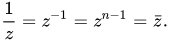
This is also true for negative exponents. In particular, the reciprocal of an nth root of unity is its complex conjugate, and is also an nth root of unity:[8]
If z is an nth root of unity and ab (mod n) then za = zb. Indeed, by the definition of congruence modulo n, a = b + kn for some integer k, and hence

Therefore, given a power za of z, one has za = zr, where 0 ≤ r < n is the remainder of the Euclidean division of a by n.

Let z be a primitive nth root of unity. Then the powers z, z2, ..., zn−1, zn = z0 = 1 are nth roots of unity and are all distinct. (If za = zb where 1 ≤ a < bn, then zba = 1, which would imply that z would not be primitive.) This implies that z, z2, ..., zn−1, zn = z0 = 1 are all of the nth roots of unity, since an nth-degree polynomial equation over a field (in this case the field of complex numbers) has at most n solutions.

From the preceding, it follows that, if z is a primitive nth root of unity, then if and only if If z is not primitive then implies but the converse may be false, as shown by the following example. If n = 4, a non-primitive nth root of unity is z = −1, and one has , although


Let z be a primitive nth root of unity. A power w = zk of z is a primitive ath root of unity for
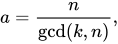
where is the greatest common divisor of n and k. This results from the fact that ka is the smallest multiple of k that is also a multiple of n. In other words, ka is the least common multiple of k and n. Thus

Thus, if k and n are coprime, zk is also a primitive nth root of unity, and therefore there are φ(n) distinct primitive nth roots of unity (where φ is Euler's totient function). This implies that if n is a prime number, all the roots except +1 are primitive.

In other words, if R(n) is the set of all nth roots of unity and P(n) is the set of primitive ones, R(n) is a disjoint union of the P(n):
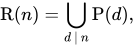
where the notation means that d goes through all the positive divisors of n, including 1 and n.

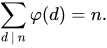
Since the cardinality of R(n) is n, and that of P(n) is φ(n), this demonstrates the classical formula
Group properties

[edit]

Group of all roots of unity

[edit]

The product and the multiplicative inverse of two roots of unity are also roots of unity. In fact, if xm = 1 and yn = 1, then (x−1)m = 1, and (xy)k = 1, where k is the least common multiple of m and n.

Therefore, the roots of unity form an abelian group under multiplication. This group is the torsion subgroup of the circle group.

Group of nth roots of unity

[edit]

For an integer n, the product and the multiplicative inverse of two nth roots of unity are also nth roots of unity. Therefore, the nth roots of unity form an abelian group under multiplication.

Given a primitive nth root of unity ω, the other nth roots are powers of ω. This means that the group of the nth roots of unity is a cyclic group. It is worth remarking that the term of cyclic group originated from the fact that this group is a subgroup of the circle group.

Galois group of the primitive nth roots of unity

[edit]

Let be the field extension of the rational numbers generated over by a primitive nth root of unity ω. As every nth root of unity is a power of ω, the field contains all nth roots of unity, and is a Galois extension of

If k is an integer, ωk is a primitive nth root of unity if and only if k and n are coprime. In this case, the map

induces an automorphism of , which maps every nth root of unity to its kth power. Every automorphism of is obtained in this way, and these automorphisms form the Galois group of over the field of the rationals.

The rules of exponentiation imply that the composition of two such automorphisms is obtained by multiplying the exponents. It follows that the map
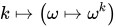
defines a group isomorphism between the units of the ring of integers modulo n and the Galois group of

This shows that this Galois group is abelian, and implies thus that the primitive roots of unity may be expressed in terms of radicals.

Galois group of the real part of the primitive roots of unity

[edit]

The real part of the primitive roots of unity are related to one another as roots of the minimal polynomial of The roots of the minimal polynomial are just twice the real part; these roots form a cyclic Galois group.

Trigonometric expression

[edit]
The cube roots of unity

De Moivre's formula, which is valid for all real x and integers n, is

Setting x = /n gives a primitive nth root of unity – one gets

but

for k = 1, 2, …, n − 1. In other words,
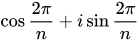
is a primitive nth root of unity.

This formula shows that in the complex plane the nth roots of unity are at the vertices of a regular n-sided polygon inscribed in the unit circle, with one vertex at 1 (see the plot for n = 3 on the right). This geometric fact accounts for the term "cyclotomic" in such phrases as cyclotomic field and cyclotomic polynomial; it is from the Greek roots "cyclo" (circle) plus "tomos" (cut, divide).

Euler's formula

which is valid for all real x, can be used to put the formula for the nth roots of unity into the form

It follows from the discussion in the previous section that this is a primitive nth-root if and only if the fraction k/n is in lowest terms; that is, that k and n are coprime. An irrational number that can be expressed as the real part of the root of unity; that is, as , is called a trigonometric number.

Algebraic expression

[edit]

The nth roots of unity are, by definition, the roots of the polynomial xn − 1, and are thus algebraic numbers. As this polynomial is not irreducible (except for n = 1), the primitive nth roots of unity are roots of an irreducible polynomial (over the integers) of lower degree, called the nth cyclotomic polynomial, and often denoted Φn. The degree of Φn is given by Euler's totient function, which counts (among other things) the number of primitive nth roots of unity.[9] The roots of Φn are exactly the primitive nth roots of unity.

Galois theory can be used to show that the cyclotomic polynomials may be conveniently solved in terms of radicals. (The trivial form is not convenient, because it contains non-primitive roots, such as 1, which are not roots of the cyclotomic polynomial, and because it does not give the real and imaginary parts separately.) This means that, for each positive integer n, there exists an expression built from integers by root extractions, additions, subtractions, multiplications, and divisions (and nothing else), such that the primitive nth roots of unity are exactly the set of values that can be obtained by choosing values for the root extractions (k possible values for a kth root). (For more details see § Cyclotomic fields, below.)

Gauss proved that a primitive nth root of unity can be expressed using only square roots, addition, subtraction, multiplication and division if and only if it is possible to construct with compass and straightedge the regular n-gon. This is the case if and only if n is either a power of two or the product of a power of two and Fermat primes that are all different.

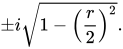
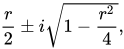
If z is a primitive nth root of unity, the same is true for 1/z, and is twice the real part of z. In other words, Φn is a reciprocal polynomial, the polynomial that has r as a root may be deduced from Φn by the standard manipulation on reciprocal polynomials, and the primitive nth roots of unity may be deduced from the roots of by solving the quadratic equation That is, the real part of the primitive root is and its imaginary part is

The polynomial is an irreducible polynomial whose roots are all real. Its degree is a power of two, if and only if n is a product of a power of two by a product (possibly empty) of distinct Fermat primes, and the regular n-gon is constructible with compass and straightedge. Otherwise, it is solvable in radicals, but one are in the casus irreducibilis, that is, every expression of the roots in terms of radicals involves nonreal radicals.

Explicit expressions in low degrees

[edit]
  • For n = 1, the cyclotomic polynomial is Φ1(x) = x − 1 Therefore, the only primitive first root of unity is 1, which is a non-primitive nth root of unity for every n > 1.
  • As Φ2(x) = x + 1, the only primitive second (square) root of unity is −1, which is also a non-primitive nth root of unity for every even n > 2. With the preceding case, this completes the list of real roots of unity.
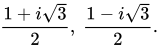
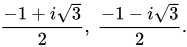
  • As Φ3(x) = x2 + x + 1, the primitive third (cube) roots of unity, which are the roots of this quadratic polynomial, are
  • As Φ4(x) = x2 + 1, the two primitive fourth roots of unity are i and i.
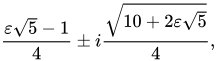
  • As Φ5(x) = x4 + x3 + x2 + x + 1, the four primitive fifth roots of unity are the roots of this quartic polynomial, which may be explicitly solved in terms of radicals, giving the roots where may take the two values 1 and −1 (the same value in the two occurrences).
  • As Φ6(x) = x2x + 1, there are two primitive sixth roots of unity, which are the negatives (and also the square roots) of the two primitive cube roots:
  • As 7 is not a Fermat prime, the seventh roots of unity are the first that require cube roots. There are 6 primitive seventh roots of unity, which are pairwise complex conjugate. The sum of a root and its conjugate is twice its real part. These three sums are the three real roots of the cubic polynomial and the primitive seventh roots of unity are where r runs over the roots of the above polynomial. As for every cubic polynomial, these roots may be expressed in terms of square and cube roots. However, as these three roots are all real, this is casus irreducibilis, and any such expression involves non-real cube roots.
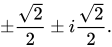
  • As Φ8(x) = x4 + 1, the four primitive eighth roots of unity are the square roots of the primitive fourth roots, ± i. They are thus
  • See Heptadecagon for the real part of a 17th root of unity.
Periodicity

[edit]

If z is a primitive nth root of unity, then the sequence of powers

… , z−1, z0, z1, …

is n-periodic (because z j + n = z jz n = z j for all values of j), and the n sequences of powers

sk: … , z k⋅(−1), z k⋅0, z k⋅1, …

for k = 1, … , n are all n-periodic (because z k⋅(j + n) = z kj). Furthermore, the set {s1, … , sn} of these sequences is a basis of the linear space of all n-periodic sequences. This means that any n-periodic sequence of complex numbers

… , x−1 , x0 , x1, …

can be expressed as a linear combination of powers of a primitive nth root of unity:

for some complex numbers X1, … , Xn and every integer j.

This is a form of Fourier analysis. If j is a (discrete) time variable, then k is a frequency and Xk is a complex amplitude.

Choosing for the primitive nth root of unity

allows xj to be expressed as a linear combination of cos and sin:

This is a discrete Fourier transform.

Summation

[edit]

Let SR(n) be the sum of all the nth roots of unity, primitive or not. Then
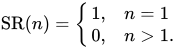
This is an immediate consequence of Vieta's formulas. In fact, the nth roots of unity being the roots of the polynomial Xn − 1, their sum is the coefficient of degree n − 1, which is either 1 or 0 according whether n = 1 or n > 1.

Alternatively, for n = 1 there is nothing to prove, and for n > 1 there exists a root z ≠ 1 – since the set S of all the nth roots of unity is a group, zS = S, so the sum satisfies z SR(n) = SR(n), whence SR(n) = 0.

Let SP(n) be the sum of all the primitive nth roots of unity. Then
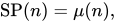
where μ(n) is the Möbius function.

In the section Elementary properties, it was shown that if R(n) is the set of all nth roots of unity and P(n) is the set of primitive ones, R(n) is a disjoint union of the P(n):

This implies
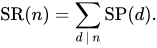
Applying the Möbius inversion formula gives

In this formula, if d < n, then SR(n/d) = 0, and for d = n: SR(n/d) = 1. Therefore, SP(n) = μ(n).

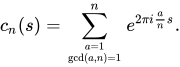
This is the special case cn(1) of Ramanujan's sum cn(s),[10] defined as the sum of the sth powers of the primitive nth roots of unity:
Orthogonality

[edit]

From the summation formula follows an orthogonality relationship: for j = 1, … , n and j′ = 1, … , n
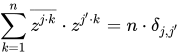
where δ is the Kronecker delta and z is any primitive nth root of unity.

The n × n matrix U whose (j, k)th entry is
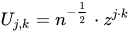
defines a discrete Fourier transform. Computing the inverse transformation using Gaussian elimination requires O(n3) operations. However, it follows from the orthogonality that U is unitary. That is,
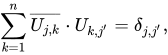
and thus the inverse of U is simply the complex conjugate. (This fact was first noted by Gauss when solving the problem of trigonometric interpolation.) The straightforward application of U or its inverse to a given vector requires O(n2) operations. The fast Fourier transform algorithms reduces the number of operations further to O(n log n).

Cyclotomic polynomials

[edit]

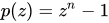
The zeros of the polynomial

are precisely the nth roots of unity, each with multiplicity 1. The nth cyclotomic polynomial is defined by the fact that its zeros are precisely the primitive nth roots of unity, each with multiplicity 1.
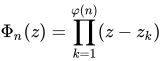
where z1, z2, z3, …, zφ(n) are the primitive nth roots of unity, and φ(n) is Euler's totient function. The polynomial Φn(z) has integer coefficients and is an irreducible polynomial over the rational numbers (that is, it cannot be written as the product of two positive-degree polynomials with rational coefficients).[9] The case of prime n, which is easier than the general assertion, follows by applying Eisenstein's criterion to the polynomial
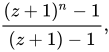
and expanding via the binomial theorem.

Every nth root of unity is a primitive dth root of unity for exactly one positive divisor d of n. This implies that[9]
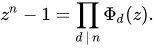
This formula represents the factorization of the polynomial zn − 1 into irreducible factors:
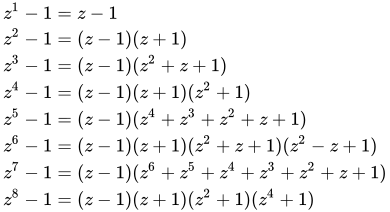
Applying Möbius inversion to the formula gives

where μ is the Möbius function. So the first few cyclotomic polynomials are

Φ1(z) = z − 1
Φ2(z) = (z2 − 1)⋅(z − 1)−1 = z + 1
Φ3(z) = (z3 − 1)⋅(z − 1)−1 = z2 + z + 1
Φ4(z) = (z4 − 1)⋅(z2 − 1)−1 = z2 + 1
Φ5(z) = (z5 − 1)⋅(z − 1)−1 = z4 + z3 + z2 + z + 1
Φ6(z) = (z6 − 1)⋅(z3 − 1)−1⋅(z2 − 1)−1⋅(z − 1) = z2z + 1
Φ7(z) = (z7 − 1)⋅(z − 1)−1 = z6 + z5 + z4 + z3 + z2 +z + 1
Φ8(z) = (z8 − 1)⋅(z4 − 1)−1 = z4 + 1

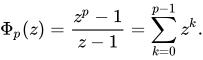
If p is a prime number, then all the pth roots of unity except 1 are primitive pth roots. Therefore,[6] Substituting any positive integer ≥ 2 for z, this sum becomes a base z repunit. Thus a necessary (but not sufficient) condition for a repunit to be prime is that its length be prime.
Note that, contrary to first appearances, not all coefficients of all cyclotomic polynomials are 0, 1, or −1. The first exception is Φ105. It is not a surprise it takes this long to get an example, because the behavior of the coefficients depends not so much on n as on how many odd prime factors appear in n. More precisely, it can be shown that if n has 1 or 2 odd prime factors (for example, n = 150) then the nth cyclotomic polynomial only has coefficients 0, 1 or −1. Thus the first conceivable n for which there could be a coefficient besides 0, 1, or −1 is a product of the three smallest odd primes, and that is 3 ⋅ 5 ⋅ 7 = 105. This by itself doesn't prove the 105th polynomial has another coefficient, but does show it is the first one which even has a chance of working (and then a computation of the coefficients shows it does). A theorem of Schur says that there are cyclotomic polynomials with coefficients arbitrarily large in absolute value. In particular, if where are odd primes, and t is odd, then 1 − t occurs as a coefficient in the nth cyclotomic polynomial.[11]


Many restrictions are known about the values that cyclotomic polynomials can assume at integer values. For example, if p is prime, then d ∣ Φp(d) if and only if d ≡ 1 (mod p).

Cyclotomic polynomials are solvable in radicals, as roots of unity are themselves radicals. Moreover, there exist more informative radical expressions for nth roots of unity with the additional property[12] that every value of the expression obtained by choosing values of the radicals (for example, signs of square roots) is a primitive nth root of unity. This was already shown by Gauss in 1797.[13] Efficient algorithms exist for calculating such expressions.[14]

Cyclic groups

[edit]

The nth roots of unity form under multiplication a cyclic group of order n, and in fact these groups comprise all of the finite subgroups of the multiplicative group of the complex number field. A generator for this cyclic group is a primitive nth root of unity.

The nth roots of unity form an irreducible representation of any cyclic group of order n. The orthogonality relationship also follows from group-theoretic principles as described in Character group.

The roots of unity appear as entries of the eigenvectors of any circulant matrix; that is, matrices that are invariant under cyclic shifts, a fact that also follows from group representation theory as a variant of Bloch's theorem.[15][page needed] In particular, if a circulant Hermitian matrix is considered (for example, a discretized one-dimensional Laplacian with periodic boundaries[16]), the orthogonality property immediately follows from the usual orthogonality of eigenvectors of Hermitian matrices.

Cyclotomic fields

[edit]

By adjoining a primitive nth root of unity to one obtains the nth cyclotomic field This field contains all nth roots of unity and is the splitting field of the nth cyclotomic polynomial over The field extension has degree φ(n) and its Galois group is naturally isomorphic to the multiplicative group of units of the ring


As the Galois group of is abelian, this is an abelian extension. Every subfield of a cyclotomic field is an abelian extension of the rationals. It follows that every nth root of unity may be expressed in term of k-roots, with various k not exceeding φ(n). In these cases Galois theory can be written out explicitly in terms of Gaussian periods: this theory from the Disquisitiones Arithmeticae of Gauss was published many years before Galois.[17]

Conversely, every abelian extension of the rationals is such a subfield of a cyclotomic field – this is the content of a theorem of Kronecker, usually called the Kronecker–Weber theorem on the grounds that Weber completed the proof.

Relation to quadratic integers

[edit]
In the complex plane, the red points are the fifth roots of unity, and the black points are the sums of a fifth root of unity and its complex conjugate.
In the complex plane, the corners of the two squares are the eighth roots of unity.

For n = 1, 2, both roots of unity 1 and −1 are integers.

For three values of n, the roots of unity are quadratic integers:

For four other values of n, the primitive roots of unity are not quadratic integers, but the sum of any root of unity with its complex conjugate (also an nth root of unity) is a quadratic integer.

For n = 5, 10, none of the non-real roots of unity (which satisfy a quartic equation) is a quadratic integer, but the sum z + z = 2 Re z of each root with its complex conjugate (also a 5th root of unity) is an element of the ring Z[1 + 5/2] (D = 5). For two pairs of non-real 5th roots of unity these sums are inverse golden ratio and minus golden ratio.

For n = 8, for any root of unity z + z equals to either 0, ±2, or ±2 (D = 2).

For n = 12, for any root of unity, z + z equals to either 0, ±1, ±2 or ±3 (D = 3).

See also

[edit]

Notes

[edit]

References

[edit]
Revisions and contributorsEdit on WikipediaRead on Wikipedia
from Grokipedia
In mathematics, particularly in complex analysis and abstract algebra, the nth roots of unity are the complex numbers $ \zeta $ satisfying the equation $ \zeta^n = 1 $, where $ n $ is a positive integer; these are explicitly given by $ \zeta_k = e^{2\pi i k / n} = \cos(2\pi k / n) + i \sin(2\pi k / n) $ for $ k = 0, 1, \dots, n-1 $.[1] These points lie equally spaced on the unit circle in the complex plane, forming the vertices of a regular n-gon inscribed in that circle.[2] Under complex multiplication, they constitute a cyclic group of order n, with 1 as the identity element and the sum of all nth roots equaling zero when n > 1.[1] A primitive nth root of unity is any $ \zeta_k $ where $ \gcd(k, n) = 1 $, generating the entire group through its powers; the number of such primitive roots is given by Euler's totient function $ \phi(n) $.[1] The minimal polynomial for the primitive nth roots over the rationals is the nth cyclotomic polynomial $ \Phi_n(x) $, which is monic, irreducible, and has integer coefficients, playing a central role in the study of cyclotomic fields.[1] In field theory, adjoining a primitive nth root to a base field F (of characteristic not dividing n) yields a Galois extension whose Galois group is isomorphic to the multiplicative group of units modulo n, $ (\mathbb{Z}/n\mathbb{Z})^\times $, highlighting their importance in understanding algebraic number fields and solvability by radicals.[3] Roots of unity have broad applications across mathematics and related fields: in geometry, they parameterize the symmetries of regular polygons; in trigonometry, they express cosine and sine values via relations like $ \cos(2\pi / n) = (\zeta + \zeta^{-1})/2 $; and in signal processing, the nth roots serve as basis functions for the discrete Fourier transform, enabling efficient analysis of periodic signals in audio and imaging.[1][4] They also appear in the roots-of-unity filter for evaluating sums and in the representation theory of quantum groups at roots of unity, connecting to modular forms and physics.[5]

Definition and Fundamentals

Definition

A root of unity is a complex number ζ\zeta such that ζn=1\zeta^n = 1 for some positive integer nn. The nnth roots of unity are precisely the solutions to the equation zn1=0z^n - 1 = 0 in the complex numbers.[6] A primitive nnth root of unity is an nnth root of unity of exact order nn, meaning ζk1\zeta^k \neq 1 for all positive integers k<nk < n. The standard primitive nnth root of unity is denoted ωn=e2πi/n\omega_n = e^{2\pi i / n}.[6] The concept of roots of unity was systematically introduced by Carl Friedrich Gauss in his 1801 work Disquisitiones Arithmeticae, particularly in the context of cyclotomic fields.[7] For n=1n=1, the only root of unity is 11. For n=2n=2, the roots are 11 and 1-1. For n=3n=3, the roots are the three solutions to z3=1z^3 = 1.[6]

Elementary Properties

All roots of unity lie on the unit circle in the complex plane, as any such $ z $ satisfies $ |z|^n = |1| = 1 $, implying $ |z| = 1 $.[8] The $ n $th roots of unity are equally spaced around this circle, forming the vertices of a regular $ n $-gon, with angular positions $ 2\pi k / n $ for $ k = 0, 1, \dots, n-1 $.[8] Considering the polynomial equation $ z^n - 1 = 0 $, Vieta's formulas yield key symmetric properties of the roots. For n > 1, the sum of all $ n $th roots of unity is zero, corresponding to the zero coefficient of $ z^{n-1} $.[9] The product of all $ n $th roots of unity is $ (-1)^{n+1} $, derived from the constant term $ -1 $ with the sign alternation $ (-1)^n $.[9] Every root of unity is an algebraic integer, as it satisfies a monic polynomial equation with integer coefficients—specifically, its minimal polynomial over the rationals divides the $ n $th cyclotomic polynomial, which is monic and has integer coefficients.[10] If $ \zeta $ is a primitive $ n $th root of unity, then the power $ \zeta^m $ is a primitive $ d $th root of unity, where $ d = n / \gcd(m, n) $.[11]

Geometric and Trigonometric Aspects

Trigonometric Representation

The nth roots of unity can be expressed in trigonometric form using Euler's formula, which states that $ e^{i\theta} = \cos \theta + i \sin \theta $ for real θ\theta.[12] The solutions to $ z^n = 1 $ are thus given by $ z_k = e^{2\pi i k / n} = \cos(2\pi k / n) + i \sin(2\pi k / n) $ for integers $ k = 0, 1, \dots, n-1 $.[12] This representation places each root on the unit circle in the complex plane, with the real part cos(2πk/n)\cos(2\pi k / n) and imaginary part sin(2πk/n)\sin(2\pi k / n) serving as the Cartesian coordinates.[13] A primitive nth root of unity, denoted ωn\omega_n, is the root with the smallest positive argument, given by ωn=cos(2π/n)+isin(2π/n)\omega_n = \cos(2\pi / n) + i \sin(2\pi / n).[12] All other nth roots are powers of this primitive root: $ z_k = \omega_n^k $. Geometrically, the nth roots of unity correspond to the vertices of a regular n-gon inscribed in the unit circle centered at the origin, equally spaced at angular intervals of $ 2\pi / n $. De Moivre's theorem, which states that $ [\cos \theta + i \sin \theta]^m = \cos(m\theta) + i \sin(m\theta) $ for integer $ m $, applies directly to powers of roots of unity.[14] Raising a root $ z_k $ to the mth power rotates it by multiples of $ 2\pi m / n $ around the unit circle, preserving the cyclic structure.[15] This trigonometric form underscores the rotational symmetry inherent in roots of unity.[16]

Periodicity

The order of a root of unity ζ\zeta is defined as the smallest positive integer mm such that ζm=1\zeta^m = 1.[17] For an nnth root of unity, this order divides nn.[18] In particular, for a primitive nth root of unity (order n), ζk=1\zeta^k = 1 precisely when nn divides kk.[17] The powers of an nnth root of unity ζ\zeta exhibit periodicity with period nn, as ζk+n=ζkζn=ζk1=ζk\zeta^{k + n} = \zeta^k \cdot \zeta^n = \zeta^k \cdot 1 = \zeta^k for any integer kk.[17] Consequently, the sequence of powers ζ0,ζ1,,ζn1\zeta^0, \zeta^1, \dots, \zeta^{n-1} repeats indefinitely every nn steps. This repetition in the exponents directly corresponds to arithmetic modulo nn, where ζk=ζkmodn\zeta^k = \zeta^{k \mod n}, mirroring the cyclic structure of the ring Z/nZ\mathbb{Z}/n\mathbb{Z}.[17] While each root of unity has a finite order dividing some nn, the collection of all roots of unity forms an infinite group under multiplication, with no universal period encompassing every element.[19] Instead, individual roots are torsion elements of finite order. For instance, the cube roots of unity satisfy ω3=1\omega^3 = 1, so their powers cycle every 3 steps: ω0=1\omega^0 = 1, ω1=ω\omega^1 = \omega, ω2=ω2\omega^2 = \omega^2, ω3=1\omega^3 = 1, and so on.[17]

Algebraic Representations

Explicit Formulas for Low Degrees

For the first root of unity, corresponding to n=1n=1, the only solution to z1=1z^1 = 1 is z=1z = 1.[20] For n=2n=2, the equation z2=1z^2 = 1 factors as (z1)(z+1)=0(z-1)(z+1) = 0, yielding the roots z=±1z = \pm 1.[20] The third roots of unity satisfy z3=1z^3 = 1, or (z1)(z2+z+1)=0(z-1)(z^2 + z + 1) = 0. The quadratic factor z2+z+1=0z^2 + z + 1 = 0 has discriminant 14=31 - 4 = -3, so the primitive roots are z=1±32=12±i32z = \frac{-1 \pm \sqrt{-3}}{2} = -\frac{1}{2} \pm i \frac{\sqrt{3}}{2}.[20] For n=4n=4, the equation z4=1z^4 = 1 factors as (z21)(z2+1)=0(z^2 - 1)(z^2 + 1) = 0, giving roots z=±1z = \pm 1 and z=±1=±iz = \pm \sqrt{-1} = \pm i.[20] The fifth roots of unity solve z5=1z^5 = 1, or (z1)Φ5(z)=0(z-1)\Phi_5(z) = 0 where Φ5(z)=z4+z3+z2+z+1=0\Phi_5(z) = z^4 + z^3 + z^2 + z + 1 = 0. These primitive roots can be expressed using square roots involving the golden ratio ϕ=1+52\phi = \frac{1 + \sqrt{5}}{2}. Specifically, one primitive root is cos2π5+isin2π5=514+i10+254\cos\frac{2\pi}{5} + i \sin\frac{2\pi}{5} = \frac{\sqrt{5} - 1}{4} + i \frac{\sqrt{10 + 2\sqrt{5}}}{4}, and another is cos4π5+isin4π5=514+i10254\cos\frac{4\pi}{5} + i \sin\frac{4\pi}{5} = \frac{-\sqrt{5} - 1}{4} + i \frac{\sqrt{10 - 2\sqrt{5}}}{4}; the remaining roots are their complex conjugates and powers.[21][20] These cases for n5n \leq 5 are solvable using only square roots (including of negative numbers), yielding compact radical expressions. In contrast, for larger nn such as n=7n=7, while still expressible by radicals due to the abelian Galois group of cyclotomic extensions, the formulas require higher-degree roots like cube roots and more nested iterations.[20]

General Algebraic Expressions

The nth roots of unity are the complex numbers satisfying the equation $ z^n - 1 = 0 $, which factors uniquely over the rationals as $ z^n - 1 = \prod_{d \mid n} \Phi_d(z) $, where each $ \Phi_d(z) $ is the dth cyclotomic polynomial.[6] The primitive nth roots of unity are precisely the roots of the irreducible cyclotomic polynomial $ \Phi_n(z) $, which has degree $ \phi(n) $ and is monic with integer coefficients.[6] For general n, explicit algebraic expressions for the roots require solving these irreducible polynomials over $ \mathbb{Q} $, but no simple closed-form formula exists using only finitely many arithmetic operations and root extractions that applies uniformly across all n.[22] Although the Galois group of $ \Phi_n(z) $ over $ \mathbb{Q} $ is abelian and thus solvable—implying the roots are expressible by radicals—these expressions become increasingly complex for larger n, involving nested radicals of degrees matching the structure of $ (\mathbb{Z}/n\mathbb{Z})^\times $.[6] The Abel-Ruffini theorem establishes that no general solution by radicals exists for arbitrary polynomials of degree at least 5, and while cyclotomic polynomials evade this for specific cases due to their solvable Galois groups, the lack of a uniform radical formula for $ \Phi_n(z) $ when $ \phi(n) \geq 5 $ (as occurs for n ≥ 7) underscores the challenge in obtaining elementary expressions.[23] Attempts to express roots via nested radicals highlight these limitations; for instance, the primitive 7th roots of unity satisfy a degree-6 irreducible polynomial and can be written using nested cube roots and square roots, but the resulting formula is highly intricate and non-elementary in structure.[22] For broader n, such constructions rely on Lagrange resolvents or computational methods to denest radicals, yet they do not yield a general pattern beyond low degrees.[24] In practice, numerical approximations often supplement algebraic efforts, particularly for the real parts of the roots. The cosine values $ \cos(2\pi k / n) $ for k = 1, ..., $ \lfloor n/2 \rfloor $ can be approximated via the Taylor series expansion $ \cos x = 1 - \frac{x^2}{2!} + \frac{x^4}{4!} - \frac{x^6}{6!} + \cdots $, where x = 2π/n, providing high precision for large n without solving the full polynomial. This series converges rapidly for small x, establishing key quantitative context for the distribution of roots on the unit circle when exact algebraic forms are infeasible. Overall, expressing general nth roots of unity algebraically ties directly to resolving the minimal polynomials $ \Phi_n(z) $ over $ \mathbb{Q} ,whereirreducibilityensurestherootsgenerateadegree, where irreducibility ensures the roots generate a degree- \phi(n) $ extension, but practical computation favors hybrid algebraic-numeric approaches for n beyond small values.[6]

Group-Theoretic Structure

nth Roots of Unity as a Group

The set of all nnth roots of unity, denoted μn={ζCζn=1}\mu_n = \{\zeta \in \mathbb{C} \mid \zeta^n = 1\}, forms a finite abelian group under complex multiplication, specifically a cyclic group of order nn.[17] This structure arises because the roots are the solutions to the equation zn1=0z^n - 1 = 0, and their multiplication closes within the set, with the identity element being 11 (corresponding to ζ0\zeta^0).[25] A generator of this group is any primitive nnth root of unity ωn\omega_n, such as ωn=e2πi/n\omega_n = e^{2\pi i / n}, which has multiplicative order exactly nn. The elements of μn\mu_n are then precisely the powers {ωnkk=0,1,,n1}\{\omega_n^k \mid k = 0, 1, \dots, n-1\}, confirming the cyclic nature generated by a single element.[17][26] The group μn\mu_n is isomorphic to the additive group Z/nZ\mathbb{Z}/n\mathbb{Z} of integers modulo nn, via the map kωnkk \mapsto \omega_n^k for k{0,1,,n1}k \in \{0, 1, \dots, n-1\}. This isomorphism preserves the group operation: multiplication in μn\mu_n corresponds to addition modulo nn in Z/nZ\mathbb{Z}/n\mathbb{Z}.[25][17] For each positive divisor dd of nn, the set of ddth roots of unity μd\mu_d forms a subgroup of μn\mu_n of order dd and index n/dn/d. These subgroups are unique for each dd, as they consist of the elements in μn\mu_n whose order divides dd.[17][26] By Lagrange's theorem applied to the finite group μn\mu_n, the order of every element divides nn, meaning that if ζμn\zeta \in \mu_n has order mm, then mnm \mid n. This implies that all proper subgroups of μn\mu_n correspond exactly to the divisors of nn, reinforcing the cyclic structure.[17]

All Roots of Unity as a Group

The set of all roots of unity in the complex numbers, often denoted by μ\mu or μ\mu_\infty, is the union over all positive integers nn of the sets of nnth roots of unity. This set forms a subgroup of the multiplicative group C×\mathbb{C}^\times of nonzero complex numbers, as the product of two roots of unity (of orders mm and nn) is a root of unity of order dividing lcm(m,n)\mathrm{lcm}(m,n), and the inverse of a root of unity of order nn is its complex conjugate, which is also a root of unity of order dividing nn.[27] Moreover, μ\mu is precisely the torsion subgroup of C×\mathbb{C}^\times, consisting of all elements of finite order, since any zC×z \in \mathbb{C}^\times satisfying zk=1z^k = 1 for some positive integer kk must satisfy z=1|z| = 1 and thus lie on the unit circle.[27] As a subgroup of the unit circle group S1={zC:z=1}S^1 = \{ z \in \mathbb{C} : |z| = 1 \}, μ\mu is countable, being the countable union of the finite sets of nnth roots of unity for each nn. Despite its countability, μ\mu is dense in S1S^1: for any wS1w \in S^1 and ϵ>0\epsilon > 0, there exist integers m,nm, n such that exp(2πim/n)w<ϵ\left| \exp(2\pi i m / n) - w \right| < \epsilon, since the rational multiples of 2π2\pi are dense in [0,2π)[0, 2\pi) by the density of Q\mathbb{Q} in R\mathbb{R}.[28] Every element of μ\mu has finite order, and for any positive integer nn, μ\mu contains the full cyclic subgroup of nnth roots of unity. Algebraically, μ\mu can be viewed as the direct limit of the directed system of finite cyclic groups μnZ/nZ\mu_n \cong \mathbb{Z}/n\mathbb{Z} (under multiplication), where the maps μmμn\mu_m \to \mu_n exist whenever mm divides nn via the natural inclusion.[29] As abstract groups, μ\mu is isomorphic to the additive group Q/Z\mathbb{Q}/\mathbb{Z} via the exponential map [q]exp(2πiq)[q] \mapsto \exp(2\pi i q) for qQ/Zq \in \mathbb{Q}/\mathbb{Z}, which is a group homomorphism sending torsion elements to roots of unity and is bijective since every root of unity is exp(2πir)\exp(2\pi i r) for some rational rr.[27] Furthermore, Q/ZpZ(p)\mathbb{Q}/\mathbb{Z} \cong \bigoplus_p \mathbb{Z}(p^\infty), where the direct sum is over all primes pp and Z(p)\mathbb{Z}(p^\infty) is the Prüfer pp-group, the inductive limit of the cyclic groups Z/pkZ\mathbb{Z}/p^k \mathbb{Z} (equivalently, multiplicatively, the group of all pkp^kth roots of unity for k0k \geq 0).[30] This decomposition reflects the primary decomposition of the torsion in Q/Z\mathbb{Q}/\mathbb{Z}, with each Prüfer component capturing the pp-primary torsion elements.

Primitive Roots and Their Role

A primitive nnth root of unity is defined as an nnth root of unity ζ\zeta whose multiplicative order is exactly nn, meaning ζn=1\zeta^n = 1 but ζk1\zeta^k \neq 1 for any positive integer k<nk < n.[17] Equivalently, ζ\zeta is primitive if ζk=1\zeta^k = 1 implies that nn divides kk.[17] This characterization ensures that the minimal period of ζ\zeta matches nn, distinguishing it from roots of lower order.[31] The number of primitive nnth roots of unity equals ϕ(n)\phi(n), where ϕ\phi denotes Euler's totient function, which counts the integers from 1 to nn that are coprime to nn.[17] If ζ\zeta is any primitive nnth root, the full set of primitive nnth roots consists of {ζk:1kn,gcd(k,n)=1}\{\zeta^k : 1 \leq k \leq n, \gcd(k, n) = 1\}.[17] This count arises from the structure of the cyclic group of nnth roots and can be derived via Möbius inversion applied to the relation n=dnϕ(d)n = \sum_{d \mid n} \phi(d), yielding the explicit formula
ϕ(n)=dnμ(d)nd, \phi(n) = \sum_{d \mid n} \mu(d) \frac{n}{d},
where μ\mu is the Möbius function, defined as μ(m)=0\mu(m) = 0 if mm has a squared prime factor, μ(m)=1\mu(m) = 1 if mm has an even number of distinct prime factors, and μ(m)=1\mu(m) = -1 if odd.[32]
Primitive nnth roots play a central role as generators of the multiplicative group of all nnth roots of unity, which is cyclic of order nn. Specifically, for any primitive ζ\zeta, the powers ζ0,ζ1,,ζn1\zeta^0, \zeta^1, \dots, \zeta^{n-1} exhaustively produce every nnth root of unity.[17] For example, when n=pn = p is prime, ϕ(p)=p1\phi(p) = p-1, so there are p1p-1 primitive ppth roots, each generating the full group.[31]

Cyclotomic Theory

Cyclotomic Polynomials

The nth cyclotomic polynomial, denoted Φn(z)\Phi_n(z), is defined as the monic polynomial whose roots are precisely the primitive nth roots of unity, that is,
Φn(z)=(zζ), \Phi_n(z) = \prod (z - \zeta),
where the product runs over all primitive nth roots of unity ζ\zeta.[10][33] The degree of Φn(z)\Phi_n(z) is given by Euler's totient function ϕ(n)\phi(n), which counts the number of integers up to n that are coprime to n. This follows directly from the fact that there are exactly ϕ(n)\phi(n) primitive nth roots of unity.[10][33] A fundamental property is the factorization of the nth cyclotomic polynomial in relation to the polynomial zn1z^n - 1:
zn1=dnΦd(z), z^n - 1 = \prod_{d \mid n} \Phi_d(z),
where the product is over all positive divisors d of n. This decomposition arises because the roots of zn1z^n - 1 are all nth roots of unity, partitioned according to their orders.[10][33] From this factorization, a recursive formula for Φn(z)\Phi_n(z) can be derived:
Φn(z)=zn1dnd<nΦd(z). \Phi_n(z) = \frac{z^n - 1}{\prod_{\substack{d \mid n \\ d < n}} \Phi_d(z)}.
This allows computation of Φn(z)\Phi_n(z) using previously computed cyclotomic polynomials for proper divisors of n.[34][33] The cyclotomic polynomials Φn(z)\Phi_n(z) are irreducible over the rationals Q\mathbb{Q}. For prime p, this was first proved by Gauss in 1801 using properties of roots and symmetric functions to show that any factorization would contradict the minimal polynomial degree. In general, irreducibility follows from criteria such as Eisenstein's (applied after the substitution zz+1z \mapsto z + 1 for prime powers) or more advanced methods involving substitutions and field extensions, as established by later mathematicians including Dedekind and others.[34] Explicit examples for small n illustrate these properties. For n=1, Φ1(z)=z1\Phi_1(z) = z - 1. For n=2, Φ2(z)=z+1\Phi_2(z) = z + 1. For n=3, Φ3(z)=z2+z+1\Phi_3(z) = z^2 + z + 1. For n=4, Φ4(z)=z2+1\Phi_4(z) = z^2 + 1. Each has integer coefficients and is monic of degree ϕ(n)\phi(n).

Cyclotomic Fields

The cyclotomic field Q(ζn)\mathbb{Q}(\zeta_n) is the extension of the rational numbers Q\mathbb{Q} obtained by adjoining a primitive nnth root of unity ζn\zeta_n, and it can be explicitly constructed as the quotient ring Q[x]/(Φn(x))\mathbb{Q}[x] / (\Phi_n(x)), where Φn(x)\Phi_n(x) is the nnth cyclotomic polynomial.[6] This field has degree ϕ(n)\phi(n) over Q\mathbb{Q}, where ϕ\phi denotes Euler's totient function, reflecting the minimal polynomial degree of ζn\zeta_n over Q\mathbb{Q}.[6] A power basis for Q(ζn)\mathbb{Q}(\zeta_n) as a vector space over Q\mathbb{Q} is given by {1,ζn,ζn2,,ζnϕ(n)1}\{1, \zeta_n, \zeta_n^2, \dots, \zeta_n^{\phi(n)-1}\}.[6] The extension Q(ζn)/Q\mathbb{Q}(\zeta_n)/\mathbb{Q} is Galois, meaning it is both normal and separable, with the Galois group Gal(Q(ζn)/Q)\mathrm{Gal}(\mathbb{Q}(\zeta_n)/\mathbb{Q}) isomorphic to the multiplicative group of units modulo nn, denoted (Z/nZ)×(\mathbb{Z}/n\mathbb{Z})^\times.[6] This isomorphism arises from the action of automorphisms on ζn\zeta_n, sending it to ζnk\zeta_n^k for kk coprime to nn.[6] The abelian nature of this Galois group underscores the simplicity of cyclotomic extensions compared to more general number fields.[35] For any positive divisor dd of nn, the cyclotomic field Q(ζd)\mathbb{Q}(\zeta_d) is a subfield of Q(ζn)\mathbb{Q}(\zeta_n).[6] This inclusion follows from the fact that ζnn/d\zeta_n^{n/d} is a primitive ddth root of unity, ensuring that all lower-order cyclotomic fields embed naturally within higher ones.[6] In the ring of integers of Q(ζn)\mathbb{Q}(\zeta_n), ramification occurs only at the finite primes dividing nn; all other primes remain unramified.[36] This property highlights the localized arithmetic complexity of cyclotomic fields, with unramified primes splitting according to the Frobenius elements in the Galois group.[36] Historically, cyclotomic fields played a pivotal role in Carl Friedrich Gauss's 1796 proof of the constructibility of the regular 17-gon using compass and straightedge, achieved by explicitly solving for the real subfield of Q(ζ17)\mathbb{Q}(\zeta_{17}) through quadratic extensions.[37] This breakthrough demonstrated that a regular heptadecagon could be constructed, leveraging the degree ϕ(17)=16=24\phi(17) = 16 = 2^4 to reduce the problem to successive square roots.[37]

Analytic and Summation Properties

Summation Formulas

One fundamental summation formula involving roots of unity arises from the geometric series. For a primitive nnth root of unity ζ=e2πi/n\zeta = e^{2\pi i / n} with n>1n > 1, the sum k=0n1ζk=0\sum_{k=0}^{n-1} \zeta^k = 0. This follows from the formula for the sum of a finite geometric series: k=0n1rk=(1rn)/(1r)\sum_{k=0}^{n-1} r^k = (1 - r^n)/(1 - r) for r1r \neq 1, where r=ζr = \zeta and ζn=1\zeta^n = 1, yielding (11)/(1ζ)=0(1 - 1)/(1 - \zeta) = 0.[1] More generally, consider power sums over all nnth roots of unity. Let ω=e2πi/n\omega = e^{2\pi i / n} be a primitive nnth root of unity. The sum pm=k=0n1ωkmp_m = \sum_{k=0}^{n-1} \omega^{k m} equals nn if nn divides mm, and 00 otherwise. This result holds because ωm\omega^m is a primitive ddth root of unity where d=n/gcd(n,m)d = n / \gcd(n, m); the geometric series sum is then nn only when ωm=1\omega^m = 1 (i.e., nmn \mid m), and 00 otherwise.[1] A related summation is the Ramanujan sum, which involves only the primitive nnth roots of unity. Defined as cn(m)=k=1gcd(k,n)=1ne2πikm/nc_n(m) = \sum_{\substack{k=1 \\ \gcd(k,n)=1}}^n e^{2\pi i k m / n}, this equals the sum of the mmth powers of the primitive nnth roots of unity. Its closed form is cn(m)=μ(n/d)ϕ(n)/ϕ(n/d)c_n(m) = \mu(n / d) \cdot \phi(n) / \phi(n / d), where d=gcd(m,n)d = \gcd(m, n), μ\mu is the Möbius function, and ϕ\phi is Euler's totient function.[38] These formulas find applications in discrete Fourier analysis, where the power sum orthogonality underpins the inversion of the discrete Fourier transform via sums over roots of unity.[1]

Orthogonality Relations

The nth roots of unity form a set of characters for the cyclic group Z/nZ\mathbb{Z}/n\mathbb{Z}, which are group homomorphisms from Z/nZ\mathbb{Z}/n\mathbb{Z} to the multiplicative group C\mathbb{C}^* of nonzero complex numbers. Specifically, for a primitive nth root of unity ω=e2πi/n\omega = e^{2\pi i / n}, the characters are given by χj(k)=ωjk\chi_j(k) = \omega^{j k} for j,k=0,1,,n1j, k = 0, 1, \dots, n-1, where addition is modulo nn.[39] These characters satisfy orthogonality relations with respect to the inner product on functions from Z/nZ\mathbb{Z}/n\mathbb{Z} to C\mathbb{C}, defined as f,g=k=0n1f(k)g(k)\langle f, g \rangle = \sum_{k=0}^{n-1} f(k) \overline{g(k)}. In particular, the inner product between distinct characters is zero: k=0n1ωk(jl)=nδjlmodn\sum_{k=0}^{n-1} \omega^{k(j - l)} = n \delta_{j l \mod n}, where δjlmodn\delta_{j l \mod n} is the Kronecker delta, equal to 1 if jl(modn)j \equiv l \pmod{n} and 0 otherwise.[40] This relation follows from the geometric series sum when j≢l(modn)j \not\equiv l \pmod{n} and the trivial sum when jl(modn)j \equiv l \pmod{n}.[39] The set of characters {χjj=0,1,,n1}\{\chi_j \mid j = 0, 1, \dots, n-1\} forms a complete orthogonal basis for the vector space of all functions from Z/nZ\mathbb{Z}/n\mathbb{Z} to C\mathbb{C}, which has dimension nn. Any function f:Z/nZCf: \mathbb{Z}/n\mathbb{Z} \to \mathbb{C} can thus be uniquely expanded as f(k)=j=0n1f^(j)χj(k)f(k) = \sum_{j=0}^{n-1} \hat{f}(j) \chi_j(k), where the coefficients f^(j)\hat{f}(j) are determined by the orthogonality. This completeness ensures that the characters diagonalize circulant matrices and convolution operators on Z/nZ\mathbb{Z}/n\mathbb{Z}.[40] A key application of these orthogonality relations is the discrete Fourier transform (DFT), which decomposes a sequence a=(a0,a1,,an1)a = (a_0, a_1, \dots, a_{n-1}) into its frequency components using the characters. The DFT is defined as a^j=1nk=0n1akωkj\hat{a}_j = \frac{1}{n} \sum_{k=0}^{n-1} a_k \omega^{-k j} for j=0,1,,n1j = 0, 1, \dots, n-1, and the inversion formula recovers the original sequence via ak=j=0n1a^jωkja_k = \sum_{j=0}^{n-1} \hat{a}_j \omega^{k j}. This transform leverages the orthogonality to ensure invertibility and Parseval's identity, k=0n1ak2=nj=0n1a^j2\sum_{k=0}^{n-1} |a_k|^2 = n \sum_{j=0}^{n-1} |\hat{a}_j|^2. In practice, the DFT is used for filtering periodic signals by transforming to the frequency domain, applying modifications (such as zeroing certain frequencies), and inverting the transform.[4] The DFT also facilitates solving linear difference equations with periodic coefficients or boundary conditions on finite domains, such as those arising in numerical simulations of periodic phenomena. By transforming the equation into the frequency domain, the orthogonality decouples the variables, allowing componentwise solutions before inversion.[41]

Advanced Algebraic Connections

Galois Groups of Primitive Roots

The Galois group of the cyclotomic extension Q(ζn)/Q\mathbb{Q}(\zeta_n)/\mathbb{Q}, where ζn\zeta_n is a primitive nnth root of unity, is isomorphic to the multiplicative group of units modulo nn, denoted (Z/nZ)×(\mathbb{Z}/n\mathbb{Z})^\times. This isomorphism arises from the fact that the extension is Galois of degree ϕ(n)\phi(n), where ϕ\phi is Euler's totient function, and the automorphisms are determined by their action on ζn\zeta_n. Specifically, each σaGal(Q(ζn)/Q)\sigma_a \in \mathrm{Gal}(\mathbb{Q}(\zeta_n)/\mathbb{Q}) corresponds to an integer aa coprime to nn via σa(ζn)=ζna\sigma_a(\zeta_n) = \zeta_n^a, providing a faithful representation of (Z/nZ)×(\mathbb{Z}/n\mathbb{Z})^\times.[6][42] This group action permutes the primitive nnth roots of unity by exponentiation: the set of primitive nnth roots consists of ζnk\zeta_n^k for kk coprime to nn, and σa\sigma_a maps ζnk\zeta_n^k to ζnak\zeta_n^{ak}, which is again primitive since gcd(ak,n)=1\gcd(ak, n) = 1. The action is transitive on this set, reflecting the irreducibility of the nnth cyclotomic polynomial over Q\mathbb{Q}.[6][42] The fixed fields of subgroups of (Z/nZ)×(\mathbb{Z}/n\mathbb{Z})^\times correspond to subextensions of Q(ζn)/Q\mathbb{Q}(\zeta_n)/\mathbb{Q}, yielding intermediate cyclotomic fields Q(ζd)\mathbb{Q}(\zeta_d) for divisors dd of nn. Each such subgroup HH fixes the subfield generated by roots of unity of order dividing the conductor associated to HH.[6] When n=pn = p is prime, the Galois group Gal(Q(ζp)/Q)\mathrm{Gal}(\mathbb{Q}(\zeta_p)/\mathbb{Q}) is cyclic of order p1p-1, isomorphic to (Z/pZ)×(\mathbb{Z}/p\mathbb{Z})^\times, which is generated by a single element corresponding to a primitive root modulo pp. This cyclic structure simplifies computations of subfields and ramification.[42][6] In the broader context of class field theory, the cyclotomic extension Q(ζn)/Q\mathbb{Q}(\zeta_n)/\mathbb{Q} realizes the ray class field of Q\mathbb{Q} modulo the conductor nn, with the Galois group isomorphic to the ray class group modulo nn; the class number of Q(ζn)\mathbb{Q}(\zeta_n) influences the structure of its unit group via relations like Dirichlet's class number formula, providing an entry point to more advanced abelian extensions.[43]

Real Parts and Quadratic Integers

The maximal real subfield of the nnth cyclotomic field Q(ζn)\mathbb{Q}(\zeta_n), where ζn=e2πi/n\zeta_n = e^{2\pi i / n} is a primitive nnth root of unity, is the subfield fixed by complex conjugation. This subfield is generated by ζn+ζn1=2cos(2π/n)\zeta_n + \zeta_n^{-1} = 2\cos(2\pi / n) and equals Q(cos(2π/n))\mathbb{Q}(\cos(2\pi / n)). For n>2n > 2, the degree of this extension over Q\mathbb{Q} is ϕ(n)/2\phi(n)/2, where ϕ\phi is Euler's totient function.[44] The Galois group of Q(cos(2π/n))/Q\mathbb{Q}(\cos(2\pi / n))/\mathbb{Q} is isomorphic to (Z/nZ)×/{±1}(\mathbb{Z}/n\mathbb{Z})^\times / \{\pm 1\}, the quotient of the unit group modulo nn by the subgroup generated by 1-1, which corresponds to the action of complex conjugation in the full Galois group of Q(ζn)/Q\mathbb{Q}(\zeta_n)/\mathbb{Q}.[6] When ϕ(n)/2=2\phi(n)/2 = 2, or equivalently ϕ(n)=4\phi(n) = 4, the real subfield is a real quadratic extension of Q\mathbb{Q}, and 2cos(2π/n)2\cos(2\pi / n) is a quadratic integer generating the ring of integers in certain cases. The positive integers nn satisfying ϕ(n)=4\phi(n) = 4 are n=5,8,10,12n=5, 8, 10, 12. For n=5n=5, 2cos(2π/5)=(51)/22\cos(2\pi / 5) = (\sqrt{5} - 1)/2 satisfies the minimal polynomial x2+x1=0x^2 + x - 1 = 0 over Z\mathbb{Z}, generating Q(5)\mathbb{Q}(\sqrt{5}). For n=8n=8, 2cos(2π/8)=22\cos(2\pi / 8) = \sqrt{2} satisfies x22=0x^2 - 2 = 0, generating Q(2)\mathbb{Q}(\sqrt{2}). For n=10n=10, 2cos(2π/10)=(5+1)/22\cos(2\pi / 10) = (\sqrt{5} + 1)/2 satisfies x2x1=0x^2 - x - 1 = 0, again generating Q(5)\mathbb{Q}(\sqrt{5}). For n=12n=12, 2cos(2π/12)=32\cos(2\pi / 12) = \sqrt{3} satisfies x23=0x^2 - 3 = 0, generating Q(3)\mathbb{Q}(\sqrt{3}).[45] The quadratic cyclotomic fields occur precisely for n=3,4,6n=3,4,6, where [Q(ζn):Q]=2[\mathbb{Q}(\zeta_n) : \mathbb{Q}] = 2. Here, Q(ζ3)=Q(3)\mathbb{Q}(\zeta_3) = \mathbb{Q}(\sqrt{-3}), Q(ζ4)=Q(i)=Q(1)\mathbb{Q}(\zeta_4) = \mathbb{Q}(i) = \mathbb{Q}(\sqrt{-1}), and Q(ζ6)=Q(3)\mathbb{Q}(\zeta_6) = \mathbb{Q}(\sqrt{-3}). In each case, the real parts cos(2πk/n)\cos(2\pi k / n) for k=1,,n1k=1,\dots,n-1 are rational (specifically, 1/2-1/2, 00, or 1/21/2), so they generate Q\mathbb{Q} as a field. However, the primitive roots of unity themselves are quadratic integers: the 33rd and 66th roots lie in the Eisenstein integers Z[ω]\mathbb{Z}[\omega] with ω=(1+3)/2\omega = (-1 + \sqrt{-3})/2, while the 44th roots lie in the Gaussian integers Z[i]\mathbb{Z}[i]. These roots of unity exhaust the torsion units in their respective rings of integers, forming the full unit group up to sign: {±1,±ζ3,±ζ32}\{ \pm 1, \pm \zeta_3, \pm \zeta_3^2 \} for Z[ω]\mathbb{Z}[\omega] and {±1,±i}\{ \pm 1, \pm i \} for Z[i]\mathbb{Z}[i]. No other quadratic fields contain roots of unity of order greater than 22 beyond ±1\pm 1.[17] The element 2cos(2π/n)2\cos(2\pi / n) also connects to the structure of units in real quadratic fields through multiple-angle formulas for cosine, which yield recurrence relations satisfied by powers of these elements. These relations mirror the linear recurrences arising in solutions to Pell equations x2dy2=±1x^2 - d y^2 = \pm 1 or ±4\pm 4 in fields like Q(d)\mathbb{Q}(\sqrt{d}), where d=2,3,5d=2,3,5 as above; for instance, Chebyshev polynomials of the first kind Tm(2cosθ)=2cos(mθ)T_m(2\cos \theta) = 2\cos(m \theta) express such units explicitly.[46]

References

User Avatar
No comments yet.