



Community hub
Recent from talks
Contribute something
Nothing was collected or created yet.
Repunit
View on Wikipedia
In recreational mathematics, a repunit is a number like 11, 111, or 1111 that contains only the digit 1 — a more specific type of repdigit. The term stands for "repeated unit" and was coined in 1966 by Albert H. Beiler in his book Recreations in the Theory of Numbers.[note 1]
Key Information

A repunit prime is a repunit that is also a prime number. Primes that are repunits in base-2 are Mersenne primes. As of May 2025, the largest known prime number 2136,279,841 − 1, the largest probable prime R8177207 and the largest elliptic curve primality-proven prime R109297 are all repunits in various bases.
Definition
[edit]The base-b repunits are defined as (this b can be either positive or negative)

Thus, the number Rn(b) consists of n copies of the digit 1 in base-b representation. The first two repunits base-b for n = 1 and n = 2 are

In particular, the decimal (base-10) repunits that are often referred to as simply repunits are defined as

Thus, the number Rn = Rn(10) consists of n copies of the digit 1 in base 10 representation. The sequence of repunits base-10 starts with
Similarly, the repunits base-2 are defined as

Thus, the number Rn(2) consists of n copies of the digit 1 in base-2 representation. In fact, the base-2 repunits are the well-known Mersenne numbers Mn = 2n − 1, they start with
Properties
[edit]- Any repunit in any base having a composite number of digits is necessarily composite. For example,
- R35(b) = 11111111111111111111111111111111111 = 11111 × 1000010000100001000010000100001 = 1111111 × 10000001000000100000010000001,
- since 35 = 7 × 5 = 5 × 7. This repunit factorization does not depend on the base-b in which the repunit is expressed.
- Only repunits (in any base) having a prime number of digits can be prime. This is a necessary but not sufficient condition. For example,
- R11(2) = 211 − 1 = 2047 = 23 × 89.
- If p is an odd prime, then every prime q that divides Rp(b) must be either 1 plus a multiple of 2p, or a factor of b − 1. For example, a prime factor of R29 is 62003 = 1 + 2·29·1069. The reason is that the prime p is the smallest exponent greater than 1 such that q divides bp − 1, because p is prime. Therefore, unless q divides b − 1, p divides the Carmichael function of q, which is even and equal to q − 1.
- Any positive multiple of the repunit Rn(b) contains at least n nonzero digits in base-b.
- Any number x is a two-digit repunit in base x − 1.
- The only known numbers that are repunits with at least 3 digits in more than one base simultaneously are 31 (111 in base-5, 11111 in base-2) and 8191 (111 in base-90, 1111111111111 in base-2). The Goormaghtigh conjecture says there are only these two cases.
- Using the pigeon-hole principle it can be easily shown that for relatively prime natural numbers n and b, there exists a repunit in base-b that is a multiple of n. To see this consider repunits R1(b),...,Rn(b). Because there are n repunits but only n−1 non-zero residues modulo n there exist two repunits Ri(b) and Rj(b) with 1 ≤ i < j ≤ n such that Ri(b) and Rj(b) have the same residue modulo n. It follows that Rj(b) − Ri(b) has residue 0 modulo n, i.e. is divisible by n. Since Rj(b) − Ri(b) consists of j − i ones followed by i zeroes, Rj(b) − Ri(b) = Rj−i(b) × bi. Now n divides the left-hand side of this equation, so it also divides the right-hand side, but since n and b are relatively prime, n must divide Rj−i(b).
- The Feit–Thompson conjecture is that Rq(p) never divides Rp(q) for two distinct primes p and q.
- Using the Euclidean Algorithm for repunits definition: R1(b) = 1; Rn(b) = Rn−1(b) × b + 1, any consecutive repunits Rn−1(b) and Rn(b) are relatively prime in any base-b for any n.
- If m and n have a common divisor d, Rm(b) and Rn(b) have the common divisor Rd(b) in any base-b for any m and n. That is, the repunits of a fixed base form a strong divisibility sequence. As a consequence, If m and n are relatively prime, Rm(b) and Rn(b) are relatively prime. The Euclidean Algorithm is based on gcd(m, n) = gcd(m − n, n) for m > n. Similarly, using Rm(b) − Rn(b) × bm−n = Rm−n(b), it can be easily shown that gcd(Rm(b), Rn(b)) = gcd(Rm−n(b), Rn(b)) for m > n. Therefore, if gcd(m, n) = d, then gcd(Rm(b), Rn(b)) = Rd(b).
Factorization of decimal repunits
[edit](Prime factors (or prime powers) parenthesized and colored (red) are "new factors", i. e. the prime factor (or power) divides Rn but does not divide Rk for all k < n) (sequence A102380 in the OEIS)[2]
|
|
|
Smallest prime factor of Rn for n > 1 are
Repunit primes
[edit]The definition of repunits was motivated by recreational mathematicians looking for prime factors of such numbers.
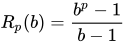
It is easy to show that if n is divisible by a, then Rn(b) is divisible by Ra(b):
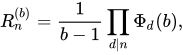
where is the cyclotomic polynomial and d ranges over the divisors of n. For p prime,


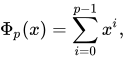
which has the expected form of a repunit when x is substituted with b.
For example, 9 is divisible by 3, and thus R9 is divisible by R3—in fact, 111111111 = 111 · 1001001. The corresponding cyclotomic polynomials and are and , respectively. Thus, for Rn to be prime, n must necessarily be prime, but it is not sufficient for n to be prime. For example, R3 = 111 = 3 · 37 is not prime. Except for this case of R3, p can only divide Rn for prime n if p = 2kn + 1 for some k.


Decimal repunit primes
[edit]Rn is prime for n = 2, 19, 23, 317, 1031, 49081, 86453, 109297 ... (sequence A004023 in OEIS). On July 15, 2007, Maksym Voznyy announced R270343 to be probably prime.[3] Serge Batalov and Ryan Propper found R5794777 and R8177207 to be probable primes on April 20 and May 8, 2021, respectively.[4] As of their discovery, each was the largest known probable prime. On March 22, 2022, probable prime R49081 was eventually proven to be a prime.[5] On May 15, 2023, probable prime R86453 was eventually proven to be a prime.[6] On May 26, 2025, probable prime R109297 was eventually proven to be a prime.[7]
It has been conjectured that there are infinitely many repunit primes[8] and they seem to occur roughly as often as the prime number theorem would predict: the exponent of the Nth repunit prime is generally around a fixed multiple of the exponent of the (N−1)th.
The prime repunits are a trivial subset of the permutable primes, i.e., primes that remain prime after any permutation of their digits.
Particular properties are
- The remainder of Rn modulo 3 is equal to the remainder of n modulo 3. Using 10a ≡ 1 (mod 3) for any a ≥ 0,
n ≡ 0 (mod 3) ⇔ Rn ≡ 0 (mod 3) ⇔ Rn ≡ 0 (mod R3),
n ≡ 1 (mod 3) ⇔ Rn ≡ 1 (mod 3) ⇔ Rn ≡ R1 ≡ 1 (mod R3),
n ≡ 2 (mod 3) ⇔ Rn ≡ 2 (mod 3) ⇔ Rn ≡ R2 ≡ 11 (mod R3).
Therefore, 3 | n ⇔ 3 | Rn ⇔ R3 | Rn. - The remainder of Rn modulo 9 is equal to the remainder of n modulo 9. Using 10a ≡ 1 (mod 9) for any a ≥ 0,
n ≡ r (mod 9) ⇔ Rn ≡ r (mod 9) ⇔ Rn ≡ Rr (mod R9),
for 0 ≤ r < 9.
Therefore, 9 | n ⇔ 9 | Rn ⇔ R9 | Rn.
Algebra factorization of generalized repunit numbers
[edit]If b is a perfect power (can be written as mn, with m, n integers, n > 1) differs from 1, then there is at most one repunit in base-b. If n is a prime power (can be written as pr, with p prime, r integer, p, r >0), then all repunit in base-b are not prime aside from Rp and R2. Rp can be either prime or composite, the former examples, b = −216, −128, 4, 8, 16, 27, 36, 100, 128, 256, etc., the latter examples, b = −243, −125, −64, −32, −27, −8, 9, 25, 32, 49, 81, 121, 125, 144, 169, 196, 216, 225, 243, 289, etc., and R2 can be prime (when p differs from 2) only if b is negative, a power of −2, for example, b = −8, −32, −128, −8192, etc., in fact, the R2 can also be composite, for example, b = −512, −2048, −32768, etc. If n is not a prime power, then no base-b repunit prime exists, for example, b = 64, 729 (with n = 6), b = 1024 (with n = 10), and b = −1 or 0 (with n any natural number). Another special situation is b = −4k4, with k positive integer, which has the aurifeuillean factorization, for example, b = −4 (with k = 1, then R2 and R3 are primes), and b = −64, −324, −1024, −2500, −5184, ... (with k = 2, 3, 4, 5, 6, ...), then no base-b repunit prime exists. It is also conjectured that when b is neither a perfect power nor −4k4 with k positive integer, then there are infinity many base-b repunit primes.
The generalized repunit conjecture
[edit]A conjecture related to the generalized repunit primes:[9][10] (the conjecture predicts where is the next generalized Mersenne prime, if the conjecture is true, then there are infinitely many repunit primes for all bases )

For any integer , which satisfies the conditions:
- .
- is not a perfect power. (since when is a perfect th power, it can be shown that there is at most one value such that is prime, and this value is itself or a root of )
- is not in the form . (if so, then the number has aurifeuillean factorization)


has generalized repunit primes of the form
for prime , the prime numbers will be distributed near the best fit line


where limit ,


and there are about

base-b repunit primes less than N.
- is the base of natural logarithm.
- is Euler–Mascheroni constant.
- is the logarithm in base
- is the th generalized repunit prime in baseb (with prime p)
- is a data fit constant which varies with .
- if , if .
- is the largest natural number such that is a th power.


We also have the following 3 properties:
- The number of prime numbers of the form (with prime ) less than or equal to is about .
- The expected number of prime numbers of the form with prime between and is about .
- The probability that number of the form is prime (for prime ) is about .



History
[edit]Although they were not then known by that name, repunits in base-10 were studied by many mathematicians during the nineteenth century in an effort to work out and predict the cyclic patterns of repeating decimals.[11]
It was found very early on that for any prime p greater than 5, the period of the decimal expansion of 1/p is equal to the length of the smallest repunit number that is divisible by p. Tables of the period of reciprocal of primes up to 60,000 had been published by 1860 and permitted the factorization by such mathematicians as Reuschle of all repunits up to R16 and many larger ones. By 1880, even R17 to R36 had been factored[11] and it is curious that, though Édouard Lucas showed no prime below three million had period nineteen, there was no attempt to test any repunit for primality until early in the twentieth century. The American mathematician Oscar Hoppe proved R19 to be prime in 1916,[12] and Lehmer and Kraitchik independently found R23 to be prime in 1929.
Further advances in the study of repunits did not occur until the 1960s, when computers allowed many new factors of repunits to be found and the gaps in earlier tables of prime periods corrected. R317 was found to be a probable prime circa 1966 and was proved prime eleven years later, when R1031 was shown to be the only further possible prime repunit with fewer than ten thousand digits. It was proven prime in 1986, but searches for further prime repunits in the following decade consistently failed. However, there was a major side-development in the field of generalized repunits, which produced a large number of new primes and probable primes.
Since 1999, four further probably prime repunits have been found, but it is unlikely that any of them will be proven prime in the foreseeable future because of their huge size.
The Cunningham project endeavours to document the integer factorizations of (among other numbers) the repunits to base 2, 3, 5, 6, 7, 10, 11, and 12.
Demlo numbers
[edit]D. R. Kaprekar has defined Demlo numbers as concatenation of a left, middle and right part, where the left and right part must be of the same length (up to a possible leading zero to the left) and must add up to a repdigit number, and the middle part may contain any additional number of this repeated digit.[13] They are named after Demlo railway station (now called Dombivili) 30 miles from Bombay on the then G.I.P. Railway, where Kaprekar started investigating them. He calls Wonderful Demlo numbers those of the form 1, 121, 12321, 1234321, ..., 12345678987654321. The fact that these are the squares of the repunits has led some authors to call Demlo numbers the infinite sequence of these,[14] 1, 121, 12321, ..., 12345678987654321, 1234567900987654321, 123456790120987654321, ..., (sequence A002477 in the OEIS), although one can check these are not Demlo numbers for p = 10, 19, 28, ...
See also
[edit]- All one polynomial — Another generalization
- Goormaghtigh conjecture
- Repeating decimal
- Repdigit
- Wagstaff prime — can be thought of as repunit primes with negative base

Footnotes
[edit]Notes
[edit]- ^ Albert H. Beiler coined the term "repunit number" as follows:
A number which consists of a repeated of a single digit is sometimes called a monodigit number, and for convenience the author has used the term "repunit number" (repeated unit) to represent monodigit numbers consisting solely of the digit 1.[1]
References
[edit]- ^ Beiler 2013, pp. 83
- ^ For more information, see Factorization of repunit numbers.
- ^ Maksym Voznyy, New PRP Repunit R(270343)
- ^ Sloane, N. J. A. (ed.). "Sequence A004023 (Indices of prime repunits: numbers n such that 11...111 (with n 1's) = (10^n - 1)/9 is prime.)". The On-Line Encyclopedia of Integer Sequences. OEIS Foundation.
- ^ "PrimePage Primes: R(49081)". PrimePage Primes. 2022-03-21. Retrieved 2022-03-31.
- ^ "PrimePage Primes: R(86453)". PrimePage Primes. 2023-05-16. Retrieved 2023-05-16.
- ^ "PrimePage Primes: R(109297)". PrimePage Primes. 2025-05-27. Retrieved 2025-05-27.
- ^ Chris Caldwell. "repunit". The Prime Glossary. Prime Pages.
- ^ Deriving the Wagstaff Mersenne Conjecture
- ^ Generalized Repunit Conjecture
- ^ a b Dickson & Cresse 1999, pp. 164–167
- ^ Francis 1988, pp. 240–246
- ^ Kaprekar 1938a, 1938b, Gunjikar & Kaprekar 1939
- ^ Weisstein, Eric W. "Demlo Number". MathWorld.
References
[edit]- Beiler, Albert H. (2013) [1964], Recreations in the Theory of Numbers: The Queen of Mathematics Entertains, Dover Recreational Math (2nd Revised ed.), New York: Dover Publications, ISBN 978-0-486-21096-4
- Dickson, Leonard Eugene; Cresse, G.H. (1999), History of the Theory of Numbers, Volume I: Divisibility and primality (2nd Reprinted ed.), Providence, RI: AMS Chelsea Publishing, ISBN 978-0-8218-1934-0
- Francis, Richard L. (1988), "Mathematical Haystacks: Another Look at Repunit Numbers", The College Mathematics Journal, 19 (3): 240–246, doi:10.1080/07468342.1988.11973120
- Gunjikar, K. R.; Kaprekar, D. R. (1939), "Theory of Demlo numbers" (PDF), Journal of the University of Bombay, VIII (3): 3–9
- Kaprekar, D. R. (1938a), "On Wonderful Demlo numbers", The Mathematics Student, 6: 68
- Kaprekar, D. R. (1938b), "Demlo numbers", J. Phys. Sci. Univ. Bombay, VII (3)
- Kaprekar, D. R. (1948), Demlo numbers, Devlali, India: Khareswada
- Ribenboim, Paulo (1996-02-02), The New Book of Prime Number Records, Computers and Medicine (3rd ed.), New York: Springer, ISBN 978-0-387-94457-9
- Yates, Samuel (1982), Repunits and repetends, FL: Delray Beach, ISBN 978-0-9608652-0-8
External links
[edit]- Weisstein, Eric W. "Repunit". MathWorld.
- The main tables of the Cunningham project.
- Repunit at The Prime Pages by Chris Caldwell.
- Repunits and their prime factors at World!Of Numbers.
- Prime generalized repunits of at least 1000 decimal digits by Andy Steward
- Repunit Primes Project Giovanni Di Maria's repunit primes page.
- Smallest odd prime p such that (b^p-1)/(b-1) and (b^p+1)/(b+1) is prime for bases 2<=b<=1024
- Factorization of repunit numbers
- Generalized repunit primes in base -50 to 50
Classes of natural numbers | |||||||||||||||||||||||||
|---|---|---|---|---|---|---|---|---|---|---|---|---|---|---|---|---|---|---|---|---|---|---|---|---|---|
| |||||||||||||||||||||||||
| |||||||||||||||||||||||||
| |||||||||||||||||||||||||
| |||||||||||||||||||||||||
| |||||||||||||||||||||||||
| |||||||||||||||||||||||||
| |||||||||||||||||||||||||
| |||||||||||||||||||||||||
| |||||||||||||||||||||||||
| |||||||||||||||||||||||||

Repunit
View on GrokipediaDefinition
Decimal Repunits
A decimal repunit is an integer consisting entirely of the digit 1 in base 10, such as 1, 11, or 111.[1] The term "repunit," a portmanteau of "repeated" and "unit," was coined by Albert H. Beiler in his 1966 book Recreations in the Theory of Numbers.[1] The nth decimal repunit, denoted , is the number with exactly n digits all equal to 1.[1] It can be expressed using the formula This arises from the finite geometric series sum .[1] For example:- (1 digit),
- (2 digits),
- (3 digits),
- (4 digits),
- (5 digits),
- (6 digits).[1]
Repunits in Other Bases
A repunit in base , where is an integer, is a number consisting of digits of 1 in base , denoted . This is formally defined as , which represents the sum of a finite geometric series: .[6] When , this reduces to the standard decimal repunit. In other bases, examples include , , and .[6] Notably, for base 2, repunits are Mersenne numbers, as .[6]Properties
Arithmetic Properties
A repunit in base 10 is given by the formula , representing the integer consisting of repeated digits of 1. This expression establishes the basic arithmetic property that . Equivalently, is the partial sum of a geometric series: This summation form highlights the additive structure inherent in the digit expansion of repunits. Repunits possess exactly decimal digits and satisfy , with for large , providing a sense of their exponential growth relative to powers of 10. Additionally, since all digits are identical, repunits are palindromic numbers, reading the same forwards and backwards in base 10.[7] Furthermore, every repunit is a Zuckerman number, defined as a positive integer divisible by the product of its digits in base 10, since the product of its digits is 1, which divides any integer.[8] The sequence of repunits forms a strong divisibility sequence over the integers, satisfying for all positive integers and . As a direct consequence, if divides , then divides . In this case, with , the quotient is which follows from the geometric series formula applied to the defining expressions for and .Algebraic Identities
Repunits possess a natural algebraic structure arising from their polynomial origins. Specifically, the decimal repunit , consisting of ones, is given by , which is the evaluation at of the polynomial . This representation as a geometric series polynomial underscores the repunit's role in algebraic number theory, facilitating connections to broader polynomial factorizations and evaluations.[9] Several fundamental identities govern the algebraic manipulation of repunits. One such identity is the additive relation , which captures the effect of concatenating repunit strings in base 10. A related doubling identity follows: , derived from factoring and dividing by 9. More generally, repunits satisfy the multiplicative identity , where denotes the repunit of length in base ; for instance, the doubling case arises as since . These identities enable systematic construction and decomposition of larger repunits from smaller ones.[9] Repunits are intimately linked to cyclotomic polynomials via the factorization , where is the -th cyclotomic polynomial. Consequently, , providing an algebraic decomposition into irreducible factors over the rationals evaluated at 10. This relation is pivotal for understanding the prime factorization of repunits, as the cyclotomic components often yield algebraic factorizations, including Aurifeuillian types for specific lengths where splits non-trivially.[9] The lifting the exponent lemma (LTE) finds applications in determining the p-adic valuations of repunits, particularly for primes p dividing . For odd primes p not dividing 10, under conditions where the multiplicative order of 10 modulo p divides n but not proper divisors, LTE provides formulas like , where d is the order, allowing computation of . This tool is essential for analyzing the exact multiplicity of primes in repunit factorizations without exhaustive computation.[9]Factorization
Factorization of Decimal Repunits
Decimal repunits are composite for all composite , as they possess algebraic factors derived from the cyclotomic polynomials underlying their form; specifically, if divides with , then divides , yielding a quotient greater than 1.[1] This structural property ensures that only repunits with prime can possibly be prime, though most such cases are also composite.[1] Certain divisibility patterns by small primes recur in these factorizations. For instance, if 3 divides , then 3 divides , because the sum of its digits equals , which is divisible by 3.[10] If is even, 11 divides , since the alternating sum of digits is zero.[10] Primes like 37 and 271 also appear frequently, often when is a multiple of 3 or 5, respectively, reflecting the repetitive nature of the repunit's decimal expansion.[11] The prime factorizations of small decimal repunits illustrate these patterns, with increasing complexity as grows. The table below lists the complete factorizations for to 20, where primes are shown without exponents if equal to 1, and and are noted as prime.[10]| Factorization | |
|---|---|
| 1 | 1 |
| 2 | 11 (prime) |
| 3 | |
| 4 | |
| 5 | |
| 6 | |
| 7 | |
| 8 | |
| 9 | |
| 10 | |
| 11 | |
| 12 | |
| 13 | |
| 14 | |
| 15 | |
| 16 | |
| 17 | |
| 18 | |
| 19 | Prime |
| 20 |
Factorization of Generalized Repunits
Generalized repunits, denoted for integer base and positive integer , admit a fundamental factorization in terms of cyclotomic polynomials. Specifically, , where is the -th cyclotomic polynomial, leading to .[9] This decomposition provides an algebraic structure that reveals the primitive prime factors associated with the divisors of , facilitating systematic factorization approaches beyond trial division. When is composite, further algebraic factorizations are possible. For any divisor of , divides , and the quotient is given by , where the sum has terms.[9] This identity allows recursive decomposition: for instance, if , then . Such factorizations are particularly useful when is a perfect power, as they yield non-trivial algebraic splits even for prime ; for example, if with , then often factors into terms involving lower powers of .[9] Illustrative examples highlight these methods. In base 2, , known as Mersenne numbers, which factor according to the cyclotomic product and have been extensively studied for their prime factors when is prime.[14] In base 3, small cases include (composite) and (prime), while demonstrates the composite divisor factorization with .[15] For , , aligning with the product .[9] Beyond basic cyclotomic and divisor-based splits, generalized repunits benefit from aurifeuillean-like identities, which provide unexpected non-trivial factorizations of or its repunit quotients for specific bases and exponents. These identities, extensions of classical aurifeuillean factorizations for forms like , apply to various by identifying when cyclotomic factors admit further algebraic decomposition into integer polynomials evaluated at .[16] For instance, in bases where satisfies certain quadratic or higher relations, such as powers of small integers, these yield efficient splits comparable to those for base-10 repunits but generalized across bases. Factoring large base- repunits presents significant computational challenges, as the numbers grow exponentially and algebraic methods alone may not suffice for complete prime factorization. In base 4, leverages the perfect power structure () for initial splits like , but evaluating and factoring the resulting large terms requires advanced techniques such as elliptic curve methods or distributed computing.[15] Similarly, in base 16 (), algebraic identities from the power structure allow partial factorization, yet the immense size—for example, has over 10 digits in base 10—demands high-performance sieving and multiprecision arithmetic, often leaving probable primes unverified without specialized primality tests.[9] These difficulties underscore the need for tailored algorithms in number theory software to handle non-decimal bases effectively.Repunit Primes
Decimal Repunit Primes
A decimal repunit prime is a repunit in base 10, denoted , that is also a prime number. These numbers consist entirely of the digit 1 repeated times and are among the rarest forms of large primes due to their repetitive structure, which often facilitates factorization for composite cases. As of November 2025, exactly eight such primes have been rigorously proven, with the largest having 109,297 digits. Additionally, three probable primes (PRPs) are known, identified through probabilistic testing but not yet formally proven; the largest of these has 8,177,207 digits.[5][4] The proven decimal repunit primes are listed in the following table, ordered by increasing . For small , primality can be verified using elementary methods like trial division up to the square root of , which is feasible for given the computational resources available at the time of discovery. Larger ones, such as , required more advanced techniques like the Lucas-Lehmer test adapted for repunits or early implementations of elliptic curve methods.[4][17]| Digits | Discovery Year | Discoverer(s) / Prover(s) | |
|---|---|---|---|
| 2 | 2 | Ancient | Known since antiquity (e.g., Euclid's era) |
| 19 | 19 | 1910s | Proven via trial division |
| 23 | 23 | 1910s | Proven via trial division |
| 317 | 317 | 1950s | Proven via early computational checks |
| 1031 | 1031 | 1985 | Harvey Dubner, Hugh C. Williams (proven) |
| 49081 | 49081 | 1999 | Harvey Dubner (PRP); Paul Underwood (2022, ECPP proof) |
| 86453 | 86453 | 2000 | Lew Baxter (PRP); Andreas Enge (2023, ECPP proof) |
| 109297 | 109297 | 2007 | J. Bourdelais, Harvey Dubner (PRP); Paul Underwood, Andreas Enge (2025, ECPP proof) |
Generalized Repunit Primes
Generalized repunit primes are prime numbers of the form for integers and , where the number consists entirely of the digit 1 when written in base . These extend the concept of repunits beyond base 10 to arbitrary bases greater than 1. A key case occurs in base , where yields the Mersenne numbers; such a repunit is prime if and only if it is a Mersenne prime, which requires to be prime, though not conversely. It is conjectured that infinitely many Mersenne primes exist. As of November 2025, the largest known Mersenne prime is , with 41,024,320 decimal digits, discovered by the Great Internet Mersenne Prime Search (GIMPS).[19] In bases other than 2, repunit primes are less frequent and often limited. For base 3, is composite and is trivial, but non-trivial examples include , which is prime; known exponents yielding primes are 3, 7, 13, 71, and 103. In base 4, the sole known repunit prime is the non-trivial . Base 6 features as prime. Broader searches up to base 20 reveal sporadic occurrences; for example, in base 11, repunit primes exist for certain larger prime exponents such as n=17; overall, many bases have few or no known repunit primes beyond small n. Decimal repunit primes represent a specific subset for .[20] The smallest non-trivial repunit primes per base up to 10 are summarized below, highlighting base-specific patterns where small n often suffice for primality in even bases but require larger n in odd bases greater than 3:| Base | Smallest | Prime |
|---|---|---|
| 2 | 2 | 3 |
| 3 | 3 | 13 |
| 4 | 2 | 5 |
| 5 | 3 | 31 |
| 6 | 2 | 7 |
| 7 | 5 | 2801 |
| 8 | 3 | 73 |
| 9 | None known | - |
| 10 | 2 | 11 |
Conjectures and Open Problems
One of the central conjectures in the study of repunit primes is that there are infinitely many such primes in base 10, where a repunit prime is prime for infinitely many positive integers . This conjecture is supported by the observed distribution of the known repunit primes, which aligns with the expected rarity predicted by the prime number theorem for numbers of this form, suggesting a logarithmic density that decreases with increasing but remains positive overall.[5] A generalization of this conjecture extends to arbitrary bases: for any fixed integer base , there are infinitely many such that the generalized repunit is prime. This broader statement remains unproven, including specifically for , and its resolution would have implications across number theory, particularly in understanding the primality of cyclotomic-related sequences.[22][23] Open problems surrounding repunit primes include determining whether , proven prime in May 2025 via the elliptic curve primality proving method, is the largest definitively established base-10 repunit prime to date. Larger candidates, such as , have been verified as probable primes through Miller-Rabin and other probabilistic tests but lack a complete deterministic proof, leaving their status unresolved.[5] While the mainstream view in number theory favors the infinitude of base-10 repunit primes, a small number of non-peer-reviewed papers have proposed arguments for their finiteness, often relying on heuristic density arguments or unverified sieve methods; however, these claims have not gained acceptance due to flaws in their proofs and contradiction with empirical evidence from larger probable primes. The infinitude conjecture also intersects with broader analytic frameworks, such as the Bunyakovsky conjecture, which posits infinitely many primes from irreducible polynomials with positive leading coefficients and no fixed prime divisors; although repunits are not directly polynomial in , related primality tests for repunit-like forms draw indirect implications from such hypotheses in exploring algebraic factorizations.[5]History
Early History
Interest in numbers consisting entirely of the digit 1, now known as repunits, emerged in the 19th century as part of broader efforts in number theory to identify primes and explore factorizations. These "strings of ones," as they were informally called before formal nomenclature, attracted attention due to their connection to the decimal expansions of reciprocals and cyclic numbers. For instance, the two-digit repunit 11 was recognized as prime long before systematic study.[24] By the late 19th century, mathematicians had begun factoring larger examples, revealing algebraic patterns tied to the divisors of . This work laid the groundwork for understanding repunit structure, though the numbers were not yet termed repunits. Early prime discoveries included the 19-digit repunit , proved prime by Oscar Hoppe in 1916 after extensive manual computation.[25] In the early 20th century, further progress in prime hunting identified additional repunit primes, such as , independently verified by D. N. Lehmer and M. Kraitchik in 1929. These findings highlighted the rarity of such primes and spurred interest in their properties among recreational and theoretical mathematicians. Pre-1960s literature often referred to them simply as repeated units in discussions of probable primes and factorization challenges. Around 1966, was identified as a probable prime, and in 1978, Hugh C. Williams proved it to be prime.[25] The term "repunit," a contraction of "repeated unit," was coined by Albert H. Beiler in his 1966 book Recreations in the Theory of Numbers, where he popularized the concept and provided the first tabulated list of known factors for decimal repunits up to significant lengths. Beiler's work marked a turning point, shifting informal observations into a more structured field of study.[1]Modern Developments
In the 1980s and 1990s, significant progress in repunit prime research was driven by computational efforts, culminating in the proof that , a 1031-digit repunit, is prime, established by Harvey Dubner and Hugh C. Williams using advanced primality testing methods.[26] This marked the largest proven repunit prime at the time and highlighted the feasibility of verifying such large numbers through deterministic algorithms. Building on this, distributed computing initiatives in the early 2000s identified additional probable primes, such as in 1999 by Dubner, which was later rigorously proven prime in 2022 by Paul Underwood using the ECPP implementation Primo.[27] Similarly, , discovered as a probable prime in 2000 by Lew Baxter, was proven prime in 2023 by Andreas Enge employing complex multiplication techniques integrated with ECPP.[28] The 2010s and early 2020s saw further advances through adaptations of distributed computing frameworks, including those inspired by the Great Internet Mersenne Prime Search (GIMPS). In May 2021, Ryan Propper and Serge Batalov announced , a probable prime with over 8 million digits, identified via optimized probabilistic tests on high-performance computing clusters.[10] Enhancements in ECPP, such as improved elliptic curve selection and certificate generation, have enabled efficient verification of these massive candidates, though no new proven base-10 repunit primes have emerged since 2023; instead, searches have focused on testing even larger probable primes exceeding 10 million digits.[27] Theoretically, a 2021 paper by Jon Grantham and Hester Graves explored connections between repunits and the ABC conjecture, demonstrating that under the conjecture with , only finitely many s-Cullen numbers can be repunits of length three or greater, aside from known exceptions, thus implying bounds on overlaps between repunit sequences and other special forms.[29] As of November 2025, ongoing searches continue through projects like PrimeGrid, which leverage volunteer computing for prime hunting in special forms, increasingly incorporating GPU acceleration for faster sieving and probabilistic primality testing of repunit candidates.[30]Related Concepts
Numbers of the form
Numbers of the form form a sequence of integers characterized by digits alternating between 1 and 0, starting and ending with 1, such as 1, 101, 10101, and 1010101 (OEIS A094028). These numbers feature an increasing number of 1's separated by single 0's, making them a variant of repunit-like structures with embedded zeros.[31] The nth term , consisting of n ones, is given by the closed-form formula This expression arises from the geometric series sum , reflecting the positions of the 1's at even powers of 10. For instance, , , , and . These numbers relate to standard decimal repunits through the identity , as 11 divides for .[31][32] These numbers exhibit interesting factorization properties, with primality limited to small values. The number is trivial and not considered prime, while is prime. Larger terms are composite: for example, , , and . In general, for , factors algebraically, often using the form , where both factors exceed 1 when n is odd and greater than 1, or via other cyclotomic decompositions for even n. It is known that 101 is the only prime in the sequence.[31][33][32] The study of these numbers originates in recreational mathematics, with the sequence appearing in problems exploring primality and factorization patterns, such as in the 1989 Putnam exam (problem A1).[32]Other Repdigit Numbers
Repdigit numbers are positive integers in base 10 composed entirely of the same digit , where ranges from 1 to 9, repeated times. These generalize repunits, which correspond to the case . The value of such a repdigit is given by the formula , where denotes the repunit of ones.[34] For and , repdigits are always composite, as they factor non-trivially into and , both integers greater than 1.[35] Consequently, the only repdigit primes are the single-digit primes 2, 3, 5, and 7.[35] This starkly contrasts with repunits, where multi-digit primes exist but are rare, with only finitely many known as of 2025, and it remains an open question whether there are infinitely many.[35] The factorization properties of these repdigits inherit much from those of repunits, often involving evaluations of cyclotomic polynomials at 10, scaled by . For example, the repdigit 888 (three 8's) equals , and longer all-8's repdigits follow analogous algebraic factorizations derived from the cyclotomic decomposition of .[9] In general, while may introduce additional prime factors or share divisors with components of , the core structure remains multiplicative and tied to the divisor properties of .[9]References
- https://proofwiki.org/wiki/Repunit_is_Zuckerman_Number