Hubbry Logo
search
logo
2233822

Root system

logo
Community Hub0 Subscribers
Read side by side
from Wikipedia

In mathematics, a root system is a configuration of vectors in a Euclidean space satisfying certain geometrical properties. The concept is fundamental in the theory of Lie groups and Lie algebras, especially the classification and representation theory of semisimple Lie algebras. Since Lie groups (and some analogues such as algebraic groups) and Lie algebras have become important in many parts of mathematics during the twentieth century, the apparently special nature of root systems belies the number of areas in which they are applied. Further, the classification scheme for root systems, by Dynkin diagrams, occurs in parts of mathematics with no overt connection to Lie theory (such as singularity theory). Finally, root systems are important for their own sake, as in spectral graph theory.[1]

Definitions and examples

[edit]
The six vectors of the root system A2

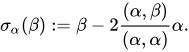
As a first example, consider the six vectors in 2-dimensional Euclidean space, R2, as shown in the image at the right; call them roots. These vectors span the whole space. If you consider the line perpendicular to any root, say β, then the reflection of R2 in that line sends any other root, say α, to another root. Moreover, the root to which it is sent equals α + , where n is an integer (in this case, n equals 1). These six vectors satisfy the following definition, and therefore they form a root system; this one is known as A2.

Definition

[edit]

Let E be a finite-dimensional Euclidean vector space, with the standard Euclidean inner product denoted by . A root system in E is a finite set of non-zero vectors (called roots) that satisfy the following conditions:[2][3]

  1. The roots span E.
  2. The only scalar multiples of a root that belong to are itself and .
  3. For every root , the set is closed under reflection through the hyperplane perpendicular to .
  4. (Integrality) If and are roots in , then the projection of onto the line through is an integer or half-integer multiple of .

Equivalent ways of writing conditions 3 and 4, respectively, are as follows:

  1. For any two roots , the set contains the element
  2. For any two roots , the number is an integer.

Some authors only include conditions 1–3 in the definition of a root system.[4] In this context, a root system that also satisfies the integrality condition is known as a crystallographic root system.[5] Other authors omit condition 2; then they call root systems satisfying condition 2 reduced.[6] In this article, all root systems are assumed to be reduced and crystallographic.

In view of property 3, the integrality condition is equivalent to stating that β and its reflection σα(β) differ by an integer multiple of α. Note that the operator defined by property 4 is not an inner product. It is not necessarily symmetric and is linear only in the first argument.

Rank-2 root systems
Root system A1 + A1 Root system D2
Root system
Root system
Root system A2 Root system G2
Root system
Root system
Root system B2 Root system C2
Root system
Root system

The rank of a root system Φ is the dimension of E. Two root systems may be combined by regarding the Euclidean spaces they span as mutually orthogonal subspaces of a common Euclidean space. A root system which does not arise from such a combination, such as the systems A2, B2, and G2 pictured to the right, is said to be irreducible.

Two root systems (E1, Φ1) and (E2, Φ2) are called isomorphic if there is an invertible linear transformation E1 → E2 which sends Φ1 to Φ2 such that for each pair of roots, the number is preserved.[7]

The root lattice of a root system Φ is the Z-submodule of E generated by Φ. It is a lattice in E.

Weyl group

[edit]
The Weyl group of the root system is the symmetry group of an equilateral triangle

The group of isometries of E generated by reflections through hyperplanes associated to the roots of Φ is called the Weyl group of Φ. As it acts faithfully on the finite set Φ, the Weyl group is always finite. The reflection planes are the hyperplanes perpendicular to the roots, indicated for by dashed lines in the figure below. The Weyl group is the symmetry group of an equilateral triangle, which has six elements. In this case, the Weyl group is not the full symmetry group of the root system (e.g., a 60-degree rotation is a symmetry of the root system but not an element of the Weyl group).

Rank one example

[edit]

There is only one root system of rank 1, consisting of two nonzero vectors . This root system is called .

Rank two examples

[edit]

In rank 2 there are four possibilities, corresponding to , where .[8] The figure at right shows these possibilities, but with some redundancies: is isomorphic to and is isomorphic to .

Note that a root system is not determined by the lattice that it generates: and both generate a square lattice while and both generate a hexagonal lattice.

Whenever Φ is a root system in E, and S is a subspace of E spanned by Ψ = Φ ∩ S, then Ψ is a root system in S. Thus, the exhaustive list of four root systems of rank 2 shows the geometric possibilities for any two roots chosen from a root system of arbitrary rank. In particular, two such roots must meet at an angle of 0, 30, 45, 60, 90, 120, 135, 150, or 180 degrees.

Root systems arising from semisimple Lie algebras

[edit]

If is a complex semisimple Lie algebra and is a Cartan subalgebra, we can construct a root system as follows. We say that is a root of relative to if and there exists some such that for all . One can show[9] that there is an inner product for which the set of roots forms a root system. The root system of is a fundamental tool for analyzing the structure of and classifying its representations. (See the section below on Root systems and Lie theory.)

History

[edit]

The concept of a root system was originally introduced by Wilhelm Killing around 1889 (in German, Wurzelsystem[10]).[11] He used them in his attempt to classify all simple Lie algebras over the field of complex numbers. (Killing originally made a mistake in the classification, listing two exceptional rank 4 root systems, when in fact there is only one, now known as F4. Cartan later corrected this mistake, by showing Killing's two root systems were isomorphic.[12])

Killing investigated the structure of a Lie algebra by considering what is now called a Cartan subalgebra . Then he studied the roots of the characteristic polynomial , where . Here a root is considered as a function of , or indeed as an element of the dual vector space . This set of roots forms a root system inside , as defined above, where the inner product is the Killing form.[11]

Elementary consequences of the root system axioms

[edit]
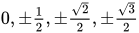
The integrality condition for is fulfilled only for β on one of the vertical lines, while the integrality condition for is fulfilled only for β on one of the red circles. Any β perpendicular to α (on the Y axis) trivially fulfills both with 0, but does not define an irreducible root system.
Modulo reflection, for a given α there are only 5 nontrivial possibilities for β, and 3 possible angles between α and β in a set of simple roots. Subscript letters correspond to the series of root systems for which the given β can serve as the first root and α as the second root (or in F4 as the middle 2 roots).


The cosine of the angle between two roots is constrained to be one-half of the square root of a positive integer. This is because and are both integers, by assumption, and

Since , the only possible values for are and , corresponding to angles of 90°, 60° or 120°, 45° or 135°, 30° or 150°, and 0° or 180°. Condition 2 says that no scalar multiples of α other than 1 and −1 can be roots, so 0 or 180°, which would correspond to 2α or −2α, are out. The diagram at right shows that an angle of 60° or 120° corresponds to roots of equal length, while an angle of 45° or 135° corresponds to a length ratio of and an angle of 30° or 150° corresponds to a length ratio of .

In summary, here are the only possibilities for each pair of roots.[13]

  • Angle of 90 degrees; in that case, the length ratio is unrestricted.
  • Angle of 60 or 120 degrees, with a length ratio of 1.
  • Angle of 45 or 135 degrees, with a length ratio of .
  • Angle of 30 or 150 degrees, with a length ratio of .

Positive roots and simple roots

[edit]
The labeled roots are a set of positive roots for the root system, with and being the simple roots

Given a root system we can always choose (in many ways) a set of positive roots. This is a subset of such that

  • For each root exactly one of the roots , is contained in .
  • For any two distinct such that is a root, .

If a set of positive roots is chosen, elements of are called negative roots. A set of positive roots may be constructed by choosing a hyperplane not containing any root and setting to be all the roots lying on a fixed side of . Furthermore, every set of positive roots arises in this way.[14]

An element of is called a simple root (also fundamental root) if it cannot be written as the sum of two elements of . (The set of simple roots is also referred to as a base for .) The set of simple roots is a basis of with the following additional special properties:[15]

  • Every root is a linear combination of elements of with integer coefficients.
  • For each , the coefficients in the previous point are either all non-negative or all non-positive.

For each root system there are many different choices of the set of positive roots—or, equivalently, of the simple roots—but any two sets of positive roots differ by the action of the Weyl group.[16]

Dual root system, coroots, and integral elements

[edit]

The dual root system

[edit]

If Φ is a root system in E, the coroot α of a root α is defined by

The set of coroots also forms a root system Φ in E, called the dual root system (or sometimes inverse root system). By definition, α∨ ∨ = α, so that Φ is the dual root system of Φ. The lattice in E spanned by Φ is called the coroot lattice. Both Φ and Φ have the same Weyl group W and, for s in W,

If Δ is a set of simple roots for Φ, then Δ is a set of simple roots for Φ.[17]

In the classification described below, the root systems of type and along with the exceptional root systems are all self-dual, meaning that the dual root system is isomorphic to the original root system. By contrast, the and root systems are dual to one another, but not isomorphic (except when ).

Integral elements

[edit]

A vector in E is called integral[18] if its inner product with each coroot is an integer: Since the set of with forms a base for the dual root system, to verify that is integral, it suffices to check the above condition for .

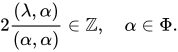
The set of integral elements is called the weight lattice associated to the given root system. This term comes from the representation theory of semisimple Lie algebras, where the integral elements form the possible weights of finite-dimensional representations.

The definition of a root system guarantees that the roots themselves are integral elements. Thus, every integer linear combination of roots is also integral. In most cases, however, there will be integral elements that are not integer combinations of roots. That is to say, in general the weight lattice does not coincide with the root lattice.

Classification of root systems by Dynkin diagrams

[edit]
Pictures of all the connected Dynkin diagrams

A root system is irreducible if it cannot be partitioned into the union of two proper subsets , such that for all and .

Irreducible root systems correspond to certain graphs, the Dynkin diagrams named after Eugene Dynkin. The classification of these graphs is a simple matter of combinatorics, and induces a classification of irreducible root systems.

Constructing the Dynkin diagram

[edit]

Given a root system, select a set Δ of simple roots as in the preceding section. The vertices of the associated Dynkin diagram correspond to the roots in Δ. Edges are drawn between vertices as follows, according to the angles. (Note that the angle between simple roots is always at least 90 degrees.)

  • No edge if the vectors are orthogonal,
  • An undirected single edge if they make an angle of 120 degrees,
  • A directed double edge if they make an angle of 135 degrees, and
  • A directed triple edge if they make an angle of 150 degrees.

The term "directed edge" means that double and triple edges are marked with an arrow pointing toward the shorter vector. (Thinking of the arrow as a "greater than" sign makes it clear which way the arrow is supposed to point.)

Note that by the elementary properties of roots noted above, the rules for creating the Dynkin diagram can also be described as follows. No edge if the roots are orthogonal; for nonorthogonal roots, a single, double, or triple edge according to whether the length ratio of the longer to shorter is 1, , . In the case of the root system for example, there are two simple roots at an angle of 150 degrees (with a length ratio of ). Thus, the Dynkin diagram has two vertices joined by a triple edge, with an arrow pointing from the vertex associated to the longer root to the other vertex. (In this case, the arrow is a bit redundant, since the diagram is equivalent whichever way the arrow goes.)

Classifying root systems

[edit]

Although a given root system has more than one possible set of simple roots, the Weyl group acts transitively on such choices.[19] Consequently, the Dynkin diagram is independent of the choice of simple roots; it is determined by the root system itself. Conversely, given two root systems with the same Dynkin diagram, one can match up roots, starting with the roots in the base, and show that the systems are in fact the same.[20]

Thus the problem of classifying root systems reduces to the problem of classifying possible Dynkin diagrams. A root systems is irreducible if and only if its Dynkin diagram is connected.[21] The possible connected diagrams are as indicated in the figure. The subscripts indicate the number of vertices in the diagram (and hence the rank of the corresponding irreducible root system).

If is a root system, the Dynkin diagram for the dual root system is obtained from the Dynkin diagram of by keeping all the same vertices and edges, but reversing the directions of all arrows. Thus, we can see from their Dynkin diagrams that and are dual to each other.

Weyl chambers and the Weyl group

[edit]
The shaded region is the fundamental Weyl chamber for the base

If is a root system, we may consider the hyperplane perpendicular to each root . Recall that denotes the reflection about the hyperplane and that the Weyl group is the group of transformations of generated by all the 's. The complement of the set of hyperplanes is disconnected, and each connected component is called a Weyl chamber. If we have fixed a particular set Δ of simple roots, we may define the fundamental Weyl chamber associated to Δ as the set of points such that for all .

Since the reflections preserve , they also preserve the set of hyperplanes perpendicular to the roots. Thus, each Weyl group element permutes the Weyl chambers.

The figure illustrates the case of the root system. The "hyperplanes" (in this case, one dimensional) orthogonal to the roots are indicated by dashed lines. The six 60-degree sectors are the Weyl chambers and the shaded region is the fundamental Weyl chamber associated to the indicated base.

A basic general theorem about Weyl chambers is this:[22]

Theorem: The Weyl group acts freely and transitively on the Weyl chambers. Thus, the order of the Weyl group is equal to the number of Weyl chambers.

In the case, for example, the Weyl group has six elements and there are six Weyl chambers.

A related result is this one:[23]

Theorem: Fix a Weyl chamber . Then for all , the Weyl-orbit of contains exactly one point in the closure of .

Root systems and Lie theory

[edit]

Irreducible root systems classify a number of related objects in Lie theory, notably the following:

In each case, the roots are non-zero weights of the adjoint representation.

We now give a brief indication of how irreducible root systems classify simple Lie algebras over , following the arguments in Humphreys.[24] A preliminary result says that a semisimple Lie algebra is simple if and only if the associated root system is irreducible.[25] We thus restrict attention to irreducible root systems and simple Lie algebras.

  • First, we must establish that for each simple algebra there is only one root system. This assertion follows from the result that the Cartan subalgebra of is unique up to automorphism,[26] from which it follows that any two Cartan subalgebras give isomorphic root systems.
  • Next, we need to show that for each irreducible root system, there can be at most one Lie algebra, that is, that the root system determines the Lie algebra up to isomorphism.[27]
  • Finally, we must show that for each irreducible root system, there is an associated simple Lie algebra. This claim is obvious for the root systems of type A, B, C, and D, for which the associated Lie algebras are the classical Lie algebras. It is then possible to analyze the exceptional algebras in a case-by-case fashion. Alternatively, one can develop a systematic procedure for building a Lie algebra from a root system, using Serre's relations.[28]

For connections between the exceptional root systems and their Lie groups and Lie algebras see E8, E7, E6, F4, and G2.

Properties of the irreducible root systems

[edit]
Φ |Φ| |Φ<| I D |W|
An (n ≥ 1) n(n + 1) n + 1 (n + 1)!
Bn (n ≥ 2) 2n2 2n 2 2 2n n!
Cn (n ≥ 3) 2n2 2n(n − 1) 2n−1 2 2n n!
Dn (n ≥ 4) 2n(n − 1) 4 2n−1 n!
E6 72 3 51840
E7 126 2 2903040
E8 240 1 696729600
F4 48 24 4 1 1152
G2 12 6 3 1 12

Irreducible root systems are named according to their corresponding connected Dynkin diagrams. There are four infinite families (An, Bn, Cn, and Dn, called the classical root systems) and five exceptional cases (the exceptional root systems). The subscript indicates the rank of the root system.

In an irreducible root system there can be at most two values for the length (α, α)1/2, corresponding to short and long roots. If all roots have the same length they are taken to be long by definition and the root system is said to be simply laced; this occurs in the cases A, D and E. Any two roots of the same length lie in the same orbit of the Weyl group. In the non-simply laced cases B, C, G and F, the root lattice is spanned by the short roots and the long roots span a sublattice, invariant under the Weyl group, equal to r2/2 times the coroot lattice, where r is the length of a long root.

In the adjacent table, |Φ<| denotes the number of short roots, I denotes the index in the root lattice of the sublattice generated by long roots, D denotes the determinant of the Cartan matrix, and |W| denotes the order of the Weyl group.

Explicit construction of the irreducible root systems

[edit]

An

[edit]
Model of the root system in the Zometool system
Simple roots in A3
e1 e2 e3 e4
α1 1 −1 0 0
α2 0 1 −1 0
α3 0 0 1 −1

Let E be the subspace of Rn+1 for which the coordinates sum to 0, and let Φ be the set of vectors in E of length 2 and which are integer vectors, i.e. have integer coordinates in Rn+1. Such a vector must have all but two coordinates equal to 0, one coordinate equal to 1, and one equal to −1, so there are n2 + n roots in all. One choice of simple roots expressed in the standard basis is αi = eiei+1 for 1 ≤ in.

The reflection σi through the hyperplane perpendicular to αi is the same as permutation of the adjacent ith and (i + 1)th coordinates. Such transpositions generate the full permutation group. For adjacent simple roots, σi(αi+1) = αi+1 + αiσi+1(αi) = αi + αi+1, that is, reflection is equivalent to adding a multiple of 1; but reflection of a simple root perpendicular to a nonadjacent simple root leaves it unchanged, differing by a multiple of 0.

The An root lattice – that is, the lattice generated by the An roots – is most easily described as the set of integer vectors in Rn+1 whose components sum to zero.

The A2 root lattice is the vertex arrangement of the triangular tiling.

The A3 root lattice is known to crystallographers as the face-centered cubic (or cubic close packed) lattice.[29] It is the vertex arrangement of the tetrahedral-octahedral honeycomb.

The A3 root system (as well as the other rank-three root systems) may be modeled in the Zometool construction set.[30]

In general, the An root lattice is the vertex arrangement of the n-dimensional simplicial honeycomb.

Bn

[edit]
Simple roots in B4
e1 e2 e3 e4
α1  1 −1 0 0
α2 0   1 −1 0
α3 0 0  1 −1
α4 0 0 0  1

Let E = Rn, and let Φ consist of all integer vectors in E of length 1 or 2. The total number of roots is 2n2. One choice of simple roots is αi = eiei+1 for 1 ≤ in – 1 (the above choice of simple roots for An−1), and the shorter root αn = en.

The reflection σn through the hyperplane perpendicular to the short root αn is of course simply negation of the nth coordinate. For the long simple root αn−1, σn−1(αn) = αn + αn−1, but for reflection perpendicular to the short root, σn(αn−1) = αn−1 + 2αn, a difference by a multiple of 2 instead of 1.

The Bn root lattice—that is, the lattice generated by the Bn roots—consists of all integer vectors.

B1 is isomorphic to A1 via scaling by 2, and is therefore not a distinct root system.

Cn

[edit]
Root system B3, C3, and A3 = D3 as points within a cube and octahedron
Simple roots in C4
e1 e2 e3 e4
α1  1 −1 0 0
α2 0  1 −1 0
α3 0 0  1 −1
α4 0 0 0  2

Let E = Rn, and let Φ consist of all integer vectors in E of length 2 together with all vectors of the form 2λ, where λ is an integer vector of length 1. The total number of roots is 2n2. One choice of simple roots is: αi = eiei+1, for 1 ≤ in − 1 (the above choice of simple roots for An−1), and the longer root αn = 2en. The reflection σn(αn−1) = αn−1 + αn, but σn−1(αn) = αn + 2αn−1.

The Cn root lattice—that is, the lattice generated by the Cn roots—consists of all integer vectors whose components sum to an even integer.

C2 is isomorphic to B2 via scaling by 2 and a 45 degree rotation, and is therefore not a distinct root system.

Dn

[edit]
Simple roots in D4
e1 e2 e3 e4
α1  1 −1 0 0
α2 0  1 −1 0
α3 0 0  1 −1
α4 0 0  1  1

Let E = Rn, and let Φ consist of all integer vectors in E of length 2. The total number of roots is 2n(n − 1). One choice of simple roots is αi = eiei+1 for 1 ≤ in − 1 (the above choice of simple roots for An−1) together with αn = en−1 + en.

Reflection through the hyperplane perpendicular to αn is the same as transposing and negating the adjacent n-th and (n − 1)-th coordinates. Any simple root and its reflection perpendicular to another simple root differ by a multiple of 0 or 1 of the second root, not by any greater multiple.

The Dn root lattice – that is, the lattice generated by the Dn roots – consists of all integer vectors whose components sum to an even integer. This is the same as the Cn root lattice.

The Dn roots are expressed as the vertices of a rectified n-orthoplex, Coxeter–Dynkin diagram: .... The 2n(n − 1) vertices exist in the middle of the edges of the n-orthoplex.

D3 coincides with A3, and is therefore not a distinct root system. The twelve D3 root vectors are expressed as the vertices of , a lower symmetry construction of the cuboctahedron.

D4 has additional symmetry called triality. The twenty-four D4 root vectors are expressed as the vertices of , a lower symmetry construction of the 24-cell.

E6, E7, E8

[edit]

72 vertices of 122 represent the root vectors of E6
(Green nodes are doubled in this E6 Coxeter plane projection)

126 vertices of 231 represent the root vectors of E7

240 vertices of 421 represent the root vectors of E8
  • The E8 root system is any set of vectors in R8 that is congruent to the following set:

The root system has 240 roots. The set just listed is the set of vectors of length 2 in the E8 root lattice, also known simply as the E8 lattice or Γ8. This is the set of points in R8 such that:

  1. all the coordinates are integers or all the coordinates are half-integers (a mixture of integers and half-integers is not allowed), and
  2. the sum of the eight coordinates is an even integer.

Thus,

  • The root system E7 is the set of vectors in E8 that are perpendicular to a fixed root in E8. The root system E7 has 126 roots.
  • The root system E6 is not the set of vectors in E7 that are perpendicular to a fixed root in E7, indeed, one obtains D6 that way. However, E6 is the subsystem of E8 perpendicular to two suitably chosen roots of E8. The root system E6 has 72 roots.
Simple roots in E8: even coordinates
1 −1 0 0 0 0 0 0
0 1 −1 0 0 0 0 0
0 0 1 −1 0 0 0 0
0 0 0 1 −1 0 0 0
0 0 0 0 1 −1 0 0
0 0 0 0 0 1 −1 0
0 0 0 0 0 1 1 0
1/2 1/2 1/2 1/2 1/2 1/2 1/2 1/2

An alternative description of the E8 lattice which is sometimes convenient is as the set Γ'8 of all points in R8 such that

  • all the coordinates are integers and the sum of the coordinates is even, or
  • all the coordinates are half-integers and the sum of the coordinates is odd.

The lattices Γ8 and Γ'8 are isomorphic; one may pass from one to the other by changing the signs of any odd number of coordinates. The lattice Γ8 is sometimes called the even coordinate system for E8 while the lattice Γ'8 is called the odd coordinate system.

One choice of simple roots for E8 in the even coordinate system with rows ordered by node order in the alternate (non-canonical) Dynkin diagrams (above) is:

αi = eiei+1, for 1 ≤ i ≤ 6, and
α7 = e7 + e6

(the above choice of simple roots for D7) along with

Simple roots in E8: odd coordinates
1 −1 0 0 0 0 0 0
0 1 −1 0 0 0 0 0
0 0 1 −1 0 0 0 0
0 0 0 1 −1 0 0 0
0 0 0 0 1 −1 0 0
0 0 0 0 0 1 −1 0
0 0 0 0 0 0 1 −1
1/2 1/2 1/2 1/2 1/2  1/2  1/2  1/2

One choice of simple roots for E8 in the odd coordinate system with rows ordered by node order in alternate (non-canonical) Dynkin diagrams (above) is

αi = eiei+1, for 1 ≤ i ≤ 7

(the above choice of simple roots for A7) along with

α8 = β5, where

(Using β3 would give an isomorphic result. Using β1,7 or β2,6 would simply give A8 or D8. As for β4, its coordinates sum to 0, and the same is true for α1...7, so they span only the 7-dimensional subspace for which the coordinates sum to 0; in fact −2β4 has coordinates (1,2,3,4,3,2,1) in the basis (αi).)

Since perpendicularity to α1 means that the first two coordinates are equal, E7 is then the subset of E8 where the first two coordinates are equal, and similarly E6 is the subset of E8 where the first three coordinates are equal. This facilitates explicit definitions of E7 and E6 as

E7 = {αZ7 ∪ (Z+1/2)7 : Σαi2 + α12 = 2, Σαi + α1 ∈ 2Z},
E6 = {αZ6 ∪ (Z+1/2)6 : Σαi2 + 2α12 = 2, Σαi + 2α1 ∈ 2Z}

Note that deleting α1 and then α2 gives sets of simple roots for E7 and E6. However, these sets of simple roots are in different E7 and E6 subspaces of E8 than the ones written above, since they are not orthogonal to α1 or α2.

F4

[edit]
Simple roots in F4
e1 e2 e3 e4
α1 1 −1 0 0
α2 0 1 −1 0
α3 0 0 1 0
α4 1/2 1/2 1/2 1/2
48-root vectors of F4, defined by vertices of the 24-cell and its dual, viewed in the Coxeter plane

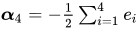
For F4, let E = R4, and let Φ denote the set of vectors α of length 1 or 2 such that the coordinates of 2α are all integers and are either all even or all odd. There are 48 roots in this system. One choice of simple roots is: the choice of simple roots given above for B3, plus .
The F4 root lattice—that is, the lattice generated by the F4 root system—is the set of points in R4 such that either all the coordinates are integers or all the coordinates are half-integers (a mixture of integers and half-integers is not allowed). This lattice is isomorphic to the lattice of Hurwitz quaternions.

G2

[edit]
Simple roots in G2
e1 e2 e3
α1 1  −1   0
β −1 2 −1

The root system G2 has 12 roots, which form the vertices of a hexagram. See the picture above.

One choice of simple roots is (α1, β = α2α1) where αi = eiei+1 for i = 1, 2 is the above choice of simple roots for A2.

The G2 root lattice—that is, the lattice generated by the G2 roots—is the same as the A2 root lattice.

The root poset

[edit]
Hasse diagram of E6 root poset with edge labels identifying the added simple root

The set of positive roots is naturally ordered by saying that if and only if is a nonnegative linear combination of simple roots. This poset is graded by , and has many remarkable combinatorial properties, one of them being that one can determine the degrees of the fundamental invariants of the corresponding Weyl group from this poset.[31] The Hasse graph is a visualization of the ordering of the root poset.

See also

[edit]

Notes

[edit]

References

[edit]

Further reading

[edit]
[edit]
Revisions and contributorsEdit on WikipediaRead on Wikipedia
from Grokipedia
A root system is a finite collection of nonzero vectors, known as roots, in a finite-dimensional Euclidean space that spans the space, includes negatives of all roots, is invariant under reflections across hyperplanes perpendicular to any root, and satisfies an integrality condition ensuring that the inner products between roots yield integer values when normalized.[1] These structures are "reduced" in the sense that the only scalar multiples of a root within the system are itself and its negative.[1] Root systems form the foundational geometric framework for understanding the structure of semisimple Lie algebras over the complex numbers, where the roots correspond to the eigenvalues of the adjoint representation of the Cartan subalgebra.[2] The key properties of a root system include the generation of a finite Weyl group by the reflections associated with each root, which acts faithfully on the space and permutes the roots.[1] Positive roots can be defined relative to a choice of simple roots forming a basis, and the entire system is generated from these via the Weyl group action.[2] Root systems are classified up to isomorphism into irreducible types, corresponding to connected Dynkin diagrams: four infinite families (A_n for n ≥ 1, B_n for n ≥ 2, C_n for n ≥ 3, D_n for n ≥ 4) and five exceptional cases (E_6, E_7, E_8, F_4, G_2).[1] This classification, established in the mid-20th century, mirrors the classification of simple Lie algebras and provides a combinatorial tool via Dynkin diagrams to encode the angles and relative lengths between simple roots.[2] Beyond Lie theory, root systems appear in the study of reductive algebraic groups and their representations, as well as in finite reflection groups and Coxeter systems.[1] The "crystallographic" condition—requiring integer structure constants—ensures compatibility with the integer lattices arising in these contexts, distinguishing them from more general finite reflection arrangements.[2] Historically, root systems were formalized in the 1950s by Claude Chevalley and others building on Élie Cartan's work on Lie algebras, with axiomatic definitions refined in the 1960s by Alexander Grothendieck to emphasize connections to algebraic groups.[1]

Core Definitions and Structures

Definition of a Root System

In mathematics, particularly in the study of Lie algebras and reflection groups, a root system is a fundamental structure consisting of a finite set Φ\Phi of nonzero vectors in a finite-dimensional real Euclidean space EE equipped with a positive definite inner product (,)(\cdot, \cdot). The set Φ\Phi must span EE, and it satisfies two key axioms: first, it is invariant under reflections across the hyperplanes perpendicular to its elements, meaning that for every αΦ\alpha \in \Phi and βΦ\beta \in \Phi, the reflection sα(β)=β2(β,α)(α,α)αs_\alpha(\beta) = \beta - 2 \frac{(\beta, \alpha)}{(\alpha, \alpha)} \alpha also lies in Φ\Phi; second, it obeys an integrality condition, where 2(β,α)(α,α)Z2 \frac{(\beta, \alpha)}{(\alpha, \alpha)} \in \mathbb{Z} for all α,βΦ\alpha, \beta \in \Phi.[3][4] This axiomatic framework captures the geometric properties of roots arising from semisimple Lie algebras, where the reflections generate a finite Weyl group acting on EE. Root systems are classified into types based on additional constraints: reduced root systems, the most common type, require that no vector in Φ\Phi is a scalar multiple of another except for ±1\pm 1 times itself, ensuring distinct lengths up to sign; non-reduced root systems relax this by permitting other scalar multiples, such as twice a short root alongside long and short roots, as seen in certain extended systems like those associated to affine Lie algebras; crystallographic (or crystalline) root systems emphasize the integrality axiom, allowing the roots to generate a full-rank lattice in EE over the integers, which is crucial for connections to integer matrices and Weyl group representations.[3][4][5] The rank of a root system Φ\Phi is defined as the dimension of the span of Φ\Phi in EE, which equals dimE\dim E since Φ\Phi spans EE. A root system is irreducible if it cannot be decomposed as an orthogonal direct sum of two nonempty proper subsystems, a property that corresponds to indecomposable Dynkin diagrams in the classification of finite root systems.[3][5]

Weyl Group Action

The Weyl group $ W(\Phi) $ of a root system $ \Phi $ in the real Euclidean space $ E $ (with positive definite inner product $ (\cdot, \cdot) $) is defined as the subgroup of the orthogonal group $ O(E) $ generated by the reflections $ s_\alpha $ for all roots $ \alpha \in \Phi $. The reflection across the hyperplane perpendicular to $ \alpha $ is given by the formula
sα(v)=v2(α,v)(α,α)α s_\alpha(v) = v - 2 \frac{(\alpha, v)}{(\alpha, \alpha)} \alpha
for all $ v \in E $. Each such reflection is an orthogonal transformation, preserving the inner product, and lies in $ O(E) $.[6] The Weyl group preserves the root system, meaning $ w(\Phi) = \Phi $ for every $ w \in W(\Phi) $. To see this, note that for any root $ \beta \in \Phi $, the reflection $ s_\alpha(\beta) = \beta - k \alpha $ where $ k = 2 (\alpha, \beta)/(\alpha, \alpha) $ is an integer by the axioms of the root system; thus $ s_\alpha(\beta) \in \Phi $ unless $ k = 0 $, in which case it fixes $ \beta $. Since the reflections map $ \Phi $ to itself and $ W(\Phi) $ is generated by these reflections, the entire group acts on $ \Phi $. Moreover, in an irreducible root system, $ W(\Phi) $ acts transitively on the set of roots of any given length. The proof follows from the connectedness of the Coxeter graph associated to the simple roots and the fact that reflections generate transformations between roots at the same angle to a fixed one, covering all possibilities within each length class.[6][7] A root system $ \Phi $ is crystallographic if, for all $ \alpha, \beta \in \Phi $, the Cartan integer $ 2 (\beta, \alpha)/(\alpha, \alpha) $ is an integer. This integrality condition ensures that the bilinear form restricts to an integral structure on the root lattice, and that the Weyl group $ W(\Phi) $ is a finite Coxeter group. Specifically, $ W(\Phi) $ admits a presentation as a Coxeter group with generators corresponding to reflections across simple root hyperplanes and relations determined by the angles between them, guaranteeing finiteness via the positive definiteness of the form and the discrete nature of the reflections.[8] The order of the Weyl group admits an explicit formula as the product of the degrees of its fundamental invariants under the action on the polynomial ring of $ E $. These degrees are even integers greater than or equal to 2, specific to each root system type (e.g., 2, 3, ..., r+1 for type $ A_r $), and their product yields the group order; this arises from the structure theorem for invariants of finite reflection groups. For instance, in rank 2, the order is 8 for type $ B_2 $ (degrees 2 and 4) and 12 for type $ G_2 $ (degrees 2 and 6).[9]

Positive Roots and Simple Roots

In a root system Φ\Phi spanning a Euclidean space EE, a positive subsystem Φ+\Phi^+ is a proper subset satisfying Φ=Φ+(Φ+)\Phi = \Phi^+ \sqcup (-\Phi^+) and such that if α,βΦ+\alpha, \beta \in \Phi^+ with α+βΦ\alpha + \beta \in \Phi, then α+βΦ+\alpha + \beta \in \Phi^+.[10] This additivity condition ensures that Φ+\Phi^+ consists precisely of the roots that lie on one side of a hyperplane arrangement defined by the root hyperplanes, corresponding to a choice of Weyl chamber. Such subsystems exist for any root system and are unique up to the action of the Weyl group WW, which acts simply transitively on the set of positive subsystems.[10] Given a positive subsystem Φ+\Phi^+, the simple roots ΔΦ+\Delta \subset \Phi^+ form a base: they are a linearly independent subset that spans EE over R\mathbb{R}, and every αΦ+\alpha \in \Phi^+ admits a unique expression α=δΔkδδ\alpha = \sum_{\delta \in \Delta} k_\delta \delta with coefficients kδZ0k_\delta \in \mathbb{Z}_{\geq 0}, while every βΦ+\beta \in -\Phi^+ has all negative integer coefficients.[10] Moreover, for distinct α,βΔ\alpha, \beta \in \Delta, the inner product satisfies (α,β)0(\alpha, \beta) \leq 0, and αβΦ\alpha - \beta \notin \Phi. The simple roots are precisely the indecomposable elements of Φ+\Phi^+, meaning those that cannot be expressed as a sum of two nonzero elements of Φ+\Phi^+.[10] Every root system admits at least one such base, and any two bases Δ,Δ\Delta, \Delta' are conjugate under an element of the Weyl group WW.[10] In the representation-theoretic context of semisimple Lie algebras g\mathfrak{g}, a choice of positive subsystem corresponds to a Borel subalgebra bg\mathfrak{b} \subset \mathfrak{g} containing a Cartan subalgebra h\mathfrak{h}, where the unipotent radical of b\mathfrak{b} is spanned by the root spaces gα\mathfrak{g}_\alpha for αΦ+\alpha \in \Phi^+; the simple roots then index the minimal parabolic subalgebras containing b\mathfrak{b}.[11] The Cartan matrix associated to an ordered base Δ={α1,,αl}\Delta = \{\alpha_1, \dots, \alpha_l\} (where l=dimEl = \dim E) is the integer matrix A=(aij)A = (a_{ij}) with entries
aij=2(αi,αj)(αi,αi), a_{ij} = \frac{2(\alpha_i, \alpha_j)}{(\alpha_i, \alpha_i)},
so that the diagonal entries are aii=2a_{ii} = 2 and the off-diagonal entries satisfy aij0a_{ij} \leq 0 for iji \neq j.[10] These off-diagonal values are constrained to {0,1,2,3}\{0, -1, -2, -3\}, and the matrix is independent of the specific ordering up to simultaneous permutation of rows and columns by the action of the Weyl group on the base.[10] The Cartan matrix uniquely determines the root system up to isomorphism.[10]

Low-Rank Examples and Motivations

Rank-One Root Systems

The rank-one root system represents the simplest non-trivial configuration in the theory of root systems, residing in a one-dimensional Euclidean space. It serves as a foundational example that illustrates core properties such as reflections and positivity without the complexity of higher dimensions. In the reduced case, which is the standard focus for finite irreducible root systems, the set of roots is Φ={α,α}\Phi = \{\alpha, -\alpha\} for some nonzero vector αR\alpha \in \mathbb{R} with positive squared length (α,α)>0(\alpha, \alpha) > 0.[1][5] This setup satisfies the axioms of a root system, where the reflection sαs_\alpha across the hyperplane perpendicular to α\alpha maps α\alpha to α-\alpha and preserves the set Φ\Phi.[1] The Weyl group of this root system is the finite group generated by sαs_\alpha, which is isomorphic to Z/2Z\mathbb{Z}/2\mathbb{Z} and acts by interchanging the two roots.[12][1] Selecting a positive subsystem yields the single positive root {α}\{\alpha\}, with α\alpha itself serving as the unique simple root, forming a basis for the root lattice.[12][5] The associated Cartan matrix is the trivial 1×11 \times 1 matrix [2][2], reflecting the integer structure constant α,α=2\langle \alpha, \alpha^\vee \rangle = 2, where α=2α/(α,α)\alpha^\vee = 2\alpha / (\alpha, \alpha) is the coroot.[1][12] A non-reduced variant extends the reduced system by including multiples, such as Φ={±α,±2α}\Phi = \{\pm \alpha, \pm 2\alpha\} (often denoted BC1BC_1), where α\alpha has unit length for normalization; however, the reduced case remains the primary example in classical Lie theory due to its irreducibility and correspondence to the Lie algebra sl2(C)\mathfrak{sl}_2(\mathbb{C}).[13] Geometrically, the roots lie symmetrically on the real line, with the Weyl group action manifesting as point reflection through the origin, underscoring the system's inherent bilateral symmetry.[1][5]

Rank-Two Root Systems

The irreducible root systems of rank two consist of four distinct types: the reduced systems A2A_2, B2B_2, and G2G_2, along with the non-reduced system BC2BC_2. These systems are realized in a two-dimensional Euclidean space and are classified up to isomorphism based on the possible angles between roots and the ratios of root lengths, which determine their geometric configurations.[14][11][15] The A2A_2 root system features six roots of equal length forming a hexagonal lattice in the plane, with angles between adjacent roots of 6060^\circ or 120120^\circ. An explicit realization embeds it in R3\mathbb{R}^3 with roots {±(e1e2),±(e2e3),±(e3e1)}\{\pm(e_1 - e_2), \pm(e_2 - e_3), \pm(e_3 - e_1)\}, where these vectors span the plane orthogonal to e1+e2+e3e_1 + e_2 + e_3 and all have squared length 2. The Weyl group is the dihedral group of order 6, isomorphic to the symmetric group S3S_3, acting as rotations and reflections preserving the equilateral triangular arrangement of simple roots. The Cartan matrix is
(2112), \begin{pmatrix} 2 & -1 \\ -1 & 2 \end{pmatrix},
reflecting the equal-length roots and 120120^\circ angle between simple roots.[11][16][14] In contrast, the B2B_2 root system includes eight roots with two distinct lengths: four short roots of squared length 1 and four long roots of squared length 2, yielding a length ratio of 2\sqrt{2}. A standard realization in R2\mathbb{R}^2 uses roots {±e1,±e2,±(e1+e2),±(e1e2)}\{\pm e_1, \pm e_2, \pm(e_1 + e_2), \pm(e_1 - e_2)\}, where angles between roots are multiples of 4545^\circ, including 9090^\circ and 135135^\circ between simple roots. The Weyl group is the dihedral group of order 8, corresponding to the symmetries of a square. Its Cartan matrix, distinguishing short and long roots, is
(2122). \begin{pmatrix} 2 & -1 \\ -2 & 2 \end{pmatrix}.
[11][16][14] The G2G_2 root system has twelve roots with two lengths: six short roots of squared length 2 and six long roots of squared length 6, for a ratio of 3\sqrt{3}. Realized in R3\mathbb{R}^3 spanning a plane, the roots are {±(e1e2),±(e1e3),±(e2e3),±(2e1e2e3),±(2e2e1e3),±(2e3e1e2)}\{\pm(e_1 - e_2), \pm(e_1 - e_3), \pm(e_2 - e_3), \pm(2e_1 - e_2 - e_3), \pm(2e_2 - e_1 - e_3), \pm(2e_3 - e_1 - e_2)\}, with angles that are multiples of 3030^\circ, such as 3030^\circ and 150150^\circ between simple roots. The Weyl group is the dihedral group of order 12, reflecting the higher symmetry from the length disparity. The Cartan matrix is
(2132), \begin{pmatrix} 2 & -1 \\ -3 & 2 \end{pmatrix},
capturing the tripled off-diagonal entry due to the short root's coroot.[11][16][14] Finally, the non-reduced BC2BC_2 root system extends B2B_2 by including roots of three distinct lengths—short (squared length 1), medium (2\sqrt{2}), and long (2)—with twelve roots total in R2\mathbb{R}^2: {±e1,±e2,±2e1,±2e2,±(e1±e2)}\{\pm e_1, \pm e_2, \pm 2e_1, \pm 2e_2, \pm(e_1 \pm e_2)\}. This introduces multiples of short roots, violating the reduced condition, while maintaining angles as multiples of 4545^\circ, including 9090^\circ and 135135^\circ. The Weyl group remains the dihedral group of order 8, and it shares the Cartan matrix of B2B_2:
(2122). \begin{pmatrix} 2 & -1 \\ -2 & 2 \end{pmatrix}.
[17][18][14]

Origins in Semisimple Lie Algebras

In the theory of semisimple Lie algebras over the complex numbers, root systems arise naturally from the structure of these algebras and their Cartan subalgebras. Consider a semisimple Lie algebra g\mathfrak{g} equipped with a Cartan subalgebra h\mathfrak{h}, which is a maximal abelian subalgebra consisting of semisimple elements. The roots are defined as the elements of the set Φ={αhgα0}\Phi = \{\alpha \in \mathfrak{h}^* \mid \mathfrak{g}_\alpha \neq 0\}, where gα={xg[h,x]=α(h)x for all hh}\mathfrak{g}_\alpha = \{x \in \mathfrak{g} \mid [h, x] = \alpha(h) x \text{ for all } h \in \mathfrak{h}\}.[19] This leads to the root space decomposition of g\mathfrak{g}: g=hαΦgα\mathfrak{g} = \mathfrak{h} \oplus \bigoplus_{\alpha \in \Phi} \mathfrak{g}_\alpha. For semisimple Lie algebras over C\mathbb{C}, each root space gα\mathfrak{g}_\alpha is one-dimensional.[19] The Killing form B(X,Y)=tr(adXadY)B(X, Y) = \operatorname{tr}(\operatorname{ad}_X \operatorname{ad}_Y) on g\mathfrak{g} is nondegenerate and symmetric, restricting to a nondegenerate bilinear form on h\mathfrak{h}. This induces a Euclidean inner product on the real span of Φ\Phi in h\mathfrak{h}^*, endowing Φ\Phi with the structure of a root system.[19] A concrete example occurs in the special linear Lie algebra sl(n+1,C)\mathfrak{sl}(n+1, \mathbb{C}), whose root system is of type AnA_n. Here, h\mathfrak{h} consists of trace-zero diagonal matrices, and the roots are αij=eiej\alpha_{ij} = e_i - e_j for iji \neq j, where {e1,,en+1}\{e_1, \dots, e_{n+1}\} is the standard basis of Cn+1\mathbb{C}^{n+1}.[19]

Basic Properties and Dualities

Axiomatic Consequences

The reflections associated to roots in a root system are linear transformations of the underlying Euclidean space EE. Specifically, for roots α,βΦ\alpha, \beta \in \Phi, the reflection sα(β)=β2\projα(β)s_\alpha(\beta) = \beta - 2 \proj_\alpha(\beta), where \projα(β)=(β,α)(α,α)α\proj_\alpha(\beta) = \frac{(\beta, \alpha)}{(\alpha, \alpha)} \alpha. This formula defines an orthogonal reflection over the hyperplane perpendicular to α\alpha, preserving the inner product and thus acting as a linear isometry on EE.[3] A fundamental consequence of the axioms is the root string property. For fixed α,βΦ\alpha, \beta \in \Phi with β∝̸α\beta \not\propto \alpha, the set of integers kk such that β+kαΦ\beta + k \alpha \in \Phi forms a consecutive string βpα,,β+qα\beta - p \alpha, \dots, \beta + q \alpha with p,q0p, q \geq 0 integers satisfying p+q3p + q \leq 3, so the string has length at most 4. Moreover, pq=2(β,α)(α,α)p - q = \frac{2(\beta, \alpha)}{(\alpha, \alpha)}, which is an integer by the axioms. This follows from the integrality of Cartan integers and the fact that reflections sαs_\alpha map roots to roots while reversing the string; applying sαs_\alpha repeatedly shows that gaps in the string would contradict the preservation of Φ\Phi.[3] The string property implies that the possible values of the Cartan integer 2(β,α)(α,α)\frac{2(\beta, \alpha)}{(\alpha, \alpha)} lie in {3,2,1,0,1,2,3}\{-3, -2, -1, 0, 1, 2, 3\} for distinct non-proportional roots, restricting the possible angles between any two roots to a finite set (such as 0,π/6,π/4,π/3,π/2,2π/3,3π/4,5π/6,π0, \pi/6, \pi/4, \pi/3, \pi/2, 2\pi/3, 3\pi/4, 5\pi/6, \pi). Consequently, the directions of roots on the unit sphere are confined to finitely many possibilities, so even without assuming finiteness in the axioms, the set Φ\Phi must be finite for reduced root systems (those with no roots that are nonzero integer multiples of others beyond ±1\pm 1).[20] From these angle restrictions and the string property, the squared lengths (α,α)(\alpha, \alpha) for αΦ\alpha \in \Phi take values in a finite set. Specifically, the ratios of squared lengths between any two roots are rational (determined by the Cartan integers), ensuring commensurability. In particular, irreducible root systems admit at most two distinct root lengths.[3] Additionally, the set Φ\Phi spans EE over Q\mathbb{Q}, meaning the Q\mathbb{Q}-vector space generated by Φ\Phi has dimension equal to dimE\dim E; this follows from the linear independence over R\mathbb{R} of a basis extracted from the reflections and the rationality of inner products via Cartan integers.[21]

Dual Root System and Coroots

Given a root system [22] in a finite-dimensional Euclidean space EE equipped with a positive definite inner product (,)(\cdot, \cdot), the dual space EE^* is canonically identified with EE via this inner product. Under this identification, the dual root system is defined as Φ={α=2α(α,α)αΦ}E\Phi^\vee = \{\alpha^\vee = \frac{2\alpha}{(\alpha, \alpha)} \mid \alpha \in \Phi\} \subset E.[10] The elements α\alpha^\vee are called coroots.[23] The set Φ\Phi^\vee itself forms a root system in EE, sharing the same Weyl group as Φ\Phi.[10] This dual structure preserves key geometric properties while potentially interchanging the roles of long and short roots in non-simply-laced cases.[24] Coroots pair integrally with roots through the expression (β,α)=2(β,α)(α,α)Z(\beta, \alpha^\vee) = \frac{2(\beta, \alpha)}{(\alpha, \alpha)} \in \mathbb{Z} for βΦ\beta \in \Phi, which encodes the Cartan integers central to the root system's structure.[10] In the realization of root systems arising from semisimple Lie algebras g\mathfrak{g} with Cartan subalgebra h\mathfrak{h}, each coroot α\alpha^\vee lies in h\mathfrak{h} (via identification using the Killing form), and the adjoint representation satisfies [α,X]=(β,α)X[\alpha^\vee, X] = (\beta, \alpha^\vee) X for XgβX \in \mathfrak{g}_\beta, the root space corresponding to root β\beta.[23] This action highlights the coroots' role in governing the linear transformations induced by the Lie algebra on its root spaces.[24]

Integral Elements and Lattices

In the context of a root system Φ\Phi in a finite-dimensional Euclidean space EE equipped with a positive definite inner product (,)(\cdot, \cdot), the root lattice Q(Φ)Q(\Phi) is defined as the Z\mathbb{Z}-span of Φ\Phi, i.e., Q(Φ)=ZΦ=αΦZαQ(\Phi) = \mathbb{Z}\Phi = \sum_{\alpha \in \Phi} \mathbb{Z} \alpha.[25] This forms a full-rank lattice in EE, meaning its rank equals dimE=l\dim E = l, the rank of the root system, and it is a discrete subgroup that spans EE over R\mathbb{R}.[26] Similarly, the coroot lattice Q(Φ)Q(\Phi^\vee) is the Z\mathbb{Z}-span of the coroots Φ={ααΦ}\Phi^\vee = \{\alpha^\vee \mid \alpha \in \Phi\}, where α=2α/(α,α)\alpha^\vee = 2\alpha / (\alpha, \alpha), and it also has full rank ll in the dual space EE^*.[8] These lattices capture the integral structure underlying the root system, with the pairing (λ,α)(\lambda, \alpha^\vee) inducing connections between roots and coroots. The weight lattice P(Φ)P(\Phi) consists of all elements λE\lambda \in E such that the pairing (λ,α)Z(\lambda, \alpha^\vee) \in \mathbb{Z} for every coroot αΦ\alpha^\vee \in \Phi^\vee.[25] This defines a full-rank lattice containing the root lattice as a sublattice, Q(Φ)P(Φ)Q(\Phi) \subseteq P(\Phi), with finite index [P(Φ):Q(Φ)][P(\Phi) : Q(\Phi)] that depends on the type of the root system and reflects its representation-theoretic properties.[27] In particular, P(Φ)P(\Phi) serves as the ambient lattice for integral weights in the associated Lie theory, where elements of P(Φ)P(\Phi) pair integrally with all coroots. A basis for P(Φ)P(\Phi) is provided by the fundamental weights {ωi}i=1l\{\omega_i\}_{i=1}^l, defined relative to a base of simple coroots {αi}i=1l\{\alpha_i^\vee\}_{i=1}^l by the conditions (ωi,αj)=δij(\omega_i, \alpha_j^\vee) = \delta_{ij} for i,j=1,,li,j = 1, \dots, l.[8] These ωi\omega_i form the dual basis to the simple coroots and generate P(Φ)P(\Phi) over Z\mathbb{Z}, ensuring that every integral weight is an integer linear combination of the fundamental weights. In terms of dualities, the weight lattice P(Φ)P(\Phi) is the dual lattice to the coroot lattice, P(Φ)=Q(Φ)P(\Phi) = Q(\Phi^\vee)^*, where the dual is taken with respect to the inner product pairing; this identification holds in standard normalizations and underscores the symmetry between roots and coroots.[27]

Classification Framework

Dynkin Diagrams Construction

Dynkin diagrams provide a graphical encoding of the structure of a root system through its simple roots, facilitating the classification of irreducible root systems associated with semisimple Lie algebras.[28] Each diagram consists of nodes and edges that capture the inner product relations among the simple roots Π={α1,,αr}\Pi = \{\alpha_1, \dots, \alpha_r\}, where rr is the rank of the root system.[1] The construction begins by representing each simple root αiΠ\alpha_i \in \Pi as a node in the diagram. Nodes ii and jj are connected by an edge if and only if the inner product (αi,αj)<0(\alpha_i, \alpha_j) < 0, indicating that the roots are adjacent in the root poset and not orthogonal.[28] The nature of the edge—its multiplicity and any direction—is determined by the Cartan integers aij=2(αi,αj)/(αi,αi)a_{ij} = 2 (\alpha_i, \alpha_j) / (\alpha_i, \alpha_i) and aji=2(αj,αi)/(αj,αj)a_{ji} = 2 (\alpha_j, \alpha_i) / (\alpha_j, \alpha_j), which are off-diagonal entries of the Cartan matrix. For simple root systems, these integers satisfy aij{0,1,2,3}a_{ij} \in \{0, -1, -2, -3\} when iji \neq j, with the product aijajia_{ij} a_{ji} dictating the bond type: 1 for a single bond, 2 for a double bond, and 3 for a triple bond.[1] When all simple roots have equal length, the diagram is undirected, with bond multiplicities reflecting symmetric relations: a single bond for aij=aji=1|a_{ij}| = |a_{ji}| = 1, double for 2, and triple for 3. In cases of unequal root lengths, an arrow is added to the bond, pointing from the longer root to the shorter one; the multiplicity is based on the larger absolute value of aija_{ij} and ajia_{ji}. For instance, if aij=1|a_{ij}| = 1 and aji=2|a_{ji}| = 2, a double bond with an arrow pointing to the shorter root (node jj) is drawn. This convention ensures the diagram visually encodes the asymmetry in lengths.[28] The full algorithm for construction proceeds as follows: first, identify the simple roots from the positive roots via a choice of Weyl chamber or linear functional that separates them. Then, compute the pairwise Cartan integers using the invariant bilinear form on the Euclidean space containing the root system. Finally, draw the nodes linearly (for classical types) or in the standard configuration (for exceptional types), adding edges according to the rules above. The resulting diagram uniquely determines the Cartan matrix up to permutation of nodes and duality, where duality swaps the roles of roots and coroots, interchanging arrow directions and distinguishing systems like BnB_n and CnC_n.[1] Representative examples illustrate the construction. For the AnA_n series (n1n \geq 1), the simple roots form a chain where consecutive pairs have aij=aji=1a_{ij} = a_{ji} = -1, yielding a linear diagram of nn nodes connected by single bonds, such as \circ - \circ - \cdots - \circ for A3A_3.[28] In the BnB_n series (n2n \geq 2), the diagram is a chain of n1n-1 single bonds followed by a double bond with an arrow pointing to the final (shorter) root, as in B2B_2: =\circ \Rightarrow{=} \circ, where the last Cartan integers are an1,n=1a_{n-1,n} = -1 and an,n1=2a_{n,n-1} = -2.[1] The exceptional G2G_2 diagram features two nodes connected by a triple bond with an arrow to the shorter root: ===\circ \Rightarrow{===} \circ, corresponding to a12=1a_{12} = -1 and a21=3a_{21} = -3. These examples highlight how the diagram compactly represents the off-diagonal structure of the Cartan matrix without explicit coordinates.[28]

Irreducible Root Systems Overview

Finite irreducible root systems are classified into four infinite classical families and five exceptional cases, up to isomorphism, according to the Cartan-Killing theorem, which establishes that these are the only possibilities for reduced root systems associated to semisimple Lie algebras over the complex numbers.[29] This classification is encoded in their Dynkin diagrams, which are graphs whose vertices correspond to a basis of simple roots and edges reflect the angles between them, with multiple edges indicating non-orthogonal pairs and arrows denoting relative lengths.[30] The classical series consist of A_n for n ≥ 1, whose Dynkin diagram is a linear chain of n vertices connected by single edges and corresponds to the root system of the special unitary group SU(n+1); B_n for n ≥ 2, with a linear chain of n vertices where the final edge is double with an arrow pointing to the end vertex (indicating the short root there), associated to SO(2n+1); C_n for n ≥ 3, similar to B_n but with the arrow on the final double edge pointing away from the end vertex, linked to the symplectic group Sp(2n); and D_n for n ≥ 4, a linear chain of n-2 vertices followed by a fork into two additional vertices from the penultimate one, corresponding to SO(2n).[31] The exceptional irreducible root systems are G_2, with two vertices joined by a triple edge with an arrow pointing to one vertex; F_4, a chain of four vertices with single edges for the first two, a double arrow on the third, and a single edge to the fourth; E_6, a chain of five vertices with a branch from the third to an additional vertex; E_7, a chain of six vertices with a similar branch from the third; and E_8, a chain of seven vertices with the branch from the third, forming an extended linear structure. Key invariants include the number of roots |Φ|, which for an irreducible system of rank l equals twice the number of positive roots, typically listed explicitly—for example, |A_n| = n(n+1) and |B_n| = 2n^2—reflecting the structure's scale.[10] The order of the Weyl group |W|, the finite reflection group generated by the root system, is also characteristic: |W(A_n)| = (n+1)!, |W(B_n)| = |W(C_n)| = 2^n n!, |W(D_n)| = 2^{n-1} n!, |W(G_2)| = 12, |W(F_4)| = 1152, |W(E_6)| = 51840, |W(E_7)| = 2903040, and |W(E_8)| = 696729600.[10] These systems are reduced, meaning no root is a scalar multiple of another except by ±1, distinguishing them from non-reduced cases like BC_n where short roots satisfy 2α being a long root; the Cartan-Killing theorem confirms no other reduced irreducible finite root systems exist beyond those listed.[1]

Geometric and Group-Theoretic Aspects

Weyl Chambers and Group Orbits

The hyperplanes $ H_\alpha = { x \in E \mid \langle x, \alpha \rangle = 0 } $ for each root $ \alpha \in \Phi $ form an arrangement that divides the finite-dimensional Euclidean space $ E $ containing the root system into open connected components, which are called the Weyl chambers.[6] These chambers are the maximal open convex sets avoiding all root hyperplanes, and their closures include portions of the bounding hyperplanes.[6] The number of such chambers equals the order of the Weyl group $ W $, as $ W $ permutes them.[6] A distinguished Weyl chamber, known as the fundamental chamber $ C $, is defined by the inequalities $ \langle x, \alpha_i \rangle > 0 $ for all simple roots $ \alpha_i $ in a choice of positive roots $ \Delta^+ $.[6] This choice of positive roots determines the simple roots and thus the inequalities bounding $ C $. The Weyl group $ W $, generated by reflections across the hyperplanes $ H_{\alpha_i} $, acts transitively on the set of all Weyl chambers: for any two chambers $ C' $ and $ C'' $, there exists $ w \in W $ such that $ w(C') = C'' $.[6] Moreover, this action is simply transitive, meaning the stabilizer of any chamber under $ W $ is trivial.[6] The walls of the fundamental chamber $ C $ are the hyperplanes $ H_{\alpha_i} $ for the simple roots $ \alpha_i $, which form its bounding facets.[32] In the affine extension of the root system, the affine Weyl group $ \tilde{W} = W \ltimes Q $, where $ Q $ is the root lattice, acts on $ E $ by incorporating translations, leading to an infinite arrangement of affine hyperplanes $ H_{\alpha, k} = { x \in E \mid \langle x, \alpha \rangle = k } $ for $ \alpha \in \Phi $ and $ k \in \mathbb{Z} $.[33] The connected components of the complement of these affine hyperplanes are called alcoves, which are the smallest regions in this arrangement and can be viewed as bounded simplices; the fundamental alcove is the intersection of the fundamental chamber $ C $ with a suitable translate.[33] The affine Weyl group acts simply transitively on the set of alcoves.[33] The Weyl group $ W $ also acts on the dual space $ E^* $, where weights $ \lambda $ reside, generating orbits $ W \cdot \lambda = { w \lambda \mid w \in W } $.[34] These orbits partition the weight space and are finite, with the size of the orbit given by the index of the stabilizer subgroup $ \mathrm{Stab}_W(\lambda) = { w \in W \mid w \lambda = \lambda } $ in $ W $.[34] For generic weights, the stabilizer is trivial, yielding orbits of full size $ |W| $; for weights fixed by certain reflections, the stabilizer is larger, corresponding to parabolic subgroups of $ W $.[34]

Root Poset Structure

In a root system Φ\Phi with a fixed base Δ\Delta of simple roots, the positive roots Φ+\Phi^+ form a poset under the partial order \leq, where αβ\alpha \leq \beta if and only if βα\beta - \alpha is a non-negative integer linear combination of the simple roots in Δ\Delta.[35] This order corresponds to the dominance partial order on the coefficient vectors of the roots when expressed in the basis Δ\Delta.[35] The minimal elements of this poset are precisely the simple roots themselves.[36] The height function ht:Φ+Nht: \Phi^+ \to \mathbb{N} assigns to each positive root α=δΔnδδ\alpha = \sum_{\delta \in \Delta} n_\delta \delta (with nδNn_\delta \in \mathbb{N}) the value ht(α)=δΔnδht(\alpha) = \sum_{\delta \in \Delta} n_\delta, which measures the "level" of α\alpha in the poset.[36] The maximal elements, known as the maximal roots, are those βΦ+\beta \in \Phi^+ such that no γΦ+\gamma \in \Phi^+ satisfies β<γ\beta < \gamma, and these achieve the maximum height in the system.[36] The partition given by the number of roots at each height level has its dual partition equal to the exponents of the associated Weyl group, as established by Kostant. The Hasse diagram of the root poset (Φ+,)(\Phi^+, \leq) is a graded poset with rank function htht, where the rank of the minimal elements (simple roots) is 1.[35] Covering relations in this diagram occur precisely when αβ\alpha \prec \beta with ht(β)=ht(α)+1ht(\beta) = ht(\alpha) + 1, meaning β=α+δ\beta = \alpha + \delta for some simple root δΔ\delta \in \Delta such that β\beta is itself a root.[35] These relations highlight the combinatorial structure, forming a directed acyclic graph where edges connect roots differing by exactly one simple root addition. This poset structure facilitates applications such as the shelling of order ideals in hyperplane arrangements associated with root systems, where the grading by height enables recursive constructions of shellable simplicial complexes.[37] Additionally, the root poset connects to Coxeter complexes via the Weyl group orbits on roots, providing a combinatorial framework for non-crossing partitions and the topology of the associated Coxeter group actions.[36]

Connections to Lie Theory

Root Systems in Lie Algebras

In the theory of semisimple Lie algebras over the complex numbers, root systems encode the structure of the root space decomposition g=hαRgα\mathfrak{g} = \mathfrak{h} \oplus \bigoplus_{\alpha \in R} \mathfrak{g}_\alpha, where h\mathfrak{h} is a Cartan subalgebra and each gα\mathfrak{g}_\alpha is one-dimensional. The roots RR form a root system in the dual space h\mathfrak{h}^*, and the interactions between root spaces are governed by the Lie bracket, which maps gαgβ\mathfrak{g}_\alpha \otimes \mathfrak{g}_\beta to gα+β\mathfrak{g}_{\alpha + \beta} if α+βR\alpha + \beta \in R, or to h\mathfrak{h} if β=α\beta = -\alpha. This decomposition reveals how the algebra decomposes into irreducible representations under certain subalgebras, highlighting the pivotal role of root systems in understanding the semisimple structure.[38] A key feature arising from this decomposition is the concept of root strings, which illustrate the finite-dimensional representations induced by individual roots. For roots α,βR\alpha, \beta \in R, the α\alpha-root string through β\beta consists of the consecutive roots of the form β+kα\beta + k\alpha for kZk \in \mathbb{Z} such that β+kαR{0}\beta + k\alpha \in R \cup \{0\}, forming an unbroken chain βpα,,β+qα\beta - p\alpha, \dots, \beta + q\alpha with p,q0p, q \geq 0. The integers pp and qq satisfy pq=β,αp - q = \langle \beta, \alpha^\vee \rangle, where α\alpha^\vee is the coroot, and the length of the string is p+q+1=1β,αp + q + 1 = 1 - \langle \beta, \alpha^\vee \rangle when β,α0\langle \beta, \alpha^\vee \rangle \leq 0. This structure ensures that the corresponding root spaces form an irreducible module under the adjoint action of a specific sl2\mathfrak{sl}_2-subalgebra.[39] Central to this are the sl2\mathfrak{sl}_2-triples, which embed copies of sl2(C)\mathfrak{sl}_2(\mathbb{C}) into g\mathfrak{g} for each root αR\alpha \in R. Specifically, choose basis elements eαgαe_\alpha \in \mathfrak{g}_\alpha and fαgαf_\alpha \in \mathfrak{g}_{-\alpha} such that [eα,fα]=hα[e_\alpha, f_\alpha] = h_\alpha, where hα=αh_\alpha = \alpha^\vee is the coroot element in h\mathfrak{h} normalized so that α(hα)=2\alpha(h_\alpha) = 2. These satisfy the relations [hα,eα]=2eα[h_\alpha, e_\alpha] = 2e_\alpha and [hα,fα]=2fα[h_\alpha, f_\alpha] = -2f_\alpha, making {eα,hα,fα}\{e_\alpha, h_\alpha, f_\alpha\} isomorphic to the standard basis of sl2(C)\mathfrak{sl}_2(\mathbb{C}). The subspace gαgα\mathfrak{g}_\alpha \oplus \mathfrak{g}_{-\alpha} carries the defining 2-dimensional representation of this sl2\mathfrak{sl}_2-triple under the adjoint action, while the full algebra g\mathfrak{g} decomposes into a direct sum of irreducible representations of varying dimensions determined by the root strings.[40] Root systems also facilitate the construction of parabolic subalgebras, which are proper subalgebras containing a fixed Borel subalgebra and play a crucial role in the representation theory and geometry of semisimple Lie algebras. For a choice of simple roots ΔR\Delta \subset R, a standard parabolic subalgebra pI\mathfrak{p}_I corresponding to a subset IΔI \subseteq \Delta is generated by a Borel subalgebra b=hα>0gα\mathfrak{b} = \mathfrak{h} \oplus \bigoplus_{\alpha > 0} \mathfrak{g}_\alpha together with the negative root spaces gβ\mathfrak{g}_{-\beta} for all simple roots βI\beta \in I. It admits a Levi decomposition pI=lIuI\mathfrak{p}_I = \mathfrak{l}_I \ltimes \mathfrak{u}_I, where lI\mathfrak{l}_I is the reductive Levi factor (the subalgebra generated by h\mathfrak{h} and the root spaces for the subsystem generated by II) and uI\mathfrak{u}_I is the nilradical consisting of the strictly positive root spaces whose roots are not in the subsystem generated by II. This decomposition is unique up to conjugation and underscores the semidirect product structure inherent to parabolic subalgebras. Finally, root systems enable the construction of integral bases for semisimple Lie algebras, notably the Chevalley basis, which provides a canonical integer structure. This basis consists of elements {xααR}{hii=1,,r}\{x_\alpha \mid \alpha \in R\} \cup \{h_i \mid i = 1, \dots, r\}, where r=dimhr = \dim \mathfrak{h} is the rank, xαx_\alpha are chosen in gα\mathfrak{g}_\alpha such that [xα,xα]=hα[x_\alpha, x_{-\alpha}] = h_\alpha for positive roots α\alpha, and the hih_i form a basis for the coroot lattice. All Lie brackets in this basis have structure constants in Z\mathbb{Z}, ensuring the basis spans a Z\mathbb{Z}-lattice stable under the bracket and facilitating constructions over rings of integers, such as in the theory of Chevalley groups.[41]

Cartan Subalgebras and Roots

In the theory of semisimple Lie algebras over the complex numbers, a Cartan subalgebra h\mathfrak{h} of a Lie algebra g\mathfrak{g} is defined as a maximal toral subalgebra, meaning it is an abelian subalgebra on which the adjoint representation is simultaneously diagonalizable, or equivalently, h\mathfrak{h} is nilpotent and equals its normalizer Ng(h)={xgAd(x)h=h}N_{\mathfrak{g}}(\mathfrak{h}) = \{ x \in \mathfrak{g} \mid \mathrm{Ad}(x) \mathfrak{h} = \mathfrak{h} \}.[42] This structure ensures that h\mathfrak{h} consists of ad-semisimple elements, and every semisimple Lie algebra possesses such a subalgebra, with the dimension of h\mathfrak{h} being the rank of g\mathfrak{g}.[43] A fundamental property is that all Cartan subalgebras of g\mathfrak{g} are conjugate under the adjoint action of the corresponding Lie group, implying they share the same dimension and structural features.[44] Roots arise naturally from the adjoint action of h\mathfrak{h} on g\mathfrak{g}. Specifically, the Lie algebra decomposes as g=hαΔgα\mathfrak{g} = \mathfrak{h} \oplus \bigoplus_{\alpha \in \Delta} \mathfrak{g}_{\alpha}, where Δh\Delta \subset \mathfrak{h}^* is the root system consisting of nonzero linear functionals α:hC\alpha: \mathfrak{h} \to \mathbb{C} such that the root spaces gα={xg[h,x]=α(h)x hh}\mathfrak{g}_{\alpha} = \{ x \in \mathfrak{g} \mid [\mathfrak{h}, x] = \alpha(\mathfrak{h}) x \ \forall h \in \mathfrak{h} \} are nonzero.[44] On each root space, the adjoint action satisfies adhgα=α(h)id\mathrm{ad}_h \big|_{\mathfrak{g}_{\alpha}} = \alpha(h) \cdot \mathrm{id} for all hhh \in \mathfrak{h}, reflecting the eigenvalue character of the decomposition.[45] The dual space h\mathfrak{h}^* is canonically identified with h\mathfrak{h} via the Killing form B(X,Y)=tr(adXadY)B(X,Y) = \mathrm{tr}(\mathrm{ad}_X \mathrm{ad}_Y), which restricts to a nondegenerate symmetric bilinear form on h\mathfrak{h}, allowing roots to be viewed as elements of h\mathfrak{h} itself.[46] The nilpotent radical emerges in the context of parabolic subalgebras, particularly Borels. A Borel subalgebra b\mathfrak{b} is a maximal solvable subalgebra containing h\mathfrak{h}, decomposed as b=hn\mathfrak{b} = \mathfrak{h} \oplus \mathfrak{n}, where n=α>0gα\mathfrak{n} = \bigoplus_{\alpha > 0} \mathfrak{g}_{\alpha} is the sum over positive roots with respect to a choice of Weyl chamber, and n\mathfrak{n} forms the nilpotent radical of b\mathfrak{b} since [n,n]n[\mathfrak{n}, \mathfrak{n}] \subset \mathfrak{n} with higher nilpotency class.[47] Regular elements in h\mathfrak{h} are those hhh \in \mathfrak{h} such that α(h)0\alpha(h) \neq 0 for all roots α0\alpha \neq 0, ensuring the centralizer Cg(h)={xg[h,x]=0}=hC_{\mathfrak{g}}(h) = \{ x \in \mathfrak{g} \mid [h, x] = 0 \} = \mathfrak{h} has minimal dimension equal to the rank of g\mathfrak{g}.[48] These elements are dense in h\mathfrak{h}, and their adjoint orbits generate the Cartan subalgebra under the group action, highlighting the stability of the toral structure.[49]

Explicit Realizations of Irreducible Systems

Series A_n

The root system of type $ A_n $ (for $ n \geq 1 $) is one of the classical irreducible root systems, realized explicitly in the $ n $-dimensional hyperplane
H={xRn+1  |  i=1n+1xi=0} H = \left\{ x \in \mathbb{R}^{n+1} \;\middle|\; \sum_{i=1}^{n+1} x_i = 0 \right\}
of $ \mathbb{R}^{n+1} $, equipped with the restriction of the standard Euclidean inner product. The roots are the vectors $ \alpha_{ij} = e_i - e_j $ for all distinct indices $ 1 \leq i, j \leq n+1 $, where $ {e_1, \dots, e_{n+1}} $ denotes the standard orthonormal basis of $ \mathbb{R}^{n+1} $. These roots span $ H $ and satisfy the defining axioms of a root system, including closure under reflections across root hyperplanes.[1][20] A standard choice of positive roots consists of those $ \alpha_{ij} $ with $ i < j $, of which there are $ \binom{n+1}{2} = \frac{n(n+1)}{2} $; the full set of roots then comprises these positive roots together with their negatives, yielding a total of $ n(n+1) $ roots. The simple roots forming a basis for this positive system are $ \alpha_i = e_i - e_{i+1} $ for $ i = 1, \dots, n $. With respect to the induced inner product on $ H $, every root has the same squared length $ \langle \alpha_{ij}, \alpha_{ij} \rangle = 2 $, so the length is $ \sqrt{2} $; this uniformity classifies $ A_n $ as a simply-laced root system.[1][20] The Weyl group $ W(A_n) $ is generated by reflections across the hyperplanes perpendicular to the simple roots and is isomorphic to the symmetric group $ S_{n+1} $, acting on $ H $ by permuting the coordinates of vectors in $ \mathbb{R}^{n+1} $. The Dynkin diagram of $ A_n $ is a linear chain of $ n $ nodes connected by single (unoriented) bonds, reflecting the equal angles between adjacent simple roots. This root system arises naturally as the root system of the semisimple complex Lie algebra $ \mathfrak{sl}(n+1, \mathbb{C}) $, consisting of trace-zero $ (n+1) \times (n+1) $ matrices.[1][20][50]

Series B_n and C_n

The root system $ B_n $ (for $ n \geq 2 $) is realized in the Euclidean space $ \mathbb{R}^n $ equipped with the standard dot product. Its roots consist of the short roots $ \pm e_i $ (for $ 1 \leq i \leq n $) and the long roots $ \pm e_i \pm e_j $ (for $ 1 \leq i < j \leq n $), where $ {e_1, \dots, e_n} $ is the standard orthonormal basis.[51] The simple roots are $ \alpha_i = e_i - e_{i+1} $ for $ 1 \leq i \leq n-1 $ and $ \alpha_n = e_n $.[51] Under this realization, the short roots have length $ \sqrt{1} = 1 $, while the long roots have length $ \sqrt{2} $.[51] The root system $ C_n $ (for $ n \geq 3 $) shares the same ambient space $ \mathbb{R}^n $ but features long roots $ \pm 2e_i $ (for $ 1 \leq i \leq n $) and short roots $ \pm e_i \pm e_j $ (for $ 1 \leq i < j \leq n $).[51] Its simple roots are $ \alpha_i = e_i - e_{i+1} $ for $ 1 \leq i \leq n-1 $ and $ \alpha_n = 2e_n $.[51] Here, the short roots have length $ \sqrt{2} $, and the long roots have length $ 2 $, reversing the length disparity of $ B_n $.[51] The systems $ B_n $ and $ C_n $ are dual to each other, satisfying $ \Phi(C_n) = \Phi^\vee(B_n) $, where $ \Phi^\vee $ denotes the dual root system obtained by rescaling roots inversely to their lengths.[4] Both $ B_n $ and $ C_n $ share the same Weyl group, which is the hyperoctahedral group of signed permutations on $ n $ elements, isomorphic to $ (\mathbb{Z}/2\mathbb{Z})^n \rtimes S_n $ and of order $ 2^n n! $.[10] This group is generated by reflections across the hyperplanes perpendicular to the roots. The Dynkin diagram for $ B_n $ consists of a chain of $ n-1 $ single edges connecting $ n $ nodes, followed by a double edge with an arrow pointing toward the final node, indicating the shorter root there.[51] For $ C_n $, the diagram is similar but with the arrow on the double edge pointing away from the final node, reflecting the longer root at that end.[51] These diagrams encode the off-diagonal entries of the Cartan matrix via the angle between adjacent simple roots, with the arrow denoting the distinction in root lengths.[51]

Series D_n

The root system DnD_n (for n4n \geq 4) is an irreducible simply laced root system of rank nn, corresponding to the Lie algebra so(2n,C)\mathfrak{so}(2n, \mathbb{C}) of the special orthogonal group in even dimension. It consists of 2n(n1)2n(n-1) roots, all of equal length 2\sqrt{2}, embedded in the Euclidean space Rn\mathbb{R}^n equipped with the standard dot product and orthonormal basis {e1,,en}\{e_1, \dots, e_n\}. The roots are explicitly given by all vectors of the form ±ei±ej\pm e_i \pm e_j for 1i<jn1 \leq i < j \leq n. A standard choice of positive roots comprises the n(n1)n(n-1) vectors ei+eje_i + e_j (with i<ji < j) and eieje_i - e_j (with i<ji < j); among these, the two maximal roots are en1+ene_{n-1} + e_n and en1ene_{n-1} - e_n. The subsystem consisting of the differences eieje_i - e_j ( iji \neq j ) forms an An1A_{n-1} root system. The simple roots are αk=ekek+1\alpha_k = e_k - e_{k+1} for 1kn21 \leq k \leq n-2, αn1=en1en\alpha_{n-1} = e_{n-1} - e_n, and αn=en1+en\alpha_n = e_{n-1} + e_n; these form a basis for Rn\mathbb{R}^n and span the positive roots as nonnegative integer combinations. The associated Dynkin diagram is a linear chain of n2n-2 nodes connected by single edges, with the (n2)(n-2)-th node branching into two additional nodes (labeled n1n-1 and nn) via single edges, reflecting the equal lengths and angles of 120120^\circ between the branching roots. The Weyl group W(Dn)W(D_n) is the semidirect product (Z/2Z)n1Sn(\mathbb{Z}/2\mathbb{Z})^{n-1} \rtimes S_n, consisting of all permutations of the coordinates together with an even number of sign flips; it has order 2n1n!2^{n-1} n! and acts faithfully on Rn\mathbb{R}^n by preserving the root system. This group is realized as the quotient of the normalizer of a maximal torus in SO(2n)\mathrm{SO}(2n) by the torus itself.

Exceptional Systems E_6, E_7, E_8, F_4, G_2

The exceptional root systems consist of five irreducible systems—G₂, F₄, E₆, E₇, and E₈—that do not belong to the classical series Aₙ, Bₙ, Cₙ, or Dₙ and exhibit unique symmetries and structures.[52] These systems are finite sets of vectors in Euclidean spaces satisfying the axioms of root systems, with the E-series being simply laced (all roots of equal length) while F₄ and G₂ feature roots of two different lengths.[52] Their Dynkin diagrams, which encode the simple roots and their inner products via standard conventions (single bonds for angle 120°, double for 135°, triple for 150°, and arrows indicating length differences), are indecomposable and non-classical.[52] The Weyl groups, generated by reflections across the hyperplanes perpendicular to the roots, have orders that reflect the high degree of symmetry in these systems.[52] The smallest exceptional system, G₂, is of rank 2 and realized in the plane orthogonal to (1,1,1) within ℝ³.[52] It comprises 12 roots: six short roots forming a regular hexagon with vertices at 60° intervals, such as ±(e₁ - e₂), ±(e₂ - e₃), and ±(e₃ - e₁), and six long roots of length √6 (√3 times the short root length √2), pointing in directions like ±(2e₁ - e₂ - e₃), ±(2e₂ - e₃ - e₁), and ±(2e₃ - e₁ - e₂).[20] A standard choice of simple roots is the short root α₁ = e₁ - e₂ and the long root α₂ = 2e₂ - e₁ - e₃ (up to Weyl action). The Dynkin diagram for G₂ is two nodes connected by a triple bond with an arrow from the long to the short root, indicating the length ratio of √3:1 between long and short roots.[20] The Weyl group of G₂ is the dihedral group of order 12, acting as rotations and reflections preserving the hexagonal symmetry.[52] Next, F₄ is the rank-4 exceptional system in ℝ⁴ with 48 roots, mixing short and long lengths in a 1:√2 ratio.[52] The roots consist of 24 long roots of the form ±eᵢ ± eⱼ (1 ≤ i < j ≤ 4) and 24 short roots: the 8 vectors ±e_i (i=1 to 4) and all 16 vectors ½(±1, ±1, ±1, ±1) with arbitrary sign combinations, all of length 1.[53] A standard choice of simple roots includes two short and two long, such as α₁ = (1/2, -1/2, -1/2, -1/2), α₂ = e₄, α₃ = e₃ - e₄, α₄ = e₂ - e₃. Its Dynkin diagram features four nodes in a chain: a single bond, followed by a double bond with an arrow pointing right (indicating the short root on the right), and another single bond.[52] The Weyl group has order 1152 and includes the hyperoctahedral group as a subgroup, reflecting the coordinate permutations and sign changes.[52] The E-series systems are simply laced and embedded in higher dimensions with branching Dynkin diagrams. E₆, of rank 6 in ℝ⁶, has 72 roots and a diagram consisting of a chain of five nodes with a sixth node branching from the third.[52] Its Weyl group order is 51,840.[52] Simple roots can be given explicitly in coordinates, but are more involved; one realization uses an orthogonal complement in ℝ⁷ or standard basis vectors adjusted for the diagram. E₇, rank 7 in ℝ⁷, contains 126 roots, with a diagram extending the E₆ chain by one more node and the branch from the third position; the Weyl group order is 2,903,040.[52] E₈, the largest at rank 8 in ℝ⁸, has 240 roots and a self-dual root system (invariant under duality), with a diagram that further extends the chain to seven nodes plus the branch from the third.[52] The Weyl group order for E₈ is 696,729,600.[52] One explicit realization of the E₈ roots involves coordinates in ℝ⁸ using the even-coordinate D₈ lattice plus half-integer spinor vectors, and alternative constructions project onto lower dimensions incorporating the golden ratio φ = (1 + √5)/2 in certain basis elements to capture the exceptional symmetry.[52][54]

References

User Avatar
No comments yet.