Hubbry Logo
SantriSantriMain
Open search
Santri
Community hub
Santri
logo
8 pages, 0 posts
0 subscribers
Be the first to start a discussion here.
Santri
Santri
from Wikipedia

Santri reading the Qur'an after prayer

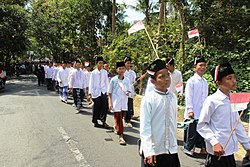
In Indonesia, santri is a term for someone who follows Islamic religious education in pesantren (Islamic boarding schools). Santri usually stay in the place until their education is complete. After completing their study period, some of them will serve the pesantren by becoming administrators. According to C.C. Berg, the term "santri" comes from Sanskrit shastri which means "one who learns Hindu scriptures"; it has the same root as the word shastra (literature).[1][2]

Starting in 2015, October 22 has been designated as the National Santri Day (Hari Santri Nasional) in Indonesia. The date refers to "jihad resolution" issued by Hasyim Asy'ari of Nahdlatul Ulama to ulama and santri prior to the national revolution.[3]

Geertz research

[edit]

In a study by American sociologist Clifford Geertz, the santri are people, particularly in Java, who practice a more orthodox version of Islam, in contrast to the more syncretic abangan.

Geertz identified three main cultural streams (aliran in Indonesian) in Javanese society; namely, the santri, abangan, and priyayi.[4][5] Members of the Santri class are more likely to be urban dwellers, and tend to be oriented to the mosque, the Qur'an, and perhaps to Islamic canon law (Sharia). In contrast, the abangan tend to be from village backgrounds and absorb both Hindu and Muslim elements, forming a culture of animist and folk traditions, it is also claimed that this particular class originated from Sindhi sailors, who had settled in Java.[4] The santri are sometimes referred to as Putihan (the white ones) as distinct from the 'red' abangan. The priyayi stream are the traditional bureaucratic elite and were strongly driven by hierarchical Hindu-Javanese tradition. Initially court officials in pre-colonial kingdoms, the stream moved into the colonial civil service, and then on to administrators of the modern Indonesian republic.[4]

The santri played a key role in Indonesian nationalist movements, and formed the strongest opposition to President Suharto's New Order army-based administration.[4] In contrast, the priyayi have tended to follow the prevailing political wind; they supported Sukarno's overt nationalism, while during Suharto's subsequent presidency, they loyally voted for his Golkar party.[4] Poorer abangan areas became strongholds of the Indonesian Communist Party (PKI) in stark opposition to the orthodox Muslim santri. The cultural divisions descended into bloody conflict in 1965/66 when santri were opposed to communists, many of whom were from abangan streams. An estimated 500,000 -1,000,000 alleged communists were killed during the transition to the New Order, and bitter political and social rivalries remain.[4]

See also

[edit]

Notes

[edit]

References

[edit]
Revisions and contributorsEdit on WikipediaRead on Wikipedia
from Grokipedia
Santri are students in who pursue intensive within , traditional boarding schools that emphasize scriptural study, moral discipline, and communal living under the guidance of a kyai or religious teacher. Originating from pre-colonial Javanese educational traditions adapted to Islamic practices, and their santri communities have existed since at least the , evolving into key institutions for disseminating Islamic knowledge amid influences from , Indian, and local customs. In contemporary Indonesian society, santri numbering around five million across approximately 28,000 contribute significantly to social welfare, including orphanages, healthcare, economic empowerment, and religious harmony, while serving as bulwarks against through community-oriented ideology and services. Their defining characteristics include rigorous adherence to traditional Islamic , often via classical texts, alongside practical engagements in mutual and efforts that underscore a commitment to moderate, inclusive interpretations of faith.

Definition and Characteristics

Etymology and Core Meaning

The term santri derives from the word śāstrī, signifying a scholar proficient in sacred scriptures, which entered Indonesian lexicon through Indian cultural transmissions via ancient trade networks. Alternative derivations trace it to Javanese cantrik, denoting a disciple or apprentice under a , underscoring the pedagogical roots of the concept in pre-Islamic Javanese traditions adapted to Islamic contexts. At its core, santri denotes an individual committed to orthodox in , particularly one engaged in rigorous and ascetic discipline within pesantren (Islamic boarding schools). This encompasses devout observance of the five pillars—shahada (faith declaration), salat (prayer), zakat (almsgiving), sawm (fasting), and hajj (pilgrimage)—distinguishing santri from syncretic Muslim variants through emphasis on scriptural fidelity and communal rather than localized customs.

Key Traits and Practices

Santri exhibit a profound commitment to orthodox , prioritizing strict adherence to the , , and as foundational to personal and communal life. This manifests in rigorous observance of the five pillars of , including daily salat prayers performed in congregation, giving, and sawm during , alongside avoidance of un-Islamic innovations such as excessive worldly attachments or syncretic rituals. Their emphasizes integrity, trustworthiness, and ethical conduct derived from Islamic principles, fostering traits like sincerity (ikhlas), , and resilience against material temptations. Central practices revolve around pesantren-based education and discipline, where santri memorize and interpret classical texts in fields like (jurisprudence), (Quranic exegesis), and (theology) under a kyai's authority. Daily routines structure life around communal worship, self-reliant labor such as farming or maintenance to instill simplicity and independence, and that balances religious study with basic needs. This regimen promotes collectivism, with santri living in dormitories, sharing meals, and engaging in mutual support, which cultivates solidarity and beyond the pesantren walls. Respect for hierarchical learning is evident in deference to the kyai as a spiritual and intellectual guide, whose teachings integrate religious knowledge with practical wisdom for societal harmony. Practices extend to community-oriented activities, such as promoting and ethical development, reflecting santri's in embedding Islamic into broader Indonesian . While traditional santri embody and , contemporary variants may incorporate modern skills, yet core traits of and sharia obedience persist across generations.

Distinction from Abangan and Priyayi

Santri represent a distinct cultural and religious variant within Javanese society, characterized by orthodox adherence to Islamic practices, in contrast to the syncretic abangan and the aristocratic priyayi as outlined in Clifford Geertz's anthropological framework from The Religion of Java (1960). Santri emphasize strict observance of sharia, daily prayers, Quranic study in pesantren, and rejection of pre-Islamic Javanese mysticism (kejawen), positioning them as devout urban or rural Muslims often linked to trading communities or reformist organizations like Nahdlatul Ulama. In distinction from abangan, who constitute the majority of nominal Muslims blending Islam with animist, Hindu-Buddhist, and ancestral spirit elements—evident in rituals like slametan communal feasts focused on harmony rather than theology—santri prioritize scriptural purity over folk , viewing abangan practices as diluted or impure. This divide manifests socio-politically, with santri aligning with Islamist parties and abangan with secular-nationalist ones, as seen in voting patterns during Indonesia's 2019 elections where santri supported candidates emphasizing Islamic identity. Geertz's categorization, while influential, has faced critique for oversimplifying fluid identities, as historical evidence suggests abangan as a term gained prominence post-Geertz rather than reflecting pre-colonial realities. Relative to , the bureaucratic elite rooted in Mataram-era (circa 16th-19th centuries), santri differ in social origin and ethos: embody refined Javanese aesthetics, hierarchical etiquette, and Hindu-influenced mysticism, often prioritizing cultural elegance (alus) over religious rigor, though some adopted santri orthodoxy. Santri, typically from non-elite backgrounds, foster egalitarian piety through discipline, contributing to anti-colonial resistance via networks like (founded 1912), whereas historically collaborated with Dutch colonial administration for status preservation. These distinctions, not rigid castes but overlapping aliran (streams), persist in modern Indonesian politics, with surveys indicating 30% self-identifying as santri versus 3% as .

Historical Development

Origins in Early Islamic Pesantren

The origins of the santri tradition trace back to the 15th century in , coinciding with the intensified facilitated by the Wali Songo, a collective of nine revered Islamic preachers who adapted pre-existing indigenous educational structures like Hindu-Buddhist pondokan—dormitory-style learning centers—into Islamic boarding schools known as . These early institutions served as hubs for da'wah (Islamic propagation), where santri, meaning "students" in Javanese, resided communally under a kyai (religious teacher) to pursue intensive religious education, emphasizing recitation, (Islamic jurisprudence), and tasawuf (). This model emerged as Islam transitioned from coastal trading enclaves to inland Javanese society, with providing a structured environment for cultural and religious assimilation without fully supplanting local customs. Maulana (d. 1419), often hailed as Java's inaugural Islamic missionary and forebear of the Wali Songo, is attributed with establishing the prototype in Gresik, , around the early 1400s, focusing on agricultural self-sufficiency alongside basic Islamic teachings to appeal to local agrarian communities. His successor in lineage, ( Rahmat, 1401–1465), expanded this framework by founding a prominent in circa 1440s, which housed hundreds of santri and integrated madrasah-style instruction with Sufi orders (tarekat), drawing influences from Arab and Indian scholarly traditions. These pioneering efforts institutionalized santri as disciplined adherents of sharia-compliant , contrasting with prevalent in rural , and laid the groundwork for pesantren's role in through religious scholarship. By the mid-16th century, following the Demak Sultanate's consolidation (circa 1475–1554), proliferated across , with santri numbers swelling as kyais disseminated kitab kuning (yellow books) imported from the , fostering networks of that preserved orthodox doctrines amid colonial encroachments. Historical records indicate that early santri life revolved around sorogan (individual tutoring) and weton (recitation sessions), instilling habits of piety, communal labor, and anti-colonial resilience, as evidenced by 's evolution into centers resisting Hindu-Buddhist remnants and later Dutch influences. This foundational phase solidified santri identity as custodians of pure Islamic praxis, verifiable through lineages documented in Javanese chronicles like the Babad Tanah Jawi.

Expansion During Colonial and Independence Eras

During the Dutch colonial era, pesantren institutions, central to santri education, demonstrated notable resilience and expansion amid efforts to marginalize Islamic learning. Established as early as 1742 with the founding of in , these boarding schools proliferated through networks of returning from and , serving as alternatives to colonial-imposed systems. Dutch policies, such as the 1925 Teacher Ordinance and the 1932 Wild School Ordinance, aimed to restrict indigenous religious instruction, yet pesantren adapted by emphasizing sorogan (individual tutorial) methods and grew in enrollment, with large institutions increasing from approximately 200 santri in the to over 1,500 by . This period marked a shift for pesantren from primarily educational roles to hubs of anti-colonial resistance, fostering santri involvement in uprisings like the Padri War (1821–1828) and the Java War led by Prince Diponegoro (1828–1830). Santri networks contributed to early nationalist organizations, including , founded in 1912 as Indonesia's first mass-based socio-political group with widespread santri participation in advocating economic self-reliance and opposition to Dutch dominance. By 1926, a faction of santri established (NU), the world's largest independent Islamic organization, which emphasized traditionalist orthodoxy while engaging in political mobilization against colonial rule. In the lead-up to and during Indonesia's independence struggle post-1945, santri expanded their influence through direct military and ideological contributions. Following the Proclamation of Independence on August 17, 1945, and santri leaders framed resistance against returning Dutch forces as a , issuing fatwas that mobilized communities and prohibited non-essential activities like to prioritize national defense. Santri formed paramilitary units such as Hisbulloh and Sabilillah, participating in key battles including the Surabaya confrontation on November 10, 1945, where they targeted Allied (primarily British) positions alongside groups like Gerakan Pemuda Islam Indonesia. This era solidified pesantren's role in nation-building, with santri advocacy for Islamic principles in the state ideology influencing debates during the 1945–1949 revolution, though ultimately yielding to Pancasila as the constitutional foundation.

Post-Independence Evolution

Following Indonesia's proclamation of independence on August 17, 1945, santri communities, centered in , continued to emphasize traditional Islamic scholarship while navigating state policies that initially marginalized . The 1950 Basic Education Law (No. 4/1950) focused on secular national schooling and excluded from regulation, enabling these institutions to operate autonomously and preserve classical curricula rooted in , , and Arabic studies without mandatory integration of general subjects. This autonomy allowed santri to maintain orthodox practices amid Sukarno's , though tensions arose from efforts to domesticate Islamic institutions under secular . From the 1950s onward, selective modernization emerged as pesantren leaders responded to socioeconomic pressures and competition from state schools. Institutions like Pesantren Tebuireng reorganized madrasah into tiered levels—elementary (ibtidaiyah), junior secondary (tsanawiyah), and senior secondary ()—to incorporate basic mathematics, , and sciences alongside religious instruction, aiming to equip santri for broader economic participation. Pioneering reforms at Pesantren Gontor, initiated by Imam Zarkasyi in the but expanded post-independence, introduced dormitory , English and modern , and training, producing graduates who entered , business, and politics while upholding santri identity. By the New Order era under (1966–1998), government subsidies and certification programs encouraged hybrid models, with pesantren enrollment growing to over 2 million santri by the 1990s, reflecting adaptation to industrialization without diluting core Islamic discipline. Politically, santri influenced post-independence dynamics through organizations like (), which represented traditionalist interests and mobilized rural voters against secular or modernist rivals. During the 1955 elections, NU secured 18% of seats, leveraging santri networks for anti-communist stances that aligned with military-backed regimes. Post-Suharto Reformasi (1998 onward), santri evolved into "new santri"—urban, tech-savvy adherents blending orthodoxy with activism—evident in NU's 90 million members by 2020 and santri-led responses to , such as digital da'wah and economic cooperatives. This shift preserved santri's role in fostering moderate against extremism, as curricula emphasized anti-violent interpretations, though challenges persisted from state oversight and funding dependencies.

Educational and Daily Life in Pesantren

Structure of Pesantren Education

The structure of education centers on the kyai as the authoritative teacher and spiritual guide, santri as resident students committed to immersive learning, and pondok as communal dormitories facilitating round-the-clock discipline and interaction, typically anchored by a for prayers and collective study. This framework emphasizes mastery of over rigid timelines, with santri progressing through demonstrated competence in recitation and comprehension rather than age-based grades in traditional settings. Core teaching methods include sorogan, an individualized tutorial where a santri reads aloud from texts to the kyai for correction and explanation; bandongan, group sessions led by the kyai expounding on kitab kuning (classical yellowed Arabic manuscripts) with santri taking notes; and weton or wetonan, post-prayer collective recitations reinforcing and communal reinforcement. These approaches prioritize oral transmission, repetition, and personal mentorship, cultivating deep religious insight (tafaqquh fiddin) alongside practical skills like self-reliance. The curriculum focuses on foundational Islamic disciplines: Quranic recitation (tadarus), jurisprudence (fiqh), theology (aqidah), Arabic grammar, and exegesis (tafsir), drawn primarily from kitab kuning to build moral character (akhlak) and orthodox adherence. Educational levels often align with the integrated madrasah system—Madrasah Ibtidaiyah for primary basics, Tsanawiyah for junior secondary, and Aliyah for senior secondary—culminating in optional takhassus specialization, though traditional pesantren retain informal progression under kyai discretion. Since regulatory integration via Ministry of Religious Affairs decrees in 2014, many pesantren incorporate national subjects like , sciences, and vocational training (e.g., ) for formal equivalency certificates, balancing religious primacy with for roughly 5 million santri in 28,194 institutions as of 2020. This hybrid model preserves kyai autonomy while addressing socioeconomic needs of rural, lower-income learners.

Daily Routines and Discipline

Santri adhere to a highly structured daily schedule in , emphasizing Islamic worship, religious study, and communal duties to cultivate spiritual and personal discipline. The routine generally begins between 3:00 a.m. and 4:30 a.m., when santri awaken for optional prayers followed by the obligatory congregational Fajr prayer at the , often succeeded by recitation sessions focused on memorization and under ustadz supervision until approximately 6:00 a.m.. Morning activities include bathing, a simple communal breakfast, and prayers before transitioning to formal religious or secular education starting around 7:30 a.m.. The day integrates the five daily prayers—Dhuhr, Asr, Maghrib, and Isha—each performed in congregation and typically followed by study blocks on subjects such as , , , or , alongside potential extracurriculars like public speaking or manual tasks in the afternoon. Meals are shared communally to promote and equality, with afternoons allowing brief rest or practical activities such as farming or cleaning to instill ; the schedule concludes with evening studies or lectures before sleep around 10:30 p.m.. Variations exist across , with traditional institutions prioritizing classical texts over modern schooling, but Fridays often serve as partial holidays for family visits and shared meals. Discipline is maintained through rigorous enforcement of the timetable, hierarchical obedience to kyai and senior santri, and communal living that minimizes distractions, with leaving the pesantren requiring formal permission limited to once every two months. Infractions prompt sanctions like toilet cleaning, full Quran recitation in a day, public confessions, or extended prayer duties, alongside habituation via daily worship and group counseling to foster internal motivation across knowledge, emotional, and behavioral dimensions. This system aims to build time management, independence, and unwavering adherence to Islamic values, with teachers modeling conduct through constant supervision and evaluation.

Socialization and Skill Acquisition

In pesantren, santri undergo intensive socialization through communal living and hierarchical interactions that instill Islamic ethical norms, discipline, and group solidarity. This process begins upon entry, where students adapt to a structured environment under the guidance of kyai (religious leaders) and ustadz (teachers), fostering respect for and peer via daily assemblies and shared responsibilities. Interactions with fellow santri emphasize mutual support and rooted in Islamic principles, transforming lower-class recruits into cohesive communities capable of . The 24-hour immersion in pesantren routines reinforces moral internalization, with activities like collective prayers and recitations embedding values of , perseverance, and . Discipline is maintained through regulations on , academics, and , which santri internalize via repetition and oversight, though enforcement varies by institution and can lead to habitual compliance rather than deep conviction in some cases. Gender-specific in segregated settings further shapes roles, with female santri often emphasizing domestic alongside . Skill acquisition focuses on religious proficiency, including memorization (tahfidz), interpretation, and language mastery, achieved through and oral examinations that build cognitive discipline. Practical , such as facility maintenance, cleanliness protocols, and basic security, are learned via hands-on duties, preparing santri for beyond the pesantren. In modern adaptations, entrepreneurial training integrates business management and vocational competencies like or crafts, with curricula progressing from basic to complex modules to enhance economic independence. These skills, combined with from rigid schedules, equip santri for roles in community or , though traditional pesantren prioritize spiritual over secular expertise.

Sociopolitical Role and Influence

Contributions to Indonesian Nationalism and Politics

Santri from pesantren played a pivotal role in Indonesia's struggle for independence, particularly through mobilization efforts led by kyai during the 1945-1949 revolution against Dutch reoccupation. On November 22, 1945, Kyai Hasyim Asy'ari, founder of Nahdlatul Ulama (NU) and a prominent pesantren leader, issued the Resolusi Jihad fatwa, declaring holy war obligatory for Muslims to defend the newly proclaimed republic. This edict, issued from his Tebuireng pesantren in Jombang, East Java, spurred thousands of santri to enlist in irregular militias such as Hizbullah and Sabilillah, which fought alongside regular forces. Pesantren functioned as recruitment hubs, training sites for guerrilla tactics, and morale centers, embedding nationalist fervor with Islamic duty. In the , commencing October 10, 1945, santri contingents were instrumental in repelling British and Dutch-allied forces, embodying the spirit invoked by the . Their participation, often under kyai command, included urban combat and defense of key positions, contributing to the battle's status as a symbol of Indonesian resilience that galvanized international sympathy for . This involvement extended beyond , with santri from Central and pesantren joining nationwide resistance, helping sustain the revolution until Dutch recognition of sovereignty in 1949. Politically, santri have shaped Indonesia's landscape through , established in 1926 by kyai including to preserve traditionalist amid reformist challenges, evolving into a mass organization with over 90 million members by the 2010s, largely santri-based. 's early anti-colonial stances, such as boycotting Dutch , laid groundwork for santri's nationalist alignment, while post-independence, it advocated Pancasila as state ideology, rejecting full implementation to foster pluralist unity. , as santri mentors, wielded influence in parliamentary , with NU-affiliated parties securing seats in constituent assemblies and later elections, promoting moderate Islamic governance over theocratic or secular extremes. In subsequent eras, santri contributed to political stability by opposing communist threats in the 1960s and authoritarian excesses under Suharto, though alignments varied; NU's withdrawal from government in 1980 highlighted santri-driven pushback against centralization. Today, santri networks bolster democratic participation, with kyai endorsements swaying voter blocs in elections, emphasizing national cohesion and anti-extremism, as evidenced by NU's role in countering radical ideologies post-2000s. The establishment of National Santri Day on October 22 by President Joko Widodo in 2015 formally recognizes these historical and ongoing contributions to sovereignty and governance.

Economic and Community Impact

Pesantren and their santri populations contribute to local economies through self-sustaining business activities, including agricultural ventures, cooperatives, and sharia-compliant initiatives that generate employment and income for surrounding communities. In regions like , , the economic independence of pesantren—achieved via internal production units and leadership-driven enterprises—has directly bolstered micro, small, and medium-sized enterprises (MSMEs) by providing markets, labor, and skill transfer. Similarly, pesantren such as Cipasung in have stimulated regional economic growth through diversified operations in farming, trade, and services, enhancing household incomes and infrastructure in adjacent villages. Santri engagement in these economic activities fosters practical vocational training, enabling graduates to establish entrepreneurial ventures that align with Islamic principles, thereby supporting rural poverty alleviation and . Studies indicate that pesantren-based models, such as community agricultural programs, strengthen local supply chains and productive es, with santri acting as facilitators in village-level economic . Nationally, these institutions' business units contribute to broader economic resilience by testing sharia-compliant models that benefit the wider , though depends on factors like leadership and resource integration. On the community front, pesantren serve as anchors of social cohesion, offering disaster response, welfare programs, and moral education that reinforce communal solidarity amid Indonesia's diverse ethnic landscape. With approximately 22,115 pesantren educating over 3.7 million santri and supported by 412,720 educators as of recent Ministry of Religious Affairs data, these networks cultivate ethical business practices and mutual aid systems rooted in Islamic values, mitigating social fragmentation and promoting middle-class emergence among Muslim populations. This role extends to poverty reduction efforts, where pesantren integrate economic da'wah (proselytization through action) with community upliftment, though outcomes vary by institutional capacity and external support.

Cultural Preservation and Orthodox Islam Advocacy

Santri have historically advocated for orthodox in Indonesia by emphasizing adherence to classical Sunni scholarship, particularly the of prevalent in the , in contrast to syncretic practices that blend with pre-Islamic Javanese , , and ancestor veneration among communities. This position manifests in curricula that prioritize the study of core Islamic texts such as the , collections, and works by medieval scholars like , fostering a that rejects ritual innovations () derived from local customs, such as certain slametan feasts incorporating non-Islamic elements. In preserving culture, santri communities maintain a distinct Islamic subculture through , which transmit not only doctrinal orthodoxy but also compatible cultural practices, including moderated forms of Sufi mysticism (tasawuf) that align with boundaries, thereby safeguarding Java's Islamic heritage against both secular modernization and puritanical imports like Salafism. kyai (religious leaders) negotiate these preservations by adapting traditional rituals—such as tahlilan commemorations—to ensure conformity with orthodox while embedding them in Indonesian social fabrics, as evidenced in the sustained popularity of pesantren-based arts like Islamic-themed performances that reinterpret Javanese epics through prophetic narratives. This dual role extends to organized advocacy via (), established on February 27, 1926, by traditionalist santri to counter reformist challenges and syncretic dilutions, promoting "" as a framework that integrates archipelago-specific cultural expressions—like communal gotong royong cooperation—within orthodox theological bounds, thereby resisting both cultural erosion from globalization and rigid transnational ideologies. 's efforts, drawing from over 90 million members largely from santri backgrounds, include campaigns against extremist deviations while upholding yellow book (kitab kuning) studies central to orthodoxy, ensuring the continuity of a tolerant yet scripturally grounded Islamic identity amid Indonesia's diverse ethnic mosaic.

Modern Adaptations and Challenges

Digital Era Transformations

The accelerated digital adoption in Indonesian , compelling many to implement online learning platforms despite traditional resistance to , as became mandatory to sustain operations. Initially reliant on basic tools like for instruction, pesantren transitioned to virtual classrooms and e-learning systems by 2021, enabling santri to access lectures remotely while preserving core Islamic curricula. This shift, however, revealed incompatibilities between digital methods and pesantren's emphasis on in-person sorogan (one-on-one ) and communal , leading to hybrid models post-2022 where online tools supplemented rather than replaced physical attendance. Pesantren have increasingly integrated digital infrastructure, including e-libraries for digitized kitab kuning (classical Islamic texts) and management apps for santri enrollment, finances, and attendance tracking, with adoption rates rising notably by 2025. These tools facilitate broader access to resources, allowing santri to study advanced or interpretations via apps, though implementation varies by pesantren resources—urban institutions like those in lead, while rural ones lag due to infrastructure deficits. Digital entrepreneurship programs have emerged, training santri in online and , aligning traditional self-sufficiency with market demands and generating community income streams. Santri engagement with and the has transformed da'wah practices, with over 70% using platforms daily for sharing religious content, as per a 2024 Ministry of Religious Affairs survey, shifting from offline preaching to viral online dissemination. This enables global outreach, such as international halqah sessions via Zoom, but introduces risks like exposure to or ethical lapses in use, prompting to enforce curricula emphasizing Islamic . Government-backed initiatives, including the Smart program launched in 2023, aim to equip 1,000–2,000 santri annually with financial and digital skills, fostering "new santri" adept at navigating online economies without compromising . Challenges persist, including limited in remote areas, teacher unfamiliarity with tech, and concerns over moral dilution from unrestricted , which some kyai view as eroding santri discipline. Yet, adaptive strategies like restricted device policies during study hours and tech-integrated madrasah components demonstrate pesantren's resilience, positioning santri as bridges between and in Indonesia's digital landscape.

Government Policies and Recognition (2020s)

In 2020, the Indonesian Ministry of Religious Affairs (Kemenag) issued Minister of Religious Affairs Regulation No. 31/2020 on Education, which formalized the integration of curricula with national standards while preserving their religious and character-building focus, enabling santri to obtain formal diplomas equivalent to public school credentials. This regulation built on the 2019 Law (UU No. 18/2019), whose implementation accelerated in the early through enhanced funding allocations and certification programs, recognizing pesantren as key institutions for national character development amid rising enrollment of over 2.3 million santri by 2022. The Kemenag's Strategic (Renstra) for 2020-2024 prioritized empowerment, allocating budgets for infrastructure upgrades and , with specific to certify 70% of pesantren units by 2024 to align with national education goals. During the , policies included tailored health protocols for pesantren, such as the 2020 joint campaign with the Ministry of Health promoting sanitation measures (: screening, masking, distancing) to sustain santri education continuity. In 2025, President approved the establishment of the Directorate General for within Kemenag on National Santri Day (October 22), marking formal state recognition of pesantren as a distinct educational pillar with dedicated personnel, expanded funding, and data systems for over 28,000 pesantren nationwide. This directorate aims to streamline certification, program development, and resource targeting, responding to santri advocacy for greater institutional autonomy. Concurrent policies addressed safety and quality, including Kemenag's 2025 on preventing in through ustadz competency standards and a pilot program for 512 child-friendly pesantren by 2029, expanding to 6,530 units. Additionally, new building standards were set in October 2025 to mitigate disaster risks in pesantren facilities, following incidents like the 2024 Madura fire. Proposed revisions to the National Education System Law (UU Sisdiknas) in 2025 further seek to embed pesantren equivalence in formal law, enhancing santri access to higher education and public sector opportunities.

Demographic Shifts and "New Santri"

In recent decades, the in Indonesian has grown significantly, reaching approximately 5 million students across 28,194 institutions by 2020, reflecting the enduring appeal of these boarding schools amid Indonesia's expanding Muslim demographic. However, enrollment figures have shown fluctuations, with numbers rising to 4.845 million in the 2022/2023 after dipping to 4.074 million the prior semester, indicating responsiveness to socioeconomic factors rather than uniform expansion. This growth coincides with Indonesia's demographic bonus, where the productive-age (15-64 years) dominates, positioning santri—predominantly —as potential contributors to national development, though traditional rural patterns are evolving. A notable shift involves increasing enrollment from urban and middle-class families, transforming pesantren from primarily rural, lower-income enclaves into venues blending religious discipline with modern aspirations, often termed "pesantren for middle-class ." This change stems from and greater access to , drawing students who integrate Islamic with professional skills, thereby commodifying to align with neoliberal economic pressures. Consequently, santri demographics now include more individuals exposed to global media and higher education, fostering a cohort that applies traditional learning to contemporary contexts like and , distinct from the historically insular, agrarian profile of earlier generations. The "new santri" phenomenon encapsulates this evolution, referring to a younger cohort of devout emerging since the under the New Order regime and accelerating post-1998 democratization, who diverge from traditional santri in ideology, political engagement, and global orientation. Unlike conventional santri tied to rural and kyai-led authority rooted in classical scholarship, new santri—often urban-educated—exhibit convergent, radical, or global tendencies: convergent types from renewal movements like those led by Nurcholish Madjid emphasized contextual ic adaptation; radical variants in the 1980s, such as Negara Islam Indonesia (NII) and adherents, pursued revolutionary purism; while 1990s globalists connected to transnational networks, exemplified by Jemaah Tarbiyah activists forming the (PKS) in the mid-1980s. These groups, influenced by international Islamist currents, prioritize scriptural revivalism over syncretic traditions, challenging established hierarchies like (NU) and , as evidenced by their electoral inroads—e.g., Parmusi's 5% vote share in signaling early momentum. This demographic-ideological reconfiguration underscores causal pressures from and , where post-Soeharto freedoms enabled non-pesantren-educated pious youth to contest traditional through alternative preaching and organizations, often bypassing conventional kyai certification. Empirical indicators include the rise of urban study circles (halqah) and da'wah, attracting middle-class youth who blend with , though this has strained relations with orthodox establishments wary of diluted . Overall, the new santri represent not a numerical surge but a qualitative pivot toward dynamic, contested religious agency amid Indonesia's youthful population bulge.

Controversies and Criticisms

Infrastructure Failures and Safety Concerns

On September 29, 2025, a three-story prayer hall at the Al-Khoziny Islamic Boarding School () in , , collapsed during an afternoon prayer session attended by hundreds of santri, resulting in at least 67 confirmed deaths, primarily teenage male students, and over 100 injuries, with many suffering head trauma and fractures. Rescue operations lasted days, involving oxygen lines and heavy machinery amid unstable , shifting to body recovery after initial survivor searches yielded limited results. Structural analysis post-collapse attributed the failure to inadequate load-bearing capacity in beams, columns, and slabs, exacerbated by unauthorized expansions, substandard materials, and non-compliance with building codes, including insufficient foundation depth and column sizing. The incident highlighted systemic oversight gaps, as many rely on informal, community-funded (gotong royong) without professional reviews or permits, leading to widespread vulnerabilities in aging or ad-hoc structures housing thousands of santri nationwide. In response, Indonesian authorities initiated safety audits on approximately 80 pesantren buildings deemed at high risk of structural failure, while pledging new national building standards tailored to , including mandatory inspections and regulatory enforcement to curb unauthorized modifications. Critics, including construction experts, described the event as a preventable outcome of lax , noting it fits a pattern of failures in religious facilities where enforcement prioritizes cultural deference over technical compliance. Despite parental reluctance to blame school leadership, the tragedy intensified calls for , with investigations ongoing into potential by builders and administrators. While the majority of santri, particularly those in Nahdlatul Ulama (NU)-affiliated pesantren, actively oppose violent extremism through promotion of tolerant Islamic teachings, isolated instances of radicalization have linked certain alumni to terrorist networks. Following the 2002 Bali bombings, which killed 202 people, international attention focused on pesantren as potential sites of indoctrination, with evidence emerging that some graduates from independent or fringe institutions joined Jemaah Islamiyah, an al-Qaeda affiliate responsible for multiple attacks in Indonesia between 2000 and 2005. However, such cases represent outliers; comprehensive reviews of over 25,000 pesantren indicate that most maintain moderate curricula rooted in traditionalist Aswaja doctrine, which emphasizes contextual interpretation of texts and rejection of puritanical ideologies imported from the Middle East. NU, representing 90 million followers including the bulk of santri, has spearheaded anti-extremism initiatives, such as the 2016 International Summit of Moderate Islamic Leaders, where it condemned caliphate advocacy and viral extremism as deviations from core Islamic principles. Empirical data underscores santri's limited affinity for militancy: a 2021 study of Indonesian Islamic education found lower support for and negative attitudes toward non-Muslims among students compared to urban youth, attributing this to communal oversight by (religious leaders) who prioritize ethical conduct over jihadist narratives. have even hosted programs, rehabilitating over 1,000 former extremists since 2010 by reintegrating them into traditional learning environments that stress anti-violence fatwas issued by NU clerics. Nonetheless, vulnerabilities persist in under-regulated or Salafi-influenced , where exposure to transnational Wahhabi literature has occasionally fostered sympathy for groups like , as seen in the 2018 involving a family radicalized partly through such channels. Santri social attitudes reflect deep-rooted , shaped by orthodox adherence to Sunni traditionalism and resistance to secular modernization. Surveys of NU santri reveal strong endorsement of gender-segregated and veiling norms, with 78% opposing interfaith marriages in a 2019 poll, viewing them as threats to communal purity. This orientation manifests in advocacy for sharia-derived policies, such as laws, which santri networks have mobilized to enforce since the , where conservative clerics influenced the defeat of a Christian amid mass protests. Broader attitudes emphasize familial and moral discipline, with curricula reinforcing opposition to Western individualism, , and as corrosive to —a stance echoed in NU's rejection of "progressive" reinterpretations of (jurisprudence). These views contribute to a "conservative turn" in Indonesian since the , where santri demographics—comprising rural majorities—have amplified calls for enforcement amid urbanization's social disruptions, though without endorsing theocratic governance. Critics from secular perspectives argue this fosters intolerance, citing santri-led fatwas against pluralism; yet, causal analysis ties such attitudes to preservation of against , not inherent bigotry, as evidenced by santri's historical tolerance toward Indonesia's ethnic diversity under NU guidance. Recent "new santri" urban migrants blend this with political , supporting parties like PKB that prioritize over .

Conflicts with Media and Secular Narratives

Mainstream Indonesian media outlets have recurrently depicted as incubators for radicalism and , fostering a public perception that links santri to despite limited empirical substantiation for widespread involvement. This portrayal intensified following high-profile attacks like the , where isolated cases involving pesantren alumni were generalized to the entire system, overlooking data showing that only a fraction—estimated at fewer than 20 out of thousands—of pesantren harbored such influences as of 2018. In contrast, studies indicate that traditional santri institutions, rooted in Nahdlatul Ulama's network, actively mitigate radical ideologies through emphasis on classical texts and community-oriented jurisprudence, functioning as societal stabilizers rather than agitators. Santri responses to these media narratives involve counter-hegemonic efforts, including the proliferation of independent digital and print platforms to refute associations and reclaim control. By July 2025, pesantren-affiliated media initiatives had expanded to include online workshops and content production, enabling santri to disseminate orthodox interpretations that challenge mainstream depictions of their as inherently regressive. These efforts highlight a perceived toward urban, secular perspectives, which santri argue systematically undervalues religious traditionalism in favor of progressive ideals that conflict with Islamic doctrinal primacy. Ideological frictions peak in santri opposition to secular paradigms, exemplified by the Majelis Ulama Indonesia's (MUI) July 2005 fatwa declaring secularism, religious liberalism, and pluralism as deviations from Islam—a position resonant with santri emphasis on tawhid (monotheistic unity) over relativist accommodations. Issued amid rising liberal reforms post-Suharto, the fatwa prompted backlash from media and academics, who on August 1, 2005, and subsequent dates labeled it a threat to Pancasila-based pluralism and human rights, with outlets like Tempo magazine critiquing MUI's authority as unrepresentative. Santri defenders, however, maintain that such rulings preserve causal integrity in faith transmission, countering secular narratives that equate orthodoxy with intolerance while empirically correlating liberal dilutions with intra-Muslim schisms. This tension underscores broader santri-media divides, where coverage often prioritizes elite-driven secularism over grassroots religious empiricism.

References

Add your contribution
Related Hubs
User Avatar
No comments yet.