Hubbry Logo
JackscrewJackscrewMain
Open search
Jackscrew
Community hub
Jackscrew
logo
8 pages, 0 posts
0 subscribers
Be the first to start a discussion here.
Jackscrew
Jackscrew
from Wikipedia
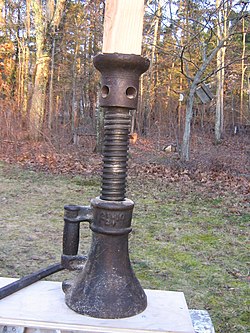
A 2.5-ton screw jack. The jack is operated by inserting the bar (visible lower left) in the holes at the top and turning.

A jackscrew, or screw jack, is a type of jack that is operated by turning a leadscrew. It is commonly used to lift moderate and heavy weights, such as vehicles; to raise and lower the horizontal stabilizers of aircraft; and as adjustable supports for heavy loads, such as the foundations of houses.

Description

[edit]

A screw jack consists of a heavy-duty vertical screw with a load table mounted on its top, which screws into a threaded hole in a stationary support frame with a wide base resting on the ground. A rotating collar on the head of the screw has holes into which the handle, a metal bar, fits. When the handle is turned clockwise, the screw moves further out of the base, lifting the load resting on the load table. In order to support large load forces, the screw is usually formed with Acme threads.

Advantages

[edit]

An advantage of jackscrews over some other types of jack is that they are self-locking, which means when the rotational force on the screw is removed, it will remain motionless where it was left and will not rotate backwards, regardless of how much load it is supporting. This makes them inherently safer than hydraulic jacks, for example, which will move backwards under load if the force on the hydraulic actuator is accidentally released.

Mechanical advantage

[edit]

The ideal mechanical advantage of a screw jack, the ratio of the force the jack exerts on the load to the input force on the lever ignoring friction is
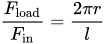
where

is the force the jack exerts on the load.
is the rotational force exerted on the handle of the jack
is the length of the jack handle, from the screw axis to where the force is applied
is the lead of the screw.

The screw jack consists of two simple machines in series; the long operating handle serves as a lever whose output force turns the screw. So the mechanical advantage is increased by a longer handle as well as a finer screw thread. However, most screw jacks have large amounts of friction which increase the input force necessary, so the actual mechanical advantage is often only 30% to 50% of this figure.

Limitations

[edit]

Screw jacks are limited in their lifting capacity. Increasing load increases friction within the screw threads. A fine pitch thread, which would increase the advantage of the screw, also reduces the speed of which the jack can operate. Using a longer operating lever soon reaches the point where the lever will simply bend at its inner end.

Screw jacks have now largely been replaced by hydraulic jacks. This was encouraged in 1858 when jacks by the Tangye company to Bramah's hydraulic press concept were applied to the successful launching of Brunel's SS Great Eastern, after two failed attempts by other means. The maximum mechanical advantage possible for a hydraulic jack is not limited by the limitations on screw jacks and can be far greater. After World War II, improvements to the grinding of hydraulic rams and the use of O ring seals reduced the price of low-cost hydraulic jacks and they became widespread for use with domestic cars. Screw jacks still remain for minimal-cost applications, such as the little-used tyre-changing jacks supplied with cars, or where their self-locking property is important, such as for horizontal stabilizers on aircraft.

Applications

[edit]
In the 19th century, the Raising of Chicago involved entire city blocks being lifted with jackscrews.

The large area of sliding contact between the screw threads means jackscrews have high friction and low efficiency as power transmission linkages, around 30%–50%. So they are not often used for continuous transmission of high power, but more often in intermittent positioning applications.[citation needed]

In heavy-duty applications, such as screw jacks, a square thread or buttress thread is used, because it has the lowest friction and wear.

Industrial and technical applications

[edit]

In technical applications, such as actuators, an Acme thread is used, although it has higher friction, because it is easy to manufacture, wear can be compensated for, it is stronger than a comparably sized square thread and it makes for smoother engagement.

The ball screw is a more advanced type of leadscrew that uses a recirculating-ball nut to minimize friction and prolong the life of the screw threads. The thread profile of such screws is approximately semicircular (commonly a "gothic arch" profile) to properly mate with the bearing balls. The disadvantage to this type of screw is that it is not self-locking. Ball screws are prevalent in powered leadscrew actuators.

Aviation

[edit]
A Boeing 737 uses an adjustable horizontal stabilizer, moved by a jackscrew, to provide the required pitch trim forces.  Generic stabilizer illustrated.

Jackscrews are also used extensively in aircraft systems to raise and lower horizontal stabilizers.

The failure of a jackscrew on a Yakovlev Yak-42 airliner due to design flaws resulted in the crash of Aeroflot Flight 8641 in 1982.

The failure of a jackscrew on a McDonnell Douglas MD-80 due to deficient maintenance brought down Alaska Airlines Flight 261 in 2000.

A MRAP armoured vehicle being transported aboard National Airlines Flight 102 in 2013, a Boeing 747-400BCF freighter, broke loose immediately after takeoff and smashed through the rear bulkhead. Both flight recorders were knocked offline, hydraulic lines were severed and most critically, the horizontal stabilizer actuator’s jackscrew was destroyed, rendering the aircraft uncontrollable.

Machinist's jacks

[edit]

A machinist's jack is a miniature screw jack used to support protruding parts of a workpiece or to balance clamping forces on that workpiece during machining operations. Aside from their size, these frequently look no different from the screw jacks used to lift buildings off their foundations.[1][2] Machinist's jacks can be as simple as a threaded spacer with a bolt in it to serve as a jackscrew.[3]

In electronic connectors

[edit]
An electronics module mounted on the back of a large electrical connector incorporating two very long T-handle jackscrews

The term jackscrew is also used for the captive screws that draw the two parts of some electrical connectors together and hold them mated. These are commonly encountered on D-subminiature connectors, where they serve primarily to prevent accidental disconnection. On larger connectors such as the one illustrated, the jack screws also help align the connectors and overcome the large frictional forces involved in inserting or removing the connector. When unscrewed, they allow the connector halves to be taken apart. Jackscrews in electrical connectors may have ordinary screw heads or extended heads designed as thumbscrews.

The idea of incorporating jack screws into electrical connectors was not considered novel in the late 1950s and early 1960s. Some patents from that era show pairs of jackscrews on opposite sides of a multi-pin connector.[4][5] Another shows a single central jackscrew.[6] These patents mention the phrase "jack screw" incidentally, without asserting a claim to the idea.

Jack screws may have either male or female threads, and on some connectors, the genders of the screws as well as various alignment pins may be mixed in order to prevent the wrong connector from being connected to the wrong socket.[7]

See also

[edit]

References

[edit]
Revisions and contributorsEdit on WikipediaRead on Wikipedia
from Grokipedia
A jackscrew, also known as a screw jack, is a mechanical that converts rotational motion into by means of mechanism, enabling the lifting, lowering, positioning, or precise adjustment of heavy loads ranging from a few pounds to hundreds of tons. It operates on the principle of a or that advances or retracts within a nut or gear housing when turned manually via a handle or driven by an , providing significant through the screw's thread geometry to amplify applied force while minimizing effort. The device typically consists of key components including a threaded (often Acme thread for efficiency and self-locking properties), a worm gear or nut assembly for motion transmission, a sturdy housing or base to support the load, and optional gearing for speed and control. Jackscrews are valued in applications for their reliability, precision, and ability to hold positions without power due to friction-based self-locking, though they require to reduce wear and overheating during operation. Common types include machine screw jacks, which use Acme threads for high load capacities (up to 250 tons) at slower speeds (3-30 inches per minute) and are self-locking for intermittent use, and ball screw jacks, which employ bearings for lower friction, significantly higher efficiency, and faster travel (20-200 inches per minute) in continuous-duty scenarios, though they necessitate external braking to prevent back-driving. Configurations may be translating (where the screw moves linearly) or rotating (where the load nut travels along a fixed screw), with options for single or coupled units in systems for synchronized multi-axis motion. Jackscrews find widespread use across industries such as automotive for vehicle lifting and repair, and for equipment positioning, for assembly line adjustments, and for shoring and alignment tasks, offering energy-efficient and environmentally robust solutions compared to hydraulic alternatives. Their design emphasizes features like overload and stable basing to handle dynamic loads, with capacities determined by thread pitch, material strength (e.g., screws and nuts).

History

Invention and Development

The conceptual foundations of the jackscrew trace back to ancient innovations in screw mechanisms, particularly the developed in the 3rd century BCE, which utilized a helical screw principle within a tube to lift water from lower to higher elevations, serving as an early precursor to screw-based linear lifting devices for loads. This ancient device demonstrated the potential of screw threads for in elevation tasks, influencing later engineering concepts despite its primary application to fluids rather than solid objects. In the late , sketched designs for a screw jack, demonstrating its potential for lifting heavy loads using a worm screw and gear mechanism. The modern jackscrew began to take shape in the 19th century amid the Industrial Revolution's demand for reliable lifting solutions in and . Screw-activated jacks had been in sporadic use since around 1200 CE for cranes and hoists, but systematic development accelerated with the need for heavy-duty applications. A notable early advancement came in 1886 when Canadian inventor Frank Henry Sleeper patented a screw and gear jack specifically designed for railroad maintenance, enabling precise lifting and alignment of heavy rails and equipment in industrial settings. By the 1870s and 1880s, jackscrews were integrated into post-Industrial Revolution machinery, such as railroad and log yarding operations, where they facilitated the handling of massive loads like bent rails or timber for transport. In the late , jackscrew design evolved significantly with the adoption of Acme threads around the 1890s to supersede weaker square threads and provide superior load-bearing capacity through a 29-degree that enhanced strength and reduced wear. This refinement allowed jackscrews to handle greater axial forces efficiently, making them indispensable in expanding industrial applications. Entering the , the transition from purely manual operation to powered variants—incorporating electric motors or hydraulic assistance—further broadened their utility, marking a shift toward more advanced designs in heavy lifting, with early screw jacks like that patented around by inventors such as Frank L. Gormley Sr..

Notable Historical Uses

One of the most ambitious applications of jackscrews occurred during the in the 1850s and 1860s, a project aimed at elevating the city's streets and buildings to improve drainage and combat frequent flooding from . Engineers employed thousands of jackscrews—manual screw jacks typically three inches in diameter with three-eighths-inch threads—to lift entire blocks piecemeal, with workers turning the screws incrementally to raise structures up to 14 feet over the course of two decades. For instance, in 1858, a one-acre block weighing an estimated 35,000 tons between Lake, , and LaSalle streets was supported by 6,000 jackscrews and elevated four feet eight inches in just five days by teams of around 600 men, demonstrating the device's capacity for precise, labor-intensive heavy lifting without modern power sources. This effort involved over 50 buildings and transformed central Chicago's infrastructure, though it required coordinated private and public funding to complete. In 19th-century bridge construction, jackscrews proved essential for precise positioning and support during complex assemblies. A prominent example is the across the in , completed in 1874, where jack-screws were used to suspend and lower massive pneumatic caissons—watertight chambers for underwater foundation work—into the riverbed from traveling platforms, enabling workers to excavate 136 feet below the surface despite challenging currents and hazards. This innovative use highlighted jackscrews' role in maintaining stability and control in large-scale projects before widespread adoption of powered alternatives. By the early , jackscrews had become a staple in nascent automotive garages for lifting vehicles during maintenance, such as tire changes and undercarriage repairs, where cast-iron models like the Eureka No. 1 or Weaver mechanical jacks could hoist cars weighing up to several tons using geared screw mechanisms operated by hand levers. These devices, often without reverse gear assistance in early automobiles, allowed mechanics to rotate vehicles on turntables for access, marking an adaptation of jackscrews from industrial to everyday mechanical tasks. The prominence of jackscrews began to wane after the introduction of hydraulic jacks in 1851, with further acceleration in the late 1850s through designs like those by the Tangye company adapting Bramah's principles for broader heavy-lifting applications, offering faster and less labor-intensive operation that gradually supplanted screw-based systems in most non-precision contexts while jackscrews persisted in niche, high-control scenarios.

Design and Components

Basic Structure

The jackscrew, also known as a screw jack, features a core assembly centered on a vertical , which serves as the primary responsible for linear displacement. This leadscrew engages with a nut or collar designed to convert rotational input into vertical motion, supporting the load through direct thread interaction. At the top of the leadscrew, a load-bearing platform or provides a stable surface for attaching or resting the lifted object, while the base offers foundational stability to prevent tipping or shifting during use. For manual variants, a or crank attaches to the input shaft, allowing operators to rotate the mechanism by hand, whereas geared models incorporate an optional worm gear system to enhance torque application and control. The and associated nut are typically housed within a protective frame or , which encases the components and includes mounting points for secure installation. This assembly ensures the lifting nut rides along the threads, maintaining alignment and load distribution throughout the structure. Jackscrews achieve self-locking capability through the low lead angle of their screw threads, which ensures that prevents unintended descent under load without external input. Construction materials prioritize durability and resistance to wear, with the and base commonly fabricated from high-strength or alloys to withstand compressive forces. The nut is often made from for its excellent load-bearing qualities and inherent , reducing in the assembly. Housing elements may utilize aluminum die-casting or gray for lightweight yet robust support. Load capacities for jackscrews typically range from 0.25 tons (250 pounds) to 250 tons or more, depending on the size and material specifications, enabling applications from small-scale lifting to heavy industrial support.

Thread Types and Variations

Jackscrews primarily utilize specialized thread forms optimized for , load-bearing capacity, and controlled under heavy loads. The choice of thread type influences the device's , , and resistance to wear, with designs selected based on application demands such as speed, precision, and static holding . Square threads represent an earlier thread form used in jackscrews, characterized by 90-degree shoulders that minimize during operation but offer lower durability compared to modern alternatives. These threads were the industry standard for motion applications, including early screw jacks, prior to the late . Acme threads, the most common in contemporary jackscrews, feature a 29-degree included and a trapezoidal shape that enhances strength and load capacity while maintaining reasonable efficiency for heavy lifting tasks. This design, standardized under ASME/ANSI B1.5, provides broader, more robust flanks than V-threads, making it ideal for machine screw jacks that handle static loads up to 250 tons at low speeds. Acme threads come in variations such as general purpose (for broad use), centralizing (for alignment in parts), and stub (for shallower and higher strength in compact spaces). Ball screw variations incorporate recirculating ball bearings within the thread grooves to drastically reduce friction, enabling higher speeds and precision motion in jackscrews suited for dynamic applications like automation and aerospace. These are particularly effective for oscillating or high-duty cycle operations but require additional braking to prevent backdriving under load. Roller screw jacks, another advanced variation, use threaded rollers instead of balls for even greater contact area, supporting extreme loads in high-cycle environments such as mining equipment. Inverted jackscrew designs reverse the conventional setup by fixing the nut and allowing the to extend upward, which facilitates applications where the load must be lifted from below a stationary base, such as in certain systems. This configuration maintains the thread type's inherent properties while altering the motion path for specific mounting needs. In jackscrew threads, the lead refers to the axial advance per full turn of the , which directly governs motion speed and requirements; for single-start threads, it equals the pitch (distance between adjacent threads), while multi-start designs increase the lead for faster travel. Typical leads in Acme jackscrews range from 0.05 to 1 inch, balancing load capacity with practical lifting rates in industrial settings.

Operation and Mechanics

Principle of Operation

A jackscrew functions by converting rotational input into linear output through the threaded between and a nut. In the translating configuration, rotational is applied to the —typically via a or crank—causing it to rotate and advance linearly through a fixed nut, elevating the load attached to the screw's end. In the rotating configuration, the screw is fixed while the nut rotates and travels along the threads, moving the attached lifting platform. This leverages the screw's threads as an that gradually displaces the load upward with each rotation. The self-locking property of a jackscrew arises from its thread geometry, where the effective lead angle is typically under 5 degrees, ensuring that between the threads exceeds the component of the load tending to cause reversal. As a result, the system resists back-driving under load without additional , maintaining the elevated position securely once the input ceases. For lowering, reverse must be applied to overcome . Operationally, jackscrews support both manual and powered configurations to suit varying demands. In manual setups, a hand crank provides low-speed, precise control for intermittent lifting tasks, while motorized variants employ electric drives for automated, continuous, or high-volume applications, enhancing efficiency in industrial settings. Load handling in a jackscrew involves axial compression transmitted through the screw to the base, distributing the weight evenly along the threaded interface. Stability demands precise vertical alignment to avoid lateral forces that could compromise the structure or cause uneven wear.

Mechanical Advantage Calculation

The mechanical advantage of a jackscrew quantifies its ability to amplify an input to lift a load, derived from its function as a screw mechanism. In the ideal case, neglecting , the ideal mechanical advantage (IMA) is given by the IMA=2πrlIMA = \frac{2\pi r}{l}, where rr is the of the or lever arm, and ll is the lead of the screw, defined as the axial advance per complete revolution. This arises because turning the once moves the effort through a equal to the 2πr2\pi r, while the load advances only by the lead ll, yielding a velocity ratio that equals the amplification under ideal conditions. To derive this, consider the jackscrew as an wrapped helically around a central , a conceptual model originating from ' principles of simple machines. The "hypotenuse" of the effective is the 2πr2\pi r of the 's path, and the vertical rise (opposite side) is the lead ll. The then follows as the ratio of hypotenuse to rise, IMA=2πrlIMA = \frac{2\pi r}{l}, analogous to an 's MA = length / height. For instance, with a 12-inch radius (r=12r = 12 inches) and a 0.5-inch lead (l=0.5l = 0.5 inches), the IMA calculates as 2π×120.575.4\frac{2\pi \times 12}{0.5} \approx 75.4, meaning an ideal input force of 1 ton could theoretically lift approximately 75 tons. In practice, friction in the threads and bearings reduces the actual mechanical advantage (AMA), expressed as AMA=IMA×ηAMA = IMA \times \eta, where η\eta is the efficiency, typically ranging from 30% to 50% for machine screw jacks due to sliding contact losses. This efficiency accounts for thread friction (coefficient μ\mu often 0.1–0.15 for lubricated steel) and bearing losses, lowering the effective force amplification; for the previous example, an η=40%\eta = 40\% yields an AMA of about 30.2. The required torque TT to raise a load QQ incorporates this via T=Q×l2πηT = Q \times \frac{l}{2\pi \eta}, balancing the ideal torque with frictional opposition.

Performance Characteristics

Advantages

Jackscrews offer a self-locking capability that enables them to securely hold loads indefinitely without requiring continuous power input or additional braking mechanisms, a key distinction from hydraulic systems that rely on seals to prevent fluid drainage and maintain position under load. This feature stems from the 's high friction coefficient and lead angle, typically effective in machine screw jacks with gear ratios of 20:1 or greater, ensuring stability even in the absence of . The design allows for exceptional precision control, facilitating fine adjustments through gradual rotation of the screw, which is particularly advantageous for tasks requiring accurate alignment, such as in machinery setup or structural leveling. This slow, controlled motion provides repeatable positioning with minimal backlash when properly maintained, outperforming faster but less precise alternatives in applications demanding exact load placement. Jackscrews demonstrate superior durability and low maintenance needs due to their fully mechanical construction, which eliminates the risk of fluid leaks common in hydraulic systems and supports extended in dry or clean environments. Without the need for pumps, hoses, or fluid reservoirs, they incur lower operational costs, especially for intermittent or static load-holding duties where frequent cycling is not required. For load capacities under 50 tons, jackscrews provide notable portability, being more compact and lightweight than comparable hydraulic jacks, which often include bulky reservoirs and pumps. This makes them easier to transport and deploy in field or mobile applications without compromising structural integrity.

Limitations and Efficiency Factors

Jackscrews exhibit low operational speeds, with typical lifting rates of 3-30 inches per minute for machine screw jacks, rendering them unsuitable for applications demanding rapid adjustments or high-velocity motion. This limitation stems from the inherent mechanics of threaded advancement, where linear travel is constrained by the worm gear's rotation and thread pitch. Efficiency in jackscrews typically falls within 20% to 40%, attributable to frictional losses in the threads and bearings, which reduce the conversion of input to useful lifting work. Ball screw configurations can achieve efficiencies up to 90%, minimizing through rolling elements, though they incur higher manufacturing costs. Thread , as explored in design variations, further contributes to these inefficiencies by increasing the required for operation. Duty cycles are typically 25% for machine screw jacks and up to 35% for jacks to prevent overheating. Load capacities for jackscrews typically range up to 100 tons per jack in many configurations, with heavy-duty models reaching 250 tons or more. For taller lifts exceeding 5 feet, risks escalate due to compressive column loading on the screw shaft, necessitating guided supports or tension-based designs to prevent failure. Jackscrews are sensitive to environmental conditions, with posing a significant issue in wet or humid settings that degrade unprotected components. Consistent is required to mitigate wear from , using greases suited to the range of -20°C to 90°C.

Applications

Industrial and Lifting Applications

Jackscrews are widely employed in and machinery lifting tasks, particularly in automotive repair and settings. In garages, mechanical screw jacks, such as scissor types, provide stable elevation for passenger s, with typical capacities ranging from 2 to 3 tons to support one or more wheels during tire changes or undercarriage work. These devices convert rotational force into via a threaded , allowing controlled lifting without , making them suitable for shop environments where precision and portability are essential. Beyond cars, jackscrews facilitate heavier machinery lifts, such as in repairs or equipment positioning, where their mechanical reliability supports loads up to several tons without power sources. In construction, jackscrews serve critical roles in temporary and . They are used to stabilize buildings during repairs or relocation, including house moving operations where multiple synchronized jackscrews lift entire structures off for transport or repositioning. For foundation work, adjustable screw jacks, often known as jack posts, provide support for sagging floors or beams, distributing loads evenly to prevent settling and enabling precise leveling in residential and commercial projects. In larger-scale applications, such as bridge or building , heavy-duty jackscrews offer robust temporary support for beams and frameworks, ensuring safety during or activities. Additionally, in assembly lines, jackscrews aid in aligning components or machinery, allowing incremental adjustments to maintain structural integrity across phases. Within manufacturing, enable pressing, positioning, and height adjustments for efficient production processes. They are integrated into factory setups for tasks like clamping workpieces during assembly or fine-tuning equipment alignment, providing consistent force application without electrical dependency. A common example is their use in adjusting conveyor heights, as seen in packaging lines where screw jacks synchronize platform elevations to accommodate varying product flows or operator . In modern industrial contexts, jackscrews are incorporated into advanced systems like scissor lifts and robotic arms to handle substantial loads from 5 to 50 tons. In scissor lifts, screw-driven mechanisms provide stable vertical extension for in warehouses, supporting heavy pallets or equipment with synchronized motion for safety. For robotic arms, pivoting jackscrews facilitate precise tilting and positioning of end-effectors in lines, enhancing accuracy in tasks such as or assembly while managing dynamic loads. These integrations leverage the jackscrew's high load-bearing capacity and self-locking feature to ensure reliable operation in high-throughput environments.

Aviation and Precision Uses

In aviation, jackscrews are critical components in stabilizer trim systems, where they enable precise extension and retraction of horizontal stabilizers to maintain aircraft pitch control. For instance, in the , the horizontal stabilizer is moved nose-up or nose-down via a jackscrew mechanism, which can be actuated mechanically through cables, electrically, or hydraulically for fine adjustments during flight. These systems rely on the jackscrew's self-locking property to hold position without continuous power input, enhancing safety in high-stakes environments. However, failures due to have led to catastrophic incidents; in in 1982, the Yak-42's horizontal stabilizer jackscrew failed from metal fatigue at high altitude, causing loss of control and 132 fatalities. Similarly, Alaska Airlines Flight 261 in 2000 involved the in-flight failure of the MD-83's horizontal stabilizer trim jackscrew assembly due to excessive from inadequate , resulting in the aircraft's inversion and crash into the , killing all 88 aboard. Machinist's jacks, compact screw-based devices, provide micron-level precision for holding and positioning workpieces in lathes and milling machines during operations. Constructed from high-quality with ACME threads, these jacks allow for minute height adjustments, ensuring accurate alignment of long or irregular stock to prevent deflection under cutting forces. Their robust design supports loads up to several hundred pounds while bolted to tables, making them indispensable for setup in precision where tolerances demand exact fixturing. In , jackscrews secure connections in high-reliability assemblies, such as connectors used for data and in and systems. These 4-40 threaded jackscrews, typically installed in pairs on metal faceplates, mechanically lock male and female plugs together, preventing disconnection from vibration or in panel-mounted applications. Thumb screws, a variant with knurled heads for tool-free operation, are commonly integrated into (PCB) enclosures and backshells to fasten components without damaging sensitive . Beyond these, jackscrew actuators deliver controlled linear motion in robotics and medical devices, where precision and repeatability are paramount. In robotic arms, acme-threaded jackscrews provide positive mechanical action for positioning end-effectors with sub-millimeter accuracy under loads up to 100 tons, supporting tasks like assembly or inspection. In medical applications, such as imaging equipment and surgical tools, leadscrew-based jackscrews enable smooth, backlash-free adjustments in patient-monitoring systems and diagnostic devices, ensuring sterile and reliable operation.

Safety and Maintenance

Safety Standards and Risks

Jackscrews are susceptible to several critical failure modes that pose significant safety risks during operation. Thread stripping occurs when excessive wear on the acme threads leads to loss of engagement between the and nut, potentially causing uncontrolled load descent; this was a primary factor in the of the horizontal stabilizer jackscrew on in 2000, where inadequate lubrication resulted in 90% thread thickness loss and shearing under operational loads of 6,000–7,000 pounds per thread. under eccentric loads can compromise slender jackscrew columns in compression, as the offset loading induces bending moments that reduce the critical buckling load, estimated using the Euler formula for power screws. from cyclic loading accelerates crack initiation and propagation in threaded components, with failure often occurring after repeated stress cycles exceeding design limits, as seen in bolted connections under dynamic environments. Regulatory standards establish rigorous requirements to mitigate these risks. The ASME B30.1-2020 standard governs mechanical jacks, including those under 10 tons capacity, mandating a design factor of at least 4 based on ultimate material strength and proof testing at 125% of rated load without permanent deformation. In the , the 2006/42/EC demands comprehensive risk assessments for lifting machinery like jackscrews, including static at 1.5 times the rated load for manual devices to ensure stability and no permanent deformation. Overloading remains a prominent failure mode, where exceeding rated capacity can lead to structural collapse; standards require proof testing at 125% of rated load to verify integrity under stress. In aviation applications, corrosion and wear on jackscrews demand stringent inspections, with the FAA issuing Airworthiness Directive 2000-15-15 post-Alaska Flight 261, mandating repetitive checks of the MD-80 series horizontal stabilizer jackscrew assembly every 650 flight hours or upon end-play exceedance to detect degradation early. Recent advancements address ongoing safety gaps through post-2020 emphasis on IoT-enabled for jackscrews, where sensors monitor , , and load in real-time to forecast failures and reduce unplanned downtime by up to 50%. Compared to pneumatic jacks, which offer faster actuation but carry higher risks of sudden from air leaks or supply failures, jackscrews provide inherent self-locking stability without fluid or gas dependencies.

Maintenance Procedures

Regular inspection is essential for jackscrews to detect potential issues early and ensure operational reliability. Visual checks for thread wear, cracks, or other damage should be performed quarterly, focusing on the , nut, and associated components for signs of deformation or . Annual is recommended per ASME B30.1 standards to verify the jackscrew's capacity under rated loads, simulating operational conditions to identify weaknesses in the assembly. Proper lubrication minimizes and extends component life in jackscrews, particularly those with Acme threads. Grease should be applied to Acme threads every 3 to 6 months, depending on usage intensity, using a high-quality, extreme-pressure suitable for the . For high-load applications, anti-seize compounds are advised on threads to prevent and under stress. After each use, clean any debris from the threads and housing to avoid contamination that could accelerate wear. Adjustments are critical to maintain precision and safety in jackscrew operation. Regularly check on handles or input mechanisms to ensure secure fastening, retightening as needed to manufacturer specifications. If axial play in the nut exceeds 0.040 inch, replace the nut immediately to prevent misalignment and failure under load. In applications, modern practices incorporate digital logging of maintenance activities, as per FAA updates emphasizing electronic recordkeeping since 2020, to track inspections and s accurately. Proper during also contributes to overall efficiency, as addressed in performance limitations.

References

Add your contribution
Related Hubs
User Avatar
No comments yet.