Hubbry Logo
Astronomical seeingAstronomical seeingMain
Open search
Astronomical seeing
Community hub
Astronomical seeing
logo
8 pages, 0 posts
0 subscribers
Be the first to start a discussion here.
Astronomical seeing
Astronomical seeing
from Wikipedia
Schematic diagram illustrating how optical wavefronts from a distant star may be perturbed by a layer of turbulent mixing in the atmosphere. The vertical scale of the wavefronts plotted is highly exaggerated.

In astronomy, seeing is the degradation of the image of an astronomical object due to turbulence in the atmosphere of Earth that may become visible as blurring, twinkling or variable distortion. The origin of this effect is rapidly changing variations of the optical refractive index along the light path from the object to the detector. Seeing is a major limitation to the angular resolution in astronomical observations with telescopes that would otherwise be limited through diffraction by the size of the telescope aperture. Today, many large scientific ground-based optical telescopes include adaptive optics to overcome seeing.

The strength of seeing is often characterized by the angular diameter of the long-exposure image of a star (seeing disk) or by the Fried parameter r0. The diameter of the seeing disk is the full width at half maximum of its optical intensity. An exposure time of several tens of milliseconds can be considered long in this context. The Fried parameter describes the size of an imaginary telescope aperture for which the diffraction limited angular resolution is equal to the resolution limited by seeing. Both the size of the seeing disc and the Fried parameter depend on the optical wavelength, but it is common to specify them for 500 nanometers. A seeing disk smaller than 0.4 arcseconds or a Fried parameter larger than 30 centimeters can be considered excellent seeing. The best conditions are typically found at high-altitude observatories on small islands, such as those at Mauna Kea or La Palma.

Effects

[edit]
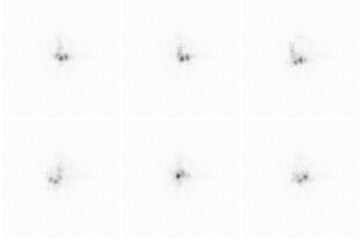
Typical short-exposure negative image of a binary star (Zeta Boötis in this case) as seen through atmospheric seeing. Each star should appear as a single Airy pattern, but the atmosphere causes the images of the two stars to break up into two patterns of speckles (one pattern above left, the other below right). The speckles are a little difficult to make out in this image due to the coarse pixel size on the camera used (see the simulated images below for a clearer example). The speckles move around rapidly, so that each star appears as a single fuzzy blob in long exposure images (called a seeing disc). The telescope used had a diameter of about 7r0 (see definition of r0 below, and example simulated image through a 7r0 telescope).
Twinkling of the brightest star of the night sky Sirius (apparent magnitude = -1,1) in the evening shortly before culmination on the southern meridian at a height of 20 degrees above the horizon. During 29 seconds Sirius moves on an arc of 7.5 minutes from the left to the right.

Astronomical seeing has several effects:

  1. It causes the images of point sources (such as stars), which in the absence of atmospheric turbulence would be steady Airy patterns produced by diffraction, to break up into speckle patterns, which change very rapidly with time (the resulting speckled images can be processed using speckle imaging)
  2. Long exposure images of these changing speckle patterns result in a blurred image of the point source, called a seeing disc
  3. The brightness of stars appears to fluctuate in a process known as scintillation or twinkling
  4. Atmospheric seeing causes the fringes in an astronomical interferometer to move rapidly
  5. The distribution of atmospheric seeing through the atmosphere (the CN2 profile described below) causes the image quality in adaptive optics systems to degrade the further you look from the location of reference star

The effects of atmospheric seeing were indirectly responsible for the belief that there were canals on Mars.[citation needed] In viewing a bright object such as Mars, occasionally a still patch of air will come in front of the planet, resulting in a brief moment of clarity. Before the use of charge-coupled devices, there was no way of recording the image of the planet in the brief moment other than having the observer remember the image and draw it later. This had the effect of having the image of the planet be dependent on the observer's memory and preconceptions which led the belief that Mars had linear features.

The effects of atmospheric seeing are qualitatively similar throughout the visible and near infrared wavebands. At large telescopes the long exposure image resolution is generally slightly higher at longer wavelengths, and the timescale (t0 - see below) for the changes in the dancing speckle patterns is substantially lower.

Measures

[edit]

There are three common descriptions of the astronomical seeing conditions at an observatory:

  • The full width at half maximum (FWHM) of the seeing disc
  • r0 (the size of a typical "lump" of uniform air within the turbulent atmosphere[1]) and t0 (the time-scale over which the changes in the turbulence become significant)
  • The CN2 profile

These are described in the sub-sections below:

The full width at half maximum (FWHM) of the seeing disc

[edit]

Without an atmosphere, a small star would have an apparent size, an "Airy disk", in a telescope image determined by diffraction and would be inversely proportional to the diameter of the telescope. However, when light enters the Earth's atmosphere, the different temperature layers and different wind speeds distort the light waves, leading to distortions in the image of a star. The effects of the atmosphere can be modeled as rotating cells of air moving turbulently. At most observatories, the turbulence is only significant on scales larger than r0 (see below—the seeing parameter r0 is 10–20 cm at visible wavelengths under the best conditions) and this limits the resolution of telescopes to be about the same as given by a space-based 10–20 cm telescope.

The distortion changes at a high rate, typically more frequently than 100 times a second. In a typical astronomical image of a star with an exposure time of seconds or even minutes, the different distortions average out as a filled disc called the "seeing disc". The diameter of the seeing disk, most often defined as the full width at half maximum (FWHM), is a measure of the astronomical seeing conditions.

It follows from this definition that seeing is always a variable quantity, different from place to place, from night to night, and even variable on a scale of minutes. Astronomers often talk about "good" nights with a low average seeing disc diameter, and "bad" nights where the seeing diameter was so high that all observations were worthless.

The FWHM of the seeing disc (or just "seeing") is usually measured in arcseconds, abbreviated with the symbol (″). A 1.0″ seeing is a good one for average astronomical sites. The seeing of an urban environment is usually much worse. Good seeing nights tend to be clear, cold nights without wind gusts. Warm air rises (convection), degrading the seeing, as do wind and clouds. At the best high-altitude mountaintop observatories, the wind brings in stable air which has not previously been in contact with the ground, sometimes providing seeing as good as 0.4".

r0 and t0

[edit]

The astronomical seeing conditions at an observatory can be conveniently described by the parameters r0 and t0.

For telescopes with diameters smaller than r0, the resolution of long-exposure images is determined primarily by diffraction and the size of the Airy pattern and thus is inversely proportional to the telescope diameter.

For telescopes with diameters larger than r0, the image resolution is determined primarily by the atmosphere and is independent of telescope diameter, remaining constant at the value given by a telescope of diameter equal to r0. r0 also corresponds to the length-scale over which the turbulence becomes significant (10–20 cm at visible wavelengths at good observatories), and t0 corresponds to the time-scale over which the changes in the turbulence become significant. r0 determines the spacing of the actuators needed in an adaptive optics system, and t0 determines the correction speed required to compensate for the effects of the atmosphere.

The parameters r0 and t0 vary with the wavelength used for the astronomical imaging, allowing slightly higher resolution imaging at longer wavelengths using large telescopes.

The seeing parameter r0 is often known as the Fried parameter, named after David L. Fried. The atmospheric time constant t0 is often referred to as the Greenwood time constant, after Darryl Greenwood.

Mathematical description of r0 and t0

[edit]
Simulated negative image showing what a single (point-like) star would look like through a ground-based telescope with a diameter of 2r0. The blurred look of the image is because of diffraction, which causes the appearance of the star to be an Airy pattern with a central disk surrounded by hints of faint rings. The atmosphere would make the image move around very rapidly, so that in a long-exposure photograph it would appear more blurred.
Simulated negative image showing what a single (point-like) star would look like through a ground-based telescope with a diameter of 7r0, on the same angular scale as the 2r0 image above. The atmosphere makes the image break up into several blobs (speckles). The speckles move around very rapidly, so that in a long-exposure photograph the star would appear as a single blurred blob.
Simulated negative image showing what a single (point-like) star would look like through a ground-based telescope with a diameter of 20r0. The atmosphere causes further atomization of the image into many blobs (speckles). As above, the speckles move around very rapidly, so that in a long-exposure photograph the star would appear as a single blurred blob.

Mathematical models can give an accurate model of the effects of astronomical seeing on images taken through ground-based telescopes. Three simulated short-exposure images are shown at the right through three different telescope diameters (as negative images to highlight the fainter features more clearly—a common astronomical convention). The telescope diameters are quoted in terms of the Fried parameter (defined below). is a commonly used measurement of the astronomical seeing at observatories. At visible wavelengths, varies from 20 cm at the best locations to 5 cm at typical sea-level sites.

In reality, the pattern of blobs (speckles) in the images changes very rapidly, so that long-exposure photographs would just show a single large blurred blob in the center for each telescope diameter. The diameter (FWHM) of the large blurred blob in long-exposure images is called the seeing disc diameter, and is independent of the telescope diameter used (as long as adaptive optics correction is not applied).

It is first useful to give a brief overview of the basic theory of optical propagation through the atmosphere. In the standard classical theory, light is treated as an oscillation in a field . For monochromatic plane waves arriving from a distant point source with wave-vector : where is the complex field at position and time , with real and imaginary parts corresponding to the electric and magnetic field components, represents a phase offset, is the frequency of the light determined by , and is the amplitude of the light.

The photon flux in this case is proportional to the square of the amplitude , and the optical phase corresponds to the complex argument of . As wavefronts pass through the Earth's atmosphere they may be perturbed by refractive index variations in the atmosphere. The diagram at the top-right of this page shows schematically a turbulent layer in the Earth's atmosphere perturbing planar wavefronts before they enter a telescope. The perturbed wavefront may be related at any given instant to the original planar wavefront in the following way: where represents the fractional change in wavefront amplitude and is the change in wavefront phase introduced by the atmosphere. It is important to emphasise that and describe the effect of the Earth's atmosphere, and the timescales for any changes in these functions will be set by the speed of refractive index fluctuations in the atmosphere.

The Kolmogorov model of turbulence

[edit]

A description of the nature of the wavefront perturbations introduced by the atmosphere is provided by the Kolmogorov model developed by Tatarski,[2] based partly on the studies of turbulence by the Russian mathematician Andrey Kolmogorov.[3][4] This model is supported by a variety of experimental measurements[5] and is widely used in simulations of astronomical imaging. The model assumes that the wavefront perturbations are brought about by variations in the refractive index of the atmosphere. These refractive index variations lead directly to phase fluctuations described by , but any amplitude fluctuations are only brought about as a second-order effect while the perturbed wavefronts propagate from the perturbing atmospheric layer to the telescope. For all reasonable models of the Earth's atmosphere at optical and infrared wavelengths the instantaneous imaging performance is dominated by the phase fluctuations . The amplitude fluctuations described by have negligible effect on the structure of the images seen in the focus of a large telescope.

For simplicity, the phase fluctuations in Tatarski's model are often assumed to have a Gaussian random distribution with the following second-order structure function: where is the atmospherically induced variance between the phase at two parts of the wavefront separated by a distance in the aperture plane, and represents the ensemble average.

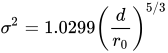
For the Gaussian random approximation, the structure function of Tatarski (1961) can be described in terms of a single parameter : indicates the strength of the phase fluctuations as it corresponds to the diameter of a circular telescope aperture at which atmospheric phase perturbations begin to seriously limit the image resolution. Typical values for I band (900 nm wavelength) observations at good sites are 20–40 cm. also corresponds to the aperture diameter for which the variance of the wavefront phase averaged over the aperture comes approximately to unity:[6]
This equation represents a commonly used definition for , a parameter frequently used to describe the atmospheric conditions at astronomical observatories.

can be determined from a measured CN2 profile (described below) as follows: where the turbulence strength varies as a function of height above the telescope, and is the angular distance of the astronomical source from the zenith (from directly overhead).

If turbulent evolution is assumed to occur on slow timescales, then the timescale t0 is simply proportional to r0 divided by the mean wind speed.

The refractive index fluctuations caused by Gaussian random turbulence can be simulated using the following algorithm:[7] where is the optical phase error introduced by atmospheric turbulence, R (k) is a two-dimensional square array of independent random complex numbers which have a Gaussian distribution about zero and white noise spectrum, K (k) is the (real) Fourier amplitude expected from the Kolmogorov (or Von Karman) spectrum, Re[] represents taking the real part, and FT[] represents a discrete Fourier transform of the resulting two-dimensional square array (typically an FFT).

Astronomical observatories are generally situated on mountaintops, as the air at ground level is usually more convective. A light wind bringing stable air from high above the clouds and ocean generally provides the best seeing conditions (telescope shown: NOT).

Turbulent intermittency

[edit]

The assumption that the phase fluctuations in Tatarski's model have a Gaussian random distribution is usually unrealistic. In reality, turbulence exhibits intermittency.[8]

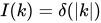
These fluctuations in the turbulence strength can be straightforwardly simulated as follows:[7] where I(k) is a two-dimensional array which represents the spectrum of intermittency, with the same dimensions as R(k), and where represents convolution. The intermittency is described in terms of fluctuations in the turbulence strength . It can be seen that the equation for the Gaussian random case above is just the special case from this equation with: where is the Dirac delta function.

The C2
n
profile

[edit]

A more thorough description of the astronomical seeing at an observatory is given by producing a profile of the turbulence strength as a function of altitude, called a profile. profiles are generally performed when deciding on the type of adaptive optics system which will be needed at a particular telescope, or in deciding whether or not a particular location would be a good site for setting up a new astronomical observatory. Typically, several methods are used simultaneously for measuring the profile and then compared. Some of the most common methods include:

  1. SCIDAR (imaging the shadow patterns in the scintillation of starlight)
  2. LOLAS (a small-aperture variant of SCIDAR designed for low-altitude profiling)
  3. SLODAR
  4. MASS
  5. MooSci (11-channel lunar scintillometer for ground level profiling)[9]
  6. RADAR mapping of turbulence
  7. Balloon-borne thermometers to measure how quickly the air temperature is fluctuating with time due to turbulence
  8. V2 Precision Data Collection Hub (PDCH) with differential temperature sensors use to measure atmospheric turbulence

There are also mathematical functions describing the profile. Some are empirical fits from measured data and others attempt to incorporate elements of theory. One common model for continental land masses is known as Hufnagel-Valley after two workers in this subject.

Mitigation

[edit]
An animated image of the Moon's surface showing the effects of Earth's atmosphere on the view

The first answer to this problem was speckle imaging, which allowed bright objects with simple morphology to be observed with diffraction-limited angular resolution. Later came space telescopes, such as NASA's Hubble Space Telescope, working outside the atmosphere and thus not having any seeing problems and allowing observations of faint targets for the first time (although with poorer resolution than speckle observations of bright sources from ground-based telescopes because of Hubble's smaller telescope diameter). The highest resolution visible and infrared images currently come from imaging optical interferometers such as the Navy Prototype Optical Interferometer or Cambridge Optical Aperture Synthesis Telescope, but those can only be used on very bright stars.

Starting in the 1990s, many telescopes have developed adaptive optics systems that partially solve the seeing problem. The best systems so far built, such as SPHERE on the ESO VLT and GPI on the Gemini telescope, achieve a Strehl ratio of 90% at a wavelength of 2.2 micrometers, but only within a very small region of the sky at a time.

Astronomers can make use of an artificial star by shining a powerful laser to correct for the blurring caused by the atmosphere.[10]

A wider field of view can be obtained by using multiple deformable mirrors conjugated to several atmospheric heights and measuring the vertical structure of the turbulence, in a technique known as Multiconjugate Adaptive Optics.

This amateur lucky imaging stack using the best of 1800 frames of Jupiter captured using a relatively small telescope approaches the theoretical maximum resolution for the telescope, rather than being limited by seeing.

Another cheaper technique, lucky imaging, has had good results on smaller telescopes. This idea dates back to pre-war naked-eye observations of moments of good seeing, which were followed by observations of the planets on cine film after World War II. The technique relies on the fact that every so often the effects of the atmosphere will be negligible, and hence by recording large numbers of images in real-time, a 'lucky' excellent image can be picked out. This happens more often when the number of r0-size patches over the telescope pupil is not too large, and the technique consequently breaks down for very large telescopes. It can nonetheless outperform adaptive optics in some cases and is accessible to amateurs. It does require very much longer observation times than adaptive optics for imaging faint targets, and is limited in its maximum resolution.[citation needed]

See also

[edit]

References

[edit]
[edit]
Revisions and contributorsEdit on WikipediaRead on Wikipedia
from Grokipedia
Astronomical seeing refers to the blurring and of images of celestial objects caused by in Earth's atmosphere, primarily due to variations in air temperature and density that alter the along the . This phenomenon results in the apparent of to the and more pronounced image degradation in telescopes, limiting the resolution and sharpness of observations. Seeing is quantified by the angular of the blurred image, typically measured in arcseconds, with excellent conditions achieving values below 0.5 arcseconds at prime observatory sites. The primary causes of astronomical seeing originate from atmospheric turbulence at different altitudes, influenced by local , topographic features, and upper-level winds like jet streams. These effects are worsened by weather patterns like cold fronts, which induce , while high-pressure systems often lead to more stable conditions and better seeing. Site selection is crucial for minimizing seeing—high-altitude, dry locations like or the often yield median seeing of 0.6–0.7 arcseconds. Seeing is formally characterized using parameters such as the (r0), the of the atmosphere that scales inversely with optical turbulence strength; larger r0 indicates better seeing. In practice, the (FWHM) of a star's image provides a direct measure. Poor seeing particularly impacts high-resolution observations of , binary stars, and lunar features, though extended deep-sky objects are less affected. Mitigation includes , which uses deformable mirrors to correct distortions in real time, and techniques like for short-exposure stacking. Understanding seeing is essential for ground-based astronomy, from to .

Fundamentals

Definition and Overview

Astronomical seeing refers to the degradation of astronomical images caused by in Earth's atmosphere, where variations in air temperature and density produce fluctuations in the that distort incoming light wavefronts. This effect blurs the observed images of celestial objects, particularly point sources like , spreading them into an apparent disk known as the seeing disk, which determines the practical limit for ground-based optical telescopes. The term "seeing" originated in the late 19th century, coined by American astronomer William H. Pickering during his observations at the Observatory station in , , around 1891, where he introduced a qualitative scale to assess atmospheric steadiness for planetary imaging. Early evaluations relied on subjective descriptions of image steadiness, but the phenomenon gained rigorous attention in the mid-20th century, with the first quantitative studies emerging in the 1950s through photoelectric photometry and detailed analyses of image motion. While seeing primarily concerns the spatial distortion and blurring of images, it is distinct from related atmospheric effects such as scintillation, which involves temporal intensity fluctuations in starlight caused by the same turbulent variations but affects brightness rather than image geometry.

Physical Causes

Astronomical seeing arises primarily from atmospheric , which causes random fluctuations in the of air along the to celestial objects. These fluctuations are driven by temperature variations that result from the mixing of air parcels with differing thermal properties, often initiated by diurnal ground heating that creates strong vertical temperature gradients near the Earth's surface. , arising from velocity differences across atmospheric layers, further amplifies by generating instabilities such as Kelvin-Helmholtz waves, while convective processes in unstable regions transport heat and momentum, leading to buoyant eddies. The atmosphere's vertical structure plays a crucial role in turbulence generation, with distinct contributions from multiple layers. The boundary layer, extending from the ground to about 1-2 km, is the dominant source of seeing degradation due to intense mixing from surface heating, terrain interactions, and low-level winds, often producing the strongest perturbations. Above this, the free atmosphere (roughly 2-10 km) contributes secondary turbulence through in stable layers and residual , while effects near the (around 10-15 km) can introduce additional variability from large-scale interactions, though typically less intense than lower-altitude sources. Refractive index variations are not solely thermal; humidity gradients and aerosol concentrations also contribute by altering air density, particularly in moist boundary layers where water vapor fluctuations can enhance differences comparable to temperature effects. Turbulence manifests statistically through a cascade of eddies spanning a wide range of scales, from small inner scales of a few millimeters—where viscous occurs—to large outer scales up to kilometers, corresponding to the of convective plumes or atmospheric layer thicknesses. This hierarchical ensures that injected at large scales by shear or is transferred down to smaller eddies, ultimately distorting incoming wavefronts.

Observational Effects

Image Distortion Mechanisms

Atmospheric distorts incoming wavefronts from celestial objects primarily through variations in the of air, induced by temperature and fluctuations. These gradients cause differential phase delays across the , leading to aberrations that degrade the coherence of the as it propagates to the . Such phase perturbations result in angular spreading of the rays, effectively broadening and shifting the apparent position of astronomical images. The primary types of distortion include tip-tilt and higher-order aberrations. Tip-tilt refers to low-order tilts that produce overall motion or wandering, where the entire of a appears to due to large-scale variations over the . This motion arises from the cumulative effect of phase gradients that tilt the plane, causing rapid displacements typically on timescales of milliseconds to seconds. Higher-order aberrations, such as focus-defocus, , and , stem from more complex phase variations that warp the curvature, leading to asymmetric broadening and distortion of the shape beyond simple translation. These effects become prominent in larger s where the samples a wider range of turbulent eddies. Anisoplanatic effects further complicate image quality by introducing spatial variations in distortion across the field of view. As light from different directions traverses distinct paths through the turbulent atmosphere, the wavefront aberrations differ, resulting in inconsistent seeing conditions for nearby objects. This angular dependence means that the distortion for a guide star may not apply uniformly to adjacent targets, limiting the coherence over angular separations larger than the isoplanatic angle. Such variations are particularly pronounced in the lower atmosphere, where turbulence is strongest. For point sources like , these mechanisms manifest as broadening of the point spread function (PSF), transforming a diffraction-limited delta function into a smeared distribution. The PSF elongation and irregularity reflect the integrated impact of phase delays and tilts, with tip-tilt contributing to shifts and higher-order terms adding irregular blurring. In the absence of , this results in a convolved image where fine details are lost to the angular spreading induced by the turbulent path.

Impacts on Astronomical Instruments

Astronomical seeing imposes a fundamental limit on the of ground-based , typically degrading it to 0.5–1 arcsecond at premier sites such as or Paranal, far exceeding the -limited performance of large apertures. For instance, an 8-meter like those at the (VLT) has a theoretical limit of about 0.03 arcseconds at visible wavelengths, but seeing routinely overrides this, setting the effective resolution floor and preventing the full light-gathering power from yielding sharper images without corrections. This blurring effect homogenizes fine details in stellar and galactic structures, limiting the ability to resolve close binary stars or the intricate morphology of protoplanetary disks. In spectroscopic observations, seeing limits the effective and significantly reduces (SNR) by spreading stellar over a larger area on the detector. To maximize collection, spectrograph slits are often matched to the seeing disk size, which admits more background and noise, thereby lowering the SNR for faint sources. For example, in high-resolution of atmospheres, poor seeing can dilute the signal from planetary absorption features, complicating measurements and chemical abundance determinations. Although itself remains unaffected if the slit is narrower than the seeing disk, the practical need to balance throughput and background often results in broader effective profiles and noisier spectra. For optical interferometry, such as with the Very Large Telescope Interferometer (VLTI), seeing induces coherence loss across baselines, rapidly fluctuating phase differences that degrade fringe visibility and contrast. This atmospheric turbulence shortens the coherence time—typically to milliseconds under good conditions—requiring fast fringe tracking to maintain stable interference, particularly challenging for baselines exceeding 100 meters where piston errors from seeing can wash out fringes entirely. Consequently, observations are confined to brighter sources, limiting applications to resolved imaging of circumstellar environments or active galactic nuclei. In contrast to space-based telescopes like the (HST), which achieve diffraction-limited resolutions of approximately 0.05 arcseconds in the visible without atmospheric interference, ground-based facilities like the Keck Observatory are seeing-limited to around 0.6 arcseconds under median conditions. This disparity highlights seeing's role in curtailing the resolution advantage of much larger ground-based apertures, though space telescopes sacrifice collecting area and face thermal constraints, underscoring the complementary nature of orbital and terrestrial observing.

Measurement Techniques

Full Width at Half Maximum (FWHM)

The Full Width at Half Maximum (FWHM) serves as the primary empirical metric for quantifying astronomical seeing, representing the angular diameter of the seeing disc where the intensity profile of a point source, such as a star, falls to half its peak value in a long-exposure image. This measure captures the blurring effect of atmospheric turbulence on the point spread function (PSF), effectively describing the apparent size of an unresolved source under given conditions. In the context of Kolmogorov turbulence theory, the FWHM is related to the standard deviation σ of the phase fluctuations by the approximate relation seeing ≈ 2.35σ, providing a direct link to the image degradation observed at the telescope focal plane. FWHM is typically derived from the analysis of stellar images captured with CCD cameras or similar detectors, where the radial intensity profile of the star is fitted to a Gaussian or Moffat function to extract the half-maximum width. A widely adopted instrumental method involves the Differential Image Motion Monitor (), which measures the relative motion between two sub-apertures viewing the same star, from which the FWHM is calculated assuming a large-aperture, diffraction-limited at 500 nm and . This technique, developed by Sarazin and Roddier, yields seeing estimates standardized to long-exposure conditions and is routinely used at professional observatories for real-time monitoring. In practice, FWHM values below 1 arcsecond indicate excellent seeing suitable for high-resolution observations, as seen at premier sites like (median 0.72 arcseconds, 2016–2023) or (median ~0.75 arcseconds), while values exceeding 3 arcseconds signify poor conditions that severely limit detail in planetary or resolved stellar imaging. These quantitative measures align closely with traditional visual estimates by astronomers, who often gauge seeing subjectively through the steadiness of star images in the eyepiece, with good visual seeing corresponding to FWHM around 1-2 arcseconds at mid-latitude sites. Despite its ubiquity, FWHM is sensitive to exposure time, as shorter integrations (e.g., milliseconds) partially freeze atmospheric motions like tilts, resulting in narrower PSFs and overly optimistic seeing estimates that require correction via modeling. Additionally, it primarily reflects second-order statistics and overlooks higher-order effects, such as anisoplanatism or scintillation, which can further degrade image quality without altering the core FWHM metric.

Fried Parameter (r₀) and Coherence Time (t₀)

The , denoted r0r_0, characterizes the spatial scale of atmospheric coherence in astronomical seeing, defined as the diameter of a circular over which the root-mean-square (rms) phase error due to equals one . This parameter represents the size of the largest "coherent patch" in the incoming , beyond which phase distortions become significant enough to degrade . The is given by the expression r0=[0.423k2secζ0Cn2(h)dh]3/5,r_0 = \left[ 0.423 \, k^2 \sec \zeta \int_0^\infty C_n^2(h) \, dh \right]^{-3/5}, where k=2π/λk = 2\pi / \lambda is the optical wavenumber, ζ\zeta is the zenith angle, and Cn2(h)C_n^2(h) is the vertical profile of the refractive index structure constant. This formulation assumes Kolmogorov turbulence statistics and integrates the cumulative effect of turbulence strength along the line of sight. The wavelength dependence follows r0λ6/5r_0 \propto \lambda^{6/5}, indicating that coherence length increases with longer observing wavelengths, thereby improving resolution in the infrared compared to the visible. At excellent astronomical sites, such as , typical r0r_0 values range from 10 to 20 cm at 500 nm under median conditions, corresponding to seeing of approximately 0.6 to 1 arcsecond. The coherence time t0t_0 quantifies the temporal stability of the , defined as the duration over which the rms phase fluctuation remains below one for a fixed point in the aperture. It is related to the by the approximate formula t00.31r0/vˉt_0 \approx 0.31 \, r_0 / \bar{v}, where vˉ\bar{v} is the effective averaged over the turbulent layers, weighted by their Cn2C_n^2 contributions. This relation arises from the of turbulent eddies across the , linking spatial and temporal coherence. In adaptive optics systems, r0r_0 determines the minimum number of wavefront sensors and deformable mirror actuators required for correction, while t0t_0 sets the necessary loop update frequency to track evolving distortions, ensuring efficient compensation for seeing effects.

Refractive Index Structure Constant (Cₙ²)

The refractive index structure constant, denoted Cn2C_n^2, quantifies the intensity of atmospheric turbulence by measuring the variance of refractive index fluctuations over a given spatial separation. It serves as a fundamental parameter in characterizing optical turbulence, with its value reflecting the strength of refractive index variations caused by temperature and humidity gradients in the air. The units of Cn2C_n^2 are m2/3^{-2/3}, arising from the dimensional analysis of the structure function in turbulence theory. Vertical profiles of Cn2(h)C_n^2(h), where hh is altitude, provide insight into the layered distribution of along the from an to the stars. These profiles typically exhibit a strong peak near the ground, driven by surface heating and shear in the , where is most intense. A secondary peak often occurs at higher altitudes, around 8-12 km, corresponding to the or region, where and temperature inversions amplify variations. Such distributions are critical for understanding how contributions vary with height, with ground-level effects dominating in many cases. Measurement of Cn2C_n^2 relies on remote and in-situ techniques tailored to capture profiles. Scintillation detectors, such as the SCIDAR (Scintillation Detection and Ranging) method, infer Cn2C_n^2 from stellar scintillation patterns observed through a , enabling high-resolution vertical profiling. systems detect backscattered light to estimate fluctuations directly, offering real-time data over extended paths. Balloon-borne sondes, equipped with fine-wire thermometers, provide in-situ measurements by ascending through the atmosphere, yielding precise temperature fluctuation data convertible to Cn2C_n^2 via established relations. These methods complement each other, with ground-based optical techniques suiting routine monitoring and airborne probes ideal for detailed campaigns. In astronomical seeing, Cn2C_n^2 integrates along the to determine the Fried parameter r0r_0, which scales the overall image degradation. The long-exposure seeing angle is approximated as θ0.98λ/r0\theta \approx 0.98 \lambda / r_0, where λ\lambda is the observing , linking local strength to observable image blur through the path-integrated Cn2C_n^2. This connection underscores Cn2C_n^2's role in predicting site performance and guiding design.

Turbulence Modeling

Kolmogorov Theory

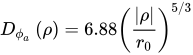
The Kolmogorov theory of turbulence, introduced by in 1941, establishes the standard framework for modeling isotropic, fully developed in incompressible fluids at high Reynolds numbers, with direct relevance to atmospheric distortions in astronomical seeing. This theory describes how turbulent kinetic energy is injected at large scales and cascades conservatively through a of eddies in the inertial subrange—where viscous dissipation is negligible—ultimately converting to heat at the smallest dissipative scales. Within this subrange, the three-dimensional power spectrum of the velocity field follows a universal form derived from : Φ(k)ϵ2/3k11/3,\Phi(\mathbf{k}) \propto \epsilon^{2/3} k^{-11/3}, where ϵ\epsilon is the mean dissipation rate per unit and k=kk = |\mathbf{k}| is the magnitude. The model relies on key assumptions of statistical homogeneity—where turbulence properties are translationally invariant—and —where they are rotationally invariant—for eddies much smaller than the outer scale L0L_0. These conditions approximate the behavior of atmospheric along the from celestial objects to ground-based telescopes, provided large-scale meteorological features are sufficiently averaged. In applications to astronomical seeing, Kolmogorov's velocity spectrum extends to fluctuations in atmospheric refractive index nn, which arise primarily from temperature perturbations acting as a passive scalar advected by the turbulent flow. The resulting three-dimensional spectrum for refractive index fluctuations is Φn(κ)=0.033Cn2κ11/3,\Phi_n(\boldsymbol{\kappa}) = 0.033 C_n^2 \kappa^{-11/3}, valid in the inertial subrange 1/L0κ1/l01/L_0 \ll \kappa \ll 1/l_0, where κ=κ\kappa = |\boldsymbol{\kappa}| is the , Cn2C_n^2 is the structure constant, and l0l_0 is the inner scale. This form captures the scale-invariant energy distribution that causes wavefront phase aberrations. The derivation outline traces from the incompressible Navier-Stokes equations, tu+(u)u=p/ρ+ν2u\partial_t \mathbf{u} + (\mathbf{u} \cdot \nabla) \mathbf{u} = -\nabla p / \rho + \nu \nabla^2 \mathbf{u}, where in the inertial subrange the nonlinear term dominates, enabling a ϵ=(u)uu\epsilon = \langle (\mathbf{u} \cdot \nabla) \mathbf{u} \cdot \mathbf{u} \rangle. then yields the velocity spectrum's , as the only combination of ϵ\epsilon and kk with units of energy density per is ϵ2/3k11/3\epsilon^{2/3} k^{-11/3}. For the , n1Tn - 1 \propto T via the Gladstone-Dale relation, and temperature variance cascades similarly under the inertial-convective assumption, producing the scalar spectrum with prefactor 0.033 from the Obukhov-Corrsin . The optical phase ϕ=(2π/λ)nds\phi = (2\pi / \lambda) \int n \, ds along the path inherits this statistics, yielding the phase structure function Dϕ(r)=[ϕ(x)ϕ(x+r)]2=6.88(r/r0)5/3D_\phi(r) = \langle [\phi(\mathbf{x}) - \phi(\mathbf{x} + \mathbf{r})]^2 \rangle = 6.88 (r / r_0)^{5/3} for separations rr within the inertial subrange, where r0r_0 is the Fried coherence parameter.

Turbulent Intermittency

Turbulent intermittency describes the localized, burst-like nature of atmospheric , where intense dissipation episodes occur sporadically in space and time, breaking the statistical assumed in classical Kolmogorov theory. These events manifest as sudden spikes or gusts in fluctuations, often lasting seconds to minutes and spanning scales from tens of meters to kilometers, which disrupt the uniform predicted for homogeneous . This non-stationarity arises from interactions between shear flows, instabilities, and surface effects, leading to clustered regions of high separated by calmer intervals. To model these deviations, refined approaches modify the phase structure function D(r)D(r) from the ideal Kolmogorov form D(r)r5/3D(r) \propto r^{5/3} by incorporating an exponent μ0.2\mu \approx 0.2--0.40.4, which accounts for the enhanced variability at higher moments. The log-normal model assumes a of the energy dissipation rate, resulting in anomalous scaling exponents ζp\zeta_p for the pp-th order structure functions, such as ζp=p/3+μp(3p)18\zeta_p = p/3 + \frac{\mu p (3 - p)}{18}, capturing the skewed probability of extreme events. Alternatively, the (or β\beta-model) uses a multiplicative cascade with a filling factor p<1p < 1 to simulate the fractal-like clustering of active turbulent eddies, producing similar corrections to D(r)D(r) and better matching observed non-linear scalings in the atmospheric . Observational evidence for includes the non-Gaussian tails in statistics of stellar scintillation, where intensity fluctuations exhibit heavy-tailed distributions rather than Gaussian profiles, reflecting sporadic strong refractive gradients. sensor measurements from sites like Paranal further confirm this through rapid phase aberrations with skewed variances, often showing log-normal distributions in seeing parameters like the r0r_0. High-cadence monitoring reveals seeing spikes of 0.5--1 arcsecond lasting ~20 seconds, linked to intermittent layers at 100--1000 m altitude. In astronomical seeing, implies potential overestimation of r0r_0 (typically 5--25 cm in the visible) under calm conditions, as standard averages miss rare bursts that broaden image profiles with sharper cores and extended wings. This variability complicates seeing predictions and affecting long-exposure image quality. For , contributes to residual errors by causing rapid changes that outpace correction loops, necessitating multi-point profiling for improved performance.

Mitigation Strategies

Observational Site Selection

Selecting optimal sites for astronomical observatories is crucial for minimizing seeing, which is primarily driven by atmospheric . Key factors include high altitude to position telescopes above much of the turbulent , where most optical distortions occur. Elevations exceeding 4,000 meters, such as those on mountain summits, reduce the path length through turbulent air and limit exposure to aerosols and that exacerbate seeing. Additionally, sites with low turbulence layers are preferred; these often feature stable atmospheric conditions where is confined to lower altitudes by inversion layers, trapping convective activity near the ground and allowing clearer air above. Stable weather patterns, including low and minimal convective activity, further enhance seeing by promoting laminar airflow over the site. Prominent examples illustrate these criteria in practice. in , at an altitude of 4,200 meters, benefits from frequent temperature inversions that cap below the summit, resulting in a seeing of approximately 0.65 arcseconds. The in , encompassing sites like Cerro Paranal and Las Campanas at elevations around 2,600–2,700 meters, leverages its arid climate— with low precipitable and minimal humidity— to achieve seeing values of 0.63–0.67 arcseconds, as dry air reduces fluctuations. These locations were chosen after extensive surveys confirming their superior atmospheric stability compared to lower-altitude alternatives. Site evaluation relies on long-term monitoring to quantify these factors reliably. Differential Image Motion Monitors (DIMM) are the standard instrument for this purpose, providing continuous measurements of seeing by analyzing the differential motion of star images through a ; campaigns lasting years ensure statistical robustness across seasons. Considerations of the isoplanatic —the angular extent over which seeing remains consistent— are also integrated, as it influences the feasibility of wide-field observations and is assessed via complementary tools like SLODAR during site testing. Such methods guided the selection of and Atacama sites, confirming their low free-atmosphere turbulence contributions. However, optimizing for seeing involves trade-offs with other practical constraints. Remote high-altitude sites often face challenges in accessibility, requiring significant infrastructure investments for roads, power, and personnel logistics, which can increase operational costs. Balancing this, proximity to urban areas must be avoided to minimize , which scatters light and indirectly worsens effective seeing for faint objects; for instance, sites like were selected partly for their isolation from growing urban , though ongoing threats necessitate protective policies. These considerations ensure sites not only deliver excellent seeing but remain viable for sustained astronomical research.

Adaptive Optics and Corrections

Adaptive optics (AO) systems counteract the effects of atmospheric seeing by actively measuring and correcting distortions in real time, enabling ground-based to approach their theoretical diffraction-limited performance. The core principle involves a , typically a Shack-Hartmann sensor, that detects aberrations caused by atmospheric turbulence, followed by a that deforms a mirror to compensate for these distortions. This technology was first proposed by Babcock in 1953 as a method to correct for atmospheric blurring using a deformable mirror. The first experimental AO system for astronomy was demonstrated by John Hardy and colleagues in 1977 on a 1.9-meter , achieving initial corrections. Deformable mirrors (DMs) are central to AO, consisting of a flexible surface actuated by numerous elements—such as piezoelectric stacks, micro-electro-mechanical systems (MEMS), or voice-coil motors—to replicate the inverse of the measured wavefront error. Modern AO systems on large telescopes employ DMs with hundreds to thousands of actuators, allowing correction of higher-order aberrations beyond simple tip-tilt. For instance, the Keck II telescope's AO system uses a 349-actuator DM to achieve Strehl ratios up to 0.7 in the near-infrared. To address the limitation of requiring bright natural guide stars, laser guide stars (LGS) create artificial reference sources by projecting high-powered lasers into the upper atmosphere, typically exciting sodium atoms at 90 km altitude for a point-like beacon. This extends sky coverage to nearly 100% for faint targets, as demonstrated in the first operational sodium LGS system on the Keck II telescope in 2006, which improved resolution to 0.081 arcseconds in the H-band. Multi-conjugate adaptive optics (MCAO) advances single-conjugate AO by using multiple DMs conjugated to different atmospheric layers, along with tomographic reconstruction from several guide stars, to correct variations with altitude and provide uniform correction over wider . Proposed by Jacques Beckers in 1988, MCAO mitigates the isoplanatic angle limitation inherent in single-layer corrections. The Gemini Multi-Conjugate AO System (GeMS) on the 8.1-meter Gemini South telescope, operational since 2011, employs three DMs and five laser guide stars to deliver near-diffraction-limited imaging ( ~0.3 in the near-infrared) across a 2-arcminute , enabling high-resolution studies of extended objects like galaxies. Complementary techniques like and speckle interferometry offer seeing corrections without full AO hardware, suitable for smaller telescopes. Lucky imaging captures thousands of very short exposures (tens of milliseconds) to freeze atmospheric motion, then selects and stacks the ~10% "lucky" frames with the least distortion, achieving near-diffraction-limited resolution (e.g., 0.1 arcseconds at 2.5-meter telescopes) in the visible. Developed by Craig Mackay in the early 2000s, it has been implemented on instruments like AstraLux at the ESO New Technology Telescope for observations. Speckle interferometry, pioneered in the 1970s by Antoine Labeyrie, records short-exposure speckle patterns from turbulence-boiled images and reconstructs the object via , recovering spatial frequencies up to the diffraction limit without phase information loss. This method has provided diffraction-limited resolutions (e.g., 0.05 arcseconds at 3.5-meter telescopes) for measuring stellar diameters and close binaries, as applied in NASA's speckle programs since the . Overall, AO and related corrections have transformed ground-based astronomy, routinely achieving resolutions of 0.05–0.1 arcseconds on 8–10 meter telescopes—orders of magnitude better than uncorrected seeing (typically 0.5–2 arcseconds)—facilitating exoplanet imaging, , and deep-field surveys. Systems like the ESO Very Large Telescope's instrument combine AO with coronagraphy to attain Strehl ratios exceeding 0.9 in the H-band, enabling direct detection of exoplanets.

References

Add your contribution
Related Hubs
User Avatar
No comments yet.