Hubbry Logo
logo
Sepoy
Community hub

Sepoy

logo
0 subscribers
Read side by side
from Wikipedia

Sepoy
Hyder Ali as a sepoy
Active16th to 21st centuries
CountryMughal Empire
Maratha Empire
India
Pakistan
  Nepal
Branchinfantry and artillery
EquipmentMusket

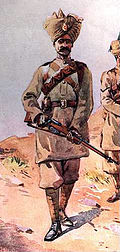
A sepoy (/ˈspɔɪ/) was the designation given to an Indian infantryman armed with a musket in the armies of the Mughal Empire and the British East India Company.

In the 18th century, the French East India Company and its European counterparts employed locally recruited soldiers within India, mainly consisting of infantry designated as "sepoys". The largest sepoy force, trained along European lines, served the British East India Company.[1][2]

The term "sipahi" (or sometimes "sepoy") continues in use in the Indian, Pakistan and Nepalese armies, where it denotes the rank of private.

Etymology

[edit]

In Persian اسپ (Aspa) means horse and Ispahai is also the word for cavalrymen.

The term sepoy is the anglicised form of the Persian word sepāhī (سپاهی), meaning the traditional "infantry soldier" in the Mughal Empire.

Historical usage

[edit]

The term sepoy came into common use in the forces of the British East India Company in the eighteenth century, where it was one of a number of names, such as peons, gentoos, mestees and topasses, used for various categories of native soldier. Initially it referred to Hindu or Muslim soldiers without regular uniforms or discipline. It later generically referred to all native soldiers in the service of the European powers in India.[3] Close to ninety-six percent of the British East India Company's army of 300,000 men were native to India and these sepoys played a crucial role in securing the subcontinent for the company.[4]

Equipment

[edit]
Sepoy units loyal to the Nawab of Bengal armed with artillery pieces and a war elephant.

The earliest sepoys used matchlock muskets and operated bulky and inefficient cannons to a limited extent during the reigns of Babur Akbar when archery and fighting from horseback was more common. By the time of Aurangzeb the Mughal armies had advanced significantly and utilized a wider range of weapons to win battles.

During the Carnatic Wars and Anglo-Mysore Wars the sepoys of the Mughal Empire employed more advanced types of musket, as well as blunderbuss and rocket weapons.

History

[edit]

Mughal Empire 16th–18th centuries

[edit]

A Sipahi or a sepoy was an infantryman armed with a musket in the army of the Mughal Empire.

The earliest sepoys were armed with daggers, talwars and matchlocks.[5] By the mid to late 17th century they began to utilize more upgraded forms of muskets and even rockets. These sepoys also operated and mounted artillery pieces and sharpshooter upon war elephants which were also used for transport, hauling artillery and in combat.[6]

By the 18th century individual Nawabs employed their own sepoy units as did the European merchant companies established in parts of India.

Sepoys became more visible when they gained European arms and fought for various fragmented polities of the Mughal Empire during the Carnatic Wars and the Bengal War, after which the importance of the local sepoy diminished and they were replaced by the "European hired Sepoy".

Sepoys in British service

[edit]

The East India Company initially recruited sepoys from the local communities in the Madras and Bombay Presidencies. The emphasis here favoured tall and soldierly recruits, broadly defined as being "of a proper caste and of sufficient size".[7] In the Bengal Army however, recruitment was only amongst high caste Brahmin and Rajput communities, mainly from the present day Uttar Pradesh and Bihar regions. Recruitment was undertaken locally by battalions or regiments often from the same community, village and even family. The commanding officer of a battalion became a form of substitute for the village chief or gaon bura. He was the mai-baap or the "father and mother" of the sepoys making up the paltan (from "platoon"). There were many family and community ties amongst the troops and numerous instances where family members enlisted in the same battalion or regiment. The izzat ("honour") of the unit was represented by the regimental colours; the new sepoy having to swear an oath in front of them on enlistment. These colours were stored in honour in the quarter guard and frequently paraded before the men. They formed a rallying point in battle. The oath of fealty by the sepoy was given to the East India Company and included a pledge of faithfulness to the salt that one has eaten.[3]

The salary of the sepoys employed by the East India Company, while not substantially greater than that paid by the rulers of Indian states, was usually paid regularly. Advances could be given and family allotments from pay due were permitted when the troops served abroad. There was a commissariat and regular rations were provided. Weapons, clothing and ammunition were provided centrally, in contrast to the soldiers of local kings whose pay was often in arrears. In addition local rulers usually expected their sepoys to arm themselves and to sustain themselves through plunder.[3]

This combination of factors led to the development of a sense of shared honour and ethos amongst the well drilled and disciplined Indian soldiery who formed the key to the success of European feats of arms in India and abroad.[3]

In 1858 following the Indian Rebellion of 1857 the surviving East India Company regiments continued as the armies of the three presidencies until they were merged into a new Indian Army under the direct control of the British Crown in 1895. (The Company had come under the control of the Crown but in 1874 it was abolished.) The designation of "sepoy" was retained for Indian soldiers below the rank of lance naik, except in cavalry where the equivalent ranks were sowar or "trooper".

Presidency Monthly Salary In Rupees (1760s)
Bengal 6[8]
Bombay 7[8]
Madras 7[8]

Sepoys in French service

[edit]

Following the formation of the French East India Company (Compagnie des Indes) in 1719, companies of Indian sepoys (cipayes) were raised to augment the French regulars and Swiss mercenary troops available. By 1720 the sepoys in French service numbered about 10,000.[9] Although much reduced in numbers after their decisive defeat in India at the Battle of Wandewash in 1760, France continued to maintain a Military Corps of Indian Sepoys (corps militaire des cipayes de l'Inde) in Pondicherry until it was disbanded and replaced by a locally recruited gendarmerie in 1898.[10] The 19th century diplomat Sir Justin Sheil commented about the British East India Company copying the French Indian army in raising an army of Indians:

It is to the military genius of the French that we are indebted for the formation of the Indian army. Our warlike neighbours were the first to introduce into India the system of drilling native troops and converting them into a regularly disciplined force. Their example was copied by us, and the result is what we now behold.

— Sir Justin Sheil (1803–1871).[11]

Sepoys in Portuguese service

[edit]

Sepoys were also recruited in Portuguese India. The term cipaio (sepoy) was also applied by the Portuguese to African soldiers in Angola, Mozambique and Portuguese Guinea, plus African rural police officers. Cipaios from Angola provided part of the garrison of Goa during the final years of Portuguese rule of that Indian territory.

Contemporary sepoys

[edit]

The title of "sepoy" is still retained in the modern Nepali Army, Indian Army and Pakistan Army. In each of these it designates the rank of private.[12]

Other usages

[edit]

The same Persian word reached English via another route in the forms of sipahi and spahi. Zipaio, the Basque version of the word, is used by leftist Basque nationalists as an insult for members of the Basque Police,[13] implying that they are not a national police of the Basque Country due to their connection with the Spanish government.

In Hispanic American countries, especially in Argentina, the word cipayo has historically been used as a pejorative colloquial expression referring to individuals considered as serving foreign interests, as opposed to serving their own country.[14]

See also

[edit]

References

[edit]
[edit]
Revisions and contributorsEdit on WikipediaRead on Wikipedia
from Grokipedia
A sepoy was an Indian infantryman, typically armed with a musket, who served in the armies of the Mughal Empire and later European trading companies in the Indian subcontinent, with the term derived from the Persian sipāhī meaning "soldier."[1][2] Originating as regular troops in Mughal service, sepoys transitioned to roles under Portuguese, Dutch, French, and especially British forces, where they formed the backbone of the British East India Company's army by the 18th century.[3][4] These soldiers, often recruited from martial castes and regions like Bengal, Awadh, and Punjab, were instrumental in the Company's military campaigns that expanded British control over much of India through conquests against local rulers and rival powers.[5] The sepoy's defining controversy arose during the 1857 rebellion, triggered by grievances over rifle cartridges rumored to be greased with animal fats offensive to Hindu and Muslim religious practices, which ignited mutinies in key garrisons and spread into a broader uprising involving princely states and civilian discontent with British annexations and economic policies.[6][7] The suppression of this revolt marked the end of Company rule, transferring governance to the British Crown and restructuring the Indian army to prevent future unified dissent among native troops.[6][7]

Etymology and Definition

Linguistic Origins

The term sepoy is an anglicized borrowing from the Persian sipāhī (سپاهی), denoting a soldier or horseman, derived from sipāh meaning "army."[1] [2] This root traces to Middle Persian and ultimately to Old Persian spāka- ("army"), reflecting the term's ancient Indo-Iranian linguistic heritage tied to military organization in Persianate cultures.[1] In the Indian subcontinent, sipāhī entered Urdu and Hindi vernaculars as a general descriptor for infantry or regular troops, particularly within the Mughal imperial system where Persian served as the administrative lingua franca.[3] [8] European contact introduced variant transliterations: Portuguese traders and colonizers rendered it as sipaio or sipae by the late 16th century, initially applying it to native horsemen or foot soldiers in their service.[2] [8] The English form sepoy first appears in records around 1718, evolving from these Indo-European intermediaries to specifically designate Indian infantrymen employed by British forces, distinct from the Ottoman Turkish sipahi (spahi), which emphasized elite cavalry.[1] [2] This adaptation highlights the term's semantic shift from broad Persianate soldiery to a colonial-era marker of disciplined, European-trained native troops.[3]

Scope and Evolution of the Term

The term sepoy derives from the Persian sipahi (سپاهی), denoting a soldier or cavalryman, which was adapted into Urdu and Hindi as sipahi, a generic reference to infantry.[1] [2] This linguistic root traces to the Ottoman and Safavid military traditions, where sipahi described professional troops, and entered South Asian usage through Persianate influences during the Delhi Sultanate and Mughal Empire periods.[9] In its earliest documented Indian context, from the 16th century onward, sepoy applied broadly to foot soldiers in imperial armies, encompassing Muslim and Hindu recruits armed with matchlocks or early muskets, serving as a standing infantry force distinct from feudal levies or cavalry.[10][4] By the late 17th century, European traders and mercenaries in India, including Portuguese and Dutch forces, began employing local sipahi as auxiliaries, anglicizing the term to "sepoy" by around 1710 to describe armed retainers.[3][11] The scope evolved significantly under British East India Company expansion from the 1750s, where sepoy specifically designated disciplined Indian infantrymen recruited en masse, drilled in European linear tactics, and issued standardized flintlock muskets, forming the bulk of Company armies by the early 19th century—numbering over 200,000 by 1857.[12] This shift marked a transition from the term's original connotation of autonomous imperial regulars to one implying subordinate, mercenary service under foreign command, often from peasant or artisan castes incentivized by steady pay and land grants.[9] Post-1857 Rebellion, when native troops briefly disrupted British control, the term persisted in the reorganized British Indian Army under Crown rule, extending to infantry from princely states and frontier regions, but with heightened emphasis on ethnic quotas and loyalty oaths to prevent mutinies.[3] By the 20th century, sepoy had narrowed further in British parlance to evoke colonial-era native soldiers, though in successor armies like Pakistan's, it retained formal rank status for enlisted infantry into the present.[10] The evolution reflects not merely linguistic adaptation but a causal adaptation to gunpowder warfare's demands, privileging professionalized, firearm-equipped units over traditional archery or melee forces, with European adoption amplifying the term's association with hybrid imperial structures.[12]

Pre-Colonial Origins

Mughal Empire Service

Sepoys in the Mughal Empire functioned primarily as infantrymen, recruited to bolster the empire's military capabilities beyond its traditional emphasis on cavalry. Derived from the Persian term sipāhī (سپاهی), denoting a soldier, the word evolved in the Indian context to refer specifically to foot soldiers, often mercenaries or locally enlisted men from diverse ethnic and religious backgrounds.[13] These troops were integral to enforcing order and participating in imperial campaigns, serving under the direct pay of the emperor or provincial governors.[14] During the reign of Emperor Aurangzeb (1658–1707), sepoys saw significant expansion, with dedicated battalions formed from the imperial pay corps to support prolonged expeditions, notably in the Deccan against Maratha and other resistances.[3] Armed with matchlock muskets, rockets, and grenades, these units provided firepower in sieges and battles where cavalry mobility was less effective.[3] Aurangzeb maintained a vast infantry component, including up to 600,000 matchlock-bearers alongside 300,000 cavalry, reflecting a strategic shift toward hybrid forces amid extended warfare.[15] However, sepoys remained secondary to the mansabdari system of ranked cavalry troopers, often suffering from inconsistent pay and discipline. In the 18th century, as Mughal central authority fragmented, sepoys were increasingly employed by influential nobles to sustain imperial remnants. Commanders like Mirza Najaf Khan (d. 1782) organized disciplined sepoy battalions to defend Delhi and counter Afghan and Maratha incursions, marking an adaptation of infantry tactics influenced by emerging European-style drilling.[16] This period highlighted sepoys' versatility but also their vulnerability to desertion and reliance on charismatic leadership amid the empire's decline.

Indigenous Indian Military Contexts

In regional Indian polities beyond direct Mughal control, such as the Maratha Confederacy and the Kingdom of Mysore, sepoys served as musket-armed infantrymen integral to standing armies that emphasized firearms alongside traditional cavalry and archery elements. These forces evolved from local warrior traditions, incorporating gunpowder weaponry to counter Mughal and later European threats, with organization reflecting a transition toward disciplined, paid regulars rather than feudal levies.[17] The Maratha military under Shivaji Maharaj initially fielded mawle infantry—indigenous foot soldiers equipped with matchlocks, bows, and spears—for fort defense, sieges, and support to cavalry raids. By 1659, Shivaji maintained approximately 10,000 such infantrymen organized in seven divisions under commanders like Sarnobat Yesaji Kank, with units structured hierarchically from naiks (over 10 men) to jumledars (over 50). Reforms prioritized cash payments, muster rolls, and non-hereditary officers to ensure loyalty and readiness, as detailed in contemporary accounts. Later Peshwa-era expansions recruited non-Maratha mercenaries, including Sikhs and Arabs, paid 6–16 rupees monthly, evolving into gardi or trained sepoys. By the 1780s, under Mahadaji Sindhia, European-influenced battalions emerged, each with 8 companies comprising 416 sepoys armed with Agra-manufactured muskets and bayonets, totaling up to 39 battalions across brigades for pitched battles like Panipat.[17][17] In Mysore, Hyder Ali reorganized the kingdom's forces from the 1760s, elevating infantry sepoys to a core role in a balanced army that included cavalry, artillery, and rocket troops. Drawing on Deccan traditions, his reforms created battalions of sepoys trained in musket volleys and bayonet charges, often augmented by European deserters and mercenaries—114 French in 1767 alone, with plans to hire 200 Dutch. Total forces reached 83,000 by the late 1770s, with sepoys forming a substantial portion for invasions like the Carnatic campaign. This structure enabled Mysore's successes against British-led coalitions, emphasizing mobility and firepower over sheer numbers. These indigenous applications of sepoy units demonstrated causal adaptations to technological shifts, fostering professionalization that paralleled but predated full colonial models, though reliant on regional resources and occasional foreign expertise.[17]

Colonial Era Employment

Service under Portuguese and French Forces

The Portuguese, establishing coastal enclaves in India from 1505 onward, relied on recruited Indian sipaís—local equivalents of sepoys—for infantry support due to chronic shortages of European troops. These soldiers, drawn primarily from Hindu and Muslim communities in Goa, Diu, and surrounding areas, manned garrisons, conducted riverine patrols, and participated in defensive campaigns against indigenous powers like the Vijayanagara remnants and later the Marathas, as well as European rivals such as the Dutch during the 1600–1663 Luso-Dutch War. By the 18th century, sipaís constituted the bulk of Portuguese land forces in India, often armed with matchlocks and supplemented by topasse auxiliaries of mixed Indo-Portuguese descent, though their effectiveness was limited by inconsistent training and pay arrears. The French Compagnie des Indes-Orientales, formalized in 1664 but militarily active from Pondichéry and other Carnatic settlements, began systematically organizing sepoy battalions in the 1740s under Governor-General Joseph François Dupleix to counter British expansion and local adversaries. Dupleix pioneered the recruitment of Muslim and Hindu infantrymen, training them in European linear tactics and equipping them with flintlock muskets and bayonets; by 1748, several regular battalions had been raised, marking a shift from ad hoc levies to professionalized units.[18][19] These sepoy forces proved decisive in initial Carnatic War engagements, such as the Battle of Adyar on 24 October 1746, where approximately 200–700 French-trained sepoys, alongside 300–400 European troops under Major Louis Paradis, routed a 10,000-strong cavalry-heavy army of the Nawab of Arcot, Anwaruddin Khan, through disciplined volley fire and artillery—highlighting the tactical superiority of organized infantry over traditional Indian horsemen.[20][21] French sepoy strength peaked at several thousand by the 1750s, supporting alliances with figures like Muzaffar Jung and Chanda Sahib, but suffered attrition in defeats such as Wandiwash (1760), after which French influence waned, with remaining units disbanded or absorbed post-1763 Treaty of Paris.[22]

British East India Company and Crown Armies

The British East India Company initially relied on small detachments of European troops but expanded recruitment of Indian sepoys to bolster forces amid territorial ambitions in the mid-18th century. In Bengal Presidency, 448 sepoys were enlisted in April 1757, with numbers surging to 2,100 by the Battle of Plassey on June 23, 1757, where they played a pivotal role in Robert Clive's victory over Siraj-ud-Daulah.[23] This marked the formal inception of sepoy units, with the 1st Bengal Native Infantry established as the first dedicated regiment in 1757 to provide disciplined infantry support under European command.[5] By the early 19th century, the Company's armies had grown substantially, comprising three Presidency armies—Bengal, Madras, and Bombay—totaling around 250,000 troops, the majority sepoys organized into native infantry battalions trained in European drill and equipped with muskets.[5] Sepoys formed the backbone of these forces, outnumbering European soldiers by ratios as high as 6:1 in some units, enabling conquests such as the defeat of the Marathas and Mysore but also fostering dependencies on local recruitment from martial castes like Rajputs and Pathans. In the Bengal Army alone, by 1857, approximately 135,000 sepoys and sowars served alongside 24,000 Europeans out of a total establishment of 159,000.[7] Following the 1857 rebellion, the Government of India Act 1858 dissolved the Company's military authority, transferring control to the British Crown effective November 1, 1858, and reorganizing sepoy regiments into the British Indian Army. Sepoys retained their role as primary infantry, with reforms emphasizing loyalty through diversified recruitment beyond high-caste Hindus, integration of Punjabi Sikhs and Gurkhas, and stricter European oversight to prevent future mutinies. By the late 19th century, the army expanded to over 150,000 sepoys, deployed in imperial campaigns from Afghanistan to Burma, while maintaining a sepoy-to-European ratio of about 3:1 to balance effectiveness and control.[5] This structure persisted into the 20th century, with sepoys proving instrumental in frontier wars and global conflicts under Crown command.

Military Structure and Operations

Recruitment, Composition, and Social Dynamics

![An early 20th century sepoy in the Indian Army, wearing a kurta.](./assets/Awan_Sepoy_30thPunjabis30th_Punjabis
Recruitment into the sepoy forces of the British East India Company commenced in the 1740s, drawing primarily from agrarian communities in the presidencies of Bengal, Madras, and Bombay to supplement limited European manpower. In the Bengal Presidency Army, the largest of the three, enlistment targeted high-caste Hindus—predominantly Brahmins, Rajputs, and Bhumihars—from rural districts in Bihar, Awadh, and the Doab region, motivated by reliable salaries, pension entitlements, and enhanced village prestige as martial figures.[5][24] By the early 19th century, the Company's armies numbered around 250,000, with sepoys constituting the overwhelming majority in a ratio of approximately 7:1 over British troops.[5][25]
Pre-1857 composition emphasized religious and caste homogeneity within units to preserve ritual purity and combat effectiveness; Bengal regiments featured mostly Hindu infantrymen, with Muslims more prominent in cavalry sowars, organized into class companies or single-class battalions to avert inter-caste disputes.[25][24] In 1857, the Bengal Army alone fielded about 135,000 sepoys, underscoring its scale and the reliance on these groups.[7] Social dynamics hinged on mutual accommodations: sepoys gained socioeconomic elevation and warrior identity, while British officers enforced discipline through paternalistic oversight, though sensitivities over caste taboos, overseas deployments, and religious practices periodically fueled grievances.[9][7] The Indian Rebellion of 1857 prompted a doctrinal pivot via the martial races theory, formalized post-mutiny to recruit from populations viewed as innately loyal and bellicose, sidelining high-caste Bengalis in favor of Punjabis (Sikhs, Muslims, Jats), Gurkhas from Nepal, Dogras, Garhwalis, Pathans, Baluchis, and Afridis from the northwest.[5][26] This reorientation diversified ethnic makeup, with Punjab supplying over half of new recruits by the 1880s, and promoted class-composition regiments for unit solidarity and reduced mutiny risk.[27][28] Post-reform social structures reinforced hierarchical bonds, with British commanders cultivating regimental traditions and religious allowances to sustain sepoy allegiance, yet perpetuating racial categorizations that idealized certain groups' martial traits while deeming others effeminate or disloyal.[26][5]

Equipment, Training, and Tactical Roles

![Sepoy of the Indian infantry, circa 1900](./assets/Sepoy_of_the_Indian_Infantry%252C_1900_cc In the Mughal Empire, sepoys primarily equipped with matchlock muskets, curved talwar swords, and occasionally rockets or grenades during the late 17th century under Aurangzeb.[3] [29] Training emphasized basic musket handling and close-quarters combat, integrated into larger imperial forces alongside cavalry and artillery, with tactics focused on combined arms assaults in expansive campaigns.[3] Under the British East India Company from the mid-18th century, sepoys received standardized European-style equipment, including flintlock muskets such as the .75-caliber Brown Bess, bayonets, and red woolen uniforms issued starting in 1756 to foster unit cohesion.[30] By the 19th century, this evolved to include the Pattern 1853 Enfield rifled musket, though its ammunition sparked grievances leading to the 1857 rebellion.[31] Training regimens, modeled on British infantry manuals, involved rigorous drill in platoon-based volley fire, marching formations, and bayonet exercises, conducted by European officers to instill discipline and adapt recruits from martial peasant backgrounds to linear tactics.[5] [25] Tactically, colonial-era sepoys served as line infantry delivering massed volleys in open battles, such as at Buxar in 1764 where superior training enabled smaller forces to defeat larger Indian armies, while also functioning as skirmishers, guards for artillery, and pioneers in sieges or expeditions.[5] In imperial expansions, they operated in hybrid roles combining European firepower with local knowledge of terrain, often outnumbering European troops and proving decisive in conflicts against Maratha, Sikh, and Mysore forces through disciplined firepower and maneuver.[25] Post-1857 reforms diversified roles to include rifle-armed units and specialized battalions, enhancing versatility in later colonial operations.[32]

Major Conflicts and Contributions

Pre-1857 Campaigns and Imperial Expansion

Sepoys constituted the majority of the British East India Company's infantry forces during the pre-1857 campaigns that facilitated territorial expansion across India. Recruited primarily from Bengal, Madras, and Bombay presidencies, these Indian soldiers, often numbering in the thousands per engagement, provided the manpower necessary for the Company's victories against larger indigenous armies. Their discipline, familiarity with local terrain, and adaptation to European drill enabled the Company to project power beyond its trading posts.[5] The Battle of Plassey on 23 June 1757 exemplified sepoy contributions to imperial growth. Robert Clive's force of approximately 3,000 included 2,100 sepoys and topasses alongside 800-950 Europeans and 60 sailors, decisively defeating Nawab Siraj-ud-Daulah's 50,000-strong army through betrayal by Mir Jafar and effective sepoy musketry during a thunderstorm that neutralized the Nawab's artillery. This triumph granted the Company diwani rights over Bengal in 1765, funding further conquests.[33][34] Subsequent engagements, such as the Battle of Buxar on 22 October 1764, reinforced British dominance in northern India, with sepoy battalions under Hector Munro outmaneuvering combined forces of Mughal Emperor Shah Alam II, Nawab of Bengal, and Nawab of Awadh, leading to the Company's revenue collection authority and military subsidy from Bengal. In the Carnatic Wars against French interests (1746-1763), sepoys bolstered victories like Wandewash in 1760, expelling French influence and securing Madras Presidency.[5] During the Anglo-Mysore Wars (1767-1799), sepoy-heavy armies countered Hyder Ali and Tipu Sultan's rocket artillery and cavalry. In the Fourth Anglo-Mysore War, the 1799 Siege of Seringapatam involved over 22,000 sepoys alongside 4,000 Europeans in a coalition force totaling 26,000 Company troops, culminating in Tipu Sultan's death and Mysore's partition. The Anglo-Maratha Wars (1775-1818) saw sepoy divisions, growing to comprise armies of 30,000-50,000 by the early 1800s, defeat the Maratha Confederacy at Assaye (1803) and other battles, annexing vast territories.[35] The Anglo-Sikh Wars (1845-1849) further demonstrated sepoy efficacy, with 20,000-30,000 sepoys supporting British troops to annex Punjab after victories at Sobraon (1846) and Gujrat (1849), incorporating Sikh artillery and irregulars into Company service. By 1857, the Company's sepoy army exceeded 230,000, dwarfing its 40,000-50,000 European component, underscoring their pivotal role in transforming a mercantile entity into India's paramount power through disciplined infantry tactics and logistical superiority.[5]

The 1857 Rebellion: Triggers, Course, and Outcomes

The immediate trigger for the sepoy mutinies was the January 1857 introduction of the Pattern 1853 Enfield rifle to Bengal Army units, requiring soldiers to bite open paper cartridges rumored to be greased with a mixture of beef tallow (taboo to Hindus) and pork lard (taboo to Muslims), sparking fears of forced religious defilement amid broader suspicions of British proselytization efforts.[36][7] Tensions escalated on March 29, 1857, when sepoy Mangal Pandey of the 34th Bengal Native Infantry attacked British officers at Barrackpore, resulting in his and others' executions and the disbandment of his regiment, which fueled perceptions of arbitrary British overreach.[37] Underlying grievances included recent annexations under the Doctrine of Lapse, such as Awadh in February 1856, which displaced local rulers and disrupted sepoy recruitment from that region; economic strains from high taxation and land revenue policies; and discriminatory practices limiting Indian officers' promotions while extending British service overseas without caste accommodations.[37][38] The uprising commenced on May 10, 1857, in Meerut, where 85 sepoys from the 3rd Bengal Light Cavalry, court-martialed for refusing greased cartridges, were joined by comrades from the 11th and 20th Bengal Native Infantry in a mutiny that killed about 50 British officers, civilians, and family members before the rebels marched 40 miles to Delhi.[39] There, on May 11, they seized the city, proclaimed the aging Mughal emperor Bahadur Shah II as symbolic leader of a restored empire, and executed British residents, including women and children, initiating a siege that drew reinforcements from across northern India.[39] The revolt fragmented into localized actions: at Kanpur, Nana Sahib's forces besieged British entrenchments from June 5 to 27, 1857, culminating in the surrender and subsequent Bibighar Massacre on July 15, where around 200 British women and children were killed; in Lucknow, rebels under Begum Hazrat Mahal held the residency from July 1857 until relief by British columns under Henry Havelock and James Outram in September, followed by a final clearance by Colin Campbell in March 1858.[39][38] British counteroffensives, bolstered by 30,000 European troops shipped from home and loyal Indian units like Sikhs and Gurkhas, recaptured Delhi on September 20, 1857, after heavy street fighting; Jhansi fell in April 1858 despite Rani Lakshmibai's resistance, and the last major rebel holdout at Gwalior was crushed by June 1858, ending organized resistance.[39] Casualties were severe, with British military and civilian deaths estimated at 6,000, including massacres of non-combatants, while Indian losses—combining combatants, civilians, and those affected by reprisals, famine, and disease—reached into the tens of thousands, though exact figures remain disputed due to incomplete records.[38] The rebellion's failure stemmed from its lack of coordinated national scope, confined largely to Bengal Presidency sepoys and northern princely states along the Ganges, with minimal support from southern India, Punjab Sikhs, or most native rulers who remained neutral or allied with Britain. Outcomes included the Government of India Act 1858, which dissolved the East India Company's administrative powers effective January 1, 1859, transferring governance to the British Crown under a Secretary of State for India and a Governor-General elevated to Viceroy, marking the start of direct imperial rule.[38] Military reforms prioritized loyalty by increasing European-to-Indian troop ratios from 1:6 to roughly 1:2, segregating units by ethnicity and religion to avoid cross-communal solidarity, and shifting recruitment to "martial races" such as Punjabis, Sikhs, and Gurkhas while reducing reliance on high-caste Bengalis.[39] Queen Victoria's Proclamation of November 1, 1858, pledged non-interference in Indian religions, customs, and princely territories, halting annexations and fostering cautious consultation with elites, though reprisals like summary executions and village burnings underscored the punitive response.[38]

Reforms and Later Imperial Role

Post-1857 Reorganization and Loyalty Measures

Following the Indian Rebellion of 1857, the British Parliament passed the Government of India Act 1858 on August 2, transferring control of India and its armies from the East India Company to the Crown, prompting immediate military reforms to restore discipline and ensure sepoy allegiance.[40] The Peel Commission, appointed in November 1858 under Major-General Sir Frederick Peel, conducted an inquiry into the army's defects and submitted recommendations in 1859 focused on balancing numerical strength with loyalty through demographic and structural adjustments.[41][42] The commission advocated reducing Indian troop numbers in vulnerable presidencies, particularly Bengal, where only 8,000 of the pre-rebellion 120,000 sepoys were retained, with replacements sourced from Punjab and other loyal regions to dilute concentrations of disaffected groups.[43] It prescribed increasing the European-to-Indian soldier ratio from the pre-1857 approximate 1:6 to 1:2 in Bengal by 1863, and 2:5 in Madras and Bombay, mandating a standing British force of around 80,000 Europeans to enforce control.[44][7] Artillery was reserved exclusively for European units under the Royal Artillery, with Indian troops confined to mule-borne mountain batteries, eliminating sepoy access to field and siege guns that could enable widespread revolt.[41][45] Loyalty measures centered on the emerging "martial races" recruitment doctrine, prioritizing Sikhs, Gurkhas, Pathans, Baluchis, and Punjabi Muslims—who had aided British suppression of the rebellion—over high-caste Hindus from Bengal, Awadh, and Bihar, deemed prone to sedition due to their role in the mutiny.[46][47] This selective policy, rooted in observations of combat performance and allegiance during 1857, involved class-composition regiments grouped by ethnicity or tribe to leverage intra-Indian divisions, localized enlistment to foster regional ties to British rule, and incentives like enhanced pay, land grants, and pensions for faithful service.[32] British officer ratios were elevated, with subalterns required to learn vernacular languages for closer supervision, while general service obligations were curtailed to respect caste and religious sensitivities, averting grievances like the Enfield cartridge incident.[48] These reforms, implemented progressively through the 1860s, stabilized the army by aligning incentives with empirical loyalty patterns rather than universal conscription.[49]

World Wars and Decolonization Conflicts

During World War I, approximately 1.5 million Indian soldiers, predominantly sepoys from the British Indian Army, served overseas in various theaters including France, Belgium, Mesopotamia, East Africa, and the Middle East.[4] These troops, drawn largely from martial race communities such as Sikhs, Gurkhas, and Punjabi Muslims, provided critical infantry support in the early desperate phases of the Western Front and later campaigns against Ottoman forces. Over 74,000 Indian soldiers died, with notable engagements including the defense at Neuve Chapelle in 1915 and advances in Mesopotamia by 1918.[4] [50] In World War II, the British Indian Army expanded from under 200,000 men in 1939 to over 2.5 million volunteers by 1945, the largest all-volunteer force in history, with sepoys forming the backbone of infantry divisions.[51] Indian troops fought in North Africa against Axis forces, including at El Alamein in 1942; in Italy, contributing to the liberation of Rome in 1944 where Sepoy Kamal Ram earned the Victoria Cross on May 12, 1944, for actions near the Gustav Line; and in the Burma Campaign against Japan from 1942 to 1945, recapturing key positions like Imphal and Kohima in 1944.[52] [51] Casualties exceeded 87,000 dead, yet the army's loyalty held despite nationalist pressures and the formation of the Indian National Army by defectors under Subhas Chandra Bose.[50] Amid decolonization pressures post-1945, remnants of the British Indian Army, including sepoy units, were deployed to Southeast Asia to disarm Japanese forces and restore colonial order, clashing with emerging nationalist movements. In the Indonesian National Revolution, around 4,000 Indian troops landed at Surabaya on October 25, 1945, to evacuate Allied internees but faced fierce resistance from Indonesian fighters, leading to the intense Battle of Surabaya where British-led Indian forces suffered heavy losses against determined local militias.[53] Some Indian soldiers, influenced by anti-colonial sentiments and Bose's legacy, defected to support Indonesian independence, highlighting tensions between imperial duty and growing nationalism.[54] These operations marked one of the final imperial uses of sepoy forces before the 1947 partition, as Britain withdrew from its Asian holdings amid mounting independence demands.[53]

Modern and Post-Independence Usage

Rank and Function in Indian, Pakistani, and Nepalese Armies

In the Indian Army, the rank of sepoy designates the lowest enlisted personnel in infantry units, equivalent to a private in Western armies, and serves as the foundational combat role for executing direct fire engagements, border patrols, and squad-level maneuvers. Sepoys, numbering in the hundreds of thousands across active battalions, complete 10 months of initial training at regimental centers focusing on weapons handling, physical conditioning, and basic tactics before deployment.[55] They operate primarily with assault rifles like the INSAS or AK-203, forming the bulk of rifle sections under non-commissioned officer supervision, with career progression beginning after two years of service toward lance naik.[56] The Pakistan Army employs sepoy similarly as the entry-level infantry rank, where soldiers perform core functions such as offensive patrols, defensive fortifications, and counter-terrorism operations in regions like the Federally Administered Tribal Areas, often equipped with G3 or Beretta ARX160 rifles. Constituting the majority of the army's 650,000 personnel, sepoys undergo nine months of basic training at the Pakistan Military Academy's affiliated centers, emphasizing marksmanship and endurance for high-altitude and desert environments, with initial postings in maneuver divisions or mechanized infantry.[57] Promotion to lance naik typically requires demonstrated leadership in field exercises after 18-24 months.[58] In the Nepalese Army, sepoy retains its designation for private soldiers, who execute infantry duties including high-altitude border security along the Himalayas, internal stability operations, and UN peacekeeping deployments in Africa and the Middle East, drawing from a force of approximately 95,000 active troops. These sepoys, often from ethnic groups like Gurungs and Magars, receive training at the Nepalese Military Academy emphasizing mountaineering and small-unit tactics, armed with INSAS rifles, and serve in battalions structured for rapid response to natural disasters or insurgencies.[3] The rank's function aligns with the army's emphasis on versatile, resilient foot soldiers, with advancements to lance naik based on service length and performance evaluations after one to two years.[3] Across these armies, the sepoy role underscores a shared heritage of mass-mobilized infantry, adapted post-independence to national security priorities without colonial-era distinctions.

Contemporary Operational Deployments

In the Indian Army, sepoys serving in infantry battalions have been integral to heightened border deployments along the Line of Actual Control (LAC) with China, including the permanent stationing of the 72 Infantry Division in eastern Ladakh as of March 2025 to bolster long-term defenses against potential incursions.[59] These units, comprising sepoy-led rifle companies, conduct patrols and fortifications in high-altitude terrains amid ongoing tensions. Additionally, the Army's new Bhairav light commando battalions—drawn from existing infantry personnel including sepoys—were operationalized starting October 2025 for rapid strikes along China and Pakistan fronts, with the first battalion deployable by November 1 and 25 total planned within six months.[60] Domestically, sepoys participated in Operation SHIVA launched July 11, 2025, deploying over 8,500 troops to secure the Amarnath Yatra pilgrimage route in Kashmir against militant threats, involving cordon-and-search operations and aerial surveillance support.[61] In the Pakistan Army, sepoys in frontline infantry roles have featured prominently in counter-terrorism operations, such as Operation Sarbakaf initiated July 30, 2025, in Bajaur district targeting militants, resulting in reported terrorist casualties amid local curfews and protests.[62] Operation Bunyan-um-Marsoos, completed by May 12, 2025, involved sepoy units in sanitization drives against insurgents, emphasizing clearance of hideouts in volatile regions.[63] Further, intensified sanitization efforts in Balochistan as of September 23, 2025, deployed sepoy formations to eliminate terrorist elements and restore order following attacks.[64] A March 12, 2025, operation neutralized militants who hijacked a train, with infantry sepoys executing the assault to free hostages.[65] Nepalese Army sipahis (equivalent to sepoys), as enlisted infantrymen, have been deployed primarily in domestic stabilization missions amid 2025 unrest, including troop surges around Kathmandu starting September 9 to enforce curfews, patrol streets, and counter looting and arson during protests that led to government resignations.[66] By October 18, 2025, sipahi units guarded 62 prisons and key infrastructure before partial withdrawals from 41 sites as tensions eased, involving arrests and recovery of looted goods.[67] These deployments coordinated with police to restore order, with sipahis reporting 27 arrests between September 10-11 for violent acts.[68]

Legacy and Interpretations

Historiographical Perspectives and Debates

Historiographical interpretations of sepoys have evolved from British imperial narratives emphasizing military discipline and betrayal to post-colonial analyses highlighting structural grievances and agency. Early British accounts, such as those in contemporary reports and histories like John William Kaye's History of the Sepoy War in India (1864–1876), framed the 1857 events primarily as a sepoy mutiny triggered by immediate grievances like the greased cartridge issue, portraying sepoys as inherently volatile due to religious superstitions and caste sensitivities rather than broader systemic failures of East India Company rule.[69] These views prioritized empirical accounts from British officers, attributing the rebellion's containment to the loyalty of non-Bengal sepoys, particularly Sikhs and Gurkhas, who comprised key forces in suppressing the uprising, with over 100,000 loyal Indian troops aiding British reconquest by 1858.[70] Indian nationalist historiography, gaining prominence in the early 20th century through figures like Vinayak Damodar Savarkar in The Indian War of Independence (1909), reinterpreted sepoys as proto-nationalist actors in a coordinated war against colonial annexation policies, such as the Doctrine of Lapse, which displaced rulers and disrupted traditional patronage networks sustaining sepoy recruitment.[71] This perspective challenged British minimization of indigenous coordination, citing evidence of sepoy alliances with princely states like Jhansi and Awadh, where sepoys numbered around 232,000 in the Bengal Army alone by 1857, amplifying the revolt's scale beyond mere indiscipline.[38] However, such accounts often overlooked documented divisions among sepoys, including desertions and intra-Indian conflicts, as evidenced by Punjab sepoys' active role in British counteroffensives, reflecting economic incentives like stable pay (fixed at 7 rupees monthly for infantry since 1766, declining in real terms amid inflation) over unified anti-colonial sentiment.[72] Modern scholarship debates sepoy loyalty through lenses of "martial races" theory, formalized post-1857 by officials like Frederick Roberts, which recruited from "loyal" groups like Sikhs (enlisting over 20,000 by 1860) while excluding Bengalis, positing cultural predispositions to fidelity rather than coercive structures.[73] Revisionist military historians, including Kaushik Roy, argue this obscured sepoy agency and cosmopolitan exposures, with sepoys serving in 40 global campaigns between 1799 and 1857, fostering pragmatic allegiance to British pay and prestige amid Mughal decline, yet vulnerable to rumors of cultural erasure like the 1856 General Service Enlistment Act mandating overseas duty.[72] Post-colonial critiques, as in Priya Satia's work, highlight British constructions of sepoys as "anti-cosmopolitans" to justify racial hierarchies, but empirical data from sepoy memoirs and wage records indicate motivations rooted in familial economic security, with loyalty rates exceeding 70% in non-rebellious units during 1857, challenging romanticized resistance narratives.[74] These debates underscore source biases: British archives emphasize operational successes, while nationalist sources amplify ideological unity, necessitating cross-verification with quantitative recruitment data showing sepoy numbers peaking at 161,000 by 1914 under divided loyalties sustained by divide-and-rule policies.[75]

Cultural and Metaphorical Extensions

In contemporary South Asian political and cultural discourse, particularly in India, the term "sepoy" has acquired a pejorative connotation, denoting individuals—often intellectuals, journalists, or professionals—accused of subservience to Western ideologies, institutions, or authority figures at the expense of indigenous or national priorities. This metaphorical usage draws on the historical image of sepoys as native troops enlisted by British colonial forces, implying a betrayal of self-determination through uncritical allegiance to foreign masters. For instance, online nationalists have labeled critics of Hindu nationalism as "sickular sepoys," portraying them as mindless propagators of a liberal-secular agenda aligned with colonial-era divides-and-rule tactics.[76] The concept of "sepoy syndrome" further extends this metaphor, describing a persistent psychological legacy of colonial inferiority among some Indians, manifested as an unquestioning preference for Western products, business models, ideas, or leadership over local equivalents. Coined in critiques of postcolonial attitudes, it posits that affected individuals internalize the notion that "a white officer can do no wrong," perpetuating a hierarchy where brown subordinates defer to foreign superiority. This term gained traction in discussions of India's startup ecosystem in 2018, where investors favoring Western templates were faulted for undervaluing homegrown innovation due to ingrained deference.[77][78] Similarly, it has been invoked to critique media or diaspora figures amplifying Western narratives on Indian affairs, framing such actions as "imported angst" echoing imperial propaganda.[79] These extensions reflect broader postcolonial debates on cultural agency, where "brown sepoys" symbolize epistemic colonization—a mindset prioritizing external validation amid globalization. While proponents view it as a call to decolonize thought, detractors from liberal circles dismiss it as reactionary hyperbole stifling dissent. The metaphor's persistence underscores unresolved tensions between nationalism and cosmopolitanism, with usage spiking in social media during geopolitical flashpoints like India-Western policy clashes.[80][81] Historically, analogous metaphorical linkages appeared in 19th-century American journalism, where the 1857 sepoy uprising was analogized to fears of slave rebellions in the U.S. South, portraying both as racial insurrections against white authority to reinforce pro-slavery rhetoric. This cross-cultural symbolism highlighted global anxieties over colonial control but lacks the enduring pejorative bite seen in modern Indian usage.[82]

References

User Avatar
No comments yet.