


Community hub
Recent from talks
Contribute something
Nothing was collected or created yet.
Anisotropy
View on Wikipedia

Anisotropy (/ˌænaɪˈsɒtrəpi, ˌænɪ-/) is the structural property of non-uniformity in different directions, as opposed to isotropy. An anisotropic object or pattern has properties that differ according to direction of measurement. For example, many materials exhibit very different physical or mechanical properties when measured along different axes, e.g. absorbance, refractive index, conductivity, and tensile strength.
An example of anisotropy is light coming through a polarizer. Another is wood, which is easier to split along its grain than across it because of the directional non-uniformity of the grain (the grain is the same in one direction, not all directions).
Fields of interest
[edit]Computer graphics
[edit]In the field of computer graphics, an anisotropic surface changes in appearance as it rotates about its geometric normal, as is the case with velvet.
Anisotropic filtering (AF) is a method of enhancing the image quality of textures on surfaces that are far away and viewed at a shallow angle. Older techniques, such as bilinear and trilinear filtering, do not take into account the angle a surface is viewed from, which can result in aliasing or blurring of textures. By reducing detail in one direction more than another, these effects can be reduced easily.
Chemistry
[edit]A chemical anisotropic filter, as used to filter particles, is a filter with increasingly smaller interstitial spaces in the direction of filtration so that the proximal regions filter out larger particles and distal regions increasingly remove smaller particles, resulting in greater flow-through and more efficient filtration.
In fluorescence spectroscopy, the fluorescence anisotropy, calculated from the polarization properties of fluorescence from samples excited with plane-polarized light, is used, e.g., to determine the shape of a macromolecule. Anisotropy measurements reveal the average angular displacement of the fluorophore that occurs between absorption and subsequent emission of a photon.
In NMR spectroscopy, the orientation of nuclei with respect to the applied magnetic field determines their chemical shift. In this context, anisotropic systems refer to the electron distribution of molecules with abnormally high electron density, like the pi system of benzene. This abnormal electron density affects the applied magnetic field and causes the observed chemical shift to change.
Real-world imagery
[edit]Images of a gravity-bound or man-made environment are particularly anisotropic in the orientation domain, with more image structure located at orientations parallel with or orthogonal to the direction of gravity (vertical and horizontal).
Physics
[edit]
Physicists from University of California, Berkeley reported about their detection of the cosmic anisotropy in cosmic microwave background radiation in 1977. Their experiment demonstrated the Doppler shift caused by the movement of the earth with respect to the early Universe matter, the source of the radiation.[1] Cosmic anisotropy has also been seen in the alignment of galaxies' rotation axes and polarization angles of quasars.[citation needed]
Physicists use the term anisotropy to describe direction-dependent properties of materials. Magnetic anisotropy, for example, may occur in a plasma, so that its magnetic field is oriented in a preferred direction. Plasmas may also show "filamentation" (such as that seen in lightning or a plasma globe) that is directional.[citation needed]
An anisotropic liquid has the fluidity of a normal liquid, but has an average structural order relative to each other along the molecular axis, unlike water or chloroform, which contain no structural ordering of the molecules. Liquid crystals are examples of anisotropic liquids.[citation needed]
Some materials conduct heat in a way that is isotropic, that is independent of spatial orientation around the heat source. Heat conduction is more commonly anisotropic, which implies that detailed geometric modeling of typically diverse materials being thermally managed is required. The materials used to transfer and reject heat from the heat source in electronics are often anisotropic.[2]
Many crystals are anisotropic to light ("optical anisotropy"), and exhibit properties such as birefringence. Crystal optics describes light propagation in these media. An "axis of anisotropy" is defined as the axis along which isotropy is broken (or an axis of symmetry, such as normal to crystalline layers). Some materials can have multiple such optical axes.[citation needed]
Geophysics and geology
[edit]Seismic anisotropy is the variation of seismic wavespeed with direction. Seismic anisotropy is an indicator of long range order in a material, where features smaller than the seismic wavelength (e.g., crystals, cracks, pores, layers, or inclusions) have a dominant alignment. This alignment leads to a directional variation of elasticity wavespeed. Measuring the effects of anisotropy in seismic data can provide important information about processes and mineralogy in the Earth; significant seismic anisotropy has been detected in the Earth's crust, mantle, and inner core.
Geological formations with distinct layers of sedimentary material can exhibit electrical anisotropy; electrical conductivity in one direction (e.g. parallel to a layer), is different from that in another (e.g. perpendicular to a layer). This property is used in the gas and oil exploration industry to identify hydrocarbon-bearing sands in sequences of sand and shale. Sand-bearing hydrocarbon assets have high resistivity (low conductivity), whereas shales have lower resistivity. Formation evaluation instruments measure this conductivity or resistivity, and the results are used to help find oil and gas in wells. The mechanical anisotropy measured for some of the sedimentary rocks like coal and shale can change with corresponding changes in their surface properties like sorption when gases are produced from the coal and shale reservoirs.[3]
The hydraulic conductivity of aquifers is often anisotropic for the same reason. When calculating groundwater flow to drains[4] or to wells,[5] the difference between horizontal and vertical permeability must be taken into account; otherwise the results may be subject to error.
Most common rock-forming minerals are anisotropic, including quartz and feldspar. Anisotropy in minerals is most reliably seen in their optical properties. These optical properties form the basis of modern mineral identification methods, including those based on artificial intelligence technologies[6]. An example of an isotropic mineral is garnet.
Igneous rock like granite also shows the anisotropy due to the orientation of the minerals during the solidification process.[7]
Medical acoustics
[edit]Anisotropy is also a well-known property in medical ultrasound imaging describing a different resulting echogenicity of soft tissues, such as tendons, when the angle of the transducer is changed. Tendon fibers appear hyperechoic (bright) when the transducer is perpendicular to the tendon, but can appear hypoechoic (darker) when the transducer is angled obliquely. This can be a source of interpretation error for inexperienced practitioners.[8]
Materials science and engineering
[edit]Anisotropy, in materials science, is a material's directional dependence of a physical property. This is a critical consideration for materials selection in engineering applications. A material with physical properties that are symmetric about an axis that is normal to a plane of isotropy is called a transversely isotropic material. Tensor descriptions of material properties can be used to determine the directional dependence of that property. For a monocrystalline material, anisotropy is associated with the crystal symmetry in the sense that more symmetric crystal types have fewer independent coefficients in the tensor description of a given property.[9][10] When a material is polycrystalline, the directional dependence on properties is often related to the processing techniques it has undergone. A material with randomly oriented grains will be isotropic, whereas materials with texture will be often be anisotropic. Textured materials are often the result of processing techniques like cold rolling, wire drawing, and heat treatment.
Mechanical properties of materials such as Young's modulus, ductility, yield strength, and high-temperature creep rate, are often dependent on the direction of measurement.[11] Fourth-rank tensor properties, like the elastic constants, are anisotropic, even for materials with cubic symmetry. The Young's modulus relates stress and strain when an isotropic material is elastically deformed; to describe elasticity in an anisotropic material, stiffness (or compliance) tensors are used instead.
In metals, anisotropic elasticity behavior is present in all single crystals with three independent coefficients for cubic crystals, for example. For face-centered cubic materials such as nickel and copper, the stiffness is highest along the <111> direction, normal to the close-packed planes, and smallest parallel to <100>. Tungsten is so nearly isotropic at room temperature that it can be considered to have only two stiffness coefficients; aluminium is another metal that is nearly isotropic.
For an isotropic material, where is the shear modulus, is the Young's modulus, and is the material's Poisson's ratio. Therefore, for cubic materials, we can think of anisotropy, , as the ratio between the empirically determined shear modulus for the cubic material and its (isotropic) equivalent:
![{\displaystyle G=E/[2(1+\nu )],}](https://wikimedia.org/api/rest_v1/media/math/render/svg/b008fdf44559a0ecfc6e7503e8f6d4ed97ed2cdb)


![{\displaystyle a_{r}={\frac {G}{E/[2(1+\nu )]}}={\frac {2(1+\nu )G}{E}}\equiv {\frac {2C_{44}}{C_{11}-C_{12}}}.}](https://wikimedia.org/api/rest_v1/media/math/render/svg/1f41d6821eb2a7288d1421770c47c1ff4ae80191)
The latter expression is known as the Zener ratio, , where refers to elastic constants in Voigt (vector-matrix) notation. For an isotropic material, the ratio is one.

Limitation of the Zener ratio to cubic materials is waived in the Tensorial anisotropy index AT [12] that takes into consideration all the 27 components of the fully anisotropic stiffness tensor. It is composed of two major parts and , the former referring to components existing in cubic tensor and the latter in anisotropic tensor so that This first component includes the modified Zener ratio and additionally accounts for directional differences in the material, which exist in orthotropic material, for instance. The second component of this index covers the influence of stiffness coefficients that are nonzero only for non-cubic materials and remains zero otherwise.



Fiber-reinforced or layered composite materials exhibit anisotropic mechanical properties, due to orientation of the reinforcement material. In many fiber-reinforced composites like carbon fiber or glass fiber based composites, the weave of the material (e.g. unidirectional or plain weave) can determine the extent of the anisotropy of the bulk material.[13] The tunability of orientation of the fibers allows for application-based designs of composite materials, depending on the direction of stresses applied onto the material.
Amorphous materials such as glass and polymers are typically isotropic. Due to the highly randomized orientation of macromolecules in polymeric materials, polymers are in general described as isotropic. However, mechanically gradient polymers can be engineered to have directionally dependent properties through processing techniques or introduction of anisotropy-inducing elements. Researchers have built composite materials with aligned fibers and voids to generate anisotropic hydrogels, in order to mimic hierarchically ordered biological soft matter.[14] 3D printing, especially Fused Deposition Modeling, can introduce anisotropy into printed parts. This is because FDM is designed to extrude and print layers of thermoplastic materials.[15] This creates materials that are strong when tensile stress is applied in parallel to the layers and weak when the material is perpendicular to the layers.
Microfabrication
[edit]Anisotropic etching techniques (such as deep reactive-ion etching) are used in microfabrication processes to create well defined microscopic features with a high aspect ratio. These features are commonly used in MEMS (microelectromechanical systems) and microfluidic devices, where the anisotropy of the features is needed to impart desired optical, electrical, or physical properties to the device. Anisotropic etching can also refer to certain chemical etchants used to etch a certain material preferentially over certain crystallographic planes (e.g., KOH etching of silicon [100] produces pyramid-like structures)
Neuroscience
[edit]Diffusion tensor imaging is an MRI technique that involves measuring the fractional anisotropy of the random motion (Brownian motion) of water molecules in the brain. Water molecules located in fiber tracts are more likely to move anisotropically, since they are restricted in their movement (they move more in the dimension parallel to the fiber tract rather than in the two dimensions orthogonal to it), whereas water molecules dispersed in the rest of the brain have less restricted movement and therefore display more isotropy. This difference in fractional anisotropy is exploited to create a map of the fiber tracts in the brains of the individual.
Remote sensing and radiative transfer modeling
[edit]Radiance fields (see Bidirectional reflectance distribution function (BRDF)) from a reflective surface are often not isotropic in nature. This makes calculations of the total energy being reflected from any scene a difficult quantity to calculate. In remote sensing applications, anisotropy functions can be derived for specific scenes, immensely simplifying the calculation of the net reflectance or (thereby) the net irradiance of a scene. For example, let the BRDF be where 'i' denotes incident direction and 'v' denotes viewing direction (as if from a satellite or other instrument). And let P be the Planar Albedo, which represents the total reflectance from the scene.

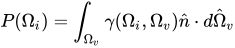
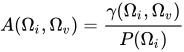
It is of interest because, with knowledge of the anisotropy function as defined, a measurement of the BRDF from a single viewing direction (say, ) yields a measure of the total scene reflectance (planar albedo) for that specific incident geometry (say, ).


See also
[edit]References
[edit]- ^ Smoot G. F.; Gorenstein M. V. & Muller R. A. (5 October 1977). "Detection of Anisotropy in the Cosmic Blackbody Radiation" (PDF). Lawrence Berkeley Laboratory and Space Sciences Laboratory, University of California, Berkeley. Archived (PDF) from the original on 9 October 2022. Retrieved 15 September 2013.
- ^ Tian, Xiaojuan; Itkis, Mikhail E; Bekyarova, Elena B; Haddon, Robert C (8 April 2013). "Anisotropic Thermal and Electrical Properties of Thin Thermal Interface Layers of Graphite Nanoplatelet-Based Composites". Scientific Reports. 3: 1710. Bibcode:2013NatSR...3.1710T. doi:10.1038/srep01710. PMC 3632880.
- ^ Saurabh, Suman; Harpalani, Satya (2 January 2019). "Anisotropy of coal at various scales and its variation with sorption". International Journal of Coal Geology. 201: 14–25. Bibcode:2019IJCG..201...14S. doi:10.1016/j.coal.2018.11.008. S2CID 133624963.
- ^ Oosterbaan, R. J. (1997). "The Energy Balance of Groundwater Flow Applied to Subsurface Drainage in Anisotropic Soils by Pipes or Ditches With Entrance Resistance" (PDF). Archived (PDF) from the original on 19 February 2009. The corresponding free EnDrain program can be downloaded from: [1].
- ^ Oosterbaan, R. J. (2002). "Subsurface Land Drainage By Tube Wells" (PDF). 9 pp. The corresponding free WellDrain program can be downloaded from: [2]
- ^ "From visual diagnostics to deep learning: automatic mineral identification in polished section images". Mining Science and Technology (Russia). doi:10.17073/2500-0632-2025-05-416.
- ^ MAT, Mahmut (19 April 2018). "Granite | Properties, Formation, Composition, Uses » Geology Science". Geology Science. Retrieved 16 February 2024.
- ^ Connolly, D. J.; Berman, L.; McNally, E.G. (February 2001). "The use of beam angulation to overcome anisotropy when viewing human tendon with high frequency linear array ultrasound". The British Journal of Radiology. 74 (878): 183–185. doi:10.1259/bjr.74.878.740183. ISSN 0007-1285. PMID 11718392. Retrieved 12 November 2025 – via PubMed.
- ^ Newnham, Robert E. Properties of Materials: Anisotropy, Symmetry, Structure (1st ed.). Oxford University Press. ISBN 978-0198520764.
- ^ Nye, J.F. Physical Properties of Crystals (1st ed.). Clarendon Press.
- ^ Courtney, Thomas H. (2005). Mechanical Behavior of Materials (2nd ed.). Waveland Pr Inc. ISBN 978-1577664253.
- ^ Sokołowski, Damian; Kamiński, Marcin (1 September 2018). "Homogenization of carbon/polymer composites with anisotropic distribution of particles and stochastic interface defects". Acta Mechanica. 229 (9): 3727–3765. doi:10.1007/s00707-018-2174-7. ISSN 1619-6937. S2CID 126198766.
- ^ "Fabric Weave Styles". Composite Envisions. Retrieved 23 May 2019.
- ^ Sano, Koki; Ishida, Yasuhiro; Aida, Tazuko (16 October 2017). "Synthesis of Anisotropic Hydrogels and Their Applications". Angewandte Chemie International Edition. 57 (10): 2532–2543. doi:10.1002/anie.201708196. PMID 29034553.
- ^ Wang, Xin; Jiang, Man; Gou, Jihua; Hui, David (1 February 2017). "3D printing of polymer matrix composites: A review and prospective". Composites Part B: Engineering. 110: 442–458. doi:10.1016/j.compositesb.2016.11.034.
External links
[edit]
- "Overview of Anisotropy"
- DoITPoMS Teaching and Learning Package: "Introduction to Anisotropy"
- "Gauge, and knitted fabric generally, is an anisotropic phenomenon"
| International | |
|---|---|
| National | |
| Other | |

Anisotropy
View on GrokipediaOverview and Fundamentals
Definition and Etymology
Anisotropy refers to the property of a substance, material, or system in which certain physical characteristics vary depending on the direction of measurement.[6] This directional dependence contrasts with isotropic behavior, where properties remain uniform regardless of orientation.[6] In physics, anisotropy manifests when external influences, such as applied forces or fields, elicit responses that differ along principal axes, often due to underlying structural asymmetries.[2] The term "anisotropy" derives from the Greek words anisos (ἀνίσος), meaning "unequal" or "uneven," and tropos (τρόπος), meaning "turn," "direction," or "manner."[7] It was formed as the antonym of "isotropy," which combines Greek isos (ἴσος, "equal") with the same root tropos.[8] The adjective "anisotropic" first appeared in English scientific literature in 1854, with the noun "anisotropy" recorded around 1875–1880, emerging within 19th-century discussions of material properties in physics.[7][9] Anisotropy applies across scales, from macroscopic structures like crystalline lattices to microscopic arrangements such as molecular orientations in polymers or fluids.[1] It encompasses variations in diverse physical responses, including mechanical strength, electrical conductivity, thermal expansion, and optical refractive index, all influenced by directional asymmetries in the system's composition or arrangement.[6] This broad applicability underscores anisotropy's role in characterizing non-uniform systems in both natural and engineered contexts.[2]Isotropy Versus Anisotropy
Isotropy describes a physical property or system that remains unchanged regardless of the direction in which it is measured, exhibiting uniformity under arbitrary rotations.[10] This rotational invariance is evident in systems with high symmetry, such as fluids where molecular orientations are random and disordered, or amorphous solids lacking long-range atomic order.[11] In these cases, properties like density, thermal conductivity, or mechanical response are identical along any axis due to the absence of preferred directions.[10] In contrast, anisotropy occurs when properties vary depending on direction, stemming from a breaking of rotational symmetry in the underlying structure.[12] This symmetry breaking introduces direction-specific behaviors, such as differing elastic moduli—where stiffness changes along different axes—or varying refractive indices that depend on light propagation orientation.[13] Unlike isotropic systems, anisotropic ones respond differently to external stimuli based on alignment relative to their internal structure, a phenomenon common in ordered materials like crystals.[10] For instance, the grain in wood illustrates this directional dependence briefly, with strength varying along or across the fibers.[10] Symmetry breaking can be visualized through lattice structures: a cubic lattice, with its equivalent axes and high rotational symmetry, often yields nearly isotropic responses for many bulk properties, as the three principal directions are indistinguishable.[13] Conversely, a hexagonal lattice features a distinct c-axis perpendicular to its basal plane, disrupting full rotational invariance and producing transverse isotropy—uniform in the plane but distinct along the axis—leading to clear directional variations.[13] These structural differences highlight how reduced symmetry enforces anisotropy, transforming uniform potential into directionally tuned characteristics. Understanding this contrast is foundational, as isotropic systems require no directional reference for description, while anisotropic ones necessitate a defined coordinate system to capture their orientation-dependent nature.[10] This prerequisite underscores the need for structured representations to quantify and predict anisotropic behaviors in subsequent analyses.[13]Everyday Examples
Anisotropy manifests in everyday natural materials, such as wood, where the grain structure makes it significantly stronger and more resistant to splitting along the longitudinal fibers than across them, a property exploited in construction and woodworking. In human physiology, muscle fibers exhibit directional contraction, allowing greater force generation parallel to their alignment than perpendicular to it, which underlies the coordinated movement of limbs and organs. Even snowflakes, with their intricate hexagonal symmetry, display anisotropy in melting rates, dissolving faster along certain crystal planes due to varying surface energies. Man-made objects also demonstrate anisotropy for practical benefits. Plywood, constructed from layered wood veneers glued with alternating grain directions, achieves enhanced strength and stability in specific orientations while reducing warping, making it ideal for furniture and structural panels. Polarized sunglasses incorporate lenses that selectively block horizontally polarized light to reduce glare from reflective surfaces like water or roads, while allowing vertical light to pass, thereby improving visual clarity in bright conditions. Anisotropy influences sensory experiences in subtle ways. The weave of fabrics, such as denim or silk, feels smoother and less frictional when stroked parallel to the threads compared to across them, affecting comfort and perceived texture in clothing. Similarly, in sight, stressed plastics like those in a bent credit card or ruler reveal colorful birefringence patterns under polarized light, highlighting internal directional strains invisible to the naked eye. These commonplace instances of directional dependence in properties pique curiosity and pave the way for deeper scientific exploration of anisotropy across disciplines.Mathematical and Theoretical Foundations
Tensorial Representation
Anisotropy in material properties is mathematically described using tensors, which provide a coordinate-independent framework to capture directional dependence. For many physical properties, such as electrical permittivity or magnetic permeability, a second-rank tensor suffices to represent the anisotropic behavior. The general form relates two vectors through a tensor , for instance, in the displacement field , where is the electric displacement and is the electric field; here, is a 3×3 matrix with up to nine components, though symmetry often reduces this to six independent ones.[14] This tensorial form allows the property to vary with direction, as seen in crystals where permittivity differs along principal axes.[14] In mechanical contexts, such as linear elasticity, anisotropy requires a fourth-rank tensor to link the second-rank stress tensor to the strain tensor . The constitutive relation is given by where is the stiffness tensor with 81 potential components, reduced to 21 by symmetries in stress and strain.[15] To simplify computations, Voigt notation contracts the indices, representing the fourth-rank tensor as a 6×6 matrix that relates the six independent stress and strain components, facilitating numerical analysis in anisotropic media.[15] In the principal coordinate system aligned with the material's symmetry axes, the diagonal terms of this matrix correspond to normal stiffnesses along those directions, while off-diagonal terms indicate coupling, such as shear-normal interactions that arise in lower-symmetry materials like orthorhombic crystals.[15] Under coordinate rotations, these tensors transform according to specific laws to preserve their physical meaning. For a second-rank tensor, the components in the new frame are , where are elements of the rotation matrix .[14] The fourth-rank stiffness tensor follows an analogous rule: , ensuring the tensor's invariance under rigid body rotations.[15] In the isotropic limit, where properties are direction-independent, the stiffness tensor simplifies dramatically, retaining only two independent constants, the Lamé parameters and , such that ; here, governs volumetric response and shear response.[16] This reduction highlights how anisotropy emerges from deviations in tensor components beyond these scalar multiples. For example, in wood, the principal tensor axes align with grain direction, leading to higher stiffness longitudinally than transversely.[14]Symmetry and Group Theory
In the context of anisotropy, group theory provides a mathematical framework for classifying the symmetries of physical systems, particularly crystals, where directional dependence arises from underlying rotational and reflectional invariances. A symmetry group consists of operations such as proper rotations (about an axis by 360°/n, where n is an integer), improper rotations (rotoinversions combining rotation and inversion through a point), reflections across planes, and the identity operation, all of which leave the system's properties unchanged. These operations form finite point groups that describe the external symmetry of crystals, ensuring that physical tensors transform consistently under the group actions to preserve anisotropic behaviors like varying elasticity along different directions.[17] Crystals are categorized into 32 point groups, which aggregate into 7 crystal systems based on their lattice parameters and symmetry elements: triclinic (no symmetry beyond identity or inversion), monoclinic (one twofold axis or mirror), orthorhombic (three mutually perpendicular twofold axes or mirrors), tetragonal (fourfold axis), trigonal (threefold axis), hexagonal (sixfold axis), and cubic (four threefold axes along body diagonals). For instance, the cubic system (e.g., point group m¯3m) exhibits high symmetry approaching isotropy for many properties, while the hexagonal system (e.g., 6/mmm) displays uniaxial anisotropy with one unique c-axis perpendicular to equivalent a-b planes. These classifications dictate how anisotropy manifests, with lower symmetry leading to greater directional variation.[18][19] Anisotropy types are directly tied to these symmetries: uniaxial anisotropy occurs in tetragonal, trigonal, or hexagonal systems, where properties differ along one principal axis (e.g., the optic axis in calcite); biaxial anisotropy appears in orthorhombic, monoclinic, or lower symmetries with two distinct optic axes; and orthorhombic anisotropy features three mutually perpendicular unequal axes, maximizing directional differences short of triclinic. Group theory links these to tensor representations, where symmetry operations reduce the number of independent components in property tensors; for example, a general fourth-rank elasticity tensor has 21 independent components in triclinic symmetry but only 3 in cubic and 2 (λ and μ) in fully isotropic cases, reflecting the constraints imposed by invariant transformations.[19][20] Character tables encapsulate the irreducible representations of point groups, essential for analyzing how physical quantities in anisotropic media decompose into symmetry-adapted basis sets. For instance, in the C_{3v} point group (common in some trigonal uniaxial crystals, such as pyrargyrite), the character table lists classes (E, 2C_3, 3σ_v) and irreducible representations (A_1, A_2, E), with characters indicating trace values under operations; this allows decomposition of tensor components, such as the dielectric tensor ε_{ij}, into totally symmetric (A_1) parts for isotropic-like behavior in the plane and anisotropic (E) modes along the axis.| C_{3v} | E | 2C_3 | 3σ_v |
|---|---|---|---|
| A_1 | 1 | 1 | 1 |
| A_2 | 1 | 1 | -1 |
| E | 2 | -1 | 0 |