Hubbry Logo
Single-track railwaySingle-track railwayMain
Open search
Single-track railway
Community hub
Single-track railway
logo
8 pages, 0 posts
0 subscribers
Be the first to start a discussion here.
Single-track railway
from Wikipedia
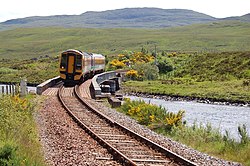
A Class 158 DMU on the Kyle of Lochalsh Line, a primarily single-track railway in Scotland
A train on the Long Island Rail Road's single-tracked Central Branch
A train on the Jinhua–Wenzhou Railway, a single-track railway in Southern Zhejiang Province, China
Single track on the Stony Point Line in the Australian state of Victoria

A single-track railway is a railway where trains traveling in both directions share the same track. Single track is usually found on lesser-used rail lines, often branch lines, where the level of traffic is not high enough to justify the cost of constructing and maintaining a second track.

Advantages and disadvantages

[edit]

Single track is significantly cheaper to build and maintain, but has operational and safety disadvantages. For example, a single-track line that takes 15 minutes to travel through would have capacity for only two trains per hour in each direction safely. By contrast, a double track with signal boxes four minutes apart can allow up to 15 trains per hour in each direction safely, provided all the trains travel at the same speed. This hindrance on the capacity of a single track may be partly overcome by making the track one-way on alternate days.

Long freight trains are a problem if the passing stretches are not long enough. Other disadvantages include the propagation of delays, since one delayed train on a single track will also delay any train waiting for it to pass. Also, a single track does not have a "reserve" track that can allow a reduced capacity service to continue if one track is closed.

Single-track operations

[edit]

Passing loops

[edit]
Passing Loop
Main line
Passing
loop

If a single-track line is designed to be used by more than one train at a time, it must have passing loops (also called passing sidings or crossing loops) at intervals along the line to allow trains running in different directions to pass each other. These consist of short stretches of double track, usually long enough to hold one train. The first train to arrive at the siding must leave the main line to allow the second to pass. The capacity of a single-track line is determined by the number of passing loops. Passing loops may also be used to allow trains heading in the same direction at different speeds to overtake.

In some circumstances on some isolated branch lines with a simple shuttle service (such as the Abbey Line in Great Britain or L202 railway in Croatia) a single-track line may work under the "one train working" principle without passing loops, where only one train is allowed on the line at a time.

Refuge sidings also allow passing of trains on a single-track railway.

Safety operations

[edit]

On single-track lines with passing loops, measures must be taken to ensure that only one train in one direction can use a stretch of single track at a time, as head-on collisions are a particular risk. Some form of signalling system is required. In traditional British practice (and countries using British practice), single-track lines were operated using a token system where the train driver had to be in possession of a token in order to enter a stretch of single track. Because there was only one unique token issued at any one time for each stretch of single track, it was impossible for more than one train to be on it at a time. This method is still used on some minor lines but in the longest single-track lines in Britain (e.g. the Highlands of Scotland) this has been superseded by radio communication, known as Radio Electronic Token Block.

In the early days of railways in North America it was common to rely upon simple timetable operation where operators knew where a train was scheduled to be at a particular time, and so would not enter a single-track stretch when they were not scheduled to. This generally worked but was inflexible and inefficient. It was improved with the invention of the telegraph and the ability to issue train orders.

Doubling and singling

[edit]
Kirkby railway station single-track railway interchange (former double-track railway)

Converting a single-track railway to double track is called duplication or doubling; converting double track to single track is known as singling. A double-track railway operating only a single track is known as single-line working. Kirkby railway station (until 1977) and Ormskirk railway station (until 1970) were double-track railway, when they were converted into single-track railway with cross-platform interchange.

New bike paths and railway corridors

[edit]

Building bike trails on rail corridors has occurred in limited examples; however, developing rail rights of way for a bike trail can restrict a train corridor to a single track. Also reclaiming a railway corridor to use trains again limits the use of double tracks. The bike path is usually where the second track would be, and there may be fierce opposition by bikers and hikers. An example of a bike, single-track corridor is the E&N Railway in Victoria, Canada.[1]

Countries with only single-track railways

[edit]

The European microstates of Liechtenstein and Vatican City each have only one single-track railway line: the Feldkirch–Buchs railway and the Vatican railway, respectively. The railway networks of North Macedonia, Albania, Montenegro and Kosovo are also reported by Eurostat to have no double tracking.[2]

References

[edit]
[edit]
Revisions and contributorsEdit on WikipediaRead on Wikipedia
from Grokipedia
A single-track railway is a rail line consisting of one continuous track shared by trains traveling in both directions, requiring coordination through passing sidings or loops where opposing trains can meet and overtake without collision. These systems are typically employed on lower-traffic routes, such as rural or branch lines, to facilitate efficient movement while minimizing infrastructure demands. Historically, single-track railways predominated in the early development of rail networks during the , including key projects like the U.S. , where cost constraints and rapid construction necessitated shared tracks with strategic sidings for passing. As railroads expanded globally from the onward, single tracks enabled initial connectivity in resource-limited areas, evolving with signaling advancements like whistle codes and to manage bidirectional flow safely. Today, they remain integral to freight and regional passenger services, particularly in and , where the majority of the U.S. rail network is single-track (as of 2013). Operationally, single-track lines rely on timetables, block signaling, and sidings—typically spaced 10-20 miles apart and 1-2 miles long—to prevent conflicts, with capacity limited to around 30-40 trains per day before congestion arises. Advantages include significantly lower and costs compared to double-track systems, making them economical for low-volume corridors and allowing easier upgrades like partial doubling for capacity gains. However, disadvantages encompass reduced overall capacity, increased delay propagation from even minor disruptions, and challenges in accommodating mixed freight-passenger traffic due to varying speeds and lengths. Reliability improves with shorter inter-station distances or combined crossing-passenger stops, but remains critical to mitigate variance in crossing times.

Definition and Fundamentals

Definition and Characteristics

A is a line consisting of one continuous running rail track that accommodates traveling in both directions, in contrast to multi-track systems where separate parallel tracks are allocated for each direction of travel. This configuration necessitates careful coordination between opposing to prevent collisions, typically achieved through the use of passing loops or short sections of double track where one train can pull aside to allow the other to proceed. Single-track are predominantly found in low-traffic environments, such as rural areas, lines serving remote communities, and industrial connections, where the frequency and volume of train movements do not economically justify the expense of dual tracks. Key physical and functional characteristics of single-track railways include their adaptability to varied topographical conditions, often featuring pronounced curves and gradients that would make multi-track construction prohibitively costly in rugged terrain. They must adhere to minimum engineering standards for load-bearing capacity and operational speeds, governed by regulations such as the U.S. Federal Railroad Administration's Track Safety Standards (49 CFR Part 213), which classify tracks based on maximum speeds—for instance, Class 2 track supports freight speeds up to 25 mph (40 km/h). These lines can incorporate various gauges, with standard gauge (1,435 mm or 4 ft 8½ in) common for mainline applications in and , while narrow-gauge variants (e.g., 597 mm or 1 ft 11½ in on the in ) are employed in constrained or historical settings to minimize material and earthwork requirements. Electrification is another variable feature; while many single-track railways remain diesel-operated due to lower traffic demands, others are overhead catenary-electrified for efficiency in regions with available power infrastructure, such as certain European branch lines. Basic terminology distinguishes "mainline single-track" as primary routes for through traffic versus "industrial spurs," which are short, dead-end single tracks branching off to serve factories or loading facilities without bidirectional mainline operations. For illustrative purposes, diagrams comparing single-track layouts (a solitary rail line with periodic loops) to double-track configurations (parallel rails for unidirectional flow) highlight the space and coordination efficiencies of single-track designs in resource-limited settings.

Historical Development

The single-track railway emerged in the early as a cost-effective solution for initial rail development amid industrial demands for efficient coal and goods transport. The , opened in 1825, represented a pioneering example, spanning 26 miles primarily as a single track with passing loops to accommodate bidirectional traffic using horse-drawn wagons and the Locomotion No. 1. High construction costs, such as over £40,000 per mile for the (1830), drove the adoption of single tracks over more expensive double configurations, particularly in resource-limited industrial regions. This approach allowed rapid deployment while minimizing land acquisition and engineering expenses, influencing subsequent networks in and beyond. During the 1800s and early 1900s, single-track railways proliferated in colonial and rural settings to support economic expansion and resource extraction. In , the network grew rapidly from the 1850s, becoming the world's fastest-expanding rail system by 1857, with single tracks facilitating trade in , , and grains while serving imperial administrative needs. These lines, often built with British capital, reduced transport costs and boosted agricultural incomes, though primarily benefiting colonial exports. In rural Britain, branch lines—typically single-track extensions from main routes—multiplied during the , with over 1,100 miles of new railway track added in 1847 alone, many as single-track branches to connect remote areas for passengers and freight. World Wars I and II further highlighted their utility for rapid, economical construction; narrow-gauge, portable single-track systems, such as trench railways, supplied front lines with minimal resources, achieving assembly rates of up to 2,460 man-days per mile. Post-World War II, however, single tracks declined in developed nations like the and Britain as economic shifts favored automobiles and highways, leading to doubling projects on high-traffic lines and abandonment of over 100,000 miles of track by century's end. Technological advancements enhanced single-track viability, beginning with the electric telegraph in the 1840s for train coordination. The London and Blackwall Railway installed the first such system in 1840, enabling real-time signaling to prevent collisions on shared tracks. By the , radio communication and automated block systems supplanted telegraphs, with train radio introduced for dispatcher-train exchanges and automatic train protection emerging in the using radio beacons for speed enforcement. Regional variations underscored socio-economic drivers: in , particularly branch lines, single tracks supported localized rural economies and suburban growth during industrialization, reflecting capital constraints in secondary routes. In , colonial India's single-track emphasis stemmed from imperial priorities for resource mobilization and market integration, fostering uneven development that prioritized ports over interior connectivity.

Infrastructure and Design

Track Layout and Components

The core components of a single-track railway include rails, sleepers, , and turnouts, all engineered to support bidirectional traffic while maintaining structural integrity under varying loads. Rails typically consist of flat-bottom profiles such as the UIC 60 standard (60 kg/m), which are continuously welded into lengths of hundreds of meters to minimize joints and facilitate smooth passage in both directions; for low-traffic lines, lighter standard rails (e.g., 45-52 kg/m) may be used to reduce costs, though heavy rails (e.g., 60 kg/m or more) are preferred for durability in areas prone to higher stresses. Sleepers, spaced at 650-760 mm intervals, secure the rails at a standard gauge of 1435 mm and transfer loads to the substructure; common types include wooden sleepers (100 kg each, treated for longevity) or mono-block sleepers (up to 320 kg, with wider spacing for efficiency), with bidirectional setups requiring additional rail anchors to prevent longitudinal creep from opposing train movements. , usually crushed stones 25-65 mm in size and 225-300 mm deep, provides lateral stability, drainage, and load distribution (up to 50 tonnes per rail), while turnouts incorporate switch blades, guard rails, and cast crossings designed for dual-direction operation, often with insulated joints staggered 100-1,400 mm apart to accommodate signaling needs. Alignment requirements for single-track railways emphasize straight or gently curved paths to accommodate bidirectional traffic, with turnouts and rail joints positioned to avoid conflicts during passing maneuvers. Track alignment must maintain a consistent gauge and include rail anchors at increased density (e.g., one per sleeper in high-creep zones) compared to multi-track setups to counter forces from trains traveling in opposite directions. Design considerations prioritize and limits to ensure safe bidirectional operations and ease integration with passing facilities. Maximum gradients are typically limited to 1.5% for mainline single tracks, with 0.5% or less preferred for low-traffic sections to minimize braking demands; steeper sections require trap or at the lower end to potential runaways. is constrained to 7-10 degrees (radii of 175-250 m) for industry or low-speed lines, with superelevation (cant) up to 150 mm to balance centrifugal forces, and transition spirals to prevent abrupt shifts that could destabilize bidirectional trains. Integration with stations involves aligning turnouts to allow seamless entry/exit, often with extended platforms flanking the single track, while level crossings demand clear sight lines and reinforced approaches to handle track transitions without excessive settlement. Passing loops serve as short extensions of the single-track layout to enable , typically 1-2 km long with symmetric turnouts at each end. Material selection and maintenance practices for single-track railways focus on cost-effective durability suited to lower traffic volumes, with adaptations for environmental challenges. Standard rails suffice for low-traffic routes (e.g., annual tonnage under 5 million), but heavy rails are mandated for segments with higher speeds or loads to resist wear; sleepers and ballast undergo periodic tamping and cleaning every 2-5 years to restore geometry, with concrete sleepers favored for their 40-50 year lifespan over wooden ones. Erosion control involves stabilizing embankments with drainage ditches (1 ft deep, flat-bottomed) and geotextiles to prevent ballast contamination, while vegetation management employs mechanical trimming, biological barriers, and targeted herbicides along rights-of-way to maintain visibility and prevent root intrusion into the subgrade—unique to low-traffic single tracks where overgrowth can accelerate degradation without frequent inspections. International standards and regulations govern single-track construction to ensure safety and adaptability. The International Union of Railways (UIC) recommends UIC 60 rails and ballast depths of 300 mm for standard gauge lines, with Leaflet 714 specifying sleeper spacing and fastening systems for bidirectional stability. In North America, the American Railway Engineering and Maintenance-of-Way Association (AREMA) Manual Chapter 5 outlines minimum rail weights (115 lb/yd or 57 kg/m) and tie spacings (21.5 inches for hardwood), emphasizing vertical curve rates of 1-2 ft per 100 ft station for low-speed single tracks. Seismic adaptations include L-type guide rails and glued-insulated joints in high-risk areas (e.g., Japan, with alarms at 40-65 mg acceleration), while environmental guidelines from UIC's RailAdapt project advocate elevated tracks and slab alternatives for flood-prone single lines, alongside updated drainage for climate resilience over 50-100 year asset lifespans.

Passing Sidings and Loops

Passing sidings and loops are essential infrastructure elements on single-track railways, enabling traveling in opposite directions to pass each other safely without halting on the main line. A siding typically refers to a short branch track connected to the main line at one end via a , forming a dead-end configuration suitable for temporary storage or refuge, while a loop is a parallel track connected at both ends to the main line, allowing through movement in either direction. Double-ended loops facilitate bidirectional passing, whereas single-ended sidings require to reverse if needing to rejoin the main track, making loops more efficient for frequent operations. Design of these facilities prioritizes accommodating typical lengths and maintaining operational speeds. Optimal lengths for loops on freight-heavy lines range from 1.8 to 2.3 kilometers to hold full trains of 100 to 120 cars, ensuring complete clearance from the main track during passes. Placement occurs in relatively flat sections or near stations to minimize gradient-related challenges, with spacing determined by demands to balance capacity and cost. Turnout angles, often specified by frog numbers, allow diverging speeds up to about 40 km/h; for instance, minimum No. 11 turnouts are standard for passing tracks to support diverging movements at up to 40 km/h. Engineering integrates signaling systems to control access and prevent conflicts, using track circuits to detect train occupancy and enforce block sections within loops. Capacity calculations for loop spacing rely on traffic volume, with uniform distribution of sidings maximizing throughput; for example, closer spacing on high-density routes can increase line capacity by 20-30% compared to irregular placements. Safety during passing involves coordinated signals that briefly reference procedures in dedicated systems, ensuring one train secures the main line while the other uses the loop. Historically, passing facilities evolved from manual operations using staff or token systems in the , where train crews physically exchanged tokens to authorize single-line entry, to automated setups in the mid-20th century incorporating electric signaling for .

Operational Procedures

Train Movement and Scheduling

On single-track railways, train movements are governed by basic principles designed to prevent collisions and ensure orderly operations. Token systems, such as the staff and ticket method or electric token block, provide physical or electronic authority for a to enter a specific section of track, ensuring only one train occupies it at a time. Timetable-based operations rely on pre-scheduled timings to coordinate movements, where trains adhere to fixed slots to avoid conflicts, often supplemented by train orders that specify meeting points at passing sidings. Priority rules typically favor trains over freight to minimize disruptions to higher-speed services, with additional precedence given based on direction of travel, such as westbound trains over eastbound in certain systems. Scheduling techniques for single-track lines balance fixed and flexible timetables to optimize throughput while avoiding conflicts. Fixed timetables assign rigid departure and arrival times, suitable for predictable low-traffic routes, whereas flexible timetables allow adjustments for variable conditions like seasonal demand. The track is divided into block sections, each capable of holding only one , with stations serving as passing points of unlimited capacity to facilitate overtakes. graphs, visualized as space-time diagrams, model movements to detect and resolve conflicts by sequencing trains and adjusting speeds or stops, often using dynamic programming algorithms for efficient solutions. Physical loops enable these passes by providing space for slower trains to wait aside. Dispatch tools range from manual methods to automated systems for coordinating movements and managing disruptions. Manual dispatching involves operators issuing track warrants or orders via radio, enforcing time intervals like five minutes between trains in unsignaled sections. (CTC) represents an advanced automated approach, where a remote monitors and routes trains through a control panel, dynamically adjusting for delays by rescheduling meets or granting temporary authorities. In CTC-equipped single-track lines, unscheduled movements or delays are handled by real-time signal and switch control, minimizing propagation effects across the network. Capacity on single-track railways is constrained, with theoretical maximums of 4-6 trains per hour per direction in low-traffic scenarios, depending on block lengths and operational rules. Loop density significantly impacts throughput, as closer spacing (e.g., every 4-5 km) reduces travel times between passes and supports higher frequencies, while longer intervals limit capacity to around 2-4 trains per hour. In practice, heterogeneous train mixes further reduce effective capacity by introducing variability in speeds and stopping patterns.

Signaling and Safety Systems

Single-track railways rely on specialized signaling systems to manage movements and prevent collisions, given the absence of parallel tracks for bidirectional traffic. The absolute block system divides the line into sections where only one is permitted at a time, with signals locked in the stop position until the preceding has cleared the section and confirmation is received from the next signal box. This system, often implemented manually via electric telegraph or automatically with track circuits, ensures positive control over entry into each block. In contrast, the token block system, commonly used on low-traffic single lines, authorizes entry by issuing a physical or electronic token unique to each section, guaranteeing that no two trains occupy the same stretch simultaneously. For remote or very low-density routes, one-train-only rules may apply, restricting operations to a single on the entire until it completes its journey, supplemented by manual radio checks. Advanced safety technologies further enhance protection on single-track networks. (ATC) systems provide continuous supervision of train speed and movement authority, automatically applying brakes if the driver exceeds limits or ignores signals, and are integrated into cab signaling for real-time enforcement. In the United States, (PTC) is mandated by the (FRA) for most mainline tracks, including single-track sections, to prevent collisions, overspeed derailments, and incursions into work zones through GPS-based positioning and wireless communication. Radio communication standards like , the for railway voice and data services, enable direct driver-to-signaller contact and transmission of signaling information, supporting across borders and functioning reliably at speeds up to 500 km/h even in challenging terrains. is being succeeded by the Future Railway Mobile Communication System (FRMCS), with testing on single-track sections underway as of 2025 to improve data capacity and support advanced automation. Operational protocols emphasize caution in single-track environments. Approach signaling uses distant signals to warn drivers of upcoming restrictions at a safe , often requiring reduced speeds in passing zones to allow oncoming trains to clear sidings. Speed restrictions are enforced in these zones depending on siding length and visibility, with progressive signaling aspects guiding gradual deceleration. Emergency stop procedures involve immediate radio alerts to dispatchers, followed by automatic brake application via ATC or PTC if equipped, while prevention incorporates trackside sensors for detecting wheel flats or misalignments that could signal impending failures. Regulatory frameworks enforce these systems globally. In the , FRA regulations under 49 CFR Part 236 require PTC on high-risk single-track routes, with compliance verified through annual testing to maintain safety integrity levels. The European Union's Technical Specifications for Interoperability (TSI), particularly the Control-Command and Signalling TSI, mandate harmonized standards like (European Train Control System) for single-track interoperability, ensuring essential requirements for safe train separation and emergency handling. These standards evolved from 19th-century incidents, such as the 1889 Armagh disaster where inadequate time-interval signaling caused 80 deaths, prompting the Regulation of Railways Act 1889 to require absolute block systems and continuous braking on passenger trains.

Advantages and Challenges

Operational Benefits

Single-track railways offer substantial economic advantages, particularly in and , making them ideal for low-volume routes where traffic does not justify the expense of double-track . Construction costs for single-track lines are typically 30-50% lower than for double-track equivalents, as they require approximately half the materials, land acquisition, and engineering efforts; for instance, upgrading a 60-mile single-track route in Maine's mountainous region to Class 1 standards was estimated at $19.84 million (2007 USD), or about $0.205 million per km. Maintenance expenses are similarly reduced due to less surface area and fewer components to service. These savings are especially pronounced on branch lines serving sparse populations or seasonal demands, where single-track setups enable viable rail service without excessive capital investment. In environmentally sensitive or geographically challenging areas, single-track railways minimize and visual disruption, fitting seamlessly into rugged terrains like mountains or islands where double tracks would require extensive earthworks. By following natural contours with a narrower right-of-way, they reduce ecological disturbance, preserving vegetation and habitats while limiting cuts and fills; Division rail study in highlighted how single-track design blends with the , supporting diverse and as ecological corridors in the White Mountains. This configuration also lowers overall environmental impact by decreasing dependency, potentially eliminating thousands of trips annually and reducing emissions—optimized single-track alignments in , for example, reduce consumption and CO₂-equivalent emissions compared to doubling existing lines. Such benefits make single-track railways preferable for isolated or protected regions, enhancing connectivity without compromising natural features. Operationally, single-track railways provide efficiencies suited to branch lines, heritage operations, and seasonal traffic patterns, where simpler infrastructure allows flexible scheduling without the complexity of bidirectional continuous flow. In low-traffic settings, such as North American main lines where single track predominates, longer trains (up to 150 cars) can be accommodated via passing sidings, yielding in fuel and crew costs while maintaining capacity for 3,700–4,800 carloads per year on routes like Maine's Mountain Division. This setup supports self-sustaining operations, with projected annual revenues of $2.84 million offsetting costs through targeted freight and services, particularly in areas with variable demand like peaks. Overall, these efficiencies promote longevity in stable, low-density environments by prioritizing essential connectivity over high-volume throughput.

Limitations and Drawbacks

Single-track railways impose significant capacity constraints compared to multi-track systems, as must coordinate movements to avoid conflicts on the shared infrastructure. This necessitates the use of passing sidings, where opposing must decelerate, stop, and accelerate, limiting overall throughput to approximately 36 per day before congestion sets in. In high-traffic scenarios, such as mixed passenger and freight operations, capacity can drop by up to 8 per day due to speed differentials and priority scheduling, making it unsuitable for growing without frequent delays. Disruptions, like a single breakdown, can halt all in both directions until resolved, amplifying vulnerabilities in the system. Safety and reliability challenges are pronounced on single-track lines, particularly in adverse conditions and remote locations. Single-track configurations present risks of head-on collisions between opposing trains. poses additional reliability issues, as single-track sections often traverse remote areas with limited access to crews and equipment, requiring complete shutdowns that complicate timely interventions. Economically, single-track operations incur long-term drawbacks through limited and high upgrade costs to accommodate expansion. Transitioning to double-track can cost around $3 million per mile for high-speed or freight corridors, representing a substantial barrier for operators facing rising demand. In-service failures on single tracks propagate that escalate economic losses, with costs reaching $2,850 for a 1.5-hour disruption in high-traffic scenarios, far exceeding those on multi-track lines due to total blockages. Quantitative models of delay propagation highlight these inefficiencies, with average waits at sidings ranging from 15 to 30 minutes per meeting in simulated operations, leading to total delays of 105–150 minutes per 100 train miles under congested conditions. Such patterns underscore the vulnerability to cascading disruptions, where one delay can affect multiple subsequent s, though safety systems like signaling can mitigate some collision risks in a limited manner.

Conversions and Alternative Uses

Track Doubling and Singling

Track doubling involves converting a single-track railway to a double-track configuration to enhance capacity and . The process generally includes surveys to assess demands and feasibility, land acquisition if needed, earthworks to widen the formation, bridge extensions or reconstructions, track laying, and signaling upgrades to support bidirectional operations. The line is opened progressively for goods at restricted speeds, followed by passenger services after certification. Timelines for such projects typically span 1-3 years for segments of 50 km, depending on and logistics. The primary motivation for doubling is to accommodate growing volumes that exceed single-track capacity. Technical challenges include adjusting alignments for and gradients, widening bridges and culverts, and managing soil stability in varied terrains. Cost estimates for doubling range from $1 million to $5 million per km, varying with factors like land acquisition, bridge work, and signaling enhancements. Track singling, the reverse process of converting double-track sections to single track, is undertaken to reduce maintenance costs on underutilized lines, particularly low-traffic single-track branches that were previously doubled. Decommissioning procedures start with traffic rerouting or temporary single-line working to ensure safety, followed by removal of the redundant track using heavy machinery to extract rails, sleepers, and fastenings. Asset salvage involves steel rails and ties, often selling them for in other projects or , as exemplified in early 20th-century conversions where materials were repurposed internationally. Environmental remediation addresses potential contaminants from creosote-treated sleepers or spilled lubricants, including soil testing, excavation of affected areas, and restoration to prevent , in compliance with regulatory standards. The remaining single track is then re-ballasted and realigned if needed, with signaling simplified to single-line systems like token block or . Singling is motivated by cost savings on low-traffic routes, such as those affected by the 1960s Beeching cuts in the UK, where underused double-track sections were reduced to single track or closed entirely to streamline operations amid declining passenger numbers. Challenges encompass minimizing service interruptions during removal, salvaging assets without damage, and remediating environmental impacts to avoid long-term liabilities.

Repurposing for Non-Rail Uses

Disused single-track railway corridors have increasingly been repurposed into non-rail infrastructure, particularly multi-use paths for cycling and pedestrians, promoting sustainable land use and recreation. In the United States, the Rails-to-Trails Conservancy has facilitated the conversion of abandoned rail lines into over 26,000 miles of public trails since the 1980s, leveraging the National Trails System Act of 1968 and its 1983 amendments to preserve corridors through railbanking, which prevents reversion of rights-of-way to adjacent landowners. The conversion process typically begins with legal assessments of railroad property interests, often involving easements or titles, to ensure interim trail use without full abandonment. This is followed by environmental , removal of rail surfaces such as and ties, and to create safe, accessible paths; commonly comes from federal grants like those under the Land and Water Fund or state programs. In the , initiatives under the Connecting Europe Facility have supported repurposing through grants, with examples including Spain's Vías Verdes program, which has converted over 3,300 km of disused lines into greenways since the 1990s. These repurposed corridors offer significant recreational and , such as enhanced connectivity and enhancement in urban greenways. In the , over 4,000 miles of former railway lines have been integrated into the , providing traffic-free routes that boost and , as seen in paths like the Bristol and Bath Railway Path. However, challenges include addressing contamination from historical rail operations, such as lead, , or petroleum in soils, requiring site assessments and cleanup under frameworks like the U.S. Comprehensive Environmental Response, Compensation, and Liability Act to mitigate health risks. As of 2025, trends in repurposed rail corridors emphasize integration of options like e-scooters to extend usability for short urban trips. Organizations like the Rails-to-Trails Conservancy advocate for policies allowing low-speed devices on trails to increase and reduce .

Global Examples and Case Studies

Countries with Extensive Single-Track Networks

India exemplifies a nation with an extensive single-track railway network, where approximately 42,000 km of the total 69,181 km route length consists of single-track lines as of March 2024, representing over 60% of the system. This configuration is driven by economic priorities in a developing , emphasizing affordable connectivity to rural and underserved regions that account for a substantial portion of and freight movements, including agricultural and essential commodities. Geographical challenges, such as flood-prone areas in eastern and southern states, further influence the prevalence of single tracks, as doubling efforts are concentrated on high-density corridors amid limited budgets. The Indian government has pursued ongoing track-doubling initiatives, completing 2,244 km in 2023-24 to enhance capacity and reduce delays on busy routes. Indonesia features another prominent single-track-dominated network, spanning roughly 6,927 km as of 2025, with the majority configured as single track across its fragmented geography. This setup supports vital for resources like and on and , alongside commuter services in densely populated areas, reflecting policy choices that favor low-cost expansion in a resource-constrained developing context. Archipelagic terrain and seismic activity necessitate resilient, simpler single-track designs, though upgrades including the doubling of 465 km on the Jakarta-Surabaya corridor (completed in ) have boosted on overburdened segments. Economic imperatives, including integration with maritime , underscore the network's role without widespread doubling due to high costs. In parts of , countries like maintain networks where single-track lines predominate, totaling about 2,644 km overall, with over 80% (approximately 2,052 km) as single track in the legacy metre-gauge system as of 2024. These lines primarily facilitate resource-based freight, such as minerals and exports from inland regions to coastal ports, aligning with historical policies rooted in colonial-era extraction economies that prioritized minimal infrastructure. Limited public funding in developing African states perpetuates single-track reliance, exacerbated by challenging climates like droughts affecting maintenance; Kenya's newer 472 km remains single-track to balance costs with improved speeds for . Broader continental trends show single tracks comprising the majority of Africa's 85,000 km network, influenced by economic underinvestment and geographic isolation.

Notable Single-Track Routes

Single-track railways are prevalent in scenic, remote, or historically preserved routes worldwide, where the challenges of terrain or lower traffic volumes make double-tracking impractical or unnecessary. These lines often feature passing loops at stations to manage bidirectional traffic, showcasing ingenuity in rugged landscapes. Notable examples include heritage narrow-gauge railways in mountainous regions and busy freight corridors that handle substantial volumes on a single line. The in exemplifies a celebrated single-track route, stretching 164 miles (264 km) from to via Fort William, with a branch to . Opened in stages between 1894 and 1901, it traverses dramatic Highland scenery, including and the , with trains using crossing loops at key stations to avoid conflicts. This line is operated by and is renowned for its isolation, with much of the track running parallel to no roads, emphasizing the railway's role in connecting remote communities. In , the (Flåmsbana) is a 20.2-kilometer single-track connecting on the Railway to the village of , descending 865 meters through steep gradients up to 5.5%. Built between 1924 and 1940 as part of a hydroelectric project, it features 20 tunnels and offers views of waterfalls and mountains, operating as a major with multiple daily shuttle services. The line includes a double-track section at Berekvam station for passing, but remains predominantly single-track to navigate the narrow valley. India's mountain railways, designated as a World Heritage site, include several iconic single-track narrow-gauge lines. The , a 88-kilometer 2-foot gauge route from New Jalpaiguri to , climbs over 2,000 meters using loops, reverses, and zigzags since its opening in 1881, passing tea plantations and Himalayan vistas. Similarly, the (1899) covers 46 kilometers from Mettupalayam to on a 1-meter gauge, tackling 52 meters per kilometer gradients with a rack system in parts, while the Kalka-Shimla Railway (1903) spans 96 kilometers with 102 tunnels on its 2-foot-6-inch gauge track through the . These routes preserve colonial-era engineering and support in challenging terrains. Switzerland's , the highest-altitude railway in , operates as a 9.9-kilometer single-track metre-gauge line from to at 3,454 meters. Completed in 1912, it uses a Strub rack system for steep sections up to 25% gradient and serves as a key access to the Jungfrau-Aletsch region, attracting over a million passengers annually despite the single-track constraints managed by timed operations and short passing facilities. In the United States, the on the Union Pacific Railroad's Mojave Subdivision is a renowned single-track feat, a 3,779-foot spiral completed in to conquer the 77-foot elevation gain at 2.2% grade between Bakersfield and . Handling up to 40-50 freight trains daily, it remains one of the busiest single-track sections globally, with the upper track passing over the lower via a , underscoring the efficiency of single-track operations in high-volume freight corridors.

References

Add your contribution
Related Hubs
User Avatar
No comments yet.