Hubbry Logo
Solow–Swan modelSolow–Swan modelMain
Open search
Solow–Swan model
Community hub
Solow–Swan model
logo
7 pages, 0 posts
0 subscribers
Be the first to start a discussion here.
Solow–Swan model
Solow–Swan model
from Wikipedia

The Solow–Swan model or exogenous growth model is an economic model of long-run economic growth. It attempts to explain long-run economic growth by looking at capital accumulation, labor or population growth, and increases in productivity largely driven by technological progress. At its core, it is an aggregate production function, often specified to be of Cobb–Douglas type, which enables the model "to make contact with microeconomics".[1]: 26  The model was developed independently by Robert Solow and Trevor Swan in 1956,[2][3][note 1] and superseded the Keynesian Harrod–Domar model.

Mathematically, the Solow–Swan model is a nonlinear system consisting of a single ordinary differential equation that models the evolution of the per capita stock of capital. Due to its particularly attractive mathematical characteristics, Solow–Swan proved to be a convenient starting point for various extensions. For instance, in 1965, David Cass and Tjalling Koopmans integrated Frank Ramsey's analysis of consumer optimization,[4] thereby endogenizing[5] the saving rate, to create what is now known as the Ramsey–Cass–Koopmans model.

Background

[edit]

The Solow–Swan model was an extension to the 1946 Harrod–Domar model that dropped the restrictive assumption that only capital contributes to growth (so long as there is sufficient labor to use all capital). Important contributions to the model came from the work done by Solow and by Swan in 1956, who independently developed relatively simple growth models.[2][3] Solow's model fitted available data on US economic growth with some success.[6] In 1987 Solow was awarded the Nobel Prize in Economics for his work. Today, economists use Solow's sources-of-growth accounting to estimate the separate effects on economic growth of technological change, capital, and labor.[7]

The Solow model is also one of the most widely used models in economics to explain economic growth.[8] Basically, it asserts that outcomes on the "total factor productivity (TFP) can lead to limitless increases in the standard of living in a country."[8]

Extension to the Harrod–Domar model

[edit]

Solow extended the Harrod–Domar model by adding labor as a factor of production and capital-output ratios that are not fixed as they are in the Harrod–Domar model. These refinements allow increasing capital intensity to be distinguished from technological progress. Solow sees the fixed proportions production function as a "crucial assumption" to the instability results in the Harrod-Domar model. His own work expands upon this by exploring the implications of alternative specifications, namely the Cobb–Douglas and the more general constant elasticity of substitution (CES).[2] Although this has become the canonical and celebrated story[9] in the history of economics, featured in many economic textbooks,[10] recent reappraisal of Harrod's work has contested it. One central criticism is that Harrod's original piece[11] was neither mainly concerned with economic growth nor did he explicitly use a fixed proportions production function.[10][12]

Long-run implications

[edit]

A standard Solow model predicts that in the long run, economies converge to their balanced growth equilibrium and that permanent growth of per capita income is achievable only through technological progress. Both shifts in saving and in population growth cause only level effects in the long-run (i.e. in the absolute value of real income per capita). An interesting implication of Solow's model is that poor countries should grow faster and eventually catch-up to richer countries. This convergence could be explained by:[13]

  • Lags in the diffusion on knowledge. Differences in real income might shrink as poor countries receive better technology and information;
  • Efficient allocation of international capital flows, since the rate of return on capital should be higher in poorer countries. In practice, this is seldom observed and is known as Lucas' paradox;
  • A mathematical implication of the model (assuming poor countries have not yet reached their steady state).

Baumol attempted to verify this empirically and found a very strong correlation between a countries' output growth over a long period of time (1870 to 1979) and its initial wealth.[14] His findings were later contested by DeLong who claimed that both the non-randomness of the sampled countries, and potential for significant measurement errors for estimates of real income per capita in 1870, biased Baumol's findings. DeLong concludes that there is little evidence to support the convergence theory.

Assumptions

[edit]

The key assumption of the Solow–Swan growth model is that capital is subject to diminishing returns in a closed economy.

  • Given a fixed stock of labor, the impact on output of the last unit of capital accumulated will always be less than the one before.
  • Assuming for simplicity no technological progress or labor force growth, diminishing returns implies that at some point the amount of new capital produced is only just enough to make up for the amount of existing capital lost due to depreciation.[1] At this point, because of the assumptions of no technological progress or labor force growth, we can see the economy ceases to grow.
  • Assuming non-zero rates of labor growth complicate matters somewhat, but the basic logic still applies[2] – in the short-run, the rate of growth slows as diminishing returns take effect and the economy converges to a constant "steady-state" rate of growth (that is, no economic growth per-capita).
  • Including non-zero technological progress is very similar to the assumption of non-zero workforce growth, in terms of "effective labor": a new steady state is reached with constant output per worker-hour required for a unit of output. However, in this case, per-capita output grows at the rate of technological progress in the "steady-state"[3] (that is, the rate of productivity growth).

Variations in the effects of productivity

[edit]

In the Solow–Swan model the unexplained change in the growth of output after accounting for the effect of capital accumulation is called the Solow residual. This residual measures the exogenous increase in total factor productivity (TFP) during a particular time period. The increase in TFP is often attributed entirely to technological progress, but it also includes any permanent improvement in the efficiency with which factors of production are combined over time. Implicitly TFP growth includes any permanent productivity improvements that result from improved management practices in the private or public sectors of the economy. Paradoxically, even though TFP growth is exogenous in the model, it cannot be observed, so it can only be estimated in conjunction with the simultaneous estimate of the effect of capital accumulation on growth during a particular time period.

The model can be reformulated in slightly different ways using different productivity assumptions, or different measurement metrics:

  • Average Labor Productivity (ALP) is economic output per labor hour.
  • Multifactor productivity (MFP) is output divided by a weighted average of capital and labor inputs. The weights used are usually based on the aggregate input shares either factor earns. This ratio is often quoted as: 33% return to capital and 67% return to labor (in Western nations).

In a growing economy, capital is accumulated faster than people are born, so the denominator in the growth function under the MFP calculation is growing faster than in the ALP calculation. Hence, MFP growth is almost always lower than ALP growth. (Therefore, measuring in ALP terms increases the apparent capital deepening effect.) MFP is measured by the "Solow residual", not ALP.

Mathematics of the model

[edit]

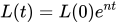
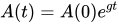
The textbook Solow–Swan model is set in continuous-time world with no government or international trade. A single good (output) is produced using two factors of production, labor () and capital () in an aggregate production function that satisfies the Inada conditions, which imply that the elasticity of substitution must be asymptotically equal to one.[15][16]

where denotes time, is the elasticity of output with respect to capital, and represents total production. refers to labor-augmenting technology or “knowledge”, thus represents effective labor. All factors of production are fully employed, and initial values , , and are given. The number of workers, i.e. labor, as well as the level of technology grow exogenously at rates and , respectively:

The number of effective units of labor, , therefore grows at rate . Meanwhile, the stock of capital depreciates over time at a constant rate . However, only a fraction of the output ( with ) is consumed, leaving a saved share for investment. This dynamic is expressed through the following differential equation:

is the derivative of the capital stock with respect to time. It is positive when the absolute amount of savings, exceeds the absolute decay of the capital stock, .

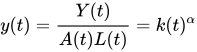
Since the production function has constant returns to scale, it can be written as output per effective unit of labour , which is a measure for wealth creation:[note 2]

The main interest of the model is the dynamics of capital intensity , the capital stock per unit of effective labour. Its behaviour over time is given by the key equation of the Solow–Swan model:[note 3]


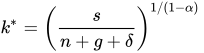
The first term, , is the actual investment per unit of effective labour: the fraction of the output per unit of effective labour that is saved and invested. The second term, , is the “break-even investment”: the amount of investment that must be invested to prevent from falling.[17]: 16  The equation implies that converges to a steady-state value of , defined by , at which there is neither an increase nor a decrease of capital intensity:
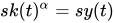
at which the stock of capital and effective labour are growing at rate . Likewise, it is possible to calculate the steady-state of created wealth that corresponds with :

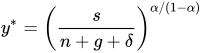
By assumption of constant returns, output is also growing at that rate. In essence, the Solow–Swan model predicts that an economy will converge to a balanced-growth equilibrium, regardless of its starting point. In this situation, the growth of output per worker is determined solely by the rate of technological progress.[17]: 18 

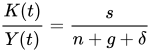
Since, by definition, , at the equilibrium we have
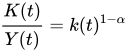
Therefore, at the equilibrium, the capital/output ratio depends only on the saving, growth, and depreciation rates. This is the Solow–Swan model's version of the golden rule saving rate.

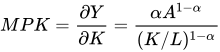
Since , at any time the marginal product of capital in the Solow–Swan model is inversely related to the capital/labor ratio.

If productivity is the same across countries, then countries with less capital per worker have a higher marginal product, which would provide a higher return on capital investment. As a consequence, the model predicts that in a world of open market economies and global financial capital, investment will flow from rich countries to poor countries, until capital/worker and income/worker equalize across countries.

Since the marginal product of physical capital is not higher in poor countries than in rich countries,[18] the implication is that productivity is lower in poor countries. The basic Solow model cannot explain why productivity is lower in these countries. Lucas suggested that lower levels of human capital in poor countries could explain the lower productivity.[19]

If the rate of return equals the marginal product of capital then

so that is the fraction of income appropriated by capital. Thus, the Solow–Swan model assumes from the beginning that the labor-capital split of income is constant.

Mankiw–Romer–Weil version of model

[edit]

Addition of human capital

[edit]

In 1992, N. Gregory Mankiw, David Romer, and David N. Weil theorised a version of the Solow-Swan model, augmented to include a role for human capital, that can explain the failure of international investment to flow to poor countries.[20] In this model output and the marginal product of capital (K) are lower in poor countries because they have less human capital than rich countries.

Similar to the textbook Solow–Swan model, the production function is of Cobb–Douglas type:

where is the stock of human capital, which depreciates at the same rate as physical capital. For simplicity, they assume the same function of accumulation for both types of capital. Like in Solow–Swan, a fraction of the outcome, , is saved each period, but in this case split up and invested partly in physical and partly in human capital, such that . Therefore, there are two fundamental dynamic equations in this model:

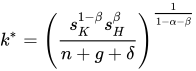
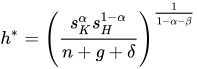
The balanced (or steady-state) equilibrium growth path is determined by , which means and . Solving for the steady-state level of and yields:


In the steady state, .

Econometric estimates

[edit]

Klenow and Rodriguez-Clare cast doubt on the validity of the augmented model because Mankiw, Romer, and Weil's estimates of did not seem consistent with accepted estimates of the effect of increases in schooling on workers' salaries. Though the estimated model explained 78% of variation in income across countries, the estimates of implied that human capital's external effects on national income are greater than its direct effect on workers' salaries.[21]

Accounting for external effects

[edit]

Theodore Breton provided an insight that reconciled the large effect of human capital from schooling in the Mankiw, Romer and Weil model with the smaller effect of schooling on workers' salaries. He demonstrated that the mathematical properties of the model include significant external effects between the factors of production, because human capital and physical capital are multiplicative factors of production.[22] The external effect of human capital on the productivity of physical capital is evident in the marginal product of physical capital:
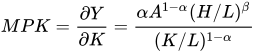
He showed that the large estimates of the effect of human capital in cross-country estimates of the model are consistent with the smaller effect typically found on workers' salaries when the external effects of human capital on physical capital and labor are taken into account. This insight significantly strengthens the case for the Mankiw, Romer, and Weil version of the Solow–Swan model. Most analyses criticizing this model fail to account for the pecuniary external effects of both types of capital inherent in the model.[22]

Total factor productivity

[edit]

The exogenous rate of TFP (total factor productivity) growth in the Solow–Swan model is the residual after accounting for capital accumulation. The Mankiw, Romer, and Weil model provide a lower estimate of the TFP (residual) than the basic Solow–Swan model because the addition of human capital to the model enables capital accumulation to explain more of the variation in income across countries. In the basic model, the TFP residual includes the effect of human capital because human capital is not included as a factor of production.

Conditional convergence

[edit]

The Solow–Swan model augmented with human capital predicts that the income levels of poor countries will tend to catch up with or converge towards the income levels of rich countries if the poor countries have similar savings rates for both physical capital and human capital as a share of output, a process known as conditional convergence. However, savings rates vary widely across countries. In particular, since considerable financing constraints exist for investment in schooling, savings rates for human capital are likely to vary as a function of cultural and ideological characteristics in each country.[23]

Since the 1950s, output/worker in rich and poor countries generally has not converged, but those poor countries that have greatly raised their savings rates have experienced the income convergence predicted by the Solow–Swan model. As an example, output/worker in Japan, a country which was once relatively poor, has converged to the level of the rich countries. Japan experienced high growth rates after it raised its savings rates in the 1950s and 1960s, and it has experienced slowing growth of output/worker since its savings rates stabilized around 1970, as predicted by the model.

The per-capita income levels of the southern states of the United States have tended to converge to the levels in the Northern states. The observed convergence in these states is also consistent with the conditional convergence concept. Whether absolute convergence between countries or regions occurs depends on whether they have similar characteristics, such as:

Additional evidence for conditional convergence comes from multivariate, cross-country regressions.[25]

Econometric analysis on Singapore and the other "East Asian Tigers" has produced the surprising result that although output per worker has been rising, almost none of their rapid growth had been due to rising per-capita productivity (they have a low "Solow residual").[7]

See also

[edit]

Notes

[edit]

References

[edit]

Further reading

[edit]
[edit]
Revisions and contributorsEdit on WikipediaRead on Wikipedia
from Grokipedia
The Solow–Swan model, also known as the neoclassical growth model, is a foundational framework in economics that explains long-run economic growth through the interaction of capital accumulation, labor (or population) growth, and exogenous technological progress, assuming constant returns to scale in production and diminishing marginal returns to individual factors like capital and labor. Independently developed by American economist Robert Solow and Australian economist Trevor Swan in 1956, the model superseded earlier Keynesian approaches like the Harrod–Domar model by incorporating flexible factor proportions and a neoclassical production function, such as the Cobb-Douglas form Y=Kα(AL)1αY = K^\alpha (AL)^{1-\alpha}, where YY is output, KK is capital, LL is labor, AA is technology, and 0<α<10 < \alpha < 1. At its core, the model describes capital dynamics via the accumulation equation K˙=sYδK\dot{K} = sY - \delta K, where ss is the constant savings rate (equal to the investment rate), and δ\delta is the depreciation rate, leading to per-worker terms like k˙=sf(k)(n+δ+g)k\dot{k} = sf(k) - (n + \delta + g)k, with k=K/Lk = K/L as capital per worker, nn as population growth rate, and gg as the rate of labor-augmenting technological progress. In the absence of technological progress (g=0g = 0), the economy converges to a unique steady state where per capita variables like capital and output are constant, with growth driven solely by population expansion; however, introducing exogenous technological progress at rate gg results in sustained per capita growth at that same rate along a balanced growth path, aligning with observed stylized facts such as roughly constant capital-output ratios over time. The model's implications highlight that while policies increasing the savings rate or reducing depreciation can raise the level of output per capita in the steady state, they do not affect its long-run growth rate without technological change; thus, sustained growth depends primarily on innovation and productivity improvements. Solow's contributions earned him the 1987 Nobel Prize in Economics, underscoring the model's enduring influence on growth theory, empirical analysis of convergence across countries, and extensions like endogenous growth models.

Historical Development

Origins and Key Contributors

The Solow–Swan model, a cornerstone of neoclassical economic growth theory, was independently developed by American economist and Australian economist Trevor Swan in 1956. Solow's seminal contribution appeared in his paper "A Contribution to the Theory of Economic Growth," published in the Quarterly Journal of Economics, where he introduced a neoclassical framework to analyze long-run economic growth by relaxing the rigid assumptions of prior models. In this work, Solow emphasized the role of capital accumulation, population growth, and technological progress in determining steady-state per capita income levels. Nearly simultaneously, Swan formulated a parallel model in his article "Economic Growth and Capital Accumulation," published in the Economic Record. Swan's analysis, developed without knowledge of Solow's draft, similarly focused on steady-state conditions under neoclassical production functions, highlighting how savings rates and depreciation influence capital intensity over time. Although Solow's paper appeared first in February 1956 and Swan's in November, their formulations are mathematically equivalent, leading to the model's joint attribution. The model's origins lie in the post-World War II economic debates, particularly the Keynesian concerns over potential instability in capitalist economies. It emerged as a direct response to the Harrod–Domar model, which posited instability due to its fixed capital-output ratio, by demonstrating a stable long-run growth path through flexible factor substitutability. Solow's work received widespread acclaim for resolving these instability fears and advancing growth theory; in 1987, he was awarded the Nobel Prize in Economic Sciences "for his contributions to the theory of economic growth." Swan's independent insight, though less internationally recognized at the time, has since been acknowledged as equally foundational to the model's development.

Extension from Harrod–Domar Model

The Harrod–Domar model, developed independently by Roy Harrod in 1939 and Evsey Domar in 1946, posits economic growth as determined by the savings rate and a fixed capital-output ratio, assuming no substitutability between capital and labor in production. This fixed-proportions assumption implies that output growth must precisely match the warranted growth rate—given by the savings rate divided by the capital-output ratio—for equilibrium; any deviation leads to a "knife-edge" instability, where the economy either spirals into chronic unemployment if actual growth falls short or explosive inflation if it exceeds the warranted rate. The model further contrasts this warranted rate with a natural growth rate driven by population growth, highlighting potential mismatches that exacerbate instability without mechanisms for adjustment. The Solow–Swan model addresses these limitations by relaxing the fixed-proportions assumption, introducing a neoclassical production function—typically Cobb-Douglas form—that permits substitutability between capital and labor, thereby allowing the capital-output ratio to vary endogenously based on factor prices and availability. This innovation enables flexible adjustment paths, where economies can deviate from equilibrium without inevitable collapse, as diminishing marginal returns to capital facilitate convergence rather than divergence. By incorporating labor as a variable input alongside capital under constant returns to scale, the model shifts the focus from the precarious balance of warranted and natural rates to a stable steady-state equilibrium in per capita income, where growth aligns with underlying parameters without inherent instability. A key critique of the Harrod–Domar framework lies in its reliance on constant returns to scale achieved solely through capital accumulation, ignoring technological progress as a driver of sustained growth. In contrast, the Solow–Swan model explicitly incorporates exogenous technological progress—often modeled as labor-augmenting—to explain long-run per capita income growth, resolving the Harrod–Domar omission and providing a more comprehensive account of why economies can achieve balanced expansion beyond mere investment levels. This extension underscores the model's emphasis on convergence dynamics, where poorer economies with higher capital returns can catch up to richer ones, fostering stability absent in the earlier paradigm.

Core Assumptions

Production Function and Factors

The Solow–Swan model is built upon a neoclassical aggregate production function that relates total output to inputs of capital and labor, incorporating technological progress as a key driver of long-term growth. The function assumes competitive factor markets, ensuring full employment of capital and labor at all times. A standard specification is the Cobb-Douglas form: Y=Kα(AL)1αY = K^{\alpha} (AL)^{1 - \alpha} where YY denotes aggregate output, KK is the stock of physical capital, LL is the size of the labor force, AA represents the level of technology, and α\alpha (with 0<α<10 < \alpha < 1) is the output elasticity of capital, often interpreted as capital's share of national income. This production function exhibits constant returns to scale: scaling both capital and effective labor (ALAL) by a factor λ>0\lambda > 0 results in output scaling by the same factor, i.e., Y(λK,λAL)=λY(K,AL)Y(\lambda K, \lambda AL) = \lambda Y(K, AL). Such homogeneity of degree one facilitates analysis at the intensive margin. Additionally, it incorporates diminishing marginal returns to capital, as the YK=α(AL)1αKα1\frac{\partial Y}{\partial K} = \alpha (AL)^{1 - \alpha} K^{\alpha - 1} decreases with larger KK for fixed effective labor, reflecting the neoclassical that additional capital becomes less productive without complementary inputs. These properties hold more generally for any neoclassical satisfying Inada conditions, but the Cobb-Douglas form is widely used for its tractability and empirical consistency. Technological progress enters the model as labor-augmenting (or Harrod-neutral), shifting the effective labor input from raw labor LL to ALAL, where AA evolves exogenously at a constant positive rate g>0g > 0, typically At=A0egtA_t = A_0 e^{gt}. This augmentation captures improvements in over time, independent of factor accumulation. By defining effective labor as E=ALE = AL, the can be rewritten in intensive form as Y=F(K,E)Y = F(K, E), enabling per effective worker analysis where variables like output per effective worker y=Y/Ey = Y/E and capital per effective worker k=K/Ek = K/E exhibit balanced growth paths. Labor-augmenting progress ensures a steady-state equilibrium exists even with ongoing , as it maintains constant factor shares and avoids unbounded capital deepening.

Savings, Population, and Depreciation Rates

In the Solow–Swan model, the savings rate ss represents the fixed proportion of national output that households allocate to and , where 0<s<10 < s < 1, such that gross investment II equals sYsY, with YY denoting total output. This assumption implies a constant propensity to save out of income, independent of the level of output or capital stock, reflecting a simplified behavioral rule for capital formation. The population growth rate nn is treated as an exogenous parameter, capturing the constant rate at which the labor force LL expands over time, typically modeled as Lt=L0entL_t = L_0 e^{nt} for n0n \geq 0. This growth dilutes capital per worker unless offset by investment, influencing the model's dynamics for per capita variables. The depreciation rate δ\delta, also exogenous and constant with 0<δ<10 < \delta < 1, measures the fraction of the existing capital stock KK that becomes unproductive each period due to wear and obsolescence. It accounts for the inevitable erosion of capital's productive capacity, requiring ongoing investment to maintain the stock. The parameters ss, nn, and δ\delta are assumed to be fixed and determined outside the model, with no initial consideration of government spending, taxation, or international trade that might alter these rates. Together, they shape net investment as IδK=sYδKI - \delta K = sY - \delta K, which governs the evolution of the capital stock by balancing new additions against losses.

Mathematical Derivation

Fundamental Equations

The Solow–Swan model is built upon a set of foundational equations that describe the relationships between output, capital accumulation, labor, and technological progress. These equations form the core setup for analyzing long-run economic growth dynamics under . The model assumes constant returns to scale in production and treats savings, depreciation, population growth, and technological progress as exogenous parameters. The production function relates aggregate output to capital and effective labor inputs. In its standard Cobb-Douglas specification, output at time tt is expressed as Yt=Ktα(AtLt)1α,Y_t = K_t^\alpha (A_t L_t)^{1-\alpha}, where YtY_t denotes total output, KtK_t is the capital stock, LtL_t is the labor force, AtA_t represents the level of labor-augmenting technology, and α\alpha (with 0<α<10 < \alpha < 1) is the output elasticity of capital, capturing diminishing marginal returns to each factor while ensuring constant returns to scale overall. This form aligns with empirical observations of factor shares and was explicitly adopted in the model's development. Capital accumulation is governed by the savings-investment identity and depreciation. The capital stock evolves according to the discrete-time equation Kt+1=(1δ)Kt+sYt,K_{t+1} = (1 - \delta) K_t + s Y_t, where ss ( 0<s<10 < s < 1 ) is the constant fraction of output saved and invested, and δ\delta ( 0<δ<10 < \delta < 1 ) is the constant depreciation rate of capital. This equation reflects the net addition to capital from savings net of depreciation, assuming full employment and that investment equals savings. Labor and technology grow exogenously at constant rates. The labor force expands as Lt+1=(1+n)Lt,L_{t+1} = (1 + n) L_t, where n0n \geq 0 is the constant population (and labor force) growth rate. Similarly, technology progresses at a constant rate: At+1=(1+g)At,A_{t+1} = (1 + g) A_t, with g0g \geq 0 denoting the exogenous rate of labor-augmenting technological improvement. These growth processes are assumed independent of economic variables, consistent with the model's exogenous treatment of demographic and innovative forces. To examine per capita dynamics, the model defines variables in terms of effective labor units, where effective labor is AtLtA_t L_t. The effective capital ratio is kt=Kt/(AtLt)k_t = K_t / (A_t L_t), and effective output is yt=Yt/(AtLt)y_t = Y_t / (A_t L_t). These transformations normalize for technological and population growth, setting the stage for analyzing capital deepening and output per effective worker without explicit closed-form solutions here. The constant savings rate ss and growth rates nn and gg underpin the model's structure, as outlined in its core assumptions.

Capital Accumulation and Per Capita Dynamics

To analyze the dynamics of capital accumulation in the Solow–Swan model, the framework shifts to an intensive form by expressing variables in per effective worker terms, where effective labor accounts for both population growth at exogenous rate nn and labor-augmenting technological progress at exogenous rate gg. This transformation, introduced in the model's foundational works, facilitates examination of how capital evolves relative to expanding effective labor units. Define capital per effective worker as kt=Kt/(AtLt)k_t = K_t / (A_t L_t), where KtK_t is the aggregate capital stock, LtL_t is the labor force, and AtA_t is the technology level with At+1=(1+g)AtA_{t+1} = (1 + g) A_t and Lt+1=(1+n)LtL_{t+1} = (1 + n) L_t. The capital accumulation equation in discrete time derives from the aggregate law of motion Kt+1=sYt+(1δ)KtK_{t+1} = s Y_t + (1 - \delta) K_t, where ss is the constant savings rate (equal to the investment rate), Yt=Ktα(AtLt)1αY_t = K_t^\alpha (A_t L_t)^{1 - \alpha} is output under a Cobb-Douglas production function with capital share α\alpha, and δ\delta is the depreciation rate. Substituting and normalizing by effective labor yields the intensive form: kt+1=sktα+(1δ)kt(1+n)(1+g)k_{t+1} = \frac{s k_t^\alpha + (1 - \delta) k_t}{(1 + n)(1 + g)} This equation captures how investment adds to capital while dilution from population and technology growth reduces the per effective worker stock. In continuous time, the dynamics simplify to the change in capital per effective worker: k˙=skα(n+g+δ)k\dot{k} = s k^\alpha - (n + g + \delta) k or equivalently, Δk=skα(n+g+δ)k\Delta k = s k^\alpha - (n + g + \delta) k, where the first term represents investment per effective worker and the second reflects break-even investment needed to offset depreciation, population growth, and technological progress. The model's transitional behavior follows directly: if initial k0<kk_0 < k^* (where kk^* satisfies the balance s(k)α=(n+g+δ)ks (k^*)^\alpha = (n + g + \delta) k^*), then Δk>0\Delta k > 0, and capital per effective worker accumulates toward the steady-state level; conversely, if k0>kk_0 > k^*, Δk<0\Delta k < 0, and it declines toward equilibrium. This monotonic convergence ensures global stability under standard assumptions of positive marginal returns. During the transition, per capita output yt=Yt/Lt=Atktαy_t = Y_t / L_t = A_t k_t^\alpha grows at a rate exceeding gg when ktk_t is rising, due to capital deepening that amplifies the of labor—a central to the model's explanation of short- to medium-run growth patterns before steady-state conditions prevail.

Steady-State Equilibrium

Derivation of Steady-State Conditions

In the Solow–Swan model, the steady state represents the balanced growth path where capital per effective worker remains constant over time, ensuring that the economy's growth dynamics stabilize in per-effective-worker terms. This condition arises from setting the change in capital per effective worker to zero in the capital accumulation equation. The model's capital accumulation dynamics are given by k˙=sy(n+g+δ)k\dot{k} = s y - (n + g + \delta) k, where kk is capital per effective worker, yy is output per effective worker, ss is the savings rate, nn is the population growth rate, gg is the technological progress rate, and δ\delta is the depreciation rate. At steady state, k˙=0\dot{k} = 0, implying that exactly offsets the dilution and of capital: sy=(n+g+δ)ks y = (n + g + \delta) k. Substituting the Cobb-Douglas y=kαy = k^\alpha, where 0<α<10 < \alpha < 1 represents the of capital, yields the steady-state condition s(k)α=(n+g+δ)ks (k^*)^\alpha = (n + g + \delta) k^*. To solve for the steady-state capital per effective worker kk^*, divide both sides of the equation by kαk^\alpha: s=(n+g+δ)(k)1αs = (n + g + \delta) (k^*)^{1 - \alpha}. Rearranging gives (k)1α=sn+g+δ(k^*)^{1 - \alpha} = \frac{s}{n + g + \delta}, so k=(sn+g+δ)11α.k^* = \left( \frac{s}{n + g + \delta} \right)^{\frac{1}{1 - \alpha}}. The steady-state output per effective worker yy^* then follows as y=(k)αy^* = (k^*)^\alpha, which simplifies to y=(sn+g+δ)α1α.y^* = \left( \frac{s}{n + g + \delta} \right)^{\frac{\alpha}{1 - \alpha}}. These expressions highlight how kk^* and yy^* depend positively on the savings rate ss and negatively on the effective dilution rate n+g+δn + g + \delta. On this balanced growth path, kk remains constant at kk^*, while yy also stabilizes at yy^* in effective terms, meaning actual output per worker grows at the exogenous rate gg due to technological progress. Consequently, output per worker Y/LY/L expands at rate gg in , while aggregate output expands at rate n+gn + g, reflecting the influence of and technological advancement. Transitional dynamics from initial conditions lead economies toward this over time.

Long-Run Growth Implications

In the steady-state equilibrium of the Solow–Swan model, the growth rate of output is determined solely by the exogenous rate of technological progress, denoted as gg, reflecting the model's neoclassical assumption that sustained growth arises from improvements in rather than factor accumulation. This implies that while drives transitional dynamics, long-run output expands at rate gg, independent of savings or rates. Capital and output per effective worker—where effective labor accounts for both population growth nn and technological progress gg—remain constant in the steady state, ensuring balanced growth. Consequently, aggregate output grows at the combined rate n+gn + g, as labor force expansion and technological advancements scale total production proportionally. The model's parameters influence steady-state levels but not this growth rate: a higher savings rate ss elevates the steady-state capital kk^* and output yy^* per effective worker by shifting investment above depreciation and dilution; conversely, increases in nn, gg, or depreciation rate δ\delta reduce kk^* and yy^* by accelerating the required investment to maintain balance. From a policy perspective, raising ss permanently increases the level of output per capita but leaves the long-run growth rate unchanged, as only exogenous gg drives sustained expansion—a key insight highlighting the limits of investment-focused policies in neoclassical frameworks. The model further identifies a "golden rule" savings rate that maximizes steady-state consumption per capita, given by sgold=αs_{\text{gold}} = \alpha, where α\alpha is capital's share in output under a Cobb–Douglas production function; at this rate, the marginal product of capital equals the effective depreciation rate n+g+δn + g + \delta, optimizing resource allocation between current and future consumption.

Model Extensions

Addition of Human Capital (Mankiw–Romer–Weil)

The Mankiw–Romer–Weil model extends the Solow–Swan framework by incorporating as an additional accumulable factor of production, addressing limitations in explaining cross-country variations in income levels observed in the basic model. This augmentation treats investments in and skills as analogous to physical capital accumulation, thereby accounting for a larger share of output growth that was previously attributed to unexplained residuals. The production function is augmented to include human capital stock HH: Y=KαHβ(AL)1αβY = K^{\alpha} H^{\beta} (A L)^{1 - \alpha - \beta} where YY is output, KK is , AA is the level of , LL is labor, and 0<α,β<10 < \alpha, \beta < 1 with α+β<1\alpha + \beta < 1 to ensure constant in all factors combined and to each. To analyze per effective worker terms, define k=K/(AL)k = K / (A L), h=H/(AL)h = H / (A L), and y=Y/(AL)y = Y / (A L), yielding the intensive-form y=kαhβy = k^{\alpha} h^{\beta}. Human capital accumulates separately from physical capital, mirroring the capital accumulation process but with distinct investment rates. The law of motion for physical capital per effective worker is k˙=sky(n+g+δ)k\dot{k} = s_k y - (n + g + \delta) k, where sks_k is the fraction of output invested in physical capital, nn is the population growth rate, gg is the exogenous rate of technological progress, and δ\delta is the depreciation rate. Similarly, for human capital, h˙=shy(n+g+δ)h\dot{h} = s_h y - (n + g + \delta) h, where shs_h is the fraction invested in human capital, assuming the same depreciation rate δ\delta for both stocks. In steady state, where k˙=0\dot{k} = 0 and h˙=0\dot{h} = 0, the capital-labor ratios satisfy sky=(n+g+δ)ks_k y = (n + g + \delta) k and shy=(n+g+δ)hs_h y = (n + g + \delta) h, implying h/k=sh/skh^* / k^* = s_h / s_k. Substituting yields the steady-state physical capital intensity: k=(sk1βshβn+g+δ)11αβk^* = \left( \frac{s_k^{1 - \beta} s_h^{\beta}}{n + g + \delta} \right)^{\frac{1}{1 - \alpha - \beta}} and human capital intensity h=(sh/sk)kh^* = (s_h / s_k) k^*. The corresponding steady-state output per effective worker is y=(k)α(h)βy^* = (k^*)^{\alpha} (h^*)^{\beta}, with output per worker growing at rate gg in the long run, consistent with the original model's implications but now influenced by both investment rates sks_k and shs_h. This dual-accumulation structure highlights how differences in human capital investment can explain persistent disparities in economic performance across economies.

Accounting for Externalities and Total Factor Productivity

In the Solow–Swan model, externalities arise when the accumulation of capital or by individual agents generates positive spillovers that enhance aggregate beyond the direct contributions of those factors. These spillovers, often modeled as an increase in the technology parameter AA, reflect uninternalized benefits such as diffusion or improved efficiency from widespread . A seminal example is , where gains from production experience accumulate at the firm level but spill over to the economy-wide level through or shared innovations, effectively raising AA as a function of cumulative gross . Total factor productivity (TFP) in the model captures the exogenous component of growth not attributable to capital or labor accumulation, measured as the , which quantifies the rate of technological progress g=ΔA/Ag = \Delta A / A. This residual isolates the portion of output growth unexplained by factor inputs, assuming constant and competitive markets. In developed economies, empirical estimates indicate that TFP growth has averaged 1-2% annually in the post-World War II era, serving as the primary driver of sustained increases. Extensions of the Solow–Swan framework partially endogenize TFP growth by incorporating these externalities, allowing AA to depend on aggregate factor stocks while preserving the model's core exogeneity in long-run trends. For instance, positive externalities from average can amplify spillovers, interacting with to boost effective productivity without fully abandoning . Such adjustments explain variations in observed growth rates while maintaining the steady-state properties of the original model. Empirically, TFP has accounted for 50-80% of overall growth in developed economies during the post-WWII period, underscoring its role in explaining the bulk of output expansion beyond factor accumulation alone. This residual's magnitude highlights the limitations of purely factor-based explanations and sets the stage for analyzing convergence patterns across countries.

Convergence and Empirics

Conditional Convergence Hypothesis

The hypothesis arises from the Solow–Swan model's prediction that economies starting with lower capital per effective worker (k) will exhibit faster output growth compared to those with higher initial k, provided they share identical structural parameters such as the savings rate (s), rate (n), technological progress rate (g), and rate (δ). This dynamic stems from the capital accumulation equation, where the change in capital per effective worker, Δk, is given by Δk = s f(k) - () k, leading poorer economies to accumulate capital more rapidly relative to their labor force until approaching their steady-state level. The "conditional" nature of this convergence emphasizes that each economy converges to its own unique steady-state capital stock per effective worker (k*), which is determined by the specific values of s, n, g, and δ; absolute convergence—where poorer countries grow faster unconditionally, leading to catch-up to similar income levels regardless of structural differences—occurs only if these parameters are identical across countries. Conditional convergence holds that convergence occurs only when countries share similar fundamentals (e.g., savings rates, human capital, institutions, policies), so developing countries converge toward their own steady-state income levels, not necessarily those of rich countries. This distinction is particularly relevant for developing countries, which frequently differ in these fundamentals from developed economies, resulting in convergence to lower steady-state per capita incomes rather than unconditional catch-up to advanced economy levels. For instance, higher savings rates or lower population growth rates elevate an economy's k*, allowing for sustained higher steady-state output per worker. In the linear approximation around the steady state, the growth rate of k is expressed as: k˙kλ(logklogk),\frac{\dot{k}}{k} \approx \lambda (\log k^* - \log k), where the convergence speed λ equals (1 - α)(n + g + δ), with α representing capital's share in output under a Cobb-Douglas production function. Across countries, variations in parameters like s and n account for divergent steady states, implying that observed differences in long-run income levels reflect fundamental policy and demographic choices rather than mere transitional dynamics. This framework highlights how the Solow–Swan model reconciles persistent cross-country income disparities with the mechanism of convergence conditional on those parameters.

Econometric Evidence and Estimates

Empirical investigations of the Solow–Swan model have primarily focused on testing the hypothesis through cross-country growth regressions, using spanning decades to estimate key parameters like the convergence rate β. In seminal work by Barro and Sala-i-Martin (1992), analysis of growth across numerous countries from the post-World War II period yielded estimates of β around 2% per year, indicating that economies converge conditionally at a modest pace when controlling for factors such as rates and . Subsequent studies extending these regressions to data through the , such as those by Barro using Barro-Lee data, have confirmed similar rates around 2% annually, though with variations across regions and time periods, underscoring the model's relevance for understanding medium-term growth dynamics. More recent analyses up to 2022, such as those on EU and high-income countries, continue to support at similar rates. A key augmentation to the model, incorporating as proposed by Mankiw, Romer, and Weil (1992), has provided robust econometric support by improving fits to cross-country data. Their estimations, based on 1960-1985 data for 98 countries, placed the of α at approximately 0.3 and that of (proxied by schooling years) at about 0.3, aligning closely with national accounting benchmarks. This augmented specification explained approximately 78% of the variation in log levels across countries, far outperforming the basic Solow model and resolving anomalies like implausibly high saving rate effects. While receives empirical backing, evidence points to club convergence patterns, where distinct groups of economies, such as members, exhibit intra-group catching-up separate from non- countries. For instance, studies on nations show fast within-club convergence driven by shared technological and institutional similarities, whereas inter-club gaps persist or widen. This supports the Solow framework's prediction of multiple steady states influenced by structural differences but highlights limitations in explaining global uniformity. Critiques of the model's empirics have historically emphasized weak evidence for , with poor countries showing minimal unconditional catching-up to rich ones over extended periods prior to the 1990s, largely due to dissimilar fundamentals such as savings rates, human capital, institutions, and policies. However, recent data since the mid-1990s, and particularly from the 2000s onward, indicate emerging absolute (unconditional) convergence among developing countries, driven by faster growth rates in poorer nations, fewer growth disasters (e.g., a decline in negative growth episodes), and convergence in fundamentals including human capital (education) and policies. Despite this development, conditional convergence remains robust and continues to provide the primary framework for understanding persistent cross-country income disparities. Additionally, observed (TFP) differences across countries are substantially larger than the model's exogenous assumption implies, accounting for up to 60% of income gaps in some analyses. Post-2000 studies further reveal TFP slowdowns in advanced economies and persistent divergences in emerging markets, challenging the model's downplaying of technology-driven disparities; as of 2024, TFP growth in advanced economies has been near 0.4% annually.

Criticisms and Limitations

Key Assumptions Under Scrutiny

The Solow–Swan model relies on several core assumptions that simplify economic dynamics but have faced significant scrutiny for their empirical and theoretical limitations. Chief among these is the exogeneity of technological progress, which posits that improvements in occur independently of economic variables and policy interventions. This assumption, central to explaining long-run growth at rate gg (the exogenous rate of labor-augmenting technical change), leaves the sources of unexplained and treats them as a residual "." Critics argue that it fails to account for how investments in , , or might influence growth rates, rendering the model incomplete for . Another key assumption under examination is the constant savings rate ss, which is taken as exogenous and fixed rather than derived from optimizing behavior by households or firms. While this simplifies the capital accumulation equation k˙=sf(k)(n+g+δ)k\dot{k} = s f(k) - (n + g + \delta) k, where kk is capital per effective worker, it ignores how savings might respond to interest rates, income levels, or demographic shifts, limiting the model's ability to incorporate intertemporal choices. Subsequent work, such as the Ramsey-Cass-Koopmans variant, endogenizes savings through utility maximization to address this gap, highlighting the original assumption's restrictiveness in capturing dynamic adjustments. The model's reliance on diminishing marginal returns to capital, embedded in the neoclassical Y=Kα(AL)1αY = K^\alpha (AL)^{1-\alpha} with 0<α<10 < \alpha < 1, ensures convergence to a but has been criticized for underestimating sustained growth in knowledge-based economies. This assumption implies that capital deepening alone cannot drive perpetual growth without technological offsets, yet empirical observations of persistent gains challenge its universality, particularly when knowledge spillovers generate increasing returns. Endogenous growth models, by contrast, relax this by modeling non-rivalrous ideas as a factor of production, allowing for scale effects where larger economies innovate more rapidly. Additionally, the assumption of constant returns to scale at the aggregate level, combined with and no pecuniary externalities, overlooks market imperfections and institutional factors that influence factor shares. For instance, the model's of a stable 1α1 - \alpha (typically around 0.65) contradicts post-1970s trends of declining labor compensation in advanced economies, attributed to , , and bargaining power shifts rather than technological neutrality. Such discrepancies underscore the need for extensions incorporating or variable factor intensities to better align with stylized facts.

Relation to Endogenous Growth Theories

The endogenous growth theories, pioneered by in 1986 and Lucas in 1988, represent a significant departure from the Solow-Swan model by internalizing the sources of long-run technological progress within the economic system itself. In these frameworks, sustained arises from increasing returns to scale in the production of ideas and (R&D) activities, where knowledge accumulation generates non-rivalrous and partially excludable that avoid the diminishing marginal returns to capital inherent in the Solow-Swan setup. Unlike the Solow-Swan model's reliance on exogenous technological progress to drive per capita output growth, endogenous models emphasize that investments in , , and R&D can perpetually elevate growth rates without convergence to a dictated by external factors. A core contrast lies in their implications for economic convergence and policy effects: the Solow-Swan model predicts , where poorer economies catch up to richer ones through , resulting in level shifts rather than permanent changes to growth rates from interventions. Endogenous growth theories, however, allow for perpetual across economies if policies fail to incentivize , as growth rates become endogenous to factors like subsidies for R&D or , potentially leading to sustained differences in long-run performance without the Solow-Swan's assumed enforcing equalization. This shift critiques the Solow-Swan's exogenous growth assumption by endogenizing (TFP), treating it as a of deliberate economic choices rather than an unexplained residual. The Solow-Swan model serves as a foundational benchmark for endogenous theories, which build upon its structure by relaxing key assumptions to incorporate TFP endogenization and scale effects from knowledge spillovers. Modern integrations often hybridize these approaches, as seen in post-2000 Schumpeterian growth models that combine the Solow-Swan's neoclassical with endogenous driven by , where firms invest in R&D to replace obsolete technologies, yielding balanced growth paths influenced by both accumulation and policy-induced inventive activity. These hybrids address limitations in pure endogenous models by reintroducing partial while retaining sustained growth potential, thus bridging the gap between exogenous and internal drivers of economic expansion.

References

Add your contribution
Related Hubs
User Avatar
No comments yet.