


Community hub
Recent from talks
Contribute something
Nothing was collected or created yet.
Southern Africa
View on Wikipedia

Central
Eastern
Northern
Southern
Western
Note that Ceuta and Melilla in Northern Africa are parts of Spain.

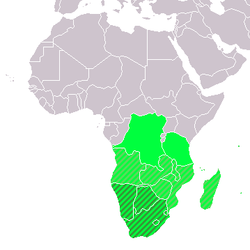
Southern Africa is the southernmost region of Africa. No definition is agreed upon, but some groupings include the United Nations geoscheme, the intergovernmental Southern African Development Community, and the physical geography definition based on the physical characteristics of the land. The most restrictive definition considers the region of Southern Africa to consist of Botswana, Eswatini, Lesotho, Namibia, and South Africa,[1] while other definitions also include several other countries from the area.
Defined by physical geography, Southern Africa is home to several river systems; the Zambezi River is the most prominent. The Zambezi flows from the northwest corner of Zambia and western Angola to the Indian Ocean on the coast of Mozambique. Along the way, it flows over Victoria Falls on the border between Zambia and Zimbabwe. Victoria Falls is one of the largest waterfalls in the world and a major tourist attraction for the region.[2]
Southern Africa includes both subtropical and temperate climates, with the Tropic of Capricorn running through the middle of the region, dividing it into its subtropical and temperate halves. Countries commonly included in Southern Africa include Angola, Botswana, Comoros, Eswatini, Lesotho, Madagascar, Malawi, Mauritius, Mozambique, Namibia, South Africa, Zambia, and Zimbabwe. In cultural geography, the island country of Madagascar is often not included due to its distinct language and cultural heritage.[2]
Southern Africa has a more developed economy and infrastructure compared to the other regions of Africa, having a robust mining sector, comparatively developed secondary and tertiary sectors, and a strong manufacturing sector. Nevertheless, the region continues to struggle with inequality, crime, poverty, and the epidemic of HIV/AIDS in Africa, with Eswatini, Lesotho, Botswana, South Africa, and Namibia having the highest HIV/AIDS rates in the world.[3]
Definitions and usage
[edit]In physical geography, the geographical delineation for the subregion is the portion of Africa south of the Cunene and Zambezi Rivers: Botswana, Eswatini, Lesotho, Namibia, South Africa, Zimbabwe, and the part of Mozambique that lies south of the Zambezi River. That definition is most often used in South Africa for natural sciences and particularly in guidebooks such as Roberts' Birds of Southern Africa, the Southern African Bird Atlas Project, and Mammals of the Southern African Subregion. It is not used in political, economic, or human geography contexts because the definition cuts Mozambique in two.[citation needed]
UN scheme of geographic regions and the SACU
[edit]In the United Nations geoscheme for Africa, five states constitute Southern Africa:[4]
 Botswana
 Eswatini (Swaziland)
 Lesotho
 Namibia
 South Africa


This definition excludes other countries in the region, and instead includes the Comoros, Madagascar, Malawi, Mauritius, Mayotte, Mozambique, Réunion, the Scattered Islands in the Indian Ocean (as a part of the French Southern Territories), Zambia, and Zimbabwe in Eastern Africa, Angola in Middle Africa (or Central Africa), and Saint Helena, Ascension, and Tristan da Cunha (under the name Saint Helena) in Western Africa, instead. Some atlases include Malawi, Zambia, and Zimbabwe in Central Africa instead of Southern or Eastern Africa.
The Southern African Customs Union, created in 1969, also comprises the five states in the UN subregion of Southern Africa.[5]
SADC membership
[edit]The Southern African Development Community (SADC) was established in 1980 to facilitate co-operation in the region. It includes:[6]
 Angola
- Botswana
 Comoros
 Democratic Republic of the Congo
- Eswatini (Swaziland)
- Lesotho
 Madagascar
 Malawi
 Mauritius
 Mozambique
- Namibia
 Seychelles
- South Africa
 Tanzania
 Zambia
 Zimbabwe


General usage
[edit]Other than the UN subregion, these countries and territories are often included in Southern Africa:[citation needed]


The Democratic Republic of the Congo is generally included in Central Africa, while Seychelles and Tanzania are more commonly associated with Eastern Africa, but these three countries have occasionally been included in Southern Africa, as they are the SADC members.
Geography
[edit]

.jpg)
The terrain of Southern Africa is varied, ranging from forest[7] and grasslands to deserts. The region has both low-lying coastal areas, and mountains.
In terms of natural resources, the region has the world's largest resources of platinum and the platinum group elements, chromium, vanadium, and cobalt, as well as uranium, gold, copper, titanium, iron, manganese, silver, beryllium, and diamonds.[8]
Southern Africa is set apart from other Sub-Saharan African regions because of its mineral resources, including copper, diamonds, gold, zinc, chromium, platinum, manganese, iron ore, and coal. Countries in Southern Africa are larger in geographic area, except three smaller landlocked states: Lesotho, Eswatini (Swaziland), and Malawi. The larger states — South Africa, Botswana, Mozambique, Zimbabwe, Zambia, Namibia, and Angola — all have extensive mineral deposits.[9]
These widespread mineral resources make this one of the wealthiest regions of Africa with the greatest potential for economic growth. A chain of mineral resources in Southern Africa stretches from the rich oil fields in northwest Angola, east through the central diamond-mining region in Huambo Province, and into the Copper Belt region of Zambia and Congo. A region of rich mineral deposits continues to the south called the Great Dyke in central Zimbabwe, through the Bushveld basin into South Africa. This extends southwest through the Witwatersrand and Northern Cape of South Africa toward the southern coast. Mining activity exists across the eastern region. Diamond mining is found in parts of Botswana and along the Namibian coast. Coal can also be found in central Mozambique, Zimbabwe and northeast South Africa.[10]
Climate
[edit]
The climate of the region is broadly divided into subtropical in the north and temperate in the south, but also includes humid-subtropical, Mediterranean-climate, highland-subtropical, oceanic, desert, and semi-arid regions. Except for lower parts of Zambia and interior areas of Namibia and Botswana, the region rarely suffers from extreme heat. In addition, the winter presents mostly as mild and dry, except in the southwest. Cool southeasterly winds and high humidity bring cool conditions in the winter. The Namib Desert is the driest area in the region.
Altitude plays an outsize role in moderating the temperatures of the South African Highveld, Lesotho, and much of Zambia and Zimbabwe. The prairie region of central and northeast South Africa, the country of Zimbabwe, and parts of Zambia are known as the veldt, divided into the Bushveld and Highveld. There are high temperatures and low rainfall within the Zambezi and Limpopo river valleys, probably due to the lower altitude.
The Western Cape has a Mediterranean vegetation and climate, including the unique fynbos, grading eastward into an oceanic climate along the Garden Route to Gqeberha and East London.[11] The Namib and Kalahari deserts form arid lands in the centre-west, separating the highlands, woodlands, croplands, and pastures of the wetter and higher East from the Atlantic Ocean. In addition, the Drakensberg and Eastern Highlands separate the highland areas and coastal plains centred on Mozambique in the north and KwaZulu-Natal in the south, the latter of which are often prone to flooding every few years. In the east, the river systems of the Zambezi and Limpopo basin form natural barriers and sea lanes between Mozambique, South Africa, and Zimbabwe.[11]
.jpg)
Across most of southern Africa, apart from the Western Cape in South Africa, the major rainfall season is during the southern-hemisphere summer, from December to February. In the Western Cape, the rainfall maximum occurs from June through August.
There are a number of important rainfall-producing weather systems in southern Africa. These include tropical-extra-tropical cloud bands, tropical lows, and tropical cyclones, cut-off lows, and mesoscale convective systems. Winter midlatitude storms account for the June–August rainfall maximum in the western cape.
Year-to-year variability in rainfall, including drought, is associated with changes in global and regional sea surface temperatures. These include the El Nino Southern Oscillation, the Subtropical Indian Ocean Dipole, and changes in the Benguela Current region in the southeast Atlantic.
Future climate projections suggest that much of southern Africa will get hotter and drier in response to global climate change.
History
[edit]Prehistory
[edit].jpg)
East and southern Africa are among the earliest regions where modern humans (Homo sapiens) and their predecessors are believed to have lived. In September 2019, scientists reported the computerized determination, based on 260 CT scans, of a virtual skull shape of the last common human ancestor to modern humans, representative of the earliest modern humans, and suggested that modern humans arose between 350,000 and 260,000 years ago through a merging of populations in East and South Africa.[12][13] Homo naledi likely coexisted with modern humans in Africa about 300,000 years ago.
Kingdom of Mapungubwe
[edit]The Kingdom of Mapungubwe (c. 1075–c. 1220) was one of the earliest state in the South African region. It was located at between the Shashe and Limpopo Rivers. The name is derived from either Karanga and Tshivenda. The kingdom is thought to have existed as the first class-based social system within the region. Society was mainly centered around family and farming. The kingdom would culminate to the Kingdom of Zimbabwe in the 13th century. And at its height the capital's population was about 5000 people.[14] There are no written records from the kingdom and what historians and archeologists know of the state is from the remains of buildings.
Kingdom of Zimbabwe and successor states
[edit]The Kingdom of Zimbabwe (c. 1220–1450) was a Shona (Karanga) kingdom in what is today Zimbabwe. The capital, which sits near present-day Masvingo, is located at Great Zimbabwe, which are the largest stone structure in precolonial Southern Africa. This kingdom came after the collapse of the Kingdom of Mapungubwe. During the decline of the Kingdom of Zimbabwe, two powers emerged, one in the north (Kingdom of Mutapa from 1430–1760) which had improved on Zimbabwe's administrative structure; and the other in the south (Kingdom of Butua from 1450–1683) which was a smaller entity than the former two, the kingdom was governed by the Torwa dynasty and its capital was situated at Khami. Both states would eventually be absorbed by the powerful Shona state, the Rozwi Empire by 1683. The economy was based on cattle herding, farming, and gold mining. The empire lasted until 1866, which came after droughts and instability.[15]
Mthethwa Paramountcy
[edit]The Mthethwa Paramountcy was an African state that emerged in the late 18th-century in the region of present-day KwaZulu-Natal. The state was consolidated and extended under the rule of Dingiswayo who produced a disciplined and highly organised army for the first time in the region.[16]
Zulu Kingdom
[edit]
The Zulu Kingdom rose under the leadership of Shaka and covered most of present-day KwaZulu-Natal in the 19th century. Internal conflict arose in the 1820s between Shaka's half-brothers Dingane and Mhlangana due to a succession dispute. Boer settlers began arriving northwards of the Orange River in the 1830s,[17] which led to conflicts between the two peoples and resulted in the Battle of Blood River in 1838. The kingdom fell during the Anglo-Zulu War of the late 19th-century.
Post-colonial eras
[edit]In the aftermath of World War II, the colonial powers came under international pressure to decolonize. The transfer to an African majority, however, was complicated by the settlement of white peoples. After an initial phase from 1945 to 1958, as a consolidation of white power, decolonization succeeded in its achievement when High Commission territories and overseas departments such as Zambia, Malawi, Botswana, Lesotho, Mauritius, Swaziland, Madagascar and the Comoros became independent states from British and French rule. The brutal struggle for independence in the colonial territories led to the independence of new states of Angola and Mozambique as well as Southern Rhodesia, which declared independence as Zimbabwe in 1980. The denouement of South West Africa achieved independence as Namibia in 1990 and the black majority in South Africa took power after the democratic elections in 1994, therefore ending the Apartheid regime. From the end of the period of colonial rule, imperial interests controlled the economies of the region and South Africa became the dominant economic power in the late 20th century. The 21st century has seen attempts to create unity among nations in Southern Africa. In spite of democracy, violence, inequality and poverty still persist throughout the region.
Economy
[edit]
The region is distinct from the rest of Africa, with a robust mining sector and comparatively developed secondary and tertiary sectors. Additionally many countries (with the exception of Mozambique and Malawi in particular) have relatively well developed infrastructure. Some of its main exports including platinum, diamonds, gold, copper, cobalt, chromium and uranium, Southern Africa still faces some of the problems that the rest of the continent does. Despite this, diamond production has fueled the economies of Botswana and Namibia, for example.
Over the 20th century, the region developed a robust manufacturing sector, focused on South Africa and Zimbabwe, which allowed greater prosperity and investments into infrastructure, education and healthcare that elevated both nations into middle income economies and captured growing markets across Africa.[18] However, since the 1990s these industries have struggled in the face of globalization and cheaper imports from China, leading to job losses particularly in heavy industry, gold mining and textiles. Zimbabwe in particular has seen significant deindustrialization as a result of factors both domestic and foreign.[19] While colonialism has left its mark on the development over the course of history,[20][21] today poverty, corruption, and HIV/AIDS are some of the biggest factors impeding economic growth. In addition, South Africa and Zimbabwe in particular, face high emigration among their skilled workers leading to a significant brain drain to western economies and billions lost in human capital flight. The pursuit of economic and political stability is an important part of the region's goals, as demonstrated by the SADC, however complete regional integration remains an elusive target.

In terms of economic strength, South Africa is the dominant economy of the region. Generally, mining, agriculture, the public sector and tourism dominate the economies of Southern African countries, apart from South Africa which has mature and flourishing financial, retail, and construction sectors. Zimbabwe maintains a smaller banking and real estate sector along with what remains of its manufacturing industry, despite a protracted economic crisis. Most global banks have their regional offices for Southern Africa based in Johannesburg. Over the years, some the other Southern African nations have invested in economic diversification, and invested public funds into rail, road and air transportation as part of a concerted effort through SADC to boost regional trade and improve communication and transportation. The countries in this region also belong to the Southern Africa Power Pool, which facilitates the development of a competitive electricity market within the SADC region and ensures sustainable energy developments through sound economic, environmental and social practices. The main objective of the power pool is to develop a world class, robust and safe interconnected electrical system across the Southern African Region. According to a report by Southern Africa Power Pool, the three largest producers of electricity in Southern Africa as at 2017, include Eskom in South Africa with an estimated 46,963MW, Zesco in Zambia with 2,877MW and SNL of Angola with 2,442MW. Whilst moderately successful by African standards, the region largely lags behind their Asian counterparts in innovation, foreign direct investment, STEM sciences and research and development.[22]
Crime
[edit].jpg)
Several countries in the region, especially South Africa and Leshoto, struggle with very high crime rates. South Africa's homicide rate has consistently ranked among the highest in the world during the past decades.[23] South Africa has four cities (Nelson Mandela Bay, Durban, Cape Town and Johannesburg) included in the top 50 most dangerous cities (defined as cities with a population over 300,000 with the highest homicide rates, as reported by The Citizen Council for Public Security and Criminal Justice, a Mexican advocacy group, in its 2023/2024 ranking).[24] High homicide rates are also present in Lesotho, Eswatini, Namibia and Botswana.[25]
Environment
[edit]_young_males_mock_fighting_..._(47110326111).jpg)
Southern Africa has a wide diversity of ecoregions including grassland, bushveld, karoo, savannah and riparian zones. Even though considerable disturbance has occurred in some regions from habitat loss due to human population density or export-focused development, there remain significant numbers of various wildlife species, including white rhino, lion,[26] African leopard, impala, kudu, blue wildebeest, vervet monkey and elephant. It has complex Plateaus that create massive mountain structures along the South African border.
There are numerous environmental issues in Southern Africa, including air pollution and desertification.
Culture
[edit]Art
[edit].jpg)
Architecture
[edit]Clothing
[edit]
Cuisine
[edit]Music
[edit]Religion
[edit]Film industry
[edit]Demographics and languages
[edit]
Southern Africa is home to many people. It was initially populated by San, Hottentots[27] and Pygmies in widely dispersed concentrations. Due to the Bantu expansion, the majority of African ethnic groups in this region, including the Xhosa, Zulu, Tsonga, Swazi, Northern Ndebele, Southern Ndebele, Tswana, Sotho, Pedi, Mbundu, Ovimbundu, Shona, Chaga and Sukuma, speak Bantu languages. The process of colonization and settling resulted in a small population of European (Afrikaner, British, Portuguese Africans, etc.) and Asian descent (Cape Malays, Indian South Africans, etc.) people in many southern African countries.

Christianity is by far the most common religion in the region, being the religion of the majority of the population in all countries of Southern Africa (see Christianity in Africa). There are also sizeable Muslim communities in Mozambique and Malawi, and smaller communities in the other countries of the region. There is also a small Hindu community in South Africa. In addition, traditional African religions are also practiced.
Architecture
[edit]Further information in the sections of Architecture of Africa:
Science and technology
[edit]Further information in the sections of History of science and technology in Africa:
Agriculture and food security
[edit].jpg)
Some key factors affecting the food security within the regions including political instability, poor governance, droughts, population growth, urbanisation, poverty, low economic growth, inadequate agricultural policies, trade terms and regimes, resource degradation and the recent increase in HIV/AIDS.[28][29]
These factors vary from country to country. For example, the Democratic Republic of the Congo has favourable climatic and physical conditions, but performs far below its capacity in food provision due to political instability and poor governance. In contrast, semi-arid countries such as Botswana and Namibia, produce insufficient food, but successfully achieve food security through food imports due to economic growth, political stability and good governance. The Republic of South Africa is a major food producer and exporter in the region.[30]
Data on agricultural production trends and food insecurity especially in term of food availability for Southern Africa is readily available through the Famine Early Warning Systems Network (FEWS NET) and Southern African Development Community (SADC) - Food, Agriculture and Nature Resource Directorate (FARN). However, this data might not fully capture the reality of a region with large urban populations and where food insecurity goes beyond per-capita availability to issues of access and dietary adequacy.[31][32]
.jpg)
Urban food security has been noted as an emerging area of concern in the region, with recent data showing high levels of food insecurity amongst low-income households. In a study of eleven cities in nine countries: Blantyre, Cape Town, Gaborone, Harare, Johannesburg, Lusaka, Maputo, Manzini, Maseru, Durban, and Windhoek, only 17% of households were categorized as 'food-secure' while more than half (57%) of all households surveyed were found to be 'severely food-insecure'.[33]
Some factors affecting urban food insecurity include climate change with potential impact on agricultural productivity, the expansion of supermarkets in the region, which is changing the way people obtain food in the city, rural-to-urban migration, unemployment, and poverty.[34][35][36][37] The issue of food insecurity in general and urban food insecurity in particular in the region is also characterized by an increased consumption of caloric junk food and processed foods leading to potential increase in the co-existence of undernutrition and dietary-related chronic diseases such as obesity and hypertension.[38][39] In South Africa for example, while over 50% experience hunger, 61% are overweight or morbidly obese.[40][41][42] There is only limited data on the other Southern African countries.
From 2018 to 2021, parts of the region suffered from a period of drought.[43]
See also
[edit].svg)
References
[edit]- ^ "UNSD — Methodology".
- ^ a b "Southern Africa".
- ^ "HIV/AIDS - adult prevalence rate - 2022 World Factbook Archive".
- ^ "Composition of macro geographical (continental) regions, geographical subregions, and selected economic and other groupings".
- ^ "Southern African Customs Union (SACU) official website". Archived from the original on 2011-05-03. Retrieved 2022-03-03.
- ^ "Southern African Development Community :: Home". www.sadc.int.
- ^ Cowling, R. M.; Richardson, D. M.; Pierce, S. M., eds. (2004). Vegetation of Southern Africa. Cambridge University Press. p. 278. ISBN 978-0-521-54801-4.
- ^ SADC. "Mining". Retrieved 27 June 2013.
- ^ "A visual journey across African landscapes". Landscape News. 2019-10-22. Retrieved 2021-05-30.
- ^ "Southern African Landscapes and Environmental Change". Routledge & CRC Press. Retrieved 2021-05-30.
- ^ a b "Africa: Physical Geography". National Geographic Society. 2012-01-04. Retrieved 2021-05-30.
- ^ Zimmer, Carl (10 September 2019). "Scientists Find the Skull of Humanity's Ancestor — on a Computer - By comparing fossils and CT scans, researchers say they have reconstructed the skull of the last common forebear of modern humans". The New York Times. Retrieved 10 September 2019.
- ^ Mounier, Aurélien; Lahr, Marta (2019). "Deciphering African late middle Pleistocene hominin diversity and the origin of our species". Nature Communications. 10 (1): 3406. Bibcode:2019NatCo..10.3406M. doi:10.1038/s41467-019-11213-w. PMC 6736881. PMID 31506422.
- ^ Huffman, page 376
- ^ Shillington, Kevin, ed. (2013-07-04). Encyclopedia of African History 3-Volume Set. Routledge. doi:10.4324/9780203483862. ISBN 978-0-203-48386-2.
- ^ Longman History of Southern Africa, Longman Publishing, 1978
- ^ Meredith, Martin (2007). Diamonds Gold and War. New York: Public Affairs. p. 5.
- ^ "Archived copy" (PDF). Archived from the original (PDF) on 2021-05-12. Retrieved 2021-03-19.
{{cite web}}: CS1 maint: archived copy as title (link) - ^ Mazikana, Anthony Tapiwa (8 March 2017). "Zimbabwe is Currently Experiencing a De-Industrialization Trend. Discussing the Causes of De-Industrialization in Zimbabwe and Offering Suggestion on How the Country Can Reverse the Trend". SSRN 2929593.
- ^ Wkley (2002). Deep Histories: gender and colonialism in Southern Africa. Amsterdam [u.a.]: Rodopi. ISBN 90-420-1229-3.
- ^ Bauer & Taylor (2005). Politics in Southern Africa: state and society in transition. Boulder [u.a.]: Rienner. ISBN 1-58826-332-0.
- ^ Hauge, Jostein (2019-08-20). "Should the African lion learn from the Asian tigers? A comparison of FDI-oriented industrial policy in Ethiopia, South Korea and Taiwan". Developing Economics. Retrieved 2021-05-30.
- ^ "Dp-intentional-homicide-victims | dataUNODC".
- ^ "The most violent cities in South Africa – with a new number 1 ranking among the worst of the worst in the world".
- ^ "Dp-intentional-homicide-victims | dataUNODC".
- ^ Bauer, H.; Packer, C.; Funston, P.F.; Henschel, P.; Nowell, K. (2016). "Panthera leo". IUCN Red List of Threatened Species. 2016 e.T15951A107265605. Retrieved 8 August 2023.
- ^ Goeieman, Fred (November 30, 2011). "Bridging a hundred year-old separation". Namibian Sun. Archived from the original on October 29, 2013. Retrieved 2013-05-23.
- ^ de Waal, Alex; Whiteside, Alan (1 October 2003). "New variant famine: AIDS and food crisis in southern Africa". The Lancet. 362 (9391): 1234–1237. doi:10.1016/S0140-6736(03)14548-5. PMID 14568749. S2CID 562611.
- ^ Misselhorn, Alison (2005). "What drives food insecurity in southern Africa? a meta-analysis of household economy studies". Global Environmental Change. 15 (1): 33–43. Bibcode:2005GEC....15...33M. doi:10.1016/j.gloenvcha.2004.11.003.
- ^ Yu, Bingxin; Liangzhi You; Shenggen Fan (January 2010). "Toward a Typology of Food Security in Developing Countries" (PDF). International Food Policy Research Institute. Archived from the original (PDF) on 18 August 2011. Retrieved 29 June 2013.
- ^ FEWS, NET. "Southern Africa Country Centers". Retrieved 29 June 2013.
- ^ SADC, FANR. "Food Security". Retrieved 29 June 2013.
- ^ al.], Bruce Frayne .. [et (2010). The state of urban food insecurity in Southern Africa (PDF). [Cape Town]: AFSUN. ISBN 978-0-9869820-1-9.[permanent dead link]
- ^ Battersby, Jane (1 June 2012). "Beyond the food desert: finding ways to speak about urban food security in South Africa". Geografiska Annaler: Series B, Human Geography. 94 (2): 141–159. doi:10.1111/j.1468-0467.2012.00401.x. S2CID 55452849.
- ^ Crush, J.; Hovorka, A.; Tevera, D. (21 June 2011). "Food security in Southern African cities: The place of urban agriculture". Progress in Development Studies. 11 (4): 285–305. doi:10.1177/146499341001100402. S2CID 55778001.
- ^ Riley, Liam; Legwegoh, Alexander (18 June 2013). "Comparative urban food geographies in Blantyre and Gaborone". African Geographical Review. 33: 52–66. doi:10.1080/19376812.2013.805148. S2CID 154319323.
- ^ Mkwambisi, David D.; Fraser, Evan D. G.; Dougill, Andy J. (1 March 2011). "Urban agriculture and poverty reduction: Evaluating how food production in cities contributes to food security, employment and income in Malawi". Journal of International Development. 23 (2): 181–203. doi:10.1002/jid.1657. S2CID 13382935.
- ^ Crush, Jonathan; Frayne, Bruce; McLachlan, Milla (2011). Rapid urbanization and the nutrition transition in southern Africa. [Cape Town]: African Food Security Urban Network (AFSUN). ISBN 978-1-920409-69-2.
- ^ Wrotniak, B. H.; Malete, L.; Maruapula, S. D.; Jackson, J.; Shaibu, S.; Ratcliffe, S.; Stettler, N.; Compher, C. (1 April 2012). "Association between socioeconomic status indicators and obesity in adolescent students in Botswana, an African country in rapid nutrition transition". Pediatric Obesity. 7 (2): e9 – e13. doi:10.1111/j.2047-6310.2011.00023.x. PMID 22434762. S2CID 206007700.
- ^ Fat in Motion. "Obesity in SA". Retrieved 29 June 2013.
- ^ Reddy, SP; Resnicow, K; James, S; Kambaran, N; Omardien, R; MBewu, AD (12 June 2008). "Underweight, overweight and obesity among South African adolescents: results of the 2002 National Youth Risk Behaviour Survey". Public Health Nutrition. 12 (2): 203–7. doi:10.1017/S1368980008002656. PMID 18547451.
- ^ LABADARIOS, Demetre; Yul Derek DAVIDS; Zandile MCHIZA; Gina WEIR-SMITH (31 March 2009). "THE ASSESSMENT OF FOOD INSECURITY IN SOUTH AFRICA" (PDF). Human Sciences Research Council. Retrieved 29 June 2013.[permanent dead link]
- ^ "Hunger in Africa continues to rise, says New UN report". East African Business Week. 2019-02-14. Archived from the original on March 19, 2020. Retrieved 2019-02-15.
Further reading
[edit]- "Southern Africa". Encyclopædia Britannica. Retrieved 2013-05-20. (subscription required)


Southern Africa
View on GrokipediaDefinitions and Scope
UN Geographic Subregion
The United Nations geoscheme, maintained by the United Nations Statistics Division under the M49 standard, defines Southern Africa (code 018) as a geographical subregion consisting exclusively of five sovereign states: Botswana, Eswatini, Lesotho, Namibia, and South Africa.[1] This delineation serves primarily statistical and analytical purposes, grouping countries based on continental proximity and historical cartographic conventions rather than political, economic, or cultural alignments.[1] Unlike broader regional frameworks, the UN classification excludes neighboring states such as Angola (Middle Africa), Malawi, Mozambique, Zambia, and Zimbabwe (Eastern Africa), emphasizing a core southern cluster dominated by South Africa's economic and demographic weight.[1] The subregion spans a total land area of approximately 2,650,670 square kilometers, with South Africa accounting for about 1.22 million square kilometers, Namibia 824,292 square kilometers, Botswana 581,730 square kilometers, Lesotho 30,355 square kilometers, and Eswatini 17,364 square kilometers. As of 2025 estimates, the combined population exceeds 74 million, driven largely by South Africa's 62.7 million inhabitants, followed by Namibia (2.6 million), Botswana (2.5 million), Lesotho (2.3 million), and Eswatini (1.2 million); this yields a population density of roughly 28 persons per square kilometer, reflecting vast arid and semi-arid expanses like the Kalahari Desert.[8] These figures underscore the subregion's resource-rich profile, including diamonds, uranium, and gold, though uneven distribution contributes to socioeconomic disparities.[1] This narrow UN definition contrasts with more expansive usages in international organizations, where Southern Africa may incorporate up to 10-16 countries for developmental or trade purposes, highlighting the geoscheme's intentional focus on minimalism to avoid overlap with adjacent subregions like Eastern and Middle Africa.[1] The classification remains unchanged since its formalization in the 1990s, prioritizing consistency for global datasets over evolving geopolitical realities.[1]SADC Membership and Regional Integration
The Southern African Development Community (SADC) constitutes a key institutional framework for regional cooperation and integration among Southern African states, promoting economic development, peace, security, and collective self-reliance. Established on August 17, 1992, via the signing of the SADC Treaty in Windhoek, Namibia, it evolved from the Southern African Development Coordination Conference (SADCC), founded on April 1, 1980, in Lusaka, Zambia, by nine frontline states to counter economic dependence on apartheid-era South Africa.[9][10] SADC's 16 member states encompass a broader geographic scope than the United Nations' Southern Africa subregion, incorporating territories from Central, Eastern, and Indian Ocean regions to facilitate functional integration, including Angola, Botswana, Comoros, Democratic Republic of the Congo, Eswatini, Lesotho, Madagascar, Malawi, Mauritius, Mozambique, Namibia, Seychelles, South Africa, Tanzania, Zambia, and Zimbabwe.[9] SADC's integration agenda, outlined in the Regional Indicative Strategic Development Plan, targets progressive economic convergence through stages such as a free trade area (FTA), customs union, common market, monetary union, and eventual political federation. The SADC FTA was launched on August 19, 2008, building on tariff liberalization schedules initiated in 2001, which liberalized approximately 85-98% of intra-regional trade lines by 2012, depending on bilateral asymmetries for least-developed members.[11] Despite these milestones, intra-SADC trade remains modest at around 20-25% of members' total external trade as of 2023, hampered by persistent non-tariff barriers, inadequate transport infrastructure, and overlapping memberships in other regional economic communities like the Common Market for Eastern and Southern Africa (COMESA).[12] Achievements include a reported 21% rise in intra-SADC trade as a share of GDP in 2023, alongside attracting $6 billion in foreign direct investment, bolstered by protocols on trade, finance, and infrastructure such as the North-South Corridor.[13] Security integration has advanced via the SADC Standby Force and interventions in conflicts, including the 2023 deployment to eastern Democratic Republic of the Congo under the SADC Mission in the DRC. However, challenges persist, including uneven compliance with protocols—evident in delays to the customs union originally slated for 2010—and political divergences, such as sanctions on Zimbabwe and instability in Mozambique's Cabo Delgado province, which undermine binding dispute resolution and harmonized policies.[14][15] Critics note that dominant economies like South Africa capture disproportionate benefits, exacerbating asymmetries rather than fostering equitable growth, with empirical data showing limited poverty reduction from integration compared to national reforms.[12]| Key SADC Integration Milestones | Date | Description |
|---|---|---|
| SADCC Formation | April 1, 1980 | Initial coordination for economic independence from South Africa.[10] |
| SADC Treaty Signing | August 17, 1992 | Shift to deeper integration framework.[9] |
| FTA Launch | August 19, 2008 | Operationalization of tariff reductions covering most goods.[11] |
| Intra-Trade GDP Share Increase | 2023 | 21% growth amid FDI inflows.[13] |
Broader and Alternative Usages
In geographical contexts beyond the United Nations geoscheme, which limits Southern Africa to Botswana, Eswatini, Lesotho, Namibia, and South Africa, broader definitions often incorporate Angola, Malawi, Mozambique, Zambia, and Zimbabwe due to shared physiographic features such as the Kalahari Basin and the Zambezi River catchment spanning these territories.[1][16] This extension aligns with natural boundaries like the Zambezi-Limpopo river systems and the Drakensberg escarpment, facilitating analyses of regional hydrology and biodiversity continuity.[17] Economically and politically, alternative usages emphasize the Southern African Development Community (SADC), established in 1992 as a regional bloc comprising 16 member states: Angola, Botswana, Comoros, Democratic Republic of the Congo, Eswatini, Lesotho, Madagascar, Malawi, Mauritius, Mozambique, Namibia, Seychelles, South Africa, Tanzania, Zambia, and Zimbabwe.[18] SADC's framework prioritizes trade integration, infrastructure development, and resource sharing, such as the 2023 launch of the SADC Regional Data Centre to harmonize economic data across these states, reflecting a functional rather than strictly latitudinal definition. This contrasts with narrower geographic scopes by including Central African elements like the Democratic Republic of the Congo for mineral supply chains, including 70% of global cobalt production from its mines. Historically, during the colonial era up to the mid-20th century, "Southern Africa" denoted British imperial spheres south of the Zambezi River, encompassing the Union of South Africa (formed 1910), Northern and Southern Rhodesia (now Zambia and Zimbabwe), Bechuanaland (Botswana), and Nyasaland (Malawi), excluding Portuguese Angola and Mozambique.[19] This usage persisted in post-independence analyses of decolonization, where the 1960s wind of change affected these territories, leading to independence waves: Malawi and Zambia in 1964, Rhodesia declaring unilateral independence in 1965.[20] Such definitions highlight Anglo-settler legacies and federation attempts like the 1953 Central African Federation, rather than ethnic or climatic criteria. In ecological and conservation contexts, alternative boundaries extend to island nations like Madagascar and the Comoros for marine and biome studies, given the Agulhas Current's influence on shared Indian Ocean ecosystems supporting 20% of global marine biodiversity hotspots.[21] This broader application aids transboundary initiatives, such as the 2002 Kavango-Zambezi (KAZA) Transfrontier Conservation Area spanning Angola, Botswana, Namibia, Zambia, and Zimbabwe, covering 499,000 km² for wildlife migration corridors.[22] These usages underscore pragmatic adaptations over rigid cartography, informed by causal factors like migratory patterns of species such as the African elephant, which traverse five countries annually.[23]Physical Geography
Topography, Geology, and Natural Resources
Southern Africa's topography is defined by a narrow coastal plain along the Atlantic and Indian Ocean shores, which rises steeply through the Great Escarpment to an elevated interior plateau spanning much of the region. The Escarpment, a product of long-term erosion shaping continental cliffs over millions of years, forms a semi-circular barrier averaging 1,000 to 2,000 meters in height and encircles the plateau from Namibia eastward to Mozambique.[24][25] This plateau, including South Africa's Highveld at elevations of 1,200 to 1,800 meters, features undulating grasslands and savannas, with lower peripheral areas like the Karoo semi-desert in the south. Prominent ranges such as the Drakensberg, integral to the Escarpment, include peaks reaching 3,482 meters at Thabana Ntlenyana in Lesotho.[26] Arid zones dominate the west and interior, with the Namib Desert's coastal dunes extending over 1,200 kilometers parallel to Namibia's Atlantic coast, and the Kalahari Basin covering roughly 900,000 km² across Botswana, Namibia, and northern South Africa as a semi-arid savanna rather than a hyper-arid waste.[27] Geologically, the region rests on ancient cratonic blocks, primarily the Kaapvaal Craton, which accreted over the Archean eon from approximately 3.6 to 2.5 billion years ago through granite-greenstone terrane assembly and later stabilization.[28] This craton, underlying eastern South Africa, Lesotho, and parts of Botswana and Zimbabwe, preserves Archean to Proterozoic sedimentary sequences, including the 2.7-billion-year-old Witwatersrand Supergroup, a clastic basin formed in shallow marine to fluvial environments. Volcanic and intrusive events, such as the 2.06-billion-year-old Bushveld Igneous Complex—an immense layered mafic-ultramafic intrusion—overlie these sequences, influencing mineralization patterns. Adjacent cratons like the Zimbabwe Craton to the north share similar Precambrian foundations, with the region's stability attributed to thick lithospheric roots resisting later tectonic disruption, though peripheral rifting and uplift shaped the Escarpment.[29] Natural resources stem directly from this ancient, mineral-enriched geology. South Africa dominates global platinum group metals output, producing 71,000 kilograms in 2023—about 71% of the world total—largely from Bushveld Complex mines.[30] The Witwatersrand Basin has historically supplied over 40% of all gold ever mined, with peak production exceeding 1,000 tonnes annually in the early 1970s from paleoplacer deposits. South Africa also holds the world's largest reserves of chromium, manganese, and vanadium, supporting ferroalloy industries. Diamond production, from Archean kimberlites, is significant in Botswana (over 20 million carats yearly) and Namibia. Hydrocarbons include Angola's offshore oil fields, yielding around 1.1 million barrels per day in 2023 despite declining mature assets. Emerging gas reserves in Namibia's Orange Basin and Mozambique's Rovuma fields promise expanded output, with Mozambique exporting liquefied natural gas since 2022.[31] These resources, concentrated in stable cratonic margins, have driven export economies but face challenges from depleting shallow deposits and infrastructure constraints.[32]Hydrology, Biodiversity, and Ecosystems
Southern Africa's hydrology is dominated by seasonal river systems influenced by variable precipitation, with many rivers exhibiting ephemeral flow regimes due to high evaporation rates exceeding 2,000 mm annually in arid interiors and rainfall averaging below 500 mm per year across much of the region.[33] The Orange River, spanning approximately 2,200 km, originates in the Drakensberg Mountains of South Africa and flows westward to the Atlantic Ocean, draining a basin of over 973,000 km² that includes parts of South Africa, Namibia, and Lesotho, supporting irrigation for agriculture and hydropower via dams like Gariep and Vanderkloof.[34] The Limpopo River, about 1,750 km long, forms international borders between South Africa, Botswana, and Zimbabwe before entering Mozambique and the Indian Ocean, with its basin covering 415,000 km² and prone to droughts that reduce discharge by up to 90% in dry seasons.[33] Further north, the Zambezi River's upper reaches influence southern Zambia and Zimbabwe, feeding Lake Kariba—a reservoir spanning 5,800 km² created by the Kariba Dam in 1959 for hydropower—and Victoria Falls, while the Okavango River in Botswana terminates in the endorheic Okavango Delta, a 15,000–22,000 km² inland wetland that expands seasonally to 40,000 km².[35] These systems face challenges from climate variability, with southern Africa experiencing prolonged droughts, such as the 2015–2019 event that halved inflows to major dams, exacerbating water scarcity where per capita availability is under 1,000 m³ annually in countries like Namibia and South Africa.[36] Biodiversity in the region is exceptionally high in select areas due to topographic diversity, edaphic factors, and historical isolation, with South Africa alone harboring three of the world's 36 biodiversity hotspots: the Cape Floristic Region, Succulent Karoo, and Maputaland-Pondoland-Albany.[37] The Cape Floristic Region, covering 90,000 km² in southwestern South Africa, supports over 9,000 vascular plant species, 69% of which are endemic, including proteas and ericas adapted to nutrient-poor sands and winter rainfall, alongside 90 mammal species with four endemics like the fynbos golden mole.[38] The Succulent Karoo, spanning Namibia and South Africa across 102,000 km², hosts 6,356 plant species with 40% endemism, dominated by succulents like aloes and mesembs thriving in fog-dependent coastal deserts and hyper-arid interiors receiving less than 50 mm annual rainfall.[39] Vertebrate diversity includes approximately 240 terrestrial mammal species region-wide, such as the black rhinoceros and African elephant, with hotspots like the Okavango Delta sustaining over 400 bird species, 130 mammals, and high densities of herbivores; however, threats from habitat fragmentation and poaching have led to declines, with IUCN data indicating 20% of southern African mammals at risk.[40] Endemism patterns reflect causal drivers like ancient Gondwanan refugia and fire-prone Mediterranean climates, rather than uniform richness, as arid zones show lower overall diversity but higher plant specialization.[41] Key ecosystems encompass a mosaic of biomes shaped by rainfall gradients from Mediterranean (500–1,000 mm winter-dominant) in the southwest to semi-arid savannas (400–800 mm summer-dominant) in the north and hyper-arid deserts (<100 mm) along the Namib coast.[42] The Kalahari Desert and Nama-Karoo biome, covering much of Botswana, Namibia, and central South Africa, feature sandy savannas and shrublands supporting acacia-dominated woodlands and grazing ungulates like gemsbok, with groundwater-dependent oases amid dunes up to 300 m high.[21] Savanna ecosystems, the largest biome at over 40% of the region's land area, include miombo woodlands in Zambia and Zimbabwe—characterized by brachystegia trees, fire-adapted grasses, and megafauna such as lion prides and buffalo herds—and the Okavango Delta's floodplain wetlands, a Ramsar site fostering seasonal migrations of 200,000 wildebeest.[43] Fynbos shrublands in the Cape, with sclerophyllous vegetation on oligotrophic soils, exhibit high speciation rates driven by frequent fires every 10–20 years, while grassland biomes on the Highveld plateau sustain biodiversity through herbivory and episodic thunderstorms, though overgrazing has degraded 60% of these areas since the 19th century.[44] These ecosystems demonstrate resilience via adaptations like deep-rooted plants in drought-prone zones but vulnerability to anthropogenic pressures, including invasive species and altered fire regimes, underscoring causal links between biome-specific hydrology and biotic assemblages.[45]Climate and Weather Patterns
Climatic Zones and Variability
Southern Africa's climatic zones are predominantly arid and semi-arid in the interior, transitioning to subtropical savanna along the eastern seaboard and Mediterranean in the southwest, as classified under the Köppen-Geiger system using temperature and precipitation thresholds. The western coastal strip, including Namibia's Namib Desert, features hot desert climates (BWh) with mean annual rainfall under 50 mm and daytime temperatures often exceeding 40°C, while the broader Kalahari region across Botswana, Namibia, and northwestern South Africa comprises hot semi-arid steppe (BSh) zones receiving 200-500 mm annually, mostly in erratic summer thunderstorms.[46][47] Eastern regions, such as coastal Mozambique, eastern Zimbabwe, and parts of Zambia and Malawi, fall under tropical savanna (Aw) with summer wet seasons (October-March) yielding 600-1,500 mm rainfall concentrated in convective events, and pronounced dry winters influenced by the Intertropical Convergence Zone's seasonal migration.[48] In South Africa's southwestern Cape, a temperate Mediterranean climate (Csb) prevails, characterized by winter rainfall of 500-1,000 mm from cold fronts and mean annual temperatures of 13-17°C, contrasting sharply with the summer-rain-dominated interior.[46]| Köppen Zone | Predominant Areas | Key Characteristics |
|---|---|---|
| BWh (Hot Desert) | Namib Desert, coastal Namibia | <50 mm annual rain; >20°C mean annual temp; fog from Benguela Current |
| BSh (Hot Semi-Arid) | Kalahari Basin (Botswana, Namibia, NW South Africa) | 200-500 mm rain, summer maxima; high evaporation rates |
| Aw (Tropical Savanna) | Eastern Mozambique, E Zimbabwe, parts of Zambia/Malawi | 600-1,500 mm summer rain; dry winters; thunderstorms |
| Csb (Mediterranean) | SW Cape, South Africa | 500-1,000 mm winter rain; mild temps (13-17°C annual mean) |
Historical Trends and Future Projections
In Southern Africa, mean annual surface air temperatures have risen by 1.04–1.44°C from 1961 to 2015, with near-surface air temperatures showing significant warming trends of 0.09–0.19°C per decade from 1979 to 2020, particularly along coastal areas and during both summer and winter seasons.[53][54] Hot days have increased over the last four decades, while cold extremes have decreased, exacerbating heat stress on agriculture and livestock.[53] Marine heat waves along the coastline doubled in frequency and intensity from 1982 to 2016, with high attribution to anthropogenic forcing.[55] Precipitation patterns exhibit high variability, with mean annual totals decreasing since the 1980s in most areas except the northwest, though summer precipitation has increased south of 15°S latitude over recent decades.[53][54] The number and intensity of extreme rainfall events have risen over the last century, contributing to more frequent floods, such as those from Cyclone Idai in 2019 which affected over 1.5 million people in Mozambique.[53] Droughts have intensified, with meteorological drought frequency increasing by 2.5–3 events per decade since 1961 and agricultural droughts becoming more widespread from 1961 to 2016; many severe events, including the 2015–2016 El Niño-linked drought, have caused substantial economic losses exceeding USD 2.2 billion in regions like the Western Cape.[53][55] Projections indicate Southern Africa will warm faster than the global average, with mean annual temperature increases of 1.2°C at 1.5°C global warming, 2.3°C at 2°C, and 3.3°C at 3°C relative to 1994–2005 baselines, leading to 2–4 additional heat waves annually at 1.5°C warming, rising to 8–12 at 3°C.[53] Annual hot days are expected to surge, with near-certain attribution to human influence even at lower warming levels.[55] Precipitation is projected to decline overall, particularly by 10–20% in summer rainfall regions under high-emission scenarios like RCP8.5, though the frequency and intensity of heavy events will increase across most of the region except the southwest, heightening flood risks.[53] Drought frequency and duration will rise, with unprecedented extremes emerging at 2°C global warming and lengths potentially doubling to four months at 3°C; tropical cyclones may become less frequent but more intense in rainfall and winds.[53][55] These changes position Southern Africa as a climate hotspot, amplifying water scarcity and agricultural vulnerabilities under limited mitigation.[53]History
Prehistory and Early Human Presence
Southern Africa preserves some of the earliest archaeological evidence of hominin evolution, with fossils of Australopithecus africanus dated to approximately 3 to 2 million years ago at sites such as Taung, Sterkfontein, and Swartkrans in present-day South Africa.[56] The Taung Child skull, discovered in 1924, represents one of the first recognized early hominin specimens from the region, exhibiting bipedal traits and a brain size intermediate between apes and later humans.[56] Recent cosmogenic nuclide dating at Sterkfontein suggests some Australopithecus remains may date to 3.4–3.6 million years ago, predating similar East African finds like "Lucy" (Australopithecus afarensis) and indicating prolonged hominin presence in southern cave systems.[57] These sites also yield evidence of contemporaneity among Australopithecus, Paranthropus, and early Homo species around 2 million years ago, alongside stone tools from the Oldowan industry, marking the onset of the Early Stone Age around 2.5 million years ago.[58][59] The Middle Stone Age, spanning roughly 300,000 to 30,000 years ago, features advanced lithic technologies such as Levallois flaking and heat-treated tools, associated with early Homo sapiens in the Kalahari Basin and coastal sites like Klasies River Mouth and Pinnacle Point.[60] Evidence of behavioral modernity emerges by 164,000 years ago, including shellfish exploitation, pigment use, and compound adhesives at Pinnacle Point, reflecting dietary expansion and cognitive sophistication among anatomically modern humans.[61] Footprints at the Cape south coast, dated to 153,000 years ago, provide the oldest direct trace of Homo sapiens locomotion in the region, supporting southern Africa's role in early modern human dispersal.[62] The Later Stone Age, beginning around 44,000–42,000 years ago, is characterized by microlithic tools, bow-and-arrow technology, and rock art, with paintings in Botswana and Lesotho directly dated to over 10,000 years ago, indicating persistent hunter-gatherer adaptations.[63][64] Archaeological records from the Kalahari and coastal zones underscore southern Africa's isolation during the late Pleistocene, fostering unique evolutionary trajectories for Homo sapiens origins, potentially predating northern African evidence in behavioral complexity.[60] These findings, derived from stratified cave deposits and open-air sites, highlight a continuous human presence shaped by environmental variability, including arid phases that may have driven technological innovations.[65] Prior to the Iron Age onset around 2,000 years ago, populations relied on foraging economies, with minimal genetic admixture until later migrations.[66]Pre-Colonial Kingdoms and Trade Networks
The arrival of Bantu-speaking peoples in Southern Africa, part of a broader expansion originating from West-Central Africa around 3500 years ago, introduced ironworking, cattle herding, and crop cultivation, laying the groundwork for complex societies by approximately 300 CE in regions now encompassing South Africa and Zimbabwe.[67][68] These migrants interacted with indigenous Khoisan hunter-gatherers and foragers, gradually displacing or assimilating them through demographic and technological advantages, leading to the formation of chiefdoms that evolved into centralized polities.[67] The Kingdom of Mapungubwe, established circa 1075 CE at the confluence of the Shashe and Limpopo rivers in present-day South Africa, represents the earliest known state-level society in the region, featuring social stratification evidenced by elite hilltop burials adorned with gold artifacts, ivory, and imported glass beads.[69] This polity, with a population likely numbering in the thousands, controlled cattle wealth and initiated long-distance exchange of gold sourced from nearby rivers, marking a shift from egalitarian structures to hierarchical governance under a paramount ruler.[69] Mapungubwe declined around 1220 CE, possibly due to climatic shifts or internal strife, but its cultural legacy influenced successor states.[70] Great Zimbabwe, emerging in the 11th century on the Zimbabwe plateau and peaking between the 13th and 15th centuries, succeeded Mapungubwe as a Shona-dominated kingdom with its capital featuring the largest pre-colonial stone architecture in sub-Saharan Africa, including dry-stone walls enclosing up to 18% of the site's area.[69] The kingdom's rulers oversaw a population of 10,000 to 18,000 inhabitants across dispersed settlements, deriving authority from control over gold mining and cattle raiding, with artifacts like soapstone birds symbolizing royal power.[69] Its decline by the mid-15th century, attributed to resource depletion and environmental stress rather than external invasion, led to fragmentation into entities like the Mutapa Empire, which expanded northward into modern Zimbabwe and Mozambique around 1450 CE, maintaining gold production until Portuguese interference in the 16th century.[71] Pre-colonial trade networks integrated these interior kingdoms with the Indian Ocean economy, facilitating the export of gold from the Zimbabwe plateau and ivory from elephant-rich southern savannas via overland routes to coastal entrepôts like Sofala in Mozambique, established as early as the 1st century CE but intensifying by the 11th century.[72][73] Swahili and Arab merchants exchanged these commodities—gold panned from rivers yielding up to 10 tons annually at peak—for imported textiles, porcelain from China, and glass beads from India, stimulating urbanization and craft specialization in the interior.[74] Evidence from sites like KwaGandaganda indicates ivory carving and export as far south as the Pongolo River by the 7th century CE, predating gold's dominance and underscoring the networks' antiquity, driven by monsoon winds enabling dhow voyages across the ocean.[75] These exchanges fostered wealth accumulation among elites but remained extractive, with limited technological diffusion beyond trade goods, as interior societies prioritized raw material production over manufacturing.[72]European Exploration and Initial Settlements
The initial European exploration of Southern Africa was driven by Portugal's quest for a direct sea route to Asia, bypassing Ottoman-controlled land paths. In 1488, Portuguese navigator Bartolomeu Dias became the first European to round the Cape of Good Hope, naming it the Cape of Storms before King John II redesignated it to symbolize a gateway to Indian Ocean trade.[76] This voyage mapped the southwestern African coast and confirmed navigability southward. Nine years later, in 1497, Vasco da Gama led an expedition that passed the Cape en route to India, establishing early Portuguese contacts with coastal Swahili traders and fostering tentative trade in gold and ivory along what became Mozambique's shoreline.[76] These efforts prioritized reconnaissance and fortified trading posts over inland penetration, with Portuguese vessels periodically resupplying at sites like Delagoa Bay (modern Maputo) but without establishing permanent inland settlements in the core southern regions until later centuries.[77] Portuguese presence extended to early colonial footholds in Angola by 1575, where Luanda served as a base for slave trade and missionary activity amid conflicts with Ndongo kingdom forces, and to Mozambique's coast, where forts at Sofala and Quelimane facilitated exports of slaves, ivory, and gold from the 16th century onward.[78] [79] These outposts relied on alliances with local rulers and African intermediaries rather than large-scale European migration, yielding limited demographic impact compared to later ventures. In contrast, no equivalent sustained settlements occurred farther south until Dutch intervention. The Dutch East India Company (VOC) initiated the first permanent European settlement in present-day South Africa in 1652, motivated by the need for a reliable provisioning stopover for ships bound for the East Indies. On April 6, 1652, Jan van Riebeeck, commanding the vessels Dromedaris, Reijger, and Goede Hoop, landed in Table Bay and constructed Fort de Goede Hoop to secure fresh water, vegetables, and meat supplies.[80] Initial operations involved Khoikhoi barter for livestock using copper and tobacco, alongside cultivation of wheat, grapes, and vegetables to combat scurvy among crews.[81] By 1657, the VOC released nine company servants as vrijburghers (free burghers) to farm independently, expanding land use and introducing enslaved laborers from Southeast Asia and Madagascar, which laid foundations for agricultural expansion and early frontier tensions with indigenous pastoralists over grazing rights.[82] This Cape station marked a shift from transient exploration to territorial foothold, growing to over 200 Europeans by 1679 despite high mortality from disease and isolation.[80]Colonial Expansion, Conflicts, and Exploitation
European powers initiated colonial expansion in Southern Africa primarily for trade routes, provisioning stations, and resource extraction, beginning with Portuguese coastal outposts in the late 15th century. Portuguese explorers, led by Vasco da Gama, rounded the Cape of Good Hope in 1498 to access Indian Ocean trade, establishing trading posts rather than inland settlements initially. By 1575, Portugal founded Luanda in present-day Angola as a base for slave trade and further incursions, while Mozambique saw fortified coastal enclaves by the early 16th century to control gold and ivory routes. These early efforts involved sporadic conflicts with local Bantu and Khoisan groups over access to ports and resources, setting precedents for land dispossession and coerced labor.[83] The Dutch East India Company (VOC) marked a shift to permanent settlement in 1652, when Jan van Riebeeck established a refreshment station at Table Bay (modern Cape Town) to supply ships en route to Asia. This Cape Colony expanded inland through trekboer pastoralists, who clashed with Khoisan pastoralists in wars from the 1670s onward, resulting in the near-extermination of Khoisan populations via disease, enslavement, and displacement by the early 18th century. British forces first occupied the Cape in 1795 during the Napoleonic Wars to secure the sea route, returning it briefly to Dutch (Batavian Republic) control before the permanent takeover in 1806 following the Battle of Blaauwberg. British abolition of slavery in 1834, coupled with frontier policies favoring Xhosa containment, prompted the Great Trek of approximately 12,000-14,000 Boers northward in the 1830s and 1840s, establishing independent republics like the Orange Free State and Transvaal amid conflicts with Ndebele and Zulu forces.[7][84][81] Inland expansion accelerated with mineral discoveries, fueling exploitation and further conflicts. Diamonds were found near Kimberley in 1867, sparking a rush that by 1871 excavated vast open pits and drew migrant labor from across Southern Africa, with Africans subjected to pass laws and compound systems to enforce cheap, controlled workforce. The 1886 Witwatersrand gold strike transformed the Transvaal into an economic powerhouse, producing over half the world's gold by 1914 and institutionalizing a migrant labor regime where black workers, recruited via taxes and hut levies, endured harsh conditions in closed compounds, with recruitment peaking at over 100,000 annually by 1900. These booms intensified land alienation, as colonial authorities seized African territories for mining concessions, exacerbating tensions with Boer republics over "uitlander" rights and leading to the First Anglo-Boer War (1880-1881), a Boer victory affirming Transvaal independence.[85][86] The Second Anglo-Boer War (1899-1902) epitomized imperial conflicts over resource control, with Britain deploying 450,000 troops against 50,000 Boers, employing scorched-earth tactics and concentration camps that killed 28,000 Boer civilians and over 20,000 black auxiliaries through disease and starvation. British victory unified the colonies into the Union of South Africa in 1910, entrenching white minority rule and labor exploitation. In German South West Africa (claimed 1884), expansion provoked the Herero and Nama uprisings (1904-1908), met with genocidal reprisals under General Lothar von Trotha, who issued extermination orders driving 65-80% of Herero (around 50,000-65,000) and 50% of Nama into the Omaheke desert or labor camps, marking one of the first 20th-century genocides. Portuguese Angola and Mozambique saw prolonged exploitation through forced cotton and rubber production under the 1890s concessions system, with indigenous resistance crushed via military campaigns and corvée labor, displacing millions by the early 20th century.[87][88][89] A series of Cape Frontier Wars (1779-1879), totaling nine conflicts, pitted Dutch and British forces against Xhosa polities over grazing lands east of the colony, culminating in the Ninth War (1877-1879) where British victory annexed the Transkei, forcing Xhosa into reserves and labor markets. The Anglo-Zulu War of 1879, triggered by British demands for confederation, saw Zulu forces under Cetshwayo defeat an invading column at Isandlwana before British reinforcements crushed the kingdom at Ulundi, partitioning Zulu lands and integrating survivors into colonial labor pools. These expansions systematically dispossessed indigenous groups of arable land—reducing African-held territory in South Africa from near-total to under 10% by 1913—while establishing extractive economies reliant on coerced migration, taxation, and racial hierarchies that prioritized European capital accumulation.[88]Independence Struggles and Decolonization
Decolonization in Southern Africa unfolded unevenly from the mid-1960s to the mid-1990s, shaped by colonial legacies of British protectorates, Portuguese overseas provinces, and white settler minorities backed by minority rule. British-administered territories like Zambia gained independence on October 24, 1964, under Kenneth Kaunda's United National Independence Party following elections in 1962 that transitioned from federation with Southern Rhodesia and Nyasaland.[90] Malawi followed on July 6, 1964, with Hastings Banda's Malawi Congress Party assuming power after breaking from the same federation, amid minimal armed resistance but significant political maneuvering against colonial oversight.[90] Botswana achieved independence on September 30, 1966, as Bechuanaland, with Seretse Khama leading a peaceful handover from British protection, retaining close economic ties to South Africa initially.[91] Lesotho transitioned on October 4, 1966, from British Basutoland under Chief Leabua Jonathan, while Eswatini (then Swaziland) followed on September 6, 1968, under King Sobhuza II, both processes marked by negotiated constitutional conferences rather than widespread violence.[90] Portuguese colonies endured prolonged wars of liberation amid Lisbon's refusal to grant autonomy until the 1974 Carnation Revolution. In Mozambique, the Front for the Liberation of Mozambique (FRELIMO) launched guerrilla operations on September 25, 1964, from bases in Tanzania, escalating into a decade-long conflict that controlled rural areas by the early 1970s and prompted over 100,000 Portuguese troops' deployment.[92] Independence arrived on June 25, 1975, with FRELIMO establishing a one-party Marxist state under Samora Machel, though the exodus of 250,000 Portuguese settlers disrupted administration and economy.[92] Angola's struggle involved rival factions—the Soviet- and Cuban-backed Popular Movement for the Liberation of Angola (MPLA), the Front for the National Liberation of Angola (FNLA), and the National Union for the Total Independence of Angola (UNITA)—culminating in the Alvor Agreement of January 1975, which set November 11, 1975, as independence day without a clear power transfer, sparking immediate civil war as MPLA forces secured Luanda with foreign intervention.[93] White-minority ruled territories faced protracted armed insurgencies and international pressure. Southern Rhodesia (later Zimbabwe) declared unilateral independence from Britain on November 11, 1965, under Ian Smith's government to preserve white control, igniting the Rhodesian Bush War with Zimbabwe African National Union (ZANU) and Zimbabwe African People's Union (ZAPU) guerrillas operating from Zambia and Mozambique, resulting in over 20,000 deaths by 1979.[94] The Lancaster House Agreement, signed December 21, 1979, after British-mediated talks, established a ceasefire, elections, and land protections, leading to formal independence on April 18, 1980, with Robert Mugabe's ZANU-PF victory.[94] Namibia, administered by South Africa since 1915 under a League of Nations mandate revoked by the UN General Assembly in 1966, saw the South West Africa People's Organization (SWAPO) wage guerrilla warfare from 1966, intensified after UN Security Council Resolution 435 in 1978 outlined elections and Cuban troop withdrawal from Angola as preconditions.[95] Independence was realized on March 21, 1990, following UN-supervised elections won by SWAPO, ending South African oversight.[96] South Africa's apartheid regime, entrenched since 1948, resisted decolonization until internal unrest, sanctions, and military stalemates prompted President F.W. de Klerk to unban the African National Congress (ANC) and release Nelson Mandela on February 11, 1990, initiating bilateral talks that evolved into multi-party negotiations.[97] The Convention for a Democratic South Africa process addressed violence from Inkatha Freedom Party clashes and right-wing resistance, culminating in the first universal suffrage elections on April 27, 1994, where the ANC secured 62.6% of votes, ending institutionalized racial segregation and installing Mandela as president.[98] These transitions often yielded initial instability, with civil conflicts in Angola and Mozambique persisting post-independence due to ideological rivalries and external meddling.[93]Post-Colonial Governance, Wars, and Economic Trajectories
Following independence from colonial powers, Southern African states exhibited divergent governance models, often transitioning from inherited parliamentary systems to dominant-party rule or authoritarian tendencies. Botswana established a stable multi-party democracy in 1966, maintaining regular elections and low corruption levels through prudent resource management, which contrasted with Zimbabwe's post-1980 shift under ZANU-PF toward one-party dominance and suppression of opposition, including the Gukurahundi massacres of 1982-1987 that killed an estimated 20,000 Ndebele civilians.[99] Angola and Mozambique, independent in 1975, adopted Marxist-Leninist one-party states under MPLA and FRELIMO, respectively, leading to centralized control but also internal dissent fueled by ethnic and ideological divides.[100] South Africa's 1994 democratic transition ended apartheid but saw the ANC consolidate power, with recent trends toward centralization amid corruption scandals eroding institutional checks.[101] Post-colonial wars, often proxies in Cold War rivalries, devastated several economies and populations. The Angolan Civil War (1975-2002) pitted the Soviet- and Cuban-backed MPLA government against UNITA rebels supported by the US and South Africa, resulting in 500,000 to 800,000 deaths, widespread displacement of 4 million people, and destruction of infrastructure that hindered oil and diamond sectors.[100] Mozambique's Civil War (1977-1992) between FRELIMO and RENAMO insurgents, backed by Rhodesia and later South Africa, caused approximately 1 million deaths and displaced 5 million, collapsing agricultural output by up to 50% and exacerbating famine.[102] The Namibian War of Independence (1966-1990) and South African Border War intertwined with these conflicts, involving SWAPO guerrillas and South African forces, culminating in Namibia's independence but leaving landmines and ethnic tensions.[103] These wars, characterized by external interventions and resource grabs, entrenched patronage networks and delayed state-building, with South Africa's destabilization policies (e.g., support for RENAMO) prolonging regional instability until the early 1990s.[104] Economic trajectories varied sharply, shaped by governance quality, resource endowments, and policy choices rather than colonial legacies alone. Botswana leveraged diamond discoveries post-1966, achieving average annual GDP growth of 5-7% through joint ventures with De Beers and reinvestment in infrastructure, elevating per capita income from $70 in 1966 to over $7,000 by 2020 while maintaining fiscal discipline.[105] In contrast, Zimbabwe's fast-track land reforms from 2000 seized commercial farms without compensation or skills transfer, causing agricultural production to plummet 60%, GDP to contract at -6% annually (2000-2008), and hyperinflation peaking at 89.7 sextillion percent in 2008 due to money printing to fund patronage.[99] Angola's oil wealth post-2002 enabled reconstruction but fueled corruption, with GDP growth averaging 11% (2002-2014) yet 50% of the population in poverty amid elite capture.[100] South Africa's post-1994 economy grew at 2-3% annually initially but stagnated post-2008, with unemployment at 33% and Gini coefficient of 0.63 (world's highest), as broad-based black economic empowerment policies enriched a connected elite without broad productivity gains.[106]| Country | Key Post-Colonial GDP Growth Driver/Issue | Avg. Annual Growth (Post-Independence Peak Period) | Outcome |
|---|---|---|---|
| Botswana | Diamond revenues, prudent fiscal policy | 5-7% (1966-2020) | Upper-middle income, diversified somewhat |
| Zimbabwe | Land reform disrupting agriculture | -6% (2000-2008) | Hyperinflation, deindustrialization |
| South Africa | Mining, services; policy-induced stagnation | 2% (1994-2023) | Persistent high inequality, youth unemployment >60% |
| Angola | Oil exports post-war | 11% (2002-2014) | Resource curse, uneven development |
Politics and Governance
Political Structures and Democratic Variations
Southern African countries predominantly operate as republics with presidential or semi-presidential systems, though Lesotho and Eswatini function as constitutional and absolute monarchies, respectively. Most adopted multi-party frameworks post-independence, but implementation varies widely, influenced by colonial legacies, liberation movements, and resource dependencies. Presidential republics like Angola, Mozambique, Namibia, South Africa, Zambia, and Zimbabwe feature strong executive powers, often checked by parliaments elected via proportional representation or majoritarian systems. Parliamentary systems in Botswana, Mauritius, and South Africa emphasize coalition dynamics, while Eswatini's Tinkhundla system restricts political parties, channeling power through royal-appointed structures.[109][110] Democratic variations reflect a spectrum from competitive elections to entrenched authoritarianism. Botswana and Mauritius sustain relatively robust multi-party competition, with Botswana's Botswana Democratic Party holding power since 1966 amid peaceful power alternations, scoring as a deficient but functional democracy. South Africa, a flawed democracy per the Economist Intelligence Unit's 2023 index (7.16/10), transitioned from apartheid via a 1996 constitution mandating proportional representation; its May 2024 elections saw the African National Congress (ANC) drop to 40.2% of votes, ending its absolute majority and prompting a government of national unity with parties like the Democratic Alliance. Namibia similarly maintains competitive polls, though SWAPO dominated until recent erosion. In contrast, Zimbabwe's ZANU-PF has ruled since 1980, with 2023 elections criticized for voter suppression and irregularities, yielding a Freedom House "Not Free" rating of 36/100 in 2024. Angola's MPLA held sway until 2017 reforms allowed limited opposition gains, but it remains a hybrid regime.[111][112][109] Authoritarian elements persist in dominant-party states like Mozambique's FRELIMO and Tanzania's CCM, where incumbents leverage state resources for electoral advantages, as seen in 2024 SADC elections marked by incumbency challenges yet limited turnover. Eswatini exemplifies monarchical absolutism, with King Mswati III dissolving parliament in 2023 amid pro-democracy protests, banning opposition participation. Lesotho's constitutional monarchy faces instability from military interventions, including a 2020 coup attempt. Regional indices highlight these disparities: Freedom House rates South Africa "Free" (79/100 in 2024), Botswana "Free" (68/100), but Zimbabwe and Eswatini "Not Free." V-Dem data underscores backsliding in electoral integrity across several states, driven by patronage and weak institutions rather than ideological shifts.[113][112][110]| Country | System Type | Democracy Classification (2023/2024) | Key Feature |
|---|---|---|---|
| Botswana | Parliamentary Republic | Deficient Democracy (0.719, Democracy Matrix) | Stable multi-party since 1966 |
| South Africa | Parliamentary Republic | Flawed Democracy (7.16, EIU); Free (79/100, FH) | Proportional representation; 2024 coalition shift |
| Namibia | Presidential Republic | Flawed Democracy | SWAPO dominance waning |
| Eswatini | Absolute Monarchy | Not Free (FH) | No party-based elections |
| Zimbabwe | Presidential Republic | Not Free (36/100, FH) | Electoral irregularities under ZANU-PF |
| Angola | Presidential Republic | Hybrid Regime | MPLA reforms post-2017 |
Regional Organizations and Interstate Relations
The Southern African Development Community (SADC), successor to the Southern African Development Coordination Conference established in 1980, formally launched in 1992 to promote economic integration, sustainable development, and regional peace among its 16 member states: Angola, Botswana, Comoros, Democratic Republic of Congo, Eswatini, Lesotho, Madagascar, Malawi, Mauritius, Mozambique, Namibia, Seychelles, South Africa, Tanzania, Zambia, and Zimbabwe.[115] SADC's treaty outlines objectives including poverty alleviation, enhanced living standards, and collective self-reliance through harmonized policies in trade, infrastructure, and security, with a free trade area operational since 2008 covering over 90% of intra-regional trade liberalization.[116] Achievements include coordinated infrastructure projects like the North-South Corridor and peacekeeping interventions, such as the 2021 Southern African Development Community Mission in Mozambique (SAMIM) against Islamist insurgency in Cabo Delgado, involving troops from South Africa, Botswana, and Tanzania deployed until withdrawal in 2024 due to resource strains.[116] However, integration progress remains uneven, hampered by South Africa's economic dominance—accounting for approximately 77% of SADC's GDP and 60% of intra-regional trade—which fosters dependency rather than balanced growth, as smaller states derive limited welfare gains from trade diversion toward South African markets.[117] [118] The Southern African Customs Union (SACU), the world's oldest customs union dating to its formalization in 1910 under British colonial administration and renegotiated in 2002, binds five frontline states—Botswana, Eswatini, Lesotho, Namibia, and South Africa—in a common external tariff, pooled revenue sharing (with South Africa receiving about 90% of collections but disbursing proportionally), and coordinated trade policies to promote industrial development and export competitiveness.[119] SACU facilitates revenue transfers critical for smaller members, comprising up to 40% of Lesotho's and Eswatini's budgets, while enabling access to South Africa's market and joint negotiations in agreements like the African Continental Free Trade Area (AfCFTA), under which SACU submitted a 90% tariff liberalization offer in 2023.[120] Yet, asymmetries persist, with disputes over revenue formula adjustments and policy sovereignty, as South Africa's excise decisions bind others without full consultation, exacerbating perceptions of unequal bargaining power.[121] Overlapping memberships complicate relations, as eight SADC states (including DRC, Malawi, Tanzania, Zambia, and Zimbabwe) also belong to the Common Market for Eastern and Southern Africa (COMESA), leading to conflicting tariff schedules and negotiation mandates that dilute SADC's cohesion; efforts like the 2015 Tripartite Free Trade Area (TFTA) among COMESA, East African Community, and SADC aim to reconcile this by creating a market of 625 million people, though implementation lags due to ratification shortfalls as of 2023.[122] Interstate cooperation emphasizes transboundary resources, with joint bodies like the Zambezi River Authority (established 1987 between Zambia and Zimbabwe, expanded regionally) managing shared waters for hydropower and irrigation, averting major conflicts despite climate-induced scarcity pressures.[123] Tensions arise from migration flows, where South Africa's economic pull draws millions from neighbors, fueling periodic xenophobic violence (e.g., 2008 and 2015 riots displacing thousands) and diplomatic strains, as seen in Lesotho's 2023 complaints over border controls disrupting remittances vital to its economy.[124] Political divergences further test ties, with SADC's consensus-based approach often deferring to incumbents in electoral disputes, such as muted responses to Zimbabwe's 2018 and 2023 polls amid allegations of irregularities, prioritizing stability over governance standards.[125] Overall, while organizations like SADC and SACU enable functional collaboration on security and trade, causal imbalances rooted in disparate development levels sustain a hierarchy favoring South Africa, limiting deeper integration absent reforms to mitigate dominance.[126]Corruption, Patronage, and Institutional Erosion
Corruption remains a persistent challenge across much of Southern Africa, with public sector graft undermining governance and economic development, as evidenced by low scores on the 2023 Corruption Perceptions Index (CPI) published by Transparency International, which ranks countries on a scale from 0 (highly corrupt) to 100 (very clean). Botswana stands out as a regional exception, achieving a CPI score of 59 and ranking 39th globally, reflecting relatively robust anti-corruption mechanisms and transparent management of diamond revenues that have bolstered institutional integrity. In contrast, Zimbabwe scored 24 (157th), Angola 33 (142nd), South Africa 41 (72nd), and Mozambique 25 (142nd), indicating systemic issues where elite capture diverts resources from public services.[127][127] These disparities highlight how patronage networks, often rooted in post-colonial power consolidation, erode merit-based institutions by prioritizing loyalty over competence. Patronage politics, characterized by the distribution of state resources such as jobs, contracts, and land to political allies, sustains ruling elites but fosters dependency and inefficiency. In Zimbabwe, under Robert Mugabe's rule from 1980 to 2017, land reforms initiated in 2000 served as a key patronage tool, reallocating white-owned farms to ZANU-PF loyalists and military figures, which disrupted agricultural output—maize production fell from 2.2 million tons in 2000 to under 500,000 tons by 2008—and entrenched clientelism that prioritized party fidelity over productivity. This system extended to electoral mobilization, where youth wings received vehicles, food, and payments for intimidation and rallies, perpetuating a cycle of violence and vote-buying that weakened democratic accountability. Similarly, in South Africa, clientelistic practices within the African National Congress (ANC) have involved cadre deployment policies since the 1990s, placing unqualified loyalists in key positions, which facilitated graft in state-owned enterprises.[128][129] Institutional erosion manifests in the capture of oversight bodies, judiciary, and bureaucracies, often leading to impunity for high-level offenders. During Jacob Zuma's presidency from 2009 to 2018, the Gupta family, Indian-origin businessmen with close ties to Zuma, allegedly influenced cabinet appointments and secured contracts worth billions for firms like Oakbay Investments, looting entities such as Eskom and Transnet through inflated tenders and kickbacks estimated at over R500 billion (approximately $30 billion) in state capture losses, as detailed in the 2018-2022 Zondo Commission inquiry. In Angola, José Eduardo dos Santos's 38-year tenure ending in 2017 exemplified kleptocratic decay, with his family— including daughter Isabel dos Santos—accused of diverting up to $5 billion from oil firm Sonangol via opaque deals and offshore transfers, hollowing out regulatory frameworks and exacerbating poverty despite oil wealth. Such patterns reflect causal dynamics where resource rents enable unaccountable rule, bypassing checks that might otherwise enforce transparency, though Botswana's counterexample demonstrates that elite pacts emphasizing long-term stability can mitigate these risks through independent audits and parliamentary oversight.[130][131][132]Economy
Resource Extraction and Primary Sectors
Southern Africa's economies heavily rely on resource extraction, particularly mining and hydrocarbons, which drive exports and fiscal revenues in countries like South Africa, Botswana, Angola, and Zambia, though this dependence exposes them to commodity price volatility and the resource curse dynamics of under-diversified growth. In 2023, the region's mining sector, valued at over USD 108 billion across mineral-rich nations, underscored its pivotal role, with South Africa alone producing platinum equivalent to 71% of global output at 123 metric tons and gold valued at USD 22.7 billion from 104,000 kilograms mined. Botswana's diamond production reached approximately 24.6 million carats in 2023 via Debswana operations, comprising over 80% of exports, while Zambia outputted 732,580 metric tons of copper, bolstering its position as Africa's second-largest producer. Angola's crude oil production averaged around 1.084 million barrels per day in late 2023, funding much of government spending despite declining reserves and post-OPEC quota exit.[133][134][135][136][137][138] These extractive industries face structural challenges, including depleting high-grade ores, infrastructure deficits, and governance issues that amplify boom-bust cycles; for instance, Botswana's Debswana curtailed output by 40% in 2025 from 2023 levels due to slack global demand, slashing sales revenues by 46% in the prior year. In South Africa, gold production has fallen 80% since 1993 amid rising costs and labor disputes, shifting emphasis to platinum group metals (PGMs) where output from key mines like Impala and Mogalakwena totaled 1.59 million ounces in 2023. Zambia's copper sector, stagnant at around 800,000 tons annually for years due to underinvestment during state ownership, saw a 12% rebound to 820,670 tons in 2024 post-privatization efforts, yet remains vulnerable to power shortages from hydroelectric dependency. Angola's oil fields, mature since peaking at 2 million barrels per day in the mid-2000s, declined to under 1 million barrels per day by mid-2025, exacerbated by limited new exploration amid fiscal constraints. Such patterns reflect causal factors like poor policy continuity and elite capture, often prioritizing short-term rents over reinvestment, as evidenced in repeated production halts and export slumps.[139][140][137][141] Agriculture, forestry, and fisheries constitute the other primary pillars, employing 70-80% of labor in rural areas but contributing modestly to GDP—around 2-5% in industrializing states like South Africa—due to low yields from rain-fed systems and soil degradation. Regional output suffered in 2024 from El Niño-induced drought, slashing maize and soybean harvests and prompting import surges for staples, with Southern Africa facing acute food shortages as production fell sharply. Challenges include erratic rainfall, limited irrigation (covering under 10% of arable land), and inefficient smallholder practices, yielding maize at 1-2 tons per hectare versus global averages of 5-6 tons, perpetuating subsistence farming and vulnerability to climate shocks. Fisheries, vital in coastal Mozambique and Namibia, yield around 1 million tons annually but grapple with overexploitation and illegal catches, while forestry remains marginal outside South Africa's commercial plantations. Efforts to modernize, such as Zambia's push for 1 million tons of copper by 2026 via foreign investment, highlight potential for scaling primary outputs, yet success hinges on addressing institutional erosion that diverts resource rents from productive infrastructure.[142][143][144][145]Industrialization, Trade, and Market Dynamics
South Africa's manufacturing sector, the most developed in the region, contributed 12.1% to GDP in 2023, down from 21% in the 1990s, reflecting persistent structural constraints including energy shortages and infrastructure deficits.[146] Key industries include automotive assembly, which produced over 500,000 vehicles in 2024 despite challenges, petrochemicals, and metal fabrication tied to mining outputs like platinum and iron ore.[147] In contrast, other Southern African economies exhibit minimal industrialization; for instance, Botswana's manufacturing remains under 6% of GDP, focused on diamond cutting and basic processing, while Zambia and Zimbabwe prioritize agro-processing with shares below 10%.[148] Regional manufacturing value-added has stagnated around 14-15% of GDP since 2000, hampered by reliance on primary commodities and limited integration into global value chains.[149] Trade within the Southern African Development Community (SADC) remains limited, with intra-regional flows accounting for 19.8% of total SADC trade in 2024, up slightly from 18.4% in 2023 but still low due to overlapping commodity exports and poor transport links.[150] Total intra-SADC trade reached approximately US$55.6 billion in recent years, dominated by South Africa's exports of machinery and vehicles to neighbors like Namibia and Botswana.[151] Extraregional partners prevail: South Africa's 2023 exports, valued at over ZAR1.5 trillion, went primarily to China (minerals and metals), Germany (vehicles), and the United States (precious metals), while imports sourced machinery from China and crude oil from Saudi Arabia.[152][153] Angola and Mozambique similarly export oil and gas to China and India, with intra-SADC exchanges confined to essentials like electricity and foodstuffs, underscoring undiversified trade structures.[154] Market dynamics are shaped by commodity price volatility and policy efforts to foster beneficiation, yet face headwinds from South Africa's electricity crisis, which caused over 300 days of loadshedding in 2023-2024, slashing manufacturing output by up to 10% in affected sectors like automotive, where 4,000 jobs were lost and 12 firms closed between 2023 and 2025.[155][156] SADC's Industrialization Strategy, launched in 2012, aims to boost value addition through regional corridors, but progress lags owing to skills shortages, high logistics costs (e.g., rail inefficiencies), and non-tariff barriers like differing standards.[157] Emerging opportunities lie in green hydrogen and electric vehicle components, with Namibia and South Africa piloting projects, though investor hesitancy persists amid corruption and regulatory uncertainty in resource-linked markets.[158] Overall, low intra-regional integration perpetuates dependence on external demand, limiting scale economies for industrialization.[159]Inequality, Unemployment, and Policy Outcomes
Southern Africa exhibits some of the world's highest levels of income inequality, as measured by the Gini coefficient, with South Africa recording 63.0 in 2014 according to World Bank data, and more recent estimates placing it at approximately 0.63 to 0.65.[160][161] Namibia follows at 59.1, Botswana at 54.9, and Eswatini at 54.6, reflecting persistent disparities rooted in historical land ownership, resource distribution, and limited economic diversification.[162] These figures surpass global averages and highlight how mineral wealth and agricultural output concentrate benefits among elites while excluding large populations from formal economic participation.| Country | Gini Coefficient (Latest Available) | Source |
|---|---|---|
| South Africa | 63.0 (2014) | World Bank[160] |
| Namibia | 59.1 | World Population Review[162] |
| Botswana | 54.9 | World Population Review[162] |
| Eswatini | 54.6 | World Population Review[162] |
Demographics and Society
Population Dynamics and Urbanization
Southern Africa's population totaled approximately 74.3 million in 2025, with growth rates varying by country but generally moderating due to declining fertility and persistent health challenges. The region's total fertility rate averaged 2.3 to 2.5 births per woman in recent estimates, below the sub-Saharan African average of around 4.5, reflecting improvements in education, contraceptive access, and socioeconomic conditions in countries like South Africa (2.3 births per woman in 2024). However, higher rates persist in Angola (5.7) and Malawi (4.5), sustaining faster growth there at over 2.5% annually, while South Africa's rate slowed to 1.1% in 2024-2025 amid an aging cohort and lower natality.[175][176][177] The population remains youthful, with median ages around 20-28 years; for instance, South Africa reports 27.5% under age 15 and only 9.7% over 60 in 2024, creating a demographic dividend potential but straining resources through youth unemployment and dependency ratios exceeding 50% in many areas.[178] Urbanization has accelerated markedly, driven primarily by rural-to-urban migration seeking economic opportunities amid agricultural stagnation and rural poverty. The urban population share in Southern Africa reached about 50-60% by 2023, with annual urban growth rates of 3.5%, outpacing overall population expansion and contributing to Africa's status as the world's fastest-urbanizing region. South Africa leads with 69.3% urban residency in 2024, concentrated in Gauteng Province's megacity clusters like Johannesburg-Pretoria (over 14 million metro population), while countries like Mozambique and Zambia hover below 40%, featuring rapid peri-urban sprawl around capitals such as Maputo and Lusaka.[179][180][181] This migration pattern, often involving educated rural youth aged 20-40, has slowed net rural exodus in some areas since the 1990s but intensified informal settlements, with over 60% of urban dwellers in low-income countries residing in slums lacking basic services.[182][183] These dynamics pose causal challenges: high urban inflows exacerbate infrastructure deficits, unemployment (youth rates over 40% in South Africa), and inequality, as migrants face barriers in formal labor markets without skills matching urban demands. Empirical data indicate that while urbanization correlates with GDP per capita gains in resource-rich states like Botswana, it often amplifies poverty traps in agrarian economies like Zimbabwe, where rural depopulation undermines food security. Regional projections from UN data forecast urban majorities by 2050, necessitating policy shifts toward integrated rural development to mitigate unbalanced growth.[184][185][186]Ethnic Diversity, Languages, and Identity
Southern Africa's ethnic composition is dominated by Bantu-speaking African groups, who form the demographic majority across most countries in the region, with significant minorities including indigenous Khoisan peoples, descendants of European settlers, and Asian immigrants. In South Africa, the largest country by population, Black Africans account for 81.4% of residents as of 2022 estimates, encompassing diverse subgroups such as Zulu (approximately 24%), Xhosa (16%), and Northern Sotho (Pedi, 9%), while Coloureds (mixed ancestry) comprise 8.2%, Whites 7.3%, and Indians/Asians 2.7%.[6] In contrast, countries like Botswana and Lesotho exhibit greater homogeneity, with Tswana peoples forming about 79% of Botswana's population and Basotho over 99% in Lesotho, reflecting historical migrations and state formations centered on specific ethnic cores. Angola and Mozambique display more fragmented Bantu distributions, with Ovimbundu (37%), Kimbundu (25%), and Bakongo (13%) in Angola, and Makhuwa, Tsonga, Lomwe, and Sena groups totaling nearly 99% African ancestry in Mozambique. Linguistic diversity mirrors this ethnic patchwork, with over 30 indigenous languages primarily from the Bantu branch of the Niger-Congo family, alongside endangered Khoisan languages featuring click consonants spoken by small San and Khoikhoi communities in Namibia, Botswana, and South Africa. South Africa recognizes 11 official languages plus South African Sign Language, including isiZulu (spoken by 24% as first language), isiXhosa (16%), Afrikaans (10%), and English (8%), with the latter two serving as lingua francas in business and government despite Afrikaans' historical ties to white minority rule.[187] English holds official status in Namibia, Botswana, Zimbabwe, Zambia, Malawi, and Lesotho, often alongside indigenous tongues like Setswana in Botswana or Chewa in Malawi, while Portuguese remains the sole official language in Angola and Mozambique, coexisting with Bantu vernaculars such as Umbundu and Sena.[188] This multilingualism stems from pre-colonial Bantu expansions southward around 2,000–1,000 years ago, overlaid by colonial introductions of Indo-European languages.[6] Ethnic identities in the region persist as primary markers of social organization, often superseding national affiliations in political mobilization and resource allocation, despite constitutional emphases on civic unity post-independence. In Zimbabwe, Shona dominance (70%) has fueled tensions with the Ndebele minority (20%), manifesting in the 1980s Gukurahundi massacres that killed an estimated 20,000, highlighting how ethnic patronage networks underpin ruling party ZANU-PF's control. South Africa's Inkatha Freedom Party (IFP), rooted in Zulu identity, clashed violently with the ANC in the 1990s, resulting in over 14,000 deaths before the 1994 transition, underscoring enduring sub-national loyalties amid broader racial categories imposed by apartheid.[189] Such dynamics reflect causal patterns where colonial "divide-and-rule" policies and post-colonial elite capture exacerbate fractionalization, with studies indicating higher ethnic diversity correlates with lower interpersonal trust and elevated conflict risk in sub-Saharan contexts, though not deterministically so.[190] In more homogeneous states like Lesotho, national identity aligns closely with Basotho ethnicity, reducing internal cleavages but limiting cosmopolitanism. Overall, while urbanization and economic interdependence erode some barriers, ethnic identities continue to influence voting patterns—e.g., Zulu support for ANC factions—and xenophobic outbreaks targeting non-citizen Africans, as seen in South Africa's 2008 riots displacing 80,000.[191]Migration, Xenophobia, and Social Tensions
Southern Africa has seen substantial intra-regional migration, with 6.4 million international migrants in the region as of mid-2020, predominantly moving for economic reasons such as employment in mining, industry, and agriculture.[192] South Africa absorbs the largest share, hosting 2.9 million migrants—about 45% of the regional total—primarily from neighboring states including Mozambique, Zimbabwe, Malawi, and Lesotho, where poverty and instability drive outflows.[192] These flows, often circular and labor-focused, have intensified since the 1990s amid uneven economic recovery post-independence and apartheid, with migrants filling low-wage roles in informal sectors but straining urban townships.[192] Xenophobic violence in South Africa, the region's migration hub, manifests as targeted attacks on foreign nationals perceived to compete for jobs, housing, and trading opportunities, with 873 documented incidents from 1994 to November 2021.[193] Major outbreaks occurred in May 2008, when riots across Gauteng and other provinces killed at least 62 people (including 21 South Africans) and displaced over 80,000, fueled by economic grievances amid the global financial crisis and local service protests.[193] Subsequent spikes in 2015 and 2019 involved looting of immigrant-owned spaza shops and informal businesses, displacing thousands more and highlighting patterns concentrated in informal settlements near Johannesburg and Durban.[193] Since 2008 alone, such incidents have caused 612 deaths and 122,298 displacements, affecting mainly traders and truck drivers from Zimbabwe, Mozambique, and Nigeria.[193] Underlying drivers include socio-economic deprivation in high-unemployment areas (where rates often surpass 40% in townships), relative scarcity of resources, and perceptions that migrants exacerbate crime and undercut local livelihoods through informal competition—claims substantiated by localized economic displacement studies rather than blanket prejudice.[193] Proximate triggers involve governance shortfalls, such as unmet service delivery promises, and opportunistic violence during community protests, with hotspots in Gauteng (347 incidents) and KwaZulu-Natal (124).[193] While some analyses from human rights organizations attribute tensions solely to irrational bias, empirical patterns link spikes to tangible pressures like post-2008 recession job losses and rapid urbanization, where low-skilled migrants arrive amid stagnant formal employment growth.[193] Beyond South Africa, social frictions arise in Botswana and Namibia through periodic mass deportations of undocumented workers from Zimbabwe and Angola, reflecting similar resource competition without equivalent violence, as these states enforce stricter border controls under SADC protocols.[192] Regional responses include tightened visa regimes and bilateral repatriation agreements, yet persistent inflows—driven by droughts and political crises in origin countries—sustain underlying tensions, with public opinion surveys showing widespread South African opposition to unrestricted African immigration due to welfare and security concerns.[192] These dynamics underscore causal links between unmanaged migration volumes and localized conflicts, where empirical data prioritizes economic realism over narratives of pan-African harmony.Culture and Intellectual Life
Traditional Practices and Modern Adaptations
Traditional practices in Southern Africa encompass a range of indigenous customs rooted in ethnic groups such as the Xhosa, Zulu, Tswana, and San, including initiation rites, marriage negotiations, and healing rituals that emphasize communal bonds, ancestral veneration, and spiritual equilibrium. Among the Xhosa in South Africa, ulwaluko involves ritual circumcision of adolescent males as a passage to manhood, accompanied by seclusion, teachings on responsibility, and reintegration ceremonies, though unregulated schools have led to over 50 deaths annually from dehydration, infection, or assault between 2014 and 2020.[194] Lobola, a bridewealth payment in cattle or cash, symbolizes alliance between families in countries like South Africa, Zimbabwe, Lesotho, and Eswatini, historically reinforcing patrilineal ties but now often negotiated in monetary terms averaging R80,000 to R100,000 in urban South Africa as of 2023.[195] Traditional healing by sangomas—diviners using herbal muti, bone-throwing for diagnosis, and rituals to appease ancestors—addresses physical, psychological, and spiritual ailments across Bantu-speaking communities, with practitioners estimating 70-80% of South Africans consulting them at some point.[196] Modern adaptations reflect tensions between preservation and contemporary pressures like urbanization, legal frameworks, and health integration. South Africa's 2004 Customary Initiation Act mandates registration of initiation schools, medical oversight, and hygiene standards to curb fatalities, reducing deaths from 84 in 2015 to 27 in 2022, though illegal operations persist due to cultural resistance to state interference.[197] Lobola has evolved into a hybrid economic transaction, with families incorporating installment payments or symbolic gestures amid inflation and gender equality debates, yet high costs contribute to delayed marriages and financial strain, as evidenced by surveys showing average payments exceeding R82,000 in 2015 escalating further.[198] Sangomas increasingly collaborate with biomedical systems; South Africa's 2008 policy recognizes traditional health practitioners, enabling co-management of conditions like HIV/AIDS, where herbal remedies complement antiretrovirals, though efficacy varies and fraudulent healers exploit vulnerabilities.[199][200] Cultural tourism has commercialized elements like dances, beadwork, and village visits in Botswana, Namibia, and South Africa, generating income for communities—such as San-led ventures in Namibia preserving tracking and storytelling—while risking commodification and authenticity dilution, with operators emphasizing ethical models to avoid exploitation.[201] Indigenous knowledge adapts to climate challenges; in Botswana's Bobirwa district, traditional norms like rotational grazing and rain rituals inform resilience strategies alongside scientific forecasts, enhancing adaptive capacity in arid regions.[202] Legal protections, including Botswana's 2016 Traditional Knowledge policy and South Africa's 2019 amendments, safeguard practices from biopiracy, balancing communal heritage with intellectual property rights.[203] These shifts underscore causal trade-offs: modernization erodes isolation but introduces risks like syncretic dilutions or regulatory overreach, with empirical outcomes varying by enforcement and community agency.Religion, Beliefs, and Secular Influences
Christianity dominates religious adherence across Southern Africa, with over 80% of the population in key countries like South Africa, Namibia, Botswana, Lesotho, Eswatini, and Zimbabwe identifying as Christian, primarily through Protestant denominations, independent African churches, and Catholicism.[204] In South Africa, Christians totaled 51.6 million in 2020, comprising roughly 87% of the population, while Namibia's Christian majority reaches 90%, largely Protestant.[204][205] Pentecostal and charismatic movements have expanded rapidly since the 1990s, attracting urban migrants and emphasizing prosperity theology, which blends biblical teachings with local expectations of material success and spiritual healing.[206] Traditional African beliefs, centered on ancestor veneration, animism, and ritual practices to mediate with spirits, remain influential despite formal Christian majorities, often manifesting in syncretism where adherents consult sangomas (traditional healers) for divination or muti (medicinal rituals) alongside church attendance.[207] Exclusive adherence to these indigenous systems is low, estimated at under 5% region-wide, but their cultural persistence contributes to phenomena like witchcraft accusations, which led to over 500 related murders in South Africa between 2015 and 2020, disproportionately targeting the elderly or vulnerable. In rural Zimbabwe and Malawi, such beliefs underpin community disputes and vigilante actions, underscoring their causal role in social tensions beyond mere symbolism.[206] Minority faiths include Islam, practiced by 1-2% in South Africa (about 972,000 adherents in 2020) and up to 18% along Mozambique's coast due to historical Arab trade influences, and Hinduism, confined mostly to South Africa's Indian-descended community at around 1%.[204] Secularism and irreligion exert limited influence, with the 2022 South African census reporting 2.9% unaffiliated—primarily among urban, educated youth—while broader sub-Saharan trends show nonbelievers below 5% elsewhere, though underreporting due to social stigma likely understates practical agnosticism.[208] This contrasts with higher Western secularization, as economic insecurity and communal structures sustain religiosity, with Pew data indicating Christian numbers grew 31% in sub-Saharan Africa from 2010-2020 amid stable or declining unaffiliated shares.[209]Arts, Literature, Music, and Media
Southern Africa's artistic expressions encompass ancient indigenous traditions, colonial influences, and post-independence innovations, often addressing themes of identity, resistance, and social transformation across its diverse ethnic groups. Visual arts feature prehistoric San rock paintings, dating back up to 24,000 years in South Africa, which depict hunting scenes, spiritual beliefs, and daily life using ochre pigments.[210] These engravings and paintings, concentrated in sites like those in the Drakensberg Mountains, reflect shared hunter-gatherer cosmologies spanning modern-day South Africa, Lesotho, and Zimbabwe.[211] Contemporary visual arts draw from this heritage, with modern San artists in Botswana and South Africa reusing rock art motifs in paintings and crafts, as seen in collections at galleries like Kalk Bay Modern.[212] [213] Literature in the region, predominantly from South Africa, has produced Nobel laureates whose works critique apartheid and explore human conditions. Nadine Gordimer, awarded the Nobel Prize in Literature in 1991, chronicled racial injustices in novels like July's People (1981), emphasizing realism rooted in political realities.[214] J.M. Coetzee, Nobel winner in 2003, departed from traditional realism in works such as Disgrace (1999), examining post-apartheid moral dilemmas and colonial legacies.[214] Earlier figures like Alan Paton, author of Cry, the Beloved Country (1948), highlighted racial divisions and rural-urban migrations, influencing global perceptions of South African society.[215] Beyond South Africa, Zimbabwean literature includes Doris Lessing's early works on colonial Rhodesia, though regional output remains overshadowed by South African dominance due to linguistic and publishing concentrations in English.[216] Music genres evolved from indigenous rhythms and missionary hymns, blending with jazz and urban sounds during the 20th century. Marabi, an early urban style emerging in 1920s South African townships, fused pennywhistle and guitar with traditional dances, laying groundwork for mbaqanga—a upbeat mix of accordion, bass, and vocals popularized in the 1960s by groups like the Mahotella Queens.[217] [218] Kwela, a 1950s pennywhistle-driven jazz variant, reflected township life, while isicathamiya vocal harmonies, refined by Ladysmith Black Mambazo since the 1960s, gained international acclaim after their 1987 Grammy for Graceland collaboration with Paul Simon.[219] Post-apartheid, genres like kwaito (1990s house-influenced dance music) and recent amapiano (log drum beats and soulful vocals since 2010s) dominate, with artists such as Black Coffee exporting sounds globally via hits like "Drive" (2018).[220] [221] In neighboring countries, Zimbabwe's mbira thumb-piano traditions underpin chimurenga music, pioneered by Thomas Mapfumo in the 1970s as anti-colonial protest.[222] Media landscapes vary, with South Africa maintaining a relatively robust independent press despite challenges. The country ranks 25th globally in the 2025 World Press Freedom Index, supported by constitutional protections and investigative outlets like the Daily Maverick, though journalists face threats from corruption exposés and political interference.[223] [224] Regional press freedom lags, with Zimbabwe and Eswatini scoring low due to state harassment; in 2024, East and Southern African authorities arrested over 50 journalists amid election coverage restrictions.[225] The Media Institute of Southern Africa (MISA) documented 200+ violations in 2024, including censorship in Angola and Mozambique, underscoring how government control over broadcasters like South Africa's SABC erodes pluralism.[226] [227] Festivals like South Africa's National Arts Festival (annual since 1974 in Makhanda) and Zimbabwe's Harare International Festival of the Arts integrate media, literature, and performances, generating economic impacts exceeding $11 million across ten regional events in 2024.[228] [229]Environment and Resource Management
Conservation Efforts and Protected Areas
Southern Africa's protected areas encompass a network of national parks, reserves, and transfrontier conservation areas (TFCAs) that safeguard diverse ecosystems, including savannas, wetlands, and coastal zones, supporting endemic species such as the black rhinoceros and African wild dog. The region features over 14 TFCAs spanning 940,000 square kilometers across Southern African Development Community (SADC) member states, designed to manage shared biodiversity through international cooperation and restore ecological connectivity disrupted by colonial-era borders.[230][231] These initiatives prioritize habitat restoration, anti-poaching enforcement, and community involvement to counter habitat loss from agriculture and urbanization. Key TFCAs include the Kavango-Zambezi (KAZA) TFCA, established in 2011 across Angola, Botswana, Namibia, Zambia, and Zimbabwe, which protects the world's largest contiguous elephant population and the Okavango Delta's Ramsar wetland.[232] The Greater Limpopo TFCA, proclaimed in 2002 and covering over 100,000 square kilometers linking Mozambique, South Africa, and Zimbabwe, integrates Kruger National Park with adjacent reserves to facilitate wildlife migration and reduce human-wildlife conflict through joint patrols.[233][234] South Africa alone maintains 1,580 protected areas encompassing 102,060 square kilometers of terrestrial habitat, with Kruger National Park—spanning 19,485 square kilometers—serving as a flagship site for big game conservation and hosting over 500 bird species alongside the "Big Five" mammals.[235][236] Conservation efforts emphasize management effectiveness, with IUCN assessments covering 681 protected areas in Eastern and Southern Africa, evaluating factors like funding and enforcement to meet global targets such as 30% terrestrial protection by 2030; the region currently achieves 17.24% coverage.[237][238] Anti-poaching strategies have yielded measurable gains, including the deployment of detection dogs in South Africa and Namibia, which have reduced rhino poaching incidents by enhancing patrol efficiency in reserves like those managed by the Peace Parks Foundation.[239] Community-based models, such as revenue-sharing from ecotourism in Botswana's Okavango Delta, incentivize local stewardship, contributing to stable populations of species like the Kalahari lion. Namibia's communal conservancies, covering 20% of the country's land by 2023, exemplify devolved rights enabling sustainable trophy hunting and photographic tourism, generating over USD 10 million annually for rural communities while curbing illegal harvesting.[240] Despite progress, efforts rely on transboundary protocols under SADC frameworks to address poaching syndicates spanning borders, with data from protected area evaluations indicating improved governance scores in TFCAs since 2010. South Africa's network expansion by 23% in the past decade has bolstered endemic plant protection in three global biodiversity hotspots, though sustained funding from sources like the Global Environment Facility remains critical for enforcement amid rising human pressures.[241][37]Degradation, Poaching, and Sustainability Challenges
Land degradation in Southern Africa manifests primarily through soil erosion, deforestation, and advancing desertification, driven by overgrazing, unsustainable agriculture, and expanding human settlements. Soil erosion represents the most prevalent form, evident in widespread gullies and barren landscapes across communal rangelands, exacerbated by rainfall variability and poor land management practices.[242] Approximately 80% of rain-fed farmlands and 90% of rangelands in the region suffer from such degradation, including nutrient loss and reduced productivity, which undermine food security and ecosystem services.[243] Deforestation, largely attributable to agricultural expansion and fuelwood collection, accounts for significant habitat loss, with broader African trends indicating that farming drives about 75% of forest cover reduction, a pattern echoed in southern countries like Zimbabwe and Mozambique.[244] Poaching poses an acute threat to megafauna, particularly rhinos and elephants, fueled by international demand for horns and ivory in markets like Vietnam and China. In South Africa, which hosts over 80% of the world's rhinos, 499 individuals were poached in 2023, primarily in Kruger National Park and KwaZulu-Natal, though numbers declined to 420 in 2024 due to enhanced patrols and aerial surveillance.[245][246] Across Africa, rhino poaching rose 4% from 2022 to 2023, totaling 586 deaths, with southern hotspots like Namibia also reporting persistent incidents despite dehorning programs.[247] Elephant poaching, while less quantified regionally in recent data, has contributed to population declines in Botswana and Zimbabwe, where illegal ivory trade networks exploit border porosities and corruption within wildlife agencies.[248] Sustainability challenges compound these issues through resource-intensive sectors like mining and agriculture amid water scarcity and climate variability. Mining operations in South Africa generate acid mine drainage, polluting rivers and groundwater with heavy metals, while consuming vast water volumes—platinum extraction alone requires millions of liters daily, intensifying shortages in arid zones.[249] Agricultural practices in rain-fed areas face high "water debts," rendering crops like wheat and potatoes unsustainable in low-rainfall districts due to over-irrigation and soil depletion.[250] Regional efforts, such as community-based conservation in Namibia and Botswana, show promise in reducing poaching via revenue-sharing from tourism, but systemic governance failures, including inadequate enforcement and elite capture of resources, hinder long-term viability.[251] Climate-induced droughts, projected to expose millions to water stress by 2030, further strain adaptive capacities, necessitating reforms in land tenure and technology adoption to avert irreversible ecosystem collapse.[252][253]Health, Crime, and Security
Epidemics, Healthcare Systems, and Mortality Rates
Southern Africa has endured severe epidemics, particularly HIV/AIDS, which peaked in the late 20th and early 21st centuries, with adult prevalence rates exceeding 20% in countries like Eswatini (25.7% in 2022) and Lesotho (22.3% in 2022), and remaining high at 12.7% in South Africa.[254] Tuberculosis (TB) incidence is among the world's highest, driven by HIV co-infection, with Lesotho reporting 661 cases per 100,000 people in 2022, the global peak.[255] Malaria persists in northern fringe areas like Mozambique and Angola, contributing to 95% of global cases concentrated in Africa, though control efforts have reduced burdens in core southern states.[256] The COVID-19 pandemic, while disruptive, caused mortality rates far lower than ongoing HIV, TB, and malaria deaths—comprising only 6.4%, 4.8%, and 6.3% respectively of those burdens in sub-Saharan Africa through 2020.[257] Healthcare systems vary markedly, with South Africa boasting Africa's strongest infrastructure, ranking 49th globally in the 2024 Healthcare Index due to its mix of public facilities and private providers, though public sectors face overcrowding and resource shortages.[258] Regional challenges include chronic underfunding (often below 5% of GDP), staff shortages, and service fragmentation, exacerbating vulnerabilities in rural and low-income areas across Botswana, Namibia, and others.[259] Leadership and management deficits, including cash-flow issues and inadequate infrastructure, hinder progress, as seen in South Africa's public system strains from HIV treatment demands.[260] Mortality rates reflect these pressures: life expectancy in South Africa reached 66 years in 2023, up from HIV lows but trailing global averages due to infectious diseases and non-communicable shifts.[261] Infant mortality stands at 26.4 per 1,000 live births in South Africa (2021 data), higher regionally in sub-Saharan contexts averaging over 30.[262] Maternal mortality improved to 118 deaths per 100,000 live births in South Africa by 2023, yet sub-Saharan Africa accounts for 70% of global totals, linked to limited antenatal care and epidemic interactions.[263] AIDS-related deaths numbered 630,000 globally in 2022, with Southern Africa's disproportionate share underscoring systemic gaps.[264]| Country | HIV Prevalence (Adults 15-49, 2022) | Life Expectancy (2023) | Infant Mortality (per 1,000 live births, recent) |
|---|---|---|---|
| South Africa | 12.7% | 66 years | 26.4 (2021) |
| Eswatini | 25.7% | ~60 years | ~40 (est.) |
| Lesotho | 22.3% | ~59 years | ~45 (est.) |
| Botswana | ~20% | ~69 years | ~20 (est.) |
| Namibia | ~11% | ~65 years | ~30 (est.) |
Crime Statistics, Causes, and Responses
South Africa records one of the highest homicide rates worldwide, at 42 per 100,000 inhabitants in 2024, surpassing many conflict zones and reflecting persistent violent crime trends.[267] The South African Police Service (SAPS) reported over 27,000 murders in the 2023/2024 financial year, with quarterly data for 2024/2025 showing continued elevations in aggravated robberies and assaults.[268] Across Southern Africa, rates vary: Lesotho exceeds 40 per 100,000, driven by gang and domestic violence, while Botswana and Namibia maintain lower figures around 15 and 17 per 100,000, respectively, per UNODC-aligned estimates up to 2021 with stable trends.[269] [270] Property crimes like burglary dominate in urban centers region-wide, with South Africa alone logging over 800,000 such incidents annually.[271]| Country | Homicide Rate (per 100,000, latest available) | Year/Source |
|---|---|---|
| South Africa | 42 | 2024/SAPS via BusinessTech |
| Lesotho | ~43 | 2020/UNODC estimates |
| Botswana | ~15 | 2021/UNODC |
| Namibia | ~17 | 2021/UNODC |
| Zimbabwe | ~7 | 2021/UNODC |
| Mozambique | ~3 | 2021/UNODC |