Hubbry Logo
Spanish chivalrySpanish chivalryMain
Open search
Spanish chivalry
Community hub
Spanish chivalry
logo
8 pages, 0 posts
0 subscribers
Be the first to start a discussion here.
Spanish chivalry
Spanish chivalry
from Wikipedia
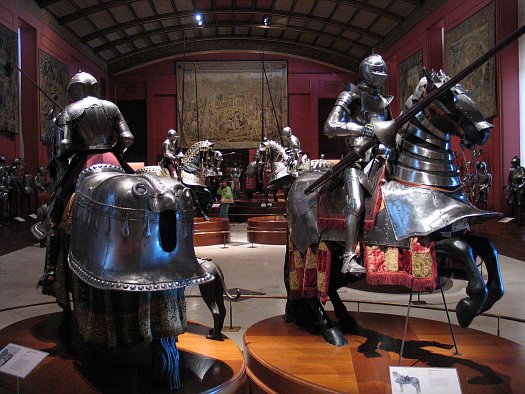
Royal Armoury of Madrid, Spain

During the Middle Ages, Europe was the stage of a large number of wars, some of them shortlived, others iterative or long. European warfare during the Middle Ages was marked by a transformation in the character of warfare from antiquity, changing military tactics, and in particular of the role of cavalry and artillery. In addition to military, tactical and technological innovations during this period, chivalric military and religious ideals arose, giving motivation for engagement in the ceaseless warfare. In the Iberian Peninsula (particularly in Spain or future Spanish territories), chivalric ideals and institutions would be adopted and exercised with more fervour than anywhere else.[1]

Early Spanish chivalry

[edit]

Chivalry, or chivalric codes of manners and proper military engagement, is believed to have arrived in the Iberian Peninsula during the 10th century, in the context of the Reconquista. This was when Frankish knights, who were willing to fight the Muslim invaders of Iberia prior to the Crusades, appeared to protect pilgrims flocking to what was believed to be the tomb of the apostle James in Galicia.[2] St. James himself was known and celebrated in Christianity as ‘the slayer of the Moors’, and the discovery of his body by Christians has been considered an igniting factor of the Reconquista.[3] The Reconquista had begun under Alfonso II (791–842) and would last nearly 700 years as Christians attempted to drive Muslims out of the Iberian Peninsula. However, the in-statement of chivalric knightly orders and the chivalric ideals and codes of conduct weren’t present on the Iberian Peninsula until almost the second century of the Reconquista. In the context of the Reconquista, and the close proximity of Christian and Muslim populations, the atmosphere for the development of Knightly Orders was ripe, and in the subsequent centuries, chivalry flourished in Spain to a greater extent than in other Christian states.[1]

Combat des chevaliers dans la campagne (1824) by Eugène Delacroix, now in the Louvre

Chivalry in medieval Spain cannot be understood outside of the context of the military orders of knighthood. Historians are conflicted as to whether Spanish knights were directed more by royalty (such as the king of Castile or the king of Aragon), or by the Papacy. But there seems to be a consensus that the knights had obligations to both and an overarching allegiance to the Church, as both were in direct contact with knights (and often royalty were themselves, knights and crusaders).[4] Some scholars have suggested that the later Spanish military Orders, like that at the fortress of Calatrava, pledged their loyalty primarily to their Kingdom, in this case Castile, but orders like the Templars or Hospitallers were more independent and not necessarily loyal to any kingdom consistently.[3]

The uniqueness of Spanish chivalry

[edit]

The Iberian Peninsula had multiple factors contributing to the strong chivalric ethos exemplified by Spanish knights. One determinate factor to the strong adoption of chivalric orders in Spain is the Reconquista, in which Christian kingdoms attempted to expel Muslims from the peninsula. The greatest foes of the Spanish knights were Muslims, who were not an imagined enemy but one deeply entrenched in reality and not as distant as the infidel, or enemy, was for the knights of France or Germany. In other Christian kingdoms, the fighting was initially waged between Christians of different kingdoms, and as such was more debated and contested within Christian circles.[5] However, in Spain, the Christian knights and kingdoms were engaged with what was almost acknowledged as a foe to Christianity, and this common enemy had some role in uniting Christian kingdoms in the cause of the Crusades and Reconquista.[6] In the 12th and 13th century, most of the prominent Spanish knightly orders were formed. The early formation of the orders was dangerous and unstable. In Calatrava, in the mid-12th century, Castilian knights established a fortress, which would later be abandoned due to the threat of a Muslim attack. Within fifty years, a fort of the Order of Calatrava was rebuilt and became a fortified monastic community.[7]

Castillo de Calatrava la Nueva

The prominence of knightly orders in the political and military realms of the Christian kingdoms of the peninsula fluctuated with the crusader zeal of the kingdoms’ rulers; however, their power was not exclusively tied to the Crusader Kings. For instance, Ferdinand III of Castile’s reign facilitated the rise of more Spanish orders because of the desire in the kingdom, led by the king, to crusade against the Moors.[8]

After the death of Ferdinand III, Castile was relatively peaceful and the morale of the orders was undermined. In this period of peace between the orders and the Muslims, mercenaries were hired to replace and assist knights in their fighting, Masters of the Orders were no longer religiously appointed, and civil war was waged between Christian knights with conflicting loyalties.

By this time chivalry was influenced by the fictional prowesses of chivalry romances. Knight Suero de Quiñones and his friends, in summer 1434, maintained a pas d'armes (Passo Honroso) jousting as an homage to his future wife in 166 combats against pilgrim knights that attempted to cross a bridge on Saint James's Way.[9]

The decline of knightly orders in Spain is debatable. Some historians have attributed the fall of chivalry and knightly orders to Miguel de Cervantes, because he “smiled Spain’s chivalry away” with his satirical novel Don Quixote (published in two parts, 1605 and 1615).[1] Others have suggested that chivalry's decline was due to the expulsion of the Muslims in 1492, or the centralization of political power under the reign of Ferdinand and Isabella.[10] Once the Moors were expelled, the four orders were perceived as powerful subjects and it became a priority for the Crown to gain control over them – particularly at a time when the Crown was struggling to establish its central authority. If one subscribes to this latter view (the earlier fall of chivalry and knightly orders at the end of the 15th century), then clearly Cervantes did not so much contribute to that event, as to document (at the beginning of the 17th century) its prior occurrence, a point that is central to Don Quixote, that this decline had already occurred at the time of Quixote's adventures.

The Spanish kings had frequently obtained the election of close connections of their families as Masters of the Orders and at Calatrava in 1489, Santiago in 1494, and Alcántara in 1495, the administration of the three Magisteries were ultimately granted to King Ferdinand of Aragón, as Sovereign of Aragón and King-Consort of Castille. Finally, by the Bull Dum intra of Pope Adrian VI dated 4 May 1523, the perpetual administration' of the three orders was transferred to "Charles I (the Holy Roman Emperor Charles V), King of Spain, and his heirs and successors…” [11]

Later incarnations of Spanish chivalry

[edit]

After the Reconquista and the loss of their prominence, Spanish orders would find a new role as an elite corps of the nobility, maintaining their castles and estates as commanderies to provide incomes for those who had distinguished themselves in the service of the monarch. The succeeding centuries saw the rise of the Spanish Empire, and the chivalric ideals of the knights transcended and reappeared in the guise of the conquistadors in the New World. “The rewards for the conquistador were similar to those of his medieval predecessor, the reconquistador: land to conquer, people to convert to Christianity, and glory or fame. The one major difference was that the conquistadors and reconquistadores were real people who also sought wealth whereas the knight-errant of the romances was a fictional creature indifferent to material gain. Bernal Díaz de Castillo, a soldier who took part in the conquest of Mexico, put the conquistador’s objective succinctly: 'we came here to serve God and the king and also to get rich'”.[12][13]

Spanish chivalric literature

[edit]

El Cid

[edit]
Engraving by Alphonse-Marie-Adolphe de Neuville of the Cid ordering the execution of the instigator of the revolt and almoravid after his conquest of the city in 1094.

El Cantar de Myo Çid ( El Poema de Myo Çid or Mio Cid, known as The Song of my Lord, known in English as The Lay of the Cid and The Poem of the Cid) is the oldest preserved Spanish epic poem. Based on a true story, it tells of the Spanish hero El Cid, and takes place during the Reconquista. “The protagonist of the poem is the historical Rodrigo Díaz de Vivar (1045–1099), also known as Cid (a dialectal form of the Arabic word sayyid, 'lord' or 'master') and Campeador ('Battler' or 'Victor'). The poem begins with the departure of Rodrigo from his home in Vivar, the first of two exiles of Rodrigo decreed by Alfonso VI, king of Castile and Leon (1065–1109). In the poem, this first exile (1081) and the second (1089) are conflated and lead to the Cid's military campaigns in the Spanish Levant, culminating in the Cid's conquest of the Moorish kingdom of Valencia (1094). Here, Rodrigo will remain with his wife and children as an independent prince until the end of his life.” [14]

Amadís de Gaula

[edit]

The original author is anonymous, perhaps from Portugal. It was first printed in 1508 by Garci Rodríguez de Montalvo. It is a chivalric romance linked to the Matter of Britain. The main character fights across several European realms, gets mad in courtly love for his lady and is persecuted by a wizard. The book had several sequels and translations into European languages.[15]

Don Quixote

[edit]
Don Quixote, his horse Rocinante and his squire Sancho Panza after an unsuccessful attack on a windmill. By Gustave Doré

Don Quixote is a novel written by Spanish author Miguel de Cervantes. Published in two volumes in 1605 and 1615, Don Quixote is the most influential work of literature from the Spanish Golden Age in the Spanish literary canon.

“A Spanish knight, about fifty years of age, who lived in great poverty in a village of La Mancha, gave himself up so entirely to reading the romances of chivalry, of which he had a large collection, that in the end they turned his brain, and nothing would satisfy him but that he must ride abroad on his old horse, armed with spear and helmet, a knight-errant, to encounter all adventures, and to redress the innumerable wrongs of the world. He induced a neighbour of his, a poor and ignorant peasant called Sancho Panza, mounted on a very good ass, to accompany him as squire. The knight saw the world only in the mirror of his beloved romances; he mistook inns for enchanted castles, windmills for giants, and country wenches for exiled princesses. His high spirit and his courage never failed him, but his illusions led him into endless trouble. In the name of justice and chivalry he intruded himself on all whom he met, and assaulted all whom he took to be making an oppressive or discourteous use of power. He and his poor squire were beaten, trounced, cheated, and ridiculed on all hands, until in the end, by the kindliness of his old friends in the village, and with the help of some new friends who had been touched by the amiable and generous character of his illusions, the knight was cured of his whimsies and was led back to his home in the village, there to die.” [16]

Prominent knightly orders of Spain

[edit]

Order of Calatrava – was the first military order founded in Castile, but the second to receive papal approval. The papal bull confirming the Order of Calatrava as a Militia was given by Pope Alexander III on 26 September 1164.[13]

Order of Santiago – (or the Order of Saint James of Compostela) was founded in the 12th century, and owes its name to the national patron of Spain, Santiago (St. James the Greater), under whose banner the Christians of Galicia and Asturias began in the 9th century to combat and drive out the Muslims.[17]

Order of Alcántara – also called the Knights of St. Julian, was originally a military order of León, founded in 1166 and confirmed by Pope Alexander III in 1177.[18]

Order of Montesa – was dedicated to Our Lady, and based at Montesa, Valencia. Pope John XXII approved it on 10 June 1317, and gave it the Cistercian rule.[19]

See also

[edit]

References

[edit]

Bibliography

[edit]
Revisions and contributorsEdit on WikipediaRead on Wikipedia
from Grokipedia

Spanish chivalry denotes the constellation of knightly ethics, martial institutions, and cultural practices that defined the Iberian warrior elite from the through the , indelibly molded by the Reconquista's exigencies of perpetual border conflict against Islamic forces. Diverging from the tournament-centric and amatory emphases of French chivalry, the Spanish variant prioritized unyielding , fervent Catholic devotion, and to indigenous monarchs over supranational papal suasion, fostering a hybrid of nationalistic fervor and crusading militancy amid Iberia's volatile frontier dynamics.
Pivotal to this tradition were the Iberian military orders—monastic confraternities wielding papal bulls to merge Cistercian austerity with combative zeal—such as the , established in 1158 to garrison strategic strongholds, and the , founded circa 1170 to safeguard pilgrims and spearhead offensives. These entities functioned as specialized vanguard forces in the , amassing vast estates through royal endowments and conquest spoils to sustain campaigns that incrementally eroded Muslim enclaves, culminating in Granada's capitulation in 1492. Exemplars like Rodrigo Díaz de Vivar, , embodied this ethos through exploits blending tactical acumen with pious ruthlessness, as chronicled in propagandistic epics that galvanized Christian coalescence. Post-Reconquista, Spanish chivalry evolved into ceremonial pomp and imperial projection, with orders repurposed for ventures, while vernacular romances exalted hyperbolic knight-errantry— foremost—inculcating aristocratic martial ideals until Cervantes' (1605) lampooned their anachronistic delusions amid gunpowder's ascendancy and absolutist consolidation. Yet this splendor masked chivalry's core as a license for elite predation, rationalizing violence as honorable duty in service to crown and cross, a causal engine propelling Spain's territorial hegemony but also entrenching feudal hierarchies and internecine strife.

Origins and Early Development

Formation Amidst the Reconquista

The Reconquista, initiated after the Muslim conquest of most of the Iberian Peninsula in 711 and marked by the Christian victory at the Battle of Covadonga in 722, created a persistent frontier warfare environment that cultivated a distinct warrior ethos among Christian forces. This prolonged conflict, spanning over seven centuries, demanded organized military responses from the northern Christian kingdoms of Asturias, León, Castile, and Aragon, where local militias evolved into more structured knightly formations bound by oaths of loyalty and religious zeal. Unlike the feudal manorial systems dominant in northern Europe, the Iberian frontier emphasized mobile, faith-driven combat against Islamic incursions, laying the groundwork for chivalric ideals centered on defense of Christendom rather than courtly refinement. The institutional formation of Spanish chivalry crystallized in the mid-12th century through the establishment of religious-military orders, which combined monastic discipline with knightly prowess to secure border fortresses and launch offensives. The Order of Calatrava, the earliest such indigenous order, was founded in 1157 when King Sancho III of Castile granted the fortress of Calatrava to Cistercian monks from the Abbey of Fitero, led by Abbot Raymond, after Templar knights abandoned it due to overwhelming Moorish pressure. These Cistercian lay brothers, initially untrained for combat, rapidly militarized under leaders like Diego Velázquez, adopting white cloaks with a red cross and vowing perpetual warfare against the Moors. The order's papal confirmation by Alexander III in 1164 solidified its status, enabling it to reclaim Calatrava in 1212 alongside victories at Las Navas de Tolosa, contributing decisively to Christian advances. Complementing Calatrava, the emerged around 1170 in the Kingdom of León, named after Spain's James the Greater and initially focused on protecting pilgrims to Compostela while combating Muslim threats in . Founded by King Ferdinand II with knights from the Order of the Holy Sepulchre, it expanded rapidly, receiving papal approval in 1175 and adopting a red sword-and-shell emblem. These orders institutionalized chivalric practices, enforcing codes of honor, piety, and martial discipline tailored to the Reconquista's exigencies, distinguishing Spanish knighthood by its emphasis on crusading militancy over romance. By the late , such formations had professionalized warfare, fostering a chivalric tradition integral to territorial reconquest and Spanish identity formation.

Influences from Visigothic Traditions and Early Christian Resistance

The , established in following the collapse of Roman authority, fostered a ethos centered on loyal military serving elective monarchs who embodied martial prowess and religious authority. Kings such as Leovigild (r. 568–586) expanded territory through conquest, subduing and Basque groups while promoting administrative and legal unification, exemplified by the Liber Iudiciorum (654), a code applying equally to and Hispano-Romans that emphasized royal justice and fidelity in warfare. This Germanic comitatus tradition of personal allegiance to a warlord-king, fused with Roman military structures, laid groundwork for a hierarchical valorizing armed service and honor-bound defense of realm and faith. The kingdom's conversion to Catholicism at the Third Council of Toledo in 589 unified Hispano-Gothic identity under a militant , portraying the as rex catholicus defender against heresies and external threats, a motif echoed in later propaganda. The rapid conquest by Umayyad forces in 711–718 dismantled centralized power, yet pockets of Visigothic nobility survived in the , preserving elements of this ethos amid fragmentation. Early Christian resistance crystallized in the Kingdom of Asturias, founded circa 718 under Pelayo (d. 737), a Visigothic aristocrat who rallied survivors against Muslim incursions, culminating in the (c. 722), the symbolic inaugural victory of the . Asturias positioned itself as the legitimate successor to the Visigothic monarchy of Toledo, with charters like Alfonso II's of 812 invoking Gothic continuity to legitimize expansion southward. This narrative reframed resistance as restorative warfare to reclaim a lost Catholic-Gothic patrimony, infusing northern warrior culture with ideological fervor against Islamic rule. Such traditions influenced nascent chivalric ideals by prioritizing pious militancy over feudal vassalage; Asturian and Leonese forces, drawing on Gothic models of royal-led holy campaigns, developed frontier tactics emphasizing endurance, loyalty, and divine sanction—precursors to the religious-military orders that formalized Spanish knighthood. Unlike contemporaneous Frankish chivalry's courtly refinements, this strain retained a raw, existential edge shaped by perpetual border defense, where martial virtue served existential Christian survival rather than romantic gallantry.

Defining Characteristics

Religious Piety and Militant Faith as Core Drivers

Religious formed the foundational ethos of Spanish chivalry, positioning knightly warfare as a divine imperative to reclaim Iberian territories from Muslim rule during the . Unlike the traditions prevalent in French chivalry, Spanish knights integrated monastic discipline with martial prowess, viewing combat against non-Christians as an act of obedience to . This militant faith was reinforced by papal endorsements, such as the 1175 bull from , which extended Holy Land crusade indulgences—full remission of sins and protection from —to participants in Iberian campaigns, equating the with sacred warfare. The military orders epitomized this fusion of piety and militancy. The Order of Calatrava, established in 1158 under Cistercian auspices to defend frontier castles, required knights to profess vows of poverty, chastity, and obedience, subjecting them to a rigorous rule that blended lay brotherhood with religious observance. Daily practices underscored devotional rigor; Calatrava knights recited 267 Pater Nosters each day, while associated female branches performed 90, ensuring spiritual preparation for battle. Similarly, the Order of Santiago, founded around 1170 to safeguard pilgrims and combat Muslim forces, imposed equivalent vows and papal privileges, including the 1175 confirmation by Alexander III, framing membership as a path to salvation through armed defense of the faith. These orders mobilized thousands; by the 13th century, Santiago alone fielded over 2,000 knights in key engagements. This piety-driven militancy propelled decisive victories, such as the 1212 Battle of Las Navas de Tolosa, where order knights, fueled by crusading zeal and indulgences proclaimed at the , shattered Almohad power and accelerated Christian advances. The ethos permeated broader chivalric culture, with knights like exemplifying faith as a catalyst for loyalty and conquest, distinct from the more romanticized, less religiously militant French norms that emphasized personal honor over holy war. Over time, vows occasionally relaxed to accommodate noble recruits, yet the core imperative of militant endured, binding military efficacy to spiritual merit and ensuring chivalry's role in Spain's territorial unification under Christian banners.

Contrasts with French Courtly Romance and Broader European Norms

Spanish chivalry diverged markedly from French courtly romance in its subordination of romantic ideals to religious militancy and practical warfare. While French traditions, emerging in the among troubadours and codified in literary works like those of (c. 1170–1190), exalted fin'amor—an often illicit, poetic devotion to a lady involving suffering, secrecy, and elevation through unrequited passion—Spanish knights prioritized the defense of against Islamic forces during the . This contrast stemmed from Spain's geopolitical reality of continuous frontier conflict, fostering a chivalric where and prowess served divine reconquest rather than courtly dalliance. In practice, Spanish chivalry manifested through military-religious orders such as Calatrava (founded 1158) and Santiago (1170), where knights adopted monastic vows of obedience, poverty, and chastity alongside combat duties, embodying a "warrior-monk" archetype absent in French secular knighthood. French chivalry, by contrast, emphasized tournaments, heraldry, and feudal loyalty, with romances idealizing knights as gallant suitors navigating aristocratic courts, as seen in the Arthurian cycles popularized from the late 12th century. Broader European norms aligned more closely with the French model, featuring knightly dubbing rituals, codes of honor in vassalage, and occasional crusades to the Holy Land, but lacked Spain's integrated system of perpetual, peninsula-specific holy war that subordinated personal glory to collective Christian expansion. Even in literary adaptations, Spanish chivalric romances like (first printed 1508), while borrowing French Arthurian elements, reframed adventures around heroic fidelity to faith and monarch rather than amorous intrigue, reflecting the Reconquista's causal imprint on cultural norms. This pragmatic orientation persisted into the 15th century, with Spanish knights focusing on territorial campaigns—such as the conquest of in 1492—over the stylized rituals that dominated northern European courts.

Military Applications and Achievements

Role in Key Reconquista Campaigns and Battles

Rodrigo Díaz de Vivar, known as , exemplified early Spanish chivalric warfare during the late 11th century, conducting campaigns against Muslim kingdoms amid the 's fragmented phase. Exiled from Castile in 1081, he served both Christian and Muslim rulers opportunistically before focusing on territorial conquests, culminating in the siege and capture of on June 15, 1094, after a prolonged campaign involving heavy cavalry charges and fortified assaults. His defense of Valencia against Almoravid incursions until his death in 1099 demonstrated chivalric ideals of personal valor, including single combats that earned him the title Campeador, though these exploits relied more on pragmatic mercenary tactics than formalized knightly codes. The establishment of military orders in the mid-12th century institutionalized chivalric military service, with the , founded in 1164 following the loss of its namesake castle to Almohad forces, playing a pivotal role in frontier defense and offensive campaigns. These orders provided disciplined , combining monastic vows with martial prowess to counter Muslim raids and expand Christian holdings. The participated in numerous engagements, including the recapture of Salvatierra Castle prior to 1211, bolstering Castilian advances in . In the Battle of Las Navas de Tolosa on July 16, 1212, Spanish chivalry reached a decisive juncture, as knights from the Orders of Calatrava, Santiago, and international groups like the Templars and Hospitallers formed the Christian vanguard under , allied with forces from , , and . Numbering around 12,000-14,000 total Christian troops against an Almohad army estimated at 25,000-30,000, the orders' spearheaded through mountain passes, suffering severe casualties—including most Calatrava knights—but breaching the caliph's bodyguard lines, leading to the rout of Muhammad al-Nasir's forces and the capture of symbolic regalia. This victory fragmented Almohad power in Iberia, enabling subsequent conquests like Ferdinand III's seizure of Cordoba in 1236 and in 1248, where order knights fortified gains and suppressed rebellions. Chivalric elements persisted into later phases, as seen in the Order of Santiago's contributions to the 1340 Battle of Rio Salado, where combined Christian forces repelled a Marinid invasion, preserving southern frontiers. Overall, these campaigns underscored Spanish chivalry's emphasis on militant piety and tactical cavalry dominance, driving empirical territorial recovery through fortified settlements and relentless pressure on Muslim polities, though successes often hinged on royal coordination rather than autonomous knightly initiative.

Contributions to Territorial Recovery and Spanish Cohesion

The military orders embodying Spanish chivalry, such as Calatrava, Alcántara, and Santiago, played a pivotal role in the by providing specialized forces for frontier defense and offensive campaigns against Muslim-held territories. Founded in response to ongoing threats—Calatrava in 1158 to guard its namesake castle, Alcántara in 1166 for border protection, and Santiago in 1170 to combat Moorish incursions—these orders amassed knights trained in tactics suited to Iberian warfare, enabling sustained pressure on Almohad and later Nasrid defenses. Their contributions included recapturing key strongholds, such as Calatrava's seizure of Salvatierra in 1198 with 400 knights and 700 foot soldiers, which secured vital passes in the and facilitated further advances into . In major battles, these orders delivered decisive manpower and suffered heavy losses that underscored their commitment to territorial expansion. At the Battle of Las Navas de Tolosa in 1212, Calatrava's knights were instrumental in shattering Almohad power, marking a that opened to Christian s under Ferdinand III. During the siege of in 1248, Santiago fielded 280 knights under its master, contributing to the city's fall and the subsequent Christian repopulation of the Guadalquivir Valley. Later, in the (1482–1492), the orders mobilized substantial contingents—Santiago providing 519 lances, Calatrava 293, and Alcántara 142—bolstering the Catholic Monarchs' final push, which culminated in Granada's surrender on January 2, 1492. Beyond combat, they enforced settlement policies by issuing charters (fueros) to attract Christian to reconquered lands, as seen in Santiago's repopulation efforts around Uclés after its 1174 and land grants in 1269 to incentivize . These chivalric institutions fostered Spanish cohesion by aligning their vast territorial holdings—spanning fortified lordships like Zorita for Calatrava and Uclés for Santiago—with royal objectives, thereby bridging fragmented Christian kingdoms through shared militant piety and anti-Muslim campaigns. Their semi-autonomous control over reconquered frontiers provided kings with reliable proxies for governance and defense, reducing reliance on fickle nobility and enabling coordinated offensives that unified Castile and Aragon's efforts. By the late 15th century, the Catholic Monarchs' assumption of mastery over the orders integrated their resources into centralized authority, suppressing internal rivalries and channeling chivalric zeal toward national consolidation, which paved the way for Spain's emergence as a unified realm post-Reconquista. This subordination, formalized under Ferdinand II and Isabella I, transformed the orders from potential rivals into pillars of monarchical power, ensuring enduring loyalty amid the transition to empire-building.

Institutional Frameworks

Establishment and Evolution of Military Orders

The military orders in Spain originated in the mid-12th century as hybrid institutions blending monastic discipline with armed defense against Muslim forces during the . The , the earliest, was established in 1158 when King entrusted the vulnerable fortress of Calatrava la Vieja to monks led by Abbot Raymond of Fitero, who committed to its militarized protection after initial settlers proved insufficiently combative. This order received formal papal confirmation via a bull issued by in 1164, adopting a rule modeled on the but permitting knights to marry under strict conditions. The followed shortly, forming around 1156 as a knightly brotherhood to safeguard the frontier castle of San Julián del Pereiro in the Kingdom of León, with formal papal recognition granted in 1177 by . Similarly, the emerged in the 1170s, founded by nobles and clergy to counter Almohad threats, obtaining its initial rule in 1171 from Cardinal Hyacinth (later ) and evolving into a major force with permission for married knights. These orders filled a critical gap in royal resources, receiving initial royal cessions of depopulated borderlands in exchange for perpetual vigilance and reconquest efforts. Over the subsequent centuries, these orders evolved from precarious garrisons into powerful feudal entities, amassing extensive lordships through battlefield acquisitions, pious donations, and royal grants that conferred fiscal exemptions, judicial autonomy, and rights to mint coinage. By the 13th century, under patronage from monarchs like and Ferdinand III of León-Castile, they coordinated with royal armies in decisive campaigns, such as the Battle of Las Navas de Tolosa in 1212, which bolstered their prestige and territorial expansion into . Internal governance matured with elected masters subject to papal oversight, though tensions arose from knightly indiscipline and encroachments on royal authority, prompting reforms like the 1311 statutes for Calatrava emphasizing stricter Cistercian adherence. In the 14th and 15th centuries, amid dynastic strife and the waning , the orders faced challenges including disputed master elections and fiscal strains, leading to increased crown intervention; for instance, Peter I of Castile confiscated Alcántara's properties temporarily in 1351 before restoration. By the late 15th century, the Catholic Monarchs and consolidated control, incorporating the orders into the monarchy through personal assumption of masterships—Isabella for Santiago in 1476 and Ferdinand for Calatrava and Alcántara—transforming them from semi-independent crusading bodies into instruments of centralized royal power while retaining their chivalric ethos. This evolution reflected broader shifts from frontier militancy to institutionalized nobility, with orders holding over 10,000 square kilometers of land by 1492, underpinning Spanish cohesion against internal divisions.

Major Orders: Calatrava, Alcántara, and Santiago

The Order of Calatrava, the first indigenous military order in Castile, was established in 1158 by Abbot Raimundo of Fitero following the Cistercian monks' defense of Calatrava la Vieja against Moorish forces after its initial loss in 1157. King Sancho III of Castile granted the site to the order, which adopted Cistercian rules supplemented by vows of perpetual combat against infidels, embodying the fusion of monastic austerity and chivalric warfare central to Spanish military tradition. The knights participated in pivotal Reconquista campaigns, including the Battle of Las Navas de Tolosa in 1212, where their heavy cavalry contributed to the decisive Christian victory that weakened Almohad power in Iberia. The emerged from the Knights of San Julián del Pereiro, a group of hermits who militarized their community around 1166 in the Kingdom of León to counter Moorish incursions on the frontier. confirmed the order's status in 1177, aligning it with Cistercian observance while emphasizing defensive warfare and frontier fortification. By 1218, King awarded them the town of Alcántara, expanding their territorial role in securing against Muslim raids and supporting royal armies in advances southward. The , founded in 1170 by King in collaboration with the Archbishop of Compostela, aimed to protect pilgrims en route to and bolster Christian defenses along the River frontier. Unlike stricter monastic orders, Santiago permitted to sustain recruitment, fostering a broader chivalric that integrated familial lineages with militant . Papally approved in 1175, the order grew to become the largest Spanish military institution, commanding extensive estates and leading assaults such as the 1229 conquest of , which advanced Castilian-Leonese unification through coordinated knightly service. These orders, under royal patronage and papal oversight, institutionalized Spanish chivalry by channeling feudal warfare into religiously motivated territorial expansion, amassing lands through meritorious combat that reinforced monarchical authority during the .

Operational Tactics and Frontier Defense Strategies

Spanish chivalric orders adapted operational tactics to the irregular nature of frontier warfare during the , prioritizing mobility, harassment, and rapid raids over sustained pitched engagements. Light units known as jinetes, equipped with javelins, shields, and lighter armor, executed hit-and-run maneuvers to disrupt enemy formations without committing to close combat until the opponent faltered. These forces, often semi-Moorish in style, hovered around adversaries, launching volleys to provoke disorder, as seen in campaigns like the 1431 Battle of Higueruela where jinetes engaged in skirmishes against Granadan light horse. Heavy drawn from the orders provided decisive charges once opportunities arose, though their effectiveness was limited by lighter armor compared to northern European counterparts. Offensive operations frequently took the form of cabalgadas, or cavalcades, involving small detachments of 50 to 300 lightly armed horsemen for swift incursions to seize , burn crops, and demoralize Muslim settlements. Larger raids, numbering in the thousands, aimed at broader devastation, such as Alfonso I of Aragon's 1125–1126 expedition through Andalucía, which pillaged villages and scorched orchards to undermine enemy sustenance. Military orders like Santiago coordinated these efforts, with leaders such as Pelay Pérez Correa directing strikes that combined surprise with psychological elements, including displaying enemy heads to intimidate defenders. Frontier defense strategies centered on a network of fortified castles manned by permanent garrisons, or presidios, maintained by the orders to secure contested borders along rivers like the and . Orders such as Calatrava, established to hold its namesake fortress from 1158, deployed brother knights in heavy armor for charges and sergeants on lighter mounts for patrols, supplemented by vassals and mercenaries obligated to contribute forces for expeditions. By the late , Santiago could mobilize up to 519 lances, reflecting scaled-up capacities for rapid response to incursions, while castles like Calatrava's Salvatierra served as strategic outposts for territorial control. These garrisons not only repelled raids but also facilitated repopulation and economic stabilization in reclaimed areas through disciplined vigilance. The integration of temporary volunteers and hired troops allowed orders like Alcántara and Calatrava to augment core brother-soldiers for specific threats, emphasizing specialized roles in flank attacks and support during frontier pushes. This structure enabled sustained pressure on Muslim holdings, with tactics evolving to include and in sieges, as evidenced by the 1147 campaign where orders employed 60-foot tunnels to breach walls. Overall, these methods underscored a pragmatic chivalric focused on attrition and rather than chivalric ideals of honorable .

Literary Representations

Epic Foundations: The Historical Exploits of El Cid

Rodrigo Díaz de Vivar, known as or Campeador ("battler" or "champion"), was a Castilian nobleman born around 1043 in the village of Vivar near , who emerged as a prominent military figure during the late 11th century amid the Reconquista's fragmented frontier warfare. Rising through service to King Sancho II of Castile, he participated in the civil conflicts dividing Ferdinand I's heirs, demonstrating tactical acumen in campaigns against and the , including a decisive victory over the Aragonese at the Battle of Graus in 1063, where he reportedly saved Sancho's life. These early exploits established his reputation for personal valor and battlefield leadership, qualities later idealized in epic literature as foundational to Spanish chivalric ethos, though his actions reflected pragmatic feudal loyalties rather than abstract ideological commitment. Following Sancho's assassination in 1072 and the ascension of Alfonso VI, Rodrigo briefly served the new king but faced exile in 1081 after leading an unauthorized expedition into the Moorish , a territory under Alfonso's protection as a tributary vassal. Barred from Castile, he shifted to the eastern Iberian frontier, initially allying with the Muslim emir of against rival Christian and forces, securing victories such as the defeat of the at the Battle of Morella in 1084 and raids that amassed tribute and territory. These campaigns, spanning roughly 1081 to 1087 and beyond, highlighted his adaptability as a condottiero-like leader, employing charges and fortified sieges to exploit alliances across religious lines, amassing wealth and followers that underscored the era's fluid geopolitics over rigid confessional warfare. Rodrigo's most enduring historical achievement came with the siege of , initiated in 1092 against the ruler amid Almoravid incursions destabilizing Muslim polities. After a 20-month involving scorched-earth tactics and naval support from Genoese allies to supplies, he captured the city on June 15, 1094, establishing a short-lived Christian that controlled key Levantine trade routes. As lord of , he governed a multi-confessional domain, converting the main into a church dedicated to the Virgin Mary while tolerating Muslim administrators for fiscal efficiency, and repelled Almoravid assaults, including a major relief army in 1097 through superior scouting and terrain mastery. His death on July 10, 1099, from illness did not end his martial legacy; his embalmed body was mounted on his to demoralize besiegers, contributing to their rout, an event blending historical opportunism with the mythic aura that would underpin epic narratives of indomitable knightly resolve. These verifiable feats—marked by 30 documented battles, territorial gains from to , and survival amid betrayals—provided the empirical core for later epic portrayals, such as the Poema de Mio Cid, which recast Rodrigo's independence and prowess as moral exemplars of loyalty, piety, and martial excellence central to Spanish chivalry's self-conception. Yet, contemporary Arabic chronicles, like those of Ibn Al-Kamil, depict him as a shrewd extortionist whose alliances with prioritized profit over crusade, revealing a causal reality of economic incentives driving frontier expansion rather than unalloyed religious zeal. This duality—historical pragmatism yielding legendary heroism—anchored Spanish chivalric ideals in real exploits that advanced Christian footholds, fostering a cultural narrative of resilient, self-reliant knighthood amid chronic instability.

Idealized Romances: Amadís de Gaula and Chivalric Fantasies

Amadís de Gaula, first published in 1508 by Garci Rodríguez de Montalvo in Zaragoza, represents the apex of Spanish chivalric romance, compiling and revising earlier manuscripts likely dating to the late 14th or early 15th century. The narrative chronicles the exploits of the knight Amadís, born of a forbidden love between King Perión of Gaul and Elisena, who is abandoned at sea as an infant and raised in Scotland, eventually embarking on quests marked by superhuman feats, battles against giants and sorcerers, and unwavering devotion to his beloved Oriana, daughter of King Lisuarte of England. This four-book structure emphasizes virtues such as prowess in arms, chastity until rightful union, loyalty to lord and lady, and pursuit of honor through errantry, all within a framework of dynastic alliances and moral triumphs over enchantment and treachery. The romance idealizes by portraying a hierarchical, aristocratic world where knights operate in a fantastical unbound by Reconquista-era constraints, blending post-Arthurian motifs with Iberian sensibilities to create escapist fantasies detached from feudal drudgery or administrative realities. Amadís embodies the perfect , resolving conflicts through personal valor rather than institutional warfare, often aided by magical elements like the dwarf Urgande's interventions or the island of Windsor as a site of idyllic retreat, which reinforced cultural aspirations for transcendence over earthly limits. Such depictions fueled a literary vogue in 16th-century , where readers, including and emerging , consumed these tales as models for , with the Amadís cycle expanding to over a dozen sequels by authors like Feliciano de Silva, amplifying themes of endless adventure and romantic fidelity. Chivalric fantasies in this genre, peaking between 1500 and 1550, proliferated as printed books democratized access to heroic narratives, with estimates of over 20 major titles and hundreds of editions circulating widely among Spanish elites and aspiring readers. These works, including Palmerín de Oliva and Tirante el Blanco precursors, projected an unblemished of excellence and courteous love, influencing real-world perceptions of knighthood amid Spain's imperial expansions, as evidenced by conquistadors invoking Amadís-like quests in chronicles. Yet, their stylized detachment from historical military orders or pragmatism—favoring solitary duels and amorous trials over collective fortress defense—highlighted a romanticized divergence from practical chivalric applications, setting the stage for later critiques of excess.

Satirical Reflections: Cervantes' Don Quixote and the Critique of Excess

published the first part of in 1605, followed by the second part in 1615, creating a that parodies the proliferation of chivalric romances in . The novel centers on , a minor nobleman from whose excessive immersion in books of knight-errantry distorts his perception of reality, leading him to adopt the persona of Don Quixote de la Mancha and embark on quests to revive medieval chivalric ideals. Accompanied by his pragmatic , Don Quixote's delusions manifest in absurd encounters, such as charging windmills he mistakes for giants, highlighting the disconnect between romanticized chivalric fantasies and the practical demands of 17th-century . Cervantes employs to expose the excesses of , which idealized knights as invincible heroes bound by honor, courtesy, and martial prowess, often detached from feasible outcomes. In the novel's preface, Cervantes explicitly states his to undermine the and of these works, aiming to "remove the and influence of in ." Don Quixote's rigid adherence to codes of arms—demanding duels over perceived slights or enforcing outdated —results not in glory but in ridicule, injury, and disruption, critiquing how unchecked fosters impracticality and self-deception. Sancho's earthy realism serves as a , underscoring the causal mismatch between chivalric and empirical reality, where noble intentions yield chaotic, often harmful consequences. The critique extends to the societal impact of chivalric excess, reflecting Cervantes' own experiences as a wounded at the in 1571 and later enslaved in until 1580, which may have informed his disillusionment with heroic myths amid real-world hardships. By portraying chivalry's anachronistic persistence in a post-Reconquista era of centralized and emerging rationality, the illustrates how overreliance on feudal martial impedes adaptation to modern governance and commerce, contributing to personal ruin as seen in Don Quixote's eventual defeat and renunciation of his illusions. This satirical lens diminished the cultural sway of chivalric romances, paving the way for more grounded literary forms while preserving chivalry's memory as a of excess over substance.

Evolution and Global Projection

Persistence into the Renaissance and Age of Exploration

The completion of the with the fall of in 1492 redirected the martial and religious fervor of Spanish chivalry toward overseas expansion, transforming the Iberian into a global imperial drive. Military orders like , and Alcántara, forged in the fight against Muslim rule, were integrated under the Catholic Monarchs' authority—Santiago's mastership reverting to in 1499—allowing their knights and resources to bolster early expeditions, though individual hidalgos dominated the ventures. This institutional continuity ensured chivalric discipline, vows of obedience, and crusading zeal persisted, framing the Indies as a new theater for holy war against perceived pagan empires. Chivalric literature reinforced these ideals during the , with romances like (first printed 1508, with over 20 editions by mid-century) portraying knights conquering exotic realms, mirroring the exploits of explorers. Conquistadors avidly consumed such works; , in his conquest of (1519–1521), drew formative influences from these texts, the legal code of the , and chivalric chronicles, viewing his campaigns as emulations of heroic knighthood involving feats of arms, loyalty to the sovereign, and conversion of infidels. Similarly, Bernal Díaz del Castillo's Historia verdadera de la conquista de la Nueva España (completed circa 1568) explicitly compares the siege of Tenochtitlán to adventures in , underscoring how readers internalized knightly quests for glory, treasure, and evangelization. Over 50 such romances circulated in by 1580, fueling a cultural milieu where was romanticized as chivalric errantry. In practice, this persistence manifested in the self-conception of figures like Francisco Pizarro, whose Inca campaign (1532–1533) echoed Reconquista tactics of small forces defeating larger foes through audacity and faith, akin to knightly razzias. Royal patronage under Charles V (r. 1516–1556) further sustained chivalric pageantry, including tournaments at court that evoked medieval orders, while papal bulls like the 1493 Inter caetera extended crusading indulgences to the New World, incentivizing knights to treat indigenous resistance as jihad-like threats. Thus, chivalry evolved from territorial recovery to transoceanic dominion, blending martial prowess with religious imperialism until the mid-16th century, when logistical demands of empire began eroding its pure form.

Embodiment in Conquistadors and Overseas Enterprises

The conquistadors of the early extended Spanish chivalric traditions beyond the Iberian , framing their expeditions as continuations of the Reconquista's martial and evangelistic imperatives against perceived infidels. , leading the 1519 conquest of the , invoked service to , , and personal honor in his Cartas de relación to Emperor Charles V, portraying the enterprise as a akin to knightly campaigns, complete with alliances against tyrannical rulers and vows of . Similarly, Francisco Pizarro's 1532 incursion into Inca territory echoed these motifs, with his force of roughly 180 men capturing at on November 16, 1532, through audacious tactics reminiscent of skirmishes, motivated by vows of conversion and enrichment under royal auspices. Participants like , a foot soldier in Cortés's army, explicitly linked their actions to chivalric literature, referencing while describing the splendor of in his 1568 Historia verdadera de la conquista de la Nueva España, which emphasized objectives of serving "God and the king and also to get rich" amid heroic perils. This fusion of idealism and pragmatism distinguished conquistadors from purely fictional knights-errant, as they pursued tangible rewards—land grants (encomiendas), titles, and precious metals—paralleling the spoils of medieval reconquistadors, with yielding over 8,000 pesos of and 200,000 of silver by 1521. Military orders such as Santiago and Calatrava, rooted in 12th-century crusading, supplied knights who integrated into these ventures, enforcing feudal-like discipline and vows of obedience; by the mid-16th century, order members held key roles in administering conquered territories, blending monastic piety with martial expansion across the . Overseas enterprises thus projected chivalric ethos globally, with papal bulls like (May 4, 1493) sanctioning division of domains, enabling to claim vast holdings from to by 1550 through , indigenous alliances, and ideological justification as holy warfare.

Decline and Enduring Legacy

Factors Leading to Diminishment in the Early Modern Era

The completion of the with the fall of in 1492 deprived Spanish military orders such as , and Alcántara of their foundational mission to combat Muslim forces on the Iberian frontier, leading to a gradual erosion of their operational autonomy and military relevance. These orders, established in the for perpetual warfare against Islamic incursions, shifted toward internal Castilian politics and administrative roles as territorial expansion ceased, with their troop contributions notably declining during the transitional late medieval period. Without ongoing border conflicts, the orders' emphasis on knightly vows of , , and obedience waned, as resources previously directed toward frontier defense were redirected to royal service or overseas ventures, diminishing their distinct chivalric identity. The advent of weaponry from the late onward revolutionized European warfare, undermining the tactical supremacy of mounted knights central to Spanish chivalric tradition. Spanish forces, while innovative in adopting tactics like the formations integrating pikemen and arquebusiers during the (1494–1559), increasingly prioritized massed fire over individual charges, rendering traditional heavy armor and lance-based prowess obsolete against and volleys. This "" equalized combatants by negating the years of specialized training required for knighthood, as firearms penetrated plate armor and disrupted formations, a shift evident in Spain's own campaigns where batteries supplanted knightly assaults by the mid-16th century. Monarchical centralization under the Catholic Monarchs and Habsburg dynasty further subordinated chivalric orders to state authority, transforming autonomous knightly brotherhoods into instruments of royal policy. and assumed perpetual administration of the orders' masterships in 1493–1499, integrating their vast estates and revenues into the crown's fiscal apparatus and curtailing independent command structures. By the , under II, knights were deployed as colonial administrators and encomenderos in the , but this extension diluted the orders' martial ethos, as crown oversight prioritized bureaucratic loyalty over frontier knighthood, contributing to their ceremonial ossification. Economic strains from the 16th-century , driven by influxes of American silver totaling over 180 tons annually by mid-century, exacerbated the decline by impoverishing the lower nobility reliant on fixed feudal incomes. Inflation rates surged approximately 400% between 1500 and 1600, outpacing agricultural rents and eroding the financial capacity of hidalgos to maintain expensive warhorses, arms, and retinues essential to chivalric status, forcing many into courtly idleness or debt. This fiscal crisis, compounded by Spain's overextension in European conflicts like the (1568–1648), reduced noble military participation, as depleted resources shifted emphasis from personal valor to state-funded professional armies. Cultural critiques amplified the perceived anachronism of chivalric ideals, with literary works exposing their incompatibility with rationalist and absolutist trends. ' Don Quixote (1605, 1615) satirized knight-errantry as delusional amid gunpowder-era realities, reflecting broader disillusionment that contributed to the genre's fade by the late 16th century, influenced by advancing and social modernization. These factors collectively transitioned Spanish chivalry from a vital institution to a nostalgic honorific tradition by the 17th century.

Long-Term Impacts on Spanish National Identity and Martial Ethos

The Reconquista, spanning from 711 to 1492, ingrained in Spanish national identity a foundational narrative of Christian perseverance and triumph over Muslim rule, fostering a martial ethos centered on religious duty, personal honor, and collective defense that extended far beyond its conclusion. This period's chivalric military orders, such as the Order of Calatrava founded in 1158 and the Order of Santiago established in 1170, exemplified ideals of knightly valor and fidelity to faith, which military historians trace as precursors to Spain's imperial expansionist mindset. These principles directly influenced the conquistadors of the , who, numbering key figures like in expeditions beginning 1519, recast conquests as extensions of Reconquista-era holy warfare, invoking chivalric codes of bravery and monarchical loyalty to justify aggressive and evangelization efforts that amassed vast territories by 1580. The persistence of such ethos is evident in the evolution of Spain's tercios infantry formations around 1534, which retained chivalric emphases on disciplined combat and unit cohesion amid the shift to gunpowder warfare. In the , Spanish military orders transitioned under royal patronage— with the Catholic Monarchs assuming control in 1499—into ceremonial institutions that continue to confer knighthoods for merit, as seen in ongoing awards by orders like Alcántara, thereby embedding chivalric symbolism in contemporary military honors and national ceremonies. During Franco's from 1939 to 1975, Reconquista-derived narratives were invoked to promote a unified Catholic-nationalist identity, reinforcing martial traditions against perceived internal threats, though post-1978 democratic reforms tempered overt religio-militaristic elements in favor of professionalized defense aligned with standards since 1982. This legacy manifests today in Spain's armed forces' doctrinal focus on honor-bound service, with approximately 120,000 active personnel upholding a heritage that prioritizes resilience forged in centuries of frontier conflict.

Modern Reassessments: Balancing Glorification and Critiques

In the twentieth century, particularly under Francisco Franco's regime from 1939 to 1975, Spanish chivalry was often glorified as a cornerstone of , invoked to legitimize authoritarian rule through associations with the Reconquista's crusading ethos and the Catholic Monarchs' unification efforts. Francoist portrayed the as a modern crusade against , echoing medieval knightly orders' militant , with regime symbols drawing from and Isabella's to evoke chivalric heroism and imperial destiny. This narrative emphasized virtues like loyalty, martial prowess, and religious zeal, framing chivalry as a timeless bulwark against internal division and external threats. Post-Franco democratic transitions after prompted reassessments that tempered such glorification with critiques of chivalry's darker facets, highlighting its role in perpetuating violence, religious intolerance, and imperial expansion. Historians have argued that chivalric ideals, as embodied in orders like the (founded 1170), normalized brutality in the , a process spanning 711–1492 often retroactively mythologized as a unified Christian reclamation but critiqued in modern scholarship as fragmented feudal conflicts driven by land acquisition rather than pure ideology. Recent works, such as Samuel A. Claussen's 2020 analysis of late medieval Castile, demonstrate how chivalric culture sanctioned interpersonal and state violence, including against and , fostering a worldview that extended to the conquest of the , where knights-turned-conquistadors applied tactics involving forced conversions and enslavement. Contemporary balances these critiques by acknowledging chivalry's constructive elements, such as codified honor systems that promoted among elites and influenced enduring Spanish military traditions, evidenced in the persistence of knightly orders under royal patronage until their secularization in the nineteenth century. Yet, scholars caution against romanticization, noting that primary chivalric texts like the (c. 1265) idealized restraint alongside aggression, but practice often prioritized conquest, as seen in the 1492 expulsion of amid chivalric pageantry. Nationalist interpretations, prevalent in Franco-era education, have faced scrutiny for bias, while empirically grounded studies prioritize archival evidence of chivalric oaths and campaigns to reveal causal links between knightly ethos and historical outcomes like demographic upheavals in Iberia and the . This dual lens—affirming chivalry's role in forging Spain's martial cohesion while condemning its facilitation of exclusionary violence—dominates current debates, informed by declassified regime documents and interdisciplinary analyses.

References

  1. https://en.wikisource.org/wiki/Letters_of_Cortes_to_Emperor_Charles_V_-_Vol_1/Second_Letter%2C_October_30%2C_1520
Add your contribution
Related Hubs
User Avatar
No comments yet.