


Community hub
Recent from talks
Contribute something
Nothing was collected or created yet.
Outline of Spain
View on Wikipedia
.svg)


The following outline provides an overview of and topical guide to Spain.
Spain, officially the Kingdom of Spain, is a country in Southern and Western Europe with territories in North Africa. Featuring the southernmost point of continental Europe, it is the largest country in Southern Europe and the fourth-most populous European Union (EU) member state. Spanning the majority of the Iberian Peninsula, its territory also includes the Canary Islands, in the Eastern Atlantic Ocean, the Balearic Islands, in the Western Mediterranean Sea, and the autonomous cities of Ceuta and Melilla, in mainland Africa. Peninsular Spain is bordered to the north by France, Andorra, and the Bay of Biscay; to the east and south by the Mediterranean Sea and Gibraltar; and to the west by Portugal and the Atlantic Ocean. Spain's capital and largest city is Madrid; other major urban areas include Barcelona, Valencia, Seville, Zaragoza, Málaga, Murcia, and Palma de Mallorca.
Spain is a secular parliamentary democracy and a constitutional monarchy, with King Felipe VI as head of state. A developed country, Spain has a high nominal per capita income globally, and its advanced economy ranks among the largest in the world. It is also the fourth-largest economy in the EU. Spain is considered a regional power with a cultural influence that extends beyond its borders, and continues to promote its cultural value through participation in multiple international organisations and forums, as well as a key actor in the relations between Europe and Latin America due to its past history.
General reference
[edit]
- Pronunciation:
- Common English country name: Spain
- Official English country name: The Kingdom of Spain
- Common endonym: España
- Official endonym: Reino de España
- Adjectival: Spanish
- Demonym: Spaniard
- Etymology: Name of Spain
- International rankings of Spain
- ISO country codes: ES, ESP, 724
- ISO region codes: ISO 3166-2:ES
- Internet country code top-level domain: .es
- International Direct Dialing uses the prefix +34. Then a first digit 9 or 8 indicates a fixed landline, 6 or 7 are for mobile cellphones[1]
- Vehicle registration plates: 1234 ABC format. [2]
Geography of Spain
[edit]

- Time zones:
- Canary Islands – Western European Time (UTC+00), Western European Summer Time (UTC+01)
- Rest of Spain – Central European Time (UTC+01), Central European Summer Time (UTC+02)
- Extreme points of Spain
- High: Teide on Tenerife 3,718 m (12,198 ft) - highest point in all of Spain[3]
Mulhacén 3,479 m (11,414 ft) - highest point in continental Spain[4] - Low: North Atlantic Ocean and Mediterranean Sea 0 m
- High: Teide on Tenerife 3,718 m (12,198 ft) - highest point in all of Spain[3]
- Borders of Spain
- Topography of Spain
Location
[edit]- Northern Hemisphere, on the Prime Meridian
- Eurasia
- Europe
- Southern Europe
- Western Europe
- Iberian Peninsula – Spain occupies most of this peninsula, sharing it with Portugal, Andorra and Gibraltar:[5]
- Europe

Map of the surrounding european countries, Portugal, France, Italy, Andorra and the United Kingdom (Gibraltar)


- Population of Spain: 49,442,844 (October 2025) - 31th most populous country
- Area of Spain: 506,000 km2 [8]
- Second largest country in Western Europe (behind France)
- Altitude:
- Average altitude: 650 m
- Rank: second highest country in Europe (behind Switzerland)
- Atlas of Spain
Environment of Spain
[edit]
- Geology of Spain
- Climate of Spain
- Renewable energy in Spain
- Environmental issues in Spain
- National parks of Spain
- Wildlife of Spain

Natural geographic features of Spain
[edit]- Beaches in Spain
- Caves in Spain
- Deserts of Spain
- Glaciers of Spain
- Islands of Spain
- Lakes of Spain
- Wetlands in Spain
- Mountains of Spain
- Rivers of Spain
- World Heritage Sites in Spain
- Instituto Geográfico Nacional
Regions of Spain
[edit]Ecological regions of Spain
[edit]Administrative divisions of Spain
[edit]
Administrative divisions of Spain
- Autonomous communities of Spain
- History of the regional distinctions of Spain
- NUTS statistical regions of Spain
Autonomous communities of Spain
[edit]
Autonomous communities of Spain – each has its own parliament and government
- By name:
- By statistic:


Autonomous cities of Spain
[edit].jpg)
_Aterrizando_en_Melilla_(16668390111).jpg)
Autonomous cities of Spain – less autonomous than the autonomous communities, but with more autonomy than Spain's other cities.[9]


Other territory
[edit]- Spanish exclaves:
- Places of sovereignty near Morocco, consisting of:
Provinces of Spain
[edit]- Ranked lists of autonomous communities
- Spanish provinces by name:
Comarcas of Spain
[edit].svg)
Municipalities of Spain
[edit]- Capital of Spain: Madrid
- Metropolitan areas in Spain
- Municipalities of Spain – Spain's approximately 8100 municipalities comprise the basic level of Spanish local government.[10]

Demography of Spain
[edit]
Government and politics of Spain
[edit]
- Spain is a:
- Form of government: Constitutional monarchy
- Capital of Spain: Madrid
- Corruption in Spain
- Federalism in Spain
- Elections in Spain
- Political parties in Spain
- Partido Popular or PP Mainstream Centre-Right associated with the main Employers Organization and clerics.[11]
- Partido Socialista Obrero Español mainstream social-democrats linked to Unión General de Trabajadores trade union and the Confederación Empresarial de Economia Social.[12]
- Sumar, a coalition of smaller left-wing parties.[13]
- Vox, a far-right political party[14]
- Political parties in Catalonia
- Social Security in Spain
- Taxation in Spain
- Political positions and movements in Spain


.jpg)
Monarchy of Spain
[edit]- Head of state: King of Spain, Felipe VI
- Royal Household of Spain
- Spanish royal sites
- Spanish monarchs
- Spanish nobility
- Forms of address in Spain
- Mayordomo mayor
- Camarera mayor de Palacio
- Grandee, a title given to the majority of Spanish nobility, including all dukedoms with one exception[15] and no barons.[16]
- Titles and honours of the Spanish Crown
- Coat of arms of Spain
- Sumiller de Corps
- Imperator totius Hispaniae, a medieval title for the emperor of Spain in Latin[17]
- Bourbon claim to the Spanish throne
- Crown of Aragon
- Kingdom of Gibraltar
.svg)
Branches of the government of Spain
[edit]Executive branch of the government of Spain
[edit]- Head of state: King of Spain, Felipe VI
- Head of government: Prime Minister of Spain (Presidente del Gobierno), Pedro Sánchez
- Leader of the Opposition (Spain)
- Cabinet of Spain (Council of Ministers)

Legislative branch of the government of Spain
[edit]- Parliament of Spain – bicameral legislature of Spain, consisting of:
Judicial branch of the government of Spain
[edit]
Foreign relations of Spain
[edit]- Diplomatic missions in Spain
- Foreign Ministers of Spain
- Centro Nacional de Inteligencia
- Burning of the Spanish Embassy
- Disputed status of the isthmus between Gibraltar and Spain
International organization membership
[edit]The Kingdom of Spain is a member of:[18]
Law and order in Spain
[edit]

- Constitution of Spain
- Constitutions of Spain
- Spanish Constitution of 1978, the current constitution.[19]
- Constitutions of Spain
- Civil Code of Spain
- Historical Memory Law – recognizes the victims on both sides of the Spanish Civil War, gives rights to the victims and the descendants of victims of the war and the subsequent dictatorship of Francisco Franco, and formally condemns the Franco Regime.[20]
- Spanish referendum on the European Constitution
- Admission to legal practice in Spain
Crime in Spain
[edit]- Cannabis in Spain
- Human trafficking in Spain
- Homicide in Spain
- Terrorism in Spain
- Squatting in Spain
,_16-10-1935.jpg)
Human rights in Spain
[edit]- Abortion in Spain
- Censorship in Spain
- Civil unions in Spain
- Copyright law of Spain
- Disability in Spain
- Euthanasia in Spain
- Family policy in Spain
- Homelessness in Spain
- Gender-related rights in Spain
- Freedom of the press in Spain
- Prostitution in Spain
- Freedom of religion in Spain
- Racism in Spain

Law enforcement in Spain
[edit]- Courts in Spain
- Police in Spain
- Punishment in Spain

Military of Spain
[edit]
.jpg)
- Command
- Commander-in-chief:
- Ministry of Defence of Spain
- Chief of the Defence Staff (Spain), principal advisor to the above.[21]
- Commander-in-chief:
- Forces
- Military history of Spain
- Military ranks of Spain
- Armorial of the Spanish Armed Forces
Local government in Spain
[edit]History of Spain
[edit]

History of Spain by period
[edit]- Years in Spain
- Prehistoric Iberia
- Hispania
- Spain in the Middle Ages
- Habsburg Spain
- Enlightenment in Spain
- Mid-nineteenth century Spain
- Spanish confiscation
- First Spanish Republic
- Spain under the Restoration
- Second Spanish Republic
- Spanish Civil War
- Spain under Franco
- Modern Spain
- Contemporary Spain
History of Spain by region
[edit]
History autonomous communities in Spain
[edit]- History of Andalusia
- History of Aragon
- History of Asturias
- History of the Balearic Islands
- History of Basque Country
- History of the Canary Islands
- History of Cantabria
- History of Castilla-La Mancha
- History of Castile and León
- History of Catalonia
- History of Extremadura
- History of Galicia
- History of La Rioja
- History of the Community of Madrid
- History of the Region of Murcia
- History of Navarre
- History of the Valencian Community


History of cities in Spain
[edit]- History of Madrid
- History of Barcelona
- History of Valencia
- History of Toledo
- History of Granada
- History of Seville
- History of León
- History of Bilbao
- History of Zaragoza
- History of Las Palmas
- History of Pamplona
- History of A Coruña
- History of Oviedo
- History of Murcia
- History of Santander
- History of Málaga
- History of Badajoz
- History of Logroño
- History of Girona
- History of Cádiz
- History of Tarragona

History of Spain by subject
[edit]- Chivalry in Spain
- Economic history of Spain
- Enlightenment in Spain
- History of education in Spain
- History of the far-right in Spain
- History of the Jews in Spain
- Literature in Medieval Spain
- Postal history of Spain
- History of the flags of Spain
- LGBTQ history in Spain
- Military history of Spain
- History of rail transport in Spain
- Religious history of Spain
- History of science and technology in Spain
- Slavery in Spain
Culture of Spain
[edit]

- Aztec influence in Spain
- Time in Spain
- Gardening in Spain
- Festivals in Spain
- Freemasonry in Spain
- Folklore of Spain
- Heraldry in Spain
- Media in Spain
- National Prizes awarded by the Ministry of Culture
- National monuments of Spain
- Museums in Spain
- Propaganda in Spain
- Postage stamps of Spain
- Public holidays in Spain
- Records of Spain
- Scouting in Spain
- Sites of cultural significance in Spain:
- Scouting and Guiding in Spain
- Tourism in Spain
- UFO sightings in Spain
- Video games in Spain
- Windmills of Spain

Art in Spain
[edit]- Cave of Altimira
- Rock art of the Iberian Mediterranean Basin
- Television in Spain
- Spanish Golden Age
- Spanish Baroque Painting
- Spanish Renaissance
- Art and culture in Francoist Spain

Architecture of Spain
[edit]- By location
- By period
- By type
- Spanish architects
- Missing landmarks in Spain
- Submerged places in Spain
.jpg)
Cinema of Spain
[edit]- Spanish films
- Spanish directors
- Luis Buñuel – first Spanish director to achieve universal recognition[22]
- Pedro Almodóvar – achieved universal recognition in the 1980s[23]
- Segundo de Chomón
- Florián Rey
- Luis García Berlanga
- Juan Antonio Bardem
- Carlos Saura
- Julio Médem
- Alejandro Amenábar
- Goya Awards
Dance in Spain
[edit].jpg)
Literature of Spain
[edit]Literature of Spain — Castilian (Spanish) literature
- Books in Spain
- By genre
- By region
- By author

Music of Spain
[edit]- By genre:
- By region:
- Chronologically:
- By name:
- Benidorm International Song Festival
- Spain in the Eurovision Song Contest

Painting in Spain
[edit]- Spanish painters
- By name
- Alonso Cano
- Juan Carreño de Miranda
- Ramon Casas i Carbó
- Claudio Coello
- Salvador Dalí
- Mariano Fortuny
- Francisco Goya
- El Greco (born in Creta).
- Bartolomé Esteban Murillo
- Pablo Picasso
- José de Ribera
- Santiago Rusiñol
- Enrique Simonet
- Joaquín Sorolla
- Diego Velázquez
- Ignacio Zuloaga
- Francisco de Zurbarán
- María Blanchard
- Ángeles Santos
- By period
- Medieval Spanish artists (born 1300-1500)
- Modern Spanish artists (born 1500-1800)
- Contemporary Spanish artists (born 1800 onwards)
- By name
Sculpture in Spain
[edit]- Lady of Elche
- Lady of Baza
- El Oso y el Madroño
- Spanish sculptors

Cuisine in Spain
[edit]Language in Spain
[edit]
National symbols of Spain
[edit]- Coat of arms of Spain
- Cockade of Spain
- Flags of Spain
- National anthem of Spain (Marcha Real)
- National motto: Plus Ultra
- A solis ortu usque ad occasum, a secondary motto.
- ¡Santiago, y cierra España!
People of Spain
[edit]

Regional ethnic groups in Spain
[edit]- Andalusian people
- Aragonese people
- Asturian people
- Balearic people
- Basque people
- Canarian people
- Cantabrian people
- Castilian people
- Catalan people
- Extremaduran people
- Galician people
- Leonese people
- Valencian people
Other groups in Spain
[edit]- Afro-Spanish
- Albanians in Spain
- Algerians in Spain
- Arabs in Spain
- Argentines in Spain
- Armenians in Spain
- Bulgarians in Spain
- Chinese people in Spain
- Colombians in Spain
- Dominicans in Spain
- Ecuadorians in Spain
- Indians in Spain
- Iranians in Spain
- Italians in Spain
- Japanese people in Spain
- Jews in Spain
- Koreans in Spain
- Lebanese people in Spain
- Moroccans in Spain
- Pakistanis in Spain
- Paraguayans in Spain
- Peruvians in Spain
- Poles in Spain
- Romani people in Spain
- Romanians in Spain
- Russians in Spain
- Sahrawis in Spain
- Serbs in Spain
- Turks in Spain
- Uruguayans in Spain
- Venezuelans in Spain

Religion and belief systems in Spain
[edit]- Irreligion in Spain
- Bahá'í Faith in Spain
- Buddhism in Spain
- Hinduism in Spain
- Islam in Spain
- Judaism in Spain
- Paganism in Spain
- Odinist Community of Spain – Ásatrú
- Sikhism in Spain

Christianity in Spain
[edit]- Anglicanism in Spain
- Bible translations into Spanish
- Protestantism in Spain
- Eastern Orthodoxy in Spain
- Monasteries in Spain
- Cathedrals in Spain

Sports in Spain
[edit]- Baseball in Spain
- Basketball in Spain
- Basque pelota
- Cycling in Spain
- Chess in Spain
- Disabled sports in Spain
- Golf in Spain
- Handball in Spain
- Ice hockey in Spain
- Ice skating in Spain
- ISU Junior Grand Prix in Spain
- Lacrosse in Spain
- Spain at the Olympics
- Tennis in Spain
- Racing in Spain
- Auto racing in Spain
- Motorcycle racing in Spain

Football in Spain
[edit]Economy and infrastructure of Spain
[edit].svg-2.png)

- Economic rank, by nominal GDP (2024): 15th
- Archives in Spain
- Agriculture in Spain
- Banking in Spain
- Bridges of Spain
- Lighthouses of Spain
- Companies of Spain
- Commercial fishing in Spain
- Currency of Spain: Euro (see also: Euro topics)
- Decline of Spain
- Ensanche
- Economic history of Spain
- Energy in Spain
- Healthcare in Spain
- Mining in Spain
- Science and technology in Spain
- Social Security in Spain
- Spanish stock markets
- Supermarket chains in Spain
- Tallest structures in Spain
- Trade unions in Spain
- Tourism in Spain
- Water supply and sanitation in Spain

Communications in Spain
[edit]- Internet in Spain
- Television in Spain
- Radio stations in Spain
- Telecommunications in Spain


Transport in Spain
[edit]- Air transport in Spain
- Airports in Spain
- EADS CASA – defunct aircraft manufacturer
- Airlines of Spain
- Iberia (airline), main airline in Spain and Portugal[24]
- Defunct airlines of Spain
- Air Spain, former charter airline.
- Rail transport in Spain
- Rapid transit in Spain
- Town tramway systems in Spain
- History of rail transport in Spain
- High-speed rail in Spain
- AVE, "Alta Velocidad Española", Spanish High Speed
- Renfe, National Network of the Spanish Railways[25]
- Cercanías, commuter rail services
- Euskotren Trena
- Rodalíes
- Track gauge in Spain
- FEVE, Narrow Gauge Railways
- Ferrocarrils de la Generalitat de Catalunya
- Ferrocarrils de la Generalitat Valenciana
- Serveis Ferroviaris de Mallorca
- Talgo – train manufacturer
- Road transport in Spain
- Directorate General of Traffic
- Roads in Spain (carreteras)
- National roads in Spain (carreteras nacionales)
- Highways in Spain (autopistas and autovías)
- Roman roads
- Vehicle registration plates of Spain
- Automotive industry in Spain
- Spanish automobiles
- Plug-in electric vehicles in Spain
- Road vehicle manufacturers
- Car manufacturers
- Motorcycle manufacturers
- Montesa Honda – Spanish subsidiary of Honda, manufactures motorcycles and bicycles[26]
- History of road transport in Spain
- Spanish automobiles
- Bultaco – defunct motorcycle manufacturer
Education in Spain
[edit]
See also
[edit]


References
[edit]- ^ "Spanish Phone Numbers". MCXess. Retrieved 16 August 2025.
- ^ "Number Plate Format". car-registrations-spain.com. CAR REGISTRATIONS SPAIN. Retrieved 16 August 2025.
- ^ "Teide National Park". UNESCO World Heritage Convention. Retrieved 16 August 2025.
- ^ de Ibero, Ibañez. "Reseña Vértice Geodésico" (PDF). viewfinderpanoramas.org. Subsecretaria Ministro de Fomento. Retrieved 16 August 2025.
- ^ a b "How many countries does Spain border?". Polska Costa. Retrieved 16 August 2025.
- ^ van de Put, Fleur. "Everything you need to know about the Spanish coasts". caserexpatinsurance.com. Caser Helvetia Group. Retrieved 16 August 2025.
- ^ "Gibraltar". exteriores.gob.es. Ministerio de Asuntos Exteriores, Unión Europea y Cooperación. Retrieved 16 August 2025.
- ^ "Spain". biodiversity.europa.eu. BISE Biodiversity Information System for Europe. Retrieved 16 August 2025.
- ^ "ciudad autónoma". www.aatespanol.cl (in Spanish). Tesauro de Arte & Arquitectura. Retrieved 17 August 2025.
- ^ "INEbase/ Clasificaciones / Relación de municipios, provincias, comunidades y ciudades autónomas y sus códigos / Relación de provincias con sus códigos". www.ine.es. Instituto Nacional de Estadística. Retrieved 17 August 2025.
- ^ Garrido Ardilla, Juan Antonio (3 July 2025). "La ideología del PP". Revista de Prensa (in European Spanish). Retrieved 18 August 2025.
- ^ "RESUMEN PROGRAMA ELECTORAL EN LECTURA FÁCIL" (PDF). plenainclusionmadrid.org. Retrieved 18 August 2025.
- ^ Negro, Ángel (6 July 2023). "¿Cuáles son los ejes principales del programa de Sumar?" (in Spanish). Antena 3. Retrieved 18 August 2025.
- ^ "100 Medidas para la España Viva" (PDF). newtral.es. Retrieved 18 August 2025.
- ^ "Guía de Títulos". diputaciondelagrandezaytitulosdelreino.es (in Spanish). Diputación de la Grandeza y Títulos del Reino. Retrieved 17 August 2025.
- ^ "Guía de Títulos" (in Spanish). Diputación de la Grandeza y Títulos del Reino. Retrieved 18 August 2025.
- ^ Cervera, César (9 February 2022). "Cuando los Reyes de León se proclamaron Emperadores de España por encima de Castilla". Diario ABC (in Spanish). Retrieved 18 August 2025.
- ^ "Spain". The World Factbook. United States Central Intelligence Agency. July 2, 2009. Retrieved July 23, 2009.
- ^ "Vigente Constitución Española, 1978". noticias.juridicas.com (in Spanish). Noticias Jurídicas. Retrieved 18 August 2025.
- ^ Jones, Sam (5 October 2022). "Spain passes law to bring 'justice' to Franco-era victims". The Guardian. Retrieved 16 August 2025.
- ^ "Royal Decree 521/2020, of May 19, which establishes the basic organization of the Armed Forces". BOE.es. Retrieved 18 August 2025.
- ^ "Luis Buñuel - Hispanopedia". es.hispanopedia.com (in Spanish). Etapa mexicana. Retrieved 17 August 2025.
- ^ "Pedro ALMODÓVAR". Festival de Cannes. Retrieved 17 August 2025.
- ^ Linda Blachly, Linda Blachly (29 November 2017). "Iberia remodels T4 lounge at Madrid Airport". Air Transport World. Archived from the original on 1 December 2017.
- ^ "Renfe". thetrainline.com. Trainline. Retrieved 17 August 2025.
- ^ Torre, Juan Pedro de la (19 March 2023). "La española Montesa sigue en pie, y más allá de las motos de trial" (in Spanish). El Confidencial. Retrieved 16 March 2025.
External links
[edit]
- Overviews
- Encyclopædia Britannica's Spain Portal site
- IberiaNature Archived 2005-01-20 at the Wayback Machine A guide to the environment, geography, climate, wildlife, natural history and landscape of Spain
- Library of Congress Spain Country Series site
- Local Spanish news and features
- Maps of Spain: satellite images, relief maps, outlines and themed maps of Spanish autonomous communities, provinces and municipalities
- Spain: CIA World Factbook entry — updated in May 2006
- Spain: The Economist Country Briefings entry
- Government
- administracion.es e-government Portal
- Agencia Estatal de Administración Tributaria Archived 2008-12-16 at the Wayback Machine — Tax Agency
- Casa Real.es - Spanish Royal Family
- Congreso de los Diputados — Congress of Deputies
- Dates in Spanish history
- El Senado - Senate
- La Moncloa.es — Prime Minister
- Other
- INEBase — National Institute of Statistics
- Languages of Spain
- Ministerio de Asuntos Exteriores Ministry of Foreign Affairs
- Official Website of Tourism in Spain
- History of Spain Primary history documents


Outline of Spain
View on GrokipediaSpain, officially the Kingdom of Spain, is a transcontinental sovereign state primarily situated in southwestern Europe on the Iberian Peninsula, which it shares with Portugal, while also encompassing overseas territories in North Africa and the Atlantic and Mediterranean seas.[1] Its mainland borders France and Andorra to the north and northeast, the Mediterranean Sea to the east and southeast, and the Atlantic Ocean and Strait of Gibraltar to the west and southwest, with the latter connecting to Morocco via the Spanish enclaves of Ceuta and Melilla.[1] The country includes the Balearic Islands in the Mediterranean, the Canary Islands off Africa's northwest coast, and smaller islets, totaling an area of 505,983 square kilometers and a population of 48,610,458 as of 2024.[2] Governed as a unitary parliamentary constitutional monarchy, Spain features King Felipe VI as ceremonial head of state and a prime minister leading the executive, with legislative power vested in the bicameral Cortes Generales; it is divided into 17 autonomous communities and two autonomous cities, granting significant regional self-governance amid historical tensions over separatism, notably in Catalonia and the Basque Country.[1][3] As a founding member of NATO, the OECD, and the United Nations, and a key EU member since 1986 using the euro, Spain maintains a high-income mixed economy ranking as the eurozone's fourth largest by GDP, driven by tourism, manufacturing, services, and agriculture, though it contends with high unemployment and public debt legacies from the 2008 financial crisis and subsequent eurozone debt crisis.[1][2] The outline of Spain encapsulates these dimensions through structured categories on its physical and human geography, from Pyrenean mountains to Mediterranean coasts and diverse climates; its history of Roman, Visigothic, Muslim, and Catholic monarchic influences culminating in global empire-building and modern democratization post-Franco; cultural hallmarks like flamenco, bullfighting, and world-renowned cuisine; and contemporary challenges including immigration, energy transition, and territorial disputes over Gibraltar and Western Sahara claims.[1][4]
General reference
Basic facts and statistics
The Kingdom of Spain is a sovereign country primarily occupying the Iberian Peninsula in southwestern Europe, with additional territories including the Balearic Islands in the Mediterranean Sea, the Canary Islands in the Atlantic Ocean, and the North African enclaves of Ceuta and Melilla.[5] Its capital and largest city is Madrid, situated centrally on the plateau.[6] Spain operates as a unitary parliamentary constitutional monarchy, with King Felipe VI serving as head of state since 19 June 2014 and Pedro Sánchez as prime minister and head of government since 2 June 2018.[7] The legislature is the bicameral Cortes Generales, comprising the Congress of Deputies and the Senate.[2] As of 1 July 2025, Spain's population stands at 49,315,949 inhabitants, reflecting ongoing demographic trends influenced by immigration and low native birth rates.[8] The total land area is 505,990 square kilometers, encompassing mainland Spain (approximately 493,000 km²), the Balearic Islands (5,000 km²), the Canary Islands (7,500 km²), and minor African possessions.[4] Castilian Spanish is the official language of the state, with all citizens required to know and use it, while co-official regional languages include Catalan, Galician, and Basque in their respective autonomous communities as per the 1978 Constitution.[9] The currency is the euro (EUR), adopted in 1999; most of the country uses Central European Time (UTC+1, with daylight saving UTC+2), while the Canary Islands observe Western European Time (UTC+0/1).[1] Spain's international calling code is +34, and its ISO 3166-1 codes are ES (alpha-2) and ESP (alpha-3).[10]| Key Statistic | Value |
|---|---|
| Nominal GDP (2025 proj.) | Approximately $1.8 trillion USD (IMF estimates based on growth projections) |
| GDP per capita (PPP, 2025 proj.) | $56,890 USD |
| HDI (2022) | 0.905 (very high) |
| Internet TLD | .es |
| Drives on | Right |
National symbols and identity
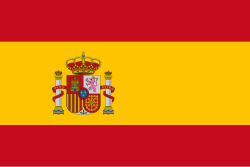
The national flag of Spain, known as la Rojigualda, features three horizontal stripes of equal height: red at the top and bottom, with a central yellow stripe twice the width of the others, and the national coat of arms centered on the yellow field. Adopted for naval vessels on May 28, 1785, by King Charles III via royal order to distinguish Spanish ships from enemy vessels during wartime, it was extended to merchant and land flags by 1793 and formalized as the sole national flag under the 1843 Law of Flags.[13] The coat of arms of Spain comprises a quartered shield: the first and fourth quarters display gules, a silver castle on gold for Castile; the second and third quarters show argent, a purple lion rampant on gold for León. A central escutcheon bears the chains of Navarre in red on gold, superimposed over the red pomegranate of Granada with green leaves and crown. Flanking the shield are the Pillars of Hercules in gold, entwined by a silver scroll with the Latin motto Plus Ultra, evoking Spain's maritime expansion beyond traditional limits after Columbus's 1492 voyage. Approved in its current form by Law 33/1981 of October 30, the coat of arms symbolizes the historic union of Spain's medieval kingdoms under the Catholic Monarchs in 1479–1492.[13] The national anthem, Marcha Real (Royal March), consists of instrumental music without official lyrics, tracing its origins to a 1761 arrangement by Manuel de Espinosa de los Monteros for infantry regiments, later adapted as a state anthem in 1770 under Charles III. It received its present orchestration in 1908 and was regulated by Royal Decree in 1928, with ceremonial protocols established under Organic Law 7/1981. Performed at official events, it underscores Spain's monarchical heritage without textual commitments that could alienate its diverse regions.[13] Beyond official emblems, traditional symbols contribute to Spanish identity, including the fighting bull (toro bravo), emblematic of bullfighting traditions codified in the 18th century and rooted in Iberian pastoral practices from antiquity, representing valor and cultural continuity despite ongoing debates over its ethics. The imperial eagle (águila imperial), associated with Roman Iberia and Habsburg rule from 1516–1700, appears in historical heraldry as a mark of sovereignty. The monarchy itself, embodied by King Felipe VI since June 19, 2014, serves as a unifying institution per the 1978 Constitution, symbolizing permanence amid Spain's 17 autonomous communities with distinct regional flags and identities forged from pre-unification kingdoms. These elements collectively reflect a national identity centered on historical unification, Catholic legacy from the 1492 Reconquista completion, and global imperial reach, while accommodating strong regional particularisms that trace to Visigothic, Muslim, and medieval eras, as evidenced by persistent autonomist sentiments in Catalonia and the Basque Country since the 1978 devolution.Geography of Spain
Geopolitical location
Spain is situated primarily on the Iberian Peninsula in southwestern Europe, encompassing approximately 85% of the peninsula's area, with its mainland geographic coordinates centered at 40°00′N 4°00′W.[14] The country shares land borders totaling 1,928 km with Portugal to the west (1,214 km), France to the northeast across the Pyrenees mountains (623 km), the Principality of Andorra (an enclave within the Pyrenees), and the British Overseas Territory of Gibraltar (1.2 km) at the southern tip.[15] Its peninsular territory is bounded by the Atlantic Ocean to the northwest and southwest, the Mediterranean Sea to the east and southeast, and the Strait of Gibraltar to the south, providing strategic maritime access between the Atlantic and Mediterranean.[16] Spain also administers overseas territories that extend its geopolitical footprint. These include the Canary Islands, an archipelago of seven main islands located 100–400 km off the northwestern coast of Africa in the Atlantic Ocean, and the Balearic Islands in the western Mediterranean. Additionally, the autonomous cities of Ceuta and Melilla are Spanish enclaves on the North African coast, bordering Morocco; Ceuta has been under Spanish control since 1415 when acquired from Portugal, while Melilla was established as a Spanish presidio in 1497.[5][17] These North African territories, covering about 32 km² combined, form the European Union's only land borders with Africa and are subjects of ongoing territorial disputes with Morocco, which claims them as integral parts of its territory despite historical treaties affirming Spanish sovereignty.[18] Geopolitically, Spain's location positions it as a critical southern flank for NATO, of which it has been a member since 1982, hosting key Allied facilities such as the U.S. Navy's Aegis Ashore site and four destroyers at Rota Naval Station, which contribute to NATO's ballistic missile defense architecture.[19] As a founding member of the European Union since 1986, Spain benefits from and influences integrated European security policies, while its control over the Strait of Gibraltar—through which 20-25% of global maritime trade passes—underscores its role in securing vital sea lanes connecting Europe to Africa and the Middle East.[19] This positioning has historically amplified Spain's influence in Mediterranean affairs and transatlantic relations, though it also exposes it to migration pressures from Africa and tensions over Gibraltar's status, where sovereignty remains disputed with the United Kingdom following the 1713 Treaty of Utrecht.[20]Physical features and terrain
Spain's terrain is dominated by the Meseta Central, a vast interior plateau covering approximately 210,000 square kilometers and comprising about 40 percent of the peninsular land area, with elevations averaging 660 meters and ranging from 610 to 760 meters.[21][22] This plateau, rimmed by rugged mountain ranges, is divided into northern and southern subregions by the east-west trending Sierra de Gredos and Sierra de Guadarrama of the Central System, contributing to Spain's overall average elevation of over 600 meters, higher than most European nations.[5] The Meseta's dissected surface features undulating plains, shallow depressions, and arid conditions in parts, shaped by tectonic uplift and erosion over millions of years. Encircling the Meseta are principal mountain systems formed during the Alpine orogeny: the Pyrenees in the north, extending 430 kilometers along the French border and peaking at Aneto (3,404 meters); the Cantabrian Mountains paralleling the northern coast, with elevations up to 2,648 meters at Torre Cerredo; the Iberian System in the northeast, reaching 2,313 meters at Moncayo; and the Baetic System in the southeast, including the Sierra Nevada, where Mulhacén rises to 3,478 meters, the highest point on mainland Spain.[23][24] These ranges, often exceeding 2,000 meters, create barriers influencing local climates and isolating the interior plateau. Low coastal plains fringe much of the 4,964-kilometer coastline, contrasting with steep cliffs in areas like the Bay of Biscay and volcanic shores of the Canary Islands.[1] Offshore territories add further topographic diversity: the Balearic Islands in the Mediterranean, with low-relief limestone karst landscapes rising to 1,445 meters on Mallorca's Puig Major; and the Canary Islands in the Atlantic, predominantly volcanic archipelagos featuring rugged peaks, lava fields, and calderas, culminating in Teide (3,718 meters) on Tenerife, Spain's tallest summit and a dormant stratovolcano.[6] Major rivers, including the Ebro (910 kilometers, draining northeast), Tagus (1,007 kilometers, central), Duero (895 kilometers, north), Guadiana (829 kilometers, southwest), and Guadalquivir (657 kilometers, south), originate in these highlands, carving fertile basins and emptying into the Atlantic or Mediterranean, with flows modulated by seasonal precipitation and dam infrastructure.[16] This varied physiography, resulting from plate tectonics, volcanic activity, and fluvial erosion, underpins Spain's regional ecological and economic differences.[5]Climate and natural environment
Spain's climate is highly diverse, shaped by its topography, latitude, and maritime influences from the Atlantic Ocean and Mediterranean Sea, resulting in multiple Köppen classifications including oceanic (Cfb), Mediterranean (Csa/Csb), and semi-arid steppe (BSk). The northern coastal areas, such as Galicia and the Basque Country, experience an oceanic climate with mild winters averaging 8–12°C and summers around 20–25°C, accompanied by high annual precipitation exceeding 1,000 mm, often distributed evenly throughout the year.[25][26] In contrast, central inland regions like the Meseta exhibit a continental Mediterranean climate with greater temperature extremes: winters can drop below 0°C in places like Madrid, where January averages 5.5°C, while July highs frequently surpass 30°C, with annual rainfall around 400 mm concentrated in spring and autumn. Southern and eastern coastal zones follow a hot-summer Mediterranean pattern (Csa), characterized by dry, hot summers with averages over 25°C in Andalusia—Seville records July means of 28°C and occasional peaks above 40°C—and mild, wetter winters with about 500–600 mm of annual precipitation, mostly from October to April. The Canary Islands, off northwest Africa, maintain a subtropical climate (Cfb/BSk) with stable temperatures year-round (18–25°C) and low rainfall under 300 mm annually, moderated by trade winds and the surrounding ocean. These variations drive distinct seasonal patterns, including frequent heatwaves in summer and occasional heavy storms or snow in mountainous interiors. The natural environment reflects this climatic heterogeneity, encompassing temperate forests in the humid north, sclerophyllous woodlands and scrublands (maquis and garrigue) in Mediterranean areas, and steppe-like grasslands in arid interiors, with over 27% of terrestrial land designated as protected areas including 15 national parks covering more than 325,000 hectares. Under undisturbed conditions, much of the mainland would support broadleaf and coniferous forests, but historical deforestation and agriculture have reduced forest cover to about 37% of land area, concentrated in the northwest and Pyrenees. Rivers like the Ebro and Tagus sustain riparian ecosystems, while coasts feature diverse habitats from dunes to cliffs, though the Balearic and Canary archipelagos host unique endemic flora adapted to insular conditions.[5][27][28] Environmental pressures include intensifying drought and desertification, affecting up to 74% of territory, particularly in the southeast where soil degradation and reduced rainfall—down 20% in some areas since the mid-20th century—exacerbate aridity, driven by climate variability, overexploitation of aquifers, and land-use changes. Recent data indicate shifts toward warmer steppe climates in parts of the interior, with prolonged dry spells increasing wildfire risk—over 400,000 hectares burned in 2022 alone—and threatening biodiversity, though conservation efforts via the Natura 2000 network, covering 27% of land and 12% of marine areas, mitigate some losses. Water scarcity remains acute, with reservoirs at historic lows in 2023–2024, prompting restrictions in regions like Catalonia and Andalusia.[29][30][31] Mountainous regions, such as the Sierra Nevada and Pyrenees, exhibit alpine influences with significant snowfall enabling winter sports, yet warming trends have reduced snowpack by 20–30% since 1950, altering hydrological cycles and ecosystems.[32]Biodiversity and ecological regions
Spain possesses one of Europe's highest levels of biodiversity, hosting approximately 8,000 vascular plant species, which constitute over 80% of the European Union total and 59% of the Mediterranean Basin's flora.[33] Endemism rates for vascular plants stand at 21% nationally, with 1,488 endemic species identified, rising to 25.9% in the Canary Islands due to their isolation and varied topography.[34] Fauna diversity includes 839 assessed vertebrate species, representing 46% of Europe's evaluated taxa, though 40-60% of assessed species face threats from habitat loss and climate change.[35][36] The mainland's ecological regions primarily fall within Mediterranean biomes, characterized by sclerophyllous forests and scrublands adapted to seasonal aridity, alongside temperate coniferous and mixed forests in northern and mountainous areas. Iberian conifer forests dominate central and southeastern ranges like the Sierra Nevada, supporting species such as Abies pinsapo (Spanish fir) with annual rainfall averaging 1,100 mm in higher elevations.[37] Northeastern Mediterranean forests extend into the Pyrenees, featuring oak (Quercus spp.) and beech (Fagus sylvatica) woodlands transitioning to alpine zones. Coastal wetlands and estuaries, including the Ebro Delta, harbor diverse avifauna and aquatic species, while the meseta plateaus sustain steppe-like grasslands with endemic herbs. The Canary Islands form a distinct Macaronesian ecoregion, with laurel forests (laurisilva) on humid northern slopes of islands like La Gomera, comprising relict subtropical species such as Laurus azorica and endemic birds including the blue chaffinch (Fringilla teydea).[35] The Balearic Islands feature Mediterranean mixed forests with high plant endemism (103 species), including Pinus halepensis pinewoods and gypsum dunes supporting unique invertebrates. These insular regions exhibit elevated speciation due to geographic isolation, contrasting the mainland's connectivity-driven diversity. Conservation efforts cover 28% of terrestrial and 12.7% of marine areas under protected status, including Natura 2000 sites safeguarding 605 species and 122 habitats, yet ongoing declines underscore pressures from urbanization and invasive species.[38][39] Key threatened fauna include the Iberian lynx (Lynx pardinus), Cantabrian brown bear (Ursus arctos), and Spanish imperial eagle (Aquila adalberti), with habitat fragmentation as a primary causal factor.[33]Administrative and regional divisions
Spain's territorial organization is structured as a decentralized unitary state, divided primarily into 17 autonomous communities and 2 autonomous cities, each with defined powers under the 1978 Constitution.[40] This framework grants varying levels of self-governance, including legislative authority over education, health, and regional planning, while central government retains control over defense, foreign affairs, and monetary policy.[41] The system emerged from the transition to democracy post-Franco, accommodating regional identities, particularly in areas like Catalonia and the Basque Country with historical claims to distinct legal traditions.[42] Autonomous communities operate with unicameral parliaments, elected governments headed by a president, and statutes of autonomy that outline their competencies.[43] The two autonomous cities, Ceuta and Melilla, located on the North African coast, function similarly but with limited territorial scope and direct central oversight in certain areas due to their strategic positions.[40] As of January 1, 2023, these divisions encompassed Spain's population of approximately 47.4 million, with Andalusia being the most populous autonomous community.[44]| Autonomous Community | Capital | Provinces | Population (2023) |
|---|---|---|---|
| Andalusia | Seville | 8 | 8,696,038 |
| Aragon | Zaragoza | 3 | 1,368,954 |
| Asturias | Oviedo | 1 | 1,016,995 |
| Balearic Islands | Palma | 1 (insular) | 1,236,413 |
| Basque Country | Vitoria-Gasteiz | 3 | 2,252,980 |
| Canary Islands | Las Palmas de Gran Canaria (de facto) | 2 (insular) | 2,202,338 |
| Cantabria | Santander | 1 | 594,586 |
| Castilla-La Mancha | Toledo | 5 | 2,112,061 |
| Castile and León | Valladolid (de facto) | 9 | 2,377,242 |
| Catalonia | Barcelona | 4 | 7,945,080 |
| Community of Madrid | Madrid | 1 | 6,802,052 |
| Extremadura | Mérida | 2 | 1,056,529 |
| Galicia | Santiago de Compostela | 4 | 2,659,361 |
| La Rioja | Logroño | 1 | 316,319 |
| Navarre | Pamplona | 1 | 672,380 |
| Region of Murcia | Murcia | 1 | 1,564,251 |
| Valencian Community | Valencia | 3 | 5,134,775 |
| Ceuta (Autonomous City) | Ceuta | - | 85,147 |
| Melilla (Autonomous City) | Melilla | - | 86,476 |
Demographics of Spain
Population size and trends
Spain's population stood at 49,315,949 inhabitants as of 1 July 2025, reflecting a quarterly increase of 119,811 people primarily from immigration inflows.[49] This figure surpassed the 49 million milestone for the first time earlier in 2025, up from 48.7 million at the end of 2024, with net migration accounting for nearly all growth amid persistent negative natural increase (births minus deaths).[50][51] The country's demographic trends reveal a structural imbalance: total fertility rate (TFR) hovered at 1.16 children per woman in 2022, well below the replacement level of 2.1, with births totaling around 328,700 that year.[52] Deaths have exceeded births every year since at least 2013, widening the gap—by 2023, births were 100,000 fewer and deaths 43,000 higher than a decade prior—exacerbating an aging population where the over-65 cohort grows faster than younger groups.[53] INE projections for 2024–2038 forecast only 5.5 million births, an 8.7% decline from the prior 15 years, signaling sustained low fertility absent policy shifts or cultural changes boosting native birth rates.[54] Net migration has offset these declines, with 324,000 long-term immigrants arriving in 2022 (a 27% rise from 2021) and net inflows exceeding 600,000 annually in recent years, predominantly from Latin America, North Africa, and Eastern Europe.[55][56] Without such inflows, the native-born population would contract sharply; projections indicate foreign-born residents comprising up to 26.8% of prime working-age (25–54) individuals by 2024, underscoring migration's role in sustaining workforce size and overall numbers.[57] Long-term forecasts from INE suggest population stabilization or modest growth through 2074 hinges on continued high migration, as native demographics trend toward contraction due to below-replacement fertility and rising life expectancy.[54]Ethnic and cultural composition
Spain's population is predominantly composed of ethnic Spaniards, descendants of a mix of pre-Roman Iberian peoples, Celts, Romans, Visigoths, and medieval Muslim and Jewish influences, with regional ethnic distinctions rooted in historical kingdoms and linguistic isolates.[58] The central Castilian group forms the numerical core, but distinct identities persist among Catalans (concentrated in Catalonia, with a population of approximately 7.5 million), Basques (about 2.2 million in the Basque Country and Navarre, speaking the non-Indo-European Euskara language of uncertain origins), and Galicians (around 2.7 million, with Celtic linguistic ties).[59] These groups maintain cultural autonomy through co-official languages and traditions, though intermarriage and urbanization have blurred boundaries; for instance, genetic studies indicate high homogeneity across peninsular Spain, with Basque isolation as a notable exception due to endogamy.[60] Immigration has diversified the ethnic landscape since the late 20th century, with foreign-born residents reaching 18.1% of the total population (about 8.8 million out of 48.6 million) as of January 2024, up from negligible levels pre-1990s.[61] Major groups include Latin Americans (e.g., Colombians and Venezuelans, leveraging shared language and historical ties, comprising over 40% of immigrants), North Africans (primarily Moroccans at around 1 million), Romanians (about 600,000), and smaller cohorts from sub-Saharan Africa, Eastern Europe, and Asia.[62] Naturalization rates are high among Ibero-Americans, reducing visible foreign nationality to 12.7% in 2023 census data, but cultural enclaves persist in urban areas like Madrid and Barcelona, where Moroccans form 10-15% of some neighborhoods.[59] The Roma population, estimated at 750,000-1 million (1.5-2% nationally), represents an indigenous minority with distinct nomadic heritage, facing socioeconomic marginalization despite legal protections.[58] Culturally, Castilian Spanish unifies 99% of the population as the official language, but regional co-official tongues underscore ethnic pluralism: Catalan (spoken by 17% or ~8 million, mainly in Catalonia and the Balearic Islands), Galician (6% or ~2.8 million), and Basque (1.5% or ~700,000 native speakers).[60] Bilingualism is widespread in these areas, with 95% of Catalans understanding Catalan, though English and immigrant languages like Arabic add layers in multicultural cities.[63] Religion remains a cultural marker, with Roman Catholicism historically dominant (shaping festivals like Semana Santa and architecture), claimed by 60-70% in surveys, but active practice has declined to under 20% weekly attendance amid secularization.[64] Muslim adherents, at 2-4% (~1-2 million, mostly from recent Moroccan and Pakistani immigration), and small Protestant, Orthodox, and Jewish communities (under 1% each) reflect demographic shifts, with Islam's growth tied to fertility rates twice the national average.[65]| Ethnic/Regional Group | Approximate Population | Key Cultural Markers |
|---|---|---|
| Castilians/Andalusians (central/southern) | ~20-25 million | Spanish language, flamenco, bullfighting traditions[58] |
| Catalans | 7.5 million | Catalan language, sardana dance, industrial heritage[60] |
| Basques | 2.2 million | Euskara language, pelota sports, strong communal identity[63] |
| Galicians | 2.7 million | Galician language, bagpipe music (gaita), Celtic folklore[60] |
| Roma | 0.75-1 million | Romani language/dialects, nomadic customs, flamenco influences[58] |
| Foreign-born (various) | 8.8 million | Diverse languages/religions, urban concentrations[61] |
Migration patterns and urbanization
Spain's migration patterns transitioned from net emigration to net immigration over the 20th century. Between the mid-19th and mid-20th centuries, approximately 2.5 million Spaniards emigrated, primarily to Latin American former colonies and European destinations, driven by economic hardships and industrialization abroad.[66] This outflow reversed in the late 20th century as Spain's economic growth attracted inflows, with the foreign-born population rising from under 1% in 1981 to over 15% by the 2010s, fueled by EU enlargement and demand for low-skilled labor in construction and services.[66] Recent decades show volatile net migration influenced by economic cycles. Following the 2008 financial crisis, Spain experienced temporary net emigration as unemployment peaked above 25%, prompting outflows of both natives and prior immigrants to northern Europe.[55] Recovery post-2014 led to renewed inflows, with net external migration reaching 642,296 in 2023, down from higher 2022 levels but still contributing significantly to population growth amid sub-replacement fertility.[67] In 2022, Spain recorded 299,779 net migrants, reflecting a 107% increase from 2021, while 2023 saw 1,251,000 total immigrants, second only to Germany in the EU.[68][69] As of January 2024, third-country nationals numbered over 7.2 million, comprising about 15% of the population, with major origins including Morocco, Colombia, Venezuela, and Romania; irregular arrivals via the Canary Islands surged in recent years, prompting policy debates on border management.[70][55] Urbanization has advanced rapidly since the mid-20th century, driven by internal rural-to-urban migration and economic opportunities in coastal and central hubs. The urban population share grew from 75.4% in 1990 to 81.6% by 2023, reaching 81.8% in 2024, concentrating over 80% of residents in cities and metropolitan areas.[71][72] Madrid and Barcelona alone host about 12% of the national population, with internal migration flows historically depleting rural provinces—particularly in inland Spain—while bolstering urban labor markets; net internal gains favor high-density regions like Catalonia and Madrid.[73][74] This pattern exacerbated rural depopulation, though temporary reversals occurred during the COVID-19 pandemic, with in-migration to low-density areas near cities rising in 2020 due to remote work and second homes.[75] Overall, urbanization correlates with higher productivity but strains housing and infrastructure in megacities, where immigrant settlement amplifies density.[76]Vital statistics and aging society
Spain exhibits one of the lowest fertility rates in the world, with the total fertility rate reaching 1.12 live births per woman in 2023, well below the replacement level of 2.1 required for population stability absent migration.[77] [78] This figure reflects a persistent decline, driven by factors including delayed childbearing, economic pressures, and cultural shifts toward smaller families, as documented in official demographic records. The crude birth rate stood at 6.61 births per 1,000 inhabitants in 2023, with 320,656 live births registered—a 2.6% decrease from 2022.[79] [78] Mortality rates remain low relative to historical norms, underscoring Spain's advanced healthcare system and high living standards. The crude death rate was 8.96 deaths per 1,000 inhabitants in 2023, with the number of deaths falling 6.1% from the prior year, yielding a negative natural population increase of approximately -2.35 per 1,000.[79] [78] Life expectancy at birth averaged 83.77 years in 2023, among the highest globally, with women outliving men by about six years based on consistent patterns in national data.[78] Regional variations exist, with Madrid recording 86.1 years in recent EU data.[80] These dynamics have fostered a rapidly aging society, characterized by a shrinking working-age population and increasing elderly dependency. In 2024, individuals aged 65 and older comprised 20.4% of Spain's population, up from prior years and exceeding the EU average of 21.6% for the bloc as a whole.[81] [82] The old-age dependency ratio—measuring persons 65+ relative to those aged 15-64—has risen accordingly, straining pension systems and public services, as low fertility fails to replenish the labor force while extended lifespans prolong retirement periods.[83] Projections indicate this trend will intensify, with the proportion of seniors potentially reaching 21.6% or higher by 2025 absent policy interventions to boost natality or sustain immigration.[84]| Indicator | 2023 Value | Source |
|---|---|---|
| Total Fertility Rate | 1.12 births per woman | INE/Eurostat[78] [77] |
| Crude Birth Rate | 6.61 per 1,000 | INE[78] |
| Crude Death Rate | 8.96 per 1,000 | INE[78] |
| Life Expectancy at Birth | 83.77 years | INE[78] |
| Population 65+ (%) | 20.4% (2024) | Eurostat[81] |
Government and politics of Spain
Constitutional framework and monarchy
Spain's constitutional framework is defined by the Constitution of 1978, which was drafted following the death of Francisco Franco in 1975 and approved by the Cortes Generales on 31 October 1978 before ratification via national referendum on 6 December 1978, entering into force on 29 December 1978.[85][86] The document establishes Spain as a social and democratic state governed by the rule of law, with national sovereignty residing in the Spanish people, from whom all state powers derive.[87] It enshrines principles of freedom, justice, equality, and political pluralism, while affirming the indissoluble unity of the Spanish Nation alongside the right to autonomy for nationalities and regions within Spain.[87] The Constitution designates Spain as a parliamentary monarchy, where the monarch serves as Head of State but wields no executive authority independent of the elected branches of government.[87] Article 56 delineates the King's role as the symbol of the state's unity and permanence, tasked with arbitrating and moderating the regular functioning of institutions to ensure their stability and continuity.[88] Specific functions include sanctioning and promulgating laws, summoning and dissolving the Cortes Generales, calling elections, proposing a candidate for President of the Government, declaring war or peace on government proposal, exercising supreme command of the Armed Forces, exercising the right of clemency, and performing ceremonial duties such as accrediting ambassadors.[88] These powers are strictly delimited by the Constitution and applicable laws, rendering the monarchy ceremonial in nature; the King acts solely in accordance with the Constitution, and most royal actions require countersignature by the responsible government ministers, who bear political responsibility while the monarch enjoys inviolability and immunity.[88][87] Succession to the throne follows the order of primogeniture with male preference among the descendants of King Juan Carlos I, extending to his sisters and their descendants if the direct line fails, with the monarch required to be Catholic and profess loyalty to the Constitution upon accession.[87] King Felipe VI ascended to the throne on 19 June 2014 following the abdication of his father, Juan Carlos I, who had reigned since 1975 and played a pivotal role in the democratic transition.[89] Under Felipe VI, the monarchy has maintained its constitutional bounds, focusing on representational duties amid public scrutiny over past royal finances, though institutional trust has stabilized without altering the framework's core limitations on monarchical power.[90] The system's design ensures parliamentary supremacy, with the executive and legislative powers vested in the Government and Cortes Generales, respectively, subordinating the Crown to democratic accountability.[87]Executive and legislative branches
The executive power in Spain is vested in the Government, which comprises the President of the Government (also known as the Prime Minister), any Vice-Presidents, and the Ministers, all appointed by the King on the proposal of the President.[40] The Government holds responsibility for directing domestic and foreign policy, exercising executive authority, managing civil and military administration, and ensuring the defense of the State, as outlined in Article 97 of the 1978 Spanish Constitution.[91] The President of the Government, currently Pedro Sánchez of the Spanish Socialist Workers' Party since his investiture on June 2, 2018, leads the Council of Ministers and is politically accountable to the Congress of Deputies; the King proposes candidates for President after general elections or government dissolution, requiring an absolute majority vote of confidence in the Congress within two months, or the Government falls.[40][91] The legislative power is exercised by the Cortes Generales, a bicameral parliament consisting of the Congress of Deputies (lower house) and the Senate (upper house), which represent the Spanish people and hold authority over legislation, budgets, and oversight of the Government.[92] The Congress of Deputies comprises 350 members elected by proportional representation in multi-member constituencies for four-year terms, serving as the primary chamber for initiating and approving most bills, including organic laws requiring absolute majorities, and wielding decisive power to invest or dismiss the Government via motions of censure or confidence.[92] The Senate, with 266 members as of the 15th legislature (208 directly elected by plurality in provincial constituencies plus up to 58 appointed by regional assemblies), provides territorial representation and can amend or veto legislation, though the Congress may override Senate objections by simple or absolute majority as needed; both houses meet in joint session for specific functions like royal assent or declaring war.[93][92] The Cortes Generales' 15th term began on August 17, 2023, following the July 23 general election, reflecting Spain's pattern of fragmented majorities necessitating coalitions for governance stability.[94]Judicial system and rule of law
Spain's judicial system is established under the 1978 Constitution, which vests judicial power in independent judges and magistrates who are subject solely to the law and irremovable from their posts except through disciplinary proceedings or upon reaching retirement age. Justice is administered on behalf of the King through courts and tribunals organized by jurisdiction and territory, with the Supreme Court serving as the highest instance in civil, criminal, administrative, social, and military matters, except for constitutional issues handled by the separate Constitutional Court. The system emphasizes the principle of jurisdictional unity, with specialized courts for specific areas like administrative and labor disputes, while territorial courts include High Courts of Justice in each autonomous community, provincial courts (Audiencias Provinciales), and municipal courts (Juzgados de Primera Instancia).[95][96][97] The General Council of the Judiciary (Consejo General del Poder Judicial, CGPJ) is the constitutional body responsible for governing the judiciary, appointing judges to higher courts, inspecting courts, and ensuring independence, comprising 21 members: the President of the Supreme Court plus 20 vocales (12 judges and 8 jurists of recognized competence) elected by a three-fifths majority in the Congress of Deputies and Senate for five-year terms, then appointed by the King. However, the CGPJ has operated in a provisional status since its mandate expired in December 2018 due to repeated political deadlocks between major parties, preventing renewal and halting key appointments, including to the Supreme Court and Constitutional Court, as of October 2025. This impasse, criticized by a United Nations Special Rapporteur for undermining judicial governance and independence, stems from the parliamentary selection process, which incentivizes partisan obstruction to influence future judicial compositions.[98][99][100] On rule of law metrics, Spain scores 0.71 in the World Justice Project Rule of Law Index 2024, ranking 25th globally out of 142 countries and 18th regionally among EU, EFTA, and North American peers, with strengths in order and security (ranked 35th) but weaknesses in constraints on government powers and absence of corruption. Perceptions of judicial independence remain low, with Spain placing 23rd in the EU's 2023 justice scorecard for public views on court and judge independence, amid concerns over political pressures, including government-proposed reforms perceived by judicial associations as threats to autonomy, prompting threats of strikes in 2025. Structural vulnerabilities, such as the political election of CGPJ members and delays in high-level appointments, have fueled criticisms that the system, while formally independent, faces practical erosion from partisan interference, particularly evident in handling politically sensitive cases like those involving regional separatism.[101][102][103]Political parties and electoral system
Spain's electoral system for national elections employs proportional representation for the Congress of Deputies, the lower house of the bicameral Cortes Generales, while the Senate uses a majoritarian system with territorial representation. General elections occur at least every four years or earlier if the government loses a confidence vote, with universal suffrage for citizens aged 18 and older.[104] The system, governed by the Representation of the People Organic Law (LOREG), allocates seats in multi-member constituencies corresponding to Spain's 50 provinces plus the autonomous cities of Ceuta and Melilla.[105] The Congress of Deputies comprises 350 seats elected via closed-list proportional representation using the d'Hondt method, which tends to favor larger parties due to its highest averages formula and the small size of many constituencies.[106] Each province guarantees at least two seats (one for Ceuta and Melilla), with additional seats distributed by population; there is a 3% threshold per constituency, but no national threshold, amplifying the role of regional parties in fragmented outcomes.[106] The Senate, with 266 seats in the current 15th legislature, elects 208 directly: four per province via a limited vote where electors choose up to three candidates from open lists, elected by plurality, plus additional seats for insular territories; the remaining 58 are indirectly elected by regional assemblies proportional to population.[93][107] This structure overrepresents rural and less populous provinces, contributing to malapportionment critiques.[108] Spain operates a multi-party system dominated by national parties but significantly influenced by regional ones, reflecting its decentralized structure. Following the July 2023 general election, the center-right People's Party (PP) holds the largest bloc with 136 seats in Congress, followed by the social-democratic Spanish Socialist Workers' Party (PSOE) with 121; the conservative-nationalist Vox has 33, and the left-wing Sumar coalition 31.[109] Regional parties, including the Basque Nationalist Party (PNV) with 5 seats, Republican Left of Catalonia (ERC) with 7, and Basque EH Bildu with 6, wield disproportionate leverage in minority governments, as seen in the current PSOE-Sumar administration reliant on their external support since November 2023.[109][110]| Party | Ideology | Congress Seats (2023) | Notes |
|---|---|---|---|
| PSOE | Social democracy | 121 | Governing party; led by Prime Minister Pedro Sánchez.[111] |
| PP | Conservatism, liberalism | 136 | Main opposition; center-right.[111] |
| Vox | Nationalism, conservatism | 33 | Advocates centralized state, immigration controls.[111] |
| Sumar | Left-wing, progressivism | 31 | Coalition including former Podemos; junior partner in government.[111] |
| ERC | Catalan independence, left | 7 | Key external supporter of government.[109] |
| PNV | Basque nationalism, centrist | 5 | Regional focus on autonomy.[109] |
Regional autonomy and separatist movements
The Spanish Constitution of 1978 established a decentralized territorial model comprising 17 autonomous communities and two autonomous cities (Ceuta and Melilla), granting varying degrees of self-government to accommodate regional identities and nationalities.[85] This framework recognizes the "indissoluble unity of the Spanish Nation" while allowing statutes of autonomy that devolve powers over education, health, policing, and taxation to regional parliaments and governments, with the Basque Country and Navarre enjoying fiscal autonomy through concierto económico arrangements dating to medieval foral rights.[87] The system emerged from post-Franco democratic transition negotiations to prevent centralist authoritarianism, but it has faced challenges from movements seeking full secession rather than enhanced autonomy.[113] Separatist sentiments have primarily manifested in the Basque Country and Catalonia, where historical grievances, linguistic distinctiveness, and economic disparities fuel demands for independence, though the Constitution prohibits unilateral secession and the Supreme Court has ruled such actions unconstitutional.[41] In the Basque Country, the armed group Euskadi Ta Askatasuna (ETA), founded in 1959 amid opposition to Franco's suppression of Basque culture, conducted a terrorist campaign for independence, resulting in over 800 deaths before announcing a permanent ceasefire in 2011 and fully disbanding in 2018.[114] Post-ETA, Basque nationalism persists through political parties like EH Bildu, which advocate sovereignty within a confederal framework, but public support for outright independence remains below 30 percent, with the region maintaining broad autonomy including its own police force and tax collection.[115] Catalonia's independence drive intensified after the 2008 financial crisis and a 2010 Constitutional Court ruling limiting the 2006 Statute of Autonomy, leading to mass protests organized by entities like the Catalan National Assembly.[116] The unauthorized 2017 referendum, deemed illegal by Spanish authorities, saw 90 percent vote in favor amid low turnout and police intervention to halt voting, prompting the Catalan parliament to declare independence briefly before suspension; the central government then invoked Article 155 to impose direct rule, dissolve the regional executive, and call elections.[117] By 2025, support for independence has declined from near-parity in 2017 to around 40 percent or less, reflected in electoral losses for separatist parties and a 2024 amnesty for convicted leaders, though recent breakdowns in coalition pacts with the national Socialist government underscore ongoing tensions without renewed momentum for secession.[118][119] Other regions exhibit milder nationalist sentiments without comparable separatist intensity; Galicia's Galician Nationalist Bloc pushes for greater fiscal powers and cultural promotion but garners independence support under 15 percent, prioritizing Celtic linguistic revival over rupture.[120] In Valencia and elsewhere, regionalism focuses on identity preservation rather than separation, with no organized movements achieving electoral viability for independence referenda.[121] These dynamics highlight how economic contributions to the national budget—Catalonia and the Basque Country as net contributors—interact with identity politics, yet judicial and fiscal safeguards reinforce Spain's unitary framework against fragmentation.[113]Foreign relations and international alliances
Spain's foreign policy prioritizes multilateralism, with a focus on strengthening the European Union as a geopolitical actor, maintaining transatlantic ties, and fostering relations with Latin America and Mediterranean neighbors. The 2025-2028 Foreign Action Strategy emphasizes a more autonomous, ambitious, and cohesive EU at its core, alongside strategic partnerships globally.[122] Spain has been a member of the European Union since 1 January 1986, following ratification of its accession treaty, and adopted the euro as its currency on 1 January 1999 while participating in the Schengen Area for border-free travel. It plays an active role in EU decision-making, advocating for deeper integration in foreign and security policy, including support for Ukraine against Russian aggression. In 2025, Spain committed €1 billion in military aid to Ukraine, including participation in NATO-led procurement of U.S. weapons, and pledged ongoing support until a "just and lasting peace" is achieved.[123][124] As NATO's 16th member since 30 May 1982, Spain reintegrated into the alliance's military command structure in 1999 and contributes to collective defense, including hosting U.S. forces at bases in Rota and Morón. Defense spending has risen toward the 2% GDP target, reflecting commitments amid debates over alliance burdensharing, with former U.S. President Trump in 2025 floating the idea of expelling Spain for insufficient contributions. Spain maintains close alliance with the United States based on shared democratic values and security cooperation.[125][19][126][127] Bilateral relations with the United Kingdom improved post-Brexit through a 2025 strategic framework and an EU-UK agreement on Gibraltar, ensuring mobility arrangements with Spain conducting Schengen controls and Gibraltar retaining internal checks. The long-standing sovereignty dispute over Gibraltar persists, however, complicating full resolution. Ties with Morocco emphasize pragmatic cooperation on migration and counterterrorism but face strains over territorial claims, including Ceuta, Melilla, and the Western Sahara; Spain's 2022 endorsement of Morocco's autonomy plan for the disputed territory marked a policy shift from prior neutrality, drawing domestic criticism from opposition parties advocating restoration of impartiality.[128][129][130][131] Spain nurtures extensive links with Latin America through the Ibero-American Community, promoting economic, cultural, and political ties via annual summits; it will host the 30th Ibero-American Summit in 2026, coinciding with the community's 35th anniversary. This framework underscores Spain's preference for multilateral engagement over purely bilateral approaches in the region. Emerging strategic partnerships include China, designated as a key actor in the 2025-2028 strategy, and alliances with India for global challenges.[132][133][134][135]Military and national defense
Spain's armed forces consist of the Army, Navy, Air and Space Force, Common Corps and Military Emergency Unit, and the Civil Guard, which functions as a gendarmerie with military status, totaling approximately 133,000 active personnel, 15,000 reservists, and 78,000 paramilitary forces as of 2025.[136] The forces transitioned to an all-volunteer professional structure in 2001, eliminating compulsory conscription, and operate under the Ministry of Defence, with the King serving as supreme commander.[137] Spain ranks 17th globally in military power according to assessments factoring manpower, equipment, logistics, and finances.[137] Defense spending reached 1.24% of GDP in 2024, the lowest among NATO members, amounting to about €17.2 billion, prompting internal and allied pressure for increases amid geopolitical tensions.[138] In June 2025, Spain agreed to allocate 2.1% of GDP to defense, targeting NATO's 2% guideline by that year through a €10.5 billion budget hike, though it rejected higher alliance proposals for 5% amid domestic fiscal constraints and differing threat perceptions.[139] [126] This includes a €34 billion multi-year investment plan through 2037 for procurement and infrastructure, emphasizing dual-use technologies and deterrence.[140] Modernization efforts focus on enhancing interoperability and expeditionary capabilities within NATO frameworks, including the Army's Fuerza 2035 restructuring into modular combat groups of 2,800–3,000 personnel each for rapid deployment.[141] Key acquisitions encompass 214 self-propelled howitzers in a €3 billion artillery program, upgrades to Saab Arthur radars via a $57 million NATO contract, and increased U.S. arms purchases reaching $2.907 billion in 2024 for systems like F-35 fighters and naval vessels.[142] [143] [144] Plans call for expanding active personnel by 20,000 over the next decade to 140,000, addressing recruitment shortfalls and high operational tempo.[145] National defense strategy, outlined in the 2021 National Security Strategy, prioritizes hybrid threats, terrorism, cyber risks, and territorial integrity over mass mobilization, integrating NATO, EU, and bilateral commitments. Core focuses include defending overseas territories like Ceuta, Melilla, and the Canary Islands against potential Moroccan incursions, maintained via permanent garrisons and deterrence reliant on alliance escalation risks rather than independent high-intensity sustainment. The Strait of Gibraltar's control involves joint NATO exercises, while the unresolved sovereignty dispute with the United Kingdom over Gibraltar emphasizes diplomatic resolution within alliance structures, with Spanish forces conducting routine patrols.[146] Spain contributes to NATO missions in Latvia's battlegroup, maritime operations in the Mediterranean, and UN/EU deployments in Lebanon and Mali, underscoring a shift from territorial defense to collective security since joining NATO in 1982.[147]Political corruption and governance challenges
Spain has faced persistent political corruption, particularly involving embezzlement, bribery, and misuse of public funds in both major parties, the Partido Popular (PP) and the Partido Socialista Obrero Español (PSOE). According to Transparency International's Corruption Perceptions Index, Spain scored 56 out of 100 in 2024, reflecting moderate perceived public sector corruption and placing it below several Western European peers like Germany (78) and the Netherlands (79).[148] This score underscores systemic vulnerabilities, including opaque party financing and favoritism in public contracting, which have eroded public trust and contributed to governance inefficiencies.[149] The Gürtel scandal, uncovered in 2009, exemplifies corruption within the PP, involving a network led by Francisco Correa that secured public contracts in exchange for bribes totaling over €120 million from 1999 to 2005. In 2018, Spain's National Court convicted 29 individuals, including former PP treasurer Luis Bárcenas, sentencing them to a combined 351 years in prison for money laundering, bribery, and tax evasion; the PP itself was fined €240,000 as a beneficiary.[150] [151] The case, spanning regions like Madrid and Valencia, culminated in a 2018 no-confidence vote that ousted Prime Minister Mariano Rajoy.[152] PSOE-linked scandals have similarly plagued Andalusia, long a party stronghold. The ERE case involved the diversion of €680 million in early retirement funds from 2000 to 2010 to ineligible recipients, including union allies and companies, via opaque procedures. In 2019, a Seville court convicted 19 officials, including two former regional presidents (Manuel Chaves and José Antonio Griñán), of embezzlement and prevarication, with Griñán receiving six years in prison.[153] [154] Recent PSOE cases under Prime Minister Pedro Sánchez include the 2024 Koldo scandal, where former minister José Luis Ábalos and aide Koldo García allegedly took €1.5 million in bribes for mask contracts during the COVID-19 pandemic, prompting investigations by the Supreme Court and parliamentary probes.[155] Governance challenges compound these issues, with bureaucratic red tape and inefficiency hampering economic recovery and public services; Spain ranks low in World Bank ease-of-doing-business metrics due to protracted permitting and administrative delays.[156] Judicial politicization exacerbates enforcement gaps, as the General Council of the Judiciary has been in deadlock since 2018 over partisan disagreements on appointments, leaving vacancies and fueling perceptions of interference—Spain scored 23rd in the EU for judicial independence in 2023.[102] This impasse, coupled with regional autonomy enabling localized graft, has delayed anti-corruption reforms and intensified political polarization, hindering cohesive policy-making.History of Spain
Prehistoric and ancient Iberia
Human occupation of the Iberian Peninsula began in the Lower Paleolithic, with stone tools and faunal remains at Sima del Elefante in the Atapuerca Mountains dated to approximately 1.2 million years ago, associated with early Homo species migrating from Africa.[157] Subsequent finds at Gran Dolina include Homo antecessor fossils from 772,000 to 949,000 years ago, evidencing systematic butchery and possible cannibalistic practices among these hominins.[157] Neanderthals occupied the region until around 42,000 years ago, after which a gap in central Iberian evidence persists until modern Homo sapiens arrival circa 42,000–26,000 years ago, marked by Aurignacian tools and later Solutrean and Magdalenian cultures.[158] Upper Paleolithic art flourished, exemplified by the polychrome bison paintings in Altamira Cave, radiocarbon-dated to between 35,000 and 15,200 years ago, demonstrating advanced symbolic expression and ochre use.[159] The Mesolithic period featured hunter-gatherer adaptations to post-glacial environments, transitioning to the Neolithic around 5500 BCE via maritime diffusion from the eastern Mediterranean, introducing Cardial impressed pottery, domesticated cereals, sheep, and cattle at coastal sites like Cova de l'Or.[160][161] Chalcolithic developments (ca. 3500–2200 BCE) included copper metallurgy, megalithic dolmens for collective burials, and fortified villages such as Los Millares, reflecting emerging social hierarchies. The Bronze Age (ca. 2200–900 BCE) saw the El Argar culture dominate southeastern Iberia, with hilltop settlements, urn burials under house floors signaling patrilineal inheritance, and intensive copper-arsenic bronze production tied to mining; this society exhibited marked inequality, with elite female weapon burials indicating complex gender roles.[162] Genomic data reveal a major influx of steppe-related ancestry around 2500–2000 BCE, correlating with near-total replacement of local Y-chromosome lineages, likely via Indo-European-speaking migrants influencing metallurgy and social structures.[163] In the southwest, Tartessos emerged ca. 900–550 BCE near the Guadalquivir Valley, known from classical sources for silver and tin wealth, orientalizing art, and semi-urban centers, though its sudden decline remains unexplained beyond possible environmental or Carthaginian pressures.[164] The Iron Age (ca. 900–200 BCE) featured diverse pre-Roman peoples: non-Indo-European Iberians along eastern and southern coasts, with oppida like Saguntum, distinctive script, and warrior stelae; Celtiberians in the central meseta, blending Celtic migrations with local Iberian substrates in fortified towns and hallucinogenic rituals; and Lusitanians in the west, pastoralists resisting centralization.[165] Phoenician traders from Tyre established Gadir (Cádiz) ca. 1100–800 BCE, founding southern emporia for metals exchange, followed by Greek colonies like Emporion (575 BCE) introducing wine and ceramics.[166] Carthaginians, inheriting Phoenician footholds, intensified control after 237 BCE under Hamilcar Barca, allying with tribes against rivals.[167] Roman intervention commenced in 218 BCE amid the Second Punic War, with initial victories securing the northeast; Scipio Africanus expelled Carthaginians at the Battle of Ilipa in 206 BCE, partitioning Hispania into Citerior and Ulterior provinces by 197 BCE.[168] Prolonged resistance followed: Celtiberian revolts culminated in Scipio Aemilianus's siege of Numantia (134–133 BCE), ending with the city's destruction; Lusitanian leader Viriathus waged guerrilla warfare until assassinated in 139 BCE; Sertorius's republican insurgency (83–72 BCE) briefly unified northern tribes before Pompey's triumph.[168] Augustus completed subjugation via the Cantabrian Wars (29–19 BCE), incorporating the northern mountains through systematic campaigns and engineering, marking the peninsula's full integration into the Roman Republic despite demographic costs exceeding 100,000 combatants.[168]Medieval period: Visigoths, Muslim conquest, and Reconquista
Following the collapse of Roman authority in the early 5th century, Germanic tribes including the Visigoths entered Hispania as foederati allies, gradually establishing dominance over the peninsula by the mid-6th century. The Visigothic Kingdom, formalized under kings like Liuvigild (568–586), centralized power in Toledo and integrated with the Hispano-Roman elite through laws such as the Liber Iudiciorum (c. 654), which applied uniformly to Goths and Romans.[169] Internal stability increased after King Reccared I's conversion from Arian Christianity to Catholicism at the Third Council of Toledo in 589, where 62 bishops condemned Arianism and aligned Visigothic rule with the majority Nicene population, reducing religious tensions but imposing restrictions on Jews, including forced conversions and property seizures in later reigns.[170][171] The kingdom endured factional strife, noble revolts, and economic strains, including droughts exacerbating crises by the early 8th century, weakening central authority under the last king, Roderic (r. 710–711).[172] In April 711, Umayyad forces under Berber commander Tariq ibn Ziyad, dispatched by Governor Musa ibn Nusayr from Ifriqiya, landed at Gibraltar (named after Tariq, Jabal Tariq) with 7,000–12,000 troops, exploiting Visigothic civil war between Roderic and rivals like Achila II. Roderic's army of up to 25,000 was decisively defeated at the Battle of Guadalete (near the Río Barbate) in July 711, where Visigothic lines collapsed amid betrayals and tactical errors, leading to Roderic's death and the rapid fall of key cities like Toledo.[173][174] Musa reinforced with Arab contingents in 712, completing conquest by 718; most Visigothic nobles submitted as clients (wali governors installed), while pockets of resistance fled north, establishing Al-Andalus as an Umayyad province with Córdoba as capital, blending Arab-Berber rule over a majority Christian and Jewish population under dhimmi status paying jizya tax.[175] Initial tolerance allowed cultural flourishing, but conversions and enslavement followed military subjugation, with the frontier stabilized after the failed raid into Francia at Tours (732). The Reconquista, a protracted series of campaigns by northern Christian polities to reverse Muslim expansion, commenced with Pelagius (Pelayo), a Visigothic noble, defeating a Muslim punitive force at the Battle of Covadonga (c. 718–722) in Asturias' mountains, using terrain to ambush and kill commander Alqama, preserving a rump Christian kingdom amid tribute refusals.[176] Asturias evolved into León and spawned Castile, while Aragon and Navarre emerged eastward; intermittent advances relied on heavy cavalry, fortified frontiers (e.g., Duero Valley repopulation c. 9th–10th centuries), and papal indulgences framing warfare as crusade from the 11th century.[177] Al-Andalus peaked as the independent Umayyad Caliphate of Córdoba (929–1031) under Abd al-Rahman III, fostering advances in agronomy, medicine, and philosophy amid multi-confessional coexistence, but fragmented into taifas (party kingdoms) after 1031, inviting Christian incursions and North African interventions by Almoravids (1086–1147) and Almohads (1147–1269).[175] The decisive Battle of Las Navas de Tolosa (July 16, 1212) saw a Castilian-led coalition under Alfonso VIII shatter Almohad power, capturing caliph Muhammad al-Nasir's tent and enabling conquests like Córdoba (1236) and Seville (1248), reducing Muslim territory to the Nasrid Emirate of Granada.[178] Granada endured as a vassal state paying parias tribute until the Catholic Monarchs, Ferdinand II of Aragon and Isabella I of Castile, whose 1469 marriage unified efforts, besieged it from 1491; Emir Muhammad XII (Boabdil) surrendered on January 2, 1492, after internal Nasrid feuds and blockade-induced famine, marking the Reconquista's end with mass expulsions of Muslims and Jews, demographic shifts toward Christian homogeneity, and redirection of resources to Atlantic exploration.[179] This 700-year process, driven by feudal militarism, religious ideology, and opportunistic fragmentation of Muslim polities rather than unified strategy, reshaped Iberia's religious and political landscape, with Christian kingdoms absorbing mudéjar (Muslim subjects) labor while enforcing conversions or exile.[177]Early modern era: Exploration, empire, and Habsburg rule
The marriage of Isabella I of Castile and Ferdinand II of Aragon in 1469 laid the foundation for Spain's unification, as their joint rule over the two kingdoms created a dynastic union that centralized power despite retaining separate institutions.[180] Isabella ascended to Castile's throne in 1474 following a civil war against her niece Joanna, while Ferdinand secured Aragon in 1479 after his father's death, enabling coordinated policies like the establishment of the Spanish Inquisition in 1478 to enforce religious orthodoxy.[181] Their campaigns culminated in the conquest of the Nasrid Kingdom of Granada on January 2, 1492, ending seven centuries of Muslim rule on the Iberian Peninsula and completing the Reconquista.[180] In the same year, the monarchs sponsored Christopher Columbus's first transatlantic voyage, departing from Palos de la Frontera on August 3, 1492, with three ships and 87 men, reaching the Bahamas on October 12 and initiating Spanish claims over the Americas.[182] Subsequent expeditions, including Columbus's three additional voyages by 1504 and explorations by figures like Vasco Núñez de Balboa (who crossed Panama in 1513) and Ferdinand Magellan (whose 1519-1522 circumnavigation confirmed Earth's sphericity), expanded Spain's domain to include vast territories in the Caribbean, Mesoamerica, and the Pacific, justified by papal bulls like Inter caetera (1493) dividing the New World between Spain and Portugal.[183] The conquests of the Aztec Empire by Hernán Cortés (1519-1521) and Inca Empire by Francisco Pizarro (1532-1533) added Mexico and Peru, yielding immense silver from Potosí mines—estimated at over 150,000 tons extracted by 1800—fueling Spain's economy but also causing inflationary pressures.[184] Upon the death of Isabella in 1504 and Ferdinand in 1516, their grandson Charles I (also Holy Roman Emperor Charles V) inherited Spain in 1516, merging it into a sprawling Habsburg domain encompassing the Netherlands, Franche-Comté, Naples, Sicily, and the Americas, with a population exceeding 20 million in Europe alone by mid-century.[185] Charles's rule (1516-1556) involved suppressing revolts like the Comuneros (1520-1521) and defending against Ottoman incursions, while the 1521-1559 Italian Wars against France secured Milan but strained finances through constant mobilization of tercios infantry units.[186] Abdicating in 1556, Charles left to his son Philip II (1556-1598) a global empire at its zenith, controlling roughly 7.5 million square kilometers by 1580, including the Philippines via Miguel López de Legazpi's 1565 expedition, but burdened by debts exceeding 36 million ducats from Habsburg inheritance and wars.[187] Philip II centralized administration from Madrid (established as capital in 1561) and enforced Catholicism, annexing Portugal in 1580 after King Sebastian's death at Alcácer Quibir, temporarily uniting the Iberian Peninsula and its empires.[186] However, prolonged conflicts like the Dutch Revolt (1568-1648) and the 1588 Spanish Armada—130 ships and 30,000 men aimed at England—ended in defeat due to storms and English fireships, costing Spain over 40 vessels and marking a naval turning point without decisively altering Habsburg continental power.[188] Under Philip III (1598-1621) and Philip IV (1621-1665), expulsion of Moriscos (1609-1614, displacing 300,000) and involvement in the Thirty Years' War (1618-1648) exacerbated economic woes, with American silver inflows causing price revolutions—inflation rates of 1-2% annually—while expelling productive labor and failing to industrialize, leading to population stagnation from 8.5 million in 1594 to 7.5 million by 1650.[189] Charles II's death in 1700, childless and emblematic of dynastic inbreeding, ended Habsburg rule, sparking the War of the Spanish Succession and Bourbon ascension.[185]18th-19th centuries: Enlightenment, independence wars, and liberal struggles
The Bourbon monarchy, established after the War of the Spanish Succession (1701–1714), pursued administrative and economic reforms in the 18th century to centralize power and revive Spain's declining fortunes, drawing on Enlightenment principles of rational governance and efficiency. Charles III (r. 1759–1788), often regarded as an enlightened despot, implemented the "Caroline" reforms, which included streamlining colonial administration under intendants, expelling the Jesuits in 1767 to curb their influence, promoting free trade within the empire, and fostering infrastructure projects like roads and canals to boost agriculture and commerce. These measures aimed to extract greater revenue from the Americas and reduce clerical and noble privileges, though they met resistance from traditional elites and yielded mixed economic results, with Spain's GDP per capita lagging behind Britain and France by the century's end.[190][191] Napoleon's invasion in 1808 triggered the Peninsular War (1808–1814), known in Spain as the War of Independence, marking a pivotal struggle against French occupation and sparking early liberal constitutionalism. French forces, initially invited by Charles IV's court to resolve dynastic disputes, compelled the abdications of Charles IV and his son Ferdinand VII at Bayonne, installing Joseph Bonaparte as king; this betrayal ignited widespread revolts, forming local juntas that coordinated guerrilla warfare (guerrillas) alongside British-Portuguese armies under Wellington, culminating in French defeats at Vitoria (1813) and Toulouse (1814). Amid the chaos, the Cortes of Cádiz, convening in 1810, promulgated the Constitution of 1812 on March 19, establishing national sovereignty, unicameral legislature, universal male suffrage, press freedom, and limits on monarchical power, influencing liberal movements across Europe and Latin America while declaring Spanish colonies integral provinces.[192][193] Ferdinand VII's restoration in 1814 ushered in absolutist reaction, as he annulled the Cádiz Constitution via the Valencia decrees on May 4, dissolving the Cortes, exiling liberals, and reimposing feudal privileges, which fueled economic stagnation and colonial revolts leading to most American independences by 1825. A military pronunciamiento led by Rafael del Riego in January 1820 forced reinstatement of the 1812 Constitution, initiating the Liberal Triennium (1820–1823), during which radicals (exaltados) pushed agrarian reforms like disentailment of Church lands, though internal divisions between moderates and radicals hampered stability. French intervention in 1823, authorized by the Congress of Verona and executed by 100,000 troops under the Duke of Angoulême, crushed the liberals, enabling Ferdinand's ferocious Ominous Decade (1823–1833) of purges, including over 10,000 executions or exiles.[194][195] Ferdinand's death in 1833 without a male heir precipitated the Carlist Wars, embodying clashes between liberal constitutionalism and absolutist traditionalism. Liberals, supporting Isabella II under the 1830 Pragmatic Sanction reinstating female succession, enacted the 1837 Constitution granting limited suffrage and parliamentary monarchy, while confiscating Church properties to fund modernization; Carlists, backing Ferdinand's brother Carlos María Isidro, rallied rural, clerical, and Basque-Navarrese forces for divine-right monarchy, fuelling the First Carlist War (1833–1840) that killed over 100,000 and entrenched regional divides. Liberal victories, aided by British and French backing via the Quadruple Alliance, imposed progressive but unstable regimes, punctuated by further pronunciamientos and the Second (1846–1849) and Third (1872–1876) Carlist Wars, delaying Spain's full liberalization until the Restoration era.[196][197]20th century: Second Republic, Civil War, Franco regime, and democratic transition
The Second Spanish Republic, proclaimed on April 14, 1931, after King Alfonso XIII's resignation amid Republican gains in the April 12 municipal elections, introduced progressive reforms including secularization of education, agrarian redistribution, and women's suffrage in 1933.[198] These measures, however, exacerbated divisions: land seizures alienated conservatives, church burnings and anti-clerical violence in 1931-1933 killed thousands of clergy, and regional autonomy statutes fueled separatist tensions in Catalonia and the Basque Country.[199] Political instability marked the period, with left-wing coalitions giving way to a right-wing CEDA victory in November 1933 elections, a failed socialist uprising in October 1934 that killed hundreds, and the Popular Front's narrow win in February 1936, followed by assassinations and strikes that paralyzed governance.[200] The Spanish Civil War erupted on July 17-18, 1936, when military garrisons in Spanish Morocco and the peninsula rebelled against the Republican government, citing anarchy, revolutionary violence, and perceived communist threats as justifications.[201] The conflict pitted Republican loyalists—comprising socialists, communists, anarchists, and regionalists—against Nationalists led by General Francisco Franco, who unified rebel forces by October 1936. Foreign intervention tilted the balance: the Soviet Union supplied the Republicans with arms and advisors, while Nazi Germany and Fascist Italy provided aircraft, troops (over 50,000 Italians), and the Condor Legion for Nationalists, testing blitzkrieg tactics.[202] The war devastated Spain, with approximately 500,000 deaths, including 200,000 from systematic executions, mob violence, and reprisals—roughly equal on both sides, though Republicans targeted clergy and rightists early, while Nationalists conducted broader purges post-victory.[203] [204] It ended on March 28, 1939, when Madrid surrendered, allowing Franco to proclaim victory and establish a centralized dictatorship. Franco's regime, formalized in 1939, imposed authoritarian rule through the Falange single party, military tribunals, and suppression of dissent, executing or imprisoning tens of thousands in the immediate postwar years to eliminate perceived red threats.[205] Economic policy initially pursued autarky, yielding stagnation and rationing until the 1959 Stabilization Plan under Opus Dei technocrats liberalized trade, devalued the peseta, and attracted foreign investment, sparking the "Spanish Miracle" with annual GDP growth averaging 7% from 1960 to 1973, driven by industrialization, remittances from emigrants, and tourism.[206] This growth reduced poverty from 40% in the 1950s to under 20% by 1975 but masked inequalities, labor exploitation, and cultural repression, including bans on Basque and Catalan languages.[207] Franco's death on November 20, 1975, amid oil crises and regional unrest, ended the era without immediate collapse, as the regime had fostered technocratic stability over ideological purity.[208] The democratic transition began under King Juan Carlos I, whom Franco had designated successor in 1969, who rejected continuity by appointing reformist Adolfo Suárez as prime minister in 1976.[209] Key steps included the 1976 Political Reform Act, approved by Francoist Cortes, legalizing parties (except communists initially) and enabling free elections on June 15, 1977, won by Suárez's centrist UCD with 34% of votes.[210] The 1977 Amnesty Law pardoned political crimes, facilitating pacts like the Moncloa Accords for wage restraint and reforms amid 25% inflation. A seven-member commission drafted the 1978 Constitution, ratified by 88% in a December 6 referendum, establishing parliamentary monarchy, regional autonomies, and rights protections while prohibiting separatism.[211] [212] The process weathered the February 23, 1981, coup attempt by Civil Guard elements, thwarted by the king's televised loyalty to democracy, paving the way for PSOE's absolute majority in October 1982 elections and NATO entry in 1982.[213] This negotiated shift prioritized consensus over retribution, averting civil strife despite lingering divisions.[214]Contemporary history: EU integration, economic crises, and recent politics (post-2000)
Spain adopted the euro currency on January 1, 1999, as part of its deepening integration into the European Union, which facilitated increased trade and foreign direct investment from EU partners, with EU countries accounting for 74% of Spanish exports and 66% of imports by 2006.[215] This integration supported structural reforms and economic modernization, contributing to Spain's active role in EU policy-making, including multiple Council Presidencies and advocacy for eurozone consolidation and enlargement.[216] However, EU membership and euro adoption also amplified vulnerabilities during economic cycles, as low interest rates fueled a credit boom in the 2000s, leading to over-reliance on construction and real estate sectors that later precipitated severe downturns.[217] The 2008 global financial crisis triggered Spain's most acute economic contraction since the 1930s, with GDP shrinking by 3.8% in 2009 and unemployment surging from 8.2% in 2007 to a peak of 26.1% in 2013, driven by the collapse of a housing bubble that had accounted for over 30% of GDP growth in prior years.[218] Public debt-to-GDP ratio tripled from 36% in 2007 to over 100% by 2014, exacerbated by bank recapitalization needs amid non-performing loans from the real estate sector.[219] In June 2012, Spain received a €100 billion European bailout for its banking system, conditional on austerity measures, labor market reforms, and financial sector restructuring, which reduced unemployment to 14% by 2019 but sparked social unrest and political polarization.[220] The program concluded successfully in January 2014, enabling gradual recovery, though structural issues like high youth unemployment (over 40% in 2013) and regional disparities persisted.[221] Post-crisis politics shifted toward fragmentation, with José Luis Rodríguez Zapatero's PSOE government (2004–2011) implementing stimulus and social spending before austerity, followed by Mariano Rajoy's PP administration (2011–2018), which enforced EU-mandated reforms amid rising populism.[222] The 2017 Catalan independence referendum, declared illegal by Spain's Constitutional Court, led to a unilateral declaration of independence, prompting Rajoy to invoke Article 155 of the Constitution to suspend regional autonomy and call elections; this crisis contributed to Rajoy's no-confidence ouster in 2018.[223] Pedro Sánchez's PSOE minority government, formed in 2018 and re-elected in 2023 via coalitions with left-wing parties and regional nationalists, granted pardons to Catalan separatist leaders in 2021 and pursued amnesty deals, actions criticized for undermining national unity but defended as stabilizing measures.[224] The rise of Vox, a conservative party founded in 2013 opposing separatism and immigration, gained traction post-2018, entering coalitions with PP in regional governments and polling increases to around 15% by 2025, reflecting voter backlash against Sánchez's policies.[225] In Catalonia's May 2024 regional elections, pro-independence parties lost their parliamentary majority for the first time in over a decade, with PSOE-affiliated Socialists securing the most seats under Salvador Illa, signaling a decline in separatist momentum.[223] By late 2025, Sánchez's coalition faced instability after Junts per Catalunya (JxCat) withdrew support amid unfulfilled independence commitments, heightening risks of early national elections amid polls favoring PP-Vox alliances.[226]Economy of Spain
Macroeconomic indicators and growth patterns
Spain's nominal GDP reached approximately 1.72 trillion USD in 2024, with GDP per capita at around 35,297 USD.[227] Real GDP growth accelerated to 3.2% in 2024, outpacing the euro area average and marking Spain as one of the fastest-growing major developed economies, driven primarily by robust labor force expansion from immigration, tourism recovery, and consumer spending.[228] Projections for 2025 indicate continued expansion at 2.9%, though moderating to 2.0-2.6% in subsequent years amid potential fiscal tightening and external risks.[11] [229] Historically, Spain's economy underwent rapid industrialization and liberalization following the 1975 death of Francisco Franco, with average annual GDP growth exceeding 3% from 1986 EU accession through the early 2000s, fueled by foreign investment, export diversification, and construction-led expansion.[11] This period ended abruptly with the 2008 global financial crisis, which exposed vulnerabilities from an overheated real estate sector and excessive private debt; GDP contracted nearly 9% cumulatively from 2009 to 2013, unemployment surged to 27% by 2013, and public debt ballooned as fiscal deficits widened to finance bailouts and stimulus.[230] Recovery was protracted, averaging under 2% growth annually pre-COVID, hampered by austerity measures, banking sector deleveraging, and structural rigidities like high youth unemployment and low productivity relative to euro area peers.[231] The COVID-19 pandemic inflicted a 10.8% GDP drop in 2020, but Spain rebounded sharply post-2021, achieving 5.5% growth in 2021 and sustaining above-eurozone averages thereafter, with 2.5% in 2023.[232] Recent outperformance stems from demographic tailwinds—net migration adding over 500,000 workers annually—rather than productivity gains, which remain 10-15% below euro area levels, underscoring persistent challenges in innovation and capital efficiency.[228] [233] Key macroeconomic indicators reflect this trajectory:| Indicator | 2023 Value | 2024 Value | 2025 Projection |
|---|---|---|---|
| Real GDP Growth (%) | 2.5 | 3.2 | 2.9 |
| Unemployment Rate (%) | 12.1 | 11.4 | 10.5 |
| Inflation (CPI, %) | 3.4 | 2.8 | 2.4 |
| Public Debt (% of GDP) | 107.7 | 103.4 | 100.7 |
Primary and secondary sectors
The primary sector in Spain, encompassing agriculture, forestry, fishing, and mining, contributed approximately 2.2% to GDP in 2023, equivalent to €32.6 billion in gross value added.[235] This sector employs around 3.6% of the workforce, or roughly 800,000 people, reflecting its role in rural economies despite mechanization and urbanization trends.[236] Agriculture dominates, with output valued at €65.1 billion in 2023, driven by high-value crops amid volatile weather and input costs.[237] Spain ranks as a global leader in several agricultural products, including olives (world's top producer at over 5 million tonnes annually), citrus fruits (especially oranges and mandarins from Valencia and Murcia), grapes for wine (producing 6-7 million tonnes yearly), and vegetables like tomatoes and peppers.[238] Key regions include Andalusia for olives and strawberries, Extremadura for cork and pigs, and the Ebro Valley for cereals such as barley and wheat. Vegetable production rose 8.9% in 2023, offsetting a 1.3% decline in animal products, though overall farm income increased 14.2% to €37.8 billion in 2024 due to higher prices.[239] Fishing, concentrated in Galicia and the Cantabrian Sea, yields about 1 million tonnes annually, focusing on tuna, sardines, and cephalopods, but faces overexploitation and EU quota limits. Forestry remains marginal, with eucalyptus and pine for pulp, while mining—producing copper, tungsten, and aggregates—generated €3.57 billion in output, employing 30,000, primarily in Andalusia (35% of national production).[240] Challenges include drought-induced yield drops (e.g., 2022-2023 grain declines) and reliance on irrigation, exacerbating regional water disputes.[241] The secondary sector, including manufacturing, construction, and extractive industries beyond primary mining, accounts for roughly 21% of GDP, with manufacturing at about 11.5% and construction at 5.6%.[242] This sector employs around 15% of the labor force, supporting export-oriented growth but lagging EU productivity averages due to energy costs and regulatory hurdles. Manufacturing output grew modestly in 2023, with industrial value added up 2.4% year-over-year.[243] Key manufacturing subsectors include automotive (third-largest in Spain, with 18 plants from brands like Volkswagen-SEAT, Renault, and Ford producing 2.4 million vehicles in 2023, shifting toward electric models amid €14% investment rise), chemicals (output expanding 7.1% to €86.5 billion in sales projected for 2024, focusing on petrochemicals and pharmaceuticals), and food processing (tied to agriculture, processing olives, wines, and meats for export).[244][245] Construction rebounded slightly to 5.6% of GDP in 2023 after post-2008 contraction, driven by residential and infrastructure projects (€22.3 billion quarterly output), though hampered by high interest rates and labor shortages.[246] Mining's secondary processing adds value in metals, but the sector contracted 9.3% in production value amid global demand fluctuations.[247] Overall, secondary sector competitiveness relies on EU funds and proximity to markets, yet faces deindustrialization risks from high energy prices and competition from Asia.[248]Services, tourism, and trade
The services sector constitutes the largest component of Spain's economy, accounting for 69.05 percent of gross domestic product (GDP) in 2024, an increase from 68.66 percent in 2023.[249] This sector encompasses a wide range of activities, including financial services, retail, transportation, and professional services, with its value added reaching 286,829 million euros in the second quarter of 2025.[250] Growth in services has been a key driver of overall economic expansion, contributing to Spain's real GDP increase of 3.2 percent in 2024.[251] Tourism represents a cornerstone of the services sector, generating substantial employment and foreign exchange earnings. In 2024, Spain welcomed nearly 138 million international visitors, marking a 9.6 percent rise from 2023 and surpassing pre-pandemic levels.[252] The sector's total contribution to GDP reached 248.7 billion euros in 2024, reflecting an nearly 8 percent year-over-year increase and comprising approximately 12 percent of national GDP when accounting for direct and indirect effects.[253][242] Tourism-related spending by international arrivals exceeded 98 billion U.S. dollars in 2024, with key destinations including Catalonia and the Balearic and Canary Islands driving much of the activity.[254] This performance underscores tourism's role in offsetting goods trade deficits, though it exposes the economy to external shocks such as geopolitical tensions or shifts in global travel patterns. International trade in goods and services remains integral to Spain's economic structure, with the European Union absorbing 62.7 percent of exports in 2023, valued at 240.38 billion euros.[255] Major exports include machinery, vehicles, and pharmaceuticals, while principal imports—primarily from Germany (48.7 billion euros), China (46.6 billion euros), and France (36.9 billion euros) in 2024—consist of energy products, chemicals, and consumer goods.[256] Spain recorded a persistent goods trade deficit in 2024, mitigated by surpluses in services exports, particularly tourism, resulting in an overall current account surplus.[257] Bilateral surpluses with select EU partners, such as France and Italy, highlight competitive strengths in mid-range manufacturing and agri-food products, though reliance on imported energy contributes to structural vulnerabilities.[257]Labor market, unemployment, and productivity issues
Spain's labor market is characterized by a historical segmentation between permanent and temporary contracts, known as dualism, which has contributed to persistent high unemployment and low productivity. This structure incentivizes firms to hire on short-term bases to avoid high dismissal costs for indefinite contracts, leading to an insider-outsider dynamic where protected insiders secure jobs while outsiders face precarious employment or joblessness.[258][259] Despite post-2008 reforms, temporary employment remained elevated at around 25-30% pre-2021, fostering high turnover and skill underutilization.[260] Unemployment has declined from crisis peaks above 25% in 2012 but remains structurally elevated compared to the EU average. As of the second quarter of 2025, the rate stood at 10.29%, down 1.07 percentage points from the prior quarter, with continued downward momentum to 10.8% by May 2025.[261][262] Youth unemployment, a chronic issue, hovered at 23.1% in August 2025, though it had been 26.5% in December 2024, reflecting barriers like inexperience and mismatched skills amid rigid hiring practices.[263][264] Structural factors, including generous unemployment benefits that extend duration and regional disparities (e.g., higher rates in Andalusia versus Basque Country), exacerbate hysteresis, where cyclical downturns embed long-term joblessness.[265][266] Productivity, measured as GDP per hour worked, lags behind OECD peers, with Spain's level relatively low and growth stagnant over the past decade due to capital misallocation, limited innovation, and over-reliance on low-skill services like tourism.[267] In 2023, Spain's labor productivity trailed the EU average, hampered by the dual market's discouragement of firm-specific training and investment in permanent workers.[268] Reforms have mitigated some issues: the 2012 changes lowered dismissal costs and boosted permanent hiring transitions from unemployment by increasing monthly rates from 1.7%, aiding post-crisis job creation without substantially raising inequality risks.[269][270] The 2021 reform further curbed temporality to under 15% by early 2023, enhancing stability but not fully resolving turnover or productivity drags from ongoing rigidities.[271][260]Fiscal policy, debt, and welfare state
Spain's fiscal policy framework emphasizes revenue mobilization through progressive income taxes, value-added tax at 21%, and corporate taxes, alongside expenditures decentralized across central government, autonomous communities, and social security funds, complicating coordination. Post-2008 financial crisis, public debt escalated from 36% of GDP in 2007 to 94% by 2012, driven by fiscal stimuli, bank rescues exceeding €60 billion, and recession-induced revenue shortfalls.[272] The ratio peaked near 120% in 2020 amid COVID-19 lockdowns and €140 billion in relief measures, before declining to 101.8% by end-2024 through GDP rebound and restrained borrowing.[273] As of September 2024, debt stood at 104.3% of GDP, with projections for 100.7% by end-2025 under moderate growth assumptions.[274] [234] Budget deficits have persistently exceeded the EU's 3% threshold, reaching 3.3% in 2023 and narrowing to 2.8% in 2024, supported by 2.5% real GDP growth and tourism revenues but pressured by regional spending overruns.[275] [276] Fiscal consolidation efforts, including the 2023-2026 stability plan, target 2.5% deficit in 2025 via expenditure caps and EU recovery funds totaling €163 billion, though adherence to the expenditure rule has been uneven since its 2012 introduction.[277] [278] General government expenditure hovered at 45.3% of GDP in recent years, with revenues at 42%, reflecting structural imbalances amplified by high unemployment legacies.[279] The welfare state accounts for over half of non-interest expenditures, with social protection benefits comprising 26.8% of GDP EU-wide in 2023, Spain aligning at approximately 26% including pensions (12-13% of GDP), family/children aids, and unemployment support.[280] Pensions, covering 9.5 million retirees as of 2024, face sustainability risks from a dependency ratio exceeding 30% and life expectancy gains, leading to 2023 reforms indexing payouts to inflation capped at 2.5% alongside contribution hikes.[281] Unemployment benefits, at 70% of prior salary for up to two years, correlate with prolonged joblessness averaging 12-14% since 2008, though recent activation policies tie aid to training.[282] Healthcare, publicly funded at 6-7% of GDP, delivers universal coverage but incurs wait times and regional disparities, with total social spending net of taxes at 23.2% of GDP in 2022.[283]| Year | Debt-to-GDP Ratio (%) | Budget Deficit (% GDP) |
|---|---|---|
| 2007 | 36.0 | -2.2 |
| 2012 | 94.0 | -10.7 |
| 2020 | 120.0 | -11.0 |
| 2023 | 105.0 | -3.3 |
| 2024 | 101.8 | -2.8 |
Economic reforms and controversies
Spain's economic reforms since the democratic transition have primarily aimed at liberalization, integration into the European Union, and addressing structural rigidities, particularly in labor and financial markets. In the 1980s, under the socialist government of Felipe González, structural adjustments included industrial reconversion to modernize inefficient sectors, monetary tightening to curb inflation, and progressive liberalization of trade and capital flows in preparation for EU accession in 1986, which facilitated access to European markets and funds while imposing fiscal discipline.[286] [287] These measures contributed to outward-oriented growth but were accompanied by high unemployment and social costs from deindustrialization.[215] During José María Aznar's center-right administration (1996–2004), reforms emphasized privatization of state-owned enterprises such as Telefónica and Repsol, alongside deregulation to meet eurozone entry criteria in 1999, fostering private sector dynamism and job creation of over five million positions, with unemployment declining to 10.4% by 2004.[288] [289] These policies generated revenues exceeding €40 billion from asset sales and aligned Spain with EU single market rules, though critics from the left argued they exacerbated income disparities without sufficient social safeguards.[290] The 2008 global financial crisis exposed vulnerabilities from the housing bubble and banking overexposure, prompting a €100 billion EU bailout for the financial sector in 2012 under Mariano Rajoy's government, conditional on austerity measures, fiscal consolidation, and structural reforms.[291] [292] The pivotal 2012 labor reform reduced severance costs for permanent contracts, prioritized firm-level over sectoral bargaining, and eased collective dismissals, enhancing hiring flexibility and contributing to labor market dynamism; unemployment peaked at 26% in 2013 but fell to 14% by 2019, with empirical analyses attributing part of the recovery to these changes amid export-led growth.[293] [270] [294] Subsequent adjustments under Pedro Sánchez from 2018 onward, including a 2021 pact to curb temporary contracts (reducing their share from 25% to under 20% by 2023), aimed to balance flexibility with stability but faced implementation delays due to coalition dependencies.[295] Controversies surrounding these reforms often center on their distributional effects and political implementation. The 2012 labor changes drew left-wing opposition for allegedly weakening worker protections and collective bargaining, with unions claiming they increased precariousness despite data showing improved job turnover and youth employment gains post-reform.[296] [297] Austerity measures tied to the EU bailout, including public spending cuts totaling €50 billion over three years, sparked protests over reduced social services and regional fiscal strains, though they enabled deficit reduction from 9.6% of GDP in 2012 to balance by 2019.[217] Persistent corruption scandals, such as the PSOE-linked ERE fraud in Andalusia (involving €680 million in misallocated funds from 2000–2010) and PP's Gürtel network (convictions for €120 million in illicit contracts), have eroded investor confidence and diverted resources, with Transparency International ranking Spain below EU averages in perceived public sector integrity as of 2023.[298] Energy policy reforms have also fueled debate, with subsidies for renewables under the 1990s liberalization contrasting recent controversies over retroactive cuts to solar incentives in 2013 (affecting €4 billion in investments) and high electricity prices driven by windfall taxes on utilities amid the 2022 energy crisis, which critics attribute to overregulation and import dependency rather than market failures alone.[299] Regional fiscal autonomy, while enabling tailored policies, has led to imbalances, with Catalonia's 2017 independence bid disrupting business relocations (over 3,000 firms moved headquarters by 2018) and highlighting inefficiencies in Spain's quasi-federal spending model.[300] Overall, while reforms have underpinned recoveries—evidenced by GDP growth averaging 2.5% annually from 2014–2019—debates persist on whether they sufficiently address dual labor markets and long-term productivity lags compared to eurozone peers.[270]Society of Spain
Family structure, birth rates, and social norms
Spain's family structures have transitioned from predominantly extended and multigenerational households in the mid-20th century to smaller nuclear units amid urbanization and economic modernization, with the average household size declining to 2.50 persons in 2020.[301] Nuclear families—typically comprising a married couple and their dependent children—remain the most common arrangement, accounting for the majority of households with children, though cohabitation without marriage has risen sharply, comprising about 10% of unions with children by the 2010s.[302] Single-parent households, led predominantly by mothers, have increased to around 5-6% of all households, reflecting higher divorce rates and non-marital births, which reached 48% of total births in recent years.[303] Reconstituted families, formed after separation and repartnering, now represent a growing share, driven by serial cohabitation patterns.[304] Birth rates in Spain are among the lowest globally, with the total fertility rate (TFR) at 1.23 children per woman in 2022, well below the replacement level of 2.1.[305] In 2023, only 320,656 live births were registered, a 2.6% decline from 2022 and the lowest since records began in 1941, yielding a crude birth rate of approximately 6.8 per 1,000 inhabitants.[306] This trend stems from structural factors including delayed childbearing—mean age at first birth rose to 31.1 years for women in 2023—high youth unemployment, precarious housing markets, and elevated female labor participation without commensurate family support policies.[306] Non-marital fertility, while increasing, has not offset the overall decline, as economic uncertainty discourages larger families regardless of marital status. Marriage rates have fallen to historic lows, with the crude marriage rate at about 3.5 per 1,000 in recent years, while divorce rates remain elevated post-2005 legalization of no-fault divorce; in 2023, 76,685 divorces occurred, comprising 95.8% of all marital dissolutions and yielding a crude divorce rate of roughly 1.6 per 1,000.[307][308] Over half of marriages now end in separation, with the ratio of breakups to new weddings exceeding 60% in 13 of the last 18 years, attributable to eased legal barriers, shifting gender norms, and reduced social stigma around dissolution.[309] Social norms emphasize strong familial bonds and intergenerational support, with surveys indicating that Spaniards prioritize family life over career advancement more than many EU peers, yet individualism has eroded traditional expectations of early marriage and multiple children.[304] Gender roles show persistence of maternal primacy in childcare despite women's high workforce participation (around 50% employment rate), contributing to fertility postponement, while acceptance of cohabitation and same-sex unions has normalized since the 2000s.[310] Cultural adherence to Catholic-influenced values coexists with secular trends, fostering a paradox where family is idealized but demographically strained by late entry into adulthood—average age at first marriage exceeds 33 for women—and economic precarity.[311]Education and human capital development
Spain's education system encompasses early childhood education (ages 0-6, non-compulsory), primary education (ages 6-12, six years), compulsory secondary education (ESO, ages 12-16, four years), and post-compulsory options including Bachillerato (academic track for university preparation) or intermediate and higher vocational training (FP).[312] Compulsory education from ages 6 to 16 is free and universal, administered primarily by Spain's 17 autonomous communities with national oversight on curricula standards, leading to variations in implementation such as emphasis on regional languages like Catalan or Basque.[313] Adult literacy stands at 98.6%, reflecting near-universal basic proficiency achieved through post-Franco expansions in schooling access.[314] Performance in international assessments reveals persistent gaps in core competencies. In the 2022 PISA evaluation, Spanish 15-year-olds averaged 473 points in mathematics (below the OECD mean of 472), 474 in reading (below 476), and 485 in science (matching 485), with socioeconomic status explaining 14-16% of variance in scores, comparable to OECD norms but indicating limited equity gains.[315] [316] Early school leaving, defined as youth aged 18-24 without upper secondary completion or training, affected 13.6% in 2024, exceeding the EU's 9% target for 2030 and ranking Spain second-highest in Europe for this metric, often linked to socioeconomic disadvantage and regional disparities in Andalusia or Extremadura.[317] Public expenditure on education reached 4.6% of GDP in 2022, with per-student costs at USD 10,181 for primary, USD 12,541 for secondary, and USD 15,654 for tertiary levels, yet outcomes lag peers in Northern Europe despite above-average hours of instruction (789 annually in primary, 1,053 in lower secondary).[318] [319] Higher education features over 80 universities, with tertiary attainment at 52% among 25-34-year-olds in 2023, above the OECD average, though gross enrollment rates hit 94% due to inclusive access including short-cycle vocational programs.[320] [321] Enrollment favors bachelor's (47% of first-time entrants, below OECD's 78%) and short cycles, with women comprising 54% of entrants and dominating fields like health sciences.[322] Vocational education and training (VET), including intermediate (Grado Medio) and higher (Grado Superior) cycles, offers 585 professional certificates and integrates dual models with workplace training, but participation remains low at under 20% of upper secondary students, contributing to skills mismatches in a labor market favoring theoretical over practical competencies.[323] Human capital development faces constraints from inadequate R&D integration and productivity hurdles. Internal R&D expenditure rose to 1.49% of GDP in 2023 (EUR 22.379 billion), up 15.8% year-over-year, yet trails the EU average of 2.26% and limits innovation-driven growth, with business enterprise R&D at 1.0-1.2% emphasizing services over manufacturing.[324] [325] Reforms since the 2020 Organic Law (LOMLOE) aim to bolster digital skills and reduce dropout via targeted interventions, but systemic issues like teacher aging (high in primary) and uneven regional funding persist, correlating with Spain's below-OECD productivity despite high tertiary output.[326] [327]Healthcare system and public health
Spain's healthcare system, known as the Sistema Nacional de Salud (SNS), provides virtually universal coverage to 99.5% of residents through a tax-funded model, with primary care, hospital services, and prescription drugs largely free at the point of use.[328] [329] The system is decentralized, with the central government setting national standards and funding a portion via general taxation, while 17 autonomous communities manage service delivery, leading to variations in resource allocation and efficiency.[329] Public expenditure accounts for about 70% of total health spending, which reached 10.7% of GDP in 2021—near the EU average—though it fell to 8.9% more recently, below the EU's 9.8%.[330] [331] Performance metrics reflect strong outcomes, with life expectancy at birth reaching 83.88 years in 2023, among the highest globally, and healthy life expectancy at 71.1 years in 2021.[332] [333] Infant mortality stands at 2.5 deaths per 1,000 live births as of 2021, contributing to Spain's 19th ranking in the 2024 World Index of Healthcare Innovation, up from prior years, with strengths in quality and choice.[334] [335] The SNS excels in preventive care and organ transplants, leading Europe in the latter, but relies on a mix of public and private providers, with about 30% of spending from out-of-pocket or private insurance.[335] Challenges include prolonged waiting times for elective surgeries and specialists, averaging months in some regions, exacerbated by high demand and physician shortages in rural areas and certain specialties.[329] [336] Regional disparities persist due to devolution, with wealthier communities like Madrid offering shorter waits and more facilities, prompting many to opt for private care despite universal access.[336] An aging population—projected to strain resources as over 20% of Spaniards are 65+—and post-COVID recovery have intensified pressures on sustainability, though the system demonstrated resilience during the pandemic with expanded capacity.[329] Public health concerns center on behavioral risks, which attributable to 31% of deaths in 2019, including tobacco use, poor diet, and alcohol consumption.[337] Cardiovascular diseases remain the leading cause of mortality, driven by hypercholesterolemia (prevalent in 49.3% of adults), hypertension (39.9%), and rising obesity rates, with 40% of young adults overweight or obese and physical inactivity affecting over 50%.[338] [339] Smoking persists at around 36% in some cohorts, contributing to circulatory issues, while alcohol and dietary factors compound risks, underscoring needs for targeted interventions amid improving but uneven lifestyle metrics.[339] [337]Immigration, integration, and demographic impacts
Spain has experienced substantial immigration inflows since the late 1990s, transforming its demographic profile amid persistently low native fertility rates of around 1.2 children per woman. By the end of 2024, the foreign-born population reached approximately 9.4 million, constituting 19% of the total population of 49 million, up from less than 1% in 1975.[340][341] This growth was driven by net external migration of 642,296 in 2023 alone, with the native-born population declining by 21,680 in the first half of 2024.[67][51] Irregular entries also surged, with 56,852 undocumented arrivals by sea or land in 2023, an 82% increase from 2022, primarily via the Canary Islands route from West Africa.[342] The government plans to regularize around 300,000 undocumented migrants annually through 2027 to channel them into the labor market.[343] The primary origins of immigrants are Latin American countries, accounting for the largest group of foreign-born residents, followed by Europe and North Africa. In 2023-2024, top inflows included Colombians (39,200 in Q1 2024), Venezuelans (27,300 in Q4 2023), Ukrainians (26,000 in Q1 2024), and Moroccans (25,800 in Q4 2023).[62][344] Residence permits in 2022 were issued mainly for family reunification (37.4%), work (30%), and studies (12.5%), reflecting a mix of economic and humanitarian drivers.[70] Naturalization rates rose, with 252,476 foreign residents acquiring Spanish citizenship in 2024, a 5.1% increase.[345] Economic integration shows immigrants disproportionately filling labor gaps in low-skill sectors like agriculture, construction, and services, contributing to 64% of new jobs in 2023 and 88% of the 470,000 jobs created in 2024.[346][56] However, non-EU immigrants face higher unemployment at 12.3% compared to 5.1% for nationals, alongside challenges in skill matching and productivity, as Spain's overall per capita GDP growth lags despite high immigration volumes.[347][348] Social integration metrics, such as language acquisition and intermarriage, vary by origin, with Latin Americans showing higher assimilation due to linguistic and cultural proximity, while North African cohorts exhibit persistent segregation in urban enclaves like those in Barcelona and Madrid.[349] Demographically, immigration has offset native population decline, averting projections of a drop to 28 million by 2050 without inflows; foreign-born residents now comprise 23.1% of the working-age population (15-64), projected to reach 36.3% by 2039.[340][57] INE projections for 2024-2074 indicate sustained growth under high-migration scenarios, bolstering the dependency ratio strained by an aging native cohort where over-65s exceed under-15s.[350] Yet, this reliance exacerbates housing shortages and public service demands, with immigrant fertility initially higher but converging to native lows over generations, limiting long-term reversal of depopulation trends in rural areas.[351][57]| Key Immigrant Groups by Origin (Recent Inflows) | Approximate Annual Arrivals (2023-2024) |
|---|---|
| Colombia | 40,000+ |
| Venezuela | 25,000+ |
| Morocco | 25,000+ |
| Ukraine | 25,000+ |
| Peru | 14,000+ |
Crime, security, and social order
Spain exhibits relatively low rates of violent crime compared to many European peers, with a homicide rate of 0.61 per 100,000 inhabitants in 2021, reflecting a decline from prior years.[352] However, property crimes, particularly theft and robbery, remain prevalent, especially in urban tourist hubs like Barcelona and Madrid, where pickpocketing targets visitors.[353] Overall criminal offenses rose 6% in 2023, marking the highest recorded level since 2010, amid post-pandemic recovery and economic pressures.[354] Cybercrime also surged, with a 9.2% increase in reported cases during the first seven months of 2024, totaling 237,640 incidents.[355] Foreign nationals are overrepresented in criminal convictions, accounting for 27.7% of adult convictions in 2023 despite comprising approximately 14% of the population.[356] [357] This disproportion holds across various offense categories, including theft and sexual assaults, though econometric analyses from 1999–2009 immigration waves found no aggregate causal increase in crime rates attributable to immigrant inflows.[358] Empirical data nonetheless indicate higher offending rates among non-nationals, potentially linked to socioeconomic factors such as unemployment and irregular status, with official arrests showing foreigners at 25% in 2014—a pattern persisting in recent years.[359] Public security is maintained by a decentralized structure, primarily the National Police Corps (Cuerpo Nacional de Policía), responsible for urban areas and numbering around 80,000 officers, and the Civil Guard (Guardia Civil), a militarized force handling rural zones, borders, and traffic with over 87,000 personnel.[360] Regional forces like Catalonia's Mossos d'Esquadra and the Basque Ertzaintza supplement national efforts in autonomous communities, while municipal police manage local order.[361] These entities coordinate under the Ministry of the Interior, emphasizing counter-terrorism and organized crime, with Spain's security threats index at 2.7 in 2024, signaling moderate risks.[362] Terrorist threats persist, dominated by jihadist networks following the 2004 Madrid bombings, with Spanish authorities disrupting 28 such cells since then through intelligence-led operations.[363] The Basque separatist group ETA disbanded in 2018, reducing domestic ethno-nationalist violence, but Islamist plots remain a concern, prompting ongoing vigilance and EU-wide cooperation.[364] Social order faces strains from protests, including 2024 anti-tourism demonstrations in Barcelona and Mallorca—where crowds used water pistols against visitors to decry housing pressures—and political unrest over government policies, such as amnesty for Catalan separatists.[365] These events have generally remained non-violent, though they highlight tensions from overtourism, immigration, and regional autonomy disputes.[366] In October 2025, thousands protested in Valencia over the government's response to 2024 floods that killed 229, underscoring public frustration with crisis management.[367]Housing crisis and inequality
Spain's housing market has experienced acute affordability challenges since the mid-2010s, characterized by rapid increases in both purchase prices and rental costs that have outpaced wage growth. Average rental prices rose by 11.5% in 2024, reaching €13.5 per square meter, while over the past decade rents have surged by up to 80% in major urban areas.[368] [369] [370] House sales increased by 10% to 642,208 units in 2024, driven partly by falling interest rates, yet new construction remains insufficient to meet demand, exacerbating shortages of affordable units.[368] [371] The crisis stems primarily from chronic supply constraints, including regulatory barriers to development, limited buildable land in high-demand cities, and a legacy of underinvestment following the 2008 property bust.[372] Spain maintains approximately 3.8 million empty homes, many held by banks or investors amid inefficient land use and zoning restrictions that prioritize preservation over expansion.[373] Demand pressures compound this, with short-term tourist rentals converting residential stock—particularly in cities like Barcelona and Madrid—and net immigration adding to urban population growth without corresponding infrastructure.[374] Historical policy favoritism toward homeownership, via subsidies and tax incentives, has crowded out rental and social housing development, leaving only about 2.5% of stock as public housing compared to higher shares in peer nations.[375] [376] These dynamics have intensified inequality, as housing wealth constitutes 63% of total net household wealth in Spain, with net wealth Gini coefficients exceeding 60%—roughly double income inequality measures.[377] [378] Income Gini stood at 31.2% in 2024, positioning Spain among Europe's more unequal economies, though recent fiscal transfers have slightly moderated disposable income disparities.[379] [380] Young adults and low-income households bear the brunt, with rental costs consuming over 40% of income in stressed areas, hindering wealth accumulation for non-owners and fueling evictions that correlate with localized price spikes.[381] [376] Property ownership rates have declined by 10 percentage points since 2011, widening the gap between asset-holding older generations and renters.[378] Government interventions, including a 2023 housing law capping annual rent increases at 2-3% in tense markets and incentives for social builds, aim to curb speculation but risk deterring investment and further constraining supply, as evidenced by stalled private developments in regulated zones.[382] [383] Forecasts indicate continued price pressures into 2025 absent deregulation, with affordability worsening for vulnerable groups unless supply expands through streamlined permitting and reduced tourist conversions.[384] [376]Culture of Spain
Languages and linguistic diversity
Castilian Spanish serves as the official language of the Spanish state, with Article 3 of the 1978 Constitution mandating that all Spaniards know it and enjoy the right to use it in official capacities nationwide.[385] This provision establishes Castilian's preeminence, spoken natively by approximately 74% of the population and understood by over 98% as either a first or second language, reflecting its role as a unifying medium across diverse regions.[1] Regional linguistic policies, enacted through autonomous community statutes since the late 1970s, have elevated co-official languages in specific territories, promoting their use in education, administration, and media while respecting Castilian's national status. Spain's linguistic diversity stems from historical substrates, including pre-Roman isolates and Romance evolutions post-Reconquista. Catalan, a Romance language, holds co-official status in Catalonia, the Balearic Islands, and the Valencian Community (where it is termed Valencian), with an estimated 4.6 million speakers in Spain, primarily as a first language in Catalonia.[386] Galician, closely related to Portuguese, is co-official in Galicia and spoken by about 2.5 million people, with native use concentrated in rural areas despite urbanization-driven shifts toward Castilian.[1] Basque (Euskara), a non-Indo-European language isolate, is co-official in the Basque Autonomous Community and parts of Navarre, with roughly 750,000 speakers, many bilingual in Castilian; its unrelated origins distinguish it from Spain's Romance-dominant tongues.[387] Aranese, an Occitan dialect, enjoys limited co-officiality in Catalonia's Val d'Aran valley, spoken by fewer than 5,000 individuals.| Language | Co-official Regions | Estimated Speakers in Spain (Total) | Native Speakers (Approx.) |
|---|---|---|---|
| Castilian Spanish | Nationwide | ~47 million (98%+ proficiency) | ~35 million (74%) |
| Catalan/Valencian | Catalonia, Balearic Islands, Valencia | ~4.6 million | ~3.5 million |
| Galician | Galicia | ~2.5 million | ~2 million |
| Basque | Basque Country, Navarre (parts) | ~750,000 | ~500,000 |
| Aranese | Val d'Aran (Catalonia) | ~5,000 | ~2,800 |