
,_conduct_shoot-house_training_at_Fort_Carson_Colo_Sept_30_2009.jpg/250px-US_Special_Forces_soldiers_from_3rd_Battalion,_10th_SF_Group_(Airborne),_conduct_shoot-house_training_at_Fort_Carson_Colo_Sept_30_2009.jpg)


,_conduct_shoot-house_training_at_Fort_Carson_Colo_Sept_30_2009.jpg)
Recent from talks
Contribute something
Nothing was collected or created yet.
United States Army Special Forces selection and training
View on Wikipedia
,_conduct_shoot-house_training_at_Fort_Carson_Colo_Sept_30_2009.jpg)
The Special Forces Qualification Course (SFQC) or, informally, the Q Course is the initial formal training program for entry into the United States Army Special Forces. Phase I of the Q Course is Special Forces Assessment and Selection (SFAS).[1] A candidate who is selected at the conclusion of SFAS will enable a candidate to continue to the next of the four phases. If a candidate successfully completes all phases they will graduate as a Special Forces qualified soldier and then, generally, be assigned to a 12-men Operational Detachment "A" (ODA), commonly known as an "A team." The length of the Q Course changes depending on the applicant's primary job field within Special Forces and their assigned foreign language capability but will usually last between 56 and 95 weeks.
Special Forces Qualification Course
[edit]Special Forces Preparation Course
[edit]This 6 week performance-oriented course includes physical conditioning, map reading and land navigation instruction; land-navigation practical exercises, and common-task training. The goal is to prepare and condition 18X and REP-63 (National Guard) soldiers to attend Special Forces Assessment and Selection Course and the follow-on Special Forces Qualification Course.[2]
Special Forces Assessment and Selection (SFAS)
[edit]A version of SFAS was introduced as a selection mechanism in the mid-1980s by the Commanding General of the John F. Kennedy Special Warfare Center and School at the time, Brigadier General James Guest.[3]

Soldiers have two ways to volunteer to attend SFAS:
- As an existing soldier in the US Army with the enlisted rank of E-3 (private first class) or higher, and for officers the rank of O-2 (1st lieutenant) promotable to O-3 (captain), or existing O-3s.
- Initial Accession or IA, where an individual who has no prior military service or who separated from military service first attends Infantry One Station Unit Training (OSUT, the combination of Basic Combat Training and Advanced Individual Training), Airborne School, and a preparation course to prepare for SFAS. This program is commonly referred to as the "X-Ray Program", derived from "18X". The candidates in this program are known as "X-Rays". Active duty and National Guard components offer Special Forces Initial Accession programs. The active duty program is referred to as the "18X Program" because of the Initial Entry Code on the assignment orders.
Training at SFAS
[edit]
The first phase of the Special Forces Qualification Course is Special Forces Assessment and Selection (SFAS), consisting of twenty-four days of training at Camp Mackall.[4]
SFAS includes numerous long-distance land navigation courses. All land navigation courses are conducted day and night under heavy loads of equipment, in varied weather conditions, and in rough hilly terrain. Land navigation work is done individually with no assistance from instructors or fellow students, and is accomplished within a time limit. Each land navigation course has its maximum time limit reduced as course moves along[clarification needed], and are upwards of 12 miles (19 km) each. Instructors evaluate candidates by using obstacle course runs, team events including moving heavy loads such as telephone poles and old jeep trucks through sand as a 12-man team, the Army Physical Fitness Test (APFT), a swim assessment, and numerous psychological exams such as IQ tests and the Defense Language Aptitude Battery (DLAB) test. The final event is a road march of up to 32 miles (51 km) known as "the Trek" or Long Range Individual Movement (LRIM).
Selection outcomes:
- Quitters are Voluntarily Withdrawn (VW) by the course cadre, and are generally designated NTR or Not-to-Return. This generally ends any opportunity to become a Special Forces soldier. Active Duty military candidates will be returned to their previous units, and IA 18X candidates will be re-trained into a new MOS based upon the needs of the Army.
- Medically dropped (and not subsequently medically discharged) are often permitted to "re-cycle", and attempt the course as soon as they are able.
- Candidates completing the course but who are "Boarded" and not selected ("Non-Select") are generally given the opportunity to attend selection again in twelve or twenty-four months.[5]
After selection at SFAS, all Active Duty enlisted and IA 18X candidates will be briefed on:
- The five Special Forces Active Duty Groups
- The four Special Forces Military Occupational Specialties (MOS) initially open to them
- The languages spoken in each Special Forces Group.
Candidates complete a "wish list". Enlisted candidates rank the available MOS (18B, 18C, 18D, 18E) in order of preference. Officer candidates will attend the 18A course. Both enlisted and officer candidates list in order of preference the SF Groups in which they prefer to serve (1st, 3rd, 5th, 7th, 10th) and the languages in which they prefer to be trained. Language selection is dependent on the Defense Language Aptitude Battery (DLAB) test scores of the candidate, as well as the SF Group to which they are assigned. Different SF Groups focus on different areas of responsibility (AOR), which require different languages. A board assigns each enlisted and officer candidate their MOS, Group placement, and language. The MOS, Group, and language a selected candidate is assigned is not guaranteed and is contingent upon the needs of the Special Forces community. Generally, 80% of selected candidates are awarded their primary choices.
Successful Active Duty candidates usually return to their previous units to await a slot in the Special Forces Qualification Course. Because an Initial Accession (IA) 18X candidate lacks a previous unit, they will normally enter the Q Course immediately.
All SF trainees must complete the United States Army Airborne School before beginning Phase 2 of the Q-Course.
Course Orientation and History: Phase I (7 weeks)
[edit]Course Description: Phase 1 of the SFQC is the SF Orientation Course, a seven-week introduction to SF. Dubbed the Orientation and History module, the course falls under the auspices of the 4th Battalion, 1st Special Warfare Training Group (Airborne). The course is separated into six modules:[6]
Module A – Introduction to Unconventional Warfare
[edit]This module exposes the students to the overall learning objectives and outcomes of the SFQC, trains them in tactical guerrilla warfare, and provides them the operational and strategic context under which they will train for the remainder of the SFQC. Under the supervision of the cadre in Robin Sage and mentorship of the "G" chiefs, the students are expected to complete this phase with a firm understanding of what will be expected of them throughout the remainder of the SFQC and the importance of unconventional warfare in the Special Forces mission.
Module B – Introduction to Special Forces
[edit]This module is intended to provide the soldiers an understanding of Special Forces, their history, organization, attributes, and core tasks relating to their mission. Lessons include SFOD-A and SFOD-B numbering convention, command and control architecture, joint special-operations area, duties and responsibilities of each MOS, SF planning and organization, core mission and tasks, SOF physical fitness and nutrition. The training prepares potential Special Forces soldiers for what is expected of them and the standards they must acquire to graduate the SFQC and be members of the Army Special Forces.
Module C – Airborne Operations and Refresher
[edit]This module allows soldiers to maintain their jump proficiency and prepare for the training they will encounter throughout the SFQC.
Module D – Special Forces Planning
[edit]This module provides the soldiers an understanding of the Special Forces Mission Planning process. The soldiers are given classes on the Military Decision Making Process followed by a practical exercise that reinforces the training.
Module E – Operational Culture and Regional Analysis
[edit]This instructional module gives students a foundation of the battlespace including: operational culture and a systems' analysis of an area. The lessons include a view of that soldier's cultural lenses, leading to an understanding of the perspective of others as well as the use of PMESII-PT system of regional analysis to deduce the capabilities, people and environment of a given area. The Pineland Area Study will be used as the basis for analysis allowing for a comprehensive understanding of the training environment. The acronym PMESII-PT refers to a form of environmental analysis to examine the aspects of political, military, economic, social, information, infrastructure, physical environment, and time aspects of the military theater.[7]
Language and Culture: Phase II (18–25 weeks)
[edit]
Phase 2 of the SFQC focuses on language and culture. During Phase 2, soldiers receive basic special-operations language training in the language assigned to them at the completion of Special Forces Assessment and Selection. Languages are divided into four categories based on their degree of difficulty for native speakers of English. Soldiers assigned a Category I or II language will be enrolled in an eighteen-week language program, while soldiers assigned a Category III or IV language attend twenty-four weeks of language training.
Students receive instruction in three basic language skills: speaking, participatory listening, and reading (limited). An overview of physical[clarification needed] and social systems, economics, politics and security, infrastructure, technology, culture, and regional studies forms the cultural component. Language instruction focuses on functional application geared toward mission-related tasks, enhanced rapport building techniques, cultural mitigation strategies, interpreting, and control of interpreter methods. Also during Phase 2, a progressive physical training program prepares for Phase 3.
To complete Phase 2, soldiers achieve a minimum of 1/1 Listening and Speaking as measured by the two-skill Oral Proficiency Interview.
Small Unit Tactics & SERE: Phase III (13 weeks)
[edit]Small Unit Tactics is the third phase in the qualification course. The 13-week[citation needed] program provides soldiers in the SFQC the apprentice-level tactical combat skills required to successfully operate on an SFOD-A.
Students master these tactical skills: advanced marksmanship; small-unit tactics; SF common tasks; urban operations; mission analysis; advanced special operations level 1; sensitive-site exploitation; military-decision-making process.
At the end of Phase 3, soldiers enroll in SERE Level C for training in support of the Code of Conduct. Training includes survival field craft skills, techniques of evasion, resistance to exploitation, and resolution skills in all types of environments. Students participate in a survival and evasion field-training exercise and in a resistance-training laboratory. The course spans three weeks with three phases of instruction. The first phase lasts approximately ten days of academic instruction on the Code of Conduct and SERE techniques incorporating classroom training and hands-on field craft.
The second phase is a five-day field training exercise for students to practice their survival and evasion skills by procuring food and water, constructing evasion fires and shelters, and evading tracker dogs and aggressor forces over long distances. The final phase takes place in the resistance-training laboratory (RTL) -- students are tested on their individual and collective abilities to resist interrogation and exploitation, and properly apply the six articles of the Code of Conduct in a realistic captivity scenario.
MOS Training Phase IV (14–50 weeks)
[edit]The purpose of this phase is to train selected soldiers in the critical MOS, skill level tasks, and competencies required to perform the duties of a member of an SF ODA. Candidates passed the SF Orientation Course, Language, SUT, and SERE before entering Phase IV training. Any variation from these prerequisites requires a waiver from the Commanding General, SWCS.
18A – Special Forces Detachment Officer
[edit]This phase is intended to train selected officers in the critical branch tasks and competencies required to perform the duties of a detachment commander of a Special Forces ODA. The course focuses on the operational spectrum of problem analysis and resolution design associated with SF core missions across the elements of national power spectrum. Duties and functional-area familiarization of the 18 series MOSs: communications, engineer, medical, weapons, intelligence; the military decision-making process; special-operations mission planning; adaptive thinking and leadership; special reconnaissance; direct action; unconventional warfare; foreign internal defense; counterinsurgency operations; military operations in urban terrain; interagency operations; warrior skills; Advanced Special Operations skills; OPFUND management; elements of national power considerations; culture; in-depth core mission analysis; information operations, planning and conduct of ODA training; and three field-training exercises.
Prior to attending SFQC, officers must complete a captains career course, which is typically either the Special Operations Forces Officer Common Core or the Maneuver Captains Career Course.[8]
- Module A – Special Forces Mission Analysis and Planning: The module provides student officers with an introduction to SOF mission peculiar software; fire support; an introduction to IO; mission planning using the MDMP; target analysis; infiltration/exfiltration planning; non-conventional unassisted evasion and recovery planning.
- Module B – Adaptive Thinking and Interpersonal Skills: This module develops the officer's ability to perform as an adaptive leader in an asymmetrical environment.
- Module C – SR/DA: This module teaches the doctrine associated with special reconnaissance and direct action missions, and provides an introduction to sensitive site exploitation operations and target site exploitation.
- Module D – Foreign Internal Defense/Counterinsurgency: This module develops the officer's capacity to develop a strategy based approach to FID support planning, and training employing methods of balanced, decentralized, intelligence driven lethal and non-lethal operations across the operational spectrum. It emphasizes the importance of combined, multi-national, and inter-agency integrated operations, and the establishment and functionality of mission supportive informal command relationships to stimulate their capacity to act as force multipliers. This module includes a FID/JCET FTX for students to work by, with, and through host-nation partners.
- Module E – Unconventional Warfare: This module teaches student officers to implement the development processes of an insurgency, and identify the components of an insurgency. Implement the role and functions in operations as it relates to the seven phases of US sponsored insurgency. Demonstrate the uses of Unconventional Warfare (UW) as a strategic option during the initial phases of a Geographic Combatant Commander's Campaign Plan. This module includes UW Case Studies and a Case Studies Brief and a UW Pilot Team FTX.
- Module F – Advanced Special Operations: This module familiarizes students with the basic fundamentals of advanced special operations.
- Module J – MOS Cross Training: This module provides officers with knowledge and education of the duties, responsibilities, and capabilities of the individual MOS members of the SFODA. It identifies activities the 18B, 18C, 18D, 18E are trained on during the SFQC, and provides a familiarization of the role of the SF Warrant Officers, Operations Sergeant, and Intelligence Sergeant to future detachment commanders. This module provides limited MOS-specific cross-training to students in the 18A Phase IV SFQC.
The Special Forces operational detachment commander is a captain with the 18A MOS award. This captain commands the detachment, and is responsible for everything the detachment does or fails to do. The commander may command or advise an indigenous battalion combat force. The commander regularly meets abroad with the country team to include ambassadors, foreign ministers of defense, and foreign presidents. The captain ensures their detachment is trained for combat anytime, anywhere, and in any environment. The commander ensures they and all their detachment members are cross-trained on all assigned equipment and duties.
18B – Weapons Sergeant
[edit]Weapons sergeants have a working knowledge with weapons systems found throughout the world. They gain extensive knowledge about various types of small arms, submachine guns, machine guns, grenade launchers, forward-observer procedures, anti-tank missiles, and directing indirect-fire weapons (mortars and artillery). They learn the capabilities and characteristics of U.S. and foreign air defense and anti-tank weapons systems, tactical training, and range fire as well as how to teach marksmanship and the employment of weapons to others. Weapons sergeants employ conventional and unconventional tactics and techniques as tactical mission leaders. They can recruit, organize, train, and advise/command indigenous combat forces up to company size. Course instruction includes direct- and indirect-fire systems and procedures: mortars, light/heavy weapons, sniper systems, anti-armor systems, forward observer and fire direction center procedures, close air support; Warrior skills; combatives; plan and conduct training; field training exercise.
- Module A – Light Weapons: This module produces a weapons sergeant capable of employing, maintaining, and engaging targets with select U.S. and foreign pistols, rifles, shotguns, submachine guns, machine guns, and grenade launchers
- Module B – Heavy Weapons: This module produces a weapons sergeant capable of employing, maintaining, and engaging targets with select U.S. and foreign anti-armor weapons, crew-served weapons, mortars, and in the use of observed-fire procedures.
- Module C – Tactics: This module produces a weapons sergeant proficient in Special Forces and light-infantry tactics through platoon level.
- Tactics FTX: This module develops the student's knowledge, skills, and understanding of the Special Forces weapons sergeant on tactics, techniques, and procedures affecting mission planning as it pertains to SF operations. This increases the student's understanding of his operational environment.
18C – Engineer Sergeant
[edit]Engineer Sergeants are experts in employing offensive and defensive combat engineer capabilities, including demolitions, landmines, explosives, and improvised munitions, construction, home-made explosives, reconnaissance, and target analysis.
Special Forces engineers know and understand advanced demolition skills for destroying targets with non-electric and electric firing systems, with U.S., foreign, and civilian demolition components. Engineer sergeants plan, supervise, lead, perform, and instruct all aspects of combat engineering, demolition operations, and theater-of operations construction engineering in either English or their target language. They can recruit, organize, train, and advise/command indigenous combat forces up to company size. The course covers: basic military construction techniques and procedures; basic and intermediate demolitions; Special Forces Tactical Facilities, UXO/IED; target analysis/interdiction and mission planning; Warrior skills; combatives; plan and conduct training; and field-training exercises.
- Module A – Demolitions: To provide students with baseline knowledge of explosives theory, their characteristics and common uses, formulas for calculating various types of charges, and standard methods of priming and placing these charges. Lesson plans include explosive entry techniques, demolition material, demolition safety, firing systems, calculation and placement of charges, expedient charges, and range operations.
- Module B – Construction: Provides students with knowledge and training in the role of an SF engineer; blueprints (read/design); construction of a masonry wall; welding, concrete construction, types and sitings of obstacles, wire obstacles, fighting positions, bunkers and shelters, camp construction/fortification, heavy equipment operations (skid-steer loader, scraper, grader, scoop loader, utility tractor), electrical wiring, plumbing and logistical operations. Soldiers learn to read blueprints as well as design and construct a theater-of-operations building, as well as field fortifications to be used as fire bases while deployed on an SFODA.
- Module C – UXO/IED: Provides students with knowledge and skills in the construction, demolition, and emplacement of special-purpose munitions and unexploded ordnance, including IEDs and homemade explosives.
- Module D – Reconnaissance: Provides students with knowledge and training in target analysis/interdiction and mission planning.
- Module E – Engineer Field Training Exercise: This completes the foreign internal defense scenario-based 18C SF engineer tasks.
18D – Medical Sergeant
[edit]Medical sergeants specialize in trauma management, infectious diseases, cardiac life support, and surgical procedures, with a basic understanding of veterinary and dental medicine. General healthcare and emergency healthcare are stressed in training.
Medical sergeants provide emergency, routine, and long-term medical care for detachment members and associated allied members and host-nation personnel. They establish field medical facilities to support unconventional-warfare operations. They provide veterinary care. They prepare the medical portion of area studies, briefbacks, and operation plans and orders.
Soldiers selected for MOS 18D attend 250 days of advanced medical training. Additionally, they spend two months on a trauma rotation in hospital emergency rooms. 18D trainees receive instruction involving lifelike human simulation models and Hollywood-type make-up effects worn by fellow students to conduct training, within safe limits guided by cadre, to simulate potential casualties they may receive and treat while on the modern battlefield or in a potential clinical environment. The medical-training phase includes a nationally accredited emergency medical technician paramedic program. They can recruit, organize, train, and advise or command indigenous combat forces up to company size.
The training involves two stages: (1) the Special Operations Combat Medic (SOCM) course, which Special amphibious reconnaissance corpsmen (SARC) and medics in the 75th Ranger Regiment, 160th Special Operations Aviation Regiment, and the United States Navy SEALs also attend and (2) the Special Forces Medical Sergeant course (SFMS), which just Medical Sergeants and SARCs complete. SOCM training is required to be refreshed every two years, while SFMS training is refreshed every four years.
18E – Communications Sergeant
[edit]The Special Forces communications sergeant learns U.S. communication systems as well as those systems globally. He incorporates this information and technology into his communications planning, and teaches it to the other members of his ODA. Communications sergeants have a thorough grounding in communication basics, communications procedures, computer technology; assembly, and systems applications.
They understand communication theory –- install, operate, and maintain radio systems across all bands. They are able to make communications in voice to data, and to read voice and data radio nets by using computer systems and networks.
Communications sergeants are experts in sending and receiving messages to link the SFODA with its command and control elements. They are familiar with antenna theory, radio wave propagation, and how to teach it to others. Communications sergeants prepare the communications portion of area studies, briefbacks, and operation plans and orders. They can recruit, organize, train, and advise/command indigenous combat forces up to company size.
The course provides training in computer applications, satellite radios, and satellite and antenna theory, and radio wave propagation. Soldiers learn to construct field-expedient antennas, employing communications procedures and techniques, and communicate throughout the high frequency (HF), VHF, and UHF spectrums, culminating with a field training exercise. The course develops a world-class SF Communicator capable of employing, accessing, and familiar with SF, joint, and inter-agency communications.
- Module A – Course Orientation: Provides students with the information of everything covered in the 18E Course, the student evaluation plan and conduct while attending the course.
- Module B – Computer Applications: This module instructs Soldiers to become proficient in computer applications A+ training and NET+ training. The A+ training provides soldiers the training necessary to troubleshoot and repair basic computer components, hard drives, power supplies, motherboards, video cards, and other internal components of a computer. The Net+ trains the soldier to network computers in a LAN and WAN, and setting-up servers and routers. Installing, operating, and maintaining the SND-L and SOMPE-G. Students are postured at the end of this module for external certification in CompTIA+ network and security.
- Module C – Communications Procedures: The module instructs the soldiers on basic communications fundamentals such as basic radio theory, basic electricity, radio telephone procedures, signal-operating instructions, communication security, power applications, and information operations/electronic warfare as they pertain to an SF communications sergeant.
- Module D – Radios Common to the Army: Students receive instruction on the operation of radios and radio-secure systems common to Army units such as the AN/PRC-148, AN/PRC119F, AN/PYQ-10 simple key loader, and the AN/CYZ-10 electronic transfer device.
- Module E – Satellite Communications: Soldiers learn satellite theory, the use of satellite radios such as the AN/PSC-5C/D AN/PRC-117G and BGAN antenna, and the radio's modes of operation, demand assigned multiple access, and point-to-point operations. Soldiers learn the use of multiple computer applications such as VIASAT, PDA-184, and MoVer to install, operate, and maintain satellite communications links.
- Module F – Communications Planning: Soldiers train in the matters of communications planning such as transmission site selection, the duties and responsibilities of the SF communications sergeant, signal support in the Special Forces group, MDMP, mission planning, and preparing a signal annex to an operations order as it pertains to their duties and responsibilities.
- Module G – High Frequency Communications: The module instructs soldiers in the use of the HF radio spectrum to communicate, such as training in antenna theory and radio wave propagation, the calculation of length to determine to make HF antennas for short, medium, and long-range communications. The operation and troubleshooting of the AN/PRC-137 special mission radio set (SMRS) and AN/PRC-150 are also taught.
- Module I – Field Performance: This module measures the soldier's proficiency in the use and techniques of the equipment and procedures taught throughout the SF Communications Sergeant Course. The soldiers achieves a passing grade to become qualified.
UW CULEX (Robin Sage): Phase V (4 weeks)
[edit]
Since 1974, Robin Sage, the culmination exercise for the SFQC, has been the litmus test for soldiers striving to earn the coveted Green Beret. (Prior to 1974, similar exercises were held under the name Devil's Arrow, Swift Strike, and Guerrilla USA.)[9] During Robin Sage, held across 15 rural North Carolina counties, soldiers put all of the skills they learned throughout the SFQC to the test in an unconventional-warfare training exercise.[10]
The exercise, broken into two phases, puts students on their first SFODA. The SFODA is trained, advised, and mentored throughout the exercise—from mission receipt through planning and infiltration. During the first week, the students are taught the necessary skills to survive and succeed in an Unconventional Warfare (UW) environment using the small group instruction teaching method. The remaining three weeks focus on their planning and application during Robin Sage. The students are placed into an environment of political instability characterized by armed conflict to force soldiers to exercise individual and collective problem-solving. A key to the success of the Robin Sage training is its real-world feel[citation needed] by the use of guerrilla forces. The SFODA must assess the combat effectiveness of the G-forces, then trains them in basic individual tasks from each of the MOSs as well as collective tasks in basic small-unit tactics, while remaining responsive to asymmetrical challenges. Just as language plays a key role in all other phases of the pipeline, language skills will be put to the test during Robin Sage. During this training, the SFODA must demonstrate their knowledge of UW doctrine and operational techniques.[11]

On the last day of isolation, the detachment presents their plan to the battalion command and staff. This plan explains the ways the commander intends to execute the mission. The next day, the students make an airborne infiltration into the fictitious country of "Pineland". They contact guerrilla forces to initiate Robin Sage. Students accomplish their task of training, advising, and assisting the guerrillas. The training educates the guerrillas in various specialties, including weapons, communications, medical, and demolitions. The training is designed to enable the guerrillas to begin liberating their country from oppression. It is the last portion of the Special Forces Qualification Course before they receive their "Green Berets".
Robin Sage involves approximately 100 Special Forces students, 100 counter-insurgent personnel (OPFOR), 200 guerrilla personnel, 40 auxiliary personnel, and 50 cadre. The local communities of North Carolina also participate in the exercise by roleplaying as citizens of Pineland.[12] The exercise is conducted in approximately 50,000 square miles (130,000 km2) of North Carolina. Many of the OPFOR and guerrilla personnel are North Carolina residents and are paid for their participation.[13] The role of the guerrilla chief, "G-chief", is sometimes played by a retired Green Beret. During the summer Robin Sage exercises, Army ROTC cadets from The Citadel and cadets from the United States Military Academy act as guerrilla fighters.[14]
2002 death during Robin Sage
[edit]During a Robin Sage exercise on 23 February 2002, Moore County Deputy Sheriff Randall Butler shot and killed 1st Lieutenant Tallas Tomeny, 31, wounded Staff Sergeant Stephen Phelps, 25, and detained civilian volunteer Charles Leiber.[15][16] While on patrol, Deputy Butler pulled over the three exercise participants after he determined their behavior indicated they might be searching for robbery targets.[17]
During the road-side investigation, Leiber (the driver of the pick-up truck) was led by Butler to Butler's patrol cruiser for questioning. After leaving Leiber in his patrol car, Butler led Tomeny from the pick-up passenger seat to the truck bed where Phelps was riding. Butler wished to inspect a bag Tomeny possessed containing Tomeny's M4 service rifle. Butler later admitted he had no knowledge of the weapon at this point because the compartment containing the rifle remained unopened.
The soldiers, under the assumption Butler was aware of the ongoing Robin Sage training, attempted to bribe him with "Don" (Pineland currency), which looks similar to Monopoly money.[17] Butler tussled with Tomeny for the bag, pushed Tomeny away, then threw the bag to the side. Tomeny backed-up and raised his hands, and, according to court documents, "Tomeny [...] did not bump Butler or reach for Butler’s service weapon." Butler re-holstered his service pistol, and "sprayed Tomeny in the eyes with pepper spray until the pepper spray appeared to run out," which caused Tomeny to scream and rub his eyes with his hands. Phelps moved from his position in the pick-up truck's bed, grabbed the bag with Tomeny's service rifle, and ran for cover in the direction of the woods.
Deputy Butler shot Tomeny, turned, and shot the fleeing Phelps who had, after hearing the shots fired at Tomeny, turned suddenly, and due to the wet pavement slipped and fell to his hands and knees. Phelps did not make any attempts to open the bag, and was shot by Butler twice. According to Butler's counsel, he warned Phelps to show his hands, but this was contested.[17]
Prior to the incident, there was confidence within the military hierarchy that all North Carolina law enforcement officials were familiar with the exercise. Press releases are now issued before an exercise commences, and law enforcement officials participating in the training are required to wear a distinctive uniform.[18]
On 27 October 2009, a federal jury in Greensboro, North Carolina, awarded $750,000 to Phelps after he sued Butler and the Moore County Sheriff's office. Tomeny's estate settled out-of-court with the sheriff's office. Jurors said they did not believe portions of Butler's testimony.[19]
Butler sued the US government for $5 million for "emotional distress" and "post-traumatic stress disorder" as a result of shooting Tomeny and Phelps; the case was dismissed.[20]
Phase VI (1 Week): Graduation
[edit]Phase 6 is the final phase and consists of one week of out processing, the Regimental First Formation where students don their green berets for the first time, and the graduation ceremony.
Further training
[edit]After successfully completing the Special Forces Qualification Course, Special Forces soldiers are then eligible for many advanced skills courses, as listed below. These include, but are not limited to, the Military Free Fall Parachutist Course (MFF) (this is now a requirement for all members of the Special Forces), the Combat Diver Qualification Course and the Special Forces Sniper Course (formerly known as the Special Operations Target Interdiction Course).[21] All Special Forces soldiers conduct real world, non-combat operations in order to maintain their skills. Special Forces Medical Sergeants (18D) often work in both military and civilian Emergency Rooms in between deployments.[22]
Additionally, because one of the Special Forces soldier's primary mission is the instruction of other forces, they participate extensively in special operations training courses offered by other services and allied nations throughout their careers.
-
 A Special Forces Master Sergeant gives pointers to two other Special Forces soldiers at a NATO sniper course in Germany.
 -
 Entering the water during the pool phase of the Special Forces Underwater Operations School at Naval Air Station Key West.
 -
 Conducting hostage rescue drills in Germany.
 -
 Cold weather training in Gunnison National Forest.
 -
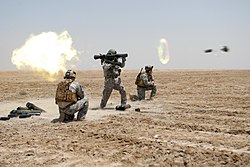 Firing a Carl Gustaf 8.4cm recoilless rifle during training in Basrah, Iraq.
 -
 Climbing out of the Worthington Glacier in Alaska at the Special Forces Master Mountaineer course.
 -
 Practicing IED detection and clearing at the Hawthorne Army Depot.
 -
 Chemical Recon Detachment training at Fort Carson.
 -
 Two instructors critique a Special Forces soldier at a HALO jump course at the Yuma Proving Grounds.
 -
 Conducting training at Castle Rock near Leavenworth, Washington to maintain basic mountaineering skills.
 -


_Mountaineer_climbs_out_of_Worthington_Glacier_during_the_US_Army_SF_Master_Mountaineer_course.jpg)
_soldiers_practice_IED_detection_and_clearing_during_premission_training_near_Hawthorne_Nevada_March_9_2008.jpg)
_Chemical_Recon_Detachment_take_pictures_of_a_contaminated_site_during_a_training_exercise_here_Feb_28_2008.jpg)

_soldier_climbs_Castle_Rock_near_Leavenworth_Washington.jpg)
_Trains_with_Indian_Special_Forces.jpg)
Other training opportunities at the John F. Kennedy Special Warfare Center and School include:[8]
- Combat Diver (Key West, Florida)
- Special Forces Combat Diver Qualification Course (CDQC)
- Special Forces Combat Diving Supervisor Course (CDSC)
- Special Forces Combat Diving Medical Technician (CDMT)
- Military Free Fall (Yuma Proving Ground, Arizona)
- Military Free Fall Parachutist Course (MFFPC)
- Military Free Fall Jumpmaster Course (MFFJM)
- Military Free Fall Instructor Course (MFFIC)
- Military Free Fall Advanced Tactical Infiltration Course (ATIC)
- Advanced Weapons and Tactics (Fort Bragg, North Carolina)
- Special Forces Sniper Course (SFSC)
- Special Forces Advanced Reconnaissance Target Analysis Exploitation Techniques Course (SFARTAETC)
- Security Force Assistance Foreign Weapons Course (SFAFWC)
- USASOC SOF-Peculiar Weapons Repair Course (USASOC SOF-P)
- Special Operations Foreign and Non-Standard Armorers Course (SOFNAC)
- Advanced Skills
- Advanced Special Operations Techniques Course (ASOTC)
- Advanced Special Operations Techniques Managers Course (ASOTMC)
- Special Warfare Brighton Course
- Special Warfare Touchstone Course
- Special Warfare Network Development Course (SWNDC)
- Special Warfare Operational Design Course (SWODC)
- Special Operations Military Deception Planner's Course (SMPC)
- Special Forces Intelligence Sergeant Course (MOS 18F)
- Operator Advanced Course
- Exploitation Analysis Center Course
- Technical Exploitation Course
- SOF Surveillance Awareness Course
- SOF Technical Surveillance Course
- SOF Technical Support Detachment Course
- Special Operations Terminal Attack Controller Course (SOTACC)
Conventional training opportunities include:[8]
- Ranger School
- Static-line Jumpmaster School
- Pathfinder School
- Reconnaissance and Surveillance Leaders Course
- Scout Leader Course
- Air Assault School
- Jungle Operations Training Center
- Northern Warfare Training Center
- Desert Warrior Course
- Army Mountain Warfare School
- Special Forces Advanced Mountain Operations School
- United States Army Sniper School
References
[edit]- ^ "Special Forces Training". GoArmy. Archived from the original on 16 June 2006.
- ^ "SPECIAL FORCES". GoArmy. Archived from the original on 15 August 2022. Retrieved 29 August 2022.
- ^ "Information For Course 2E-F129/011-F44". Army Training Requirements and Resources System. 11 January 2016. Archived from the original on 4 March 2016.
- ^ "SPECIAL FORCES ASSESSMENT AND SELECTION (SFAS)". NationalGuard. Archived from the original on 1 January 2017.
- ^ The window to attend SFAS a second time can be influenced by deployment schedules since "non-selected" candidates are assigned to infantry units in the meantime.[citation needed]
- ^ "Information For Course 2E-F253/011-F95". Army Training Requirements and Resources System. 21 October 2016. Archived from the original on 23 January 2017.
- ^ Walden, Joseph (2011). "Comparison of the STEEPLE Strategy Methodology and the Department of Defense's PMESII-PT Methodology" (PDF). SupplyChainResearch. Archived from the original (PDF) on 12 July 2022.
- ^ a b c "SWCS Fiscal Year 2021 Academic Handbook" (PDF). United States Army. 2020. Archived from the original (PDF) on 12 March 2022.
- ^ Twedell, Kelley (8 March 2013). "Robin Sage, Special Forces Training Begins Saturday". FortBraggPatch. Archived from the original on 11 October 2013. Retrieved 14 March 2014.
- ^ Robinson, Linda (10 June 2007). "A Few More Good Men Across the military services, a push is onto expand the special operations forces". U.S. News & World Report. Archived from the original on 13 June 2007. Retrieved 31 August 2022.
- ^ "Fake nation tests tomorrow's Special Forces". USA Today. Associated Press. 4 July 2007. Archived from the original on 17 May 2021. Retrieved 31 August 2022.
- ^ Kester, Brian (11 March 2005). "Marines train alongside soldiers at Robin Sage exercise". GlobalSecurity.org. Marine Corps News. Archived from the original on 12 July 2022. Retrieved 19 May 2011.
- ^ "Central N.C. residents notified of Robin Sage exercises :: WRAL.com". WRAL-TV. 1 August 2010. Archived from the original on 3 August 2010. Retrieved 7 March 2017.
- ^ "Army ROTC Summer Training Opportunities". Marquette University. Archived from the original on 5 March 2019.
- ^ "ROBIN SAGE". GlobalSecurity.org. Archived from the original on 12 July 2022. Retrieved 19 May 2011.
- ^ TOMENY, PHELPS v. BUTLER, MOORE COUNTY SHERIFF DEPT., No. 06-1929 (United States Court of Appeals for the Fourth Circuit 15 November 2007), archived from the original on 13 January 2022.
- ^ a b c "Conflicting version of ROBIN SAGE Incident". Associated Press. 1 November 2002. Archived from the original on 16 July 2011. Retrieved 19 May 2011.
- ^ "070619-01 Special Forces exercise 'Robin Sage' to begin". USASOC. 19 June 2007. Archived from the original on 28 December 2007. Retrieved 7 March 2017.
- ^ "Jury awards at least $750,000 to former soldier". Military Times. Associated Press. 28 October 2009. Archived from the original on 11 April 2012.
- ^ RANDALL C. BUTLER v UNITED STATES OF AMERICA, 1:05CV1136 (United States District Court for the Middle District of North Carolina 25 February 2010), archived from the original on 2 September 2020.
- ^ "Special Forces (CMF 18) Career Progression Plan" (PDF). US Army. 13 July 2022. Archived from the original (PDF) on 31 August 2022.
- ^ Smith, Carol (19 March 2003). "Medics hone their 'perishable skills'". Seattle Post-Intelligencer. Archived from the original on 17 October 2021.
External links
[edit]- The short film Big Picture: Special Forces is available for free viewing and download at the Internet Archive.
United States Army Special Forces selection and training
View on GrokipediaHistorical Development
Origins in World War II and Korean War
The origins of United States Army Special Forces selection and training trace to World War II-era precursors, particularly the Office of Strategic Services (OSS), established on June 13, 1942, under Major General William J. Donovan to coordinate espionage, sabotage, and unconventional warfare behind enemy lines.[6] OSS recruitment targeted independent thinkers from the armed forces, emphasizing psychological resilience and adaptability over conventional military conformity, with initial screening involving interviews assessing motivation, intelligence, and tolerance for isolation.[6] Training occurred at secluded sites such as national parks and camps like Area B in Maryland, incorporating phases of physical conditioning—including obstacle courses, long marches, and survival exercises—followed by specialized instruction in hand-to-hand combat, demolitions, small arms proficiency, cryptography, and guerrilla tactics to support resistance groups in occupied Europe and Asia.[7] These programs pioneered small-team operations and foreign internal defense, with curricula later adopted by successors including the Army's Special Forces and the Central Intelligence Agency, achieving high effectiveness in fostering operatives capable of operating autonomously in denied areas.[6] Another key influence was the First Special Service Force (1st SSF), activated on July 9, 1942, as a joint U.S.-Canadian commando unit under Lieutenant Colonel Robert T. Frederick, which underwent intensive selection emphasizing volunteers with proven combat experience or exceptional fitness.[8] Training at Fort William Henry Harrison, Montana, from 1942 to 1943, featured rigorous physical standards—such as timed marches with heavy loads, winter warfare simulations, and amphibious assaults—alongside specialized skills in rock climbing, parachuting, sabotage, and silent weapons, designed to produce versatile raiders for high-risk missions in Italy and France.[9] The 1st SSF's attrition during training exceeded 50% due to demands for mental toughness and technical proficiency, setting precedents for elite unit vetting that informed post-war unconventional warfare doctrines.[8] Post-World War II, OSS veteran Colonel Aaron Bank advocated for similar capabilities amid Cold War threats, leading to the activation of the 10th Special Forces Group on June 19, 1952, at Fort Bragg, North Carolina, under the Psychological Warfare Center.[10] The inaugural Special Forces Qualification Course (SFQC) began in 1952, drawing from OSS-inspired models with volunteer selection focusing on physical endurance tests, intelligence assessments, and aptitude for language and cultural immersion, followed by phased training in small-unit tactics, foreign weapons, and psychological operations.[11] By early 1953, 99 graduates from the first two SFQC classes deployed to Korea as replacements for the 8240th Army Unit, where they refined early protocols by training up to 1,500 South Korean partisans in guerrilla warfare, infiltration, and line-crossing raids into North Korea.[12] These operations, conducted from bases like Camp Drake in Japan, exposed selection shortcomings—such as insufficient emphasis on partisan liaison—and prompted adjustments, including enhanced team evaluation and survival training, marking the first combat validation of SF methods during the Korean War's final phases from February to July 1953.[13]Establishment of Modern Selection During Vietnam Era
In response to escalating U.S. military commitments in Vietnam, the Army's Special Warfare Center at Fort Bragg, North Carolina, established the Special Forces Training Group (Provisional) in 1962 to accommodate a surge in enlisted volunteers seeking assignment to Special Forces units.[14] This initiative marked a departure from the pre-1960s model, which primarily drew personnel from experienced non-commissioned officers (NCOs) with prior service, often selected through internal recommendations and limited formal screening.[15] The provisional group focused on processing and initially assessing double volunteers—those committing to both airborne qualification and Special Forces duty—allowing the force to expand rapidly from advisory roles in 1957, when just 58 Vietnamese soldiers received training, to supporting thousands of indigenous forces by the mid-1960s.[16] Selection during this period emphasized motivation, physical endurance, and adaptability through integrated evaluation within the training phases, rather than a standalone assessment course. Candidates underwent preliminary screening for basic qualifications, including airborne status and security clearances, followed by immersion in small-unit tactics, language basics, and unconventional warfare principles tailored to counterinsurgency needs in Vietnam. Attrition occurred organically via washout in physical conditioning, field exercises, and skill acquisition, with the process designed to identify soldiers capable of operating in austere environments alongside Civilian Irregular Defense Group (CIDG) allies. By 1964, this volunteer-driven approach enabled the 5th Special Forces Group to field over 1,200 personnel managing 80 camps, reflecting a pragmatic adaptation to wartime demands despite criticisms of diluted experience levels among some entrants.[16] The Vietnam-era reforms laid foundational elements for subsequent standardization, prioritizing empirical performance in high-stress scenarios over rigid prerequisites, though they relaxed prior emphasis on extensive prior service to meet operational tempo. This evolution supported the training of over 40,000 paramilitary troops by the late 1960s but highlighted tensions with conventional Army elements wary of Special Forces' unconventional focus and rapid expansion. Post-assignment, soldiers received on-the-job refinement in Vietnam, including Recondo School for reconnaissance and ambush tactics, reinforcing the selection's causal link to mission effectiveness in guerrilla contexts.[17]Post-Cold War Reforms and 21st-Century Adaptations
Following the dissolution of the Soviet Union in 1991, U.S. Army Special Forces selection and training adapted to a post-Cold War security environment dominated by regional instabilities, ethnic conflicts, and low-intensity operations rather than peer-state confrontation. The Special Forces Qualification Course (SFQC) incorporated elements of stability operations and foreign internal defense, reflecting doctrinal shifts outlined in Army publications emphasizing versatile, expeditionary capabilities for missions like those in the Balkans during the 1990s.[18] These reforms maintained the core focus on unconventional warfare while expanding training scenarios to include humanitarian assistance and counterdrug operations, driven by reduced force structures and the need for multifunctional operators.[19] The Global War on Terror, initiated after the September 11, 2001, attacks, accelerated demands on Special Forces, leading to a near-doubling of the Regiment's size and sustained high operational tempos in Afghanistan and Iraq. This strained the training pipeline, with SFQC durations often exceeding 18 months and attrition rates hovering around 60-70% across phases, prompting efficiency-driven modifications to boost output without compromising standards.[20] Special Forces Assessment and Selection (SFAS) retained its foundational 21-24 day rigor, emphasizing peer-evaluated physical endurance, land navigation, and psychological resilience, as core selection criteria proved enduringly effective for identifying adaptable candidates amid evolving threats.[21] A pivotal 21st-century reform occurred in 2019, when the U.S. Army John F. Kennedy Special Warfare Center and School restructured the SFQC to condense timelines from up to 95 weeks to approximately 56-72 weeks for most military occupational specialties. Post-SFAS, candidates transitioned directly into integrated small unit tactics, survival training, and MOS-specific instruction, deferring select advanced skills—such as certain weapons familiarization—to unit-level sustainment, thereby addressing personnel shortages from prolonged deployments.[22][23] Phase II underwent the most substantive evolution, blending language immersion with regional expertise and cultural acclimation tailored to counterinsurgency contexts, while incorporating data-driven assessments to refine team-building exercises.[24] These adaptations extended to enhanced integration of 21st-century technologies, including simulation-based rehearsals for hybrid warfare and human performance protocols to mitigate injury risks during high-volume rucking and tactical movements in SFAS.[25] By 2022, initiatives like ARSOF 2022 further aligned training with great power competition, prioritizing irregular warfare against near-peer adversaries through updated Robin Sage culminations that simulate contested environments with cyber and information operations overlays.[26] Attrition persisted as a deliberate filter, with selectee rates under 30% ensuring only those demonstrating causal resilience in ambiguous scenarios advanced, underscoring the pipeline's empirical calibration to operational outcomes rather than arbitrary quotas.[27]Prerequisites and Initial Preparation
Eligibility Criteria and Enlistment Pathways
Eligibility for United States Army Special Forces demands adherence to rigorous standards in citizenship, age, aptitude, physical fitness, and prior service qualifications to ensure candidates possess the foundational attributes for unconventional warfare roles. Applicants must be United States citizens, although lawful permanent residents holding a valid Green Card for at least six months may enlist through the 18X program, which facilitates expedited naturalization upon completing security clearance requirements.[2] Non-citizens beyond this pathway are ineligible due to the need for secret-level security clearances essential for operational access.[2] Age limits vary by entry point: non-prior service recruits must be 19 to 34 years old at enlistment, while active-duty soldiers applying for assessment must fall between 20 and 34 years old.[2] These thresholds reflect empirical assessments of physical resilience and career longevity in demanding field conditions, with waivers occasionally granted for National Guard or Reserve applicants up to age 36 based on prior qualifications and evaluations.[28] All candidates must achieve a minimum TECH score of 110 on the Armed Services Vocational Aptitude Battery, indicating sufficient cognitive capacity for complex tactics and languages.[2] Physical standards mandate compliance with Army height and weight regulations, alongside qualification for Airborne School, as parachute operations form a core infiltration method.[2] For enlisted personnel, current soldiers seeking Special Forces must hold ranks from E-3 (private first class) to E-6 (staff sergeant), ensuring a baseline of operational experience without excessive service time that could limit post-selection utility.[2] Officers and warrant officers follow parallel but distinct tracks: commissioned officers typically enter as 18A Special Forces Officers at pay grades O-1 (promotable) through O-3, requiring prior leadership roles and targeted year-group alignment for promotion boards, while warrant officers (180A) must already possess Special Forces enlisted experience at E-6 or higher with at least 36 months in operational detachments.[1][29] Enlistment pathways diverge for non-prior service and serving members. The 18X Special Forces Candidate option enables civilians to enlist directly into this infantry-linked specialty, progressing through 22 weeks of One Station Unit Training, followed by Special Operations preparation and assessment without intermediate conventional assignments.[30] Prior-service soldiers, including those from other branches via inter-service transfer, apply through reclassification (REP-63 process), contingent on unit endorsement, minimum service obligations, and caps on total years served—typically no more than 12 to 14—to preserve training investment returns.[2] National Guard and Army Reserve pathways mirror active-duty routes but incorporate component-specific waivers and drills, emphasizing part-time commitments compatible with rapid mobilization needs.[28] All pathways culminate in Special Forces Assessment and Selection, where initial eligibility serves as a gatekeeper rather than a guarantee of success.[2]Special Forces Preparation Course (SFPC)
The Special Forces Preparation Course (SFPC) serves as an initial conditioning program for enlisted soldiers and officers selected to pursue Special Forces qualifications, conducted at the U.S. Army John F. Kennedy Special Warfare Center and School (SWCS) at Fort Liberty, North Carolina. It bridges the gap between basic military training—such as Airborne School—and the demanding Special Forces Assessment and Selection (SFAS), focusing on building physical resilience, technical skills, and mental toughness to reduce early attrition in the pipeline. The course targets candidates from pathways like the 18X Special Forces recruit contract or repackaged active-duty personnel, ensuring they meet baseline standards for SFAS entry, including passing the Army Combat Fitness Test (ACFT) with at least 90 points in the 22-26 male age group.[31][2] Lasting six weeks, SFPC emphasizes progressive physical training to develop aerobic capacity, muscular endurance, and load-bearing proficiency through ruck marches, running, calisthenics, and strength exercises tailored to SFAS demands, such as 12-mile timed rucks with 55-65 pound loads. Land navigation forms a core component, with day and night exercises teaching map reading, compass use, pace count accuracy, and terrain association to prepare for unaided movement in austere environments. Candidates also receive instruction in practical skills like rucksack packing, blister prevention and foot care, basic knot-tying, hydration management, and rope climbing to support extended field operations.[2][32] Introductory team-building and small-unit tasks introduce peer evaluation dynamics, fostering leadership and followership under stress, while medical screenings and administrative processing ensure administrative readiness. Completion of SFPC does not guarantee SFAS attendance; candidates must demonstrate consistent performance, with voluntary withdrawals or medical drops possible but rare compared to later phases. The program, overseen by the 1st Special Warfare Training Group (Airborne), draws from empirical data on prior candidate failures to prioritize high-yield preparations, such as those outlined in SWCS preparation handbooks stressing overtraining avoidance to prevent injury.[33]Special Forces Assessment and Selection (SFAS)
Structure and Timeline of SFAS
The Special Forces Assessment and Selection (SFAS) course spans 24 days and is conducted at Camp Mackall, a satellite facility of the U.S. Army John F. Kennedy Special Warfare Center and School located at Fort Liberty, North Carolina.[34][35] This duration allows for a progressive evaluation of candidates' physical capabilities, mental fortitude, and potential for teamwork under duress, with the schedule subject to minor adjustments based on weather or operational needs.[34] The course commences with administrative in-processing on day one, followed immediately by an initial physical screening that includes the Army Physical Fitness Test (APFT) comprising push-ups, sit-ups, and a two-mile run.[36] Subsequent individual events escalate in intensity, featuring timed five-mile runs, ruck marches of 12 miles or greater carrying 45- to 55-pound loads over varied terrain, a 50-meter combat swimmer test, pull-up assessments, and obstacle course navigation, all designed as go/no-go evaluations where failure in any can lead to voluntary withdrawal or administrative elimination.[36][35] Approximately one week of the timeline is allocated to land navigation, a core component emphasizing self-reliance and orienteering skills; candidates undertake multiple day and night courses in the Uwharrie National Forest, requiring them to locate successive points using only a map, compass, and protractor within strict time constraints, with proctored solo efforts spanning up to 48 hours.[36] These pass/fail iterations progressively increase in distance and complexity to simulate operational isolation.[35] The latter phase shifts to team-oriented assessments, where surviving candidates are randomly assigned to small teams for collective challenges such as log drills—carrying heavy telephone poles over miles—rifle physical training, boat carries, and other peer-evaluated tasks that test leadership, followership, communication, and resilience amid sleep deprivation and peer pressure.[35] Cadre observe interactions continuously, incorporating psychological profiling and input from team members to gauge intangibles like initiative and adaptability.[34] Selection decisions are rendered at the course's end, with successful candidates notified for advancement to the Special Forces Qualification Course; non-selectees receive performance feedback and may be afforded limited recycle opportunities if deemed viable, though the process prioritizes irrevocable commitment over remediation.[34] Detailed event sequencing remains partially classified to preserve assessment validity, as outlined in official preparation materials.[37]Physical, Mental, and Team Evaluation Components
![US Army soldiers in SFAS class 04-10 participate in log and rifle PT at Camp Mackall][float-right] The physical evaluation in Special Forces Assessment and Selection (SFAS) emphasizes endurance, strength, and resilience through standardized tests and progressive challenges conducted over approximately 24 days at Camp Mackall, North Carolina. Candidates must pass the Special Forces Physical Assessment (SFPA), requiring a minimum of 28 hand-release push-ups, 6 pull-ups, and a 2-mile run in 15:12 or less, with successful performers typically exceeding these thresholds, such as sub-13:30 for the run.[33] Additional physical demands include a 5-mile run completed in under 37:30 minutes and a 12-mile ruck march with a 45-pound pack finished in no more than 2 hours and 36 minutes, alongside training escalations to 18-mile rucks with 55 pounds.[38] These events, incorporating obstacle climbs up to 30 feet using ropes, swims in boots and uniforms, and combat-focused drills like bodyweight carries over 100 meters, filter candidates based on raw physical capacity under load and fatigue, where physical performance has been identified as the strongest predictor of overall selection success.[39] Mental evaluation components assess cognitive endurance, decision-making, and psychological resilience amid sleep deprivation, nutritional stress, and mounting uncertainty, revealing traits like perseverance and adaptability essential for unconventional warfare roles. Land navigation courses, particularly nighttime iterations of unknown distance and duration known as the STAR course, test spatial reasoning and self-reliance without external aids, often extending through exhaustion to probe mental resolve.[34] Preparation emphasizes mental performance training over 24 weeks, focusing on grit, confidence, and controllability, with candidates monitored for cognitive function decline under simulated operational stressors.[33] Research correlates higher cognitive ability and perseverance scores with SFAS completion, underscoring that mental attributes enable sustained performance when physical limits are approached.[40] Team evaluation occurs primarily during "Team Week," where candidates form ad hoc groups for collective tasks simulating operational interdependence, such as transporting improvised loads like vehicle components, logs, or casualty simulations over varied terrain, demanding load-sharing, communication, and mutual support.[34] Peer evaluations form a critical mechanism, with participants anonymously rating teammates on attributes like dependability, loyalty, and selfless contribution, influencing cadre decisions on selectability; rejection by peers for poor team dynamics can result in non-selection regardless of individual prowess.[33] Instructors observe leadership emergence and conflict resolution in these scenarios, prioritizing those embodying ARSOF core attributes such as being a team player capable of subordinating personal goals to group mission accomplishment.[33] This holistic integration of physical, mental, and team assessments ensures selected candidates possess the multifaceted capabilities required for Special Forces operational teams.Attrition Rates and Selection Statistics
Selection rates for the Special Forces Assessment and Selection (SFAS) course vary by class, candidate background, and year, but generally range from 30% to 50%, reflecting the program's intent to rigorously filter participants based on physical endurance, mental resilience, and team compatibility.[41][42] In one documented class from November 2021, 151 out of 345 candidates achieved selection, yielding a 44% success rate, with the remaining 56% attributed to a combination of voluntary withdrawals, involuntary drops, administrative separations, medical issues, and peer review failures.[41][43] Historical averages indicate enlisted candidates from active duty units face lower selection probabilities, around 35%, compared to officers at approximately 50% and National Guard enlisted at 45%.[44] Attrition in SFAS is multifaceted, with voluntary quits comprising a significant portion due to the cumulative stress of extended ruck marches, sleep deprivation, and ambiguous individual and team tasks that test motivation under duress.[45] Medical attrition, often from stress fractures or overuse injuries during high-volume load-bearing events, accounts for a notable share, though exact breakdowns fluctuate; in the 2021 class analyzed, it contributed alongside peer evaluations where teammates identify those deemed unfit for Special Forces roles.[41] Performance predictors include pre-course fitness metrics, such as Army Physical Fitness Test scores, where top-quartile candidates exhibit selection probabilities up to 45%, versus 16% for bottom-quartile entrants, underscoring the causal link between baseline preparation and outcomes.[45]| Candidate Category | Approximate SFAS Selection Rate |
|---|---|
| Active Duty Enlisted | 35% |
| 18X Pipeline Candidates | 40% |
| National Guard Enlisted | 45% |
| Officers | 50% |
Special Forces Qualification Course (Q Course)
Phase I: Orientation, History, and Unconventional Warfare Introduction
Phase I of the Special Forces Qualification Course (SFQC), designated as the Special Forces Orientation Course, spans approximately six to seven weeks and serves as an introductory module for candidates following selection through Special Forces Assessment and Selection (SFAS).[5][46] This phase acquaints students with the core tenets of U.S. Army Special Forces, emphasizing historical foundations, operational principles, and the doctrine of unconventional warfare (UW). Conducted at the John F. Kennedy Special Warfare Center and School (SWCS) at Fort Liberty, North Carolina, it includes academic instruction, basic tactical familiarization, and land navigation exercises to build foundational skills and mindset resilience. The orientation component orients candidates to Special Forces structure, missions, and career progression, highlighting the roles of Operational Detachment-Alpha (ODA) teams in foreign internal defense, direct action, and special reconnaissance.[47] Instruction covers the evolution of Special Forces from World War II precursors like the Office of Strategic Services (OSS) to formal establishment in 1952 under Colonel Aaron Bank, with expansion during the Vietnam War to counter insurgencies.[48] This historical review underscores adaptability to asymmetric threats, as evidenced by operations in Korea, Vietnam, and post-9/11 conflicts, where Special Forces conducted UW to support indigenous forces against conventional adversaries.[46] Unconventional warfare instruction introduces UW as activities enabling a resistance movement or insurgency to coerce, disrupt, or overthrow a government or occupying power through externally sponsored operations, per Army doctrine.[49] Modules explore guerrilla tactics, subversion, sabotage, and intelligence operations, drawing from historical cases like the Jedburgh teams in WWII and Phoenix Program in Vietnam. Candidates study seven UW phases: preparation, initial contact, infiltration, organization, build-up, employment, and transition, fostering understanding of working by, with, and through foreign partners in denied environments.[47] Practical elements include small-unit tactics primers and terrain model familiarization to integrate theory with application, ensuring candidates grasp SF's emphasis on indirect approaches over direct combat.[50] Attrition in this phase stems primarily from academic failure or voluntary withdrawal, with emphasis on self-motivation and ethical grounding in the Special Forces creed.[46]Phase II: Language, Regional Expertise, and Cultural Training
Phase II equips Special Forces candidates with essential language proficiency, cultural immersion, and regional orientation to enable effective interaction with foreign populations and forces in unconventional warfare environments. Training emphasizes practical communication skills tailored to operational scenarios, such as negotiating with local leaders or instructing indigenous troops.[1] Candidates are assigned one of approximately 14 strategic languages based on their future Operational Detachment-Alpha's regional focus, including Spanish, French, Arabic, Dari, Pashto, Russian, Chinese-Mandarin, and Korean, among others.[1] Language selection aligns with the theater responsibilities of Special Forces Groups, for example, Middle Eastern languages for the 5th Special Forces Group or Latin American languages for the 7th Special Forces Group.[51] The phase lasts 18 to 25 weeks, varying by language difficulty category as defined by the Defense Language Institute: Category I languages like Spanish require about 18 weeks, while Category IV languages like Arabic demand up to 25 weeks of intensive study. Instruction occurs primarily at the Defense Language Institute Foreign Language Center in Monterey, California, through immersive methods including classroom drills, role-playing exercises, and audio-visual aids focused on mission-relevant vocabulary, grammar, and syntax for speaking, listening, reading, and writing.[5] Cultural training integrates with language modules, covering societal norms, religious practices, historical contexts, political structures, economic factors, and ethnographic details of the target region to foster cross-cultural competence and avoid mission-compromising faux pas.[51] Regional expertise components analyze geopolitical dynamics, terrain, infrastructure, and potential insurgent influences, drawing on open-source intelligence and case studies to prepare candidates for advising host-nation partners. Proficiency is assessed via the Oral Proficiency Interview (OPI) and Defense Language Proficiency Test (DLPT), with candidates required to achieve at least a 1/1+ rating (novice to intermediate) in speaking and listening for qualification, though operational demands often necessitate further refinement post-graduation.[52] This baseline enables basic rapport-building and instruction in austere settings but prioritizes functional utility over fluency, reflecting the reality that sustained immersion in the field drives higher competence.[51] Failure to meet standards results in recycling or elimination, underscoring the phase's role in validating a candidate's adaptability for Special Forces' human-centric missions.[5]Phase III: Small Unit Tactics, Survival, Evasion, Resistance, and Escape (SERE)
Phase III of the Special Forces Qualification Course (SFQC) focuses on developing candidates' proficiency in small unit tactics (SUT) and survival, evasion, resistance, and escape (SERE) skills essential for operational effectiveness in unconventional warfare environments. This phase typically spans 13 weeks, emphasizing practical application of combat tactics at the team level.[53][54] Candidates receive instruction in advanced marksmanship, including combat rifle techniques, to enhance precision and speed under stress. Training progresses to small unit maneuvers, such as patrolling, ambushes, raids, and defensive operations, conducted in varied terrains to simulate real-world scenarios.[5][49] Urban operations form a core component, where candidates learn close-quarters battle, room clearing, and vehicle convoys in built-up areas, integrating fire and movement principles for Operational Detachment-Alpha (ODA) teams. Mission analysis training teaches troop-leading procedures, including intelligence preparation of the battlefield, orders production, and rehearsals, fostering decision-making under time constraints. Special Forces common tasks, such as land navigation and communications, are reinforced to ensure interoperability within 12-man ODAs. Demolitions and breaching techniques are introduced to support tactical disruptions.[5][49] These elements build on prior phases, preparing candidates for MOS-specific applications without yet specializing in occupational roles.[52] The SERE block, integrated toward the phase's end and lasting approximately three weeks, equips candidates to survive and return from isolation behind enemy lines. Instruction begins with academic modules on the Department of Defense Code of Conduct, emphasizing lawful conduct as prisoners of war. Field exercises cover survival fundamentals, including shelter construction, foraging, water procurement, and signaling in austere environments like forests, deserts, or arctic conditions. Evasion training involves terrain appreciation, camouflage, and movement techniques to avoid detection by pursuers, often practiced in multi-day scenarios with simulated hunter forces.[55][2] Resistance and escape phases simulate capture, subjecting candidates to controlled interrogation and exploitation techniques to build psychological resilience. Role-players portray interrogators using lawful methods per the Geneva Conventions, teaching verbal deception, memory aids, and rapport-building countermeasures without endorsing illegal actions. Physical hardships, such as stress positions and sleep deprivation within limits, test endurance, drawing from empirical data on captivity survival rates from historical conflicts like Vietnam, where SERE-derived skills correlated with higher successful evasions. Escape instruction includes lock-picking, improvised tools, and planning from confinement, culminating in a graded exercise replicating POW camp breakout. This training, evolved from post-World War II programs, prioritizes evidence-based techniques over unverified narratives, with attrition driven by voluntary withdrawals rather than failure rates exceeding 10-15% in recent cycles.[55][52] Successful completion qualifies candidates for Phase IV MOS training, with documented improvements in team cohesion metrics post-phase.[54]Phase IV: Military Occupational Specialty (MOS) Training
Phase IV of the Special Forces Qualification Course (SFQC) provides candidates with specialized training in their assigned Military Occupational Specialty (MOS) within the 18-series, equipping them with the technical expertise required for operational roles in Special Forces operational detachment-alphas (ODAs).[49] Assignment to a specific MOS occurs prior to this phase, determined by factors including the U.S. Army Special Operations Command's manning requirements across the seven Special Forces Groups, the candidate's prior experience, aptitude demonstrated in earlier phases, and preferences when feasible.[30] Enlisted personnel train in one of four primary MOS: 18B (Weapons Sergeant), 18C (Engineer Sergeant), 18D (Medical Sergeant), or 18E (Communications Sergeant), while officers pursue 18A (Detachment Officer).[49] Training emphasizes skills tailored to unconventional warfare, foreign internal defense, and advising indigenous forces, integrating advanced technical proficiency with cultural and operational adaptability. For 18B Weapons Sergeants, instruction covers the operation, maintenance, and instruction of U.S. and foreign infantry and crew-served weapons systems, including anti-armor and anti-materiel capabilities, typically spanning 14 weeks.[49] 18C Engineer Sergeants focus on demolitions, field fortifications, mine warfare, and infrastructure development or sabotage in austere environments, also around 14 weeks.[49] 18E Communications Sergeants receive training in satellite communications, encryption, network establishment, and electronic warfare countermeasures, lasting approximately 16 weeks.[5] The 18D Medical Sergeant course stands out for its duration and intensity, extending the overall SFQC by about 36 weeks beyond the base 51-56 weeks due to comprehensive trauma management, surgical interventions, preventive medicine, veterinary care, and dental procedures adapted for combat and remote operations.[14] This phase incorporates the Special Operations Combat Medic qualification, stressing prolonged field care and training host-nation forces in basic medical support. Officers in 18A training refine detachment leadership, planning, and integration of MOS skills into ODA missions over roughly 14 weeks.[49] Failure to meet standards in MOS-specific evaluations can result in recycling, reassignment to another MOS, or course elimination, with attrition influenced by the phase's technical demands.[5] Upon completion, candidates proceed to Phase V, applying their MOS competencies in culminating exercises.[14]Phase V: Unconventional Warfare Culmination Exercise (Robin Sage)
The Unconventional Warfare Culmination Exercise, designated Robin Sage, constitutes the capstone field training of Phase V in the Special Forces Qualification Course, evaluating candidates' proficiency in orchestrating guerrilla operations and foreign internal defense within a simulated theater of unconventional warfare.[56] Conducted under the auspices of the U.S. Army John F. Kennedy Special Warfare Center and School at Fort Liberty, North Carolina, it replicates real-world scenarios where Special Forces teams infiltrate hostile territory to rally and direct indigenous resistance forces against an occupying adversary.[57] The exercise derives its name from Lieutenant Colonel Jerry M. "Robin" Sage, an Office of Strategic Services operative during World War II renowned for facilitating prisoner-of-war escapes in Nazi Germany.[58] Spanning a two-week period and executed eight times per year to correspond with SFQC class schedules, Robin Sage unfolds across roughly 15 counties in central North Carolina, encompassing both public and private lands to foster an expansive, rural operational area approximating 10,000 square miles.[59] Candidates, organized into 12-man Operational Detachment-Alpha teams mirroring standard Special Forces configurations, commence with covert infiltration—typically via static-line parachute jumps, helicopter insertions, or overland approaches—into the fictional Republic of Pineland, a notional U.S.-allied nation under invasion by a hostile force dubbed Legitimate Authority National Directorship (LAND).[60] [5] Once inserted, teams must evade detection, establish rapport with Pineland partisans role-played by local civilians, military reservists, and actors, and execute a series of progressively complex missions including intelligence gathering, ambush planning, supply caching, and disruption of enemy logistics.[56] Core objectives center on applying unconventional warfare doctrine, as outlined in joint publications such as JP 3-05, by leveraging through, by, and with surrogate forces to achieve strategic effects disproportionate to the deploying team's size.[61] Teams negotiate alliances, train guerrilla auxiliaries in small-unit tactics, conduct psychological operations to erode enemy morale, and coordinate unconventional assisted recovery for isolated personnel, all while navigating simulated foreign cultural dynamics and limited resources to underscore the primacy of adaptability and interpersonal acumen over technological superiority.[57] Instructors and auxiliary personnel, numbering in the hundreds per iteration, portray a spectrum of actors from sympathetic villagers to opportunistic collaborators, compelling candidates to discern loyalties and mitigate betrayal risks through first-hand negotiation and leadership under ambiguity.[5] Assessment criteria emphasize not merely tactical execution but holistic operational integration: candidates are graded on their capacity to synchronize intelligence preparation of the battlefield with kinetic and non-kinetic effects, sustain team cohesion amid sleep deprivation and logistical privation, and improvise solutions to unforeseen contingencies, such as compromised safe houses or partisan defections.[56] Failure to link up with designated auxiliaries within prescribed timelines or achieve mission benchmarks results in recycling or attrition, with success rates reflecting the exercise's rigor—historically, only those demonstrating mature judgment in employing minimal force for maximal influence proceed to don the Green Beret.[62] Upon culmination, teams execute exfiltration, often involving link-up with conventional forces for QRF validation, affirming their readiness for deployment in austere environments where conventional power projection proves infeasible.[58]Phase VI: Graduation, Beret Ceremony, and Initial Assignment
Upon successful completion of the Unconventional Warfare Culmination Exercise in Phase V, candidates enter Phase VI of the Special Forces Qualification Course (SFQC), a approximately one-week period dedicated to administrative closure, ceremonial recognition, and transition to operational service. This phase marks the formal end of the core SFQC pipeline, transforming qualified soldiers into members of the U.S. Army Special Forces Regiment.[50] Outprocessing activities dominate the initial days, encompassing medical screenings, equipment accountability, personnel record updates, and coordination of relocation logistics to assigned units. These steps ensure administrative readiness before dispersal, allowing graduates to depart Fort Liberty (formerly Fort Bragg), North Carolina, efficiently.[49] The phase culminates in the Regimental First Formation (RFF) graduation ceremony, where soldiers don the green beret— the regiment's iconic headgear—for the first time, signifying their qualification and acceptance into the elite force. Held publicly to honor achievement, the event often occurs at large venues such as the Crown Coliseum in Fayetteville, North Carolina, and includes speeches from regimental leadership emphasizing unconventional warfare ethos and readiness for global threats. For example, SFQC Class 340's RFF on August 28, 2025, integrated 168 new Special Forces soldiers, highlighting the program's output amid evolving operational demands. Similarly, the August 9, 2012, ceremony inducted over 110 graduates, underscoring consistent cohort sizes despite rigorous attrition.[62][63][64] Post-ceremony, graduates receive initial assignments to an Operational Detachment Alpha (ODA)—the 12-man core tactical unit of Special Forces—within one of the active-duty groups: 1st, 3rd, 5th, 7th, or 10th Special Forces Group (Airborne), or National Guard equivalents like the 19th or 20th. Branching to groups factors in military occupational specialty (e.g., 18B weapons sergeant or 18D medical sergeant), regional language expertise from Phase II, service component (active or reserve), and current unit vacancies or operational tempo. New ODAs members typically report for group-specific indoctrination, team integration, and mission preparation, bridging to advanced skills sustainment.[65][66]Advanced and Specialized Training
Post-Q Course Language Refinement and Robin Sage Extensions
Following graduation from the Special Forces Qualification Course (SFQC), newly qualified Special Forces soldiers undergo targeted language refinement to elevate proficiency beyond the elementary 1/1 level (speaking and listening on the Interagency Language Roundtable scale) achieved during Phase II of the SFQC. This post-qualification training typically spans six months and is conducted at the Defense Language Institute Foreign Language Center (DLIFLC) or equivalent immersion programs aligned with the soldier's assigned theater language, such as Arabic, Pashto, or Spanish for regionally focused groups.[67][50] The curriculum emphasizes practical application in operational contexts, including conversational fluency for intelligence gathering, negotiation, and rapport-building with indigenous forces, addressing the gap between basic SFQC exposure (18-24 weeks for Category I-II languages) and the advanced 2/2 or 3/3 proficiency required for effective unconventional warfare.[51][68] Language assignments are determined post-SFQC based on group needs and soldier aptitude, with annual Defense Language Proficiency Tests (DLPT) mandating sustainment through unit-led immersion, online tools, or short courses to counteract skill atrophy during deployments.[69] Failure to maintain minimum scores can result in remedial training, underscoring the causal link between linguistic competence and mission success in foreign internal defense and counterinsurgency operations.[70] Extensions of the Robin Sage unconventional warfare culmination exercise occur post-SFQC through unit-level advanced training that replicates and expands its guerrilla linkage, auxiliary network building, and clandestine operations in the fictional Republic of Pineland scenario. These follow-on exercises, integrated into operational detachment validation and group readiness cycles, incorporate layered complexities such as joint fires, cyber elements, and interagency partnerships absent from the baseline SFQC version, preparing 12-man ODAs for real-world deployment variables.[57] Conducted multiple times annually across expanded terrain in North Carolina, these iterations leverage experienced Special Forces cadre to mentor new qualifiers, with scenarios evolving to include urban unconventional warfare and hybrid threats based on lessons from operations in Iraq and Afghanistan.[71] Participation reinforces Phase V skills, with metrics tracking team cohesion, mission planning, and adaptability under simulated adversity.[61]Joint Combined Exchange Training (JCET) and Operational Integration
Joint Combined Exchange Training (JCET) programs enable U.S. Army Special Forces personnel to conduct bilateral training with partner nation militaries, focusing on mission-essential tasks such as small-unit tactics, urban operations, and counterterrorism in austere environments.[72] Authorized under 10 U.S.C. § 2011, JCETs primarily serve to enhance the readiness of U.S. Special Operations Forces through exposure to regional operational contexts, while secondarily supporting partner capacity building via tactical exchanges.[73] These exercises typically involve operational detachment-alpha (ODA) teams of 10 to 40 personnel deploying for periods ranging from weeks to months, often in the partner nation's indigenous terrain to simulate deployment conditions.[74][75] For Green Berets, JCETs post-Qualification Course integrate language proficiency, cultural immersion, and unconventional warfare skills into practical scenarios, refining operational templates for foreign internal defense and advising missions.[76] Examples include the 10th Special Forces Group (Airborne)'s January 29 to February 22, 2024, JCET with Latvian special operations forces, emphasizing interoperability in cold-weather tactics and rapid-response planning.[72] Similarly, the 3rd Special Forces Group (Airborne) completed a two-month JCET with Tanzania's 93rd Special Forces Battalion in 2025, incorporating scenario-based drills on technical skills and joint patrolling to mirror real-world threats.[77] Such engagements build enduring relationships, with Green Berets providing instruction on U.S. doctrine while adopting host-nation insights, as seen in a 2023 two-month JCET between 10th SFG (A) and Spanish special operations forces focused on combined arms maneuvers.[75] Operational integration via JCETs aligns Special Forces teams with U.S. geographic combatant commands' theater security cooperation plans, fostering seamless joint and multinational operations during contingencies.[78] These trainings enhance interoperability standards, such as NATO protocols, and prepare ODAs for persistent engagement in regions like Europe, Africa, and the Indo-Pacific, where exercises like those with Indian Para SF demonstrate cross-cultural tactical adaptation.[77] By conducting live-fire, evasion, and advisory simulations abroad, JCETs bridge the gap between institutional training and deployment, reducing friction in coalition environments and bolstering U.S. influence through non-combatant partner enablement.[73] Metrics from Special Operations Command Africa highlight improved partner responsiveness post-JCET, with sustained effects in countering transnational threats.[79]Career Progression and Continuous Professional Military Education
Upon completion of the Special Forces Qualification Course (SFQC), graduates are assigned to one of the active or National Guard Special Forces Groups, where they integrate into Operational Detachment-Alpha (ODA) teams for initial operational deployments and missions focused on unconventional warfare, foreign internal defense, and direct action. Enlisted personnel receive the 18-series military occupational specialty (MOS) designation and are generally promoted to sergeant (E-5) upon SFQC graduation, marking the entry point for career-long service in Special Forces.[80] Officers (branch 18A) and warrant officers (180A) follow parallel paths, with initial billets as detachment commanders or technical specialists, respectively, emphasizing small-unit leadership in austere environments.[81] Enlisted career progression in Career Management Field (CMF) 18 prioritizes operational experience on ODAs, followed by key developmental assignments such as team sergeant or operations sergeant roles, with promotions tied to demonstrated proficiency in leadership, language skills, and mission execution. Staff sergeants (E-6) typically require 48 months of collective time on an SFODA or similar unit post-SFQC, while master sergeants (E-8) must complete advanced qualifications including the Static Line Jumpmaster Course and at least one elite program like Ranger School or the Special Forces Sniper Course.[80] Sergeants major (E-9) often hold nominative positions, such as group command sergeant major, after accumulating rated time in broadening assignments like instructor roles at the John F. Kennedy Special Warfare Center and School (SWCS).[82] Officer progression advances from ODA commander (typically captain, O-3) to company commander, with key developmental time of at least 24 months in detachment leadership prior to major (O-4) promotion.[81] Warrant officers progress through tiers of expertise, supporting ODAs in technical areas like intelligence or communications, with emphasis on joint assignments and advanced tactical certifications. Continuous professional military education (PME) for Special Forces personnel integrates Non-Commissioned Officer Professional Development System (NCOPDS) for enlisted, structured leader education for officers, and specialized SOF courses to maintain combat readiness and adaptability. Enlisted soldiers attend progressive NCOPDS levels—Basic Leader Course for E-5/E-6, Advanced Leader Course for E-6/E-7, and Senior Leader Course for E-7/E-8—tailored to Special Forces contexts, including sustainment of language proficiency at Defense Language Proficiency Test (DLPT) level 2/2 or higher.[80] Officers complete the Maneuver Captain's Career Course and Intermediate Level Education (ILE) equivalent, with senior leaders pursuing the Command and General Staff Officer Course or Army War College for strategic acumen in irregular warfare.[81] All ranks engage in mandatory refresher training in core competencies, such as Military Free-Fall Parachutist, Combat Diver, or Survival, Evasion, Resistance, and Escape (SERE) updates, alongside joint PME through programs like those at the Joint Special Operations University to foster interoperability.[1] This regimen ensures sustained expertise, with annual requirements for physical fitness, weapons qualification, and mission-specific simulations to counter evolving threats.[82]Challenges, Risks, and Controversies
Physical and Psychological Toll on Candidates
The Special Forces Assessment and Selection (SFAS) course imposes severe physical demands on candidates through extended ruck marches, land navigation exercises, and team events carrying heavy loads, often exceeding 50 pounds over distances up to 50 miles in austere terrain, leading to widespread musculoskeletal strain.[83] In a study of 800 volunteers during SFAS, 38% experienced injuries, with blisters and abrasions being the most prevalent, while 12% reported illnesses such as respiratory infections; these encounters frequently resulted in medical evaluations and potential course withdrawal.[83] Physical training activities account for up to 80% of injuries in Special Operations Forces pipelines, including stress fractures, compartment syndrome, and rhabdomyolysis from overexertion, exacerbating risks in candidates already fatigued from minimal recovery periods.[84] Subsequent phases of the Special Forces Qualification Course (SFQC), including Small Unit Tactics and MOS-specific training, compound these effects with prolonged field exercises involving combat simulations, dive qualifications, and high-altitude jumps, where injury incidence mirrors or exceeds SFAS rates due to cumulative wear. Sleep deprivation, integral to simulating operational realities, further impairs recovery; candidates often endure fewer than four hours nightly during peak stress periods, correlating with reduced testosterone levels and heightened vulnerability to overtraining injuries.[85] The overall physical attrition manifests in attrition rates of 57% to 75% during SFAS alone, with many candidates medically disqualified due to unresolved injuries like lower extremity stress reactions.[34] Psychologically, the selection process tests resilience through isolation, ambiguous tasks, and peer evaluations under chronic uncertainty, fostering self-doubt and voluntary dropouts as candidates confront personal limits. Dropout rates in special forces selection can reach 80%, driven by psychological stressors including failure to adapt to team dynamics or sustain motivation amid repeated evaluations.[86] Psychological hardiness—encompassing commitment, control, and challenge orientation—predicts success, with lower-hardiness candidates more prone to mental fatigue and withdrawal; assessments of over 1,100 SF candidates confirmed this trait's role in enduring the course's mental rigors.[87] Sleep deprivation amplifies cognitive decline, impairing decision-making and increasing error rates in high-stakes scenarios, while post-training analyses reveal elevated risks for stress-related disorders if underlying vulnerabilities exist, though resilient candidates often emerge with enhanced adaptability.[88] Combined physical and psychological strains result in total pipeline attrition exceeding 70% from initial SFAS entry to SFQC graduation, underscoring the deliberate intensity designed to cull all but the most capable.[42]Notable Incidents, Injuries, and Fatalities
During Special Forces Assessment and Selection (SFAS), candidates experience high rates of medical encounters due to the grueling physical demands, including ruck marches, land navigation, and team events over 21-24 days. A study of 800 SFAS participants found blisters affecting 19.8% and abrasions or lacerations in 13.0%, with musculoskeletal injuries comprising the majority of cases leading to medical drops or recycling. Lower extremity stress reactions and overuse injuries, such as shin splints and stress fractures, are prevalent, often resulting from prolonged load-bearing activities exceeding 50 pounds on varied terrain at Camp Mackall. These injuries contribute to attrition rates exceeding 50% in SFAS, though most are non-fatal and managed through rest, treatment, or return-to-duty protocols.[83] The Q Course phases amplify risks, particularly in specialized training like demolitions, diving, and airborne operations. On September 14, 2017, Staff Sgt. Alexander P. Dalida, 32, assigned to the John F. Kennedy Special Warfare Center and School, died from injuries sustained in a premature detonation during a breaching exercise at Fort Bragg, North Carolina; seven other soldiers were hospitalized with blast injuries, prompting an Army investigation into equipment handling and safety protocols. The Combat Diver Qualification Course (CDQC), required for certain Special Forces roles, has seen multiple fatalities linked to environmental and physiological stressors. Staff Sgt. Jose Duenez Jr. collapsed and died on April 10, 2021, during a preparatory ruck march in Key West, Florida, attributed to a medical event under heat and exertion. Months later, on July 10, 2021, Staff Sgt. Micah G. Walker, a medic with 10th Special Forces Group, drowned during open-water dive training at the Special Forces Underwater Operations School, highlighting risks of hypoxia, equipment failure, and fatigue in the course's 13-week pipeline.[89][90] Advanced training elements, such as Military Free Fall, carry airborne hazards. Master Sgt. Nathan Goodman, 36, with 10th Special Forces Group, died on January 14, 2020, from injuries during a routine high-altitude jump near Eloy, Arizona, involving parachute malfunction or entanglement. These incidents reflect broader patterns in special operations training, where a Government Accountability Office review identified 48 deaths across U.S. Special Operations Command pipelines from 2013 to 2023, often from preventable accidents like falls, drownings, or explosions, underscoring the need for enhanced risk mitigation without diluting operational readiness. Despite safety measures, including medical screening and phased progression, the pipeline's intensity ensures injuries and rare fatalities as inherent costs of selecting elite operators capable of unconventional warfare demands.[91][92]Debates on Rigor, Inclusivity, and Process Efficacy
The selection and training pipeline for United States Army Special Forces has sparked internal and external debates regarding the appropriate level of physical and mental rigor, particularly in light of high attrition rates exceeding 65% at the Special Forces Assessment and Selection (SFAS) phase and 23-50% during the Special Forces Qualification Course (SFQC).[93][94] Proponents of maintaining stringent standards argue that such demands are causally essential for identifying soldiers capable of enduring the isolation, ambiguity, and physical extremes of unconventional warfare missions, where failure could result in operational collapse or loss of life.[27] Critics, including some within the Green Beret community, contend that excessive rigor contributes to preventable injuries, inflated costs—estimated at over $100,000 per candidate—and a talent pool narrowed by arbitrary physical thresholds rather than mission-specific competencies, prompting calls for enhanced pre-selection psychological and physiological screening to reduce voluntary withdrawals, which comprise a significant portion of dropouts.[95][96] Inclusivity efforts, accelerated after the 2015 Department of Defense policy opening combat roles to women, have intensified scrutiny over whether gender-neutral standards inherently disadvantage female candidates due to average physiological differences in strength, endurance, and injury resilience, or if subtle accommodations undermine unit cohesion and lethality.[97] From fiscal years 2022-2023, only 10 female soldiers attempted SFAS, with historical selection rates for women hovering around 10%, compared to higher overall pass rates for male cohorts, leading to just a handful of female graduates by 2020.[98][99][65] Internal Army investigations and veteran testimonies have accused informal standard dilutions—such as adjusted grading or extended recovery periods—to boost diversity metrics, potentially eroding the meritocratic ethos central to Special Forces identity, though Army leadership maintains that core physical benchmarks remain unaltered to preserve combat efficacy.[100][101] These tensions reflect broader causal realities: empirical data on sex-based performance gaps in elite physical tasks suggest that forced parity risks selecting less capable operators, prioritizing ideological goals over empirical outcomes, a concern echoed in critiques of diversity initiatives as distractions from warfighting readiness.[102] Debates on process efficacy center on whether the pipeline's structure—spanning 12-24 months and emphasizing peer evaluations, land navigation, and team events—optimally filters for adaptable leaders or inadvertently favors superficial traits like raw endurance over tactical acumen and cultural fluency.[22] Reforms, including modifications to SFAS events in 2019 to incorporate more small-unit tactics and reduce isolated ruck marches, have drawn fire from alumni who claim they dilute the "gut check" essential for building unbreakable teams, potentially producing graduates less resilient in austere environments.[22] The 18X direct-recruit program, intended to bolster manning amid chronic shortages (historically ~80% fill rates), faces particular criticism for admitting minimally experienced civilians who exhibit higher failure rates in later phases, diluting regimental quality and straining cadre resources, as evidenced by internal data showing declining applicant success in selection.[103][104][105] Despite these issues, longitudinal analyses affirm the pipeline's value in yielding operators with superior retention and mission success, though recommendations persist for data-driven tweaks, such as predictive modeling to enhance throughput without compromising selectivity.[106][27]Effectiveness and Strategic Value
Metrics of Success in Selection and Training Outcomes
The Special Forces Assessment and Selection (SFAS) course maintains high selectivity, with overall selection rates typically ranging from 30% to 44% across recent classes, reflecting voluntary withdrawals, medical disqualifications, peer evaluations, and performance-based non-selections. For the November 2021 SFAS class, 151 out of 345 candidates achieved selection, yielding a 44% rate, while National Guard 18X candidates succeeded at 35% and non-18X enlisted at 60%. Historical data indicate variability, with a 31% selection rate observed in one cohort of 800 candidates, many of whom had prior Ranger School experience. These rates underscore the emphasis on ruck marching proficiency, endurance, and psychological resilience as primary predictors of advancement, rather than isolated physical benchmarks.[41][45] In the subsequent Special Forces Qualification Course (SFQC), or Q Course, attrition averages 35% for enlisted soldiers and 27% for officers, drawn from 2012–2017 data encompassing small unit tactics, MOS-specific training, and unconventional warfare phases. Combined SFAS and SFQC attrition reaches approximately 77% for enlisted candidates, with no-show rates of 5–8% common among selected personnel prior to Q Course commencement. Recycle rates within MOS phases vary, nearing 25% for communications specialists (18E) and 30% for engineers (18C), indicating targeted rigor in technical proficiency. Downward graduation trends in earlier fiscal years (e.g., FY1989–1991) were noted particularly in the medic track, though recent adjustments prioritize holistic candidate preparation to sustain output.[42][27][106] Broader pipeline outcomes reveal systemic challenges in meeting accessions goals, with Special Forces recruiting averaging 1,011 new soldiers annually from 2018 to 2020 against a target of 1,540, partly attributable to stringent selection thresholds that filter for operational efficacy over volume. Success metrics extend beyond graduation to predictors like pre-SFAS physical standards—successful candidates often achieve sub-13:30 two-mile runs, over 38 hand-release push-ups, and 12+ pull-ups—correlating with reduced injury and higher completion likelihood. Peer-reviewed analyses emphasize that these filters yield operators resilient to the multifaceted demands of foreign internal defense and direct action, though demographic disparities persist, with white candidates showing 26% pass rates versus 20% for non-white over three recent fiscal years.[104][107][27]Contributions to National Security and Global Operations
United States Army Special Forces, through their core missions of foreign internal defense and unconventional warfare, have significantly enhanced national security by building partner nation capacities and enabling operations with minimal U.S. troop commitments. In foreign internal defense, Special Forces teams train and advise allied militaries, fostering long-term stability and deterring adversaries without large-scale U.S. interventions.[108] This approach leverages the operators' language skills and cultural expertise, developed during selection and training, to establish enduring relationships that counter threats from state and non-state actors.[75] For instance, Special Forces have conducted missions in over 138 countries annually, representing deployments to approximately 70% of the world's nations, which amplifies U.S. influence across diverse theaters.[109] In unconventional warfare, Special Forces organize and lead indigenous forces behind enemy lines, disrupting hostile regimes and terrorist networks with asymmetric tactics. During Operation Enduring Freedom in Afghanistan, Special Forces Operational Detachment Alpha 595 partnered with Northern Alliance fighters in November 2001, facilitating the rapid capture of Mazar-i-Sharif and contributing to the Taliban's collapse within weeks through targeted airstrikes and ground coordination.[110] This operation exemplified the efficacy of small, highly trained teams in achieving strategic objectives, as detailed in official Army histories, by exploiting local knowledge and minimizing U.S. casualties.[110] Similarly, in Iraq and Syria under Operation Inherent Resolve, Special Forces advised partner forces in defeating ISIS, including a 2018 joint operation in Afghanistan where U.S. teams and Afghan Special Security Forces eliminated 170 ISIS-Khorasan fighters, degrading the group's operational capacity.[111] [112] These contributions extend to global deterrence and crisis response, where Special Forces provide scalable options against peer competitors like China and Russia, operating below the threshold of armed conflict to shape environments favorably.[113] Comprising just 2% of the Joint Force, Special Forces deliver disproportionate returns on investment by enabling host nations to secure their territories, as seen in sustained pressure on insurgent networks in Afghanistan through partnered raids and capacity-building.[114] [115] In regions like Africa, ongoing engagements train local troops to combat terrorism, stabilizing fragile states and preventing safe havens for transnational threats.[116] This persistent presence, rooted in the rigorous selection process that ensures adaptability and resilience, has historically deterred Soviet ambitions in Europe during the Cold War and continues to support U.S. policy objectives worldwide.[117]Comparative Analysis with Other Special Operations Pipelines
The United States Army Special Forces pipeline, comprising the 21-day Special Forces Assessment and Selection (SFAS) followed by the Special Forces Qualification Course (Q Course) lasting 6 to 24 months depending on military occupational specialty (MOS), emphasizes unconventional warfare, foreign internal defense, and cultural/language proficiency, with an overall enlisted attrition rate of approximately 77%.[42][93] In comparison, the Navy SEAL pipeline begins with the 24-week Basic Underwater Demolition/SEAL (BUD/S) training, which prioritizes maritime operations, cold-water exposure, and direct action raids, followed by 26 weeks of SEAL Qualification Training (SQT), yielding an average attrition rate of 68% across BUD/S phases.[118][119] Both pipelines demand exceptional physical fitness and psychological fortitude, but SFAS attrition stems largely from failures in prolonged land navigation and ruck marches under stress, whereas BUD/S losses peak during Hell Week's continuous physical exertion and environmental stressors like hypothermia-inducing surf torture.[120][93] Marine Corps Forces Special Operations Command (MARSOC) Individual Training Course (ITC), a 9-month program following a 1-week Assessment and Selection (A&S), focuses on special reconnaissance and direct action with a post-A&S attrition rate of 28%, lower than SF or SEAL equivalents due to pre-screening from experienced Marines and emphasis on small-team tactics over extended individual isolation.[121][93] Overall MARSOC applicant-to-graduation success hovers around 29%, reflecting a pipeline designed for rapid integration of Marine combat skills into special operations roles.[93] The Army's 1st Special Forces Operational Detachment-Delta (Delta Force) selection, targeting prior SF or Ranger personnel, involves a secretive 4- to 6-week assessment of advanced marksmanship, close-quarters battle, and operator judgment, with attrition exceeding 90%—higher than SF due to its draw from elite pools and zero-tolerance for performance gaps in high-stakes simulations.[122][123] Air Force Special Warfare pipelines for Pararescue (PJ), Combat Control (CCT), and Special Reconnaissance (SR) commence with an 8-week Assessment and Selection, followed by 1- to 2-year specialty training in austere medical evacuation, airfield seizure, and technical surveillance, with historical attrition around 80-90% but recent improvements to 47% via preparatory programs.[124][125] Unlike the Army SF's broader operational focus, Air Force paths integrate technical expertise (e.g., combat lifesaving under fire) with aviation support, resulting in longer overall durations but selection phases testing water confidence and altitude operations akin to SEALs yet with greater emphasis on independent problem-solving in denied environments.[120]| Pipeline | Total Duration | Overall Attrition Rate | Primary Selection Stressors | Core Mission Emphasis |
|---|---|---|---|---|
| Army Special Forces | 12-24 months | ~77% (enlisted) | Land navigation, ruck endurance, team events | Unconventional warfare, partner forces |
| Navy SEALs | ~12 months | 68-80% | Surf immersion, Hell Week, ocean swims | Maritime direct action, raids |
| MARSOC ITC | ~9 months | ~71% (from applicants) | Small-team patrols, basic skills validation | Reconnaissance, special operations raids |
| Delta Force Selection | 4-6 weeks | >90% | Advanced CQB, judgment under isolation | Counterterrorism, hostage rescue |
| Air Force Special Warfare | 1-2 years | 47-90% (varying eras) | Water ops, altitude, technical assessments | Personnel recovery, airfield control |