


Community hub
Recent from talks
Contribute something
Nothing was collected or created yet.
St Stephen's Chapel
View on Wikipedia

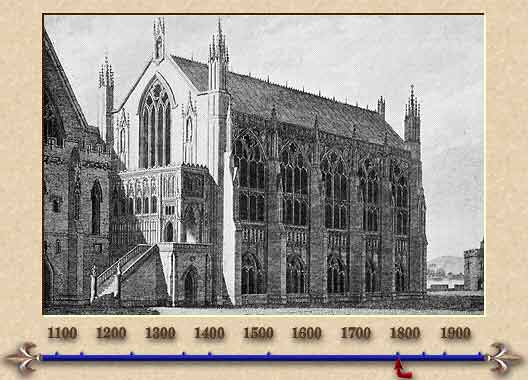
St Stephen's Chapel, sometimes called the Royal Chapel of St Stephen, was a chapel completed around 1297 in the old Palace of Westminster. After the death of Henry VIII until 1834, the building served as the chamber of the House of Commons of England and that of Great Britain. It was largely destroyed in the fire of 1834, but the Chapel of St Mary Undercroft in the crypt survived.
The present-day St Stephen's Hall and its porch, which are within the new Palace of Westminster built in the 19th century, stand on exactly the same site and are today accessed through the St Stephen's Entrance, the public entrance of the House of Commons.
History
[edit]As a royal chapel
[edit]
According to Cooke (1987), King Henry III witnessed the consecration of the Sainte Chapelle in Paris in 1248, and wished to construct a chapel in his principal palace at Westminster to rival it. Work continued for many years under Henry's successors, to be completed around 1297.[2] In the resulting two-storey chapel, the Upper Chapel was used by the Royal Family, and the Lower Chapel, by the Royal Household and courtiers.

Historical events
[edit]Two royal weddings are recorded as having been solemnised in St Stephen's Chapel. On 20 January 1382, King Richard II was married to Anne of Bohemia. The bridegroom was fifteen, the bride sixteen.[3] The other marriage occurred on 15 January 1478, between the younger of the two Princes in the Tower, Richard, Duke of York, and Anne Mowbray.[4] Being five years old, she was close to a year older than Richard. At the age of eight, Anne died. Her coffin was discovered in a vault in Stepney in 1964, and her remains reinterred in Westminster Abbey.[4] The body of Richard's father, King Edward IV, who died at the Palace of Westminster on 9 April 1483, was conveyed to St Stephen's Chapel the next day, and lay in state there for eight days before his interment at St George's Chapel, Windsor.[5]
Thomas Cranmer was consecrated in St Stephen's Chapel as Archbishop of Canterbury on 30 March 1533.[6] After the death of King Henry VIII the Palace of Westminster ceased to be a royal residence. Henry's son, King Edward VI, instituted the Abolition of Chantries Acts, 1545 and 1547, and St Stephen's Chapel thus became available for use as the debating chamber of the House of Commons.[7] Oliver Cromwell had the crypt whitewashed and used it to stable his horses.[8]
On the night before the 1911 census, women's suffragist Emily Davison spent the night in a broom cupboard in the back of the crypt in order to be able to give her address as the House of Commons, despite not being allowed to stand for Parliament or vote.[9] A plaque was unofficially placed in the cupboard to commemorate this in around 1991 by the late Tony Benn MP. He put the plaque in place with his own hands and proudly showed it to visitors. He later installed a second plaque for a purpose which is now lost but the Palace authorities required him to remove it. The screw holes are still visible.
As the House of Commons chamber
[edit]
The former chapel's layout and functionality influenced the positioning of furniture and the seating of Members of Parliament in the Commons. The Speaker's chair was placed on the altar steps – arguably the origin of the tradition of members bowing to the Speaker, as they would formerly have done to the altar. Where the lectern had once been, the Table of the House was installed. The members sat facing one another in the medieval choir stalls, creating the adversarial seating plan that persists in the chamber of the Commons to this day. The old choir screen, with its two side-by-side entrances, was also retained and formed the basis of the modern voting system for parliamentarians, with "aye" voters passing through the right-hand door and "no" voters passing through the left-hand one.[10]

In order to suit the needs of the House of Commons, various changes to the chapel's original Gothic form were made by various architects between 1547 and 1834. Initial changes during the late 16th century were relatively minor; the original chapel furnishings were replaced, the interior whitewashed and the stained-glass windows replaced with plain glass. More drastic alterations were undertaken by Christopher Wren in the 1690s. During that work the building was significantly reduced in height with the removal of the clerestory and vaulted ceiling while the great medieval windows were walled up, with smaller windows cut into the new stonework. Inside, the walls were reduced in thickness to accommodate extra seating and the addition of upper-level male-only public galleries along both sides of the chamber, and the remains of the medieval interior were concealed behind wainscoting and oak panelling. A false ceiling was installed in the chamber to help to improve its acoustics, the quality of which was important in an age without artificial amplification. The newly created attic space above the ceiling housed a ventilation lantern and was used as the ladies' gallery, although the view down into the chamber beneath through the lantern was severely restricted. More seating was later added for the extra members brought in by the Acts of Union with Scotland (1707) and Ireland (1800). By the 19th century, the chapel's interior had a very bland and modest look in contrast to its former medieval magnificence.[11] Further alterations were made to the exterior by James Wyatt at the end of the 18th century.
Fire and reconstruction
[edit]The fire of 1834 totally destroyed the main body of the chapel, with the crypt below, and the adjoining cloisters, barely surviving. Among the few furnishings rescued from the flames was the Table of the House, which is now kept in the Speaker's apartments at the palace. Although it was demolished shortly after the fire, the surviving stone shell of the chapel, with all its later additions burned away, attracted many visitors and antiquaries who came to view the original medieval decorations which had become visible once again. The historical importance of the chapel was realised in the design of the new palace in the form of St Stephen's Hall, the lavishly decorated main public entrance hall built on the same floor plan as the old chapel, with the position of the Speaker's chair marked out on the floor.[12]
The crypt below St Stephen's Hall, the Chapel of St Mary Undercroft, which had fallen into disuse some time before the fire and had seen a number of uses, was restored, and returned to its original use as a place of worship. It is still used for this purpose today. Children of peers, who possess the style of "The Honourable", have the privilege of being able to use it as a wedding venue. Members of Parliament and peers have the right to use the chapel as a place of christening.[13]
The body of Margaret Thatcher was kept in St Mary Undercroft on the night before her funeral on 17 April 2013.[14]
Further reading
[edit]- Maurice Hastings, St Stephen's Chapel and its Place in the Development of Perpendicular Style in England (1955)
- Sir Robert Cooke, The Palace of Westminster (London: Burton Skira, 1987)
References
[edit]- ^ The bird's-eye view by H. J. Brewer was published in The Builder in 1884, according to www.parliament.uk.
- ^ John Steane, The Archaeology of Medieval England and Wales (1985, ISBN 0709923856), p. 7
- ^ Anne of Bohemia Archived 20 September 2011 at the Wayback Machine, Reformation Society website. Retrieved 11 July 2011.
- ^ a b Anne Mowbray, Duchess of York from Westminster Abbey website. Retrieved 11 July 2011.
- ^ "1483-The Year of Three Kings" Archived 17 March 2013 at the Wayback Machine. Retrieved 11 July 2011.
- ^ Stephen Taylor, From Cranmer to Davidson: A Church of England Miscellany (1999, ISBN 0851157424), p. 3
- ^ Kenneth R. Mackenzie, Parliament (1962), p. 29
- ^ The gentleman's magazine and historical chronicle, vol. 80, Part 1 (1810), p. 4
- ^ William Kent, An Encyclopaedia of London (1951), p. 639
- ^ Kim Dovey, Framing Places: Mediting Power in Built Form (1999), p. 87
- ^ Anthony Emery, Greater Medieval Houses of England and Wales, 1300–1500, vol. 3 (2006), p. 256
- ^ J. N. Spellen, The Inner Life of the House of Commons (1854), p. 6
- ^ Emma Crewe, Lords of Parliament: Manners, Rituals and Politics (2005, ISBN 0719072077), p. 97
- ^ "Westminster service remembers Baroness Thatcher". BBC News. 15 April 2013.
External links
[edit]
- explore-parliament.net – shows various views of the chapel, notably this image.
- Virtual St Stephens | – including a section on 'Visualizing St Stephens' throughout its history
| International | |
|---|---|
| National | |
| Other | |

St Stephen's Chapel
View on GrokipediaOrigins and Construction
Royal Foundations under Edward I
Edward I commissioned the rebuilding of St Stephen's Chapel in 1292, initiating a major expansion of the Palace of Westminster to enhance royal prestige amid contemporary European architectural rivalries, such as Louis IX's Sainte-Chapelle in Paris.[5][6] The project replaced an earlier chapel structure documented since the reign of King John, aiming to create a private royal oratory that symbolized monarchical authority through lavish design and scale unmatched by prior English precedents.[2] This initiative aligned with Edward I's broader patronage of Westminster as a seat of governance, where judicial proceedings in Westminster Hall underscored the chapel's role in reinforcing centralized royal power.[6] The chapel's site was strategically selected immediately adjacent to Westminster Hall, facilitating seamless integration with the palace's administrative core and allowing the king's household to access worship proximate to governance activities.[7] Construction commenced with the lower chapel, a vaulted undercroft later known as St Mary Undercroft, whose completion by approximately 1297 under Edward I's oversight introduced innovative tracery and rib vaulting that presaged the Perpendicular Gothic style's emphasis on verticality and light.[8] Progress during Edward I's reign (until 1307) prioritized foundational elements, including masonry and structural framing, with fabric accounts documenting expenditures on materials like Reigate stone for durability against Thames-side conditions.[9] These early phases established the chapel's two-story configuration, with the undercroft serving practical support functions while foreshadowing the upper chapel's grandeur.[10]Expansion and Completion under Edward III
Under Edward III, construction on St Stephen's Chapel resumed after interruptions during Edward II's reign, with intensive work spanning from 1331 to 1363, culminating in the structural completion by around 1348 and final decorative phases—including wall paintings and window glazing—from 1348 to 1363.[6][10] This period represented the most ambitious phase of the project, transforming the partially built edifice into a fully realized two-story royal chapel complex oriented toward the River Thames, underscoring the monarch's commitment to a grand ecclesiastical space befitting his authority.[11] The works were financed through royal revenues, reflecting Edward III's personal investment in elevating the chapel as a symbol of divine kingship amid his era's political and military triumphs.[6] The total expenditure across Edward I, II, and III exceeded £9,000, with Edward III bearing a significant portion during the final decades, enabling the employment of skilled master masons to innovate on the chapel's framework and ensure its structural integrity.[6] These efforts not only finalized the building's form but also prepared it for its liturgical role, as evidenced by the 1348 foundation of a secular college of canons at the chapel, mirroring Edward III's parallel establishment at Windsor Castle to enhance its royal prestige.[12] The chapel's expansive scale and riverside prominence thus embodied the king's vision for a premier venue of monarchical worship, distinct from earlier phases under his predecessors.[13]Architectural Features
Perpendicular Gothic Design Elements
The upper chapel of St Stephen's Chapel, completed by 1348, represented a foundational example of English Perpendicular Gothic, introducing rectilinear tracery and vertical emphasis that diverged from the flowing, curvilinear forms of continental Decorated Gothic.[14] This style prioritized geometric precision and expansive window surfaces over sculptural depth, achieving a uniformity of straight lines in mullions and panels that extended the perception of height and light. Architectural historians identify its innovations, particularly in window design, as originating the Perpendicular phase around 1330–1340, distinct from French Rayonnant influences by emphasizing planar surfaces and reduced ornamental complexity.[14] Measuring 29 meters (95 feet) in length and 9 meters (30 feet) in width, the chapel's elongated rectangular plan supported high vaults rising to create an airy, vertically oriented space, as replicated in the post-1834 St Stephen's Hall to preserve original proportions.[15] The structure incorporated a two-level layout, with the upper chapel reserved for the royal family and the lower for household members, underpinned by the vaulted crypt of St Mary Undercroft, whose surviving 14th-century stone ribs and bosses provide empirical evidence of the overall rib-vaulting system.[7] Building records from 1292–1363 document the procurement of materials for these vaults, confirming their ribbed configuration as precursors to later lierne and fan vaulting in English architecture. Prominent among its features were the large clerestory windows with rectilinear tracery, especially the east gable window, where straight-lined geometric subdivisions allowed maximal glazing—up to four-fifths of wall area—for interior illumination, a hallmark of Perpendicular's shift toward dematerialized walls.[14] These tracery patterns, executed in stone as panels and transoms, extended downward beyond window heads into wall arcading, unifying the elevation in a grid-like rhythm that enhanced structural clarity and aesthetic abstraction. The rib vaults, supported by slender piers, distributed weight efficiently while forming intricate intersecting patterns, optimizing acoustics through reflective surfaces and volume, as inferred from the chapel's adaptation for spoken liturgy in contemporary royal usage.[6]Decorative Program and Symbolism
The decorative program of St Stephen's Chapel encompassed wall paintings, stained glass windows, and altarpieces that integrated biblical narratives, hagiographic figures, and royal iconography to affirm theological underpinnings of kingship. Executed largely under Edward III from 1348 to 1363, the wall paintings featured cycles drawn from the Book of Job—such as the destruction of Job's children and the feast of Job—and the history of Tobit, including the blinding of Tobit, painted a secco on stone with premium pigments like ultramarine, red lake from lac insects, and gold-silver leaf over mordants.[16] These subjects evoked endurance through adversity and divine recompense, mirroring the causal dynamics of royal governance where temporal trials yielded providential success, as evidenced by the chapel's funding from war revenues and crown estates.[6] Altarpieces and reredos, adorned with jewels and gilding, likely incorporated relics and Eucharistic imagery, further embedding sacramental theology in monarchical display.[17] The east altar wall murals prominently depicted Edward III flanked by his sons, led by St George as patron of military valor, projecting dynastic vigor and divine sanction over Plantagenet rule.[18] Stained glass windows, installed in the 1350s with substantial royal expenditure, portrayed saints—including St Stephen the protomartyr—and biblical scenes that bathed the interior in vivid light, symbolizing celestial endorsement of earthly authority.[6] This iconography, documented in archaeological fragments and contemporary accounts, prioritized empirical royal lineage and piety over abstract ideals, with Edward III's commissions—coinciding with the Order of the Garter's founding—asserting kingship as a chivalric continuum rooted in conquest and faith. Opulent materials, including imported lapis for ultramarine and gold leaf applied via oil-varnished gesso, underscored the direct causal chain from monarchical extraction—via taxes on wool trade and French war indemnities—to architectural splendor, evidencing how fiscal centralization enabled theological propaganda of divine-right prosperity.[16][6] The program's cohesion tied St Stephen's martyrdom to royal self-sacrifice in governance, reinforcing legitimacy through visual narratives of saintly intercession and biblical precedent rather than institutional egalitarianism.[17]Surviving Crypt: St Mary Undercroft
The Chapel of St Mary Undercroft constitutes the intact lower crypt of St Stephen's Chapel, built as its foundational level between 1297 and 1365, with initial completion under Edward I in 1297, further development under Edward II, and finalization by Edward III around 1365.[8] Its architecture includes five vaulted bays supported by clustered columns of polished Purbeck marble, a tiled floor incorporating marble elements, and a ceiling adorned with intricate carvings depicting foliage, dragons, musical angels, and heads of men and beasts.[8] This subterranean structure endured the 1834 fire that obliterated the upper chapel and much of the Palace of Westminster, owing to its protected underground position beneath the primary conflagration zones.[4] Post-Reformation, following the 1548 dissolution of the attached college, the space adapted to secular roles, functioning as a wine cellar, Speaker's dining room (evidenced by surviving chimney holes), storage area, and possibly stables during the Interregnum.[19] These varied utilizations underscore its structural resilience across regime shifts and functional repurposings. In the aftermath of the fire, the undercroft underwent restoration from 1860 to 1870 under Edward Barry as part of the neo-Gothic rebuilding of the Palace, preserving and enhancing its medieval core while integrating it into the Victorian ensemble.[8] Today, it operates as a working chapel—a royal peculiar under the monarch's oversight—for parliamentary staff, members, and their families, hosting services, weddings, christenings, and occasional concerts.[19]Function as Royal Chapel
Liturgical and Ceremonial Role
St Stephen's Chapel served as the primary venue for the liturgical observances of the English royal household within the Palace of Westminster throughout the later medieval period. Founded as a royal chapel under Edward I and expanded by Edward III, it hosted a structured cycle of daily services, including masses and the canonical hours, performed by the resident clergy to sustain continuous prayer for the king and dynasty.[3][20] In 1348, Edward III established St Stephen's College to staff the chapel, comprising a dean, twelve canons—modeled numerically on Christ and the apostles—six singing men, and six boy choristers, who executed the daily liturgical round according to the Use of Sarum. This regimen incorporated the seven canonical hours alongside specialized observances such as the Office of the Dead and a dedicated Lady Mass, ensuring perpetual intercession aligned with royal endowments for the souls of deceased monarchs and their kin.[21][22][23] These rituals, attended by the sovereign and court during residence, emphasized hierarchical precedence, with the king's presence at masses underscoring monarchical centrality in palace worship over administrative or parliamentary activities. Empirical evidence from royal financial records confirms the chapel's opulent fittings and vestments, funded through crown allocations exceeding those of lesser institutions, reflected deliberate investment in visible piety rather than egalitarian or proto-democratic functions.[3][20]Ties to Monarchical Authority and Household Worship
St Stephen's Chapel exemplified the Plantagenet monarchs' personal investment in religious infrastructure as a means of asserting divine sanction over their rule, with Kings Edward I, Edward II, and Edward III providing sustained patronage from the late 13th to mid-14th centuries. Edward I initiated major rebuilding works in 1292, modeling the chapel on the Sainte-Chapelle in Paris to project royal magnificence and piety amid conquests in Wales and Scotland.[5] [24] Edward III, completing the upper chapel around 1348, endowed it with lands, revenues, and artworks to sustain its operations, viewing it as a venue for household devotion that intertwined spiritual authority with temporal power. These investments prioritized monarchical agency, channeling resources to rituals that visually and ceremonially elevated the king above feudal subjects rather than accommodating emerging parliamentary influences.[25] As the primary household chapel within the Palace of Westminster, St Stephen's facilitated daily liturgical services for the royal family, courtiers, and attendants, accommodating worship for a court of several hundred when in residence.[3] It functioned as the fixed base for the Chapel Royal's personnel at Westminster, comprising approximately 26 priests, four singing men, six choristers, a verger, and supporting staff under a dean, who conducted masses, vespers, and commemorative rites tied to royal life events.[6] [26] This structure reflected absolute royal oversight of ecclesiastical matters at court, where the monarch appointed clergy and dictated ceremonies that reinforced hierarchical loyalties, such as annual observances honoring saintly patrons aligned with dynastic legitimacy.[12] The chapel's role in royal governance extended to hosting privy councils and ceremonial affirmations of fealty, where nobles rendered homage in a sacral setting that blurred divine and secular allegiance. Under Edward III, such gatherings in or near the chapel underscored the king's role as feudal overlord, with rituals invoking biblical kingship to legitimize fiscal demands and military levies.[25] This pre-parliamentary emphasis on household-centric worship preserved the chapel as an instrument of centralized authority, distinct from broader assemblies, until the 16th century.[3]Transition to Secular Parliamentary Use
Initial Occupation by House of Commons
Following the dissolution of St Stephen's College in 1548 under Edward VI's Chantries Act of 1547, which targeted religious institutions to fund royal initiatives amid Reformation policies, the chapel's upper portion became available for secular repurposing.[27][28] The House of Commons, previously convening irregularly in spaces like the Painted Chamber or abbey chapter house due to expanding business after Henry VIII's constitutional shifts, received permission to occupy the site by 1550 as a dedicated debating venue.[27][28] This allocation addressed practical space constraints without doctrinal fervor, reflecting administrative pragmatism rather than a deliberate break from monarchical traditions. The chapel's ecclesiastical architecture was adapted minimally for parliamentary functions, preserving its longitudinal layout to facilitate debate. Members sat on opposing benches repurposed from former choir stalls, with the Speaker's chair positioned on the altar steps at the eastern end to oversee proceedings.[29][1] The inner chapel served as the main chamber, approximately 15 by 10 meters and two stories high with galleries, while the nave functioned as a lobby for petitioners; these arrangements echoed liturgical divisions without extensive reconstruction.[30][1] Such continuity in form supported adversarial discourse, with no evidence of immediate iconoclastic alterations beyond basic desanctification. This transition maintained the chapel's integration within the royal Palace of Westminster, underscoring a hybrid persistence of crown oversight over parliamentary activities until the structure's destruction in 1834.[28] The Commons' tenure thus represented an expedient allocation of underutilized royal property, prioritizing utility over symbolic rupture in the post-Reformation landscape.[3]Adaptations and Daily Operations as Debating Chamber
Following its allocation to the House of Commons in 1548, St Stephen's Chapel underwent initial adaptations by extending the medieval choir stalls into parallel benches facing each other, with the Speaker's chair positioned at the former altar end to facilitate debate.[31] In 1692, Sir Christopher Wren oversaw further modifications, installing oak wainscoting along the walls, tiered wooden benches, and an upper gallery for additional seating and public observation, while preserving the chapel's high vaulted ceiling and stone structure.[31] These changes accommodated roughly 300-400 members in a chamber measuring approximately 18.6 meters long by 11.4 meters wide, though later expansions like galleries under windows and ventilation shafts above the ceiling proved inadequate for growing numbers.[32] Daily operations retained echoes of the chapel's liturgical origins, commencing each sitting with Anglican prayers led by the chaplain from the Speaker's chair, a practice emphasizing brevity and non-participatory standing to prioritize legislative business over worship.[33] Debates proceeded adversarially from benches or standing positions, with members addressing the House amid the Gothic surroundings, though procedural inefficiencies arose from the fixed layout, which encouraged interruptions and limited visibility for backbenchers. Sessions often extended into evenings, relying on candlelight until gas lighting trials in the 1810s, but the emphasis shifted to substantive discourse, with empirical records noting heated exchanges on fiscal and reform matters despite acoustic distortions from echoes off stone surfaces. The chamber's unsuitability stemmed from chronic overcrowding, as post-1707 and 1801 Union Acts added over 140 seats to an already constrained space, forcing up to 400 members into tiered rows and leading to frequent complaints of physical discomfort and impaired hearing.[32] Poor acoustics, with reverberation times around 0.94 seconds and moderate speech clarity metrics, exacerbated misunderstandings during debates, while inadequate ventilation—limited to high windows and attic shafts—trapped heat, smoke from pipes, and Thames-induced dampness, contributing to health issues like respiratory ailments among members.[32] Wooden fittings and open flames heightened fire risks, as noted in structural assessments, underscoring causal factors in operational decline rather than idealized functionality.[31]Key Historical Events
Medieval Political Assemblies
St Stephen's Chapel, as the principal royal chapel within the Palace of Westminster, provided the liturgical backdrop for monarchical ceremonies accompanying early parliamentary sessions convened by Edward III starting in the 1330s. These assemblies originated as extensions of the king's council, or curia regis, where magnates, clergy, and representatives offered counsel on taxation, warfare, and governance, always under direct royal summons and oversight rather than as autonomous entities. Records from the period, including parliamentary rolls, indicate that such gatherings emphasized advisory petitions to the sovereign, with no evidence of legislative independence; attendance was tied to feudal summons based on landholding and military service obligations.[35] The chapel's completion in 1363, during Edward III's reign, aligned with the evolving role of these councils amid the Hundred Years' War, yet political deliberations occurred in adjacent palace chambers like the Painted Chamber, preserving the chapel for exclusive royal worship and reinforcing its symbolic ties to divine-right authority. Assemblies functioned to legitimize royal decisions through collective endorsement, as seen in grants of extraordinary taxes approved only upon the king's initiative, thereby upholding feudal hierarchies predicated on loyalty, tenure, and reciprocal obligations between crown and subjects.[6] A pivotal instance was the 1376 assembly, dubbed the "Good Parliament" for its scrutiny of royal finances and corruption allegations against courtiers amid war costs exceeding £200,000 annually. Commons representatives, led by Speaker Peter de la Mare, impeached figures like Alice Perrers and Baron William Latimer for mismanagement, yet proceedings remained deferential: criticisms were presented as petitions to Edward III, and post-session royal pardons nullified outcomes, underscoring the assemblies' subordination to monarchical prerogative. Parliamentary writs and chronicles from the era confirm this dynamic, where feudal structures—rooted in land-based allegiance—were affirmed rather than eroded, with no challenge to the king's ultimate veto or dissolution powers.[36]Tudor and Stuart Era Developments
In the mid-16th century, following the dissolution of St Stephen's College amid the English Reformation, the chapel underwent significant secularization as Edward VI granted it to the House of Commons in 1548 as a permanent debating chamber.[3] Religious fittings, including altars and Catholic iconography, were systematically removed at a cost of £344 16s. 10½d., transforming the space from a site of liturgical worship to one of political discourse.[37] Medieval choir stalls were repurposed as benches, establishing a precedent for the chamber's layout, while by 1570 it resembled a theater with four rows of seating.[31] A speaker's chair, adorned with gilded royal arms, was installed in 1586 for £2, underscoring the Commons' assertion of authority within a formerly royal precinct.[37] During the Stuart period, the chapel endured amid escalating royal-parliamentary conflicts, serving as the venue for debates that challenged monarchical prerogative. In 1642, King Charles I entered the chamber seeking to arrest five members, only to be rebuffed by Speaker William Lenthall's declaration of parliamentary privilege, an episode symbolizing the erosion of divine-right sovereignty.[38] The Commons continued meeting there through the Civil Wars and Interregnum, hosting deliberations on regicide and republican governance, though the king's 1649 trial itself occurred in Westminster Hall.[3] Following the Restoration in 1660, repairs addressed wear from wartime use, with chairs repainted green by 1670 to denote the Commons' domain.[31] Security enhancements in the 1670s, prompted by fears of Catholic intrigue, included Sir Christopher Wren's 1679 assessment of the basement and roof reinforcements.[31] Contemporary accounts highlighted persistent risks from the chapel's wooden fabric, candle-lit sessions, and growing attendance, with overcrowding evident as early as the 1629 confrontation where members physically restrained the speaker to prolong debate.[37] By 1692, Wren's redesign introduced oak wainscoting, tiered benches, and an upper gallery within the 60 ft by 30 ft space, accommodating expanded membership from events like the 1707 Act of Union, yet exacerbating congestion that strained the aging structure.[31] These adaptations preserved the chapel's utility amid ideological upheavals, embodying the shift from royal chapel to bastion of parliamentary contestation.[39]Destruction and Immediate Aftermath
The 1834 Palace Fire
The fire that engulfed the Palace of Westminster on October 16, 1834, began in the early evening when officials from the Exchequer burned two cartloads of wooden tally sticks—obsolete receipts from a discontinued accounting system abolished in 1826—in temporary furnaces located in the Star Chamber Court basement beneath the House of Lords.[4] These furnaces, originally designed for coal heating, proved unsuitable for the dense wooden fuel; embers escaped through open doors and ignited adjacent woodwork after the sticks were crammed in beyond capacity, with piles reportedly reaching only four inches high inside but sufficient to overheat the flues.[4][40] By approximately 6:00 p.m., the blaze had erupted visibly, rapidly propagating through the palace's interconnected timber-framed structures, including the vaulted wooden roof and paneling of St Stephen's Chapel, which had served as the House of Commons debating chamber since 1547.[4] The chapel's medieval Gothic elements, such as its 14th-century stone walls overlaid with later wooden additions and poor ventilation, accelerated the fire's intensity, despite initial attempts by palace staff and arriving firefighters to contain it using manual pumps from the Thames.[40] Eyewitness accounts from parliamentary officials and the Clerk of the Works noted the flames' swift ascent, fueled by dry, neglected timbers accumulated over centuries of deferred maintenance, with the chapel's roof collapsing by midnight.[41] Salvage operations by MPs and firefighters recovered some furnishings and records from the Commons chamber, but the chapel was utterly gutted, leaving only its crypt (the Chapel of St Mary Undercroft) intact amid the ruins; this destruction erased irreplaceable medieval fabric, including remnants of 14th-century frescoes and structural innovations that symbolized continuity in British governance.[4][40] Casualties were limited to minor injuries among responders, with no fatalities, as the building was largely unoccupied after the session's adjournment.[41] Official inquiries, including testimony to a select committee, attributed the catastrophe to systemic neglect, such as ignoring warnings about the furnaces and failing to adopt safer disposal methods for the tally sticks, reflecting broader parliamentary frugality in upkeep of the aging structure despite its national significance.[4][40]Temporary Relocation and Loss Assessment
Following the fire that ravaged the Palace of Westminster on 16 October 1834, the House of Commons urgently relocated its sessions to a temporary chamber improvised within the surviving Court of Requests building, convening there from February 1835 until the new Palace's completion in 1852.[42] This adaptation of the former Lesser Hall prioritized rapid resumption of legislative functions over elaborate reconstruction, utilizing makeshift timber structures and salvaged elements amid the site's debris to house debates and committees.[43] Proposals for distant relocations, such as York or Dublin, were debated but rejected in favor of proximate venues to minimize disruption, underscoring parliamentary emphasis on continuity and administrative efficiency.[44] Post-fire evaluations framed the chapel's losses as profoundly disruptive yet secondary to restoring practical governance, with MPs advocating designs that addressed longstanding deficiencies like inadequate ventilation, cramped seating, and poor acoustics rather than nostalgic replication of the medieval layout.[45] The destruction of St Stephen's Chapel's upper structure and crypt obliterated centuries of accumulated parliamentary symbolism, including pews and furnishings tied to Commons' evolution from liturgical space, but salvage efforts recovered scattered masonry fragments for potential reuse.[41] While acknowledging the chapel's instrumental role in institutional precedents like speaker's processions, assessments critiqued pre-fire neglect—exemplified by the tally-burning mishap—and prioritized fiscal prudence alongside utilitarian reforms to avert future vulnerabilities.[46]Reconstruction and Modern Legacy
Design of St Stephen's Hall by Charles Barry
Following the 1834 fire that destroyed much of the Palace of Westminster, Charles Barry incorporated St Stephen's Hall into his overall Gothic Revival redesign of the palace, positioning it directly on the footprint of the former St Stephen's Chapel to serve as a commemorative vestibule and primary public entrance to the House of Commons.[1] The hall replicated the approximate dimensions of the original chapel site, extending roughly 300 feet in length to accommodate processional access while integrating seamlessly with the surrounding neo-Gothic structure.[47] Construction advanced during the 1840s, with the hall substantially completed by 1851, though additional elements like statues continued into the late 1850s under Barry's oversight.[1] Barry eschewed an exact replica of the medieval chapel, opting instead for a pragmatic adaptation that prioritized functionality and safety over strict historical fidelity, informed by first-hand observations of the fire's causes—such as inadequate fireproofing and poor ventilation in the wooden-roofed predecessor.[48] He employed cast-iron framing for the roof and structural supports, combined with stone cladding, to enhance fire resistance, drawing on contemporary engineering practices that emphasized compartmentalization and non-combustible materials to mitigate rapid fire spread.[49] Improvements in natural lighting via clerestory windows and widened access points addressed empirical shortcomings of the prior chapel-turned-debating chamber, facilitating better crowd flow for parliamentary visitors without compromising the hall's role as a transitional space to the Commons chamber.[50] This approach elicited criticism from Gothic Revival purists, who argued that Barry's emphasis on utilitarian enhancements diluted the authentic Perpendicular Gothic essence of the original chapel, favoring modern conveniences like ironwork over ornate medieval replication.[51] Associates of Augustus Welby Pugin, Barry's detailing collaborator, contended that such compromises reflected a broader tension between archaeological accuracy and practical governance needs, though Barry defended the design as a realistic evolution suited to 19th-century parliamentary demands.[52] Despite these debates, the hall's integration exemplified Barry's causal focus on preventing fire recurrence through material innovations, ensuring longevity amid the palace's high-traffic use.[48]Commemorative Elements and Gothic Revival Influence
St Stephen's Hall features a series of marble statues depicting pivotal figures in the development of English constitutional history, including 20 barons who compelled King John to seal the Magna Carta in 1215, Simon de Montfort for convening the Parliament of 1265, and John Hampden for resisting Charles I's ship money in 1637, among others in a set of 12 sculptures by artists such as John Bell.[53][15] These elements underscore a narrative of incremental parliamentary assertion against monarchical overreach, drawing from documented events like the baronial rebellions and early assemblies while aligning with 19th-century interpretations favoring evolutionary liberty over absolutism. At the hall's ends, mosaic panels by R. Anning Bell further commemorate historical themes, reinforcing the space's role in evoking Britain's governance origins through verifiable medieval precedents rather than unsubstantiated legend.[15] Augustus Welby Pugin's interior detailing in St Stephen's Hall, including vaulted ceilings and ornate tracery, embodied the Gothic Revival's advocacy for a return to pre-industrial medieval forms, which Pugin argued embodied moral and structural integrity superior to neoclassical symmetries he critiqued as abstract and pagan-derived.[54] This approach influenced Victorian architecture by prioritizing authentic craftsmanship—such as pointed arches and ribbed vaults rooted in 13th-14th century precedents—over eclectic revivals, fostering a broader movement toward historically grounded designs in public buildings like railway stations and town halls.[55] Today, the hall functions as a public corridor providing access to the House of Commons, maintaining the tradition of open parliamentary approachability established in the medieval chapel era.[15] It sustained minor damage during World War II air raids on the Palace of Westminster, which was renovated comprehensively in 1960 to restore original features like stonework and decorations.[15]20th-21st Century Scholarship and Digital Reconstructions
In the late 20th and early 21st centuries, scholarly attention to St Stephen's Chapel intensified through interdisciplinary approaches integrating architectural history, manuscript analysis, and archaeological evidence, revealing details of its medieval construction and adaptation obscured by its destruction in 1834.[13] The Arts and Humanities Research Council (AHRC)-funded project "St Stephen's Chapel, Westminster: Visual and Political Culture, 1292–1941" (2013–2017), a collaboration between the University of York and the Institute of Historical Research, examined the chapel's artistic, architectural, and political roles using surviving fragments, contemporary accounts, and comparative Gothic structures.[56] This initiative, partnered with the Houses of Parliament, produced peer-reviewed outputs challenging earlier interpretive biases by prioritizing empirical data from building accounts and iconographic evidence over anachronistic democratic narratives.[57] Digital reconstructions emerged as a key methodological advancement, enabling precise visualizations grounded in primary sources. In 2017, the University of York released 3D models of the chapel as a royal Perpendicular Gothic structure (c. 1340s–1360s) and its later conversion into the House of Commons chamber (post-1547), derived from archaeological surveys, medieval drawings, and fabric rolls rather than speculative restoration.[58] These interactive models, accessible via the Virtual St Stephen's platform, depict the chapel's vaulted interior, stained glass programs glorifying Edward III's kingship, and spatial adaptations for parliamentary use, such as pew installations and acoustic modifications documented in 16th–17th-century records.[59] Complementary efforts, including a 2013–2014 Leverhulme Trust-funded edition of the chapel's 14th-century building accounts, provided granular data on materials, labor (e.g., over 200 masons employed intermittently), and costs exceeding £60,000, facilitating accurate scaling and texturing in the digital outputs.[60] Doctoral theses advanced nuanced understandings of the chapel's interplay between aesthetics and power. James Hillson's 2016 University of York PhD thesis, "St Stephen's Chapel, Westminster: Architecture, Decoration and Politics in the Reigns of Henry III and the Three Edwards," analyzed how its tracery, wall paintings (e.g., scenes of royal saints), and liturgical furnishings served monarchical propaganda, drawing on wardrobe accounts and continental influences like the Sainte-Chapelle to argue for deliberate political symbolism over mere stylistic evolution.[61] Similarly, Elizabeth Biggs's 2017 York thesis on the chapel's college of canons (1348–1548) highlighted its clerical elite composition and dissolution under Henry VIII, underscoring institutional continuity from royal piety to parliamentary occupancy.[62] Recent monographs synthesize these findings to reposition the chapel within Gothic historiography. The 2024 edited volume St Stephen's Chapel and the Palace of Westminster (Boydell Press), compiling essays from project contributors, details its role in Perpendicular style innovations—such as fan vaults and glazed triforia—while evidencing exclusive access patterns: medieval services for the royal household and household knights, with Commons meetings (from 1547) limited to gentry and barons in a sacralized royal space, not a proto-democratic "people's chamber."[63] This body of work, prioritizing verifiable artifacts over romanticized traditions, debunks portrayals of the chapel as inherently populist by demonstrating its origins in elite, crown-centric functions, where political assemblies reinforced hierarchical order rather than egalitarian ideals.[64]Significance in British History
Architectural Achievements and Innovations
St Stephen's Chapel, rebuilt from 1292 to 1348 under commissions by Edward I and Edward III, pioneered the large-scale application of the Perpendicular style, characterized by straight vertical mullions and uniform rectilinear tracery that extended from walls to vaults, creating a grid-like emphasis on height and continuity.[5][14] This approach marked a departure from the curvilinear Decorated Gothic, enabling expansive glazed surfaces—up to 60% of wall area in some sections—that admitted far more natural light than the stone-heavy, radiating tracery of contemporaneous French Rayonnant designs, such as Sainte-Chapelle, resulting in brighter, more spatially cohesive interiors suited to liturgical functions.[5][14] Engineering feats included a timber-vaulted roof, constructed circa 1340s by master carpenter William Hurley, which spanned approximately 40 feet without intermediate columns through innovative bracketing and ribbing that mimicked stone vaults while reducing weight and fire risk in the wooden superstructure.[65] The chapel's stonework employed precise proportional ratios, with wall heights reaching 90 feet and clerestory windows aligned to maximize vertical thrust, influencing subsequent Perpendicular developments like the south transept at Gloucester Cathedral (c. 1331–1360), where similar tracery grids and heightened vaults echoed Westminster's model for broader nave reconstructions.[5][66] The crypt's survival intact through the 1834 Palace fire—enduring temperatures exceeding 1,000°C while upper structures collapsed—provides empirical evidence of its robust masonry, featuring thick ragstone walls and ribbed vaults that distributed loads effectively over centuries of use.[66] Sustained royal funding, totaling over £60,000 in medieval equivalents across phases, exemplified centralized patronage's advantages in fostering such innovations, though it limited scalability without equivalent episcopal or monastic resources elsewhere; contemporary critiques were rare, focusing instead on decorative excesses rather than structural flaws.[14]Role in Evolution of Parliamentary Institutions
St Stephen's Chapel, secularized under Edward VI in 1547, became the fixed meeting place of the House of Commons, enabling more consistent sessions that supported its transition from an occasional royal advisory body to a deliberative institution with growing autonomy from the Crown between 1547 and 1834.[67] This dedicated venue in the Palace of Westminster allowed for the development of procedural norms during the Elizabethan era, where members adapted the chapel's choir stalls into facing benches oriented toward the Speaker's chair, thereby institutionalizing a layout that prioritized orderly debate under centralized authority rather than egalitarian exchange.[68] The permanence of the space itself facilitated pragmatic adaptations, such as the establishment of committees and reporting mechanisms, amid political pressures like those preceding the English Civil War, though the Commons remained hierarchically structured and subordinate to royal prerogative until the late 17th century.[69] The chapel hosted critical debates on the Reform Act of 1832, which redistributed seats and extended the franchise to approximately 650,000 male householders—about 7% of the adult population—marking a milestone in parliamentary expansion, yet this change stemmed primarily from elite negotiations to avert revolutionary unrest rather than broad democratic mandates. Pro-reform Whig leaders, facing threats from extra-parliamentary agitation, secured passage through compromises that preserved property qualifications and excluded most working-class voters, reflecting causal drivers rooted in stabilizing aristocratic influence over governance.[70] Post-1832, the chapel's spatial limitations—accommodating roughly 300 members on the floor despite a swelled Commons of 658—intensified overcrowding, hindering efficient deliberation and amplifying acoustics that turned heated exchanges into cacophony, which in turn bolstered arguments for relocation or reconstruction even before the 1834 fire. These constraints underscored the venue's role in exposing institutional bottlenecks, prompting MPs to critique its adequacy for an enlarged body and contributing to pre-fire momentum for modernization, though romanticized views of the chapel as a foundational "cradle of parliamentary liberty" overlook its origins in a restricted, propertied assembly under monarchical oversight.[58]References
- https://www.[mdpi](/page/MDPI).com/2624-599X/5/1/12