Hubbry Logo
Sainte-ChapelleSainte-ChapelleMain
Open search
Sainte-Chapelle
Community hub
Sainte-Chapelle
logo
8 pages, 0 posts
0 subscribers
Be the first to start a discussion here.
Sainte-Chapelle
Sainte-Chapelle
from Wikipedia

The Sainte-Chapelle (French: [sɛ̃t ʃapɛl]; English: Holy Chapel) is a royal chapel in the Gothic style, within the medieval Palais de la Cité, the residence of the Kings of France until the 14th century, on the Île de la Cité in the River Seine in Paris, France.

Key Information

Construction began sometime after 1238 and the chapel was consecrated on 26 April 1248.[2] The Sainte-Chapelle is considered among the highest achievements of the Rayonnant period of Gothic architecture. It was commissioned by King Louis IX of France to house his collection of Passion relics, including Christ's claimed Crown of Thorns – one of the most important relics in medieval Christendom. This was later held in the nearby Notre-Dame Cathedral until the 2019 fire, which it survived.[3]

Along with the Conciergerie, Sainte-Chapelle is one of the earliest surviving buildings of the Capetian royal palace on the Île de la Cité. Although damaged during the French Revolution and restored in the 19th century, it has one of the most extensive 13th-century stained glass collections anywhere in the world.

The chapel is now operated as a museum by the Centre des monuments nationaux, along with the nearby Conciergerie, the other remaining vestige of the original palace.

History

[edit]

Construction of France

[edit]

Sainte-Chapelle was inspired by the earlier Carolingian royal chapels, notably the Palatine Chapel of Charlemagne at his palace in Aix-la-Chapelle (now Aachen). It was built in about 800 and served as the oratory of the Emperor. In 1238 Louis IX had already built one royal chapel, attached to the Château de Saint-Germain-en-Laye. This earlier chapel had only one level; its plan, on a much grander scale, was adapted for Sainte-Chapelle.[4]

The two levels of the new chapel, equal in size, had entirely different purposes. The upper level, where the sacred relics were kept, was reserved exclusively for the royal family and their guests. The lower level was used by the courtiers, servants, and soldiers of the palace. It was a very large structure, 36 meters (118 ft) long, 17 meters (56 ft) wide, and 42.5 meters (139 ft) high, ranking in size with the new Gothic cathedrals in France.[4]

In addition to serving as a place of worship, the Sainte-Chapelle played an important role in the political and cultural ambitions of King Louis and his successors.[5][6] With the imperial throne at Constantinople occupied by a mere Count of Flanders and with the Holy Roman Empire in uneasy disarray, Louis' artistic and architectural patronage helped to position him as the central monarch of western Christendom, the Sainte-Chapelle fitting into a long tradition of prestigious palace chapels. Just as the Emperor could pass privately from his palace into the Hagia Sophia in Constantinople, so now Louis could pass directly from his palace into the Sainte-Chapelle. More importantly, the two-story palace chapel had obvious similarities to Charlemagne's palatine chapel at Aachen (built 782–805)—a parallel that Louis was keen to exploit in presenting himself as a worthy successor to the first Holy Roman Emperor.[7] The presence of the fragment of the True Cross and crown of thorns gave enormous prestige to Louis IX. Pope Innocent IV proclaimed that it meant that Christ had symbolically crowned Louis with his own crown.[8]

The Royal Chapel

[edit]

Sainte-Chapelle, in the courtyard of the royal palace on the Île de la Cité (now part of a later administrative complex known as La Conciergerie), was built to house Louis IX's collection of relics of Christ, which included the crown of thorns, the Image of Edessa, and some thirty other items. Louis purchased his Passion relics from Baldwin II, the Latin emperor at Constantinople, for the sum of 135,000 livres. This money was paid to the Venetians to whom the relics had been pawned.

The relics arrived in Paris in August 1239, carried from Venice by two Dominican friars. Upon arrival, King Louis hosted a week-long celebratory reception for the relics. For the final stage of their journey they were carried by Louis IX himself, barefoot and dressed as a penitent, a scene depicted in the Relics of the Passion window on the south side of the chapel. The relics were stored in a large and elaborate silver chest, the Grand-Chasse, on which Louis spent a further 100,000 livres.

The entire chapel, by contrast, cost 40,000 livres to build and glaze. Until it was completed in 1248, the relics were housed at chapels at the Château de Vincennes and a specially built chapel at the Château de Saint-Germain-en-Laye. In 1246, fragments of the True Cross and the Holy Lance were added to Louis's collection, along with other relics. The chapel was consecrated on 26 April 1248 and Louis's relics were moved to their new home with great ceremony. Shortly afterward, the King departed on the Seventh Crusade, in which he was captured and later ransomed and released.[4] In 1704, the French composer Marc-Antoine Charpentier was buried in the chapel's small cemetery, but this cemetery no longer exists.

The Parisian scholastic Jean de Jandun praised the building as one of Paris' most beautiful structures in his "Tractatus de laudibus Parisius" (1323), citing:

that most beautiful of chapels, the chapel of the king, most decently situated within the walls of the king's house, enjoys a complete and indissoluble structure of the most solid stone. The most excellent colors of the pictures, the precious gilding of the images, the beautiful transparence of the ruddy windows on all sides, the most beautiful cloths of the altars, the wondrous merits of the sanctuary, the figures of the reliquaries externally adorned with dazzling gems, bestow such a hyperbolic beauty on that house of prayer, that, in going into it below, one understandably believes oneself, as if rapt to heaven, to enter one of the best chambers of Paradise.

O how salutary prayers to the all-powerful God pour out in these oratories, when the internal and spiritual purities of those praying correspond proportionally with the external and physical elegance of the oratory!

O how peacefully to the most holy God the praises are sung in these tabernacles, when the hearts of those singers are by the pleasing pictures of the tabernacle analogically beautified with the virtues!

O how acceptable to the most glorious God appear the offerings on these altars, when the life of those sacrificing shines in correspondence with the gilded light of the altars![9]

Modifications (16th–18th century)

[edit]

The chapel underwent considerable modification in the centuries that followed. A new two-story building, the Treasury of Chartres, was attached to the chapel on the north side shortly after it was completed. It remained until 1783, when it was demolished to build the new Palace of Justice. Another building, which served as a vestiary and sacristy, as well as residence for the guardian of the treasury, was placed on the north side. In the 15th century, Louis X of France built a monumental enclosed stairway from the courtyard on the south side to the upper level. This was damaged by fire in 1630, rebuilt, but finally demolished. Fires in the palace in 1630 and 1776 also caused considerable damage, especially to the furniture, and a flood in the winter of 1689–1690 caused major damage to the painted walls of the lower chapel. The original stained glass on the ground floor was removed, and the floor raised. The original ground floor glass was replaced by Gothic-style windows in the 19th century.[10]

Revolutionary vandalism (18th century)

[edit]

Sainte-Chapelle, as both a symbol of religion and royalty, was a prime target for vandalism during the French Revolution. The chapel was turned into a storehouse for grain, and the sculpture and royal emblems on the exterior were smashed.[11] The spire was pulled down. Some of the stained glass was broken or dispersed, but nearly two-thirds of the glass today is original; some of the original glass was relocated in other windows, The sacred relics were dispersed although some survive as the "relics of Sainte-Chapelle" in the treasury of Notre-Dame de Paris. Various reliquaries, including the grande châsse, were melted down for their precious metal.

Restoration (19th–21st century)

[edit]

Between 1803 and 1837, the upper chapel was turned into a depository for the archives of the Palace of Justice next door.[12] The lower two meters (6 ft 7 in) of stained glass was removed to facilitate working light. Some of the glass was used to replace broken glass in other windows, and other panes were put on the market.[13] Beginning in 1835, scholars, archeologists and writers demanded that the church be preserved and restored to its medieval state. In 1840, under King Louis-Philippe, a long campaign of restoration began. It was first conducted by Félix Duban, then by Jean-Baptiste Lassus and Émile Boeswillwald, with the young Eugène Viollet-le-Duc as an assistant. The work continued for twenty-eight years, and served as a training ground for a generation of archeologists and restorers.[12] It was faithful to the original drawings and descriptions of the chapel that survived.[14]

The restoration of the stained glass was a parallel project, which lasted from 1846 until 1855, with the goal of returning the chapel to its original appearance. It was carried out by the glass craftsmen Antoine Lusson and Maréchal de Metz and the designer Louis Steinheil. About one third of the glass, added in later years, was removed and replaced with medieval glass from other sources, or with new glass made in the original Gothic style. Eighteen of the original panels are found today in the Musée de Cluny in Paris.[15]

The stained glass was removed and placed into safe storage during World War II. In 1945 a layer of external varnish had been applied to protect the glass from the dust and scratches of wartime bombing.[16] This had gradually darkened, making the already fading images even harder to see.[17] In 2008, a more comprehensive seven-year programme of restoration began, costing some €10 million to clean and preserve all the stained glass, clean the facade stonework and conserve and repair some of the sculptures. Half of the funding was provided by private donors, the other half coming from the Villum Foundation.[16] Included in the restoration was an innovative thermoformed glass layer applied outside the stained-glass windows for added protection. The restoration of the flamboyant rose window on the west facade was completed in 2015 in time for the 800th anniversary of the birth of St. Louis.[18]

Timeline

[edit]
  • 1239 - Louis IX purchases the reputed Crown of Thorns
  • 1241 - The crown and other relics arrive in Paris
  • 1242-44 - Construction begins
  • 1248 - Sainte-Chapelle completed and consecrated
  • 1264-1267 - Installation of the tribune of relics
  • 1379 - Charles V of France offers the Sainte-Chapelle Gospels to the treasury
  • 1383 - First spire rebuilt
  • End of 15th c. - Monumental exterior stairway built by Louis XII
  • 1460 (approx.) 14th-century spire replaced
  • 1485-1498 - west rose window installed
  • 1630 - Fire damages spire and outer stairway
  • 1690 - Flood damages lower chapel - original lower chapel stained glass removed
  • 1793 - Revolutionaries smash portals and royal emblems. Chapel turned to civil use, and spire destroyed.
  • 1803-1837 - Chapel becomes storeroom for files of Ministry of Justice
  • 1805 - Relics of Passion transferred to Notre-Dame de Paris
  • 1840-48 - Major restoration of chapel and decoration
  • 1846-55 - Restoration and additions to stained glass windows
  • 1853-55 - Current spire constructed
  • 1862- Chapel is classified as an historical monument[a]

Description

[edit]

The royal chapel is a prime example of the phase of Gothic architectural style called "Rayonnant", marked by its sense of weightlessness and strong vertical emphasis. It stands squarely upon a lower chapel, which served as parish church for all the inhabitants of the palace, which was the seat of government.

Exterior

[edit]

The contemporary visitor entering the courtyard of the Royal Palace would have been met by the sight of a grand ceremonial staircase (the Grands Degres) to their right and the north flank and eastern apse of the Sainte-Chapelle to their left. The chapel exterior shows many of the typical characteristics of Rayonnant architecture—deep buttresses surmounted by pinnacles, crocketted gables around the roof-line and vast windows subdivided by bar tracery. The internal division into upper and lower chapels is clearly marked on the outside by a string-course, the lower walls pierced by smaller windows with a distinctive spherical triangle shape. Despite its decoration, the exterior is relatively simple and austere, devoid of flying buttresses or major sculpture and giving little hint of the richness within.

No designer-builder is named in the archives concerned with the construction. In the 19th century it was assumed (as with so many buildings of medieval Paris) to be the work of the master mason Pierre de Montreuil, who worked on the remodelling of the Royal Abbey of Saint-Denis and completed the south transept façade of Notre-Dame Cathedral in Paris.[19] Modern scholarship rejects this attribution in favour of Jean de Chelles or Thomas de Cormont, while Robert Branner saw in the design the hand of an unidentified master mason from Amiens.[20]

The Sainte-Chapelle's most obvious architectural precursors include the apsidal chapels of Amiens Cathedral, which it resembles in its general form, and the Bishop's Chapel (c. 1180s) of Noyon Cathedral, from which it borrowed the two-story design. a major influence on its overall design may have come from contemporary metalwork, particularly the precious shrines and reliquaries made by Mosan goldsmiths.[20]

Though the buttresses are substantial, they are too close to the vault to counter its side thrust. Metal elements such as iron rods or chains, able to support tension, were used to replace the flying buttresses of previous structures.

West front

[edit]

The west front is composed of a porch two levels high, beneath a flamboyant Gothic rose window installed in the upper chapel in the 15th century. At the top is a pointed arch an oculus window, and a balustrade around the bottom of the roof, decorated with interlaced fleur-de-lys emblems placed by Charles V of France. On either side of the porch are towers which contain the narrow winding stairways to the upper chapel, and which also hide the buttresses. The spires of the towers are also decorated with royal fleur-des-lys beneath a sculpted crown of thorns. This decoration dates to the 15th century, and was restored in about 1850 by Geoffroy-Dechaume.[21]

The portal of the upper chapel is located on the balcony of the upper level. The original sculpture of the west portal was smashed during the Revolution. It was restored by Geoffroy-Dechaume between 1854 and 1873.[21]

Spire

[edit]

The current spire, thirty-three meters (108 ft) high, is the fifth to be built at Sainte-Chapelle since the 13th century. The appearance of the first is unknown, but the second, built in 1383 under Charles V, is pictured in an illustration of the Tres Riches Heures du Duc de Berry.[21] He replaced it with another in about 1460, but this spire burned in 1630. It was replaced by another, which was destroyed following the French Revolution in 1793. The present spire was built of cedar wood by the architect Lassus beginning in 1852. The sculpture decorating the spire was designed in 1853 by Geoffroy-Dechaume. The painter-designer Steinheil designed the sculpture at the base of the spire, and his face appears as two of the apostles, Saint Thomas and Saint Bartholomew. Above the gables are statues representing angels carrying the instruments of The Passion. Above the chevet is a statue of the Archangel Michael slaying a dragon. Around the feet of the archangel are sculptures, also designed by Geoffroy-Dechaume, of eight persons, portrayed by workers of the reconstruction, laying wreaths at the Archangel's feet.[21]

Interior

[edit]

Saint Chapelle, built to house a reliquary, was itself like a precious reliquary turned inside out (with the richest decoration on the inside).[22] Although the interior is dominated by the stained glass (see below), every inch of the remaining wall surface and the vault was also richly coloured and decorated. Analysis of remaining paint fragments reveals that the original colours were much brighter than those favoured by the 19th-century restorers and would have been closer to the colours of the stained glass. The quatrefoils of the dado arcade were painted with scenes of saints and martyrs and inset with painted and gilded glass, emulating Limoges enamels, while rich textiles hangings added to the richness of the interior.

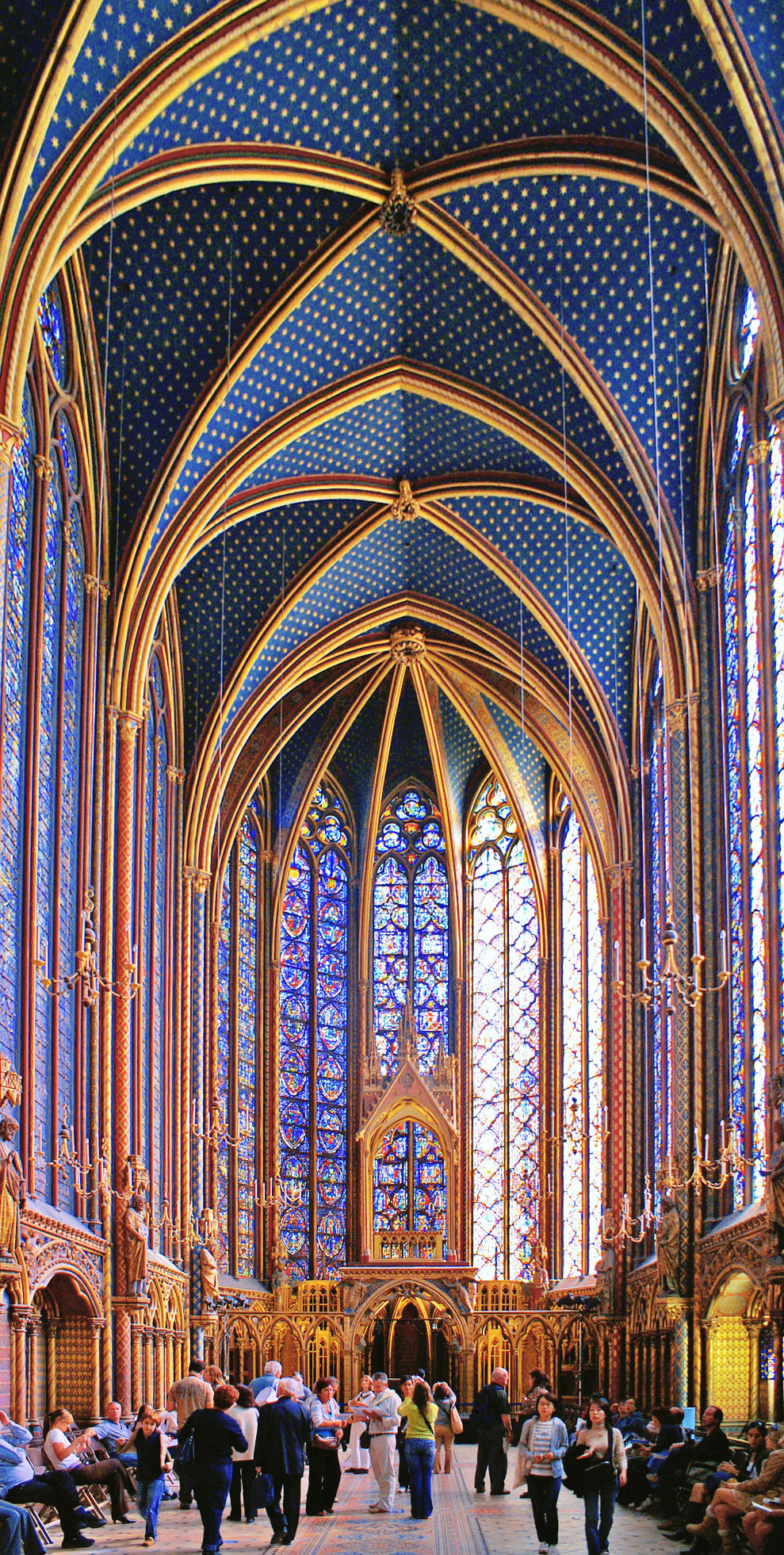
The most striking aspect and original feature of the plan is the nearly total absence of masonry walls in the upper chapel. The walls are replaced by pillars and buttresses, and the space between is almost entirely glass, filling the upper chapel with light.[23]

Lower Chapel

[edit]

The lower chapel was dedicated to the Virgin Mary, and was used by the non-royal inhabitants of the neighbouring Royal Palace. The portal of the chapel represents the Virgin Mary as a column statue. The portal, and almost all the decoration of the chapel, was created by Geoffroy-Duchaume between 1854 and 1858. The primary decorative themes of the sculpture, columns and murals are the Fleur-de-Lys emblem of Louis IX and a stylised castle, the coat of arms of Blanche of Castile, the mother of Louis IX.[24]

The lower chapel is only 6.6 meters (22 ft) high, with a six-meter wide central vessel and two narrow side aisles. The supports of the ceiling vaults are unusual; the outward thrust of the vaults is counterbalanced by small, elegant arched buttresses between the outer and inner columns, and they are also reinforced by a metallic structure hidden under the paint and plaster.[24]

The one-hundred forty capitals of the columns are an important decorative feature; they are from the mid-13th century, and predate the columns of the upper chapel. They have floral decoration of acanthus leaves typical of the period. Each of the gilded leaves corresponds with a slender colonette above, which rises upward to support the vaults. The columns are painted with alternating floral designs and the castle emblem of Castile. The red, gold and blue painting dates to the 19th century restoration.[24]

The original stained glass of the lower chapel was destroyed by a flood in 1690; it was replaced by colourless glass. The present glass depicts scenes from the life of the Virgin Mary, surrounded by grisaille glass, while the apse has more elaborate and colourful scenes from the Virgin's life. All the windows were designed by Steinheil during the 19th century restoration. The lower chapel originally had a doorway to the sacristy on the left lateral traverse. Since it could not have a window, it was decorated in the 13th century with a mural of the Annunciation. This was rediscovered during the 19th-century work, and restored by Steinheil.[25]

Upper Chapel

[edit]

The upper chapel is reached by narrow stairways in the towers from lower level. The structure is simple; a rectangle 33 by 10.7 meters (108 by 35 ft), with four traverses and an apse at the east end with seven bays of windows. The most striking features are the walls, which appear to be almost entirely made of stained glass; a total of 670 square meters (7,200 sq ft) of glass, not counting the rose window at the west end. This was a clever illusion created by the master builder; each vertical support of the windows is composed of seven slender columns, which disguise their full thickness. In addition, the walls and windows are braced on the exterior by two belts of iron chain, one at the mid-level of the bays and the other at the top of the lancets; these are hidden behind the bars holding the stained glass. Additional metal supports are hidden under the eaves of the roof to brace the windows against the wind or other stress. Furthermore, the windows of the nave are slightly higher than the windows in the apse (15.5 meters, 51 ft compared with 13.7 meters, 45 ft), making the chapel appear longer than it actually is.[26]

There are two small alcoves set into the walls on the third traverse of the chapel, with archivolts or arches richly decorated above with painting and sculpture of angels. These were the places where the King and Queen worshipped during religious services; the King on the north side, the Queen on the south.[27]

Vaults of the upper chapel

[edit]

Stained glass

[edit]

The most famous features of the chapel, among the finest of their type in the world, are the fifteen great stained-glass windows in the nave and apse of the upper chapel, which date from the mid-13th century, as well as the later rose window (put in place in the 15th century). The stone wall surface is reduced to little more than a delicate framework. The thousands of small pieces of glass turn the walls into great screens of coloured light, largely deep blues and reds, which gradually change in intensity from hour to hour.[28]

Most of the windows were put into place between 1242 and 1248. The names of the glass artists are unknown, but the art historian Louis Grodecki identified what appear to be three different ateliers with different styles. The windows in the apse and most of the windows on the north wall of the nave are made by one workshop. These works are known for supple forms and costumes, with simplified features. The second workshop, named by Grodecki as Master of the Ezekiel window, made the Ezekiel and Daniel windows, as well as the window of the Kings. That work is characterized by elongated forms, and more elaborate and angular draperies. The third artist or workshop is called the Master of Judith and Esther, for the distinct style of those windows, as well as the window of Job. They are distinguished by more subtle details in the faces, and a resemblance to the figures in illuminated manuscripts.[29]

Despite some damage the windows display a clear iconographical programme. The three windows of the eastern apse illustrate the New Testament, featuring scenes of The Passion (centre) with the Infancy of Christ (left) and the Life of John the Evangelist (right). By contrast, the windows of the nave are dominated by Old Testament exemplars of ideal kingship/queenship in an obvious nod to their royal patrons. The cycle starts at the western bay of the north wall with scenes from the Book of Genesis (heavily restored). The next ten windows of the nave follow clockwise with scenes from Exodus, Joseph, Numbers/Leviticus, Joshua/Deuteronomy, Judges, (moving to the south wall) Jeremiah/Tobias, Judith/Job, Esther, David and the Book of Kings. The final window, occupying the westernmost bay of the south wall brings this narrative of sacral kingship right up to date with a series of scenes showing the rediscovery of Christ's relics, the miracles they performed, and their relocation to Paris in the hands of King Louis himself.[30]

The west rose window

[edit]

The rose window at the west of the upper chapel was made in the late 15th century, later than the other windows. It is a very fine example of the flamboyant Gothic style, named for the flamelike curling designs. It is nine meters in diameter, and is composed of eighty-nine separate panels representing scenes of the Apocalypse. The 15th-century glass artists used a new technique, called silver stain, which allowed them to paint on the glass with enamel paints, and to use fire to fuse the paint onto the glass. This allowed them to modify the color, and create shading and other fine details. It was thoroughly cleaned in 2014–15, giving it greater brightness and clarity.[31]

Stained glass from Saint-Chapelle in other museums

[edit]

Some of the early stained glass that was removed from Saint-Chapelle is now found in the other museums, including the National Museum of the Middle Ages, or Musée de Cluny, in Paris and the Victoria and Albert Museum in London.

Art and decoration

[edit]

Sculpture

[edit]

Most of the sculpture of the portals was destroyed during the French Revolution, but between 1855 and 1870 the sculptor Adolphe-Victor Geoffroy-Dechaume was able to recreate it, using 18th century descriptions and engravings. One of the major works he recreated was the tympanum over the portal of the upper chapel, with a figure of Christ giving a blessing, with the Virgin Mary and John the Baptist alongside him. Two angels are behind him, holding the crown of thorns and the cross, the most famous relics of the chapel. On the lintel below, the sculpture depicts Saint Michael weighing the souls of the dead, with those sent to heaven on the left and those damned on the right.[26] Sculpted Biblical scenes from the Old Testament fill the panels on lower walls, including the Creation and Noah's ark. They were made by Geoffroy-Dechaume in 1869–70.

While most of the sculpture on the exterior dates to the 19th century, the apse of the upper chapel contains a number of original 12th-century statues, which, unlike the exterior statues, were polychrome. Traces of color were found during the restoration in the 19th century, and the statues were restored to include those colors. The arches of the tribune in the apse at the east end, where the case of sacred relics was placed, is ornamented with the original polychrome angels from the 13th century.[32]

The upper chapel walls also displayed a group of sixteen statues of the Apostles, which date to about 1240. Some portray the apostles in simple classical costumes and bare feet, while others are polychrome and have much more elaborate clerical costumes. Some of these statues are now found in the collection of the National Museum of the Middle Ages in the Musée de Cluny.

Painting

[edit]

The goal of the two principal architects of the 19th-century restoration, Durban and Lassus, was to recreate the interior, as much as possible, as it appeared in the 13th century. They collected traces of the original polychrome paint from the columns, and in 1842 presented a comprehensive plan for interior decoration. In the soubassements, the lower portions where no traces of original color were found, they used a neutral tone, to avoid conflicting with the colors of the stained glass windows. For their palette of colors on other decoration, they drew upon the illuminations of a 13th-century book of Psalm from the Royal Library. They systematically repainted the forty-four 13th-century quadrilobe medallions on the stone arches of the soubassements, which depicted the martyrdom of saints presented against a gilded background. In 1845 Steinheil continued by repainting all of the medallions of the nave, with the exception of those in the two royal alcoves, following the original compositions. In 1983 the Service of Historic Monuments cleaned four of the medallions which had not been restored, and un-restored two which had been repainted, to study the original traces of paint from before 1845.[33]

The relics and the reliquary

[edit]

The principal relics for which the chapel was built were the crown of thorns, believed to have been worn by Christ during his Passion, and a small piece of the cross on which he was crucified. These were found in Constantinople, which had been captured by the Crusaders in 1204, and was then ruled by Baudouin II of Cortenay. Baudouin agreed to sell the crown for 135,000 livres, which went primarily to Venetian bankers, to whom he had mortgaged the crown to pay for the defence of the city. By purchasing the crown, Louis gained the prestige of funding the conquest of Constantinople, as well as displaying his personal devotion. The crown arrived in August 1239 and was placed in the earlier royal chapel of St. Nicholas, near the palace. Two years later, he made an additional purchase from Baudouin of a piece of the True Cross and other relics related to the Passion, which were brought to Paris in September 1241. Thereafter, on each Holy Friday, the day of the Crucifixion, he conducted a solemn ceremony at Sainte-Chapelle, in which the relic was brought out and displayed to the faithful.[12]

The King had a large chasse made to hold and display the sacred objects. This was a case, open on the front, 2.7 meters (8 ft 10 in) long, made of silver and gilded copper. Each of the individual objects had its own case of precious metal with jewels. This was originally placed above the altar, but between 1264 and 1267, it was placed atop a high tribune in the apse of the church, where everyone could see it. In 1306, a new sacred relic was added: a portion of the skull of Louis himself, since he had been declared a saint.[34]

During the French Revolution, the Chasse and the vessels holding the relics were taken apart and melted down for their jewels and precious metals. The fragment of the cross was transferred first in 1793 to a collection of antiquities, then given to the Bishop of Paris. A new reliquary of gold and crystal was made for the crown of thorns. Since the Concordat of 1801, it was displayed in the treasury of the cathedral of Notre Dame de Paris,[34] but it was saved from the Notre-Dame de Paris fire on 15 April 2019 and was kept temporarily in the Louvre Museum.[35] It returned to the cathedral in December of 2024. [36]

Organ

[edit]

An organ is attested from the beginning; it was replaced in 1493, 1550 and 1762. It was not until July 1791 when the organ was transferred from the Sainte-Chapelle to Saint-Germain l'Auxerrois due to the French Revolution. The organ was built by François-Henri Clicquot, in a case designed by Pierre-Noël Rousset in 1752. However, its Neoclassical style seems to some writers to be too modern for that date.

Other Saintes-Chapelles

[edit]

Prior to the dissolution of the Sainte-Chapelle in 1803, following the French Revolution, the term "Sainte-Chapelle royale" also referred not only to the building but to the chapelle itself, the choir of Sainte-Chapelle. However, the term was also applied to a number of other buildings. Louis IX's chapel inspired several "copies", in the sense of royal or ducal chapels of broadly similar architectural form, built to house relics, particularly fragments of Louis' Passion Relics given by the King.[37] Such chapels were normally attached to a ducal palace (e.g. Bourges, Riom), or else to an Abbey with particular links to the royal family (e.g. St-Germer-de-Fly). As with the original, such Holy Chapels were nearly always additional to the regular palatine or abbatial chapel, with their own dedicated clergy—usually established as a college of canons.[38] For the patrons, such chapels served not only as public expressions of personal piety but also as valuable diplomatic tools, encouraging important visitors to come and venerate their relics and showing their connection to the French crown. Notable Saintes-Chapelles in France include:

As the status of Saint Louis grew among Europe's aristocracy, the influence of his famous chapel also extended beyond France, with important copies at Karlštejn Castle near Prague (c. 1360), the Hofburgkapelle in Vienna (consecrated 1449), Collegiate Church of the Holy Cross and St. Bartholomew, Wrocław (c. 1350) and Exeter College, Oxford (1860).

See also

[edit]

References

[edit]

Bibliography

[edit]

Further reading

[edit]
[edit]
Revisions and contributorsEdit on WikipediaRead on Wikipedia
from Grokipedia
The Sainte-Chapelle is a royal medieval Gothic chapel situated on the in , , within the grounds of the former , now occupied by the Palais de Justice. Commissioned by King , construction began in 1242 and the chapel was consecrated on April 26, 1248, specifically to enshrine a collection of Passion relics acquired by the king, including the Crown of Thorns purchased from Baldwin II, Latin Emperor of Constantinople, in 1239. These relics, which also encompassed fragments of the and the , were housed in the upper chapel, reserved for the royal family, while the lower chapel served palace staff and featured dedicated altars for palace servants. Exemplifying the style of architecture, the Sainte-Chapelle is renowned for its expansive stained-glass windows, which comprise approximately 600 square meters and depict over 1,000 biblical figures across 15 lancet windows narrating scenes from Genesis to the , supplemented by the western illustrating the . The design prioritizes verticality and light, with thin stone walls pierced by these vast glazing areas supported by flying buttresses and iron bars, creating an interior effect of a "gem box" or jeweled that symbolically elevates the relics toward the divine. This architectural innovation marked a departure from earlier Gothic emphasis on , favoring luminous transparency to evoke heavenly . Following the , the chapel was secularized in 1794, stripped of relics—many dispersed or lost—and repurposed as a courthouse archive, sustaining damage until its designation as a historic monument in 1837 prompted extensive restoration led by from 1841 to 1864, which reinstated much of the original polychromy and glasswork. Today, it stands as a pinnacle of medieval artistry, drawing visitors for its preserved 13th-century features and testament to Capetian royal piety, though the relics' provenance remains subject to historical scrutiny given their Byzantine origins amid financial distress.

Historical Background

Origins and Construction under Louis IX

King , reigning from 1226 to 1270 and later canonized as Saint Louis, initiated the Sainte-Chapelle's origins through his acquisition of sacred relics associated with the Passion of Christ. In 1238, facing financial distress after the Fourth Crusade's , Latin Baldwin II offered the Crown of Thorns to Louis IX, who negotiated its purchase over two years at a cost exceeding 13,000 gold pieces. The relic arrived in on August 18, 1239, via a grand procession, prompting Louis to seek a secure, royal housing rather than depositing it in Notre-Dame Cathedral to maintain direct monarchical control. Subsequent acquisitions amplified this imperative; between 1241 and 1242, Louis obtained additional relics, including a fragment of the , the , and the , totaling around 22 Passion items from Byzantine sources. These purchases, funded by royal treasury and loans, reflected Louis's personal piety and strategic use of relics to elevate Capetian kingship's sacral authority, positioning as a new Jerusalem. In January 1246, Louis formalized the chapel's foundation via a establishing a college of chaplains—each with assisting clergy—to oversee its liturgical duties, underscoring its role as a private royal oratory within the Palais de la Cité. Construction commenced around 1242 to 1246, executed with unprecedented speed for a Gothic structure, completing the upper by 1248 at an estimated cost of 45,000 French livres—roughly equivalent to half the annual royal revenue. Attributed to architect Pierre de Montreuil, the design pioneered Gothic elements, such as expansive stained-glass walls supported by slender iron bars and buttresses, prioritizing veneration over structural mass. The was consecrated on April 26, 1248, with relics installed amid ceremonies that reinforced Louis's image as Christ's earthly vicar. This rapid erection, amid Louis's preparations for the , demonstrated logistical prowess, including prefabricated stone elements transported via the .

Purpose as Royal Reliquary Chapel

The was commissioned by King in the mid-13th century primarily to house a collection of relics linked to the Passion of Christ, transforming it into a dedicated royal within the . Construction began around 1242–1243, with the chapel consecrated on April 26, 1248, after the relics were temporarily stored in other royal chapels. Central to this purpose was the Crown of Thorns, acquired by Louis IX in 1239 from Baldwin II, the of , following two years of negotiations amid the Byzantine Empire's financial distress after the . The purchase, costing 13,134 gold livres—roughly half the king's annual revenue—underscored the relic's perceived spiritual and political value, as it was believed to embody Christ's direct suffering and confer divine favor on the monarchy. Additional Passion relics, including a fragment of the , the , and the , were obtained between 1239 and 1246, totaling over 20 items venerated as authentic witnesses to Christ's . These relics were enshrined in the upper chapel's on an elevated platform, accessible only to the king, his family, and court during private liturgies, emphasizing the chapel's role as an exclusive space for royal devotion rather than public . This arrangement not only facilitated intimate veneration but also elevated the Capetian dynasty's prestige by positioning Louis IX as a new Constantine, bridging sacred history with French royal authority through the relics' display amid radiant narrating their provenance. The chapel's foundation charter of 1246 formalized its dedication, ensuring the relics' perpetual custody under royal oversight and integrating them into daily royal worship to invoke protection and legitimacy for the realm.

Early Royal Usage and Modifications

The Sainte-Chapelle served primarily as a private royal chapel following its consecration on April 26, 1248, by Eudes de Suzhou, the bishop of , under Louis IX. The upper chapel was reserved exclusively for the king, his family, and distinguished guests, where relics including the Crown of Thorns—acquired by Louis IX in 1239—and fragments of the were displayed in a purpose-built . Connected directly to the royal apartments via the Galerie des Merciers, it facilitated private masses, liturgical ceremonies, and public processions that emphasized the king's piety and divine right to rule, such as depictions in the of Louis IX barefoot carrying the relics. These events, supported by papal indulgences granting remission of sins to visitors, drew pilgrims and reinforced Capetian legitimacy by portraying as a new . Under Louis IX's successors, including Philip III (r. 1270–1285) and Philip IV (r. 1285–1314), the chapel retained its status as a oratory, with the upper level continuing to host exclusive royal liturgies and veneration while the lower chapel accommodated palace servants and lesser members. The structure symbolized sacral monarchy, linking the to biblical precedents like King through its architecture and -focused rituals, which included feast days for the relics' reception and dedication. Usage emphasized the king's role as God's anointed, with ceremonies promoting dynastic continuity and national unity amid political challenges from and the church. Early modifications were limited, focusing on enhancing relic display rather than structural changes. In the 1260s, a reliquary tribune was added in the upper chapel to house a grand silver-gilded copper shrine containing the 22 relics, elevating them for visibility during ceremonies. The chapel's integration into the Palais de la Cité prompted adjacent palace adaptations under Philip IV at the century's end, though the chapel itself underwent no major architectural alterations before the Renaissance. Stained glass installation, comprising 1,113 panels narrating biblical history and the relics' acquisition, was completed during initial construction, preserving the Rayonnant Gothic design.

Disruptions and Transformations

Alterations in the Renaissance and Baroque Periods

During the period in , spanning the , the Sainte-Chapelle underwent no significant structural alterations, preserving its 13th-century Gothic form amid broader modifications to the surrounding . The chapel continued to function as a site for royal ceremonies and veneration, with its architectural integrity intact despite stylistic shifts in contemporary French building toward classical elements. In the Baroque era of the , the chapel faced damage from a major in 1630 originating in the adjacent , which completely destroyed the Flamboyant Gothic spire erected in 1460. The spire was promptly reconstructed following the blaze, restoring the chapel's silhouette, though this replacement structure—dating to circa 1630—later met destruction during the . These repairs emphasized functional recovery over stylistic overhaul, maintaining the dominance of the original Gothic framework rather than imposing Baroque embellishments. A subsequent in 1690 further damaged elements like the lower chapel's original , necessitating additional localized fixes but not transforming the overall design.

Desecration During the French Revolution

During the , the Sainte-Chapelle faced targeted desecration as revolutionaries viewed it as a potent symbol of royal absolutism and Catholic under divine right. In the fervor of anti-clerical measures, the chapel was closed to worship around 1790, initiating the systematic removal and destruction of its sacred contents. The primary focus of vandalism was the chapel's reliquary function: the ornate Grande Châsse and associated , which had housed Louis IX's collection of Passion relics including fragments of the and the Crown of Thorns, were dismantled and melted down for their gold, silver, and other metals, resulting in the loss of most relics. However, key items such as the Crown of Thorns were transferred to Notre-Dame Cathedral prior to full dispersal, evading immediate destruction. Interior furnishings suffered extensively, with wooden stalls, the stone jubé screen separating the from the , royal insignia, and liturgical objects deliberately smashed or burned to eliminate monarchical and religious . Structural alterations accompanied the : the shrine was stripped, the over the high removed, and elements of the dismantled, though the core Gothic framework of walls and largely endured due to its utilitarian stone construction rather than overt symbolic targeting. Post-desecration, the deconsecrated space was repurposed for secular use, initially as a grain storage depot amid wartime shortages and later for archiving judicial documents within the adjacent Palais de , reflecting the revolutionaries' emphasis on practical utility over preservation of feudal-era heritage. This phase of neglect and repurposing persisted until the early , underscoring the causal link between ideological rejection of sacral kingship and material erasure of its architectural embodiments.

Post-Revolutionary Secularization and Neglect

Following the of 1789–1799, the Sainte-Chapelle underwent as its religious functions were terminated, with reliquaries melted down for their metal content and most Passion relics dispersed or destroyed. The Crown of Thorns, one surviving relic, was transferred to Notre-Dame Cathedral in 1806. This marked the chapel's transition from a sacred royal to a profane utility space, reflecting the revolutionary rejection of monarchical and ecclesiastical symbols. Initially repurposed as a warehouse for flour storage immediately after the Revolution, the chapel was later converted into an archive depot for judicial records of the neighboring Palais de Justice from 1803 to 1838. The upper chapel housed filing cabinets that obscured the stained glass windows, while the lower level accommodated offices, further diminishing its architectural visibility and accelerating deterioration. Neglect compounded existing damages from earlier fires in 1630 and 1776, as well as revolutionary vandalism, leaving the structure in disrepair by the early ; some panels were walled over, shattered, or sold abroad, including to . Without maintenance, exposure to the elements and utilitarian use eroded the Gothic features, reducing the once-vibrant interior to a shadowed, utilitarian shell until preservation efforts gained traction in the 1830s.

Restorations and Preservation

19th-Century Revival Efforts

After serving as an from 1803 to 1838, during which post-Revolutionary modifications obscured its medieval features, the Sainte-Chapelle became the focus of systematic restoration efforts in the mid-19th century. These works, spanning 1840 to 1863, were directed successively by architects Félix Duban (1836–1848), Jean-Baptiste Lassus (1848–1857), and Adolphe-Napoléon Didron Boeswillwald, with contributing as a site manager from 1840. The removed later additions, such as shelving and secular partitions, to revive the chapel's 13th-century configuration as a royal . Structural repairs emphasized fidelity to the original Gothic design, including reinforcement of walls and vaults weakened by and prior fires. , absent since a fire destroyed its 17th-century predecessor, was reconstituted as the fifth iteration since construction, reaching 75 meters in height with Gothic detailing. Sculpted elements, including apostles and vegetal motifs, were preserved and integrated, with new works by sculptors like Adolphe-Victor Geoffroy-Dechaume commissioned for damaged areas, such as archangels. The , retaining two-thirds of its original 13th-century panels despite Revolutionary dispersals, underwent meticulous cleaning and selective reintegration of recovered fragments. Gaps were filled through research into surviving pieces, aiming for seamless continuity between ancient and new elements. Painted decorations in the upper chapel were reconstituted based on well-preserved medieval traces, restoring vibrant polychromy to walls and vaults. The relic tribune was rebuilt, underscoring the chapel's sacral purpose. These efforts, conducted under the Commission des Monuments Historiques, positioned the Sainte-Chapelle as a pioneering case study in Gothic revival, influencing subsequent French restorations by prioritizing comprehensive revival over mere conservation. While praised for salvaging the from , the interventionist approach—recreating an idealized medieval state—drew later for blending authentic and modern elements. Completion by 1867 returned the chapel to liturgical use, affirming its status as a Gothic exemplar.

20th-Century Interventions

The panels of the Sainte-Chapelle were removed during to protect them from potential aerial bombardment and stored in secure facilities, with reinstallation occurring after the in 1918. This precautionary measure was repeated during , when all windows were dismantled between 1939 and 1940, crated, and safeguarded in châteaux in , before being returned and remounted by 1945 to restore the chapel's visual integrity. These operations minimized direct wartime damage but introduced risks of handling-related deterioration, such as edge chipping and lead corrosion during storage and transport. Postwar efforts in the late and emphasized cleaning and stabilization to counteract accumulated grime from urban pollution and neglect during the chapel's administrative use within the Palais de Justice. Protective varnishes applied during the wars were partially removed to address darkening effects, though some residues persisted until later interventions. Ongoing maintenance throughout the century included periodic inspections of iron armatures supporting the and minor repairs to weakened by , reflecting a shift toward systematic conservation rather than comprehensive reconstruction. By the 1970s and 1980s, interventions incorporated emerging techniques like analysis for assessing lead came integrity and selective glazing replacements for irreparably damaged sections, prioritizing authenticity over aesthetic enhancement. These works, coordinated by French authorities, preserved approximately 85% of the original 13th-century glazing while documenting losses from earlier centuries. Such measures underscored the chapel's status as a , with interventions funded through state allocations to mitigate environmental degradation in central .

Recent Developments and Ongoing Projects

In 2021–2023, the Centre des monuments nationaux (CMN), the body overseeing the chapel's management, completed restoration of the two porches on the western facade, addressing weathering and structural wear from centuries of exposure. This phase prioritized preservation of the Gothic sculptural details while ensuring structural integrity. From early 2025, a new conservation phase commenced on the of Ezekiel's Bay, positioned between the and facade, involving disassembly, cleaning, and re-leading of the 13th-century panels to combat degradation from and . has been erected both internally and externally, though covered with mirrored panels to reduce visual obstruction for visitors; the chapel remains accessible throughout the works. This effort forms part of a multi-year initiative to extend the "second " of the original vitraux, which constitute over 600 square meters of medieval glass and have endured prior cleanings darkened by protective varnishes applied in earlier restorations. Subsequent plans include restoration of the south facade, shifting focus from the upper chapel's windows to exterior stonework and reinforcements, with completion timelines extending into the late 2020s pending funding and archaeological assessments. These projects emphasize non-invasive techniques, such as laser cleaning and UV-resistant glazing, to maintain authenticity while adapting to modern environmental threats like urban pollution.

Architectural Features

Exterior Design and Symbolism

The exterior of the Sainte-Chapelle exemplifies Gothic architecture, characterized by slender verticality and a stone skeleton supporting expansive glazed surfaces, though its facade remains relatively austere compared to the interior's opulence. Constructed primarily between 1242 and 1248 under Louis IX, the structure integrates into the , prioritizing internal relic veneration over external grandeur, with the two-story design reflecting the chapel's division into lower (for palace staff) and upper (royal) levels. Buttresses, partially concealed by the palace's thickness, reinforce the upper walls to accommodate vast windows, while iron bars further stabilize the south facade, enabling the minimal solid masonry that defines its lightweight appearance. The west front features a two-level leading to the portals of both chapels, surmounted by a large added in the in Gothic style. This 9-meter-diameter window, depicting the with flame-like , symbolizes eschatological themes tied to the relics' salvific power. The original 13th-century spire, reaching approximately 36 meters, crowned the ensemble, evoking forms and heavenly ascent, though it was destroyed in 1630 and rebuilt in the . Sculptural elements, including royal emblems like the fleur-de-lys on the lower chapel's exterior, originally adorned the facade, signifying Capetian legitimacy. Symbolically, the exterior embodies Louis IX's ideology of sacral kingship, positioning the chapel as a New Temple of Solomon and as a new , with its relic-focused design asserting divine favor upon the . The crown motif over the west portal reinforces royal authority intertwined with Christ's Passion relics, such as the Crown of Thorns, underscoring the Capetians' role as God's anointed protectors of sacred objects. This restrained yet purposeful exterior served to legitimize Louis's piety and political unification efforts, framing the chapel as a for the realm itself.

Interior Spatial Organization

The Sainte-Chapelle's interior is organized into two superimposed levels: a lower for palace staff and servants, dedicated to the Virgin Mary, and an upper reserved for King Louis IX and the housing of sacred relics. This vertical hierarchy reflects the chapel's role within the royal , with the lower level accessed directly from the and the upper via a dedicated spiral integrated into the thickness of the walls. The lower chapel adopts a crypt-like spatial arrangement, with rib-vaulted ceilings at a height of approximately 6.5 meters (21 feet), comprising a central about 6 meters (20 feet) wide flanked by narrow side aisles roughly 2 meters (7 feet) wide on either side. Its design emphasizes enclosure, featuring painted walls, modest decorative elements such as fleurs-de-lis motifs, and limited confined mainly to the and side chapels, which contribute to a dimly lit, supportive atmosphere beneath the upper structure. In contrast, the upper chapel embodies Gothic principles of verticality and luminous openness, forming a single, undivided space measuring approximately 33 meters (108 feet) in length by 10 meters (34 feet) in width, with vaults rising to 20 meters. Composed of four rectangular bays terminating in a seven-sided polygonal , the interior minimizes solid wall surfaces, allocating over two-thirds of the enclosure to 15 towering stained-glass windows (each 15 meters high) and a western , supported by slender stone piers, iron reinforcement bars, and external buttresses. This engineering allows for expansive glazing that floods the space with colored light, dissolving spatial boundaries and directing visual focus upward along clustered columns and ribs toward the starry-vaulted ceiling, evoking a jewel box centered on the .

Structural and Engineering Innovations

The Sainte-Chapelle represents a pinnacle of Gothic engineering, achieving a structure where glass constitutes approximately two-thirds of the upper chapel's wall surface through refined load-bearing techniques that minimized solid masonry. Pointed arches and vaults direct downward to slender stone piers and columns, enabling thin walls that rise to 42.5 meters while supporting expansive stained-glass windows. This configuration, completed between 1242 and 1248, exemplifies rapid construction—spanning just six years—made possible by prefabricated stone elements and on-site assembly innovations typical of mid-13th-century French Gothic workshops. External buttresses, deliberately kept small to avoid obstructing , are augmented by extensive iron reinforcements to counter the outward from the high vaults and heavy timber roof. Iron bars traverse the upper walls horizontally, while vertical rods and chains the structure, linking arches and stabilizing the framework against lateral forces. Additional iron passes through buttresses and stair turrets, converging above the vaults, with bolts securing the delicate of window heads; these elements collectively distribute loads efficiently, preventing collapse under wind or seismic stress without relying on massive flying buttresses. Internally, the chapel's four-bay culminates in a seven-sided chevet, its unified "" form enhancing vertical thrust via unified vaulting that funnels weight to corner piers. Lead and iron ties further reinforce joints, allowing the stone skeleton to bear the weight of lead-covered roofs and spires, innovations that prioritized luminous interiors over opaque solidity. This presaged later Gothic developments, balancing structural integrity with aesthetic goals of .

Stained Glass and Iconography

Overall Design and Technical Mastery

The ensemble of the Sainte-Chapelle comprises fifteen lancet windows and one , totaling approximately 600 square meters of glazing installed during the chapel's construction from 1243 to 1248. This program forms a unified visual spanning the Old and New Testaments, with panels arranged in horizontal registers across each lancet, subdivided into smaller scenes framed by architectural canopies and medallions. The design prioritizes verticality and light transmission, with minimal stone mullions and iron armatures supporting expansive glass surfaces that integrate seamlessly with the Gothic structure, creating an immersive luminous environment. Technical execution reflects advanced 13th-century glassmaking, utilizing potash-lime-silicate glass colored throughout with metal oxides to produce six principal hues: , copper red, manganese purple, iron green, yellow from silver stain, and clear glass for elements. Production involved blowing and crown glass techniques yielding larger, more uniform sheets, enabling the scale of the panels while maintaining color consistency across the atelier's output. Details such as facial features, drapery folds, and inscriptions were achieved through the application of paints, trace lines, and matt washes, fired at high temperatures to fuse permanently without bubbling or cracking, demonstrating precise control over thermal processes. Assembly techniques further highlight mastery, with thousands of glass pieces—over 1,000 scenes in total—cut to shape using grozing irons and joined with H-section lead cames soldered at intersections, reinforced by iron bars embedded in the to withstand wind loads on panels up to 15 meters tall. This method allowed for complex figural compositions without excessive opacity, optimizing the diffusion of to animate colors from dawn to dusk. Chemical analyses confirm the use of plant-ash fluxes for , contributing to the glass's durability and intensity, innovations that surpassed earlier Romanesque glazing in scale and refinement.

Narrative Content and Theological Emphasis

The stained glass windows in the upper chapel of the Sainte-Chapelle present a comprehensive of through 1,113 scenes distributed across 15 panels, functioning as a visual speculum humanae salvationis that traces biblical events from Creation to . The program unfolds sequentially: the north wall depicts foundations, beginning with Genesis scenes of , Noah's flood, Abraham's covenant, Mosaic law-giving, Joshua's conquests, and the Israelite kings; the south wall extends to heroines and monarchs like Judith, Job, , and , with the final panel incorporating King Louis IX offering the Passion relics to validate Capetian legitimacy. The choir features a central window narrating Christ's Passion from betrayal to , encircled by full-length prophets—Daniel, , , Jesse, and —each holding scrolls with messianic prophecies, while the west illustrates the Book of Revelation's eschatological visions. This iconographic scheme emphasizes typological exegesis, a dominant medieval hermeneutic wherein figures and events prefigure antitypes, particularly Christ's and the authenticity of the chapel's relics like the Crown of Thorns and fragments. For instance, bearing the typifies Louis IX transporting the Crown, portraying the king as a sacral akin to biblical forebears, with filtering through the glass symbolizing illumination of scriptural truth and the relics' evidentiary role in faith. Prophets' inscriptions and interjected royal motifs, such as fleurs-de-lis and imagery, integrate with , affirming the king's piety as instrumental to France's spiritual destiny amid Crusader-era relic acquisitions. The narratives employ amplificatio from ars poetriae traditions, expanding canonical texts into episodic sequences to heighten didactic impact, prioritizing typological correspondences over strict chronology to link disparate stories thematically—e.g., patriarchal trials mirroring Christ's agony—thus reinforcing the chapel's function as a reliquary-theater where visual typology authenticated relic veneration and royal devotion.

Dispersals, Losses, and Modern Restorations

During the , following the chapel's secularization in 1794, some windows were walled up, leading to the destruction or dismantling of panels, with surviving fragments dispersed onto the art market. Despite these losses, the majority of the upper chapel's 13th-century glass remained intact, preserving over 600 square meters of original medieval vitrage, one of the largest surviving ensembles. By the mid-19th century, accumulated grime and decay had obscured the glass, prompting a major restoration campaign from to under architects like , during which panels were dismantled, cleaned, and reassembled with some repairs and replacements for damaged sections. elements suffered notable losses during this period and earlier events, though primary narrative panels were largely preserved. To protect against wartime threats, all panels were removed and stored during and again in , then reinstalled postwar without significant further loss. In the late 20th and early 21st centuries, atmospheric pollution caused severe soiling, addressed through an ongoing multi-decade program initiated around 2000, involving systematic cleaning and protective measures. Specific interventions include the 2014-2015 removal and laser-based restoration of individual windows, such as the southwestern lancet, to remove centuries of encrustations without chemical agents. A new phase targeting the 13th-century glass began in February 2025, focusing on conservation techniques to ensure longevity.

Relics and Their Significance

Acquisition and Collection by Louis IX

In 1238, Baldwin II, the of , facing severe financial difficulties due to military pressures on his fragile empire, offered the Crown of Thorns—purportedly worn by Christ during the Passion—to his cousin, King , as a means to secure aid. Louis agreed to purchase the relic for 135,000 livres tournois, a sum equivalent to roughly half of France's annual revenue at the time, with payments structured in installments to Venetian intermediaries who had temporarily held the artifact as collateral. The Crown arrived in via ship in August 1239, where Louis IX, accompanied by his mother Queen , his siblings, and numerous nobles and clergy, received it with solemn procession from the port of Boulogne to the royal palace on the . Emboldened by this acquisition, Louis IX expanded his collection of Passion relics over the following years, procuring additional items from the same Byzantine sources, including fragments of the , the , the , and the , among approximately twenty-two relics in total associated with Christ's Passion. These purchases, totaling further significant expenditures—such as an additional 100,000 livres for subsequent relics—were facilitated through diplomatic envoys and reflected Louis's personal piety and strategic intent to elevate the prestige of the French monarchy by associating it with Christendom's most venerated objects. By 1241–1242, the full collection had been assembled in , prompting Louis to commission a dedicated to safeguard and display them, underscoring his role as a collector driven by both devotional zeal and .

Reliquaries and Display Practices

The relics of the Passion housed in the Sainte-Chapelle were preserved in ornate reliquaries crafted from precious materials such as gold, silver, , and gilt , which served both protective and devotional functions by elevating the artifacts' sanctity through opulent design. Individual reliquaries often incorporated transparent elements to permit visual of the relics without direct contact, as seen in the case of the Crown of Thorns, which was mounted in a ring formed by six interlocking crystal segments secured by three gilt bronze leaves each. These containers drew on Byzantine influences, prioritizing tight enclosure to safeguard fragile items while symbolizing divine enclosure within earthly splendor. The collection of approximately twenty-two relics was unified within the Grande Châsse, a monumental functioning as a master that aggregated the smaller caskets into a single, hierarchical display. This grand chasse, installed by the 1260s, measured several meters in height and featured intricate metalwork, enabling rotational viewing and public presentation during ceremonies. Display practices centered on the upper chapel's , where the Grande Châsse occupied an elevated behind the high , positioned under a ceremonial for axial prominence amid the surrounding narrating Passion scenes. Reserved primarily for King Louis IX, his family, and court during daily masses and feast-day liturgies, the relics were integrated into royal worship to underscore Capetian sacral legitimacy, with the king's proximity affirming personal piety and dynastic authority. Limited public expositions occurred on significant occasions, such as relic arrival processions in 1242 and 1248, fostering among and pilgrims while maintaining exclusivity. The chapel's itself amplified these practices, framing the chasse as the focal "reliquary jewel" within a luminous Gothic . Most reliquaries and the Grande Châsse were melted down during the , with surviving elements like the Crown of Thorns later re-encased in 19th-century crystal tubes.

Debates on Authenticity and Historical Critiques

The relics housed in the Sainte-Chapelle, including the Crown of Thorns acquired by Louis IX in 1239 and fragments of the obtained between 1241 and 1242, possess a documented from Constantinople's imperial collections, where they had been venerated for centuries prior to the Latin Empire's establishment in 1204. However, their purported origin from the Passion of Christ remains unverified by empirical standards, as no continuous historical attestation links them directly to first-century , and medieval relic often relied on rather than forensic evidence. Scholars emphasize that the sales were driven by Baldwin II's urgent need for funds to defend his precarious throne against Byzantine and Bulgarian threats, prompting critiques that financial exigency compromised rigorous authentication processes typical even in Byzantine relic transfers. Authenticity debates intensified with Reformation-era skepticism, exemplified by John Calvin's 1543 calculation that extant True Cross fragments exceeded the wood volume of two full crosses, highlighting the proliferation of claimed Passion relics across Christendom. Modern historiography views the Sainte-Chapelle collection as a product of 13th-century devotional culture, where relics amplified royal sacrality but lacked scientific validation; carbon dating on wooden fragments from similar provenances has yielded inconsistent results, often post-dating the Crucifixion by centuries. The Archdiocese of Paris explicitly states that the Crown of Thorns, now preserved at Notre-Dame Cathedral after surviving the 2019 fire, cannot be authenticated beyond its historical veneration. Historical critiques portray Louis IX's acquisitions as instrumental in constructing Capetian legitimacy, intertwining piety with political theater to equate the king with Christ's vicegerent, though contemporaries like questioned the exorbitant costs—equivalent to fortifying multiple castles—for items of dubious veracity. While Louis's personal devotion appears sincere, evidenced by his barefoot reception of the in 1239 and the chapel's lavish completed by 1248, analysts argue the relics' strategic deployment fostered a monarchical that prioritized over empirical truth, a dynamic unmasked by post-Enlightenment of relic economies rife with forgeries. Dispersal during the , with many items melted for bullion or lost, further eroded claims, as surviving pieces underwent no systematic testing to affirm antiquity.

Artistic and Decorative Elements

Sculpture and Statuary

The principal sculptural elements of the Sainte-Chapelle consist of the twelve statues positioned along the piers of the upper between the stained-glass windows, decorative capitals crowning the columns, and portal tympana on both the lower and upper levels. These works, executed between 1243 and 1248 during the chapel's construction under Louis IX, exemplify early French Gothic styles from Parisian workshops, characterized by dynamic folds, individualized features, and symbolic attributes denoting authority. The apostle statues, standing approximately 1.4 to 1.65 meters tall, depict the biblical figures as pillars of the Church, barefoot to evoke divine humility and holding discs inscribed with crosses signifying consecration. Specific attributes include grasping a key and cross, Saint Paul wielding a , and Saint John portrayed as youthful and beardless with a smile. Of the original twelve limestone figures, six were removed and partially preserved during the , with three fully intact examples—measuring up to 165 cm in height—now housed at the in ; the remainder in situ include at least five originals, supplemented by 19th-century replacements to restore the ensemble. Portal sculptures feature a 19th-century Virgin and Child on the lower chapel entrance, replicating a medieval original, and a Blessing Christ on the upper portal tympanum, modeled after the Amiens Cathedral portal and carved by Adolphe-Victor Geoffroy-Dechaume in the mid-19th century. The west front portal's original Gothic sculpture was destroyed during the Revolution and rebuilt between 1854 and 1873 under Geoffroy-Dechaume's direction as part of Viollet-le-Duc's broader restoration campaign. Over one hundred 13th-century capitals adorn the upper chapel's columns and consoles, showcasing naturalistic motifs such as thistles, buttercups, vines, roses, birds, and fantastical animals, which animate the architecture while subordinating ornament to structural clarity in the Gothic idiom. These elements, largely intact despite revolutionary vandalism, underscore the chapel's integration of as a supportive framework for its luminous stained-glass program rather than as autonomous figural display.

Painting, Goldwork, and Furnishings

The interior of the Sainte-Chapelle featured an elaborate scheme in the 13th century, employing dominant colors of blue, red, and gold to create a luminous, jewel-like environment evocative of royal treasury and divine splendor. This decoration extended across walls, columns, and ceilings, with applied to enhance motifs and simulate the opulence of goldsmithing techniques used in reliquaries. In the lower chapel, columns were painted with alternating patterns of fleurs-de-lis on blue grounds and Castilian castles on red, honoring the Spanish heritage of Queen , mother of Louis IX. The ceiling bore similar motifs, while a depicting the above the door to the tower—containing royal archives—represents the oldest surviving wall painting in , dating to the chapel's around 1248. Goldwork appeared in gilded accents on these elements, contributing to the overall effect of encrusted luxury. The upper chapel's decorations emphasized celestial themes, with the vaulted ceiling rendered as a starry sky in deep blue punctuated by gold stars, symbolizing the heavenly realm accessible to the king during relic veneration. Arcades featured 44 painted medallions portraying Christian martyrs, such as St. Sebastian and St. Catherine, executed on stone with chiseled backgrounds and inlaid glass for added brilliance; framed and highlighted these figures. Much of the original painting and goldwork deteriorated over centuries due to floods from the , exposure, and historical upheavals, including damage during the . 19th-century restorers, led by , recreated the scheme based on surviving medieval fragments, faithfully reproducing colors, motifs, and gilding techniques to revive the intended vibrancy. Furnishings in the medieval period were subordinate to the architectural and painted elements, primarily consisting of wooden altars and screens likely painted and partially gilded to harmonize with the interior; however, nearly all such items were lost to and reuse, with no original examples surviving intact. Modern replicas or later additions do not preserve authentic 13th-century designs.

Organ and Liturgical Music

The of the Sainte-Chapelle emphasized plainchant and sequences tailored to its -focused feasts, particularly those for the Crown of Thorns on August 11 and the Precious Blood on October 1, with 21 such sequences composed to narrate histories and reinforce Capetian sacral kingship. These monophonic settings, syllabic and rhymed, integrated doctrinal narratives without evidence of 13th-century specific to the chapel, prioritizing oral traditions and community practices over notational innovations. The chapel's proprium, as detailed in later sources like the 1689 edition, regulated these repertories, reflecting adaptations from Parisian norms while highlighting the s' activation in . By the late medieval and Renaissance periods, polyphonic elements emerged alongside plainchant, drawing from the Notre-Dame school's early polyphony and including works associated with composers like Johannes Ockeghem, whose motets and masses were performed in royal chapels including Sainte-Chapelle equivalents. The chapel's collegiate structure supported a chapel master and singers for these elaborations, evolving performance practices through the 16th century amid broader French sacred music trends. In the 17th century, served as maître de chapelle from 1698 until his death in 1704, composing and premiering works like the Missa Assumpta est Maria on August 15, 1702, for the Feast of the Assumption, blending grand motets with the chapel's relic-centric acoustics. This period marked a shift toward more ornate , preserved in Charpentier's Meslanges autograph manuscripts. The organ, absent in the chapel's 13th-century origins, was installed in the : a designed by Pierre-Noël Rousset and built by carpenter Lavergne in , with the instrument constructed in 1771 by François-Henri Clicquot, France's leading organ builder. Deconsecrated in 1791 during the , the organ was sold and relocated to Saint-Germain-l'Auxerrois parish, where Claude François Clicquot reinstalled it; no organ has since been reinstated at Sainte-Chapelle.

Broader Impact and Legacy

Role in Promoting Sacral Monarchy

The Sainte-Chapelle, commissioned by Louis IX in 1241 and consecrated in 1248, functioned as a deliberate instrument to construct and promote sacral monarchy, portraying the Capetian as a divinely anointed ruler akin to monarchs. By housing relics of Christ's Passion, including the Crown of Thorns purchased from Baldwin II of in 1239 for 135,000 livres tournois, the chapel elevated Louis's personal piety and authority, merging royal power with sacred legitimacy. This integration transformed the royal palace into a center of religious devotion, where the 's role as protector of holy objects underscored his God-given mandate to rule . Architecturally and liturgically, the chapel adapted forms—such as the longitudinal plan reminiscent of bishop's chapels—to serve royal ideology, rejecting centralized imperial models like Charlemagne's chapel in favor of a linear space emphasizing hierarchical royal procession. Its stained-glass program, comprising over 1,100 panels, narrated biblical history from Genesis to the relics' arrival in , implicitly linking the French monarchy to and sacral kingship. The structure's jeweled aesthetic, with expansive glazing and minimal stonework, evoked a on a monumental scale, symbolizing the monarchy's custodial role over sacred patrimony and asserting over institutions. Beyond private royal worship, the chapel hosted public relic expositions and ceremonies, such as the annual feasts for the Crown of Thorns on , which drew crowds and disseminated the image of Louis as a saintly , fostering national unity under his divine rule. Custom liturgical sequences composed for these events further naturalized sacral kingship by intertwining relic veneration with royal praise, influencing perceptions of Capetian legitimacy amid 13th-century territorial expansions. This dual public-private dynamic projected Louis and his successors as sacral figures, redefining French from feudal lordship toward an absolutist, divinely sanctioned authority.

Architectural Influence on Later Gothic Works

The Sainte-Chapelle's Gothic design, completed between 1242 and 1248, exemplified a shift toward structural lightness and luminous interiors through vast expanses of —comprising over 600 square meters in the upper chapel—supported by slender piers, bar tracery, and external buttresses that minimized solid . This approach prioritized verticality and the diffusion of colored light, setting a precedent for later Gothic works that emphasized transparency over mass. Its rapid construction under Louis IX demonstrated feasibility for such innovations, influencing masons to apply similar techniques in subsequent projects to evoke . A direct emulation appears in the Sainte-Chapelle at the Château de Vincennes, commissioned in 1379 by Charles V and designed by architect Raymond du Temple explicitly inspired by the Parisian model. While adapted to a single-level plan unlike the two-story chapel, incorporated hallmarks such as high windows, flying buttresses for wall stability, and ornate tracery, though evolving toward Flamboyant Gothic with more undulating stonework; construction extended into the Renaissance, completing under Henri II around 1550. This replication underscored the chapel's role as a template for royal spaces, linking Capetian sacral kingship across sites. Broader impacts extended to ecclesiastical architecture, where the Paris chapel's innovations in glazing ratios—reaching 75% of wall surface in the upper level—encouraged analogous designs in smaller chapels and cathedral extensions across Europe, fostering the style's dissemination into the . For instance, its tracery patterns and light-flooded naves informed retrofits like the Rayonnant transepts of (c. 1250–1260), which amplified glazing while retaining earlier elements. These adaptations prioritized aesthetic and symbolic effects over structural conservatism, influencing palace oratories in regions like through French stylistic exports.

Contemporary Cultural Role and Preservation Challenges

In the 21st century, the Sainte-Chapelle serves as a premier cultural and tourist destination in Paris, attracting over 1.2 million visitors annually as part of the UNESCO-listed Banks of the Seine, designated a World Heritage Site in 1991. Its upper chapel, renowned for its expansive 13th-century stained glass windows, draws crowds for self-guided tours, guided visits, and family activities emphasizing the site's medieval artistry and historical relics. The chapel's acoustics and luminous interior make it a favored venue for classical music concerts, featuring works like Vivaldi's The Four Seasons, with performances scheduled multiple evenings weekly from spring through autumn, accommodating up to several hundred attendees per event. Preservation efforts face multifaceted challenges stemming from the building's 13th-century , urban pollution, and high visitor traffic, which accelerate wear on stonework, sculptures, and the fragile comprising nearly two-thirds original medieval panels. A 2008 initiative addressed centuries of grime-induced darkening on the windows, but ongoing degradation from atmospheric pollutants and UV exposure necessitates periodic interventions. Recent projects include the restoration of the west facade porches completed between 2021 and 2023, followed by south facade work announced in early 2025, involving , , and repairs. Stained glass conservation poses particular difficulties, with a new campaign launched in February 2025 targeting panels like those in Ezekiel's bay, requiring internal and external that temporarily alters visitor access while technicians dismantle, repair, and reinstall fragile lead-came frameworks. These efforts, managed by France's Centre des monuments nationaux, balance structural integrity against the site's active use, amid broader pressures from seismic vulnerabilities in the Île de la Cité's historic fabric and climate-induced material expansion. Despite such hurdles, the chapel remains open year-round, with restorations designed to minimize disruptions to its cultural programming.

References

Add your contribution
Related Hubs
User Avatar
No comments yet.