Hubbry Logo
WindbreakerWindbreakerMain
Open search
Windbreaker
Community hub
Windbreaker
logo
8 pages, 0 posts
0 subscribers
Be the first to start a discussion here.
Windbreaker
Windbreaker
from Wikipedia
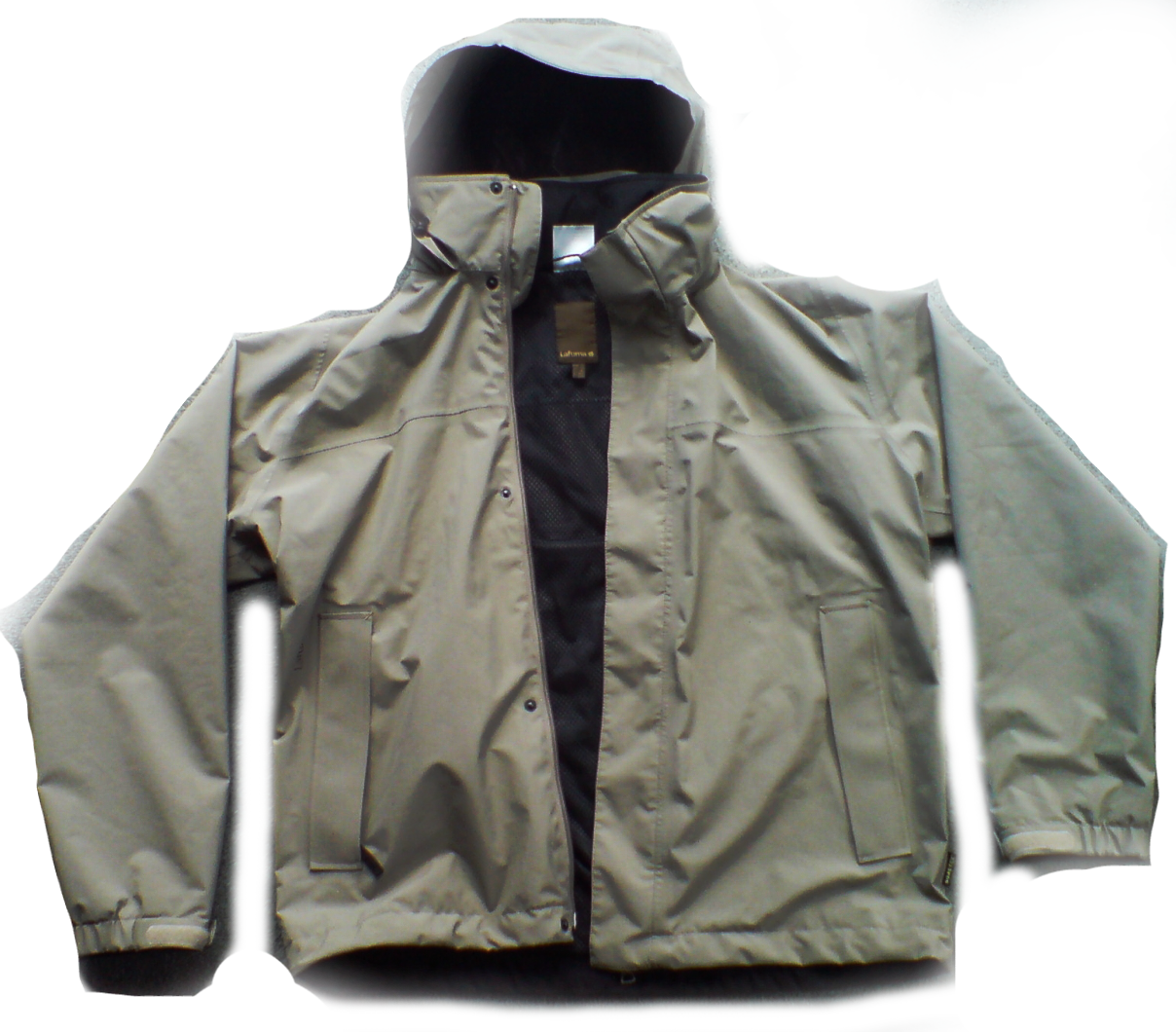
A windbreaker with its "stowable" hood unstowed

A windbreaker, or a windcheater, is a thin fabric jacket designed to resist wind chill and light rain, making it a lighter version of the jacket. It is usually lightweight in construction and characteristically made of synthetic material. A windbreaker often incorporates an elastic waistband, elastic armbands and a zipper to allow adjustment for weather conditions.

Regular jackets or coats may include a type of windbreaker as an interlining that can be removed when desired. Windbreakers sometimes include a hood that may be removable and/or stowable. Many windbreakers may also include large pockets on the inside or the outside which allow belongings to be protected from the weather. Windbreakers may offer light to moderate insulating protection, more so than a sweater, but less than an overcoat.[1]

Windbreakers are primarily worn during the warmer seasons when wind or rain are expected, or as part of a layering strategy during colder seasons.[2] Brightly colored windbreakers may also be worn by runners as protection from the weather, and as a reflective garment used for safety.[citation needed] A 2012 study demonstrated that adding windbreaker pants and jackets is a lightweight but effective means of delaying hypothermia if the user is outside walking and encounters unexpected low temperatures.[3]

Windbreaker

[edit]
A Rissman company ad for windbreaker jackets (1942)
United States President Richard Nixon wearing a windbreaker on September 6, 1969.

The term was first used and trademarked by the John Rissman company of Chicago for its gabardine jackets.[4]

Windcheater is used in the United Kingdom and certain Commonwealth countries, including Australia and India. It can also refer to any glossy synthetic material used to make clothing. Windcheater tops are also commonly known as cagoules or windbreakers in the United Kingdom.

Windcheater

[edit]

Windbreakers can also be called “windcheaters”. The term predates the term windbreaker and was originally used to describe a sort of garment that was more akin to a pullover anorak than a modern zippered windbreaker.

Windcheater is also used to describe a retail item used on the beach and camping to prevent wind from disturbing social enjoyment. Normally made from cotton, nylon, canvas and recycled sails, these windbreaks tend to have three or more panels held in place with poles that slide into pockets sewn into the panel (like many tents).The poles are then hammered into the ground and a windbreak is formed.[citation needed]

See also

[edit]

References

[edit]
Revisions and contributorsEdit on WikipediaRead on Wikipedia
from Grokipedia
A windbreaker is a lightweight jacket made from wind-resistant synthetic materials, designed primarily to protect the wearer from and light while remaining highly packable and versatile for outdoor use. These jackets typically feature a slim, single-layer with tightly woven fabrics like or to block airflow and minimize convective heat loss, often incorporating elastic cuffs, hems, and sometimes hoods to seal out drafts. Unlike fully waterproof rain jackets, windbreakers offer water-repellent properties suitable for mild showers but prioritize and mobility over heavy protection. Windbreakers are essential for activities such as hiking, running, cycling, and casual outdoor pursuits, where they serve as an outer layer in a clothing system to maintain warmth in breezy conditions without restricting movement. Their compact design allows them to be folded into a pocket or pouch, making them ideal for transitional seasons like spring and fall, or as emergency shelter from sudden gusts during warmer months. Popularized in the late 20th century through athletic and streetwear influences, such as Nike's Windrunner model introduced in 1979, windbreakers have evolved from functional gear to a staple in modern wardrobes, blending utility with stylistic elements like bold colors and logos. In recent years, lightweight windbreakers have gained popularity as stylish men's spring outerwear, featuring minimalist designs, hoods, neutral or pastel tones, water-repellent treatments, and fits ranging from slim to oversize, from brands such as Zara, H&M, Uniqlo, Columbia, and The North Face. The term itself dates to around 1918, originally a trademark of the John Rissman & Son company describing wind-resistant garments like leather shirts before becoming synonymous with these synthetic jackets.

Definition and Terminology

Core Definition

A windbreaker is a lightweight, thin outer jacket designed primarily to block during mild weather. It provides minimal protection against light rain or , serving as a barrier that reduces the effects of on the body without offering full . Unlike heavier jackets or coats intended for severe conditions, a windbreaker emphasizes portability, , and ease of layering, making it suitable for activities in temperate climates where overheating is a concern. Its basic structure typically includes a short length for mobility, along with elastic cuffs and hem to prevent from entering. The term "windbreaker" derives from the compound words "" and "breaker," first appearing around 1918 to describe wind-resistant garments, initially a type of . In some regions, such as and the , it is alternatively called a windcheater.

Regional Variations

In English-speaking regions, the term "windcheater" serves as a primary for "windbreaker," particularly in and , as well as other countries, referring to the same lightweight jacket intended to block without notable functional distinctions. This variant usage reflects linguistic preferences rather than design differences, with both terms describing a thin outer layer for casual or outdoor protection. In non-English contexts, similar garments are known by equivalents such as "Windjacke" in German, emphasizing wind resistance through lightweight construction, or "coupe-vent" in French, which denotes a wind-cutting jacket often used in mild weather. These terms align closely with the core purpose of wind protection but adapt to local nomenclature without altering the garment's essential form. The designation "windbreaker" emerged as a U.S.-centric term, originally trademarked by the John Rissman Company of in the for its jackets, before becoming a genericized name adopted worldwide. This early commercialization in America contributed to its prevalence in , while fostering global recognition beyond regional boundaries.

History

Early Origins

The modern windbreaker traces its conceptual roots to the indigenous garments of Arctic peoples, particularly the , who developed highly effective wind-resistant clothing to endure extreme conditions. Traditional Inuit parkas, such as the women's , were crafted from layered animal skins such as caribou or seal hides, with the inner layer often featuring the fur for insulation and the outer layer treated with animal fats or fish oils to repel wind, moisture, and cold. These designs emphasized hooded constructions to seal against gusts, drawing on materials readily available in the environment, and archaeological evidence from sites like in reveals similar parkas dating back approximately 550 years, confirming their longstanding role in wind and cold protection. In the , European explorers venturing into territories increasingly adopted and adapted these indigenous hooded, wind-sealing designs during expeditions, recognizing their superiority over European woolens in blocking harsh winds. Figures like officer Sherard Osborn praised techniques, incorporating sealskin greatcoats and deer-skin elements into their attire for better wind resistance during voyages such as the Franklin search expeditions of the 1850s. This cross-cultural exchange highlighted the practical efficacy of hooded parkas, which prevented wind ingress through fitted seals around the face and body, influencing early Western adaptations for . By the late , these influences contributed to the emergence of lightweight wind-resistant shirts and vests tailored for sailors and outdoorsmen, often constructed from basic or to provide portable protection against coastal and maritime winds. British sailors, for instance, wore waxed jackets—cotton canvas treated with for enhanced wind and water repellency—while woolen reefer jackets offered layered defense for deck work in blustery conditions. These garments marked a transition toward more accessible, non-fur alternatives suited to industrial-era mobility, prioritizing breathability and ease over the bulkier indigenous skins. The term "windbreaker" itself entered English usage in 1918, initially describing leather shirts worn by workers in exposed, windy environments to break the force of gusts and maintain warmth. This etymological coinage reflected the growing need for specialized outerwear in labor-intensive settings, bridging pre-industrial designs with emerging practical terminology.

Modern Development and Trademark

The for "Windbreaker" was first registered on February 25, 1919, by the Hilker-Weichers Manufacturing Co. of for jackets designed to protect against wind, under U.S. No. 124,537. This mark was assigned to John Rissman & Son on January 5, 1931, who renewed it in 1938 and expanded production of the lightweight, wind-resistant garments. By the , John Rissman & Son aggressively marketed their products through advertisements emphasizing authenticity. Following , windbreakers gained widespread appeal in the late 1940s and 1950s, partly due to the availability of clothing, including styles akin to the —a short, fitted garment issued to U.S. troops from onward that shared the windbreaker's practical, waist-length design. This era also coincided with rising interest in among civilians, as economic growth and leisure time increased participation in activities like and , boosting demand for affordable, versatile outerwear. In the , innovations focused on enhancing portability and performance for use, with companies like Sierra Designs—founded in 1965—introducing ultra-lightweight windbreakers tailored for and , utilizing advanced synthetic fabrics for better packability and weather resistance. Popularity surged further in the amid a broader outdoor activity boom, driven by cultural shifts toward and adventure sports, which elevated windbreakers as essential gear for enthusiasts. By the , the term "windbreaker" had become genericized, losing its exclusive association with the original trademark and enabling by numerous manufacturers beyond John Rissman & Son, whose registrations had expired. This widespread adoption reflected the garment's transition from branded specialty item to everyday apparel staple.

Design and Construction

Key Features

Windbreakers are characterized by essential structural components that ensure effective wind blocking while maintaining user comfort and mobility. Elastic or drawstring cuffs seal the wrists, and a corresponding adjustable hem at the waist creates a tight, windproof barrier around the body, minimizing air infiltration during exposure to gusts. Additionally, a stand-up collar provides foundational neck protection, often complemented by an adjustable hood that can be drawn tight to shield against wind directed at the head and upper torso. Closure mechanisms vary to balance accessibility and wind resistance: full-zip fronts allow quick entry and exit, frequently paired with a flap for added protection along the line, whereas pullover designs reduce potential entry points by eliminating front openings entirely. Pockets, typically and positioned at the chest or sides, offer secure storage for small essentials without disrupting the garment's streamlined profile. A hallmark of windbreaker design is its packability, with many models engineered to compress into their own integrated or a compact stuff sack, enabling effortless stowing in a or bag for on-the-go use. For breathability, select designs incorporate perforations or inserts under the arms, facilitating airflow to regulate temperature during while preserving the jacket's primary wind-resistant structure.

Materials and Fabrics

Early windbreakers, developed in the early , primarily utilized , a tightly woven fabric made from or a cotton-wool blend, which provided essential water-repellency and windproofing through its dense construction that minimized air permeability while maintaining durability for outdoor use. This material's tightly packed yarns created a barrier against gusts and light moisture, making it ideal for the lightweight yet protective outerwear needed by athletes and explorers during that era. In modern iterations, windbreakers have shifted to synthetic fabrics such as , , and variants, often treated with (DWR) coatings to enhance lightweight wind blocking without sacrificing mobility or packability. These materials excel in wind resistance due to their smooth, low-friction surfaces and reinforced weaves— nylon, for instance, incorporates stronger threads in a grid pattern to prevent tears from spreading, ensuring long-term durability in rugged conditions. A common example is 100% taffeta, valued for its featherlight weight (typically 2-3 oz per ) and ability to repel wind effectively while allowing some when uncoated. Lining choices further tailor windbreakers to specific needs, with unlined designs promoting maximum for high-activity scenarios by facilitating air circulation directly against the skin. Alternatively, options featuring lightweight or fleece linings add subtle insulation for cooler weather, trapping body heat without excessive bulk— enhances ventilation to manage moisture buildup, while fleece provides soft warmth that complements the outer shell's resistance. Since the , has influenced material selection, with a notable trend toward recycled —derived from post-consumer plastic bottles—and blends in eco-friendly windbreakers, reducing environmental impact while preserving performance in windproofing and durability. These alternatives maintain the lightweight and repellent properties of traditional synthetics but incorporate lower-carbon production processes, such as using GOTS-certified for natural water resistance without chemical treatments.

Types and Variations

Sports and Outdoor

Windbreakers adapted for athletic pursuits emphasize and packability to support high-output activities such as running, , and , allowing users to maintain comfort during exertion while providing essential wind protection. These models often incorporate lightweight fabrics like nylon or with perforations or panels to facilitate vapor transfer, preventing overheating. Reflective strips or logos on the chest and sleeves enhance visibility in low-light conditions, crucial for early morning or evening sessions on roads or trails. For instance, the Houdini jacket, weighing just 102 grams, packs into its own pocket and offers good , making it a staple for runners and cyclists. In outdoor scenarios like and , hooded windbreakers with adjustable drawcords offer targeted protection against gusts and spray, securing the hood and hem for a customizable fit. These designs prioritize in rugged environments, often featuring PFC-free DWR coatings for light water repellency. For backpacking, ultra-lightweight variants under 200 grams, such as the Montbell Hooded at 71 grams, provide minimal bulk while compressing into a tiny package for easy stowing in a pack. The Helly Hansen Crew Hooded , rated windproof at 6/6, includes drawstring adjustments on the hood and hem, ideal for inshore where quick weather changes demand reliable coverage. Specific examples illustrate these adaptations: in , jackets like the Black Diamond Distance Wind Shell employ minimal seams and elastic wrists with microfiber linings to minimize chafing and ensure unrestricted arm motion over uneven terrain. For , loose-fit windbreakers, such as those from , use four-way stretch fabrics to allow full swing freedom without binding, maintaining a relaxed for all-day play in variable winds. Performance metrics for these athletic windbreakers typically balance wind resistance with mobility, with top models performing well in tests (measured in cubic feet per minute, or CFM, where lower values indicate better resistance). The Rab Vital Hoody, for example, achieves a 7.7/10 wind resistance score while weighing only 136 grams, ensuring it does not restrict movement during dynamic activities like or . These ratings confirm their efficacy in reducing without the bulk of heavier shells.

Fashion and Casual

In the 1980s, windbreakers evolved into a staple of casual fashion through bold color palettes and prominent logos, exemplified by the Members Only brand, which popularized jackets featuring metallic zippers and shiny finishes as symbols of urban style. By the 1990s, oversized windbreakers became integral to hip-hop fashion, often layered over tracksuits or baggy jeans to convey a streetwise aesthetic, as seen in the wardrobes of artists like those featured in East Coast rap scenes. Contemporary casual variants emphasize versatility for urban lifestyles, including slim-fit designs that hug the torso for a modern and cropped lengths that pair seamlessly with high-waisted pants or dresses. In recent years, particularly for spring seasons, stylish men's lightweight windbreakers have gained popularity. These typically feature minimalist cuts, hooded designs, neutral or pastel tones, and are made from nylon or polyester with water-repellent impregnation. They come in slim fit or oversize styles. Popular brands offering such models include Zara, H&M, Uniqlo, Columbia, and The North Face. Note that as of 2024-2025, collections for 2026 have not been presented yet, with fashion shows for spring-summer 2026 expected in 2025. In Russia, these items are widely available on online platforms such as Lamoda, Wildberries, and Ozon, with prices ranging from 3000 to 15000 rubles. Reversible windbreakers with printed interiors, such as graphic patterns or contrasting solids, offer dual styling options, allowing wearers to switch between subtle outer layers and bold statements without changing outfits. Brand highlights in fashion windbreakers draw from military-inspired icons like ' MA-1 line, which influenced lightweight, zip-up designs adopted by subcultures and translated into casual bombers with reversible linings and patch details. Modern collaborations, such as Supreme's partnerships with , have elevated windbreakers through limited-edition drops featuring bold prints and technical fabrics reimagined for appeal. Since 2020, sustainable integrations have reshaped casual windbreakers in , with brands incorporating upcycled materials like recycled bottles into lightweight shells to reduce environmental impact while maintaining an edgy, urban vibe.

Usage and Cultural Impact

Practical Applications

Windbreakers are particularly suited for transitional seasons such as spring and fall, where they serve as a lightweight layer over base clothing to provide protection against in mild temperatures ranging from 10-20°C (50-68°F). This versatility allows users to maintain comfort without overheating, as the jackets block convective loss while permitting during variable . In daily scenarios, windbreakers excel in activities like bike commuting, , or attending outdoor festivals, where their compact packability enables easy storage in a until needed. They are frequently employed as a mid-layer beneath rain gear to enhance resistance without adding bulk, making them ideal for unpredictable urban or suburban outings. Windbreakers integrate seamlessly into three-season outdoor layering systems, typically positioned as the outer or wind-resistant layer over a base layer and insulation, topped with a waterproof shell for handling variable conditions like sudden gusts or light . This modular approach ensures adaptability, allowing users to adjust for exertion levels or changing environments without excess weight. For maintenance, windbreakers are generally machine-washable on a gentle cycle in cold water and quick-drying when air-dried, which helps preserve their properties. With proper care, including avoiding fabric softeners and periodic reproofing if applicable, they can last several years under normal use. The windbreaker emerged as a during the and , frequently appearing in films, , and youth subcultures that blended preppy aesthetics with emerging hip-hop styles. In cinema, it symbolized casual rebellion and everyday coolness, as seen in teen movies where characters donned versions for urban adventures and schoolyard antics. Hip-hop pioneers like Run-D.M.C. popularized windbreakers and track jackets, integrating them into their signature looks that influenced global youth fashion through and performances. In the , nostalgia-driven revivals brought the windbreaker back into the spotlight, particularly through brands like Members Only, whose iconic jackets from the were reissued in updated forms to tap into retro trends. These revivals gained traction in media, notably in the series , where Eleven's blue windbreaker in Season 1 became a defining element of her character, pairing with a pink dress to evoke nostalgia and symbolizing her protective, outsider persona. Contemporary representations in media highlight the windbreaker's evolution into a staple of streetwear and youth expression. Influencers on platforms like Instagram frequently style oversized or branded versions for urban outfits, emphasizing its versatility in casual rebellion against formal norms. In K-pop, idols such as members of BTS and BLACKPINK incorporate windbreakers into airport fashion and music video wardrobes, blending them with layered looks to project effortless cool and global accessibility. As of 2025, windbreakers have seen a major resurgence in fashion trends, appearing on runways and worn by celebrities like Hailey Bieber, Zoë Kravitz, and Charli XCX as the "it-girl" jacket for spring and fall, blending retro sportswear with sustainable and athleisure styles. Globally, the windbreaker has permeated diverse fashion scenes since the , underscoring its adaptability across cultures. In , particularly styles, it features in eclectic ensembles with bold prints and layered accessories, embodying creative individualism and subcultural flair. In , the garment integrated into trends during the , where brands like and Nike promoted it as part of sporty-casual hybrids worn for urban commuting and leisure, reflecting a shift toward functional yet stylish everyday attire.

References

Add your contribution
Related Hubs
User Avatar
No comments yet.