


Community hub
Recent from talks
Contribute something
Nothing was collected or created yet.
| Skuas | |
|---|---|

| |
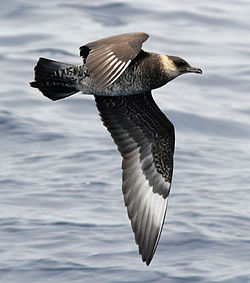
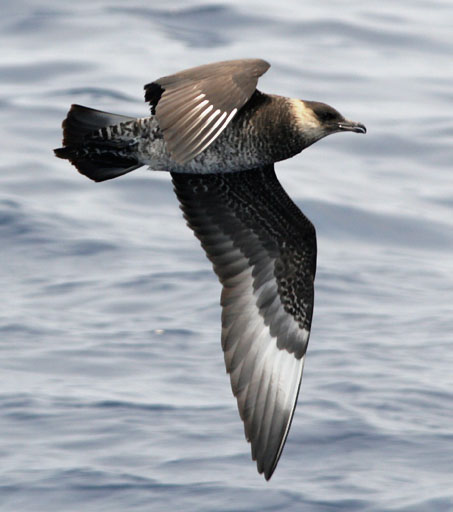
| Pomarine jaeger | |
Scientific classification 
| |
| Kingdom: | Animalia |
| Phylum: | Chordata |
| Class: | Aves |
| Order: | Charadriiformes |
| Suborder: | Lari |
| Family: | Stercorariidae Gray, 1871 |
| Genus: | Stercorarius Brisson, 1760 |
| Type species | |
| Larus parasiticus Linnaeus, 1758
| |
| Species | |
|
See text. | |
The skuas (/ˈskjuːə/) are a group of predatory and kleptoparasitic seabirds with seven species forming the genus Stercorarius, the only genus in the family Stercorariidae. The three smaller skuas, the Arctic skua, the long-tailed skua, and the pomarine skua, are called jaegers in North American English.
The English word "skua" comes from the Faroese name for the great skua, skúgvur [ˈskɪkvʊɹ], with the island of Skúvoy renowned for its colony of that bird. The general Faroese term for skuas is kjógvi [ˈtʃɛkvɪ]. The word "jaeger" or Jäger is German for "hunter".[1][2] The genus name Stercorarius is Latin and means "of dung";[note 1] the food disgorged by other birds when pursued by skuas was once thought to be excrement.[3]
Skuas nest on the ground in temperate, Antarctic, and Arctic regions, and are long-distance migrants. They have even been sighted at the South Pole.[4]
Biology and habits
[edit]
Outside the breeding season, skuas take fish, offal, and carrion. Many practice kleptoparasitism, which comprises up to 95% of the feeding methods of wintering skuas, by chasing gulls, terns and other seabirds to steal their catches, regardless of the size of the species attacked (up to three times heavier than the attacking skua). Larger species, such as the great skua, regularly kill and eat adult seabirds, such as puffins and gulls and have been observed killing birds as large as a grey heron.[5] On the breeding grounds, the three, more slender northern breeding species commonly eat lemmings. Those species that breed in the southern oceans largely feed on fish that can be caught near their colonies. The eggs and chicks of other seabirds, primarily penguins, are an important food source for most skua species during the nesting season.[6]
In the southern oceans and Antarctica region, some skua species (especially the south polar skua) will readily scavenge carcasses at breeding colonies of both penguins and pinnipeds. Skuas will also kill live penguin chicks and sick or injured adult penguins. In these areas, the skuas will often forfeit their catches to the considerably larger and very aggressive giant petrels. Skuas have also been observed to directly pilfer milk from the elephant seal's teats.[7][8]
Skuas are medium to large birds, typically with grey or brown plumage, often with white markings on the wings.[6] The skuas range in size from the long-tailed skua, Stercorarius longicaudus, at 310 grams (0.68 pounds), to the brown skua, Stercorarius antarcticus, at 1.63 kg (3.6 lb). On average, a skua is about 56 cm (22 in) long, and 121 cm (48 in) across the wings. They have longish bills with a hooked tip, and webbed feet with sharp claws. They look like large dark gulls, but have a fleshy cere above the upper mandible.
The skuas are strong, acrobatic fliers. They are generally aggressive in disposition. Potential predators approaching their nests will be quickly attacked by the parent birds, which usually target the heads of intruders – a practice known as 'divebombing'.[9]


Taxonomy
[edit]The genus Stercorarius was introduced by the French zoologist Mathurin Jacques Brisson in 1760 with the parasitic jaeger (Stercorarius parasiticus) as the type species.[10][11]
Skuas are related to gulls, waders, auks, and skimmers. In the three smaller species, all nesting exclusively in the Holarctic, breeding adults have the two central tail feathers obviously elongated, and at least some adults have white on the underparts and pale yellow on the neck. These characteristics are not shared by the larger species, all native to the Southern Hemisphere except for the great skua. Therefore, the skuas are often split into two genera, with only the smaller species retained in Stercorarius, and the large species placed in Catharacta. However, based on genetics, behaviour, and feather lice, the overall relationship among the species is best expressed by placing all in a single genus.[12] The pomarine and great skuas' mitochondrial DNA (inherited from the mother) is in fact more closely related to each other than it is to either Arctic or long-tailed skuas, or to the Southern Hemisphere species.[13] Thus, hybridisation must have played a considerable role in the evolution of the diversity of Northern Hemisphere skuas.
Species
[edit]The genus contains seven species:[14]
| Common name | Scientific name and subspecies | Range | Size and ecology | IUCN status and estimated population |
|---|---|---|---|---|
| Chilean skua
|
Stercorarius chilensis Bonaparte, 1857 |
Breeds along the coasts of southern Chile and southern Argentina, winters along the Pacific coasts of Peru and Chile as well as the Atlantic coast of Argentina
|
Size: Habitat: Diet: |
LC
|
| South polar skua
|
Stercorarius maccormicki Saunders, 1893 |
Breeds along the coast on Antarctica, winters in the north Atlantic and north Pacific
|
Size: Habitat: Diet: |
LC
|
| Brown skua
|
Stercorarius antarcticus (Lesson, 1831) |
Southern Ocean
|
Size: Habitat: Diet: |
LC
|
| Great skua
|
Stercorarius skua (Brünnich, 1764) |
Breeds along the coastline of the northeast Atlantic, winters in the north Atlantic
|
Size: Habitat: Diet: |
LC
|
| Pomarine jaeger or pomarine skua
|
Stercorarius pomarinus (Temminck, 1815) |
Breeds along the Arctic coastline, winters in tropical and subtropical oceans
|
Size: Habitat: Diet: |
LC
|
| Parasitic jaeger or Arctic skua
|
Stercorarius parasiticus (Linnaeus, 1758) |
Breeds along the Arctic coastline, winters in the southern hemisphere
|
Size: Habitat: Diet: |
LC
|
| Long-tailed jaeger or long-tailed skua
|
Stercorarius longicaudus Vieillot, 1819 Two subspecies
|
Breeds in the Arctic, winters in the Southern Ocean
|
Size: Habitat: Diet: |
LC
|
.jpg)


.jpg)


References
[edit]- ^ The word stercorārius is from stercus ("dung"), which is also the etymon of stercoranism, stercobilin, stercoral, etc.
- ^ "Jaeger". Oxford English Dictionary (Online ed.). Oxford University Press. (Subscription or participating institution membership required.)
- ^ "Skua". Oxford English Dictionary (Online ed.). Oxford University Press. (Subscription or participating institution membership required.)
- ^ Jobling, James A (2010). The Helm Dictionary of Scientific Bird Names. London: Christopher Helm. p. 365. ISBN 978-1-4081-2501-4.
- ^ Mark Sabbatini, "Non-human life form seen at Pole", The Antarctic Sun, 5 January 2003.
- ^ Scottish Ornithologists' Club Archived 2011-07-16 at the Wayback Machine
- ^ a b Harrison, Colin J.O. (1991). Forshaw, Joseph (ed.). Encyclopaedia of Animals: Birds. London: Merehurst Press. p. 109. ISBN 1-85391-186-0.
- ^ "Antarctica's Milk-Stealing, Grudge-Holding Seabirds". Boston NPR. 2016.
- ^ "Our Oceans - Antarctic and Southern Ocean Coalition". Retrieved 2025-08-25.
- ^ "Scottish Wildlife Trust builds £50,000 loo on Handa". BBC News. 12 March 2012.
- ^ Brisson, Mathurin Jacques (1760). Ornithologie, ou, Méthode Contenant la Division des Oiseaux en Ordres, Sections, Genres, Especes & leurs Variétés (in French and Latin). Paris: Jean-Baptiste Bauche. Vol. 1, p. 56, Vol. 6, p. 149.
- ^ Peters, James Lee, ed. (1934). Check-list of Birds of the World. Vol. 2. Cambridge, Massachusetts: Harvard University Press. p. 311.
- ^ American Ornithologists' Union (2000). Forty-second supplement to the American Ornithologists' Union Check-list of North American Birds. The Auk 117(3):847–858.
- ^ Cohen, Baker, Belchschmidt, Dittmann, Furness, Gerwin, Helbig, de Korte, Marshall, Palma, Peter, Ramli, Siebold, Willcox, Wilson and Zink (1997). Enigmatic phylogeny of skuas. Proc. Biol. Sci. 264(1379):181–190.
- ^ Gill, Frank; Donsker, David, eds. (2019). "Noddies, gulls, terns, auks". World Bird List Version 9.2. International Ornithologists' Union. Retrieved 24 June 2019.
External links
[edit]

- . Encyclopædia Britannica. Vol. 25 (11th ed.). 1911.
- Great Skua videos on the Internet Bird Collection
_svg-element.svg)


| International | |
|---|---|
| National | |
| Other | |

Taxonomy and Systematics
Etymology
The term "skua" originates from the Faroese word skúgvur (or skúvur), which traces back to Old Norse skúfr, meaning "tuft," "tassel," or "seagull," likely alluding to the bird's distinctive tufted ear feathers or overall shaggy appearance.[7][8] This nomenclature entered scientific usage through New Latin in the late 17th century, during European explorations of northern seas, and was adopted into English around 1678, reflecting early encounters with these seabirds in Faroese and Scandinavian waters.[9][10] Historically, the naming of skuas has been intertwined with that of jaegers, causing some taxonomic confusion in ornithological literature. "Jaeger" derives from the German Jäger, meaning "hunter," emphasizing the birds' aggressive kleptoparasitic behavior of chasing and robbing other seabirds of food.[11] In European traditions, all species in the family Stercorariidae were broadly termed skuas, but 19th-century American ornithologists distinguished the smaller, more agile forms (such as the parasitic and long-tailed jaegers) as "jaegers," reserving "skua" for the larger, bulkier species like the great skua, to highlight morphological differences.[12] Regional vernacular names further illustrate the cultural embedding of these birds in local lore. In the Shetland Islands, the great skua is known as the "bonxie," a term derived from Old Norse bónki (or related Scandinavian words like Norwegian bunke), denoting something dumpy, heap-like, or thick-set, which captures the bird's robust build and its notorious "piratical" raids on other avifauna.[13][14] These etymological roots underscore the skuas' recognition as formidable predatory seabirds across Nordic and Atlantic cultures.Classification and Phylogeny
Skuas are classified within the family Stercorariidae, which comprises predatory seabirds including both skuas and jaegers, and is placed in the order Charadriiformes.[15] The family was elevated from subfamily status (Stercorariinae within Laridae) to full family rank based on DNA sequence analyses demonstrating its distinct phylogenetic position as sister to Alcidae (auks) and Laridae (gulls, terns, and skimmers).[16] Stercorariidae is monotypic at the subfamily level, containing a single genus, Stercorarius, with seven recognized species. Traditionally, the species were divided between two genera: Stercorarius for the three smaller "jaegers" (S. longicaudus, S. parasiticus, and S. pomarinus) and Catharacta for the four larger "skuas" (S. antarcticus, S. chilensis, S. maccormicki, and S. skua), a separation supported by morphological and behavioral differences such as size, plumage, and foraging strategies.[17] However, molecular studies using mitochondrial DNA have revealed close genetic affinities across these groups, particularly showing that the pomarine jaeger (S. pomarinus) is more closely related to the great skua (S. skua) than to other jaegers.[17] This finding contributed to the merger of Catharacta into Stercorarius, as adopted in the American Ornithological Union Check-list in 2000 and supported by subsequent genetic analyses emphasizing hybridization events and shared evolutionary history as key factors in skua diversification.[18][19] Phylogenetically, skuas form a monophyletic clade within the suborder Lari, with basal divergence from their closest relatives—gulls (Laridae) and auks (Alcidae)—estimated at approximately 35 million years ago during the late Eocene, based on molecular clock analyses calibrated with fossil evidence.[20] Early studies, such as Furness (1987), provided a morphological framework highlighting skuas' evolution as aggressive hyperpredators adapted to seabird colonies, while Cohen et al. (1997) used cytochrome b and 12S rRNA mitochondrial sequences to resolve intergeneric relationships, confirming monophyly and challenging traditional divisions.[21][17] Species-level distinctions within Stercorarius rely on a combination of morphological traits (e.g., bill shape, leg color) and genetic markers, with southern hemisphere taxa showing rapid post-glacial radiations around 0.5–1 million years ago.[22]Physical Description
Morphology and Size
Skuas (genus Stercorarius) display a robust body structure adapted for a predatory seabird lifestyle, with overall sizes varying by species from smaller jaegers to larger forms. Typical measurements include body lengths of 41–64 cm, wingspans of 110–160 cm, and weights ranging from 0.25–2.2 kg.[23][24] Skuas exhibit reversed sexual size dimorphism, with females larger than males across species.[25] Key morphological features include a sturdy, barrel-shaped build that supports agile terrestrial and aerial pursuits. The bill is strong and distinctly hooked at the tip, facilitating the tearing of flesh from prey or scavenged items.[26] Legs are short yet powerfully muscled, with sharp claws and partial webbing between the toes, enabling effective ground chases and occasional swimming. In jaeger species like the long-tailed jaeger, the central tail feathers are notably elongated, forming streamers that enhance aerodynamic maneuverability during flight.[27] Anatomical adaptations emphasize endurance and speed, particularly in flight. The plumage is dense and waterproof, providing insulation and buoyancy essential for marine environments.[28] Strong pectoral muscles anchor to an enlarged keeled sternum, delivering the power needed for sustained soaring over oceans and rapid aerial chases comparable in intensity to those of falcons.[29][30]Plumage and Sexual Dimorphism
Skuas display notable plumage polymorphism, with dark and pale morphs varying in prevalence across species. The dark morph, predominant in great skuas (Stercorarius skua) and south polar skuas (S. maccormicki), consists of uniformly dark brown to blackish overall plumage, accented by prominent white flashes on the primary wing feathers that are visible in flight. In arctic skuas (S. parasiticus) and long-tailed skuas (S. longicaudus), the pale morph is more common, featuring lighter underparts that enhance camouflage against tundra and snowy substrates during breeding.[31] Intermediate morphs occur in some populations, blending elements of both, but are less frequent.[32] Adults undergo a complete annual prebasic molt after breeding, typically at sea during migration or wintering, which replaces worn feathers and shifts plumage from the brighter breeding condition—characterized by vivid yellow facial patches—to a duller, more uniform winter appearance.[33] Juveniles emerge with distinct barred or scaled patterns on the body and wings, providing additional camouflage; these molt progressively through a partial preformative molt in the first winter, attaining subadult plumage, and reach full adult coloration by the second or third year.[34] Sexual dimorphism in plumage is minimal, with males and females generally sharing identical morphs and patterns within species. Although plumage shows little differentiation, skuas exhibit reverse sexual size dimorphism, with females larger than males overall.[35] The adaptive value of skua plumage lies in its dual role: cryptic tones and patterns provide concealment for nests on exposed breeding grounds, reducing predation risk, while bold contrasting elements like white wing flashes aid in species recognition and elaborate aerial displays during courtship and territorial interactions.[36]Distribution and Habitat
Global Range
Skuas exhibit a predominantly circumpolar distribution, with distinct species groups occupying high-latitude regions in both hemispheres. In the Northern Hemisphere, four species—Great Skua (Stercorarius skua), Arctic Jaeger (S. parasiticus), Long-tailed Jaeger (S. longicaudus), and Pomarine Jaeger (S. pomarinus)—breed primarily in Arctic and subarctic tundra and coastal areas. The Great Skua nests in the North Atlantic, including Iceland, Norway (including Svalbard), the Faroe Islands, and Scotland.[37] The Arctic Jaeger breeds along the northernmost coasts of Eurasia and North America, while the Pomarine and Long-tailed Jaegers occupy tundra from Alaska through Canada to Siberia.[38][39][40] These species are highly migratory, undertaking transequatorial journeys to winter in the Southern Hemisphere's oceans, often between the tropics and Antarctic waters, including coastal Australia and the southern tips of South America.[38][41][42] In the Southern Hemisphere, three main species—South Polar Skua (Stercorarius maccormicki), Brown Skua (S. antarcticus), and Chilean Skua (S. chilensis)—are centered on sub-Antarctic and Antarctic regions. The South Polar Skua breeds circumantarctically along ice-free coastal areas, particularly in the Ross Sea region.[43] The Brown Skua occupies the Antarctic Peninsula and sub-Antarctic islands across the Atlantic, Indian, and Pacific Oceans, while the Chilean Skua breeds in Patagonia, southern Chile (from Chiloé Island southward), and the Falkland Islands.[44][45] These southern species generally remain in southern latitudes year-round, with some northward vagrancy into subtropical waters during non-breeding periods, though the South Polar Skua occasionally migrates transequatorially to higher northern latitudes.[43][45] Overlap between northern and southern skua groups is rare but occurs in the Southern Ocean, where wintering northern migrants encounter breeding southern populations, potentially leading to inter-hemispheric interactions.[46]Habitat Preferences
Skuas exhibit distinct habitat preferences that align with their opportunistic predatory lifestyle, favoring open, low-vegetation environments conducive to ground nesting and access to prey resources. Northern species, such as the parasitic jaeger (Stercorarius parasiticus) and pomarine jaeger (S. pomarinus), primarily breed in coastal Arctic tundra, characterized by sparse vegetation and proximity to seabird colonies for kleptoparasitic opportunities.[47][48] The great skua (S. skua) selects treeless northern islands with low vegetation, such as those in Iceland and around Great Britain, often nesting close to mixed seabird colonies to exploit food sources.[49] In southern regions, brown skuas (Stercorarius antarcticus) and south polar skuas (S. maccormicki) prefer sub-Antarctic grasslands, moorlands, and barren Antarctic ground, including coastal tundra on remote islands and the mainland, where they establish territories near penguin rookeries.[50][51] These breeding sites generally avoid dense forests, as skuas thrive in open terrains that facilitate visibility and mobility essential for their predation strategies.[52] During non-breeding periods, skuas shift to marine environments, utilizing open ocean waters and pack ice edges across subarctic to equatorial latitudes, where they remain far offshore and out of sight of land.[49][50] This pelagic preference supports their wide-ranging movements, with southern species often associating with dynamic oceanographic features like bathymetric fronts.[53] Altitudinally, skuas tolerate low elevations, typically breeding between 0 and 500 meters above sea level in cool, windy climates that match their physiological adaptations. Terrain elevation is a minor factor in nest site selection compared to proximity to prey colonies.[54] In Arctic breeding grounds, summer temperatures of 5–15°C prevail, with individuals showing thermoregulatory stress above 9°C, indicating an upper thermal limit.[55] Southern populations endure harsher conditions, including winter lows below −10°C during the breeding season onset and reliance on sea ice proximity for resource access.[56] Human activities have altered skua habitats, particularly in less remote areas, though these birds generally favor isolated islands minimizing interference. In the Falkland Islands, brown skua nesting sites face encroachment from agricultural expansion and waste-related ecosystem changes, potentially disrupting territory defense and prey availability.[51] Near Antarctic research stations, south polar skuas experience localized disturbances, including habitat exclusion from construction and increased competition from human-associated food sources, leading to variable population responses such as localized growth from garbage scavenging.[50][51]Behavior and Ecology
Feeding Strategies
Skuas employ a range of opportunistic feeding strategies, with kleptoparasitism—commonly known as food piracy—serving as their primary tactic across many species. In this behavior, skuas aggressively pursue other seabirds, including gulls, petrels, auks, and penguins, harassing them in mid-air or on the ground until the victims drop or regurgitate their catch. This strategy is particularly well-developed in species like the Great Skua (Stercorarius skua) and parasitic jaeger (S. parasiticus), where individuals specialize in aerial chases to steal fish or other prey. Success rates in these pursuits vary by victim species, environmental conditions, and skua plumage phase, but can reach up to 79% for light-phase parasitic jaegers targeting puffins, though rates are often lower (around 30-63%) against more agile prey like guillemots.[57][58][59] Complementing kleptoparasitism, skuas frequently resort to direct predation, targeting the eggs, chicks, and adults of smaller seabirds, as well as occasional small mammals near breeding colonies. For instance, South Polar Skuas (S. maccormicki) primarily prey on Adélie Penguin (Pygoscelis adeliae) eggs and chicks during the austral summer, using stealthy ground approaches to ambush nests. Scavenging forms another key method, with skuas feeding on carrion such as washed-up marine mammals or fishery discards, which can constitute a reliable energy source in nutrient-poor areas. Piscivory occurs sporadically via plunge-diving or surface-seizing techniques, particularly in pelagic species like the Great Skua, which exploit fish schools or offal from trawlers. These alternative tactics allow skuas to adapt to fluctuating prey availability, with kleptoparasitism often yielding higher energetic returns than independent hunting in competitive environments.[60][61][62] Feeding patterns exhibit seasonal shifts tied to breeding cycles and habitat transitions. During the breeding season, skuas prioritize terrestrial prey, such as penguin chicks and eggs, to meet elevated energy demands near colonies, often defending feeding territories within rookeries. In contrast, non-breeding periods and winter months see a pivot to oceanic foraging, emphasizing scavenging on carrion and discards alongside kleptoparasitism of migratory seabirds. This flexibility is evident in Great Skuas, where 76% of tracked individuals focus on marine foraging including kleptoparasitism year-round, but breeding pairs increase colony-based predation to support chick-rearing. Energetic models suggest that stolen food can account for a majority of intake in kleptoparasite-specialized populations, underscoring the strategy's efficiency despite the costs of pursuit.[62][63][64]Breeding and Reproduction
Skuas typically form monogamous pairs that maintain strong, long-term bonds, often lasting for life, although divorce may occur if breeding attempts fail repeatedly. These pairs exhibit high site fidelity, returning to the same nesting territories year after year. In the northern hemisphere, breeding occurs during the summer months from May to July, while in the southern hemisphere, it takes place from October to February, aligning with periods of extended daylight and food availability in polar and subpolar regions.[65][66][50] Nests are constructed as simple scrapes on the ground, often lined with grass, moss, or pebbles, and situated in loose colonies with low densities of 1-6 pairs per km², depending on habitat quality and food proximity. Pairs aggressively defend territories around the nest, typically within a radius of 30-100 m, using displays, dives, and physical attacks to deter intruders, including other skuas and potential predators. Females lay clutches of two eggs, with an incubation period of 24-32 days shared by both parents; the female often performs more incubation early on, while males provide most food during this phase. Hatching is asynchronous, with the second egg laid 1-3 days after the first, which can lead to competitive interactions among chicks.[67][68][69] Chick-rearing is biparental, with both adults foraging to provision the young, often relying on kleptoparasitism or predation on seabird eggs and chicks to meet nutritional demands. Chicks are altricial and brooded closely for the first few weeks, fledging after 25-50 days, during which time they remain dependent on parents for food. Annual reproductive success averages 0.5-1 fledgling per pair, heavily influenced by food availability; poor conditions can result in complete brood failure. In some species, such as the great skua, asynchronous hatching promotes siblicide, where the dominant chick may kill or evict the subordinate, reducing brood size to one and enhancing survival of the fittest offspring under resource limitation.[66][70]Migration and Movements
Skuas display varied migratory behaviors influenced by their breeding origins and species-specific adaptations. Species breeding in the Northern Hemisphere, such as the long-tailed jaeger (Stercorarius longicaudus), are long-distance migrants that travel southward 10,000–15,000 km annually to reach Antarctic and sub-Antarctic waters during the non-breeding season.[41] In contrast, many Southern Hemisphere species, including the brown skua (Stercorarius antarcticus), exhibit more sedentary tendencies, often remaining within sub-Antarctic zones but undertaking post-breeding dispersal to nearby productive areas.[71] The south polar skua (Stercorarius maccormicki), however, performs extensive trans-equatorial migrations northward to temperate and subtropical waters in the North Pacific and North Atlantic Oceans.[72] Satellite telemetry and geolocation studies have elucidated these patterns, particularly for south polar skuas breeding in Adélie Land, Antarctica. These birds follow looping routes that leverage westerly winds in the Southern Hemisphere and trade winds northward, minimizing energy expenditure while largely skirting the low-productivity tropical doldrums. One-way migrations can span over 10,000 km, with annual round trips reaching up to 20,000 km or more, marking some of the longest avian migrations recorded. Juveniles show greater dispersiveness on initial migrations, often exploring wider areas and facing elevated mortality due to inexperience and environmental challenges.[46] Philopatry is pronounced among skuas, especially in south polar populations, where adults exhibit high site fidelity to breeding colonies, with over 80% returning to the same nest sites in subsequent seasons.[73] Despite this, vagrant south polar skuas have been documented in equatorial regions, potentially as part of irregular exploratory forays during non-breeding periods.[74]Species
Recognized Species
The genus Stercorarius comprises seven extant species of skuas, predatory seabirds divided into three smaller northern species commonly known as jaegers and four larger southern species known as skuas. These species exhibit distinct geographic ranges, with the jaegers breeding in the Arctic and subarctic regions and migrating to southern oceans, while the southern skuas are largely confined to Antarctic and subantarctic waters.[15] The recognized species are as follows:| Scientific Name | Common Name | Average Weight | IUCN Status | Distribution Notes |
|---|---|---|---|---|
| Stercorarius pomarinus | Pomarine Jaeger | 500–800 g | Least Concern | Breeds in high Arctic tundra of North America and Eurasia; winters in southern oceans.[39] |
| Stercorarius parasiticus | Parasitic Jaeger | 300–650 g | Least Concern | Breeds across northern Holarctic; highly migratory to tropical and southern seas.[31] |
| Stercorarius longicaudus | Long-tailed Jaeger | 250–350 g | Least Concern | Breeds in Arctic tundra; longest migrant among jaegers, wintering off southern continents.[75][76] |
| Stercorarius maccormicki | South Polar Skua | 900–1,600 g | Least Concern | Breeds on Antarctic coastal margins; non-migratory but disperses northward in winter.[43][23] |
| Stercorarius antarcticus | Brown Skua | 1,200–2,180 g | Least Concern | Breeds on Antarctic Peninsula and nearby islands; some populations sedentary.[44][77] |
| Stercorarius chilensis | Chilean Skua | 1,100–1,700 g | Least Concern | Breeds in southern South America (Chile and Argentina); disperses northward in non-breeding season.[78] |
| Stercorarius skua | Great Skua | 1,200–2,000 g | Least Concern | Breeds in northern Atlantic and North Sea islands; pelagic in non-breeding season.[24] |